

IEC 60398:2015
(Main)Installations for electroheating and electromagnetic processing - General performance test methods
General Information
- Abstract
IEC 60398:2015 specifies the basic test procedures, conditions and methods for establishing the main performance parameters and the main operational characteristics of industrial installations and equipment intended for electroheating (EH) or electromagnetic processing of materials (EPM). This third edition cancels and replaces the second edition of IEC 60398 published in 1999 and the first edition of IEC TS 62796 published in 2013. This edition constitutes a technical revision. This edition includes the following significant technical changes with respect to the previous edition:
- the title and scope of the standard have been expanded to include installations and equipment for electromagnetic processing of materials;
- the requirements have been restructured;
- tests concerning safety have been moved to IEC 60519-1;
- new tests and clauses addressing energy efficiency considerations have been added;
- a new annex placing this standard in the context of energy efficiency assessment as developed by ISO and IEC has been added;
- new annexes addressing visual display of data, estimation of energy use and energy recoverability of fluids have been added.
- Status
- Published
- Publication Date
- 08-Apr-2015
- Technical Committee
- TC 27 - Industrial electroheating and electromagnetic processing
- Drafting Committee
- MT 18 - TC 27/MT 18
- Current Stage
- PPUB - Publication issued
- Start Date
- 09-Apr-2015
- Completion Date
- 30-Apr-2015
Overview
IEC 60398:2015 is an international standard published by the International Electrotechnical Commission (IEC) that defines general performance test methods for installations used in electroheating (EH) and electromagnetic processing of materials (EPM). This third edition updates and expands upon previous versions by broadening the scope to include electromagnetic processing equipment, restructuring requirements, and emphasizing energy efficiency assessment. The standard provides foundational test procedures, conditions, and measurement techniques essential to evaluating industrial installations’ operational characteristics and energy performance.
Key Topics
Scope Expansion
The 2015 edition incorporates installations for electromagnetic processing of materials alongside electroheating, reflecting technological advances and industry needs.Performance Testing Procedures
The standard defines basic test methods to assess key parameters such as energy consumption, power usage during different operational states (startup, standby, shutdown), equipment capacity, and temperature homogeneity.Energy Efficiency Focus
New clauses and annexes address energy efficiency considerations, including:- Methods for estimating energy use
- Assessment of energy recoverability from fluids
- Visual display of energy data through diagrams like Sankey charts
- Integration with ISO and IEC energy efficiency frameworks
Measurement Techniques
Guidance on precise measurement of electrical data (voltage, current, power), temperature (using thermocouples, thermographic methods), pressure, humidity, and workload parameters is included to ensure consistent and accurate testing.Restructured Requirements
Safety-related tests have been moved to IEC 60519-1, enabling IEC 60398 to concentrate on operational performance and efficiency.
Applications
IEC 60398:2015 is applicable for:
Industrial Electroheating Systems
Such as furnaces, ovens, and other installations that use electrical energy to heat materials directly or indirectly.Electromagnetic Processing Equipment
Including installations designed for heating, drying, curing, or modifying materials using electromagnetic fields.Performance Evaluation and Benchmarking
Enabling manufacturers and operators to quantify and compare energy consumption and operational efficiency, helping drive improvements and regulatory compliance.Energy Efficiency Improvements
Supporting energy management initiatives by providing structured test procedures that facilitate energy audits, optimization, and sustainability reporting.Design Validation and Quality Assurance
Assisting engineers in verifying that equipment meets specified performance criteria under defined test conditions.
Related Standards
IEC 60519-1
Focuses on safety requirements for electroheating installations, complementing IEC 60398’s performance testing scope.ISO 13579-1
Offers guidelines on energy efficiency assessment methods related to heat treatment and industrial furnaces, often cross-referenced by IEC 60398 for consistency.IEC TS 62796
The earlier technical specification merged into the current IEC 60398 edition, originally covering electromagnetic processing test methodologies.
Practical Value
Adopting IEC 60398:2015 helps industries achieve:
- Reliable and reproducible testing of electroheating and electromagnetic processing installations.
- Enhanced understanding of energy consumption patterns, enabling targeted efficiency improvements.
- Compliance with international performance standards, strengthening market acceptance and customer confidence.
- Integration of energy-efficient practices aligned with global sustainability goals.
The structured approach to testing and reporting offered by IEC 60398 empowers professionals to optimize operational processes, reduce energy costs, and minimize environmental impact within industrial heating and processing sectors.
Relations
- Effective Date
- 05-Sep-2023
- Effective Date
- 05-Sep-2023
Get Certified
Connect with accredited certification bodies for this standard

DVS-ZERT GmbH
German welding certification society.
BSMI (Bureau of Standards, Metrology and Inspection)
Taiwan's standards and inspection authority.
CARES (UK Certification Authority for Reinforcing Steels)
UK certification for reinforcing steels and construction.
Sponsored listings
Frequently Asked Questions
IEC 60398:2015 is a standard published by the International Electrotechnical Commission (IEC). Its full title is "Installations for electroheating and electromagnetic processing - General performance test methods". This standard covers: IEC 60398:2015 specifies the basic test procedures, conditions and methods for establishing the main performance parameters and the main operational characteristics of industrial installations and equipment intended for electroheating (EH) or electromagnetic processing of materials (EPM). This third edition cancels and replaces the second edition of IEC 60398 published in 1999 and the first edition of IEC TS 62796 published in 2013. This edition constitutes a technical revision. This edition includes the following significant technical changes with respect to the previous edition: - the title and scope of the standard have been expanded to include installations and equipment for electromagnetic processing of materials; - the requirements have been restructured; - tests concerning safety have been moved to IEC 60519-1; - new tests and clauses addressing energy efficiency considerations have been added; - a new annex placing this standard in the context of energy efficiency assessment as developed by ISO and IEC has been added; - new annexes addressing visual display of data, estimation of energy use and energy recoverability of fluids have been added.
IEC 60398:2015 specifies the basic test procedures, conditions and methods for establishing the main performance parameters and the main operational characteristics of industrial installations and equipment intended for electroheating (EH) or electromagnetic processing of materials (EPM). This third edition cancels and replaces the second edition of IEC 60398 published in 1999 and the first edition of IEC TS 62796 published in 2013. This edition constitutes a technical revision. This edition includes the following significant technical changes with respect to the previous edition: - the title and scope of the standard have been expanded to include installations and equipment for electromagnetic processing of materials; - the requirements have been restructured; - tests concerning safety have been moved to IEC 60519-1; - new tests and clauses addressing energy efficiency considerations have been added; - a new annex placing this standard in the context of energy efficiency assessment as developed by ISO and IEC has been added; - new annexes addressing visual display of data, estimation of energy use and energy recoverability of fluids have been added.
IEC 60398:2015 is classified under the following ICS (International Classification for Standards) categories: 13.280 - Radiation protection; 17.240 - Radiation measurements; 25.180.10 - Electric furnaces. The ICS classification helps identify the subject area and facilitates finding related standards.
IEC 60398:2015 has the following relationships with other standards: It is inter standard links to IEC TS 62796:2013, IEC 60398:1999. Understanding these relationships helps ensure you are using the most current and applicable version of the standard.
IEC 60398:2015 is available in PDF format for immediate download after purchase. The document can be added to your cart and obtained through the secure checkout process. Digital delivery ensures instant access to the complete standard document.
Standards Content (Sample)
IEC 60398 ®
Edition 3.0 2015-04
INTERNATIONAL
STANDARD
NORME
INTERNATIONALE
Installations for electroheating and electromagnetic processing –
General performance test methods
Installations pour traitement électrothermique et électromagnétique –
Méthodes générales d'essai de fonctionnement
All rights reserved. Unless otherwise specified, no part of this publication may be reproduced or utilized in any form
or by any means, electronic or mechanical, including photocopying and microfilm, without permission in writing from
either IEC or IEC's member National Committee in the country of the requester. If you have any questions about IEC
copyright or have an enquiry about obtaining additional rights to this publication, please contact the address below or
your local IEC member National Committee for further information.
Droits de reproduction réservés. Sauf indication contraire, aucune partie de cette publication ne peut être reproduite
ni utilisée sous quelque forme que ce soit et par aucun procédé, électronique ou mécanique, y compris la photocopie
et les microfilms, sans l'accord écrit de l'IEC ou du Comité national de l'IEC du pays du demandeur. Si vous avez des
questions sur le copyright de l'IEC ou si vous désirez obtenir des droits supplémentaires sur cette publication, utilisez
les coordonnées ci-après ou contactez le Comité national de l'IEC de votre pays de résidence.
IEC Central Office Tel.: +41 22 919 02 11
3, rue de Varembé Fax: +41 22 919 03 00
CH-1211 Geneva 20 info@iec.ch
Switzerland www.iec.ch
About the IEC
The International Electrotechnical Commission (IEC) is the leading global organization that prepares and publishes
International Standards for all electrical, electronic and related technologies.
About IEC publications
The technical content of IEC publications is kept under constant review by the IEC. Please make sure that you have the
latest edition, a corrigenda or an amendment might have been published.
IEC Catalogue - webstore.iec.ch/catalogue Electropedia - www.electropedia.org
The stand-alone application for consulting the entire The world's leading online dictionary of electronic and
bibliographical information on IEC International Standards, electrical terms containing more than 30 000 terms and
Technical Specifications, Technical Reports and other definitions in English and French, with equivalent terms in 15
documents. Available for PC, Mac OS, Android Tablets and additional languages. Also known as the International
iPad. Electrotechnical Vocabulary (IEV) online.
IEC publications search - www.iec.ch/searchpub IEC Glossary - std.iec.ch/glossary
The advanced search enables to find IEC publications by a More than 60 000 electrotechnical terminology entries in
variety of criteria (reference number, text, technical English and French extracted from the Terms and Definitions
committee,…). It also gives information on projects, replaced clause of IEC publications issued since 2002. Some entries
and withdrawn publications. have been collected from earlier publications of IEC TC 37,
77, 86 and CISPR.
IEC Just Published - webstore.iec.ch/justpublished
Stay up to date on all new IEC publications. Just Published IEC Customer Service Centre - webstore.iec.ch/csc
details all new publications released. Available online and If you wish to give us your feedback on this publication or
also once a month by email. need further assistance, please contact the Customer Service
Centre: csc@iec.ch.
A propos de l'IEC
La Commission Electrotechnique Internationale (IEC) est la première organisation mondiale qui élabore et publie des
Normes internationales pour tout ce qui a trait à l'électricité, à l'électronique et aux technologies apparentées.
A propos des publications IEC
Le contenu technique des publications IEC est constamment revu. Veuillez vous assurer que vous possédez l’édition la
plus récente, un corrigendum ou amendement peut avoir été publié.
Catalogue IEC - webstore.iec.ch/catalogue Electropedia - www.electropedia.org
Application autonome pour consulter tous les renseignements
Le premier dictionnaire en ligne de termes électroniques et
bibliographiques sur les Normes internationales,
électriques. Il contient plus de 30 000 termes et définitions en
Spécifications techniques, Rapports techniques et autres
anglais et en français, ainsi que les termes équivalents dans
documents de l'IEC. Disponible pour PC, Mac OS, tablettes
15 langues additionnelles. Egalement appelé Vocabulaire
Android et iPad.
Electrotechnique International (IEV) en ligne.
Recherche de publications IEC - www.iec.ch/searchpub
Glossaire IEC - std.iec.ch/glossary
Plus de 60 000 entrées terminologiques électrotechniques, en
La recherche avancée permet de trouver des publications IEC
en utilisant différents critères (numéro de référence, texte, anglais et en français, extraites des articles Termes et
comité d’études,…). Elle donne aussi des informations sur les Définitions des publications IEC parues depuis 2002. Plus
projets et les publications remplacées ou retirées. certaines entrées antérieures extraites des publications des
CE 37, 77, 86 et CISPR de l'IEC.
IEC Just Published - webstore.iec.ch/justpublished
Service Clients - webstore.iec.ch/csc
Restez informé sur les nouvelles publications IEC. Just
Published détaille les nouvelles publications parues. Si vous désirez nous donner des commentaires sur cette
Disponible en ligne et aussi une fois par mois par email. publication ou si vous avez des questions contactez-nous:
csc@iec.ch.
IEC 60398 ®
Edition 3.0 2015-04
INTERNATIONAL
STANDARD
NORME
INTERNATIONALE
Installations for electroheating and electromagnetic processing –
General performance test methods
Installations pour traitement électrothermique et électromagnétique –
Méthodes générales d'essai de fonctionnement
INTERNATIONAL
ELECTROTECHNICAL
COMMISSION
COMMISSION
ELECTROTECHNIQUE
INTERNATIONALE
ICS 25.180.10 ISBN 978-2-8322-2602-
– 2 – IEC 60398:2015 IEC 2015
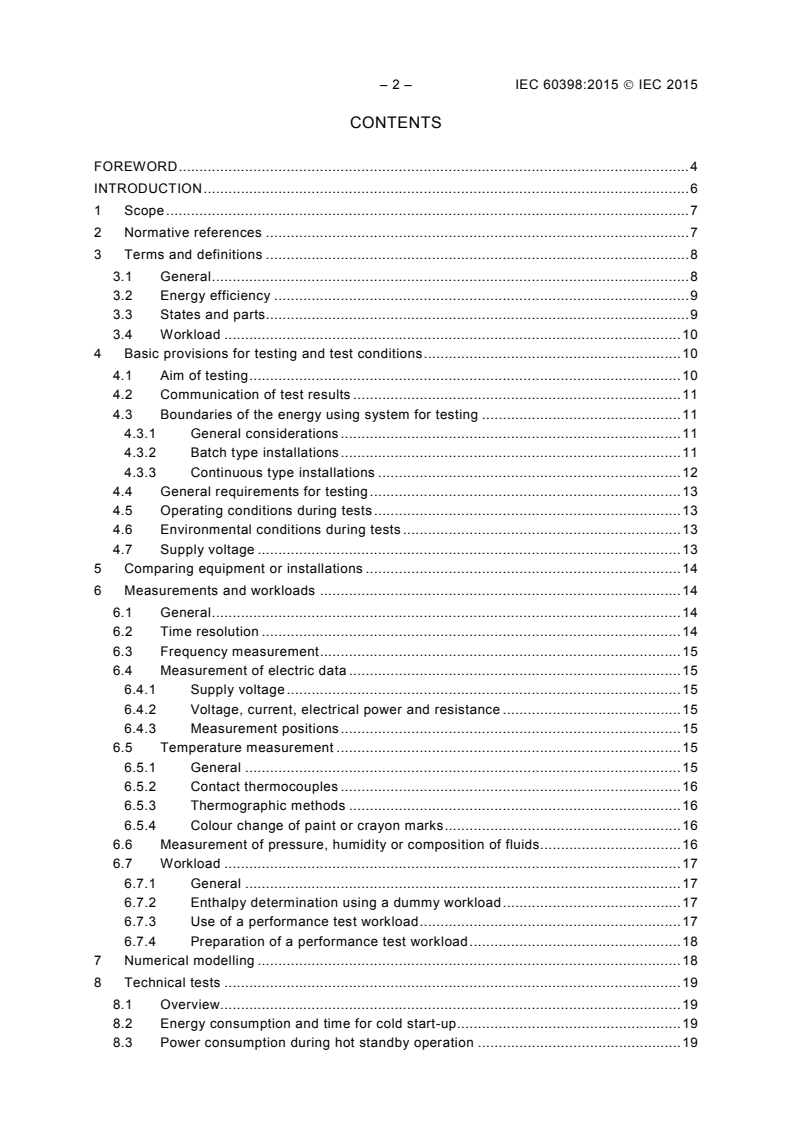
CONTENTS
FOREWORD . 4
INTRODUCTION . 6
1 Scope . 7
2 Normative references . 7
3 Terms and definitions . 8
3.1 General . 8
3.2 Energy efficiency . 9
3.3 States and parts. 9
3.4 Workload . 10
4 Basic provisions for testing and test conditions . 10
4.1 Aim of testing . 10
4.2 Communication of test results . 11
4.3 Boundaries of the energy using system for testing . 11
4.3.1 General considerations . 11
4.3.2 Batch type installations . 11
4.3.3 Continuous type installations . 12
4.4 General requirements for testing . 13
4.5 Operating conditions during tests . 13
4.6 Environmental conditions during tests . 13
4.7 Supply voltage . 13
5 Comparing equipment or installations . 14
6 Measurements and workloads . 14
6.1 General . 14
6.2 Time resolution . 14
6.3 Frequency measurement . 15
6.4 Measurement of electric data . 15
6.4.1 Supply voltage . 15
6.4.2 Voltage, current, electrical power and resistance . 15
6.4.3 Measurement positions . 15
6.5 Temperature measurement . 15
6.5.1 General . 15
6.5.2 Contact thermocouples . 16
6.5.3 Thermographic methods . 16
6.5.4 Colour change of paint or crayon marks . 16
6.6 Measurement of pressure, humidity or composition of fluids . 16
6.7 Workload . 17
6.7.1 General . 17
6.7.2 Enthalpy determination using a dummy workload . 17
6.7.3 Use of a performance test workload . 17
6.7.4 Preparation of a performance test workload . 18
7 Numerical modelling . 18
8 Technical tests . 19
8.1 Overview. 19
8.2 Energy consumption and time for cold start-up . 19
8.3 Power consumption during hot standby operation . 19
8.4 Power consumption during holding operation . 19
8.5 Energy consumption and time for shut-down operation . 20
8.6 Energy consumption during a regular maintenance operation. 20
8.7 Energy consumption during normal operation. 20
8.8 Cumulative energy consumption and peak power consumption . 20
8.9 Equipment capacity . 21
8.10 Performance dependence on supply voltage . 21
8.11 Processing range of intended operation . 22
8.12 Properties of the processed workload surface . 22
8.12.1 General . 22
8.12.2 Measurement sensor positions . 23
8.12.3 Temperature homogeneity . 23
8.12.4 Homogeneity of evaporation of a solvent . 23
8.12.5 Homogeneity of gloss . 24
8.12.6 Other properties . 24
9 Efficiency of the installation . 24
9.1 General . 24
9.2 Specific energy consumption of the workload . 24
9.3 Heating efficiency of EH or EPM equipment . 24
9.4 Supply power usage efficiency . 25
9.5 Energy transfer efficiency . 25
Annex A (informative) Energy efficiency assessment . 27
A.1 Use of this standard for energy efficiency assessment . 27
A.2 Plan-Do-Check-Act cycle approach . 27
A.3 Comparison, classification, labelling . 27
A.4 Comparison with ISO 13579-1 . 28
A.4.1 General . 28
A.4.2 Considered energy generation . 28
A.4.3 Comparing results . 28
Annex B (informative) Visual display of energy efficiency related information . 29
B.1 General . 29
B.2 Sankey diagram of power balance . 29
B.3 Time resolved power usage diagram . 30
Annex C (informative) Estimating energy use . 32
C.1 General . 32
C.2 Minimum energy consumption . 32
C.3 Holding power . 33
C.4 Transfer losses and transfer efficiency . 34
C.5 Examples . 34
C.5.1 Tempering of TCO on glass substrate . 34
C.5.2 Drying and hardening of lacquer . 34
Annex D (informative) Energy recoverability . 35
Bibliography . 36
Figure B.1 – Example of a Sankey diagram . 29
Figure B.2 – Example of a time-power diagram . 30
– 4 – IEC 60398:2015 IEC 2015
INTERNATIONAL ELECTROTECHNICAL COMMISSION
____________
INSTALLATIONS FOR ELECTROHEATING
AND ELECTROMAGNETIC PROCESSING –
GENERAL PERFORMANCE TEST METHODS
FOREWORD
1) The International Electrotechnical Commission (IEC) is a worldwide organization for standardization comprising
all national electrotechnical committees (IEC National Committees). The object of IEC is to promote
international co-operation on all questions concerning standardization in the electrical and electronic fields. To
this end and in addition to other activities, IEC publishes International Standards, Technical Specifications,
Technical Reports, Publicly Available Specifications (PAS) and Guides (hereafter referred to as “IEC
Publication(s)”). Their preparation is entrusted to technical committees; any IEC National Committee interested
in the subject dealt with may participate in this preparatory work. International, governmental and non-
governmental organizations liaising with the IEC also participate in this preparation. IEC collaborates closely
with the International Organization for Standardization (ISO) in accordance with conditions determined by
agreement between the two organizations.
2) The formal decisions or agreements of IEC on technical matters express, as nearly as possible, an international
consensus of opinion on the relevant subjects since each technical committee has representation from all
interested IEC National Committees.
3) IEC Publications have the form of recommendations for international use and are accepted by IEC National
Committees in that sense. While all reasonable efforts are made to ensure that the technical content of IEC
Publications is accurate, IEC cannot be held responsible for the way in which they are used or for any
misinterpretation by any end user.
4) In order to promote international uniformity, IEC National Committees undertake to apply IEC Publications
transparently to the maximum extent possible in their national and regional publications. Any divergence
between any IEC Publication and the corresponding national or regional publication shall be clearly indicated in
the latter.
5) IEC itself does not provide any attestation of conformity. Independent certification bodies provide conformity
assessment services and, in some areas, access to IEC marks of conformity. IEC is not responsible for any
services carried out by independent certification bodies.
6) All users should ensure that they have the latest edition of this publication.
7) No liability shall attach to IEC or its directors, employees, servants or agents including individual experts and
members of its technical committees and IEC National Committees for any personal injury, property damage or
other damage of any nature whatsoever, whether direct or indirect, or for costs (including legal fees) and
expenses arising out of the publication, use of, or reliance upon, this IEC Publication or any other IEC
Publications.
8) Attention is drawn to the Normative references cited in this publication. Use of the referenced publications is
indispensable for the correct application of this publication.
9) Attention is drawn to the possibility that some of the elements of this IEC Publication may be the subject of
patent rights. IEC shall not be held responsible for identifying any or all such patent rights.
International Standard IEC 60398 has been prepared by IEC technical committee 27:
Industrial electroheating and electromagnetic processing.
This third edition cancels and replaces the second edition of IEC 60398 published in 1999 and
the first edition of IEC TS 62796 published in 2013. This edition constitutes a technical
revision.
This edition includes the following significant technical changes with respect to the previous
edition:
• the title and scope of the standard have been expanded to include installations and
equipment for electromagnetic processing of materials;
• the requirements have been restructured;
• tests concerning safety have been moved to IEC 60519-1 ;
• new tests and clauses addressing energy efficiency considerations have been added;
• a new annex placing this standard in the context of energy efficiency assessment as
developed by ISO and IEC has been added;
• new annexes addressing visual display of data, estimation of energy use and energy
recoverability of fluids have been added.
The text of this standard is based on the following documents:
FDIS Report on voting
27/949/FDIS 27/952/RVD
Full information on the voting for the approval of this standard can be found in the report on
voting indicated in the above table.
This publication has been drafted in accordance with the ISO/IEC Directives, Part 2.
The committee has decided that the contents of this publication will remain unchanged until
the stability date indicated on the IEC web site under "http://webstore.iec.ch" in the data
related to the specific publication. At this date, the publication will be
• reconfirmed,
• withdrawn,
• replaced by a revised edition, or
• amended.
___________
Fifth edition to be published.
– 6 – IEC 60398:2015 IEC 2015
INTRODUCTION
Designing equipment for electroheating (EH) or for electromagnetic processing of materials
(EPM) is a complex task. The manufacturer of the installation or equipment usually needs to
fulfil the following requirements, which come from different sources and are quite often in this
order of priorities:
a) to enable the intended process and make the installation to work properly;
b) to be cost effective during design and manufacturing;
c) to ensure that the equipment is safe to use in the sense of providing freedom from
unacceptable risk of physical injury or damage to the health of the operator (safety in the
narrower sense of ISO 12100:2010);
d) to prove that the equipment is cost effective to operate and uses sufficiently small
amounts of energy, material and other resources;
e) to ensure that the equipment is safe to use in the sense of providing freedom from
unacceptable risk or physical injury or damage to the health of people, or damage to
property or the environment (adding other safety aims to c) and in the much broader
definition of safety according to ISO/IEC Guide 51).
It is usually part of the proprietary knowledge of the manufacturer or user of the equipment, to
make it cost effective or enabling intended processes with a benefit. IEC 60519-1:— assists
with achieving safety in the ISO 12100:2010 sense. The focus of this standard is on basic
requirements for measuring instrumentation and test methods concerned with energy and
resource efficiency, performance of the intended process and assessing cost of ownership for
installations and equipment for EH and EPM.
INSTALLATIONS FOR ELECTROHEATING
AND ELECTROMAGNETIC PROCESSING –
GENERAL PERFORMANCE TEST METHODS
1 Scope
This International Standard specifies the basic test procedures, conditions and methods for
establishing the main performance parameters and the main operational characteristics of
industrial installations and equipment intended for electroheating (EH) or electromagnetic
processing of materials (EPM).
Measurements and tests that are solely used for the verification of safety requirements of
equipment for EH or for EPM are outside the scope of this standard and are covered by the
IEC 60519 series.
This standard is applicable for the commissioning, verification of design improvements or for
energy related tasks including benchmarking with respect to energy use or energy efficiency,
establishing of an energy baseline, and labelling. Some concepts from this standard can
directly be used as key performance indicators.
Detailed tests for specific types of EH or EPM equipment and installations are beyond the
scope of this standard and are provided in particular test standards for EH or EPM equipment.
This standard is intended as general reference for all future test standards applicable to
particular EH or EPM equipment or installations.
This standard includes the concept and material presented in IEC TS 62796 on energy
efficiency dealing with the electrical and processing parts of the equipment, as well as the
overall performance.
2 Normative references
The following documents, in whole or in part, are normatively referenced in this document and
are indispensable for its application. For dated references, only the edition cited applies. For
undated references, the latest edition of the referenced document (including any
amendments) applies.
IEC 60519-1:— , Safety in installations for electroheating and electromagnetic processing –
Part 1: General Requirements
ISO/IEC 13273-1 , Energy efficiency and renewable energy sources – Common international
terminology – Part 1: Energy Efficiency
ISO/IEC Guide 99, International vocabulary of metrology – Basic and general concepts and
associated terms (VIM)
ISO 50001:2011, Energy management systems – Requirements with guidance for use
___________
Fifth edition to be published.
To be published.
– 8 – IEC 60398:2015 IEC 2015
3 Terms and definitions
For the purposes of this document, the terms and definitions given in IEC 60519-1,
ISO/IEC 13273-1, ISO 50001, ISO/IEC Guide 99, as well as the following apply.
NOTE General definitions are given in the International Electrotechnical Vocabulary, IEC 60050. Terms relating to
industrial electroheating are defined in IEC 60050-841.
3.1 General
3.1.1
energy using system
physical item or organization with defined system boundaries, using energy
Note 1 to entry: An energy using system can be a plant, a process, part of a process, a building, a part of a
building, a machine, equipment, a product, etc.
[SOURCE: ISO/IEC 13273-1:—, 3.1.11, modified – Original cross-references have been
deleted.]
3.1.2
system boundary
physical or site limits and/or organizational limits as defined by the organization for a stated
purpose
EXAMPLE A process; a group of processes; a site; an entire organization; multiple sites under the control of an
organization.
Note 1 to entry: The stated purpose could be for a management system, or for the boundaries of an energy
assessment or for the boundaries of a specific measurement and verification activity.
[SOURCE: ISO/IEC 13273-1:—, 3.3.2, modified – “M&V” has been replaced by full term in
Note 1 to entry.]
3.1.3
equipment category
group within a type of equipment, using the same principle for processing of the workload
Note 1 to entry: A category can be further divided with respect to the size or the capacity of equipment.
Note 2 to entry: An example of type is equipment for induction heating, and an example of category is such
equipment for metal wire heating in a specified capacity interval, using medium frequency.
3.1.4
equipment capacity
measure of the production rate capability of equipment in normal operation
EXAMPLE Flow, mass or volume.
Note 1 to entry: The capacity does not refer to the volume of the working space.
3.1.5
intended workload quality
degree to which a set of inherent characteristics of a processed workload fulfils requirements
Note 1 to entry: Workload that does not attain the intended workload quality is regarded as scrap or undergoes
rework.
3.1.6
processing range,
range between an upper and a lower limit of set parameters between which the processed
workload exhibits the intended workload quality
3.2 Energy efficiency
3.2.1
energy efficiency
ratio or other quantitative relationship between an output of performance, service, goods or
energy, and an input of energy
EXAMPLE Conversion efficiency; energy required/energy used; output/input; theoretical energy used to
operate/energy used to operate.
Note 1 to entry: Both input and output need to be clearly specified in quantity and quality, and be measurable.
[SOURCE: ISO 50001:2011, 3.8]
3.2.2
energy intensity
quotient describing the total amount of energy necessary to generate a unit of output, activity,
economic value, or service
EXAMPLE Gigajoule per euro of GDP (gross domestic product); Gigajoule per unit of turnover.
[SOURCE: ISO/IEC 13273-1:—, 3.1.16 modified – Original cross references have been
deleted.]
3.2.3
specific energy consumption
quotient describing the total amount of energy necessary to generate a unit of output, activity,
or service
EXAMPLE Gigajoule (GJ) per tonne of steel, annual kilowatt hour (kWh) per square metre (m ), litres (l) of fuel
per kilometre (km), etc.
[SOURCE: ISO/IEC 13273-1:—, 3.1.17 modified – Original cross references have been
deleted.]
3.2.4
heating efficiency,
ratio of the usable enthalpy increase in the workload to the electric energy supplied to it
during a cycle of batch operation or stationary operation
3.3 States and parts
3.3.1
cold start-up
process by which the equipment is energised into hot standby operation from the cold state
Note 1 to entry: This mode of operation applies to cases where there is a significant energy consumption needed
for obtaining a state of the equipment allowing the actual processing of the workload.
3.3.2
holding power
electric power consumed for keeping the workload in the processing chamber or zone at a
specified temperature
Note 1 to entry: The temperature is typically maintained during a time intended to equalize the workload
temperature.
Note 2 to entry: Holding power is not applicable for all EH or EPM equipment.
3.3.3
hot standby operation
mode of operation of the installation occurring immediately after normal operation
– 10 – IEC 60398:2015 IEC 2015
Note 1 to entry: This mode of operation of the installation is with its hot state remaining, without workload, and
with the means of operation ready for prompt normal operation.
3.3.4
shut-down operation
process by which the installation is de-energised safely into the cold state
3.3.5
port,
opening in the processing chamber or enclosure through which the workload moves
3.3.6
means of access
structural feature of the EH or EPM installation which can be opened or removed without the
use of a tool to provide access to the installation
3.4 Workload
3.4.1
intended workload
normal workload
object intended to be processed as specified in the manufacturer’s documentation
Note 1 to entry: The intended workload includes any container, holder or other device necessary for the
processing and which is directly or indirectly subjected to the output power.
3.4.2
dummy workload
artificial workload with known thermal properties, designed for accurate enthalpy increase
measurements by absorbing the available output power
3.4.3
performance test workload
artificial or partially artificial workload designed for discrimination of processing results
Note 1 to entry: Examples of such results are relative slag content, relative or absolute areas or volumes of
unsatisfactorily processed material.
4 Basic provisions for testing and test conditions
4.1 Aim of testing
This standard provides tests concerning
– the outcome of the process,
– service performance or intended workload quality,
– energy use of the system,
– other resource use.
In all cases, the definition of the system boundaries is mandated and shall be documented.
The specific outcome of the process, the expected workload quality and the minimum service
performance after processing are usually defined by the manufacturer and user.
NOTE Details can be beyond the scope of this standard or even particular test standards for EH or EPM
equipment.
This standard determines all general tests necessary to assess the energy use of the system,
which provide basic data for
a) determining energy intensity or specific energy use as agreed on by the manufacturer and
user,
b) energy efficiency related services like comparing, labelling or classification (see Annex A),
c) determining energy performance indicators (see Annex A) or
d) tests related to energy management according to ISO 50001.
Additional tests may be specified in the commissioning and operation manuals issued by the
manufacturer or may be agreed between the manufacturer and user.
4.2 Communication of test results
Data generated during the measurements or tests defined in this standard can be used for
many different purposes or services. Some of these services come with their own defined
minimum requirements for the amount and depth of documentation and their requirements on
communication.
This standard provides minimum requirements for documentation with each single test
enabling use and reuse of data for different purposes. Only well-documented data is
trustworthy and enables comparison in time or between different installations.
Annex B provides information on how data can be visualised.
4.3 Boundaries of the energy using system for testing
4.3.1 General considerations
The following basic rules apply:
– All energy uses being part of electric energy generation or transport to the installation are
excluded.
– All energy uses being part of the installation or being necessary for the intended process
of the installation are included.
The following energy uses of the intended process shall be considered:
a) Energy of compression or decompression of steam, air or any other gas shall be included
in the calculations of used and lost energy.
b) Exo- or endothermic chemical energy involving any reactive gases in the processing of the
workload shall be included.
c) Energy used for cooling action by any excess reactive and/or inert gases in the
processing of the workload shall be included.
d) Energy used for cooling of the processed workload to ambient temperature, or as
preparation for further treatment as part of normal operation shall be included, but stated
separately in the calculation of used and lost energy. If a part of this thermal energy is
transferred back into the installation or process, this recycling of thermal energy shall be
reported separately, to allow comparisons with other installations in the same category not
having this feature. Thermal energy used outside the process shall not be included in
reporting (see Annex D).
4.3.2 Batch type installations
Batch type installations are characterised by a discontinuous processing, where the intended
process happens at a specific treatment position or inside a processing chamber. If there are
means of access, these are opened and a workload is placed inside a processing chamber of
the installation and then undergoes normal operation. The means of access are then
reopened and the workload is removed from this processing chamber and the installation
either goes into hot standby operation with closed means of access, or the process is directly
restarted with another workload after replacement of the workload.
– 12 – IEC 60398:2015 IEC 2015
Normal operation includes a processing phase in the operation cycle and can also include one
or more of the following sub-processes in this cycle:
– closing and opening of means of access;
– pressurising of the processing chamber;
– movement or transport of the workload, this includes for example rotation or wobbling
movement during operation;
– holding the workload at a specified temperature for a specified time;
– introducing reactive or protective gases into the processing chamber, including deposition
processes;
– free or forced cooling of the workload, for example, if cooling is necessary to avoid
damage or boiling by exposing the hot workload to ambient atmosphere.
The energy used to perform these sub-processes shall be included. The spatial boundary of
the installation with respect to the process is defined by
a) an entrance port position where the workload is placed prior to normal operation or the
equipment, which transports the workload into a processing chamber or position; such
equipment is a part of the installation and its energy use is included;
b) an exit port position where the workload is placed after normal operation for removal, or
the equipment, which moves the workload out of a processing chamber or position; such
equipment is a part of the installation and its energy use is included;
c) the energy use of all equipment in between, including for example all switchgear, pumps,
and cooling means necessary for the processing.
NOTE In equipment utilising non-atmospheric pressure or other atmospheres than air, the boundary between the
EH or EPM installation and any other installation is typically a valve; a load lock – consisting of two valves and
used for the transfer of workload between different atmospheres – will usually be part of the EH or EPM
installation.
The cycle of batch operation relevant for measurement shall begin after hot standby
operation.
4.3.3 Continuous type installations
Continuous type installations are characterised by a continuous or semi-continuous
processing. The workload is conveyed through the processing region of the installation, which
can be a processing chamber of the installation during normal operation. The processing
occurs at consecutive positions inside the installation as the workload is transported through it
– for example in roll to roll operations or in sheet feed installations. Most installations go into
standby operation when no workload is conveyed; this can be a hot standby for many thermal
processes.
The normal operation includes a processing phase and can include one or more of the
following sub-processes, which occur at different and typically separated spatial positions
inside the installation,
– holding the workload at a specified temperature;
– introducing reactive or protective gases, including deposition processes;
– free or forced cooling of the workload, for example if cooling is necessary to avoid damage
by exposing the hot workload to ambient atmosphere.
The energy used to perform these sub-processes shall be included only if it is necessary to
cool or depressurise the workload in an integral part of the installation. The boundary of the
installation is then defined by
a) the entrance and exit ports;
b) all equipment in between, including for example all switchgear, pumps, cooling means
necessary for operation of the installation.
The energy consumption of transport or roll handling in stand-alone installations is included in
the used energy. It shall be stated separately in the calculations.
4.4 General requirements for testing
The relevant safety requirements and the manufacturer’s instructions shall be observed during
all tests, to ensure safety.
The characteristics and parameters defined in Clause 8 shall be tested in the hot state of an
EH or EPM installation
– during commissioning,
– when the installation is ready for normal operation,
– at regular intervals as specified by the manufacturer,
– following maintenance or
– after modifications.
The operator responsible for performing the measurements or tests shall be sufficiently
trained to make accurate tests and have sufficient time and resources at hand to perform
measurements and tests as intended and indicated in this standard.
4.5 Operating conditions during tests
Operating conditions during tests shall be in the range of normal operation conditions and
thus reflect the manufacturer’s intended use of the installation while excluding extreme usage
patterns, deliberate misuse or unauthorized modifications of the installation or its operating
parameters.
4.6 Environmental conditions during tests
All tests shall be performed
– under standardised environmental conditions, at ambient temperature in the range
between 5 °C and 40 °C, relative air humidity of less than 95 %, at less than 1 000 m
altitude above the sea level, or
– at the place of use of the installation under the available and specified environmental
conditions there.
The environmental conditions shall not exceed those defined for the intended use of the
installation. All environmental conditions affecting measurement results shall be monitored
during the tests and shall be reported. This includes
a) temperature and humidity in the air inlet region to the processing chamber, if relevant;
b) temperature and humidity of cooling air drawn into the installation;
c) exhaust air temperature and humidity, if relevant for the energy balance calculations;
d) temperature of the workload when entering the installation;
e) moisture or solvent content of the workload when entering the installation, if applicable.
4.7 Supply voltage
The supply voltage shall not exceed the limits defined for the intended use.
NOTE The rated supply voltage range is specified by agreement between the manufacturer and user. A common
range is a deviation not exceeding ± 10 % from nominal, as this is the range defined by IEC 60038.
The supply voltage to the installation shall be monitored during the tests.
– 14 – IEC 60398:2015 IEC 2015
5 Comparing equipment or installations
Benchmarking or labelling are services intending or allowing direct comparison between
equipment. The same holds for the evaluation of different equipment categories for a specific
process. The following differences between equipment can lead to differences in test results
especially concerning specific energy use:
a) details of the process (e.g. processing frequency or mode of energy transfer to the
workload),
b) type of process (batch or continuous),
c) equipment capacity especially in identical equipment category,
d) workload size or mass,
e) details of the equipment (e.g. size),
f) environment of the installation (e.g. average temperature and humidity, their fluctuations
or height above sea level),
g) form of supply (from the electrical grid or on-site power generation) and secure delivery of
electric energy (fluctuations of the input voltage, waveform) – 8.10 provides a test for the
dependence of processing on supply voltage.
All relevant details as listed above or other applicable issues influencing comparison shall be
part of any test documentation.
Comparison is useful when only some aspects are varied and others are kept constant. In
case of comparison between equipment of a single category or between equipment
categories, it is therefore recommended that identical workloads are used.
The manufacturer usually allows for some variation in workloads and settings so that
comparative tests can be made
...