

ISO/IEC 9314-20:2001
(Main)Information technology - Fibre distributed data interface (FDDI) - Part 20: Abstract test suite for FDDI physical medium dependent conformance testing (PMD ATS)
General Information
- Abstract
The Fibre Distributed Data Interface (FDDI), ISO/IEC 9314, is intended for use in a high performance general purpose multistation network and is designed for efficient operation with a peak data rate of 100 Mbit/s. It uses a Token Ring Architecture with optical fibre as the transmission medium. FDDI provides for hundreds of stations operating over an extent of tens of kilometres. The FDDI Physical Media Dependent (PMD) standard, ISO/IEC 9314-3, specifies the lower sublayer of the Physical Layer for the FDDI, including the optical interface for multimode fibre FDDI stations. This part of ISO/IEC 9314 is an abstract test suite (ATS) conformance test for FDDI PMD. ISO/IEC 9314-3 specifies the optical interface of FDDI stations; it is not a protocol standard and this part of ISO/IEC 9314 requires the measurement of physical quantities such as optical power, wavelength and signal jitter. The intent of this part of ISO/IEC 9314 is to specify the tests as broadly as possible to allow measurement by various detailed test implementations.
- Status
- Published
- Publication Date
- 13-Mar-2001
- Technical Committee
- ISO/IEC JTC 1/SC 25 - Interconnection of information technology equipment
- Current Stage
- PPUB - Publication issued
- Start Date
- 14-Mar-2001
- Completion Date
- 28-Feb-2001
Buy Documents

ISO/IEC 9314-20:2001 - Information technology - Fibre distributed data interface (FDDI) - Part 20: Abstract test suite for FDDI physical medium dependent conformance testing (PMD ATS) Released:3/14/2001
Overview
ISO/IEC 9314-20:2001 - Information technology - Fibre Distributed Data Interface (FDDI) - Part 20: Abstract Test Suite for FDDI Physical Medium Dependent Conformance Testing (PMD ATS) - specifies conformance tests for the FDDI physical medium dependent (PMD) interface. FDDI is a high‑performance token‑ring network using optical fibre at a peak data rate of 100 Mbit/s. This ATS defines broad, implementation‑neutral tests that measure physical quantities (optical power, wavelength, signal jitter, etc.) to verify compliance with the PMD requirements in ISO/IEC 9314-3.
Key Topics
- Scope and intent: Verifies station optical input/output ports and cable‑plant behavior according to ISO/IEC 9314‑3. Tests are abstract to accommodate different test implementations.
- Physical measurements: Requires calibrated measurements of optical power, center wavelength, spectral width (FWHM), pulse envelope, rise/fall times, extinction ratio and optical spectrum.
- Timing and jitter: Specifies tests for random jitter (RJ) and data‑dependent jitter (DDJ) and includes procedures for output jitter and eye‑opening analysis.
- Receiver tests: Active input sensitivity threshold, saturation levels and Bit Error Rate (BER) testing are included; BER testing is treated statistically with an explicitly stated confidence level.
- Interface signals & controls: Tests for Signal_Detect thresholds and hysteresis, station bypass interfaces (switching time, bypass attenuation), interchannel isolation and media interruption timing.
- Test methodology: Emphasizes measurement error handling, repeatability (multiple measurements and statistical margins), and a 90% confidence approach for BER/ statistical tests.
- Connector/mechanical checks: Media Interface Connector (MIC) receptacle keying and related attachment checks are defined.
Applications
- Conformance testing labs validating FDDI PMD implementations against ISO/IEC 9314‑3.
- Hardware vendors designing FDDI transceivers and optical interfaces who need to ensure PMD compliance.
- Integrators and network engineers verifying multimode fibre FDDI station ports, connector keying and optical link performance.
- Test equipment manufacturers creating BERTs, optical spectrum/power meters and jitter analyzers for FDDI conformance testing.
Who Should Use This Standard
- Test laboratories performing formal conformance certification.
- Manufacturers of FDDI optical transceivers, station equipment, and cable plants.
- Standards bodies and profile developers building interoperable FDDI test specifications.
Related Standards
- ISO/IEC 9314‑3 (PMD - optical interface requirements)
- ISO/IEC 9314‑1 (PHY), 9314‑2 (MAC), 9314‑6 (SMT) - complementary ATS and protocol standards
- ISO/IEC 9314‑13 (PICS proforma) - conformance statement template
Keywords: ISO/IEC 9314-20, FDDI PMD ATS, conformance testing, optical power, wavelength, jitter, BER, MIC, fibre optic interface.
Buy Documents
ISO/IEC 9314-20:2001 - Information technology - Fibre distributed data interface (FDDI) - Part 20: Abstract test suite for FDDI physical medium dependent conformance testing (PMD ATS) Released:3/14/2001
Get Certified
Connect with accredited certification bodies for this standard

BSI Group
BSI (British Standards Institution) is the business standards company that helps organizations make excellence a habit.

NYCE
Mexican standards and certification body.

ANCE
Mexican certification and testing association.
Sponsored listings
Frequently Asked Questions
ISO/IEC 9314-20:2001 is a standard published by the International Electrotechnical Commission (IEC). Its full title is "Information technology - Fibre distributed data interface (FDDI) - Part 20: Abstract test suite for FDDI physical medium dependent conformance testing (PMD ATS)". This standard covers: The Fibre Distributed Data Interface (FDDI), ISO/IEC 9314, is intended for use in a high performance general purpose multistation network and is designed for efficient operation with a peak data rate of 100 Mbit/s. It uses a Token Ring Architecture with optical fibre as the transmission medium. FDDI provides for hundreds of stations operating over an extent of tens of kilometres. The FDDI Physical Media Dependent (PMD) standard, ISO/IEC 9314-3, specifies the lower sublayer of the Physical Layer for the FDDI, including the optical interface for multimode fibre FDDI stations. This part of ISO/IEC 9314 is an abstract test suite (ATS) conformance test for FDDI PMD. ISO/IEC 9314-3 specifies the optical interface of FDDI stations; it is not a protocol standard and this part of ISO/IEC 9314 requires the measurement of physical quantities such as optical power, wavelength and signal jitter. The intent of this part of ISO/IEC 9314 is to specify the tests as broadly as possible to allow measurement by various detailed test implementations.
The Fibre Distributed Data Interface (FDDI), ISO/IEC 9314, is intended for use in a high performance general purpose multistation network and is designed for efficient operation with a peak data rate of 100 Mbit/s. It uses a Token Ring Architecture with optical fibre as the transmission medium. FDDI provides for hundreds of stations operating over an extent of tens of kilometres. The FDDI Physical Media Dependent (PMD) standard, ISO/IEC 9314-3, specifies the lower sublayer of the Physical Layer for the FDDI, including the optical interface for multimode fibre FDDI stations. This part of ISO/IEC 9314 is an abstract test suite (ATS) conformance test for FDDI PMD. ISO/IEC 9314-3 specifies the optical interface of FDDI stations; it is not a protocol standard and this part of ISO/IEC 9314 requires the measurement of physical quantities such as optical power, wavelength and signal jitter. The intent of this part of ISO/IEC 9314 is to specify the tests as broadly as possible to allow measurement by various detailed test implementations.
ISO/IEC 9314-20:2001 is classified under the following ICS (International Classification for Standards) categories: 01 - GENERALITIES. TERMINOLOGY. STANDARDIZATION. DOCUMENTATION; 33.180.10 - Fibres and cables; 35.100.10 - Physical layer. The ICS classification helps identify the subject area and facilitates finding related standards.
ISO/IEC 9314-20:2001 is available in PDF format for immediate download after purchase. The document can be added to your cart and obtained through the secure checkout process. Digital delivery ensures instant access to the complete standard document.
Standards Content (Sample)
INTERNATIONAL ISO/IEC
STANDARD
9314-20
First edition
2001-03
Information technology –
Fibre distributed data interface (FDDI) –
Part 20:
Abstract test suite for FDDI physical medium
dependent conformance testing (PMD ATS)
Reference number
INTERNATIONAL ISO/IEC
STANDARD
9314-20
First edition
2001-03
Information technology –
Fibre distributed data interface (FDDI) –
Part 20:
Abstract test suite for FDDI physical medium
dependent conformance testing (PMD ATS)
ISO/IEC 2001
All rights reserved. Unless otherwise specified, no part of this publication may be reproduced or utilized in any form or by any
means, electronic or mechanical, including photocopying and microfilm, without permission in writing from the publisher.
ISO/IEC Copyright Office Case postale 56 CH-1211 Genève 20 Switzerland
•
PRICE CODE
Q
For price, see current catalogue
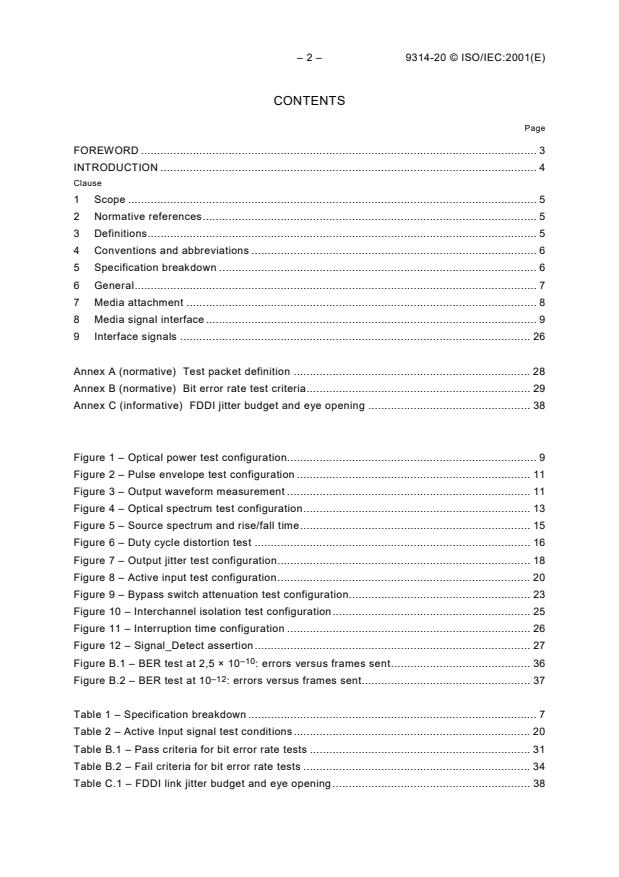
– 2 – 9314-20 © ISO/IEC:2001(E)
CONTENTS
Page
FOREWORD . 3
INTRODUCTION .4
Clause
1 Scope . 5
2 Normative references. 5
3 Definitions. 5
4 Conventions and abbreviations . 6
5 Specification breakdown . 6
6 General. 7
7 Media attachment . 8
8 Media signal interface . 9
9 Interface signals . 26
Annex A (normative) Test packet definition . 28
Annex B (normative) Bit error rate test criteria. 29
Annex C (informative) FDDI jitter budget and eye opening . 38
Figure 1 – Optical power test configuration. 9
Figure 2 – Pulse envelope test configuration . 11
Figure 3 – Output waveform measurement . 11
Figure 4 – Optical spectrum test configuration. 13
Figure 5 – Source spectrum and rise/fall time. 15
Figure 6 – Duty cycle distortion test . 16
Figure 7 – Output jitter test configuration. 18
Figure 8 – Active input test configuration. 20
Figure 9 – Bypass switch attenuation test configuration. 23
Figure 10 – Interchannel isolation test configuration. 25
Figure 11 – Interruption time configuration . 26
Figure 12 – Signal_Detect assertion. 27
–10
Figure B.1 – BER test at 2,5 × 10 : errors versus frames sent. 36
–12
Figure B.2 – BER test at 10 : errors versus frames sent. 37
Table 1 – Specification breakdown . 7
Table 2 – Active Input signal test conditions. 20
Table B.1 – Pass criteria for bit error rate tests . 31
Table B.2 – Fail criteria for bit error rate tests . 34
Table C.1 – FDDI link jitter budget and eye opening. 38
9314-20 © ISO/IEC:2001(E) – 3 –
INFORMATION TECHNOLOGY –
FIBRE DISTRIBUTED DATA INTERFACE (FDDI) –
Part 20: Abstract test suite for FDDI physical medium
dependent conformance testing (PMD ATS)
FOREWORD
1) ISO (International Organization for Standardization) and IEC (International Electrotechnical Commission) form
the specialized system for worldwide standardization. National bodies that are members of ISO or IEC
participate in the development of International Standards through technical committees established by the
respective organization to deal with particular fields of technical activity. ISO and IEC technical committees
collaborate in fields of mutual interest. Other international organizations, governmental and non-governmental,
in liaison with ISO and IEC, also take part in the work.
2) In the field of information technology, ISO and IEC have established a joint technical committee, ISO/IEC JTC1.
Draft International Standards adopted by the joint technical committee are circulated to national bodies for
voting. Publication as an International Standard requires approval by at least 75 % of the national bodies
casting a vote.
3) Attention is drawn to the possibility that some of the elements of this International Standard may be the subject
of patent rights. ISO and IEC shall not be held responsible for identifying any or all such patent rights.
International Standard ISO/IEC 9314-20 was prepared by subcommittee 25: Interconnection
of information technology equipment, of ISO/IEC joint technical committee 1: Information
technology.
This publication has been drafted in accordance with the ISO/IEC Directives, Part 3.
Annexes A and B form an integral part of this standard.
Annex C is for information only.
This publication must be read in conjuntion with ISO/IEC 9314-3:1990.
ISO/IEC 9314 consists of the following parts, under the general title Information technology –
Fibre Distributed Data Interface (FDDI):
– Part 1: Token Ring Physical Layer Protocol (PHY)
– Part 2: Token Ring Media Access Control (MAC)
– Part 3: Physical Layer Medium Dependent (PMD)
– Part 4: Single Mode Fibre Physical Layer Medium Dependent (SMF-PMD)
– Part 5: Hybrid Ring Control (HRC)
– Part 6: Station Management (SMT)
– Part 7: Physical Layer Protocol (PHY-2)
– Part 8: Media Access Control-2 (MAC-2)
– Part 9: Information technology – Fibre Distributed Data Interface (FDDI) – Part 9: Low-cost fibre
physical layer medium dependent
– Part 13: Conformance Test Protocol Implementation – Conformance Statement (CT-PICS)
Proforma
1)
– Part 21: Abstract Test Suite for FDDI – Physical Layer Protocol Conformance Testing (PHY-ATS)
– Part 25: Abstract test suite for FDDI – Station Management Conformance Testing (SMT-ATS)
1)
– Part 26: Abstract Test Suite for FDDI – Media Access Control Conformance Testing (MAC-ATS)
___________
1)
To be published.
– 4 – 9314-20 © ISO/IEC:2001(E)
INTRODUCTION
The Fibre Distributed Data Interface (FDDI), ISO/IEC 9314, is intended for use in a high
performance general purpose multistation network and is designed for efficient operation with
a peak data rate of 100 Mbit/s. It uses a Token Ring Architecture with optical fibre as the
transmission medium. FDDI provides for hundreds of stations operating over an extent of tens
of kilometres.
The FDDI Physical Media Dependent (PMD) standard, ISO/IEC 9314-3, specifies the lower
sublayer of the Physical Layer for the FDDI, including the optical interface for multimode fibre
FDDI stations. This part of ISO/IEC 9314 is an abstract test suite (ATS) conformance test for
FDDI PMD. ISO/IEC 9314-3 specifies the optical interface of FDDI stations. ISO/IEC 9314-3 is
not a protocol standard and this part of ISO/IEC 9314 requires the measurement of physical
quantities such as optical power, wavelength and signal jitter. The intent of this part of
ISO/IEC 9314 is to specify the tests as broadly as possible to allow measurement by various
detailed test implementations. The ATS in this part of ISO/IEC 9314 differs from the
methodology of higher level protocol conformance tests written using the Tree and Tabular
Combined Notation (TTCN) because TTCN does not provide for Physical Layer testing, where
there is no concept of a protocol data unit and where physical quantities must be measured.
Four other ISO/IEC standards provide a complete conformance test of an FDDI station:
a) An ATS for the FDDI Physical Layer Protocol (PHY) that provides a conformance test for
FDDI PHY, ISO 9314-1. ISO 9314-1 specifies the upper sublayer of the Physical Layer for
the FDDI, including the data encode/decode, framing and clocking, as well as the elasticity
buffer, smoothing and repeat filter functions. FDDI PHY, however, does contain several
state machines and implements a protocol at the level of FDDI code symbols. The only
physical quantity that is measured in this conformance test is frequency. The PHY ATS
cannot use the TTCN notation and a notation is developed in the PHY ATS for specifying
test patterns and expected results in terms of FDDI code symbol strings.
b) An ATS for FDDI Media Access Control (MAC), ISO 9314-2, that provides a conformance
test for FDDI MAC. ISO 9314-2 specifies the lower sublayer of the Data Link Layer for
FDDI. It specifies access to the medium, including addressing, data checking and data
framing. ISO 9314-2 also specifies the receiver and transmitter state machines. Since
MAC is primarily with complete PDUs, the TTCN language is used to specify MAC protocol
tests. Provisions of ISO/IEC 9314-2, however, require high resolution timing that may be
difficult to achieve in commercial protocol testers.
c) An ATS for FDDI Station Management (SMT), ISO/IEC 9314-6, that provides a
conformance test for FDDI SMT. ISO/IEC 9314-6 specifies the local portion of the system
management application process for FDDI, including the control required for proper
operation of an FDDI station in an FDDI ring. SMT provides services such as connection
management, station insertion and removal, station initialization, configuration manage-
ment and fault recovery, communications protocol for external authority, scheduling
policies and the collection of statistics. SMT interacts with PMD, PHY and MAC.
Therefore, an ATS for portions of SMT that use MAC PDUs can be specified in TTCN,
while other portions require other approaches.
d) A Conformance Test Protocol Implementation Conformance Statement (PICS) Proforma,
ISO/IEC 9314-13, for FDDI that provides a statement of the mandatory and optional
requirements of each of the four FDDI base standards. The PICS proforma is used to
identify requirements for conformance testing and to specify optional functionality
requirements, particularly by workshops for functional standards and profiles.
9314-20 © ISO/IEC:2001(E) – 5 –
INFORMATION TECHNOLOGY –
FIBRE DISTRIBUTED DATA INTERFACE (FDDI) –
Part 20: Abstract test suite for FDDI physical medium
dependent conformance testing (PMD ATS)
1 Scope
This part of ISO/IEC 9314 specifies a series of tests in order to verify conformance of FDDI
stations to the requirements of ISO/IEC 9314-3:1990.
NOTE ISO/IEC 9314-3 specifies the requirements for the optical input/output port of FDDI stations as well as for
–10
cable plants. It states that a bit error rate for a station-to-station link should not exceed 2,5 × 10 for conforming
stations connected to each other through a conforming cable plant.
2 Normative references
The following normative documents contain provisions which, through reference in this text,
constitute provisions of this part of ISO/IEC 9314. For dated references, subsequent
amendments to, or revisions of, any of these publications do not apply. However, parties to
agreements based on this part of ISO/IEC 9314 are encouraged to investigate the possibility
of applying the most recent edition of the normative documents indicated below. For undated
references, the latest edition of the normative document referred to applies. Members of IEC
and ISO maintain registers of currently valid International Standards.
ISO 9314-1:1989, Information processing systems – Fibre Distributed Data Interface (FDDI) –
Part 1: Token Ring Physical Layer Protocol (PHY)
ISO 9314-2:1989, Information processing systems – Fibre Distributed Data Interface (FDDI) –
Part 2: Token Ring Media Access Control (MAC)
ISO/IEC 9314-3:1990, Information processing systems – Fibre Distributed Data Interface
(FDDI) – Part 3: Physical Layer Medium Dependent (PMD)
ISO/IEC 9314-6:1998, Information technology – Fibre Distributed Data Interface (FDDI) –
Part 6: Token Ring Station Management (SMT)
3 Definitions
The specialized FDDI terms used in this part of ISO/IEC 9314 are defined in the FDDI base
standards ISO 9314-1 (PHY), ISO 9314-2 (MAC), ISO/IEC 9314-3 (PMD) and ISO/IEC 9314-6
(SMT).
– 6 – 9314-20 © ISO/IEC:2001(E)
4 Conventions and abbreviations
The following acronyms and abbreviations are used in this ATS:
BER: Bit Error Rate (PMD)
BERT: Bit Error Rate Tester (PMD)
CMS: Cladding Mode Stripper (ISO/IEC 60793-1)
DCD: Duty Cycle Distortion (PMD)
DDJ: Data Dependent Jitter (PMD)
FDDI: Fibre Distributed Data Interface
HLS: Halt Line State (PHY)
ILS: Idle Line State (PHY)
IUT: Implementation Under Test
MAC: Media Access Control
MIC: Media Interface Connector (PMD)
NA: Numerical Aperture (ISO/IEC 60793-1)
PCM: Physical Connection Management (SMT)
PHY: Physical Layer Protocol (PHY)
PMD: Physical Medium Dependent (PMD)
PTF/PTCP: Precision Test Fibre/Precision Test Connector Plug (PMD)
QLS: Quiet Line State (PHY)
RJ: Random Jitter (PMD)
SME: Source Monitoring Equipment (ISO/IEC 60793-1)
SMT: Station Management (SMT)
TTRT: Target Token Rotation Time (MAC).
The terms SMT, MAC, PHY and PMD, when used without modifiers, refer specifically to the
local entities.
5 Specification breakdown
Table 1 summarizes the requirements of ISO/IEC 9314-3. It identifies those requirements that
are tested in this test specification and the specific test suite where they are tested.
9314-20 © ISO/IEC:2001(E) – 7 –
Table 1 – Specification breakdown
Name PICS ISO/IEC 9314-3 Test
Item No. reference reference
Active output interface
Center wavelength PMD1.1 8.1.1 Table 1 8.2.4
Average power PMD1.2 8.1.1 Table 1 8.2.1
Source FWHM spectral width PMD1.3 8.1.1 Figure 9 8.2.4
Rise time PMD1.4 8.1.1 Table 1 8.2.2
Fall time PMD1.5 8.1.1 Table 1 8.2.2
Duty cycle distortion PMD1.6 8.1.1 Table 1 8.2.5
Random jitter PMD1.7 8.1.1 Table 1 8.2.6
Data dependent jitter PMD1.8 8.1.1 Table 1 8.2.6
Extinction ratio PMD1.9 8.1.1 Table 1 8.2.3
Pulse envelope 8.1.2 figures 10 and 11 8.2.2
Active input interface
Sensitivity threshold PMD2.1 8.2.2 Table 2 8.3.4
−12
BER <10 at 2 dB above threshold 8.0 8.3.5
Saturation power level PMD2.1 8.2.2 Table 2 8.3.6
– – –
Station bypass interface signal
PMD3.1 8.3, Table 3 and Figure 12 8.4.1
Bypass attenuation
PMD3.2 8.3, Table 3 and Figure 12 8.4.2
Interchannel isolation
PMD3.2 8.3, Table 3 and Figure 12 Not testable
Switching time
PMD3.3 8.3, Table 3 and Figure 12 8.4.3
Media interruption time
Interface signals
Signal_Detect threshold PMD4.1 & 9.1.1.1 9.2.1
PMD4.2
Signal_Detect hysteresis PMD4.3 9.1.1.1 9.2.1
MIC receptacle
Receptacle keying PMD6.1 7.2.2, Figure 8 7.2
Receptacle dimensions 7.2, Figure 5 and Figure 6 Not tested
6 General
6.1 Test environment
The FDDI standards do not specify an operating environment. All tests specified in this
document shall be performed with temperature and atmospheric conditions consistent with the
environmental operating specifications of the IUT.
For FDDI stations which are directly powered (either wholly or partly) from the a.c. power line,
all tests shall be carried out within 0,5 % of the nominal operating voltage. If the equipment is
powered by other means and those means are not supplied as a part of the apparatus (e.g.
batteries, stabilized a.c. supplies, d.c.) all tests shall be carried out within the power supply
limit declared by the supplier. If the power supply is a.c., the tests shall be conducted within
4 % of the normal operating frequency.
All optical power measurements shall be made with a calibrated power meter traceable to a
recognized primary standard.
– 8 – 9314-20 © ISO/IEC:2001(E)
6.2 Measurement error
Physical quantities are measured in this ATS (particularly optical power levels). There are
measurement errors associated with the calibration and tolerance of the measurement
instruments. Moreover, it is known that measurements of optical output power are not
necessarily precisely repeatable due to differences in the way connectors mate each time
they are inserted. Where measurement repeatability is a concern, it is common in test
standards to require a number of measurements and to add a safety factor of three times the
standard deviation of those measurements to the mean. This ATS follows that convention.
Bit error rates (BER) are measured in this ATS. At the rates specified in PMD practical tests
are statistical tests of the hypothesis that IUT meets the PMD requirements with a limited
sample size. Associated with these tests is a confidence level. The confidence level chosen in
this ATS is 90 %. Tests that establish this confidence level may have varying duration.
However, the shorter the test, the larger the safety margin required of the IUT if it is to have a
high probability of passing the test.
It is the burden of the conformance test laboratory to verify that an IUT does conform to the
standard. Therefore, measurement errors due to calibration, repeatability and statistical
sampling are added to the requirement being tested so that the greater the error, the more
difficult it becomes to pass the conformance test.
7 Media attachment
7.1 MIC Requirements
An FDDI station is attached to the fibre optic medium by a Media Interface Connector (MIC).
Clause 7 of ISO/IEC 9314-3:1990 specifies the dimensions of the MIC plug and the receptacle
in the station. This clause defines tests of station MIC requirements.
7.2 Receptacle keying
7.2.1 Purpose
Every FDDI port is designated either A, B, S or M and Figure 8 of ISO/IEC 9314-3:1990
specifies the keying required for a receptacle for each type of port. This test case verifies the
receptacle keying.
7.2.2 Equipment
FDDI connector plugs with keying for A, B, S and M ports.
7.2.3 Procedure
Attempt to insert the four plugs in each port of the IUT and record which plugs are
successfully inserted.
7.2.4 Pass_fail criteria
Only the following plugs can be inserted:
a) A port: S or A plugs can be inserted;
b) B port: S or B plugs can be inserted;
c) M port: S or M plugs can be inserted;
d) S port; S plug can be inserted.
9314-20 © ISO/IEC:2001(E) – 9 –
8 Media signal interface
8.1 Media signal test cases
The following test cases verify the requirements for the media signal interface specified in
clause 8 of ISO/IEC 9314-3:1990.
8.2 Active output interface
The test cases in this group validate the requirements of 8.1 of ISO/IEC 9314-3:1990, which
specifies the characteristics of the station output signal.
8.2.1 Average optical output power
8.2.1.1 Purpose
To verify that the average optical power coupled from the IUT into a PTF/PTCP is more than
–20,0 dBm, and less than –14,0 dBm when a data pattern of Halt symbols is transmitted as
specified in Table 1 of ISO/IEC 9314-3:1990.
8.2.1.2 Equipment
An optical power meter is used. The power meter shall be calibrated between –14 dBm and
–31 dBm in the wavelength range 1 250 nm to 1 400 nm.
8.2.1.3 Configuration
See Figure 1.
IUT
Optical power meter
MIC
PTF/PTCP
Figure 1 – Optical power test configuration
8.2.1.4 Procedure
The optical power meter is connected to the IUT using a PTF/PTCP. The IUT is turned on but
its input is dark; this will result in the IUT entering the Physical Connection Management
(PCM) Connect State and transmitting Halt Line State (HLS). The measurement shall be
repeated ten times with the PTF/PTCP reinserted in the IUT between measurements. The
connector plug shall be cleaned before each insertion. The PTF/PTCP shall not be
manipulated manually to control the power measurement. Obvious outlying data points shall
be excluded. The mean of the 10 measurements shall be computed with the sample standard
deviation, s.
– 10 – 9314-20 © ISO/IEC:2001(E)
8.2.1.5 Pass_fail criteria
Let C be the calibration uncertainty of the power meter expressed in dB (for example,
suppose, the uncertainty were 5 %, then C = 10 log (1,05) = 0,211 9). Let P be the mean of
the power measurements. Let s be the sample standard deviation.
The IUT passes if
P
(20 + C + 3 × s) ≤ ≤ (–14 – C – 3 × s) dBm (1)
The IUT fails if
P ≥ (–14 + C + 3 × s) dBm (2)
or
P ≤ –(20 + C + 3 × s) dBm (3)
Otherwise the results are inconclusive.
8.2.2 Output waveform
8.2.2.1 Purpose
To verify that the output optical pulse rise time and fall time, conform to Table 1 of
ISO/IEC 9314-3:1990, and the overshoot and undershoot are within the limit shown in
figures 10 and 11 of ISO/IEC 9314-3:1990. The rise and fall times to be used in the spectral
width test (test suite 4.1.3) are computed in this test.
8.2.2.2 Equipment
– Sampling oscilloscope or waveform analyzer
– Optical to electrical converter
The combined bandwidth range of the optical to electrical converter and the Waveform
Recorder or Waveform Analyzer shall be greater than 100 kHz to 750 MHz.
A waveform analyzer is a device which samples the input waveform and automates the
measurement and calculation of rise time, fall time, overshoot, and undershoot, of the signal,
but does not necessarily record or display a complete trace of the waveform. To satisfy the
requirements of this test the analyzer shall be capable of:
– detecting peak and minimum signal points;
– determining the high and low signal values of the pulse by averaging at least three values
taken from the intervals shown in Figure 3;
– measuring the 10 % and 90 % signal level crossing points.
9314-20 © ISO/IEC:2001(E) – 11 –
8.2.2.3 Configuration
See Figure 2.
IUT
O/E
MIC
Sampling oscilloscope
converter
Bandwidth range
greater than
100 kHz to 750 MHz
Figure 2 – Pulse envelope test configuration
Interval for Interval for
S S
l h
S
p
S : 100
p
Rise time
Fall time
S : 0
l
S
m
–20 –10 0 10 20 30 40 50
t ns
Figure 3 – Output waveform measurement
8.2.2.4 Procedure
With a dark input the IUT will transition to the PCM Connect State and send HLS. When an
oscilloscope is used, the various power levels and times specific below are measured
manually by the operator by visual inspection of the oscilloscope waveform display. When a
waveform analyzer is used the parameters specified below are measured automatically by
electronic circuits such as peak detectors and comparitors, or by programmed analysis of a
sampled waveform.
Relative amplitude %
– 12 – 9314-20 © ISO/IEC:2001(E)
Refer to Figure 3. Measure the 0 % signal level, S, and 100 % signal levels, S , as the
l h
average level in the 10 ns intervals indicated in Figure 3.
Determine the 10 % signal level as follows:
10 % level = S + (S – S ) × 0,10 (4)
l h l
Determine the 90 % signal level as follows:
90 % level = S + (S – S ) × 0,90 (5)
l h l
Determine the rising and falling 10 % and 90 % signal points and the corresponding rise and
fall times as illustrated in Figure 3.
Find the peak signal point, S . Compute the overshoot as follows:
p
S − S
p h
Overshoot = × 100 %(6)
S − S
h l
Find the minimum power point, S , on the waveform trace. Compute the undershoot as
m
follows:
S − S
t m
Undershoot = × 100 %(7)
S − S
h t
8.2.2.5 Pass_fail criteria
a) The rise time shall be greater than 0,6 ns and less than 3,5 ns;
b) The fall time shall be greater than 0,6 ns and less than 3,5 ns;
c) Overshoot shall be less than 25 %;
d) Undershoot shall be less than 5 %.
8.2.3 Extinction ratio
8.2.3.1 Purpose
To verify that the extinction ratio conforms to PMD Table 1.
8.2.3.2 Equipment
Refer to 8.2.2.2. The test equipment for this clause is similar, except that the combined
bandwidth range of the optical to electrical converter and the waveform recorder or waveform
analyzer shall extend from d.c. to at least 75 MHz.
9314-20 © ISO/IEC:2001(E) – 13 –
8.2.3.3 Configuration
See Figure 2.
8.2.3.4 Procedure
A dark input will cause the IUT to transition to the PCM Connect State and send HLS.
Determine the 0 % signal level, S , and the 100 % signal level, S , as described in 8.2.2.4.
l h
Determine the DC reference baseline signal level (optical to electrical converter output with
no light input), S .
d
Compute the extinction ratio as follows:
S − S
l d
Extinction ratio = × 100 %(8)
S − S
h d
8.2.3.5 Pass_fail criteria
The extinction ratio shall be not more than 10 %.
8.2.4 Spectral characteristics
This test case uses the output rise/fall times recorded in test step 8.2.2.4 above.
8.2.4.1 Purpose
This test verifies that the optical centre wavelength and spectral width requirements stated in
clause 8, Table 1 of ISO/IEC 9314-3:1990 and Figure 9 of ISO/IEC 9314-3:1990, respectively.
8.2.4.2 Equipment
An optical spectrum analyzer is required, as follows:
– the range shall be between 600 nm to 1 600 nm;
– the resolution shall be 0,1 nm;
– accuracy shall be 1 nm.
8.2.4.3 Configuration
See Figure 4.
System
under test
MIC
Optical
spectrum
analyzer
Figure 4 – Optical spectrum test configuration
– 14 – 9314-20 © ISO/IEC:2001(E)
8.2.4.4 Procedure
This test uses the rise and fall times obtained in 8.2.2. Use the greater value, either rise or fall
time, to plot the test point.
The spectrum analyzer is connected to the output of the IUT using a short fibre patch cable
and a plot of the optical output spectrum obtained.
From the plot of the output spectrum determine peak power wavelength. Locate the two half
power points farthest from the peak power wavelength. Let λ be the center wavelength, λ be
c l
the left half power wavelength and λ be the right half power wavelength. Then the center
r
wavelength is given by the following expression:
λ + λ
r l
(9)
λ =
c
The full width, half maximum spectral width, FWHM, is given by:
FWHM = λ – λ (10)
r l
Using the greater value of rise or fall time, find the appropriate line in Figure 5. Find the point
on that line corresponding to the source center wavelength. Project that point to the y axis to
determine the maximum allowed spectral width for that rise/fall time and center wavelength.
8.2.4.5 Pass_fail criteria
a) The source centre wavelength shall be in the range 1 270 nm to 1 380 nm;
b) The spectral width shall not exceed the y axis value given in Figure 9 of ISO/IEC 9314-3:
1990 or 200 nm, whichever is less.
8.2.5 Duty cycle distortion
8.2.5.1 Purpose
To verify that the peak to peak Duty Cycle Distortion is in the range of 0,0 ns to 1,0 ns as
specified in Table 1 of ISO/IEC 9314-3:1990.
9314-20 © ISO/IEC:2001(E) – 15 –
3,0
1,5
3,5
2,0
Region of acceptable
spectral width and centre
wavelength for rise times
from 1,5 ns to 3,5 ns
2,5
3,0
3,5
1 270 1 280 1 300 1 320 1 340 1 360 1 380
Source center wavelength (nm)
Figure 5 – Source spectrum and rise/fall time
8.2.5.2 Equipment
– Oscilloscope
– Optical to electrical converter
– FDDI station tester or a second FDDI station
– Optical signal splitter
The combined bandwidth range of the converter and the oscilloscope shall be greater than
100 kHz to 750 MHz.
8.2.5.3 Configuration
See Figure 6.
8.2.5.4 Procedure
This procedure requires observing the waveform of idle symbols transmitted by the IUT. An
FDDI tester or another station may be used to induce the IUT to send ILS. If the IUT port is
presented with continuous HLS it will transition to the PCM Next state and send ILS (that is
transmit idle symbols).
The IUT may have some local means not specified in the FDDI standards to induce it to enter
the PCM Maintenance state and send ILS for test purposes. If so this method may be used
and an FDDI station tester is not required.
Spectral width (FW/HM) of source (nm)
– 16 – 9314-20 © ISO/IEC:2001(E)
FDDI
tester
IUT
MIC O/E
Sampling
converter
oscilloscope
PTF/PTCP
Bandwidth range greater
than 100 kHz to 750 MHz
Figure 6 – Duty cycle distortion test
The method for inducing the IUT to transmit idle symbols is not specified in this test case.
Using a recording oscilloscope or a photograph of the oscilloscope trace obtain the waveform
trace of idle symbols output by the IUT. From this trace, measure the width of the high and
low state levels of the waveform at the 50 % amplitude point. Let W be the duration of the
w
wider state and W the duration of the narrower state. Calculate the DCD as follows:
n
W − W
w n
DCD = (11)
8.2.5.5 Pass_fail criteria
DCD shall be less than 1,0 ns.
8.2.6 Output jitter and eye opening
While PMD specifies several separate jitter components, signal quality is measured in this
test standard by measurement of the signal with two specified test patterns:
– a continuous stream of idle symbols;
– a series of frames containing the test pattern specified in annex A.
9314-20 © ISO/IEC:2001(E) – 17 –
–10
PMD requires that jitter be measured to a probability of 2,5 × 10 . At least three methods
are used to measure jitter:
– visual observation of the signal “eye opening” on an oscilloscope. In general this method,
while it gives a good general visual indication of signal quality, cannot be used to measure
jitter at a precise probability. This part of ISO/IEC 9314 does not preclude the use of
sampling or digital oscilloscopes that may have sufficient memory and capability to allow
precise measurements of jitter to the specified probability. However, the use of
oscilloscopes to measure jitter is not discussed further in this part of ISO/IEC 9314;
– direct measurement of jitter using a Time Interval Analyzer that determines the position of
signal transitions relative to the clock and builds a histogram of signal transition points
–10
versus the clock strobe point. The jitter value where the probability exceeds 2,5 × 10
can be determined from the histogram. Direct measurement of jitter at a probability of
–10
2,5 × 10 requires that a very large number of transition points be tabulated and may be
beyond the capability of many instruments;
– measurement of eye openings using a Bit Error Rate Tester (BERT). The BERT method of
measuring eye openings is described in A.4.2.2 of ISO/IEC 9314-3:1990. The eye opening
is determined by the DCD, and two jitter components which are specified in Table 1 of
ISO/IEC 9314-3:1990, Data Dependent Jitter (DDJ) and Random Jitter (RJ).
The procedure for measuring jitter with a BERT is described below. Other measuring
procedures including oscilloscopes and time interval analyzers are acceptable provided they
–10
are capable of measuring jitter with a probability of 2,5 × 10 .
A BERT may be used to measure the “eye opening” of a signal, that is the central portion of a
bit period where jitter does not confound the signal. Therefore the results are stated in terms
of the width of the eye opening, which is the parameter directly measured by the BERT and
the DDJ component. Annex B shows the correlation between jitter requirements in FDDI and
the eye opening.
Provided the ILS eye opening (which measures the sum of DCD and RJ) is less than the limit,
and the DCD (which is measured in 8.2.5) also meets the standard, then there is no practical
need to compute RJ. Under these circumstances, even if RJ exceeds the limit in
ISO/IEC 9314-3, there must be a corresponding reduction in DCD. With the jitter model
assumed in PMD, the output RJ contribution to the link bit error rate is less significant than
DCD, because output and receiver RJ terms are summed in r.m.s. fashion, and the receiver
term always dominates. Annex C summarizes the FDDI jitter budget and is based on annex E
of ISO/IEC 9314-3:1990. Annex C shows the conversion of jitter to an eye opening.
RJ + DCD is measured by measuring the eye-opening of a constant pattern of idle symbols,
E . The test pattern eye opening, ED, which includes the eye closure due to RJ, DCD and DDJ
I
is measured using a stream of packets containing the test pattern specified in annex A which
has a spectrum that will produce DDJ.
8.2.6.1 Purpose
The purpose of this test is to verify that the peak to peak jitter of the output signal is as
specified in ISO/IEC 9314-3, Table 1 and ISO/IEC 9314-3, A.3 (b).
– 18 – 9314-20 © ISO/IEC:2001(E)
8.2.6.2 Equipment
– Station Tester or another FDDI station
– Bit Error Rate Tester (BERT) or a Time Interval Analyzer
– Optical/electrical transducer
– 125 MHz clock recovery retiming circuit with random jitter less than 0,1 ns when used with
the test packets defined in annex A
– Optical signal splitter
8.2.6.3 Configuration
See Figure 7.
IUT
FDDI
tester
High bandwidth
(min. 100 kHz to 750 MHz)
optical/electrical converter
Data
Retimed data
Bit error
Reference
rate tester
62,5 MHz
clock recovery
Recovered clock
Clock
NOTE BERT is assumed to contain adjustable delay for eye opening measurement.
Figure 7 – Output jitter test configuration
8.2.6.4 Procedure
The IUT is induced to continuously output idle symbols for an extended period, that is, it
sends ILS. This may be done by having the tester continuously send HLS to the IUT. This
causes the IUT to transmit ILS with PCM in the Next State (see ISO/IEC 9314-6 (SMT)
9.6.1.2). It may be possible to induce the IUT PCM State machine to enter the Maintenance
State and Send ILS (continuous idle symbols). The width of the eye opening is measured
using the ILS output giving the ILS eye opening, E .
I
An active ring is then initialized using the tester and IUT. The tester holds the token and
continuously transmits (following the normal FDDI token holding rules) the test packets
defined in annex A, to the IUT which repeats them. The width of the eye opening is then
measured while the IUT repeats the test packets. This yields the DDJ eye opening, E .
D
Compute DDJ as follows:
DDJ = E – E (12)
I D
9314-20 © ISO/IEC:2001(E) – 19 –
8.2.6.5 Pass_fail criteria
a) E shall be greater than 6,24 ns. This criterion is valid only if the IUT has passed test
I
8.2.5;
b) DDJ shall not exceed 0,6 ns.
8.3 Active input interface
The purpose of this subclause is to verify that the System Under Test (IUT) meets the
–10
specified sensitivity requirements at a Bit Error Rate (BER) of 2,5 × 10 and has a BER of
–12
less than 10 when the input power is more than 2 dB above the specified threshold. In this
test a representative “worst case” input signal is generated and packets containing a specified
test pattern are used to test the receiver sensitivity. The representative worst case shall be a
continuous string of the frames defined in annex A.
A single bit error in a packet can cause one of two effects in the IUT:
– the packet may be stripped;
– the FCS check may fail, causing the IUT to set the E indicator.
–10
The measurements of interest are at BERs of 2,5 × 10 or less. The test packets are
43 725 code bits in length. At this BER the probability that a packet contains one or more bit
–5 –10
errors is 1,09 × 10 , and the probability that it contains two or more bit errors is 1,19 × 10 .
Therefore, the possibility that a bad packet contains two or more errors is neglected and
every stripped packet and packet with the E indicator set is attributed to a single bit error.
Input port bit error rate tests shall
– be based upon the ability of the IUT to repeat the test frames defined in annex A,
– consider any test frame stripped by the IUT to result from a single bit error,
– consider the setting of the E indicator by the IUT on any repeated test frame to be the
result of a single bit error,
– consider the lost frames to have a Poisson distribution,
– for a verdict of “pass” use a test that establishes to a 90 % confidence level the hypothesis
that BER is less than the specified rate is true.
– for a verdict of fail use a test that establishes to a 90 % confidence level the hypothesis
that the BER is more than the specified rate is true.
Tests of varying length may be used to test the pass and fail hypotheses. Annex B includes a
table of tests of different lengths that may be used to verify conformance to the 90 %
confidence level. Test results may be inclusive, if neither the pass nor fail criterion is
satisfied, and the shorter the test the greater the likelihood of an inconclusive test verdict.
When a test is inconclusive a longer test may be used to resolve the verdict, however, if the
actual bit error rate of the IUT is very close to the specification limit it may not be possible to
reach a test verdict of either pass or fail in a practical test.
8.3.1 Equipment
– FDDI station tester
– Optical signal measurement system
– Optical signal control system
The tester is an FDDI station which is capable of repetitively transmitting the test packet
defined in annex A and counting those valid test packets returned to it. The tester shall also
be capable of identifying packets damaged on the link from the IUT to the tester, by
examining the trailing indicators.
– 20 – 9314-20 © ISO/IEC:2001(E)
The optical signal control system shall be capable of producing near worst case Active Input
signal conditions specified in Table 2, and of allowing the input power level to be adjusted.
8.3.2 General configuration
Figure 8 illustrates a generic test configuration which allows the generation and monitoring of
the test input signal characteristics specified in Table 2, which represent near worst case
signal quality conditions. The means for generating the near worst case signal conditions are
not specified, but they may include selection of components and filtering.
FDDI
IUT
tester
Optical signal
control system
Optical signal
measurement signal
Figure 8 – Active input test configuration
The input port signal conditions given in Table 2 are common to the tests of input sensitivity.
These legal (input) conditions are intended to stress the receiver. They are derived from the
input port requirements of Table 2 of ISO/IEC 9314-3, with the jitter components combined to
a single eye opening.
The IUT is coupled to the test signal via a PTF/PTCP.
8.3.3 General procedure
The test configuration is adjusted to produce an optical signal with the characteristics
specified in Table 2. Three separate tests are run, with three separate input power levels. The
receiver BER is measured for each case.
Table 2 – Active Input signal test conditions
Parameter Minimum Maximum Units
Center wavelength 1 270 1 380 nm
Rise time (10 % to 90 %) 4,5 5,0 ns
Fall time (90 % to 10 %) 4,5 5,0 ns
Duty cycle distortion 0,8 1,0 ns
ILS eye opening 6,24 6,4 ns
Test pattern eye opening 5,04 5,2 ns
9314-20 © ISO/IEC:2001(E) – 21 –
To measure the receiver BER, a ring is formed with the IUT and the tester. TTRT should be
set to its maximum value to permit the tester to transmit for long periods without releasing the
token. The tester generates the number of test packets needed for the selected test (see
annex B). The tester counts the number of valid test packets repeated by the IUT. During the
course of the test the IUT may also generate packets (e.g., SIF Frames). Every test packet
not received correctly by the tester is considered to represent one IUT bit error.
8.3.4 Sensitivity threshold
8.3.4.1 Purpose
–10
To verify that the receiver input sensitivity threshold at the 2,5 × 10 BER is –31,0 dBm as
specified in Table 2 of ISO/IEC 9314-3:1990.
8.3.4.2 Configuration
See Figure 8 and 8.3.2.
8.3.4.3 Procedure
Let C be the calibration uncertainty of the power measurement. The mean input power, P ,
I
measured in ILS, shall not exceed –(31 + C) dBm.
Refer to 8.3.3 for the measurement procedure. Input signal conditions shall be in the range
specified in Table 2. The tester shall transmit test frames defined in annex A and count as
error events those frames that are either stripped or have their E indicator set.
8.3.4.4 Pass_fail criteria
A verdict of pass shall be given when the number of error events indicate with a 90 %
–10
confidence that the BER is less than 2,5 × 10 . A test verdict of fail shall be given when
the number of error events indicates with a 90 % confidence that the input BER exceeds
–10
2,5 × 10 . Otherwise, the verdict shall be inconclusive. Annex B contains a table of tests
that satisfy the 90 % confidence criterion.
8.3.5 BER 2 dB above threshold
8.3.5.1 Purpose
–12
The purpose of this test is to verify that the receiver BER is less than 10 at power levels
2 dBm above the threshold as specified in the first paragraph of clause 8 of ISO/IEC 9314-3:
1990 and Table 2.
8.3.5.2 Configuration
See Figure 8.
8.3.5.3 Procedure
The procedure is described in 8.3.3. Let C be the calibration uncertainty of the power
measurement.
The mean input power, P , shall not exceed –(29 + C) dBm. Other input signal conditions shall
I
be in the range specified in Table 2. The tester shall transmit test frames defined in annex A
and count as error events those frames that are either stripped or have their E indicator set.
– 22 – 9314-20 © ISO/IEC:2001(E)
8.3.5.4 Pass_fail criteria
A verdict of pass shall be given when the number of error events indicate with a 90 %
–12
confidence that the BER is less than 10 .
A test verdict of fail shall be given when the number of error events indicate with a 90 %
–12
confidence that the input BER exceeds 10 . Otherwise, the verdict shall be inconclusive.
Annex B contains a table of tests that satisfy the 90 % confidence criterion.
8.3.6 Saturation
8.3.6.1 Purpose
–12
This test verifies that the receiver BER is at least 10 at the saturation power level as
specified in ISO/IEC 9314-3, Table 2.
8.3.6.2 Configuration
See Figure 8.
8.3.6.3 Procedure
Since saturation normally only occurs when an input is connected to an output through a short
cable, the signal is not significantly degraded. The input signal for this test case shall be in
the ranges specified in ISO/IEC 9314-3, Table 2 for the active output interface, except for the
input power.
Let C be the calibration uncertainty of the power measurement. The mean input power shall
be –(14 + C) dBm.
At least 88 954 950 test packets shall be repeated without error. This allows at most one
–12
damaged packet and establishes to a 90 % confidence level that the BER is less than 10 .
8.3.6.4 Pass_fail criteria
A verdict of pass shall be given when the number of error events indicate with a 90 %
−
confidence that the BER is less than 10 .
A test verdict of fail shall be given when the number of error events indicate with a 90 %
–12
confidence that the input BER exceeds 10 .
Otherwise, the verdict shall be inconclusive.
Annex B contains a table of tests that s
...