

IEC 62368-3:2017
(Main)Audio/video, information and communication technology equipment - Part 3: Safety aspects for DC power transfer through communication cables and ports
General Information
- Abstract
IEC 62368-3:2017 applies to equipment intended to supply and receive operating power through communication cables or ports. It covers particular requirements for circuits that are designed to transfer DC power from a power sourcing equipment (PSE) to a powered device (PD).
The power transfer uses voltages at ES1 or ES2 or in very specific cases voltage levels at ES3.
Any cable provided with a connector defined by an industry standard that permits DC power transfer between equipment is considered a communication cable even if communication does not take place. For example, a USB cable can be used just to recharge a portable device battery.
This International Standard is to be used in conjunction with IEC 62368-1:2014.
It has the status of a group safety publication in accordance with IEC Guide 104.
The subclauses of IEC 62368-1 apply as far as reasonable. Where safety aspects are similar to those of IEC 62368-1, the relevant clause or subclause of IEC 62368-1 is given for reference in a note in the relevant subclause. Where a requirement in IEC 62368-3 refers to a requirement or criterion of IEC 62368-1, a specific reference to IEC 62368-1 is made.
This group safety publication is primarily intended to be used as a product safety standard for the products mentioned in the scope, but shall also be used by technical committees in the preparation of standards for products similar to those mentioned in the scope of this standard, in accordance with the principles laid down in IEC Guide 104 and lSO/lEC Guide 51.
- Status
- Published
- Publication Date
- 06-Dec-2017
- Technical Committee
- TC 108 - Safety of electronic equipment within the field of audio/video, information technology and communication technology
- Drafting Committee
- WG HBSDT - TC 108/WG HBSDT
- Current Stage
- PPUB - Publication issued
- Start Date
- 07-Dec-2017
- Completion Date
- 05-Jan-2018
Buy Documents
IEC 62368-3:2017 - Audio/video, information and communication technology equipment - Part 3: Safety aspects for DC power transfer through communication cables and ports Released:12/7/2017
Overview
IEC 62368-3:2017 is an international standard published by the International Electrotechnical Commission (IEC) focusing on the safety aspects of DC power transfer through communication cables and ports. It is part of the IEC 62368 series that addresses audio/video, information, and communication technology equipment safety. This part specifically applies to equipment designed to supply and receive operating power through communication cables or ports, covering power transfer circuits from power sourcing equipment (PSE) to powered devices (PD) using DC voltages classified as ES1, ES2, or in specific cases, ES3.
The standard emphasizes the safe design and implementation of DC power delivery over communication interfaces such as USB cables, where the cable may be used solely for power transfer without communication signals. IEC 62368-3:2017 is designed to be used in conjunction with IEC 62368-1:2014, which provides the foundational safety requirements for audio/video, information, and communication technology equipment.
Key Topics
1. Scope and Applicability
- Covers DC power transfer through communication cables or ports connecting Power Sourcing Equipment (PSE) to Powered Devices (PD).
- Applies to voltages within safety levels ES1, ES2, and occasionally ES3, with ES1 and ES2 generally aligning with non-hazardous voltage definitions used in other standards (e.g., SELV, PELV).
- Communication cables are defined broadly to include industry standard connectors that permit DC power transfer, irrespective of communication functionality.
2. Safety Requirements
- Electrical-caused injury safeguards for both PSE and PD.
- Prevention of electrical-caused fires due to DC power transfer circuits.
- Specific safeguards addressing single fault conditions in power sourcing equipment.
- Design criteria for overcurrent, overvoltage, and insulation protection.
- Requirements for interfacing DC power transfer with building wiring and other equipment.
3. Remote Power Feeding (RFT)
- Defines power transfer using remote feeding technologies such as RFT-C and RFT-V.
- Covers limitations on electrical energy, current, and voltage to ensure user safety and equipment protection.
- Classification of RFT power sources and related fire protection measures.
- Specifies installation instructions and safeguards to mitigate risks related to remote power feeding.
4. Integration with IEC 62368-1
- Cross-references and harmonization with IEC 62368-1:2014 to maintain consistency in safety engineering.
- Applies relevant clauses from IEC 62368-1 as far as reasonable when designing DC power transfer circuits.
- Provides normative and informative annexes to explain rationale, operational considerations, and safety principles.
Applications
IEC 62368-3:2017 is essential for manufacturers, designers, and testing laboratories working on:
- DC power delivery over USB cables used for device recharging or power supply without communication.
- Equipment providing power through Ethernet or other communication cables implementing Power over Ethernet (PoE) or similar remote feeding solutions.
- Audio/Video and ICT devices requiring safe DC power transfer across communication ports.
- Ensuring compliance in products such as docking stations, portable devices, network equipment, and communication terminals.
- Developing new product safety standards by technical committees for equipment that transfers DC power through communication interfaces to align with global safety requirements.
Related Standards
- IEC 62368-1:2014 – The primary standard for the safety of audio/video, information, and communication technology equipment, providing foundational safety principles referenced throughout IEC 62368-3.
- IEC Guide 104 – Provides guidance on group safety publications and harmonization across IEC standards.
- Other relevant IEC Electrotechnical Standards covering electrical safety, wiring rules, and product certifications may complement IEC 62368-3 compliance activities.
Conclusion
IEC 62368-3:2017 plays a critical role in ensuring the safe transfer of DC power across communication cables and ports, addressing modern needs in audio/video and communications technology. Understanding and implementing this standard helps mitigate risks of electrical injury and fire hazards while enabling innovative power delivery solutions in ICT equipment. Compliance with this standard, alongside IEC 62368-1, supports global market access and product reliability in a growing connected device ecosystem.
Keywords: IEC 62368-3, DC power transfer, communication cables, power sourcing equipment, powered devices, electrical safety standard, USB power delivery, remote power feeding, IEC 62368-1, ICT equipment safety, Power over Ethernet, product safety standard, audio/video equipment, electrical injury prevention, fire protection requirements.
Buy Documents
IEC 62368-3:2017 - Audio/video, information and communication technology equipment - Part 3: Safety aspects for DC power transfer through communication cables and ports Released:12/7/2017
Get Certified
Connect with accredited certification bodies for this standard

BSI Group
BSI (British Standards Institution) is the business standards company that helps organizations make excellence a habit.

NYCE
Mexican standards and certification body.

ANCE
Mexican certification and testing association.
Sponsored listings
Frequently Asked Questions
IEC 62368-3:2017 is a standard published by the International Electrotechnical Commission (IEC). Its full title is "Audio/video, information and communication technology equipment - Part 3: Safety aspects for DC power transfer through communication cables and ports". This standard covers: IEC 62368-3:2017 applies to equipment intended to supply and receive operating power through communication cables or ports. It covers particular requirements for circuits that are designed to transfer DC power from a power sourcing equipment (PSE) to a powered device (PD). The power transfer uses voltages at ES1 or ES2 or in very specific cases voltage levels at ES3. Any cable provided with a connector defined by an industry standard that permits DC power transfer between equipment is considered a communication cable even if communication does not take place. For example, a USB cable can be used just to recharge a portable device battery. This International Standard is to be used in conjunction with IEC 62368-1:2014. It has the status of a group safety publication in accordance with IEC Guide 104. The subclauses of IEC 62368-1 apply as far as reasonable. Where safety aspects are similar to those of IEC 62368-1, the relevant clause or subclause of IEC 62368-1 is given for reference in a note in the relevant subclause. Where a requirement in IEC 62368-3 refers to a requirement or criterion of IEC 62368-1, a specific reference to IEC 62368-1 is made. This group safety publication is primarily intended to be used as a product safety standard for the products mentioned in the scope, but shall also be used by technical committees in the preparation of standards for products similar to those mentioned in the scope of this standard, in accordance with the principles laid down in IEC Guide 104 and lSO/lEC Guide 51.
IEC 62368-3:2017 applies to equipment intended to supply and receive operating power through communication cables or ports. It covers particular requirements for circuits that are designed to transfer DC power from a power sourcing equipment (PSE) to a powered device (PD). The power transfer uses voltages at ES1 or ES2 or in very specific cases voltage levels at ES3. Any cable provided with a connector defined by an industry standard that permits DC power transfer between equipment is considered a communication cable even if communication does not take place. For example, a USB cable can be used just to recharge a portable device battery. This International Standard is to be used in conjunction with IEC 62368-1:2014. It has the status of a group safety publication in accordance with IEC Guide 104. The subclauses of IEC 62368-1 apply as far as reasonable. Where safety aspects are similar to those of IEC 62368-1, the relevant clause or subclause of IEC 62368-1 is given for reference in a note in the relevant subclause. Where a requirement in IEC 62368-3 refers to a requirement or criterion of IEC 62368-1, a specific reference to IEC 62368-1 is made. This group safety publication is primarily intended to be used as a product safety standard for the products mentioned in the scope, but shall also be used by technical committees in the preparation of standards for products similar to those mentioned in the scope of this standard, in accordance with the principles laid down in IEC Guide 104 and lSO/lEC Guide 51.
IEC 62368-3:2017 is classified under the following ICS (International Classification for Standards) categories: 33.160.01 - Audio, video and audiovisual systems in general; 35.020 - Information technology (IT) in general. The ICS classification helps identify the subject area and facilitates finding related standards.
IEC 62368-3:2017 is available in PDF format for immediate download after purchase. The document can be added to your cart and obtained through the secure checkout process. Digital delivery ensures instant access to the complete standard document.
Standards Content (Sample)
IEC 62368-3 ®
Edition 1.0 2017-12
INTERNATIONAL
STANDARD
NORME
INTERNATIONALE
GROUP SAFETY PUBLICATION
PUBLICATION GROUPÉE DE SÉCURITÉ
Audio/video, information and communication technology equipment –
Part 3: Safety aspects for DC power transfer through communication cables and
ports
Équipements des technologies de l’audio/vidéo, de l’information et de la
communication –
Partie 3: Aspects liés à la sécurité relatifs au transfert de puissance en courant
continu au moyen de câbles et d’accès de communication
IEC62368-3:2017-12(en-fr)
All rights reserved. Unless otherwise specified, no part of this publication may be reproduced or utilized in any form
or by any means, electronic or mechanical, including photocopying and microfilm, without permission in writing from
either IEC or IEC's member National Committee in the country of the requester. If you have any questions about IEC
copyright or have an enquiry about obtaining additional rights to this publication, please contact the address below or
your local IEC member National Committee for further information.
Droits de reproduction réservés. Sauf indication contraire, aucune partie de cette publication ne peut être reproduite
ni utilisée sous quelque forme que ce soit et par aucun procédé, électronique ou mécanique, y compris la photocopie
et les microfilms, sans l'accord écrit de l'IEC ou du Comité national de l'IEC du pays du demandeur. Si vous avez des
questions sur le copyright de l'IEC ou si vous désirez obtenir des droits supplémentaires sur cette publication, utilisez
les coordonnées ci-après ou contactez le Comité national de l'IEC de votre pays de résidence.
IEC Central Office Tel.: +41 22 919 02 11
3, rue de Varembé Fax: +41 22 919 03 00
CH-1211 Geneva 20 info@iec.ch
Switzerland www.iec.ch
About the IEC
The International Electrotechnical Commission (IEC) is the leading global organization that prepares and publishes
International Standards for all electrical, electronic and related technologies.
About IEC publications
The technical content of IEC publications is kept under constant review by the IEC. Please make sure that you have the
latest edition, a corrigenda or an amendment might have been published.
IEC Catalogue - webstore.iec.ch/catalogue Electropedia - www.electropedia.org
The stand-alone application for consulting the entire The world's leading online dictionary of electronic and
bibliographical information on IEC International Standards, electrical terms containing 20 000 terms and definitions in
Technical Specifications, Technical Reports and other English and French, with equivalent terms in 16 additional
documents. Available for PC, Mac OS, Android Tablets and languages. Also known as the International Electrotechnical
iPad. Vocabulary (IEV) online.
IEC publications search - www.iec.ch/searchpub IEC Glossary - std.iec.ch/glossary
The advanced search enables to find IEC publications by a 65 000 electrotechnical terminology entries in English and
variety of criteria (reference number, text, technical French extracted from the Terms and Definitions clause of
committee,…). It also gives information on projects, replaced IEC publications issued since 2002. Some entries have been
and withdrawn publications. collected from earlier publications of IEC TC 37, 77, 86 and
CISPR.
IEC Just Published - webstore.iec.ch/justpublished
Stay up to date on all new IEC publications. Just Published IEC Customer Service Centre - webstore.iec.ch/csc
details all new publications released. Available online and If you wish to give us your feedback on this publication or
also once a month by email. need further assistance, please contact the Customer Service
Centre: csc@iec.ch.
A propos de l'IEC
La Commission Electrotechnique Internationale (IEC) est la première organisation mondiale qui élabore et publie des
Normes internationales pour tout ce qui a trait à l'électricité, à l'électronique et aux technologies apparentées.
A propos des publications IEC
Le contenu technique des publications IEC est constamment revu. Veuillez vous assurer que vous possédez l’édition la
plus récente, un corrigendum ou amendement peut avoir été publié.
Catalogue IEC - webstore.iec.ch/catalogue Electropedia - www.electropedia.org
Application autonome pour consulter tous les renseignements
Le premier dictionnaire en ligne de termes électroniques et
bibliographiques sur les Normes internationales,
électriques. Il contient 20 000 termes et définitions en anglais
Spécifications techniques, Rapports techniques et autres
et en français, ainsi que les termes équivalents dans 16
documents de l'IEC. Disponible pour PC, Mac OS, tablettes
langues additionnelles. Egalement appelé Vocabulaire
Android et iPad.
Electrotechnique International (IEV) en ligne.
Recherche de publications IEC - www.iec.ch/searchpub
Glossaire IEC - std.iec.ch/glossary
65 000 entrées terminologiques électrotechniques, en anglais
La recherche avancée permet de trouver des publications IEC
en utilisant différents critères (numéro de référence, texte, et en français, extraites des articles Termes et Définitions des
comité d’études,…). Elle donne aussi des informations sur les publications IEC parues depuis 2002. Plus certaines entrées
projets et les publications remplacées ou retirées. antérieures extraites des publications des CE 37, 77, 86 et
CISPR de l'IEC.
IEC Just Published - webstore.iec.ch/justpublished
Service Clients - webstore.iec.ch/csc
Restez informé sur les nouvelles publications IEC. Just
Published détaille les nouvelles publications parues. Si vous désirez nous donner des commentaires sur cette
Disponible en ligne et aussi une fois par mois par email. publication ou si vous avez des questions contactez-nous:
csc@iec.ch.
IEC 62368-3 ®
Edition 1.0 2017-12
INTERNATIONAL
STANDARD
NORME
INTERNATIONALE
GROUP SAFETY PUBLICATION
PUBLICATION GROUPÉE DE SÉCURITÉ
Audio/video, information and communication technology equipment –
Part 3: Safety aspects for DC power transfer through communication cables and
ports
Équipements des technologies de l’audio/vidéo, de l’information et de la
communication –
Partie 3: Aspects liés à la sécurité relatifs au transfert de puissance en courant
continu au moyen de câbles et d’accès de communication
INTERNATIONAL
ELECTROTECHNICAL
COMMISSION
COMMISSION
ELECTROTECHNIQUE
INTERNATIONALE
ICS 33.160.01; 35.020 ISBN 978-2-8322-5131-7
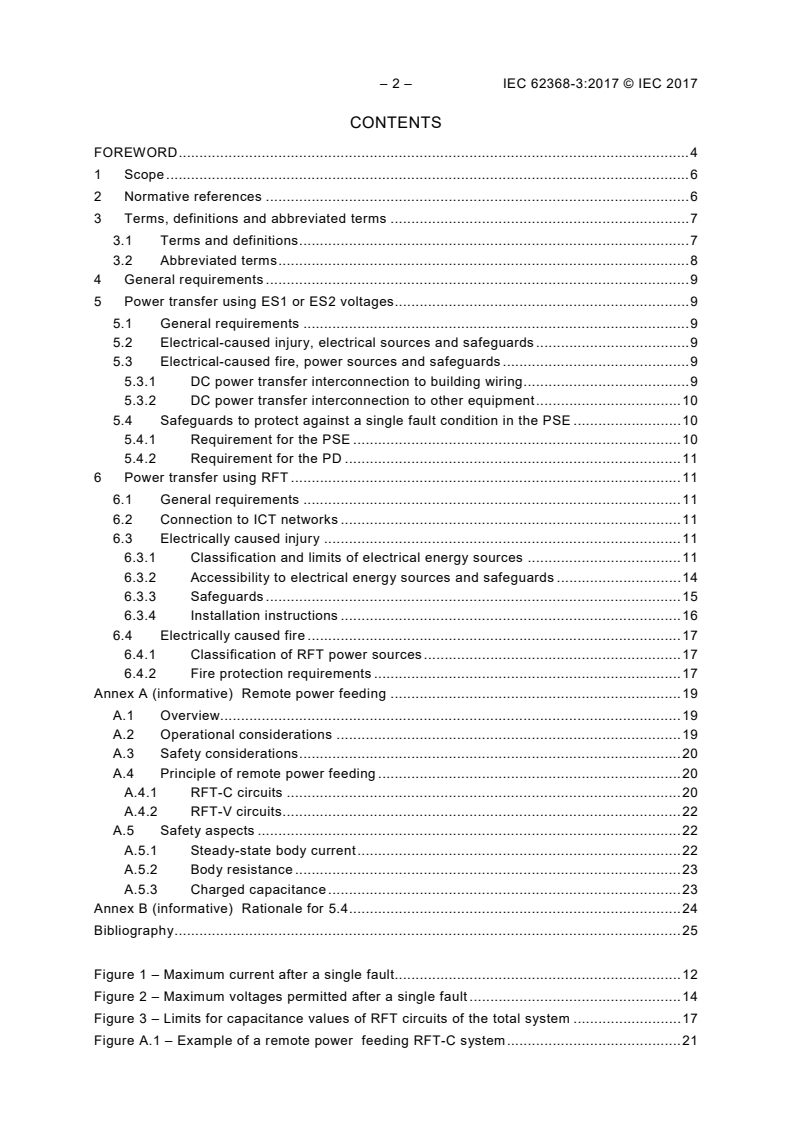
– 2 – IEC 62368-3:2017 © IEC 2017
CONTENTS
FOREWORD . 4
1 Scope . 6
2 Normative references . 6
3 Terms, definitions and abbreviated terms . 7
3.1 Terms and definitions . 7
3.2 Abbreviated terms . 8
4 General requirements . 9
5 Power transfer using ES1 or ES2 voltages . 9
5.1 General requirements . 9
5.2 Electrical-caused injury, electrical sources and safeguards . 9
5.3 Electrical-caused fire, power sources and safeguards . 9
5.3.1 DC power transfer interconnection to building wiring . 9
5.3.2 DC power transfer interconnection to other equipment . 10
5.4 Safeguards to protect against a single fault condition in the PSE . 10
5.4.1 Requirement for the PSE . 10
5.4.2 Requirement for the PD . 11
6 Power transfer using RFT . 11
6.1 General requirements . 11
6.2 Connection to ICT networks . 11
6.3 Electrically caused injury . 11
6.3.1 Classification and limits of electrical energy sources . 11
6.3.2 Accessibility to electrical energy sources and safeguards . 14
6.3.3 Safeguards . 15
6.3.4 Installation instructions . 16
6.4 Electrically caused fire . 17
6.4.1 Classification of RFT power sources . 17
6.4.2 Fire protection requirements . 17
Annex A (informative) Remote power feeding . 19
A.1 Overview. 19
A.2 Operational considerations . 19
A.3 Safety considerations . 20
A.4 Principle of remote power feeding . 20
A.4.1 RFT-C circuits . 20
A.4.2 RFT-V circuits . 22
A.5 Safety aspects . 22
A.5.1 Steady-state body current . 22
A.5.2 Body resistance . 23
A.5.3 Charged capacitance . 23
Annex B (informative) Rationale for 5.4 . 24
Bibliography . 25
Figure 1 – Maximum current after a single fault. 12
Figure 2 – Maximum voltages permitted after a single fault . 14
Figure 3 – Limits for capacitance values of RFT circuits of the total system . 17
Figure A.1 – Example of a remote power feeding RFT-C system . 21
Figure A.2 – Example of a remote power feeding RFT-C system with repeater . 21
Figure A.3 – Example of a remote power feeding RFT-V system . 22
Table 1 – RFT-V circuits, power and current limitations . 18
– 4 – IEC 62368-3:2017 © IEC 2017
INTERNATIONAL ELECTROTECHNICAL COMMISSION
____________
AUDIO/VIDEO, INFORMATION AND COMMUNICATION
TECHNOLOGY EQUIPMENT –
Part 3: Safety aspects for DC power transfer
through communication cables and ports
FOREWORD
1) The International Electrotechnical Commission (IEC) is a worldwide organization for standardization comprising
all national electrotechnical committees (IEC National Committees). The object of IEC is to promote
international co-operation on all questions concerning standardization in the electrical and electronic fields. To
this end and in addition to other activities, IEC publishes International Standards, Technical Specifications,
Technical Reports, Publicly Available Specifications (PAS) and Guides (hereafter referred to as "IEC
Publication(s)"). Their preparation is entrusted to technical committees; any IEC National Committee interested
in the subject dealt with may participate in this preparatory work. International, governmental and non-
governmental organizations liaising with the IEC also participate in this preparation. IEC collaborates closely
with the International Organization for Standardization (ISO) in accordance with conditions determined by
agreement between the two organizations.
2) The formal decisions or agreements of IEC on technical matters express, as nearly as possible, an international
consensus of opinion on the relevant subjects since each technical committee has representation from all
interested IEC National Committees.
3) IEC Publications have the form of recommendations for international use and are accepted by IEC National
Committees in that sense. While all reasonable efforts are made to ensure that the technical content of IEC
Publications is accurate, IEC cannot be held responsible for the way in which they are used or for any
misinterpretation by any end user.
4) In order to promote international uniformity, IEC National Committees undertake to apply IEC Publications
transparently to the maximum extent possible in their national and regional publications. Any divergence
between any IEC Publication and the corresponding national or regional publication shall be clearly indicated in
the latter.
5) IEC itself does not provide any attestation of conformity. Independent certification bodies provide conformity
assessment services and, in some areas, access to IEC marks of conformity. IEC is not responsible for any
services carried out by independent certification bodies.
6) All users should ensure that they have the latest edition of this publication.
7) No liability shall attach to IEC or its directors, employees, servants or agents including individual experts and
members of its technical committees and IEC National Committees for any personal injury, property damage or
other damage of any nature whatsoever, whether direct or indirect, or for costs (including legal fees) and
expenses arising out of the publication, use of, or reliance upon, this IEC Publication or any other IEC
Publications.
8) Attention is drawn to the Normative references cited in this publication. Use of the referenced publications is
indispensable for the correct application of this publication.
9) Attention is drawn to the possibility that some of the elements of this IEC Publication may be the subject of
patent rights. IEC shall not be held responsible for identifying any or all such patent rights.
International Standard IEC 62368-3 has been prepared by IEC technical committee 108:
Safety of electronic equipment within the field of audio/video, information technology and
communication technology.
The text of this International Standard is based on the following documents:
FDIS Report on voting
108/695/FDIS 108/696/RVD
Full information on the voting for the approval of this International Standard can be found in
the report on voting indicated in the above table.
This document has been drafted in accordance with the ISO/IEC Directives, Part 2.
This International Standard is to be used in conjunction with IEC 62368-1:2014.
It has the status of a group safety publication in accordance with IEC Guide 104.
The subclauses of IEC 62368-1 apply as far as reasonable. Where safety aspects are similar
to those of IEC 62368-1, the relevant clause or subclause of IEC 62368-1 is given for
reference in a note in the relevant subclause. Where a requirement in IEC 62368-3 refers to a
requirement or criterion of IEC 62368-1, a specific reference to IEC 62368-1 is made.
In this standard, the following print types are used:
– requirements proper and normative annexes: in roman type;
– compliance statements and test specifications: in italic type;
– notes and other informative matter: in smaller roman type;
– normative conditions within tables: in smaller roman type;
– terms that are defined in Clause 3 and in IEC 62368-1:2014: in bold type.
The following differing practices of a less permanent nature exist in the countries indicated
below.
– 6.1: other requirements apply regarding power transfer using RFT (US);
– 6.3.3.1: regarding separation from other circuits and parts, see note in 4.1.15 of
IEC 62368-1:2014 (Norway);
– A.1: RFT-V systems and requirements (North America).
A list of all parts in the IEC 62368 series, published under the general title Audio/video,
information and communication technology equipment, can be found on the IEC website.
The committee has decided that the contents of this document will remain unchanged until the
stability date indicated on the IEC website under "http://webstore.iec.ch" in the data related to
the specific document. At this date, the document will be
• reconfirmed,
• withdrawn,
• replaced by a revised edition, or
• amended.
– 6 – IEC 62368-3:2017 © IEC 2017
AUDIO/VIDEO, INFORMATION AND COMMUNICATION
TECHNOLOGY EQUIPMENT –
Part 3: Safety aspects for DC power transfer
through communication cables and ports
1 Scope
This part of IEC 62368 applies to equipment intended to supply and receive operating power
through communication cables or ports. It covers particular requirements for circuits that are
designed to transfer DC power from a power sourcing equipment (PSE) to a powered
device (PD).
The power transfer uses voltages at ES1 or ES2 or in very specific cases voltage levels at
ES3.
NOTE 1 ES1 can generally be assumed to have similar limits as non-hazardous voltage definitions used in other
standards (for example, SELV, PELV).
NOTE 2 ES2 can generally be assumed to have similar limits for single fault conditions as non-hazardous
voltage definitions used in other standards.
NOTE 3 PS2 circuits are generally expected to provide less than 100 W to an undefined load under both normal
operating conditions and single fault conditions.
EXAMPLES
– For power transfer using voltages at ES1: USB, PoE, ISDN S0, etc.
– For power transfer using voltages at ES2: analogue telephone during ringing, ISDN U, etc.
– For power transfer using voltages at ES3: power feeding used by communications service providers and
utilities communication circuits (for example, RFT circuits, such as line powered HDSLx, SHDSLx, VDSLx
and G.fast).
NOTE 4 Any cable provided with a connector defined by an industry standard that permits DC power transfer
between equipment is considered a communication cable even if communication does not take place. For example,
a USB cable can be used just to recharge a portable device battery.
This group safety publication is primarily intended to be used as a product safety standard for
the products mentioned in the scope, but shall also be used by technical committees in the
preparation of standards for products similar to those mentioned in the scope of this standard,
in accordance with the principles laid down in IEC Guide 104 and lSO/lEC Guide 51.
One of the responsibilities of a technical committee is, wherever applicable, to make use of
basic safety publications and/or group safety publications in the preparation of its publications.
2 Normative references
The following documents are referred to in the text in such a way that some or all of their
content constitutes requirements of this document. For dated references, only the edition
cited applies. For undated references, the latest edition of the referenced document (including
any amendments) applies.
IEC 62368-1:2014, Audio/video, information and communication technology equipment –
Part 1: Safety requirements
IEC Guide 104, The preparation of safety publications and the use of basic safety publications
and group safety publications
lSO/lEC Guide 51, Safety aspects – Guidelines for their inclusion in standards
3 Terms, definitions and abbreviated terms
3.1 Terms and definitions
For the purposes of this document, the terms and definitions given in IEC 62368-1:2014 and
the following apply.
ISO and IEC maintain terminological databases for use in standardization at the following
addresses:
– IEC Electropedia: available at http://www.electropedia.org/
– ISO Online browsing platform: available at http://www.iso.org/obp
3.1.1
power sourcing equipment
PSE
equipment, other than dedicated external power supply units intended to supply specific
equipment within the scope of IEC 62368-1, supplying DC power to other equipment through
communication cables or ports
Note 1 to entry: It should be noted that the IEEE 802.3-2015 standard has a similar but different definition.
Note 2 to entry: This note applies to the French language only.
3.1.2
powered device
PD
equipment supplied DC power by a PSE through communication cables or ports
Note 1 to entry: It should be noted that the IEEE 802.3-2015 standard has a similar but different definition.
Note 2 to entry: Some in line devices may just function as a PSE to inject power into the cable connecting to PD
equipment. IEEE 802.3-2015 identifies such devices as Midspan PSE.
Note 3 to entry: Some PD equipment may also have a PSE output to pass on unused power to other PD
equipment.
Note 4 to entry: This note applies to the French language only.
3.1.3
information and communication technology network
ICT network
metallically terminated transmission medium and its associated equipment and
communication cables
Note 1 to entry: The cable consists of two or more conductors intended for communication and/or power transfer
between the various pieces of equipment. The equipment may be located within the same or separate structures,
buildings or locations, excluding:
– the mains system for supply, transmission and distribution of electrical power, if used as a communication
transmission medium;
– a dedicated HBES/BACS network.
Note 2 to entry: This may include twisted pairs, and may include circuits, that are subjected to transients as
indicated by ID1 in Table 14 of IEC 62368-1:2014 (assumed to be 1,5 kV).
Note 3 to entry: An ICT network may be:
– publicly or privately owned;
– subject to longitudinal (common mode) voltages induced from nearby power lines or electric traction lines.
Note 4 to entry: Examples of ICT networks are:
– 8 – IEC 62368-3:2017 © IEC 2017
– a public switched telephone network;
– a public data network;
– an Integrated Services Digital Network (ISDN);
– a private network with electrical interface characteristics similar to the above.
Note 5 to entry: For information about circuit voltages and signals which may be present, see Annex B of
IEC 62949:2017.
Note 6 to entry: This note applies to the French language only.
3.1.4
RFT circuit
remote feeding telecommunication circuit
remote feeding communication circuit
equipment circuit within the ICT network not connected to an AC mains, intended to supply
or receive DC power at voltages exceeding the limits of ES2, and on which overvoltages may
occur
Note 1 to entry: Communication signalling is not required to be present on an RFT circuit.
Note 2 to entry: This note applies to the French language only.
3.1.5
RFT-C circuit
RFT circuit which is so designed and protected that under normal operating conditions and
single fault conditions, the currents in the circuit do not exceed defined values
Note 1 to entry: The limit values of current under normal operating conditions and single fault conditions are
specified in 6.3.1.1.
3.1.6
RFT-V circuit
RFT circuit which is so designed and protected that under normal operating conditions and
single fault conditions, the voltages are limited and the accessible area of contact is limited
Note 1 to entry: The limit values of voltage under normal operating conditions and single fault conditions are
specified in 6.3.1.2.
3.2 Abbreviated terms
BACS building automation and control system
HBES home and building electronic system
HDSL high bit-rate digital subscriber line
ICT information and communication technology
ISDN integrated services digital network
LPS limited power source
PD powered device
PoE power over ethernet
PSE power sourcing equipment
RFT remote feeding (tele)communication
SHDSL symmetric high bit-rate digital subscriber line
USB universal serial bus
VDSL very-high-bit-rate digital subscriber line
4 General requirements
For equipment serving as a PD or a PSE using voltages at ES1 or ES2, the requirements of
Clause 5 apply. However, Clause 5 does not apply to equipment used as PSE or PD with
proprietary connectors or where a proprietary protocol is used to enable the power transfer.
NOTE A proprietary connector is a connector not used in an industry standard and which is under the control of
one manufacturer.
For equipment serving as a PD or a PSE using RFT, the requirements of Clause 6 apply.
5 Power transfer using ES1 or ES2 voltages
5.1 General requirements
The maximum rated output voltage of the PSE under normal operating conditions shall not
exceed the rated limits of the intended communication systems power source functional
specifications under conditions of no load, normal load, and maximum rated load.
NOTE 1 For USB 2.0 and 3.1, the limits are 5,25 V. For a USB battery charger, the limit is 6 V. USB power
delivery can be rated up to 20 V max.
NOTE 2 Other ES1 and ES2 DC power transfer systems are under investigation.
Where a PD or PSE have the capability to both provide power and receive power, all the
requirements from 5.1 to 5.4 shall apply for each mode as applicable.
NOTE 3 Equipment can have multiple ports serving different PSE and PD roles simultaneously in any combination.
5.2 Electrical-caused injury, electrical sources and safeguards
The requirements of Clause 5 of IEC 62368-1:2014 apply for a PSE classified as ES1 and
ES2.
5.3 Electrical-caused fire, power sources and safeguards
5.3.1 DC power transfer interconnection to building wiring
To protect the communication cables, including building wiring, and other devices including
the PD, the PSE shall implement power limiting control to reduce the likelihood of ignition and
shall limit the output current to a value that does not cause damage to the wiring system.
To reduce the likelihood of ignition, the PSE circuit that provides power shall comply with the
requirements for a limited power source (LPS) of Clause Q.1 of IEC 62368 1:2014.
NOTE 1 This means that a fire enclosure is not normally required in the power feeding load circuits of the PD.
For interconnection of PSE circuits to other devices for DC power transfer via building wiring,
where it is unknown whether remotely attached devices comply with this document, the PSE
shall limit the output current to a value that does not cause damage to the wiring system due
to overheating, under any conditions of external load up to and including short circuits. The
maximum continuous current from the equipment shall not exceed a current limit that is
suitable for the minimum wire gauge specified in the equipment installation instructions.
For a PD that receives multiple power input circuits from one or more PSE, the PD also shall
implement power limiting in accordance with PS2 or Annex Q of IEC 62368-1:2014 to control
additive power from returning to another PSE under normal operating conditions, abnormal
operating conditions and single fault conditions.
NOTE 2 The requirement for single fault condition does not apply to an IC current limiter in compliance with
Clause G.9 of IEC 62368-1:2014.
– 10 – IEC 62368-3:2017 © IEC 2017
EXAMPLES of such PD equipment are: an analogue telephone, a security camera, a network switch or hub, or
devices outside the scope of IEC 62368-1 such as lighting or novelty items.
PSE circuits connected to external paired conductor cable, such as those described in
ID numbers 1 and 2 of Table 14 of IEC 62368-1:2014 having a minimum wire diameter of
0,4 mm, shall have the current limited to not more than 1,3 A.
Compliance is checked with 6.2 or Clause Q.1 of IEC 62368-1:2014.
NOTE 3 These safeguards typically apply to equipment that are not located in close proximity to each other, such
as those associated with power over Ethernet and similar communication cables.
5.3.2 DC power transfer interconnection to other equipment
For interconnection of DC power transfer PSE circuits to other equipment, via either direct
plug-in connectors or via fly leads, where it is unknown that the attached devices are likely to
comply with IEC 62368-1, the delivered power shall comply with either PS2 or Clause Q.1 of
IEC 62368-1:2014.
EXAMPLES for such equipment are a scanner, mouse, keyboard, DVD drive, CD-ROM drive, camera, network
switch or hub, or devices outside the scope of IEC 62368-1, such as lighting or novelty items.
Compliance is checked in accordance with 6.2 or Clause Q.1 of IEC 62368-1:2014.
For PSE circuits under abnormal operating conditions and single fault conditions in the
PSE, the available output power shall not exceed the specified fault current rating in the
power delivery specification. Where there is no prescribed maximum fault current specified for
the standardized interface, the available current shall not exceed the rated maximum output
current of the power delivery specification by more than:
– 50 % for circuits equal to or less than 2 A for more than 5 s; and
– 30 % for circuits greater than 2 A for more than 5 s; and
– shall not exceed 8,0 A under any circumstances.
For example, for USB PSE circuits under abnormal operating conditions and single fault
conditions in the PSE, a rated current of 3 A is specified in the USB power delivery
specification for USB Micro-A, Micro-AB and Micro-B connectors and a rated current of 1,8 A
in the USB 2.0 and USB 3.0 specification.
NOTE 1 Other USB specifications use higher values, such as 5 A or 6 A.
Compliance is checked by inspection and test.
NOTE 2 These safeguards typically apply to equipment and accessories located in close proximity to each other,
such as those associated with USB and similar communication cables.
5.4 Safeguards to protect against a single fault condition in the PSE
NOTE See Annex B for the rationale for 5.4.1 and 5.4.2.
5.4.1 Requirement for the PSE
Under single fault conditions in the PSE with a single output, the output voltage of the PSE
shall not exceed 130 % of the nominal rated output voltage and shall not exceed ES2 limits at
the relevant DC power transfer port of the PSE.
For PSEs that can deliver a range of different nominal output voltages via negotiation with the
PD (for example USB power delivery), if it is not always known what type of PD will be
attached, the voltage from the PSE under single fault conditions shall be limited to
– 130 % for circuits greater than 5 V (with a minimum of 7,5 V), and
– 150 % for circuits equal to or less than 5 V
of the nominal output voltage that was negotiated.
NOTE The USB power delivery specification power rules require the support by a PSE for 5 V (up to 15 W rating),
5 V/9 V (> 15 W and up to 27 W rating), 5 V/9 V/15 V (> 27 W and up to 45 W rating) and 5 V/9 V/15 V/20 V
(> 45 W and up to 100 W rating), with current not to exceed 3 A (up to 60 W rating) or 5 A (> 60 W at 20 V). Other
voltages are allowed in the specification provided that the required voltages and currents are supported for the
PSE rating. These rules supersede the previous "Profiles", and are normative (the previous profiles were optional
normative).
5.4.2 Requirement for the PD
The PD shall not create any hazard when supplied with
– 130 % of the nominal rated input voltage of the PD at the relevant DC power transfer port
for circuits greater than 5 V (with a minimum of 7,5 V); and
– 150 % of the nominal rated input voltage of the PD at the relevant DC power transfer port
for circuits equal to or less than 5 V.
Any consequential failure of components in the PD shall not create a hazard.
6 Power transfer using RFT
6.1 General requirements
NOTE 1 In the US, other requirements apply (see ITU-T K 50).
Power transfer with voltages at ES3 is a very specific technology used for supplying repeaters
and communication terminals via a long distance over communication cables and is known
under the term "remote feeding".
Access to the conductors of the RFT circuit is normally restricted to a skilled person.
Access by an instructed person is restricted in accordance with 5.3.2.1 and 5.3.2.2 of
IEC 62368-1:2014. Access by an ordinary person is not allowed.
NOTE 2 Clause 6 covers power feeding to remote equipment at voltages in excess of the voltage limits for ES2
(see Annex A).
6.2 Connection to ICT networks
An RFT circuit may be directly connected to an ICT network.
6.3 Electrically caused injury
6.3.1 Classification and limits of electrical energy sources
6.3.1.1 RFT-C circuit limits
6.3.1.1.1 General
Unless the current limits in 6.3.1.1.2 to 6.3.1.1.4 are inherently met, the RFT-C circuit should
have a monitoring and control device (for example, a balance control), that maintains the
required current limits.
6.3.1.1.2 Limits under normal operating conditions
Under normal operating conditions, an RFT-C circuit shall comply with all of the following.
a) The steady state current that can flow from the RFT-C circuit supply equipment into the
ICT network shall not exceed 60 mA DC under any load condition.
b) The steady state current that can flow from one conductor of the RFT-C circuit supply
equipment through the ICT network to earth shall not exceed 2 mA DC.
– 12 – IEC 62368-3:2017 © IEC 2017
c) The RFT-C circuit shall be limited to the voltage rating of the wiring of the ICT network, if
this voltage is known.
NOTE If the voltage rating of the wiring of the ICT network is not known, see 6.3.4 d).
d) The voltage rating of the insulation between conductors and from any conductor to earth in
an RFT-C circuit shall be co-ordinated with the maximum RFT-C circuit voltage in the
RFT-C circuit supply equipment, if this is known. If this is not known, the insulation shall
be suitable for 800 V DC.
This insulation level also applies to connectors.
Compliance is checked by inspection and measurement. Item 6.3.1.1.2 b) is checked by using
a resistor of 2 000 Ω ± 2 %.
6.3.1.1.3 Limits under single fault conditions
Under single fault conditions (see Clause B.4 of IEC 62368-1:2014) within a RFT-C circuit
supply equipment, or a failure of the insulation between one conductor of the ICT network
and earth, the current in an RFT-C circuit shall not exceed the line-to-earth and line-to-line
limits given in Figure 1. Moreover, the limits after 2 s are 25 mA and 60 mA, respectively.
Compliance is checked by inspection and measurement while simulating, one at a time, such
failures of components and insulations as are likely to occur in the equipment, and failure of
insulations between each connection point for the ICT network and earth. A resistor of
350 Ω ± 2 % is used between conductors and 2 000 Ω ± 2 % is used between one conductor
and earth. In Figure 1, the time is measured from the initiation of the failure.
1 000
0,01 0,1 1 10
Time (s)
Line to line
Line to earth
IEC
Figure 1 – Maximum current after a single fault
I (mA)
DC
6.3.1.1.4 Limits with one conductor earthed
If one conductor of an RFT-C circuit that normally connects to a ICT network is accidentally
earthed:
– the current between the other conductor and earth, measured through a 2 000 Ω ± 2 %
resistor, under any external load condition, shall not exceed the relevant line-to-earth limit
given in Figure 1 with a limit of 25 mA after 10 s; and
– the open circuit voltage between the other conductor and earth shall not exceed the
maximum RFT-C circuit voltage determined in 6.3.1.1.2 c) and 6.3.1.1.2 d). The
measurement is made after 2 s.
Compliance is checked by inspection and measurement.
6.3.1.2 RFT-V circuit limits
6.3.1.2.1 Limits under normal operating conditions
Under normal operating conditions, an RFT-V circuit shall comply with the following:
– the steady state open circuit voltage between earth and each conductor that normally
connects to an ICT network shall not exceed:
• 140 V DC, or
• 200 V DC, provided that a monitoring and control device is used that limits the current
to earth in accordance with 6.3.1.2.3;
– the voltage rating of the insulation of an RFT-V circuit receiving power via the ICT
network shall be suitable for 400 V DC between conductors and 200 V DC between any
conductor and earth.
Compliance is checked by inspection and measurement.
6.3.1.2.2 Limits under single fault conditions
Under single fault conditions (see Clause B.4 of IEC 62368-1:2014) within a RFT-V circuit
supply equipment, with and without any conductor of the RFT-V circuit that normally
connects to an ICT network being earthed:
– during the first 200 ms, the output voltage between each conductor and earth or between
conductors shall not exceed the limits of Figure 2, measured across a 5 000 Ω ± 2 %
resistor with all load circuits disconnected; and
– after the first 200 ms, the limits of 6.3.1.2.1 apply.
Compliance is checked by inspection and measurement while simulating failure of
components and insulation such as are likely to occur in the equipment.
– 14 – IEC 62368-3:2017 © IEC 2017
1 500 V peak
1 500
1 500
For 400 V < U < 1 500 V : 𝑈 =
𝑇
�
𝑇0
1 000
Steady state voltage
limits for ES2 as
given in Table 4 of
400 V peak or DC
IEC 62368-1:2014
0 1 5 10 14 15 200 205
Time T (ms)
U V
T ms
T 1 ms
IEC
Figure 2 – Maximum voltages permitted after a single fault
6.3.1.2.3 Limits with one conductor earthed
If one conductor of an RFT-V circuit that normally connects to a ICT network is earthed:
– the open circuit voltage between the other conductor and earth shall not exceed the
maximum RFT-V circuit supply voltage after 200 ms; and
– for RFT-V circuits whose open circuit voltage exceeds 140 V DC under normal operating
conditions, the current between the other conductor and earth, measured through a
2 000 Ω ± 2 % resistor, under any external load condition, shall not exceed the relevant
line-to-earth limit given in Figure 1. Moreover, this current shall not exceed 10 mA DC
after 10 s.
Compliance is checked by inspection and measurement.
6.3.2 Accessibility to electrical energy sources and safeguards
6.3.2.1 Accessibility for an ordinary person
NOTE See also 5.3.2 of IEC 62368-1:2014.
The equipment shall be so constructed that, for an ordinary person, there is adequate
protection against contact with bare parts of RFT circuits.
These requirements apply for all positions of the equipment when it is wired and operated as
in normal use.
Protection shall be achieved by insulation or by guarding or by the use of interlocks.
Compliance is checked as given in 5.3.2.3 of IEC 62368-1:2014.
Voltage (V)
6.3.2.2 Accessibility for an instructed person
NOTE See also 4.3.3 of IEC 62368-1:2014.
For equipment to be installed in a restricted access area (see 3.3.6.7 of IEC 62368-1:2104),
the requirements for an ordinary person apply, except that contact may be possible with the
bare parts of an RFT circuit by the blunt probe shown in Figure V.3 of IEC 62368-1:2014;
however, such parts shall be so located or guarded that unintentional contact is unlikely.
Compliance is checked by inspection and measurement. In deciding whether or not
unintentional contact is likely, account is taken of the need to gain access past, or near to,
the bare parts.
6.3.2.3 Accessibility for a skilled person
NOTE See also 4.3.4 and 5.3 of IEC 62368-1:2014.
For a skilled person, bare parts of RFT circuits shall be located or guarded so that
accidental shorting to parts at ES1 or to parts at ES2, for example, by tools or test probes
used by a skilled person, is unlikely.
Any guards required for compliance with this subclause shall be easily removable and
replaceable if removal is necessary for servicing.
Compliance is checked by inspection and measurement. In deciding whether or not
unintentional contact is likely, account is taken of the way a skilled person needs to gain
access past, or near to, the bare parts in order to service other parts.
6.3.3 Safeguards
6.3.3.1 Separation from other circuits and parts
Within the equipment, RFT circuits shall be separated from:
– other RFT circuits by functional insulation, provided that neither circuit exceeds the
limits of 6.3.1.1 and 6.3.1.2 if this insulation is short-circuited. Otherwise, the circuits shall
be separated as if one were at ES3;
– earthed accessible parts, earthed ES1 circuits and earthed ES2 circuits by basic
insulation;
NOTE 1 For requirements in Norway, see the note in 4.1.15 of IEC 62368-1:2014.
– unearthed accessible parts, unearthed ES1 circuits, unearthed ES2 circuits and ES3
circuits at by one or both of the following:
• double insulation or reinforced insulation;
• basic insulation, together with a conductive screen serving as protective bonding
conductor and connected to the main protective earthing terminal.
NOTE 2 For requirements in Norway, see the note in 4.1.15 of IEC 62368-1:2014.
Compliance is checked by inspection and measurement.
– 16 – IEC 62368-3:2017 © IEC 2017
6.3.3.2 Interconnection of equipment
6.3.3.2.1 General requirements
Interconnection circuits shall be selected to provide continued conformance to the
requirements of 6.3.1 for RFT circuits, after making connections.
An interconnecting cable may contain more than one type of circuit (for example, conductors
at ES1, ES2, ES3 or RFT-circuit voltages) provided that they are separated as required by
Clause 5 of IEC 62368-1:2014 and this document.
6.3.3.2.2 Interconnection between RFT circuits
RFT-C circuits in the supply equipment shall be connected only to RFT-C circuits in other
equipment.
RFT-V circuits in the supply equipment shall be connected only to RFT-V circuits in other
equipment.
For compliance, see 6.3.4 e).
6.3.4 Installation instructions
For equipment using an RFT circuit, the i
...