

IEC 62909-1:2017
(Main)Bi-directional grid connected power converters - Part 1: General requirements
General Information
- Abstract
IEC 62909-1:2017 specifies general aspects of bi-directional grid-connected power converters (GCPC), consisting of a grid-side inverter with two or more types of DC-port interfaces on the application side with system voltages not exceeding 1 000 V AC or 1 500 V DC. In special cases, a GCPC will have only one DC-port interface, which is connected to a bidirectional energy-storage device. This document includes terminology, specifications, performance, safety, system architecture, and test-case definitions. The "system architecture" defines interaction between the inverter and converters. Requirements which are common, general, and independent of special characteristics of individual generators and bi-directional storages are defined.
This document does not cover uninterruptible power supply (UPS) systems, which fall under the scope of IEC 62040 (all parts). Requirements for internal and external digital communication might be necessary; the interface requirements including communication with distributed energy resources are provided in a future part of IEC 62909. All EMC requirements are defined by reference to existing IEC standards. External communication requirements are out of scope of this document.
- Status
- Published
- Publication Date
- 18-May-2017
- Technical Committee
- SC 22E - Stabilized power supplies
- Drafting Committee
- WG 8 - TC 22/SC 22E/WG 8
Overview
IEC 62909-1:2017 sets the general requirements for bi-directional grid-connected power converters (GCPC). These converters include a grid-side inverter designed to interface with multiple types of DC ports and operate at system voltages up to 1000 V AC or 1500 V DC. The standard covers critical aspects such as terminology, performance specifications, safety, system design, and testing procedures for these power converters. It provides a foundational framework applicable regardless of the specific characteristics of the connected generators or energy storage devices. Notably, this standard excludes uninterruptible power supplies (UPS) covered under IEC 62040 and defers digital communication interfaces to future IEC 62909 parts. Electromagnetic compatibility (EMC) requirements are referenced by existing IEC standards.
Key Topics
- GCPC Architecture: Detailed definitions of system components, interfaces, and operating modes of bi-directional power converters, focusing on their interaction with distributed energy resources and energy storage devices.
- Performance Criteria: Specifications for DC connection interfaces, converters (including DC/DC converters and bi-directional inverters), and AC output performance accuracy, including harmonic distortion limits.
- Safety Measures: Comprehensive hazard protection including fault and abnormal condition handling, short-circuit and overload protection, electric shock safeguards, insulation requirements, and coordination with residual current devices (RCDs).
- Environmental and Mechanical Protection: Protection against fire, thermal hazards, mechanical stresses, environmental conditions, and sonic pressures to ensure safe and reliable operation.
- Testing Requirements: Defined testing procedures including visual, mechanical, electrical, abnormal operation, material, environmental, and hydrostatic pressure tests that validate conformance to performance and safety standards.
- Information and Marking: Guidelines for manufacturer declarations, installation, commissioning, usage, adjustment, maintenance information, and proper labeling to facilitate correct selection, integration, and safe operation.
Applications
IEC 62909-1 is essential for manufacturers, system integrators, and engineers involved in the design, production, and deployment of bi-directional grid-connected power converters. Typical applications include:
- Renewable energy systems employing energy storage and distributed generation.
- Smart grid technologies requiring bidirectional power flow for load balancing and grid stabilization.
- Battery energy storage systems with DC interfaces connected to AC grids.
- Industrial systems where safety and interoperability with grid infrastructure govern equipment design.
- Integration of distributed energy resources where standards-compliant converters ensure reliable, efficient, and safe bi-directional power transfer.
Related Standards
- IEC 62040 series – Standards on uninterrupted power supply (UPS) systems, which are excluded from IEC 62909-1 scope.
- EMC IEC standards – Referenced for electromagnetic compatibility requirements applicable to GCPCs.
- Future parts of IEC 62909 series – To specify communication interface requirements between converters and distributed energy resources.
By adhering to IEC 62909-1:2017, stakeholders guarantee that bi-directional grid-connected power converters meet international safety, performance, and operational standards, supporting robust and sustainable electrical power systems worldwide.
Relations
- Effective Date
- 05-Sep-2023
Get Certified
Connect with accredited certification bodies for this standard

IMQ S.p.A. (Certification)
Italian electrical product certification.

SLG Prüf- und Zertifizierungs GmbH
German testing and certification body.

UL Solutions
Global safety science company with testing, inspection and certification.
Sponsored listings
Frequently Asked Questions
IEC 62909-1:2017 is a standard published by the International Electrotechnical Commission (IEC). Its full title is "Bi-directional grid connected power converters - Part 1: General requirements". This standard covers: IEC 62909-1:2017 specifies general aspects of bi-directional grid-connected power converters (GCPC), consisting of a grid-side inverter with two or more types of DC-port interfaces on the application side with system voltages not exceeding 1 000 V AC or 1 500 V DC. In special cases, a GCPC will have only one DC-port interface, which is connected to a bidirectional energy-storage device. This document includes terminology, specifications, performance, safety, system architecture, and test-case definitions. The "system architecture" defines interaction between the inverter and converters. Requirements which are common, general, and independent of special characteristics of individual generators and bi-directional storages are defined. This document does not cover uninterruptible power supply (UPS) systems, which fall under the scope of IEC 62040 (all parts). Requirements for internal and external digital communication might be necessary; the interface requirements including communication with distributed energy resources are provided in a future part of IEC 62909. All EMC requirements are defined by reference to existing IEC standards. External communication requirements are out of scope of this document.
IEC 62909-1:2017 specifies general aspects of bi-directional grid-connected power converters (GCPC), consisting of a grid-side inverter with two or more types of DC-port interfaces on the application side with system voltages not exceeding 1 000 V AC or 1 500 V DC. In special cases, a GCPC will have only one DC-port interface, which is connected to a bidirectional energy-storage device. This document includes terminology, specifications, performance, safety, system architecture, and test-case definitions. The "system architecture" defines interaction between the inverter and converters. Requirements which are common, general, and independent of special characteristics of individual generators and bi-directional storages are defined. This document does not cover uninterruptible power supply (UPS) systems, which fall under the scope of IEC 62040 (all parts). Requirements for internal and external digital communication might be necessary; the interface requirements including communication with distributed energy resources are provided in a future part of IEC 62909. All EMC requirements are defined by reference to existing IEC standards. External communication requirements are out of scope of this document.
IEC 62909-1:2017 is classified under the following ICS (International Classification for Standards) categories: 19.040 - Environmental testing; 29.200 - Rectifiers. Convertors. Stabilized power supply. The ICS classification helps identify the subject area and facilitates finding related standards.
IEC 62909-1:2017 has the following relationships with other standards: It is inter standard links to IEC 62909-1:2025. Understanding these relationships helps ensure you are using the most current and applicable version of the standard.
IEC 62909-1:2017 is available in PDF format for immediate download after purchase. The document can be added to your cart and obtained through the secure checkout process. Digital delivery ensures instant access to the complete standard document.
Standards Content (Sample)
IEC 62909-1 ®
Edition 1.0 2017-05
INTERNATIONAL
STANDARD
NORME
INTERNATIONALE
colour
inside
Bi-directional grid-connected power converters –
Part 1: General requirements
Convertisseurs de puissance connectés aux réseaux bidirectionnels –
Partie 1: Exigences générales
All rights reserved. Unless otherwise specified, no part of this publication may be reproduced or utilized in any form
or by any means, electronic or mechanical, including photocopying and microfilm, without permission in writing from
either IEC or IEC's member National Committee in the country of the requester. If you have any questions about IEC
copyright or have an enquiry about obtaining additional rights to this publication, please contact the address below or
your local IEC member National Committee for further information.
Droits de reproduction réservés. Sauf indication contraire, aucune partie de cette publication ne peut être reproduite
ni utilisée sous quelque forme que ce soit et par aucun procédé, électronique ou mécanique, y compris la photocopie
et les microfilms, sans l'accord écrit de l'IEC ou du Comité national de l'IEC du pays du demandeur. Si vous avez des
questions sur le copyright de l'IEC ou si vous désirez obtenir des droits supplémentaires sur cette publication, utilisez
les coordonnées ci-après ou contactez le Comité national de l'IEC de votre pays de résidence.
IEC Central Office Tel.: +41 22 919 02 11
3, rue de Varembé Fax: +41 22 919 03 00
CH-1211 Geneva 20 info@iec.ch
Switzerland www.iec.ch
About the IEC
The International Electrotechnical Commission (IEC) is the leading global organization that prepares and publishes
International Standards for all electrical, electronic and related technologies.
About IEC publications
The technical content of IEC publications is kept under constant review by the IEC. Please make sure that you have the
latest edition, a corrigenda or an amendment might have been published.
IEC Catalogue - webstore.iec.ch/catalogue Electropedia - www.electropedia.org
The stand-alone application for consulting the entire The world's leading online dictionary of electronic and
bibliographical information on IEC International Standards, electrical terms containing 20 000 terms and definitions in
Technical Specifications, Technical Reports and other English and French, with equivalent terms in 16 additional
documents. Available for PC, Mac OS, Android Tablets and languages. Also known as the International Electrotechnical
iPad. Vocabulary (IEV) online.
IEC publications search - www.iec.ch/searchpub IEC Glossary - std.iec.ch/glossary
The advanced search enables to find IEC publications by a 65 000 electrotechnical terminology entries in English and
variety of criteria (reference number, text, technical French extracted from the Terms and Definitions clause of
committee,…). It also gives information on projects, replaced IEC publications issued since 2002. Some entries have been
and withdrawn publications. collected from earlier publications of IEC TC 37, 77, 86 and
CISPR.
IEC Just Published - webstore.iec.ch/justpublished
Stay up to date on all new IEC publications. Just Published IEC Customer Service Centre - webstore.iec.ch/csc
details all new publications released. Available online and If you wish to give us your feedback on this publication or
also once a month by email. need further assistance, please contact the Customer Service
Centre: csc@iec.ch.
A propos de l'IEC
La Commission Electrotechnique Internationale (IEC) est la première organisation mondiale qui élabore et publie des
Normes internationales pour tout ce qui a trait à l'électricité, à l'électronique et aux technologies apparentées.
A propos des publications IEC
Le contenu technique des publications IEC est constamment revu. Veuillez vous assurer que vous possédez l’édition la
plus récente, un corrigendum ou amendement peut avoir été publié.
Catalogue IEC - webstore.iec.ch/catalogue Electropedia - www.electropedia.org
Application autonome pour consulter tous les renseignements
Le premier dictionnaire en ligne de termes électroniques et
bibliographiques sur les Normes internationales,
électriques. Il contient 20 000 termes et définitions en anglais
Spécifications techniques, Rapports techniques et autres
et en français, ainsi que les termes équivalents dans 16
documents de l'IEC. Disponible pour PC, Mac OS, tablettes
langues additionnelles. Egalement appelé Vocabulaire
Android et iPad.
Electrotechnique International (IEV) en ligne.
Recherche de publications IEC - www.iec.ch/searchpub
Glossaire IEC - std.iec.ch/glossary
65 000 entrées terminologiques électrotechniques, en anglais
La recherche avancée permet de trouver des publications IEC
en utilisant différents critères (numéro de référence, texte, et en français, extraites des articles Termes et Définitions des
comité d’études,…). Elle donne aussi des informations sur les publications IEC parues depuis 2002. Plus certaines entrées
projets et les publications remplacées ou retirées. antérieures extraites des publications des CE 37, 77, 86 et
CISPR de l'IEC.
IEC Just Published - webstore.iec.ch/justpublished
Service Clients - webstore.iec.ch/csc
Restez informé sur les nouvelles publications IEC. Just
Published détaille les nouvelles publications parues. Si vous désirez nous donner des commentaires sur cette
Disponible en ligne et aussi une fois par mois par email. publication ou si vous avez des questions contactez-nous:
csc@iec.ch.
IEC 62909-1 ®
Edition 1.0 2017-05
INTERNATIONAL
STANDARD
NORME
INTERNATIONALE
colour
inside
Bi-directional grid-connected power converters –
Part 1: General requirements
Convertisseurs de puissance connectés aux réseaux bidirectionnels –
Partie 1: Exigences générales
INTERNATIONAL
ELECTROTECHNICAL
COMMISSION
COMMISSION
ELECTROTECHNIQUE
INTERNATIONALE
ICS 29.200 ISBN 978-2-8322-4365-7
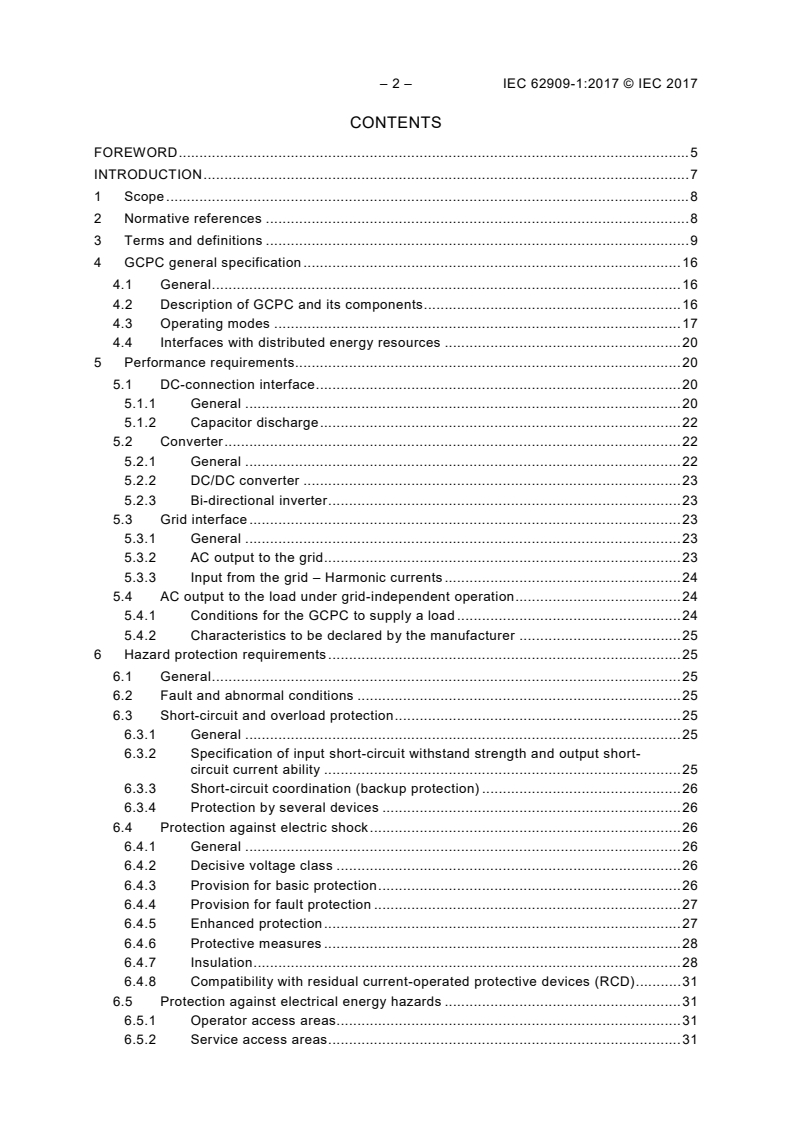
– 2 – IEC 62909-1:2017 © IEC 2017
CONTENTS
FOREWORD . 5
INTRODUCTION . 7
1 Scope . 8
2 Normative references . 8
3 Terms and definitions . 9
4 GCPC general specification . 16
4.1 General . 16
4.2 Description of GCPC and its components . 16
4.3 Operating modes . 17
4.4 Interfaces with distributed energy resources . 20
5 Performance requirements. 20
5.1 DC-connection interface . 20
5.1.1 General . 20
5.1.2 Capacitor discharge . 22
5.2 Converter . 22
5.2.1 General . 22
5.2.2 DC/DC converter . 23
5.2.3 Bi-directional inverter . 23
5.3 Grid interface . 23
5.3.1 General . 23
5.3.2 AC output to the grid . 23
5.3.3 Input from the grid – Harmonic currents . 24
5.4 AC output to the load under grid-independent operation . 24
5.4.1 Conditions for the GCPC to supply a load . 24
5.4.2 Characteristics to be declared by the manufacturer . 25
6 Hazard protection requirements . 25
6.1 General . 25
6.2 Fault and abnormal conditions . 25
6.3 Short-circuit and overload protection . 25
6.3.1 General . 25
6.3.2 Specification of input short-circuit withstand strength and output short-
circuit current ability . 25
6.3.3 Short-circuit coordination (backup protection) . 26
6.3.4 Protection by several devices . 26
6.4 Protection against electric shock . 26
6.4.1 General . 26
6.4.2 Decisive voltage class . 26
6.4.3 Provision for basic protection . 26
6.4.4 Provision for fault protection . 27
6.4.5 Enhanced protection . 27
6.4.6 Protective measures . 28
6.4.7 Insulation . 28
6.4.8 Compatibility with residual current-operated protective devices (RCD) . 31
6.5 Protection against electrical energy hazards . 31
6.5.1 Operator access areas. 31
6.5.2 Service access areas . 31
6.6 Protection against fire and thermal hazards . 31
6.6.1 Circuits representing a fire hazard . 31
6.6.2 Components representing a fire hazard . 31
6.6.3 Fire enclosures . 32
6.6.4 Temperature limits . 32
6.6.5 Limited power sources . 32
6.7 Protection against mechanical hazards . 32
6.7.1 General . 32
6.7.2 Liquid cooled GCPC . 32
6.8 Equipment with multiple sources of supply . 33
6.9 Protection against environmental stresses . 33
6.10 Protection against sonic pressure hazards . 33
6.10.1 General . 33
6.10.2 Sonic pressure and sound level . 33
6.11 Wiring and connections . 33
6.11.1 General . 33
6.11.2 Routing . 34
6.11.3 Colour coding . 34
6.11.4 Splices and connections . 34
6.11.5 Accessible connections . 34
6.11.6 Interconnections between parts of the GCPC . 34
6.11.7 Supply connections. 34
6.11.8 Terminals . 34
6.12 Enclosures . 34
6.12.1 General . 34
6.12.2 Handles and manual controls . 34
6.12.3 Cast metal . 34
6.12.4 Sheet metal . 34
6.12.5 Stability test for enclosure . 35
7 Test requirements . 35
7.1 General . 35
7.1.1 Test objectives and classification . 35
7.1.2 Selection of test samples . 35
7.1.3 Sequence of tests . 35
7.1.4 Earthing conditions . 35
7.1.5 General conditions for tests . 35
7.1.6 Compliance . 35
7.1.7 Test overview . 35
7.2 Test specifications . 35
7.2.1 Visual inspections (type test, sample test and routine test) . 35
7.2.2 Mechanical tests . 35
7.2.3 Electrical tests . 36
7.2.4 Abnormal operation and simulated faults tests . 38
7.2.5 Material tests . 40
7.2.6 Environmental tests (type tests) . 40
7.2.7 Hydrostatic pressure test (type test and routine test) . 41
8 Information and marking requirements . 41
8.1 General . 41
8.2 Information for selection . 41
– 4 – IEC 62909-1:2017 © IEC 2017
8.3 Information for installation and commissioning . 41
8.3.1 General . 41
8.3.2 Mechanical considerations . 41
8.3.3 Environment . 41
8.3.4 Handling and mounting . 41
8.3.5 Enclosure temperature. 41
8.3.6 Connections . 41
8.3.7 Protection requirements . 42
8.3.8 Commissioning . 42
8.4 Information for use . 42
8.4.1 General . 42
8.4.2 Adjustment . 43
8.4.3 Labels, signs and signals . 43
8.5 Information for maintenance . 43
8.5.1 General . 43
8.5.2 Capacitor discharge . 43
8.5.3 Auto restart/bypass connection . 43
8.5.4 Other hazards . 43
8.5.5 Equipment with multiple sources of supply . 43
Bibliography . 44
Figure 1 – Example of GCPC structure . 17
Figure 2 – Power flow of mode I . 18
Figure 3 – Power flow of mode II . 19
Figure 4 – Power flow of mode III . 19
Figure 5 – Power flow of mode IV . 20
Figure 6 – Examples of DC-connection interface voltage range . 21
Table 1 – Alphabetical list of terms . 9
INTERNATIONAL ELECTROTECHNICAL COMMISSION
____________
BI-DIRECTIONAL GRID-CONNECTED POWER CONVERTERS –
Part 1: General requirements
FOREWORD
1) The International Electrotechnical Commission (IEC) is a worldwide organization for standardization comprising
all national electrotechnical committees (IEC National Committees). The object of IEC is to promote
international co-operation on all questions concerning standardization in the electrical and electronic fields. To
this end and in addition to other activities, IEC publishes International Standards, Technical Specifications,
Technical Reports, Publicly Available Specifications (PAS) and Guides (hereafter referred to as “IEC
Publication(s)”). Their preparation is entrusted to technical committees; any IEC National Committee interested
in the subject dealt with may participate in this preparatory work. International, governmental and non-
governmental organizations liaising with the IEC also participate in this preparation. IEC collaborates closely
with the International Organization for Standardization (ISO) in accordance with conditions determined by
agreement between the two organizations.
2) The formal decisions or agreements of IEC on technical matters express, as nearly as possible, an international
consensus of opinion on the relevant subjects since each technical committee has representation from all
interested IEC National Committees.
3) IEC Publications have the form of recommendations for international use and are accepted by IEC National
Committees in that sense. While all reasonable efforts are made to ensure that the technical content of IEC
Publications is accurate, IEC cannot be held responsible for the way in which they are used or for any
misinterpretation by any end user.
4) In order to promote international uniformity, IEC National Committees undertake to apply IEC Publications
transparently to the maximum extent possible in their national and regional publications. Any divergence
between any IEC Publication and the corresponding national or regional publication shall be clearly indicated in
the latter.
5) IEC itself does not provide any attestation of conformity. Independent certification bodies provide conformity
assessment services and, in some areas, access to IEC marks of conformity. IEC is not responsible for any
services carried out by independent certification bodies.
6) All users should ensure that they have the latest edition of this publication.
7) No liability shall attach to IEC or its directors, employees, servants or agents including individual experts and
members of its technical committees and IEC National Committees for any personal injury, property damage or
other damage of any nature whatsoever, whether direct or indirect, or for costs (including legal fees) and
expenses arising out of the publication, use of, or reliance upon, this IEC Publication or any other IEC
Publications.
8) Attention is drawn to the Normative references cited in this publication. Use of the referenced publications is
indispensable for the correct application of this publication.
9) Attention is drawn to the possibility that some of the elements of this IEC Publication may be the subject of
patent rights. IEC shall not be held responsible for identifying any or all such patent rights.
International Standard IEC 62909-1 has been prepared by subcommittee 22E: Stabilized
power supplies, of IEC technical committee 22: Power electronic systems and equipment.
The text of this International Standard is based on the following documents:
FDIS Report on voting
22E/182/FDIS 22E/183/RVD
Full information on the voting for the approval of this International Standard can be found in
the report on voting indicated in the above table.
This document has been drafted in accordance with the ISO/IEC Directives, Part 2.
– 6 – IEC 62909-1:2017 © IEC 2017
This publication is to be read in conjunction with IEC 62477-1:2012. It follows the structure of
IEC 62477-1:2012 and supplements or modifies its corresponding clauses. Wherever the term
"PECS" appears in the cited clauses, it needs to be replaced by "GCPC".
A list of all parts in the IEC 62909 series, published under the general title Bi-directional grid
connected power converters, can be found on the IEC website.
The committee has decided that the contents of this document will remain unchanged until the
stability date indicated on the IEC website under "http://webstore.iec.ch" in the data related to
the specific document. At this date, the document will be
• reconfirmed,
• withdrawn,
• replaced by a revised edition, or
• amended.
IMPORTANT – The 'colour inside' logo on the cover page of this publication indicates
that it contains colours which are considered to be useful for the correct
understanding of its contents. Users should therefore print this document using a
colour printer.
INTRODUCTION
The solution to global warming and fossil fuel depletion requires an expansion of renewable
energy and the spread of distributed energy resources, with the new infrastructure containing
micro-grids and smaller-scale nano-grids. Nano-grid systems are especially suited to
increasing energy-usage efficiency and reducing power consumption of homes by combining
and optimally controlling energy storage with generators.
In order to optimize the power consumption within the nano-grid of a home, it is necessary to
supply the electricity its residents require by combining and optimizing an electricity generator
with rechargeable energy storage. Independent generators and battery storage units are
already on the market; but, for such new systems, development has just started. Although
power generation sources and storage batteries are generally expensive, the tendency of that
is still more remarkable in the early stage in which a market is formed. For stable growth of a
market, extendibility, compatibility, and robustness of such system are especially important. If
a connecting interface is standardized and compatibility is insured, many products can be put
onto the market and their prices can be kept at a proper level. If a new standard is utilized for
product certification, their broad acceptance can be earlier and greater. From the above
viewpoint, it is necessary to promptly advance standardization of bi-directional grid-connected
power converter (GCPC) which combined the source of power generation and the storage
battery. This part of IEC 62909 provides common general requirements independent of
special characteristics of individual applications.
– 8 – IEC 62909-1:2017 © IEC 2017
BI-DIRECTIONAL GRID-CONNECTED POWER CONVERTERS –
Part 1: General requirements
1 Scope
This part of IEC 62909 specifies general aspects of bi-directional grid-connected power
converters (GCPC), consisting of a grid-side inverter with two or more types of DC-port
interfaces on the application side with system voltages not exceeding 1 000 V AC or
1 500 V DC. In special cases, a GCPC will have only one DC-port interface, which is
connected to a bidirectional energy-storage device. This document includes terminology,
specifications, performance, safety, system architecture, and test-case definitions. The
"system architecture" defines interaction between the inverter and converters. Requirements
which are common, general, and independent of special characteristics of individual
generators and bi-directional storages are defined.
This document does not cover uninterruptible power supply (UPS) systems, which fall under
the scope of IEC 62040 (all parts). Requirements for internal and external digital
communication might be necessary; the interface requirements including communication with
distributed energy resources are provided in a future part of IEC 62909. All EMC requirements
are defined by reference to existing IEC standards. External communication requirements are
out of scope of this document.
NOTE The control signal from the grid is not defined in this document.
2 Normative references
The following documents are referred to in the text in such a way that some or all of their
content constitutes requirements of this document. For dated references, only the edition
cited applies. For undated references, the latest edition of the referenced document (including
any amendments) applies.
IEC 60038:2009, IEC standard voltages
IEC 60146-2:1999, Semiconductor converters – Part 2: Self-commutated semiconductor
converters including direct d.c converters
IEC 61000-3-2:2014, Electromagnetic compatibility (EMC) – Part 3-2: Limits – Limits for
harmonic current emissions (equipment input current ≤ 16 A per phase)
IEC 61000-3-12:2011, Electromagnetic compatibility (EMC) – Part 3-12: Limits – Limits for
harmonic currents produced by equipment connected to public low-voltage systems with input
current >16 A and ≤ 75 A per phase
IEC 61727:2004, Photovoltaic (PV) systems – Characteristics of the utility interface
IEC 62109-1:2010, Safety of power converters for use in photovoltaic power systems – Part 1:
General requirements
IEC 62040-3:2011, Uninterruptible power systems (UPS) – Part 3: Method of specifying the
performance and test requirements
IEC 62477-1:2012, Safety requirements for power electronic converter systems and
equipment – Part 1: General
IEC 62477-1:2012/AMD1:2016
3 Terms and definitions
For the purposes of this document, the following terms and definitions apply.
ISO and IEC maintain terminological databases for use in standardization at the following
addresses:
• IEC Electropedia: available at http://www.electropedia.org/
• ISO Online browsing platform: available at http://www.iso.org/obp
Table 1 provides an alphabetical cross-reference listing of terms.
Table 1 – Alphabetical list of terms
Term Term Term
Term Term Term
number number number
basic insulation 3.1 bi-directional grid 3.19 protective equipotential 3.38
connected power bonding
converter
basic protection 3.2 grid-independent 3.20 protective impedance 3.39
operation
bi-directional 3.3 grid isolation 3.21 protective screening 3.40
inverter
DC-connection 3.4 grid side interface 3.22 protective separation 3.41
interface
DC-port interface 3.5 hot plug 3.23 reinforced insulation 3.42
DC/DC converter 3.6 installation 3.24 routine test 3.43
decisive voltage 3.7 live part 3.25 sample test 3.44
class
double insulation 3.8 mains supply 3.26 SELV 3.45
distributed energy 3.9 modulation index 3.27 simple separation 3.46
resources
DVC Ax 3.10 nominal operation voltage 3.28 start-up maximum 3.47
range current
enclosure 3.11 non-mains supply 3.29 supplementary insulation 3.48
enhanced protection 3.12 PE conductor 3.30 system 3.49
extra low voltage 3.13 PELV 3.31 system voltage 3.50
fault protection 3.14 power electronic 3.32 touch current 3.51
converter
fire enclosure 3.15 power factor 3.33 type test 3.52
functional insulation 3.16 protective class I 3.34 withstand voltage 3.53
grid 3.17 protective class II 3.35 working voltage 3.54
grid connection 3.18 protective class III 3.36
protective earthing 3.37
3.1
basic insulation
insulation applied to hazardous live parts to provide basic protection against electric shock
– 10 – IEC 62909-1:2017 © IEC 2017
[SOURCE: IEC 60050-195:1998, 195-06-06, modified – The definition has been rephrased,
the expression "against electric shock" has been added and the note has been deleted.]
3.2
basic protection
protection against electric shock under fault-free conditions
[SOURCE: IEC 60050-195:1998, 195-06-01]
3.3
bi-directional inverter
equipment capable of converting active electrical power from AC to DC and DC to AC
3.4
DC-connection interface
internal system DC bus between power electronic converters and bi-directional inverter
3.5
DC-port interface
interface between the DC/DC converter and distributed energy resources or, in the case
where the DC-connection interface is directly connected to distributed energy resources
without DC/DC converter, between the DC-connection interface and the distributed energy
resources
3.6
DC/DC converter
equipment that converts one DC voltage to another DC voltage
3.7
decisive voltage class
DVC
classification of voltage range used to determine the necessary protective measures from
electric shock and the requirements of insulation between circuits
[SOURCE: IEC 62477-1:2012, 3.5, modified – The adjective "necessary" has been added.]
3.8
double insulation
insulation comprising both basic insulation and supplementary insulation
[SOURCE: IEC 60050-826:2004, 826-12-16]
3.9
distributed energy resources
DC power sources generating and/or storing electricity near the consuming area
Note 1 to entry: Examples of distributed energy resources include, but is not limited to, photovoltaic cells, fuel
cells, wind and water power generators, primary batteries, accumulators (e.g. in electrical vehicles), etc.
3.10
DVC Ax
general DVC value used for DVC A, DVC A1, DVC A2 or DVC A3
[SOURCE: IEC 62477-1:2012, 3.8, modified – The definition has been rephrased.]
3.11
enclosure
housing affording the type and degree of protection suitable for the intended application
[SOURCE: IEC 60050-195:1998, 195-02-35]
3.12
enhanced protection
protective provision having a reliability of protection not less than that provided by two
independent protective provisions
[SOURCE: IEC 62477-1:2012, 3.13]
3.13
extra-low voltage
ELV
voltage not exceeding the relevant voltage limit of band I specified in IEC 60449
Note 1 to entry: In IEC 60449, band I is defined as not exceeding 50 V AC RMS and 120 V DC. Other product
committees may have defined ELV with different voltage levels.
Note 2 to entry: In this document, protection against electric shock is dependent on DVC.
[SOURCE: IEC 60050-826:2004, 826-12-30, modified – Note 1 and Note 2 to entry have been
added.]
3.14
fault protection
protection against electric shock under single-fault conditions
[SOURCE: IEC 62477-1:2012, 3.16, modified – Note 1 to entry has been deleted.]
3.15
fire enclosure
part of the equipment intended to minimize the spread of fire or flames from within
[SOURCE: IEC 62477-1:2012, 3.18]
3.16
functional insulation
insulation between conductive parts within a circuit that is necessary for the proper
functioning of the circuit, but which does not provide protection against electric shock
[SOURCE: IEC 62477-1:2012, 3.19, modified – Note 1 to entry has been deleted.]
3.17
grid
electric utility’s power system
3.18
grid connection
distributed energy resources’ connection to the grid through GCPC
– 12 – IEC 62909-1:2017 © IEC 2017
3.19
bi-directional grid-connected power converter
grid-connected power converter
GCPC
power converter connected to the grid by bi-directional inverter with multiple DC-port
interfaces
3.20
grid-independent operation
electricity supply through GCPC to an AC load during grid isolation
3.21
grid isolation
disconnection of GCPC from the grid
3.22
grid side interface
interface of bi-directional inverter connecting to mains supply
3.23
hot plug
connection of PEC when GCPC is operating and when power is flowing
3.24
installation
equipment including at least one GCPC
[SOURCE: IEC 62477-1:2012, 3.21, modified – "the PECS" has been replaced by "one
GCPC" and Note 1 to entry has been deleted.]
3.25
live part
conductor or conductive part intended to be energized in normal operation, including a neutral
conductor, but by convention not a protective earth conductor or protective earth neutral
conductor
[SOURCE: IEC 60050-195:1998, 195-02-19, modified – The words "a PEN conductor or PEM
conductor or PEL conductor" have been replaced by "a protective earth conductor or
protective earth neutral conductor" in the second part of the definition.]
3.26
mains supply
low voltage (< 1 000 V) AC power distribution system for supplying power to AC equipment
[SOURCE: IEC 62477-1:2012, 3.24, modified – The brackets "(< 1 000 V)" have been added.]
3.27
modulation index
ratio of the grid side voltage to DC-connection interface voltage of bi-directional inverter
3.28
nominal operation voltage range
DC-connection interface voltage range in which power electric converters in GCPC normally
operate
3.29
non-mains supply
electrical circuit that is not energized directly from the mains supply
Note 1 to entry: For example, a circuit isolated by a transformer or supplied by a battery, generator, or similar
sources not directly connected to the AC power distribution system.
3.30
PE conductor
conductor in the installation wiring, or in the power supply cord, connecting a main protective
earthing terminal in the equipment to an earth point in the installation for safety purposes
[SOURCE: IEC 62477-1:2012, 3.41, modified – The term "building" has been deleted".]
3.31
PELV
electric system in which the voltage cannot exceed the value of extra low voltage:
– under normal conditions; and
– under single fault conditions, except earth faults in other electric circuits
[SOURCE: IEC 60050-826:2004, 826-12-32, modified – The term "system" has been deleted
in the defined term, as well as the note to entry.]
3.32
power electronic converter
PEC
device or part thereof for the purpose of electronic power conversion, including signalling,
measurement, control circuitries and other parts, if essential for the power conversion function
Note 1 to entry: In this document, PEC represents a “bi-directional inverter” or a “DC/DC converter”.
[SOURCE: IEC 62477-1:2012, 3.45, modified – Note 1 to entry has been added.]
3.33
power factor
PF
ratio of the kilowatt-hours (kWh) to the square root of the sum of the squares of the kilowatt-
hours and the kilovarhours (kVARh) over a period of time:
E
REAL
PF=
2 2
E +E
REAL REACTIVE
where
E is the energy in kWh;
REAL
E is the reactive energy in kVARh
REACTIVE
[SOURCE: IEC 61727:2004, 3.1, modified – The definition has been rephrased.]
3.34
protective class I
protection against electric shock that does not only rely on basic insulation, but also includes
the means for connection of accessible conductive parts to the PE in the fixed wiring of the
installation, so that accessible conductive parts cannot become live in the event of a failure of
the basic insulation
[SOURCE: IEC 62477-1:2012, 3.37, modified – The definition has been rephrased.]
– 14 – IEC 62909-1:2017 © IEC 2017
3.35
protective class II
protection against electric shock that does not only rely on basic insulation, but also
supplementary insulation or reinforced insulation, there being no provision for protective
earthing or reliance upon inaccessibility
[SOURCE: IEC 62477-1:2012, 3.38, modified – The definition has been rephrased and
"installation conditions" has been replaced by "inaccessibility".]
3.36
protective class III
protection against electric shock that relies on supply at DVC Ax (or B under certain
conditions) and in which voltages higher than those of DVC Ax (B) are not generated and
there is no provision for protective earthing
[SOURCE: IEC 62477-1:2012, 3.39, modified – The definition has been rephrased and Note 1
to entry has been deleted.]
3.37
protective earthing
PE
earthing of a point in a system, or equipment, for protection against electric shock in case of a
fault
[SOURCE: IEC 62477-1: 2012, 3.40]
3.38
protective equipotential bonding
equipotential bonding for purposes of safety from electric shock
[SOURCE: IEC 62477-1:2012, 3.36, modified – The hyphens have been deleted from the
defined term and the brackets "(e.g. protection against electric shock)" have been replaced by
"from electric shock".]
3.39
protective impedance
impedance between hazardous live parts and accessible conductive parts, of such value that
the current, in normal use and under likely fault conditions, is limited to a safe value, and
which is so constructed that its ability is maintained throughout the life of the equipment
[SOURCE: IEC 62477-1:2012, 3.42, modified – The adjective "connected" has been deleted in
the expression "impedance connected between…".]
3.40
protective screening
separation of circuits from hazardous live-parts by means of an interposed conductive screen,
connected to the means of connection for a PE conductor, either directly or via protective
equipotential bonding
[SOURCE: IEC 62477-1:2012, 3.43, modified – The word "(electrically)" has been deleted
from the defined term.]
3.41
protective separation
separation of one electric circuit from another by means of:
• double insulation or
• basic insulation and electrically protective screening or
• reinforced insulation
[SOURCE: IEC 62477-1:2012, 3.44, modified – The word "(electrically)" has been deleted
from the defined term.]
3.42
reinforced insulation
insulation of hazardous-live-parts which provides a degree of protection against electric shock
equivalent to double insulation
[SOURCE: IEC 60664-1:2007, 3.17.5, modified – The note to entry has been deleted.]
3.43
routine test
test to which each individual device is subjected during or after manufacture to ascertain
whether it complies with certain criteria
[SOURCE: IEC 60050-411:1996, 411-53-02, modified – The term "machine" has been
replaced by the term "device".]
3.44
sample test
test on a number of devices taken at random from a batch
[SOURCE: IEC 62477-1:2012, 3.50]
3.45
SELV
electric system in which the voltage cannot exceed the value of extra-low voltage:
– under normal conditions and
– under single fault conditions, including earth faults in other electric circuits
[SOURCE: IEC 60050-826:2004, 826.12.31, modified – The term "system" has been deleted
in the defined term, as well as the note to entry.]
3.46
simple separation
separation between electric circuits or between an electric circuit and local earth by means of
basic insulation
[SOURCE: IEC 60050-826:2004, 826.12.28]
3.47
start-up maximum current
maximum current consumed by GCPC during the time interval between the start of GCPC and
reaching the nominal operation voltage range of the DC-connection interface
3.48
supplementary insulation
independent insulation applied in addition to basic insulation for fault protection
[SOURCE: IEC 60664-1:2007, 3.17.3]
– 16 – IEC 62909-1:2017 © IEC 2017
3.49
system
set of interrelated and/or interconnected independent elements
[SOURCE: IEC 6247
...