

ISO/IEC 15045-1:2004
(Main)Information technology - Home electronic system (HES) gateway - Part 1: A residential gateway model for HES
General Information
- Abstract
The Residential Gateway (RG) is a device of the Home Electronic System (HES) that connects home network domains to network domains outside the house. It supports communications among devices within the premises, and among systems, service providers, operators and users outside the premises. The RG enables service and content providers to deliver services such as entertainment, video and broadband digital streams, monitoring for health care, security and occupancy, home appliance control and preventive maintenance, remote metering, and energy management. The RG specified by this standard does not imply the use of any particular protocol such as IP and it is recognised that many forms of the RG will exist using many types of data such as analogue video and broadband digital streams.
- Status
- Published
- Publication Date
- 21-Jan-2004
- Technical Committee
- ISO/IEC JTC 1/SC 25 - Interconnection of information technology equipment
- Current Stage
- PPUB - Publication issued
- Start Date
- 22-Jan-2004
- Completion Date
- 15-Sep-2003

Overview
ISO/IEC 15045-1:2004 - Information technology - Home electronic system (HES) gateway - Part 1: A residential gateway model for HES defines a model and functional requirements for the Residential Gateway (RG) that links Home Area Networks (HANs) to Wide Area Networks (WANs). The standard adopts a black‑box approach: it specifies the gateway’s interfaces, safety and security requirements, and interoperability goals without mandating particular protocols (for example, it does not require IP). It covers both analogue and digital media and supports multiple physical and modular configurations, including single, modular and distributed RG implementations.
Key Topics
- Scope & model: Role of the RG in connecting devices, service providers and operators to deliver content and services into the home.
- Functional requirements: Interfacing (WAN/HAN), protocol conversion, address translation (WAN→HAN, HAN→HAN), information transfer and auxiliary services.
- Conformance: Basic and optional function clauses to guide compliance testing and declarations.
- Functional safety: Requirements for safe command delivery, blocking capability, discriminative blocking and feedback mechanisms to prevent hazardous conditions.
- Privacy & security: Threat analysis, information security, defence measures (authentication, access control, logging, resource management), mitigation of external attacks, and IP‑specific security considerations.
- Architecture guidance (informative annex): Domains, component parts, internal processes and structural implementations (unit, modular, distributed).
- Interoperability focus: Ensures devices and external services interwork regardless of internal implementation or transport types (analogue/digital).
Applications
ISO/IEC 15045-1:2004 is practical for anyone designing, deploying or managing home network gateways and services. Typical applications include:
- Delivery of entertainment, video and broadband digital streams.
- Remote monitoring for health care, home security and occupancy sensing.
- Home automation and appliance control, preventive maintenance and HVAC control.
- Remote metering and energy management integration with utility services.
- Supporting service provider portals, micro‑payments and subscription services while protecting safety and privacy.
Who should use this standard
- Residential gateway manufacturers and embedded device vendors.
- Service providers and content distributors integrating home services.
- System integrators and installers of smart home and energy management systems.
- Security architects and compliance teams defining gateway security policies.
- Standards bodies and test labs assessing conformance and interoperability.
Related Standards
The document references and complements existing functional safety and information security standards (it does not replace them). It is intended to be applied alongside other protocol and safety standards relevant to HAN/WAN deployments.
Keywords: ISO/IEC 15045-1:2004, residential gateway, HES gateway, home area network (HAN), WAN, interoperability, functional safety, gateway security, protocol conversion, address translation.
Get Certified
Connect with accredited certification bodies for this standard

BSI Group
BSI (British Standards Institution) is the business standards company that helps organizations make excellence a habit.

NYCE
Mexican standards and certification body.
Sponsored listings
Frequently Asked Questions
ISO/IEC 15045-1:2004 is a standard published by the International Electrotechnical Commission (IEC). Its full title is "Information technology - Home electronic system (HES) gateway - Part 1: A residential gateway model for HES". This standard covers: The Residential Gateway (RG) is a device of the Home Electronic System (HES) that connects home network domains to network domains outside the house. It supports communications among devices within the premises, and among systems, service providers, operators and users outside the premises. The RG enables service and content providers to deliver services such as entertainment, video and broadband digital streams, monitoring for health care, security and occupancy, home appliance control and preventive maintenance, remote metering, and energy management. The RG specified by this standard does not imply the use of any particular protocol such as IP and it is recognised that many forms of the RG will exist using many types of data such as analogue video and broadband digital streams.
The Residential Gateway (RG) is a device of the Home Electronic System (HES) that connects home network domains to network domains outside the house. It supports communications among devices within the premises, and among systems, service providers, operators and users outside the premises. The RG enables service and content providers to deliver services such as entertainment, video and broadband digital streams, monitoring for health care, security and occupancy, home appliance control and preventive maintenance, remote metering, and energy management. The RG specified by this standard does not imply the use of any particular protocol such as IP and it is recognised that many forms of the RG will exist using many types of data such as analogue video and broadband digital streams.
ISO/IEC 15045-1:2004 is classified under the following ICS (International Classification for Standards) categories: 35.200 - Interface and interconnection equipment; 35.240.99 - IT applications in other fields. The ICS classification helps identify the subject area and facilitates finding related standards.
ISO/IEC 15045-1:2004 is available in PDF format for immediate download after purchase. The document can be added to your cart and obtained through the secure checkout process. Digital delivery ensures instant access to the complete standard document.
Standards Content (Sample)
INTERNATIONAL ISO/IEC
STANDARD
15045-1
First edition
2004-01
Information technology –
Home electronic system (HES) gateway –
Part 1:
A residential gateway model for HES
Reference number
INTERNATIONAL ISO/IEC
STANDARD
15045-1
First edition
2004-01
Information technology –
Home electronic system (HES) gateway –
Part 1:
A residential gateway model for HES
ISO/IEC 2004
All rights reserved. Unless otherwise specified, no part of this publication may be reproduced or utilized in any form or by any
means, electronic or mechanical, including photocopying and microfilm, without permission in writing from the publisher.
ISO/IEC Copyright Office Case postale 56 CH-1211 Genève 20 Switzerland
• • •
PRICE CODE
P
For price, see current catalogue
– 2 – 15045-1 © ISO/IEC:2004(E)
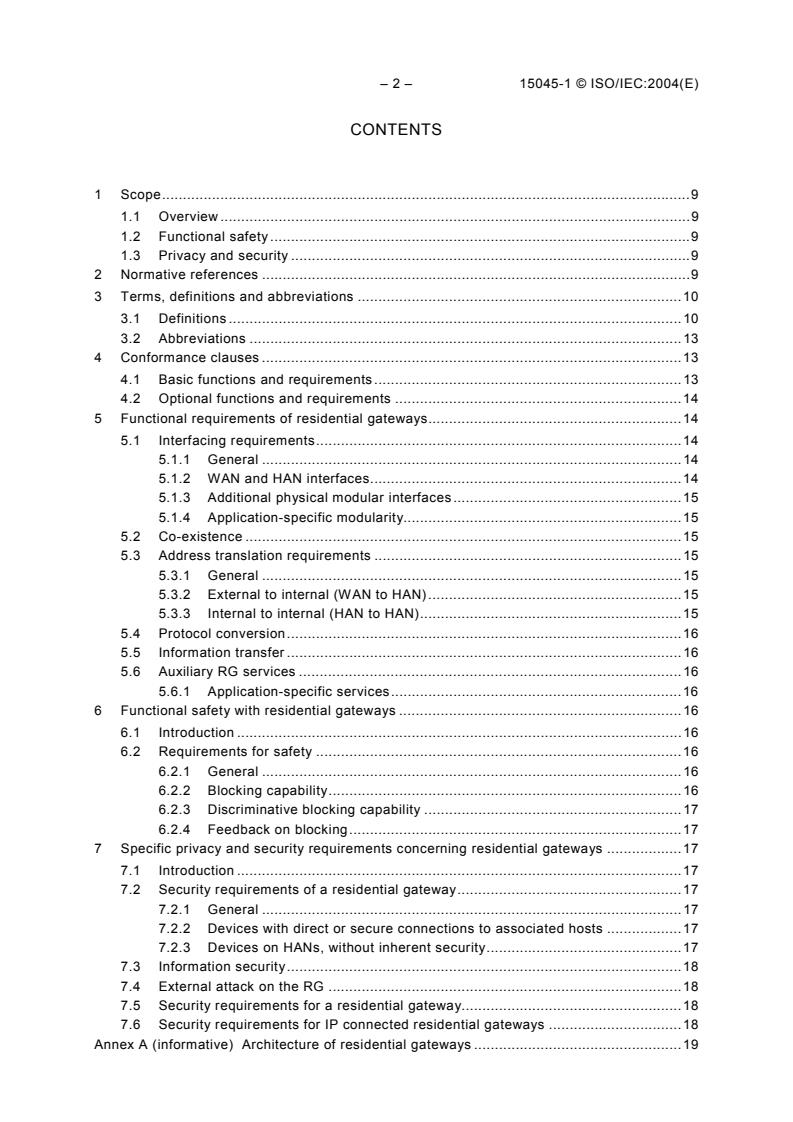
CONTENTS
1 Scope.9
1.1 Overview .9
1.2 Functional safety.9
1.3 Privacy and security .9
2 Normative references .9
3 Terms, definitions and abbreviations .10
3.1 Definitions .10
3.2 Abbreviations .13
4 Conformance clauses .13
4.1 Basic functions and requirements.13
4.2 Optional functions and requirements .14
5 Functional requirements of residential gateways.14
5.1 Interfacing requirements.14
5.1.1 General .14
5.1.2 WAN and HAN interfaces.14
5.1.3 Additional physical modular interfaces.15
5.1.4 Application-specific modularity.15
5.2 Co-existence .15
5.3 Address translation requirements .15
5.3.1 General .15
5.3.2 External to internal (WAN to HAN).15
5.3.3 Internal to internal (HAN to HAN).15
5.4 Protocol conversion.16
5.5 Information transfer .16
5.6 Auxiliary RG services .16
5.6.1 Application-specific services.16
6 Functional safety with residential gateways .16
6.1 Introduction .16
6.2 Requirements for safety .16
6.2.1 General .16
6.2.2 Blocking capability.16
6.2.3 Discriminative blocking capability .17
6.2.4 Feedback on blocking.17
7 Specific privacy and security requirements concerning residential gateways .17
7.1 Introduction .17
7.2 Security requirements of a residential gateway.17
7.2.1 General .17
7.2.2 Devices with direct or secure connections to associated hosts .17
7.2.3 Devices on HANs, without inherent security.17
7.3 Information security.18
7.4 External attack on the RG .18
7.5 Security requirements for a residential gateway.18
7.6 Security requirements for IP connected residential gateways .18
Annex A (informative) Architecture of residential gateways .19
15045-1 ISO/IEC:2004(E) – 3 –
A.1 Overview of architecture.19
A.2 Architectural domains.19
A.2.1 General .19
A.2.2 Domain of the RG.20
A.2.3 Basic residential gateway architecture.20
A.2.4 Interfaces and processes.21
A.2.5 Details of component parts .22
A.2.6 Structural implementations of the RG .25
Annex B (informative) Functional safety considerations .29
B.1 Introduction .29
B.1.1 General .29
B.1.2 Commands to potentially hazardous objects .29
B.1.3 Commands to relocatable programmable objects.29
B.1.4 Commands to automatic objects .29
B.1.5 Command translation.30
B.1.6 Linked changed state.30
B.1.7 Addressing .30
B.1.8 Broadcast messages, variables and commands.30
Annex C (informative) Specific privacy and security of residential gateways .31
C.1 Introduction .31
C.2 Threats.31
C.2.1 General .31
C.2.2 Masquerade and replay .31
C.2.3 Interception: eavesdropping and modification .31
C.2.4 Denial-of-service and resource-exhaustion attack.32
C.2.5 Software and configuration security: trojan horses, worms, viruses.32
C.2.6 Spyware/data leakage .33
C.2.7 Repudiation .33
C.2.8 Signal intelligence .33
C.2.9 Unintentional domain to domain interconnect.33
C.2.10 Secure purchase and payment .34
C.3 Defence measures .34
C.3.1 Introduction .34
C.3.2 Authentication .34
C.3.3 Access control.35
C.3.4 Integrity and confidentiality.35
C.3.5 Message authentication code (MAC) .35
C.3.6 Hash functions and digital signatures .36
C.3.7 Logging .36
C.3.8 Resource management.36
C.3.9 Host resistance.37
C.3.10 Social engineering.37
C.3.11 Intrusion detection .37
C.3.12 Repudiation .37
Figure 1 – Typical service provision for home network .7
Figure 2 – Diagram of possible RG connections and interfaces.7
Figure A.1 – Domain of the residential gateway .20
– 4 – 15045-1 © ISO/IEC:2004(E)
Figure A.2 – Unit architecture .21
Figure A.3 – Modular architecture .21
Figure A.4 – WAN Gateway gateway interface .22
Figure A.5 – HAN Gateway gateway interface.23
Figure A.6 – RG internal processes and interfaces .24
Figure A.7 – Simple 1:1 implementation of RG.25
Figure A.8 – Complex integral RG implementation .26
Figure A.9 – Complex modular RG implementation .27
Figure A.10 – Distributed RGs linked via HAN.28
Figure A.11 – Distributed RGs directly linked .28
Figure A.12 – Distributed RGs linked via WAN.28
15045-1 ISO/IEC:2004(E) – 5 –
INFORMATION TECHNOLOGY –
HOME ELECTRONIC SYSTEM (HES) GATEWAY –
Part 1: A residential gateway model for HES
FOREWORD
1) ISO (International Organization for Standardization) and IEC (International Electrotechnical Commission) form the
specialized system for worldwide standardization. National bodies that are members of ISO or IEC participate in
the development of International Standards through technical committees established by the respective
organization to deal with particular fields of technical activity. ISO and IEC technical committees collaborate in
fields of mutual interest. Other international organizations, governmental and non-governmental, in liaison with
ISO and IEC, also take part in the work.
2) In the field of information technology, ISO and IEC have established a joint technical committee, ISO/IEC JTC 1.
Draft International Standards adopted by the joint technical committee are circulated to national bodies for voting.
Publication as an International Standard requires approval by at least 75 % of the national bodies casting a vote.
3) All users should ensure that they have the latest edition of this publication.
4) No liability shall attach to IEC or ISO or its directors, employees, servants or agents including individual experts
and members of their technical committees and IEC or ISO member bodies for any personal injury, property
damage or other damage of any nature whatsoever, whether direct or indirect, or for costs (including legal fees)
and expenses arising out of the publication of, use of, or reliance upon, this ISO/IEC publication or any other IEC,
ISO or ISO/IEC publications.
5) Attention is drawn to the normative references cited in this publication. Use of the referenced publications is
indispensable for the correct application of this publication.
6) Attention is drawn to the possibility that some of the elements of this International Standard may be the subject of
patent rights. ISO and IEC shall not be held responsible for identifying any or all such patent rights.
International Standard ISO/IEC 15045-1 was prepared by subcommittee 25: Interconnection
of information technology equipment, of ISO/IEC joint technical committee 1: Information
technology.
This publication has been drafted in accordance with the ISO/IEC Directives, Part 2.
– 6 – 15045-1 © ISO/IEC:2004(E)
INTRODUCTION
The residential gateway (RG) is a device of the Home Electronic System (HES) that connects
home network domains to network domains outside the house, as shown in Figure 1. It
supports communications among devices within the premises and systems, service providers,
operators and users outside the premises.
The RG enables service and content providers to deliver services such as entertainment,
video and broadband digital streams, monitoring for health care, security and occupancy,
home appliance control and preventive maintenance, remote metering, and energy
management. The RG specified by this standard does not imply the use of any particular
protocol such as IP and it is recognised that many forms of the RG will exist using many types
of data such as analogue video and broadband digital streams.
The safe and effective delivery of these services places many demands on the facilities of the
RG. These include the integrity and security of communications, the delivery of commands to
devices in the home from external sources, the blocking of selected commands that may
create unsafe conditions, the protection of the home from the risks inherent in a connection to
the internet, and facilitating micro-payments. There may be many different configurations of
RG. Regardless of the RG configuration, this standard ensures the interoperability of home
devices with external services. Also, this standard specifies features to enhance the safety
and security of network devices and consumer transactions via the network.
The RG connects the remote user and the internet with the people, equipment, appliances or
services in the home. These devices or systems are usually objects or nodes on a particular
Home Area Network (HAN).
Residential gateway
Some of the potential interfaces and supported networks of a residential gateway are shown
in Figure 1. In all cases the gateway provides the mechanism whereby Wide Area Networks
(WANs) communicate with Home Area Networks. The gateway may be a standalone gateway;
it may be embedded in another device; or more than one gateway unit may be used. A
number of distributed gateway units may display the behaviour of a single gateway.
15045-1 ISO/IEC:2004(E) – 7 –
WID E AREA N ET W O RK D O M AIN
Media Content
Provider
Service Provider 1
Broadcast D TV
HOME AREA N ETW ORK DOMAIN
Digit al T V
Provider
Service Provider 2
Equipment
Maintenance
Service Provider 3
Security Service
Lighting & Tem perature
Environment Sensor
WIDE AREA
Control (Thermostat)
Service Provider 4 Security
CO
COMMUNICATION Sensor
Content and
Sensor
Entertainm ent
RESIDEN TIAL
NETWORKS
Central
GATEW AY
Heating
PC
Boiler
Service Provider 5
TV &
U tility Metering
ST B
and Energy Mgmt Appliance
Heating
12345.6
Radiator
Service Provider 6
U tility Meter
Hom e Voice C ont rol
A nalogue Telephone C onnection
H igh Bandwidth Entertainment Bus
H om e Autom ation Bus (N ode)
Figure 1 – Typical service provision for home network
N
RESIDEN TIAL GATEW AY
N
N
Home
DLC/PLC KO N N EX
N
Network
N
PSTN
CEBus N
N
ISDN
N
LON
N
Ethernet LAN to PCs
xDSL
ISO 8802.3
RESIDEN TIAL
GSM/UMTS A/V Equipment/Digital TV
IEEE1394
GATEW AY
CABLE
Bluetooth
RF Links to
mobile, PC
SAT V 802.11b
and
Entertainment
System s
Anot her W A N
Another H AN
Figure 2 – Diagram of possible RG connections and interfaces
Figure 2 illustrates that multiple WANs and HANs may be supported by the RG. This figure is
not intended to imply that all or any of the interfaces or connections shown need to be
connected to a residential gateway (or for instance that terrestrial DTV is excluded in favour
of SATV).
The physical manifestation of a residential gateway is outside the scope of this standard. This
standard accommodates a range of potential configurations. These configurations may range
from an approach where a single box acts as interface between two or more WANs and
HANs, to a modular dedicated residential gateway, to multiple residential gateways distributed
among physically separate locations within the premises.
– 8 – 15045-1 © ISO/IEC:2004(E)
This standard is based on a black box approach, since it specifies the interfaces of the RG
and the function provided but leaves considerable freedom on how these functions are
implemented within the black box .
This standard is applicable to all communications and other technologies that may be
incorporated in the residential gateway and includes both analogue and digital systems.
This document comprises the following:
• requirements of a residential gateway;
• functional safety requirements of a residential gateway, where these are not covered by
existing functional safety standards;
• security requirements of a residential gateway;
• options for the Architecture of the residential gateway and the elements of a conforming
residential gateway (see Annex A);
• safety requirements of home systems connected to Wide Area Networks and the role of
the residential gateway (see Annex B);
• security requirements of home systems connected to Wide Area Networks and the role of
the residential gateway (see Annex C).
This document offers a future-proof , forwards and backwards compatible standard for
residential gateways and for networks and devices to which they are interfaced.
———————
In systems terminology a ‘black box’ refers to an object that has inputs, outputs and carries out functions but
for which the means and methodology that convert the inputs into outputs are not specified. Only inputs,
outputs and functions are specified.
A system that is called ‘future proof’ is expected to be adapted to technologies and meet requirements that
were not specified when it was designed but may be needed in future.
15045-1 ISO/IEC:2004(E) – 9 –
INFORMATION TECHNOLOGY –
HOME ELECTRONIC SYSTEM (HES) GATEWAY –
Part 1: Residential gateway model for HES
1 Scope
1.1 Overview
This part of ISO/IEC 15045 specifies the minimum functional requirements of a residential
gateway (RG) and the documentation to be provided. The standard specifies what a gateway
should do in order to deliver services in a suitably safe, secure and future-proof way without
being prescriptive. It also gives functional requirements.
1.2 Functional safety
This standard specifies certain safety features where commands sent from remote places to
devices on the premises could cause danger to persons or property.
While this standard only specifies minimum requirements for the gateway architecture,
gateway operation, and associated home systems in terms of safety, it provides an extensive
checklist of functional situations that should be treated with the utmost caution and
recommends appropriate measures.
1.3 Privacy and security
This standard specifies security measures to ensure the integrity of information that may pass
through the residential gateway.
A residential gateway operating between the internet and the home creates significant
concerns for security to the user.
Particular attention is drawn to safety, security and privacy. The attention of the user
(consumer, maintainer or application service provider (ASP)) of the gateway is drawn to
dangers resulting from unexpected system interoperation, from unauthorised access and from
compromise of private user information. RGs that are stated to conform to this standard will
be evaluated by the RG manufacturers for potential functional safety and/or security hazards
arising from systems integration.
2 Normative references
The following referenced documents are indispensable for the application of this document.
For dated references, only the edition cited applies. For undated references, the latest edition
of the referenced document (including any amendments) applies.
ISO/IEC 7498, Information technology – Open Systems Interconnection – Basic Reference
Model
ISO/IEC 14762, Information technology – Home Control Systems – Guidelines for functional
safety
– 10 – 15045-1 © ISO/IEC:2004(E)
ISO/IEC 18012-1, Information technology – Home electronic system – Guidelines for product
interoperability – Part 1: Introduction
3 Terms, definitions and abbreviations
3.1 Definitions
For the purposes of this part of ISO/IEC 15045, the following definitions apply.
3.1.1
co-existence
no interference between different pieces of equipment on the premises
Specifically, the operation of one RG does not interfere with the operation of another RG.
3.1.2
documentation
all instances of product literature, brochures, data sheets, manuals and catalogues in which
the product is described, defined, detailed or pictured that may be produced in paper or any
electronic format
NOTE In this definition, “product” refers to a product, a system, a network or a residential gateway.
3.1.3
file transfer protocol, FTP
IP based protocol (see IETF – Internet Engineering Task Force)
3.1.4
home area network, HAN
any electronic network situated within the general environment of a residential dwelling and
that connects enabled nodes within that dwelling
3.1.5
HAN to gateway interface, HGI
translates the communications protocol of HAN nodes to that of the internal processor within
the RG
NOTE The specification of the RG internal processor is outside the scope of this standard. The HGI may be
implemented in software, firmware or hardware and may be modular or integrated in the RG.
3.1.6
IPSec
provides security services at the IP layer that allow the user to apply combinations of integrity,
replay detection and encryption to IP packets
It also provides a mechanism for users to authenticate each other and generate and exchange
session keys, secret keys that are used for a limited time (a session), and then discarded.
NOTE For further explanation, see IETF.
3.1.7
local area network, LAN
any electronic network that connects computing devices together to form a group of
intercommunicating devices
———————
To be published.
15045-1 ISO/IEC:2004(E) – 11 –
3.1.8
management information base
Simple Network Management Protocol (SNMP)
NOTE See also IETF.
3.1.9
network address translation, NAT
feature defined for the internet whereby one IP address is assigned to an RG
Messages intended for specific nodes on a home network are sent to that address and
mapped by the NAT to specific node addresses and vice versa.
NOTE See also IETF.
3.1.10
personal area network
any electronic network that connects to enabled devices within the immediate vicinity of a
person, generally within a 10 m radius including devices carried by that person
3.1.11
processing and protocol conversion
for any WGI or HGI, processing and protocol conversion may take place to present data in the
format and protocol of the RG
3.1.12
residential gateway
electronic device that is situated between WANs and HANs (or LANs) in the premises
3.1.13
residential gateway internal processes
any RG will have internal processes (which are not defined in terms of software requirements)
to carry out the requirements of an RG
3.1.14
route
to route information is to direct the information, command or data stream to a particular
address or node in the WAN, LAN or HAN
3.1.15
spyware
trojan horse software that may report to an external entity information about a computer,
device or network and its parameters
3.1.16
secure/multi purpose internet mail extensions
secure encoding for e-mail attachments
NOTE See also IETF.
3.1.17
secure sockets layer/transport layer security (SSL)
the Secure Sockets Layer protocol implements security on HTTP-based communications
———————
The IETF formed the TLS Working Group to develop a common standard. Version 1 of TLS, the Transport Layer
Security protocol [N10], was issued in January 1999. See IETF.
– 12 – 15045-1 © ISO/IEC:2004(E)
3.1.18
specific WAN interface
specific interface for a WAN termination
3.1.19
telnet
terminal emulation program for TCP for remote access to computers
3.1.20
trojan horse virus
type of computer virus where the virus embeds itself in software delivered to the computer
and carries a payload which then causes other types of events to occur and which may be of
malicious intent
3.1.21
user datagram protocol
connectionless protocol
NOTE See also IETF.
3.1.22
virtual private network
a computing device is linked at a remote location from a network of computers by a secure
means of communication in such a way that the remote device appears to have the same
characteristics as if it were within the network of computers
3.1.23
wide area network, WAN
any electronic network which connects computing devices in the environment external to the
premises
3.1.25
WAN to gateway interface, WGI
component which translates the communications protocol of WAN nodes to that of the internal
processor within the RG
NOTE The specification of the RG internal processor is outside the scope of this standard. The WGI may be
implemented in software, firmware or hardware and may be modular or integrated in the RG.
3.1.26
“x” digital subscriber line, xDSL
technique for superimposing digital signals on a standard analogue local telephone line at a
frequency above that of audible speech; “x” may be “A” for asymmetric or “V” for very high
rate
15045-1 ISO/IEC:2004(E) – 13 –
3.2 Abbreviations
ASP Application Service Provider
FTP File Transfer Protocol
HAN Home Area Network
HES Home Electronic Systems
HGI HAN to Gateway Interface
IDS Intrusion Detection System
IETF Internet Engineering Task Force
IP Internet Protocol See IETF
LAN Local Area Network
MAC Message Authentication Code
NAT Network Address Translation
PAN Personal Area Network
PPC Processing and Protocol conversion
RG Residential Gateway
RGIP Residential Gateway Internal Process
S/MIME Secure/Multi Purpose Internet Mail Extensions
SSL/TLS Secure Sockets Layer/Transport Layer Security
MIB Management Information Base
SWI Specific WAN Interface
TCP Transport Control Protocol
UDP User Datagram Protocol
VPN Virtual Private Network
WAN Wide Area Network
WGI WAN to Gateway Interface
xDSL “x” Digital Subscriber Line
OSGi Open Systems Gateway Interface
SATV Satellite Television
UMTS Universal Mobile Telephone System (also known as 3G)
DLC Distribution Line Communication
PLC Power Line Communication
KONNEX The name of the Converged European Standards EIB, EHS and
Batibus
4 Conformance clauses
4.1 Basic functions and requirements
In order to conform to this standard a residential gateway shall provide the following basic
functions:
• Interface to one or more WANs;
• Interface to one or more HANs:
• Transfer information between WAN(s) and HAN(s);
• Specify WAN and HAN interfaces that are supported using the terms specified in 5.1.2;
• Describe the support provided by the RG for transferring information from a WAN to a
HAN in terms specified in 5.3.2, 5.4 and 5.5.
———————
These items can include simple wiring terminations where no protocol conversion takes place.
– 14 – 15045-1 © ISO/IEC:2004(E)
4.2 Optional functions and requirements
In order to conform to this standard, a residential gateway shall specify optional functions as
follows.
• Where appropriate with respect to the complexity of the RG and especially in the case of
IP traffic, prevent unauthorised information from passing into and out of the premises and
allow information to flow only to or from suitably authorised persons or devices as
specified in clause 6 and clause 7.
• Where appropriate with respect to the complexity of the RG and especially in the case of
IP traffic, protect entities within the home with respect to safety, security and privacy as
specified in clause 6 and clause 7.
• If an RG meeting this standard is upgraded to support an additional WAN or HAN, then the
conformance criteria specified above shall also apply to the upgraded configuration.
NOTE A gateway may have a simple termination or pass through. In this case it will simply transmit traffic (IP
or otherwise) to devices in the home domain and it will not require preventative strategies for IP, since these
will be dealt with at the end device.
• The transfer of information between HANs shall be documented in terms specified in 5.3.3,
5.4 and 5.5.
• The routing of information from one device to other devices on a HAN shall be
documented in terms specified in 5.3.3, 5.4 and 5.5.
• Expansion of the basic RG (a basic RG conforms to 4.1) to accommodate additional WANs
or HANs in support of third party devices shall be documented as specified in 5.1.3.
• Accommodation of application-specific controllers shall be documented as specified in
5.6.1.
• Features to support WAN service delivery shall be documented as specified in 5.6.1.
• Features to support HAN applications shall be documented as specified in 5.1.
• Conversion between internal and external addresses shall be documented as specified in
5.1.2.
• Conversion between multiple internal addresses shall be documented as specified in
5.3.3.
• Conversion of protocols and data formats shall be documented as specified in 5.4.
5 Functional requirements of residential gateways
5.1 Interfacing requirements
5.1.1 General
Residential gateway shall interface to one or more Wide Area Networks and one or more
Home Area Networks.
5.1.2 WAN and HAN interfaces
Interfaces to WANs or HANs supported shall be fully documented as stated in ISO 7498.
15045-1 ISO/IEC:2004(E) – 15 –
5.1.3 Additional physical modular interfaces
If the RG has internal interfaces that allow modular and interchangeable use of the RG by
third party devices, these interfaces shall be fully defined and documented. The
documentation shall be fully defined in terms of ISO 7498 either by reference to the relevant
specifications for the various layers or by providing the detailed specification for each layer
required by the designer and manufacturer of equipment to be connected to such interfaces.
5.1.4 Application-specific modularity
If modules are provided to carry out application-specific tasks related to service provision,
safety and security then these shall be fully defined and documented.
5.2 Co-existence
If RGs are installed in premises where the configuration consists of multiple distributed RGs,
then the activity of one Standard RG shall not in any way interfere with the proper operation
of another Standard residential gateway. Multiple RGs shall interoperate according to the
compliance requirement of ISO/IEC 18012-1.
5.3 Address translation requirements
5.3.1 General
If an RG translates addresses, then the following requirements shall be observed (as defined
in ISO/IEC 18012-1).
5.3.2 External to internal (WAN to HAN)
5.3.2.1 HAN supporting IP addressing
If the HAN to which the RG is interfaced supports IP, then the RG shall provide basic IP
services such as address assignment, IP-to-physical layer address translation, router function
(gateway) (and optionally host name resolution (DNS)). The RG may not be the only device
on the HAN capable of delivering these services. If so the RG shall ensure interoperability
with other resources.
5.3.2.2 HAN not supporting IP addressing
If the HAN to which the RG is interfaced does not support IP addressing, the RG shall
maintain knowledge of the local address of the devices in the HAN and provide address
translation as required. The RG shall have the capability of routing information reliably
between an entity in the WAN and a device on the HAN. It may also need security access
parameters for such devices.
NOTE 1 It is most likely that the RG will be provided with an IP address if it contains an interface to a WAN that
uses the internet. Additionally, there may be devices within premises that also have IP addresses. For these
devices, the RG will know about and recognise the IP addresses of devices on networks within premises and route
messages to these devices.
NOTE 2 Attention is drawn to the potential migration of IP addresses from IPv4 to IPv6.
5.3.3 Internal to internal (HAN to HAN)
If the RG is interfaced to more than one HAN (type or specific system) and devices on one
HAN may be required to communicate (or provide information for) devices on another HAN,
then the RG should, where appropriate, maintain knowledge of those devices including local
HAN addresses and provide address translation.
NOTE The purpose is to facilitate communications among devices even on different HANs. The RG will assume
the burden of address and message translation across incompatible HANs. This may be a bilateral or multilateral
requirement since this requirement may not be limited to two HANs on an RG. In the case where two HANs have
the same addressing format, the RG may only be required to provide a routing function (between different
communication media for instance).
– 16 – 15045-1 © ISO/IEC:2004(E)
5.4 Protocol conversion
If the RG provides protocol conversion, then the features shall be fully documented in the
specification, for example by specifying them according to the Interoperability Standard for
Home Electronic System (see ISO/IEC 18012-1). In addition, any WAN-to-HAN and HAN-to-
HAN communications shall ensure that (within the confines of the set of commonality between
the two networks) there is conversion from the terminology and protocols of one WAN or HAN
to those of the other HAN. Furthermore, information and commands shall be delivered in the
terms of the receiving HAN or WAN.
5.5 Information transfer
An RG shall transfer the information between WAN and HAN and between HAN and HAN as
required by the application and interfaces supported. Examples of this type of information
include voice, data, text, control and video. The types of information transfers supported shall
be documented in the specification of an RG for all interfaces supported by the RG. The
function provided by the gateway shall be given by performance data for parameters such as
bandwidth, bit rate, format, coding, addressing, latency time and bit error rate.
5.6 Auxiliary RG services
5.6.1 Application-specific services
If the RG provides application-specific services, for example for safety or security, then these
services shall, wherever possible, meet the requirements of existing relevant standards and
standardized methods (software/hardware). If the application specific functions do not
conform to any particular standard, then all operations and features shall be fully
documented.
NOTE These requirements apply to application-specific services provided either within the operating parameters
of the basic gateway or implemented by the use of plug-in modules for a modular RG.
6 Functional safety with residential gateways
6.1 Introduction
Functional safety is a shared responsibility of objects in the HAN and the gateway. Devices
controlled via a network shall be inherently safe as described in ISO/IEC TR 14762. The
control of objects from remote systems via the RG may compromise safety more seriously
than remote control via a local network. Although the primary responsibility for safe operation
of objects lies with the devices containing these objects, the RG is able to assist in reducing
the increased risks created by enabling control from a distant location. Annex B discusses
some of the particular safety concerns of the residential gateway.
6.2 Requirements for safety
6.2.1 General
If the RG has the capability of processing commands or information directed through it (such
as a firewall capability) then it shall also grant it.
6.2.2 Blocking capability
The RG shall be able to block commands to objects specified during installation or
configuration. This capability shall be documented.
———————
A standard is under development to address security requirements for HES; when it is published, the current
clause will be updated or replaced as relevant.
15045-1 ISO/IEC:2004(E) – 17 –
6.2.3 Discriminative blocking capability
If an RG is able to discriminate particular commands, then it shall be able to block specific
commands which could lead to hazardous states. This capability and its use shall be
documented.
6.2.4 Feedback on blocking
Where commands may be blocked, the RG shall be able to give feedback to the originating
system or device as to the fact of blocking.
NOTE For discussion of these requirements, please see Annex B.
7 Specific privacy and security requirements concerning residential gateways
7.1 Introduction
There are many potential security threats to a home network (especially if the RG supports
IP), that may originate from the WAN or from within the HAN. These threats may compromise
the integrity of the home network or expose private messages between HAN devices or
between the WAN and HAN. The residential gateway through which messages and
information pass shall provide both defensive and proactive services to ensure the privacy
and security of messages, information and media content directed to and from trustworthy
entities outside the premises and devices on the home network. Information from other non-
trustworthy entities outside the premises shall be screened before being forwarded into the
premises.
7.2 Security requirements of a residential gateway
7.2.1 General
Annex C provides an overview of the security issues facing the Home Electronic System. Most
of the issues involve the information and traffic that pass through the residential gateway. In
many cases (especially if the RG supports IP) the gateway is responsible for ensuring that the
security, privacy, and integrity of the network are not compromised and that transactions,
such as financial transactions, take place securely between trusted entities. There are two
main cases:
7.2.2 Devices with direct or secure connections to associated hosts
Devices in the home may be categorised as secure entities in their own right, in which case
they will provide means for ensuring the security of information that passes between them and
secure hosts in the external environment. For the devices and applications that require
security (which is highly recommended), it is likely to be end-to-end security provided by
SSL/TLS or IPSec (or a similar encryption methodology of appropriate strength according to
the information security required for the device). This should apply also to their software
upgrading. See C.2.5.
7.2.3 Devices on HANs, without inherent security
This class of device is characterised by the networked appliance. The HAN is likely to have a
different address structure than the (general) IP addressing of the external environment. In
this case the RG shall carry out Network Address Translation (of necessity, to the address
structure of the HAN or for IP), which to a large extent protects that device from direct attack
from the external environment. If these devices need to access their trusted server on the
WAN, then the RG shall prevent access to any other address on the WAN.
– 18 – 15045-1 © ISO/IEC:2004(E)
7.3 Information security
The information to and from devices is likely to be sensitive and needs protection against
interception and modification. Typical applications of this type are meter reading and energy
control.
Selected sensitive traffic between the RG and the trusted server associated with devices on
the HAN shall be capable of being secured using an encryption methodology of appropriate
strength according to the information security required for the device.
NOTE Where the delivery HAN in the home uses a technology that can be monitored surreptitiously, it is highly
recommended that traffic between devices in the house and the RG should be encrypted.
7.4 External attack on the RG
The RG is also a target for attack and it too shall accept IP packets only from a source that is
trusted.
7.5 Security requirements for a residential gateway
The following functions are defined for use by an RG and shall be completely documented
where implemented:
• firewall capability;
• encryption for information passing between the RG and service providers in the WAN;
• prevention of unauthorised access to devices in the HAN;
• support for the security measures associated with financial transactions;
• support for the security measures associated with content provision and IPR.
7.6 Security requirements for IP connected residential gateways
Additionally, an RG with IP (except for IP6 and higher) connections that provides an open port
to the internet shall meet the following requirements.
• It shall maintain a “firewall capability” that controls access between the WAN and the HAN
and vice versa.
• It shall provide adequate security services between itself and trusted servers in the WAN.
• It shall be possible to control access into the HAN from unknown addresses external to the
RG and it shall be possible to prevent devices of any sort on the HAN accessing unknown
addresses on the WAN.
• If financial transactions may be carried out between automatic devices on the HAN and
ASPs in the WAN, appropriate security features shall be provided to prevent surveillance
of information exchanged between the device on the HAN and the ASP.
• Optionally, the end user may be supplied with secure remote access service into the HAN.
NOTE For discussion of these requirements, see Annex C.
15045-1 ISO/IEC:2004(E) – 19 –
Annex A
(informative)
Architecture o
...