

IEC TR 61641:2008
(Main)Enclosed low-voltage switchgear and controlgear assemblies - Guide for testing under conditions of arcing due to internal fault
General Information
- Abstract
This technical report applies to enclosed low-voltage switchgear and controlgear assemblies hereafter called ASSEMBLIES manufactured according to IEC 60439-1. This second edition cancels and replaces the first edition (1996) and constitutes a technical revision. The main change introduced in this new edition is the following: the concept of ASSEMBLY protection under arcing conditions has been introduced.
- Status
- Published
- Publication Date
- 29-Jan-2008
- Technical Committee
- SC 121B - Low-voltage switchgear and controlgear assemblies
- Drafting Committee
- MT 2 - TC 121/SC 121B/MT 2
- Current Stage
- DELPUB - Deleted Publication
- Start Date
- 09-Sep-2014
- Completion Date
- 28-Aug-2026
Overview
IEC TR 61641:2008, published by the International Electrotechnical Commission (IEC), provides a comprehensive guide for testing enclosed low-voltage switchgear and controlgear assemblies-referred to as ASSEMBLIES-under internal arcing fault conditions. The standard specifically applies to ASSEMBLIES manufactured according to IEC 60439-1 and addresses the risks and consequences associated with internal arc faults, which can result in overpressures, thermal stresses, and the emission of hot gases or particles within electrical enclosures.
This technical report enables manufacturers and users to assess the ability of low-voltage switchgear and controlgear assemblies to minimize risks to personnel and equipment during an internal arc. The focus is on personal protection and assembly protection while providing a clear methodology for arc testing under controlled conditions.
Key Topics
Arcing Faults in Low-Voltage Assemblies
- Exploration of internal arc incidents and their associated physical phenomena, including pressure buildup and thermal effects inside enclosures.
Test Methodology
- Guidance on conducting arc tests, including sample preparation, mounting conditions, and arc initiation points.
- Specification of test currents, arc durations, and types of current-limiting protection devices in use.
Performance Criteria
- Clear criteria for assessing personal protection:
- Prevention of hazardous part ejection
- Integrity of enclosure doors and covers
- Absence of holes caused by arcing on accessible surfaces
- Non-ignition of test indicators
- Maintenance of protective grounding circuits
- Criteria for assembly protection:
- Limiting the effects of the arc to a defined enclosure area
- Allowing emergency operation after fault isolation, where specified
- Clear criteria for assessing personal protection:
Documentation and Reporting
- Detailed requirements for test reporting, including test setup, results, and assessment against all criteria.
Applications
IEC TR 61641:2008 is highly relevant for manufacturers, integrators, and operators of low-voltage electrical switchgear and controlgear assemblies across a wide range of industries. Typical applications include:
- Industrial Facilities
- Ensuring the safety and reliability of switchgear in manufacturing plants, processing facilities, and energy supply installations.
- Commercial Buildings
- Protecting personnel and equipment in places with critical power requirements, such as data centers and hospitals.
- Infrastructure Projects
- Application within transportation hubs, utility substations, and public service installations where electrical arc incidents can have major safety and operational impacts.
Implementing the recommendations of this standard allows organizations to verify the arc resistance of electrical assemblies, helping to reduce operational risks and ensure compliance with international safety expectations.
Related Standards
To ensure a comprehensive approach to switchgear safety and performance, IEC TR 61641:2008 should be considered alongside other key standards, such as:
- IEC 60439-1: Low-voltage switchgear and controlgear assemblies - the foundational standard for type-tested and partially type-tested assemblies.
- IEC 61439 series: The updated series for low-voltage switchgear and controlgear assemblies, replacing IEC 60439.
- IEC 60204-1: Safety of machinery - Electrical equipment of machines.
- IEC 60947 series: Low-voltage switchgear and controlgear - covers standards for components such as circuit-breakers and contactors.
Practical Value
By utilizing IEC TR 61641:2008, stakeholders in electrical system design, manufacturing, and maintenance can:
- Minimize the risk of injury from internal arc faults.
- Improve assembly design for enhanced arc containment.
- Meet global requirements for arc-tested enclosures.
- Provide vital documentation for regulatory compliance and risk assessments.
Keywords: IEC TR 61641, internal arc fault, low-voltage switchgear, controlgear assemblies, arc fault testing, personal protection, assembly protection, electrical safety, IEC 60439-1, arc-resistant switchgear.
Relations
- Effective Date
- 05-Sep-2023
Get Certified
Connect with accredited certification bodies for this standard

IMQ S.p.A. (Certification)
Italian electrical product certification.

SLG Prüf- und Zertifizierungs GmbH
German testing and certification body.

UL Solutions
Global safety science company with testing, inspection and certification.
Sponsored listings
Frequently Asked Questions
IEC TR 61641:2008 is a technical report published by the International Electrotechnical Commission (IEC). Its full title is "Enclosed low-voltage switchgear and controlgear assemblies - Guide for testing under conditions of arcing due to internal fault". This standard covers: This technical report applies to enclosed low-voltage switchgear and controlgear assemblies hereafter called ASSEMBLIES manufactured according to IEC 60439-1. This second edition cancels and replaces the first edition (1996) and constitutes a technical revision. The main change introduced in this new edition is the following: the concept of ASSEMBLY protection under arcing conditions has been introduced.
This technical report applies to enclosed low-voltage switchgear and controlgear assemblies hereafter called ASSEMBLIES manufactured according to IEC 60439-1. This second edition cancels and replaces the first edition (1996) and constitutes a technical revision. The main change introduced in this new edition is the following: the concept of ASSEMBLY protection under arcing conditions has been introduced.
IEC TR 61641:2008 is classified under the following ICS (International Classification for Standards) categories: 29.130.20 - Low voltage switchgear and controlgear. The ICS classification helps identify the subject area and facilitates finding related standards.
IEC TR 61641:2008 has the following relationships with other standards: It is inter standard links to IEC TR 61641:2014. Understanding these relationships helps ensure you are using the most current and applicable version of the standard.
IEC TR 61641:2008 is available in PDF format for immediate download after purchase. The document can be added to your cart and obtained through the secure checkout process. Digital delivery ensures instant access to the complete standard document.
Standards Content (Sample)
IEC/TR 61641
Edition 2.0 2008-01
TECHNICAL
REPORT
RAPPORT
TECHNIQUE
Enclosed low-voltage switchgear and controlgear assemblies – Guide for testing
under conditions of arcing due to internal fault
Ensembles d'appareillage à basse tension sous enveloppe – Guide pour l'essai
en conditions d'arc dues à un défaut interne
IEC/TR 61641:2008
All rights reserved. Unless otherwise specified, no part of this publication may be reproduced or utilized in any form or by
any means, electronic or mechanical, including photocopying and microfilm, without permission in writing from either IEC or
IEC's member National Committee in the country of the requester.
If you have any questions about IEC copyright or have an enquiry about obtaining additional rights to this publication,
please contact the address below or your local IEC member National Committee for further information.
Droits de reproduction réservés. Sauf indication contraire, aucune partie de cette publication ne peut être reproduite
ni utilisée sous quelque forme que ce soit et par aucun procédé, électronique ou mécanique, y compris la photocopie
et les microfilms, sans l'accord écrit de la CEI ou du Comité national de la CEI du pays du demandeur.
Si vous avez des questions sur le copyright de la CEI ou si vous désirez obtenir des droits supplémentaires sur cette
publication, utilisez les coordonnées ci-après ou contactez le Comité national de la CEI de votre pays de résidence.
IEC Central Office
3, rue de Varembé
CH-1211 Geneva 20
Switzerland
Email: inmail@iec.ch
Web: www.iec.ch
About the IEC
The International Electrotechnical Commission (IEC) is the leading global organization that prepares and publishes
International Standards for all electrical, electronic and related technologies.
About IEC publications
The technical content of IEC publications is kept under constant review by the IEC. Please make sure that you have the
latest edition, a corrigenda or an amendment might have been published.
ƒ Catalogue of IEC publications: www.iec.ch/searchpub
The IEC on-line Catalogue enables you to search by a variety of criteria (reference number, text, technical committee,…).
It also gives information on projects, withdrawn and replaced publications.
ƒ IEC Just Published: www.iec.ch/online_news/justpub
Stay up to date on all new IEC publications. Just Published details twice a month all new publications released. Available
on-line and also by email.
ƒ Electropedia: www.electropedia.org
The world's leading online dictionary of electronic and electrical terms containing more than 20 000 terms and definitions
in English and French, with equivalent terms in additional languages. Also known as the International Electrotechnical
Vocabulary online.
ƒ Customer Service Centre: www.iec.ch/webstore/custserv
If you wish to give us your feedback on this publication or need further assistance, please visit the Customer Service
Centre FAQ or contact us:
Email: csc@iec.ch
Tel.: +41 22 919 02 11
Fax: +41 22 919 03 00
A propos de la CEI
La Commission Electrotechnique Internationale (CEI) est la première organisation mondiale qui élabore et publie des
normes internationales pour tout ce qui a trait à l'électricité, à l'électronique et aux technologies apparentées.
A propos des publications CEI
Le contenu technique des publications de la CEI est constamment revu. Veuillez vous assurer que vous possédez
l’édition la plus récente, un corrigendum ou amendement peut avoir été publié.
ƒ Catalogue des publications de la CEI: www.iec.ch/searchpub/cur_fut-f.htm
Le Catalogue en-ligne de la CEI vous permet d’effectuer des recherches en utilisant différents critères (numéro de référence,
texte, comité d’études,…). Il donne aussi des informations sur les projets et les publications retirées ou remplacées.
ƒ Just Published CEI: www.iec.ch/online_news/justpub
Restez informé sur les nouvelles publications de la CEI. Just Published détaille deux fois par mois les nouvelles
publications parues. Disponible en-ligne et aussi par email.
ƒ Electropedia: www.electropedia.org
Le premier dictionnaire en ligne au monde de termes électroniques et électriques. Il contient plus de 20 000 termes et
définitions en anglais et en français, ainsi que les termes équivalents dans les langues additionnelles. Egalement appelé
Vocabulaire Electrotechnique International en ligne.
ƒ Service Clients: www.iec.ch/webstore/custserv/custserv_entry-f.htm
Si vous désirez nous donner des commentaires sur cette publication ou si vous avez des questions, visitez le FAQ du
Service clients ou contactez-nous:
Email: csc@iec.ch
Tél.: +41 22 919 02 11
Fax: +41 22 919 03 00
IEC/TR 61641
Edition 2.0 2008-01
TECHNICAL
REPORT
RAPPORT
TECHNIQUE
Enclosed low-voltage switchgear and controlgear assemblies – Guide for
testing under conditions of arcing due to internal fault
Ensembles d'appareillage à basse tension sous enveloppe – Guide pour l'essai
en conditions d'arc dues à un défaut interne
INTERNATIONAL
ELECTROTECHNICAL
COMMISSION
COMMISSION
ELECTROTECHNIQUE
PRICE CODE
INTERNATIONALE
M
CODE PRIX
ICS 29.130.20 ISBN 2-8318-9540-5
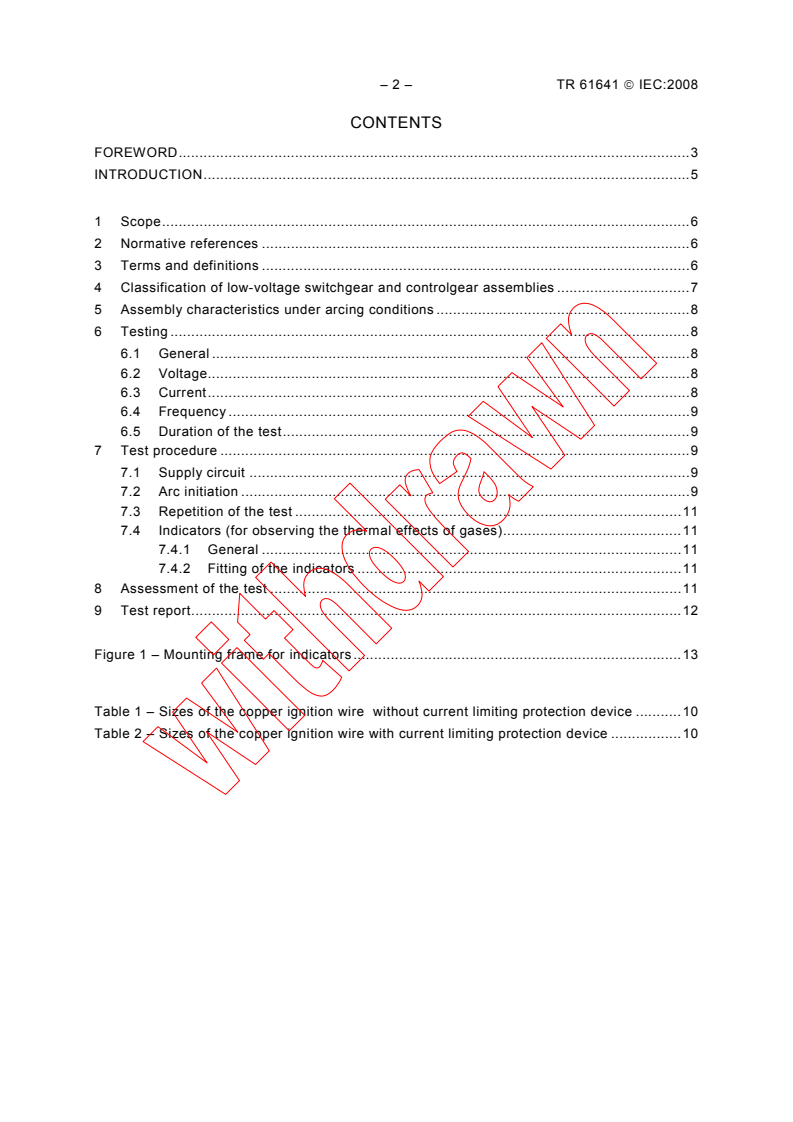
– 2 – TR 61641 © IEC:2008
CONTENTS
FOREWORD.3
INTRODUCTION.5
1 Scope.6
2 Normative references .6
3 Terms and definitions .6
4 Classification of low-voltage switchgear and controlgear assemblies .7
5 Assembly characteristics under arcing conditions .8
6 Testing .8
6.1 General .8
6.2 Voltage.8
6.3 Current.8
6.4 Frequency .9
6.5 Duration of the test.9
7 Test procedure .9
7.1 Supply circuit .9
7.2 Arc initiation .9
7.3 Repetition of the test .11
7.4 Indicators (for observing the thermal effects of gases).11
7.4.1 General .11
7.4.2 Fitting of the indicators .11
8 Assessment of the test .11
9 Test report.12
Figure 1 – Mounting frame for indicators.13
Table 1 – Sizes of the copper ignition wire without current limiting protection device .10
Table 2 – Sizes of the copper ignition wire with current limiting protection device .10
TR 61641 © IEC:2008 – 3 –
INTERNATIONAL ELECTROTECHNICAL COMMISSION
____________
ENCLOSED LOW-VOLTAGE SWITCHGEAR
AND CONTROLGEAR ASSEMBLIES –
GUIDE FOR TESTING UNDER CONDITIONS
OF ARCING DUE TO INTERNAL FAULT
FOREWORD
1) The International Electrotechnical Commission (IEC) is a worldwide organization for standardization comprising
all national electrotechnical committees (IEC National Committees). The object of IEC is to promote
international co-operation on all questions concerning standardization in the electrical and electronic fields. To
this end and in addition to other activities, IEC publishes International Standards, Technical Specifications,
Technical Reports, Publicly Available Specifications (PAS) and Guides (hereafter referred to as “IEC
Publication(s)”). Their preparation is entrusted to technical committees; any IEC National Committee interested
in the subject dealt with may participate in this preparatory work. International, governmental and non-
governmental organizations liaising with the IEC also participate in this preparation. IEC collaborates closely
with the International Organization for Standardization (ISO) in accordance with conditions determined by
agreement between the two organizations.
2) The formal decisions or agreements of IEC on technical matters express, as nearly as possible, an international
consensus of opinion on the relevant subjects since each technical committee has representation from all
interested IEC National Committees.
3) IEC Publications have the form of recommendations for international use and are accepted by IEC National
Committees in that sense. While all reasonable efforts are made to ensure that the technical content of IEC
Publications is accurate, IEC cannot be held responsible for the way in which they are used or for any
misinterpretation by any end user.
4) In order to promote international uniformity, IEC National Committees undertake to apply IEC Publications
transparently to the maximum extent possible in their national and regional publications. Any divergence
between any IEC Publication and the corresponding national or regional publication shall be clearly indicated in
the latter.
5) IEC provides no marking procedure to indicate its approval and cannot be rendered responsible for any
equipment declared to be in conformity with an IEC Publication.
6) All users should ensure that they have the latest edition of this publication.
7) No liability shall attach to IEC or its directors, employees, servants or agents including individual experts and
members of its technical committees and IEC National Committees for any personal injury, property damage or
other damage of any nature whatsoever, whether direct or indirect, or for costs (including legal fees) and
expenses arising out of the publication, use of, or reliance upon, this IEC Publication or any other IEC
Publications.
8) Attention is drawn to the Normative references cited in this publication. Use of the referenced publications is
indispensable for the correct application of this publication.
9) Attention is drawn to the possibility that some of the elements of this IEC Publication may be the subject of
patent rights. IEC shall not be held responsible for identifying any or all such patent rights.
The main task of IEC technical committees is to prepare International Standards. However, a
technical committee may propose the publication of a technical report when it has collected
data of a different kind from that which is normally published as an International Standard, for
example "state of the art".
IEC 61641, which is a technical report, has been prepared by subcommittee 17D: Low-voltage
switchgear and controlgear assemblies, of IEC technical committee 17: Switchgear and
controlgear. This second edition cancels and replaces the first edition (1996) and constitutes
a technical revision.
The main changes introduced in this new edition are the following:
– the numbering of the clauses has been changed in order to meet the requirements in
Part 2 of the ISO/IEC Directives;
– the concept of ASSEMBLY protection under arcing conditions has been introduced;
– 4 – TR 61641 © IEC:2008
– existing terms and definitions have been modified and new terms and definitions have
been added (3.4 to 3.9);
– Clause 4 (Classification of low-voltage switchgear and controlgear assemblies) and
Clause 5 (ASSEMBLY characteristics under arcing conditions) have been added;
– Clause 4 “Test procedure” in the former edition has been split into the new Clauses 6
“Testing” and 7 “Test procedure” with actualised requirements;
– new Table 2 with sizes of the copper ignition wire with current limiting protection device
has been added;
– the new criteria 6 and 7 for ASSEMBLY protection have been added in Clause 8.
The text of this technical report is based on the following documents:
Enquiry draft Report on voting
17D/352/DTR 17D /353/RVC
Full information on the voting for the approval of this technical report can be found in the
report on voting indicated in the above table.
This publication has been drafted in accordance with the ISO/IEC Directives, Part 2.
The French version of this technical report has not been voted upon.
The committee has decided that the contents of this publication will remain unchanged until
the maintenance result date indicated on the IEC web site under "http://webstore.iec.ch" in
the data related to the specific publication. At this date, the publication will be
• reconfirmed,
• withdrawn,
• replaced by a revised edition, or
• amended.
TR 61641 © IEC:2008 – 5 –
INTRODUCTION
The occurrence of arcs inside enclosed low-voltage switchgear and controlgear assemblies -
hereafter called ASSEMBLIES - is coupled with various physical phenomena. For example,
the arc energy resulting from an arc developed in air at atmospheric pressure within the
enclosure will cause an internal overpressure and local overheating which will result in
mechanical and thermal stressing of the ASSEMBLY. Moreover, the materials involved may
produce hot decomposition products, either gases or vapours, which may be discharged to
the outside of the enclosure.
This technical report makes allowance for internal overpressure acting on covers, doors, etc.
and also takes into consideration the thermal effects of the arc or its roots on the enclosures
and of ejected hot gases and glowing particles, but not damage to internal partitions. It does
not cover all effects which may constitute a risk, such as toxic gases. The test procedure
simulates only situations when doors and covers are closed and correctly secured.
The interpretation of results is subject to an agreement between the manufacturer and the
user.
– 6 – TR 61641 © IEC:2008
ENCLOSED LOW-VOLTAGE SWITCHGEAR
AND CONTROLGEAR ASSEMBLIES –
GUIDE FOR TESTING UNDER CONDITIONS
OF ARCING DUE TO INTERNAL FAULT
1 Scope
This technical report applies to enclosed low-voltage switchgear and controlgear assemblies -
hereafter called ASSEMBLIES - manufactured according to IEC 60439-1.
The purpose of this technical report is to give guidance on the method of testing of enclosed
low-voltage switchgear and controlgear assemblies under conditions of arcing in air due to an
internal fault.
The purpose of this test is to assess the ability of the ASSEMBLY to limit the risk of personal
injury and damage of ASSEMBLIES resulting from an internal arcing fault.
This is a voluntary test made either at the discretion of the manufacturer, or subject to an
agreement between manufacturer and user.
NOTE The recommendations of this report are not acceptable in the USA, nor in Canada, nor in the United
Kingdom.
2 Normative references
The following referenced documents are indispensable for the application of this document.
For dated references, only the edition cited applies. For undated references, the latest edition
of the referenced document (including any amendments) applies.
IEC 60439-1:1999, Low-voltage switchgear and controlgear assemblies – Part 1: Type-tested
and partially type-tested assemblies
Amendment 1:2004
3 Terms and definitions
For the purposes of this document, the terms and definitions of IEC 60439-1 apply with the
following additions.
3.1
permissible current under arcing conditions
I
p arc
value given by the manufacturer together with a corresponding permissible arc duration (see
3.2) indicating the maximum allowable value of prospective short-circuit current at the
terminals of the incoming unit for which the requirements of this test specification are fulfilled
NOTE The value is the r.m.s. value of the a.c. component of the current.
3.2
permissible arc duration
t
arc
value given by the manufacturer together with a corresponding permissible current under
arcing conditions (see 3.1) indicating the maximum permissible arc duration for which the
requirements of this test specification are fulfilled
TR 61641 © IEC:2008 – 7 –
NOTE The value can be different for different parts of the ASSEMBLY.
3.3
permissible conditional short-circuit current under arcing conditions
I
pc arc
value given by the manufacturer for a circuit of the ASSEMBLY indicating the prospective
current for which the ASSEMBLY fulfils the requirements of the test specification (see
Clause 7) when the circuit is protected by a current-limiting device as stated by the
manufacturer
NOTE The value is the r.m.s. value of the a.c. component of the current.
3.4
arc
short-circuit arising from a fault between active parts of different potential and/or between
active parts and other conductive parts resulting in a free burning arc within an ASSEMBLY
3.5
personal protection under arcing conditions
ability of an ASSEMBLY to limit the risk of personal injury caused by the mechanical and
thermal effects of an internal arcing fault
NOTE 1 This applies to enclosed low-voltage switchgear and controlgear assemblies when doors and covers are
closed and correctly secured.
NOTE 2 It does not cover all effects which may constitute a risk, such as toxic gases.
3.6
ASSEMBLY protection under arcing conditions
ability of an ASSEMBLY to limit the effects of an internal arcing fault on the operation to a
defined area inside the ASSEMBLY
3.7
arc free zone
part of a circuit within the ASSEMBLY where it is not possible to apply an ignition wire without
destroying the insulation material on conductors
3.8
arc proof zone
part of a circuit where an ignition wire can be applied and fulfilling all relevant criteria for the
assessment of the test
3.9
arc proof ASSEMBLY
assembly consisting of arc free zones and/or arc proof zones
4 Classification of low-voltage switchgear and controlgear assemblies
According to their characteristics under arcing conditions low-voltage switchgear and
controlgear assemblies can be classified into
– low-voltage switchgear and controlgear assembly providing personal protection under
arcing conditions;
– low-voltage switchgear and controlgear assembly providing personal and ASSEMBLY
protection under arcing conditions (see Clause 8, criteria 6 and 7).
– 8 – TR 61641 © IEC:2008
5 Assembly characteristics under arcing conditions
The following details are to be given by the manufacturer.
– Rated values:
• permissible current under arcing conditions (I ) and the associated arcing time
p arc
(t ), or
arc
• permissible conditional short-circuit current under arcing conditions (I )
pc arc
• rated operational voltage (U )
.
e
NOTE The permissible current or permissible conditional short circuit current under arcing conditions may be
lower than the rated short time withstand current (I ) or the rated conditional short circuit current (I ).
cw cc
– The defined areas (e.g. section, sub-section) to which the effects of an internal arcing fault
are limited in respect of ASSEMBLY protection.
– The characteristics (current rating, breaking capacity, cut-off current, I t, etc.) of the
current-limiting devices (e.g. current-limiting circuit breakers or fuses) necessary for the
protection of the circuit, if applicable.
6 Testing
6.1 General
The test is carried out on representative samples.
The following points should be observed.
– The test should be carried out on a test specimen not previously subjected to an arcing
test or on a specimen cleaned and prepared accordingly. The specimen and the
equipment in it may be repaired or replaced before each test.
NOTE Degradation of insulation due to carbonization or moderate erosion of metal parts is not necessarily
considered to render a unit unsuitable for a further test.
– The mounting conditions should be as close as possible to those of normal service. A
mock-up of any room in which the ASSEMBLY could be installed is in general not
necessary.
– The test specimen should be fully equipped. Mock-ups of internal components are
permitted provided that
a) they have the same volume and shape, and a similar external material as the original
items;
b) any metallic external material is earthed in a similar manner to normal service .
– The assigned measure for protection against electric shock shall be effective (see 7.4 of
IEC 60439-1).
– The arcing test is carried out as a three-phase test according to the service conditions.
6.2 Voltage
The applied voltage of the test circuit is 105 % of the rated operational voltage of the
ASSEMBLY ±5 %.
6.3 Current
6.3.1 To test a permissible current under arcing conditions, the test supply is adjusted by
making a short-circuit as close as possible to the incoming terminals of the ASSEMBLY.
TR 61641 © IEC:2008 – 9 –
NOTE For the relationship between peak value and r.m.s. value of short-circuit currents, see 7.5.3 of
IEC 60439-1.
6.3.2 To test a permissible conditional short circuit current under arcing conditions the test
supply is adjusted by making a short-circuit on the line side of the current limiting device and
as close to the device as possible.
6.3.3 In each case, the impedance used to adjust the test supply is the same used during
the test.
6.4 Frequency
At a rated frequency of 50 Hz or 60 Hz, the frequency at the beginning of the test should be
between 45 Hz and 67 Hz. At other frequencies, it should not deviate from the rated value by
more than ±10 %.
6.5 Duration of the test
The power supply duration of the ASSEMBLY under test is given by the manufacturer. It is
chosen according to the time response of the electrical protection devices. If details regarding
these devices are not known, a power supply duration of at least 0,1 s is applied. Normally
this duration should not exceed 0,5 s.
NOTE When the ASSEMBLY is intended to be fed from a transformer, the permissible arc duration of the
incoming switching device should in general be 0,3 s to allow for the operation of the high-voltage protective
equipment.
In case of testing with a conditional short-circuit current under arcing conditions and an arcing
time limited by the test specimen itself (e.g. by means of non current-limiting switchgear) the
applied voltage is maintained for at least 10 more cycles after shut-down.
7 Test procedure
7.1 Supply circuit
The test sample is connected and supplied corresponding to the normal service arrangement.
This includes the connection of PE, N and PEN conductors, which are connected directly to
the neutral point of the test current source. If the supply can be fed from more than one
direction, the direction of feed to be chosen is that one likely to result in the highest
stress(es).
7.2 Arc initiation
The arc is initiated between the phases without connection to earth by means of a bare
copper ignition wire connecting the adjacent conductors across the shortest distance, and
connected to three phases.
With regard to the test current, the sizes of the copper ignition wire given in Table 1 should be
used.
– 10 – TR 61641 © IEC:2008
Table 1 – Sizes of the copper ignition wire
without current limiting protection device
Test current (rms value) Wire size
kA mm
0,75
≤ 25
> 25 ≤ 40 1,0
> 40 1,5
If the test current is influenced by current-limiting protection devices, the size of the ignition
wire should be chosen from Table 2 according to the let-through current of this device so that
the melting of the wire can be expected before the operation of this device.
Table 2 – Sizes of the copper ignition wire with current limiting protection device
Wire size
Let-through current
(peak value)
min. max.
2 2
kA mm mm
≤ 10 0,1 0,2
20 0,15 0,3
30 0,2 0,5
40 0,3 0,6
50 0,4 0,8
60 0,5 0,8
70 0,6 0,9
80 0,7 1,0
90 0,8 1,1
The point of initiation should be chosen so that the effects of the resultant arc produce the
highest stresses in the ASSEMBLY.
The following points of ignition along the main circuit should be taken into account, if
applicable:
– load side of the outgoing functional unit,
– supply side of the outgoing functional unit,
– along the distribution busbar,
– along the main busbar,
– load side of the incoming functional unit,
– supply side of the incoming functional unit.
NOTE 1 If the arc travels along several points of ignition during the test, a separate test is not required.
A test is not necessary at any of these points that fulfil the requirement of an arc-free zone
(see 3.7). The ignition wire is connected only to accessible bare conductors. Insulating
material on conductors is not to be destroyed, removed or punctured when the ignition wire is
connected.
TR 61641 © IEC:2008 – 11 –
NOTE 2 The arc should not be initiated by puncturing solid insulation.
7.3 Repetition of the test
If during the test the arc extinguishes within the first half of the full intended test duration
without being ignited again, the test is repeated using the same point of initiation as for the
first test. A further repetition is not required.
7.4 Indicators (for observing the thermal effects of gases)
7.4.1 General
The indicators to be used are pieces of black cotton cloth so arranged that their cut edges do
not point towards the test unit. Care should be taken in mounting the indicators to ensure that
they do not ignite each other. This can be achieved by fitting them, for example, in a mounting
frame of steel sheets (see Figure 1).
The indicator dimensions should be about 150 mm x 150 mm. Black cretonne (cotton fabric
approximately 150 g/m ) should be used for the indicators.
7.4.2 Fitting of the indicators
Indicators should be fitted vertically at all sides of the ASSEMBLY which are readily
accessible to operating personnel.
They should be placed, up to a maximum height of 2 m and a distance of 300 mm ± 5 % from
the ASSEMBLY, facing all points where gas is likely to be emitted (e.g. joints, inspection
windows, doors).
8 Assessment of the test
The following criteria are used to assess the characteristics under arcing conditions as
detailed in Clause 4.
Personal protection is achieved when these criteria are fulfilled:
– 1) correctly secured doors, covers, etc., do not open;
– 2) parts (of the ASSEMBLY), which may cause a hazard, do not fly off. (This includes
large parts or those with sharp edges, for example inspection windows, pressure relief
flaps, cover plates, etc.);
– 3) arcing does not cause holes to develop in the freely accessible external parts of the
enclosure as a result of burning or other effects;
– 4) the indicators arranged vertically do not ignite (indicators ignited as a result of paint or
stickers burning are excluded from this assessment);
– 5) the protective circuit for accessible parts of the enclosure is still effective.
Assembly protection is achieved when criteria 1) to 6) are fulfilled:
– 6) the ASSEMBLY is capable of confining the arc to the defined area where it ignited, and
there is no propagation of the arc to other areas within the ASSEMBLY .
In addition, if specified by the manufacturer, criterion 7 applies where the ASSEMBLY is to be
suitable for limited continued operation:
– 12 – TR 61641 © IEC:2008
– 7) after clearing of the fault or after isolation or disassembly of the affected functional
units in the defined area, emergency operation of the remaining ASSEMBLY is possible.
This is verified by a dielectric test with a value of 1,5 times the rated operational voltage
during 1 min.
9 Test report
The following information is given in the test re
...