

IEC 61788-19:2013
(Main)Superconductivity - Part 19: Mechanical properties measurement - Room temperature tensile test of reacted Nb3Sn composite superconductors
General Information
- Abstract
IEC 61788-19:2013 covers a test method detailing the tensile test procedures to be carried out on reacted Cu/Nb3Sn composite superconducting wires at room temperature. The object of this test is to measure the modulus of elasticity and to determine the proof strength of the composite due to yielding of the copper and the copper tin components from the stress versus strain curve. Furthermore, the elastic limit, the tensile strength, and the elongation after fracture can be determined by means of the present method, but they are treated as optional quantities because the measured quantities of the elastic limit and the elongation after fracture have been reported to be subject to significant uncertainties according to the international round robin test. The sample covered by this test procedure should have a bare round or rectangular cross-section with an area between 0,15 mm2 and 2,0 mm2 and a copper to non-copper volume ratio of 0,2 to 1,5 and should have no insulation. Key words: supraconductivity, mechanical properties
- Status
- Published
- Publication Date
- 18-Nov-2013
- Technical Committee
- TC 90 - Superconductivity
- Drafting Committee
- WG 5 - TC 90/WG 5
- Current Stage
- PPUB - Publication issued
- Start Date
- 19-Nov-2013
- Completion Date
- 30-Nov-2013
Overview
IEC 61788-19:2013 is an international standard published by the International Electrotechnical Commission (IEC) focused on the mechanical properties measurement of reacted Nb3Sn composite superconductors. Specifically, it defines a detailed test method for performing room temperature tensile tests on reacted Cu/Nb3Sn composite superconducting wires. The goal of these tests is to accurately measure the modulus of elasticity and proof strength of the superconducting composite materials, essential metrics for assessing material performance in practical applications.
This standard is critical for industries and laboratories working with superconducting wires, where mechanical property data ensures reliability during fabrication, handling, and end use in electrical and electronic devices.
Key Topics
Scope and Sample Requirements:
The standard targets bare, reacted Nb3Sn composite wires with round or rectangular cross-sections, sized between 0.15 mm² and 2.0 mm² in cross-sectional area. The copper to non-copper volume ratio should range from 0.2 to 1.5 with no insulation on the samples.Test Methodology:
Defines the tensile test procedures to measure stress versus strain at room temperature, incorporating:- Gripping techniques ensuring correct specimen fixation
- Use of precision extensometers (including optical extensometers) to measure strain accurately
- Controlled test speeds for consistent loading
Mechanical Property Determination:
Key mechanical properties obtained from test data include:- Modulus of Elasticity (E) – indicating material stiffness
- 0.2% Proof Strength (Rp0.2) – related to the onset of plastic deformation, crucial for assessing material yield limits
- Optional properties such as elastic limit, tensile strength, and elongation after fracture, though these are noted to have measurement uncertainties based on international round robin tests.
Uncertainty and Test Reporting:
The standard addresses methods to evaluate uncertainty in measurements and provides guidance on comprehensive test reporting covering specimens, conditions, and results, ensuring reproducibility and traceability.
Applications
IEC 61788-19:2013 supports wide-ranging applications in the field of superconductivity and electrical engineering, including:
Superconducting Magnet Manufacturing:
Mechanical properties determined by this standard help design and validate Nb3Sn wires used in high-field magnets for particle accelerators, MRI machines, and fusion reactors.Quality Control in Wire Production:
Manufacturers can apply this tensile test method to monitor wire consistency and meet mechanical specifications critical for reliability under electromagnetic stresses.Material Research and Development:
Researchers investigating new composite formulations or reaction processes leverage this standard to quantify mechanical improvements or degradation at room temperature.Performance Assurance in Electrical Equipment:
Reliable tensile data ensures superconducting wires will tolerate operational stresses, preventing mechanical failure in critical electrical and electronic systems.
Related Standards
Professionals utilizing IEC 61788-19:2013 may also consider other relevant standards for broader superconductivity material characterization:
IEC 61788-series:
Various parts cover superconducting materials’ electrical, thermal, and magnetic properties measurement.ISO Material Testing Standards:
General standards on tensile testing and elasticity measurement complement the specialized procedures in IEC 61788-19.IEC 61000-series:
Standards on electromagnetic compatibility, relevant when considering mechanical strain effects on superconducting wire performance.IEC 60617 & Electropedia:
Provide terminologies and definitions ensuring consistent language for superconductivity and electrotechnical measurements.
Keywords: IEC 61788-19, Nb3Sn composite superconductors, tensile test, modulus of elasticity, proof strength, room temperature mechanical properties, Cu/Nb3Sn wire, superconductivity standards, mechanical testing superconductors, electrical wire quality control.
Get Certified
Connect with accredited certification bodies for this standard

Element Materials Technology
Materials testing and product certification.

IMQ S.p.A. (Certification)
Italian electrical product certification.

SLG Prüf- und Zertifizierungs GmbH
German testing and certification body.
Sponsored listings
Frequently Asked Questions
IEC 61788-19:2013 is a standard published by the International Electrotechnical Commission (IEC). Its full title is "Superconductivity - Part 19: Mechanical properties measurement - Room temperature tensile test of reacted Nb3Sn composite superconductors". This standard covers: IEC 61788-19:2013 covers a test method detailing the tensile test procedures to be carried out on reacted Cu/Nb3Sn composite superconducting wires at room temperature. The object of this test is to measure the modulus of elasticity and to determine the proof strength of the composite due to yielding of the copper and the copper tin components from the stress versus strain curve. Furthermore, the elastic limit, the tensile strength, and the elongation after fracture can be determined by means of the present method, but they are treated as optional quantities because the measured quantities of the elastic limit and the elongation after fracture have been reported to be subject to significant uncertainties according to the international round robin test. The sample covered by this test procedure should have a bare round or rectangular cross-section with an area between 0,15 mm2 and 2,0 mm2 and a copper to non-copper volume ratio of 0,2 to 1,5 and should have no insulation. Key words: supraconductivity, mechanical properties
IEC 61788-19:2013 covers a test method detailing the tensile test procedures to be carried out on reacted Cu/Nb3Sn composite superconducting wires at room temperature. The object of this test is to measure the modulus of elasticity and to determine the proof strength of the composite due to yielding of the copper and the copper tin components from the stress versus strain curve. Furthermore, the elastic limit, the tensile strength, and the elongation after fracture can be determined by means of the present method, but they are treated as optional quantities because the measured quantities of the elastic limit and the elongation after fracture have been reported to be subject to significant uncertainties according to the international round robin test. The sample covered by this test procedure should have a bare round or rectangular cross-section with an area between 0,15 mm2 and 2,0 mm2 and a copper to non-copper volume ratio of 0,2 to 1,5 and should have no insulation. Key words: supraconductivity, mechanical properties
IEC 61788-19:2013 is classified under the following ICS (International Classification for Standards) categories: 17.220.20 - Measurement of electrical and magnetic quantities; 29.050 - Superconductivity and conducting materials; 31.100 - Electronic tubes; 77.040.10 - Mechanical testing of metals. The ICS classification helps identify the subject area and facilitates finding related standards.
IEC 61788-19:2013 is available in PDF format for immediate download after purchase. The document can be added to your cart and obtained through the secure checkout process. Digital delivery ensures instant access to the complete standard document.
Standards Content (Sample)
IEC 61788-19 ®
Edition 1.0 2013-11
INTERNATIONAL
STANDARD
NORME
INTERNATIONALE
colour
inside
Superconductivity –
Part 19: Mechanical properties measurement – Room temperature tensile test of
reacted Nb Sn composite superconductors
Supraconductivité –
Partie 19: Mesure des propriétés mécaniques – Essai de traction à température
ambiante des supraconducteurs composites de Nb Sn mis en réaction
All rights reserved. Unless otherwise specified, no part of this publication may be reproduced or utilized in any form
or by any means, electronic or mechanical, including photocopying and microfilm, without permission in writing from
either IEC or IEC's member National Committee in the country of the requester.
If you have any questions about IEC copyright or have an enquiry about obtaining additional rights to this publication,
please contact the address below or your local IEC member National Committee for further information.
Droits de reproduction réservés. Sauf indication contraire, aucune partie de cette publication ne peut être reproduite ni
utilisée sous quelque forme que ce soit et par aucun procédé, électronique ou mécanique, y compris la photocopie et les
microfilms, sans l'accord écrit de la CEI ou du Comité national de la CEI du pays du demandeur.
Si vous avez des questions sur le copyright de la CEI ou si vous désirez obtenir des droits supplémentaires sur cette
publication, utilisez les coordonnées ci-après ou contactez le Comité national de la CEI de votre pays de résidence.
IEC Central Office Tel.: +41 22 919 02 11
3, rue de Varembé Fax: +41 22 919 03 00
CH-1211 Geneva 20 info@iec.ch
Switzerland www.iec.ch
About the IEC
The International Electrotechnical Commission (IEC) is the leading global organization that prepares and publishes
International Standards for all electrical, electronic and related technologies.
About IEC publications
The technical content of IEC publications is kept under constant review by the IEC. Please make sure that you have the
latest edition, a corrigenda or an amendment might have been published.
Useful links:
IEC publications search - www.iec.ch/searchpub Electropedia - www.electropedia.org
The advanced search enables you to find IEC publications The world's leading online dictionary of electronic and
by a variety of criteria (reference number, text, technical electrical terms containing more than 30 000 terms and
committee,…). definitions in English and French, with equivalent terms in
It also gives information on projects, replaced and additional languages. Also known as the International
withdrawn publications. Electrotechnical Vocabulary (IEV) on-line.
IEC Just Published - webstore.iec.ch/justpublished Customer Service Centre - webstore.iec.ch/csc
Stay up to date on all new IEC publications. Just Published If you wish to give us your feedback on this publication
details all new publications released. Available on-line and or need further assistance, please contact the
also once a month by email. Customer Service Centre: csc@iec.ch.
A propos de la CEI
La Commission Electrotechnique Internationale (CEI) est la première organisation mondiale qui élabore et publie des
Normes internationales pour tout ce qui a trait à l'électricité, à l'électronique et aux technologies apparentées.
A propos des publications CEI
Le contenu technique des publications de la CEI est constamment revu. Veuillez vous assurer que vous possédez
l’édition la plus récente, un corrigendum ou amendement peut avoir été publié.
Liens utiles:
Recherche de publications CEI - www.iec.ch/searchpub Electropedia - www.electropedia.org
La recherche avancée vous permet de trouver des Le premier dictionnaire en ligne au monde de termes
publications CEI en utilisant différents critères (numéro de électroniques et électriques. Il contient plus de 30 000
référence, texte, comité d’études,…). termes et définitions en anglais et en français, ainsi que
Elle donne aussi des informations sur les projets et les les termes équivalents dans les langues additionnelles.
publications remplacées ou retirées. Egalement appelé Vocabulaire Electrotechnique
International (VEI) en ligne.
Just Published CEI - webstore.iec.ch/justpublished
Service Clients - webstore.iec.ch/csc
Restez informé sur les nouvelles publications de la CEI.
Just Published détaille les nouvelles publications parues. Si vous désirez nous donner des commentaires sur
Disponible en ligne et aussi une fois par mois par email. cette publication ou si vous avez des questions
contactez-nous: csc@iec.ch.
IEC 61788-19 ®
Edition 1.0 2013-11
INTERNATIONAL
STANDARD
NORME
INTERNATIONALE
colour
inside
Superconductivity –
Part 19: Mechanical properties measurement – Room temperature tensile test of
reacted Nb Sn composite superconductors
Supraconductivité –
Partie 19: Mesure des propriétés mécaniques – Essai de traction à température
ambiante des supraconducteurs composites de Nb Sn mis en réaction
INTERNATIONAL
ELECTROTECHNICAL
COMMISSION
COMMISSION
ELECTROTECHNIQUE
PRICE CODE
INTERNATIONALE
CODE PRIX X
ICS 29.050; 77.040.10 ISBN 978-2-8322-1183-0
– 2 – 61788-19 © IEC:2013
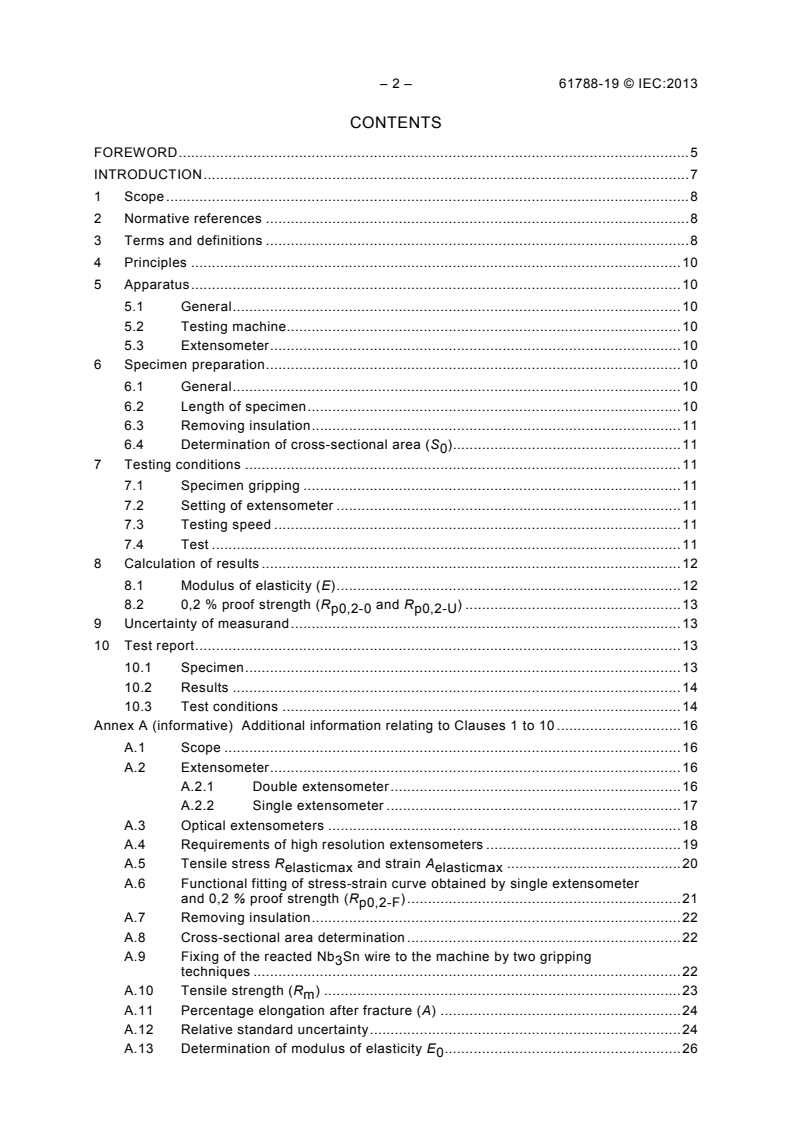
CONTENTS
FOREWORD . 5
INTRODUCTION . 7
1 Scope . 8
2 Normative references . 8
3 Terms and definitions . 8
4 Principles . 10
5 Apparatus . 10
5.1 General . 10
5.2 Testing machine. 10
5.3 Extensometer . 10
6 Specimen preparation . 10
6.1 General . 10
6.2 Length of specimen . 10
6.3 Removing insulation . 11
6.4 Determination of cross-sectional area (S ). 11
7 Testing conditions . 11
7.1 Specimen gripping . 11
7.2 Setting of extensometer . 11
7.3 Testing speed . 11
7.4 Test . 11
8 Calculation of results . 12
8.1 Modulus of elasticity (E) . 12
8.2 0,2 % proof strength (R and R ) . 13
p0,2-0 p0,2-U
9 Uncertainty of measurand . 13
10 Test report . 13
10.1 Specimen . 13
10.2 Results . 14
10.3 Test conditions . 14
Annex A (informative) Additional information relating to Clauses 1 to 10 . 16
A.1 Scope . 16
A.2 Extensometer . 16
A.2.1 Double extensometer . 16
A.2.2 Single extensometer . 17
A.3 Optical extensometers . 18
A.4 Requirements of high resolution extensometers . 19
A.5 Tensile stress R and strain A . 20
elasticmax elasticmax
A.6 Functional fitting of stress-strain curve obtained by single extensometer
and 0,2 % proof strength (R ) . 21
p0,2-F
A.7 Removing insulation . 22
A.8 Cross-sectional area determination . 22
A.9 Fixing of the reacted Nb Sn wire to the machine by two gripping
techniques . 22
A.10 Tensile strength (R ) . 23
m
A.11 Percentage elongation after fracture (A) . 24
A.12 Relative standard uncertainty . 24
A.13 Determination of modulus of elasticity E . 26
61788-19 © IEC:2013 – 3 –
A.14 Assessment on the reliability of the test equipment . 27
A.15 Reference documents . 27
Annex B (informative) Uncertainty considerations . 28
B.1 Overview . 28
B.2 Definitions . 28
B.3 Consideration of the uncertainty concept . 28
B.4 Uncertainty evaluation example for TC 90 standards . 30
B.5 Reference documents of Annex B . 31
Annex C (informative) Specific examples related to mechanical tests . 33
C.1 Overview . 33
C.2 Uncertainty of the modulus of elasticity . 33
C.3 Evaluation of sensitivity coefficients . 34
C.4 Combined standard uncertainties of each variable . 35
C.5 Uncertainty of 0,2 % proof strength R . 38
p0,2
Bibliography . 43
Figure 1 – Stress-strain curve and definition of modulus of elasticity and 0,2 % proof
strengths for Cu/Nb Sn wire . 15
Figure A.1 – Light weight ultra small twin type extensometer . 16
Figure A.2 – Low mass averaging double extensometer . 17
Figure A.3 – An example of the extensometer provided with balance weight and
vertical specimen axis . 18
Figure A.4 – Double beam laser extensometer . 19
Figure A.5 – Load versus displacement record of a reacted Nb Sn wire . 20
Figure A.6 – Stress-strain curve of a reacted Nb Sn wire . 21
Figure A.7 – Two alternatives for the gripping technique. . 23
Figure A.8 – Details of the two alternatives of the wire fixing to the machine . 23
Figure C.1 – Measured stress-strain curve . 33
Figure C.2 – Stress-strain curve . 39
Table A.1 – Standard uncertainty value results achieved on different Nb Sn wires
during the international round robin tests . 25
Table A.2 – Results of ANOVA (F-test) for the variations of E . 26
Table B.1 – Output signals from two nominally identical extensometers . 29
Table B.2 – Mean values of two output signals . 29
Table B.3 – Experimental standard deviations of two output signals . 29
Table B.4 – Standard uncertainties of two output signals . 30
Table B.5 – Coefficient of Variations of two output signals . 30
Table C.1 – Load cell specifications according to manufacturer’s data sheet. 35
Table C.2 – Uncertainties of displacement measurement . 36
Table C.3 – Uncertainties of wire diameter measurement . 37
Table C.4 – Uncertainties of gauge length measurement . 37
Table C.5 – Calculation of stress at 0 % and at 0,1 % strain using the zero offset
regression line as determined in Figure C.1 (b) . 38
Table C.6 – Linear regression equations computed for the three shifted lines and for
the stress – strain curve in the region where the lines intersect . 40
– 4 – 61788-19 © IEC:2013
Table C.7 – Calculation of strain and stress at the intersections of the three shifted
lines with the stress – strain curve . 40
Table C.8 – Measured stress versus strain data and the computed stress based on a
linear fit to the data in the region of interest . 41
61788-19 © IEC:2013 – 5 –
INTERNATIONAL ELECTROTECHNICAL COMMISSION
____________
SUPERCONDUCTIVITY –
Part 19: Mechanical properties measurement –
Room temperature tensile test of reacted Nb Sn
composite superconductors
FOREWORD
1) The International Electrotechnical Commission (IEC) is a worldwide organization for standardization comprising
all national electrotechnical committees (IEC National Committees). The object of IEC is to promote
international co-operation on all questions concerning standardization in the electrical and electronic fields. To
this end and in addition to other activities, IEC publishes International Standards, Technical Specifications,
Technical Reports, Publicly Available Specifications (PAS) and Guides (hereafter referred to as “IEC
Publication(s)”). Their preparation is entrusted to technical committees; any IEC National Committee interested
in the subject dealt with may participate in this preparatory work. International, governmental and non-
governmental organizations liaising with the IEC also participate in this preparation. IEC collaborates closely
with the International Organization for Standardization (ISO) in accordance with conditions determined by
agreement between the two organizations.
2) The formal decisions or agreements of IEC on technical matters express, as nearly as possible, an international
consensus of opinion on the relevant subjects since each technical committee has representation from all
interested IEC National Committees.
3) IEC Publications have the form of recommendations for international use and are accepted by IEC National
Committees in that sense. While all reasonable efforts are made to ensure that the technical content of IEC
Publications is accurate, IEC cannot be held responsible for the way in which they are used or for any
misinterpretation by any end user.
4) In order to promote international uniformity, IEC National Committees undertake to apply IEC Publications
transparently to the maximum extent possible in their national and regional publications. Any divergence
between any IEC Publication and the corresponding national or regional publication shall be clearly indicated in
the latter.
5) IEC itself does not provide any attestation of conformity. Independent certification bodies provide conformity
assessment services and, in some areas, access to IEC marks of conformity. IEC is not responsible for any
services carried out by independent certification bodies.
6) All users should ensure that they have the latest edition of this publication.
7) No liability shall attach to IEC or its directors, employees, servants or agents including individual experts and
members of its technical committees and IEC National Committees for any personal injury, property damage or
other damage of any nature whatsoever, whether direct or indirect, or for costs (including legal fees) and
expenses arising out of the publication, use of, or reliance upon, this IEC Publication or any other IEC
Publications.
8) Attention is drawn to the Normative references cited in this publication. Use of the referenced publications is
indispensable for the correct application of this publication.
9) Attention is drawn to the possibility that some of the elements of this IEC Publication may be the subject of
patent rights. IEC shall not be held responsible for identifying any or all such patent rights.
International Standard IEC 61788-19 has been prepared by IEC technical committee 90:
Superconductivity.
The text of this standard is based on the following documents:
FDIS Report on voting
90/328/FDIS 90/330/RVD
Full information on the voting for the approval of this standard can be found in the report on
voting indicated in the above table.
This publication has been drafted in accordance with the ISO/IEC Directives, Part 2.
A list of all parts of the IEC 61788 series, published under the general title Superconductivity,
can be found on the IEC website.
– 6 – 61788-19 © IEC:2013
The committee has decided that the contents of this publication will remain unchanged until
the stability date indicated on the IEC web site under "http://webstore.iec.ch" in the data
related to the specific publication. At this date, the publication will be
• reconfirmed,
• withdrawn,
• replaced by a revised edition, or
• amended.
IMPORTANT – The 'colour inside' logo on the cover page of this publication indicates
that it contains colours which are considered to be useful for the correct
understanding of its contents. Users should therefore print this document using a
colour printer.
61788-19 © IEC:2013 – 7 –
INTRODUCTION
The Cu/Nb Sn superconductive composite wires are multifilamentary composite materials.
They are manufactured in different ways. The first method is the bronze route, where fine Nb /
Nb alloy filaments are embedded in a bronze matrix, a barrier and a copper stabilizer. The
second is the internal-tin method, where fine multifilaments are composed with copper matrix
including Sn reservoirs, a barrier, and a copper stabilizer. The third is the powder-in-tube
method, where Nb / Nb alloy tubes are filled with Sn rich powders and are embedded in a Cu
stabilizing matrix.
Common to all types of Nb Sn composite wires is that the superconducting A15 phase Nb Sn
3 3
has been formed at final wire dimension by applying one or more heat treatments for several
days with a temperature at the last heat treatment step of around 640 °C or above. This
superconducting phase is very brittle and failure of filaments occurs – accompanied by the
degradation of the superconducting properties.
Commercial composite superconductors have a high current density and a small cross-
sectional area. The major application of the composite superconductors is to build
superconducting magnets. This can be done either by winding the superconductor on a spool
and applying the heat treatment together with the spool afterwards (wind and react) or by heat
treatment of the conductor before winding the magnet (react and wind). While the magnet is
being manufactured, complicated stresses are applied to its windings. Therefore the react and
wind method is the minority compared to the wind and react manufacturing process.
In the case that the mechanical properties should be determined in the unreacted, non-
superconducting stage of the composite, one should also apply this standard or alternatively
IEC 61788-6 (Superconductivity– Part 6: Mechanical properties measurement – Room
temperature tensile test of Cu/Nb-Ti composite superconductors).
While the magnet is being energized, a large electromagnetic force is applied to the
superconducting wires because of their high current density. In the case of the react and wind
manufacturing technique, the winding strain and stress levels are very restricted.
It is therefore a prerequisite to determine the mechanical properties of the superconductive
reacted Nb Sn composite wires of which the windings are manufactured.
– 8 – 61788-19 © IEC:2013
SUPERCONDUCTIVITY –
Part 19: Mechanical properties measurement –
Room temperature tensile test of reacted Nb Sn
composite superconductors
1 Scope
This part of IEC61788 covers a test method detailing the tensile test procedures to be carried
Sn composite superconducting wires at room temperature.
out on reacted Cu/Nb
The object of this test is to measure the modulus of elasticity and to determine the proof
strength of the composite due to yielding of the copper and the copper tin components from
the stress versus strain curve.
Furthermore, the elastic limit, the tensile strength, and the elongation after fracture can be
determined by means of the present method, but they are treated as optional quantities
because the measured quantities of the elastic limit and the elongation after fracture have
been reported to be subject to significant uncertainties according to the international round
robin test.
The sample covered by this test procedure should have a bare round or rectangular cross-
2 2
section with an area between 0,15 mm and 2,0 mm and a copper to non-copper volume
ratio of 0,2 to 1,5 and should have no insulation.
2 Normative references
The following documents, in whole or in part, are normatively referenced in this document and
are indispensable for its application. For dated references, only the edition cited applies. For
undated references, the latest edition of the referenced document (including any
amendments) applies.
IEC 60050 (all parts), International Electrotechnical Vocabulary (available at
)
ISO 376, Metallic materials – Calibration of force-proving instruments used for the verification
of uniaxial testing machines
ISO 6892-1, Metallic materials – Tensile testing – Part 1: Method of test at room temperature
ISO 7500-1, Metallic materials – Verification of static uniaxial testing machines – Part 1:
Tension/compression testing machines – Verification and calibration of the force-measuring
system
ISO 9513, Metallic materials – Calibration of extensometer systems used in uniaxial testing
3 Terms and definitions
For the purposes of this document, the definitions given in IEC 60050-815 and ISO 6892-1, as
well as the following, apply.
61788-19 © IEC:2013 – 9 –
3.1
tensile stress
R
tensile force divided by the original cross-sectional area at any moment during the test
3.2
strain
A
displacement increment divided by initial gauge length of extensometers at any moment
during the test
3.3
modulus of elasticity
E
gradient of the straight portion of the stress-strain curve in the elastic deformation region
3.4
extensometer gauge length
length of the parallel portion of the test piece used for the measurement of displacement by
means of an extensometer
3.5
distance between grips
L
g
length between grips that hold a test specimen in position before the test is started
3.6
0,2 % proof strength
R
p0,2
stress value where the ductile components yield by 0,2 %.
Note 1 to entry: The designated proof strengths, R and R correspond to point A or point C obtained
p0,2-0 p0,2-U
from unloading slope U between 0,3 % and 0,4 % in Figure 1(a), respectively. This strength is regarded as a
representative 0,2 % proof strength of the composite.
3.7
tensile strength
R
m
tensile stress corresponding to the maximum testing force
3.8
tensile stress at elastic limit
R
elasticmax
tensile force divided by the original cross-sectional area at the transition of elastic to plastic
deformation
3.9
strain at elastic limit
A
elasticmax
strain at the transition of elastic to plastic deformation
Note 1 to entry: The stress R and the corresponding strain A refer to point G in Figure A.6 o0f
elasticmax elasticmax
Annex A.5 and are regarded as the transition point of elastic to plastic deformation.
– 10 – 61788-19 © IEC:2013
4 Principles
The test consists of straining a test piece by tensile force beyond the elastic deformation
regime, in principle for the purpose of determining the modulus of elasticity (E) and the proof
strengths of R
p0,2.
5 Apparatus
5.1 General
The test machine and the extensometers shall conform to ISO 7500-1 and ISO 9513,
respectively. The calibration shall obey ISO 376. The special requirements of this standard
are presented here.
5.2 Testing machine
A tensile machine control system that provides a constant stroke speed shall be used. Grips
shall have a structure and strength appropriate for the test specimen and shall be constructed
to provide a firm connection with the tensile machine. The faces of the grips shall be filed or
knurled, or otherwise roughened, so that the test specimen will not slip on them during testing.
Gripping may be screw type, pneumatically, or hydraulically actuated.
5.3 Extensometer
The mass of the extensometer shall be 30 g or depending on wire diameter even less, so as
not to affect the mechanical properties of the brittle reacted superconductive wire. The mass
of the extensometers had to be balanced symmetrically around the wire to avoid any non-
alignment force (see Clause A.2). Care shall also be taken to prevent bending moments from
being applied to the test specimen.
Depending on the employed strain measuring method, however, the quantities determined by
the present test should be limited. When using the conventional single extensometer system,
the determination of E and R is recommended. On the other hand, it is possible to
U p0,2-U
determine all quantities described here by using an averaging double extensometer system,
because of its capability to compensate the bending effects of the reacted sample and to
guarantee a proper determination of the modulus of elasticity E .
NOTE Further information is given in Clauses A.2 and A.3.
6 Specimen preparation
6.1 General
The wire should be straightened before heat treatment and should be inserted into a ceramic
or quartz tube with slightly larger inner diameter referring to the wire size.
The constant temperature zone length of the heat treatment furnace shall be longer than the
total length mentioned below in 6.2.
Care shall be taken to prevent bending or pre-loading when the reacted specimen is manually
handled during removal from the ceramic or quartz tube and mounting.
6.2 Length of specimen
The total length of the test specimen shall be the sum of inward distance between grips and
both grip lengths. The inward distance between grips shall be 60 mm or more, as requested
for the installation of the extensometers.
61788-19 © IEC:2013 – 11 –
6.3 Removing insulation
If the test specimen surface is coated with an insulating material, the coating shall be
removed before the heat treatment. Either a chemical or mechanical method shall be used
with care taken not to damage the specimen surface (see Clause A.7).
6.4 Determination of cross-sectional area (S )
A micrometer or other dimension-measuring apparatus shall be used to obtain the cross-
sectional area of the specimen after the insulation coating has been removed. The cross-
sectional area of a round wire shall be calculated using the arithmetic mean of the two
orthogonal diameters. The cross-sectional area of a rectangular wire shall be obtained from
the product of its thickness and width. Corrections to be made for the corners of the cross-
sectional area shall be determined through consultation among the parties concerned (see
Clause A.8).
7 Testing conditions
7.1 Specimen gripping
When the test specimen is mounted on the grips of the tensile machine, the test specimen
and tensile loading axis shall be on a single straight line with a minimum of machine/specimen
mismatch. Gripping techniques of specimen are described in Clause A.9.
7.2 Setting of extensometer
When mounting the extensometer, care shall be taken to prevent the test specimen from
being deformed. The extensometer shall be mounted at the centre between the grips, aligning
the measurement direction with the specimen axis direction.
During mounting care should be taken not to pre-load the specimen. After installation, loading
shall be physically zeroed.
Double extensometer shall be mounted symmetrically around the cross-section to allow
averaging of the strain to compensate the bending effects.
To guarantee best performance of the stress-strain curve of rectangular wires the
extensometer should be mounted in such a way that strain is measured symmetrically on the
small sides of the wire.
7.3 Testing speed
The tensile tests shall be performed with displacement control. The machine crosshead speed
is recommended to be set between 0,1 mm/min and 0,5 mm/min.
7.4 Test
Following this procedure the tensile machine shall be started after the crosshead speed has
been set to a specific level. The signals from the extensometers and the load cell shall be
recorded, saved, and plotted on the abscissa and ordinate of the diagram as shown in
Figures 1 (a) and 1 (b). When the total strain has reached a value between 0,3 % and 0,4 %
the tensile force shall be reduced by 30 % to 40 % without changing the crosshead speed.
Following this procedure the wire shall be reloaded again until final fracture.
Prior to the start of any material test program it is advisable to check the complete test
equipment using similar size wires of known elastic properties (See Clause A.14).
– 12 – 61788-19 © IEC:2013
8 Calculation of results
8.1 Modulus of elasticity (E)
Modulus of elasticity shall be calculated in general using the following formula and the straight
portion of the unloading curve and of the initial loading one. Appropriate software for data
evaluation should be used for post analyses of the plotted data with the possibility of
enlargement of the stress versus strain graph, especially around the region where the
deviation from linearity is expected.
E = ΔF / (S ΔA) (1)
where
E is the modulus of elasticity;
ΔF is the increment of the corresponding force;
ΔA is the increment of strain corresponding to ΔF;
S is the original cross−sectional area of the test specimen. Since unloading process is
carried out at the strain indicated by the point A in Figure 1(a), the same Formula (1) is used
U
for both the unloading modulus of elasticity (E ) and the initial loading one (E ). It is
U 0
, where A is
recommended to measure the unloading curve at the starting point A
U U
recommended to be between 0,3 % and 0,4 %.
The modulus of elasticity determined from the unloading curve is expressed as E which is
U
given by the slope of the line (U between 0,3 % and 0,4 % strain) in Figure 1(a) and that from
the initial loading curve is expressed as E by the zero offset line.
It should be, however, noted that the straight portion of the initial stress – strain curve is very
narrow as indicated in Figure A.6 of Clause A.5. To measure this quantity with a low relative
standard uncertainty the only currently possible technique is the use of an averaging double
extensometer system. In this sense, the quantity of E should be a representative data for
U
the present text, while E should be reported only when the measure is performed by means
of double extensometer system.
After the test, the results shall be examined using the ratio E /E . The ratio shall satisfy the
0 U
condition as given in Equation 2 in which Δ = 0,3 (see Clause A.12).
1-Δ < E /E < 1+Δ (2)
0 U
When it does not satisfy the condition, the test is judged not to be valid. Then the test shall be
repeated after the experimental procedure is reexamined according to the present test
method.
It is guided to achieve the unloading-reloading procedure as follows: when the loading curve
arrives at the strain A (between 0,3 % and 0,4 %), the stress is reduced to r of the
U umin
maximum stress (stress position where the unloading started r ) and then the wire is
umax
reloaded. The slope of the unloading curves shall be obtained in the linear portion between
the stress r and r .
umax umin
NOTE 3 Typical range of r is 99 % of the maximum stress (stress where the unloading starts). The range of
umax
r is at 90 % referring to the onset of the unloading stress (see Figure 1 (b)).
umin
61788-19 © IEC:2013 – 13 –
8.2 0,2 % proof strength (R and R )
p0,2-0 p0,2-U
The 0,2 % proof strength of the composite is determined in two ways from the
unloading/reloading and initial loading part of the stress-strain curve as shown in Figures 1(a)
and 1(b).
The 0,2 % proof strength of the composite under unloading R shall be determined as
p0,2-U
follows: the linear portion of the unloading slope is moved parallel to the origin of the fitted
curve, which may include a negative strain value. Thereafter, a parallel line shall be shifted to
0,2 % on the abscissa from this strain point. The intersection of this line U with the stress-
strain curve determines the point C that shall be defined as the 0,2 % proof strength.
Depending of the unloading line (e. g. U in Fig 1(a)), 0,2 % proof strength (R ) is
0,35 p0,2-U
determined.
The 0,2 % proof strength under loading R shall be determined as follows: the initial linear
p0,2-0
portion at zero offset position of the loading line of the stress-strain curve is moved 0,2 %
along the strain axis and the point A at which this linear line intersects the stress-strain curve
shall be defined as the 0,2 % proof strength under loading.
Each of 0,2 % proof strength value shall be calculated using the formula (3) given below:
R = F / S (3)
p0,2−i i 0
where
R is the 0,2 % proof strength (MPa) at each point;
p0,2-i
F is the force (N) at each point;
i
as i = 0 or U.
9 Uncertainty of measurand
Unless otherwise specified, measurements shall be carried out in a temperature that can
range from 283 K to 308 K. A force measuring cell with the relative standard uncertainty less
than 0,1 %, valid between zero and the maximum force capacity of load cell shall be used.
The extensometers should have the relative standard uncertainty of strain less than 0,05 %.
The displacement measuring transducer (e.g. LVDT [linear variable differential transformer])
used for the calibration should have the relative standard uncertainty less than 0,01 %.
The relative standard uncertainty values of measured moduli of elasticity E and E and the
0 U
proof strengths R and R currently achieved with respect to the international round
p0,2-0 p0,2-U
robin test of eleven representative research groups are given in Table A.1 (see Clause A.12).
According to the international round robin test (see (9) of Clause A.15), the relative standard
uncertainty was reported to be 1,4 % for E for the test data of N = 17 in average after the
qualification check. Similarly, 1,3 % for E (N = 15), 1,5 % for R (N = 17) and 2,5 % for
U p0,2-0
R (N = 13) were reported.
p0,2-U
10 Test report
10.1 Specimen
The following information shall be reported:
a) Name of the manufacturer of the specimen
b) Classification and/or symbol
– 14 – 61788-19 © IEC:2013
c) Lot number
The following information shall be reported if possible:
d) Raw materials and their chemical composition
e) Cross-sectional shape and dimension of the wire
f) Filament diameter
g) Number of filaments
h) Copper to non-copper ratio
10.2 Results
Results of the following mechanical properties shall be reported.
a) Modulus of elasticity (E and E )
0 U
b) 0,2 % proof strengths (R and R )
p0,2-0 p0,2-U
The following information shall be reported if required:
c) Tensile stress R
elasticmax
d) Strain A
elasticmax
e) Tensile strength (R )
m
f) Percentage elongation after fracture (A)
g) 0,2 % proof strength determined by means of function fitting method (R )
p0,2-F
10.3 Test conditions
The following information shall be reported:
a) Crosshead speed
b) Distance between grips
c) Temperature
d) Manufacturer and model of testing machine
e) Manufacturer and model of extensometers
f) Gripping method
61788-19 © IEC:2013 – 15 –
E U
u E
0,2 %
H
0,2 %
A
C
A
u
0,0 0,1 0,2 0,3 0,4 0,5 0,6 0,7 0,8
Strain (%) IEC 2772/13
(a)
r
umax
r
umax
135 r
umin
r
umin
MaMxiaximummu m
stress
stress
0,320 0,330 0,340 0,350
0,320 0,330 0,340 0,350
(b)
Strain (%)
b)
Strain, %
IEC 2773/13
The Figure 1(a) shows the over-all relation between stress and strain; (b) is the enlarged view indicating the unload
and reload procedure.
Key
U: Computed unloading line of U between 0,3 % and 0,4 % strain using 1st order regression line in Figure
1(a)
Point A: 0,2 % strain shift from initial origin of the loading line (zero offset line). R obtained experimentally.
p0,2-0
Point C: 0,2 % strain shift from origin of fit curve with the determined slope of unloading line U (e.g. U ).
0,35
R is obtained by computation.
p0,2-U
Point H: Final fracture point of the wire.
The slope of the initial loading line is usually smaller than that of the unloading lines. In such cases the line has to
be drawn from 0,2 % offset point on the abscissa to obtain 0,2 % proof strength (R ) of the composite due to
p0,2-0
yielding of the ductile components such as copper and bronze (point A). Point A is obtained from the initial loading
line.
Point C is obtained using the unloading line. The slope of the unloading line between 0,3 % and 0,4 % should be
shifted to the origin of the fit curve, which may include a negative strain shift (see Clause A.6). The parallel 0,2 %
strain shift of this slope as a line on the abscissa intersects the fitted curve at point C, which is defined as the
0,2 % proof strength of the composite (R ).
p0,2-U
The graph in Figure 1(b) shows the raw data of the unloading region. The slope should be determined between
99 % of maximum stress at the onset of unloading and 90 % stress of the maximum stress as indicated (see 8.1).
Figure 1 – Stress-strain curve and definition of modulus
of elasticity and 0,2 % proof strengths for Cu/Nb Sn wire
Stress (MPa)
Stress (MPa)
– 16 – 61788-19 © IEC:2013
Annex A
(informative)
Additional information relating to Clauses 1 to 10
A.1 Scope
This annex gives reference information on the variable factors that may affect the tensile test
methods. All items described in this annex are informative.
A.2 Extensometer
A.2.1 Double extensometer
Any type of extensometer can be used if it consists of two single extensometers capable of
recording two signals to be averaged by software or one signal already averaged by the
extensometer system itself.
In Figures A.1 and A.2 typical advanced light weight extensometers are shown.
∼0,5 g
IEC 2166/13
Dimensions in millimetres
The extensometer has a gauge length of ~ 12 mm (total mass ~ 0,5 g). The two extensometers are wired together
into a single type extensometer, thus averaging the two displacement records electrically.
Figure A.1 – Light weight ultra small twin type extensometer
12,3
61788-19 © IEC:2013 – 17 –
∼3 g
IEC 2167/13
Dimensions in millimetres
The extensometer has a gauge length of ~ 26 mm (total mass ~ 3 g). Each of the two extensometers is a single
type extensometer, the averaging should be carried out by software.
Figure A.2 – Low mass averaging double extensometer
A.2.2 Single extensometer
Figure A.3 shows a single extensometer with a total weight of 31 g together with a balance
weight. It was used during a RRT for Cu/Nb-Ti wires conducted in Japan and sound results
were obtained. The results were used to establish the international standard (IEC 61788-6)
[3, 4] .
___________
Figures in square brackets in this annex refer to the Reference documents listed in Clause A.15
25,6
– 18 – 61788-19 © IEC:2013
Bar spring
a) Top view
Stopper
Strain gauge
Specimen
Balance weight
Frame
22 35
Cross spring plate
Frame
Gauge length setting hole
b) Side view
IEC 2168
...