

ISO/IEC TR 30174:2021
(Main)Internet of Things (IoT) - Socialized IoT system resembling human social interaction dynamics
General Information
- Abstract
ISO/IEC TR 30174:2021(E) describes:
• key features of the socialized IoT systems, e.g. sensing the external physical world, resolving the uncertainties of targets, satisfying users' demand and providing quality service, etc.;
• socialized attributes, i.e. socialized network, socialized collaboration, and socialized services, which are derived from the key features; and
• guidelines on how to use or apply the socialized attributes in the design and development of IoT systems.
- Status
- Published
- Publication Date
- 03-Nov-2021
- Technical Committee
- ISO/IEC JTC 1/SC 41 - Internet of Things and Digital Twin
- Current Stage
- PPUB - Publication issued
- Start Date
- 04-Nov-2021
- Completion Date
- 09-Nov-2021


Overview
ISO/IEC TR 30174:2021 - "Internet of Things (IoT) - Socialized IoT system resembling human social interaction dynamics" is an ISO/IEC Technical Report that describes the concept of a socialized IoT system. It frames IoT deployments as organized, collaborative systems whose nodes and services behave in ways analogous to human social interaction: coordinated sensing, division of labour, adaptive cooperation and service orchestration. The report is informative (technical report) and provides guidance for applying these socialized attributes in IoT design and development.
Key topics and technical coverage
- Core purpose and scope
- Key features of socialized IoT systems: sensing the physical world, resolving uncertainties about targets, satisfying user demand and delivering quality service (Clause 1, 6).
- Definition of socialized attributes: socialized network, socialized collaboration, and socialized service (Clause 7).
- Guidelines for applying these attributes to IoT system design and implementation.
- Socialized network models
- Analyses of network organization such as topology-driven, target-driven, task-driven and environment-driven networks (Clause 7.2).
- Collaboration and learning
- Division of labour and collaborative processing strategies among IoT nodes; mechanisms for socialized self-learning and adaptive behavior (Clause 7.3).
- Service lifecycle
- Service coordination, release and update patterns for socialized IoT services (Clause 7.4).
- Security considerations
- Sensing security and mechanisms for socialized sensing security to improve robustness and trustworthiness of physical-world observations (Clause 8).
- Applications and system design guidance
- Use-case driven guidance including an intrusion prevention system and infrastructure protection examples (Clause 9).
- Standards context
- Prepared by ISO/IEC JTC 1/SC 41 (Internet of Things and Digital Twin). The report references related vocabulary sources (e.g., IEC Electropedia, ISO online platform).
Practical applications and who will use this standard
- Who benefits
- IoT system architects and designers, IoT product developers, solution integrators, cybersecurity engineers, researchers and standards professionals.
- Practical applications
- Designing coordinated sensing platforms (multi-sensor fusion, target detection)
- Building adaptive, service-oriented IoT platforms with dynamic node collaboration
- Enhancing sensing security and intrusion-prevention systems for critical infrastructure
- Developing IoT service orchestration, update and lifecycle management strategies
Related standards and notes
- This is a Technical Report (informative); it does not contain normative references. It aligns with vocabulary and IoT/Digital Twin work produced by ISO/IEC JTC 1/SC 41 and references IEC/ISO terminologies (IEC Electropedia, ISO OBP). For implementation, consult applicable normative IoT, security and interoperability standards in your domain.
Keywords: ISO/IEC TR 30174:2021, socialized IoT, IoT system design, socialized network, IoT collaboration, sensing security, intrusion prevention, IoT service orchestration.
Get Certified
Connect with accredited certification bodies for this standard

ANCE
Mexican certification and testing association.

Intertek Slovenia
Intertek testing, inspection, and certification services in Slovenia.

LNE (Laboratoire National de Métrologie et d'Essais)
French national laboratory for metrology and testing.
Sponsored listings
Frequently Asked Questions
ISO/IEC TR 30174:2021 is a technical report published by the International Electrotechnical Commission (IEC). Its full title is "Internet of Things (IoT) - Socialized IoT system resembling human social interaction dynamics". This standard covers: ISO/IEC TR 30174:2021(E) describes: • key features of the socialized IoT systems, e.g. sensing the external physical world, resolving the uncertainties of targets, satisfying users' demand and providing quality service, etc.; • socialized attributes, i.e. socialized network, socialized collaboration, and socialized services, which are derived from the key features; and • guidelines on how to use or apply the socialized attributes in the design and development of IoT systems.
ISO/IEC TR 30174:2021(E) describes: • key features of the socialized IoT systems, e.g. sensing the external physical world, resolving the uncertainties of targets, satisfying users' demand and providing quality service, etc.; • socialized attributes, i.e. socialized network, socialized collaboration, and socialized services, which are derived from the key features; and • guidelines on how to use or apply the socialized attributes in the design and development of IoT systems.
ISO/IEC TR 30174:2021 is classified under the following ICS (International Classification for Standards) categories: 33.020 - Telecommunications in general. The ICS classification helps identify the subject area and facilitates finding related standards.
ISO/IEC TR 30174:2021 is available in PDF format for immediate download after purchase. The document can be added to your cart and obtained through the secure checkout process. Digital delivery ensures instant access to the complete standard document.
Standards Content (Sample)
ISO/IEC TR 30174
Edition 1.0 2021-11
TECHNICAL
REPORT
colour
inside
Internet of things (IoT) – Socialized IoT system resembling human social
interaction dynamics
All rights reserved. Unless otherwise specified, no part of this publication may be reproduced or utilized in any form
or by any means, electronic or mechanical, including photocopying and microfilm, without permission in writing from
either IEC or IEC's member National Committee in the country of the requester. If you have any questions about
ISO/IEC copyright or have an enquiry about obtaining additional rights to this publication, please contact the address
below or your local IEC member National Committee for further information.
IEC Central Office Tel.: +41 22 919 02 11
3, rue de Varembé info@iec.ch
CH-1211 Geneva 20 www.iec.ch
Switzerland
About the IEC
The International Electrotechnical Commission (IEC) is the leading global organization that prepares and publishes
International Standards for all electrical, electronic and related technologies.
About IEC publications
The technical content of IEC publications is kept under constant review by the IEC. Please make sure that you have the
latest edition, a corrigendum or an amendment might have been published.
IEC publications search - webstore.iec.ch/advsearchform IEC online collection - oc.iec.ch
The advanced search enables to find IEC publications by a Discover our powerful search engine and read freely all the
variety of criteria (reference number, text, technical publications previews. With a subscription you will always
committee, …). It also gives information on projects, replaced have access to up to date content tailored to your needs.
and withdrawn publications.
Electropedia - www.electropedia.org
IEC Just Published - webstore.iec.ch/justpublished
The world's leading online dictionary on electrotechnology,
Stay up to date on all new IEC publications. Just Published
containing more than 22 000 terminological entries in English
details all new publications released. Available online and
and French, with equivalent terms in 18 additional languages.
once a month by email.
Also known as the International Electrotechnical Vocabulary
(IEV) online.
IEC Customer Service Centre - webstore.iec.ch/csc
If you wish to give us your feedback on this publication or
need further assistance, please contact the Customer Service
Centre: sales@iec.ch.
ISO/IEC TR 30174
Edition 1.0 2021-11
TECHNICAL
REPORT
colour
inside
Internet of things (IoT) – Socialized IoT system resembling human social
interaction dynamics
INTERNATIONAL
ELECTROTECHNICAL
COMMISSION
ICS 33.020 ISBN 978-2-8322-1037-7
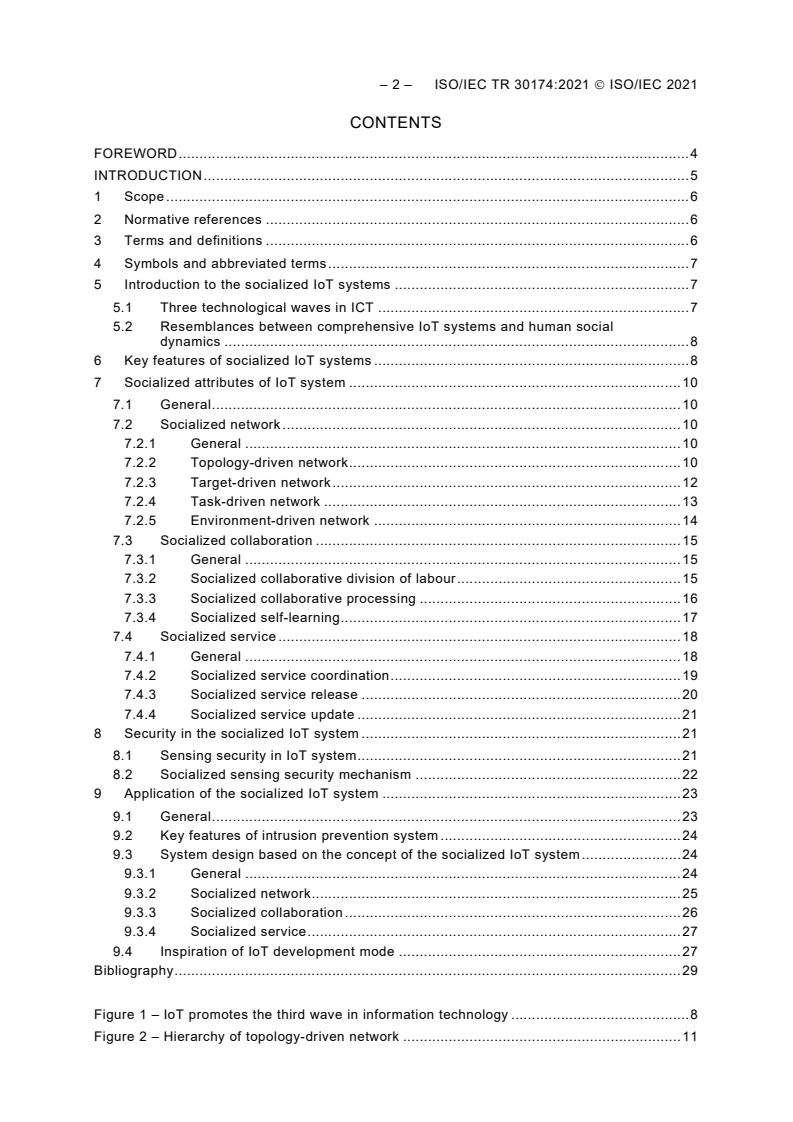
– 2 – ISO/IEC TR 30174:2021 ISO/IEC 2021
CONTENTS
FOREWORD . 4
INTRODUCTION . 5
1 Scope . 6
2 Normative references . 6
3 Terms and definitions . 6
4 Symbols and abbreviated terms . 7
5 Introduction to the socialized IoT systems . 7
5.1 Three technological waves in ICT . 7
5.2 Resemblances between comprehensive IoT systems and human social
dynamics . 8
6 Key features of socialized IoT systems . 8
7 Socialized attributes of IoT system . 10
7.1 General . 10
7.2 Socialized network . 10
7.2.1 General . 10
7.2.2 Topology-driven network . 10
7.2.3 Target-driven network . 12
7.2.4 Task-driven network . 13
7.2.5 Environment-driven network . 14
7.3 Socialized collaboration . 15
7.3.1 General . 15
7.3.2 Socialized collaborative division of labour . 15
7.3.3 Socialized collaborative processing . 16
7.3.4 Socialized self-learning . 17
7.4 Socialized service . 18
7.4.1 General . 18
7.4.2 Socialized service coordination . 19
7.4.3 Socialized service release . 20
7.4.4 Socialized service update . 21
8 Security in the socialized IoT system . 21
8.1 Sensing security in IoT system . 21
8.2 Socialized sensing security mechanism . 22
9 Application of the socialized IoT system . 23
9.1 General . 23
9.2 Key features of intrusion prevention system . 24
9.3 System design based on the concept of the socialized IoT system . 24
9.3.1 General . 24
9.3.2 Socialized network . 25
9.3.3 Socialized collaboration . 26
9.3.4 Socialized service . 27
9.4 Inspiration of IoT development mode . 27
Bibliography . 29
Figure 1 – IoT promotes the third wave in information technology . 8
Figure 2 – Hierarchy of topology-driven network . 11
Figure 3 – Example of target-driven network . 12
Figure 4 – Node selectivity of task-driven network . 13
Figure 5 – Socialized collaboration of IoT system . 15
Figure 6 – Socialized self-learning similar to mobile agent . 18
Figure 7 – Socialized service release . 20
Figure 8 – Socialized service update. 21
Figure 9 – The conceptual hierarchy of the IoT security . 22
Figure 10 – Realization mechanism of IoT sensing security based on socialized
collaborative processing . 23
Figure 11 – Network infrastructure of the intrusion prevention system . 25
Figure 12 – Socialized collaborative division of labour based on SNR . 26
Figure 13 – Target detection based on self-learning . 27
Figure 14 – IoT development mode based on "Common platform + Application profiles" . 28
– 4 – ISO/IEC TR 30174:2021 ISO/IEC 2021
INTERNET OF THINGS (IoT) –
SOCIALIZED IoT SYSTEM RESEMBLING
HUMAN SOCIAL INTERACTION DYNAMICS
FOREWORD
1) ISO (the International Organization for Standardization) and IEC (the International Electrotechnical
Commission) form the specialized system for worldwide standardization. National bodies that are members of
ISO or IEC participate in the development of International Standards through technical committees established
by the respective organization to deal with particular fields of technical activity. ISO and IEC technical
committees collaborate in fields of mutual interest. Other international organizations, governmental and non-
governmental, in liaison with ISO and IEC, also take part in the work.
2) The formal decisions or agreements of IEC and ISO on technical matters express, as nearly as possible, an
international consensus of opinion on the relevant subjects since each technical committee has representation
from all interested IEC and ISO National bodies.
3) IEC and ISO documents have the form of recommendations for international use and are accepted by IEC and
ISO National bodies in that sense. While all reasonable efforts are made to ensure that the technical content of
IEC and ISO documents is accurate, IEC and ISO cannot be held responsible for the way in which they are
used or for any misinterpretation by any end user.
4) In order to promote international uniformity, IEC and ISO National bodies undertake to apply IEC and ISO
documents transparently to the maximum extent possible in their national and regional publications. Any
divergence between any IEC and ISO document and the corresponding national or regional publication shall be
clearly indicated in the latter.
5) IEC and ISO do not provide any attestation of conformity. Independent certification bodies provide conformity
assessment services and, in some areas, access to IEC and ISO marks of conformity. IEC and ISO are not
responsible for any services carried out by independent certification bodies.
6) All users should ensure that they have the latest edition of this document.
7) No liability shall attach to IEC and ISO or their directors, employees, servants or agents including individual
experts and members of its technical committees and IEC and ISO National bodies for any personal injury,
property damage or other damage of any nature whatsoever, whether direct or indirect, or for costs (including
legal fees) and expenses arising out of the publication, use of, or reliance upon, this ISO/IEC document or any
other IEC and ISO documents.
8) Attention is drawn to the Normative references cited in this document. Use of the referenced publications is
indispensable for the correct application of this document.
9) Attention is drawn to the possibility that some of the elements of this ISO/IEC document may be the subject of
patent rights. IEC and ISO shall not be held responsible for identifying any or all such patent rights.
IEC TR 30174 has been prepared by subcommittee 41: Internet of Things and Digital Twin, of
ISO/IEC joint technical committee 1: Information technology. It is a Technical Report.
The text of this Technical Report is based on the following documents:
Draft Report on voting
JTC1-SC41/227/DTR JTC1-SC41/240A/RVDTR
Full information on the voting for its approval can be found in the report on voting indicated in
the above table.
The language used for the development of this Technical Report is English.
This document was drafted in accordance with ISO/IEC Directives, Part 2, and developed in
accordance with ISO/IEC Directives, Part 1 and ISO/IEC Directives, IEC Supplement,
available at www.iec.ch/members_experts/refdocs and www.iso.org/directives.
IMPORTANT – The "colour inside" logo on the cover page of this document indicates
that it contains colours which are considered to be useful for the correct
understanding of its contents. Users should therefore print this document using a
colour printer.
INTRODUCTION
The Internet of Things (IoT) technology is the third wave of information industry, following the
computer, communications network and the Internet. It provides the technology tools to build
an effective interactive IoT system connecting human users and the physical world, which
causes the changes in individual's daily life and also in the operations of human society. The
innovative ideas can be implemented in IoT systems creating new markets for technology-
based but user-friendly services. The technologies in the IoT systems will keep evolving with
improving the existing technology and also the insertion of new technologies.
The communications network focuses on connection and transmission, and it realizes
transmission service. The Internet focuses on information sharing, and provides services
related to information sharing. The IoT systems focus on the objective physical world,
realizing the basic sensing service and other services for the objects of interest (i.e. targets),
events, etc., in the physical world.
In order to realize the sensing of the complex physical world, an IoT system needs to have an
organized and coordinated sensing capability. For a specific target, this capability activates
relevant sensor nodes, and division of labour and cooperation strategies are applied, which is
similar to an enterprise that organizes people with required capabilities to form a project team
and completes the project with proper division of labour and cooperation. In this perspective,
therefore, it can be stated that the IoT system has socialized attributes as IoT nodes and
terminals establish an orderly socialized system.
This document comprises five main clauses. Clause 5 introduces the background and
motivations for the study of the socialized IoT system. Clause 6 discusses the essential
differences of the IoT systems compared to the communications network and the Internet.
This comparison is summarized with the key features of the socialized IoT system. Clause 7
further analyses the socialized network, socialized collaboration and socialized service, which
are designated as the three pillars of the IoT socialized attributes. Clause 8 addresses the
sensing security issue for IoT systems. Clause 9 discusses the application methods of the
socialized IoT attributes using a use case analysis, such as the intrusion prevention system or
infrastructure protection. This document provides readers with the knowledge of the socialized
characteristics and features of the IoT system, and inspires readers to adopt them in the
design of IoT systems and provision of IoT services.
– 6 – ISO/IEC TR 30174:2021 ISO/IEC 2021
INTERNET OF THINGS (IoT) –
SOCIALIZED IoT SYSTEM RESEMBLING
HUMAN SOCIAL INTERACTION DYNAMICS
1 Scope
This document describes:
• key features of the socialized IoT systems, e.g. sensing the external physical world,
resolving the uncertainties of targets, satisfying users' demand and providing quality
service, etc.;
• socialized attributes, i.e. socialized network, socialized collaboration, and socialized
services, which are derived from the key features; and
• guidelines on how to use or apply the socialized attributes in the design and development
of IoT systems.
2 Normative references
There are no normative references in this document.
3 Terms and definitions
For the purposes of this document, the following terms and definitions apply.
ISO and IEC maintain terminological databases for use in standardization at the following
addresses:
• IEC Electropedia: available at http://www.electropedia.org/
• ISO Online browsing platform: available at http://www.iso.org/obp
3.1
event
something that happens in the physical world and is observable or detectable by sensors
[SOURCE: IEC 60050-113:2011, 113-01-04, modified – In the definition, "subspace time of
space-time" is replaced with "the physical world and is observable or detectable by sensors.]
3.2
object
person or thing that is observable or detectable by sensors
Note 1 to entry: Thing can be any living one (animals, plants, etc.) or any material one (table, car, etc.).
3.3
target
object or event about which information is searched by interest to IoT system
[SOURCE: IEC 60050-713:1998, 713-04-14, modified – In the definition, "or event" is added
and "radar" is replaced with "interest to IoT system."]
3.4
socialized
having organized and constructive behaviour of functions in a system or among systems built
with the attributes of the division of labour and the collaboration of tasks
3.5
socialized IoT system
system providing functionalities of IoT built on socialized (3.4) capability
Note 1 to entry: A socialized IoT system can include, but not be limited to, IoT devices, IoT gateways, sensors
and actuators.
[SOURCE: ISO/IEC 20924:2021, 3.2.9, modified – In the term, "socialized" is added. In the
definition, "built on socialized (3.4) capability" is added.]
4 Symbols and abbreviated terms
ICT information and communication technologies
IoT Internet of Things
D/I data/information
SNR signal-to-noise ratio
5 Introduction to the socialized IoT systems
5.1 Three technological waves in ICT
Information acquisition, information transmission and information processing constitute the
three pillars of information technology. The impact of IoT technology on information
technology has caused significantly positive ripples on these pillars, which are denoted as
"three waves" as described below and also shown in Figure 1.
1) The first wave: The rise of the computer brings us to the digital world, which has changed
the way of processing data/information (D/I). The first wave is labelled as "digitalization".
2) The second wave: The rapid development of communications technology and the Internet
has created a world of inter-networking, which changes the way of transmitting D/I. The
second wave is marked as "networking".
3) The third wave: IoT technology is the third revolution in information technology, which has
changed the way of acquiring D/I. The third wave is designated as "socialization".
IoT technology has been moving forward to realize comprehensive information systems by
sensing the physical world and providing sensing services, which requires the IoT physical
and virtual entities to form an organized infrastructure in order to cooperate and collaborate
with each other to accomplish given purposes or tasks similar to the teamwork by organized
human teams. Therefore, an information system with such abilities can be characterized as a
"socialized" system resembling human social dynamics.
– 8 – ISO/IEC TR 30174:2021 ISO/IEC 2021
Figure 1 – IoT promotes the third wave in information technology
5.2 Resemblances between comprehensive IoT systems and human social dynamics
There exist many similarities between the comprehensive IoT system and human social
dynamics, which can be illustrated by the three hierarchical levels described below.
1) Various types of sensors – bio-mimetic sensors, electronic sensors, chemical sensors,
etc. – act as an extension of our sensory organs such as eyes, nose, ears, etc., to enable
us to explore the physical world.
2) After the D/I are received from sensors, they are transmitted via sensor networks and/or
data communication networks to D/I processing unit(s) for extracting and generating
hidden information, situational information, predictive information, decision-aiding
information, etc., by D/I aggregation, integration, fusion, mining, analytics, etc. This is
analogous to the D/I collected by the human sensor organs which are transmitted to the
brain through the human neural system for further processing.
3) In order to realize a comprehensive sensing and understanding of the physical world, the
cooperation and collaboration of the D/I processing units from various types of sensor
networks is required, which takes after human individuals in teams collaborating with each
other and sharing their information and knowledge to make better decisions with available
D/I.
From the observations made in the three hierarchical levels, resemblances, i.e. social
characteristics, between comprehensive IoT systems and human social dynamics do exist;
thus, comprehensive IoT systems built on socialized capability are called "socialized IoT
systems".
6 Key features of socialized IoT systems
The emergence and advancement of communications network and the Internet have greatly
transformed how human society operates. An IoT system is inextricably linked with the
communications network and Internet, and plays an irreplaceable role in realizing the
integration of "Operational Technology (OT)" and "Information Technology (IT)". In essence,
the key features of IoT are illustrated by comparing IoT with communications network and
Internet in terms of purpose, provided services and the connecting ways.
1) The communications network is a network which focuses on data transmission. It focuses
on the transmission of data itself and provides data delivery services.
The Internet focuses on the information sharing and provides the services related to
information sharing. The Internet takes information sharing as the core and promotes big
data services. The big data services involve analytics and data mining of a large number
of historical data and estimate or predict future trends.
An IoT system is a comprehensive information system with the purpose of sensing the
external physical world, and one of its major services is the sensing service. An IoT
system focuses on events occurring in the physical world that are both predictable and
unpredictable. It encapsulates data related to events (such as target, task, environment,
etc.), and it triggers decision-making process to manage the events. Thus, the IoT system
transforms "big data service" to "big event service".
2) The communications network connects people. For example, people make phone calls
and send messages through the mobile networks. As long as the network transmits voice
or text messages from one mobile phone to another, the communication between people
is completed. Communications network is concerned with the transmission of information
and network coverage. Therefore, the communications network is an information
transmission network connecting people.
The Internet connects computers. The Internet provides people with rich and constantly
updated information. People can get a plenty of electronic information by browsing news,
downloading materials and using various online multimedia services.
An IoT system connects things that exist in the complex and changing physical world. It
aims at sensing the external physical world and provides sensing services. Therefore, an
IoT system is a system providing a platform for interactions between human beings and
the objects in the physical world.
From the comparisons between the communications network and the Internet, the IoT
systems exhibit the following key features.
a) The IoT system focuses on the external physical world.
The application scenarios concerned by the IoT system come from the external physical
world. Massive sensor nodes acquire data from the physical world, and sensing nodes
form a network for the needs of information transmission and processing. In order to
achieve an effective management of the massive sensing nodes, an efficient network
organizational structure is necessary.
b) There are uncertainties for sensing targets in the IoT systems.
For the IoT system, there are many uncertainties in the temporal and spatial distributions
in target sensing. Because it is difficult for a single sensing node to achieve the all-around
coverage and continuous sensing in all-weather conditions, it is necessary to place
sensing nodes in different spatial locations, and carry out continuous real-time sensing.
Thus, the division of labour and coordination between different sensing nodes in time and
space is necessary.
Different targets have different external shapes and characteristics, and the environment
around the targets in different locations is also significantly different. A single sensing
node has limitations in functional capability and sensing ability. It is necessary to utilize a
variety of sensing nodes to realize a comprehensive sensing of the targets in order to
eliminate the negative impact of the uncertainties so that an accurate sensing of the
targets can be achieved. It facilitates the division of labour and collaboration in function
types and processing capabilities between multiple sensing nodes.
Further, changes brought by the updated information about targets, events and
environments need to be fully explored based on historical information. The prediction or
estimation of the target's future states (e.g. position, location, status, trajectory, and/or
behaviour) can be learned based on the historical trends. Therefore, a single sensing
node needs to have self-learning ability and the organized learning mechanism needs to
be established among different sensing nodes.
c) IoT system is both demand- and service-driven.
The IoT system is not driven by data, but driven by external demands. The emergence of
external targets or tasks, or changes in the environment will trigger the IoT system to
respond. The sensing approach and network topology need to be adjusted based on the
targets' current and future predicted states.
– 10 – ISO/IEC TR 30174:2021 ISO/IEC 2021
7 Socialized attributes of IoT system
7.1 General
From the above analysis on the key features of IoT systems, the challenges faced by the IoT
systems are clearly shown, and effort is being made to find reasonable and effective solutions.
The solutions for the key points of the requirements can be summarized as follows.
1) For sensing of the real physical world better, a large number of sensing nodes are needed
and IoT system needs to be built with an effective and efficient organizational structure.
2) To minimize or remove the uncertainties associated with the target being sensed by the
IoT systems, the sensing nodes in the IoT system are facilitated to form the effective
division of labour and cooperation among them. In order to improve the capability of
sensing, the IoT system should have the ability to learn and establish a learning
mechanism.
3) Driven by the goals and tasks, the sensing mode and networking topology of the IoT
systems need to be adjusted and updated in order to provide better IoT services.
Through comparative analysis, it is not difficult to find the characteristics of the system's
reasonable organizational structure, division of labour and cooperation, and service
orientation are unique to social groups. These three characteristics, i.e. socialized network,
socialized collaboration and socialized service, reflect the sensing behaviour of the IoT
system and are the bases of the socialized attributes; therefore, these are designated as the
three pillars of IoT system socialized attributes.
7.2 Socialized network
7.2.1 General
The network is not only the basic organizational structure of the IoT systems, but also the
important foundation to support the applications and services of the IoT system. Socialized
network refers to the internal mechanism of the establishment and operation of the IoT
systems, which embodies the characteristics and attributes of socialization, including four
types of network, i.e. topology-driven network, target-driven network, task-driven network and
environment-driven network.
7.2.2 Topology-driven network
In order to effectively handle the management of massive heterogeneous sensor nodes, the
IoT system needs to establish a well-designed organization structure. The well-designed
organization structure with an effective networking and collaboration as well as efficient
services helps the IoT system be more responsive when it is driven by external targets and
tasks.
The network supporting this organizational structure constitutes the basic network of the IoT
system, which is named "topology-driven network". The characteristics of topology-driven
network are described as follows.
See list items 2), 4) and 5) in 7.2.2 for explanation of colours.
Figure 2 – Hierarchy of topology-driven network
1) The main body of the topology-driven network typically adopts a hierarchical structure,
which is a typical method for building a reasonable organizational structure in human
society. From the vertical perspective, it presents a pyramid structure and the number of
sensors participating in decision-making gradually decreases from the bottom up. From
the horizontal perspective, sensors at each level interact and collaborate in a peer-to-peer
way to carry out the sensing task. This structure helps the IoT system to establish
administrative relationship between heterogeneous sensor nodes. In general, the
topology-driven network is relatively stable and does not change due to the change of
specific sensing tasks; however, the local structure of the topology-driven network is
dynamic.
2) The topology-driven network has a centre, which sits over the entire network and performs
the final data aggregation and other pre-processing of D/I, denoted as the red dot in
Figure 2.
3) The topology-driven network can continuously grow and develop. When new nodes join
the network, the new nodes and the nodes in the network form a hierarchical or planar
relationship depending on tasks given to the nodes. As new nodes join the network, the
network will continue to expand and scale itself to manage the new nodes. When the
connections between sensor nodes change due to the changes in node subordination
ordering, the hierarchical structure between nodes will also be adjusted accordingly.
4) When the scale of the topology-driven network becomes too large, the clustering approach
divides the network into multiple clusters of moderate scale with a cluster head, depicted
as the yellow dots in Figure 2, elected within each cluster.
How to cluster and how to determine the cluster head are the key issues to establish the
cluster hierarchy. The sensor nodes considered to be elected as the cluster head would be
evaluated for the following capabilities, for example, energy supply conditions,
communication radius, geographical distribution, etc. This process is similar to a
leadership election in human society, which involves the evaluation of a person's
capability (experiences, education, resources, leadership, etc.) and the external
environmental conditions (support groups, fund collected, etc.).
– 12 – ISO/IEC TR 30174:2021 ISO/IEC 2021
5) While the main body adopts the hierarchical structure, the local part can use the peer-to-
peer structure. In the peer-to-peer structure, all nodes occupy the same level in the
hierarchy in the local network, i.e. no head and no subordinate nodes, having no
subordinate relationship between the nodes. This is depicted as the green dots in
Figure 2. One of the advantages of adopting peer-to-peer structure in a local network is
that it can build networks in a flexible and expedited way, and at the same time, it can
avoid the network management overhead of setting up the organizational structure. Due to
the small number of nodes and the small scale of the local network, the access and
management requirement of the nodes will get prompt responses.
7.2.3 Target-driven network
A target is composed of objects, events and phenomena of interest in an IoT system. It is
important for the IoT system to observe, track and locate various targets in order to sense the
real physical world. In other words, the IoT system is focused on the target that could be an
object/objects of interest, an event/events of interest, or the phenomena about the object(s) or
the event(s), or the combination of all of these.
For the IoT system, estimating the time and place of the targets' emergence in advance is
uncertain and difficult. When a target appears in a specific area, one or more different types
of sensing nodes in the area may be activated at the same time. Because of the uncertainty
associated with the target, the nodes activated by the target may not belong to the same
cluster or the same hierarchy in the topology-driven network. In order to meet the subsequent
needs of target awareness, these activated nodes must be reorganized and form a temporary
network independent of the basic topology-driven network, which is called target-driven
network.
The temporary network has a high degree of flexibility and adaptability, which can deal with
the sudden occurrence of the target in time and space, such as determining the local centre of
the network autonomously and controlling the communication range of messages on demand.
The network topology and information routing can be dynamically adjusted to cope with the
uncertainty of the target.
Figure 3 – Example of target-driven network
When multiple targets appear simultaneously in the monitoring area, the target-driven network
can dynamically adjust the networking of the sensing nodes according to the characteristics of
the target, as shown in Figure 3, in an intrusion prevention system or an infrastructure
protection system. When the target climbs the fence, it will activate the infrared sensing node,
vibration sensing node, radar and other sensing nodes. And these activated nodes are to form
a temporary network to observe the target and its movement. If the vibration sensing nodes
cannot detect the vibration signal caused by the target, where the nodes are represented by
the three red dots outside the dotted ellipse in Figure 3, they will be excluded from the
temporary network. If the target is only close to the fence and does not climb the fence, all
kinds of sensor nodes (three yellow dots in Figure 3) do not need to report the target
information to the command centre platform. When a dog appears, the damage caused by
dogs to the fence will be less than that caused by people, so the alert level of the network
driven by dogs (indicated by green dots in the dotted ellipse) is lower than that driven by
people.
7.2.4 Task-driven network
Based on the topology-driven network, several nodes of the IoT system are activated due to
the emergence of targets, forming a target-driven network. For tasking the activated nodes for
the targets, the target-driven network needs to further determine the specific sensing tasks
and the task division between the sensor nodes; thus, a task-driven network is established.
First of all, the target-driven network can classify and identify the target and obtain the
preliminary information of the target, for example, the vibration sensing node detects whether
the target generates a vibration signal; the infrared sensing node monitors whether the
emitting heat by the target exceeds the threshold. This is similar to what happens when a
newcomer appears; people will observe his/her appearance, height, weight and other
characteristics.
Based on the target's classification and identification, different sensing tasks are assigned to
the nodes. For each sensing task, sensor nodes are selected based on the selection
conditions that the capability of sensor nodes matches with the task requirements. For
example, the nodes with low signal-to-noise ratio (SNR) cannot join the task-driven network;
and the nodes with poor communication ability cannot join the task-driven network. As shown
in Figure 4, the nodes inside the ellipse belong to the target-driven network, while the grey
dots represent the nodes in the target-driven network that are not included in the task-driven
network, and their connection with the target is represented by the dotted lines.
Figure 4 – Node selectivity of task-driven network
– 14 – ISO/IEC TR 30174:2021 ISO/IEC 2021
After the selection process, the final set of nodes can form the task-driven network. Then,
according to the required sensing tasks, the nodes in the task-driven network undertake task
assignments through the division of labour. For example, some nodes are responsible for
sensing the number of targets; some are responsible for sensing the shape of targets; some
are responsible for sensing the motion of targets; some are responsible for sensing the
specific behaviour of targets, etc. According to the change of sensing task requirements, task-
driven network can dynamically adjust the type and number of nodes in the network, and then
divide the tasks between nodes which monitor similar targets.
7.2.5 Environment-driven network
The main environmental factors that adversely impact the IoT system are weather conditions,
noise and interference. The environmental weather conditions such as temperature, wind, rain,
snow and other meteorological conditions will affect part of the system nodes or even all
nodes in the weather-affected area. The noise and interference will also affect the nodes in
the IoT system depending on the characteristics of the noise and interference sources,
propagation environment, etc. In addition, the nodes of the IoT system may be more sensitive
to some kind of noise or interference, which is a kind of selectivity to noises or interferences.
The environmental factors are complex, diverse, dynamic and uncertain. Developing the
environment adaptation mechanism in the IoT system is very challenging, and this can be
learnt from the task execution methods in human society. Before executing a task, an
expected execution environment is used to design the task that will be executed in the
expected environment. In order to cope with the changing, a contingency execution plan is
designed and implemented. When the environment changes, the corresponding environment
adaptation mechanism of the IoT system is activated according to the contingency plan.
The IoT system needs to take the environmental factors into account to establish the
environment-driven network that can be classified into three types of networks: (1) a
meteorology-driven network; (2) a noise/interference reduction-driven network; and (3) a
context switching-driven network.
1) The meteorology-driven network refers to the network which mitigates the impact of
adverse environmental weather conditions degrading the sensing nodes' measurement
quality by changing the IoT system's sensor nodes and networking. The meteorology-
driven network can be triggered by the regional weather monitoring nodes. When the
weather seriously affects the sensing ability of some nodes, these nodes will be removed
from the network and replaced by the nodes that are not significantly affected.
2) The noise/interference reduction-driven network is a functional network that dynamically
selects sensing nodes based on their sensitivity levels to different types of noises and
interferences while minimally affecting target signals so that an acceptable SNR can be
maintained.
3) The context switching-driven network is the network which adopts an adaptation
mechanism for changing sensing methods or networking to match the new environmental
context due to the movement of the sensor nodes. The context refers to a set of targets
and the relationship between them in an environment. When sensor nodes move as they
are on a moving platform, e.g. automobile, the environment context surrounding the
sensor nodes will change. The nodes will form a network in the new environment to
perform an appropriate task or tasks. For example, the context switching-driven network is
adapted due to the movement of a car. When the car is at a gas station, the car's tank
sensors and tyre pressure sensors will be activated to form the context network. When it
moves to a parking lot, theft prevention sensors will establish a new network in order to
adapt to the new environment.
7.3 Socialized collaboration
7.3.1 General
On a basis of the socialized network, the IoT system is to achieve a comprehensive sensing
of the targets and events in the ever-changing environment with a variety of sensing
requirements; therefore, efficient collaboration among many IoT entities is indispensable. For
an effective collaboration, it can be modelled from human society where people work together
to complete a task by establishing a collaborative division of labour, collaborative processing
and self-learning mechanism. As in human teamwork, the overall structure of the socialized
collaboration of IoT system mimics the three factors as illustrated in Figure 5, showing the
composition of the collaborative division of labour, the collaborative processing and the self-
learning mechanism.
Figure 5 – Socialized collaboration of IoT system
7.3.2 Socialized collaborative division of labour
It is necessary that the IoT system performs socialized collaborative division of labour, due to
the sensing modality limitation of a single sensor node and the diverse sensing requirements.
1) In an IoT system, a single sensor node can only obtain the information of the local
physical quantity within a limited range. Thus, it is next to impossible to use a single
sensor node to achieve the overall sensing of the targets and events in the complex
physical world. Instead, multiple nodes located in different geographical locations need to
collaborate with each other to compensate for the sensing limitations in time and space
and also due to ambient noise and interference, etc.
2) For the IoT system, it is important to utilize disparate sensors in order to compensate for
the limited capability of one type of sensor. For example, many kinds of sensing nodes are
used to d
...