

IEC TS 61044:2021
(Main)Opportunity charging of lead-acid traction batteries
General Information
- Abstract
IEC TS 61044:2021(E) covers opportunity charging of lead-acid traction batteries, i.e., the use of idle time during a working period to increase the state of charge (SoC) so as to extend the daily working period of a lead-acid traction battery while at the same time avoiding an excessive depth of discharge.
This document specifies requirements for the use of opportunity charging of lead-acid traction batteries of vented and valve regulated types when the battery manufacturer has not provided alternative specific operating procedures.
- Status
- Published
- Publication Date
- 04-Aug-2021
- Technical Committee
- TC 21 - Secondary cells and batteries
- Drafting Committee
- WG 3 - TC 21/WG 3
- Current Stage
- PPUB - Publication issued
- Start Date
- 05-Aug-2021
- Completion Date
- 27-Aug-2021
IEC TS 61044:2021 - Opportunity charging of lead‑acid traction batteries (Overview)
IEC TS 61044:2021 provides guidance and requirements for opportunity charging of lead‑acid traction batteries used in industrial vehicles and similar applications. The Technical Specification covers both vented lead‑acid batteries and valve regulated lead‑acid (VRLA) batteries, and is intended to be used when the battery manufacturer has not provided specific operating procedures. Its purpose is to extend daily operating time by using idle periods to increase the State of Charge (SoC) while avoiding excessive depth of discharge and premature battery deterioration.
Key topics and technical requirements
- Scope & applicability: Applies to vented and VRLA lead‑acid traction batteries where no manufacturer instructions exist.
- SoC and depth of discharge (DoD):
- SoC expressed as percentage of rated capacity.
- Excessive discharge thresholds (for this document unless manufacturer states otherwise): vented = 80% DoD, VRLA = 60% DoD.
- Opportunity charging at SoC > 70% is less effective and can increase temperature and water loss.
- When to initiate opportunity charging:
- Preferably after at least 30% of rated capacity has been discharged.
- For high energy‑throughput / high temperature applications, initiate only after ≥ 40% discharge.
- Charging equipment:
- Self‑compensating chargers are preferred for opportunity charging.
- Non‑self‑compensating chargers must not be used for VRLA batteries.
- Charger current‑voltage‑time characteristics should follow battery manufacturer recommendations for VRLA.
- Operational safeguards:
- Ventilation requirements for vented batteries.
- Temperature monitoring - elevated temperatures accelerate ageing.
- Electrolyte agitation recommended for vented batteries to avoid acid stratification.
- Regular full charges:
- Generally, perform at least one regular/complete charge every working day (exceptions require manufacturer consultation).
- Planning & warranty:
- Assess energy balance and duty cycle before implementing opportunity charging.
- Discuss warranty and lifecycle implications with the battery manufacturer because increased energy turnover can affect battery life.
Applications and users
IEC TS 61044 is practical for:
- Fleet managers and operators of forklifts, airport ground support, warehouse vehicles and other industrial transport.
- Battery maintenance engineers and charging system designers.
- Facility managers planning on‑shift charging strategies to extend run time without battery swaps.
- OEMs and integrators specifying chargers and battery management procedures.
Related standards
- IEC 62485‑3:2014 - Safety requirements for secondary batteries and battery installations (Traction batteries).
Use IEC TS 61044:2021 when implementing opportunity charging to balance increased daily availability with safe operating limits for lead‑acid traction batteries. Always prioritize the battery manufacturer’s specific instructions where available.
Relations
- Effective Date
- 05-Sep-2023
Get Certified
Connect with accredited certification bodies for this standard

IMQ S.p.A. (Certification)
Italian electrical product certification.

SLG Prüf- und Zertifizierungs GmbH
German testing and certification body.

UL Solutions
Global safety science company with testing, inspection and certification.
Sponsored listings
Frequently Asked Questions
IEC TS 61044:2021 is a technical specification published by the International Electrotechnical Commission (IEC). Its full title is "Opportunity charging of lead-acid traction batteries". This standard covers: IEC TS 61044:2021(E) covers opportunity charging of lead-acid traction batteries, i.e., the use of idle time during a working period to increase the state of charge (SoC) so as to extend the daily working period of a lead-acid traction battery while at the same time avoiding an excessive depth of discharge. This document specifies requirements for the use of opportunity charging of lead-acid traction batteries of vented and valve regulated types when the battery manufacturer has not provided alternative specific operating procedures.
IEC TS 61044:2021(E) covers opportunity charging of lead-acid traction batteries, i.e., the use of idle time during a working period to increase the state of charge (SoC) so as to extend the daily working period of a lead-acid traction battery while at the same time avoiding an excessive depth of discharge. This document specifies requirements for the use of opportunity charging of lead-acid traction batteries of vented and valve regulated types when the battery manufacturer has not provided alternative specific operating procedures.
IEC TS 61044:2021 is classified under the following ICS (International Classification for Standards) categories: 29.220.20 - Acid secondary cells and batteries; 29.220.99 - Other cells and batteries. The ICS classification helps identify the subject area and facilitates finding related standards.
IEC TS 61044:2021 has the following relationships with other standards: It is inter standard links to IEC TR 61044:2002. Understanding these relationships helps ensure you are using the most current and applicable version of the standard.
IEC TS 61044:2021 is available in PDF format for immediate download after purchase. The document can be added to your cart and obtained through the secure checkout process. Digital delivery ensures instant access to the complete standard document.
Standards Content (Sample)
IEC TS 61044 ®
Edition 1.0 2021-08
TECHNICAL
SPECIFICATION
Opportunity charging of lead-acid traction batteries
All rights reserved. Unless otherwise specified, no part of this publication may be reproduced or utilized in any form
or by any means, electronic or mechanical, including photocopying and microfilm, without permission in writing from
either IEC or IEC's member National Committee in the country of the requester. If you have any questions about IEC
copyright or have an enquiry about obtaining additional rights to this publication, please contact the address below or
your local IEC member National Committee for further information.
IEC Central Office Tel.: +41 22 919 02 11
3, rue de Varembé info@iec.ch
CH-1211 Geneva 20 www.iec.ch
Switzerland
About the IEC
The International Electrotechnical Commission (IEC) is the leading global organization that prepares and publishes
International Standards for all electrical, electronic and related technologies.
About IEC publications
The technical content of IEC publications is kept under constant review by the IEC. Please make sure that you have the
latest edition, a corrigendum or an amendment might have been published.
IEC publications search - webstore.iec.ch/advsearchform IEC online collection - oc.iec.ch
The advanced search enables to find IEC publications by a Discover our powerful search engine and read freely all the
variety of criteria (reference number, text, technical publications previews. With a subscription you will always
committee, …). It also gives information on projects, replaced have access to up to date content tailored to your needs.
and withdrawn publications.
Electropedia - www.electropedia.org
IEC Just Published - webstore.iec.ch/justpublished
The world's leading online dictionary on electrotechnology,
Stay up to date on all new IEC publications. Just Published
containing more than 22 000 terminological entries in English
details all new publications released. Available online and
and French, with equivalent terms in 18 additional languages.
once a month by email.
Also known as the International Electrotechnical Vocabulary
(IEV) online.
IEC Customer Service Centre - webstore.iec.ch/csc
If you wish to give us your feedback on this publication or
need further assistance, please contact the Customer Service
Centre: sales@iec.ch.
IEC TS 61044 ®
Edition 1.0 2021-08
TECHNICAL
SPECIFICATION
Opportunity charging of lead-acid traction batteries
INTERNATIONAL
ELECTROTECHNICAL
COMMISSION
ICS 29.220.20; 29.220.99 ISBN 978-2-8322-1006-7
– 2 – IEC TS 61044:2021 © IEC 2021
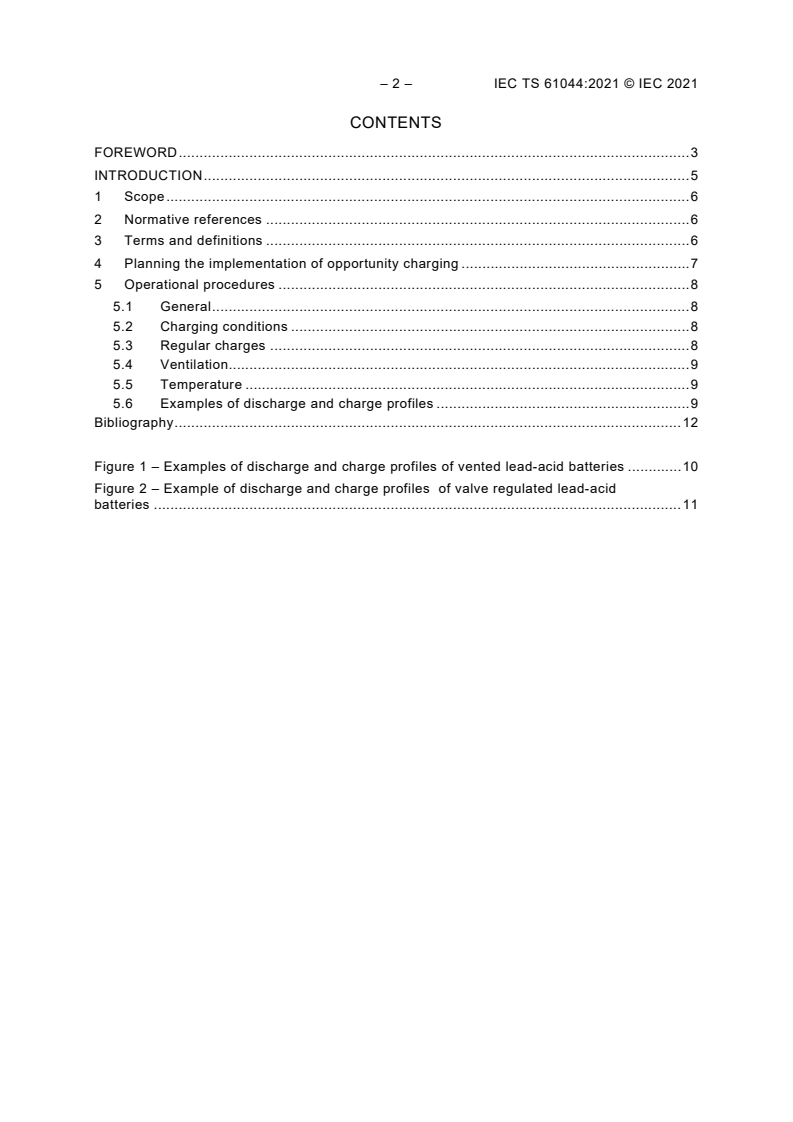
CONTENTS
FOREWORD . 3
INTRODUCTION . 5
1 Scope . 6
2 Normative references . 6
3 Terms and definitions . 6
4 Planning the implementation of opportunity charging . 7
5 Operational procedures . 8
5.1 General . 8
5.2 Charging conditions . 8
5.3 Regular charges . 8
5.4 Ventilation. 9
5.5 Temperature . 9
5.6 Examples of discharge and charge profiles . 9
Bibliography . 12
Figure 1 – Examples of discharge and charge profiles of vented lead-acid batteries . 10
Figure 2 – Example of discharge and charge profiles of valve regulated lead-acid
batteries . 11
INTERNATIONAL ELECTROTECHNICAL COMMISSION
____________
OPPORTUNITY CHARGING OF LEAD-ACID
TRACTION BATTERIES
FOREWORD
1) The International Electrotechnical Commission (IEC) is a worldwide organization for standardization comprising
all national electrotechnical committees (IEC National Committees). The object of IEC is to promote
international co-operation on all questions concerning standardization in the electrical and electronic fields. To
this end and in addition to other activities, IEC publishes International Standards, Technical Specifications,
Technical Reports, Publicly Available Specifications (PAS) and Guides (hereafter referred to as “IEC
Publication(s)”). Their preparation is entrusted to technical committees; any IEC National Committee interested
in the subject dealt with may participate in this preparatory work. International, governmental and non-
governmental organizations liaising with the IEC also participate in this preparation. IEC collaborates closely
with the International Organization for Standardization (ISO) in accordance with conditions determined by
agreement between the two organizations.
2) The formal decisions or agreements of IEC on technical matters express, as nearly as possible, an international
consensus of opinion on the relevant subjects since each technical committee has representation from all
interested IEC National Committees.
3) IEC Publications have the form of recommendations for international use and are accepted by IEC National
Committees in that sense. While all reasonable efforts are made to ensure that the technical content of IEC
Publications is accurate, IEC cannot be held responsible for the way in which they are used or for any
misinterpretation by any end user.
4) In order to promote international uniformity, IEC National Committees undertake to apply IEC Publications
transparently to the maximum extent possible in their national and regional publications. Any divergence
between any IEC Publication and the corresponding national or regional publication shall be clearly indicated in
the latter.
5) IEC itself does not provide any attestation of conformity. Independent certification bodies provide conformity
assessment services and, in some areas, access to IEC marks of conformity. IEC is not responsible for any
services carried out by independent certification bodies.
6) All users should ensure that they have the latest edition of this publication.
7) No liability shall attach to IEC or its directors, employees, servants or agents including individual experts and
members of its technical committees and IEC National Committees for any personal injury, property damage or
other damage of any nature whatsoever, whether direct or indirect, or for costs (including legal fees) and
expenses arising out of the publication, use of, or reliance upon, this IEC Publication or any other IEC
Publications.
8) Attention is drawn to the Normative references cited in this publication. Use of the referenced publications is
indispensable for the correct application of this publication.
9) Attention is drawn to the possibility that some of the elements of this IEC Publication may be the subject of
patent rights. IEC shall not be held responsible for identifying any or all such patent rights.
IEC TS 61044 has been prepared by IEC technical committee 21: Secondary cells and
batteries. It is a Technical Specification.
This first edition cancels and replaces the second edition of IEC TR 61044 published in 2002.
This edition constitutes a technical revision.
This edition includes the following significant technical changes with respect to the previous
edition:
a) the recommended depth of discharge for opportunity charging has been adjusted;
b) a distinction is made between valve regulated lead-acid batteries (VRLA) and vented lead-
acid batteries.
– 4 – IEC TS 61044:2021 © IEC 2021
The text of this Technical Specification is based on the following documents:
Draft Report on voting
21/1081/DTS 21/1088/RVDTS
Full information on the voting for its approval can be found in the report on voting indicated in
the above table.
The language used for the development of this Technical Specification is English.
This document was drafted in accordance with ISO/IEC Directives, Part 2, and developed in
accordance with ISO/IEC Directives, Part 1 and ISO/IEC Directives, IEC Supplement,
available at www.iec.ch/members_experts/refdocs. The main document types developed by
IEC are described in greater detail at www.iec.ch/standardsdev/publications.
The committee has decided that the contents of this document will remain unchanged until the
stability date indicated on the IEC website under webstore.iec.ch in the data related to the
specific document. At this date, the document will be
• reconfirmed,
• withdrawn,
• replaced by a revised edition, or
• amended.
INTRODUCTION
Lead-acid traction batteries find a widespread application in industrial transportation vehicles
because of their particular properties of providing a reliable power supply source with a very
low environmental impact.
In such applications, both monitoring and power management by electronic means have made
great strides not only on the discharge side of the energy balance but during charging as well.
This progress permits refuelling, i.e., charging of a lead-acid traction battery in a well-
controlled manner during idle periods in the course of a working schedule.
As a result, the total capacity or ampere-hour output of the lead-acid battery increases per
working day substantially beyond the manufacturer's maximum recommended value.
However, such opportunity charging will provide improved capital efficiency only if adequate
precautions are taken to prevent premature deterioration of the state of the lead-acid traction
battery caused by such a practice.
This document is intended to present requirements, derived from the field experience of
battery manufacturers in general and from opportunity charging of lead-acid traction batteries
...