


IEC TS 62788-2:2017
(Main)Measurement procedures for materials used in photovoltaic modules - Part 2: Polymeric materials - Frontsheets and backsheets
General Information
- Abstract
IEC TS 62788-2:2017(E) defines test methods and datasheet reporting requirements for safety and performance related properties (mechanical, electrical, thermal, optical and chemical) of non-rigid polymeric materials intended for use in terrestrial photovoltaic modules as polymeric frontsheets and backsheets. The test methods define how to characterize backsheet and frontsheet materials and their components in a manner representative of how they will be used in the module, which eventually includes combination with other matched components such as encapsulant or adhesives. The methods described in this document support the safety and performance related tests defined on PV module level as defined in the series IEC 61730 and IEC 61215. This document also defines test methods for assessment of inherent material characteristics of polymeric backsheets and frontsheets or their components.
- Status
- Published
- Publication Date
- 15-Aug-2017
- Technical Committee
- TC 82 - Solar photovoltaic energy systems
- Drafting Committee
- WG 2 - TC 82/WG 2
- Current Stage
- DELPUB - Deleted Publication
- Start Date
- 12-Jul-2024
- Completion Date
- 04-Sep-2020
Buy Documents
IEC TS 62788-2:2017 - Measurement procedures for materials used in photovoltaic modules - Part 2: Polymeric materials - Frontsheets and backsheets
IEC TS 62788-2:2017 - Measurement procedures for materials used in photovoltaic modules - Part 2: Polymeric materials - Frontsheets and backsheets Released:8/16/2017
Overview
IEC TS 62788-2:2017 - Measurement procedures for materials used in photovoltaic modules, Part 2: Polymeric materials – Frontsheets and backsheets - defines standardized test methods and datasheet reporting for non‑rigid polymeric materials used as frontsheets and backsheets in terrestrial photovoltaic (PV) modules. The technical specification describes how to characterize mechanical, electrical, thermal, optical and chemical properties in ways that are representative of actual module construction and service conditions. It supports PV module safety and performance testing at the module level (see IEC 61730 and IEC 61215).
Key Topics
The standard provides procedures and reporting requirements for:
- Mechanical characteristics: thickness, area weight, tensile strength, elongation, curling.
- Adhesion testing: 180° peel, T‑peel, dynamic pluck, lap‑shear, cross‑hatch tape tests and related specimen preparation and conditioning.
- Thermal properties: thermal endurance, dimensional stability, coefficient of thermal expansion (CTE), thermal conductivity.
- Electrical properties: DC breakdown voltage, distance through insulation (dti), Comparative Tracking Index (CTI), volume resistivity.
- Optical properties: optical transmittance (frontsheets), reflectance (backsheets), yellowness index (YI), colour (L*, a*, b*), surface gloss.
- Diffusion and barrier performance: water vapour and oxygen permeability.
- Chemical resistance and other characteristics (ignitability, flammability).
- Accelerated ageing tests: damp heat, weathering and other accelerated exposure protocols.
- Data reporting: uniform characterization form (UCF), material datasheet and product identification/label requirements.
Keywords integrated: IEC TS 62788-2:2017, polymeric backsheets, polymeric frontsheets, PV module materials, test methods, datasheet reporting.
Applications
IEC TS 62788-2:2017 is intended for:
- PV module manufacturers validating material compatibility and module construction.
- Material and film suppliers qualifying polymeric frontsheets/backsheets for PV use.
- Independent test laboratories performing standardized mechanical, electrical, thermal, optical and barrier tests.
- Certification bodies and quality assurance teams aligning material-level tests with module-level standards (IEC 61730 / IEC 61215).
- R&D teams developing new polymeric formulations and laminate stacks for improved durability and safety.
Practical uses include material selection, failure analysis, lifetime prediction, vendor comparison, and compliance documentation.
Related standards
- IEC 61730 - PV module safety qualification (supported by material tests in this TS)
- IEC 61215 - PV module performance qualification (material-level methods here support module‑level tests)
IEC TS 62788-2:2017 provides a consistent, application‑focused framework to measure and report polymeric material properties crucial to PV module durability, safety and long‑term performance.
Relations
- Effective Date
- 05-Sep-2023
Buy Documents
IEC TS 62788-2:2017 - Measurement procedures for materials used in photovoltaic modules - Part 2: Polymeric materials - Frontsheets and backsheets
IEC TS 62788-2:2017 - Measurement procedures for materials used in photovoltaic modules - Part 2: Polymeric materials - Frontsheets and backsheets Released:8/16/2017
Get Certified
Connect with accredited certification bodies for this standard

DNV
DNV is an independent assurance and risk management provider.

Lloyd's Register
Lloyd's Register is a global professional services organisation specialising in engineering and technology.
DNV Energy Systems
Energy and renewable energy certification.
Sponsored listings
Frequently Asked Questions
IEC TS 62788-2:2017 is a technical specification published by the International Electrotechnical Commission (IEC). Its full title is "Measurement procedures for materials used in photovoltaic modules - Part 2: Polymeric materials - Frontsheets and backsheets". This standard covers: IEC TS 62788-2:2017(E) defines test methods and datasheet reporting requirements for safety and performance related properties (mechanical, electrical, thermal, optical and chemical) of non-rigid polymeric materials intended for use in terrestrial photovoltaic modules as polymeric frontsheets and backsheets. The test methods define how to characterize backsheet and frontsheet materials and their components in a manner representative of how they will be used in the module, which eventually includes combination with other matched components such as encapsulant or adhesives. The methods described in this document support the safety and performance related tests defined on PV module level as defined in the series IEC 61730 and IEC 61215. This document also defines test methods for assessment of inherent material characteristics of polymeric backsheets and frontsheets or their components.
IEC TS 62788-2:2017(E) defines test methods and datasheet reporting requirements for safety and performance related properties (mechanical, electrical, thermal, optical and chemical) of non-rigid polymeric materials intended for use in terrestrial photovoltaic modules as polymeric frontsheets and backsheets. The test methods define how to characterize backsheet and frontsheet materials and their components in a manner representative of how they will be used in the module, which eventually includes combination with other matched components such as encapsulant or adhesives. The methods described in this document support the safety and performance related tests defined on PV module level as defined in the series IEC 61730 and IEC 61215. This document also defines test methods for assessment of inherent material characteristics of polymeric backsheets and frontsheets or their components.
IEC TS 62788-2:2017 is classified under the following ICS (International Classification for Standards) categories: 27.160 - Solar energy engineering. The ICS classification helps identify the subject area and facilitates finding related standards.
IEC TS 62788-2:2017 has the following relationships with other standards: It is inter standard links to IEC TS 62788-2:2024. Understanding these relationships helps ensure you are using the most current and applicable version of the standard.
IEC TS 62788-2:2017 is available in PDF format for immediate download after purchase. The document can be added to your cart and obtained through the secure checkout process. Digital delivery ensures instant access to the complete standard document.
Standards Content (Sample)
IEC TS 62788-2 ®
Edition 1.0 2017-08
TECHNICAL
SPECIFICATION
colour
inside
Measurement procedures for materials used in photovoltaic modules –
Part 2: Polymeric materials – Frontsheets and backsheets
All rights reserved. Unless otherwise specified, no part of this publication may be reproduced or utilized in any form
or by any means, electronic or mechanical, including photocopying and microfilm, without permission in writing from
either IEC or IEC's member National Committee in the country of the requester. If you have any questions about IEC
copyright or have an enquiry about obtaining additional rights to this publication, please contact the address below or
your local IEC member National Committee for further information.
IEC Central Office Tel.: +41 22 919 02 11
3, rue de Varembé Fax: +41 22 919 03 00
CH-1211 Geneva 20 info@iec.ch
Switzerland www.iec.ch
About the IEC
The International Electrotechnical Commission (IEC) is the leading global organization that prepares and publishes
International Standards for all electrical, electronic and related technologies.
About IEC publications
The technical content of IEC publications is kept under constant review by the IEC. Please make sure that you have the
latest edition, a corrigenda or an amendment might have been published.
IEC Catalogue - webstore.iec.ch/catalogue Electropedia - www.electropedia.org
The stand-alone application for consulting the entire The world's leading online dictionary of electronic and
bibliographical information on IEC International Standards, electrical terms containing 20 000 terms and definitions in
Technical Specifications, Technical Reports and other English and French, with equivalent terms in 16 additional
documents. Available for PC, Mac OS, Android Tablets and languages. Also known as the International Electrotechnical
iPad. Vocabulary (IEV) online.
IEC publications search - www.iec.ch/searchpub IEC Glossary - std.iec.ch/glossary
The advanced search enables to find IEC publications by a 65 000 electrotechnical terminology entries in English and
variety of criteria (reference number, text, technical French extracted from the Terms and Definitions clause of
committee,…). It also gives information on projects, replaced IEC publications issued since 2002. Some entries have been
and withdrawn publications. collected from earlier publications of IEC TC 37, 77, 86 and
CISPR.
IEC Just Published - webstore.iec.ch/justpublished
Stay up to date on all new IEC publications. Just Published IEC Customer Service Centre - webstore.iec.ch/csc
details all new publications released. Available online and If you wish to give us your feedback on this publication or
also once a month by email. need further assistance, please contact the Customer Service
Centre: csc@iec.ch.
IEC TS 62788-2 ®
Edition1.0 2017-08
TECHNICAL
SPECIFICATION
colour
inside
Measurement procedures for materials used in photovoltaic modules –
Part 2: Polymeric materials – Frontsheets and backsheets
INTERNATIONAL
ELECTROTECHNICAL
COMMISSION
ICS 27.160 ISBN 978-2-8322-4673-3
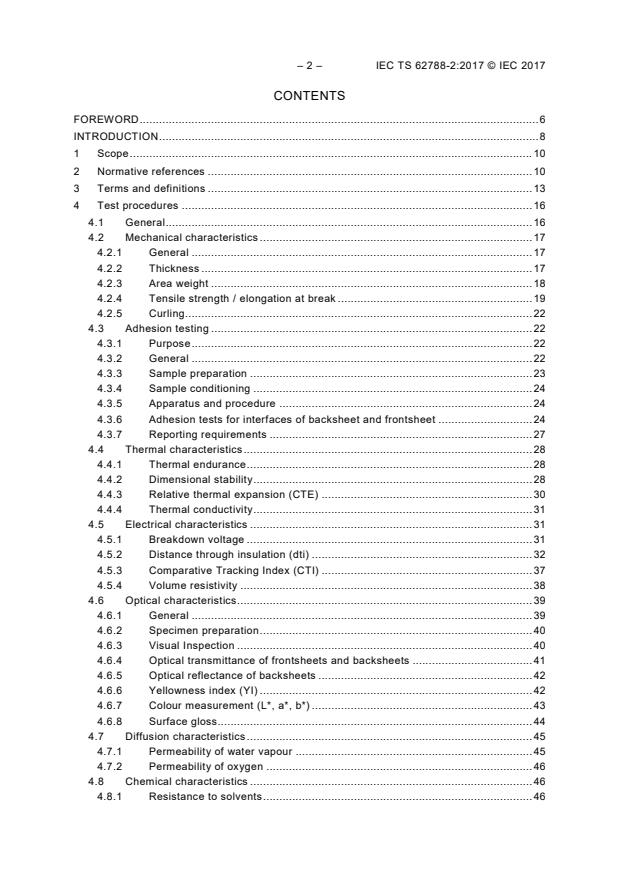
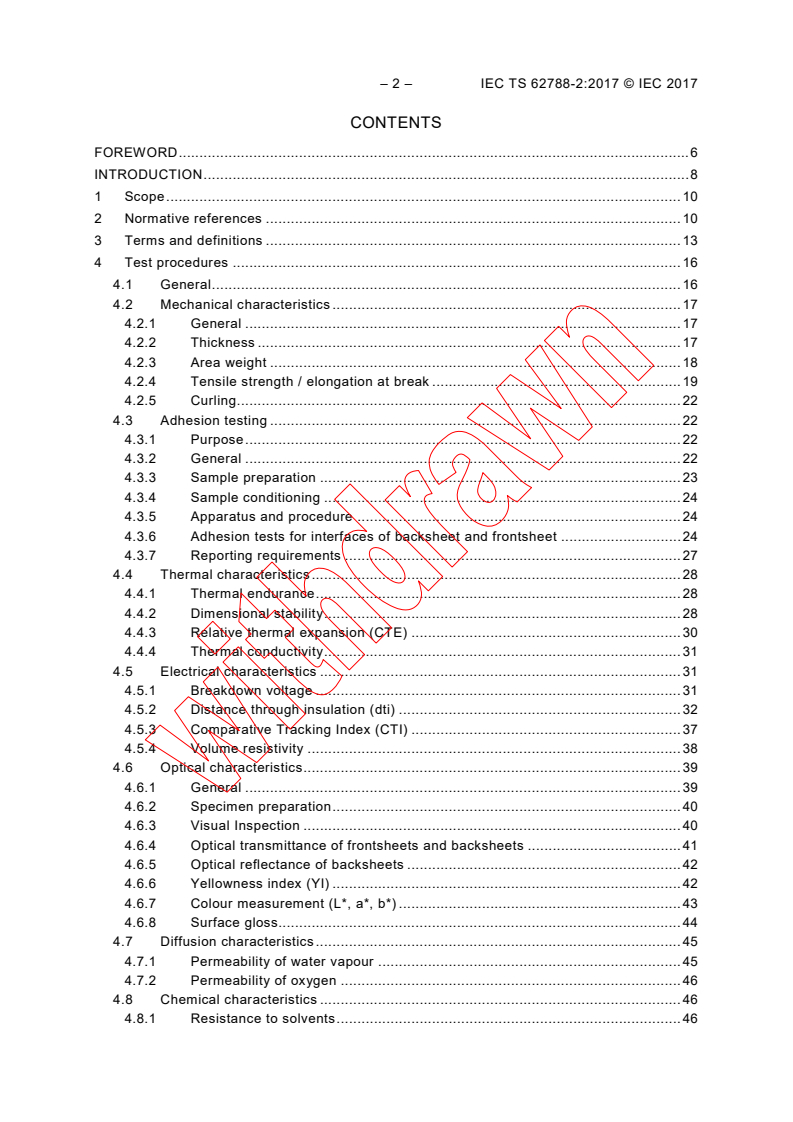
– 2 – IEC TS 62788-2:2017 © IEC 2017
CONTENTS
FOREWORD . 6
INTRODUCTION . 8
1 Scope . 10
2 Normative references . 10
3 Terms and definitions . 13
4 Test procedures . 16
4.1 General . 16
4.2 Mechanical characteristics . 17
4.2.1 General . 17
4.2.2 Thickness . 17
4.2.3 Area weight . 18
4.2.4 Tensile strength / elongation at break . 19
4.2.5 Curling . 22
4.3 Adhesion testing . 22
4.3.1 Purpose . 22
4.3.2 General . 22
4.3.3 Sample preparation . 23
4.3.4 Sample conditioning . 24
4.3.5 Apparatus and procedure . 24
4.3.6 Adhesion tests for interfaces of backsheet and frontsheet . 24
4.3.7 Reporting requirements . 27
4.4 Thermal characteristics . 28
4.4.1 Thermal endurance . 28
4.4.2 Dimensional stability . 28
4.4.3 Relative thermal expansion (CTE) . 30
4.4.4 Thermal conductivity . 31
4.5 Electrical characteristics . 31
4.5.1 Breakdown voltage . 31
4.5.2 Distance through insulation (dti) . 32
4.5.3 Comparative Tracking Index (CTI) . 37
4.5.4 Volume resistivity . 38
4.6 Optical characteristics . 39
4.6.1 General . 39
4.6.2 Specimen preparation . 40
4.6.3 Visual Inspection . 40
4.6.4 Optical transmittance of frontsheets and backsheets . 41
4.6.5 Optical reflectance of backsheets . 42
4.6.6 Yellowness index (YI) . 42
4.6.7 Colour measurement (L*, a*, b*) . 43
4.6.8 Surface gloss. 44
4.7 Diffusion characteristics . 45
4.7.1 Permeability of water vapour . 45
4.7.2 Permeability of oxygen . 46
4.8 Chemical characteristics . 46
4.8.1 Resistance to solvents . 46
4.9 Other characteristics . 48
4.9.1 Ignitability – Purpose . 48
4.9.2 Flammability – Purpose . 48
4.10 Accelerated ageing tests . 48
4.10.1 Purpose . 48
4.10.2 Damp Heat (DH) testing at elevated heat and moisture . 49
4.10.3 Weathering at elevated levels of temperature and moisture . 50
5 Uniform characterization form (UCF) . 55
5.1 General . 55
5.2 Layer stack description . 55
5.3 Material test results and reporting requirements. 56
6 Data sheet . 58
6.1 Purpose . 58
6.2 Reporting requirements . 58
7 Product identification sheet (label) . 58
Annex A (informative) Overview of adhesion testing of frontsheet and backsheet . 59
A.1 Type of adhesion failure . 59
A.2 Characteristics of adhesion peel tests . 60
A.3 Characteristics of pluck and lap-shear tests . 60
A.4 Cross-hatch tape testing . 61
A.5 Other caveats . 61
A.6 Overview . 61
Annex B (normative) Adhesive bond strength test procedures in PV context . 64
B.1 180°peel adhesion test . 64
B.1.1 Specimens . 64
B.1.2 Procedure . 64
B.1.3 Measurement . 65
B.2 T-peel adhesion test . 66
B.2.1 Sample preparation . 66
B.2.2 Procedure . 67
B.2.3 Measurement . 67
B.3 Dynamic tensile (T-pluck). 68
B.3.1 Purpose . 68
B.3.2 Principle . 68
B.3.3 Specimens . 68
B.3.4 Measurement procedure . 69
B.3.5 Final measurements . 69
B.4 Dynamic overlap shear . 70
B.4.1 Purpose . 70
B.4.2 Principle . 70
B.4.3 Specimens . 70
B.4.4 Measurement procedure . 72
B.4.5 Final measurements . 72
B.5 Cross-hatch tape test . 73
B.5.1 Apparatus . 73
B.5.2 Procedure . 74
B.5.3 Final measurements . 74
– 4 – IEC TS 62788-2:2017 © IEC 2017
Annex C (normative) DC breakdown voltage . 75
C.1 Apparatus . 75
C.2 Surrounding medium . 76
C.3 Procedure . 76
C.4 Criteria of breakdown . 77
C.5 Other characterization methods . 77
Annex D (informative) Abrasion testing . 79
D.1 Purpose . 79
D.2 Methods . 79
Annex E (normative) Sampling of films . 82
E.1 Purpose . 82
E.2 Procedure . 82
Annex F (normative) Sample preparation . 83
F.1 Purpose . 83
F.2 Sample constructions . 83
F.2.1 General considerations . 83
F.2.2 Materials and procedures . 83
Bibliography . 87
Figure 1 – Specimen type . 20
Figure 2 – Specimen before and after shrinkage . 29
Figure 3 – Examples of lamination cycles . 34
Figure 4 – Schematics of test specimen for distance for insulation before and after
lamination . 34
Figure 5 – Directions for sectioning (perpendicular to solder wire position) . 35
Figure 6 – Example of dti cross-section of a backsheet with an E-layer as inner side
material . 37
Figure A.1 – Adhesive and cohesive failure type schematics for lap-shear (top) and T-
pluck (bottom) . 59
Figure B.1 – Example test panel (70 mm x 150 mm) and test specimen . 64
Figure B.2 – Fixation of the sample for 180° peel (for use with flexible/flexible samples)
and cross-section of the sample . 65
Figure B.3 – Single and multiple failure modes in a peel test . 66
Figure B.4 – Sheet sandwich (above) from which test specimens for T-peel are
prepared . 67
Figure B.5 – Dynamic tensile (pluck) schematic . 68
Figure B.6 – Schematic of pluck sample (in cross-section) for a laminated backsheet
test . 69
Figure B.7 – Dynamic tensile variables . 69
Figure B.8 – Overlap shear force schematics . 70
Figure B.9 – Schematic of overlap shear specimen shown in cross-section, for a
laminated backsheet coupon . 71
Figure B.10 – Details of overlap shear specimens (ISO 4587:2003, Figure 1) . 71
Figure B.11 – Overview of overlap shear test conditions . 72
Figure B.12 – Dynamic overlap shear schematic . 73
Figure B.13 – Illustration of area removal by tape in cross-hatch test, with classification
from 0 to 5 (from left to right) . 74
Figure C.1 – Equal electrodes for dielectric strength test (taken from Figure 1b of
IEC 60243-1:2013). 76
Figure D.1 – Number size distributions of saltation particles at the dune site, 30 cm
height, and the Gobi sites, 20 cm and 30 cm height, from 1223 to 1320 UT, 5 April
2002 [13] . 80
Figure D.2 – Particle size distribution of sand from different heights . 81
Figure D.3 – Grain size distribution of surface sand and drifting sand captured at 20
cm high above the crest of dune [14] . 81
Table 1 – Overview of adhesion tests . 25
Table 2 – Overview of sample preparation for exposure of sun-facing side of backsheet
depending on intended post evaluation (see Table F.1) . 52
Table 3 – Uniform characterization form (UCF) for polymeric PV frontsheet or
backsheet . 57
Table A.1 – Overview of various adhesion tests and their general capability of testing
polymeric frontsheet and backsheet . 62
Table F.1 – Overview of sample preparation suitable for material tests . 85
– 6 – IEC TS 62788-2:2017 © IEC 2017
INTERNATIONAL ELECTROTECHNICAL COMMISSION
____________
MEASUREMENT PROCEDURES FOR MATERIALS USED
IN PHOTOVOLTAIC MODULES –
Part 2: Polymeric materials – Frontsheets and backsheets
FOREWORD
1) The International Electrotechnical Commission (IEC) is a worldwide organization for standardization comprising
all national electrotechnical committees (IEC National Committees). The object of IEC is to promote
international co-operation on all questions concerning standardization in the electrical and electronic fields. To
this end and in addition to other activities, IEC publishes International Standards, Technical Specifications,
Technical Reports, Publicly Available Specifications (PAS) and Guides (hereafter referred to as “IEC
Publication(s)”). Their preparation is entrusted to technical committees; any IEC National Committee interested
in the subject dealt with may participate in this preparatory work. International, governmental and non-
governmental organizations liaising with the IEC also participate in this preparation. IEC collaborates closely
with the International Organization for Standardization (ISO) in accordance with conditions determined by
agreement between the two organizations.
2) The formal decisions or agreements of IEC on technical matters express, as nearly as possible, an international
consensus of opinion on the relevant subjects since each technical committee has representation from all
interested IEC National Committees.
3) IEC Publications have the form of recommendations for international use and are accepted by IEC National
Committees in that sense. While all reasonable efforts are made to ensure that the technical content of IEC
Publications is accurate, IEC cannot be held responsible for the way in which they are used or for any
misinterpretation by any end user.
4) In order to promote international uniformity, IEC National Committees undertake to apply IEC Publications
transparently to the maximum extent possible in their national and regional publications. Any divergence
between any IEC Publication and the corresponding national or regional publication shall be clearly indicated in
the latter.
5) IEC itself does not provide any attestation of conformity. Independent certification bodies provide conformity
assessment services and, in some areas, access to IEC marks of conformity. IEC is not responsible for any
services carried out by independent certification bodies.
6) All users should ensure that they have the latest edition of this publication.
7) No liability shall attach to IEC or its directors, employees, servants or agents including individual experts and
members of its technical committees and IEC National Committees for any personal injury, property damage or
other damage of any nature whatsoever, whether direct or indirect, or for costs (including legal fees) and
expenses arising out of the publication, use of, or reliance upon, this IEC Publication or any other IEC
Publications.
8) Attention is drawn to the Normative references cited in this publication. Use of the referenced publications is
indispensable for the correct application of this publication.
9) Attention is drawn to the possibility that some of the elements of this IEC Publication may be the subject of
patent rights. IEC shall not be held responsible for identifying any or all such patent rights.
The main task of IEC technical committees is to prepare International Standards. In
exceptional circumstances, a technical committee may propose the publication of a technical
specification when
• the required support cannot be obtained for the publication of an International Standard,
despite repeated efforts, or
• the subject is still under technical development or where, for any other reason, there is the
future but no immediate possibility of an agreement on an International Standard.
Technical specifications are subject to review within three years of publication to decide
whether they can be transformed into International Standards.
IEC TS 62788-2, which is a technical specification, has been prepared by IEC technical
committee 82: Solar photovoltaic energy systems.
The text of this technical specification is based on the following documents:
Enquiry draft Report on voting
82/1189/DTS 82/1243A/RVDTS
Full information on the voting for the approval of this technical specification can be found in
the report on voting indicated in the above table.
A list of all parts in the IEC 62788 series, published under the general title Measurement
procedures for materials used in photovoltaic modules, can be found on the IEC website.
This document has been drafted in accordance with the ISO/IEC Directives, Part 2.
The committee has decided that the contents of this publication will remain unchanged until
the stability date indicated on the IEC website under "http://webstore.iec.ch" in the data
related to the specific publication. At this date, the publication will be
• transformed into an International standard,
• reconfirmed,
• withdrawn,
• replaced by a revised edition, or
• amended.
A bilingual version of this publication may be issued at a later date.
IMPORTANT – The 'colour inside' logo on the cover page of this publication indicates
that it contains colours which are considered to be useful for the correct
understanding of its contents. Users should therefore print this document using a
colour printer.
– 8 – IEC TS 62788-2:2017 © IEC 2017
INTRODUCTION
Backsheets provide the electrical insulation at the backside of a PV module under the
environmental stress factors and use conditions encountered during the intended lifetime of
the module. Frontsheets have the same function at the front side of the module facing
towards the sun. Both can be made from glass or polymeric material.
Polymeric backsheets and frontsheets are typically compositions of layered materials, such as
films, adhesives or coatings, in which at least one material layer delivers the relied-upon
insulation (RUI) for electrical safety. Other layers may provide extended protection of the RUI
against the environmental factors or adhesive functionality. As an integral part of the PV
module, backsheet and frontsheet shall provide their durable electrical insulating function in
presence of the other components of the PV module, such as light-to-current conversion
element (the “cell”), electrical circuits and connectors, frontsheet and encapsulant, sealing
material, junction boxes, etc. These elements may introduce additional stresses on the
backsheet or frontsheet (e.g. by chemical interactions or introducing thermal load or
mechanical stress) or alter environmental stresses (e.g. filtering of UV radiation reaching the
sun-facing side of the backsheet).
It is impractical to conduct all endurance tests for frontsheet or backsheet component on
module level. Instead, testing is performed directly on these components for pre-qualification
of the materials as such, as e.g. given by the thermal endurance test required for material
intended for use as relied-upon-insulation, that is qualified by IEC 60216 (see
IEC 61730-1:2016, 5.5.1.3.3) and results in RTE/RTI/TI ratings of ≥ 90 °C or maximum
operating temperature (whichever is greater). In the case of thermal pre-qualification of
backsheet and frontsheet only dielectric and mechanical material tests apply for RTE/RTI/TI
assessment.
In analogy to RTE/RTI/TI, it is desirable to also obtain pre-qualification of backsheet and
frontsheet films to provide durable electrical insulation after exposure to additional
environmental factors, such as:
a) Elevated moisture and temperature (damp heat), or
b) UV-weathering in a manner representative of the field conditions. These tests can either
be conducted direct on the backsheet or frontsheet films or on dedicated test coupons as
engineering type specimens, which are prepared from the same materials and produced
under comparable processing conditions (i.e. lamination) as the PV modules.
• The portion of the backsheet that contributes to the relied upon insulation should be
evaluated for d.c. voltage (V) breakdown strength according to IEC 60243-1 and
IEC 60243-2, and meet the requirements as described in 5.6.4.3 of IEC 61730-1:2016.
In this document a suitable choice of test parameters for the assessment of polymeric
frontsheet and backsheet is defined.
• The relied upon insulation material shall have a minimum thickness, also known as
distance through insulation (dti) defined in the “thickness in thin layers” rows of
Tables 3 and 4 in 5.6 of IEC 61730-1:2016.
• Materials relied upon for insulation are further categorized into Materials Groups I, II,
or III, according to CTI values describing potential tracking along interfaces that may
get in contact with live parts.
• Durable adhesion between components of the backsheet or frontsheet is needed to
preserve the integrity of the sheet material in field conditions. Also, preservation of
adhesion to other components of the module such as encapsulant and edge seal or
adhesion to the junction box adhesive are important. Different test geometries may
apply depending on the interface under test and construction of the sheet material.
Other characteristics of frontsheet or backsheet might be relevant for the electrical yield
(e.g. optical transmittance or reflectance) or module producibility (e.g. lamination process).
This document defines test methods required for reporting of properties of polymeric
frontsheet and backsheet in a datasheet. Those properties are related to safety and yield of
the assembled PV module and may be applied to backsheet/frontsheet before and after
specific ageing tests as mentioned before.
In analogy to RTE/RTI/TI testing, the test methods in this document are intended to be used
in procedures for pre-qualification and/or quality assurance of frontsheet and backsheet
components with respect to their endurance under damp-heat and UV weathering stresses –
once these pre-qualification procedures are agreed on and implemented in alignment with the
pertinent standards IEC 61730 and IEC 61215, in which the safety requirements on PV
module level are defined.
NOTE At the time of writing this TS, an amendment project for IEC 61730-1 is in preparation, in which
requirements for measurement of dti (distance through insulation) and resistance against weathering are planned
based on methods defined in this document IEC TS 62788-2 as well as IEC TS 62788-7-2.
The test methods in these TS provide additional information on material properties and
endurance of backsheet and frontsheet components that cannot be assessed in the tests on
PV module alone.
Furthermore, optional characterization test methods are defined, addressing properties of
backsheet and frontsheet that are of informative nature, e.g. in the context of PV module
design, but which are not directly safety, yield or processing related.
Test methods for characterization of components of backsheet and frontsheet are described,
which are useful in R&D context.
All of these test methods are set into perspective by indicating their use and limitations.
– 10 – IEC TS 62788-2:2017 © IEC 2017
MEASUREMENT PROCEDURES FOR MATERIALS USED
IN PHOTOVOLTAIC MODULES –
Part 2: Polymeric materials – Frontsheets and backsheets
1 Scope
This part of IEC 62788 defines test methods and datasheet reporting requirements for safety
and performance related properties (mechanical, electrical, thermal, optical and chemical) of
non-rigid polymeric materials intended for use in terrestrial photovoltaic modules as polymeric
frontsheets and backsheets.
The test methods in this document define how to characterize backsheet and frontsheet
materials and their components in a manner representative of how they will be used in the
module, which eventually includes combination with other matched components such as
encapsulant or adhesives. The methods described in this document support the safety and
performance related tests defined on PV module level as defined in the series IEC 61730 and
IEC 61215.
This document also defines test methods for assessment of inherent material characteristics
of polymeric backsheets and frontsheets or their components, which may be required in
datasheet reporting or may be useful in the context of product development or design of PV
modules.
Rigid polymeric sheet materials (also providing mechanical support) may require further
consideration.
2 Normative references
The following documents are referred to in the text in such a way that some or all of their
content constitutes requirements of this document. For dated references, only the edition
cited applies. For undated references, the latest edition of the referenced document (including
any amendments) applies.
IEC 60050-581, International Electrotechnical Vocabulary – Part 581: Electromechanical
components for electronic equipment
IEC 60050-826, International Electrotechnical Vocabulary – Part 826: Electrical installations
IEC 60068-1, Environmental testing – Part 1: General and guidance
IEC 60112:2003, Method for the determination of the proof and the comparative tracking
indices of solid insulating materials
IEC 60212, Standard conditions for use prior to and during the testing of solid electrical
insulating materials
IEC 60216-1, Electrical insulating materials – Properties of thermal endurance – Part 1:
Ageing procedures and evaluation of test results
IEC 60216-2:2005, Electrical insulating materials – Thermal endurance properties – Part 2:
Determination of thermal endurance properties of electrical insulating materials – Choice of
test criteria
IEC 60216-5, Electrical insulating materials – Thermal endurance properties – Part 5:
Determination of relative thermal endurance index (RTE) of an insulating material
IEC 60243-1:2013, Electrical strength of insulating materials – Test methods – Part 1: Tests
at power frequencies
IEC 60243-2, Electric strength of insulating materials – Test methods – Part 2: Additional
requirements for tests using direct voltage
IEC 60296, Fluids for electrotechnical applications – Unused mineral insulating oils for
transformers and switchgear
IEC 60664-1, Insulation co-ordination for equipment within low-voltage systems – Part 1:
Principles, requirements and tests
IEC 60904-3:2016, Photovoltaic devices – Part 3: Measurement principles for terrestrial
photovoltaic (PV) solar devices with reference spectral irradiance data
IEC 61140, Protection against electric shock – Common aspects for installation and
equipment
IEC 61189-3, Test methods for electrical materials, printed boards and other interconnection
structures and assemblies – Part 3: Test methods for interconnection structures (printed
boards)
IEC 61215-1:2016, Terrestrial photovoltaic (PV) modules – Design qualification and type
approval – Part 1: Test requirements
IEC 61215-2:2016, Terrestrial photovoltaic (PV) modules – Design qualification and type
approval – Part 2: Test procedures
IEC 61730-1:2016, Photovoltaic (PV) module safety qualification – Part 1: Requirements for
construction
IEC 61730-2, Photovoltaic (PV) module safety qualification – Part 2: Requirements for testing
IEC TS 61836, Solar photovoltaic energy systems – Terms, definitions and symbols
IEC 62788-1-2, Measurement procedures for materials used in photovoltaic modules –
Part 1-2: Encapsulants – Measurement of volume resistivity of photovoltaic encapsulants and
other polymeric materials
IEC 62788-1-4, Measurement procedures for materials used in photovoltaic modules –
Part 1-4: Encapsulants – Measurement of optical transmittance and calculation of the solar-
weighted photon transmittance, yellowness index, and UV cut-off wavelength
IEC 62788-1-5, Measurement procedures for materials used in photovoltaic modules –
Part 1-5: Encapsulants – Measurement of change in linear dimensions of sheet encapsulation
material resulting from applied thermal conditions
IEC TS 62788-7-2, Measurement procedures for materials used in photovoltaic modules –
Part 7-2: Environmental exposures – Accelerated weathering tests of polymeric materials
IEC 62790, Junction boxes for photovoltaic modules – Safety requirements and tests
– 12 – IEC TS 62788-2:2017 © IEC 2017
IEC 62805-2, Method for measuring photovoltaic (PV) glass – Part 2: Measurement of
transmittance and reflectance
ISO 291, Plastics – Standard atmospheres for conditioning and testing
ISO 527 (all parts): Plastics
ISO 527-3, Plastics – Determination of tensile properties – Part 3: Test conditions for films
and sheets
ISO 536:2012, Paper and board – Determination of grammage
ISO 2409:2013, Paints and varnishes – Cross-cut test
ISO 2808, Paints and varnishes determination of film thickness
ISO 2813, Paints and varnishes – Determination of gloss value at 20 degrees, 60 degrees and
85 degrees
ISO 4587:2003, Adhesives – Determination of tensile lap-shear strength of rigid-to-rigid
bonded assemblies
ISO 4593: Plastics – Film and sheeting – Determination of thickness by mechanical scanning
ISO 11359-1, Plastics – Thermomechanical analysis (TMA) – Part 1: General principles
ISO 11359-2: Plastics – Thermomechanical analysis (TMA) – Part 2: Determination of
coefficient of linear thermal expansion and glass transition temperature
ISO 11664-1, Colorimetry – Part 1: CIE standard colorimetric observers
ISO 11664-2, Colorimetry – Part 2: CIE standard illuminants
ISO 11664-4, Colorimetry – Part 4: CIE 1976 L*a*b* Colour space
ISO 15105-2, Plastics – Film and sheeting – Determination of gas-transmission rate – Part 2:
Equal-pressure method
ISO 15106-1, Plastics – Film and sheeting – Determination of water vapour transmission rate
– Part 1: Humidity detection sensor method
ISO 15106-2, Plastics – Film and sheeting – Determination of water vapour transmission rate
– Part 2: Infrared detection sensor method
ISO 15106-3, Plastics – Film and sheeting – Determination of water vapour transmission rate
– Part 3: Electrolytic detection sensor method
ISO 17223, Plastics – Determination of yellowness index and change in yellowness index
EN 821-2, Advanced technical ceramics – Monolithic ceramics, thermo-physical properties –
Part 2: Determination of thermal diffusivity by the laser flash (or heat pulse) method
ASTM D374–16, Standard Test Methods for Thickness of Solid Electrical Insulation
ASTM D3487-16, Standard Specification for Mineral Insulating Oil Used in Electrical
Apparatus
ASTM D 5402-06, Standard Practice for Assessing the Solvent Resistance of Organic
Coatings Using Solvent Rubs
ASTM D7869-17, Standard Practice for Xenon Arc Exposure Test with Enhanced Light and
Water Exposure for Transportation Coatings
ASTM E1461, Standard Test Method for Thermal Diffusivity by the Flash Method
UL 746B, Standard for Polymeric Materials – Long Term Property Evaluations
3 Terms and definitions
For the purposes of this document, the terms and definitions given in IEC 60050-581,
IEC 60050-826, IEC 60664-1, IEC TS 61836, IEC 61730-1 and IEC 61140, together with the
following, apply.
ISO and IEC maintain terminological databases for use in standardization at the following
addresses:
• IEC Electropedia: available at http://www.electropedia.org/
• ISO Online browsing platform: available at http://www.iso.org/obp
3.1
abrasion resistance
ability of a material to withstand mechanical action such as rubbing, scraping, or erosion, that
tends progressively to remove material from its surface
3.2
adhesive failure
de-bonding occurring between the adhesive and the adherent, to be differentiated from
cohesive failure within the adhesive material
Note 1 to entry: See also Clause A.1.
3.3
air-facing side
side of the frontsheet or backsheet that is oriented towards the outside of the PV module, i.e.
away from the cells
3.4
backsheet
BS
outer layer of the PV module, located on the back of PV module and providing protection of
the inner components of the module from external stresses and weather elements, as well as
electrical insulation
3.5
bond strength
force required to separate an adhesive from an adherent
3.6
breakdown voltage
voltage at which electric breakdown occurs under prescribed test conditions, or in use
– 14 – IEC TS 62788-2:2017 © IEC 2017
Note 1 to entry: Breakdown voltage depends on whether direct or alternate current (d.c. or a.c.) is applied.
[SOURCE: IEC 60050-212:2010, 212-11-34]
3.7
cohesive failure
crack propagating within the adhesive during adhesion test, e.g. peel test
Note 1 to entry: See also Clause A.1.
3.8
comparative tracking index
CTI
numerical index value related to the maximum voltage which a material can withstand without
a permanent electrically conductive carbon path tracking when evaluated under specified test
conditions defined in IEC 60112
Note 1 to entry: The mentioned maximum test voltage is not in conjunction with any system or operational voltage,
but it is used for evaluation of material groups.
[SOURCE: IEC 60050-212:2010, 212-11-59, modified: clarified that CTI is an index value to
evaluate material groups]
3.9
distance through insulation
dti
thickness value required for relied upon insulation based on thin layers of insulating material
3.10
effective hemispherical reflectance of photon irradiance
ratio of the total reflected photon irradiance to the incident photon irradiance in the
wavelength range of 300 nm to 1 250 nm, weighted with the solar spectrum. Reflectance is
collected over an entire hemisphere for detection
SEE: IEC 62805.
3.11
effective hemispherical transmission of photon irradiance
ratio of the total transmitted photon irradiance to the incident photon irradiance in the
wavelength range of 300 nm to 1 250 nm, weighted with the solar spectrum. Transmittance is
collected over an entire hemisp
...
IEC TS 62788-2 ®
Edition 1.0 2017-08
TECHNICAL
SPECIFICATION
colour
inside
Measurement procedures for materials used in photovoltaic modules –
Part 2: Polymeric materials – Frontsheets and backsheets
All rights reserved. Unless otherwise specified, no part of this publication may be reproduced or utilized in any form
or by any means, electronic or mechanical, including photocopying and microfilm, without permission in writing from
either IEC or IEC's member National Committee in the country of the requester. If you have any questions about IEC
copyright or have an enquiry about obtaining additional rights to this publication, please contact the address below or
your local IEC member National Committee for further information.
IEC Central Office Tel.: +41 22 919 02 11
3, rue de Varembé Fax: +41 22 919 03 00
CH-1211 Geneva 20 info@iec.ch
Switzerland www.iec.ch
About the IEC
The International Electrotechnical Commission (IEC) is the leading global organization that prepares and publishes
International Standards for all electrical, electronic and related technologies.
About IEC publications
The technical content of IEC publications is kept under constant review by the IEC. Please make sure that you have the
latest edition, a corrigenda or an amendment might have been published.
IEC Catalogue - webstore.iec.ch/catalogue Electropedia - www.electropedia.org
The stand-alone application for consulting the entire The world's leading online dictionary of electronic and
bibliographical information on IEC International Standards, electrical terms containing 20 000 terms and definitions in
Technical Specifications, Technical Reports and other English and French, with equivalent terms in 16 additional
documents. Available for PC, Mac OS, Android Tablets and languages. Also known as the International Electrotechnical
iPad. Vocabulary (IEV) online.
IEC publications search - www.iec.ch/searchpub IEC Glossary - std.iec.ch/glossary
The advanced search enables to find IEC publications by a 65 000 electrotechnical terminology entries in English and
variety of criteria (reference number, text, technical French extracted from the Terms and Definitions clause of
committee,…). It also gives information on projects, replaced IEC publications issued since 2002. Some entries have been
and withdrawn publications. collected from earlier publications of IEC TC 37, 77, 86 and
CISPR.
IEC Just Published - webstore.iec.ch/justpublished
Stay up to date on all new IEC publications. Just Published IEC Customer Service Centre - webstore.iec.ch/csc
details all new publications released. Available online and If you wish to give us your feedback on this publication or
also once a month by email. need further assistance, please contact the Customer Service
Centre: csc@iec.ch.
IEC TS 62788-2 ®
Edition1.0 2017-08
TECHNICAL
SPECIFICATION
colour
inside
Measurement procedures for materials used in photovoltaic modules –
Part 2: Polymeric materials – Frontsheets and backsheets
INTERNATIONAL
ELECTROTECHNICAL
COMMISSION
ICS 27.160 ISBN 978-2-8322-4673-3
– 2 – IEC TS 62788-2:2017 © IEC 2017
CONTENTS
FOREWORD . 6
INTRODUCTION . 8
1 Scope . 10
2 Normative references . 10
3 Terms and definitions . 13
4 Test procedures . 16
4.1 General . 16
4.2 Mechanical characteristics . 17
4.2.1 General . 17
4.2.2 Thickness . 17
4.2.3 Area weight . 18
4.2.4 Tensile strength / elongation at break . 19
4.2.5 Curling . 22
4.3 Adhesion testing . 22
4.3.1 Purpose . 22
4.3.2 General . 22
4.3.3 Sample preparation . 23
4.3.4 Sample conditioning . 24
4.3.5 Apparatus and procedure . 24
4.3.6 Adhesion tests for interfaces of backsheet and frontsheet . 24
4.3.7 Reporting requirements . 27
4.4 Thermal characteristics . 28
4.4.1 Thermal endurance . 28
4.4.2 Dimensional stability . 28
4.4.3 Relative thermal expansion (CTE) . 30
4.4.4 Thermal conductivity . 31
4.5 Electrical characteristics . 31
4.5.1 Breakdown voltage . 31
4.5.2 Distance through insulation (dti) . 32
4.5.3 Comparative Tracking Index (CTI) . 37
4.5.4 Volume resistivity . 38
4.6 Optical characteristics . 39
4.6.1 General . 39
4.6.2 Specimen preparation . 40
4.6.3 Visual Inspection . 40
4.6.4 Optical transmittance of frontsheets and backsheets . 41
4.6.5 Optical reflectance of backsheets . 42
4.6.6 Yellowness index (YI) . 42
4.6.7 Colour measurement (L*, a*, b*) . 43
4.6.8 Surface gloss. 44
4.7 Diffusion characteristics . 45
4.7.1 Permeability of water vapour . 45
4.7.2 Permeability of oxygen . 46
4.8 Chemical characteristics . 46
4.8.1 Resistance to solvents . 46
4.9 Other characteristics . 48
4.9.1 Ignitability – Purpose . 48
4.9.2 Flammability – Purpose . 48
4.10 Accelerated ageing tests . 48
4.10.1 Purpose . 48
4.10.2 Damp Heat (DH) testing at elevated heat and moisture . 49
4.10.3 Weathering at elevated levels of temperature and moisture . 50
5 Uniform characterization form (UCF) . 55
5.1 General . 55
5.2 Layer stack description . 55
5.3 Material test results and reporting requirements. 56
6 Data sheet . 58
6.1 Purpose . 58
6.2 Reporting requirements . 58
7 Product identification sheet (label) . 58
Annex A (informative) Overview of adhesion testing of frontsheet and backsheet . 59
A.1 Type of adhesion failure . 59
A.2 Characteristics of adhesion peel tests . 60
A.3 Characteristics of pluck and lap-shear tests . 60
A.4 Cross-hatch tape testing . 61
A.5 Other caveats . 61
A.6 Overview . 61
Annex B (normative) Adhesive bond strength test procedures in PV context . 64
B.1 180°peel adhesion test . 64
B.1.1 Specimens . 64
B.1.2 Procedure . 64
B.1.3 Measurement . 65
B.2 T-peel adhesion test . 66
B.2.1 Sample preparation . 66
B.2.2 Procedure . 67
B.2.3 Measurement . 67
B.3 Dynamic tensile (T-pluck). 68
B.3.1 Purpose . 68
B.3.2 Principle . 68
B.3.3 Specimens . 68
B.3.4 Measurement procedure . 69
B.3.5 Final measurements . 69
B.4 Dynamic overlap shear . 70
B.4.1 Purpose . 70
B.4.2 Principle . 70
B.4.3 Specimens . 70
B.4.4 Measurement procedure . 72
B.4.5 Final measurements . 72
B.5 Cross-hatch tape test . 73
B.5.1 Apparatus . 73
B.5.2 Procedure . 74
B.5.3 Final measurements . 74
– 4 – IEC TS 62788-2:2017 © IEC 2017
Annex C (normative) DC breakdown voltage . 75
C.1 Apparatus . 75
C.2 Surrounding medium . 76
C.3 Procedure . 76
C.4 Criteria of breakdown . 77
C.5 Other characterization methods . 77
Annex D (informative) Abrasion testing . 79
D.1 Purpose . 79
D.2 Methods . 79
Annex E (normative) Sampling of films . 82
E.1 Purpose . 82
E.2 Procedure . 82
Annex F (normative) Sample preparation . 83
F.1 Purpose . 83
F.2 Sample constructions . 83
F.2.1 General considerations . 83
F.2.2 Materials and procedures . 83
Bibliography . 87
Figure 1 – Specimen type . 20
Figure 2 – Specimen before and after shrinkage . 29
Figure 3 – Examples of lamination cycles . 34
Figure 4 – Schematics of test specimen for distance for insulation before and after
lamination . 34
Figure 5 – Directions for sectioning (perpendicular to solder wire position) . 35
Figure 6 – Example of dti cross-section of a backsheet with an E-layer as inner side
material . 37
Figure A.1 – Adhesive and cohesive failure type schematics for lap-shear (top) and T-
pluck (bottom) . 59
Figure B.1 – Example test panel (70 mm x 150 mm) and test specimen . 64
Figure B.2 – Fixation of the sample for 180° peel (for use with flexible/flexible samples)
and cross-section of the sample . 65
Figure B.3 – Single and multiple failure modes in a peel test . 66
Figure B.4 – Sheet sandwich (above) from which test specimens for T-peel are
prepared . 67
Figure B.5 – Dynamic tensile (pluck) schematic . 68
Figure B.6 – Schematic of pluck sample (in cross-section) for a laminated backsheet
test . 69
Figure B.7 – Dynamic tensile variables . 69
Figure B.8 – Overlap shear force schematics . 70
Figure B.9 – Schematic of overlap shear specimen shown in cross-section, for a
laminated backsheet coupon . 71
Figure B.10 – Details of overlap shear specimens (ISO 4587:2003, Figure 1) . 71
Figure B.11 – Overview of overlap shear test conditions . 72
Figure B.12 – Dynamic overlap shear schematic . 73
Figure B.13 – Illustration of area removal by tape in cross-hatch test, with classification
from 0 to 5 (from left to right) . 74
Figure C.1 – Equal electrodes for dielectric strength test (taken from Figure 1b of
IEC 60243-1:2013). 76
Figure D.1 – Number size distributions of saltation particles at the dune site, 30 cm
height, and the Gobi sites, 20 cm and 30 cm height, from 1223 to 1320 UT, 5 April
2002 [13] . 80
Figure D.2 – Particle size distribution of sand from different heights . 81
Figure D.3 – Grain size distribution of surface sand and drifting sand captured at 20
cm high above the crest of dune [14] . 81
Table 1 – Overview of adhesion tests . 25
Table 2 – Overview of sample preparation for exposure of sun-facing side of backsheet
depending on intended post evaluation (see Table F.1) . 52
Table 3 – Uniform characterization form (UCF) for polymeric PV frontsheet or
backsheet . 57
Table A.1 – Overview of various adhesion tests and their general capability of testing
polymeric frontsheet and backsheet . 62
Table F.1 – Overview of sample preparation suitable for material tests . 85
– 6 – IEC TS 62788-2:2017 © IEC 2017
INTERNATIONAL ELECTROTECHNICAL COMMISSION
____________
MEASUREMENT PROCEDURES FOR MATERIALS USED
IN PHOTOVOLTAIC MODULES –
Part 2: Polymeric materials – Frontsheets and backsheets
FOREWORD
1) The International Electrotechnical Commission (IEC) is a worldwide organization for standardization comprising
all national electrotechnical committees (IEC National Committees). The object of IEC is to promote
international co-operation on all questions concerning standardization in the electrical and electronic fields. To
this end and in addition to other activities, IEC publishes International Standards, Technical Specifications,
Technical Reports, Publicly Available Specifications (PAS) and Guides (hereafter referred to as “IEC
Publication(s)”). Their preparation is entrusted to technical committees; any IEC National Committee interested
in the subject dealt with may participate in this preparatory work. International, governmental and non-
governmental organizations liaising with the IEC also participate in this preparation. IEC collaborates closely
with the International Organization for Standardization (ISO) in accordance with conditions determined by
agreement between the two organizations.
2) The formal decisions or agreements of IEC on technical matters express, as nearly as possible, an international
consensus of opinion on the relevant subjects since each technical committee has representation from all
interested IEC National Committees.
3) IEC Publications have the form of recommendations for international use and are accepted by IEC National
Committees in that sense. While all reasonable efforts are made to ensure that the technical content of IEC
Publications is accurate, IEC cannot be held responsible for the way in which they are used or for any
misinterpretation by any end user.
4) In order to promote international uniformity, IEC National Committees undertake to apply IEC Publications
transparently to the maximum extent possible in their national and regional publications. Any divergence
between any IEC Publication and the corresponding national or regional publication shall be clearly indicated in
the latter.
5) IEC itself does not provide any attestation of conformity. Independent certification bodies provide conformity
assessment services and, in some areas, access to IEC marks of conformity. IEC is not responsible for any
services carried out by independent certification bodies.
6) All users should ensure that they have the latest edition of this publication.
7) No liability shall attach to IEC or its directors, employees, servants or agents including individual experts and
members of its technical committees and IEC National Committees for any personal injury, property damage or
other damage of any nature whatsoever, whether direct or indirect, or for costs (including legal fees) and
expenses arising out of the publication, use of, or reliance upon, this IEC Publication or any other IEC
Publications.
8) Attention is drawn to the Normative references cited in this publication. Use of the referenced publications is
indispensable for the correct application of this publication.
9) Attention is drawn to the possibility that some of the elements of this IEC Publication may be the subject of
patent rights. IEC shall not be held responsible for identifying any or all such patent rights.
The main task of IEC technical committees is to prepare International Standards. In
exceptional circumstances, a technical committee may propose the publication of a technical
specification when
• the required support cannot be obtained for the publication of an International Standard,
despite repeated efforts, or
• the subject is still under technical development or where, for any other reason, there is the
future but no immediate possibility of an agreement on an International Standard.
Technical specifications are subject to review within three years of publication to decide
whether they can be transformed into International Standards.
IEC TS 62788-2, which is a technical specification, has been prepared by IEC technical
committee 82: Solar photovoltaic energy systems.
The text of this technical specification is based on the following documents:
Enquiry draft Report on voting
82/1189/DTS 82/1243A/RVDTS
Full information on the voting for the approval of this technical specification can be found in
the report on voting indicated in the above table.
A list of all parts in the IEC 62788 series, published under the general title Measurement
procedures for materials used in photovoltaic modules, can be found on the IEC website.
This document has been drafted in accordance with the ISO/IEC Directives, Part 2.
The committee has decided that the contents of this publication will remain unchanged until
the stability date indicated on the IEC website under "http://webstore.iec.ch" in the data
related to the specific publication. At this date, the publication will be
• transformed into an International standard,
• reconfirmed,
• withdrawn,
• replaced by a revised edition, or
• amended.
A bilingual version of this publication may be issued at a later date.
IMPORTANT – The 'colour inside' logo on the cover page of this publication indicates
that it contains colours which are considered to be useful for the correct
understanding of its contents. Users should therefore print this document using a
colour printer.
– 8 – IEC TS 62788-2:2017 © IEC 2017
INTRODUCTION
Backsheets provide the electrical insulation at the backside of a PV module under the
environmental stress factors and use conditions encountered during the intended lifetime of
the module. Frontsheets have the same function at the front side of the module facing
towards the sun. Both can be made from glass or polymeric material.
Polymeric backsheets and frontsheets are typically compositions of layered materials, such as
films, adhesives or coatings, in which at least one material layer delivers the relied-upon
insulation (RUI) for electrical safety. Other layers may provide extended protection of the RUI
against the environmental factors or adhesive functionality. As an integral part of the PV
module, backsheet and frontsheet shall provide their durable electrical insulating function in
presence of the other components of the PV module, such as light-to-current conversion
element (the “cell”), electrical circuits and connectors, frontsheet and encapsulant, sealing
material, junction boxes, etc. These elements may introduce additional stresses on the
backsheet or frontsheet (e.g. by chemical interactions or introducing thermal load or
mechanical stress) or alter environmental stresses (e.g. filtering of UV radiation reaching the
sun-facing side of the backsheet).
It is impractical to conduct all endurance tests for frontsheet or backsheet component on
module level. Instead, testing is performed directly on these components for pre-qualification
of the materials as such, as e.g. given by the thermal endurance test required for material
intended for use as relied-upon-insulation, that is qualified by IEC 60216 (see
IEC 61730-1:2016, 5.5.1.3.3) and results in RTE/RTI/TI ratings of ≥ 90 °C or maximum
operating temperature (whichever is greater). In the case of thermal pre-qualification of
backsheet and frontsheet only dielectric and mechanical material tests apply for RTE/RTI/TI
assessment.
In analogy to RTE/RTI/TI, it is desirable to also obtain pre-qualification of backsheet and
frontsheet films to provide durable electrical insulation after exposure to additional
environmental factors, such as:
a) Elevated moisture and temperature (damp heat), or
b) UV-weathering in a manner representative of the field conditions. These tests can either
be conducted direct on the backsheet or frontsheet films or on dedicated test coupons as
engineering type specimens, which are prepared from the same materials and produced
under comparable processing conditions (i.e. lamination) as the PV modules.
• The portion of the backsheet that contributes to the relied upon insulation should be
evaluated for d.c. voltage (V) breakdown strength according to IEC 60243-1 and
IEC 60243-2, and meet the requirements as described in 5.6.4.3 of IEC 61730-1:2016.
In this document a suitable choice of test parameters for the assessment of polymeric
frontsheet and backsheet is defined.
• The relied upon insulation material shall have a minimum thickness, also known as
distance through insulation (dti) defined in the “thickness in thin layers” rows of
Tables 3 and 4 in 5.6 of IEC 61730-1:2016.
• Materials relied upon for insulation are further categorized into Materials Groups I, II,
or III, according to CTI values describing potential tracking along interfaces that may
get in contact with live parts.
• Durable adhesion between components of the backsheet or frontsheet is needed to
preserve the integrity of the sheet material in field conditions. Also, preservation of
adhesion to other components of the module such as encapsulant and edge seal or
adhesion to the junction box adhesive are important. Different test geometries may
apply depending on the interface under test and construction of the sheet material.
Other characteristics of frontsheet or backsheet might be relevant for the electrical yield
(e.g. optical transmittance or reflectance) or module producibility (e.g. lamination process).
This document defines test methods required for reporting of properties of polymeric
frontsheet and backsheet in a datasheet. Those properties are related to safety and yield of
the assembled PV module and may be applied to backsheet/frontsheet before and after
specific ageing tests as mentioned before.
In analogy to RTE/RTI/TI testing, the test methods in this document are intended to be used
in procedures for pre-qualification and/or quality assurance of frontsheet and backsheet
components with respect to their endurance under damp-heat and UV weathering stresses –
once these pre-qualification procedures are agreed on and implemented in alignment with the
pertinent standards IEC 61730 and IEC 61215, in which the safety requirements on PV
module level are defined.
NOTE At the time of writing this TS, an amendment project for IEC 61730-1 is in preparation, in which
requirements for measurement of dti (distance through insulation) and resistance against weathering are planned
based on methods defined in this document IEC TS 62788-2 as well as IEC TS 62788-7-2.
The test methods in these TS provide additional information on material properties and
endurance of backsheet and frontsheet components that cannot be assessed in the tests on
PV module alone.
Furthermore, optional characterization test methods are defined, addressing properties of
backsheet and frontsheet that are of informative nature, e.g. in the context of PV module
design, but which are not directly safety, yield or processing related.
Test methods for characterization of components of backsheet and frontsheet are described,
which are useful in R&D context.
All of these test methods are set into perspective by indicating their use and limitations.
– 10 – IEC TS 62788-2:2017 © IEC 2017
MEASUREMENT PROCEDURES FOR MATERIALS USED
IN PHOTOVOLTAIC MODULES –
Part 2: Polymeric materials – Frontsheets and backsheets
1 Scope
This part of IEC 62788 defines test methods and datasheet reporting requirements for safety
and performance related properties (mechanical, electrical, thermal, optical and chemical) of
non-rigid polymeric materials intended for use in terrestrial photovoltaic modules as polymeric
frontsheets and backsheets.
The test methods in this document define how to characterize backsheet and frontsheet
materials and their components in a manner representative of how they will be used in the
module, which eventually includes combination with other matched components such as
encapsulant or adhesives. The methods described in this document support the safety and
performance related tests defined on PV module level as defined in the series IEC 61730 and
IEC 61215.
This document also defines test methods for assessment of inherent material characteristics
of polymeric backsheets and frontsheets or their components, which may be required in
datasheet reporting or may be useful in the context of product development or design of PV
modules.
Rigid polymeric sheet materials (also providing mechanical support) may require further
consideration.
2 Normative references
The following documents are referred to in the text in such a way that some or all of their
content constitutes requirements of this document. For dated references, only the edition
cited applies. For undated references, the latest edition of the referenced document (including
any amendments) applies.
IEC 60050-581, International Electrotechnical Vocabulary – Part 581: Electromechanical
components for electronic equipment
IEC 60050-826, International Electrotechnical Vocabulary – Part 826: Electrical installations
IEC 60068-1, Environmental testing – Part 1: General and guidance
IEC 60112:2003, Method for the determination of the proof and the comparative tracking
indices of solid insulating materials
IEC 60212, Standard conditions for use prior to and during the testing of solid electrical
insulating materials
IEC 60216-1, Electrical insulating materials – Properties of thermal endurance – Part 1:
Ageing procedures and evaluation of test results
IEC 60216-2:2005, Electrical insulating materials – Thermal endurance properties – Part 2:
Determination of thermal endurance properties of electrical insulating materials – Choice of
test criteria
IEC 60216-5, Electrical insulating materials – Thermal endurance properties – Part 5:
Determination of relative thermal endurance index (RTE) of an insulating material
IEC 60243-1:2013, Electrical strength of insulating materials – Test methods – Part 1: Tests
at power frequencies
IEC 60243-2, Electric strength of insulating materials – Test methods – Part 2: Additional
requirements for tests using direct voltage
IEC 60296, Fluids for electrotechnical applications – Unused mineral insulating oils for
transformers and switchgear
IEC 60664-1, Insulation co-ordination for equipment within low-voltage systems – Part 1:
Principles, requirements and tests
IEC 60904-3:2016, Photovoltaic devices – Part 3: Measurement principles for terrestrial
photovoltaic (PV) solar devices with reference spectral irradiance data
IEC 61140, Protection against electric shock – Common aspects for installation and
equipment
IEC 61189-3, Test methods for electrical materials, printed boards and other interconnection
structures and assemblies – Part 3: Test methods for interconnection structures (printed
boards)
IEC 61215-1:2016, Terrestrial photovoltaic (PV) modules – Design qualification and type
approval – Part 1: Test requirements
IEC 61215-2:2016, Terrestrial photovoltaic (PV) modules – Design qualification and type
approval – Part 2: Test procedures
IEC 61730-1:2016, Photovoltaic (PV) module safety qualification – Part 1: Requirements for
construction
IEC 61730-2, Photovoltaic (PV) module safety qualification – Part 2: Requirements for testing
IEC TS 61836, Solar photovoltaic energy systems – Terms, definitions and symbols
IEC 62788-1-2, Measurement procedures for materials used in photovoltaic modules –
Part 1-2: Encapsulants – Measurement of volume resistivity of photovoltaic encapsulants and
other polymeric materials
IEC 62788-1-4, Measurement procedures for materials used in photovoltaic modules –
Part 1-4: Encapsulants – Measurement of optical transmittance and calculation of the solar-
weighted photon transmittance, yellowness index, and UV cut-off wavelength
IEC 62788-1-5, Measurement procedures for materials used in photovoltaic modules –
Part 1-5: Encapsulants – Measurement of change in linear dimensions of sheet encapsulation
material resulting from applied thermal conditions
IEC TS 62788-7-2, Measurement procedures for materials used in photovoltaic modules –
Part 7-2: Environmental exposures – Accelerated weathering tests of polymeric materials
IEC 62790, Junction boxes for photovoltaic modules – Safety requirements and tests
– 12 – IEC TS 62788-2:2017 © IEC 2017
IEC 62805-2, Method for measuring photovoltaic (PV) glass – Part 2: Measurement of
transmittance and reflectance
ISO 291, Plastics – Standard atmospheres for conditioning and testing
ISO 527 (all parts): Plastics
ISO 527-3, Plastics – Determination of tensile properties – Part 3: Test conditions for films
and sheets
ISO 536:2012, Paper and board – Determination of grammage
ISO 2409:2013, Paints and varnishes – Cross-cut test
ISO 2808, Paints and varnishes determination of film thickness
ISO 2813, Paints and varnishes – Determination of gloss value at 20 degrees, 60 degrees and
85 degrees
ISO 4587:2003, Adhesives – Determination of tensile lap-shear strength of rigid-to-rigid
bonded assemblies
ISO 4593: Plastics – Film and sheeting – Determination of thickness by mechanical scanning
ISO 11359-1, Plastics – Thermomechanical analysis (TMA) – Part 1: General principles
ISO 11359-2: Plastics – Thermomechanical analysis (TMA) – Part 2: Determination of
coefficient of linear thermal expansion and glass transition temperature
ISO 11664-1, Colorimetry – Part 1: CIE standard colorimetric observers
ISO 11664-2, Colorimetry – Part 2: CIE standard illuminants
ISO 11664-4, Colorimetry – Part 4: CIE 1976 L*a*b* Colour space
ISO 15105-2, Plastics – Film and sheeting – Determination of gas-transmission rate – Part 2:
Equal-pressure method
ISO 15106-1, Plastics – Film and sheeting – Determination of water vapour transmission rate
– Part 1: Humidity detection sensor method
ISO 15106-2, Plastics – Film and sheeting – Determination of water vapour transmission rate
– Part 2: Infrared detection sensor method
ISO 15106-3, Plastics – Film and sheeting – Determination of water vapour transmission rate
– Part 3: Electrolytic detection sensor method
ISO 17223, Plastics – Determination of yellowness index and change in yellowness index
EN 821-2, Advanced technical ceramics – Monolithic ceramics, thermo-physical properties –
Part 2: Determination of thermal diffusivity by the laser flash (or heat pulse) method
ASTM D374–16, Standard Test Methods for Thickness of Solid Electrical Insulation
ASTM D3487-16, Standard Specification for Mineral Insulating Oil Used in Electrical
Apparatus
ASTM D 5402-06, Standard Practice for Assessing the Solvent Resistance of Organic
Coatings Using Solvent Rubs
ASTM D7869-17, Standard Practice for Xenon Arc Exposure Test with Enhanced Light and
Water Exposure for Transportation Coatings
ASTM E1461, Standard Test Method for Thermal Diffusivity by the Flash Method
UL 746B, Standard for Polymeric Materials – Long Term Property Evaluations
3 Terms and definitions
For the purposes of this document, the terms and definitions given in IEC 60050-581,
IEC 60050-826, IEC 60664-1, IEC TS 61836, IEC 61730-1 and IEC 61140, together with the
following, apply.
ISO and IEC maintain terminological databases for use in standardization at the following
addresses:
• IEC Electropedia: available at http://www.electropedia.org/
• ISO Online browsing platform: available at http://www.iso.org/obp
3.1
abrasion resistance
ability of a material to withstand mechanical action such as rubbing, scraping, or erosion, that
tends progressively to remove material from its surface
3.2
adhesive failure
de-bonding occurring between the adhesive and the adherent, to be differentiated from
cohesive failure within the adhesive material
Note 1 to entry: See also Clause A.1.
3.3
air-facing side
side of the frontsheet or backsheet that is oriented towards the outside of the PV module, i.e.
away from the cells
3.4
backsheet
BS
outer layer of the PV module, located on the back of PV module and providing protection of
the inner components of the module from external stresses and weather elements, as well as
electrical insulation
3.5
bond strength
force required to separate an adhesive from an adherent
3.6
breakdown voltage
voltage at which electric breakdown occurs under prescribed test conditions, or in use
– 14 – IEC TS 62788-2:2017 © IEC 2017
Note 1 to entry: Breakdown voltage depends on whether direct or alternate current (d.c. or a.c.) is applied.
[SOURCE: IEC 60050-212:2010, 212-11-34]
3.7
cohesive failure
crack propagating within the adhesive during adhesion test, e.g. peel test
Note 1 to entry: See also Clause A.1.
3.8
comparative tracking index
CTI
numerical index value related to the maximum voltage which a material can withstand without
a permanent electrically conductive carbon path tracking when evaluated under specified test
conditions defined in IEC 60112
Note 1 to entry: The mentioned maximum test voltage is not in conjunction with any system or operational voltage,
but it is used for evaluation of material groups.
[SOURCE: IEC 60050-212:2010, 212-11-59, modified: clarified that CTI is an index value to
evaluate material groups]
3.9
distance through insulation
dti
thickness value required for relied upon insulation based on thin layers of insulating material
3.10
effective hemispherical reflectance of photon irradiance
ratio of the total reflected photon irradiance to the incident photon irradiance in the
wavelength range
...