

IEC TS 62933-3-1:2018
(Main)Electrical energy storage (EES) systems - Part 3-1: Planning and performance assessment of electrical energy storage systems - General specification
General Information
- Abstract
IEC/TS 62933-3-1:2018(E) is applicable to EES systems designed for grid-connected indoor or outdoor installation and operation. This document considers
necessary functions and capabilities of EES systems
test items and performance assessment methods for EES systems
requirements for monitoring and acquisition of EES system operating parameters
exchange of system information and control capabilities required
- Status
- Replaced
- Publication Date
- 28-Aug-2018
- Technical Committee
- TC 120 - Electrical Energy Storage (EES) systems
- Drafting Committee
- WG 3 - TC 120/WG 3
Buy Documents
IEC TS 62933-3-1:2018 - Electrical energy storage (EES) systems - Part 3-1: Planning and performance assessment of electrical energy storage systems - General specification Released:8/29/2018
Overview
IEC TS 62933-3-1:2018 is an IEC Technical Specification for electrical energy storage (EES) systems focused on the planning and performance assessment of grid‑connected EES installations (indoor or outdoor). It defines the general specification for required functions, performance test items and assessment methods, monitoring and data acquisition, and the information exchange and control capabilities needed for reliable integration with the grid.
Key topics and technical requirements
- Scope and system architecture
- Applicability to grid‑connected EES systems and typical subsystem architecture: accumulation, power conversion, auxiliary, and control subsystems.
- Planning and sizing
- Considerations for site environment, grid parameters at the point of connection (POC), service conditions, local regulations, and sizing recommendations (power rating and energy capacity).
- Main electrical parameters
- Specification and assessment of input/output power rating, rated energy capacity, auxiliary power consumption, self‑discharge, roundtrip efficiency and duty‑cycle efficiency.
- Functional performance
- Required control functions and operation states, including frequency support, islanding and black‑start capability, active power limitation, manual/pattern/automatic power control, and modes for voltage support.
- Communication and information exchange
- Information model for EES systems, remote monitoring and control message categories, and interfaces for supervisory control and data acquisition.
- Testing and verification
- Factory Acceptance Test (FAT), Installation/Commissioning, Site Acceptance Test (SAT), and ongoing performance monitoring phases and test items.
Practical applications
IEC TS 62933-3-1 is designed to support practical EES deployments, including:
- Frequency regulation and reserve services (primary, secondary, dynamic)
- Renewable integration: energy firming and power smoothing for wind and solar
- Grid support: voltage control (Q(U)), power quality, and peak shaving
- Microgrid and black‑start capabilities where islanding and fast control are required
Who should use this standard
- EES system designers and manufacturers (OEMs)
- Project planners and system integrators sizing and specifying storage
- Utilities and transmission/distribution operators integrating storage at POC
- Commissioning and testing laboratories performing FAT/SAT
- Regulators and procurement teams defining performance requirements
Related standards and implementation notes
- IEC TS 62933-3-1 is part of the IEC guidance on electrical energy storage; users should check related IEC documents and local grid codes for specific grid connection requirements and safety standards. Use this Technical Specification to ensure interoperable monitoring, predictable performance, and compliant control functionality when planning or assessing grid‑connected EES projects.
Keywords: IEC TS 62933-3-1:2018, electrical energy storage, EES systems, planning, performance assessment, grid‑connected storage, roundtrip efficiency, monitoring, FAT, SAT, power conversion, frequency control.
Relations
- Effective Date
- 05-Sep-2023
Buy Documents
IEC TS 62933-3-1:2018 - Electrical energy storage (EES) systems - Part 3-1: Planning and performance assessment of electrical energy storage systems - General specification Released:8/29/2018
Get Certified
Connect with accredited certification bodies for this standard

BSI Group
BSI (British Standards Institution) is the business standards company that helps organizations make excellence a habit.

Bureau Veritas
Bureau Veritas is a world leader in laboratory testing, inspection and certification services.

DNV
DNV is an independent assurance and risk management provider.
Sponsored listings
Frequently Asked Questions
IEC TS 62933-3-1:2018 is a technical specification published by the International Electrotechnical Commission (IEC). Its full title is "Electrical energy storage (EES) systems - Part 3-1: Planning and performance assessment of electrical energy storage systems - General specification". This standard covers: IEC/TS 62933-3-1:2018(E) is applicable to EES systems designed for grid-connected indoor or outdoor installation and operation. This document considers necessary functions and capabilities of EES systems test items and performance assessment methods for EES systems requirements for monitoring and acquisition of EES system operating parameters exchange of system information and control capabilities required
IEC/TS 62933-3-1:2018(E) is applicable to EES systems designed for grid-connected indoor or outdoor installation and operation. This document considers necessary functions and capabilities of EES systems test items and performance assessment methods for EES systems requirements for monitoring and acquisition of EES system operating parameters exchange of system information and control capabilities required
IEC TS 62933-3-1:2018 is classified under the following ICS (International Classification for Standards) categories: 13.020.30 - Environmental impact assessment. The ICS classification helps identify the subject area and facilitates finding related standards.
IEC TS 62933-3-1:2018 has the following relationships with other standards: It is inter standard links to IEC 62933-3-1:2025. Understanding these relationships helps ensure you are using the most current and applicable version of the standard.
IEC TS 62933-3-1:2018 is available in PDF format for immediate download after purchase. The document can be added to your cart and obtained through the secure checkout process. Digital delivery ensures instant access to the complete standard document.
Standards Content (Sample)
IEC TS 62933-3-1 ®
Edition 1.0 2018-08
TECHNICAL
SPECIFICATION
colour
inside
Electrical energy storage (EES) systems –
Part 3-1: Planning and performance assessment of electrical energy storage
systems – General specification
All rights reserved. Unless otherwise specified, no part of this publication may be reproduced or utilized in any form
or by any means, electronic or mechanical, including photocopying and microfilm, without permission in writing from
either IEC or IEC's member National Committee in the country of the requester. If you have any questions about IEC
copyright or have an enquiry about obtaining additional rights to this publication, please contact the address below or
your local IEC member National Committee for further information.
IEC Central Office Tel.: +41 22 919 02 11
3, rue de Varembé info@iec.ch
CH-1211 Geneva 20 www.iec.ch
Switzerland
About the IEC
The International Electrotechnical Commission (IEC) is the leading global organization that prepares and publishes
International Standards for all electrical, electronic and related technologies.
About IEC publications
The technical content of IEC publications is kept under constant review by the IEC. Please make sure that you have the
latest edition, a corrigenda or an amendment might have been published.
IEC Catalogue - webstore.iec.ch/catalogue Electropedia - www.electropedia.org
The stand-alone application for consulting the entire The world's leading online dictionary of electronic and
bibliographical information on IEC International Standards, electrical terms containing 21 000 terms and definitions in
Technical Specifications, Technical Reports and other English and French, with equivalent terms in 16 additional
documents. Available for PC, Mac OS, Android Tablets and languages. Also known as the International Electrotechnical
iPad. Vocabulary (IEV) online.
IEC publications search - webstore.iec.ch/advsearchform IEC Glossary - std.iec.ch/glossary
The advanced search enables to find IEC publications by a 67 000 electrotechnical terminology entries in English and
variety of criteria (reference number, text, technical French extracted from the Terms and Definitions clause of
committee,…). It also gives information on projects, replaced IEC publications issued since 2002. Some entries have been
and withdrawn publications. collected from earlier publications of IEC TC 37, 77, 86 and
CISPR.
IEC Just Published - webstore.iec.ch/justpublished
Stay up to date on all new IEC publications. Just Published IEC Customer Service Centre - webstore.iec.ch/csc
details all new publications released. Available online and If you wish to give us your feedback on this publication or
also once a month by email. need further assistance, please contact the Customer Service
Centre: sales@iec.ch.
IEC TS 62933-3-1 ®
Edition 1.0 2018-08
TECHNICAL
SPECIFICATION
colour
inside
Electrical energy storage (EES) systems –
Part 3-1: Planning and performance assessment of electrical energy storage
systems – General specification
INTERNATIONAL
ELECTROTECHNICAL
COMMISSION
ICS 13.020.30 ISBN 978-2-8322-5973-3
– 2 – IEC TS 62933-3-1:2018 © IEC 2018
CONTENTS
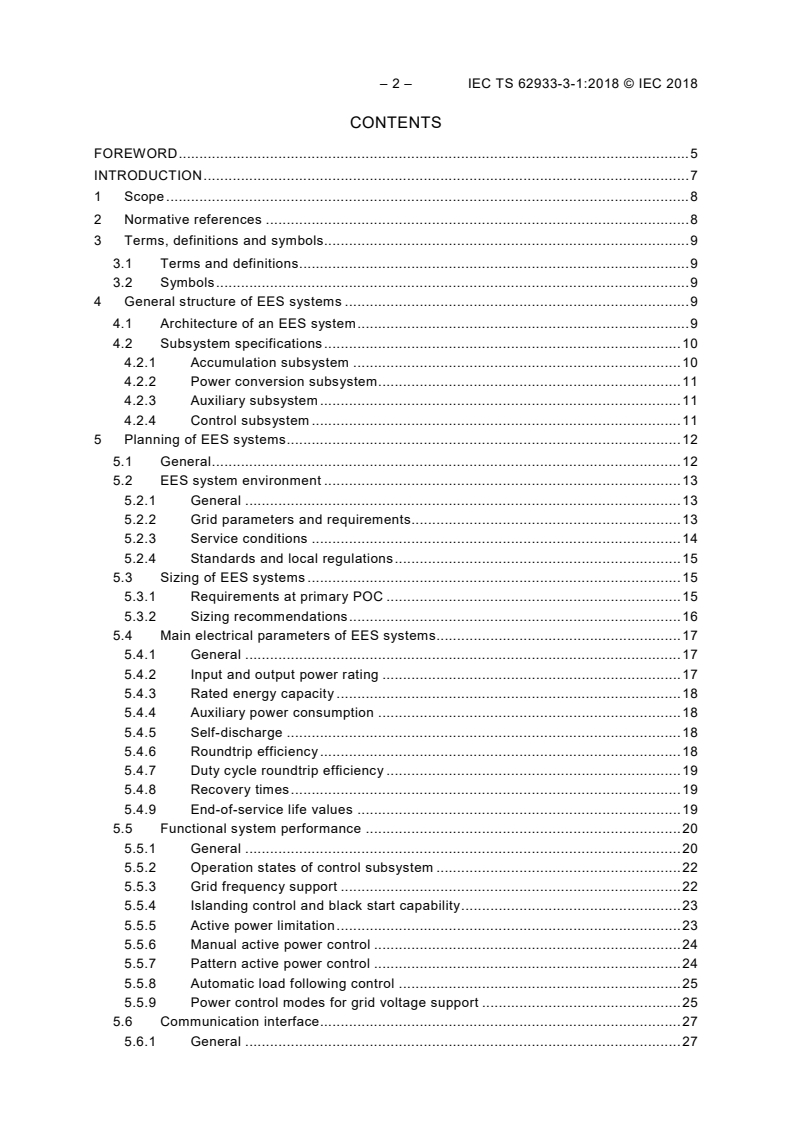
FOREWORD . 5
INTRODUCTION . 7
1 Scope . 8
2 Normative references . 8
3 Terms, definitions and symbols. 9
3.1 Terms and definitions . 9
3.2 Symbols . 9
4 General structure of EES systems . 9
4.1 Architecture of an EES system . 9
4.2 Subsystem specifications . 10
4.2.1 Accumulation subsystem . 10
4.2.2 Power conversion subsystem . 11
4.2.3 Auxiliary subsystem . 11
4.2.4 Control subsystem . 11
5 Planning of EES systems . 12
5.1 General . 12
5.2 EES system environment . 13
5.2.1 General . 13
5.2.2 Grid parameters and requirements. 13
5.2.3 Service conditions . 14
5.2.4 Standards and local regulations . 15
5.3 Sizing of EES systems . 15
5.3.1 Requirements at primary POC . 15
5.3.2 Sizing recommendations . 16
5.4 Main electrical parameters of EES systems . 17
5.4.1 General . 17
5.4.2 Input and output power rating . 17
5.4.3 Rated energy capacity . 18
5.4.4 Auxiliary power consumption . 18
5.4.5 Self-discharge . 18
5.4.6 Roundtrip efficiency . 18
5.4.7 Duty cycle roundtrip efficiency . 19
5.4.8 Recovery times . 19
5.4.9 End-of-service life values . 19
5.5 Functional system performance . 20
5.5.1 General . 20
5.5.2 Operation states of control subsystem . 22
5.5.3 Grid frequency support . 22
5.5.4 Islanding control and black start capability . 23
5.5.5 Active power limitation . 23
5.5.6 Manual active power control . 24
5.5.7 Pattern active power control . 24
5.5.8 Automatic load following control . 25
5.5.9 Power control modes for grid voltage support . 25
5.6 Communication interface. 27
5.6.1 General . 27
5.6.2 Information model for an EES system . 27
5.6.3 Remote monitoring and control . 29
6 EES system performance assessment . 33
6.1 Factory acceptance test (FAT) . 33
6.2 Installation and commissioning . 34
6.2.1 General . 34
6.2.2 Installation phase . 34
6.2.3 Commissioning phase . 34
6.3 Site acceptance test (SAT) . 35
6.4 Performance monitoring phase . 36
Annex A (informative) Examples of EES system applications . 38
A.1 EES system designed for reserve control . 38
A.1.1 General . 38
A.1.2 Example of an EES system for primary frequency control . 38
A.1.3 Example of an EES system for secondary frequency control . 39
A.1.4 Example of an EES system for dynamic frequency control . 40
A.2 EES system in conjunction with renewable energy production . 42
A.2.1 General . 42
A.2.2 Example of EES system for renewable (energy) firming . 42
A.2.3 Example of EES system for renewable (power) smoothing . 43
A.3 EES system for grid support applications . 44
A.3.1 Example of an EES system for grid voltage support (Q(U) control mode) . 44
A.3.2 Example of an EES system for power quality support by voltage-related
active power injection . 47
Annex B (informative) Aspects to be considered with regard to EES system installation . 49
B.1 Site-assembling . 49
B.2 Protection against disaster – Fire prevention . 49
B.3 Transportation and on-site storage . 49
Bibliography . 50
Figure 1 – Typical architectures of EES systems . 10
Figure 2 – Example of classification of EES systems according to energy form . 11
Figure 3 – Sample performance versus time characteristics for EES systems . 19
Figure 4 – Sample consideration to design the service life of EES systems . 20
Figure 5 –Example of EES system operation states . 22
Figure 6 – Example for P(f) strategy . 23
Figure 7 – Example of setting of active output power at primary POC . 24
Figure 8 – Example of day pattern operation at primary POC . 25
Figure 9 – Example of peak shaving application . 25
Figure 10 – Example of a general control characteristic . 26
Figure 11 – Reference diagram for information exchange . 27
Figure 12 – EES system as an aggregation of several EES systems at the same
primary POC . 28
Figure A.1 – Sample duty cycle for a primary frequency control application with 30-s
power output every 30 min shown over 2 h . 38
Figure A.2 – Sample power output for a secondary frequency control application with
20-min power output over 3 h . 40
– 4 – IEC TS 62933-3-1:2018 © IEC 2018
Figure A.3 – Sample output power of an EES system for a dynamic frequency control
application in spring, summer, autumn and winter . 41
Figure A.4 – Sample output power of an EES system in a renewable (solar) energy
firming application . 43
Figure A.5 – Sample output power of an EES system for a renewable (solar) power
smoothing application . 44
Figure A.6 – Example of grid voltage at the POC of a photovoltaic power plant . 45
Figure A.7 – Sample reactive power supply of an EES system at the POC . 46
Figure A.8 – Sample duty cycle for power quality support by voltage-related active
power injection with 5-min power output every 45 min over 12 h . 48
Table 1 – Points of attention for planning phase. 17
Table 2 – Example of day pattern operation . 24
Table 3 – Example for messages of measurement and monitoring categories versus
categories of messages . 30
Table 4 – Example of messages of an EES system information model . 31
Table 5 – Example of items to be taken into account in the different installation phases . 34
Table 6 – Points of attention for commissioning phase . 35
Table 7 – Points of attention for performance monitoring phase . 36
Table 8 – Example of local measurements and monitoring of EES system . 37
Table A.1 – Sample values of a duty cycle for primary frequency control for sudden
loss of generation . 39
Table A.2 – Sample values of recovery time for primary frequency control for sudden
loss of generation . 39
Table A.3 – Sample values of a duty cycle for secondary frequency control for sudden
loss of generation . 40
Table A.4 – Sample values of a duty cycle for dynamic primary frequency control. 41
Table A.4 – Sample values of a duty cycle for renewable (energy) firming . 43
Table A.5 – Sample values of a duty cycle for grid voltage support by Q(U) control
mode . 47
Table A.6 – Sample values of a duty cycle for power quality . 48
INTERNATIONAL ELECTROTECHNICAL COMMISSION
____________
ELECTRICAL ENERGY STORAGE (EES) SYSTEMS –
Part 3-1: Planning and performance assessment of
electrical energy storage systems – General specification
FOREWORD
1) The International Electrotechnical Commission (IEC) is a worldwide organization for standardization comprising
all national electrotechnical committees (IEC National Committees). The object of IEC is to promote
international co-operation on all questions concerning standardization in the electrical and electronic fields. To
this end and in addition to other activities, IEC publishes International Standards, Technical Specifications,
Technical Reports, Publicly Available Specifications (PAS) and Guides (hereafter referred to as “IEC
Publication(s)”). Their preparation is entrusted to technical committees; any IEC National Committee interested
in the subject dealt with may participate in this preparatory work. International, governmental and non-
governmental organizations liaising with the IEC also participate in this preparation. IEC collaborates closely
with the International Organization for Standardization (ISO) in accordance with conditions determined by
agreement between the two organizations.
2) The formal decisions or agreements of IEC on technical matters express, as nearly as possible, an international
consensus of opinion on the relevant subjects since each technical committee has representation from all
interested IEC National Committees.
3) IEC Publications have the form of recommendations for international use and are accepted by IEC National
Committees in that sense. While all reasonable efforts are made to ensure that the technical content of IEC
Publications is accurate, IEC cannot be held responsible for the way in which they are used or for any
misinterpretation by any end user.
4) In order to promote international uniformity, IEC National Committees undertake to apply IEC Publications
transparently to the maximum extent possible in their national and regional publications. Any divergence
between any IEC Publication and the corresponding national or regional publication shall be clearly indicated in
the latter.
5) IEC itself does not provide any attestation of conformity. Independent certification bodies provide conformity
assessment services and, in some areas, access to IEC marks of conformity. IEC is not responsible for any
services carried out by independent certification bodies.
6) All users should ensure that they have the latest edition of this publication.
7) No liability shall attach to IEC or its directors, employees, servants or agents including individual experts and
members of its technical committees and IEC National Committees for any personal injury, property damage or
other damage of any nature whatsoever, whether direct or indirect, or for costs (including legal fees) and
expenses arising out of the publication, use of, or reliance upon, this IEC Publication or any other IEC
Publications.
8) Attention is drawn to the Normative references cited in this publication. Use of the referenced publications is
indispensable for the correct application of this publication.
9) Attention is drawn to the possibility that some of the elements of this IEC Publication may be the subject of
patent rights. IEC shall not be held responsible for identifying any or all such patent rights.
The main task of IEC technical committees is to prepare International Standards. In
exceptional circumstances, a technical committee may propose the publication of a technical
specification when
• the required support cannot be obtained for the publication of an International Standard,
despite repeated efforts, or
• the subject is still under technical development or where, for any other reason, there is the
future but no immediate possibility of an agreement on an International Standard.
Technical Specification IEC 62933-3-1 has been prepared by IEC technical committee TC 120:
Electrical Energy Storage (EES) Systems.
– 6 – IEC TS 62933-3-1:2018 © IEC 2018
The text of this technical specification is based on the following documents:
Enquiry draft Report on voting
120/118/DTS 120/123/RVDTS
Full information on the voting for the approval of this technical specification can be found in
the report on voting indicated in the above table.
This document has been drafted in accordance with the ISO/IEC Directives, Part 2.
A list of all parts in the IEC 62933 series, published under the general title Electrical energy
storage (EES) systems, can be found on the IEC website.
The committee has decided that the contents of this publication will remain unchanged until
the stability date indicated on the IEC website under "http://webstore.iec.ch" in the data
related to the specific publication. At this date, the publication will be
• transformed into an International standard,
• reconfirmed,
• withdrawn,
• replaced by a revised edition, or
• amended.
A bilingual version of this publication may be issued at a later date.
IMPORTANT – The 'colour inside' logo on the cover page of this publication indicates
that it contains colours which are considered to be useful for the correct
understanding of its contents. Users should therefore print this document using a
colour printer.
INTRODUCTION
IEC 62933-2-1 should be used as a reference when selecting testing items and their
corresponding evaluation methods as well as principal parameters. Principal terms used in
this document are defined in IEC 62933-1. Environmental issues are covered by
IEC TS 62933-4-1. The personnel safety issues are covered by IEC TS 62933-5-1.
– 8 – IEC TS 62933-3-1:2018 © IEC 2018
ELECTRICAL ENERGY STORAGE (EES) SYSTEMS –
Part 3-1: Planning and performance assessment of
electrical energy storage systems – General specification
1 Scope
This part of IEC 62933 is applicable to EES systems designed for grid-connected indoor or
outdoor installation and operation. This document considers
• necessary functions and capabilities of EES systems
• test items and performance assessment methods for EES systems
• requirements for monitoring and acquisition of EES system operating parameters
• exchange of system information and control capabilities required
Stakeholders of this document comprise personnel involved with EES systems, which includes
– planners of electric power systems and EES systems
– owners of EES system
– operators of electric power systems and EES systems
– constructors
– suppliers of EES system and its equipment
– aggregators
Use-case-specific technical documentation, including planning and installation specific tasks
such as system design, monitoring and measurement, operation and maintenance, are very
important and can be found throughout this document.
NOTE This document has been written for AC grids, however parts can also apply to DC grids.
2 Normative references
The following documents are referred to in the text in such a way that some or all of their
content constitutes requirements of this document. For dated references, only the edition
cited applies. For undated references, the latest edition of the referenced document (including
any amendments) applies.
IEC 60721-1, Classification of environmental conditions – Part 1: Environmental parameters
and their severities
IEC 62351 (all parts), Power systems management and associated information exchange –
Data and communications security
IEC 62443 (all parts), Industrial communication networks – Network and system security
IEC 62933-1:2018, Electrical energy storage (EES) systems – Part 1: Vocabulary
IEC 62933-2-1, Electrical energy storage (EES) systems – Part 2-1: Unit parameters and
testing methods – General specification
IEC TS 62933-5-1, Electrical energy storage (EES) systems – Part 5-1: Safety considerations
for grid-integrated EES systems – General specification
ISO/IEC 27000, Information technology – Security techniques – Information security
management systems – Overview and vocabulary
3 Terms, definitions and symbols
3.1 Terms and definitions
For the purposes of this document, the terms and definitions given in IEC 62933-1 and the
following apply.
ISO and IEC maintain terminological databases for use in standardization at the following
addresses:
• IEC Electropedia: available at http://www.electropedia.org
• ISO Online browsing platform: available at http://www.iso.org/obp
3.1.1
idle, adj.
time period where the EES system does not or is not able to perform any grid
tasks related to active output power at the point of connection (POC)
3.1.2
recovery time
duration needed by an EES system to recover from a duty cycle so that the following duty
cycle is within its specified conditions for a certain operating mode and at continuous
operating conditions
Note 1 to entry: The definition is loosely based on IEC 60050-447:2010, 447-05-08.
3.2 Symbols
P active power
Q reactive power
S apparent power
U voltage
I current
cosφ power factor
f frequency
4 General structure of EES systems
4.1 Architecture of an EES system
The typical architecture of an EES system, which internally feeds the auxiliary subsystem, is
given in Figure 1 a).
– 10 – IEC TS 62933-3-1:2018 © IEC 2018
a) EES system without auxiliary POC
b) EES system with auxiliary POC
Figure 1 – Typical architectures of EES systems
If the auxiliary subsystem is fed from another feeder, the optional architecture of an ESS
system is shown in Figure 1 b).
In 4.2 the subsystems of an EES system are described. In general, for all subsystems, the
contribution to the overall system efficiency, for example roundtrip efficiency, shall be
indicated.
4.2 Subsystem specifications
4.2.1 Accumulation subsystem
The energy capacity of the accumulation subsystem of the EES system has to be evaluated in
an appropriate way with respect to the energy form. The energy capacity of the accumulation
subsystem directly influences the rated input and output energy capacity at the primary POC,
i.e. it influences the active input and output power values at the primary POC as well as the
duration the active input and output power can be applied at the primary POC.
A widely-used approach for classifying EES systems is the determination according to the
form of energy used in the accumulation subsystem. A classification example of EES systems
according to energy form in the accumulation subsystem is shown in Figure 2.
EES systems
Mechanical Electrochemical Electrical
Secondary batteries Double-layer
Pumped hydro – PHS
Lead acid/NiCd/NiMH/Li/NaS
capacitor – DLC
Flow batteries Superconducting
Compressed air – CAES
Redox flow/hybrid flow
magnetic coil – SMES
Flywheel – FES
Chemical Thermal
Hydrogen Sensible heat storage
Electrolyser/fuel cell/SNG Molten salt/A-CAES
IEC
Figure 2 – Example of classification of EES systems according to energy form
4.2.2 Power conversion subsystem
The power conversion subsystem converts the power of the accumulation subsystem into
electrical power at the POC, typically AC output power during discharge of the accumulation
subsystem, and can convert grid AC input power to suitable power for charging the
accumulation subsystem. This conversion can be performed by electrical and/or mechanical
systems. The power conversion subsystem influences the apparent power characteristic of
the EES system. The power conversion subsystem can also influence the power quality at the
POC.
Generally the power conversion subsystem is connected to the accumulation subsystem and
to the (primary) connection terminal. For planning issues the power conversion subsystem
shall also include all power transfer apparatus between the connection terminal and the
accumulation subsystem, for example any kind of power transformer, sine filter or switching
elements.
4.2.3 Auxiliary subsystem
All necessary equipment intended to perform EES system auxiliary functions shall be used,
for example heating, ventilation, fire suppression system and air conditioning system.
4.2.4 Control subsystem
A system for monitoring and controlling the EES system shall be used. A control subsystem
may include a communication subsystem, protection subsystem and management subsystem.
During the planning phase the required remote control capabilities and the operation modes
that the control system will support shall be stated, considering the applicable local grid code
requirements.
The EES system shall be designed in such a way that a supply outage does not affect the
EES system security and the ability of the EES system to start up again. The maximum
outage duration should be considered (for example a specific back-up power has to be
designed). A safe disconnection and safe system shutdown concept shall be agreed between
the supplier and user of the EES system.
– 12 – IEC TS 62933-3-1:2018 © IEC 2018
All protection functions shall be described with functionality and trigger values.
5 Planning of EES systems
5.1 General
The planning of an EES system is dependent on the topology of the grid as well as on the
power demand and generation available at the POC. There is a wide variety of grids that have
EES systems connected. These variations impact EES system specifications including:
• functionality (peak shaving, frequency support, virtual synchronous machine behaviour,
etc.),
• accumulation subsystem (energy capacity, power, etc.),
• power conversion subsystem (response time, droop control, power, short-circuit power,
etc.).
The EES system requirements should be clearly outlined in order to provide the best solution
and to maximize system adaptability and performance benefits. The needs of the electrical
network may also need to be considered. During the planning phase, at the system level and
after the application has been defined, the EES system requirements have to be specified
according to the application.
The results of the sizing of EES systems (examples are given in Annex A) are the relevant
parameters of the EES system including
– rated input and output power
– short duration input and output power
– rated energy capacity
– response time parameters
– auxiliary power consumption
– self-discharge
– roundtrip efficiency
– duty cycle roundtrip efficiency
– recovery times
– end-of-service life values
Clause 5 helps the planner define the specifications in such a way that EES system suppliers
have all the relevant information to design a system.
Clause 5 provides information needed to assess the performances of a system. This ensures
that potential users (such as a utility) can have the necessary information about the EES
system from the system supplier. In particular maintenance requirements and end-of-service
life values shall be provided and be compatible with the application.
In general the rated value of a quantity is used for specification purposes, established for a
specified set of operating conditions of a component, device, equipment, or system. When
specifying the rated values for planning purposes of an EES system, the critical operating
limits of the power capability chart, capability reductions due to ageing, altered environmental
conditions and other limiting factors shall be taken into account. All rated values used for
planning purposes shall be values related to the end-of-service life.
Other parameters such as availability shall be provided and taken into account during the
planning phase.
Auxiliary power consumption varies throughout the service life of the EES system and shall
therefore be assessed for the whole service life of the unit and for the environmental
conditions expected at the installation site. The influence on the overall EES system efficiency
of the extreme weather conditions should also be considered (see 5.2.3).
NOTE End-of-service life value definitions are given in IEC 62933-1. The test of auxiliary power consumption is
included in IEC 62933-2-1.
5.2 EES system environment
5.2.1 General
Subclause 5.2 describes the environment of the EES system, which shall be considered for
planning an EES system. Subclause 5.2 contains three further subclauses:
• grid parameters and requirements, which include mainly electrical parameters, constraints,
operational ranges and requirements of the electrical power grid at the (primary) POC
(5.2.2),
• service conditions, which include the non-electrical environment of the EES system (5.2.3),
• standards and local regulations, which include additional requirements according to
applicable standards and regulations (5.2.4).
According to the place of installation the site-specific requirements shall be considered during
the planning phase. Examples of site-specific requirements of an EES system are given in
Annex B.
In addition, the classification of environmental conditions in IEC 60721-1 shall be considered
in the planning phase.
5.2.2 Grid parameters and requirements
5.2.2.1 Grid parameters
The main parameters of the grid at the POC, to which the EES system is going to be
connected, shall be considered in the planning phase. These parameters include
• nominal voltage of the service
• highest voltage for components
• temporary voltage variations
• nominal frequency
• continuous normal frequency variation
• temporary frequency variations
• short-circuit current and duration
• neutral connection
These parameters are typically provided by the grid operator and may be included in specific
grid requirements based on local grid codes.
5.2.2.2 Protective earthing
For earthing, refer for example to IEC 60364 (all parts) and local regulations.
5.2.2.3 Emissions and disturbances of the EES system at the POC
The contribution to harmonic voltage and current disturbances or other undesired effects at
the POC of the EES system shall be declared clearly by the system supplier to assess
possible issues with grid codes already at the planning stage (see also IEC 62933-2-1 for
appropriate testing).
– 14 – IEC TS 62933-3-1:2018 © IEC 2018
5.2.2.4 Immunity of the EES system
The EES system shall be immune against possible, harmful impacts from the electrical
environment. For example, in EMC-sensitive cases, such as the installation of an EES system
in a substation, the EES system should implement an immunity level according to the
requirements stated in IEC 61000-6-5.
5.2.3 Service conditions
5.2.3.1 General
Subclause 5.2.3 includes all non-electrical environmental conditions such as altitude, humidity,
etc.
Where applicable, EES system planners should refer to IEC 60721-3-3, IEC 60364-5-51 or
IEC TS 62933-4-1 for guidelines on environmental conditions.
5.2.3.2 Earthquake resistivity and endurance
Where appropriate the EES system and its support structure shall withstand earthquakes. In
general the EES system and its support structure should be designed in accordance with the
seismic classification area of the site and local codes. The EES system should achieve at
least the same performance against earthquakes than the rest of the grid equipment.
For soil acceleration levels, as well as test methods, refer to IEC 60068-3-3 and local
regulations. Additionally local conditions, for example environmental conditions, shall be
taken into account.
Where an earthquake-proof standard is specified, the EES system should comply with this
standard. However, where a large influence by vibration is expected, additional standards and
measures should be considered.
5.2.3.3 Ambient temperature and solar radiation
The EES system shall be designed and constructed to withstand the stress generated due to
temperature variation considering the effects of the ambient temperature and the solar
radiation on the operating temperature. Unless specifically ordered otherwise by the customer,
the cooling/heating system shall be sized appropriately while considering the most demanding
operational and weather conditions of the site.
5.2.3.4 Protection against dust and corrosive atmospheres
Where required, the EES system shall be equipped with protection against dust and corrosive
atmospheres according to the operating environment. The structure of the EES system shall
be easily maintained.
5.2.3.5 Inundation
If required, the measures against flood according to local regulations shall be applied. These
regulations can depend on installation conditions such as location, characteristics of the
region and principle and scale of the EES system. Where flood protection measures are
specified by local regulation, the EES system should comply with that regulation. However,
where flooding probability is not negligible, protective measures should be applied
irrespective of the absence of a local regulation.
5.2.3.6 Wind
If required, the wind protection measures should conform to related regulations depending on
installation conditions such as location, characteristics of the region, principle and scale of the
EES system. In case wind protection measures are specified by local regulation, the EES
system should comply with that regulation. However, where large influence by wind is
expected, protective measures should be applied irrespective of the absence of a local
regulation.
5.2.4 Standards and local regulations
5.2.4.1 General impact on EES system design
All standards and local regulations which impact EES system design shall be explored in the
planning phase.
5.2.4.2 Emissions of EES system
To minimize the influence on the environment caused by the installation of an EES system,
two categories should be considered. Specifically, one category is a regular occurrence, such
as noise exhaust gas and EMC; the other category is an irregular occurrence, such as fire,
explosion collapse and disposal. For environmental impacts refer to IEC TS 62933-4-1; for
safety refer to IEC 62933-5 (all parts) and for EMC emissions refer to IEC 61000-6-4.
5.3 Sizing of EES systems
5.3.1 Requirements at primary POC
Sizing of EES systems is usually connected to the identification of one or more suitable duty
cycles, which the EES system may typically have to perform at the primary POC to meet its
operational requirements. Additionally it is necessary to know the (minimum and maximum)
recovery times which are available to restore the EES system between duty cycles. In addition,
the required service life time of the EES system should be specified with regard to the proper
consideration of system ageing and possibly necessary maintenance and refurbishment works.
The specification of identified duty cycles should include
• duration of the duty cycle and the expected frequency (number of times per
day/week/year);
• required pattern of the active power at the primary POC of the EES system, possibly
including allowed tolerance ranges (maximum overshoot and/or undercut);
• required pattern of the reactive power at the primary POC of the EES system, possibly
including allowed tolerance ranges (maximum overshoot and/or undercut).
The specified pattern of active and reactive power at the primary POC can include durations
in which active and/or reactive power is zero. From these patterns it should be possible to
derive ramp rates of active and reactive power.
Since the initial value at the beginning of each duty cycle should be within a certain energy
content range, a recovery cycle may be necessary to bring back the EES system to a state
where it is possible to perform duty cycles again. The degrees of freedom in recovery cycles
depend mainly on grid requirements. With regard to sizing the EES system, the following
characteristic values of the recovery process should be given:
a) minimum duration
b) maximum duration
c) range of allowed active output or input power, including maximum and minimum active
output or input power values
d) possible requirements or constraints regarding reactive input and output power
e) maximum allowed ramp rates of active and reactive power
f) allowed range of power factor values at primary POC
g) possible requirements regarding power factor
– 16 – IEC TS 62933-3-1:2018 © IEC 2018
Regarding the operational features of the EES system, which should be represented by the
identified duty cycles and recovery times, not all possible (worst) case situations of the
electrical power grid regarding power and energy demand at the primary POC can be covered.
But the required duty cycles and the specified recovery times should cover most probable grid
situations. Future developments regarding power generation and power consumption in the
electrical power grid as well as changes to the grid structure should also be considered when
specifying duty cycles and recovery times.
For different operational requirements, sets of duty cycles with different time durations
(short-term and long-term durations) and different maximum power values might be identified.
In this case superposition of duty cycles for different operational features might be necessary
to properly describe the overall operational capability of an EES system.
The following characteristics of the required duty cycles should be identified:
– response time
– overall duration
– initial energy content
– energy content value at the end of the duty cycle
– maximum value of active output power
– maximum value of active input power
– speed of change of active power values
– speed of change between active input or output power
– maximum partial energy output, i.e. maximum energy output in a time period within the
duty cycle with only active power output at the (primary) POC. This maximum energy
output value at the (primary) POC is the mathematical integral of active output power over
the duration of the time period with only active power output
– maximum partial energy input, i.e. maximum energy input over a time period within the
duty cycle with only active power input at the (primary) POC. This maximum energy input
value at the (primary) POC is the mathematical integral of active input power over the
duration of this
...