

IEC 62109-1:2010
(Main)Safety of power converters for use in photovoltaic power systems - Part 1: General requirements
General Information
- Abstract
IEC 62109-1:2010 applies to the power conversion equipment (PCE) for use in photovoltaic systems where a uniform technical level with respect to safety is necessary. Defines the minimum requirements for the design and manufacture of PCE for protection against electric shock, energy, fire, mechanical and other hazards. Provides general requirements applicable to all types of PV PCE.
- Status
- Published
- Publication Date
- 27-Apr-2010
- Technical Committee
- TC 82 - Solar photovoltaic energy systems
- Drafting Committee
- WG 6 - TC 82/WG 6
- Current Stage
- PPUB - Publication issued
- Start Date
- 28-Apr-2010
- Completion Date
- 30-Apr-2010
Buy Documents
IEC 62109-1:2010 - Safety of power converters for use in photovoltaic power systems - Part 1: General requirements Released:4/28/2010
IEC 62109-1:2010 - Safety of power converters for use in photovoltaic power systems - Part 1: General requirements Released:4/28/2010
Overview
IEC 62109-1:2010 - Safety of power converters for use in photovoltaic power systems (Part 1: General requirements) defines the minimum safety requirements for power conversion equipment (PCE) used in photovoltaic (PV) systems. It establishes a uniform technical baseline for the design, manufacture and testing of PV inverters, converters and related equipment to protect against electric shock, energy, fire, mechanical and other hazards.
Keywords: IEC 62109-1, PV power converters safety, photovoltaic inverters safety standard, power conversion equipment, electrical safety.
Key topics and technical requirements
IEC 62109-1 provides general, practical requirements that apply across PV PCE types. Major topics include:
- Scope and object - which PCE are included and which aspects are excluded.
- General testing requirements - test sequences, reference conditions, thermal testing, and single-fault testing.
- Electrical safety tests - impulse voltage, dielectric (voltage) tests, partial discharge and touch-current measurements.
- Protection against electric shock and energy hazards - decisive voltage classifications, protective separation, insulation, clearance & creepage, and RCD/RCM compatibility.
- Backfeed and fault conditions - tests and pass/fail criteria for backfeed under normal and single-fault states.
- Marking and documentation - mandatory identification, ratings, warning markings and installation/maintenance instructions.
- Environmental and physical requirements - ingress protection, pollution degree, UV exposure, temperature/humidity categories, mechanical stability, lifting/installation provisions.
- Fire, mechanical, sonic, liquid and chemical hazards - material selection, fire enclosures, limited power source testing, moving parts protection, liquid containment and chemical safety.
- Physical construction - wiring, terminals, connectors, openings, polymeric materials and enclosure requirements.
Practical applications and users
IEC 62109-1 is intended for stakeholders involved in PV equipment safety and compliance:
- Manufacturers and designers of PV inverters, converters and PCE - to guide safe design and component selection.
- Test laboratories and certification bodies - to perform type and routine testing against standardized criteria.
- System integrators and installers - for installation instructions, marking and compatibility guidance.
- Regulators and procurement teams - to specify minimum safety requirements in tenders and approvals.
- Maintenance personnel - for safe service procedures and understanding single-fault behaviours.
Related standards
- IEC 62109-2 (specific requirements for particular PCE types) - complements Part 1 by addressing detailed/variant-specific criteria.
- Other IEC electrical safety and PV standards may be referenced for system-level compliance.
IEC 62109-1 is essential for achieving consistent, verifiable safety in photovoltaic power conversion equipment and for demonstrating compliance with international PV safety best practices.
Buy Documents
IEC 62109-1:2010 - Safety of power converters for use in photovoltaic power systems - Part 1: General requirements Released:4/28/2010
IEC 62109-1:2010 - Safety of power converters for use in photovoltaic power systems - Part 1: General requirements Released:4/28/2010
Get Certified
Connect with accredited certification bodies for this standard

DNV
DNV is an independent assurance and risk management provider.

Lloyd's Register
Lloyd's Register is a global professional services organisation specialising in engineering and technology.
DNV Energy Systems
Energy and renewable energy certification.
Sponsored listings
Frequently Asked Questions
IEC 62109-1:2010 is a standard published by the International Electrotechnical Commission (IEC). Its full title is "Safety of power converters for use in photovoltaic power systems - Part 1: General requirements". This standard covers: IEC 62109-1:2010 applies to the power conversion equipment (PCE) for use in photovoltaic systems where a uniform technical level with respect to safety is necessary. Defines the minimum requirements for the design and manufacture of PCE for protection against electric shock, energy, fire, mechanical and other hazards. Provides general requirements applicable to all types of PV PCE.
IEC 62109-1:2010 applies to the power conversion equipment (PCE) for use in photovoltaic systems where a uniform technical level with respect to safety is necessary. Defines the minimum requirements for the design and manufacture of PCE for protection against electric shock, energy, fire, mechanical and other hazards. Provides general requirements applicable to all types of PV PCE.
IEC 62109-1:2010 is classified under the following ICS (International Classification for Standards) categories: 27.160 - Solar energy engineering. The ICS classification helps identify the subject area and facilitates finding related standards.
IEC 62109-1:2010 is available in PDF format for immediate download after purchase. The document can be added to your cart and obtained through the secure checkout process. Digital delivery ensures instant access to the complete standard document.
Standards Content (Sample)
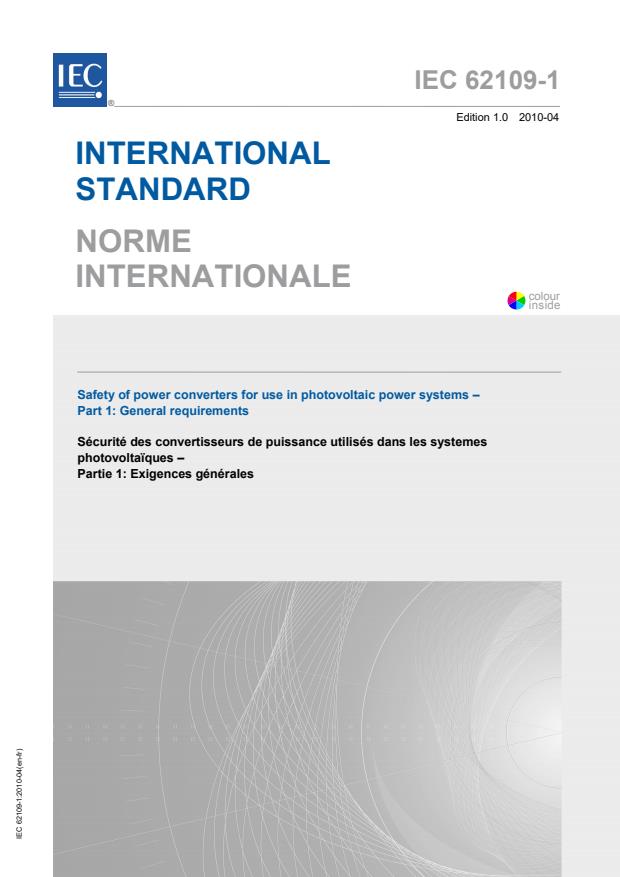
IEC 62109-1 ®
Edition 1.0 2010-04
INTERNATIONAL
STANDARD
colour
inside
Safety of power converters for use in photovoltaic power systems –
Part 1: General requirements
All rights reserved. Unless otherwise specified, no part of this publication may be reproduced or utilized in any form
or by any means, electronic or mechanical, including photocopying and microfilm, without permission in writing from
either IEC or IEC's member National Committee in the country of the requester.
If you have any questions about IEC copyright or have an enquiry about obtaining additional rights to this publication,
please contact the address below or your local IEC member National Committee for further information.
IEC Central Office
3, rue de Varembé
CH-1211 Geneva 20
Switzerland
Email: inmail@iec.ch
Web: www.iec.ch
About the IEC
The International Electrotechnical Commission (IEC) is the leading global organization that prepares and publishes
International Standards for all electrical, electronic and related technologies.
About IEC publications
The technical content of IEC publications is kept under constant review by the IEC. Please make sure that you have the
latest edition, a corrigenda or an amendment might have been published.
ƒ Catalogue of IEC publications: www.iec.ch/searchpub
The IEC on-line Catalogue enables you to search by a variety of criteria (reference number, text, technical committee,…).
It also gives information on projects, withdrawn and replaced publications.
ƒ IEC Just Published: www.iec.ch/online_news/justpub
Stay up to date on all new IEC publications. Just Published details twice a month all new publications released. Available
on-line and also by email.
ƒ Electropedia: www.electropedia.org
The world's leading online dictionary of electronic and electrical terms containing more than 20 000 terms and definitions
in English and French, with equivalent terms in additional languages. Also known as the International Electrotechnical
Vocabulary online.
ƒ Customer Service Centre: www.iec.ch/webstore/custserv
If you wish to give us your feedback on this publication or need further assistance, please visit the Customer Service
Centre FAQ or contact us:
Email: csc@iec.ch
Tel.: +41 22 919 02 11
Fax: +41 22 919 03 00
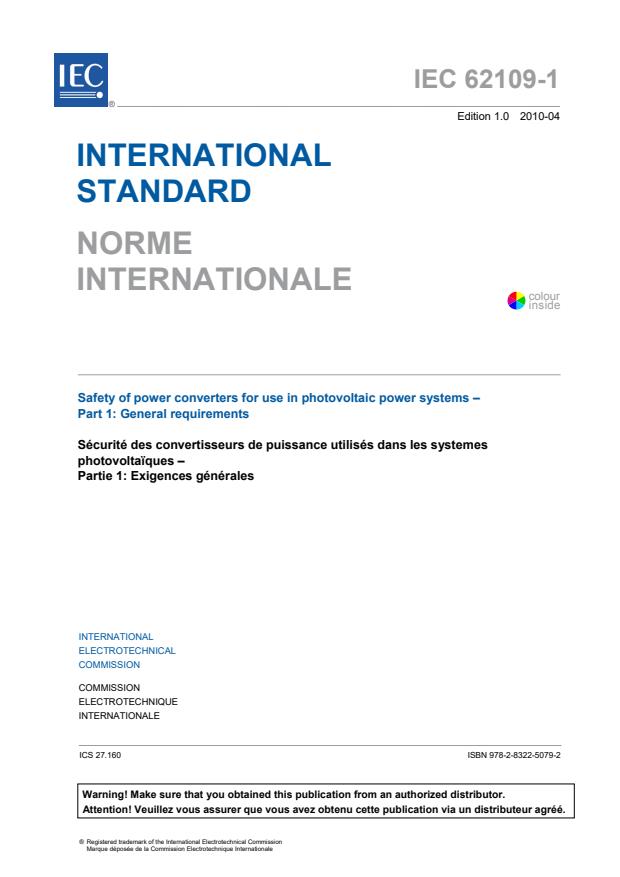
IEC 62109-1 ®
Edition 1.0 2010-04
INTERNATIONAL
STANDARD
colour
inside
Safety of power converters for use in photovoltaic power systems –
Part 1: General requirements
INTERNATIONAL
ELECTROTECHNICAL
COMMISSION
PRICE CODE
XG
ICS 27.160 ISBN 978-2-88910-621-9
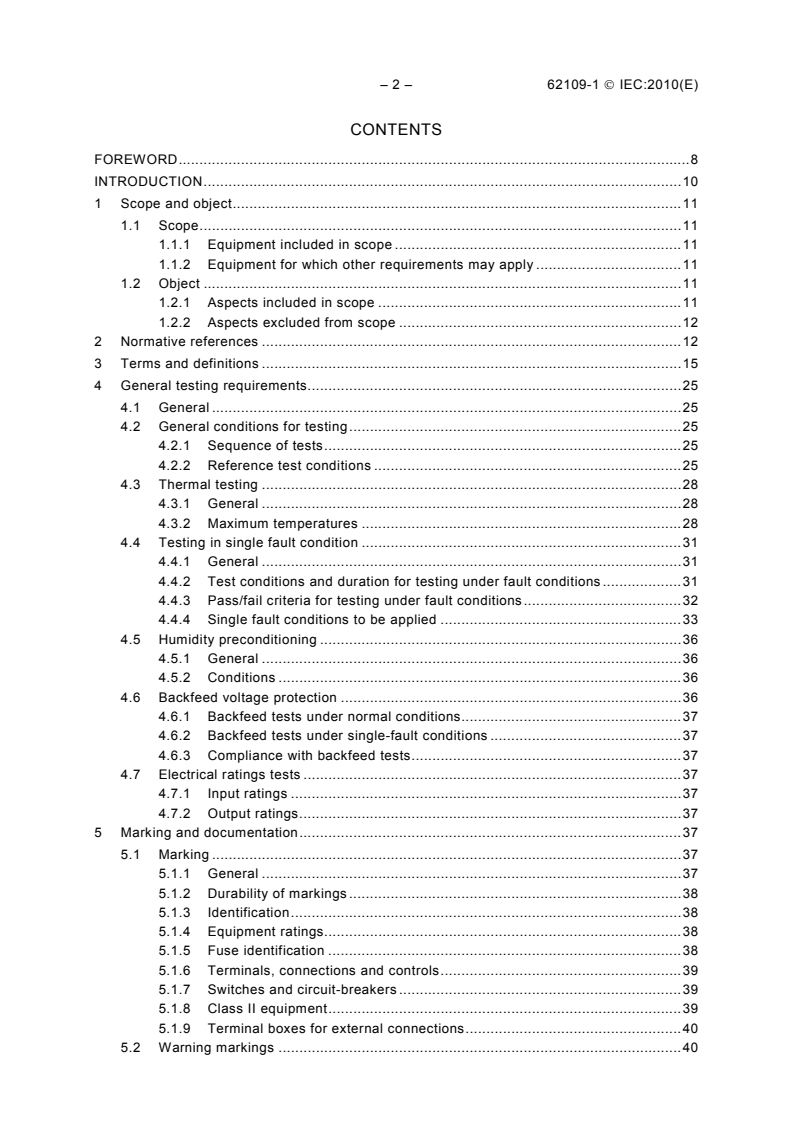
– 2 – 62109-1 © IEC:2010(E)
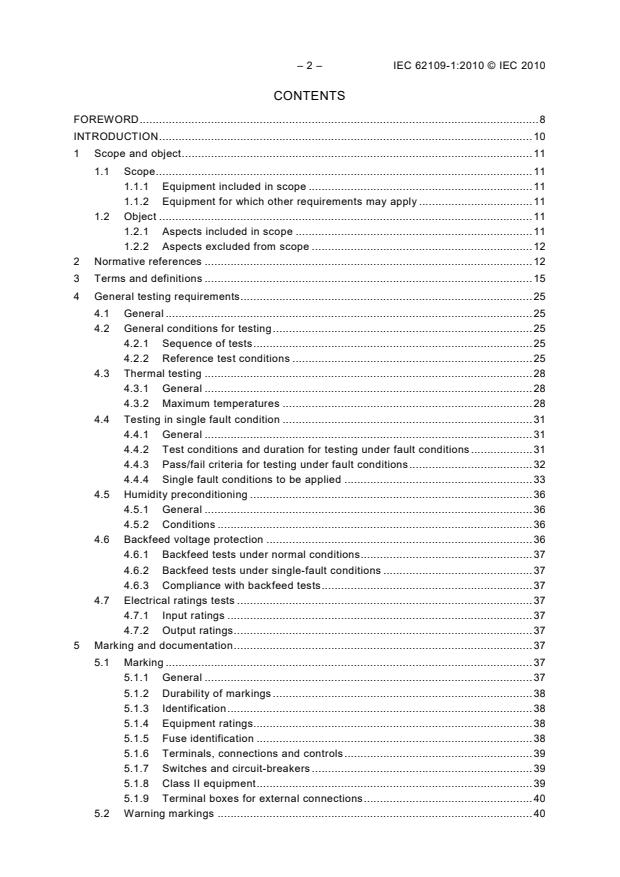
CONTENTS
FOREWORD.8
INTRODUCTION.10
1 Scope and object.11
1.1 Scope.11
1.1.1 Equipment included in scope .11
1.1.2 Equipment for which other requirements may apply .11
1.2 Object .11
1.2.1 Aspects included in scope .11
1.2.2 Aspects excluded from scope .12
2 Normative references .12
3 Terms and definitions .15
4 General testing requirements.25
4.1 General .25
4.2 General conditions for testing.25
4.2.1 Sequence of tests.25
4.2.2 Reference test conditions .25
4.3 Thermal testing .28
4.3.1 General .28
4.3.2 Maximum temperatures .28
4.4 Testing in single fault condition .31
4.4.1 General .31
4.4.2 Test conditions and duration for testing under fault conditions .31
4.4.3 Pass/fail criteria for testing under fault conditions.32
4.4.4 Single fault conditions to be applied .33
4.5 Humidity preconditioning .36
4.5.1 General .36
4.5.2 Conditions .36
4.6 Backfeed voltage protection .36
4.6.1 Backfeed tests under normal conditions.37
4.6.2 Backfeed tests under single-fault conditions .37
4.6.3 Compliance with backfeed tests.37
4.7 Electrical ratings tests .37
4.7.1 Input ratings .37
4.7.2 Output ratings.37
5 Marking and documentation.37
5.1 Marking .37
5.1.1 General .37
5.1.2 Durability of markings .38
5.1.3 Identification.38
5.1.4 Equipment ratings.38
5.1.5 Fuse identification .38
5.1.6 Terminals, connections and controls.39
5.1.7 Switches and circuit-breakers .39
5.1.8 Class II equipment.39
5.1.9 Terminal boxes for external connections.40
5.2 Warning markings .40
62109-1 © IEC:2010(E) – 3 –
5.2.1 Visibility and legibility requirements for warning markings.40
5.2.2 Content for warning markings .40
5.2.3 Sonic hazard markings and instructions.41
5.2.4 Equipment with multiple sources of supply.41
5.2.5 Excessive touch current.41
5.3 Documentation .42
5.3.1 General .42
5.3.2 Information related to installation.42
5.3.3 Information related to operation.43
5.3.4 Information related to maintenance.44
6 Environmental requirements and conditions.44
6.1 Environmental categories and minimum environmental conditions .45
6.1.1 Outdoor .45
6.1.2 Indoor, unconditioned .45
6.1.3 Indoor, conditioned.45
6.2 Pollution degree .46
6.3 Ingress protection.47
6.4 UV exposure .47
6.5 Temperature and humidity.47
7 Protection against electric shock and energy hazards.47
7.1 General .47
7.2 Fault conditions.47
7.3 Protection against electric shock .48
7.3.1 General .48
7.3.2 Decisive voltage classification .48
7.3.3 Protective separation.52
7.3.4 Protection against direct contact.52
7.3.5 Protection in case of direct contact .57
7.3.6 Protection against indirect contact .60
7.3.7 Insulation including clearance and creepage distances.68
7.3.8 Residual Current Detection (RCD) or Monitoring (RCM) device
compatibility .79
7.3.9 Protection against shock hazard due to stored energy .80
7.4 Protection against energy hazards .80
7.4.1 Determination of hazardous energy level .80
7.4.2 Operator access areas .81
7.4.3 Service access areas .81
7.5 Electrical tests related to shock hazard .81
7.5.1 Impulse voltage test (type test).81
7.5.2 Voltage test (dielectric strength test) (type test and routine test).83
7.5.3 Partial discharge test (type test or sample test) .87
7.5.4 Touch current measurement (type test) .88
7.5.5 Equipment with multiple sources of supply.89
8 Protection against mechanical hazards.89
8.1 General .89
8.2 Moving parts .90
8.2.1 Protection of service persons .90
8.3 Stability .90
8.4 Provisions for lifting and carrying.91
– 4 – 62109-1 © IEC:2010(E)
8.5 Wall mounting .91
8.6 Expelled parts .92
9 Protection against fire hazards .92
9.1 Resistance to fire .92
9.1.1 Reducing the risk of ignition and spread of flame.92
9.1.2 Conditions for a fire enclosure .93
9.1.3 Materials requirements for protection against fire hazard.93
9.1.4 Openings in fire enclosures .96
9.2 Limited power sources.100
9.2.1 General .100
9.2.2 Limited power source tests .100
9.3 Short-circuit and overcurrent protection.101
9.3.1 General .101
9.3.2 Number and location of overcurrent protective devices . 101
9.3.3 Short-circuit co-ordination (backup protection). 102
10 Protection against sonic pressure hazards.102
10.1 General .102
10.2 Sonic pressure and sound level.102
10.2.1 Hazardous noise levels.102
11 Protection against liquid hazards.103
11.1 Liquid containment, pressure and leakage.103
11.2 Fluid pressure and leakage .103
11.2.1 Maximum pressure .103
11.2.2 Leakage from parts.104
11.2.3 Overpressure safety device .104
11.3 Oil and grease.104
12 Chemical hazards.104
12.1 General .104
13 Physical requirements .105
13.1 Handles and manual controls .105
13.1.1 Adjustable controls .105
13.2 Securing of parts .105
13.3 Provisions for external connections .105
13.3.1 General .105
13.3.2 Connection to an a.c. mains supply .106
13.3.3 Wiring terminals for connection of external conductors . 110
13.3.4 Supply wiring space.111
13.3.5 Wire bending space for wires 10 mm and greater .112
13.3.6 Disconnection from supply sources. 112
13.3.7 Connectors, plugs and sockets .112
13.3.8 Direct plug-in equipment.113
13.4 Internal wiring and connections .113
13.4.1 General .113
13.4.2 Routing.113
13.4.3 Colour coding .113
13.4.4 Splices and connections .114
13.4.5 Interconnections between parts of the PCE .114
13.5 Openings in enclosures .114
62109-1 © IEC:2010(E) – 5 –
13.5.1 Top and side openings .114
13.6 Polymeric materials .116
13.6.1 General .116
13.6.2 Polymers serving as enclosures or barriers preventing access to
hazards .117
13.6.3 Polymers serving as solid insulation .117
13.6.4 UV resistance .118
13.7 Mechanical resistance to deflection, impact, or drop. 118
13.7.1 General .118
13.7.2 250 N deflection test for metal enclosures .119
13.7.3 7 J impact test for polymeric enclosures . 119
13.7.4 Drop test .119
13.8 Thickness requirements for metal enclosures .120
13.8.1 General .120
13.8.2 Cast metal .120
13.8.3 Sheet metal .120
14 Components .122
14.1 General .122
14.2 Motor overtemperature protection.124
14.3 Overtemperature protection devices .124
14.4 Fuse holders .124
14.5 Mains voltage selecting devices .124
14.6 Printed circuit boards .124
14.7 Circuits or components used as transient overvoltage limiting devices . 125
14.8 Batteries.125
14.8.1 Battery enclosure ventilation.125
14.8.2 Battery mounting .126
14.8.3 Electrolyte spillage .126
14.8.4 Battery connections .127
14.8.5 Battery maintenance instructions .127
14.8.6 Battery accessibility and maintainability.127
15 Software and firmware performing safety functions. 127
Annex A (normative) Measurement of clearances and creepage distances . 128
Annex B (normative) Programmable equipment . 133
Annex C (normative) Symbols to be used in equipment markings. 134
Annex D (informative) Test probes for determining access. 136
Annex E (informative) RCDs .138
Annex F (informative) Altitude correction for clearances .140
Annex G (informative) Clearance and creepage distance determination for frequencies
greater than 30 kHz .141
Annex H (informative) Measuring instrument for touch current measurements (see
7.5.4).144
Annex I (informative) Examples of protection, insulation, and overvoltage category
requirements for PCE .146
Annex J (normative) Ultraviolet light conditioning test .150
Figure 1 – Functional summary of protective measures against electric shock .48
Figure 2 – Typical waveform for a.c. working voltage .51
– 6 – 62109-1 © IEC:2010(E)
Figure 3 – Typical waveform for d.c. working voltage .51
Figure 4 – Typical waveform for pulsating working voltage.52
Figure 5 – Examples for protection against direct contact for DVC-C circuits .56
Figure 6 – Protection by DCV A with protective separation.57
Figure 7 – Protection by means of protective impedance .58
Figure 8 – Protection by limitation of discharge energy .59
Figure 9 – Protection by means of voltage limitation .60
Figure 10 – Examples of protective bonding and earthing .61
Figure 11 – Protective bonding impedance test for separate unit with power fed from
the PCE with overcurrent protection for the power cable .63
Figure 12 – Protective bonding impedance test for separate unit with accessible parts
and with power fed from the PCE without overcurrent protection.64
Figure 13 – Voltage test procedures .85
Figure 14 – Fire enclosure bottom openings below an unenclosed or partially enclosed
component.97
Figure 15 – Fire enclosure baffle construction.98
Figure 16 – Examples of cross-sections of designs of openings preventing vertical
access .115
Figure 17 – Examples of louver design .115
Figure 18 – Enclosure openings.116
Figure 19 − Methods of compliance verification.123
Figure A.1 – Narrow groove .128
Figure A.2 – Wide groove .129
Figure A.3 – V-shaped groove .129
Figure A.4 – Rib.129
Figure A.5 – Uncemented joint with narrow groove .129
Figure A.6 – Uncemented joint with wide groove.130
Figure A.7 – Uncemented joint with narrow and wide grooves. 130
Figure A.8 – Narrow recess .130
Figure A.9 – Wide recess.131
Figure A.10 – Intervening, unconnected conductive part . 131
Figure A.11 – Distance for multilayer PWBs.132
Figure D.1 – Test finger .136
Figure D.2 – Test pin .137
Figure D.3 – Straight unjointed test finger.137
Figure E.1 – Flow chart leading to selection of the RCD/RCM type upstream of a PCE . 138
Figure G.1 – Clearance distance determination for frequencies greater than 30 kHz. 141
Figure G.2 – Creepage distance determination for frequencies greater than 30 kHz . 142
Figure H.1 – Measuring instrument .144
Figure H.2 – Alternative measuring instrument.145
Figure I.1 – Transformer (basic) isolated PV inverter . 147
Figure I.2 – Transformer (basic) isolated PV inverter with SPD to reduce impulse
voltage for functional insulation.147
Figure I.3 – Isolated PV inverter with SPD to reduce impulse voltage for basic
insulation .148
62109-1 © IEC:2010(E) – 7 –
Figure I.4 – Transformer isolated auxiliary circuit with reinforced insulation . 148
Figure I.5 – Transformerless PV inverter.149
Table 1 – Total temperature limits for transformers, inductors, and other coils and their
insulation systems .30
Table 2 – Total temperature limits for materials and components where manufacturer’s
ratings and component standards do not exist (see 4.3.2.1) .30
Table 3 – Total touch temperature limits for accessible surfaces.31
Table 4 – Environmental categories, environmental conditions, and test requirements.45
Table 5 – Reduction of the pollution degree of internal environment through the use of
additional protection .46
Table 6 – Summary of the limits of the decisive voltage classes .49
Table 7 – Examples of application of insulation and separation.50
Table 8 – Insulation between accessible unearthed parts and DVC-A or -B circuits
adjacent to DVC-B or -C circuits .55
Table 9 – Values of accessible capacitance and charging voltage (threshold of pain) .59
Table 10 – Test duration for protective bonding test.65
Table 11 – External protective earthing conductor cross-section .66
Table 12 – Insulation voltage for low voltage circuits .71
Table 13 – Clearance distances.73
Table 14 – Creepage distances (mm).75
Table 15 – Impulse voltage test .82
Table 16 – Impulse test voltage .83
Table 17 – AC or DC test voltage for circuits connected directly to the mains .84
Table 18 – a.c. or d.c. test voltage for circuits not connected directly to the mains.84
Table 19 – Partial discharge test.88
Table 20 – Summary of material flammability requirements.96
Table 21 – Allowable openings in fire enclosure bottoms .98
Table 22 – Limits for inherently limited power sources .101
Table 23 – Limits for power sources not inherently limited .101
Table 24 – Sizes of conductors .108
Table 25 – Physical tests on power supply cords . 109
Table 26 – Wire bending space from terminals to obstructions.112
Table 27 – Minimum property retention limits after UV exposure.118
Table 28 – Thickness of sheet metal for enclosures: Carbon steel or stainless steel .121
Table 29 – Thickness of sheet metal for enclosures: aluminium, copper or brass. 122
Table A.1 – Value of X .128
Table C.1 – Symbols.134
Table F.1 – Correction factor for clearances at altitudes above 2 000 m (see 7.3.7.4.1). 140
Table F.2 – Test voltages for verifying clearances at different altitudes.140
Table G.1 – Minimum values of clearances in air at atmospheric pressure for
inhomogeneous field conditions (Table 1 of IEC 60664-4). 142
Table G.2 – Minimum values of creepage distances for different frequency ranges
(Table 2 of IEC 60664-4) .143
– 8 – 62109-1 © IEC:2010(E)
INTERNATIONAL ELECTROTECHNICAL COMMISSION
_____________
SAFETY OF POWER CONVERTERS FOR USE
IN PHOTOVOLTAIC POWER SYSTEMS –
Part 1: General requirements
FOREWORD
1) The International Electrotechnical Commission (IEC) is a worldwide organization for standardization comprising
all national electrotechnical committees (IEC National Committees). The object of IEC is to promote
international co-operation on all questions concerning standardization in the electrical and electronic fields. To
this end and in addition to other activities, IEC publishes International Standards, Technical Specifications,
Technical Reports, Publicly Available Specifications (PAS) and Guides (hereafter referred to as “IEC
Publication(s)”). Their preparation is entrusted to technical committees; any IEC National Committee interested
in the subject dealt with may participate in this preparatory work. International, governmental and non-
governmental organizations liaising with the IEC also participate in this preparation. IEC collaborates closely
with the International Organization for Standardization (ISO) in accordance with conditions determined by
agreement between the two organizations.
2) The formal decisions or agreements of IEC on technical matters express, as nearly as possible, an international
consensus of opinion on the relevant subjects since each technical committee has representation from all
interested IEC National Committees.
3) IEC Publications have the form of recommendations for international use and are accepted by IEC National
Committees in that sense. While all reasonable efforts are made to ensure that the technical content of IEC
Publications is accurate, IEC cannot be held responsible for the way in which they are used or for any
misinterpretation by any end user.
4) In order to promote international uniformity, IEC National Committees undertake to apply IEC Publications
transparently to the maximum extent possible in their national and regional publications. Any divergence
between any IEC Publication and the corresponding national or regional publication shall be clearly indicated in
the latter.
5) IEC itself does not provide any attestation of conformity. Independent certification bodies provide conformity
assessment services and, in some areas, access to IEC marks of conformity. IEC is not responsible for any
services carried out by independent certification bodies.
6) All users should ensure that they have the latest edition of this publication.
7) No liability shall attach to IEC or its directors, employees, servants or agents including individual experts and
members of its technical committees and IEC National Committees for any personal injury, property damage or
other damage of any nature whatsoever, whether direct or indirect, or for costs (including legal fees) and
expenses arising out of the publication, use of, or reliance upon, this IEC Publication or any other IEC
Publications.
8) Attention is drawn to the Normative references cited in this publication. Use of the referenced publications is
indispensable for the correct application of this publication.
9) Attention is drawn to the possibility that some of the elements of this IEC Publication may be the subject of
patent rights. IEC shall not be held responsible for identifying any or all such patent rights.
International Standard IEC 62109-1 has been prepared by IEC technical committee 82: Solar
photovoltaic energy systems.
The text of this standard is based on the following documents:
FDIS Report on voting
82/593/FDIS 82/597/RVD
Full information on the voting for approval can be found in the report on voting indicated in the
above table.
A list of all parts of IEC 62109 series, under the general title, Safety of power converters for
use in photovoltaic power systems, can be found on the IEC website.
62109-1 © IEC:2010(E) – 9 –
The committee has decided that the contents of this publication will remain unchanged until
the stability date indicated on the IEC web site under "http://webstore.iec.ch" in the data
related to the specific publication. At this date, the publication will be
• reconfirmed,
• withdrawn,
• replaced by a revised edition, or
• amended.
A bilingual version of this publication may be issued at a later date.
IMPORTANT – The 'colour inside' logo on the cover page of this publication indicates
that it contains colours which are considered to be useful for the correct
understanding of its contents. Users should therefore print this document using a
colour printer.
– 10 – 62109-1 © IEC:2010(E)
INTRODUCTION
This Part of IEC 62109 specifies the safety requirements that are generally applicable to all
equipment within its scope. For certain types of equipment, these requirements will be
supplemented or modified by the special requirements of one or more subsequent parts (for
example IEC 62109-2, IEC 62109-3, etc.) of the standard which must be read in conjunction
with the Part 1 requirements.
62109-1 © IEC:2010(E) – 11 –
SAFETY OF POWER CONVERTERS FOR USE
IN PHOTOVOLTAIC POWER SYSTEMS –
Part 1: General requirements
1 Scope and object
1.1 Scope
This part of IEC 62109 applies to the power conversion equipment (PCE) for use in
Photovoltaic (PV) systems where a uniform technical level with respect to safety is necessary.
This standard defines the minimum requirements for the design and manufacture of PCE for
protection against electric shock, energy, fire, mechanical and other hazards.
This standard provides general requirements applicable to all types of PV PCE. There are
additional parts of this standard that provide specific requirements for the different types of
power converters, such as Part 2 - inverters. Additional parts may be published as new
products and technologies are commercialised.
1.1.1 Equipment included in scope
This standard covers PCE connected to systems not exceeding maximum PV source circuit
voltage of 1 500 V d.c. The equipment may also be connected to systems not exceeding
1 000 V a.c. at the a.c. mains circuits, non-mains a.c. load circuits, and to other DC source or
load circuits such as batteries. This standard may be used for accessories for use with PCE,
except where more appropriate standards exist.
Evaluation of PCE to this standard includes evaluation of all features and functions
incorporated in or available for the PCE, or referred to in the documentation provided with the
PCE, if such features or functions can affect compliance with the requirements of this
standard.
1.1.2 Equipment for which other requirements may apply
This standard has not been written to address characteristics of power sources other than
photovoltaic systems, such as wind turbines, fuel cells, rotating machine sources, etc.
NOTE 1 Requirements for other sources may be incorporated in the IEC 62109 series in the future.
Additional or other requirements are necessary for equipment intended for use in explosive
atmospheres (see IEC 60079), aircraft, marine installations, electromedical applications (see
IEC 60601) or at elevations above 2 000 m.
NOTE 2 Requirements are included for adjustment of clearance distances for higher elevations, but not for other
factors related to elevation, such as thermal considerations
1.2 Object
1.2.1 Aspects included in scope
The purpose of the requirements of this part of IEC 62109 is to ensure that the design and
methods of construction used provide adequate protection for the operator and the
surrounding area against:
a) electric shock and energy hazards;
b) mechanical hazards;
– 12 – 62109-1 © IEC:2010(E)
c) excessive temperature hazards;
d) spread of fire from the equipment;
e) chemical hazards;
f) sonic pressure hazards;
g) liberated fluids, gases and explosion hazards.
NOTE Servicing personnel are expected to have the necessary knowledge and skill to use reasonable care in
dealing with hazards associated with the operation, repair and maintenance of this equipment. Based upon this
premise, this standard provides only limited requirements (for example markings or guarding) intended to protect
service personnel from hazards that may not be apparent even to trained personnel.
1.2.2 Aspects excluded from scope
Aspects not covered by this standard include, but are not limited to, the following:
a) functional reliability, performance or other properties of the equipment not related to
safety;
b) effectiveness of transport packaging;
c) EMC requirements;
d) installation requirements, which are covered by local and national installation codes.
NOTE This standard does provide requirements for PCE intended to ensure that the PCE can be installed in a
safe manner, including requirements for installation instructions provided with the product.
2 Normative references
The following referenced documents are indispensable for the application of this document.
For dated references, only the edition cited applies. For undated references, the latest edition
of the referenced document (including any amendments) applies.
IEC 60060-1, High-voltage test techniques − Part 1: General definitions and test requirements
IEC 60085, Electrical insulation – Thermal evaluation and designation
IEC 60112, Method for the determination of the proof and the comparative tracking indices of
solid insulating materials
IEC 60216-1, Electrical insulating materials – Properties of thermal endurance – Part 1:
Ageing procedures and evaluation of test results
IEC 60216-2, Electrical insulating materials – Thermal endurance properties – Part 2:
Determination of thermal endurance properties of electrical insulating materials – Choice of
test criteria
IEC 60216-3, Electrical insulating m
...
IEC 62109-1 ®
Edition 1.0 2010-04
INTERNATIONAL
STANDARD
NORME
INTERNATIONALE
colour
inside
Safety of power converters for use in photovoltaic power systems –
Part 1: General requirements
Sécurité des convertisseurs de puissance utilisés dans les systemes
photovoltaïques –
Partie 1: Exigences générales
All rights reserved. Unless otherwise specified, no part of this publication may be reproduced or utilized in any form
or by any means, electronic or mechanical, including photocopying and microfilm, without permission in writing from
either IEC or IEC's member National Committee in the country of the requester. If you have any questions about IEC
copyright or have an enquiry about obtaining additional rights to this publication, please contact the address below or
your local IEC member National Committee for further information.
Droits de reproduction réservés. Sauf indication contraire, aucune partie de cette publication ne peut être reproduite
ni utilisée sous quelque forme que ce soit et par aucun procédé, électronique ou mécanique, y compris la photocopie
et les microfilms, sans l'accord écrit de l'IEC ou du Comité national de l'IEC du pays du demandeur. Si vous avez des
questions sur le copyright de l'IEC ou si vous désirez obtenir des droits supplémentaires sur cette publication, utilisez
les coordonnées ci-après ou contactez le Comité national de l'IEC de votre pays de résidence.
IEC Central Office Tel.: +41 22 919 02 11
3, rue de Varembé Fax: +41 22 919 03 00
CH-1211 Geneva 20 info@iec.ch
Switzerland www.iec.ch
About the IEC
The International Electrotechnical Commission (IEC) is the leading global organization that prepares and publishes
International Standards for all electrical, electronic and related technologies.
About IEC publications
The technical content of IEC publications is kept under constant review by the IEC. Please make sure that you have the
latest edition, a corrigenda or an amendment might have been published.
IEC Catalogue - webstore.iec.ch/catalogue Electropedia - www.electropedia.org
The stand-alone application for consulting the entire The world's leading online dictionary of electronic and
bibliographical information on IEC International Standards, electrical terms containing 20 000 terms and definitions in
Technical Specifications, Technical Reports and other English and French, with equivalent terms in 16 additional
documents. Available for PC, Mac OS, Android Tablets and languages. Also known as the International Electrotechnical
iPad. Vocabulary (IEV) online.
IEC publications search - www.iec.ch/searchpub IEC Glossary - std.iec.ch/glossary
The advanced search enables to find IEC publications by a 65 000 electrotechnical terminology entries in English and
variety of criteria (reference number, text, technical French extracted from the Terms and Definitions clause of
committee,…). It also gives information on projects, replaced IEC publications issued since 2002. Some entries have been
and withdrawn publications. collected from earlier publications of IEC TC 37, 77, 86 and
CISPR.
IEC Just Published - webstore.iec.ch/justpublished
Stay up to date on all new IEC publications. Just Published IEC Customer Service Centre - webstore.iec.ch/csc
details all new publications released. Available online and If you wish to give us your feedback on this publication or
also once a month by email. need further assistance, please contact the Customer Service
Centre: csc@iec.ch.
A propos de l'IEC
La Commission Electrotechnique Internationale (IEC) est la première organisation mondiale qui élabore et publie des
Normes internationales pour tout ce qui a trait à l'électricité, à l'électronique et aux technologies apparentées.
A propos des publications IEC
Le contenu technique des publications IEC est constamment revu. Veuillez vous assurer que vous possédez l’édition la
plus récente, un corrigendum ou amendement peut avoir été publié.
Catalogue IEC - webstore.iec.ch/catalogue Electropedia - www.electropedia.org
Application autonome pour consulter tous les renseignements
Le premier dictionnaire en ligne de termes électroniques et
bibliographiques sur les Normes internationales,
électriques. Il contient 20 000 termes et définitions en anglais
Spécifications techniques, Rapports techniques et autres
et en français, ainsi que les termes équivalents dans 16
documents de l'IEC. Disponible pour PC, Mac OS, tablettes
langues additionnelles. Egalement appelé Vocabulaire
Android et iPad.
Electrotechnique International (IEV) en ligne.
Recherche de publications IEC - www.iec.ch/searchpub
Glossaire IEC - std.iec.ch/glossary
La recherche avancée permet de trouver des publications IEC 65 000 entrées terminologiques électrotechniques, en anglais
en utilisant différents critères (numéro de référence, texte, et en français, extraites des articles Termes et Définitions des
comité d’études,…). Elle donne aussi des informations sur les publications IEC parues depuis 2002. Plus certaines entrées
projets et les publications remplacées ou retirées. antérieures extraites des publications des CE 37, 77, 86 et
CISPR de l'IEC.
IEC Just Published - webstore.iec.ch/justpublished
Service Clients - webstore.iec.ch/csc
Restez informé sur les nouvelles publications IEC. Just
Published détaille les nouvelles publications parues. Si vous désirez nous donner des commentaires sur cette
Disponible en ligne et aussi une fois par mois par email. publication ou si vous avez des questions contactez-nous:
csc@iec.ch.
IEC 62109-1 ®
Edition 1.0 2010-04
INTERNATIONAL
STANDARD
NORME
INTERNATIONALE
colour
inside
Safety of power converters for use in photovoltaic power systems –
Part 1: General requirements
Sécurité des convertisseurs de puissance utilisés dans les systemes
photovoltaïques –
Partie 1: Exigences générales
INTERNATIONAL
ELECTROTECHNICAL
COMMISSION
COMMISSION
ELECTROTECHNIQUE
INTERNATIONALE
ICS 27.160 ISBN 978-2-8322-5079-2
– 2 – IEC 62109-1:2010 © IEC 2010
CONTENTS
FOREWORD . 8
INTRODUCTION . 10
1 Scope and object . 11
1.1 Scope . 11
1.1.1 Equipment included in scope . 11
1.1.2 Equipment for which other requirements may apply . 11
1.2 Object . 11
1.2.1 Aspects included in scope . 11
1.2.2 Aspects excluded from scope . 12
2 Normative references . 12
3 Terms and definitions . 15
4 General testing requirements. 25
4.1 General . 25
4.2 General conditions for testing . 25
4.2.1 Sequence of tests . 25
4.2.2 Reference test conditions . 25
4.3 Thermal testing . 28
4.3.1 General . 28
4.3.2 Maximum temperatures . 28
4.4 Testing in single fault condition . 31
4.4.1 General . 31
4.4.2 Test conditions and duration for testing under fault conditions . 31
4.4.3 Pass/fail criteria for testing under fault conditions . 32
4.4.4 Single fault conditions to be applied . 33
4.5 Humidity preconditioning . 36
4.5.1 General . 36
4.5.2 Conditions . 36
4.6 Backfeed voltage protection . 36
4.6.1 Backfeed tests under normal conditions . 37
4.6.2 Backfeed tests under single-fault conditions . 37
4.6.3 Compliance with backfeed tests . 37
4.7 Electrical ratings tests . 37
4.7.1 Input ratings . 37
4.7.2 Output ratings . 37
5 Marking and documentation . 37
5.1 Marking . 37
5.1.1 General . 37
5.1.2 Durability of markings . 38
5.1.3 Identification . 38
5.1.4 Equipment ratings. 38
5.1.5 Fuse identification . 38
5.1.6 Terminals, connections and controls . 39
5.1.7 Switches and circuit-breakers . 39
5.1.8 Class II equipment . 39
5.1.9 Terminal boxes for external connections . 40
5.2 Warning markings . 40
5.2.1 Visibility and legibility requirements for warning markings . 40
5.2.2 Content for warning markings . 40
5.2.3 Sonic hazard markings and instructions . 41
5.2.4 Equipment with multiple sources of supply . 41
5.2.5 Excessive touch current . 41
5.3 Documentation . 42
5.3.1 General . 42
5.3.2 Information related to installation . 42
5.3.3 Information related to operation . 43
5.3.4 Information related to maintenance . 44
6 Environmental requirements and conditions. 44
6.1 Environmental categories and minimum environmental conditions . 45
6.1.1 Outdoor . 45
6.1.2 Indoor, unconditioned . 45
6.1.3 Indoor, conditioned . 45
6.2 Pollution degree . 46
6.3 Ingress protection . 47
6.4 UV exposure . 47
6.5 Temperature and humidity . 47
7 Protection against electric shock and energy hazards . 47
7.1 General . 47
7.2 Fault conditions . 48
7.3 Protection against electric shock . 48
7.3.1 General . 48
7.3.2 Decisive voltage classification . 49
7.3.3 Protective separation . 52
7.3.4 Protection against direct contact . 52
7.3.5 Protection in case of direct contact . 57
7.3.6 Protection against indirect contact . 60
7.3.7 Insulation including clearance and creepage distances . 68
7.3.8 Residual Current Detection (RCD) or Monitoring (RCM) device
compatibility . 79
7.3.9 Protection against shock hazard due to stored energy . 79
7.4 Protection against energy hazards . 80
7.4.1 Determination of hazardous energy level . 80
7.4.2 Operator access areas . 81
7.4.3 Service access areas . 81
7.5 Electrical tests related to shock hazard . 81
7.5.1 Impulse voltage test (type test) . 81
7.5.2 Voltage test (dielectric strength test) (type test and routine test). 83
7.5.3 Partial discharge test (type test or sample test) . 87
7.5.4 Touch current measurement (type test) . 88
7.5.5 Equipment with multiple sources of supply . 89
8 Protection against mechanical hazards . 89
8.1 General . 89
8.2 Moving parts . 90
8.2.1 Protection of service persons . 90
8.3 Stability . 90
8.4 Provisions for lifting and carrying. 91
– 4 – IEC 62109-1:2010 © IEC 2010
8.5 Wall mounting . 91
8.6 Expelled parts . 92
9 Protection against fire hazards . 92
9.1 Resistance to fire . 92
9.1.1 Reducing the risk of ignition and spread of flame . 92
9.1.2 Conditions for a fire enclosure . 93
9.1.3 Materials requirements for protection against fire hazard . 93
9.1.4 Openings in fire enclosures . 96
9.2 Limited power sources . 100
9.2.1 General . 100
9.2.2 Limited power source tests . 100
9.3 Short-circuit and overcurrent protection . 101
9.3.1 General . 101
9.3.2 Number and location of overcurrent protective devices . 101
9.3.3 Short-circuit co-ordination (backup protection) . 102
10 Protection against sonic pressure hazards. 102
10.1 General . 102
10.2 Sonic pressure and sound level . 102
10.2.1 Hazardous noise levels . 102
11 Protection against liquid hazards . 103
11.1 Liquid containment, pressure and leakage . 103
11.2 Fluid pressure and leakage . 103
11.2.1 Maximum pressure . 103
11.2.2 Leakage from parts . 103
11.2.3 Overpressure safety device . 104
11.3 Oil and grease . 104
12 Chemical hazards . 104
12.1 General . 104
13 Physical requirements . 104
13.1 Handles and manual controls . 104
13.1.1 Adjustable controls . 105
13.2 Securing of parts . 105
13.3 Provisions for external connections . 105
13.3.1 General . 105
13.3.2 Connection to an a.c. mains supply . 106
13.3.3 Wiring terminals for connection of external conductors . 110
13.3.4 Supply wiring space . 111
13.3.5 Wire bending space for wires 10 mm and greater . 111
13.3.6 Disconnection from supply sources . 112
13.3.7 Connectors, plugs and sockets . 112
13.3.8 Direct plug-in equipment . 113
13.4 Internal wiring and connections . 113
13.4.1 General . 113
13.4.2 Routing . 113
13.4.3 Colour coding . 113
13.4.4 Splices and connections . 114
13.4.5 Interconnections between parts of the PCE . 114
13.5 Openings in enclosures . 114
13.5.1 Top and side openings . 114
13.6 Polymeric materials . 116
13.6.1 General . 116
13.6.2 Polymers serving as enclosures or barriers preventing access to
hazards . 117
13.6.3 Polymers serving as solid insulation . 117
13.6.4 UV resistance . 118
13.7 Mechanical resistance to deflection, impact, or drop . 118
13.7.1 General . 118
13.7.2 250 N deflection test for metal enclosures . 119
13.7.3 7 J impact test for polymeric enclosures . 119
13.7.4 Drop test . 119
13.8 Thickness requirements for metal enclosures . 120
13.8.1 General . 120
13.8.2 Cast metal . 120
13.8.3 Sheet metal . 120
14 Components . 122
14.1 General . 122
14.2 Motor overtemperature protection . 124
14.3 Overtemperature protection devices . 124
14.4 Fuse holders . 124
14.5 Mains voltage selecting devices . 124
14.6 Printed circuit boards . 124
14.7 Circuits or components used as transient overvoltage limiting devices . 125
14.8 Batteries. 125
14.8.1 Battery enclosure ventilation . 125
14.8.2 Battery mounting . 126
14.8.3 Electrolyte spillage . 126
14.8.4 Battery connections . 127
14.8.5 Battery maintenance instructions . 127
14.8.6 Battery accessibility and maintainability . 127
15 Software and firmware performing safety functions . 127
Annex A (normative) Measurement of clearances and creepage distances . 128
Annex B (normative) Programmable equipment . 133
Annex C (normative) Symbols to be used in equipment markings . 134
Annex D (informative) Test probes for determining access . 136
Annex E (informative) RCDs . 138
Annex F (informative) Altitude correction for clearances . 140
Annex G (informative) Clearance and creepage distance determination for frequencies
greater than 30 kHz . 141
Annex H (informative) Measuring instrument for touch current measurements (see
7.5.4) . 144
Annex I (informative) Examples of protection, insulation, and overvoltage category
requirements for PCE . 146
Annex J (normative) Ultraviolet light conditioning test . 150
Figure 1 – Functional summary of protective measures against electric shock . 48
Figure 2 – Typical waveform for a.c. working voltage . 51
– 6 – IEC 62109-1:2010 © IEC 2010
Figure 3 – Typical waveform for d.c. working voltage . 51
Figure 4 – Typical waveform for pulsating working voltage . 52
Figure 5 – Examples for protection against direct contact for DVC-C circuits . 56
Figure 6 – Protection by DCV A with protective separation. 57
Figure 7 – Protection by means of protective impedance . 58
Figure 8 – Protection by limitation of discharge energy . 59
Figure 9 – Protection by means of voltage limitation . 60
Figure 10 – Examples of protective bonding and earthing . 61
Figure 11 – Protective bonding impedance test for separate unit with power fed from
the PCE with overcurrent protection for the power cable . 64
Figure 12 – Protective bonding impedance test for separate unit with accessible parts
and with power fed from the PCE without overcurrent protection . 64
Figure 13 – Voltage test procedures . 85
Figure 14 – Fire enclosure bottom openings below an unenclosed or partially enclosed
component . 97
Figure 15 – Fire enclosure baffle construction . 98
Figure 16 – Examples of cross-sections of designs of openings preventing vertical
access . 115
Figure 17 – Examples of louver design . 115
Figure 18 – Enclosure openings . 116
Figure 19 − Methods of compliance verification . 123
Figure A.1 – Narrow groove . 128
Figure A.2 – Wide groove . 129
Figure A.3 – V-shaped groove . 129
Figure A.4 – Rib . 129
Figure A.5 – Uncemented joint with narrow groove . 129
Figure A.6 – Uncemented joint with wide groove . 130
Figure A.7 – Uncemented joint with narrow and wide grooves . 130
Figure A.8 – Narrow recess . 130
Figure A.9 – Wide recess . 131
Figure A.10 – Intervening, unconnected conductive part . 131
Figure A.11 – Distance for multilayer PWBs . 132
Figure D.1 – Test finger . 136
Figure D.2 – Test pin . 137
Figure D.3 – Straight unjointed test finger . 137
Figure E.1 – Flow chart leading to selection of the RCD/RCM type upstream of a PCE . 138
Figure G.1 – Clearance distance determination for frequencies greater than 30 kHz . 141
Figure G.2 – Creepage distance determination for frequencies greater than 30 kHz. 142
Figure H.1 – Measuring instrument . 144
Figure H.2 – Alternative measuring instrument . 145
Figure I.1 – Transformer (basic) isolated PV inverter . 147
Figure I.2 – Transformer (basic) isolated PV inverter with SPD to reduce impulse
voltage for functional insulation . 147
Figure I.3 – Isolated PV inverter with SPD to reduce impulse voltage for basic
insulation . 148
Figure I.4 – Transformer isolated auxiliary circuit with reinforced insulation . 148
Figure I.5 – Transformerless PV inverter . 149
Table 1 – Total temperature limits for transformers, inductors, and other coils and their
insulation systems . 30
Table 2 – Total temperature limits for materials and components where manufacturer’s
ratings and component standards do not exist (see 4.3.2.1) . 30
Table 3 – Total touch temperature limits for accessible surfaces . 31
Table 4 – Environmental categories, environmental conditions, and test requirements . 46
Table 5 – Reduction of the pollution degree of internal environment through the use of
additional protection . 47
Table 6 – Summary of the limits of the decisive voltage classes . 49
Table 7 – Examples of application of insulation and separation . 50
Table 8 – Insulation between accessible unearthed parts and DVC-A or -B circuits
adjacent to DVC-B or -C circuits . 55
Table 9 – Values of accessible capacitance and charging voltage (threshold of pain) . 59
Table 10 – Test duration for protective bonding test . 65
Table 11 – External protective earthing conductor cross-section . 66
Table 12 – Insulation voltage for low voltage circuits . 71
Table 13 – Clearance distances . 73
Table 14 – Creepage distances (mm). 75
Table 15 – Impulse voltage test . 82
Table 16 – Impulse test voltage . 83
Table 17 – AC or DC test voltage for circuits connected directly to the mains . 84
Table 18 – a.c. or d.c. test voltage for circuits not connected directly to the mains . 84
Table 19 – Partial discharge test . 88
Table 20 – Summary of material flammability requirements . 96
Table 21 – Allowable openings in fire enclosure bottoms . 98
Table 22 – Limits for inherently limited power sources . 101
Table 23 – Limits for power sources not inherently limited . 101
Table 24 – Sizes of conductors . 108
Table 25 – Physical tests on power supply cords . 109
Table 26 – Wire bending space from terminals to obstructions . 112
Table 27 – Minimum property retention limits after UV exposure . 118
Table 28 – Thickness of sheet metal for enclosures: Carbon steel or stainless steel . 121
Table 29 – Thickness of sheet metal for enclosures: aluminium, copper or brass . 122
Table A.1 – Value of X . 128
Table C.1 – Symbols . 134
Table F.1 – Correction factor for clearances at altitudes above 2 000 m (see 7.3.7.4.1) . 140
Table F.2 – Test voltages for verifying clearances at different altitudes . 140
Table G.1 – Minimum values of clearances in air at atmospheric pressure for
inhomogeneous field conditions (Table 1 of IEC 60664-4) . 142
Table G.2 – Minimum values of creepage distances for different frequency ranges
(Table 2 of IEC 60664-4) . 143
– 8 – IEC 62109-1:2010 © IEC 2010
INTERNATIONAL ELECTROTECHNICAL COMMISSION
_____________
SAFETY OF POWER CONVERTERS FOR USE
IN PHOTOVOLTAIC POWER SYSTEMS –
Part 1: General requirements
FOREWORD
1) The International Electrotechnical Commission (IEC) is a worldwide organization for standardization comprising
all national electrotechnical committees (IEC National Committees). The object of IEC is to promote
international co-operation on all questions concerning standardization in the electrical and electronic fields. To
this end and in addition to other activities, IEC publishes International Standards, Technical Specifications,
Technical Reports, Publicly Available Specifications (PAS) and Guides (hereafter referred to as “IEC
Publication(s)”). Their preparation is entrusted to technical committees; any IEC National Committee interested
in the subject dealt with may participate in this preparatory work. International, governmental and non-
governmental organizations liaising with the IEC also participate in this preparation. IEC collaborates closely
with the International Organization for Standardization (ISO) in accordance with conditions determined by
agreement between the two organizations.
2) The formal decisions or agreements of IEC on technical matters express, as nearly as possible, an international
consensus of opinion on the relevant subjects since each technical committee has representation from all
interested IEC National Committees.
3) IEC Publications have the form of recommendations for international use and are accepted by IEC National
Committees in that sense. While all reasonable efforts are made to ensure that the technical content of IEC
Publications is accurate, IEC cannot be held responsible for the way in which they are used or for any
misinterpretation by any end user.
4) In order to promote international uniformity, IEC National Committees undertake to apply IEC Publications
transparently to the maximum extent possible in their national and regional publications. Any divergence
between any IEC Publication and the corresponding national or regional publication shall be clearly indicated in
the latter.
5) IEC itself does not provide any attestation of conformity. Independent certification bodies provide conformity
assessment services and, in some areas, access to IEC marks of conformity. IEC is not responsible for any
services carried out by independent certification bodies.
6) All users should ensure that they have the latest edition of this publication.
7) No liability shall attach to IEC or its directors, employees, servants or agents including individual experts and
members of its technical committees and IEC National Committees for any personal injury, property damage or
other damage of any nature whatsoever, whether direct or indirect, or for costs (including legal fees) and
expenses arising out of the publication, use of, or reliance upon, this IEC Publication or any other IEC
Publications.
8) Attention is drawn to the Normative references cited in this publication. Use of the referenced publications is
indispensable for the correct application of this publication.
9) Attention is drawn to the possibility that some of the elements of this IEC Publication may be the subject of
patent rights. IEC shall not be held responsible for identifying any or all such patent rights.
International Standard IEC 62109-1 has been prepared by IEC technical committee 82: Solar
photovoltaic energy systems.
This bilingual version (2019-01) corresponds to the monolingual English version, published in
2010-04.
The text of this standard is based on the following documents:
FDIS Report on voting
82/593/FDIS 82/597/RVD
Full information on the voting for approval can be found in the report on voting indicated in the
above table.
The French version of this standard has not been voted upon.
A list of all parts of IEC 62109 series, under the general title, Safety of power converters for
use in photovoltaic power systems, can be found on the IEC website.
The committee has decided that the contents of this publication will remain unchanged until
the stability date indicated on the IEC web site under "http://webstore.iec.ch" in the data
related to the specific publication. At this date, the publication will be
• reconfirmed,
• withdrawn,
• replaced by a revised edition, or
• amended.
IMPORTANT – The 'colour inside' logo on the cover page of this publication indicates
that it contains colours which are considered to be useful for the correct
understanding of its contents. Users should therefore print this document using a
colour printer.
– 10 – IEC 62109-1:2010 © IEC 2010
INTRODUCTION
This Part of IEC 62109 specifies the safety requirements that are generally applicable to all
equipment within its scope. For certain types of equipment, these requirements will be
supplemented or modified by the special requirements of one or more subsequent parts (for
example IEC 62109-2, IEC 62109-3, etc.) of the standard which must be read in conjunction
with the Part 1 requirements.
SAFETY OF POWER CONVERTERS FOR USE
IN PHOTOVOLTAIC POWER SYSTEMS –
Part 1: General requirements
1 Scope and object
1.1 Scope
This part of IEC 62109 applies to the power conversion equipment (PCE) for use in
Photovoltaic (PV) systems where a uniform technical level with respect to safety is necessary.
This standard defines the minimum requirements for the design and manufacture of PCE for
protection against electric shock, energy, fire, m
...