


IEC 60034-18-21:2012
(Main)Rotating electrical machines - Part 18-21: Functional evaluation of insulation systems - Test procedures for wire-wound windings - Thermal evaluation and classification
General Information
- Abstract
IEC 60034-18-21:2012 gives test procedures for the thermal evaluation and classification of insulation systems used or proposed for use in wire-wound alternating current (a.c.) or direct current (d.c.) rotating electrical machines. The test performance of a candidate insulation system is compared to the test performance of a reference insulation system with proven service experience. The main technical changes with regard to the previous edition can be seen in the introduction of some basic statistical methods in the evaluation of comparative data. Moreover, the standard states a simpler use of different test procedures.
- Status
- Published
- Publication Date
- 18-Sep-2012
- Technical Committee
- TC 2 - Rotating machinery
- Current Stage
- PPUB - Publication issued
- Start Date
- 19-Sep-2012
- Completion Date
- 30-Sep-2012
Buy Documents
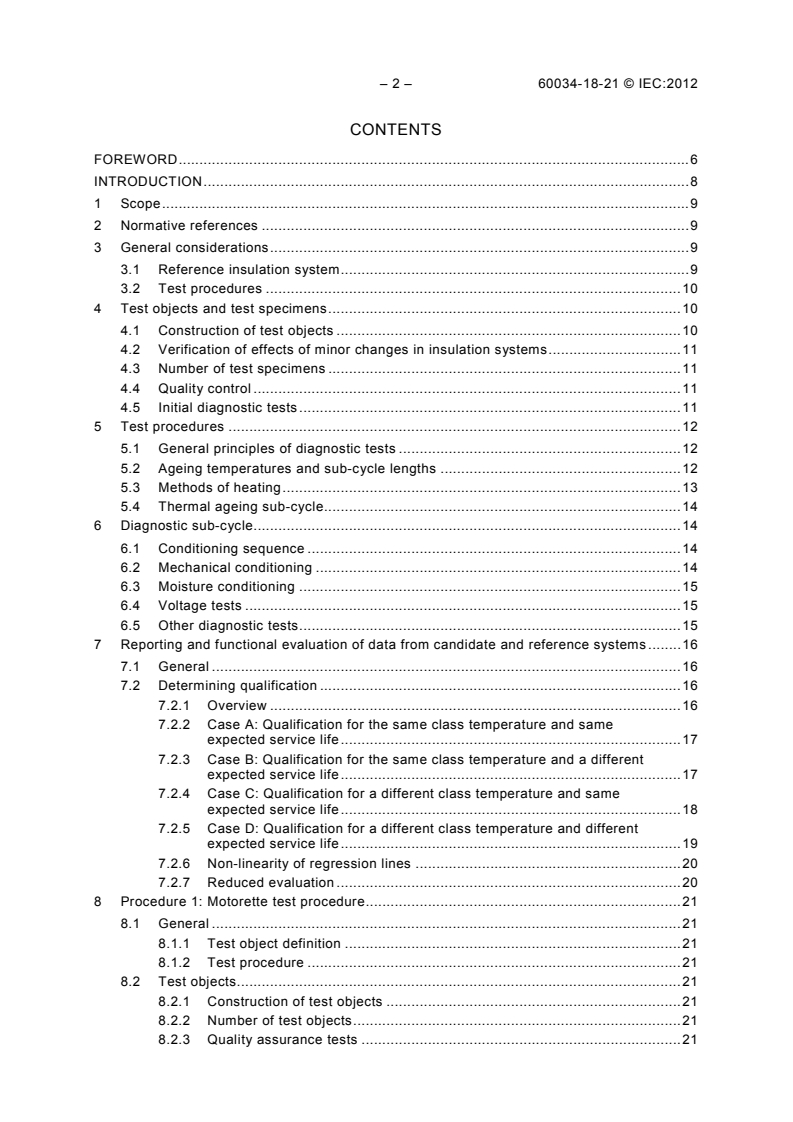
IEC 60034-18-21:2012 - Rotating electrical machines - Part 18-21: Functional evaluation of insulation systems - Test procedures for wire-wound windings - Thermal evaluation and classification Released:9/19/2012
Overview
IEC 60034-18-21:2012 is an international standard published by the International Electrotechnical Commission (IEC) that focuses on the thermal evaluation and classification of insulation systems used in wire-wound windings of rotating electrical machines. This standard applies to insulation systems in alternating current (a.c.) and direct current (d.c.) machines, providing comprehensive test procedures for assessing the thermal durability and functionality of insulation materials in operational environments.
The core purpose of IEC 60034-18-21 is to establish rigorous methodologies to compare candidate insulation systems against reference systems with proven in-service performance. This comparison ensures that new or modified insulation designs meet stringent reliability and safety standards before deployment.
Key Topics
Thermal Evaluation and Classification
The standard provides detailed test procedures to assess the thermal aging characteristics of insulation systems, enabling classification according to their thermal endurance in rotating electrical machines.Test Procedures for Wire-Wound Windings
Multiple test procedures are described to simulate real-life thermal and mechanical stresses-including ageing temperatures, sub-cycle lengths, heating methods, and diagnostic tests-to evaluate mechanical and electrical properties post-thermal stress.Reference and Candidate Insulation Systems
The evaluation is based on comparison between a candidate system (new or modified insulation) and an established reference system that has proven service reliability, ensuring benchmarking under the same test conditions.Statistical Methods for Data Evaluation
The 2012 edition introduces basic statistical approaches to improve comparative analysis accuracy, supporting objective decision-making on qualification and classification.Quality Control and Reproducibility
Recommendations on test object construction, number of specimens, initial diagnostic tests, and quality assurance are included to maintain consistency and reliability in testing outcomes.
Applications
IEC 60034-18-21:2012 is critical for manufacturers, researchers, and engineers involved in the design, testing, and certification of rotating electrical machines, particularly:
Electric Motors and Generators
Ensuring wire-wound stator and rotor windings meet thermal endurance standards to prevent insulation failure and extend operational life.Power Generation and Industrial Drives
Protecting key components in power plants and industrial applications by verifying insulation systems can safely operate at designated thermal classes.Insulation Material Development
Validating new insulation materials and system designs through standardized thermal ageing test cycles before market release.Product Certification and Compliance
Supporting type testing and compliance verification according to international thermal classification standards in electrical machine manufacturing.
Related Standards
IEC 60034 Series
Includes comprehensive standards for rotating electrical machines covering design, testing, and performance criteria.IEC 60085
Concerns electrical insulation systems and their thermal classification, complementing the evaluation focus of IEC 60034-18-21.IEC 60505
Provides guidelines on capacitance and dissipation factor measurements, useful for additional diagnostic tests referenced in insulation evaluation.ISO/IEC Standards on Statistical Methods
Supporting the introduction of statistical data evaluation in comparative thermal testing.
In summary, IEC 60034-18-21:2012 delivers precise, practical test procedures for assessing the thermal performance of wire-wound insulation systems in rotating electrical machines. It helps ensure reliability, safety, and longevity by defining standardized evaluation techniques and classification benchmarks critical for motor and generator manufacturers and electrical insulation developers worldwide.
Relations
- Effective Date
- 05-Sep-2023
Buy Documents
IEC 60034-18-21:2012 - Rotating electrical machines - Part 18-21: Functional evaluation of insulation systems - Test procedures for wire-wound windings - Thermal evaluation and classification Released:9/19/2012
Get Certified
Connect with accredited certification bodies for this standard

DNV
DNV is an independent assurance and risk management provider.

Lloyd's Register
Lloyd's Register is a global professional services organisation specialising in engineering and technology.
DNV Energy Systems
Energy and renewable energy certification.
Sponsored listings
Frequently Asked Questions
IEC 60034-18-21:2012 is a standard published by the International Electrotechnical Commission (IEC). Its full title is "Rotating electrical machines - Part 18-21: Functional evaluation of insulation systems - Test procedures for wire-wound windings - Thermal evaluation and classification". This standard covers: IEC 60034-18-21:2012 gives test procedures for the thermal evaluation and classification of insulation systems used or proposed for use in wire-wound alternating current (a.c.) or direct current (d.c.) rotating electrical machines. The test performance of a candidate insulation system is compared to the test performance of a reference insulation system with proven service experience. The main technical changes with regard to the previous edition can be seen in the introduction of some basic statistical methods in the evaluation of comparative data. Moreover, the standard states a simpler use of different test procedures.
IEC 60034-18-21:2012 gives test procedures for the thermal evaluation and classification of insulation systems used or proposed for use in wire-wound alternating current (a.c.) or direct current (d.c.) rotating electrical machines. The test performance of a candidate insulation system is compared to the test performance of a reference insulation system with proven service experience. The main technical changes with regard to the previous edition can be seen in the introduction of some basic statistical methods in the evaluation of comparative data. Moreover, the standard states a simpler use of different test procedures.
IEC 60034-18-21:2012 is classified under the following ICS (International Classification for Standards) categories: 27.160 - Solar energy engineering; 29.160.01 - Rotating machinery in general. The ICS classification helps identify the subject area and facilitates finding related standards.
IEC 60034-18-21:2012 has the following relationships with other standards: It is inter standard links to IEC 60034-18-21:1992/AMD2:1996. Understanding these relationships helps ensure you are using the most current and applicable version of the standard.
IEC 60034-18-21:2012 is available in PDF format for immediate download after purchase. The document can be added to your cart and obtained through the secure checkout process. Digital delivery ensures instant access to the complete standard document.
Standards Content (Sample)
IEC 60034-18-21 ®
Edition 2.0 2012-09
INTERNATIONAL
STANDARD
NORME
INTERNATIONALE
Rotating electrical machines –
Part 18-21: Functional evaluation of insulation systems – Test procedures for
wire-wound windings – Thermal evaluation and classification
Machines électriques tournantes –
Partie 18-21: Evaluation fonctionnelle des systèmes d'isolation – Procédures
d'essai pour enroulements à fils – Evaluation thermique et classification
All rights reserved. Unless otherwise specified, no part of this publication may be reproduced or utilized in any form
or by any means, electronic or mechanical, including photocopying and microfilm, without permission in writing from
either IEC or IEC's member National Committee in the country of the requester.
If you have any questions about IEC copyright or have an enquiry about obtaining additional rights to this publication,
please contact the address below or your local IEC member National Committee for further information.
Droits de reproduction réservés. Sauf indication contraire, aucune partie de cette publication ne peut être reproduite ni
utilisée sous quelque forme que ce soit et par aucun procédé, électronique ou mécanique, y compris la photocopie et les
microfilms, sans l'accord écrit de la CEI ou du Comité national de la CEI du pays du demandeur.
Si vous avez des questions sur le copyright de la CEI ou si vous désirez obtenir des droits supplémentaires sur cette
publication, utilisez les coordonnées ci-après ou contactez le Comité national de la CEI de votre pays de résidence.
IEC Central Office Tel.: +41 22 919 02 11
3, rue de Varembé Fax: +41 22 919 03 00
CH-1211 Geneva 20 info@iec.ch
Switzerland www.iec.ch
About the IEC
The International Electrotechnical Commission (IEC) is the leading global organization that prepares and publishes
International Standards for all electrical, electronic and related technologies.
About IEC publications
The technical content of IEC publications is kept under constant review by the IEC. Please make sure that you have the
latest edition, a corrigenda or an amendment might have been published.
Useful links:
IEC publications search - www.iec.ch/searchpub Electropedia - www.electropedia.org
The advanced search enables you to find IEC publications The world's leading online dictionary of electronic and
by a variety of criteria (reference number, text, technical electrical terms containing more than 30 000 terms and
committee,…). definitions in English and French, with equivalent terms in
It also gives information on projects, replaced and additional languages. Also known as the International
withdrawn publications. Electrotechnical Vocabulary (IEV) on-line.
IEC Just Published - webstore.iec.ch/justpublished Customer Service Centre - webstore.iec.ch/csc
Stay up to date on all new IEC publications. Just Published If you wish to give us your feedback on this publication
details all new publications released. Available on-line and or need further assistance, please contact the
also once a month by email. Customer Service Centre: csc@iec.ch.
A propos de la CEI
La Commission Electrotechnique Internationale (CEI) est la première organisation mondiale qui élabore et publie des
Normes internationales pour tout ce qui a trait à l'électricité, à l'électronique et aux technologies apparentées.
A propos des publications CEI
Le contenu technique des publications de la CEI est constamment revu. Veuillez vous assurer que vous possédez
l’édition la plus récente, un corrigendum ou amendement peut avoir été publié.
Liens utiles:
Recherche de publications CEI - www.iec.ch/searchpub Electropedia - www.electropedia.org
La recherche avancée vous permet de trouver des Le premier dictionnaire en ligne au monde de termes
publications CEI en utilisant différents critères (numéro de électroniques et électriques. Il contient plus de 30 000
référence, texte, comité d’études,…). termes et définitions en anglais et en français, ainsi que
Elle donne aussi des informations sur les projets et les les termes équivalents dans les langues additionnelles.
publications remplacées ou retirées. Egalement appelé Vocabulaire Electrotechnique
International (VEI) en ligne.
Just Published CEI - webstore.iec.ch/justpublished
Service Clients - webstore.iec.ch/csc
Restez informé sur les nouvelles publications de la CEI.
Just Published détaille les nouvelles publications parues. Si vous désirez nous donner des commentaires sur
Disponible en ligne et aussi une fois par mois par email. cette publication ou si vous avez des questions
contactez-nous: csc@iec.ch.
IEC 60034-18-21 ®
Edition 2.0 2012-09
INTERNATIONAL
STANDARD
NORME
INTERNATIONALE
Rotating electrical machines –
Part 18-21: Functional evaluation of insulation systems – Test procedures for
wire-wound windings – Thermal evaluation and classification
Machines électriques tournantes –
Partie 18-21: Evaluation fonctionnelle des systèmes d'isolation – Procédures
d'essai pour enroulements à fils – Evaluation thermique et classification
INTERNATIONAL
ELECTROTECHNICAL
COMMISSION
COMMISSION
ELECTROTECHNIQUE
PRICE CODE
INTERNATIONALE
CODE PRIX X
ICS 29.160 ISBN 978-2-83220-337-8
– 2 – 60034-18-21 © IEC:2012
CONTENTS
FOREWORD . 6
INTRODUCTION . 8
1 Scope . 9
2 Normative references . 9
3 General considerations . 9
3.1 Reference insulation system . 9
3.2 Test procedures . 10
4 Test objects and test specimens . 10
4.1 Construction of test objects . 10
4.2 Verification of effects of minor changes in insulation systems . 11
4.3 Number of test specimens . 11
4.4 Quality control . 11
4.5 Initial diagnostic tests . 11
5 Test procedures . 12
5.1 General principles of diagnostic tests . 12
5.2 Ageing temperatures and sub-cycle lengths . 12
5.3 Methods of heating . 13
5.4 Thermal ageing sub-cycle . 14
6 Diagnostic sub-cycle. 14
6.1 Conditioning sequence . 14
6.2 Mechanical conditioning . 14
6.3 Moisture conditioning . 15
6.4 Voltage tests . 15
6.5 Other diagnostic tests . 15
7 Reporting and functional evaluation of data from candidate and reference systems . 16
7.1 General . 16
7.2 Determining qualification . 16
7.2.1 Overview . 16
7.2.2 Case A: Qualification for the same class temperature and same
expected service life . 17
7.2.3 Case B: Qualification for the same class temperature and a different
expected service life . 17
7.2.4 Case C: Qualification for a different class temperature and same
expected service life . 18
7.2.5 Case D: Qualification for a different class temperature and different
expected service life . 19
7.2.6 Non-linearity of regression lines . 20
7.2.7 Reduced evaluation . 20
8 Procedure 1: Motorette test procedure . 21
8.1 General . 21
8.1.1 Test object definition . 21
8.1.2 Test procedure . 21
8.2 Test objects . 21
8.2.1 Construction of test objects . 21
8.2.2 Number of test objects . 21
8.2.3 Quality assurance tests . 21
60034-18-21 © IEC:2012 – 3 –
8.2.4 Initial diagnostic tests . 22
8.3 Thermal ageing sub-cycle . 22
8.3.1 Ageing temperatures and sub-cycle lengths . 22
8.3.2 Means of heating . 22
8.3.3 Ageing procedure . 22
8.4 Diagnostic sub-cycle . 22
8.4.1 General . 22
8.4.2 Mechanical conditioning . 22
8.4.3 Moisture conditioning . 22
8.4.4 Voltage test . 22
8.4.5 Other diagnostic tests . 23
8.5 Analyzing, reporting and classification . 23
9 Procedure 2: Motor test procedure . 23
9.1 General . 23
9.1.1 Test object definition . 23
9.1.2 Test procedure . 23
9.2 Test objects . 24
9.2.1 Construction of test objects . 24
9.2.2 Number of test objects . 24
9.2.3 Quality assurance tests . 24
9.2.4 Initial diagnostic tests . 24
9.3 Thermal ageing sub-cycle . 24
9.3.1 Ageing temperatures and sub-cycle lengths . 24
9.3.2 Means of heating . 24
9.3.3 Ageing procedure . 25
9.3.4 Mechanical stresses during the thermal ageing sub-cycle . 25
9.4 Diagnostic sub-cycle . 25
9.4.1 Mechanical conditioning . 25
9.4.2 Moisture conditioning . 26
9.4.3 Voltage withstand test . 26
9.4.4 Other diagnostic tests . 26
9.5 Analyzing, reporting and classification . 27
10 Procedure 3: Test procedure for stator windings in slots . 27
10.1 General . 27
10.1.1 Test object definition . 27
10.1.2 Test procedures . 27
10.2 Test objects . 27
10.2.1 Construction of test objects . 27
10.2.2 Number of test specimens . 27
10.2.3 Quality assurance tests . 27
10.2.4 Initial diagnostic tests . 27
10.3 Thermal ageing sub-cycle . 27
10.3.1 Ageing temperatures and sub-cycle lengths . 27
10.3.2 Means of heating . 28
10.3.3 Ageing procedure . 28
10.4 Diagnostic sub-cycle . 28
10.4.1 Mechanical conditioning . 28
10.4.2 Moisture conditioning . 28
10.4.3 Voltage withstand test . 28
– 4 – 60034-18-21 © IEC:2012
10.4.4 Other diagnostic tests . 28
10.5 Analyzing, reporting and classification . 28
11 Procedure 4: Test procedure for pole windings . 29
11.1 General . 29
11.1.1 Test object definition . 29
11.1.2 Test procedures . 29
11.2 Test objects . 29
11.2.1 Construction of test objects . 29
11.2.2 Number of test objects . 29
11.2.3 Quality assurance tests . 29
11.2.4 Initial diagnostic tests . 29
11.3 Thermal ageing sub-cycle . 29
11.3.1 Ageing temperatures and sub-cycle lengths . 29
11.3.2 Means of heating . 29
11.3.3 Ageing procedure . 30
11.4 Diagnostic sub-cycle . 30
11.4.1 Mechanical conditioning . 30
11.4.2 Moisture conditioning . 30
11.4.3 Voltage withstand test . 30
11.4.4 Other diagnostic tests . 31
11.5 Analyzing, reporting and classification . 31
12 Procedure 5: Test procedure for rotor windings in slots . 31
12.1 General . 31
12.1.1 Test object definition . 31
12.1.2 Test procedures . 31
12.2 Test objects . 31
12.2.1 Construction of test objects . 31
12.2.2 Number of test specimens . 32
12.2.3 Quality assurance tests . 32
12.2.4 Initial diagnostic tests . 32
12.3 Thermal ageing sub-cycle . 32
12.3.1 Ageing temperatures and sub-cycle lengths . 32
12.3.2 Ageing means. 32
12.3.3 Ageing procedure . 32
12.4 Diagnostic sub-cycle . 32
12.4.1 Mechanical conditioning . 32
12.4.2 Moisture conditioning . 32
12.4.3 Voltage test . 33
12.4.4 Other diagnostic tests . 33
12.5 Analyzing, reporting and classification . 33
Annex A (informative) Motorette construction (examples) . 34
Annex B (informative) Models for windings on poles (examples) . 39
Annex C (informative) Equipment for moisture tests . 46
Figure 1 – Candidate system qualified for the same thermal class and the same
expected service life . 17
Figure 2 – Candidate system qualified for the same thermal class and different
expected service life . 18
60034-18-21 © IEC:2012 – 5 –
Figure 3 – Candidate system qualified for a different class temperature and the same
expected service life . 19
Figure 4 – Candidate system qualified for a different service life and different thermal
class from the reference . 20
Figure A.1 – Components of motorette before final assembly . 37
Figure A.2 – Completely assembled and varnished motorette . 37
Figure A.3 – Manufacturing drawing of motorette frame . 38
Figure B.1 – Test fixture for random wire-wound field coil . 40
Figure B.2 – Random wire-wound field coil mounted on the test fixture . 40
Figure B.3 – Manufacturing drawing for simulating pole for random wire-wound field
coil test fixture . 41
Figure B.4 – Manufacturing drawing for simulated frame for random wire-wound field
coil test fixture . 42
Figure B.5 – Test fixture for precision wire-wound field coil . 43
Figure B.6 – Precision wire-wound field coil mounted on the test fixture . 43
Figure B.7 – Manufacturing drawing for simulated pole for precision wire-wound field
coil test fixture . 44
Figure B.8 – Manufacturing drawing for simulated frame for precision wire-wound . 45
Figure C.1 – Diagram illustrating basic principle of condensation chamber with cooled
test objects . 47
Figure C.2 – Cut away of condensation chamber with cooled test objects . 48
Table 1 – Thermal classes . 12
Table 2 – Recommended temperatures and ageing sub-cycle exposure periods . 13
Table 3 – Conditions for qualification of candidate system . 16
Table 4 – Test voltages . 23
– 6 – 60034-18-21 © IEC:2012
INTERNATIONAL ELECTROTECHNICAL COMMISSION
____________
ROTATING ELECTRICAL MACHINES –
Part 18-21: Functional evaluation of insulation systems –
Test procedures for wire-wound windings –
Thermal evaluation and classification
FOREWORD
1) The International Electrotechnical Commission (IEC) is a worldwide organization for standardization comprising
all national electrotechnical committees (IEC National Committees). The object of IEC is to promote
international co-operation on all questions concerning standardization in the electrical and electronic fields. To
this end and in addition to other activities, IEC publishes International Standards, Technical Specifications,
Technical Reports, Publicly Available Specifications (PAS) and Guides (hereafter referred to as “IEC
Publication(s)”). Their preparation is entrusted to technical committees; any IEC National Committee interested
in the subject dealt with may participate in this preparatory work. International, governmental and non-
governmental organizations liaising with the IEC also participate in this preparation. IEC collaborates closely
with the International Organization for Standardization (ISO) in accordance with conditions determined by
agreement between the two organizations.
2) The formal decisions or agreements of IEC on technical matters express, as nearly as possible, an international
consensus of opinion on the relevant subjects since each technical committee has representation from all
interested IEC National Committees.
3) IEC Publications have the form of recommendations for international use and are accepted by IEC National
Committees in that sense. While all reasonable efforts are made to ensure that the technical content of IEC
Publications is accurate, IEC cannot be held responsible for the way in which they are used or for any
misinterpretation by any end user.
4) In order to promote international uniformity, IEC National Committees undertake to apply IEC Publications
transparently to the maximum extent possible in their national and regional publications. Any divergence
between any IEC Publication and the corresponding national or regional publication shall be clearly indicated in
the latter.
5) IEC itself does not provide any attestation of conformity. Independent certification bodies provide conformity
assessment services and, in some areas, access to IEC marks of conformity. IEC is not responsible for any
services carried out by independent certification bodies.
6) All users should ensure that they have the latest edition of this publication.
7) No liability shall attach to IEC or its directors, employees, servants or agents including individual experts and
members of its technical committees and IEC National Committees for any personal injury, property damage or
other damage of any nature whatsoever, whether direct or indirect, or for costs (including legal fees) and
expenses arising out of the publication, use of, or reliance upon, this IEC Publication or any other IEC
Publications.
8) Attention is drawn to the Normative references cited in this publication. Use of the referenced publications is
indispensable for the correct application of this publication.
9) Attention is drawn to the possibility that some of the elements of this IEC Publication may be the subject of
patent rights. IEC shall not be held responsible for identifying any or all such patent rights.
International Standard IEC 60034-18-21 has been prepared by IEC technical committee 2:
Rotating machinery.
This second edition cancels and replaces the first edition published in 1992, and its
amendments 1 (1994) and 2 (1996), and constitutes a technical revision.
The main technical changes with regard to the previous edition can be seen in the
introduction of some basic statistical methods in the evaluation of comparative data.
Moreover, the standard states a simpler use of different test procedures.
60034-18-21 © IEC:2012 – 7 –
The text of this standard is based on the following documents:
FDIS Report on voting
2/1672/FDIS 2/1682/RVD
Full information on the voting for the approval of this standard can be found in the report on
voting indicated in the above table.
This publication has been drafted in accordance with the ISO/IEC Directives, Part 2.
NOTE A table of cross-references of all IEC TC 2 publications can be found on the IEC TC 2 dashboard on the
IEC website.
The committee has decided that the contents of this publication will remain unchanged until
the stability date indicated on the IEC web site under "http://webstore.iec.ch" in the data
related to the specific publication. At this date, the publication will be
• reconfirmed,
• withdrawn,
• replaced by a revised edition, or
• amended.
IMPORTANT – The 'colour inside' logo on the cover page of this publication indicates
that it contains colours which are considered to be useful for the correct
understanding of its contents. Users should therefore print this document using a
colour printer.
– 8 – 60034-18-21 © IEC:2012
INTRODUCTION
IEC 60034-18 comprises several parts, dealing with different types of functional evaluation
and special kinds of test procedures for insulation systems of rotating electrial machines. Part
IEC 60034-18-1 provides general guidelines for such procedures and qualification principles.
The subsequent parts IEC 60034-18-21, IEC 60034-18-22, IEC 60034-18-31,
IEC 60034-18-33, IEC 60034-18-34, IEC 60034-18-41 and IEC 60034-18-42 give detailed
procedures for the various types of windings.
This part IEC 60034-18-21 deals with the thermal evaluation and classification of insulation
systems for wire-wound (usually random wound) windings.
Parts relevant to this document are:
– IEC 60034-18-1: General guidelines
– IEC 60034-18-31: Test procedures for form-wound windings
– IEC 60034-18-41: Qualification and type tests for Type I electrical insulation systems used
in rotating electrical machines fed from voltage converters
– IEC 60034-18-42: Qualification and acceptance tests for partial discharge resistant
electrical insulation systems (Type II) used in rotating electrical machines fed from voltage
converters
60034-18-21 © IEC:2012 – 9 –
ROTATING ELECTRICAL MACHINES –
Part 18-21: Functional evaluation of insulation systems –
Test procedures for wire-wound windings –
Thermal evaluation and classification
1 Scope
This part of IEC 60034 gives test procedures for the thermal evaluation and classification of
insulation systems used or proposed for use in wire-wound alternating current (a.c.) or direct
current (d.c.) rotating electrical machines.
The test performance of a candidate insulation system is compared to the test performance of
a reference insulation system with proven service experience.
IEC 60034-18-1 describes general testing principles applicable to thermal endurance testing
of insulation systems used in rotating electrical machines. The principles of IEC 60034-18-1
are followed unless otherwise stated in IEC 60034-18-21.
2 Normative references
The following documents, in whole or in part, are normatively referenced in this document and
are indispensable for its application. For dated references, only the edition cited applies. For
undated references, the latest edition of the referenced document (including any
amendments) applies.
IEC 60034-1, Rotating electrical machines – Part 1: Rating and performance
IEC 60034-18-1:2010, Rotating electrical machines – Part 18-1: Functional evaluation of
insulation systems – General guidelines
IEC 60085, Electrical insulation – Thermal evaluation and designation
IEC 60216-1, Electrical insulating materials – Properties of thermal endurance – Part 1:
Ageing procedures and evaluation of test results
IEC 60216-5, Electrical insulating materials – Thermal endurance properties – Part 5:
Determination of relative thermal endurance index (RTE) of an insulating material
IEC 60455 (all parts), Resin based reactive compounds used for electrical insulation
IEC 60464 (all parts), Varnishes used for electrical insulation
IEC 60505, Evaluation and qualification of electrical insulation systems
3 General considerations
3.1 Reference insulation system
A reference insulation system shall be tested using the same test procedure as for the
candidate system. See 4.3 of IEC 60034-18-1.
– 10 – 60034-18-21 © IEC:2012
3.2 Test procedures
Each thermal endurance test generally consists of a series of cycles, where each cycle
comprises a thermal ageing sub-cycle followed by a conditioning sub-cycle and a diagnostic
sub-cycle.
There are five different test procedures, according to the type of test object, namely,
Procedure 1: Motorette test procedure, Procedure 2: Motor test procedure, Procedure 3: Test
procedure for stator windings in slots, Procedure 4: Test procedure for pole windings and
Procedure 5: Test procedure for rotor windings in slots and they are described in Clauses 8,
9, 10, 11 and 12. The thermal endurance test procedure uses several cycles, each consisting
of:
– a thermal ageing sub-cycle;
– a diagnostic sub-cycle, which includes mechanical and moisture conditioning followed by a
diagnostic voltage test, performed in that order.
In addition to the required tests, additional non-destructive informative tests may be used.
4 Test objects and test specimens
4.1 Construction of test objects
It is expected that the various insulating materials or components making up any insulation
system to be evaluated by these test procedures will first be screened using company
screening procedures. Temperature indices for insulating materials may be used. However,
temperature indices of insulating materials cannot be used to classify insulation systems but
are to be considered only as indicators for the thermal functional tests for systems. For
electrical isolation systems see IEC 60085.
Wherever economics or the size of the machine or both warrant it, an actual machine or
machine component should be used as the test object. Usually this means that coils of full
cross section, with actual clearances and creepage distances are needed, though a reduced
slot length may be adequate.
Test objects may be actual machines, machine components or models.
Test models shall contain all the essential elements employed in the windings they simulate
and shall be considered only as close approximations. Insulation thicknesses, creepage
distances and, where necessary, discharge protection appropriate for the intended
maximum rated voltage and equipment standards or practice shall be used.
For large and high-voltage machines, test models representing a part of a coil or bar may be
used, when ageing specific for that part is investigated, provided that representative factors
of influence can be applied to the test specimens.
The systems compared shall have arrangements consistent with those to be used in
machines.
NOTE It is recognized that markedly different values of test life may be obtained for the same insulating
materials, depending on insulation thicknesses and creepage distances.
Test specimens simulating parts of a coil or winding may be used for evaluation, if stresses
acting on these parts in service can be reproduced reliably in the test.
Particular types of models have been used successfully in some countries and examples of
these are illustrated in Annexes A and B.
60034-18-21 © IEC:2012 – 11 –
The manufacturer should make certain that the materials proposed for use in the new
insulation system can be handled without deterioration of properties in the intended
manufacturing processes.
4.2 Verification of effects of minor changes in insulation systems
A minor change is described in IEC 60034-18-1. An example of a minor change in a wire-
wound insulation system may include purchasing a key component material from a new
supplier without changing the material specification. If thermal ageing evaluation is
appropriate to evaluate a minor change to a service-proven insulation system, it is acceptable
to use one temperature to age one test object consisting of no fewer than the recommended
number of test specimens.
Reduced evaluation should be performed using an ageing temperature cycle within the range
of known thermal endurance data for the service-proven system.
4.3 Number of test specimens
Tests should be conducted using no fewer than five test specimens per ageing temperature,
per insulation system. This is the minimum recommended number for statistical confidence.
4.4 Quality control
Each insulating material intended to be used in preparation of test objects should be
subjected to separate tests to establish uniformity before it is used in assembly.
Each test specimen shall be subjected to the quality control tests of the normal or intended
production process.
To eliminate defective test objects, they should be qualified first by visual examination and
then by over-voltage tests consistent with the machine or coil tests in the manufacturing
facility, or as described in the appropriate subclauses for diagnostic tests, whichever voltage
test is greater.
NOTE When appropriate additional screening (or qualifying) tests may be used, including the following:
– insulation resistance measurement;
– loss tangent and capacitance measurement;
– partial discharge inception voltage measurement;
– balance of phase currents while running;
– repetitive surge;
– leakage current;
– high-voltage test.
Any widely deviating test object should be discarded or inspected to determine the reason for
the deviation and appropriate allowances should be made for the deviations.
4.5 Initial diagnostic tests
Each completed test object shall be subjected to all of the diagnostic tests selected to be
used in the thermal functional test before starting the first thermal ageing sub-cycle, to
establish that each test specimen is capable of passing the selected diagnostic tests.
– 12 – 60034-18-21 © IEC:2012
5 Test procedures
5.1 General principles of diagnostic tests
In many cases, experience has indicated that the best diagnostic evaluation of a thermally
degraded and thus usually brittle insulation system is obtained by exposure to mechanical
stress, thus producing cracks in the mechanically stressed parts, then exposure to moisture
and finally application of the test voltage.
In other cases, mechanical stress, moisture exposure and application of voltage may not be
the best diagnostic tests and may be replaced by selected dielectric tests (e.g., measurement
of partial discharge or loss tangent) to check the condition of the insulation after each thermal
ageing sub-cycle.
The test procedure consists of several ageing tests, performed at different ageing
temperatures. At each temperature, the test life of the insulation system is determined. Based
on these test life values, the life at the class temperature is estimated relative to that of the
reference system at its class temperature.
Each ageing test is performed in cycles, each cycle consisting of a thermal ageing sub-cycle
and a diagnostic sub-cycle. The diagnostic sub-cycle may include mechanical and moisture
conditioning procedures, followed by a diagnostic voltage test and other diagnostic tests.
5.2 Ageing temperatures and sub-cycle lengths
It is recommended that the tests be carried out on the number of specimens indicated in
subsequent subclauses of this standard for at least three different ageing temperatures.
The intended thermal class (or class temperature) of the candidate insulation system as well
as the known class of the reference system shall be selected from Table 1, which is a subset
of the thermal classes defined in IEC 60085 and IEC 60505.
Table 1 – Thermal classes
Thermal class rating Thermal class
°C
105 (A) 105
120 (E) 120
130 (B) 130
155 (F) 155
180 (H) 180
200 (N) 200
NOTE The thermal classes 105 (A), 120 (E) and 200 (N) in Table 1 are nowadays seldom used in rotating
electrical machines and are not found in IEC 60034-1.
Table 2 lists the suggested ageing temperatures and corresponding periods of exposure in
each thermal ageing sub-cycle for insulation systems of the various thermal classes. Time
and temperature may be adjusted to make the best use of facilities and staff but comparisons
shall take such variations into consideration.
The lowest ageing temperature should be selected such as to produce the mean test life of
about 5 000 h and the highest temperature should produce a mean test life of at least 100 h.
This is generally accomplished by choosing the lowest ageing temperature to correspond to
an exposure period of 28 to 35 days or longer.
60034-18-21 © IEC:2012 – 13 –
In addition, at least two higher ageing temperatures should be selected, separated by
intervals of 20 K or more. Intervals of less than 20 K may be suitable when tests are made at
more than four ageing temperatures. The highest temperature shall provide a mean test life of
at least 100 h.
To minimize the uncertainty introduced by extrapolation the lowest test temperature should
not exceed by more than 25 K the temperature to which the results will be extrapolated.
If the intended thermal class for the candidate insulation system differs from the known class
of the reference system, different ageing temperatures and sub-cycle lengths are to be
selected in an appropriate manner.
Where the candidate insulation system represents a minor change from a classified system,
4.2 may be followed.
It is recommended that the lengths of ageing sub-cycles for the intended class temperature be
selected so as to give a mean life of about 10 cycles for each ageing temperature.
Table 2 – Recommended temperatures and ageing sub-cycle exposure periods
Days per
Anticipated
105 120 130 155 180 200 ageing
thermal class
sub-cycle
T < T ≤ T T T T T T T T T T T T T
1 A 2 1 2 1 2 1 2 1 2 1 2 1 2
170 180 185 195 195 205 220 230 245 255 265 275 1 – 2
Suggested
range
160 170 175 185 185 195 210 220 235 245 255 265 2 – 3
for ageing
150 160 165 175 175 185 200 210 225 235 245 255 4 – 6
temperature
(T ) °C
A 140 150 155 165 165 175 190 200 215 225 235 245 7 – 10
130 140 145 155 155 165 180 190 205 215 225 235 14 – 21
120 130 135 145 145 155 170 180 195 205 215 225 28 – 35
110 120 125 135 135 145 160 170 185 195 205 215 45 – 60
NOTE This Table 2 is designed to give flexibility to laboratories to choose ageing times and temperatures in such
a way as to optimize the use of their manpower and facilities. It accommodates the ideal situation (based on 10 K
rule) that allows for doubling the ageing time for every 10 K decrease in ageing temperature (e.g. 1, 2, 4, 8, 16, 32,
and 64 days of ageing). It allows the ageing to b
...