

IEC TS 60601-4-6:2024
(Main)Medical electrical equipment - Part 4-6: Guidance and interpretation - Voluntary guidance to help achieve basic safety and essential performance with regard to the possible effects of electromagnetic disturbances
General Information
- Abstract
IEC TS 60601-4-6:2024 provides practical methods to help achieve basic safety and essential performance with regard to the possible effects of em disturbances throughout the expected service life of me equipment or an me system.
These practical methods attempt to address all of the different types of errors, malfunctions or failures that can be caused by em disturbances in me equipment or me systems.
The purpose of this document is to provide recommendations for the techniques and measures used in the design, verification, and validation of systems, hardware, software, and firmware used in me equipment or me systems to help achieve basic safety and essential performance with regard to the em disturbances that could occur throughout the expected service life.
- Status
- Published
- Publication Date
- 22-Apr-2024
- Technical Committee
- SC 62A - Common aspects of medical equipment, software, and systems
- Current Stage
- PPUB - Publication issued
- Start Date
- 23-Apr-2024
- Completion Date
- 17-May-2024
Buy Documents
IEC TS 60601-4-6:2024 - Medical electrical equipment - Part 4-6: Guidance and interpretation - Voluntary guidance to help achieve basic safety and essential performance with regard to the possible effects of electromagnetic disturbances Released:4/23/2024
Overview
IEC TS 60601-4-6:2024 is a technical specification published by the International Electrotechnical Commission (IEC) that provides voluntary guidance to support manufacturers and designers of medical electrical equipment (ME equipment) and systems in achieving basic safety and essential performance when facing the possible effects of electromagnetic (EM) disturbances. The document outlines practical methods, techniques, and measures to mitigate risks caused by EM disturbances throughout the expected service life of ME equipment or ME systems. Its primary purpose is to assist in the design, verification, and validation of systems, hardware, software, and firmware, ensuring continued safety and performance integrity in healthcare environments.
Key Topics
Electromagnetic Disturbance (EM disturbance) Mitigation
IEC TS 60601-4-6 details a wide range of techniques and measures to identify, control, and reduce risks associated with EM disturbances. These include:- Project management and planning best practices
- Specification and application of electromagnetic compatibility (EMC) standards
- System and component design for robust EM immunity
- Operational strategies for ongoing performance assurance
Design, Verification, and Validation Guidance
The standard emphasizes structured processes for documenting and justifying the selected mitigation techniques. It recommends the use of checklists (such as Table B.1 in the standard) to systematically address each basic safety and essential performance concern related to EM disturbances.Lifecycle Considerations
Techniques and measures are mapped to every stage of the ME equipment or system lifecycle:- Concept and specification
- Design and development
- Implementation, integration, installation, commissioning
- Operation, maintenance, upgrade, and decommissioning
Customization and Documentation
IEC TS 60601-4-6 emphasizes customized risk management, recommending that manufacturers document the rationale for the techniques used-especially when high-effectiveness (HE) strategies are omitted or replaced. This supports transparency and traceability in safety documentation.
Applications
Medical Device Manufacturers
The guidance is essential for companies designing and building electronic medical products, helping to ensure that unforeseen EM interference does not compromise patient safety or device performance.System Integrators and Hospital Technology Managers
System-wide application supports installation and commissioning of medical systems in complex electromagnetic environments, such as hospital networks or intensive care units.Regulatory and Compliance Specialists
The practical methods outlined help organizations demonstrate compliance with required EMC stipulations and ensure alignment with international safety directives, such as those based on IEC 60601-1, IEC 60601-1-2, and related risk management standards.Product Upgrade and Lifecycle Management
With evolving technology and potentially varying electromagnetic environments, the guidance aids in performing appropriate safety assessments and validations during upgrades, refurbishments, or third-party component integration.
Related Standards
- IEC 60601-1: General requirements for basic safety and essential performance of medical electrical equipment.
- IEC 60601-1-2: Requirements and tests for electromagnetic compatibility of medical electrical equipment.
- ISO 14971: Application of risk management to medical devices.
- IEC 60601-2-XX / IEC 80601-2-XX: Particular standards for specific types of medical electrical equipment or systems.
Practical Value
IEC TS 60601-4-6:2024 is a critical tool for ensuring medical device safety and resilience in electromagnetic environments. By providing a comprehensive, voluntary framework for risk assessment and mitigation strategies, it allows manufacturers and operators to address both common and unique EM threats proactively. Its recommendations help extend product reliability, improve patient outcomes, and streamline compliance with international medical device safety requirements, making it highly valuable for anyone involved in the development, deployment, or regulation of medical electrical equipment and systems.
Buy Documents
IEC TS 60601-4-6:2024 - Medical electrical equipment - Part 4-6: Guidance and interpretation - Voluntary guidance to help achieve basic safety and essential performance with regard to the possible effects of electromagnetic disturbances Released:4/23/2024
Get Certified
Connect with accredited certification bodies for this standard

BSI Group
BSI (British Standards Institution) is the business standards company that helps organizations make excellence a habit.

TÜV Rheinland
TÜV Rheinland is a leading international provider of technical services.

TÜV SÜD
TÜV SÜD is a trusted partner of choice for safety, security and sustainability solutions.
Sponsored listings
Frequently Asked Questions
IEC TS 60601-4-6:2024 is a technical specification published by the International Electrotechnical Commission (IEC). Its full title is "Medical electrical equipment - Part 4-6: Guidance and interpretation - Voluntary guidance to help achieve basic safety and essential performance with regard to the possible effects of electromagnetic disturbances". This standard covers: IEC TS 60601-4-6:2024 provides practical methods to help achieve basic safety and essential performance with regard to the possible effects of em disturbances throughout the expected service life of me equipment or an me system. These practical methods attempt to address all of the different types of errors, malfunctions or failures that can be caused by em disturbances in me equipment or me systems. The purpose of this document is to provide recommendations for the techniques and measures used in the design, verification, and validation of systems, hardware, software, and firmware used in me equipment or me systems to help achieve basic safety and essential performance with regard to the em disturbances that could occur throughout the expected service life.
IEC TS 60601-4-6:2024 provides practical methods to help achieve basic safety and essential performance with regard to the possible effects of em disturbances throughout the expected service life of me equipment or an me system. These practical methods attempt to address all of the different types of errors, malfunctions or failures that can be caused by em disturbances in me equipment or me systems. The purpose of this document is to provide recommendations for the techniques and measures used in the design, verification, and validation of systems, hardware, software, and firmware used in me equipment or me systems to help achieve basic safety and essential performance with regard to the em disturbances that could occur throughout the expected service life.
IEC TS 60601-4-6:2024 is classified under the following ICS (International Classification for Standards) categories: 11.040.01 - Medical equipment in general; 33.100.20 - Immunity. The ICS classification helps identify the subject area and facilitates finding related standards.
IEC TS 60601-4-6:2024 is available in PDF format for immediate download after purchase. The document can be added to your cart and obtained through the secure checkout process. Digital delivery ensures instant access to the complete standard document.
Standards Content (Sample)
IEC TS 60601-4-6 ®
Edition 1.0 2024-04
TECHNICAL
SPECIFICATION
Medical electrical equipment –
Part 4-6: Guidance and interpretation – Voluntary guidance to help achieve basic
safety and essential performance with regard to the possible effects of
electromagnetic disturbances
All rights reserved. Unless otherwise specified, no part of this publication may be reproduced or utilized in any form
or by any means, electronic or mechanical, including photocopying and microfilm, without permission in writing from
either IEC or IEC's member National Committee in the country of the requester. If you have any questions about IEC
copyright or have an enquiry about obtaining additional rights to this publication, please contact the address below or
your local IEC member National Committee for further information.
IEC Secretariat Tel.: +41 22 919 02 11
3, rue de Varembé info@iec.ch
CH-1211 Geneva 20 www.iec.ch
Switzerland
About the IEC
The International Electrotechnical Commission (IEC) is the leading global organization that prepares and publishes
International Standards for all electrical, electronic and related technologies.
About IEC publications
The technical content of IEC publications is kept under constant review by the IEC. Please make sure that you have the
latest edition, a corrigendum or an amendment might have been published.
IEC publications search - webstore.iec.ch/advsearchform IEC Products & Services Portal - products.iec.ch
The advanced search enables to find IEC publications by a Discover our powerful search engine and read freely all the
variety of criteria (reference number, text, technical publications previews, graphical symbols and the glossary.
committee, …). It also gives information on projects, replaced With a subscription you will always have access to up to date
and withdrawn publications. content tailored to your needs.
IEC Just Published - webstore.iec.ch/justpublished
Electropedia - www.electropedia.org
Stay up to date on all new IEC publications. Just Published
The world's leading online dictionary on electrotechnology,
details all new publications released. Available online and once
containing more than 22 500 terminological entries in English
a month by email.
and French, with equivalent terms in 25 additional languages.
Also known as the International Electrotechnical Vocabulary
IEC Customer Service Centre - webstore.iec.ch/csc
(IEV) online.
If you wish to give us your feedback on this publication or need
further assistance, please contact the Customer Service
Centre: sales@iec.ch.
IEC TS 60601-4-6 ®
Edition 1.0 2024-04
TECHNICAL
SPECIFICATION
Medical electrical equipment –
Part 4-6: Guidance and interpretation – Voluntary guidance to help achieve
basic safety and essential performance with regard to the possible effects of
electromagnetic disturbances
INTERNATIONAL
ELECTROTECHNICAL
COMMISSION
ICS 11.040.01; 33.100.20 ISBN 978-2-8322-8809-2
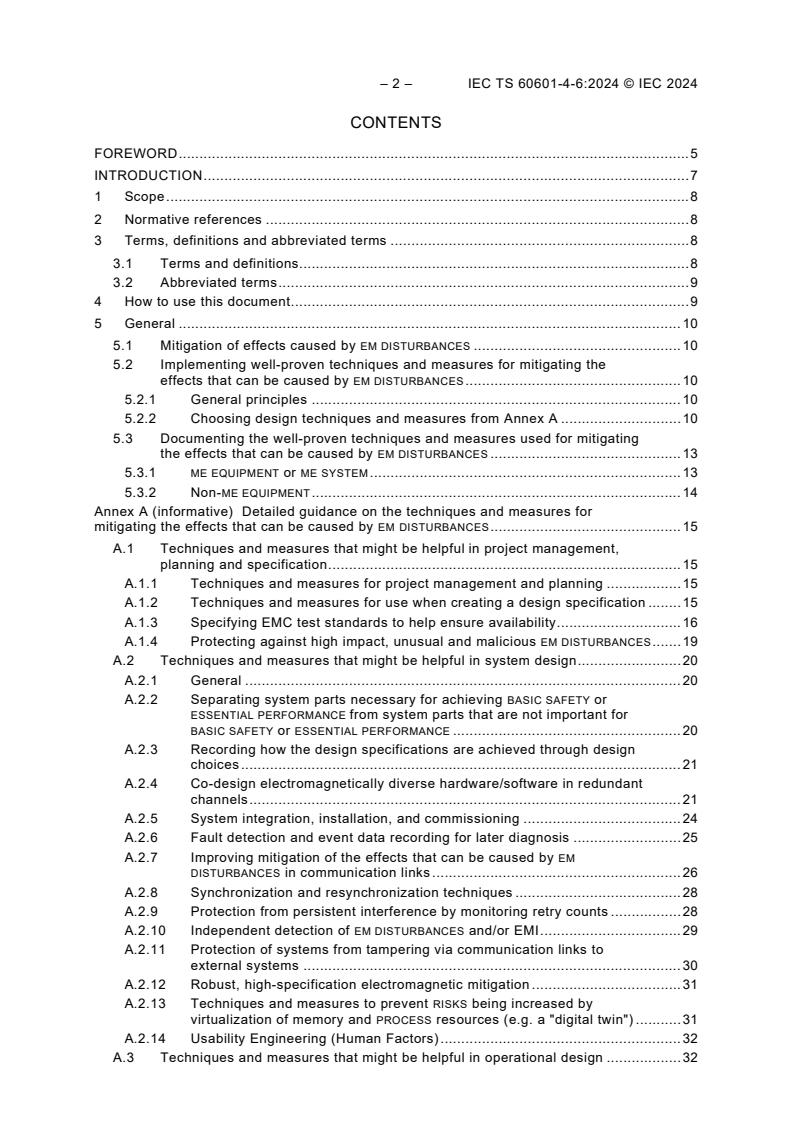
– 2 – IEC TS 60601-4-6:2024 © IEC 2024
CONTENTS
FOREWORD . 5
INTRODUCTION . 7
1 Scope . 8
2 Normative references . 8
3 Terms, definitions and abbreviated terms . 8
3.1 Terms and definitions. 8
3.2 Abbreviated terms . 9
4 How to use this document . 9
5 General . 10
5.1 Mitigation of effects caused by EM DISTURBANCES . 10
5.2 Implementing well-proven techniques and measures for mitigating the
effects that can be caused by EM DISTURBANCES . 10
5.2.1 General principles . 10
5.2.2 Choosing design techniques and measures from Annex A . 10
5.3 Documenting the well-proven techniques and measures used for mitigating
the effects that can be caused by EM DISTURBANCES . 13
5.3.1 ME EQUIPMENT or ME SYSTEM . 13
5.3.2 Non-ME EQUIPMENT . 14
Annex A (informative) Detailed guidance on the techniques and measures for
mitigating the effects that can be caused by EM DISTURBANCES . 15
A.1 Techniques and measures that might be helpful in project management,
planning and specification . 15
A.1.1 Techniques and measures for project management and planning . 15
A.1.2 Techniques and measures for use when creating a design specification . 15
A.1.3 Specifying EMC test standards to help ensure availability . 16
A.1.4 Protecting against high impact, unusual and malicious EM DISTURBANCES . 19
A.2 Techniques and measures that might be helpful in system design . 20
A.2.1 General . 20
A.2.2 Separating system parts necessary for achieving BASIC SAFETY or
ESSENTIAL PERFORMANCE from system parts that are not important for
BASIC SAFETY or ESSENTIAL PERFORMANCE . 20
A.2.3 Recording how the design specifications are achieved through design
choices . 21
A.2.4 Co-design electromagnetically diverse hardware/software in redundant
channels . 21
A.2.5 System integration, installation, and commissioning . 24
A.2.6 Fault detection and event data recording for later diagnosis . 25
A.2.7 Improving mitigation of the effects that can be caused by EM
DISTURBANCES in communication links . 26
A.2.8 Synchronization and resynchronization techniques . 28
A.2.9 Protection from persistent interference by monitoring retry counts . 28
A.2.10 Independent detection of EM DISTURBANCES and/or EMI . 29
A.2.11 Protection of systems from tampering via communication links to
external systems . 30
A.2.12 Robust, high-specification electromagnetic mitigation . 31
A.2.13 Techniques and measures to prevent RISKS being increased by
virtualization of memory and PROCESS resources (e.g. a "digital twin") . 31
A.2.14 Usability Engineering (Human Factors) . 32
A.3 Techniques and measures that might be helpful in operational design . 32
A.3.1 General . 32
A.3.2 Developing appropriate operation and maintenance instructions . 33
A.3.3 Designing appropriate maintenance techniques . 33
A.3.4 Limiting the possibilities for operation and hence mis-operation . 34
A.3.5 Protecting against operation errors . 34
A.3.6 Protecting against hardware or software modifications or manipulations . 35
A.3.7 Defensive programming techniques . 35
A.3.8 Limited use of interrupts . 38
A.3.9 Limited use of memory address pointer variables . 39
A.3.10 Avoiding recursion . 39
A.3.11 Error detection and correction for invariable memory . 40
A.3.12 Error detection and correction techniques in redundant designs . 41
A.3.13 Time-based error detection/correction in buses and interfaces . 42
A.3.14 Error detection and correction for variable memory . 43
A.3.15 Error detecting/correcting coding for ROM, RAM, buses, and interfaces . 45
A.3.16 Error detection and correction for logic and data processing . 45
A.3.17 Error detection and correction for electrical and electromechanical
components . 47
A.3.18 Caution when using hardware or software libraries . 48
A.3.19 Error detection and correction for electronic components . 48
A.3.20 Error detection/correction by monitoring program sequence (i.e.
watchdogs) . 51
A.3.21 Error detection and correction using multi-channel input/output
interfaces . 53
A.3.22 Using test patterns: static and dynamic. 53
A.3.23 Using fiber-optic cables for signals and data communications . 54
A.3.24 Techniques and measures for AC and DC power supplies/power
converters . 54
A.3.25 Monitoring of ventilation, cooling, and heating . 56
A.3.26 Careful use of wireless (radio) data communications . 57
A.3.27 Good electromagnetic engineering at every level of design . 58
A.3.28 Design to comply with EMC test specifications as set out in A.1.3 and
A.1.4 . 58
A.3.29 De-rating of hardware components, where appropriate . 59
A.3.30 Improve robustness of interrupts. 59
A.4 Techniques and measures that might be helpful in implementation,
integration, installation, and commissioning . 60
A.4.1 Providing information on constraints and additional measures . 60
A.4.2 Procuring materials, components, and products . 61
A.4.3 Assemble/integrate according to the design for adequate mitigation of
the effects that can be caused by EM DISTURBANCES . 62
A.4.4 Install/commission according to the design for achieving adequate
mitigation of the effects that can be caused by EM DISTURBANCES . 62
A.5 Techniques and measures that might be helpful in VERIFICATION and
validation (including testing) . 62
A.5.1 Applying VERIFICATION and/or validation techniques and measures . 62
A.5.2 VERIFICATION testing to the EMC test plan from A.1.3 and A.1.4 . 64
A.5.3 Using non-standardized ad hoc checks or tests . 65
A.5.4 Verifying correct installation and commissioning . 66
A.5.5 EMC tests before and after accelerated life tests . 67
– 4 – IEC TS 60601-4-6:2024 © IEC 2024
A.6 Techniques and measures that might be helpful in operation, maintenance,
repair, overhaul, refurbishment, and upgrade . 67
A.6.1 Assessment of changes in the ELECTROMAGNETIC ENVIRONMENT . 67
A.6.2 Assessment of continuing correct installation . 68
A.6.3 Maintaining adequate mitigation of the effects that can be caused by EM
, despite modifications or changes . 69
DISTURBANCES
A.6.4 Batch (lot) traceability . 70
A.6.5 Component changes, new supplier, dual / alternate source . 70
A.7 Techniques and measures that might be helpful in decommissioning . 71
A.8 Integrating third-party items into ME EQUIPMENT or ME SYSTEMS . 71
A.8.1 The general iterative approach . 71
A.8.2 Suppliers' certifications and electromagnetic assessments . 73
A.8.3 Custom-manufactured component parts . 73
Annex B (informative) Checklist of techniques and measures recommended for
helping to achieve adequate mitigation of the effects that can be caused by EM
DISTURBANCES . 75
Bibliography . 89
Index of defined terms . 126
Figure 1 – General principles for achieving mitigation of effects that can be caused by
EM DISTURBANCES . 13
Figure A.1 – Choosing standard volume-manufactured subsystems and component
parts . 73
Table B.1 – Checklist of techniques and measures recommended for adequate
mitigation of the effects that can be caused by EM DISTURBANCES throughout the
EXPECTED SERVICE LIFE . 76
INTERNATIONAL ELECTROTECHNICAL COMMISSION
____________
MEDICAL ELECTRICAL EQUIPMENT –
Part 4-6: Guidance and interpretation – Voluntary guidance to help
achieve basic safety and essential performance with regard to the
possible effects of electromagnetic disturbances
FOREWORD
1) The International Electrotechnical Commission (IEC) is a worldwide organization for standardization comprising
all national electrotechnical committees (IEC National Committees). The object of IEC is to promote international
co-operation on all questions concerning standardization in the electrical and electronic fields. To this end and
in addition to other activities, IEC publishes International Standards, Technical Specifications, Technical Reports,
Publicly Available Specifications (PAS) and Guides (hereafter referred to as "IEC Publication(s)"). Their
preparation is entrusted to technical committees; any IEC National Committee interested in the subject dealt with
may participate in this preparatory work. International, governmental and non-governmental organizations liaising
with the IEC also participate in this preparation. IEC collaborates closely with the International Organization for
Standardization (ISO) in accordance with conditions determined by agreement between the two organizations.
2) The formal decisions or agreements of IEC on technical matters express, as nearly as possible, an international
consensus of opinion on the relevant subjects since each technical committee has representation from all
interested IEC National Committees.
3) IEC Publications have the form of recommendations for international use and are accepted by IEC National
Committees in that sense. While all reasonable efforts are made to ensure that the technical content of IEC
Publications is accurate, IEC cannot be held responsible for the way in which they are used or for any
misinterpretation by any end user.
4) In order to promote international uniformity, IEC National Committees undertake to apply IEC Publications
transparently to the maximum extent possible in their national and regional publications. Any divergence between
any IEC Publication and the corresponding national or regional publication shall be clearly indicated in the latter.
5) IEC itself does not provide any attestation of conformity. Independent certification bodies provide conformity
assessment services and, in some areas, access to IEC marks of conformity. IEC is not responsible for any
services carried out by independent certification bodies.
6) All users should ensure that they have the latest edition of this publication.
7) No liability shall attach to IEC or its directors, employees, servants or agents including individual experts and
members of its technical committees and IEC National Committees for any personal injury, property damage or
other damage of any nature whatsoever, whether direct or indirect, or for costs (including legal fees) and
expenses arising out of the publication, use of, or reliance upon, this IEC Publication or any other IEC
Publications.
8) Attention is drawn to the Normative references cited in this publication. Use of the referenced publications is
indispensable for the correct application of this publication.
9) IEC draws attention to the possibility that the implementation of this document may involve the use of (a)
patent(s). IEC takes no position concerning the evidence, validity or applicability of any claimed patent rights in
respect thereof. As of the date of publication of this document, IEC had not received notice of (a) patent(s), which
may be required to implement this document. However, implementers are cautioned that this may not represent
the latest information, which may be obtained from the patent database available at https://patents.iec.ch. IEC
shall not be held responsible for identifying any or all such patent rights.
IEC TS 60601-4-6 has been prepared by subcommittee 62A: Common aspects of medical
equipment, software, and systems, of IEC technical committee 62: Medical equipment,
software, and systems. It is a Technical Specification.
The text of this Technical Specification is based on the following documents:
Draft Report on voting
62A/1538/DTS 62A/1589/RVDTS
Full information on the voting for its approval can be found in the report on voting indicated in
the above table.
– 6 – IEC TS 60601-4-6:2024 © IEC 2024
The language used for the development of this Technical Specification is English.
This document was drafted in accordance with ISO/IEC Directives, Part 2, and developed in
accordance with ISO/IEC Directives, Part 1 and ISO/IEC Directives, IEC Supplement, available
at www.iec.ch/members_experts/refdocs. The main document types developed by IEC are
described in greater detail at www.iec.ch/publications.
In this document, the following print types are used:
– recommendations and definitions: roman type.
– test instructions: italic type.
– informative material appearing outside of tables, such as notes, examples and references: in smaller type.
Normative text of tables is also in a smaller type.
– TERMS DEFINED IN CLAUSE 3 OF THIS TECHNICAL SPECIFICATION OR AS NOTED: SMALL CAPITALS.
In referring to the structure of this document, the term
– "clause" means one of the numbered divisions within the table of contents, inclusive of all
subdivisions (e.g. Clause 1 includes 1.1, 1.2, etc.);
– "subclause" means a numbered subdivision of a clause (e.g. 1.1, 1.2 and 1.3.1 are all
subclauses of Clause 1).
References to clauses within this document are preceded by the term "Clause" followed by the
clause number. References to subclauses within this document are by number only.
In this document, the conjunctive "or" is used as an "inclusive or" so a statement is true if any
combination of the conditions is true.
The verbal forms used in this document conform to usage described in Clause 7 of the ISO/IEC
Directives, Part 2. For the purposes of this document, the auxiliary verb:
– "shall" means that compliance with a requirement or a test is mandatory for compliance with
this document;
– "should" means that compliance with a requirement or a test is recommended but is not
mandatory for compliance with this document.
A list of all parts of the IEC 60601 series, published under the general title Medical electrical
equipment, can be found on the IEC website.
The committee has decided that the contents of this document will remain unchanged until the
stability date indicated on the IEC website under webstore.iec.ch in the data related to the
specific document. At this date, the document will be
• reconfirmed,
• withdrawn, or
• revised.
IMPORTANT – The "colour inside" logo on the cover page of this document indicates
that it contains colours which are considered to be useful for the correct understanding
of its contents. Users should therefore print this document using a colour printer.
INTRODUCTION
In 2017 it was decided to remove Annex F of IEC 60601-1-2:2014 [1] into a separate document
and provide guidance to help achieve basic safety and essential performance with regard to the
possible effects of ELECTROMAGNETIC DISTURBANCE by a technical specification under the
IEC 60601 series of standards.
This IEC document provides voluntary guidance on the assessment and application of
techniques and measures that can help reduce the risks associated with the interfering effects
of ELECTROMAGNETIC DISTURBANCES on medical equipment and medical systems.
___________
Numbers in square brackets refer to the Bibliography.
– 8 – IEC TS 60601-4-6:2024 © IEC 2024
MEDICAL ELECTRICAL EQUIPMENT –
Part 4-6: Guidance and interpretation – Voluntary guidance to help
achieve basic safety and essential performance with regard to the
possible effects of electromagnetic disturbances
1 Scope
This document provides practical methods to help achieve BASIC SAFETY and ESSENTIAL
PERFORMANCE with regard to the possible effects of EM DISTURBANCES throughout the EXPECTED
SERVICE LIFE of ME EQUIPMENT or an ME SYSTEM.
These practical methods attempt to address all of the different types of errors, malfunctions or
failures that can be caused by EM DISTURBANCES in ME EQUIPMENT or ME SYSTEMS.
The purpose of this document is to provide recommendations for the techniques and measures
used in the design, VERIFICATION, and validation of systems, hardware, software, and firmware
used in ME EQUIPMENT or ME SYSTEMS to help achieve BASIC SAFETY and ESSENTIAL PERFORMANCE
with regard to the EM DISTURBANCES that could occur throughout the EXPECTED SERVICE LIFE.
2 Normative references
The following documents are referred to in the text in such a way that some or all of their content
constitutes requirements of this document. For dated references, only the edition cited applies.
For undated references, the latest edition of the referenced document (including any
amendments) applies.
IEC 60601-1, Medical electrical equipment – Part 1: General requirements for basic safety and
essential performance
3 Terms, definitions and abbreviated terms
3.1 Terms and definitions
For the purposes of this document, the terms and definitions given in IEC 60601-1 and the
following apply.
ISO and IEC maintain terminology databases for use in standardization at the following
addresses:
• IEC Electropedia: available at https://www.electropedia.org/
• ISO Online browsing platform: available at https://www.iso.org/obp
3.1.1
COMPETENCE
training, technical knowledge, experience, and qualifications relevant to the specific duties to
be performed
3.2 Abbreviated terms
AC alternating current
ANSI American National Standards Institute
CE Conformité European (European Conformity)
CISPR Comité Internationale Speciale des Perturbations Radioélectriques
(International Special Committee on Radio Interference)
DC direct current
EDR event data recorder
EMI electromagnetic interference
EMP electromagnetic pulse
ESD ELECTROSTATIC DISCHARGE
HEMP high-altitude electromagnetic pulse
I/O input/output
IEC International Electrotechnical Commission
IEMI intentional electromagnetic interference
ISM industrial, scientific, and medical
ISO International Organization for Standardization
JTAG Joint Test Action Group
NEMP nuclear electromagnetic pulse
PCB printed circuit board
PDS pre-defined state
RF radio frequency
4 How to use this document
This document makes it possible to create a structured justification to demonstrate adequate
mitigation of the effects that can be caused by EM DISTURBANCES for each of the BASIC SAFETY
or ESSENTIAL PERFORMANCE issues associated with ME EQUIPMENT or an ME SYSTEM.
Clause 4 describes the use of this document in detail. It is recommended to create a structured
justification for each of the BASIC SAFETY or ESSENTIAL PERFORMANCE issues, by completing the
cells in the right-hand-most column of the example checklist in Table B.1, plus providing all the
documents referenced in those cells.
In general, it is expected that most ME EQUIPMENT or ME SYSTEMS could have several BASIC
SAFETY or ESSENTIAL PERFORMANCE issues, each one of which is recommended to be associated
with its own, completed, Table B.1 checklist.
BASIC SAFETY or ESSENTIAL PERFORMANCE
In some circumstances two or more different issues for
might be able to be addressed by a single Table B.1 checklist.
Note that IEC 60601-1, along with ISO 14971 and ISO TR 24971, provides a well-proven
PROCESS for assessing RISKS and by how much they need reduction to be acceptable RISKS,
and prescribes well-proven techniques and measures for reducing each of those RISKS.
This document relies on a HAZARD analysis and RISK ASSESSMENT PROCESS as specified in
IEC 60601-1 and ISO 14971 having been completed. This document assumes the correct
application of the requirements of IEC 60601-1-2:2014 and IEC 60601-1-2:2014/AMD1:2020,
and of the requirements in any relevant "particular" standards in the ISO/IEC 60601-2-XX and
IEC 80601-2-XX series. This document provides a list of possible techniques and measures
that can be used to mitigate the effects that can be caused by EM DISTURBANCES.
– 10 – IEC TS 60601-4-6:2024 © IEC 2024
5 General
5.1 Mitigation of effects caused by EM DISTURBANCES
There are many well-proven techniques and measures for mitigating the effects that can be
caused by EM DISTURBANCES, including in:
a) project management, planning and specification;
b) system design (both hardware and software);
c) operational design (both hardware and software);
d) implementation, integration, installation and commissioning;
e) VERIFICATION and validation of both hardware and software;
f) operation, maintenance, repair, refurbishment and upgrade, and
g) decommissioning.
5.2 Implementing well-proven techniques and measures for mitigating the effects that
can be caused by EM DISTURBANCES
5.2.1 General principles
Appropriate techniques and measures for mitigating the effects that can be caused by
EM DISTURBANCES are recommended to be identified and applied as necessary throughout the
EXPECTED SERVICE LIFE.
The aim of this subclause is to give an informative overview of a range of techniques and
measures available for mitigating the effects that can be caused by EM DISTURBANCES. For more
detailed information on these techniques and measures, see Annex A.
Figure 1 shows the general principles of this approach.
It will often be the case that some of the techniques and measures listed in Annex A will have
already been used by the MANUFACTURER in a given type of ME EQUIPMENT or ME SYSTEM to
control RISKS caused by errors, malfunctions and failures that are not directly associated with
EM DISTURBANCES. In this case, it is recommended to modify these techniques and measures to
help achieve adequate mitigation of the effects that can be caused by EM DISTURBANCES, as
described in their entries in Annex A.
However, even where this is done, it is recommended that as appropriate, additional techniques
and measures specified in Annex A are used to achieve sufficient mitigation of the effects that
can be caused by EM DISTURBANCES, to help achieve the MANUFACTURER's aims for the BASIC
SAFETY and ESSENTIAL PERFORMANCE of the ME EQUIPMENT or ME SYSTEM throughout the
EXPECTED SERVICE LIFE.
This is especially so because it is in the nature of EM DISTURBANCES to create a wide range of
possible errors, malfunctions, or failures in several locations all at once or in some critical time
sequence (see A.1.2).
5.2.2 Choosing design techniques and measures from Annex A
It is recommended to follow the techniques and measures with the following considerations:
a) It has been generally found to be impractical to perform anything more than a general
assessment of the EM DISTURBANCES that could possibly occur throughout the EXPECTED
SERVICE LIFE. A MANUFACTURER's specification for the maximum ELECTROMAGNETIC
ENVIRONMENT of their equipment is generally composed of assessments of EM
DISTURBANCES and levels.
b) These assessments are good enough for determining which of the many published EMC
EMISSIONS and IMMUNITY standards to apply for the achievement of functionality with
adequate uptime, but cannot determine what EM DISTURBANCES, and combinations of
them, could foreseeably occur during the EXPECTED SERVICE LIFE.
c) It is necessary to maintain adequate mitigation of the effects that can be caused by EM
DISTURBANCES in the operational environment despite all foreseeable faults, misuse,
ageing, component tolerances, assembly errors, physical and climatic conditions, etc.,
that could occur throughout the EXPECTED SERVICE LIFE.
It is recommended that the MANUFACTURER selects an adequate combination of techniques and
measures that, together, help achieve adequate mitigation of the effects that can be caused by
EM DISTURBANCES. It is recommended that their selection is documented with the reasons for
the selections made and for rejecting those that are not used. These decisions are usually
documented in the RISK MANAGEMENT FILE.
Table B.1 provides a basic checklist that can be be applied for this purpose. It identifies a
number of techniques and measures that can be used at appropriate stages of the EXPECTED
SERVICE LIFE. However, Table B.1 is not necessarily exhaustive and it is applicable to use
additional techniques and measures to give adequate assurance that the effects that can be
EM DISTURBANCES will not cause failure to achieve BASIC SAFETY and ESSENTIAL
caused by
PERFORMANCE of the ME EQUIPMENT or ME SYSTEM throughout the EXPECTED SERVICE LIFE.
No techniques and measures with regard to EM DISTURBANCES, such as those described in this
document, can be assumed to guarantee complete protection against every possible type of
EM DISTURBANCE, combination of EM DISTURBANCES, fault or misuse that could result in EMI.
The exact combination of techniques and measures that a MANUFACTURER might select for a
ME EQUIPMENT or ME SYSTEM depends on many factors specific to the medical
particular
application in question. Except where stated otherwise, the techniques and measures specified
in Annex A are appropriate for both "continuous" and "on-demand" functions.
Depending on the nature of the project, different techniques and measures might be used in its
various stages, for example:
a) if a project does not involve any software design, then no software design techniques and
measures would be selected for any of the project's stages; likewise,
b) if there is no circuit design, then circuit design techniques and measures would not be
needed.
c) If ME EQUIPMENT or an ME SYSTEM does not need to maintain its functionality or be safe after
a nuclear explosion that created EMP (such as HEMP or NEMP), then the techniques and
measures described in this document that are intended to provide protection against EMP,
HEMP or NEMP, need not be applied.
Knowledge of the extent to which robust conventional ELECTROMAGNETIC COMPATIBILITY (EMC)
management techniques (such as high-specification electromagnetic mitigation including
shielding, filtering, and transient suppression) are able to prevent EM DISTURBANCES from
affecting the BASIC SAFETY and ESSENTIAL PERFORMANCE during the EXPECTED SERVICE LIFE can
be used during the selection and application of the techniques and measures, where this is
justified.
– 12 – IEC TS 60601-4-6:2024 © IEC 2024
Each technique or measure described in this document is described in more detail in Annex A,
based on its relevance to the stage of the project, under the headings: Aim; Description;
Identification; Mitigation, and Effectiveness.
Aim The overall purpose of the technique or measure.
Description Broadly how the technique or measure achieves its aim.
Identification The effectiveness of the technique or measure in revealing the presence
of an error or malfunction that could be caused by EM DISTURBANCES
Mitigation The behaviour of the system function in response to the detected errors or
malfunctions that could have been caused by EM DISTURBANCES.
"Effectiveness" specifies the value of each technique or measure for mitigating the effects that
can be caused by EM DISTURBANCES, using the attributes:
Not Effective (NE);
Effective (E);
Highly Effective (HE).
In this document, the "effectiveness" of a technique or measure listed in Table B.1 as NE, E, or
RISK level resulting from the application of the PROCESS
HE (see above) is graded by the
described in Annex C of ISO TR 24971:2020 [3] by the MANUFACTURER of the ME EQUIPMENT or
ME SYSTEM.
Three RISK levels are used in this document, taken from C.4 of ISO TR 24971:2020 [3]:
1 = Insignificant or negligible risk
2 = Investigate further RISK reduction
3 = Unacceptable risk
It is recommended that if a technique or measure rated as HE for the relevant ME EQUIPMENT or
ME SYSTEM is not used, a detailed technical explanation of why it was not used is documented.
For example, the technique or measure might not actually be relevant for the design being
implemented, or it might be that an alternative technique or measure is used instead that
provides the same benefits regarding mitigation of the effects of EM DISTURBANCES for the design
issue concerned.
Where a technique or measure applies to a technology that is not relevant to the ME EQUIPMENT
or ME SYSTEM concerned, and the effectiveness is shown in Table B.1 as being HE, it is
recommended that a justification for why that technique or measure was not applied is
documented.
The "effectiveness" levels (E, HE) listed in Table B.1 are generic starting points, and it is
recommended that the MANUFACTURER makes an informed application consistent with
expectations of the medical application.
It is important to understand that ME EQUIPMENT and ME SYSTEMS cannot be said to achieve BASIC
SAFETY and ESSENTIAL PERFORMANCE with regard to EM DISTURBANCES simply on the basis of the
system parts from which they are composed.
Other techniques and measures not listed in Table B.1 might also be able to assist in
demonstrating that the effects that can be caused by EM DISTURBANCES, have been sufficiently
mitigated to achieve BASIC SAFETY and ESSENTIAL PERFORMANCE throughout the EXPECTED
SERVICE LIFE, and space has been allowed in that table for them to be written in.
Figure 1 – General principles for achieving mitigation of effects
that can be caused by EM DISTURBANCES
Table B.1 summarizes the techniques and measures recommended for helping to achieve
sufficient mitigation of the effects that can be caused by EM DISTURBANCES throughout the
EXPECTED SERVICE LIFE. It also provides a useful checklist that is recommended for use in
demonstrating the application of the guidance in this document.
See Annex A for detailed information on the techniques and measures summarized in
Table B.1.
5.3 Documenting the well-proven techniques and measures used for mitigating the
effects that can be caused by EM DISTURBANCES
ME EQUIPMENT or ME SYSTEM
5.3.1
It is recommended that the safety documentation of ME EQUIPMENT or an ME SYSTEM includes all
BASIC SAFETY and ESSENTIAL PERFORMANCE
of the evidence that helps ensure that it maintains
over the EXPECTED SERVICE LIFE.
Prior to the ME EQUIPMENT or ME SYSTEM being put into use, it is recommended that a structured
justification is included in the safety documentation demonstrating that reasonable assurance
of BASIC SAFETY and ESSENTIAL PERFORMANCE with regard to EM DISTURBANCES has been
achieved. This justification could be assessed as part of RISK ASSESSMENT activities;
alternatively, other appropriate structured assessment approaches could be used.
This structured justification could help to assess the extent of compliance with the applicable
safety standards and the adequacy of the range of activities, techniques and measures that
have been used to achieve BASIC SAFETY and ESSENTIAL PERFORMANCE about EM DISTURBANCES,
including VERIFICATION and validation activities.
It is recommended that supporting information is made available for this justification. This
ELECTROMAGNETIC ENVIRONMENT specifications, EMC test results and
usually includes
certifications, and material demonstrating the range and suitability of the techniques and
measures used to help assure BASIC SAFETY and ESSENTIAL PERFORMANCE with regard to EM
DISTURBANCES.
– 14 – IEC TS 60601-4-6:2024 © IEC 2024
It is also recommended that information used to support claims made as to the BASIC SAFETY
and ESSENTIAL PERFORMANCE with regard to EM DISTURBANCES of ME EQUIPMENT or an ME SYSTEM
is made available to system integrators and end users and retained in order to support system
review activities throughout the EXPECTED SERVICE LIFE of the ME EQUIPMENT or ME SYSTEM.
Independent assessment of the justification that BASIC SAFETY and ESSENTIAL PERFORMANCE
EM DISTURBANCES can be undertaken where considered
have been achieved with regard to
appropriate.
It is recommended to demonstrate that the guidance in this document has been followed by
adding text and hyperlinked references to relevant design, VERIFICATION, or validation
documents, into the cells in the right-hand-most columns of the example checklist of Table B.1.
As discussed in 5.2.2, if a technique or measure in the checklist in Table B.1 is categorized as
ESSENTIAL PERFORMANCE in question but has not been applied, then it is
HE for the
recommended that the right-hand-most column in Table B.1 states (or provides a link to a
document that states) the reasons why not, and what was done instead.
5.3.2 Non-ME EQUIPMENT
In the case of a non-ME EQUIPMENT used in an ME SYSTEM, it is recommended that information
is obtained or developed to determine the potential impact on the BASIC SAFETY and ESSENTIAL
PERFORMANCE of the ME SYSTEM, and this information made available to system integrators and
end users.
It is recommended that such information includes the environmental specifications with which
the non-ME EQUIPMENT complies, the techniques and measures that have been applied in the
design of the non-ME EQUIPMENT to mitigate the effects that can be caused by EM DISTURBANCES,
and guidance on installation and maintenance.
It is also recommended that such information also includes details of the non-ME EQUIPMENT'S
behavior, where appropriate, in the case of degradation; for example, "pre-defined operational
states" (PDSs) that the equipment can assume in response to errors or failures due to
intolerable EM DISTURBANCES, as well as guidance on the application of the non-ME EQUIPMENT.
It is recommended that information used to support a non-ME EQUIPMENT claims with regard to
EM DISTURBANCES is made available to system integrators and end users, and the
MANUFACTURER recommends that they retain it in order to support review activities throughout
the EXPECTED SERVICE LIFE of the ME SYSTEM. Such information might use one or more copies of
the checklist in Annex B, broadly as discussed in 5.3.1, to help to provide a structured
justification demonstrating that reasonable assurance of BASIC SAFETY and ESSENTIAL
PERFORMANCE have been achieved with regard to EM DISTURBANCES.
Annex A
(informative)
Detailed guidance on the techniques and measures for mitigating the
effects that can be caused by EM DISTURBANCES
A.1 Techniques and measures that might be helpful in project management,
planning and specification
A.1.1 Techniques and measures for project management and planning
Aim: To help avoid failures in the management, planning, selection, design, implementation,
commissioning, VERIFICATION, and maintenance of measures for avoiding and controlling
dangerous failures due to EM DISTURBANCES and EMI.
This applies to an ME SYSTEM, ME EQUIPMENT, and to the components thereof.
Description: It is recommended that the PROCESSES for the management, planning, selection,
design, implementation, commissioning, modification, VERIFICATION, and maintenance of each
function explicitly include measures for mitigating the effects that can be caused by EM
DISTURBANCES and be documented.
It is recommended that a competent person has overall responsibility for managing the
mitigation of the effects that can be caused by EM DISTURBANCES on the ME EQUIPMENT or ME
SYSTEM. It is also recommended that appropriate COMPETENCE is made available throughout the
EXPECTED SERVICE LIFE.
Identification: By assessment of the design for conformance with this document.
Mitigation: By using the techniques and measures such as, for example, those described in
this document (or equivalen
...