

IEC 60679-1:2017
(Main)Piezoelectric, dielectric and electrostatic oscillators of assessed quality - Part 1: Generic specification
General Information
- Abstract
IEC 60679-1:2017 specifies general requirements for piezoelectric, dielectric and electrostatic oscillators, including Dielectric Resonator Oscillators (DRO) and oscillators using FBAR (hereinafter referred to as "Oscillator"), of assessed quality using either capability approval or qualification approval procedures.
NOTE Dielectric Resonator Oscillators (DRO) and oscillators using FBAR are under consideration.
This edition includes the following significant technical changes with respect to the previous edition:
a) the title has been changed;
b) additional matters related to oscillator using SAW or MEMS resonator in "Terms, definitions and general information" have been included;
c) measurement methods of IEC 60679-1:2007 have been removed (they will be moved to IEC 62884 series);
d) the content of Annex A has been extended;
e) a new term and definition DIXO (Digital interfaced Crystal Oscillator) has been added;
f) a new term and definition SSXO (Spread Spectrum Crystal Oscillator) has been added;
g) Annex D has been added.
- Status
- Published
- Publication Date
- 25-Jul-2017
- Technical Committee
- TC 49 - Piezoelectric, dielectric and electrostatic devices and associated materials for frequency control, selection and detection
- Drafting Committee
- WG 7 - TC 49/WG 7
- Current Stage
- PPUB - Publication issued
- Start Date
- 26-Jul-2017
- Completion Date
- 18-Aug-2017
Buy Documents
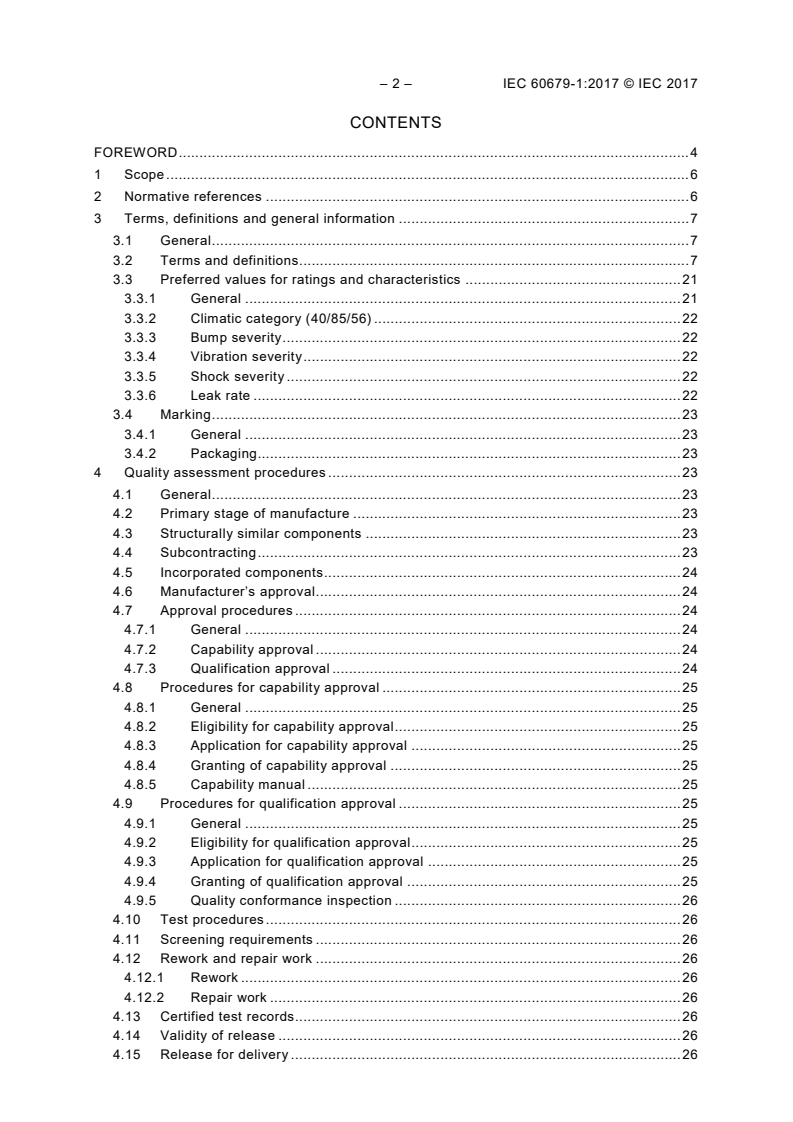
IEC 60679-1:2017 - Piezoelectric, dielectric and electrostatic oscillators of assessed quality - Part 1: Generic specification Released:7/26/2017
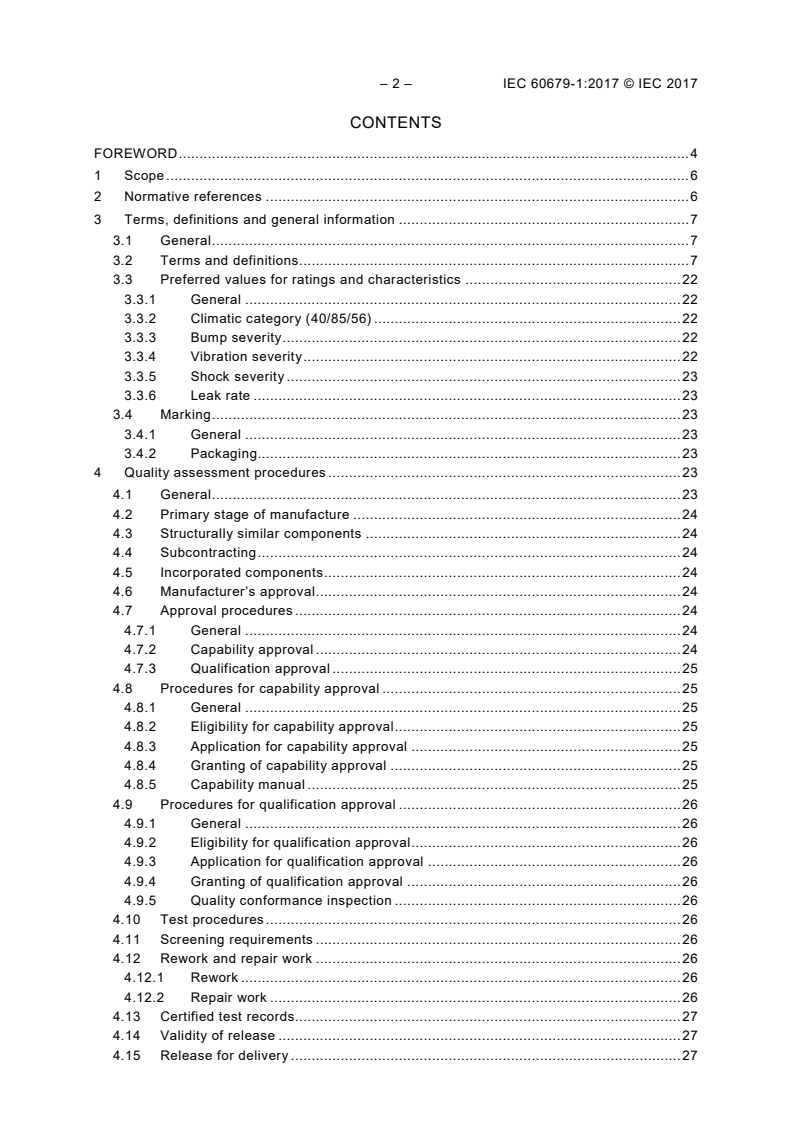
IEC 60679-1:2017 - Piezoelectric, dielectric and electrostatic oscillators of assessed quality - Part 1: Generic specification Released:7/24/2019
Overview
IEC 60679-1:2017 is an international standard developed by the International Electrotechnical Commission (IEC) that specifies general requirements for piezoelectric, dielectric, and electrostatic oscillators of assessed quality. This standard covers a wide variety of oscillators, including Dielectric Resonator Oscillators (DRO) and devices using Film Bulk Acoustic Resonator (FBAR) technology. The scope extends to approval procedures based on either capability or qualification, ensuring that these oscillators meet internationally recognized quality and performance benchmarks.
This fourth edition includes updated definitions and new terms covering emerging technologies, such as oscillators using Surface Acoustic Wave (SAW), Micro-Electro-Mechanical Systems (MEMS) resonators, Digital Interfaced Crystal Oscillators (DIXO), and Spread Spectrum Crystal Oscillators (SSXO). The measurement methods from the earlier edition have been removed and are now referenced in the IEC 62884 series.
Key Topics
IEC 60679-1:2017 addresses several critical aspects for oscillator devices:
- General Requirements: Lays out the essential quality, marking, and rating criteria for oscillators, including terminology, graphical symbols, and preferred unit values.
- Definitions and Classifications: Provides precise definitions for oscillator types (e.g., SPXO, VCXO, TCXO, OCXO, SAW, MEMS-based).
- Quality Assessment Procedures: Outlines detailed processes for both capability and qualification approval, specifying documentation, test procedures, and inspection routines.
- Marking and Packaging: Requirements for physical marking and the correct packaging of oscillator devices to maintain quality during handling and transport.
- Performance Attributes: Addresses parameters such as frequency stability, frequency tolerance, operating and storage temperature ranges, and frequency adjustment range.
- Special Oscillator Types: Introduction and standardization of digital interfaced (DIXO) and spread spectrum (SSXO) crystal oscillators, improving compatibility with modern digital systems.
- Annexes: Provide normative details on load circuits for various logic families, electrostatic discharge sensitivity, latch-up testing, and digital oscillator functionality.
Applications
Oscillators conforming to IEC 60679-1:2017 are vital components across the electronics industry. Their applications include, but are not limited to:
- Telecommunications: Timing and frequency references in wireless and wired telecom networks.
- Consumer Electronics: Stable clock sources in smartphones, computers, and IoT devices.
- Industrial Automation: Synchronized operations in automation controllers and measurement systems.
- Aerospace and Defense: Rugged oscillators needed for harsh environments and high-reliability systems.
- Automotive Electronics: Sensor and controller timing for advanced driver-assistance systems (ADAS) and infotainment systems.
By following this standard, manufacturers and system integrators can ensure consistent oscillator performance, facilitating global interoperability and compliance with other electronic device standards.
Related Standards
For comprehensive quality assessment and measurement of oscillator characteristics, the following related IEC and ISO standards are often referenced together with IEC 60679-1:
- IEC 60027: Letter symbols to be used in electrical technology.
- IEC 60050-561: Electrotechnical vocabulary for piezoelectric, dielectric, and electrostatic devices.
- IEC 60469: Definitions and algorithms for transitions, pulses, and related waveforms.
- IEC 60617: Graphical symbols for diagrams.
- IEC 62884-1: Measurement techniques of piezoelectric, dielectric, and electrostatic oscillators.
- IEC 60749-26 / -27: ESD sensitivity testing methods.
- IEC 61340-5-1: Protection of electronic devices from electrostatic phenomena.
- ISO 80000-1: Quantities and units - General.
Ensuring that oscillators meet both IEC 60679-1 and its related standards gives stakeholders high confidence in product quality, reliability, and compatibility within rapidly evolving electronic and telecommunications markets.
Relations
- Effective Date
- 05-Sep-2023
Buy Documents
IEC 60679-1:2017 - Piezoelectric, dielectric and electrostatic oscillators of assessed quality - Part 1: Generic specification Released:7/26/2017
IEC 60679-1:2017 - Piezoelectric, dielectric and electrostatic oscillators of assessed quality - Part 1: Generic specification Released:7/24/2019
Frequently Asked Questions
IEC 60679-1:2017 is a standard published by the International Electrotechnical Commission (IEC). Its full title is "Piezoelectric, dielectric and electrostatic oscillators of assessed quality - Part 1: Generic specification". This standard covers: IEC 60679-1:2017 specifies general requirements for piezoelectric, dielectric and electrostatic oscillators, including Dielectric Resonator Oscillators (DRO) and oscillators using FBAR (hereinafter referred to as "Oscillator"), of assessed quality using either capability approval or qualification approval procedures. NOTE Dielectric Resonator Oscillators (DRO) and oscillators using FBAR are under consideration. This edition includes the following significant technical changes with respect to the previous edition: a) the title has been changed; b) additional matters related to oscillator using SAW or MEMS resonator in "Terms, definitions and general information" have been included; c) measurement methods of IEC 60679-1:2007 have been removed (they will be moved to IEC 62884 series); d) the content of Annex A has been extended; e) a new term and definition DIXO (Digital interfaced Crystal Oscillator) has been added; f) a new term and definition SSXO (Spread Spectrum Crystal Oscillator) has been added; g) Annex D has been added.
IEC 60679-1:2017 specifies general requirements for piezoelectric, dielectric and electrostatic oscillators, including Dielectric Resonator Oscillators (DRO) and oscillators using FBAR (hereinafter referred to as "Oscillator"), of assessed quality using either capability approval or qualification approval procedures. NOTE Dielectric Resonator Oscillators (DRO) and oscillators using FBAR are under consideration. This edition includes the following significant technical changes with respect to the previous edition: a) the title has been changed; b) additional matters related to oscillator using SAW or MEMS resonator in "Terms, definitions and general information" have been included; c) measurement methods of IEC 60679-1:2007 have been removed (they will be moved to IEC 62884 series); d) the content of Annex A has been extended; e) a new term and definition DIXO (Digital interfaced Crystal Oscillator) has been added; f) a new term and definition SSXO (Spread Spectrum Crystal Oscillator) has been added; g) Annex D has been added.
IEC 60679-1:2017 is classified under the following ICS (International Classification for Standards) categories: 31.140 - Piezoelectric devices. The ICS classification helps identify the subject area and facilitates finding related standards.
IEC 60679-1:2017 has the following relationships with other standards: It is inter standard links to IEC 60679-1:2007. Understanding these relationships helps ensure you are using the most current and applicable version of the standard.
IEC 60679-1:2017 is available in PDF format for immediate download after purchase. The document can be added to your cart and obtained through the secure checkout process. Digital delivery ensures instant access to the complete standard document.
Standards Content (Sample)
IEC 60679-1 ®
Edition 4.0 2017-07
INTERNATIONAL
STANDARD
Piezoelectric, dielectric and electrostatic oscillators of assessed quality –
Part 1: Generic specification
All rights reserved. Unless otherwise specified, no part of this publication may be reproduced or utilized in any form
or by any means, electronic or mechanical, including photocopying and microfilm, without permission in writing from
either IEC or IEC's member National Committee in the country of the requester. If you have any questions about IEC
copyright or have an enquiry about obtaining additional rights to this publication, please contact the address below or
your local IEC member National Committee for further information.
IEC Central Office Tel.: +41 22 919 02 11
3, rue de Varembé Fax: +41 22 919 03 00
CH-1211 Geneva 20 info@iec.ch
Switzerland www.iec.ch
About the IEC
The International Electrotechnical Commission (IEC) is the leading global organization that prepares and publishes
International Standards for all electrical, electronic and related technologies.
About IEC publications
The technical content of IEC publications is kept under constant review by the IEC. Please make sure that you have the
latest edition, a corrigenda or an amendment might have been published.
IEC Catalogue - webstore.iec.ch/catalogue Electropedia - www.electropedia.org
The stand-alone application for consulting the entire The world's leading online dictionary of electronic and
bibliographical information on IEC International Standards, electrical terms containing 20 000 terms and definitions in
Technical Specifications, Technical Reports and other English and French, with equivalent terms in 16 additional
documents. Available for PC, Mac OS, Android Tablets and languages. Also known as the International Electrotechnical
iPad. Vocabulary (IEV) online.
IEC publications search - www.iec.ch/searchpub IEC Glossary - std.iec.ch/glossary
The advanced search enables to find IEC publications by a 65 000 electrotechnical terminology entries in English and
variety of criteria (reference number, text, technical French extracted from the Terms and Definitions clause of
committee,…). It also gives information on projects, replaced IEC publications issued since 2002. Some entries have been
and withdrawn publications. collected from earlier publications of IEC TC 37, 77, 86 and
CISPR.
IEC Just Published - webstore.iec.ch/justpublished
Stay up to date on all new IEC publications. Just Published IEC Customer Service Centre - webstore.iec.ch/csc
details all new publications released. Available online and If you wish to give us your feedback on this publication or
also once a month by email. need further assistance, please contact the Customer Service
Centre: csc@iec.ch.
IEC 60679-1 ®
Edition 4.0 2017-07
INTERNATIONAL
STANDARD
Piezoelectric, dielectric and electrostatic oscillators of assessed quality –
Part 1: Generic specification
INTERNATIONAL
ELECTROTECHNICAL
COMMISSION
ICS 31.140 ISBN 978-2-8322-4608-5
– 2 – IEC 60679-1:2017 © IEC 2017
CONTENTS
FOREWORD . 4
1 Scope . 6
2 Normative references . 6
3 Terms, definitions and general information . 7
3.1 General . 7
3.2 Terms and definitions . 7
3.3 Preferred values for ratings and characteristics . 21
3.3.1 General . 21
3.3.2 Climatic category (40/85/56) . 22
3.3.3 Bump severity . 22
3.3.4 Vibration severity . 22
3.3.5 Shock severity . 22
3.3.6 Leak rate . 22
3.4 Marking . 23
3.4.1 General . 23
3.4.2 Packaging. 23
4 Quality assessment procedures . 23
4.1 General . 23
4.2 Primary stage of manufacture . 23
4.3 Structurally similar components . 23
4.4 Subcontracting . 23
4.5 Incorporated components . 24
4.6 Manufacturer’s approval . 24
4.7 Approval procedures . 24
4.7.1 General . 24
4.7.2 Capability approval . 24
4.7.3 Qualification approval . 24
4.8 Procedures for capability approval . 25
4.8.1 General . 25
4.8.2 Eligibility for capability approval . 25
4.8.3 Application for capability approval . 25
4.8.4 Granting of capability approval . 25
4.8.5 Capability manual . 25
4.9 Procedures for qualification approval . 25
4.9.1 General . 25
4.9.2 Eligibility for qualification approval . 25
4.9.3 Application for qualification approval . 25
4.9.4 Granting of qualification approval . 25
4.9.5 Quality conformance inspection . 26
4.10 Test procedures . 26
4.11 Screening requirements . 26
4.12 Rework and repair work . 26
4.12.1 Rework . 26
4.12.2 Repair work . 26
4.13 Certified test records. 26
4.14 Validity of release . 26
4.15 Release for delivery . 26
4.16 Unchecked parameters . 27
Annex A (normative) Load circuit for logic drive . 28
A.1 TTL and Schottky . 28
A.2 CMOS . 30
A.3 ECL . 30
A.4 LVDS . 31
Annex B (normative) Latch-up test . 32
B.1 Definition . 32
B.1.1 Latch-up . 32
B.1.2 Test procedure . 32
B.2 Test method . 32
Annex C (normative) Electrostatic discharge sensitivity classification . 33
C.1 Definition . 33
C.1.1 Electrostatic discharge (ESD) . 33
C.1.2 Test procedure . 33
C.2 Test methods . 33
C.2.1 General . 33
C.2.2 Leaded oscillator . 33
C.2.3 SMD oscillator . 33
C.2.4 The impact of ESD on Oscillator in steady-state . 33
Annex D (normative) Digital interfaced crystal oscillator’s function . 34
Bibliography . 35
Figure 1 – Basic configurations of SAW resonators . 9
Figure 2 – Example of the use of frequency offset. 11
Figure 3 – Linearity of frequency modulation deviation . 16
Figure 4 – Characteristics of an output waveform . 18
Figure 5 – Definition of start-up time . 19
Figure 6 – Clock signal with period jitter. 19
Figure 7 – Phase jitter measures . 20
Figure 8 – Gaussian distribution of jitter . 20
Figure 9 – Jitter amplitude and period of jitter frequency . 20
Figure 10 – Jitter tolerance according to ITU-T G.825, ATIS-0900101, Telcordia GR-
253 and ETSI EN 300 462 . 21
Figure A.1 – Circuit for TTL . 28
Figure A.2 – Circuit for Schottky logic . 29
Figure A.3 – Circuit for PECL . 30
Figure A.4 – Circuit for LVDS . 31
Table A.1 – Values to be used when calculating R and R . 30
1 2
Table A.2 – Operating condition . 31
Table A.3 – DC Electrical characteristics output load = 50 Ω to Vcc-2V . 31
Table D.1 – Function of the digital interface . 34
– 4 – IEC 60679-1:2017 © IEC 2017
INTERNATIONAL ELECTROTECHNICAL COMMISSION
____________
PIEZOELECTRIC, DIELECTRIC AND ELECTROSTATIC
OSCILLATORS OF ASSESSED QUALITY –
Part 1: Generic specification
FOREWORD
1) The International Electrotechnical Commission (IEC) is a worldwide organization for standardization comprising
all national electrotechnical committees (IEC National Committees). The object of IEC is to promote
international co-operation on all questions concerning standardization in the electrical and electronic fields. To
this end and in addition to other activities, IEC publishes International Standards, Technical Specifications,
Technical Reports, Publicly Available Specifications (PAS) and Guides (hereafter referred to as “IEC
Publication(s)”). Their preparation is entrusted to technical committees; any IEC National Committee interested
in the subject dealt with may participate in this preparatory work. International, governmental and non-
governmental organizations liaising with the IEC also participate in this preparation. IEC collaborates closely
with the International Organization for Standardization (ISO) in accordance with conditions determined by
agreement between the two organizations.
2) The formal decisions or agreements of IEC on technical matters express, as nearly as possible, an international
consensus of opinion on the relevant subjects since each technical committee has representation from all
interested IEC National Committees.
3) IEC Publications have the form of recommendations for international use and are accepted by IEC National
Committees in that sense. While all reasonable efforts are made to ensure that the technical content of IEC
Publications is accurate, IEC cannot be held responsible for the way in which they are used or for any
misinterpretation by any end user.
4) In order to promote international uniformity, IEC National Committees undertake to apply IEC Publications
transparently to the maximum extent possible in their national and regional publications. Any divergence
between any IEC Publication and the corresponding national or regional publication shall be clearly indicated in
the latter.
5) IEC itself does not provide any attestation of conformity. Independent certification bodies provide conformity
assessment services and, in some areas, access to IEC marks of conformity. IEC is not responsible for any
services carried out by independent certification bodies.
6) All users should ensure that they have the latest edition of this publication.
7) No liability shall attach to IEC or its directors, employees, servants or agents including individual experts and
members of its technical committees and IEC National Committees for any personal injury, property damage or
other damage of any nature whatsoever, whether direct or indirect, or for costs (including legal fees) and
expenses arising out of the publication, use of, or reliance upon, this IEC Publication or any other IEC
Publications.
8) Attention is drawn to the Normative references cited in this publication. Use of the referenced publications is
indispensable for the correct application of this publication.
9) Attention is drawn to the possibility that some of the elements of this IEC Publication may be the subject of
patent rights. IEC shall not be held responsible for identifying any or all such patent rights.
International Standard IEC 60679-1 has been prepared by IEC technical committee TC 49:
Piezoelectric, dielectric and electrostatic devices and associated materials for frequency
control, selection and detection.
This fourth edition cancels and replaces the third edition published in 2007. This edition
constitutes a technical revision.
This edition includes the following significant technical changes with respect to the previous
edition:
a) the title has been changed;
b) additional matters related to oscillator using SAW or MEMS resonator in "Terms,
definitions and general information" have been included;
c) measurement methods of IEC 60679-1:2007 have been removed (they will be moved to
IEC 62884 series);
d) the content of Annex A has been extended;
e) a new term and definition DIXO (Digital interfaced Crystal Oscillator) has been added;
f) a new term and definition SSXO (Spread Spectrum Crystal Oscillator) has been added;
g) Annex D has been added.
The text of this standard is based on the following documents:
FDIS Report on voting
49/1229/FDIS 49/1233/RVD
Full information on the voting for the approval of this International Standard can be found in
the report on voting indicated in the above table.
This document has been drafted in accordance with the ISO/IEC Directives, Part 2.
A list of all parts of the IEC 60679 series, published under the general title piezoelectric,
dielectric and electrostatic oscillators of assessed quality can be found on the IEC website.
Future standards in this series will carry the new general title as cited above. Titles of existing
standards in this series will be updated at the time of the next edition.
The committee has decided that the contents of this document will remain unchanged until the
stability date indicated on the IEC website under "http://webstore.iec.ch" in the data related to
the specific document. At this date, the document will be
• reconfirmed,
• withdrawn,
• replaced by a revised edition, or
• amended.
A bilingual version of this publication may be issued at a later date.
– 6 – IEC 60679-1:2017 © IEC 2017
PIEZOELECTRIC, DIELECTRIC AND ELECTROSTATIC
OSCILLATORS OF ASSESSED QUALITY –
Part 1: Generic specification
1 Scope
This part of IEC 60679 specifies general requirements for piezoelectric, dielectric and
electrostatic oscillators, including Dielectric Resonator Oscillators (DRO) and oscillators using
FBAR (hereinafter referred to as "Oscillator"), of assessed quality using either capability
approval or qualification approval procedures.
NOTE Dielectric Resonator Oscillators (DRO) and oscillators using FBAR are under consideration.
2 Normative references
The following documents are referred to in the text in such a way that some or all of their
content constitutes requirements of this document. For dated references, only the edition
cited applies. For undated references, the latest edition of the referenced document (including
any amendments) applies.
IEC 60027 (all parts), Letter symbols to be used in electrical technology
IEC 60050-561, International electrotecnical vocabulary – Part 561: Piezoelectric, dielectric
and electrostatic devices and associated materials for frequency control, selection and
detection. Available at www.electropedia.org
IEC 60469, Transitions, pulses and related waveforms – Terms, definitions and algorithms
IEC 60617, Graphical symbols for diagrams. Available at http://std.iec.ch/iec60617
IEC 60748-2, Semiconductor devices – Integrated circuits – Part 2: Digital integrated circuits
IEC 60749-26, Semiconductor devices – Mechanical and climatic test methods – Part 26:
Electrostatic discharge (ESD) sensitivity testing – Human body model (HBM)
IEC 60749-27, Semiconductor devices – Mechanical and climatic test methods – Part 27:
Electrostatic discharge (ESD) sensitivity testing – Machine model (MM)
IEC TR 61000-4-1, Electromagnetic compatibility (EMC) – Part 4-1: Testing and measurement
techniques – Overview of the IEC 61000-4 series
IEC 61340-5-1, Electrostatics – Part 5-1: Protection of electronic devices from electrostatic
phenomena – General requirements
IEC 62884-1:2017, Measurement techniques of piezoelectric, dielectric, and electrostatic
oscillators – Part 1: Basic methods for the measurement
ISO 80000-1, Quantities and units – Part 1: General
Where any discrepancies occur for any reason, documents shall rank in the following order of
precedence:
• detail specification;
• sectional specification;
• generic specification;
• any other international documents (for example of the IEC) to which reference is made.
The same order of precedence shall apply to equivalent national documents.
3 Terms, definitions and general information
3.1 General
Units, graphical symbols, letter symbols and terminology shall, wherever possible, be taken
from the following standards:
• IEC 60027;
• IEC 60050-561;
• IEC 60469;
• IEC 60617;
• ISO 80000-1.
3.2 Terms and definitions
For the purposes of this document, the following terms and definitions apply.
ISO and IEC maintain terminological databases for use in standardization at the following
addresses:
• IEC Electropedia: available at http://www.electropedia.org/
• ISO Online browsing platform: available at http://www.iso.org/obp
3.2.1
simple packaged crystal oscillator
SPXO
crystal controlled oscillator having no means of temperature control or compensation,
exhibiting a frequency/temperature characteristic determined substantially by the quartz
crystal resonator employed
[SOURCE: IEC 60050-561:2014, 561-03-30]
3.2.2
overtone crystal controlled oscillator
oscillator designed to operate with the controlling piezoelectric resonator functioning in a
specified mechanical overtone order of vibration
[SOURCE: IEC 60050-561:2014, 561-03-20, modified – The word "functioning" has been
added.]
3.2.3
crystal cut
orientation of the crystal element with respect to the crystallographic axes of the crystal
Note 1 to entry: It can be desirable to specify the cut (and hence the general form of the frequency/temperature
performance) of a crystal unit used in an oscillator application. The choice of the crystal cut will imply certain
attributes of the oscillator which may not otherwise appear in the detail specification.
[SOURCE: IEC 60050-561:2014, 561-03-04]
– 8 – IEC 60679-1:2017 © IEC 2017
3.2.4
voltage controlled crystal oscillator
VCXO
crystal controlled oscillator, the frequency of which can be deviated or modulated according to
a specific relation, through application of a control voltage
[SOURCE: IEC 60050-561:2014, 561-03-41]
3.2.5
temperature compensated crystal oscillator
TCXO
crystal controlled oscillator whose frequency deviation due to temperature is reduced by
means of a compensation system, incorporated in the device
[SOURCE: IEC 60050-561:2014, 561-03-36]
3.2.6
oven controlled crystal oscillator
OCXO
crystal controlled oscillator in which at least the piezoelectric resonator is temperature
controlled
Note 1 to entry: This mode of operation ensures that the oscillator frequency will remain sensibly constant over
the operating temperature range of the OCXO, therefore independent of the frequency/temperature characteristic
of the crystal unit.
[SOURCE: IEC 60050-561:2014, 561-03-19, modified – The note to entry has been added.]
3.2.7
surface acoustic wave
SAW
acoustic wave, propagating along the surface of an elastic substrate, the amplitude of which
decays exponentially with substrate depth
[SOURCE: IEC 60050-561:2014, 561-01-86]
3.2.8
SAWR
surface acoustic wave resonator
SAW resonator
resonator using multiple reflections of surface acoustic waves
[SOURCE: IEC 60050-561:2014, 561-01-87, modified – The term "SAW resonator" has been
added.]
3.2.9
one-port SAW resonator
SAW resonator having a pair of terminals
SEE: Figure 1a.
[SOURCE: IEC 60050-561:2014, 561-01-57, modified – The figure reference has been
changed.]
3.2.10
two-port SAW resonator
SAW resonator having input and output ports
SEE: Figure 1b
[SOURCE: IEC 60050-561:2014, 561-01-94, modified – The figure reference has been
changed.]
IEC
a) One-port resonator with opened array
IEC
b) Two-port resonator with shorted arrays
Figure 1 – Basic configurations of SAW resonators
3.2.11
SAW oscillator
oscillator that uses a SAW resonator as the main frequency controlling element
3.2.12
simple packaged SAW oscillator
SPSO
SAW oscillator having no means of temperature control or compensation, exhibiting a
frequency/temperature characteristic determined substantially by SAW resonator employed
[SOURCE: IEC 60050-561:2014, 561-03-30, modified – change from crystal oscillator to SAW
oscillator and from crystal resonator to SAW resonator.]
3.2.13
voltage controlled SAW oscillator
VCSO
SAW oscillator, the frequency of which can be deviated or modulated according to a specific
relation, through application of a control voltage
[SOURCE: IEC 60050-561:2014, 561-03-41, modified – change from crystal resonator to SAW
oscillator.]
– 10 – IEC 60679-1:2017 © IEC 2017
3.2.14
temperature compensated SAW oscillator
TCSO
SAW oscillator whose frequency deviation due to temperature is reduced by means of a
compensation system incorporated in the device
[SOURCE: IEC 60050-561:2014, 561-03-36, modified – change from crystal resonator to SAW
oscillator.]
3.2.15
electrostatic micro electro mechanical system oscillator
electrostatic MEMS oscillator
oscillator that uses a MEMS device as the main frequency controlling element
3.2.16
voltage controlled electrostatic MEMS oscillator
electrostatic MEMS oscillator, the frequency of which can be deviated or modulated according
to a specified relation, by application of a control voltage
[SOURCE: IEC 60050-561:2014, 561-03-41, modified – change from crystal to MEMS
oscillator.]
3.2.17
digital interfaced crystal oscillator
DIXO
crystal oscillator, the frequency and the functions of which can be controlled, by application of
an external digital signal
Note 1 to entry: It will be combined as DI-TCXO in TCXO and as DI-OCXO in OCXO.
3.2.18
spread spectrum crystal oscillator
SSXO
crystal oscillator that reduces the peak of frequency spectrum by modulating the oscillation
frequency
3.2.19
nominal frequency
frequency given by the manufacturer or the specification to identify the oscillator
[SOURCE: IEC 60050-561:2014, 561-02-31, modified – The word "filter" has been replaced
by" oscillator".]
3.2.20
frequency tolerance
maximum permissible deviation of a specified characteristic frequency from the specified
value due to a specific cause, or a combination of causes
Note 1 to entry: Frequency tolerances are often assigned separately to specified ambient effects, namely
electrical, mechanical and environmental. When this approach is used, it is necessary to define the values of other
operating parameters as well as the range of the specified variable, that is to say:
– deviation from the frequency at the specified reference temperature due to operation over the specified
temperature range, other conditions remaining constant;
– deviation from the frequency at the specified supply voltage due to supply voltage changes over the specified
range, other conditions remaining constant;
– deviation from the initial frequency due to ageing, other conditions remaining constant;
– deviation from the frequency with specified load conditions due to changes in load impedance over the
specified range, other conditions remaining constant.
In some cases, an overall frequency tolerance may be specified, due to any/all combinations of operating
parameters, during a specified lifetime.
[SOURCE: IEC 60050-561:2014, 561-01-33, modified – Note 1 to entry has been added.]
3.2.21
frequency offset
frequency difference, positive or negative, which should be added to the specified nominal
frequency of Oscillator, when adjusting the Oscillator frequency under a particular set of
operating conditions in order to minimize its deviation from nominal frequency over the
specified range of operating conditions
Note 1 to entry: In order to minimize the frequency deviation from nominal over the entire temperature range, a
frequency offset may be specified for adjustment at the reference temperature (see Figure 2).
F(T) with offset =ΔF at 25 °C
ΔF
Nominal Frequency
F(T) with zero offset
Adjustment temperature
–20 °C 70 °C
25 °C
ΔF
-ΔF
–20°C
25°C
70°C
Operating temperature during adjustment
IEC
Figure 2 – Example of the use of frequency offset
[SOURCE: IEC 60050-561:2014, 561-03-09]
3.2.22
adjustment frequency
frequency to which an oscillator must be adjusted, under a particular combination of operating
conditions, in order to meet the frequency tolerance specification over the specified range of
operating conditions
Note 1 to entry: Adjustment frequency corresponds to nominal frequency plus frequency offset.
Frequency offset
Frequency
– 12 – IEC 60679-1:2017 © IEC 2017
[SOURCE: IEC 60050-561:2014, 561-03-01]
3.2.23
frequency adjustment range
range over which oscillator frequency may be varied by means of some variable element, for
the purpose of
a) setting the frequency to a particular value, or
b) to correct oscillator frequency to a prescribed value after deviation due to ageing, or other
changed conditions
Note 1 to entry: For test procedures – see 4.5.11 of IEC 62884-1:2017.
[SOURCE: IEC 60050-561:2014, 561-04-1003-07, modified – Note 1 to entry has been added.]
3.2.24
storage temperature range
minimum and maximum temperatures as measured on the enclosure at which an oscillator
may be stored without deterioration or damage to its performance
[SOURCE: IEC 60050-561:2014, 561-02-67, modified – The word "the device" has been
replaced by "an oscillator".]
3.2.25
operating temperature range,
range of temperatures over which the oscillator will function, maintaining frequency and other
output signal characteristics within specified tolerances
[SOURCE: IEC 60050-561:2014, 561-03-18]
3.2.26
operable temperature range
range of temperatures over which the oscillator will continue to provide an output signal,
though not necessarily within the specified tolerances of frequency, level, waveform, etc.
[SOURCE: IEC 60050-561:2014, 561-01-58, modified – Some elements and specifications
have been changed from resonator to Oscillator.]
3.2.27
reference temperature
temperature at which certain Oscillator performance parameters are measured
Note 1 to entry: The reference temperature is normally 25 °C ± 2 °C.
[SOURCE: IEC 60050-561:2014, 561-03-25]
3.2.28
reference point temperature
temperature measured at a specific reference point relative to an oscillator
[SOURCE: IEC 60050-561:2014, 561-03-24]
3.2.29
thermal transient frequency stability
oscillator frequency time response when ambient temperature is changed from one specified
temperature to another with a specific rate
[SOURCE: IEC 60050-561:2014, 561-03-37]
3.2.30
stabilization time
duration, measured from the initial application of power, required for an oscillator to stabilize
its operation within specified limits
Note 1 to entry: For test procedures – see 4.5.10 of IEC 62884-1:2017.
[SOURCE: IEC 60050-561:2014, 561-03-33, modified – Note 1 to entry has been added.]
3.2.31
frequency/temperature characteristics
deviation from the frequency at the specified reference temperature due to operation over the
specified temperature range, other conditions remaining constant
Note 1 to entry: For test procedures – see 4.5.5 of IEC 62884-1:2017.
3.2.32
frequency/temperature stability
maximum permissible deviation of the oscillator frequency, with no reference implied, due to
operation over the specified temperature range at nominal supply and load conditions,
other conditions constant
( f − f )
max min
f − T = ±
stability
( f + f )
max min
where
f is the maximum frequency measured during the temperature run,
max
f is the minimum frequency measured during the temperature run
min
Note 1 to entry: For test procedures – see 4.5.5 of IEC 62884-1:2017 .
[SOURCE: MIL-PRF-55310E w/Amendment 2:2014]
3.2.33
frequency/voltage coefficient
fractional change in output frequency resulting from an incremental change in supply voltage,
other parameters remaining unchanged
Note 1 to entry: In the case of OCXOs, a considerable time may elapse before the full effect of a supply voltage
change is observed, as the temperature of the oven may drift gradually to a new value following the voltage
perturbation.
Note 2 to entry: For test procedures – see 4.5.7 of IEC 62884-1:2017.
[SOURCE: IEC 60050-561:2014, 561-03-11, modified – Note 2 to entry has been added.]
3.2.34
frequency/load coefficient
fractional change in output frequency resulting from an incremental change in electrical load
impedance, other parameters remaining unchanged
Note 1 to entry: For test procedures – see 4.5.6 of IEC 62884-1:2017.
[SOURCE: IEC 60050-561:2014, 561-03-08, modified – Note 1 to entry has been added.]
3.2.35
long-term frequency stability
frequency ageing
relationship between oscillator frequency and time
– 14 – IEC 60679-1:2017 © IEC 2017
Note 1 to entry: This long-term frequency drift that is caused by secular changes in the crystal unit and/or other
elements of the oscillator circuit, and should be expressed as fractional change in mean frequency per specified
time interval.
[SOURCE: IEC 60050-561:2014, 561-03-16]
3.2.36
short-term frequency stability
random fluctuations of the frequency of Oscillator over short periods of time
[SOURCE: IEC 60050-561:2014, 561-03-29]
3.2.37
Allan variance AVAR of fractional frequency fluctuation
AVAR of fractional frequency fluctuation
unbiased estimate of the preferred definition in the time domain of the short-term stability
characteristic of Oscillator output frequency:
M −1
2 2
σ (τ ) ≅ (Y − Y )
y ∑ k +1 k
2(M −1)
k =1
where
Y are the average fractional frequency fluctuations obtained sequentially, with no
k
systematic dead time between measurements;
τ is the sample time over which measurements are averaged;
M is the number of measurements.
Note 1 to entry: The confidence of the estimate improves as M increases.
[SOURCE: IEC 60050-561:2014/AMD1:2016, 561-03-02, modified – The second preferred
term has been added.]
3.2.38
Allan deviation of fractional frequency fluctuation
ADEV of fractional frequency fluctuation
measure in the time domain of the short-term frequency stability of Oscillator, based on the
statistical properties of a number of frequency measurements, each representing an average
of the frequency over the specified sampling interval τ
Note 1 to entry: The preferred measure of fractional frequency fluctuation is:
M −1 2
σ (τ ) ≅ (Y − Y )
y k+1 k
∑
2(M − 1)
k=1
3.2.39
phase noise
frequency-domain measure of the short-term frequency stability of Oscillator
Note 1 to entry: This phase noise is normally expressed as the power spectral density of the phase fluctuations,
S (f), where the phase fluctuation function φ(t) is expressed as;
ϕ
1 dφ(t)
= F(t) − F
2π dt
The spectral density of phase fluctuation can be directly related to the spectral density of
frequency fluctuation by
F
S ( f ) = S ( f ) [rad /Hz]
φ y
f
Where
F(t) is the instantaneous oscillator frequency
F is the average oscillator frequency
f is the Fourier frequency
Note 2 to entry: For test procedures – see 4.5.25 of IEC 62884-1:2017.
[SOURCE: IEC 60050-561:2014, 561-03-22 modified – Note 1 to entry has been modified and
Note 2 to entry has been added.]
3.2.40
spectral purity
measure of frequency stability in the frequency domain
Note 1 to entry: This spectral purity is usually represented as the signal side noise power spectrum expressed in
decibels relative to total signal power, per hertz bandwidth. This spectral purity includes non-deterministic noise
power, harmonic distortion components and spurious single frequency interferences.
Note 2 to entry: For test procedures – see 4.5.29 of IEC 62884-1:2017.
[SOURCE: IEC 60050-561:2014, 561-03-31, modified – Note 2 to entry has been added.]
3.2.41
incidental frequency modulation
optional measure of frequency stability in the frequency domain
Note 1 to entry: Incidental frequency modulation is best described in terms of the spectrum of the resultant base-
band signal obtained by applying Oscillator signal to an ideal discriminator circuit of specified characteristics. lf the
detection bandwidth is adequately specified, the incidental frequency modulation may be expressed as a fractional
–8
proportion of the output frequency (for example 2×10 r.m.s. in a 10 kHz band).
Note 2 to entry: For test procedures – see 4.5.30 of IEC 62884-1:2017.
[SOURCE: IEC 60050-561:2014, 561-03-13, modified – The existing Note 1 and Note 2 have
been merged into Note 1 and a new Note 2 to entry has been added.]
3.2.42
amplitude modulation distortion
frequency distortion
amplitude distortion
amplitude/frequency distortion
non-linear distortion in which the relative magnitudes of the spectral components of the
modulating signal waveform are modified
Note 1 to entry: For test procedures – see 4.5.22.3 of IEC 62884-1:2017.
[SOURCE: IEC 60050-561:2014, 561-03-03, modified – Note 1 to entry has been added.]
3.2.43
linearity of frequency modulation deviation
measure of the transfer characteristic of a modulation system as compared to an ideal
(straight line) function, usually expressed as an allowable non-linearity in per cent of the
specified full range deviation
Note 1 to entry: Modulation linearity can also be expressed in terms of the permissible distortion of base-band
signals produced by the modulation device (for example, intermodulation and harmonic distortion products shall not
exceed –40 dB relative to the total modulating signal power) . For test procedures – see 4.5.23.1 of IEC 62884-
1:2017.
– 16 – IEC 60679-1:2017 © IEC 2017
Note 2 to entry: Figure 3 is a plot of the output frequency of a typical modulated oscillator specified to have a
modulation characteristic of 133,3 Hz/V over a range of ±3 V, with an allowed non-linearity of ±5 %. Curve D is the
actual characteristic compared with the ideal (curve A) and the limits (curves B and C).
D
Centre frequency
C
A
-200
B
-400
–3 –2 –1 0 1 2 3
Voltage, V
IEC
Figure 3 – Linearity of frequency modulation deviation
[SOURCE: IEC 60050-561:2014, 561-03-15, modified – The figure has been modified.]
3.2.44
harmonic distortion
non-linear distortion characterized by the generation of undesired spectral components
harmonically related to the desired signal frequency
Note 1 to entry: Each harmonic component is usually expressed as a power ratio (in decibels) relative to the
output power of the desired signal.
Note 2 to entry: For test procedures – see 4.5.15 of IEC 62884-1:2017.
[SOURCE: IEC 60050-561:2014, 561-03-12, modified – Note 2 to entry has been added.]
3.2.45
spurious oscillations
discrete frequency spectral components, non-harmonically related to the desired output
frequency, appearing at the output terminal of an oscillator
Note 1 to entry: These components can appear as symmetrical sidebands or as signal spectral components,
depending upon the mode of generation. Spurious components in the output spectrum are usually expressed as a
power ratio (in decibels) with respect to the output signal power.
[SOURCE: IEC 60050-561:2014, 561-03-32]
3.2.46
pulse duration
duration between pulse start time and pulse stop time
SEE: Figure 4.
Frequency deviation, Hz
Note 1 to entry: For test procedures – see 4.5.16.3 of IEC 62884-1:2017.
[SOURCE: IEC 60050-561:2014, 561-03-23, modified – Note 1 to entry has been added.]
3.2.47
rise time
time interval required for the leading edge of a waveform to change between two defined
levels
Note 1 to entry: These levels may be two logic levels V and V or 10 % to 90 % of its maximum amplitude
OL OH
(V – V ), or any other ratio defined in the detail specification (see Figure 4)
HI LO
where
V is the low level output voltage;
OL
V is the high level output voltage;
OH
V is the upper flat voltage of the pulse waveform;
HI
V is the low flat voltage of the pulse waveform.
LO
Note 2 to entry: For test procedures – see 4.5.16.2 of IEC 62884-1:2017.
[SOURCE: IEC 60050-561:2014, 561-03-27, modified – Note 2 to entry has been added.]
3.2.48
decay time
fall time
time interval required for the trailing edge of a waveform to change between two defined
levels
Note 1 to entry: These levels may be two logic levels V and V or 90 % to 10 % of its maximum amplitude
OH OL
(V – V ), or any other ratio as defined in the detail specification (see Figure 4).
HI LO
Note 2 to entry: For test procedures – see 4.5.16.2 of IEC 62884-1:2017.
[SOURCE: IEC 60050-561:2014, 561-03-05, modified – The end of the definition has been
moved to Note 1 to entry and Note 2 to entry has been added.]
3.2.49
3-state output
output stage which may be enabled or disabled by the application of an input control signal
Note 1 to entry: In the disable mode, the output impedance of the gate is set to a high level permitting the
application of test signals to following stages.
Note 2 to entry: For test procedures – see 4.5.21 of IEC 62884-1:2017.
3.2.50
symmetry
mark/space ratio
duty cycle
ratio between the time (t ), in which the output voltage is above a specified level, and the time
(t ), in which the output voltage is below the specified level
Note 1 to entry: The symmetry is expressed in percent of the duration of the full s
...
IEC 60679-1 ®
Edition 4.0 2017-07
INTERNATIONAL
STANDARD
NORME
INTERNATIONALE
Piezoelectric, dielectric and electrostatic oscillators of assessed quality –
Part 1: Generic specification
Oscillateurs piézoélectriques, diélectriques et électrostatiques sous assurance
de la qualité –
Partie 1: Spécification générique
All rights reserved. Unless otherwise specified, no part of this publication may be reproduced or utilized in any form
or by any means, electronic or mechanical, including photocopying and microfilm, without permission in writing from
either IEC or IEC's member National Committee in the country of the requester. If you have any questions about IEC
copyright or have an enquiry about obtaining additional rights to this publication, please contact the address below or
your local IEC member National Committee for further information.
Droits de reproduction réservés. Sauf indication contraire, aucune partie de cette publication ne peut être reproduite
ni utilisée sous quelque forme que ce soit et par aucun procédé, électronique ou mécanique, y compris la photocopie
et les microfilms, sans l'accord écrit de l'IEC ou du Comité national de l'IEC du pays du demandeur. Si vous avez des
questions sur le copyright de l'IEC ou si vous désirez obtenir des droits supplémentaires sur cette publication, utilisez
les coordonnées ci-après ou contactez le Comité national de l'IEC de votre pays de résidence.
IEC Central Office Tel.: +41 22 919 02 11
3, rue de Varembé info@iec.ch
CH-1211 Geneva 20 www.iec.ch
Switzerland
About the IEC
The International Electrotechnical Commission (IEC) is the leading global organization that prepares and publishes
International Standards for all electrical, electronic and related technologies.
About IEC publications
The technical content of IEC publications is kept under constant review by the IEC. Please make sure that you have the
latest edition, a corrigendum or an amendment might have been published.
IEC publications search - webstore.iec.ch/advsearchform Electropedia - www.electropedia.org
The advanced search enables to find IEC publications by a The world's leading online dictionary on electrotechnology,
variety of criteria (reference number, text, technical containing more than 22 000 terminological entries in English
committee,…). It also gives information on projects, replaced and French, with equivalent terms in 16 additional languages.
and withdrawn publications. Also known as the International Electrotechnical Vocabulary
(IEV) online.
IEC Just Published - webstore.iec.ch/justpublished
Stay up to date on all new IEC publications. Just Published IEC Glossary - std.iec.ch/glossary
details all new publications released. Available online and 67 000 electrotechnical terminology entries in English and
once a month by email. French extracted from the Terms and Definitions clause of
IEC publications issued since 2002. Some entries have been
IEC Customer Service Centre - webstore.iec.ch/csc collected from earlier publications of IEC TC 37, 77, 86 and
If you wish to give us your feedback on this publication or CISPR.
need further assistance, please contact the Customer Service
Centre: sales@iec.ch.
A propos de l'IEC
La Commission Electrotechnique Internationale (IEC) est la première organisation mondiale qui élabore et publie des
Normes internationales pour tout ce qui a trait à l'électricité, à l'électronique et aux technologies apparentées.
A propos des publications IEC
Le contenu technique des publications IEC est constamment revu. Veuillez vous assurer que vous possédez l’édition la
plus récente, un corrigendum ou amendement peut avoir été publié.
Recherche de publications IEC - Electropedia - www.electropedia.org
webstore.iec.ch/advsearchform Le premier dictionnaire d'électrotechnologie en ligne au
La recherche avancée permet de trouver des publications IEC monde, avec plus de 22 000 articles terminologiques en
en utilisant différents critères (numéro de référence, texte, anglais et en français, ainsi que les termes équivalents dans
comité d’études,…). Elle donne aussi des informations sur les 16 langues additionnelles. Egalement appelé Vocabulaire
projets et les publications remplacées ou retirées. Electrotechnique International (IEV) en ligne.
IEC Just Published - webstore.iec.ch/justpublished Glossaire IEC - std.iec.ch/glossary
Restez informé sur les nouvelles publications IEC. Just 67 000 entrées terminologiques électrotechniques, en anglais
Published détaille les nouvelles publications parues. et en français, extraites des articles Termes et Définitions des
Disponible en ligne et une fois par mois par email. publications IEC parues depuis 2002. Plus certaines entrées
antérieures extraites des publications des CE 37, 77, 86 et
Service Clients - webstore.iec.ch/csc CISPR de l'IEC.
Si vous désirez nous donner des commentaires sur cette
publication ou si vous avez des questions contactez-nous:
sales@iec.ch.
IEC 60679-1 ®
Edition 4.0 2017-07
INTERNATIONAL
STANDARD
NORME
INTERNATIONALE
Piezoelectric, dielectric and electrostatic oscillators of assessed quality –
Part 1: Generic specification
Oscillateurs piézoélectriques, diélectriques et électrostatiques sous assurance
de la qualité –
Partie 1: Spécification générique
INTERNATIONAL
ELECTROTECHNICAL
COMMISSION
COMMISSION
ELECTROTECHNIQUE
INTERNATIONALE
ICS 31.140 ISBN 978-2-8322-7178-0
– 2 – IEC 60679-1:2017 © IEC 2017
CONTENTS
FOREWORD . 4
1 Scope . 6
2 Normative references . 6
3 Terms, definitions and general information . 7
3.1 General . 7
3.2 Terms and definitions . 7
3.3 Preferred values for ratings and characteristics . 22
3.3.1 General . 22
3.3.2 Climatic category (40/85/56) . 22
3.3.3 Bump severity . 22
3.3.4 Vibration severity . 22
3.3.5 Shock severity . 23
3.3.6 Leak rate . 23
3.4 Marking . 23
3.4.1 General . 23
3.4.2 Packaging. 23
4 Quality assessment procedures . 23
4.1 General . 23
4.2 Primary stage of manufacture . 24
4.3 Structurally similar components . 24
4.4 Subcontracting . 24
4.5 Incorporated components . 24
4.6 Manufacturer’s approval . 24
4.7 Approval procedures . 24
4.7.1 General . 24
4.7.2 Capability approval . 24
4.7.3 Qualification approval . 25
4.8 Procedures for capability approval . 25
4.8.1 General . 25
4.8.2 Eligibility for capability approval . 25
4.8.3 Application for capability approval . 25
4.8.4 Granting of capability approval . 25
4.8.5 Capability manual . 25
4.9 Procedures for qualification approval . 26
4.9.1 General . 26
4.9.2 Eligibility for qualification approval . 26
4.9.3 Application for qualification approval . 26
4.9.4 Granting of qualification approval . 26
4.9.5 Quality conformance inspection . 26
4.10 Test procedures . 26
4.11 Screening requirements . 26
4.12 Rework and repair work . 26
4.12.1 Rework . 26
4.12.2 Repair work . 26
4.13 Certified test records. 27
4.14 Validity of release . 27
4.15 Release for delivery . 27
4.16 Unchecked parameters . 27
Annex A (normative) Load circuit for logic drive . 28
A.1 TTL and Schottky . 28
A.2 CMOS . 30
A.3 ECL . 30
A.4 LVDS . 31
Annex B (normative) Latch-up test . 32
B.1 Definition . 32
B.1.1 Latch-up . 32
B.1.2 Test procedure . 32
B.2 Test method . 32
Annex C (normative) Electrostatic discharge sensitivity classification . 33
C.1 Definition . 33
C.1.1 Electrostatic discharge (ESD) . 33
C.1.2 Test procedure . 33
C.2 Test methods . 33
C.2.1 General . 33
C.2.2 Leaded oscillator . 33
C.2.3 SMD oscillator . 33
C.2.4 The impact of ESD on Oscillator in steady-state . 33
Annex D (normative) Digital interfaced crystal oscillator’s function . 34
Bibliography . 35
Figure 1 – Basic configurations of SAW resonators . 9
Figure 2 – Example of the use of frequency offset. 11
Figure 3 – Linearity of frequency modulation deviation . 16
Figure 4 – Characteristics of an output waveform . 18
Figure 5 – Definition of start-up time . 19
Figure 6 – Clock signal with period jitter. 19
Figure 7 – Phase jitter measures . 20
Figure 8 – Gaussian distribution of jitter . 20
Figure 9 – Jitter amplitude and period of jitter frequency . 21
Figure 10 – Jitter tolerance according to ITU-T G.825, ATIS-0900101, Telcordia GR-
253 and ETSI EN 300 462 . 21
Figure A.1 – Circuit for TTL . 28
Figure A.2 – Circuit for Schottky logic . 29
Figure A.3 – Circuit for PECL . 30
Figure A.4 – Circuit for LVDS . 31
Table A.1 – Values to be used when calculating R and R . 30
1 2
Table A.2 – Operating condition . 31
Table A.3 – DC Electrical characteristics output load = 50 Ω to Vcc-2V . 31
Table D.1 – Function of the digital interface . 34
– 4 – IEC 60679-1:2017 © IEC 2017
INTERNATIONAL ELECTROTECHNICAL COMMISSION
____________
PIEZOELECTRIC, DIELECTRIC AND ELECTROSTATIC
OSCILLATORS OF ASSESSED QUALITY –
Part 1: Generic specification
FOREWORD
1) The International Electrotechnical Commission (IEC) is a worldwide organization for standardization comprising
all national electrotechnical committees (IEC National Committees). The object of IEC is to promote
international co-operation on all questions concerning standardization in the electrical and electronic fields. To
this end and in addition to other activities, IEC publishes International Standards, Technical Specifications,
Technical Reports, Publicly Available Specifications (PAS) and Guides (hereafter referred to as “IEC
Publication(s)”). Their preparation is entrusted to technical committees; any IEC National Committee interested
in the subject dealt with may participate in this preparatory work. International, governmental and non-
governmental organizations liaising with the IEC also participate in this preparation. IEC collaborates closely
with the International Organization for Standardization (ISO) in accordance with conditions determined by
agreement between the two organizations.
2) The formal decisions or agreements of IEC on technical matters express, as nearly as possible, an international
consensus of opinion on the relevant subjects since each technical committee has representation from all
interested IEC National Committees.
3) IEC Publications have the form of recommendations for international use and are accepted by IEC National
Committees in that sense. While all reasonable efforts are made to ensure that the technical content of IEC
Publications is accurate, IEC cannot be held responsible for the way in which they are used or for any
misinterpretation by any end user.
4) In order to promote international uniformity, IEC National Committees undertake to apply IEC Publications
transparently to the maximum extent possible in their national and regional publications. Any divergence
between any IEC Publication and the corresponding national or regional publication shall be clearly indicated in
the latter.
5) IEC itself does not provide any attestation of conformity. Independent certification bodies provide conformity
assessment services and, in some areas, access to IEC marks of conformity. IEC is not responsible for any
services carried out by independent certification bodies.
6) All users should ensure that they have the latest edition of this publication.
7) No liability shall attach to IEC or its directors, employees, servants or agents including individual experts and
members of its technical committees and IEC National Committees for any personal injury, property damage or
other damage of any nature whatsoever, whether direct or indirect, or for costs (including legal fees) and
expenses arising out of the publication, use of, or reliance upon, this IEC Publication or any other IEC
Publications.
8) Attention is drawn to the Normative references cited in this publication. Use of the referenced publications is
indispensable for the correct application of this publication.
9) Attention is drawn to the possibility that some of the elements of this IEC Publication may be the subject of
patent rights. IEC shall not be held responsible for identifying any or all such patent rights.
International Standard IEC 60679-1 has been prepared by IEC technical committee TC 49:
Piezoelectric, dielectric and electrostatic devices and associated materials for frequency
control, selection and detection.
This bilingual version (2019-07) corresponds to the monolingual English version, published in
2017-07.
This fourth edition cancels and replaces the third edition published in 2007. This edition
constitutes a technical revision.
This edition includes the following significant technical changes with respect to the previous
edition:
a) the title has been changed;
b) additional matters related to oscillator using SAW or MEMS resonator in "Terms,
definitions and general information" have been included;
c) measurement methods of IEC 60679-1:2007 have been removed (they will be moved to
IEC 62884 series);
d) the content of Annex A has been extended;
e) a new term and definition DIXO (Digital interfaced Crystal Oscillator) has been added;
f) a new term and definition SSXO (Spread Spectrum Crystal Oscillator) has been added;
g) Annex D has been added.
The text of this standard is based on the following documents:
FDIS Report on voting
49/1229/FDIS 49/1233/RVD
Full information on the voting for the approval of this International Standard can be found in
the report on voting indicated in the above table.
The French version of this standard has not been voted upon.
This document has been drafted in accordance with the ISO/IEC Directives, Part 2.
A list of all parts of the IEC 60679 series, published under the general title piezoelectric,
dielectric and electrostatic oscillators of assessed quality can be found on the IEC website.
Future standards in this series will carry the new general title as cited above. Titles of existing
standards in this series will be updated at the time of the next edition.
The committee has decided that the contents of this document will remain unchanged until the
stability date indicated on the IEC website under "http://webstore.iec.ch" in the data related to
the specific document. At this date, the document will be
• reconfirmed,
• withdrawn,
• replaced by a revised edition, or
• amended.
– 6 – IEC 60679-1:2017 © IEC 2017
PIEZOELECTRIC, DIELECTRIC AND ELECTROSTATIC
OSCILLATORS OF ASSESSED QUALITY –
Part 1: Generic specification
1 Scope
This part of IEC 60679 specifies general requirements for piezoelectric, dielectric and
electrostatic oscillators, including Dielectric Resonator Oscillators (DRO) and oscillators using
FBAR (hereinafter referred to as "Oscillator"), of assessed quality using either capability
approval or qualification approval procedures.
NOTE Dielectric Resonator Oscillators (DRO) and oscillators using FBAR are under consideration.
2 Normative references
The following documents are referred to in the text in such a way that some or all of their
content constitutes requirements of this document. For dated references, only the edition
cited applies. For undated references, the latest edition of the referenced document (including
any amendments) applies.
IEC 60027 (all parts), Letter symbols to be used in electrical technology
IEC 60050-561, International electrotecnical vocabulary – Part 561: Piezoelectric, dielectric
and electrostatic devices and associated materials for frequency control, selection and
detection. Available at www.electropedia.org
IEC 60469, Transitions, pulses and related waveforms – Terms, definitions and algorithms
IEC 60617, Graphical symbols for diagrams. Available at http://std.iec.ch/iec60617
IEC 60748-2, Semiconductor devices – Integrated circuits – Part 2: Digital integrated circuits
IEC 60749-26, Semiconductor devices – Mechanical and climatic test methods – Part 26:
Electrostatic discharge (ESD) sensitivity testing – Human body model (HBM)
IEC 60749-27, Semiconductor devices – Mechanical and climatic test methods – Part 27:
Electrostatic discharge (ESD) sensitivity testing – Machine model (MM)
IEC TR 61000-4-1, Electromagnetic compatibility (EMC) – Part 4-1: Testing and measurement
techniques – Overview of the IEC 61000-4 series
IEC 61340-5-1, Electrostatics – Part 5-1: Protection of electronic devices from electrostatic
phenomena – General requirements
IEC 62884-1:2017, Measurement techniques of piezoelectric, dielectric, and electrostatic
oscillators – Part 1: Basic methods for the measurement
ISO 80000-1, Quantities and units – Part 1: General
Where any discrepancies occur for any reason, documents shall rank in the following order of
precedence:
• detail specification;
• sectional specification;
• generic specification;
• any other international documents (for example of the IEC) to which reference is made.
The same order of precedence shall apply to equivalent national documents.
3 Terms, definitions and general information
3.1 General
Units, graphical symbols, letter symbols and terminology shall, wherever possible, be taken
from the following standards:
• IEC 60027;
• IEC 60050-561;
• IEC 60469;
• IEC 60617;
• ISO 80000-1.
3.2 Terms and definitions
For the purposes of this document, the following terms and definitions apply.
ISO and IEC maintain terminological databases for use in standardization at the following
addresses:
• IEC Electropedia: available at http://www.electropedia.org/
• ISO Online browsing platform: available at http://www.iso.org/obp
3.2.1
simple packaged crystal oscillator
SPXO
crystal controlled oscillator having no means of temperature control or compensation,
exhibiting a frequency/temperature characteristic determined substantially by the quartz
crystal resonator employed
[SOURCE: IEC 60050-561:2014, 561-03-30]
3.2.2
overtone crystal controlled oscillator
oscillator designed to operate with the controlling piezoelectric resonator functioning in a
specified mechanical overtone order of vibration
[SOURCE: IEC 60050-561:2014, 561-03-20, modified – The word "functioning" has been
added.]
3.2.3
crystal cut
orientation of the crystal element with respect to the crystallographic axes of the crystal
Note 1 to entry: It can be desirable to specify the cut (and hence the general form of the frequency/temperature
performance) of a crystal unit used in an oscillator application. The choice of the crystal cut will imply certain
attributes of the oscillator which may not otherwise appear in the detail specification.
[SOURCE: IEC 60050-561:2014, 561-03-04]
– 8 – IEC 60679-1:2017 © IEC 2017
3.2.4
voltage controlled crystal oscillator
VCXO
crystal controlled oscillator, the frequency of which can be deviated or modulated according to
a specific relation, through application of a control voltage
[SOURCE: IEC 60050-561:2014, 561-03-41]
3.2.5
temperature compensated crystal oscillator
TCXO
crystal controlled oscillator whose frequency deviation due to temperature is reduced by
means of a compensation system, incorporated in the device
[SOURCE: IEC 60050-561:2014, 561-03-36]
3.2.6
oven controlled crystal oscillator
OCXO
crystal controlled oscillator in which at least the piezoelectric resonator is temperature
controlled
Note 1 to entry: This mode of operation ensures that the oscillator frequency will remain sensibly constant over
the operating temperature range of the OCXO, therefore independent of the frequency/temperature characteristic
of the crystal unit.
[SOURCE: IEC 60050-561:2014, 561-03-19, modified – The note to entry has been added.]
3.2.7
surface acoustic wave
SAW
acoustic wave, propagating along the surface of an elastic substrate, the amplitude of which
decays exponentially with substrate depth
[SOURCE: IEC 60050-561:2014, 561-01-86]
3.2.8
SAWR
surface acoustic wave resonator
SAW resonator
resonator using multiple reflections of surface acoustic waves
[SOURCE: IEC 60050-561:2014, 561-01-87, modified – The term "SAW resonator" has been
added.]
3.2.9
one-port SAW resonator
SAW resonator having a pair of terminals
SEE: Figure 1a.
[SOURCE: IEC 60050-561:2014, 561-01-57, modified – The figure reference has been changed.]
3.2.10
two-port SAW resonator
SAW resonator having input and output ports
SEE: Figure 1b
[SOURCE: IEC 60050-561:2014, 561-01-94, modified – The figure reference has been changed.]
IEC
a) One-port resonator with opened array
IEC
b) Two-port resonator with shorted arrays
Figure 1 – Basic configurations of SAW resonators
3.2.11
SAW oscillator
oscillator that uses a SAW resonator as the main frequency controlling element
3.2.12
simple packaged SAW oscillator
SPSO
SAW oscillator having no means of temperature control or compensation, exhibiting a
frequency/temperature characteristic determined substantially by SAW resonator employed
[SOURCE: IEC 60050-561:2014, 561-03-30, modified – change from crystal oscillator to SAW
oscillator and from crystal resonator to SAW resonator.]
3.2.13
voltage controlled SAW oscillator
VCSO
SAW oscillator, the frequency of which can be deviated or modulated according to a specific
relation, through application of a control voltage
[SOURCE: IEC 60050-561:2014, 561-03-41, modified – change from crystal resonator to SAW
oscillator.]
– 10 – IEC 60679-1:2017 © IEC 2017
3.2.14
temperature compensated SAW oscillator
TCSO
SAW oscillator whose frequency deviation due to temperature is reduced by means of a
compensation system incorporated in the device
[SOURCE: IEC 60050-561:2014, 561-03-36, modified – change from crystal resonator to SAW
oscillator.]
3.2.15
electrostatic micro electro mechanical system oscillator
electrostatic MEMS oscillator
oscillator that uses a MEMS device as the main frequency controlling element
3.2.16
voltage controlled electrostatic MEMS oscillator
electrostatic MEMS oscillator, the frequency of which can be deviated or modulated according
to a specified relation, by application of a control voltage
[SOURCE: IEC 60050-561:2014, 561-03-41, modified – change from crystal to MEMS oscillator.]
3.2.17
digital interfaced crystal oscillator
DIXO
crystal oscillator, the frequency and the functions of which can be controlled, by application of
an external digital signal
Note 1 to entry: It will be combined as DI-TCXO in TCXO and as DI-OCXO in OCXO.
3.2.18
spread spectrum crystal oscillator
SSXO
crystal oscillator that reduces the peak of frequency spectrum by modulating the oscillation
frequency
3.2.19
nominal frequency
frequency given by the manufacturer or the specification to identify the oscillator
[SOURCE: IEC 60050-561:2014, 561-02-31, modified – The word "filter" has been replaced
by" oscillator".]
3.2.20
frequency tolerance
maximum permissible deviation of a specified characteristic frequency from the specified
value due to a specific cause, or a combination of causes
Note 1 to entry: Frequency tolerances are often assigned separately to specified ambient effects, namely
electrical, mechanical and environmental. When this approach is used, it is necessary to define the values of other
operating parameters as well as the range of the specified variable, that is to say:
– deviation from the frequency at the specified reference temperature due to operation over the specified
temperature range, other conditions remaining constant;
– deviation from the frequency at the specified supply voltage due to supply voltage changes over the specified
range, other conditions remaining constant;
– deviation from the initial frequency due to ageing, other conditions remaining constant;
– deviation from the frequency with specified load conditions due to changes in load impedance over the
specified range, other conditions remaining constant.
In some cases, an overall frequency tolerance may be specified, due to any/all combinations of operating
parameters, during a specified lifetime.
[SOURCE: IEC 60050-561:2014, 561-01-33, modified – Note 1 to entry has been added.]
3.2.21
frequency offset
frequency difference, positive or negative, which should be added to the specified nominal
frequency of Oscillator, when adjusting the Oscillator frequency under a particular set of
operating conditions in order to minimize its deviation from nominal frequency over the
specified range of operating conditions
Note 1 to entry: In order to minimize the frequency deviation from nominal over the entire temperature range, a
frequency offset may be specified for adjustment at the reference temperature (see Figure 2).
F(T) with offset =ΔF at 25 °C
ΔF
Nominal Frequency
F(T) with zero offset
Adjustment temperature
–20 °C 70 °C
25 °C
ΔF
-ΔF
–20°C
25°C
70°C
Operating temperature during adjustment
IEC
Figure 2 – Example of the use of frequency offset
[SOURCE: IEC 60050-561:2014, 561-03-09]
3.2.22
adjustment frequency
frequency to which an oscillator must be adjusted, under a particular combination of operating
conditions, in order to meet the frequency tolerance specification over the specified range of
operating conditions
Note 1 to entry: Adjustment frequency corresponds to nominal frequency plus frequency offset.
[SOURCE: IEC 60050-561:2014, 561-03-01]
Frequency offset
Frequency
– 12 – IEC 60679-1:2017 © IEC 2017
3.2.23
frequency adjustment range
range over which oscillator frequency may be varied by means of some variable element, for
the purpose of
a) setting the frequency to a particular value, or
b) to correct oscillator frequency to a prescribed value after deviation due to ageing, or other
changed conditions
Note 1 to entry: For test procedures – see 4.5.11 of IEC 62884-1:2017.
[SOURCE: IEC 60050-561:2014, 561-04-1003-07, modified – Note 1 to entry has been added.]
3.2.24
storage temperature range
minimum and maximum temperatures as measured on the enclosure at which an oscillator
may be stored without deterioration or damage to its performance
[SOURCE: IEC 60050-561:2014, 561-02-67, modified – The word "the device" has been
replaced by "an oscillator".]
3.2.25
operating temperature range,
range of temperatures over which the oscillator will function, maintaining frequency and other
output signal characteristics within specified tolerances
[SOURCE: IEC 60050-561:2014, 561-03-18]
3.2.26
operable temperature range
range of temperatures over which the oscillator will continue to provide an output signal,
though not necessarily within the specified tolerances of frequency, level, waveform, etc.
[SOURCE: IEC 60050-561:2014, 561-01-58, modified – Some elements and specifications
have been changed from resonator to Oscillator.]
3.2.27
reference temperature
temperature at which certain Oscillator performance parameters are measured
Note 1 to entry: The reference temperature is normally 25 °C ± 2 °C.
[SOURCE: IEC 60050-561:2014, 561-03-25]
3.2.28
reference point temperature
temperature measured at a specific reference point relative to an oscillator
[SOURCE: IEC 60050-561:2014, 561-03-24]
3.2.29
thermal transient frequency stability
oscillator frequency time response when ambient temperature is changed from one specified
temperature to another with a specific rate
[SOURCE: IEC 60050-561:2014, 561-03-37]
3.2.30
stabilization time
duration, measured from the initial application of power, required for an oscillator to stabilize
its operation within specified limits
Note 1 to entry: For test procedures – see 4.5.10 of IEC 62884-1:2017.
[SOURCE: IEC 60050-561:2014, 561-03-33, modified – Note 1 to entry has been added.]
3.2.31
frequency/temperature characteristics
deviation from the frequency at the specified reference temperature due to operation over the
specified temperature range, other conditions remaining constant
Note 1 to entry: For test procedures – see 4.5.5 of IEC 62884-1:2017.
3.2.32
frequency/temperature stability
maximum permissible deviation of the oscillator frequency, with no reference implied, due to
operation over the specified temperature range at nominal supply and load conditions,
other conditions constant
( f − f )
max min
f − T = ±
stability
( f + f )
max min
where
f is the maximum frequency measured during the temperature run,
max
f is the minimum frequency measured during the temperature run
min
Note 1 to entry: For test procedures – see 4.5.5 of IEC 62884-1:2017 .
[SOURCE: MIL-PRF-55310E w/Amendment 2:2014]
3.2.33
frequency/voltage coefficient
fractional change in output frequency resulting from an incremental change in supply voltage,
other parameters remaining unchanged
Note 1 to entry: In the case of OCXOs, a considerable time may elapse before the full effect of a supply voltage
change is observed, as the temperature of the oven may drift gradually to a new value following the voltage
perturbation.
Note 2 to entry: For test procedures – see 4.5.7 of IEC 62884-1:2017.
[SOURCE: IEC 60050-561:2014, 561-03-11, modified – Note 2 to entry has been added.]
3.2.34
frequency/load coefficient
fractional change in output frequency resulting from an incremental change in electrical load
impedance, other parameters remaining unchanged
Note 1 to entry: For test procedures – see 4.5.6 of IEC 62884-1:2017.
[SOURCE: IEC 60050-561:2014, 561-03-08, modified – Note 1 to entry has been added.]
– 14 – IEC 60679-1:2017 © IEC 2017
3.2.35
long-term frequency stability
frequency ageing
relationship between oscillator frequency and time
Note 1 to entry: This long-term frequency drift that is caused by secular changes in the crystal unit and/or other
elements of the oscillator circuit, and should be expressed as fractional change in mean frequency per specified
time interval.
[SOURCE: IEC 60050-561:2014, 561-03-16]
3.2.36
short-term frequency stability
random fluctuations of the frequency of Oscillator over short periods of time
[SOURCE: IEC 60050-561:2014, 561-03-29]
3.2.37
Allan variance AVAR of fractional frequency fluctuation
AVAR of fractional frequency fluctuation
unbiased estimate of the preferred definition in the time domain of the short-term stability
characteristic of Oscillator output frequency:
M −1
2 2
σ (τ ) ≅ (Y − Y )
y ∑ k +1 k
2(M −1)
k =1
where
Y are the average fractional frequency fluctuations obtained sequentially, with no
k
systematic dead time between measurements;
τ is the sample time over which measurements are averaged;
M is the number of measurements.
Note 1 to entry: The confidence of the estimate improves as M increases.
[SOURCE: IEC 60050-561:2014/AMD1:2016, 561-03-02, modified – The second preferred
term has been added.]
3.2.38
Allan deviation of fractional frequency fluctuation
ADEV of fractional frequency fluctuation
measure in the time domain of the short-term frequency stability of Oscillator, based on the
statistical properties of a number of frequency measurements, each representing an average
of the frequency over the specified sampling interval τ
Note 1 to entry: The preferred measure of fractional frequency fluctuation is:
M −1 2
σ (τ ) ≅ (Y − Y )
y k+1 k
∑
2(M − 1)
k=1
3.2.39
phase noise
frequency-domain measure of the short-term frequency stability of Oscillator
Note 1 to entry: This phase noise is normally expressed as the power spectral density of the phase fluctuations,
S (f), where the phase fluctuation function φ(t) is expressed as;
ϕ
1 dφ(t)
= F(t) − F
2π dt
The spectral density of phase fluctuation can be directly related to the spectral density of
frequency fluctuation by
F
S ( f ) = S ( f ) [rad /Hz]
φ y
f
Where
F(t) is the instantaneous oscillator frequency
F is the average oscillator frequency
f is the Fourier frequency
Note 2 to entry: For test procedures – see 4.5.25 of IEC 62884-1:2017.
[SOURCE: IEC 60050-561:2014, 561-03-22 modified – Note 1 to entry has been modified and
Note 2 to entry has been added.]
3.2.40
spectral purity
measure of frequency stability in the frequency domain
Note 1 to entry: This spectral purity is usually represented as the signal side noise power spectrum expressed in
decibels relative to total signal power, per hertz bandwidth. This spectral purity includes non-deterministic noise
power, harmonic distortion components and spurious single frequency interferences.
Note 2 to entry: For test procedures – see 4.5.29 of IEC 62884-1:2017.
[SOURCE: IEC 60050-561:2014, 561-03-31, modified – Note 2 to entry has been added.]
3.2.41
incidental frequency modulation
optional measure of frequency stability in the frequency domain
Note 1 to entry: Incidental frequency modulation is best described in terms of the spectrum of the resultant base-
band signal obtained by applying Oscillator signal to an ideal discriminator circuit of specified characteristics. lf the
detection bandwidth is adequately specified, the incidental frequency modulation may be expressed as a fractional
–8
proportion of the output frequency (for example 2×10 r.m.s. in a 10 kHz band).
Note 2 to entry: For test procedures – see 4.5.30 of IEC 62884-1:2017.
[SOURCE: IEC 60050-561:2014, 561-03-13, modified – The existing Note 1 and Note 2 have
been merged into Note 1 and a new Note 2 to entry has been added.]
3.2.42
amplitude modulation distortion
frequency distortion
amplitude distortion
amplitude/frequency distortion
non-linear distortion in which the relative magnitudes of the spectral components of the
modulating signal waveform are modified
Note 1 to entry: For test procedures – see 4.5.22.3 of IEC 62884-1:2017.
[SOURCE: IEC 60050-561:2014, 561-03-03, modified – Note 1 to entry has been added.]
– 16 – IEC 60679-1:2017 © IEC 2017
3.2.43
linearity of frequency modulation deviation
measure of the transfer characteristic of a modulation system as compared to an ideal
(straight line) function, usually expressed as an allowable non-linearity in per cent of the
specified full range deviation
Note 1 to entry: Modulation linearity can also be expressed in terms of the permissible distortion of base-band
signals produced by the modulation device (for example, intermodulation and harmonic distortion products shall not
exceed –40 dB relative to the total modulating signal power) . For test procedures – see 4.5.23.1 of IEC 62884-
1:2017.
Note 2 to entry: Figure 3 is a plot of the output frequency of a typical modulated oscillator specified to have a
modulation characteristic of 133,3 Hz/V over a range of ±3 V, with an allowed non-linearity of ±5 %. Curve D is the
actual characteristic compared with the ideal (curve A) and the limits (curves B and C).
D
Centre frequency
C
A
-200
B
-400
–3 –2 –1 0 1 2 3
Voltage, V
IEC
Figure 3 – Linearity of frequency modulation deviation
[SOURCE: IEC 60050-561:2014, 561-03-15, modified – The figure has been modified.]
3.2.44
harmonic distortion
non-linear distortion characterized by the generation of undesired spectral components
harmonically related to the desired signal frequency
Note 1 to entry: Each harmonic component is usually expressed as a power ratio (in decibels) relative to the
output power of the desired signal.
Note 2 to entry: For test procedures – see 4.5.15 of IEC 62884-1:2017.
[SOURCE: IEC 60050-561:2014, 561-03-12, modified – Note 2 to entry has been added.]
3.2.45
spurious oscillations
discrete frequency spectral components, non
...