

IEC 61883-7:2003
(Main)Consumer audio/video equipment - Digital interface - Part 7: Transmission of ITU-R BO.1294 System B
General Information
- Abstract
IEC 61883-7:2003 defines packetization and transmission for transport streams of ITU-R BO.1294 system B (DirecTV system/DSS) over the IEEE 1394 Serial Bus. This bilingual version (2012-08) corresponds to the monolingual English version, published in 2003-01.
- Status
- Published
- Publication Date
- 27-Jan-2003
- Technical Committee
- TC 100 - Audio, video and multimedia systems and equipment
- Current Stage
- PPUB - Publication issued
- Start Date
- 28-Jan-2003
- Completion Date
- 31-Jan-2003
Buy Documents
IEC 61883-7:2003 - Consumer audio/video equipment - Digital interface - Part 7: Transmission of ITU-R BO.1294 System B Released:1/28/2003
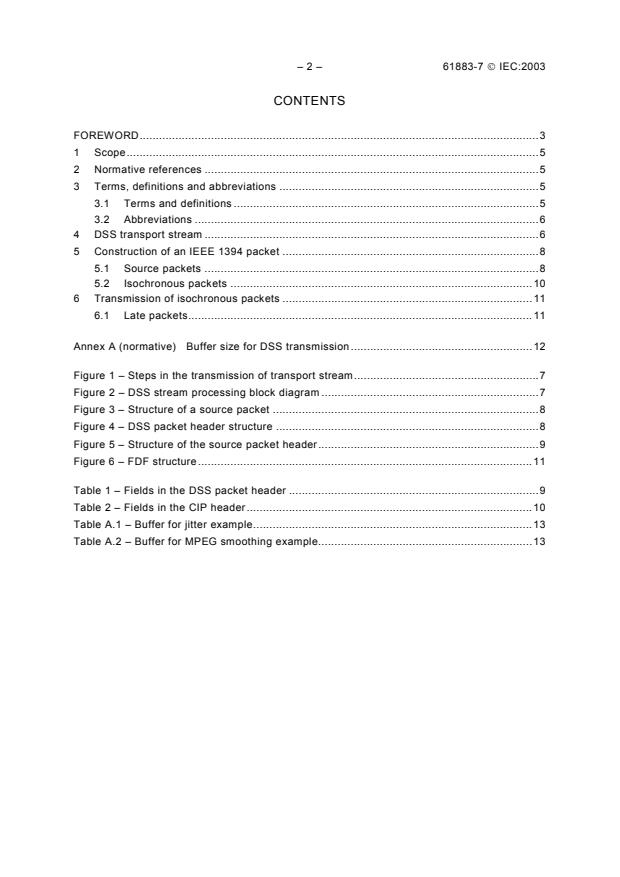
IEC 61883-7:2003 - Consumer audio/video equipment - Digital interface - Part 7: Transmission of ITU-R BO.1294 System B Released:1/28/2003
Overview
IEC 61883-7:2003 - "Consumer audio/video equipment - Digital interface - Part 7: Transmission of ITU‑R BO.1294 System B" specifies packetization and transmission rules for ITU‑R BO.1294 System B (DSS/DirecTV) transport streams over the IEEE 1394 (FireWire) serial bus. First published in January 2003 (bilingual reissue 2012‑08 corresponding to the 2003 English edition), the standard defines how DSS transport stream packets are formed, timestamped, smoothed and carried in IEEE 1394 isochronous packets so receivers can reconstruct correct timing despite interface jitter.
Key topics and technical requirements
- Source packet structure: A DSS source packet is 140 bytes - a 130 B DSS transport stream packet plus a 10 B DSS packet header. A separate source packet header (4 B) containing timestamps is added for timing recovery.
- DSS packet header: Includes a System Clock Count (23‑bit field) and flags such as SIF (invalid flag) and EF (error flag). The clock count synchronizes to the MPEG system clock and assists bit‑stream recorders (e.g., D‑VHS) in clock recovery.
- Timing and timestamps: The source packet header carries cycle_count (13 bit) and cycle_offset (12 bit) fields derived from the IEEE 1394 CYCLE_TIME register. These timestamps indicate the intended delivery time at the receiver’s T‑STD (Transport Stream Target Decoder).
- Smoothing and jitter control: The standard describes use of a smoothing buffer to reduce bandwidth when program selection occurs; smoothing introduces time shifts that are compensated with timestamps. Receivers use a receiver buffer to absorb IEEE 1394 transmitter jitter.
- Isochronous/CIP packaging: DSS uses the IEEE 1394 isochronous transport with a two‑quadlet CIP header format. CIP fields defined include DBS (data block size), FN (fractions per source packet), DBC (data block counter rules), FMT (DSS format) and FDF (including TSF - timeshift flag).
- Fragmentation rules: Source packets are split into data blocks (fractions) of 9 quadlets and packed into isochronous packets; rules control DBC progression and alignment.
Applications and who uses it
- Implementers of set‑top boxes, satellite receivers (DSS/DirecTV) and consumer A/V devices using IEEE 1394 for packetized broadcast transport.
- Chipset and firmware developers building IEEE 1394 isochronous transmitters/receivers, CIP header handlers and timestamp logic.
- Recorders and playback devices (e.g., digital VCR/bit‑stream recorders) that need accurate system clock recovery and jitter compensation.
- System integrators and test labs validating conformance to packetization, timing and buffering requirements.
Related standards
- IEC 61883‑1 (General)
- ITU‑R BO.1294:1997 (DSS functional requirements)
- IEEE 1394:1995 and IEEE 1394a:2000 (High Performance Serial Bus)
Keywords: IEC 61883‑7, DSS, DirecTV, ITU‑R BO.1294, IEEE 1394, FireWire, transport stream, isochronous packets, CIP header, packetization, timestamps, jitter compensation.
Relations
- Effective Date
- 05-Sep-2023
Buy Documents
IEC 61883-7:2003 - Consumer audio/video equipment - Digital interface - Part 7: Transmission of ITU-R BO.1294 System B Released:1/28/2003
IEC 61883-7:2003 - Consumer audio/video equipment - Digital interface - Part 7: Transmission of ITU-R BO.1294 System B Released:1/28/2003
Get Certified
Connect with accredited certification bodies for this standard

BSI Group
BSI (British Standards Institution) is the business standards company that helps organizations make excellence a habit.

NYCE
Mexican standards and certification body.

ANCE
Mexican certification and testing association.
Sponsored listings
Frequently Asked Questions
IEC 61883-7:2003 is a standard published by the International Electrotechnical Commission (IEC). Its full title is "Consumer audio/video equipment - Digital interface - Part 7: Transmission of ITU-R BO.1294 System B". This standard covers: IEC 61883-7:2003 defines packetization and transmission for transport streams of ITU-R BO.1294 system B (DirecTV system/DSS) over the IEEE 1394 Serial Bus. This bilingual version (2012-08) corresponds to the monolingual English version, published in 2003-01.
IEC 61883-7:2003 defines packetization and transmission for transport streams of ITU-R BO.1294 system B (DirecTV system/DSS) over the IEEE 1394 Serial Bus. This bilingual version (2012-08) corresponds to the monolingual English version, published in 2003-01.
IEC 61883-7:2003 is classified under the following ICS (International Classification for Standards) categories: 33.160.01 - Audio, video and audiovisual systems in general; 35.200 - Interface and interconnection equipment. The ICS classification helps identify the subject area and facilitates finding related standards.
IEC 61883-7:2003 has the following relationships with other standards: It is inter standard links to IEC PAS 61883-7:2001. Understanding these relationships helps ensure you are using the most current and applicable version of the standard.
IEC 61883-7:2003 is available in PDF format for immediate download after purchase. The document can be added to your cart and obtained through the secure checkout process. Digital delivery ensures instant access to the complete standard document.
Standards Content (Sample)
INTERNATIONAL IEC
STANDARD
61883-7
First edition
2003-01
Consumer audio/video equipment –
Digital interface –
Part 7:
Transmission of ITU-R BO.1294 System B
Matériel audio/vidéo grand public –
Interface numérique –
Partie 7:
Transmission du Système B de l’UIT-R BO.1294
Reference number
IEC 61883-1:2003(E)
Publication numbering
As from 1 January 1997 all IEC publications are issued with a designation in the
60000 series. For example, IEC 34-1 is now referred to as IEC 60034-1.
Consolidated editions
The IEC is now publishing consolidated versions of its publications. For example,
edition numbers 1.0, 1.1 and 1.2 refer, respectively, to the base publication, the
base publication incorporating amendment 1 and the base publication incorporating
amendments 1 and 2.
Further information on IEC publications
The technical content of IEC publications is kept under constant review by the IEC,
thus ensuring that the content reflects current technology. Information relating to
this publication, including its validity, is available in the IEC Catalogue of
publications (see below) in addition to new editions, amendments and corrigenda.
Information on the subjects under consideration and work in progress undertaken
by the technical committee which has prepared this publication, as well as the list
of publications issued, is also available from the following:
x IEC Web Site (www.iec.ch)
x Catalogue of IEC publications
The on-line catalogue on the IEC web site (http://www.iec.ch/searchpub/cur_fut.htm)
enables you to search by a variety of criteria including text searches, technical
committees and date of publication. On-line information is also available on
recently issued publications, withdrawn and replaced publications, as well as
corrigenda.
x IEC Just Published
This summary of recently issued publications (http://www.iec.ch/online_news/
justpub/jp_entry.htm) is also available by email. Please contact the Customer
Service Centre (see below) for further information.
x Customer Service Centre
If you have any questions regarding this publication or need further assistance,
please contact the Customer Service Centre:
Email: custserv@iec.ch
Tel: +41 22 919 02 11
Fax: +41 22 919 03 00
INTERNATIONAL IEC
STANDARD
61883-7
First edition
2003-01
Consumer audio/video equipment –
Digital interface –
Part 7:
Transmission of ITU-R BO.1294 System B
Matériel audio/vidéo grand public –
Interface numérique –
Partie 7:
Transmission du Système B de l’UIT-R BO.1294
IEC 2003 Copyright - all rights reserved
No part of this publication may be reproduced or utilized in any form or by any means, electronic or
mechanical, including photocopying and microfilm, without permission in writing from the publisher.
International Electrotechnical Commission, 3, rue de Varembé, PO Box 131, CH-1211 Geneva 20, Switzerland
Telephone: +41 22 919 02 11 Telefax: +41 22 919 03 00 E-mail: inmail@iec.ch Web: www.iec.ch
PRICE CODE
Commission Electrotechnique Internationale
N
International Electrotechnical Commission
Международная Электротехническая Комиссия
For price, see current catalogue
– 2 – 61883-7 IEC:2003(E)
CONTENTS
FOREWORD . 3
1 Scope . 5
2 Normative references. 5
3 Terms, definitions and abbreviations. 5
3.1 Terms and definitions . 5
3.2 Abbreviations. 6
4 DSS transport stream . 6
5 Construction of an IEEE 1394 packet. 8
5.1 Source packets. 8
5.2 Isochronous packets.10
6 Transmission of isochronous packets.11
6.1 Late packets .11
Annex A (normative) Buffer size for DSS transmission .12
Figure 1 – Steps in the transmission of transport stream . 7
Figure 2 – DSS stream processing block diagram . 7
Figure 3 – Structure of a source packet. 8
Figure 4 – DSS packet header structure. 8
Figure 5 – Structure of the source packet header . 9
Figure 6 – FDF structure .11
Table 1 – Fields in the DSS packet header. 9
Table 2 – Fields in the CIP header .10
Table A.1 – Buffer for jitter example .13
Table A.2 – Buffer for MPEG smoothing example.13
61883-7 IEC:2003(E) – 3 –
INTERNATIONAL ELECTROTECHNICAL COMMISSION
____________
CONSUMER AUDIO/VIDEO EQUIPMENT –
DIGITAL INTERFACE –
Part 7: Transmission of ITU-R BO.1294 System B
FOREWORD
1) The IEC (International Electrotechnical Commission) is a worldwide organization for standardization comprising
all national electrotechnical committees (IEC National Committees). The object of the IEC is to promote
international co-operation on all questions concerning standardization in the electrical and electronic fields. To
this end and in addition to other activities, the IEC publishes International Standards. Their preparation is
entrusted to technical committees; any IEC National Committee interested in the subject dealt with may
participate in this preparatory work. International, governmental and non-governmental organizations liaising
with the IEC also participate in this preparation. The IEC collaborates closely with the International
Organization for Standardization (ISO) in accordance with conditions determined by agreement between the
two organizations.
2) The formal decisions or agreements of the IEC on technical matters express, as nearly as possible, an
international consensus of opinion on the relevant subjects since each technical committee has representation
from all interested National Committees.
3) The documents produced have the form of recommendations for international use and are published in the form
of standards, technical specifications, technical reports or guides and they are accepted by the National
Committees in that sense.
4) In order to promote international unification, IEC National Committees undertake to apply IEC International
Standards transparently to the maximum extent possible in their national and regional standards. Any
divergence between the IEC Standard and the corresponding national or regional standard shall be clearly
indicated in the latter.
5) The IEC provides no marking procedure to indicate its approval and cannot be rendered responsible for any
equipment declared to be in conformity with one of its standards.
6) Attention is drawn to the possibility that some of the elements of this International Standard may be the subject
of patent rights. The IEC shall not be held responsible for identifying any or all such patent rights.
IEC 61883-7 has been prepared by technical area 4, Digital system interfaces, of IEC
technical committee 100: Audio, video and multimedia systems and equipment.
The text of this standard is based on the following documents:
FDIS Report on voting
100/558/FDIS 100/610/RVD
Full information on the voting for the approval of this standard can be found in the report on
voting indicated in the above table.
This publication has been drafted in accordance with the ISO/IEC Directives, Part 2.
International Standard IEC 61883 consists of the following parts under the general title
Consumer audio/video equipment – Digital interface:
Part 1: General
Part 2: SD-DVCR data transmission
Part 3: HD-DVCR data transmission
Part 4: MPEG2-TS data transmission
Part 5: SDL-DVCR data transmission
Part 6: Audio and music data transmission protocol
Part 7: Transmission of ITU-R BO.1294 System B
– 4 – 61883-7 IEC:2003(E)
The committee has decided that the contents of this publication will remain unchanged until
2004. At this date, the publication will be
• reconfirmed;
• withdrawn;
• replaced by a revised edition, or
• amended.
61883-7 IEC:2003(E) – 5 –
CONSUMER AUDIO/VIDEO EQUIPMENT –
DIGITAL INTERFACE –
Part 7: Transmission of ITU-R BO.1294 System B
1 Scope
This specification defines packetization and transmission for transport streams of ITU-R BO.1294
system B (DirecTV system/DSS) over the IEEE 1394 Serial Bus.
2 Normative references
The following referenced documents are indispensable for the application of this document.
For dated references, only the edition cited applies. For undated references, the latest edition
of the referenced document (including any amendments) applies.
IEC 61883-1, Consumer audio/video equipment – Digital interface – Part 1: General
ITU-R BO.1294:1997, Common functional requirements for the reception of digital multi-
programme television emissions by satellites operating in the 11/12 GHz frequency range
IEEE 1394:1995, Standard for a High Performance Serial Bus
IEEE 1394a:2000, Standard for a High Performance Serial Bus – Amendment 1
3 Terms, definitions and abbreviations
For the purposes of this part of IEC 61883, the following terms and definitions apply.
3.1 Terms and definitions
For the purposes of this part of IEC 61883, the following terms and definitions apply.
3.1.1
byte
eight bits of data, used as a synonym for octet
NOTE The symbol for byte is B.
3.1.2
CSR architecture
convenient abbreviation of the following reference: ISO/IEC 13213:1994, Information
technology – Microprocessor systems – Control and status register (CSR) architecture for
microcomputer buses
3.1.3
quadlet
four bytes of data
———————
In this document, the name “DSS” is used instead of ITU-R BO.1294 system B.
– 6 – 61883-7 IEC:2003(E)
3.2 Abbreviations
For the purpose of this part of IEC 61883, the following abbreviations used in IEEE 1394
apply:
AV/C Audio Video Control
CIP Common Isochronous Packet
CTR Cycle Time Register
HD High Definition
IEEE The Institute of Electrical and Electronics Engineers, Inc.
MPEG Motion Picture Expert Group
TSP Transport Stream Package
4 DSS transport stream
A DSS transport stream consists of transport stream packets with a length of 130 B.
NOTE Refer to Annex 1 of ITU-R BO.1294: 1997 for more information.
A stream may contain several programs. In Figure 1, an example is given of a transport
stream, which consists of several programs. Often, only one or a few programs need to be
transmitted. If a program selection is carried out, then only those transport stream packets
from that particular transport stream are transmitted. In this situation, the occupied bandwidth
on the IEEE 1394 interface can be reduced. Reduction of the bit rate is carried in a smoothing
buffer. As a result of the smoothing operation, the transport stream packets will be shifted in
time.
The transport stream packets at the output of the smoothing buffer are transmitted over the
IEEE 1394 interface. During transmission, this interface will introduce some jitter on
the arrival time of the transport stre
...
IEC 61883-7 ®
Edition 1.0 2003-01
INTERNATIONAL
STANDARD
NORME
INTERNATIONALE
Consumer audio/video equipment – Digital interface –
Part 7: Transmission of ITU-R BO.1294 System B
Matériel audio/vidéo grand public – Interface numérique –
Partie 7: Transmission du Système B de l'UIT-R BO.1294
All rights reserved. Unless otherwise specified, no part of this publication may be reproduced or utilized in any form
or by any means, electronic or mechanical, including photocopying and microfilm, without permission in writing from
either IEC or IEC's member National Committee in the country of the requester.
If you have any questions about IEC copyright or have an enquiry about obtaining additional rights to this publication,
please contact the address below or your local IEC member National Committee for further information.
Droits de reproduction réservés. Sauf indication contraire, aucune partie de cette publication ne peut être reproduite ni
utilisée sous quelque forme que ce soit et par aucun procédé, électronique ou mécanique, y compris la photocopie et les
microfilms, sans l'accord écrit de la CEI ou du Comité national de la CEI du pays du demandeur.
Si vous avez des questions sur le copyright de la CEI ou si vous désirez obtenir des droits supplémentaires sur cette
publication, utilisez les coordonnées ci-après ou contactez le Comité national de la CEI de votre pays de résidence.
IEC Central Office Tel.: +41 22 919 02 11
3, rue de Varembé Fax: +41 22 919 03 00
CH-1211 Geneva 20 info@iec.ch
Switzerland www.iec.ch
About the IEC
The International Electrotechnical Commission (IEC) is the leading global organization that prepares and publishes
International Standards for all electrical, electronic and related technologies.
About IEC publications
The technical content of IEC publications is kept under constant review by the IEC. Please make sure that you have the
latest edition, a corrigenda or an amendment might have been published.
Useful links:
IEC publications search - www.iec.ch/searchpub Electropedia - www.electropedia.org
The advanced search enables you to find IEC publications The world's leading online dictionary of electronic and
by a variety of criteria (reference number, text, technical electrical terms containing more than 30 000 terms and
committee,…). definitions in English and French, with equivalent terms in
It also gives information on projects, replaced and additional languages. Also known as the International
withdrawn publications. Electrotechnical Vocabulary (IEV) on-line.
IEC Just Published - webstore.iec.ch/justpublished Customer Service Centre - webstore.iec.ch/csc
Stay up to date on all new IEC publications. Just Published If you wish to give us your feedback on this publication
details all new publications released. Available on-line and or need further assistance, please contact the
also once a month by email. Customer Service Centre: csc@iec.ch.
A propos de la CEI
La Commission Electrotechnique Internationale (CEI) est la première organisation mondiale qui élabore et publie des
Normes internationales pour tout ce qui a trait à l'électricité, à l'électronique et aux technologies apparentées.
A propos des publications CEI
Le contenu technique des publications de la CEI est constamment revu. Veuillez vous assurer que vous possédez
l’édition la plus récente, un corrigendum ou amendement peut avoir été publié.
Liens utiles:
Recherche de publications CEI - www.iec.ch/searchpub Electropedia - www.electropedia.org
La recherche avancée vous permet de trouver des Le premier dictionnaire en ligne au monde de termes
publications CEI en utilisant différents critères (numéro de électroniques et électriques. Il contient plus de 30 000
référence, texte, comité d’études,…). termes et définitions en anglais et en français, ainsi que
Elle donne aussi des informations sur les projets et les les termes équivalents dans les langues additionnelles.
publications remplacées ou retirées. Egalement appelé Vocabulaire Electrotechnique
International (VEI) en ligne.
Just Published CEI - webstore.iec.ch/justpublished
Service Clients - webstore.iec.ch/csc
Restez informé sur les nouvelles publications de la CEI.
Just Published détaille les nouvelles publications parues. Si vous désirez nous donner des commentaires sur
Disponible en ligne et aussi une fois par mois par email. cette publication ou si vous avez des questions
contactez-nous: csc@iec.ch.
IEC 61883-7 ®
Edition 1.0 2003-01
INTERNATIONAL
STANDARD
NORME
INTERNATIONALE
Consumer audio/video equipment – Digital interface –
Part 7: Transmission of ITU-R BO.1294 System B
Matériel audio/vidéo grand public – Interface numérique –
Partie 7: Transmission du Système B de l'UIT-R BO.1294
INTERNATIONAL
ELECTROTECHNICAL
COMMISSION
COMMISSION
ELECTROTECHNIQUE
PRICE CODE
INTERNATIONALE
N
CODE PRIX
ICS 33.160.01; 35.200 ISBN 978-2-83220-236-4
– 2 – 61883-7 IEC:2003
CONTENTS
FOREWORD . 3
1 Scope . 5
2 Normative references . 5
3 Terms, definitions and abbreviations . 5
3.1 Terms and definitions . 5
3.2 Abbreviations . 6
4 DSS transport stream . 6
5 Construction of an IEEE 1394 packet . 8
5.1 Source packets . 8
5.2 Isochronous packets . 10
6 Transmission of isochronous packets . 11
6.1 Late packets . 11
Annex A (normative) Buffer size for DSS transmission . 12
Figure 1 – Steps in the transmission of transport stream . 7
Figure 2 – DSS stream processing block diagram . 7
Figure 3 – Structure of a source packet . 8
Figure 4 – DSS packet header structure . 8
Figure 5 – Structure of the source packet header . 9
Figure 6 – FDF structure . 11
Table 1 – Fields in the DSS packet header . 9
Table 2 – Fields in the CIP header . 10
Table A.1 – Buffer for jitter example . 13
Table A.2 – Buffer for MPEG smoothing example. 13
61883-7 IEC:2003 – 3 –
INTERNATIONAL ELECTROTECHNICAL COMMISSION
____________
CONSUMER AUDIO/VIDEO EQUIPMENT –
DIGITAL INTERFACE –
Part 7: Transmission of ITU-R BO.1294 System B
FOREWORD
1) The IEC (International Electrotechnical Commission) is a worldwide organization for standardization comprising
all national electrotechnical committees (IEC National Committees). The object of the IEC is to promote
international co-operation on all questions concerning standardization in the electrical and electronic fields. To
this end and in addition to other activities, the IEC publishes International Standards. Their preparation is
entrusted to technical committees; any IEC National Committee interested in the subject dealt with may
participate in this preparatory work. International, governmental and non-governmental organizations liaising
with the IEC also participate in this preparation. The IEC collaborates closely with the International
Organization for Standardization (ISO) in accordance with conditions determined by agreement between the
two organizations.
2) The formal decisions or agreements of the IEC on technical matters express, as nearly as possible, an
international consensus of opinion on the relevant subjects since each technical committee has representation
from all interested National Committees.
3) The documents produced have the form of recommendations for international use and are published in the form
of standards, technical specifications, technical reports or guides and they are accepted by the National
Committees in that sense.
4) In order to promote international unification, IEC National Committees undertake to apply IEC International
Standards transparently to the maximum extent possible in their national and regional standards. Any
divergence between the IEC Standard and the corresponding national or regional standard shall be clearly
indicated in the latter.
5) The IEC provides no marking procedure to indicate its approval and cannot be rendered responsible for any
equipment declared to be in conformity with one of its standards.
6) Attention is drawn to the possibility that some of the elements of this International Standard may be the subject
of patent rights. The IEC shall not be held responsible for identifying any or all such patent rights.
IEC 61883-7 has been prepared by technical area 4, Digital system interfaces, of IEC
technical committee 100: Audio, video and multimedia systems and equipment.
This bilingual version (2012-08) corresponds to the monolingual English version, published in
2003-01.
The text of this standard is based on the following documents:
FDIS Report on voting
100/558/FDIS 100/610/RVD
Full information on the voting for the approval of this standard can be found in the report on
voting indicated in the above table.
The French version of this standard has not been voted upon.
This publication has been drafted in accordance with the ISO/IEC Directives, Part 2.
International Standard IEC 61883 consists of the following parts under the general title
Consumer audio/video equipment – Digital interface:
Part 1: General
Part 2: SD-DVCR data transmission
Part 3: HD-DVCR data transmission
Part 4: MPEG2-TS data transmission
– 4 – 61883-7 IEC:2003
Part 5: SDL-DVCR data transmission
Part 6: Audio and music data transmission protocol
Part 7: Transmission of ITU-R BO.1294 System B
The committee has decided that the contents of this publication will remain unchanged until
2004. At this date, the publication will be
• reconfirmed;
• withdrawn;
• replaced by a revised edition, or
• amended.
61883-7 IEC:2003 – 5 –
CONSUMER AUDIO/VIDEO EQUIPMENT –
DIGITAL INTERFACE –
Part 7: Transmission of ITU-R BO.1294 System B
1 Scope
This specification defines packetization and transmission for transport streams of ITU-R
BO.1294 system B (DirecTV system/DSS) over the IEEE 1394 Serial Bus.
2 Normative references
The following referenced documents are indispensable for the application of this document.
For dated references, only the edition cited applies. For undated references, the latest edition
of the referenced document (including any amendments) applies.
IEC 61883-1, Consumer audio/video equipment – Digital interface – Part 1: General
ITU-R BO.1294:1997, Common functional requirements for the reception of digital multi-
programme television emissions by satellites operating in the 11/12 GHz frequency range
IEEE 1394:1995, Standard for a High Performance Serial Bus
IEEE 1394a:2000, Standard for a High Performance Serial Bus – Amendment 1
3 Terms, definitions and abbreviations
For the purposes of this part of IEC 61883, the following terms and definitions apply.
3.1 Terms and definitions
For the purposes of this part of IEC 61883, the following terms and definitions apply.
3.1.1
byte
eight bits of data, used as a synonym for octet
NOTE The symbol for byte is B.
3.1.2
CSR architecture
convenient abbreviation of the following reference: ISO/IEC 13213:1994, Information
technology – Microprocessor systems – Control and status register (CSR) architecture for
microcomputer buses
3.1.3
quadlet
four bytes of data
———————
In this document, the name “DSS” is used instead of ITU-R BO.1294 system B.
– 6 – 61883-7 IEC:2003
3.2 Abbreviations
For the purpose of this part of IEC 61883, the following abbreviations used in IEEE 1394
apply:
AV/C Audio Video Control
CIP Common Isochronous Packet
CTR Cycle Time Register
HD High Definition
IEEE The Institute of Electrical and Electronics Engineers, Inc.
MPEG Motion Picture Expert Group
TSP Transport Stream Package
4 DSS transport stream
A DSS transport stream consists of transport stream packets with a length of 130 B.
NOTE Refer to Annex 1 of ITU-R BO.1294: 1997 for more information.
A stream may contain several programs. In Figure 1, an example is given of a transport
stream, which consists of several programs. Often, only one or a few programs need to be
transmitted. If a program selection is carried out, then only those transport stream packets
from that particular transport stream are transmitted. In this situation, the occupied bandwidth
on the IEEE 1394 interface can be reduced. Reduction of the bit rate is carried in a smoothing
buffer. As a result of the smoothing operation, the transport stream packets will be shifted in
time.
The transport stream packets at the output of the smoothing buffer are transmitted over the
IEEE 1394 interface. During transmission, this interface will introduce some jitter on
the arrival time of the transport stream packets in the receiver.
In the DSS transport stream, there are strong requirements on the timing of the transport
stream packets. The jitter introduced by the both the smoothing buffer and the transmitter of
the interface has to be compensated. This is done by adding a time stamp to the transport
stream packets:
– at the moment it arrives at the input of the smoothing buffer; or
– at the input of the digital interface, if smoothing is not applied.
The receiver of the interface contains a receiver buffer, which compensates for the introduced
jitter.
61883-7 IEC:2003 – 7 –
IEC 3100/02
a) Complete transport stream with multiplex of programs (A,B,C,D)
b) Transport stream of the selected program A with DSS packet header (=DSS source packets)
c) Source packets with source packet header
d) Source packets at the output of the smoothing buffer
e) Source packets at the input of the 1394 receiver
f) Reconstructed timing for the transport stream
NOTE The clock frequency for transferring the bytes of a transport stream packet may be different
in every situation
Figure 1 – Steps in the transmission of transport stream
Figure 2 shows how the DSS stream is processed between the original multiplex signal, the
IEEE 1394 interface and the decoder.
DSS and Smoothing
source buffer evens Arbitrate for Re-
Original packet the interval bus and construction
multiplex headers between transmit of original
signal added packets data timing
Timing
Smoothing Receiving recovery
Demux Add headers Transmitter 1394 T-STD
buffer buffer (de-
smoother)
a) c) d) e) f)
IEC 3101/02
Figure 2 – DSS stream processing block diagram
– 8 – 61883-7 IEC:2003
5 Construction of an IEEE 1394 packet
5.1 Source packets
5.1.1 Structure of a source packet
The length of the source packet is 140 B as shown in Figure 3. The source packet consists of
one DSS transport stream packet with a length of 130 B and a DSS packet header of 10 B.
The source packet header is additionally added before transmission to the smoothing buffer.
The source packet header contains a time stamp.
Source packet header (4 B)
DSS packet header (10 B)
DSS transport stream packet (130 B)
DSS source packet (140 B)
IEC 3102/02
Figure 3 – Structure of a source packet
5.1.2 DSS packet header
Figure 4 shows the structure of a DSS packet header.
msb lsb
MSB SIF
System Clock Count (23 bit)
EF Reserved (0000000 )
Reserved byte 0 (00 )
Reserved byte 1 (00 )
Reserved byte 2 (00 )
Reserved byte 3 (00 )
Reserved byte 4 (00 )
LSB Reserved byte 5 (00 )
IEC 3103/02
Figure 4 – DSS packet header structure
61883-7 IEC:2003 – 9 –
Table 1 shows the DSS packet header components.
Table 1 – Fields in the DSS packet header
Field Definition
SIF System clock count Invalid Flag (1: invalid, 0: valid)
System clock A 23 bit field that is set to the lowest 23 bit of the 27 MHz clock
count counter, which is synchronized with MPEG system clock. The value of
this counter may be different from the byte time stamp counter used to
(23 bit)
generate the byte time stamp in the auxiliary data packet (defined in
4.1 of Appendix 1 to Annex 1 of ITU-R BO.1294: 1997.
EF Error Flag (1: Error, 0: no Error)
Set to value 1 when the associated transport stream packet is
erroneous
The system clock count is used by bit stream recorders, like D-VHS, to lock its system clock
phase to the source stream without needing to look into the DSS transport stream packet for
clock information. If a stream contains video and/or audio application packets, then the
stream shall contain packets with a valid system clock count. The maximum interval between
valid system clock counts (or “ticks”) shall be 200 ms. Therefore many audio and video
packets in between may not contain a valid system clock count.
If a stream does not contain video or audio application packets, then the system clock count
is not required.
5.1.3 Source packet header
Figure 5 shows the structure of the source packet header.
msb lsb
MSB Reserved
Cycle_count (13 bit)
Cycle_offset (12 bit)
LSB
IEC 3104/02
Figure 5 – Structure of the source packet header
The reserved bits are zero. The cycle_count and cycle_offset fields represent a time stamp.
The time stamp is used by isochronous data receivers for reconstructing a correct timing of
the transport stream packets at their output. The time stamp indicates the intended delivery
time of the first bit/byte of the transport stream packets from the receiver output to the T-STD
(Transport Stream Target Decoder). The time stamp represents the 25 bit of the IEEE 1394
CYCLE_TIME register (CTR) at the moment the first bit/byte of the transport stream packet
arrives from the application, plus an offset which is equal to the constant overall delay of the
transport stream packet between the moment of arriving (of the first bit) and the moment
the transport stream packet (first bit) is delivered by the receiver to the application.
– 10 – 61883-7 IEC:2003
5.1.4 Fractions
A source packet is split into 4 data blocks with a length of 9 quadlets. Zero or more data
blocks are packed in an IEEE 1394 isochronous packet. A receiver of the isochronous packets
collects the data blocks of one source packet and combines them in order to reconstruct the
source packet before sending this source packet to the application. There are restrictions on
the transmission of fractions (see 5.2.2).
5.2 Isochronous packets
5.2.1 CIP header for the DSS transport stream
The structure of the CIP header for DSS transport stream conforms to the two quadlet CIP
header format explained in IEC 61883-1, 6.2.1. Table 2 shows the values of the CIP header
components.
Table 2 – Fields in the CIP header
Field Value Description
SID . Depends on configuration
DBS 00001001 9 quadlets
FN 10 4 data blocks in one source packet
QPC 000 No padding
SPH 1 Source packet header is present
DBC 0 . 255 See 5.2.2
FMT 100001 Format type of DSS (ITU-R BO.1294 System B)
FDF . See 5.2.3
5.2.2 DBC values
The first data block of a source packet (data block containing the source packet header)
corresponds to a DBC value from which the two LSBs are 00 .
An isochronous packet contains 0, 1, or 2 data blocks, or an integer number of source
packets.
– If the isochronous packet contains:
One data block, then the BDC value increments by 1;
Two data blocks, then the DBC value is a multiple of 2, the LSB is 0 .
– If the isochronous packet contains n source packets (n is an integer) then the DBC value
is a multiple of 4. The two LSBs are 00 .
5.2.3 FDF data
The structure of the CIP header is shown in Figure 6.
TSF (Timeshift_flag): indicates a time-shifted stream
– 0 = the stream is not time-shifted;
– 1 = the stream is time-shifted.
61883-7 IEC:2003 – 11 –
3 B
Reserved
TSF (1 B)
IEC 3105/02
Figure 6 – FDF structure
6 Transmission of isochronous packets
Active transmitters send an isochronous packet in every cycle. If there is insufficient data to
transmit in the isochronous packet, an empty packet is transmitted.
6.1 Late packets
The time stamp in the transmitted source packet header points to a value in the future. If the
delay in the transmitter is too long and results in a time stamp which points in the past (late
packet), then this source packet is not transmitted.
A late packet occurs if the actual value of the CTR becomes equal to the value represented in
the time stamp from the source packet header and before transmission of the isochronous
packet(s) that contain the source packet (including CRC).
– If one source packet/cycle is transmitted, the interval needed to transmit the complete
isochronous packet can be calculated (the clock frequency and the number of bits is
known). If a late packet occurs, then an empty packet or the next valid packet should be
sent and the late packet is discarded.
– If more than one source packet/cycle is transmitted, then the same procedure is followed.
It is allowed to discard all source packets from the isochronous packet if one source
packet turns out to be a late packet.
– If fractions are transmitted, it is recommended to first collect a complete source packet in
the transmitter.
– If a late packet occurs, then the complete source packet should be discarded.
If a late packet occurs when some data blocks of the source packet have already been
transmitted (for example at a bus reset), then data blocks remaining in the transmitting buffer
are removed.
– 12 – 61883-7 IEC:2003
Annex A
(normative)
Buffer size for DSS transmission
A.1 General
To calculate receiving buffer size, two kinds of buffers are defined:
a) buffer for IEEE 1394 jitter; and
b) buffer for MPEG smoothing.
There are two kinds of transmissions. Calculation is made with both cases:
1) for full transponder transport stream transmission, only a buffer for IEEE 1394 jitter is
necessary since no smoothing exists;
2) for partial transport stream transmission, both a buffer for 1394 jitter and a buffer for
MPEG smoothing are required.
A.2 Buffer for IEEE 1394 jitter
The TSP packet can be sent to the application by the receiver as soon as the CRC of the
isochronous packet is carried out. The buffer size needed to compensate jitter introduced
by the transmitter is given by the following relation:
Buffer_size_I = (R_bus) × (max_jitter) + (B_granularity)
where
R_bus is the allocated data rate on the IEEE 1394 interface;
max_jitter is the maximum 1394_jitter (~ 311 µs) minus the minimum time
needed to transmit one bus packet. 311 µs (fixed) = 125 µs (1 cycle
late) + 78 µs (delay by async) + 108 µs (delay by iso);
one_bus_packet_time bus packet size / 393,216 Mbit/s;
B_granularity is the size of one bus packet (TSP/cycle).
The necessary buffer size will be largest with high transmission rates (several TSPs per
cycle) and high clock frequencies of the bus (400 Mbit/s).
In Table A.1, the buffer size for jitter is given for some transmission rates.
61883-7 IEC:2003 – 13 –
Table A.1 – Buffer for jitter example
Transmission rate Transmission rate Minimum buffer size
TSP/cycle Mbit/s B
1/8 1,152 63
1/4 2,304 125
1/2 4,608 250
1 9,216 499
2 18,432 991
3 27,648 1 476
4 36,864 1 955
5 46,080 2 427
NOTE 1 The buffer size above does not include the size, which depends on the
reading out data rate.
NOTE 2 The data rate on the bus is 393,216 MHz.
A.3 Buffer for MPEG smoothing
The buffer for MPEG smoothing is defined by the equation as follows:
Buffer_size_S = (B_smoothing) + (R_bus × jitter_RTI) + (B_aux)
where
B_smoothing = 1 536 B;
R_bus = data rate on IEEE1394;
jitter_RTI = 50 µs (ISO/IEC 13818-9);
B_aux = 144 B as source packet.
In Table A.2
...