

IEC 61991:2019
(Main)Railway applications - Rolling stock - Protective provisions against electrical hazards
General Information
- Abstract
IEC 61991:2019 defines requirements applied in the design and manufacture of electrical installations and equipment to be used on rolling stock to protect persons from electric shocks. This document is applicable to rolling stock of rail transport systems, road transport systems if they are powered by an external supply (e.g. trolley buses), magnetically levitated transport systems, and to the electrical equipment installed in these systems. This second edition cancels and replaces the first edition, published in 2000. It is based on EN 50153:2014. This edition includes the following significant technical changes with respect to the previous edition:
a) replacement of several reference standards.
b) several terms and abbreviated terms are introduced;
c) special national conditions are included in annex
- Status
- Published
- Publication Date
- 09-May-2019
- Technical Committee
- TC 9 - Electrical equipment and systems for railways
- Drafting Committee
- MT 61991 - TC 9/MT 61991
- Current Stage
- PPUB - Publication issued
- Start Date
- 10-May-2019
- Completion Date
- 22-Mar-2019
Buy Documents
IEC 61991:2019 RLV - Railway applications - Rolling stock - Protective provisions against electrical hazards Released:5/10/2019
IEC 61991:2019 - Railway applications - Rolling stock - Protective provisions against electrical hazards Released:5/10/2019
Overview
IEC 61991:2019 - "Railway applications - Rolling stock - Protective provisions against electrical hazards" sets international requirements for the design and manufacture of electrical installations and equipment on rolling stock to protect persons from electric shock. Applicable to rail, magnetically levitated transport, and road transport vehicles powered by an external supply (e.g., trolley buses), this second edition (2019) supersedes the 2000 edition and is based on EN 50153:2014. Key updates include replaced reference standards, new terms/abbreviations, and added annexes for national conditions and impedance management.
Key topics and technical requirements
- Voltage band classification: Defines voltage bands and their application to protective design (see Tables in the standard).
- Protection against direct contact: Prescribes methods such as insulation, prevention of access, and use of ELV systems (SELV, PELV), plus warning labels where required.
- Protection against indirect contact: Requirements for protective bonding, equipotential connections, and disconnection strategies to limit touch voltages and fault currents.
- Disconnection of supply: Functional and timing characteristics for fault disconnection to ensure safety.
- Vehicle main protective bonding: Rules for bonding paths, impedance limits and treatment of contact-line faults.
- Power circuits: Guidance for circuits insulated from, or using, the vehicle body or bogie.
- Additional requirements: Specific rules for current collectors, capacitors, plug-and-socket devices (portable and intervehicle), and special power sources.
- Annexes:
- Annex A: Items where contracting parties must choose between procedural or mechanical/electrical measures.
- Annex B: Special national conditions (examples: France, Great Britain, Japan).
- Annex C: Example solutions for impedance management in EMUs (preventing return-current absorption).
Practical applications and users
IEC 61991:2019 is essential for:
- Rolling stock designers and electrical engineers designing vehicle electrical systems.
- Manufacturers of traction equipment, onboard power systems, connectors, and current collectors.
- System integrators, safety and compliance teams, and maintenance personnel implementing protective bonding and insulation strategies.
- Regulatory authorities, certification bodies, and procurement teams specifying safety compliance in contracts.
Using IEC 61991 ensures consistent protection against electrical hazards across rolling stock fleets, supports safe design choices (insulation, SELV/PELV, bonding), and helps manage interoperability and national variations via Annex B.
Related standards
- EN 50153:2014 (basis for this edition)
- Other IEC norms referenced within IEC 61991 (see normative references in the standard)
Keywords: IEC 61991:2019, railway applications, rolling stock, electrical hazards, protective provisions, electric shock protection, SELV, PELV, equipotential bonding, voltage bands, EMU impedance management.
Relations
- Effective Date
- 05-Sep-2023
Buy Documents
IEC 61991:2019 RLV - Railway applications - Rolling stock - Protective provisions against electrical hazards Released:5/10/2019
IEC 61991:2019 - Railway applications - Rolling stock - Protective provisions against electrical hazards Released:5/10/2019
Get Certified
Connect with accredited certification bodies for this standard

IRIS Certification (UNIFE)
International Railway Industry Standard certification.

TÜV SÜD Rail GmbH
TÜV SÜD railway certification services.

Bureau Veritas Railway Certification
Railway and transportation certification.
Sponsored listings
Frequently Asked Questions
IEC 61991:2019 is a standard published by the International Electrotechnical Commission (IEC). Its full title is "Railway applications - Rolling stock - Protective provisions against electrical hazards". This standard covers: IEC 61991:2019 defines requirements applied in the design and manufacture of electrical installations and equipment to be used on rolling stock to protect persons from electric shocks. This document is applicable to rolling stock of rail transport systems, road transport systems if they are powered by an external supply (e.g. trolley buses), magnetically levitated transport systems, and to the electrical equipment installed in these systems. This second edition cancels and replaces the first edition, published in 2000. It is based on EN 50153:2014. This edition includes the following significant technical changes with respect to the previous edition: a) replacement of several reference standards. b) several terms and abbreviated terms are introduced; c) special national conditions are included in annex
IEC 61991:2019 defines requirements applied in the design and manufacture of electrical installations and equipment to be used on rolling stock to protect persons from electric shocks. This document is applicable to rolling stock of rail transport systems, road transport systems if they are powered by an external supply (e.g. trolley buses), magnetically levitated transport systems, and to the electrical equipment installed in these systems. This second edition cancels and replaces the first edition, published in 2000. It is based on EN 50153:2014. This edition includes the following significant technical changes with respect to the previous edition: a) replacement of several reference standards. b) several terms and abbreviated terms are introduced; c) special national conditions are included in annex
IEC 61991:2019 is classified under the following ICS (International Classification for Standards) categories: 45.060.01 - Railway rolling stock in general. The ICS classification helps identify the subject area and facilitates finding related standards.
IEC 61991:2019 has the following relationships with other standards: It is inter standard links to IEC 61991:2000. Understanding these relationships helps ensure you are using the most current and applicable version of the standard.
IEC 61991:2019 is available in PDF format for immediate download after purchase. The document can be added to your cart and obtained through the secure checkout process. Digital delivery ensures instant access to the complete standard document.
Standards Content (Sample)
IEC 61991 ®
Edition 2.0 2019-05
REDLINE VERSION
INTERNATIONAL
STANDARD
colour
inside
Railway applications – Rolling stock –
Protective provisions against electrical hazards
All rights reserved. Unless otherwise specified, no part of this publication may be reproduced or utilized in any form
or by any means, electronic or mechanical, including photocopying and microfilm, without permission in writing from
either IEC or IEC's member National Committee in the country of the requester. If you have any questions about IEC
copyright or have an enquiry about obtaining additional rights to this publication, please contact the address below or
your local IEC member National Committee for further information.
IEC Central Office Tel.: +41 22 919 02 11
3, rue de Varembé info@iec.ch
CH-1211 Geneva 20 www.iec.ch
Switzerland
About the IEC
The International Electrotechnical Commission (IEC) is the leading global organization that prepares and publishes
International Standards for all electrical, electronic and related technologies.
About IEC publications
The technical content of IEC publications is kept under constant review by the IEC. Please make sure that you have the
latest edition, a corrigendum or an amendment might have been published.
IEC publications search - webstore.iec.ch/advsearchform Electropedia - www.electropedia.org
The advanced search enables to find IEC publications by a The world's leading online dictionary on electrotechnology,
variety of criteria (reference number, text, technical containing more than 22 000 terminological entries in English
committee,…). It also gives information on projects, replaced and French, with equivalent terms in 16 additional languages.
and withdrawn publications. Also known as the International Electrotechnical Vocabulary
(IEV) online.
IEC Just Published - webstore.iec.ch/justpublished
Stay up to date on all new IEC publications. Just Published IEC Glossary - std.iec.ch/glossary
details all new publications released. Available online and 67 000 electrotechnical terminology entries in English and
once a month by email. French extracted from the Terms and Definitions clause of
IEC publications issued since 2002. Some entries have been
IEC Customer Service Centre - webstore.iec.ch/csc collected from earlier publications of IEC TC 37, 77, 86 and
If you wish to give us your feedback on this publication or CISPR.
need further assistance, please contact the Customer Service
Centre: sales@iec.ch.
IEC 61991 ®
Edition 2.0 2019-05
REDLINE VERSION
INTERNATIONAL
STANDARD
colour
inside
Railway applications – Rolling stock –
Protective provisions against electrical hazards
INTERNATIONAL
ELECTROTECHNICAL
COMMISSION
ICS 45.060.01 ISBN 978-2-8322-6931-2
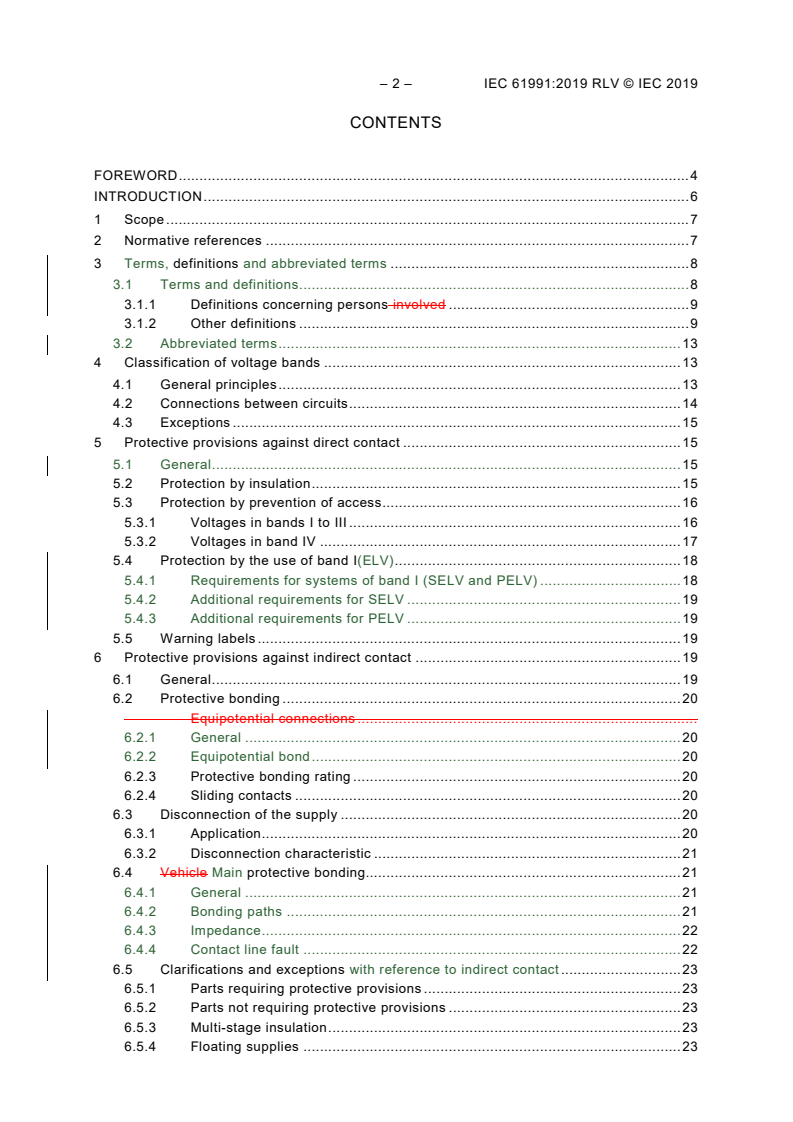
– 2 – IEC 61991:2019 RLV © IEC 2019
CONTENTS
FOREWORD . 4
INTRODUCTION . 6
1 Scope . 7
2 Normative references . 7
3 Terms, definitions and abbreviated terms . 8
3.1 Terms and definitions . 8
3.1.1 Definitions concerning persons involved . 9
3.1.2 Other definitions . 9
3.2 Abbreviated terms . 13
4 Classification of voltage bands . 13
4.1 General principles . 13
4.2 Connections between circuits . 14
4.3 Exceptions . 15
5 Protective provisions against direct contact . 15
5.1 General . 15
5.2 Protection by insulation . 15
5.3 Protection by prevention of access . 16
5.3.1 Voltages in bands I to III . 16
5.3.2 Voltages in band IV . 17
5.4 Protection by the use of band I(ELV) . 18
5.4.1 Requirements for systems of band I (SELV and PELV) . 18
5.4.2 Additional requirements for SELV . 19
5.4.3 Additional requirements for PELV . 19
5.5 Warning labels . 19
6 Protective provisions against indirect contact . 19
6.1 General . 19
6.2 Protective bonding . 20
Equipotential connections .
6.2.1 General . 20
6.2.2 Equipotential bond . 20
6.2.3 Protective bonding rating . 20
6.2.4 Sliding contacts . 20
6.3 Disconnection of the supply . 20
6.3.1 Application . 20
6.3.2 Disconnection characteristic . 21
6.4 Vehicle Main protective bonding. 21
6.4.1 General . 21
6.4.2 Bonding paths . 21
6.4.3 Impedance . 22
6.4.4 Contact line fault . 22
6.5 Clarifications and exceptions with reference to indirect contact . 23
6.5.1 Parts requiring protective provisions . 23
6.5.2 Parts not requiring protective provisions . 23
6.5.3 Multi-stage insulation . 23
6.5.4 Floating supplies . 23
6.5.5 Insulated wheel or levitation systems without a protective conductor . 24
6.6 Additional requirements – Bearings . 24
7 Power circuit . 24
7.1 General principles . 24
7.2 Power circuit insulated from the vehicle body or bogie . 25
7.3 Power circuit using the vehicle body or bogie . 25
8 Additional requirements . 25
8.1 General . 25
8.2 Current collectors . 25
8.3 Capacitors . 26
8.4 Plug and socket devices . 26
8.4.1 Portable apparatus . 26
8.4.2 Vehicle and intervehicle connectors . 27
8.5 Special sources . 27
8.5.1 General . 27
8.5.2 Live parts not requiring protective provisions . 27
8.5.3 Live parts requiring protective provisions . 27
Annex A (normative) List of items where contracting parties shall choose
either a procedure or a mechanical device co-operate . 28
Annex B (informative) Special national conditions . 29
B.1 General . 29
B.2 France . 29
B.3 Great Britain . 29
B.3.1 Operate over 750 V DC third rail electrified lines . 29
B.3.2 Bonding between rail vehicle main body to bogie . 29
B.3.3 Intervehicle bonding . 30
B.4 Japan. 30
B.4.1 General . 30
B.4.2 [6.4.4] Contact line fault . 30
B.4.3 [8.4.1] Portable apparatus . 30
Annex C (informative) Example solutions for impedance management in electric
multiple units (EMUs) . 31
C.1 Preventing absorption of return current in EMUs . 31
C.2 Examples of solutions . 32
Bibliography . 33
Figure C.1 – Concentration of return current . 31
Figure C.2 – Attach earth resistors for long-length EMUs preventing current absorption . 31
Table 1 – Voltage bands . 14
Table 2 – Maximum impedance between each vehicle body of a unit and protective
conductor of the fixed installation . 22
Table B.1 – Voltage bands . 29
– 4 – IEC 61991:2019 RLV © IEC 2019
INTERNATIONAL ELECTROTECHNICAL COMMISSION
____________
RAILWAY APPLICATIONS – ROLLING STOCK –
Protective provisions against electrical hazards
FOREWORD
1) The International Electrotechnical Commission (IEC) is a worldwide organization for standardization comprising
all national electrotechnical committees (IEC National Committees). The object of IEC is to promote
international co-operation on all questions concerning standardization in the electrical and electronic fields. To
this end and in addition to other activities, IEC publishes International Standards, Technical Specifications,
Technical Reports, Publicly Available Specifications (PAS) and Guides (hereafter referred to as “IEC
Publication(s)”). Their preparation is entrusted to technical committees; any IEC National Committee interested
in the subject dealt with may participate in this preparatory work. International, governmental and non-
governmental organizations liaising with the IEC also participate in this preparation. IEC collaborates closely
with the International Organization for Standardization (ISO) in accordance with conditions determined by
agreement between the two organizations.
2) The formal decisions or agreements of IEC on technical matters express, as nearly as possible, an international
consensus of opinion on the relevant subjects since each technical committee has representation from all
interested IEC National Committees.
3) IEC Publications have the form of recommendations for international use and are accepted by IEC National
Committees in that sense. While all reasonable efforts are made to ensure that the technical content of IEC
Publications is accurate, IEC cannot be held responsible for the way in which they are used or for any
misinterpretation by any end user.
4) In order to promote international uniformity, IEC National Committees undertake to apply IEC Publications
transparently to the maximum extent possible in their national and regional publications. Any divergence
between any IEC Publication and the corresponding national or regional publication shall be clearly indicated in
the latter.
5) IEC itself does not provide any attestation of conformity. Independent certification bodies provide conformity
assessment services and, in some areas, access to IEC marks of conformity. IEC is not responsible for any
services carried out by independent certification bodies.
6) All users should ensure that they have the latest edition of this publication.
7) No liability shall attach to IEC or its directors, employees, servants or agents including individual experts and
members of its technical committees and IEC National Committees for any personal injury, property damage or
other damage of any nature whatsoever, whether direct or indirect, or for costs (including legal fees) and
expenses arising out of the publication, use of, or reliance upon, this IEC Publication or any other IEC
Publications.
8) Attention is drawn to the Normative references cited in this publication. Use of the referenced publications is
indispensable for the correct application of this publication.
9) Attention is drawn to the possibility that some of the elements of this IEC Publication may be the subject of
patent rights. IEC shall not be held responsible for identifying any or all such patent rights.
This redline version of the official IEC Standard allows the user to identify the changes
made to the previous edition. A vertical bar appears in the margin wherever a change
has been made. Additions are in green text, deletions are in strikethrough red text.
International Standard IEC 61991 has been prepared by IEC technical committee 9: Electrical
equipment and systems for railways.
This second edition cancels and replaces the first edition, published in 2000. This edition
constitutes a technical revision. It is based on EN 50153:2014.
This edition includes the following significant technical changes with respect to the previous
edition:
a) Replacement of several reference standards.
b) Several terms and abbreviated terms are introduced;
c) Table 2 – Voltage bands for France is moved to Annex B as Table B.1, Table 3 – Voltage
bands for Italy is deleted;
d) Annex B and Annex C are introduced.
e) Annex B includes special national conditions.
The text of this International Standard is based on the following documents:
FDIS Report on voting
9/2467/FDIS 9/2487/RVD
Full information on the voting for the approval of this International Standard can be found in
the report on voting indicated in the above table.
This document has been drafted in accordance with the ISO/IEC Directives, Part 2.
The committee has decided that the contents of this document will remain unchanged until the
stability date indicated on the IEC website under "http://webstore.iec.ch" in the data related to
the specific document. At this date, the document will be
• reconfirmed,
• withdrawn,
• replaced by a revised edition, or
• amended.
IMPORTANT – The “colour inside” logo on the cover page of this publication indicates
that it contains colours which are considered to be useful for the correct understanding
of its contents. Users should therefore print this publication using a colour printer.
– 6 – IEC 61991:2019 RLV © IEC 2019
INTRODUCTION
It is generally accepted that safety depends on human factors, based on the normal behaviour
of the operators involved, as well as upon technical factors.
For these reasons, this document leaves a choice to the contracting parties between two
alternatives in several instances. These alternatives consist of either the provision of
operating rules, regulations and procedures, or the application of technical measures such as
mechanical or electrical interlocking devices.
A list of the cases for which the contracting parties (e.g. user and manufacturer) shall reach
agreement before signing the contract is included in Annex A.
RAILWAY APPLICATIONS – ROLLING STOCK –
Protective provisions against electrical hazards
1 Scope
This document offers a set of rules that are defines requirements applied in the design and
manufacture of electrical installations and equipment to be used on rolling stock to protect
persons from electric shocks.
The methods used to satisfy the rules may differ, in accordance with the procedures and
practices of the operating organization.
This document is applicable to vehicles rolling stock of rail transport systems, road vehicles
transport systems if they are powered by an external supply (e.g. trolley buses), magnetically
levitated vehicles transport systems, and to the electrical equipment installed in these
vehicles systems.
This document does not apply to:
– mine railways in underground mines,
– crane installations, moving platforms and similar transport systems on rails,
– funicular railways,
– temporary constructions.
Testing of vehicles against the requirements of IEC 61991 is not included. For this, refer
to IEC 61133.
The requirements for the fixed installations about the protection against the vehicles’ potential
are not covered in this document.
2 Normative references
The following documents are referred to in the text in such a way that some or all of their
content constitutes requirements of this document. For dated references, only the edition
cited applies. For undated references, the latest edition of the referenced document (including
any amendments) applies.
IEC 60077-1,— Railway applications – Electric equipment for rolling stock – Part 1: General
1)
service conditions and general rules
IEC 60364 (all parts), Electrical installations of buildings
IEC 60364-4-41:1992, Electrical installations of buildings – Part 4: Protection for safety –
Chapter 41: Protection against electric shock
IEC 60364-4-41:2005, Low-voltage electrical installations – Part 4-41: Protection for safety –
Protection against electric shock
—————————
1)
To be published.
– 8 – IEC 61991:2019 RLV © IEC 2019
IEC 60439 (all parts), Low-voltage switchgear and controlgear assemblies
IEC TS 60479-1:1994, Effects of current on human beings and livestock – Part 1: General
aspects
IEC 60529:1989, Degrees of protection provided by enclosures (IP Code)
IEC 60536 (all parts), Classification of electrical and electronic equipment with regard to
protection against electric shock
1)
IEC 60850,— Railway applications – Supply voltages of traction systems
IEC 61140:2016, Protection against electric shock – Common aspects for installation and
equipment
IEC 61310-1:1995, Safety of machinery – Indication, marking and actuation – Part 1:
Requirements for visual, auditory acoustic and tactile signals
IEC 62128,— Railway applications – Protective provisions against electrical hazards –
1)
Electric equipment for fixed installations
IEC 62128-1:2013, Railway applications – Fixed installations – Electrical safety, earthing and
the return circuit – Part 1: Protective provisions against electric shock
IEC 62313, Railway applications – Power supply and rolling stock – Technical criteria for the
coordination between power supply (substation) and rolling stock
IEC 62497-1, Railway applications –Insulation coordination – Part 1: Basic requirements –
Clearances and creepage distances for all electrical and electronic equipment
IEC 62995:2018,Railway applications – Rolling Stock – Rules for installation of cabling
3 Terms, definitions and abbreviated terms
3.1 Terms and definitions
For the purposes of this document, the following terms and definitions apply.
ISO and IEC maintain terminological databases for use in standardization at the following
addresses:
• IEC Electropedia: available at http://www.electropedia.org/
• ISO Online browsing platform: available at http://www.iso.org/obp
NOTE For more information relating to definitions of parts of the fixed installations, refer to IEC 62128-1 from
which these definitions are derived.
NOTE In order to avoid risks of misunderstanding, definitions used in the text are written in italics.
—————————
1)
To be published.
3.1.1 Definitions concerning persons involved
3.1.1.1
instructed person
person informed about the tasks assigned to him and about possible dangers involved in
neglectful behaviour and who, if necessary, has been given a degree of training
person adequately advised or supervised by electrically skilled persons to enable him or her
to perceive risks and to avoid hazards which electricity can create
[SOURCE: IEC 60050-195:1998, 195-04-02]
3.1.1.2
ordinary person
any person who cannot be defined either as a skilled person or as an instructed person
person who is neither a skilled person nor an instructed person
[SOURCE: IEC 60050-195:1998, 195-04-03]
3.1.1.3
skilled person
person who can judge the work assigned to him and recognize possible dangers on the basis
of his professional training, knowledge and experience and of his knowledge of the relevant
requirements
person with relevant education and experience to enable him or her to perceive risks and to
avoid hazards which electricity can create
[SOURCE: IEC 60050-195:1998, 195-04-01]
3.1.2 Other definitions
3.1.2.1
closed electrical operating area
any room or location which serves exclusively for the operation of electrical equipment and is
kept secure by a means appropriate to the voltage and location
Note 1 to entry: Access to such areas is permitted only to (electrically) skilled persons and (electrically) instructed
persons.
Note 2 to entry: The definition of closed electrical operating area can be suitable for underfloor or upperroof
cabinets. Generally speaking, it is any location (inside or outside the car body) which is kept secured because of
the voltage that can be assumed to be present on the equipment inside it. Access to such areas is not allowed to
for ordinary persons.
3.1.2.2
contact line
conductor system for supplying electrical energy to vehicles rolling stock through current-
collecting equipment
[SOURCE: IEC 60050-811:2017, 811-33-01, modified – The term “vehicle” has been replaced
by “rolling stock” and Note 1 to entry has been omitted.]
3.1.2.3
contact wire
electric conductor of an overhead contact line with which the current collectors make contact
[SOURCE: IEC 60050-811:2017, 811-33-15]
– 10 – IEC 61991:2019 RLV © IEC 2019
3.1.2.4
direct contact
electric contact of persons or livestock animals with live parts
[SOURCE: IEC 60050-195:1998, 195-06-03]
3.1.2.5
double insulation
insulation comprising both basic insulation and supplementary insulation
[SOURCE: IEC 60050-195:1998, 195-06-08]
3.1.2.6
earth
conductive mass of the earth, whose electrical potential at any point is conventionally taken
as equal to zero
3.1.2.7
electrical operating area
any room or location which serves primarily for the operation of electrical equipment and is
normally entered only by skilled persons or (electrically) instructed persons
NOTE The definition of closed electrical operating area can be suitable for underfloor or upper roof cabinets.
Generally speaking it is any location (inside or outside the car body) which is kept secure because of the voltage
that can assume the equipment inside it. Access to such areas is not allowed to ordinary persons.
Note 1 to entry: Generally speaking, an electrical operating area is any location (mainly inside the car body)
where electrical equipment operates. The above is the main function of this area but not the only one. In fact,
normally the area is not kept secured and protection against direct contact is achieved by other means (e.g.
(electrically) protective obstacles).
3.1.2.8
electric shock
dangerous physiological effect resulting from an electric current passing through a human or
animal body
[SOURCE: IEC 60050-195:1998, 195-01-04]
3.1.2.9
extra-low voltage
voltage not exceeding the relevant voltage limit of band II specified in Table 1
[SOURCE: IEC 60050-826:2004, 826-12-30, modified – The term “band I” has been replaced
by “band II” and “IEC 60449” has been replaced by “Table 1”.]
3.1.2.10
equipotential bond
electrical connection putting various exposed conductive parts at a substantially equal
potential
Note 1 to entry: This can be abbreviated as ‘bond’ or ‘bonding’.
3.1.2.11
exposed conductive part
any metallic or other form of conductive material which is not energized except in case of
failure, and which may be accessible to touch
conductive part of electrical equipment, which can be touched and which is not normally live,
but can become live when basic insulation fails
Note 1 to entry: A conductive part of electrical equipment which can only become live through contact with an
exposed conductive part which has become live is not considered to be an exposed conductive part itself.
3.2.9
failure
termination of the ability of an item to perform a required function
3.2.10
hazard
condition that can lead to a potential accident or an actual accident
3.1.2.12
indirect contact
electric contact of persons or livestock animals with exposed conductive parts which have
become live under fault conditions
[SOURCE: IEC 60050-195:1998, 195-06-04]
3.1.2.13
interlocking device
device which makes the operation of a switching device dependent upon the position or
operation of one or more other pieces of equipment
[SOURCE: IEC 60050-441:2000, 441-16-49]
3.1.2.14
insulate, verb
prevent electric conduction between conductive elements by means of insulating materials
[SOURCE: IEC 60050-151:2001, 151-15-36]
3.1.2.15
insulation
all the materials and parts used to insulate conductive elements of a device
[SOURCE: IEC 60050-151:2001, 151-15-41]
3.1.2.16
live part
conductor or conductive part intended to be energized in normal use, including a neutral
conductor
Note 1 to entry: This concept does not necessarily imply a risk of electric shock.
Note 2 to entry: By convention, this does not include the running rails and parts connected to them.
[SOURCE: IEC 60050-811:2017, 811-36-23]
3.1.2.17
locking system
system which comprises interlocking devices and physically prevents access to live parts
unless the supply of electrical energy to the live parts has been isolated and made safe
3.1.2.18
mechanical locking
use of a lock or bolted /screwed fixings to prevent access panels or doors being opened and
require the use of a key or tool to remove
– 12 – IEC 61991:2019 RLV © IEC 2019
3.1.2.19
multi-stage insulation
insulation system having more than one stage of insulation and an intermediate frame
between consecutive stages
[SOURCE: IEC 60322:2001, 3.4, modified – Notes have been deleted.]
3.1.2.20
nominal voltage
voltage by which an installation or part of an installation is designated
suitable approximate value of voltage used to designate or identify a system
Note 1 to entry: The voltages are expressed by the value between poles, ripple-free for DC and by the RMS value
between phases for AC.
Note 2 to entry: The actual voltage may can differ from the nominal voltage by a quantity within permitted
tolerances. For further information about traction systems supply voltages, see IEC 60850.
[SOURCE: IEC 60050-601:1985, 601-01-21, modified – Notes to entry have been added.]
3.1.2.21
PELV system
electric system in which the voltage cannot exceed the value of extra-low voltage:
– under normal conditions and
– under single fault conditions, except earth faults in other electric circuits
[SOURCE: IEC 60050-826:2004, 826-12-32, modified – Note has been deleted.]
3.1.2.22
protective obstacle
part preventing unintentional direct contact, but not preventing direct contact by deliberate
action
[SOURCE: IEC 60050-195:1998, 195-06-16]
3.1.2.23
power circuit
circuit carrying the current of the machines and equipment, such as the converters and
traction motors, which transmit the traction output
[SOURCE: IEC 60050-811:2017, 811-25-03]
3.2.17
protective bonding
equipotential connection for protective purposes
3.1.2.24
protective conductor
conductor used for some protective measures for protection against electric shock for
electrically connecting any of the following parts:
– exposed conductive parts;
– main earthing terminal;
– earth electrode;
– earthed point of the source or artificial neutral.
conductor provided for purposes of safety, for example protection against electric shock
[SOURCE: IEC 60050-195:1998, 195-02-09]
3.1.2.25
protective-equipotential-bonding
equipotential bonding for the purposes of safety
[SOURCE: IEC 60050-195:1998, 195-01-15]
3.1.2.26
SELV system
electric system in which the voltage cannot exceed the value of extra-low voltage:
– under normal conditions and
– under single fault conditions, including earth faults in other electric circuits
[SOURCE: IEC 60050-826:2004, 826-12-31, modified – Note has been deleted.]
3.1.2.27
total insulation
insulation composed of basic insulation as provision for basic protection, and supplementary
insulation as provision for fault protection, or providing basic and fault protection by reinforced
insulation, in accordance with IEC 61140:2016, 7.4
[SOURCE: IEC 60050-851:2008/AMD1:2014, 851-15-11, modified – “equipment with” has
been replaced with “insulation composed of” and“IEC 61140:2011,7.3” has been replaced
with “IEC 61140:2016,7.4”.]
3.1.2.28
Unit
minimum operational formation comprising one or more vehicles coupled together
3.2 Abbreviated terms
AC Alternating Current
DC Direct Current
ELV Extra Low Voltage
EMU Electric Multiple Unit
PELV Protective Extra Low Voltage
RMS root-mean-square value (effective value)
SELV Safety Extra Low Voltage
4 Classification of voltage bands
4.1 General principles
In this document is, the applicable protective measures are based on the maximum highest
value of the nominal supply voltages at which the equipment or the electrical circuits are
subjected to.
The voltages are classified into bands according to the nominal value as shown in Table 1 to
3. Different installation rules apply to each of these bands.
The power supply of the various circuits installed in railway rolling stock are of can be from
different types sources such as:
– batteries,
– 14 – IEC 61991:2019 RLV © IEC 2019
– transformers,
– voltage dividers,
– rotating machines,
– static converters,
– capacitors,
– special sources.
Table 1 – Voltage bands
Nominal voltage
U
n
Band
AC DC
V V
I U ≤ 25 U ≤ 60
II
25 < U ≤ 50 60 < U ≤ 120
III 50 < U ≤ 1 000 120 < U ≤ 1 500
IV
U > 1 000 U > 1 500
In some countries such as France, the following table 2 applies:
Table 2 – Voltage bands
Nominal voltage
Band AC DC
V V
I U ≤ 25 U ≤ 60
II
25 < U ≤ 50 60 < U ≤ 120
III 50 < U ≤ 500 120 < U ≤ 750
IV U > 500 U > 750
In some countries such as Italy, the following table 3 applies:
Table 3 – Voltage bands
Nominal voltage
Band AC DC
V V
I U ≤ 25 U ≤ 50
III
25 < U ≤ 400 50 < U ≤ 600
IV U > 400 U > 600
NOTE The special national conditions for France are listed in Annex B, Clause B.2.
4.2 Connections between circuits
Circuits operating at different nominal voltages connected by power conversion equipment
which does not provides a conducting path between them, or circuits which are linked only by
a connection direct to the vehicle body external to the power conversion circuitry, shall be
sufficient insulation between them are individually classified at the nominal voltage of each
circuit.
If the conducting paths referred to in this subclause include capacitive or inductive
connections, whose impedance is low enough to induce hazardous voltages into any circuit
under either normal or fault conditions, then all the circuits so connected shall be are
classified at the nominal voltage of the highest voltage circuit.
NOTE This condition can apply to circuits connected, for example, by means of a chopper converter with
impedance coupling.
Where circuits are linked conductively to a higher voltage source other than simply directly by
circuit bonds connected to the vehicle body (for example by an auto-transformer or potential
divider), all circuits in the group shall be are treated as if energized at the nominal voltage of
the source, unless the conditions of 4.3 have been met.
4.3 Exceptions
If voltage conversion from one band to another involves overvoltage detection resulting in
disconnection of the primary or the secondary circuit, or having other means capable of
preventing excessive voltage in the secondary circuit, then the secondary circuit shall is
permitted to be classified according to the highest voltage at which the detection equipment
will operate. Where overvoltage detection is used the integrity of the equipment should be
evaluated as appropriate.
NOTE The integrity of the detection equipment should be taken into account.
Circuits not connected to the vehicle body, for example floating supplies, shall be classified as
appropriate in order to ensure that the requirements of this standard are met, taking due
account of the potentials possible in such circuits under normal or fault conditions are
permitted to be classified in any voltage band. The band selected should be appropriate,
taking due account of the various potentials possible in such circuits under normal or fault
conditions so as to ensure that the requirements of this document are met.
The limit between bands III and IV is allowed to be lowered to take account of special national
conditions.
5 Protective provisions against direct contact
5.1 General
Live parts capable of causing an electric shock shall be protected against direct contact. All
types of equipment shall be capable of being operated without loss of protection against direct
contact. Protection against direct contact shall be provided, where possible, by at least one of
the means described in 5.2 to 5.3, supplemented as necessary by warning labels as
described in 5.4.
Where it is not possible to provide protective provisions in accordance with 5.2 or 5.3, then it
is permitted to use protection by the use of band I voltage in accordance with the conditions
of 5.4.
Additionally where required to ensure adequate protection against direct contact, warning
labels as described in 5.5 shall be provided.
5.2 Protection by insulation
In addition to the requirements of IEC 60077-1 IEC 62497-1, the insulating materials used to
cover live parts shall be appropriate to the nominal rated equipment operating voltage and the
– 16 – IEC 61991:2019 RLV © IEC 2019
conditions of use. Further provisions should be considered in order to minimize the
consequences of damage.
5.3 Protection by prevention of access
Access to live parts shall be prevented by placing them within closed electrical operating
areas or by placing them out of reach. The rest of this standard explains the measures
required.
5.3.1 Voltages in bands I to III
5.3.1.1 Protection by the use of closed electrical operating areas
Live parts within the vehicle, energized with voltages in bands I to III shall be contained within
closed electrical operating areas.
Access to closed electrical operating areas containing energized live parts is permitted as
follows:
– band I and II: access is permitted to (electrically) instructed persons and skilled persons;
– band III: access is only permitted to (electrically) instructed persons and skilled persons
provided that all reasonably practicable precautions are taken against unintended direct
contact are taken.
Prevention of access can shall be achieved either by mechanical locking or by physical
separation, supported by labels or procedures appropriate to the location and the equipment
enclosed supported with procedures and warning labels appropriate to the location and
equipment enclosed.
Means of preventing access shall comply with the following:
• in areas within vehicles, accessible to ordinary persons, screens and covers shall conform
to the degree of protection IP4X as set out in IEC 60529, or, where these are electrically
connected to the vehicle body, to the degree of protection IP2XD as set out in IEC 60529;
the requirements of this subclause do not apply to plug connectors, lamp holders without
lamps or and fuse sockets for screw-in type fuses without inserts;
• in other areas where grid or mesh screens are used, these shall be placed at a sufficient
distance to prevent any direct contact, taking into account possible buckling or warping.
5.3.1.2 Protection by the use of electrical operating areas
Where the conditions of 5.2.1.1 do not apply, then For live parts shall be contained within an
electrical operating areas and the following shall apply:
– protection against direct contact is not required for live parts energized within bands I
and II, provided that these meet the requirements of clause 8;
– live parts energized within bands I and II need no protection against direct contact
provided that the requirements of 8.5.2 are met.
– the use of (electrically) protective obstacles to afford a limited protection against direct
contact with live parts at band III voltages may be acceptable in electrical operating areas
inaccessible to ordinary persons by their location (such as underframe cases, roofs,
interiors of motor units, excluding driver's cabs), provided that the hazard is readily
identifiable. For example, it is acceptable for fuses and isolating links of equipment at
band III voltages, whose grips are protected with an insulating material, not to be
protected. Such units components shall only be situated in electrical operating areas.
5.3.1.3 Protection by clearance
For live parts on the outside of the vehicle (e.g. current collectors, roof conductors, resistors)
which are potentially accessible to persons in a straight line from any standing surface in, on
or by vehicles, protection against direct contact by means of clearance shall be provided if no
other protective measures as defined in this document are used.
NOTE Accessible in a straight line implies that live parts can be touched from a standing surface without use of
specially shaped objects.
Protection by clearance is considered to be provided, if at least the clearances from standing
surfaces to live parts depicted in IEC 62128 (under consideration) IEC 62128-1:2013, Figure 3,
are maintained, excepting the condition of shoe gear adjacent to the platform edge.
This protection is considered to be present, if contact with live parts is possible but clearance
is afforded by virtue in case of the movement of the vehicle (e.g. on road and foot-crossings).
Where only (electrically) instructed persons and skilled persons have access and where
operation of the system makes protection by clearance impossible (e.g. systems using third
and/or third and fourth rail power supplies) protection shall be afforded by procedure.
5.3.1.4 Protection against hazards from external power supply bus lines
Access to live parts that may be energized with voltage band III when the supply system is
likely to be energized from an external source power supply (e.g. another vehicle, preheating
equipment, shed supply, etc.) shall be prevented by an interlocking device or a procedure.
Connectors in the power supply bus line shall be fitted with warning labels as set out in 5.5.
5.3.2 Voltages in band IV
5.3.2.1 Protection by the use of closed electrical operating areas
Access to live parts energized with voltages in band IV shall be excluded to all persons
including skilled persons.
Access to live parts normally energized with voltages in band IV shall only be possible to
(electrically) instructed persons and skilled persons after the live parts have been
de-energized and made safe by one or more of the following method
...
IEC 61991 ®
Edition 2.0 2019-05
INTERNATIONAL
STANDARD
NORME
INTERNATIONALE
Railway applications – Rolling stock –
Protective provisions against electrical hazards
Applications ferroviaires – Matériel roulant –
Dispositions de protection contre les dangers électriques
All rights reserved. Unless otherwise specified, no part of this publication may be reproduced or utilized in any form
or by any means, electronic or mechanical, including photocopying and microfilm, without permission in writing from
either IEC or IEC's member National Committee in the country of the requester. If you have any questions about IEC
copyright or have an enquiry about obtaining additional rights to this publication, please contact the address below or
your local IEC member National Committee for further information.
Droits de reproduction réservés. Sauf indication contraire, aucune partie de cette publication ne peut être reproduite
ni utilisée sous quelque forme que ce soit et par aucun procédé, électronique ou mécanique, y compris la photocopie
et les microfilms, sans l'accord écrit de l'IEC ou du Comité national de l'IEC du pays du demandeur. Si vous avez des
questions sur le copyright de l'IEC ou si vous désirez obtenir des droits supplémentaires sur cette publication, utilisez
les coordonnées ci-après ou contactez le Comité national de l'IEC de votre pays de résidence.
IEC Central Office Tel.: +41 22 919 02 11
3, rue de Varembé info@iec.ch
CH-1211 Geneva 20 www.iec.ch
Switzerland
About the IEC
The International Electrotechnical Commission (IEC) is the leading global organization that prepares and publishes
International Standards for all electrical, electronic and related technologies.
About IEC publications
The technical content of IEC publications is kept under constant review by the IEC. Please make sure that you have the
latest edition, a corrigendum or an amendment might have been published.
IEC publications search - webstore.iec.ch/advsearchform Electropedia - www.electropedia.org
The advanced search enables to find IEC publications by a The world's leading online dictionary on electrotechnology,
variety of criteria (reference number, text, technical containing more than 22 000 terminological entries in English
committee,…). It also gives information on projects, replaced and French, with equivalent terms in 16 additional languages.
and withdrawn publications. Also known as the International Electrotechnical Vocabulary
(IEV) online.
IEC Just Published - webstore.iec.ch/justpublished
Stay up to date on all new IEC publications. Just Published IEC Glossary - std.iec.ch/glossary
details all new publications released. Available online and 67 000 electrotechnical terminology entries in English and
once a month by email. French extracted from the Terms and Definitions clause of
IEC publications issued since 2002. Some entries have been
IEC Customer Service Centre - webstore.iec.ch/csc collected from earlier publications of IEC TC 37, 77, 86 and
If you wish to give us your feedback on this publication or CISPR.
need further assistance, please contact the Customer Service
Centre: sales@iec.ch.
A propos de l'IEC
La Commission Electrotechnique Internationale (IEC) est la première organisation mondiale qui élabore et publie des
Normes internationales pour tout ce qui a trait à l'électricité, à l'électronique et aux technologies apparentées.
A propos des publications IEC
Le contenu technique des publications IEC est constamment revu. Veuillez vous assurer que vous possédez l’édition la
plus récente, un corrigendum ou amendement peut avoir été publié.
Recherche de publications IEC - Electropedia - www.electropedia.org
webstore.iec.ch/advsearchform Le premier dictionnaire d'électrotechnologie en ligne au
La recherche avancée permet de trouver des publications IEC monde, avec plus de 22 000 articles terminologiques en
en utilisant différents critères (numéro de référence, texte, anglais et en français, ainsi que les termes équivalents dans
comité d’études,…). Elle donne aussi des informations sur les 16 langues additionnelles. Egalement appelé Vocabulaire
projets et les publications remplacées ou retirées. Electrotechnique International (IEV) en ligne.
IEC Just Published - webstore.iec.ch/justpublished Glossaire IEC - std.iec.ch/glossary
Restez informé sur les nouvelles publications IEC. Just 67 000 entrées terminologiques électrotechniques, en anglais
Published détaille les nouvelles publications parues. et en français, extraites des articles Termes et Définitions des
Disponible en ligne et une fois par mois par email. publications IEC parues depuis 2002. Plus certaines entrées
antérieures extraites des publications des CE 37, 77, 86 et
Service Clients - webstore.iec.ch/csc CISPR de l'IEC.
Si vous désirez nous donner des commentaires sur cette
publication ou si vous avez des questions contactez-nous:
sales@iec.ch.
IEC 61991 ®
Edition 2.0 2019-05
INTERNATIONAL
STANDARD
NORME
INTERNATIONALE
Railway applications – Rolling stock –
Protective provisions against electrical hazards
Applications ferroviaires – Matériel roulant –
Dispositions de protection contre les dangers électriques
INTERNATIONAL
ELECTROTECHNICAL
COMMISSION
COMMISSION
ELECTROTECHNIQUE
INTERNATIONALE
ICS 45.060.01 ISBN 978-2-8322-6596-3
– 2 – IEC 61991:2019 © IEC 2019
CONTENTS
FOREWORD . 4
INTRODUCTION . 6
1 Scope . 7
2 Normative references . 7
3 Terms, definitions and abbreviated terms . 8
3.1 Terms and definitions . 8
3.1.1 Definitions concerning persons . 8
3.1.2 Other definitions . 8
3.2 Abbreviated terms . 12
4 Classification of voltage bands . 12
4.1 General principles . 12
4.2 Connections between circuits . 13
4.3 Exceptions . 13
5 Protective provisions against direct contact . 14
5.1 General . 14
5.2 Protection by insulation . 14
5.3 Protection by prevention of access . 14
5.3.1 Voltages in bands I to III . 14
5.3.2 Voltages in band IV . 15
5.4 Protection by the use of band I (ELV) . 16
5.4.1 Requirements for systems of band I (SELV and PELV) . 16
5.4.2 Additional requirements for SELV . 16
5.4.3 Additional requirements for PELV . 16
5.5 Warning labels . 16
6 Protective provisions against indirect contact . 17
6.1 General . 17
6.2 Protective bonding . 17
6.2.1 General . 17
6.2.2 Equipotential bond . 17
6.2.3 Protective bonding rating . 17
6.2.4 Sliding contacts . 18
6.3 Disconnection of the supply . 18
6.3.1 Application . 18
6.3.2 Disconnection characteristic . 18
6.4 Main protective bonding . 18
6.4.1 General . 18
6.4.2 Bonding paths . 18
6.4.3 Impedance . 19
6.4.4 Contact line fault . 20
6.5 Clarifications and exceptions with reference to indirect contact . 20
6.5.1 Parts requiring protective provisions . 20
6.5.2 Parts not requiring protective provisions . 20
6.5.3 Multi-stage insulation . 20
6.5.4 Floating supplies . 21
6.5.5 Insulated wheel or levitation systems without a protective conductor . 21
6.6 Additional requirements – Bearings . 21
7 Power circuit . 21
7.1 General principles . 21
7.2 Power circuit insulated from the vehicle body or bogie . 22
7.3 Power circuit using the vehicle body or bogie . 22
8 Additional requirements . 22
8.1 General . 22
8.2 Current collectors . 22
8.3 Capacitors . 22
8.4 Plug and socket devices . 23
8.4.1 Portable apparatus . 23
8.4.2 Vehicle and intervehicle connectors . 23
8.5 Special sources . 24
8.5.1 General . 24
8.5.2 Live parts not requiring protective provisions . 24
8.5.3 Live parts requiring protective provisions . 24
Annex A (normative) List of items where contracting parties shall co-operate . 25
Annex B (informative) Special national conditions . 26
B.1 General . 26
B.2 France . 26
B.3 Great Britain . 26
B.3.1 Operate over 750 V DC third rail electrified lines . 26
B.3.2 Bonding between rail vehicle main body to bogie . 26
B.3.3 Intervehicle bonding . 27
B.4 Japan. 27
B.4.1 General . 27
B.4.2 [6.4.4] Contact line fault . 27
B.4.3 [8.4.1] Portable apparatus . 27
Annex C (informative) Example solutions for impedance management in electric
multiple units (EMUs) . 28
C.1 Preventing absorption of return current in EMUs . 28
C.2 Examples of solutions . 29
Bibliography . 30
Figure C.1 – Concentration of return current . 28
Figure C.2 – Attach earth resistors for long-length EMUs preventing current absorption . 28
Table 1 – Voltage bands . 13
Table 2 – Maximum impedance between each vehicle body of a unit and protective
conductor of the fixed installation . 19
Table B.1 – Voltage bands . 26
– 4 – IEC 61991:2019 © IEC 2019
INTERNATIONAL ELECTROTECHNICAL COMMISSION
____________
RAILWAY APPLICATIONS – ROLLING STOCK –
Protective provisions against electrical hazards
FOREWORD
1) The International Electrotechnical Commission (IEC) is a worldwide organization for standardization comprising
all national electrotechnical committees (IEC National Committees). The object of IEC is to promote
international co-operation on all questions concerning standardization in the electrical and electronic fields. To
this end and in addition to other activities, IEC publishes International Standards, Technical Specifications,
Technical Reports, Publicly Available Specifications (PAS) and Guides (hereafter referred to as “IEC
Publication(s)”). Their preparation is entrusted to technical committees; any IEC National Committee interested
in the subject dealt with may participate in this preparatory work. International, governmental and non-
governmental organizations liaising with the IEC also participate in this preparation. IEC collaborates closely
with the International Organization for Standardization (ISO) in accordance with conditions determined by
agreement between the two organizations.
2) The formal decisions or agreements of IEC on technical matters express, as nearly as possible, an international
consensus of opinion on the relevant subjects since each technical committee has representation from all
interested IEC National Committees.
3) IEC Publications have the form of recommendations for international use and are accepted by IEC National
Committees in that sense. While all reasonable efforts are made to ensure that the technical content of IEC
Publications is accurate, IEC cannot be held responsible for the way in which they are used or for any
misinterpretation by any end user.
4) In order to promote international uniformity, IEC National Committees undertake to apply IEC Publications
transparently to the maximum extent possible in their national and regional publications. Any divergence
between any IEC Publication and the corresponding national or regional publication shall be clearly indicated in
the latter.
5) IEC itself does not provide any attestation of conformity. Independent certification bodies provide conformity
assessment services and, in some areas, access to IEC marks of conformity. IEC is not responsible for any
services carried out by independent certification bodies.
6) All users should ensure that they have the latest edition of this publication.
7) No liability shall attach to IEC or its directors, employees, servants or agents including individual experts and
members of its technical committees and IEC National Committees for any personal injury, property damage or
other damage of any nature whatsoever, whether direct or indirect, or for costs (including legal fees) and
expenses arising out of the publication, use of, or reliance upon, this IEC Publication or any other IEC
Publications.
8) Attention is drawn to the Normative references cited in this publication. Use of the referenced publications is
indispensable for the correct application of this publication.
9) Attention is drawn to the possibility that some of the elements of this IEC Publication may be the subject of
patent rights. IEC shall not be held responsible for identifying any or all such patent rights.
International Standard IEC 61991 has been prepared by IEC technical committee 9: Electrical
equipment and systems for railways.
This second edition cancels and replaces the first edition, published in 2000. This edition
constitutes a technical revision. It is based on EN 50153:2014.
This edition includes the following significant technical changes with respect to the previous
edition:
a) Replacement of several reference standards.
b) Several terms and abbreviated terms are introduced;
c) Table 2 – Voltage bands for France is moved to Annex B as Table B.1, Table 3 – Voltage
bands for Italy is deleted;
d) Annex B and Annex C are introduced.
e) Annex B includes special national conditions.
The text of this International Standard is based on the following documents:
FDIS Report on voting
9/2467/FDIS 9/2487/RVD
Full information on the voting for the approval of this International Standard can be found in
the report on voting indicated in the above table.
This document has been drafted in accordance with the ISO/IEC Directives, Part 2.
The committee has decided that the contents of this document will remain unchanged until the
stability date indicated on the IEC website under "http://webstore.iec.ch" in the data related to
the specific document. At this date, the document will be
• reconfirmed,
• withdrawn,
• replaced by a revised edition, or
• amended.
– 6 – IEC 61991:2019 © IEC 2019
INTRODUCTION
It is generally accepted that safety depends on human factors, based on the normal behaviour
of the operators involved, as well as upon technical factors.
For these reasons, this document leaves a choice to the contracting parties between two
alternatives in several instances. These alternatives consist of either the provision of
operating rules, regulations and procedures, or the application of technical measures such as
mechanical or electrical interlocking devices.
A list of the cases for which the contracting parties (e.g. user and manufacturer) shall reach
agreement before signing the contract is included in Annex A.
RAILWAY APPLICATIONS – ROLLING STOCK –
Protective provisions against electrical hazards
1 Scope
This document defines requirements applied in the design and manufacture of electrical
installations and equipment to be used on rolling stock to protect persons from electric shocks.
This document is applicable to rolling stock of rail transport systems, road transport systems if
they are powered by an external supply (e.g. trolley buses), magnetically levitated transport
systems, and to the electrical equipment installed in these systems.
This document does not apply to:
– mine railways in mines,
– crane installations, moving platforms and similar transport systems on rails,
– funicular railways,
– temporary constructions.
The requirements for the fixed installations about the protection against the vehicles’ potential
are not covered in this document.
2 Normative references
The following documents are referred to in the text in such a way that some or all of their
content constitutes requirements of this document. For dated references, only the edition
cited applies. For undated references, the latest edition of the referenced document (including
any amendments) applies.
IEC 60364-4-41:2005, Low-voltage electrical installations – Part 4-41: Protection for safety –
Protection against electric shock
IEC TS 60479-1, Effects of current on human beings and livestock – Part 1: General aspects
IEC 60529, Degrees of protection provided by enclosures (IP Code)
IEC 61140:2016, Protection against electric shock – Common aspects for installation and
equipment
IEC 61310-1, Safety of machinery – Indication, marking and actuation – Part 1: Requirements
for visual, acoustic and tactile signals
IEC 62128-1:2013, Railway applications – Fixed installations – Electrical safety, earthing and
the return circuit – Part 1: Protective provisions against electric shock
IEC 62313, Railway applications – Power supply and rolling stock – Technical criteria for the
coordination between power supply (substation) and rolling stock
IEC 62497-1, Railway applications –Insulation coordination – Part 1: Basic requirements –
Clearances and creepage distances for all electrical and electronic equipment
– 8 – IEC 61991:2019 © IEC 2019
IEC 62995:2018,Railway applications – Rolling Stock – Rules for installation of cabling
3 Terms, definitions and abbreviated terms
3.1 Terms and definitions
For the purposes of this document, the following terms and definitions apply.
ISO and IEC maintain terminological databases for use in standardization at the following
addresses:
• IEC Electropedia: available at http://www.electropedia.org/
• ISO Online browsing platform: available at http://www.iso.org/obp
NOTE For more information relating to definitions of parts of the fixed installations, refer to IEC 62128-1 from
which these definitions are derived.
3.1.1 Definitions concerning persons
3.1.1.1
instructed person
person adequately advised or supervised by electrically skilled persons to enable him or her
to perceive risks and to avoid hazards which electricity can create
[SOURCE: IEC 60050-195:1998, 195-04-02]
3.1.1.2
ordinary person
person who is neither a skilled person nor an instructed person
[SOURCE: IEC 60050-195:1998, 195-04-03]
3.1.1.3
skilled person
person with relevant education and experience to enable him or her to perceive risks and to
avoid hazards which electricity can create
[SOURCE: IEC 60050-195:1998, 195-04-01]
3.1.2 Other definitions
3.1.2.1
closed electrical operating area
room or location which serves exclusively for the operation of electrical equipment and is kept
secure by a means appropriate to the voltage and location
Note 1 to entry: Access to such areas is permitted only to (electrically) skilled persons and (electrically) instructed
persons.
Note 2 to entry: The definition of closed electrical operating area can be suitable for underfloor or upperroof
cabinets. Generally speaking, it is any location (inside or outside the car body) which is kept secured because of
the voltage that can be assumed to be present on the equipment inside it. Access to such areas is not allowed for
ordinary persons.
3.1.2.2
contact line
conductor system for supplying electrical energy to rolling stock through current-collecting
equipment
[SOURCE: IEC 60050-811:2017, 811-33-01, modified – The term “vehicle” has been replaced
by “rolling stock” and Note 1 to entry has been omitted.]
3.1.2.3
contact wire
electric conductor of an overhead contact line with which the current collectors make contact
[SOURCE: IEC 60050-811:2017, 811-33-15]
3.1.2.4
direct contact
electric contact of persons or animals with live parts
[SOURCE: IEC 60050-195:1998, 195-06-03]
3.1.2.5
double insulation
insulation comprising both basic insulation and supplementary insulation
[SOURCE: IEC 60050-195:1998, 195-06-08]
3.1.2.6
earth
conductive mass of the earth, whose electrical potential at any point is conventionally taken
as equal to zero
3.1.2.7
electrical operating area
room or location which serves primarily for the operation of electrical equipment and is
normally entered only by skilled persons or (electrically) instructed persons
Note 1 to entry: Generally speaking, an electrical operating area is any location (mainly inside the car body)
where electrical equipment operates. The above is the main function of this area but not the only one. In fact,
normally the area is not kept secured and protection against direct contact is achieved by other means (e.g.
(electrically) protective obstacles).
3.1.2.8
electric shock
physiological effect resulting from an electric current passing through a human or animal body
[SOURCE: IEC 60050-195:1998, 195-01-04]
3.1.2.9
extra-low voltage
voltage not exceeding the relevant voltage limit of band II specified in Table 1
[SOURCE: IEC 60050-826:2004, 826-12-30, modified – The term “band I” has been replaced
by “band II” and “IEC 60449” has been replaced by “Table 1”.]
3.1.2.10
equipotential bond
electrical connection putting various exposed conductive parts at a substantially equal
potential
Note 1 to entry: This can be abbreviated as ‘bond’ or ‘bonding’.
– 10 – IEC 61991:2019 © IEC 2019
3.1.2.11
exposed conductive part
conductive part of electrical equipment, which can be touched and which is not normally live,
but can become live when basic insulation fails
Note 1 to entry: A conductive part of electrical equipment which can only become live through contact with an
exposed conductive part which has become live is not considered to be an exposed conductive part itself.
3.1.2.12
indirect contact
electric contact of persons or animals with exposed conductive parts which have become live
under fault conditions
[SOURCE: IEC 60050-195:1998, 195-06-04]
3.1.2.13
interlocking device
device which makes the operation of a switching device dependent upon the position or
operation of one or more other pieces of equipment
[SOURCE: IEC 60050-441:2000, 441-16-49]
3.1.2.14
insulate, verb
prevent electric conduction between conductive elements by means of insulating materials
[SOURCE: IEC 60050-151:2001, 151-15-36]
3.1.2.15
insulation
all the materials and parts used to insulate conductive elements of a device
[SOURCE: IEC 60050-151:2001, 151-15-41]
3.1.2.16
live part
conductor or conductive part intended to be energized in normal use
Note 1 to entry: This concept does not necessarily imply a risk of electric shock.
Note 2 to entry: By convention, this does not include the running rails and parts connected to them.
[SOURCE: IEC 60050-811:2017, 811-36-23]
3.1.2.17
locking system
system which comprises interlocking devices and physically prevents access to live parts
unless the supply of electrical energy to the live parts has been isolated and made safe
3.1.2.18
mechanical locking
use of a lock or bolted /screwed fixings to prevent access panels or doors being opened and
require the use of a key or tool to remove
3.1.2.19
multi-stage insulation
insulation system having more than one stage of insulation and an intermediate frame
between consecutive stages
[SOURCE: IEC 60322:2001, 3.4, modified – Notes have been deleted.]
3.1.2.20
nominal voltage
suitable approximate value of voltage used to designate or identify a system
Note 1 to entry: The voltages are expressed by the value between poles, ripple-free for DC and by the RMS value
between phases for AC.
Note 2 to entry: The actual voltage can differ from the nominal voltage by a quantity within permitted tolerances.
For further information about traction systems supply voltages, see IEC 60850.
[SOURCE: IEC 60050-601:1985, 601-01-21, modified – Notes to entry have been added.]
3.1.2.21
PELV system
electric system in which the voltage cannot exceed the value of extra-low voltage:
– under normal conditions and
– under single fault conditions, except earth faults in other electric circuits
[SOURCE: IEC 60050-826:2004, 826-12-32, modified – Note has been deleted.]
3.1.2.22
protective obstacle
part preventing unintentional direct contact, but not preventing direct contact by deliberate
action
[SOURCE: IEC 60050-195:1998, 195-06-16]
3.1.2.23
power circuit
circuit carrying the current of the machines and equipment, such as the converters and
traction motors, which transmit the traction output
[SOURCE: IEC 60050-811:2017, 811-25-03]
3.1.2.24
protective conductor
conductor provided for purposes of safety, for example protection against electric shock
[SOURCE: IEC 60050-195:1998, 195-02-09]
3.1.2.25
protective-equipotential-bonding
equipotential bonding for the purposes of safety
[SOURCE: IEC 60050-195:1998, 195-01-15]
3.1.2.26
SELV system
electric system in which the voltage cannot exceed the value of extra-low voltage:
– under normal conditions and
– under single fault conditions, including earth faults in other electric circuits
[SOURCE: IEC 60050-826:2004, 826-12-31, modified – Note has been deleted.]
– 12 – IEC 61991:2019 © IEC 2019
3.1.2.27
total insulation
insulation composed of basic insulation as provision for basic protection, and supplementary
insulation as provision for fault protection, or providing basic and fault protection by reinforced
insulation, in accordance with IEC 61140:2016, 7.4
[SOURCE: IEC 60050-851:2008/AMD1:2014, 851-15-11, modified – “equipment with” has
been replaced with “insulation composed of” and“IEC 61140:2011,7.3” has been replaced
with “IEC 61140:2016,7.4”.]
3.1.2.28
Unit
minimum operational formation comprising one or more vehicles coupled together
3.2 Abbreviated terms
AC Alternating Current
DC Direct Current
ELV Extra Low Voltage
EMU Electric Multiple Unit
PELV Protective Extra Low Voltage
RMS root-mean-square value (effective value)
SELV Safety Extra Low Voltage
4 Classification of voltage bands
4.1 General principles
In this document, the applicable protective measures are based on the highest value of the
nominal supply voltage which the equipment or the electrical circuits are subjected to.
The voltages are classified into bands according to the nominal value as shown in Table 1.
Different rules apply to each of these bands.
The power supply of the various circuits installed in railway rolling stock can be from different
sources such as:
– batteries,
– transformers,
– voltage dividers,
– rotating machines,
– static converters,
– capacitors,
– special sources.
Table 1 – Voltage bands
Nominal voltage
U
n
Band
AC DC
V V
I U ≤ 25 U ≤ 60
II
25 < U ≤ 50 60 < U ≤ 120
III 50 < U ≤ 1 000 120 < U ≤ 1 500
IV U > 1 000 U > 1 500
NOTE The special national conditions for France are listed in Annex B, Clause B.2.
4.2 Connections between circuits
Circuits operating at different nominal voltages connected by power conversion equipment
which provides a sufficient insulation between them are individually classified at the nominal
voltage of each circuit.
If the conducting paths referred to in this subclause include capacitive or inductive
connections, whose impedance is low enough to induce hazardous voltages into any circuit
under either normal or fault conditions, then all the circuits so connected are classified at the
nominal voltage of the highest voltage circuit.
NOTE This condition can apply to circuits connected, for example, by means of a chopper converter with
impedance coupling.
Where circuits are linked conductively to a higher voltage source other than directly by circuit
bonds connected to the vehicle body (for example by an auto-transformer or potential divider),
all circuits in the group are treated as if energized at the nominal voltage of the source, unless
the conditions of 4.3 have been met.
4.3 Exceptions
If voltage conversion from one band to another involves overvoltage detection resulting in
disconnection of the primary or the secondary circuit, or having other means capable of
preventing excessive voltage in the secondary circuit, then the secondary circuit is permitted
to be classified according to the highest voltage at which the detection equipment will operate.
Where overvoltage detection is used the integrity of the equipment should be evaluated as
appropriate.
Circuits not connected to the vehicle body, for example floating supplies, are permitted to be
classified in any voltage band. The band selected should be appropriate, taking due account
of the various potentials possible in such circuits under normal or fault conditions so as to
ensure that the requirements of this document are met.
The limit between bands III and IV is allowed to be lowered to take account of special national
conditions.
– 14 – IEC 61991:2019 © IEC 2019
5 Protective provisions against direct contact
5.1 General
Live parts capable of causing an electric shock shall be protected against direct contact. All
types of equipment shall be capable of being operated without loss of protection against direct
contact. Protection against direct contact shall be provided, where possible, by at least one of
the means described in 5.2 to 5.3.
Where it is not possible to provide protective provisions in accordance with 5.2 or 5.3, then it
is permitted to use protection by the use of band I voltage in accordance with the conditions
of 5.4.
Additionally where required to ensure adequate protection against direct contact, warning
labels as described in 5.5 shall be provided.
5.2 Protection by insulation
In addition to the requirements of IEC 62497-1, the insulating materials used to cover live
parts shall be appropriate to the rated equipment operating voltage and the conditions of use.
Further provisions should be considered in order to minimize the consequences of damage.
5.3 Protection by prevention of access
5.3.1 Voltages in bands I to III
5.3.1.1 Protection by the use of closed electrical operating areas
Live parts within the vehicle, energized with voltages in bands I to III shall be contained within
closed electrical operating areas.
Access to closed electrical operating areas containing energized live parts is permitted as
follows:
– band I and II: access is permitted to (electrically) instructed persons and skilled persons;
– band III: access is only permitted to (electrically) instructed persons and skilled persons
provided that precautions against unintended direct contact are taken.
Prevention of access shall be achieved by mechanical locking supported with procedures and
warning labels appropriate to the location and equipment enclosed.
Means of preventing access shall comply with the following:
• in areas within vehicles, accessible to ordinary persons, screens and covers shall conform
to the degree of protection IP4X as set out in IEC 60529, or, where these are electrically
connected to the vehicle body, to the degree of protection IP2XD as set out in IEC 60529;
the requirements of this subclause do not apply to plug connectors, lamp holders without
lamps and fuse sockets for screw-in type fuses without inserts;
• in other areas where grid or mesh screens are used, these shall be placed at a sufficient
distance to prevent any direct contact, taking into account possible buckling or warping.
5.3.1.2 Protection by the use of electrical operating areas
For live parts contained within an electrical operating area the following shall apply:
– live parts energized within bands I and II need no protection against direct contact
provided that the requirements of 8.5.2 are met.
– the use of (electrically) protective obstacles to afford a limited protection against direct
contact with live parts at band III voltages may be acceptable in electrical operating areas
inaccessible to ordinary persons by their location (such as underframe cases, roofs,
interiors of motor units, excluding driver's cabs), provided that the hazard is readily
identifiable. For example, it is acceptable for fuses and isolating links of equipment at
band III voltages, whose grips are protected with an insulating material, not to be
protected. Such components shall only be situated in electrical operating areas.
5.3.1.3 Protection by clearance
For live parts on the outside of the vehicle (e.g. current collectors, roof conductors, resistors)
which are potentially accessible to persons in a straight line from any standing surface in, on
or by vehicles, protection against direct contact by means of clearance shall be provided if no
other protective measures as defined in this document are used.
NOTE Accessible in a straight line implies that live parts can be touched from a standing surface without use of
specially shaped objects.
Protection by clearance is considered to be provided, if at least the clearances from standing
surfaces to live parts depicted in IEC 62128-1:2013, Figure 3, are maintained, excepting the
condition of shoe gear adjacent to the platform edge.
This protection is considered to be present, if contact with live parts is possible but clearance
is afforded in case of the movement of the vehicle (e.g. on road and foot-crossings). Where
only (electrically) instructed persons and skilled persons have access and where operation of
the system makes protection by clearance impossible (e.g. systems using third and/or third
and fourth rail power supplies) protection shall be afforded by procedure.
5.3.1.4 Protection against hazards from external power supply
Access to live parts that may be energized with voltage band III when the supply system is
likely to be energized from an external power supply (e.g. another vehicle, preheating
equipment, shed supply, etc.) shall be prevented by an interlocking device or a procedure.
Connectors in the power supply bus line shall be fitted with warning labels as set out in 5.5.
5.3.2 Voltages in band IV
5.3.2.1 Protection by the use of closed electrical operating areas
Access to live parts energized with voltages in band IV shall be excluded to all persons
including skilled persons.
Access to live parts normally energized with voltages in band IV shall only be possible to
(electrically) instructed persons and skilled persons after the live parts have been
de-energized and made safe by one or more of the following methods:
– procedure;
– interlocking devices;
– protective-equipotential-bonding;
– safety or monitoring devices.
Means of preventing access and making live parts safe shall comply with the following:
• covers in areas accessible to ordinary persons in vehicles shall conform to the degree of
protection IP4X as set out in IEC 60529; areas accessible to instructed persons and
skilled persons shall conform to the degree of protection IP2X as set out in IEC 60529;
• in cases where band III voltages are not eliminated after band IV live parts have been
deenergized, the precautions of 5.3.1 shall be taken to prevent direct contact with live
parts which remain energized with voltages in band III.
– 16 – IEC 61991:2019 © IEC 2019
5.3.2.2 Protection by clearance
For live parts on the outside of the vehicle (e.g. current collectors, roof conductors, resistors),
which are potentially accessible to persons in a straight line from any standing surface in, on
or by vehicles, protection against direct contact by means of clearance shall be provided,
except for the pantograph head, if no other protective measures as defined in this document
are used.
NOTE Accessible in a straight line implies that live parts can be touched from a standing surface without use of
specially shaped objects.
Protection by clearance is considered to be provided, if at least the clearances from standing
surfaces to live parts depicted in IEC 62128-1:2013, Figure 4, are maintained, except for the
condition of shoe gear adjacent to the platform edge.
5.3.2.3 Protection against hazards from external power supply
Access to live parts when the supply system is likely to be energized from an external power
supply (e.g. another vehicle, preheating equipment, shed supply, etc.) shall be prevented by
an interlocking device or procedure.
For equipment requiring frequent intervention, such as electric train supply jumpers,
interlocking devices or procedures shall be provided to ensure that the live parts of the
equipment become accessible only after their power supply has been switched off and the live
parts have been made safe by protective bonding.
Connectors in the power supply bus line shall be fitted with warning labels as set out in 5.5.
5.4 Protection by the use of band I (ELV)
5.4.1 Requirements for systems of band I (SELV and PELV)
Systems of band I shall meet the following requirements:
• the power sources for SELV and PELV shall meet the requirements of 414.3, power
sources for SELV and PELV, of IEC 60364-4-41:2005;
• the system shall meet the requirements of 414.4, requirements for SELV and PELV
system, of IEC 60364-4-41:2005;
• the system shall meet the requirements of Clause 8 of
...