

IEC TS 63573:2026
(Main)Technical requirements for electrical sheet metal and strip metal used in rotating electrical machines
General Information
- Abstract
IEC TS 63573-1:2026, which is a Technical specification, defines specific requirements for materials to be used for the stator and/or rotor core of rotating electrical machines according to the IEC 60034 series. This document applies in addition to IEC 60404- series and is addressed to the suppliers of the raw material (electrical sheet), to producers of magnetic cores (including a possible annealing treatment), to electric motor manufacturers as well as to users of electrical steel. This document does not apply to motor customers.
The objective of this document is to address the immediate needs of motor manufacturers striving to achieve high IEC efficiency classes.
IEC TS 63573 is an independent product-specific specification focusing on rotating electrical machines in accordance with the IEC 60034 series and can be applied as a supplement to IEC 60404-8-4.
At the time of publication of this document it is anticipated that collaboration with IEC Technical Committee 68 (Magnetic alloys and steels) will lead to the development of Amendment 2 to IEC 60404-8-4:2022. This amendment is expected to clarify the relevant issues and provide a comprehensive solution.
This Technical Specification will be withdrawn once Amendment 2 to IEC 60404-8-4:2022 is published and takes effect, provided it addresses the identified need.
- Status
- Published
- Publication Date
- 08-Apr-2026
- Technical Committee
- TC 2 - Rotating machinery
- Drafting Committee
- WG 12 - TC 2/WG 12
- Current Stage
- PPUB - Publication issued
- Start Date
- 09-Apr-2026
- Completion Date
- 10-Apr-2026
Overview
IEC TS 63573:2026 provides technical requirements for electrical sheet metal and strip metal used in the stator and rotor cores of rotating electrical machines, as defined by the IEC 60034 series. This technical specification is intended for suppliers of raw electrical sheet, producers of magnetic cores, electric motor manufacturers, and users of electrical steel. It operates in addition to the IEC 60404 series, addressing immediate industry needs for clear, harmonized material specifications for high-efficiency rotating electrical machines.
The objective of IEC TS 63573 is to bridge current gaps until anticipated updates to IEC 60404-8-4:2022 through Amendment 2, setting a well-defined, product-specific standard for non-grain-oriented electrical steel and related components, which plays a crucial role in achieving high IEC efficiency classes in electric motors.
Key Topics
- Material Specifications: Defines requirements for electrical sheet and strip metal, including quality, surface finish, permissible tolerances, and physical properties relevant to electric machine performance.
- Magnetic and Mechanical Properties: Outlines the key characteristics such as specific total losses, magnetic field strength, and the mechanical attributes necessary for reliable core construction.
- Order and Delivery Guidelines: Specifies the critical information to be included in supply agreements, such as product designation, dimensions, test certifications, insulation details, and CO₂ emission data.
- Core Manufacture and Processing: Details the designation codes for different types (standard, high permeability, high strength, high frequency), core stacking methods, grain size evaluation, and special considerations for handling, such as annealing processes and radioactive contamination limits.
- Testing and Certification: Describes methods for assessing electromagnetic and mechanical properties, including accepted test procedures and requirements for factory certificates.
- Tolerances and Deviations: Provides details on permissible deviations in terms of thickness, width, length, shape, residual stress, and wave factor, ensuring fit-for-purpose materials for rotating machines.
Applications
IEC TS 63573:2026 is fundamental for:
- Electric Motor Manufacturers: Ensures access to standardized requirements for raw materials and magnetic cores, supporting the production of high-performance, energy-efficient electric motors.
- Electrical Steel Producers: Offers transparent, harmonized criteria for product quality and conformance, simplifying supplier-customer relationships and streamlining procurement processes.
- Material Suppliers and Core Fabricators: Guides the preparation and delivery of electrical sheets and magnetic cores suitable for use in modern, high-efficiency rotating electrical machines.
- Quality Assurance and Testing Laboratories: Provides standard methods for the evaluation of material and core properties to meet IEC performance and reliability expectations.
With clear definitions, measurement methods, and certification requirements, the document ensures consistency across suppliers and end-users, critical for efficient machine design, manufacture, and operation.
Related Standards
- IEC 60034 series: Rotating electrical machines - Governs general requirements and testing for rotating machinery.
- IEC 60404-1-1: Surface insulations of electrical steel sheet, strip, and laminations - Critical for insulation quality on magnetic materials.
- IEC 60404-8-4: Specification for cold-rolled non-oriented electrical steel in the fully processed state - Closely linked, with IEC TS 63573 supplementing until future amendments are adopted.
- IEC 60404-9: Methods for determining geometric characteristics for electrical steel - Referenced for defining permissible shape deviations.
- IEC Electropedia: International database of electrotechnical terminology supports clarity and shared understanding.
Practical Value
This technical specification helps the electrical machinery industry meet growing demands for high efficiency, consistent performance, and reliable supply chains. By establishing standardized material requirements and clear communication protocols, IEC TS 63573 fosters global harmonization, simplifies procurement, and enhances the performance of rotating electrical machines in various industrial applications.
Keywords: IEC TS 63573, electrical sheet metal, rotating electrical machines, stator core, rotor core, IEC 60034, magnetic core, electrical steel, technical requirements, efficiency class, IEC 60404, core fabrication, electric motor material, international standards.
Get Certified
Connect with accredited certification bodies for this standard

IMQ S.p.A. (Certification)
Italian electrical product certification.

SLG Prüf- und Zertifizierungs GmbH
German testing and certification body.

UL Solutions
Global safety science company with testing, inspection and certification.
Sponsored listings
Frequently Asked Questions
IEC TS 63573:2026 is a technical specification published by the International Electrotechnical Commission (IEC). Its full title is "Technical requirements for electrical sheet metal and strip metal used in rotating electrical machines". This standard covers: IEC TS 63573-1:2026, which is a Technical specification, defines specific requirements for materials to be used for the stator and/or rotor core of rotating electrical machines according to the IEC 60034 series. This document applies in addition to IEC 60404- series and is addressed to the suppliers of the raw material (electrical sheet), to producers of magnetic cores (including a possible annealing treatment), to electric motor manufacturers as well as to users of electrical steel. This document does not apply to motor customers. The objective of this document is to address the immediate needs of motor manufacturers striving to achieve high IEC efficiency classes. IEC TS 63573 is an independent product-specific specification focusing on rotating electrical machines in accordance with the IEC 60034 series and can be applied as a supplement to IEC 60404-8-4. At the time of publication of this document it is anticipated that collaboration with IEC Technical Committee 68 (Magnetic alloys and steels) will lead to the development of Amendment 2 to IEC 60404-8-4:2022. This amendment is expected to clarify the relevant issues and provide a comprehensive solution. This Technical Specification will be withdrawn once Amendment 2 to IEC 60404-8-4:2022 is published and takes effect, provided it addresses the identified need.
IEC TS 63573-1:2026, which is a Technical specification, defines specific requirements for materials to be used for the stator and/or rotor core of rotating electrical machines according to the IEC 60034 series. This document applies in addition to IEC 60404- series and is addressed to the suppliers of the raw material (electrical sheet), to producers of magnetic cores (including a possible annealing treatment), to electric motor manufacturers as well as to users of electrical steel. This document does not apply to motor customers. The objective of this document is to address the immediate needs of motor manufacturers striving to achieve high IEC efficiency classes. IEC TS 63573 is an independent product-specific specification focusing on rotating electrical machines in accordance with the IEC 60034 series and can be applied as a supplement to IEC 60404-8-4. At the time of publication of this document it is anticipated that collaboration with IEC Technical Committee 68 (Magnetic alloys and steels) will lead to the development of Amendment 2 to IEC 60404-8-4:2022. This amendment is expected to clarify the relevant issues and provide a comprehensive solution. This Technical Specification will be withdrawn once Amendment 2 to IEC 60404-8-4:2022 is published and takes effect, provided it addresses the identified need.
IEC TS 63573:2026 is classified under the following ICS (International Classification for Standards) categories: 29.160.10 - Components for rotating machines. The ICS classification helps identify the subject area and facilitates finding related standards.
IEC TS 63573:2026 is available in PDF format for immediate download after purchase. The document can be added to your cart and obtained through the secure checkout process. Digital delivery ensures instant access to the complete standard document.
Standards Content (Sample)
IEC TS 63573 ®
Edition 1.0 2026-04
TECHNICAL
SPECIFICATION
Technical requirements for electrical sheet metal and strip metal used in rotating
electrical machines
ICS 29.160.10 ISBN 978-2-8327-1130-9
All rights reserved. Unless otherwise specified, no part of this publication may be reproduced or utilized in any form or
by any means, electronic or mechanical, including photocopying and microfilm, without permission in writing from either
IEC or IEC's member National Committee in the country of the requester. If you have any questions about IEC copyright
or have an enquiry about obtaining additional rights to this publication, please contact the address below or your local
IEC member National Committee for further information.
IEC Secretariat Tel.: +41 22 919 02 11
3, rue de Varembé info@iec.ch
CH-1211 Geneva 20 www.iec.ch
Switzerland
About the IEC
The International Electrotechnical Commission (IEC) is the leading global organization that prepares and publishes
International Standards for all electrical, electronic and related technologies.
About IEC publications
The technical content of IEC publications is kept under constant review by the IEC. Please make sure that you have the
latest edition, a corrigendum or an amendment might have been published.
IEC publications search - IEC Products & Services Portal - products.iec.ch
webstore.iec.ch/advsearchform Discover our powerful search engine and read freely all the
The advanced search enables to find IEC publications by a
publications previews, graphical symbols and the glossary.
variety of criteria (reference number, text, technical With a subscription you will always have access to up to date
committee, …). It also gives information on projects, content tailored to your needs.
replaced and withdrawn publications.
Electropedia - www.electropedia.org
IEC Just Published - webstore.iec.ch/justpublished The world's leading online dictionary on electrotechnology,
Stay up to date on all new IEC publications. Just Published containing more than 22 500 terminological entries in English
details all new publications released. Available online and and French, with equivalent terms in 25 additional languages.
once a month by email. Also known as the International Electrotechnical Vocabulary
(IEV) online.
IEC Customer Service Centre - webstore.iec.ch/csc
If you wish to give us your feedback on this publication or
need further assistance, please contact the Customer
Service Centre: sales@iec.ch.
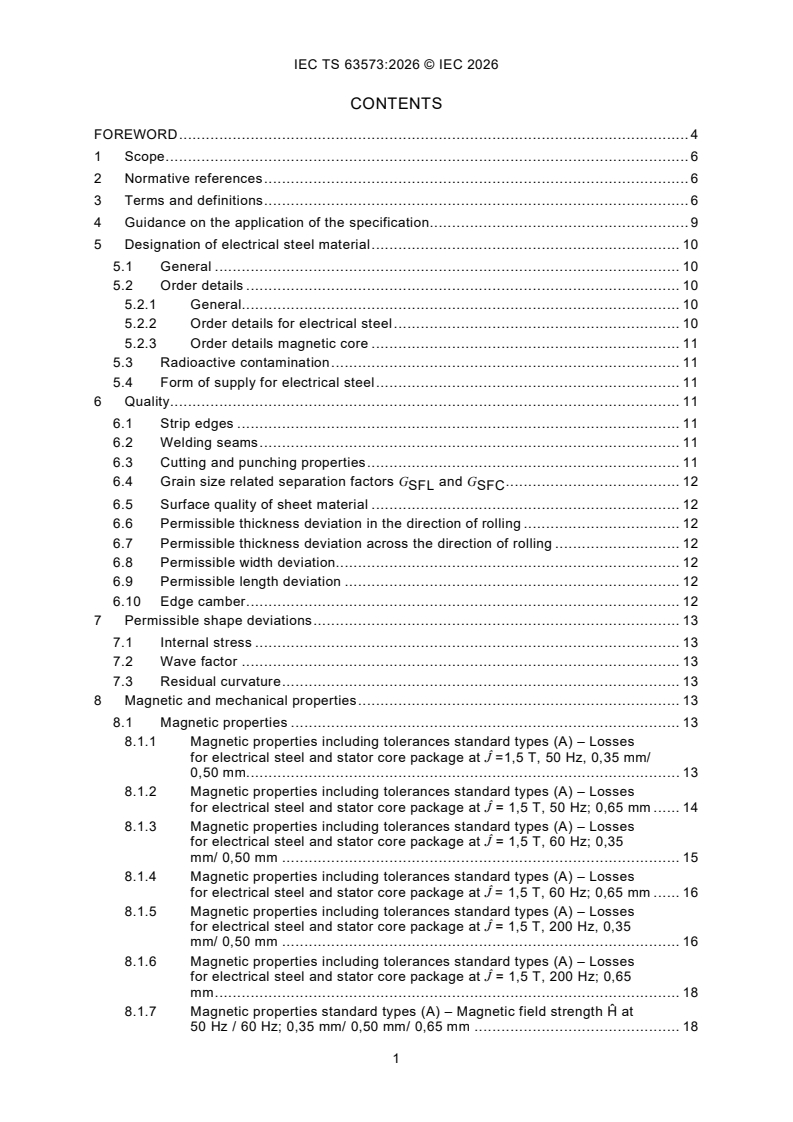
CONTENTS
FOREWORD . 4
1 Scope . 6
2 Normative references . 6
3 Terms and definitions . 6
4 Guidance on the application of the specification . 9
5 Designation of electrical steel material . 10
5.1 General . 10
5.2 Order details . 10
5.2.1 General. 10
5.2.2 Order details for electrical steel . 10
5.2.3 Order details magnetic core . 11
5.3 Radioactive contamination . 11
5.4 Form of supply for electrical steel . 11
6 Quality . 11
6.1 Strip edges . 11
6.2 Welding seams . 11
6.3 Cutting and punching properties . 11
6.4 Grain size related separation factors G and G . 12
SFL SFC
6.5 Surface quality of sheet material . 12
6.6 Permissible thickness deviation in the direction of rolling . 12
6.7 Permissible thickness deviation across the direction of rolling . 12
6.8 Permissible width deviation . 12
6.9 Permissible length deviation . 12
6.10 Edge camber . 12
7 Permissible shape deviations . 13
7.1 Internal stress . 13
7.2 Wave factor . 13
7.3 Residual curvature . 13
8 Magnetic and mechanical properties . 13
8.1 Magnetic properties . 13
8.1.1 Magnetic properties including tolerances standard types (A) – Losses
for electrical steel and stator core package at Ĵ =1,5 T, 50 Hz, 0,35 mm/
0,50 mm. 13
8.1.2 Magnetic properties including tolerances standard types (A) – Losses
for electrical steel and stator core package at Ĵ = 1,5 T, 50 Hz; 0,65 mm . 14
8.1.3 Magnetic properties including tolerances standard types (A) – Losses
for electrical steel and stator core package at Ĵ = 1,5 T, 60 Hz; 0,35
mm/ 0,50 mm . 15
8.1.4 Magnetic properties including tolerances standard types (A) – Losses
for electrical steel and stator core package at Ĵ = 1,5 T, 60 Hz; 0,65 mm . 16
8.1.5 Magnetic properties including tolerances standard types (A) – Losses
for electrical steel and stator core package at Ĵ = 1,5 T, 200 Hz, 0,35
mm/ 0,50 mm . 16
8.1.6 Magnetic properties including tolerances standard types (A) – Losses
for electrical steel and stator core package at Ĵ = 1,5 T, 200 Hz; 0,65
mm . 18
8.1.7 Magnetic properties standard types (A) – Magnetic field strength Ĥ at
50 Hz / 60 Hz; 0,35 mm/ 0,50 mm/ 0,65 mm . 18
8.1.8 Magnetic properties including tolerances high permeability types HP –
Losses for electrical steel and stator core package at Ĵ =1,5 T, 50 Hz;
0,35 mm, 0,50 mm, 0,65 mm . 20
8.1.9 Magnetic properties including tolerances high permeability types HP –
Losses for electrical steel and stator core package at Ĵ =1,5 T, 60 Hz . 20
8.1.10 Magnetic properties including tolerances high permeability types HP –
Losses for electrical steel and stator core package at Ĵ =1,5 T, 200 Hz . 21
8.1.11 Magnetic properties high permeability types HP – Magnetic field
strength Ĥ at 50 Hz; 0,35 mm/ 0,50 mm/ 0,65 mm . 21
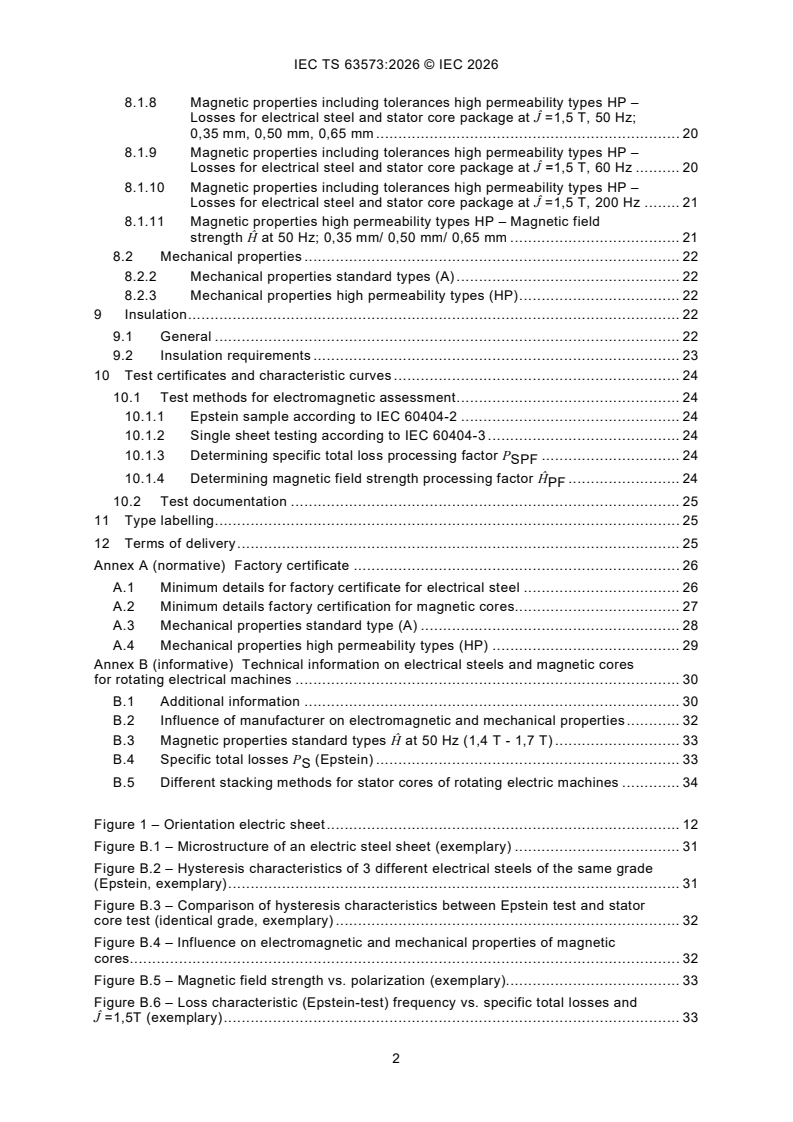
8.2 Mechanical properties . 22
8.2.2 Mechanical properties standard types (A) . 22
8.2.3 Mechanical properties high permeability types (HP) . 22
9 Insulation . 22
9.1 General . 22
9.2 Insulation requirements . 23
10 Test certificates and characteristic curves . 24
10.1 Test methods for electromagnetic assessment . 24
10.1.1 Epstein sample according to IEC 60404-2 . 24
10.1.2 Single sheet testing according to IEC 60404-3 . 24
10.1.3 Determining specific total loss processing factor P . 24
SPF
10.1.4 Determining magnetic field strength processing factor Ĥ . 24
PF
10.2 Test documentation . 25
11 Type labelling . 25
12 Terms of delivery . 25
Annex A (normative) Factory certificate . 26
A.1 Minimum details for factory certificate for electrical steel . 26
A.2 Minimum details factory certification for magnetic cores. 27
A.3 Mechanical properties standard type (A) . 28
A.4 Mechanical properties high permeability types (HP) . 29
Annex B (informative) Technical information on electrical steels and magnetic cores
for rotating electrical machines . 30
B.1 Additional information . 30
B.2 Influence of manufacturer on electromagnetic and mechanical properties . 32
B.3 Magnetic properties standard types Ĥ at 50 Hz (1,4 T - 1,7 T) . 33
B.4 Specific total losses P (Epstein) . 33
S
B.5 Different stacking methods for stator cores of rotating electric machines . 34
Figure 1 – Orientation electric sheet . 12
Figure B.1 – Microstructure of an electric steel sheet (exemplary) . 31
Figure B.2 – Hysteresis characteristics of 3 different electrical steels of the same grade
(Epstein, exemplary) . 31
Figure B.3 – Comparison of hysteresis characteristics between Epstein test and stator
core test (identical grade, exemplary) . 32
Figure B.4 – Influence on electromagnetic and mechanical properties of magnetic
cores . 32
Figure B.5 – Magnetic field strength vs. polarization (exemplary). 33
Figure B.6 – Loss characteristic (Epstein-test) frequency vs. specific total losses and
Ĵ =1,5T (exemplary) . 33
Figure B.7 – Different core stacking methods . 34
Figure B.8 – Contour of an electric sheet metal . 35
Table 1 – Tolerances specific total losses 50 Hz standard types 0,35 mm and 0,50 mm . 13
Table 2 – Tolerances specific total losses 50 Hz standard types 0,65 mm . 14
Table 3 – Tolerances specific total losses 60 Hz standard types 0,35 mm and 0,50 mm . 15
Table 4 – Tolerances specific total losses 60 Hz standard types 0,65 mm . 16
Table 5 – Tolerances specific total losses 200 Hz standard types 0,35 mm and
0,50 mm . 16
Table 6 – Tolerances specific total losses 200 Hz standard types 0,65 mm . 18
Table 7 – Tolerances magnetic field strength 50 Hz / 60 Hz standard types 0,35 mm,
0,50 mm, 065 mm . 18
Table 8 – Tolerances specific total losses 50 Hz high permeability types 0,35 mm,
0,50 mm, 0,65 mm . 20
Table 9 – Tolerances specific total losses 60 Hz high permeability types 0,35 mm,
0,50 mm, 065 mm . 20
Table 10 – Tolerances specific total losses 200 Hz high permeability types 0,35 mm,
0,50 mm, 0,65 mm . 21
Table 11 – Tolerances magnetic field strength 50 Hz / 60 Hz high permeability types
0,35 mm, 0,50 mm, 0,65 mm . 21
Table 12 – Tolerance related to nominal thickness . 22
Table 13 – Insulation details electric steels for rotating electrical machines . 23
Table A.1 – Required information electric steels for rotating electrical machines . 26
Table A.2 – Required information for magnetic cores . 27
Table A.3 – Mechanical properties electrical steel type (A) for rotating electrical
machines . 28
Table A.4 – Mechanical properties electrical steel for rotating electrical machines
type (HP) . 29
INTERNATIONAL ELECTROTECHNICAL COMMISSION
____________
Technical requirements for electrical sheet metal
and strip metal used in rotating electrical machines
FOREWORD
1) The International Electrotechnical Commission (IEC) is a worldwide organization for standardization comprising
all national electrotechnical committees (IEC National Committees). The object of IEC is to promote international
co-operation on all questions concerning standardization in the electrical and electronic fields. To this end and
in addition to other activities, IEC publishes International Standards, Technical Specifications, Technical Reports,
Publicly Available Specifications (PAS) and Guides (hereafter referred to as “IEC Publication(s)”). Their
preparation is entrusted to technical committees; any IEC National Committee interested in the subject dealt with
may participate in this preparatory work. International, governmental and non-governmental organizations liaising
with the IEC also participate in this preparation. IEC collaborates closely with the International Organization for
Standardization (ISO) in accordance with conditions determined by agreement between the two organizations.
2) The formal decisions or agreements of IEC on technical matters express, as nearly as possible, an international
consensus of opinion on the relevant subjects since each technical committee has representation from all
interested IEC National Committees.
3) IEC Publications have the form of recommendations for international use and are accepted by IEC National
Committees in that sense. While all reasonable efforts are made to ensure that the technical content of IEC
Publications is accurate, IEC cannot be held responsible for the way in which they are used or for any
misinterpretation by any end user.
4) In order to promote international uniformity, IEC National Committees undertake to apply IEC Publications
transparently to the maximum extent possible in their national and regional publications. Any divergence between
any IEC Publication and the corresponding national or regional publication shall be clearly indicated in the latter.
5) IEC itself does not provide any attestation of conformity. Independent certification bodies provide conformity
assessment services and, in some areas, access to IEC marks of conformity. IEC is not responsible for any
services carried out by independent certification bodies.
6) All users should ensure that they have the latest edition of this publication.
7) No liability shall attach to IEC or its directors, employees, servants or agents including individual experts and
members of its technical committees and IEC National Committees for any personal injury, property damage or
other damage of any nature whatsoever, whether direct or indirect, or for costs (including legal fees) and
expenses arising out of the publication, use of, or reliance upon, this IEC Publication or any other IEC
Publications.
8) Attention is drawn to the Normative references cited in this publication. Use of the referenced publications is
indispensable for the correct application of this publication.
9) IEC draws attention to the possibility that the implementation of this document may involve the use of (a)
patent(s). IEC takes no position concerning the evidence, validity or applicability of any claimed patent rights in
respect thereof. As of the date of publication of this document, IEC had not received notice of (a) patent(s), which
may be required to implement this document. However, implementers are cautioned that this may not represent
the latest information, which may be obtained from the patent database available at https://patents.iec.ch. IEC
shall not be held responsible for identifying any or all such patent rights.
IEC TS 63573 has been prepared by IEC technical committee 2: Rotating machinery. It is a
Technical Specification.
The text of this Technical Specification is based on the following documents:
Draft Report on voting
2/2287/DTS 2/2302/RVDTS
Full information on the voting for its approval can be found in the report on voting indicated in
the above table.
The language used for the development of this Technical Specification is English.
This document was drafted in accordance with ISO/IEC Directives, Part 2, and developed in
accordance with ISO/IEC Directives, Part 1 and ISO/IEC Directives, IEC Supplement, available
at www.iec.ch/members_experts/refdocs. The main document types developed by IEC are
described in greater detail at www.iec.ch/publications.
The committee has decided that the contents of this document will remain unchanged until the
stability date indicated on the IEC website under webstore.iec.ch in the data related to the
specific document. At this date, the document will be
– reconfirmed,
– withdrawn, or
– revised.
1 Scope
This Technical Specification defines specific requirements for materials to be used for the stator
and/or rotor core of rotating electrical machines according to the IEC 60034 series. This
document applies in addition to IEC 60404- series and is addressed to the suppliers of the raw
material (electrical sheet), to producers of magnetic cores (including a possible annealing
treatment), to electric motor manufacturers as well as to users of electrical steel. This document
does not apply to motor customers.
The objective of this document is to address the immediate needs of motor manufacturers
striving to achieve high IEC efficiency classes.
IEC TS 63573 is an independent product-specific specification focusing on rotating electrical
machines in accordance with the IEC 60034 series and can be applied as a supplement to
IEC 60404-8-4.
At the time of publication of this document it is anticipated that collaboration with IEC Technical
Committee 68 (Magnetic alloys and steels) will lead to the development of Amendment 2 to
IEC 60404-8-4:2022. This amendment is expected to clarify the relevant issues and provide a
comprehensive solution.
This Technical Specification will be withdrawn once Amendment 2 to IEC 60404-8-4:2022 is
published and takes effect, provided it addresses the identified need.
2 Normative references
The following documents are referred to in the text in such a way that some or all of their content
constitutes requirements of this document. For dated references, only the edition cited applies.
For undated references, the latest edition of the referenced document (including any
amendments) applies.
IEC 60404-1-1:2004, Magnetic materials - Part 1-1: Classification - Surface insulations of
electrical steel sheet, strip and laminations
IEC 60404-8-4:2022, Magnetic materials - Part 8-4: Specifications for individual materials -
Cold-rolled non-oriented electrical steel strip and sheet delivered in the fully-processed state
IEC 60404-9:2018, Magnetic materials - Part 9: Methods of determination of the geometrical
characteristics of electrical steel strip and sheet
3 Terms and definitions
For the purposes of this document, the terms and definitions given in IEC 60404-8-4:2022 and
the following apply.
ISO and IEC maintain terminology databases for use in standardization at the following
addresses:
– IEC Electropedia: available at https://www.electropedia.org/
– ISO Online browsing platform: available at https://www.iso.org/obp
3.1
stator core
magnetic stator core
static part of an electric machine, which is composed of high-permeability material and intended
to conduct magnetic flux
Note 1 to entry: The magnetic core is surrounded by the stator winding.
3.2
rotor core
magnetic rotor core
rotating part of an electric machine, which is composed of high permeability material and
intended to conduct magnetic flux
3.3
core stacking method
method used to join individual electric sheets to form a complete magnetic core, which can be
done among other technologies by stacking, welding, riveting, interlocking or glueing
Note 1 to entry: See also Figure B.7.
3.4
punching
shear cutting
cutting process for shaping electrical steel sheets
3.5
lasering
cutting process for shaping electrical sheets
3.6
specific total losses processing factor P (%)
SPF
factor used to represent the specific total losses deviation determined at the electrical steel
(e.g., Epstein test acc. to IEC 60404-2) in relation to the specific total losses at the magnetic
core
P
S2
P = ×100
SPF
P
S1
where
P is specific total losses at the magnetic core
S2
P is specific total losses at the electric steel (For example as a result from the Epstein test
S1
method)
3.7
magnetic field strength processing factor Ĥ (%)
PF
factor used to represent the magnetic field strength dissipation determined at the electric sheet
in relation to the magnetic field strength determined at the magnetic core
ˆ
H
ˆ
H = ×100
PF
ˆ
H
where
ˆ
H is magnetic field strength at the magnetic core
ˆ
H is magnetic field strength at the electric steel (e.g.as a result from the Epstein test
method)
3.8
specific total losses P (W/kg)
S
mass-related power loss which occurs in the electric sheet or in the magnetic core due to the
re-magnetization process in the electromagnetic alternating field
Note 1 to entry: The mass-related power loss P is composed of the mass-related hysteresis losses P (W/kg) and
S h
the mass-related eddy current losses P (W/kg).
e
Note 2 to entry: See also Figure B.6.
Note 3 to entry: For calculation of P , see IEC 60404-2, IEC 60404-3, IEC 60404-6.
S
3.9
specific hysteresis power loss P (W/kg)
h
power loss resulting from the frequency-dependent re-magnetization of the Weiss domains in
the electrical sheet and depends on the structure of the electrical sheet
P
S
Note 1 to entry: P = ; P can be calculated or determined indirectly by measurement.
h h
P
e
3.10
specific eddy current loss P (W/kg)
e
losses caused by closed current paths in the laminated core which depend on the thickness of
the laminations and the material electrical resistivity
P
S
Note 1 to entry: P = ; P can be calculated or determined indirectly by measurement.
e e
P
h
3.11
electric sheet
single, thin (e.g., 0,5 mm) sheet, made from very low carbon alloys, cold rolled, with soft
magnetic behavior and reduced magnetic conductivity (compared to pure iron) which is joined
together with other electrical sheets by a suitable stacking process to form a magnetic core
3.12
density ρ (kg/dm )
at a given point within a three-dimensional domain of quasi-infinitesimal volume dV, scalar
quantity equal to the mass dm within the domain divided by the volume dV, thus ρ = dm/dV
Note 1 to entry: Mass density is an intensive quantity describing a local property of a substance.
Note 2 to entry: The concept of mass density may also be applied to the mass m in a domain D with volume V,
m1
ρ = = ρVd .
leading to the average density
av
∫
VV
ρ
Note 3 to entry: The coherent SI unit of mass density is kilogram per cubic meter, kg/m . Other units are tons per
3 3 3 3 3
cubic meter, t/m (1 t/m = 1 000 kg/m = 1 g/cm ), and kilogram per liter, kg/l (1 kg/l = 1 000 kg/m ).
[SOURCE: IEC 60050-113:2011, 113-03-07]
3.13
thermal conductivity λ (W/(m*K))
at a point fixed in a medium with a temperature field, scalar quantity λ characterizing the ability
of the medium to transmit heat through a surface element containing that point: φ = −λ grad T,
where φ is the density of heat flow rate and T is thermodynamic temperature
Note 1 to entry: In an anisotropic medium, thermal conductivity is a tensor quantity.
Note 2 to entry: The coherent SI unit of thermal conductivity is watt per meter kelvin, W/(m·K).
[SOURCE: IEC 60050-113:2011, 113-04-38]
3.14
fully-finished
fully-processed
already finally annealed and insulated
3.15
semi-finished
semi-processed
without being finally annealed and non-insulated
4 Guidance on the application of the specification
This specification contains information regarding the requirements for non-grain-oriented
electrical sheets for electric machines.
Interesting technical background information related to the electric steels can be found in the
informative Annex B.
The specifications concern, among other details, requirements for the electrical sheets
regarding the specific total losses as well as the magnetic field strengths at defined magnetic
polarisation values.
These defaults are delimited by defined tolerance bands. The practically existing differences in
properties are considered by 3 gradations (Range A, Range B, Range C) of the standardised
tolerances. In addition, steel names, standardised thicknesses, specific total losses and
magnetic field strengths may be agreed individually. These must be defined between the
supplier and the customer.
Specification value tables containing a "Specific total losses processing factor" or a "Magnetic
field strength processing factor" apply to the electrical sheet and to the magnetic core. These
factors are used to describe any changes in the properties of the electrical steel compared to
the finished magnetic core and must be agreed between the supplier and the user of the
magnetic core. As a result, the magnetic core can be delivered with consistent, defined
electromagnetic properties.
A characterisation of the electrical sheets can also be carried out via the "Grain size related
separation factor", which is explained in 6.4.
5 Designation of electrical steel material
5.1 General
The following code letters shall be used to identify the designation of electric sheet and strip
metal:
A Standard type, fully- finished based on IEC 60404-8-4
K Standard types, semi- finished based on IEC 60404-8-3
HP Hight permeability types
HS Hight strength electrical types
HF Hight frequency types
For the time being, the respective values for types of K, HS and HF shall be separately agreed
between supplier and buyer.
5.2 Order details
5.2.1 General
The following minimum details shall be available to the supplier for enquiries or orders.
5.2.2 Order details for electrical steel
a) Purchaser information based on IEC 60404-8-4
b) Product designation
c) Designation of the applicable standard and if necessary, designation of other binding
documents
d) Designation of the electrical steel according to IEC 60404-8-4 as well as the designation of
the electrical steel according to the steel manufacturer’s designation
e) Horizontal or vertical axis of the coils to be supplied
f) Internal diameter of the coils
g) Type and location of sampling for the electromagnetic and mechanical test
h) Test certificate according to Clause A.1
i) Details of the insulation system
j) Details of the suitability of the insulating layer for the planned annealing process (max.
permissible annealing temperature depending on time)
k) Carbon dioxide emission data
___________
Horizontal: Inner hole of the coil is horizontally aligned. Vertical: Inner hole of the coil is vertical aligned.
5.2.3 Order details magnetic core
a) Product designation
b) Designation of the applicable standard and if necessary, designation of other binding
documents
c) Dimensions for magnetic cores based on a suitable documentation.
d) Type and location of sampling for the electromagnetic and mechanical test
e) Type of test certificate according to this document
f) Test certificate according to Table A.2
g) Details of the insulation system
h) Details of the suitability of the insulating layer for the planned annealing process (max.
permissible annealing temperature depending on time)
i) Packaging method for magnetic cores
j) Carbon dioxide emission data
5.3 Radioactive contamination
The delivered products shall not contain radioactive contamination of the nuclides Co-60 and
CS-137 exceeding the applicable concentration limits of the International Atomic Energy
Agency (IAEA) Safety Standards Series No. GSR Part 3, Table I.2. The measurement method
to be used is gamma spectrometry in accordance with ISO 20042. If further nuclides are
detected during the measurement, a detailed analysis shall be commissioned.
NOTE Deviating verifications regarding radioactive contamination can be agreed between the supplier and the
buyer.
5.4 Form of supply for electrical steel
The product is supplied in coils in the case of strip and in bundles in the case of sheets.
For coils two welds per coil are allowed, with the following requirements:
– Marking of welding with adhesive tape or paper.
– Welding type is butt junction, overlapping sheets are not allowed.
– Height (thickness) of welding seam shall not exceed 50 µm.
6 Quality
6.1 Strip edges
The strip edge shall be properly cut. The height of the burr shall not exceed 50 μm.
Deviating requirements shall be agreed on between manufacturer and purchaser. Please also
note IEC 60404-8-4.
6.2 Welding seams
Any thickening due to welding seams shall not exceed 50 µm.
Deviating requirements shall be agreed on between manufacturer and purchaser. Please also
note IEC 60404-8-4.
6.3 Cutting and punching properties
The products shall be able to be precisely cut and punched by means of suitable cutting tools
at any point and in any normal cutting form without premature tool wear. Please note
IEC 60404-8-4.
6.4 Grain size related separation factors G and G
SFL SFC
Varying averaged grain sizes of an electric sheet can affect the electromagnetic properties of
the electric sheet differently after it is cut as part of the machining process.
To allow the user to classify the averaged grain size, a grain size related separation factor is
defined as follows.
M
CLL
G = (μm)
SFL
M
CLC
G = μm
( )
SFC
NOTE 1 M = mean chord length grains - longitudinal direction
CLL
NOTE 2 M = mean chord length grains - cross direction
CLC
Figure 1 – Orientation electric sheet
Indication of the mean chord length of grain sizes according to the linear intercept method for
300 grains along to the longitudinal direction for G or along to the cross direction for G .
SFL SFC
Please see Figure 1.
6.5 Surface quality of sheet material
Please note IEC 60404-8-4 related to the surface quality of sheet material.
6.6 Permissible thickness deviation in the direction of rolling
The permissible thickness deviation is defined in 8.2.
6.7 Permissible thickness deviation across the direction of rolling
The permissible thickness deviation is defined in 8.2.
6.8 Permissible width deviation
Refer to IEC 60404-8-4 for the permissible width deviation.
6.9 Permissible length deviation
Refer to IEC 60404-8-4 for the permissible length deviation.
6.10 Edge camber
Refer to IEC 60404-8-4 for the permissible edge camber.
7 Permissible shape deviations
7.1 Internal stress
Refer to IEC 60404-8-4 for the permissible internal stresses.
7.2 Wave factor
The wave factor (ripple factor) as defined in IEC 60404-9:2018 shall not exceed 1 %.
Deviating requirements shall be agreed on between manufacturer and purchaser. Please also
note IEC 60404-8-4.
7.3 Residual curvature
Refer to IEC 60404-8-4 for the permissible curvature.
8 Magnetic and mechanical properties
8.1 Magnetic properties
8.1.1 Magnetic properties including tolerances standard types (A) – Losses for
electrical steel and stator core package at Ĵ =1,5 T, 50 Hz, 0,35 mm/ 0,50 mm
Table 1 – Tolerances specific total losses 50 Hz standard types 0,35 mm and 0,50 mm
Max.
anisotropy
Tolerance Tolerance Tolerance
Nominal
4)
P
Steel name P of loss for
SPF 3) 3) 3)
S
thickness range A range B range C
electrical
steel
mm W/kg % % % %
1)
M210-35A 2,1 Tbd +0/-15 +0/-20 +0/-30 +/-17
1)
M230-35A 2,30 Tbd +0/-15 +0/-20 +0/-30 +/-17
1)
M235-35A 2,35 Tbd +0/-15 +0/-20 +0/-30 +/-17
1)
M250-35A 2,50 Tbd +0/-15 +0/-20 +0/-30 +/-17
0,35
1)
+0/-15 +0/-20 +0/-30
M270-35A 2,70 Tbd +/-17
1)
+0/-15 +0/-20 +0/-30
M300-35A 3,00 Tbd +/-17
1)
+0/-15 +0/-20 +0/-30
M330-35A 3,30 Tbd +/-17
1)
+0/-15 +0/-20 +0/-30
M360-35A 3,60 Tbd +/-17
1)
+0/-15 +0/-20 +0/-30
M230-50A 2,30 Tbd +/-17
1)
+0/-15 +0/-20 +0/-30
M250-50A 2,50 Tbd +/-17
1)
+0/-15 +0/-20 +0/-30
M270-50A 2,70 Tbd +/-17
1)
+0/-15 +0/-20 +0/-30
M290-50A 2,90 Tbd +/-17
1)
+0/-15 +0/-20 +0/-30
M310-50A 3,10 Tbd +/-14
1)
0,50 +0/-15 +0/-20 +0/-30
M330-50A 3,30 Tbd +/-14
1)
+0/-15 +0/-20 +0/-30
M350-50A 3,50 Tbd +/-12
1)
+0/-15 +0/-20 +0/-30
M400-50A 4,00 Tbd +/-12
1)
+0/-15 +0/-20 +0/-30
M470-50A 4,70 +/-10
Tbd
1)
+0/-15 +0/-20 +0/-30
M530-50A 5,30 Tbd +/-10
1)
+0/-15 +0/-20 +0/-30
M600-50A 6,00 Tbd +/-10
Max.
anisotropy
Nominal Tolerance Tolerance Tolerance
4)
P P
Steel name of loss for
S SPF 3) 3) 3)
thickness
range A range B range C
electrical
steel
mm W/kg % % % %
1)
+0/-15 +0/-20 +0/-30
M700-50A 7,00 Tbd +/-10
1)
+0/-15 +0/-20 +0/-30
M800-50A 8,00 Tbd +/-10
1)
+0/-15 +0/-20 +0/-30
M940-50A 9,40 Tbd +/-10
1)
+0/-15 +0/-20 +0/-30
M1000-50A 10,0 Tbd +/-10
2) 1)
+0/-15 +0/-20 +0/-30
M***-**A *,** *,** Tbd +/-**
1)
To be determined in responsibility between supplier and buyer of the iron package (including the exact
measuring method).
2)
To be determined in responsibility between supplier and buyer.
3)
Related to specific total losses P (W/kg) of the electrical steel.
S
4)
Specific total losses P for electrical steel. (To be determined based on IEC 60404-2.)
S
The values in Table 1 are valid for measurements in the Epstein frame (see 10.1.1) and can be
agreed individually between supplier and buyer.
8.1.2 Magnetic properties including tolerances standard types (A) – Losses for
electrical steel and stator core package at Ĵ = 1,5 T, 50 Hz; 0,65 mm
Table 2 – Tolerances specific total losses 50 Hz standard types 0,65 mm
Max.
anisotropy of
Nominal Tolerance Tolerance Tolerance
4)
P
P
Steel name loss for
SPF
S 3) 3) 3)
thickness
range A range B range C
electrical
steel
mm W/kg % % % %
1)
+0/-15 +0/-20 +0/-30
M310-65A 3,10 +/-14
Tbd
1)
+0/-15 +0/-20 +0/-30
M330-65A 3,30 Tbd +/-14
1)
+0/-15 +0/-20 +0/-30
M350-65A 3,50 Tbd +/-12
1)
+0/-15 +0/-20 +0/-30
M400-65A 4,00 Tbd +/-12
1)
+0/-15 +0/-20 +0/-30
M470-65A 4,70 Tbd +/-10
0,65
1)
+0/-15 +0/-20 +0/-30
M530-65A 5,30 Tbd +/-10
1)
+0/-15 +0/-20 +0/-30
M600-65A 6,00 Tbd +/-10
1)
+0/-15 +0/-20 +0/-30
M700-65A 7,00 Tbd +/-10
1)
+0/-15 +0/-20 +0/-30
M800-65A 8,00 Tbd +/-10
1)
+0/-15 +0/-20 +0/-30
M1000-65A 10,0 Tbd +/-10
2) 1)
+0/-15 +0/-20 +0/-30
M***-**A *,** *,** Tbd +/-**
1)
To be determined in responsibility between supplier and buyer of the iron package (including the exact
measuring method).
2)
To be determined in responsibility between supplier and buyer.
3)
Related to specific total losses P (W/kg) of the electrical steel.
S
4)
Specific total losses P for electrical steel. (To be determined based on IEC 60404-2.)
S
The values in Table 2 are valid for measurements in the Epstein frame (see 10.1.1) and can be
agreed individually between supplier and buyer.
8.1.3 Magnetic properties including tolerances standard types (A) – Losses for
electrical steel and stator core package at Ĵ = 1,5 T, 60 Hz; 0,35 mm/ 0,50 mm
Table 3 – Tolerances specific total losses 60 Hz standard types 0,35 mm and 0,50 mm
Max.
anisotropy of
Tolerance Tolerance Tolerance
Nominal
4)
P
P loss for
Steel name
SPF 3) 3) 3)
S
thickness
range A range B range C
electrical
steel
mm W/kg % % % %
1)
M210-35A 2,65 Tbd +0/-15 +0/-20 +0/-30 +/-17
1)
M230-35A 2,90 Tbd +0/-15 +0/-20 +0/-30 +/-17
1)
M235-35A 2,97 Tbd +0/-15 +0/-20 +0/-30 +/-17
1)
M250-35A 3,14 Tbd +0/-15 +0/-20 +0/-30 +/-17
0,35
1)
+0/-15 +0/-20 +0/-30
M270-35A 3,36 Tbd +/-17
1)
+0/-15 +0/-20 +0/-30
M300-35A 3,74 +/-17
Tbd
1)
+0/-15 +0/-20 +0/-30
M330-35A 4,12 Tbd +/-17
1)
+0/-15 +0/-20 +0/-30
M360-35A 4,55 Tbd +/-17
1)
+0/-15 +0/-20 +0/-30
M230-50A 2,95 Tbd +/-17
1)
+0/-15 +0/-20 +0/-30
M250-50A 3,21 Tbd +/-17
1)
+0/-15 +0/-20 +0/-30
M270-50A 3,47 Tbd +/-17
1)
+0/-15 +0/-20 +0/-30
M290-50A 3,71 Tbd +/-17
1)
+0/-15 +0/-20 +0/-30
M310-50A 3,95 Tbd +/-14
1)
+0/-15 +0/-20 +0/-30
M330-50A 4,20 Tbd +/-14
1)
+0/-15 +0/-20 +0/-30
M350-50A 4,45 Tbd +/-12
1)
0,50 +0/-15 +0/-20 +0/-30
M400-50A 5,10 Tbd +/-12
1)
+0/-15 +0/-20 +0/-30
M470-50A 5,90 +/-10
Tbd
1)
+0/-15 +0/-20 +0/-30
M530-50A 6,66 Tbd +/-10
1)
+0/-15 +0/-20 +0/-30
M600-50A 7,53 Tbd +/-10
1)
+0/-15 +0/-20 +0/-30
M700-50A 8,79 Tbd +/-10
1)
+0/-15 +0/-20 +0/-30
M800-50A 10,06 Tbd +/-10
1)
+0/-15 +0/-20 +0/-30
M940-50A 11,84 Tbd +/-10
1)
+0/-15 +0/-20 +0/-30
M1000-50A 12,6 Tbd +/-10
2) 1)
+0/-15 +0/-20 +0/-30
M***-**A *,** *,** Tbd +/-**
1)
To be determined in responsibility between supplier and buyer of the iron package (including the exact
measuring method).
2)
To be determined in responsibility between supplier and buyer.
3)
Related to specific total losses P (W/kg) of the electrical steel.
S
4)
To be determined based on IEC 60404-2.
The values in Table 3 are valid for measurements in the Epstein frame (see 10.1.1) and can be
agreed individually between supplier and buyer.
8.1.4 Magnetic properties including tolerances standard types (A) – Losses for
electrical steel and stator core package at Ĵ = 1,5 T, 60 Hz; 0,65 mm
Table 4 – Tolerances specific total losses 60 Hz standard types 0,65 mm
Max.
Nominal Tolerance Tolerance Tolerance anisotropy of
4)
P P
Steel name
S SPF 3) 3) 3)
thickness loss for
range A range B range C
electrical steel
mm W/kg % % % %
1)
+0/-15 +0/-20 +0/-30
M310-65A 4,08 Tbd +/-14
1)
+0/-15 +0/-20 +0/-30
M330-65A 4,30 Tbd +/-14
1)
+0/-15 +0/-20 +0/-30
M350-65A 4,57 Tbd +/-12
1)
+0/-15 +0/-20 +0/-30
M400-65A 5,20 Tbd +/-12
1)
+0/-15 +0/-20 +0/-30
M470-65A 6,13 Tbd +/-10
0,65
1)
+0/-15 +0/-20 +0/-30
M530-65A 6,84 Tbd +/-10
1)
+0/-15 +0/-20 +0/-30
M600-65A 7,71 Tbd +/-10
1)
+0/-15 +0/-20 +0/-30
M700-65A 8,98 Tbd +/-10
1)
+0/-15 +0/-20 +0/-30
M800-65A 10,26 Tbd +/-10
1)
+0/-15 +0/-20 +0/-30
M1000-65A 12,77 Tbd +/-10
2) 1)
+0/-15 +0/-20 +0/-30
*,** *,** +/-**
M***-**A Tbd
1)
To be determined in responsibility between supplier and buyer of the iron package (including the exact
measuring method).
2)
To be determined in responsibility between supplier and buyer.
3)
Related to specific total losses P (W/kg) of the electrical steel.
S
4)
Specific total losses P for electrical steel. (To be determined based on IEC 60404-2.)
S
The values in Table 4 are valid for measurements in the Epstein frame (see 10.1.1) and can be
agreed individually between supplier and buyer.
8.1.5 Magnetic properties including tolerances standard types (A) – Losses for
electrical steel and stator core package at Ĵ = 1,5 T, 200 Hz, 0,35 mm/ 0,50 mm
Table 5 – Tolerances specific total losses 200 Hz standard types 0,35 mm and 0,50 mm
Max.
anisotropy of
Nominal Tolerance Tolerance Tolerance
4)
P P
Steel name loss for
S SPF 3) 3) 3)
thickness
range A range B range C
electrical
steel
mm W/kg % % % %
1)
M210-35A 14 Tbd +0/-15 +0/-20 +0/-30 +/-17
1)
M230-35A 15 Tbd +0/-15 +0/-20 +0/-30 +/-17
1)
M235-35A 16 Tbd +0/-15 +0/-20 +0/-30 +/-17
1)
M250-35A 17 Tbd +0/-15 +0/-20 +0/-30 +/-17
0,35
1)
+0/-15 +0/-20 +0/-30
M270-35A 18 Tbd +/-17
1)
+0/-15 +0/-20 +0/-30
M300-35A 19 Tbd +/-17
1)
+0/-15 +0/-20 +0/-30
M330-35A 20 Tbd +/-17
1)
+0/-15 +0/-20 +0/-30
M360-35A 22 Tbd +/-17
Max.
anisotropy of
Nominal Tolerance Tolerance Tolerance
4)
P P
Steel name loss for
S SPF 3) 3) 3)
thickness
range A range B range C
electrical
steel
mm W/kg % % % %
1)
+0/-15 +0/-20 +0/-30
M230-50A 23 Tbd +/-17
1)
+0/-15 +0/-20 +0/-30
M250-50A 24 Tbd +/-17
1)
+0/-15 +0/-20 +0/-30
M270-50A 25 Tbd +/-17
...