

IEC 61534-22:2014
(Main)Powertrack systems - Part 22: Particular requirements for powertrack systems intended for onfloor or underfloor installation
General Information
- Abstract
IEC 61534-22:2014 specifies the particular requirements and tests for PT systems intended for mounting on, or under the floor level and floor service units which are mounted on the floor, under the floor or flush with the floor. This second edition cancels and replaces the first edition published in 2009. This edition constitutes a technical revision. This edition includes the following significant technical changes with respect to the previous edition:
- Clauses 18 to 22 have been adapted to IEC 61534-1:2011 and include short-circuit test requirements;
- addition of a new (500 N) classification for the resistance to traffic load applied to small surface areas on a flushfloor service unit;
- addition of a new classification for the non-automatic closing of the lid on flushfloor service units and appropriate tests;
- addition of tests for floor service units declared for use when a floor is wet treated.
This publication is to be read in conjunction with IEC 61534-1:2011.
- Status
- Published
- Publication Date
- 06-Jul-2021
- Technical Committee
- SC 23A - Cable management systems
- Drafting Committee
- MT 15 - TC 23/SC 23A/MT 15
- Current Stage
- PPUB - Publication issued
- Start Date
- 19-Jun-2014
- Completion Date
- 30-Jun-2014
Buy Documents
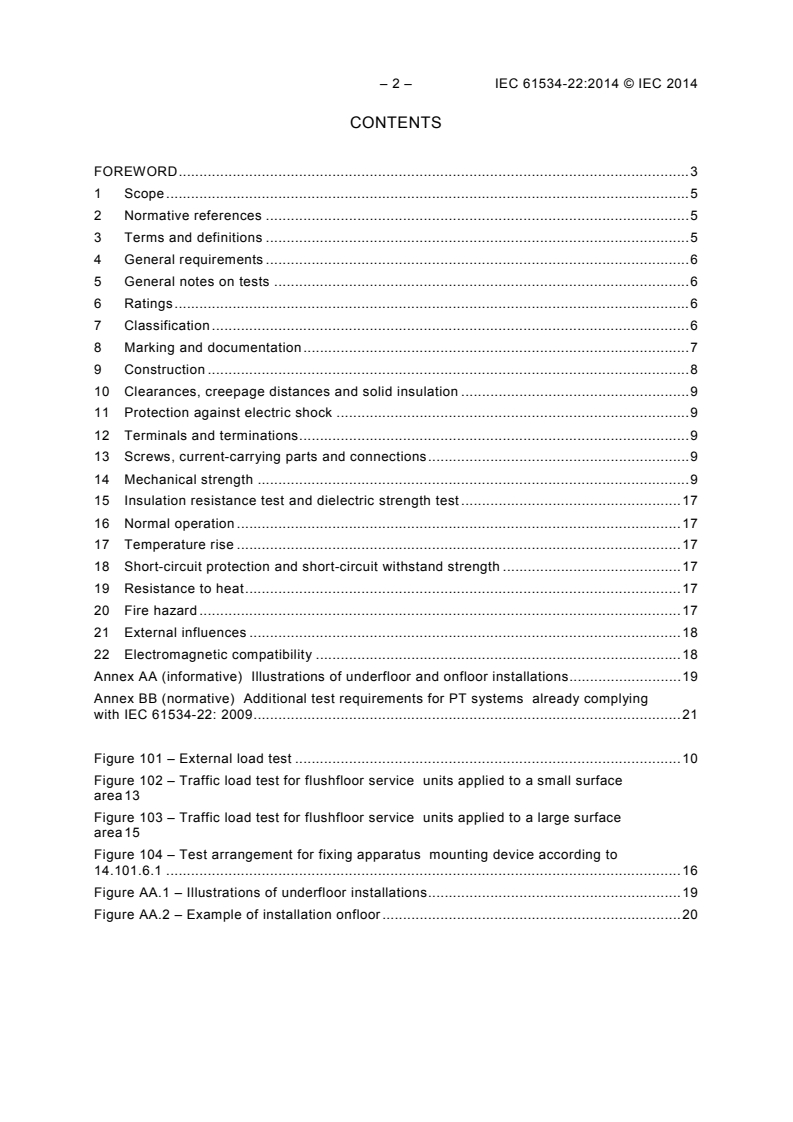
IEC 61534-22:2014 - Powertrack systems - Part 22: Particular requirements for powertrack systems intended for onfloor or underfloor installation Released:6/19/2014

IEC 61534-22:2014+AMD1:2021 CSV - Powertrack systems - Part 22: Particular requirements for powertrack systems intended for onfloor or underfloor installation Released:7/7/2021
Overview
IEC 61534-22:2014 is an international standard developed by the International Electrotechnical Commission (IEC) that specifies particular requirements and testing protocols for powertrack (PT) systems designed for onfloor or underfloor installation. This standard is a part of the IEC 61534 series, which governs powertrack systems used for cable management and electrical equipment accommodation. The 2014 edition, amended in 2021, replaces the first edition from 2009 and introduces significant technical revisions that enhance safety, durability, and functionality, especially for PT systems embedded in or mounted on floor surfaces.
This standard is essential for manufacturers, installers, and inspectors involved in electrical infrastructure that incorporates powertrack systems beneath or on top of finished floors. It complements and should be used alongside IEC 61534-1:2011, which outlines general requirements applicable to all PT systems.
Key Topics
Scope and Application
IEC 61534-22:2014 applies specifically to PT systems and floor service units intended for floor-level mounting or installation beneath floors, including flushfloor service units. It excludes flushfloor PT systems other than these service units. The standard defines critical terms such as underfloor PT systems, onfloor PT systems, finished floors, and apparatus mounting devices.Technical Revisions and Updates
The 2014 edition with the 2021 amendment incorporates these key technical changes:- Clauses related to short-circuit protection and withstand strength (Clauses 18 to 22) align with IEC 61534-1:2011 and include updated short-circuit tests.
- Introduction of a 500 N classification addressing traffic load resistance on small surface areas of flushfloor service units.
- New classification and testing for non-automatic closing lids on flushfloor service units to improve user safety and operational reliability.
- Added testing requirements for floor service units intended for use on wet-treated floors, ensuring performance in environments affected by moisture treatments.
Construction and Safety
The standard addresses mechanical strength, insulation resistance, dielectric strength, clearances, creepage distances, and protection against electric shock. It mandates rigorous mechanical and electrical testing to assure compliance with safety and durability benchmarks.Environmental and Operational Considerations
IEC 61534-22 considers external influences such as heat resistance, fire hazard, and electromagnetic compatibility (EMC), ensuring the PT systems perform reliably under various environmental conditions.Testing and Classification
Detailed procedures and criteria for mechanical strength tests, including traffic load simulations for both small and large surface areas, ensure that floor-mounted PT systems resist typical wear-and-tear from pedestrian and equipment traffic.
Applications
Commercial Buildings
Powertrack systems installed under raised floors or flush with floor surfaces in offices, conference rooms, and commercial spaces for seamless power and data distribution.Industrial Facilities
Onfloor and underfloor PT systems for heavy-duty environments requiring robust traffic load resistance and dependable electrical connectivity.Public Infrastructure
Facilities with high foot traffic or specialized flooring treatments, such as hospitals, airports, and educational institutions, benefit from floor service units tested for wet-treated floor conditions and non-automatic lid operations.Renovations and Retrofitting
The standard supports installation of PT systems both in new buildings and during refurbishment projects, ensuring compliance with the latest safety and performance requirements.
Related Standards
IEC 61534-1:2011 – Powertrack Systems: General Requirements
This standard provides the foundational requirements for PT systems, including definitions, ratings, general construction, and performance criteria that Part 22 supplements and modifies.ISO/IEC Directives, Part 2
Guidelines governing the preparation and drafting of international standards such as IEC 61534-22.Electrical Accessories Standards (IEC Technical Committee 23)
Additional standards relating to safe electrical installations and accessories complement the requirements of IEC 61534-22.IEC Electropedia & ISO Online Browsing Platform
Authoritative sources for standardized terminologies relevant to electrotechnical components used within powertrack systems.
Keywords: IEC 61534-22, powertrack systems, onfloor installation, underfloor installation, flushfloor service units, electrical accessories, mechanical strength, traffic load classification, short-circuit protection, insulation resistance, fire hazard, electromagnetic compatibility, floor service units, cable management systems, international electrotechnical standard, IEC powertrack standard.
Relations
- Effective Date
- 05-Sep-2023
- Effective Date
- 05-Sep-2023
Buy Documents
IEC 61534-22:2014 - Powertrack systems - Part 22: Particular requirements for powertrack systems intended for onfloor or underfloor installation Released:6/19/2014
IEC 61534-22:2014+AMD1:2021 CSV - Powertrack systems - Part 22: Particular requirements for powertrack systems intended for onfloor or underfloor installation Released:7/7/2021
Get Certified
Connect with accredited certification bodies for this standard

IMQ S.p.A. (Certification)
Italian electrical product certification.

SLG Prüf- und Zertifizierungs GmbH
German testing and certification body.

UL Solutions
Global safety science company with testing, inspection and certification.
Sponsored listings
Frequently Asked Questions
IEC 61534-22:2014 is a standard published by the International Electrotechnical Commission (IEC). Its full title is "Powertrack systems - Part 22: Particular requirements for powertrack systems intended for onfloor or underfloor installation". This standard covers: IEC 61534-22:2014 specifies the particular requirements and tests for PT systems intended for mounting on, or under the floor level and floor service units which are mounted on the floor, under the floor or flush with the floor. This second edition cancels and replaces the first edition published in 2009. This edition constitutes a technical revision. This edition includes the following significant technical changes with respect to the previous edition: - Clauses 18 to 22 have been adapted to IEC 61534-1:2011 and include short-circuit test requirements; - addition of a new (500 N) classification for the resistance to traffic load applied to small surface areas on a flushfloor service unit; - addition of a new classification for the non-automatic closing of the lid on flushfloor service units and appropriate tests; - addition of tests for floor service units declared for use when a floor is wet treated. This publication is to be read in conjunction with IEC 61534-1:2011.
IEC 61534-22:2014 specifies the particular requirements and tests for PT systems intended for mounting on, or under the floor level and floor service units which are mounted on the floor, under the floor or flush with the floor. This second edition cancels and replaces the first edition published in 2009. This edition constitutes a technical revision. This edition includes the following significant technical changes with respect to the previous edition: - Clauses 18 to 22 have been adapted to IEC 61534-1:2011 and include short-circuit test requirements; - addition of a new (500 N) classification for the resistance to traffic load applied to small surface areas on a flushfloor service unit; - addition of a new classification for the non-automatic closing of the lid on flushfloor service units and appropriate tests; - addition of tests for floor service units declared for use when a floor is wet treated. This publication is to be read in conjunction with IEC 61534-1:2011.
IEC 61534-22:2014 is classified under the following ICS (International Classification for Standards) categories: 29.060.10 - Wires; 29.120.20 - Connecting devices. The ICS classification helps identify the subject area and facilitates finding related standards.
IEC 61534-22:2014 has the following relationships with other standards: It is inter standard links to IEC 61534-22:2014/AMD1:2021, IEC 61534-22:2009. Understanding these relationships helps ensure you are using the most current and applicable version of the standard.
IEC 61534-22:2014 is available in PDF format for immediate download after purchase. The document can be added to your cart and obtained through the secure checkout process. Digital delivery ensures instant access to the complete standard document.
Standards Content (Sample)
IEC 61534-22 ®
Edition 2.0 2014-06
INTERNATIONAL
STANDARD
NORME
INTERNATIONALE
Powertrack systems –
Part 22: Particular requirements for powertrack systems intended for onfloor or
underfloor installation
Systèmes de conducteurs préfabriqués –
Partie 22: Exigences particulières pour les systèmes de conducteurs
préfabriqués destinés au montage sur le sol ou sous le sol
All rights reserved. Unless otherwise specified, no part of this publication may be reproduced or utilized in any form
or by any means, electronic or mechanical, including photocopying and microfilm, without permission in writing from
either IEC or IEC's member National Committee in the country of the requester. If you have any questions about IEC
copyright or have an enquiry about obtaining additional rights to this publication, please contact the address below or
your local IEC member National Committee for further information.
Droits de reproduction réservés. Sauf indication contraire, aucune partie de cette publication ne peut être reproduite
ni utilisée sous quelque forme que ce soit et par aucun procédé, électronique ou mécanique, y compris la photocopie
et les microfilms, sans l'accord écrit de l'IEC ou du Comité national de l'IEC du pays du demandeur. Si vous avez des
questions sur le copyright de l'IEC ou si vous désirez obtenir des droits supplémentaires sur cette publication, utilisez
les coordonnées ci-après ou contactez le Comité national de l'IEC de votre pays de résidence.
IEC Central Office Tel.: +41 22 919 02 11
3, rue de Varembé Fax: +41 22 919 03 00
CH-1211 Geneva 20 info@iec.ch
Switzerland www.iec.ch
About the IEC
The International Electrotechnical Commission (IEC) is the leading global organization that prepares and publishes
International Standards for all electrical, electronic and related technologies.
About IEC publications
The technical content of IEC publications is kept under constant review by the IEC. Please make sure that you have the
latest edition, a corrigenda or an amendment might have been published.
IEC Catalogue - webstore.iec.ch/catalogue Electropedia - www.electropedia.org
The stand-alone application for consulting the entire The world's leading online dictionary of electronic and
bibliographical information on IEC International Standards, electrical terms containing more than 30 000 terms and
Technical Specifications, Technical Reports and other definitions in English and French, with equivalent terms in 14
documents. Available for PC, Mac OS, Android Tablets and additional languages. Also known as the International
iPad. Electrotechnical Vocabulary (IEV) online.
IEC publications search - www.iec.ch/searchpub IEC Glossary - std.iec.ch/glossary
The advanced search enables to find IEC publications by a More than 55 000 electrotechnical terminology entries in
variety of criteria (reference number, text, technical English and French extracted from the Terms and Definitions
committee,…). It also gives information on projects, replaced clause of IEC publications issued since 2002. Some entries
and withdrawn publications. have been collected from earlier publications of IEC TC 37,
77, 86 and CISPR.
IEC Just Published - webstore.iec.ch/justpublished
Stay up to date on all new IEC publications. Just Published IEC Customer Service Centre - webstore.iec.ch/csc
details all new publications released. Available online and If you wish to give us your feedback on this publication or
also once a month by email. need further assistance, please contact the Customer Service
Centre: csc@iec.ch.
A propos de l'IEC
La Commission Electrotechnique Internationale (IEC) est la première organisation mondiale qui élabore et publie des
Normes internationales pour tout ce qui a trait à l'électricité, à l'électronique et aux technologies apparentées.
A propos des publications IEC
Le contenu technique des publications IEC est constamment revu. Veuillez vous assurer que vous possédez l’édition la
plus récente, un corrigendum ou amendement peut avoir été publié.
Catalogue IEC - webstore.iec.ch/catalogue Electropedia - www.electropedia.org
Application autonome pour consulter tous les renseignements
Le premier dictionnaire en ligne de termes électroniques et
bibliographiques sur les Normes internationales,
électriques. Il contient plus de 30 000 termes et définitions en
Spécifications techniques, Rapports techniques et autres
anglais et en français, ainsi que les termes équivalents dans
documents de l'IEC. Disponible pour PC, Mac OS, tablettes
14 langues additionnelles. Egalement appelé Vocabulaire
Android et iPad.
Electrotechnique International (IEV) en ligne.
Recherche de publications IEC - www.iec.ch/searchpub
Glossaire IEC - std.iec.ch/glossary
Plus de 55 000 entrées terminologiques électrotechniques, en
La recherche avancée permet de trouver des publications IEC
en utilisant différents critères (numéro de référence, texte, anglais et en français, extraites des articles Termes et
comité d’études,…). Elle donne aussi des informations sur les Définitions des publications IEC parues depuis 2002. Plus
projets et les publications remplacées ou retirées. certaines entrées antérieures extraites des publications des
CE 37, 77, 86 et CISPR de l'IEC.
IEC Just Published - webstore.iec.ch/justpublished
Service Clients - webstore.iec.ch/csc
Restez informé sur les nouvelles publications IEC. Just
Published détaille les nouvelles publications parues. Si vous désirez nous donner des commentaires sur cette
Disponible en ligne et aussi une fois par mois par email. publication ou si vous avez des questions contactez-nous:
csc@iec.ch.
IEC 61534-22 ®
Edition 2.0 2014-06
INTERNATIONAL
STANDARD
NORME
INTERNATIONALE
Powertrack systems –
Part 22: Particular requirements for powertrack systems intended for onfloor or
underfloor installation
Systèmes de conducteurs préfabriqués –
Partie 22: Exigences particulières pour les systèmes de conducteurs
préfabriqués destinés au montage sur le sol ou sous le sol
INTERNATIONAL
ELECTROTECHNICAL
COMMISSION
COMMISSION
ELECTROTECHNIQUE
PRICE CODE
INTERNATIONALE
CODE PRIX S
ICS 29.060.10, 29.120.20 ISBN 978-2-8322-1656-9
– 2 – IEC 61534-22:2014 © IEC 2014
CONTENTS
FOREWORD . 3
1 Scope . 5
2 Normative references . 5
3 Terms and definitions . 5
4 General requirements . 6
5 General notes on tests . 6
6 Ratings . 6
7 Classification . 6
8 Marking and documentation . 7
9 Construction . 8
10 Clearances, creepage distances and solid insulation . 9
11 Protection against electric shock . 9
12 Terminals and terminations . 9
13 Screws, current-carrying parts and connections . 9
14 Mechanical strength . 9
15 Insulation resistance test and dielectric strength test . 17
16 Normal operation . 17
17 Temperature rise . 17
18 Short-circuit protection and short-circuit withstand strength . 17
19 Resistance to heat . 17
20 Fire hazard . 17
21 External influences . 18
22 Electromagnetic compatibility . 18
Annex AA (informative) Illustrations of underfloor and onfloor installations. 19
Annex BB (normative) Additional test requirements for PT systems already complying
with IEC 61534-22: 2009 . 21
Figure 101 – External load test . 10
Figure 102 – Traffic load test for flushfloor service units applied to a small surface
area 13
Figure 103 – Traffic load test for flushfloor service units applied to a large surface
area 15
Figure 104 – Test arrangement for fixing apparatus mounting device according to
14.101.6.1 . 16
Figure AA.1 – Illustrations of underfloor installations . 19
Figure AA.2 – Example of installation onfloor . 20
INTERNATIONAL ELECTROTECHNICAL COMMISSION
____________
POWERTRACK SYSTEMS –
Part 22: Particular requirements for powertrack
systems intended for onfloor or underfloor installation
FOREWORD
1) The International Electrotechnical Commission (IEC) is a worldwide organization for standardization comprising
all national electrotechnical committees (IEC National Committees). The object of IEC is to promote
international co-operation on all questions concerning standardization in the electrical and electronic fields. To
this end and in addition to other activities, IEC publishes International Standards, Technical Specifications,
Technical Reports, Publicly Available Specifications (PAS) and Guides (hereafter referred to as “IEC
Publication(s)”). Their preparation is entrusted to technical committees; any IEC National Committee interested
in the subject dealt with may participate in this preparatory work. International, governmental and non-
governmental organizations liaising with the IEC also participate in this preparation. IEC collaborates closely
with the International Organization for Standardization (ISO) in accordance with conditions determined by
agreement between the two organizations.
2) The formal decisions or agreements of IEC on technical matters express, as nearly as possible, an international
consensus of opinion on the relevant subjects since each technical committee has representation from all
interested IEC National Committees.
3) IEC Publications have the form of recommendations for international use and are accepted by IEC National
Committees in that sense. While all reasonable efforts are made to ensure that the technical content of IEC
Publications is accurate, IEC cannot be held responsible for the way in which they are used or for any
misinterpretation by any end user.
4) In order to promote international uniformity, IEC National Committees undertake to apply IEC Publications
transparently to the maximum extent possible in their national and regional publications. Any divergence
between any IEC Publication and the corresponding national or regional publication shall be clearly indicated in
the latter.
5) IEC itself does not provide any attestation of conformity. Independent certification bodies provide conformity
assessment services and, in some areas, access to IEC marks of conformity. IEC is not responsible for any
services carried out by independent certification bodies.
6) All users should ensure that they have the latest edition of this publication.
7) No liability shall attach to IEC or its directors, employees, servants or agents including individual experts and
members of its technical committees and IEC National Committees for any personal injury, property damage or
other damage of any nature whatsoever, whether direct or indirect, or for costs (including legal fees) and
expenses arising out of the publication, use of, or reliance upon, this IEC Publication or any other IEC
Publications.
8) Attention is drawn to the Normative references cited in this publication. Use of the referenced publications is
indispensable for the correct application of this publication.
9) Attention is drawn to the possibility that some of the elements of this IEC Publication may be the subject of
patent rights. IEC shall not be held responsible for identifying any or all such patent rights.
International Standard IEC 61534-22 has been prepared by subcommittee 23A: Cable
management systems, of IEC Technical Committee 23: Electrical accessories.
This second edition cancels and replaces the first edition published in 2009. This edition
constitutes a technical revision.
This edition includes the following significant technical changes with respect to the previous
edition:
• Clauses 18 to 22 have been adapted to IEC 61534-1:2011 and include short-circuit test
requirements;
• addition of a new (500 N) classification for the resistance to traffic load applied to small
surface areas on a flushfloor service unit;
– 4 – IEC 61534-22:2014 © IEC 2014
• addition of a new classification for the non-automatic closing of the lid on flushfloor service
units and appropriate tests;
• addition of tests for floor service units declared for use when a floor is wet-treated.
The text of this standard is based on the following documents:
FDIS Report on voting
23A/702/FDIS 23A/708/RVD
Full information on the voting for the approval of this standard can be found in the report on
voting indicated in the above table.
This publication has been drafted in accordance with the ISO/IEC Directives, Part 2.
This standard is to be used in conjunction with IEC 61534-1:2011, Powertrack systems –
Part 1: General requirements.
This Part 22 supplements or modifies the corresponding clauses of IEC 61534-1. Where a
particular clause or subclause of IEC 61534-1:2011 is not mentioned in this Part 22, that
clause or subclause applies as far as is reasonable. Where this Part 22 states "addition" or
"replacement", the relevant text of IEC 61534-1:2011 is to be adapted accordingly.
Subclauses, tables and figures which are in addition to those in IEC 61534-1:2011 are
numbered starting with 101.
A list of all parts of IEC 61534 series, published under the general title Powertrack systems,
can be found on the IEC website.
The following differences exist in the countries indicated below:
Subclause 7.105.2: In the United Kingdom, this classification is not permitted.
The committee has decided that the contents of this publication will remain unchanged until
the stability date indicated on the IEC web site under "http://webstore.iec.ch" in the data
related to the specific publication. At this date, the publication will be
• reconfirmed,
• withdrawn,
• replaced by a revised edition, or
• amended.
POWERTRACK SYSTEMS –
Part 22: Particular requirements for powertrack
systems intended for onfloor or underfloor installation
1 Scope
Clause 1 of IEC 61534-1:2011 and IEC 61534-1:2011/AMD1:2014 is applicable except as
follows:
1.1 Addition:
This part of IEC 61534 specifies the particular requirements and tests for PT systems
intended for mounting on, or under the floor level and floor service units which are mounted
on the floor, under the floor or flush with the floor.
NOTE 1 Types and applications are shown in Figures AA.1a, AA.1b and AA.2
NOTE 2 Flushfloor PT systems, with the exception of flushfloor service units, are not covered by this standard.
2 Normative references
Clause 2 of IEC 61534-1:2011 is applicable except as follows:
Addition:
IEC 61534-1:2011, Powertrack systems – Part 1: General requirements
IEC 61534-1:2011/AMD1:2014
3 Terms and definitions
Clause 3 of IEC 61534-1:2011 and IEC 61534-1:2011/AMD1:2014 is applicable except as
follows:
Additional terms and definitions:
3.101
underfloor PT system
PT system whose components, except flushfloor service units, are intended for installation
beneath the finished floor and in normal use are not exposed to traffic loads
Examples are shown in Figures AA.1a and AA.1b
3.102
onfloor PT system
PT system whose components are mounted on the floor surface
An example is shown in Figure AA.2.
– 6 – IEC 61534-22:2014 © IEC 2014
3.103
finished floor
floor which carries the traffic load and which may be made of concrete, wood, or the like and
which may or may not be completed with floor covering material such as carpet, tile, paint,
parquet or similar means
3.104
apparatus mounting device
system component to accommodate electrical apparatus, for example switches, socket-
outlets, circuit-breakers
3.105
floor service unit
system component used with a floor system and intended to accommodate one or more
electrical apparatus such as switches, socket-outlets, circuit-breakers either directly or by use
of mounting devices
3.106
flushfloor service unit
floor service unit that is flush with the finished floor when the unit is not in use’
3.107
in-use floor service unit
floor service unit which has cables and/or cords connected to external electrical appliances
3.108
not in-use floor service unit
floor service unit which has no cables and/or cords connected to external electrical appliances
4 General requirements
Clause 4 of IEC 61534-1:2011 is applicable.
5 General notes on tests
Clause 5 of IEC 61534-1:2011 is applicable.
6 Ratings
Clause 6 of IEC 61534-1:2011 is applicable.
7 Classification
Clause 7 of IEC 61534-1:2011 is applicable except as follows:
Replacement:
7.1 According to resistance to impact for installation and application
7.1.1 PT system for 5 J impact
7.1.2 PT system for 20 J impact
Additional subclauses:
7.101 According to floor treatment
7.101.1 Dry-treatment of floor
7.101.2 Wet-treatment of floor for not in-use floor service unit
7.101.3 Wet-treatment of floor for in-use floor service unit
7.102 According to the intended location
7.102.1 Underfloor PT system
7.102.2 Onfloor PT system
7.103 According to resistance to traffic load applied to small surface area on a
flushfloor service unit
7.103.1 500 N
7.103.2 750 N
7.103.3 1 000 N
7.103.4 1 500 N
7.103.5 2 000 N
7.103.6 2 500 N
7.103.7 3 000 N
7.104 Optional classification according to resistance to traffic load applied to large
surface area on a flushfloor service unit
7.104.1 2 000 N
7.104.2 3 000 N
7.104.3 5 000 N
7.104.4 10 000 N
7.104.5 15 000 N
7.105 According to the type of lid used on flushfloor service units
7.105.1 Automatic closing of the lid
7.105.2 Non-automatic closing of the lid
NOTE In the United Kingdom, classification 7.105.2 is not permitted.
8 Marking and documentation
Clause 8 of IEC 61534-1:2011 and IEC 61534-1:2011/AMD1:2014 is applicable.
– 8 – IEC 61534-22:2014 © IEC 2014
9 Construction
Clause 9 of IEC 61534-1:2011 is applicable except as follows:
Additional subclauses:
9.101 Underfloor powertrack system components shall withstand external loads during
transport and installation but are not subjected to traffic loads in normal use.
Compliance is checked by the tests specified in 14.101.2.
9.102 Onfloor powertrack system components shall withstand external loads.
Compliance is checked by the tests specified in 14.101.3.
9.103 Flushfloor service units shall withstand traffic loads in accordance with 7.103 and
7.104.
Compliance is checked by the tests specified in 14.101.4.
9.104 Lids of flush floor service units shall be so designed that in normal use they cannot be
detached without an intentional action and also resist movement or unintentional opening
when subject to external load.
Compliance is checked by inspection and the test of 14.101.4 and 14.101.5 as appropriate.
Lids of flush floor service units declared according to 7.105.1 shall be so designed that in
normal use they will close automatically.
Compliance is checked by inspection and manual test.
9.105 Floor service units declared according to 7.101.2 and 7.101.3 shall avoid water
coming into contact with insulated conductors and live parts during wet-treatment of floor by
one or a combination of the following methods which may vary within the system:
– method 1: ensuring by design that water does not come into contact with insulated
conductors and live parts when the water level is 10 mm above the upper level of the floor
covering;
– method 2: providing an IP rating not less than IPX4;
– method 3: providing manufacturer's instructions which require that insulated conductors
and live parts are positioned not less than 10 mm above the upper level of the floor
covering.
For method 1, compliance is checked by measurement. For method 2, compliance is checked
by the test of 21.2.3.101. For method 3, compliance is checked by inspection.
9.106 Flushfloor service units shall be so constructed that when installed with the lid closed
they shall not present a trip hazard. Any protrusion above the finished floor shall not be
greater than 4 mm, or 8 mm in the case of a chamfered step with an angle not exceeding 45º
with the horizontal surface. When the service unit is in use this requirement does not apply.
Compliance is checked by inspection.
10 Clearances, creepage distances and solid insulation
Clause 10 of IEC 61534-1:2011 is applicable.
11 Protection against electric shock
Clause 11 of IEC 61534-1:2011 is applicable except as follows:
Additional subclause:
11.1.101 The minimum IP rating for powertrack system components accessible to ordinary
persons during normal use shall be IP 3XD. This requirement does not apply to accessories.
12 Terminals and terminations
Clause 12 of IEC 61534-1:2011 is applicable.
13 Screws, current-carrying parts and connections
Clause 13 of IEC 61534-1:2011 is applicable.
14 Mechanical strength
Clause 14 of IEC 61534-1:2011 is applicable except as follows:
14.2 Impact test
Delete 14.2.
Additional subclauses:
14.101 External mechanical load test
14.101.1 General
Underfloor and onfloor PT systems and PT flushfloor service units, shall have sufficient
mechanical strength against external mechanical loads likely to occur during normal use:
– underfloor PT system components by the test of 14.101.2;
– onfloor PT system components by the tests of 14.101.3;
– flushfloor service units by the test of 14.101.4 and 14.101.5 as appropriate.
Any part for temporary use only during the installation phase does not need to comply with
these tests but may be included for the test to allow compliance of other parts.
14.101.2 Load test for underfloor powertrack system components
14.101.2.1 General
Powertrack (PT) systems including tap-off units shall have sufficient mechanical strength
against external loads likely to occur during installation and use.
– 10 – IEC 61534-22:2014 © IEC 2014
14.101.2.2 Powertrack
The test shall be performed on a sample consisting of two lengths of powertrack each with a
minimum length of 0,5 m which are connected together with the necessary connectors and
with a supply connector at each end of the sample.
The sample is positioned on a horizontal rigid support. A steel cube of (50 ± 0,5) mm with an
edge radius of approximately 1 mm is placed centrally on the joint. In the case of multi-
compartment powertrack whose partition walls provide support, the middle of the largest
compartment is selected, see Figure 101.
L
F
L/2
b/2
b
d < b
IEC 2134/08
Key
b width of the largest compartment
d width of the smallest compartment
L length of sample
F applied vertical force
Figure 101 – External load test
A vertical force of (750 ± 10) N is gradually applied over (60 ± 1) s and maintained for a
further (120 ± 5) s centrally to the cube.
During the test, there shall be no deformation that impairs electrical safety.
In case of doubt, the sample shall conform to Clause 10 and 11.1.1.1.
After the test, the sample shall show no signs of damage, nor any cracks visible to normal or
corrected vision without additional magnification.
After removal of the external load, the continuity of the protective circuit shall remain
unaffected.
A current of (25 ± 1) A a.c. having a nominal frequency of 50 Hz or 60 Hz supplied by a
source with a no-load voltage not exceeding 12 V shall be passed between the earthing
terminals at each end of the sample. Measurement of the voltage drop shall be made within
120 s after the initiation of the current flow. The impedance per metre, calculated from the
measurement of the voltage drop between the two supply connectors, shall not exceed the
value declared by the manufacturer or 0,05 Ω/m whichever is the lower.
14.101.2.3 Tap-off units
A tap-off unit shall be centrally installed on a length of powertrack which has a minimum
length of 0,5 m.
The powertrack is positioned on a horizontal rigid support. A steel cube of (50 ± 0,5) mm with
an edge radius of approximately 1 mm is placed centrally on the tap-off unit.
A vertical force of (750 ± 10) N is gradually applied over (60 ± 1) s and maintained for a
further (120 ± 5) s centrally to the cube.
During the test, there shall be no deformation that impairs electrical safety.
In case of doubt, the sample shall conform to Clause 10 and 11.1.1.1.
After the test, the sample shall show no signs of damage, nor any cracks visible to normal or
corrected vision without additional magnification.
After removal of the external load, the continuity of the protective circuit shall remain
unaffected.
A current of (25 ± 1) A a.c. having a nominal frequency of 50 Hz or 60 Hz supplied by a
source with a no-load voltage not exceeding 12 V shall be passed between the earthing
terminal or contact of the tap-off unit and the nearest point on the protective earth busbar with
the tap-off unit fully engaged as in normal use. Measurement of the voltage drop shall be
made within 120 s after the initiation of the current flow. The impedance calculated from the
measurement of the voltage drop between the two points stated shall not exceed the value
declared by the manufacturer or 0,05 Ω/m whichever is the lower.
14.101.3 Load test for onfloor PT system components
14.101.3.1 General
PT systems including tap-off units shall have sufficient mechanical strength against external
loads likely to occur during installation and use.
14.101.3.2 Powertrack
The test shall be performed on a sample consisting of two lengths of powertrack each with a
minimum length of 0,5 m which are connected together with the necessary connectors and
with a supply connector at each end of the sample.
The sample is positioned on a horizontal rigid support. A steel cube of (50 ± 0,5) mm with an
edge radius of approximately 1 mm is placed centrally on the joint. In the case of multi-
compartment powertrack whose partition walls provide support, the middle of the largest
compartment is selected, see Figure 101.
– 12 – IEC 61534-22:2014 © IEC 2014
A vertical force of (1 000 ± 10) N is gradually applied over (60 ± 1) s and maintained for a
further (120 ± 5) s centrally to the cube.
During the test, there shall be no deformation that impairs electrical safety.
In case of doubt, the sample shall conform to Clause 10 and 11.1.1.1.
After the test, the sample shall show no signs of damage, nor any cracks visible to normal or
corrected vision without additional magnification.
After removal of the external load, the continuity of the protective circuit shall remain
unaffected.
A current of (25 ± 1) A a.c. having a nominal frequency of 50 Hz or 60 Hz supplied by a
source with a no-load voltage not exceeding 12 V shall be passed between the earthing
terminals at each end of the sample. Measurement of the voltage drop shall be made within
120 s after the initiation of the current flow. The impedance per metre, calculated from the
measurement of the voltage drop between the two supply connectors, shall not exceed the
value declared by the manufacturer or 0,05 Ω/m whichever is the lower.
14.101.3.3 Tap-off units
A tap-off unit shall be centrally installed on a length of powertrack which has a minimum
length of 0,5 m.
The powertrack is positioned on a horizontal rigid support. A steel cube of (50 ± 0,5) mm with
an edge radius of approximately 1 mm is placed centrally on the tap-off unit.
A vertical force of (1 000 ± 10) N is gradually applied over (60 ± 1) s and maintained for a
further (120 ± 5) s centrally to the cube.
During the test, there shall be no deformation that impairs electrical safety.
In case of doubt, the sample shall conform to Clause 10 and 11.1.1.1
After the test, the sample shall show no signs of damage, nor any cracks visible to normal or
corrected vision without additional magnification.
After removal of the external load, the continuity of the protective circuit shall remain
unaffected.
A current of (25 ± 1) A a.c. having a nominal frequency of 50 Hz or 60 Hz supplied by a
source with a no-load voltage not exceeding 12 V shall be passed between the earthing
terminal or contact of the tap-off unit and the nearest point on the protective earth busbar with
the tap-off unit fully engaged as in normal use. Measurement of the voltage drop shall be
made within 120 s after the initiation of the current flow. The impedance calculated from the
measurement of the voltage drop between the two points stated shall not exceed the value
declared by the manufacturer or 0,05 Ω/m whichever is the lower.
14.101.4 Traffic load test for flushfloor service units as declared in 7.103
The test is carried out on an assembly prepared according to the manufacturer’s instructions.
Additional provision may be included to simulate the influence of the floor material on the
sides of the product. Other system components may be included, if necessary, to prevent
movement.
The surface of the sample which can be exposed to traffic is loaded with the force declared
according to 7.103.
A vertical force is applied through a steel cylinder of (13,3 ± 0,1) mm diameter with an edge
radius of 1 mm providing a contact surface of approximately 1 cm with a minimum length of
30 mm as shown in Figure 102.
13,3 ± 0,1
R1,0
S
F
L
R1,0
L/2
b/2
b
d < b
IEC 1875/14
Dimensions in millimetres
Key
b width of the largest compartment
d width of the smallest compartment
L length of the flushfloor service unit
F applied vertical force on the roller
S detail of steel test cylinder
Figure 102 – Traffic load test for flushfloor service
units applied to a small surface area
The cylinder is placed approximately in the middle of the length of the sample and in the most
unfavourable position in the width of the sample. In the case of a multi-compartment floor
service unit whose partition(s) provide support, the middle of the largest compartment is
selected.
To allow for settlement of the sample, a pre-load of 50 N is applied and then the measurement
apparatus is calibrated to zero.
30,0 (min)
– 14 – IEC 61534-22:2014 © IEC 2014
The force is gradually increased up to the value declared according to 7.103 over (15 ± 5) s
and maintained for (60 ± 1) s.
During the test the samples shall show no deflection greater than 6 mm and lids shall resist
movement or unintentional opening. After the tests, the samples shall show no signs of
disintegration, nor shall there be any crack visible to normal or corrected vision without
additional magnification. One minute after the load has been removed, there shall be no
permanent deformation exceeding 3 mm and no permanent deformation that would reduce the
classified IP rating or impair safety; in case of doubt the sample shall conform to the tests of
21.2.
14.101.5 Traffic load test for flushfloor service units as declared in 7.104
The test is carried out on an assembly prepared according to the manufacturer’s instructions.
Additional provisions may be included to simulate the influence of the floor material on the
sides of the product. Other system components may be included, if necessary, to prevent
movement.
The surface of the sample which can be exposed to traffic is loaded with the force declared
according to 7.104.
The force is vertically applied through a circular steel plate with a (130 ± 0,5) mm diameter
and a thickness of (20 ± 1) mm with an edge radius of approximately 2 mm as shown in
Figure 103.
L
F
L/2
b/2
b
d < b
IEC 2136/08
Dimensions in millimetres
s
Contact surface
R2,0
Ø130,0 ±0,5
IEC 1876/14
Key
b width of the largest compartment
d width of the smallest compartment
L length of the flushfloor service unit
F applied vertical force on the circular steel plate ‘S’
S circular steel plate
Figure 103 – Traffic load test for flushfloor service
units applied to a large surface area
The centre of the circular plate is placed half way along the length of the sample and centrally
over the accessible region considered to be the weakest.
The force is gradually applied over (60 ± 1) s and maintained for a further (120 ± 5) s.
During the test, the samples shall show no deflection greater than 6 mm and lids shall resist
movement or unintentional opening. After the test, the sample shall show no signs of
disintegration, nor shall there be any crack visible to normal or corrected vision without
additional magnification. One minute after the load has been removed, there shall be no
permanent deformation exceeding 3 mm and no permanent deformation that would reduce the
classified IP rating or impair safety; in case of doubt the sample shall conform to the tests of
21.2.
20,0±1,0
– 16 – IEC 61534-22:2014 © IEC 2014
14.101.6 Fixing test for apparatus mounting
14.101.6.1 Apparatus mounting of socket-outlets
Apparatus mounting devices shall withstand pull and pressure forces likely to occur during
normal use.
Compliance is checked by the following test.
The relevant PT system components are installed according to the manufacturer’s
instructions.
An apparatus-mounting device is installed as in normal use.
Non-metallic systems shall be tested at (60 ± 2) °C.
As shown in Figure 104, a pull and a press force of 1,5 times the maximum plug withdrawal
force, taken from the relevant standard, is applied through the steel bracket to the apparatus
mounting device for (60 ± 5 ) s in the most unfavourable position and direction within an angle
of 45° to 90° from the mounting plane of the apparatus.
IEC 2137/08
Key
1 pull force
2 fixing device for apparatus
3 steel bracket
4 torque
Figure 104 – Test arrangement for fixing apparatus
mounting device according to 14.101.6.1
Immediately after this test, the apparatus mounting device is subjected to a torque of
(3,0 ± 0,2) Nm, clockwise and anticlockwise. The duration of the test is (60 ± 5) s in each
direction. During the test, the apparatus mounting device shall not turn more than an angle of
15° from its initial position.
After the test, neither the steel bracket nor the apparatus mounting device shall become
detached and electrical safety shall not be impaired. The floor service unit shall remain firmly
fixed to its location.
14.101.6.2 Apparatus mounting other than socket-outlets.
For other apparatus, only a pull and press force test is carried out according to the test of
14.101.6.1 with a force of (50 ± 2) N.
14.101.7 Onfloor PT systems with tap-off units
In normal use, the construction of the tap-off unit shall be such as to prevent unintentional
disconnection from the powertrack or live parts becoming accessible.
Compliance is checked by the following test.
The tap-off unit is inserted as in normal use 10 times and withdrawn 10 times from the tap-off
outlet with the PT system installed in normal use as declared by the manufacturer.
The tap-off unit is inserted once more into the tap-off outlet as in normal use as declared by
the manufacturer. A pull force of (30 ± 1) N is applied for (60 ± 5) s to the tap-off unit using
the connected cable/cord in a direction parallel to the normal removal direction of the tap-off
unit.
The tap-off unit shall not become disconnected from the powertrack and live parts shall not
become accessible when tested according to 11.1.1.1.
15 Insulation resistance test and dielectric strength test
Clause 15 of IEC 61534-1:2011 is applicable.
16 Normal operation
Clause 16 of IEC 61534-1:2011 is applicable.
17 Temperature rise
Clause 17 of IEC 61534-1:2011 is applicable.
18 Short-circuit protection and short-circuit withstand strength
Clause 18 of IEC 61534-1:2011 is applicable.
19 Resistance to heat
Clause 19 of IEC 61534-1:2011 is applicable.
20 Fire hazard
Clause 20 of IEC 61534-1:2011 is applicable.
– 18 – IEC 61534-22:2014 © IEC 2014
21 External influences
Clause 21 of IEC 61534-1:2011 is applicable except as follows:
Additional subclause:
21.2.3.101 Protection against ingress of water for wet treatment
PT system classified according to 7.101.2 or 7.101.3 shall be protected against harmful
ingress of water with a degree of protection not less than IP X4 according to IEC 60529, when
in normal use.
A typical PT system including at least one joint shall be set up as in normal use in accordance
with the manufacturer’s instructions on a test floor that is flat and not less than 100 mm
around the sample. Components of the system not included in the test shall be tested
separately and assembled in a manner representative of service conditions.
Compliance is checked by the following test.
The assembly is tested in accordance with the appropriate test of IEC 60529 using the spray
nozzle.
Fixing screws and nuts are tightened by applying torque according to the manufacturer’s
instruction. If the manufacturer does not specify torque, the values of Table 5 apply.
The assembly shall have passed the test if the electrical safety is not impaired and the
quantity of water in mm is considered as non-hazardous when the volume of water which has
penetrated the assembly, excluding floor service units, is less than 0,5 % of the volume of
each part of the assembly under test. For floor service units the quantity of water in mm is
considered as non-hazardous when the volume of water which has penetrated the floor
service unit is less than 0,5 % times the internal volume of the floor service unit.
22 Electromagnetic compatibility
Clause 22 of IEC 61534-1:2011 is applicable.
Annexes
The annexes of IEC 61534-1:2011 and IEC 61534-1:2011/AMD1:2014 are applicable except
as follows:
Additional annexes:
Annex AA
(informative)
Illustrations of underfloor and onfloor installations
Figure AA.1 shows examples of underfloor installations and Figure AA.2 shows an example of
an onfloor installation.
IEC 2138/08
a) Example of installation underfloor embedded
IEC 2139/08
b) Example of installation under a raised floor
Figure AA.1 – Illustrations of underfloor installations
– 20 – IEC 61534-22:2014 © IEC 2014
IEC 2140/08
Figure AA.2 – Example of installation onfloor
Annex BB
(normative)
Additional test requirements for PT systems
already complying with IEC 61534-22: 2009
PT systems already complying with IEC 61534-22:2009 only require testing in accordance
with the following clauses if appropriate:
• 7.105.2 Non-automatic closing of the lid
• 9.105 Floor service units declared according to 7.101.2 and 7.101.3
• 14.101.5 Traffic load test for flushfloor service units as declared in 7.104
• 18 Short-circuit protection and short-circuit withstand strength
_____________
– 22 – IEC 61534-22:2014 © IEC 2014
SOMMAIRE
AVANT-PROPOS . 23
1 Domaine d’application . 25
2 Références normatives . 25
3 Termes et définitions . 25
4 Exigences générales . 26
5 Généralités sur les essais. 26
6 Caractéristiques assignées . 26
7 Classification . 26
8 Marquage et documentation . 28
9 Construction . 28
10 Distances d'isolement dans l'air, lignes de fuite et isolation solide . 29
11 Protection contre les chocs électriques . 29
12 Bornes et terminaisons .
...
IEC 61534-22 ®
Edition 2.1 2021-07
CONSOLIDATED VERSION
INTERNATIONAL
STANDARD
NORME
INTERNATIONALE
colour
inside
Powertrack systems –
Part 22: Particular requirements for powertrack systems intended for onfloor or
underfloor installation
Systèmes de conducteurs préfabriqués –
Partie 22: Exigences particulières pour les systèmes de conducteurs
préfabriqués destinés au montage sur le sol ou sous le sol
All rights reserved. Unless otherwise specified, no part of this publication may be reproduced or utilized in any form
or by any means, electronic or mechanical, including photocopying and microfilm, without permission in writing from
either IEC or IEC's member National Committee in the country of the requester. If you have any questions about IEC
copyright or have an enquiry about obtaining additional rights to this publication, please contact the address below or
your local IEC member National Committee for further information.
Droits de reproduction réservés. Sauf indication contraire, aucune partie de cette publication ne peut être reproduite
ni utilisée sous quelque forme que ce soit et par aucun procédé, électronique ou mécanique, y compris la photocopie
et les microfilms, sans l'accord écrit de l'IEC ou du Comité national de l'IEC du pays du demandeur. Si vous avez des
questions sur le copyright de l'IEC ou si vous désirez obtenir des droits supplémentaires sur cette publication, utilisez
les coordonnées ci-après ou contactez le Comité national de l'IEC de votre pays de résidence.
IEC Central Office Tel.: +41 22 919 02 11
3, rue de Varembé info@iec.ch
CH-1211 Geneva 20 www.iec.ch
Switzerland
About the IEC
The International Electrotechnical Commission (IEC) is the leading global organization that prepares and publishes
International Standards for all electrical, electronic and related technologies.
About IEC publications
The technical content of IEC publications is kept under constant review by the IEC. Please make sure that you have the
latest edition, a corrigendum or an amendment might have been published.
IEC publications search - webstore.iec.ch/advsearchform IEC online collection - oc.iec.ch
The advanced search enables to find IEC publications by a Discover our powerful search engine and read freely all the
variety of criteria (reference number, text, technical publications previews. With a subscription you will always
committee, …). It also gives information on projects, replaced have access to up to date content tailored to your needs.
and withdrawn publications.
Electropedia - www.electropedia.org
IEC Just Published - webstore.iec.ch/justpublished
The world's leading online dictionary on electrotechnology,
Stay up to date on all new IEC publications. Just Published
containing more than 22 000 terminological entries in English
details all new publications released. Available online and
and French, with equivalent terms in 18 additional languages.
once a month by email.
Also known as the International Electrotechnical Vocabulary
(IEV) online.
IEC Customer Service Centre - webstore.iec.ch/csc
If you wish to give us your feedback on this publication or
need further assistance, please contact the Customer Service
Centre: sales@iec.ch.
A propos de l'IEC
La Commission Electrotechnique Internationale (IEC) est la première organisation mondiale qui élabore et publie des
Normes internationales pour tout ce qui a trait à l'électricité, à l'électronique et aux technologies apparentées.
A propos des publications IEC
Le contenu technique des publications IEC est constamment revu. Veuillez vous assurer que vous possédez l’édition la
plus récente, un corrigendum ou amendement peut avoir été publié.
Recherche de publications IEC - IEC online collection - oc.iec.ch
webstore.iec.ch/advsearchform Découvrez notre puissant moteur de recherche et consultez
La recherche avancée permet de trouver des publications IEC gratuitement tous les aperçus des publications. Avec un
en utilisant différents critères (numéro de référence, texte, abonnement, vous aurez toujours accès à un contenu à jour
comité d’études, …). Elle donne aussi des informations sur adapté à vos besoins.
les projets et les publications remplacées ou retirées.
Electropedia - www.electropedia.org
IEC Just Published - webstore.iec.ch/justpublished
Le premier dictionnaire d'électrotechnologie en ligne au
Restez informé sur les nouvelles publications IEC. Just
monde, avec plus de 22 000 articles terminologiques en
Published détaille les nouvelles publications parues.
anglais et en français, ainsi que les termes équivalents dans
Disponible en ligne et une fois par mois par email.
16 langues additionnelles. Egalement appelé Vocabulaire
Electrotechnique International (IEV) en ligne.
Service Clients - webstore.iec.ch/csc
Si vous désirez nous donner des commentaires sur cette
publication ou si vous avez des questions contactez-nous:
sales@iec.ch.
IEC 61534-22 ®
Edition 2.1 2021-07
CONSOLIDATED VERSION
INTERNATIONAL
STANDARD
NORME
INTERNATIONALE
colour
inside
Powertrack systems –
Part 22: Particular requirements for powertrack systems intended for onfloor or
underfloor installation
Systèmes de conducteurs préfabriqués –
Partie 22: Exigences particulières pour les systèmes de conducteurs
préfabriqués destinés au montage sur le sol ou sous le sol
INTERNATIONAL
ELECTROTECHNICAL
COMMISSION
COMMISSION
ELECTROTECHNIQUE
INTERNATIONALE
ICS 29.060.10; 29.120.20 ISBN 978-2-8322-5022-8
IEC 61534-22 ®
Edition 2.1 2021-07
CONSOLIDATED VERSION
REDLINE VERSION
VERSION REDLINE
colour
inside
Powertrack systems –
Part 22: Particular requirements for powertrack systems intended for onfloor or
underfloor installation
Systèmes de conducteurs préfabriqués –
Partie 22: Exigences particulières pour les systèmes de conducteurs
préfabriqués destinés au montage sur le sol ou sous le sol
– 2 – IEC 61534-22:2014+AMD1:2021 CSV
© IEC 2021
CONTENTS
FOREWORD . 3
1 Scope . 5
2 Normative references . 5
3 Terms and definitions . 5
4 General requirements . 6
5 General notes on tests . 6
6 Ratings . 6
7 Classification . 6
8 Marking and documentation . 8
9 Construction . 8
10 Clearances, creepage distances and solid insulation . 9
11 Protection against electric shock . 9
12 Terminals and terminations . 9
13 Screws, current-carrying parts and connections . 9
14 Mechanical strength . 9
15 Insulation resistance test and dielectric strength test . 18
16 Normal operation . 18
17 Temperature rise . 18
18 Short-circuit protection and short-circuit withstand strength . 18
19 Resistance to heat . 18
20 Fire hazard . 18
21 External influences . 19
22 Electromagnetic compatibility . 19
Annex AA (informative) Illustrations of underfloor and onfloor installations. 20
Annex BB (normative) Additional test requirements for PT systems already complying
with IEC 61534-22: 2009 . 22
Figure 101 – External load test . 10
Figure 102 – Traffic load test for flushfloor service units applied to a small surface
area . 14
Figure 103 – Traffic load test for flushfloor service units applied to a large surface
area . 16
Figure 104 – Test arrangement for fixing apparatus mounting device according to
14.101.6.1 . 17
Figure AA.1 – Illustrations of underfloor installations . 20
Figure AA.2 – Example of installation onfloor . 21
© IEC 2021
INTERNATIONAL ELECTROTECHNICAL COMMISSION
____________
POWERTRACK SYSTEMS –
Part 22: Particular requirements for powertrack
systems intended for onfloor or underfloor installation
FOREWORD
1) The International Electrotechnical Commission (IEC) is a worldwide organization for standardization comprising
all national electrotechnical committees (IEC National Committees). The object of IEC is to promote
international co-operation on all questions concerning standardization in the electrical and electronic fields. To
this end and in addition to other activities, IEC publishes International Standards, Technical Specifications,
Technical Reports, Publicly Available Specifications (PAS) and Guides (hereafter referred to as “IEC
Publication(s)”). Their preparation is entrusted to technical committees; any IEC National Committee interested
in the subject dealt with may participate in this preparatory work. International, governmental and non-
governmental organizations liaising with the IEC also participate in this preparation. IEC collaborates closely
with the International Organization for Standardization (ISO) in accordance with conditions determined by
agreement between the two organizations.
2) The formal decisions or agreements of IEC on technical matters express, as nearly as possible, an international
consensus of opinion on the relevant subjects since each technical committee has representation from all
interested IEC National Committees.
3) IEC Publications have the form of recommendations for international use and are accepted by IEC National
Committees in that sense. While all reasonable efforts are made to ensure that the technical content of IEC
Publications is accurate, IEC cannot be held responsible for the way in which they are used or for any
misinterpretation by any end user.
4) In order to promote international uniformity, IEC National Committees undertake to apply IEC Publications
transparently to the maximum extent possible in their national and regional publications. Any divergence
between any IEC Publication and the corresponding national or regional publication shall be clearly indicated in
the latter.
5) IEC itself does not provide any attestation of conformity. Independent certification bodies provide conformity
assessment services and, in some areas, access to IEC marks of conformity. IEC is not responsible for any
services carried out by independent certification bodies.
6) All users should ensure that they have the latest edition of this publication.
7) No liability shall attach to IEC or its directors, employees, servants or agents including individual experts and
members of its technical committees and IEC National Committees for any personal injury, property damage or
other damage of any nature whatsoever, whether direct or indirect, or for costs (including legal fees) and
expenses arising out of the publication, use of, or reliance upon, this IEC Publication or any other IEC
Publications.
8) Attention is drawn to the Normative references cited in this publication. Use of the referenced publications is
indispensable for the correct application of this publication.
9) Attention is drawn to the possibility that some of the elements of this IEC Publication may be the subject of
patent rights. IEC shall not be held responsible for identifying any or all such patent rights.
This consolidated version of the official IEC Standard and its amendment has been
prepared for user convenience.
IEC 61534-22 edition 2.1 contains the second edition (2014-06) [documents
23A/702/FDIS and 23A/708/RVD] and its amendment 1 (2021-07) [documents
23A/927/CDV and 23A/940/RVC].
In this Redline version, a vertical line in the margin shows where the technical content
is modified by amendment 1. Additions are in green text, deletions are in strikethrough
red text. A separate Final version with all changes accepted is available in this
publication.
– 4 – IEC 61534-22:2014+AMD1:2021 CSV
© IEC 2021
International Standard IEC 61534-22 has been prepared by subcommittee 23A: Cable
management systems, of IEC Technical Committee 23: Electrical accessories.
This second edition constitutes a technical revision.
This edition includes the following significant technical changes with respect to the previous
edition:
• Clauses 18 to 22 have been adapted to IEC 61534-1:2011 and include short-circuit test
requirements;
• addition of a new (500 N) classification for the resistance to traffic load applied to small
surface areas on a flushfloor service unit;
• addition of a new classification for the non-automatic closing of the lid on flushfloor service
units and appropriate tests;
• addition of tests for floor service units declared for use when a floor is wet-treated.
This publication has been drafted in accordance with the ISO/IEC Directives, Part 2.
This standard is to be used in conjunction with IEC 61534-1:2011, Powertrack systems –
Part 1: General requirements.
This Part 22 supplements or modifies the corresponding clauses of IEC 61534-1. Where a
particular clause or subclause of IEC 61534-1:2011 is not mentioned in this Part 22, that
clause or subclause applies as far as is reasonable. Where this Part 22 states "addition" or
"replacement", the relevant text of IEC 61534-1:2011 is to be adapted accordingly.
Subclauses, tables and figures which are in addition to those in IEC 61534-1:2011 are
numbered starting with 101.
A list of all parts of IEC 61534 series, published under the general title Powertrack systems,
can be found on the IEC website.
The following differences exist in the countries indicated below:
Subclause 7.105.2: In the United Kingdom, this classification is not permitted.
The committee has decided that the contents of the base publication and its amendment will
remain unchanged until the stability date indicated on the IEC web site under
"http://webstore.iec.ch" in the data related to the specific publication. At this date, the
publication will be
• reconfirmed,
• withdrawn,
• replaced by a revised edition, or
• amended.
IMPORTANT – The 'colour inside' logo on the cover page of this publication indicates
ed to be useful for the correct
that it contains colours which are consider
understanding of its contents. Users should therefore print this document using a
colour printer.
© IEC 2021
POWERTRACK SYSTEMS –
Part 22: Particular requirements for powertrack
systems intended for onfloor or underfloor installation
1 Scope
Clause 1 of IEC 61534-1:2011 and IEC 61534-1:2011/AMD1:2014 is applicable except as
follows:
1.1 Addition:
This part of IEC 61534 specifies the particular requirements and tests for PT systems
intended for mounting on, or under the floor level and floor service units which are mounted
on the floor, under the floor or flush with the floor.
NOTE 1 Types and applications are shown in Figures AA.1a, AA.1b and AA.2
NOTE 2 Flushfloor PT systems, with the exception of flushfloor service units, are not covered by this standard.
2 Normative references
Clause 2 of IEC 61534-1:2011 is applicable except as follows:
Addition:
IEC 61534-1:2011, Powertrack systems – Part 1: General requirements
IEC 61534-1:2011/AMD1:2014
IEC 61534-1:2011/AMD2:2020
3 Terms and definitions
Clause 3 of IEC 61534-1:2011, and Clause 3 of IEC 61534-1:2011/AMD1:2014 and Clause 3
of IEC 61534-1:2011/AMD2:2020 is are applicable except as follows:
ISO and IEC maintain terminological databases for use in standardization at the following
addresses:
• IEC Electropedia: available at http://www.electropedia.org/
• ISO Online browsing platform: available at http://www.iso.org/obp
Additional terms and definitions:
3.101
underfloor PT system
PT system whose components, except flushfloor service units, are intended for installation
beneath the finished floor and in normal use are not exposed to traffic loads
Examples are shown in Figures AA.1a and AA.1b
3.102
onfloor PT system
PT system whose components are mounted on the floor surface
– 6 – IEC 61534-22:2014+AMD1:2021 CSV
© IEC 2021
An example is shown in Figure AA.2.
3.103
finished floor
floor which carries the traffic load and which may be made of concrete, wood, or the like and
which may or may not be completed with floor covering material such as carpet, tile, paint,
parquet or similar means
3.104
apparatus mounting device
system component to accommodate electrical apparatus, for example switches, socket-
outlets, circuit-breakers
3.105
floor service unit
system component used with a floor system and intended to accommodate one or more
electrical apparatus such as switches, socket-outlets, circuit-breakers either directly or by use
of mounting devices
3.106
flushfloor service unit
floor service unit that is flush with the finished floor when the unit is not in use’
3.107
in-use floor service unit
floor service unit which has cables and/or cords connected to external electrical appliances
3.108
not in-use floor service unit
floor service unit which has no cables and/or cords connected to external electrical appliances
4 General requirements
Clause 4 of IEC 61534-1:2011 and Clause 4 of IEC 61534-1:2011/AMD2:2020 is are
applicable.
5 General notes on tests
Clause 5 of IEC 61534-1:2011 and Clause 5 of IEC 61534-1:2011/AMD2:2020 is are
applicable.
6 Ratings
Clause 6 of IEC 61534-1:2011 is applicable.
7 Classification
Clause 7 of IEC 61534-1:2011 is applicable except as follows:
Replacement:
7.1 According to resistance to impact for installation and application
7.1.1 PT system for 5 J impact
© IEC 2021
7.1.2 PT system for 20 J impact
Additional subclauses:
7.101 According to floor treatment
7.101.1 Dry-treatment of floor
7.101.2 Wet-treatment of floor for not in-use floor service unit
7.101.3 Wet-treatment of floor for in-use floor service unit
7.102 According to the intended location
7.102.1 Underfloor PT system
7.102.2 Onfloor PT system
7.103 According to resistance to traffic load applied to small surface area on a
flushfloor service unit
7.103.1 500 N
7.103.2 750 N
7.103.3 1 000 N
7.103.4 1 500 N
7.103.5 2 000 N
7.103.6 2 500 N
7.103.7 3 000 N
7.104 Optional classification according to resistance to traffic load applied to large
surface area on a flushfloor service unit
7.104.1 2 000 N
7.104.2 3 000 N
7.104.3 5 000 N
7.104.4 10 000 N
7.104.5 15 000 N
7.105 According to the type of lid used on flushfloor service units
7.105.1 Automatic closing of the lid
7.105.2 Non-automatic closing of the lid
NOTE In the United Kingdom, classification 7.105.2 is not permitted.
– 8 – IEC 61534-22:2014+AMD1:2021 CSV
© IEC 2021
8 Marking and documentation
Clause 8 of IEC 61534-1:2011, and Clause 8 of IEC 61534-1:2011/AMD1:2014 and Clause 8
of IEC 61534-1:2011/AMD2:2020 is are applicable.
9 Construction
Clause 9 of IEC 61534-1:2011 and Clause 9 of IEC 61534-1:2011/AMD2:2020 is are
applicable except as follows:
Additional subclauses:
9.101 Underfloor powertrack system components shall withstand external loads during
transport and installation but are not subjected to traffic loads in normal use.
Compliance is checked by the tests specified in 14.101.2.
9.102 Onfloor powertrack system components shall withstand external loads.
Compliance is checked by the tests specified in 14.101.3.
9.103 Flushfloor service units shall withstand traffic loads in accordance with 7.103 and
7.104.
Compliance is checked by the tests specified in 14.101.4.
9.104 Lids of flush floor service units shall be so designed that in normal use they cannot be
detached without an intentional action and also resist movement or unintentional opening
when subject to external load.
Compliance is checked by inspection and the test of 14.101.4 and 14.101.5 as appropriate.
Lids of flush floor service units declared according to 7.105.1 shall be so designed that in
normal use they will close automatically.
Compliance is checked by inspection and manual test.
9.105 Floor service units declared according to 7.101.2 and 7.101.3 shall avoid water
coming into contact with insulated conductors and live parts during wet-treatment of floor by
one or a combination of the following methods which may vary within the system:
– method 1: ensuring by design that water does not come into contact with insulated
conductors and live parts when the water level is 10 mm above the upper level of the floor
covering;
– method 2: providing an IP rating not less than IPX4;
– method 3: providing manufacturer's instructions which require that insulated conductors
and live parts are positioned not less than 10 mm above the upper level of the floor
covering.
For method 1, compliance is checked by measurement. For method 2, compliance is checked
by the test of 21.2.3.101. For method 3, compliance is checked by inspection.
9.106 Flushfloor service units shall be so constructed that when installed with the lid closed
they shall not present a trip hazard. Any protrusion above the finished floor shall not be
greater than 4 mm, or 8 mm in the case of a chamfered step with an angle not exceeding 45º
with the horizontal surface. When the service unit is in use this requirement does not apply.
© IEC 2021
Compliance is checked by inspection.
10 Clearances, creepage distances and solid insulation
Clause 10 of IEC 61534-1:2011 is applicable.
11 Protection against electric shock
Clause 11 of IEC 61534-1:2011 and Clause 11 of IEC 61534-1:2011/AMD1:2014 is are
applicable except as follows:
Additional subclause:
11.1.101 The minimum IP rating for powertrack system components accessible to ordinary
persons during normal use shall be IP 3XD. This requirement does not apply to accessories.
12 Terminals and terminations
Clause 12 of IEC 61534-1:2011 is applicable.
13 Screws, current-carrying parts and connections
Clause 13 of IEC 61534-1:2011 and Clause 13 of IEC 61534-1:2011/AMD1:2014 is are
applicable.
14 Mechanical strength
Clause 14 of IEC 61534-1:2011 is applicable except as follows:
14.2 Impact test
Delete 14.2.
Additional subclauses:
14.101 External mechanical load test
14.101.1 General
Underfloor and onfloor PT systems and PT flushfloor service units, shall have sufficient
mechanical strength against external mechanical loads likely to occur during normal use:
– underfloor PT system components by the test of 14.101.2;
– onfloor PT system components by the tests of 14.101.3;
– flushfloor service units by the test of 14.101.4 and 14.101.5 as appropriate.
Any part for temporary use only during the installation phase does not need to comply with
these tests but may be included for the test to allow compliance of other parts.
– 10 – IEC 61534-22:2014+AMD1:2021 CSV
© IEC 2021
14.101.2 Load test for underfloor powertrack system components
14.101.2.1 General
Powertrack (PT) systems including tap-off units shall have sufficient mechanical strength
against external loads likely to occur during installation and use.
14.101.2.2 Powertrack
The test shall be performed on a sample consisting of two lengths of powertrack each with a
minimum length of 0,5 m which are connected together with the necessary connectors and
with a supply connector at each end of the sample.
The sample is positioned on a horizontal rigid support. A steel cube of (50 ± 0,5) mm with an
edge radius of approximately 1 mm is placed centrally on the joint. In the case of multi-
compartment powertrack whose partition walls provide support, the middle of the largest
compartment is selected, see Figure 101.
L
F
L/2
b/2
b
d < b
IEC 2134/08
Key
b width of the largest compartment
d width of the smallest compartment
L length of sample
F applied vertical force
Figure 101 – External load test
A vertical force of (750 ± 10) N is gradually applied over (60 ± 1) s and maintained for a
further (120 ± 5) s centrally to the cube.
© IEC 2021
During the test, there shall be no deformation that impairs electrical safety.
In case of doubt, the sample shall conform to Clause 10 and 11.1.1.1.
After the test, the sample shall show no signs of damage, nor any cracks visible to normal or
corrected vision without additional magnification.
After removal of the external load, the continuity of the protective circuit shall remain
unaffected.
A current of (25 ± 1) A a.c. having a nominal frequency of 50 Hz or 60 Hz supplied by a
source with a no-load voltage not exceeding 12 V shall be passed between the earthing
terminals at each end of the sample. Measurement of the voltage drop shall be made within
120 s after the initiation of the current flow. The impedance per metre, calculated from the
measurement of the voltage drop between the two supply connectors, shall not exceed the
value declared by the manufacturer or 0,05 Ω/m whichever is the lower.
14.101.2.3 Tap-off units
A tap-off unit shall be centrally installed on a length of powertrack which has a minimum
length of 0,5 m.
The powertrack is positioned on a horizontal rigid support. A steel cube of (50 ± 0,5) mm with
an edge radius of approximately 1 mm is placed centrally on the tap-off unit.
A vertical force of (750 ± 10) N is gradually applied over (60 ± 1) s and maintained for a
further (120 ± 5) s centrally to the cube.
During the test, there shall be no deformation that impairs electrical safety.
In case of doubt, the sample shall conform to Clause 10 and 11.1.1.1.
After the test, the sample shall show no signs of damage, nor any cracks visible to normal or
corrected vision without additional magnification.
After removal of the external load, the continuity of the protective circuit shall remain
unaffected.
A current of (25 ± 1) A a.c. having a nominal frequency of 50 Hz or 60 Hz supplied by a
source with a no-load voltage not exceeding 12 V shall be passed between the earthing
terminal or contact of the tap-off unit and the nearest point on the protective earth busbar with
the tap-off unit fully engaged as in normal use. Measurement of the voltage drop shall be
made within 120 s after the initiation of the current flow. The impedance calculated from the
measurement of the voltage drop between the two points stated shall not exceed the value
declared by the manufacturer or 0,05 Ω/m whichever is the lower.
14.101.3 Load test for onfloor PT system components
14.101.3.1 General
PT systems including tap-off units shall have sufficient mechanical strength against external
loads likely to occur during installation and use.
– 12 – IEC 61534-22:2014+AMD1:2021 CSV
© IEC 2021
14.101.3.2 Powertrack
The test shall be performed on a sample consisting of two lengths of powertrack each with a
minimum length of 0,5 m which are connected together with the necessary connectors and
with a supply connector at each end of the sample.
The sample is positioned on a horizontal rigid support. A steel cube of (50 ± 0,5) mm with an
edge radius of approximately 1 mm is placed centrally on the joint. In the case of multi-
compartment powertrack whose partition walls provide support, the middle of the largest
compartment is selected, see Figure 101.
A vertical force of (1 000 ± 10) N is gradually applied over (60 ± 1) s and maintained for a
further (120 ± 5) s centrally to the cube.
During the test, there shall be no deformation that impairs electrical safety.
In case of doubt, the sample shall conform to Clause 10 and 11.1.1.1.
After the test, the sample shall show no signs of damage, nor any cracks visible to normal or
corrected vision without additional magnification.
After removal of the external load, the continuity of the protective circuit shall remain
unaffected.
A current of (25 ± 1) A a.c. having a nominal frequency of 50 Hz or 60 Hz supplied by a
source with a no-load voltage not exceeding 12 V shall be passed between the earthing
terminals at each end of the sample. Measurement of the voltage drop shall be made within
120 s after the initiation of the current flow. The impedance per metre, calculated from the
measurement of the voltage drop between the two supply connectors, shall not exceed the
value declared by the manufacturer or 0,05 Ω/m whichever is the lower.
14.101.3.3 Tap-off units
A tap-off unit shall be centrally installed on a length of powertrack which has a minimum
length of 0,5 m.
The powertrack is positioned on a horizontal rigid support. A steel cube of (50 ± 0,5) mm with
an edge radius of approximately 1 mm is placed centrally on the tap-off unit.
A vertical force of (1 000 ± 10) N is gradually applied over (60 ± 1) s and maintained for a
further (120 ± 5) s centrally to the cube.
During the test, there shall be no deformation that impairs electrical safety.
In case of doubt, the sample shall conform to Clause 10 and 11.1.1.1
After the test, the sample shall show no signs of damage, nor any cracks visible to normal or
corrected vision without additional magnification.
After removal of the external load, the continuity of the protective circuit shall remain
unaffected.
A current of (25 ± 1) A a.c. having a nominal frequency of 50 Hz or 60 Hz supplied by a
source with a no-load voltage not exceeding 12 V shall be passed between the earthing
terminal or contact of the tap-off unit and the nearest point on the protective earth busbar with
the tap-off unit fully engaged as in normal use. Measurement of the voltage drop shall be
made within 120 s after the initiation of the current flow. The impedance calculated from the
© IEC 2021
measurement of the voltage drop between the two points stated shall not exceed the value
declared by the manufacturer or 0,05 Ω/m whichever is the lower.
14.101.4 Traffic load test for flushfloor service units as declared in 7.103
The test is carried out on an assembly prepared according to the manufacturer’s instructions.
Additional provision may be included to simulate the influence of the floor material on the
sides of the product. Other system components may be included, if necessary, to prevent
movement.
The surface of the sample which can be exposed to traffic is loaded with the force declared
according to 7.103.
A vertical force is applied through a steel cylinder of (13,3 ± 0,1) mm diameter with an edge
radius of 1 mm providing a contact surface of approximately 1 cm with a minimum length of
30 mm as shown in Figure 102.
– 14 – IEC 61534-22:2014+AMD1:2021 CSV
© IEC 2021
13,3 ± 0,1
R1,0
S
F
L
R1,0
L/2
b/2
b
d < b
IEC 1875/14
Dimensions in millimetres
Key
b width of the largest compartment
d width of the smallest compartment
L length of the flushfloor service unit
F applied vertical force on the roller
S detail of steel test cylinder
Figure 102 – Traffic load test for flushfloor service
units applied to a small surface area
The cylinder is placed approximately in the middle of the length of the sample and in the most
unfavourable position in the width of the sample. In the case of a multi-compartment floor
service unit whose partition(s) provide support, the middle of the largest compartment is
selected.
To allow for settlement of the sample, a pre-load of 50 N is applied and then the measurement
apparatus is calibrated to zero.
The force is gradually increased up to the value declared according to 7.103 over (15 ± 5) s
and maintained for (60 ± 1) s.
During the test the samples shall show no deflection greater than 6 mm and lids shall resist
movement or unintentional opening. After the tests, the samples shall show no signs of
disintegration, nor shall there be any crack visible to normal or corrected vision without
additional magnification. One minute after the load has been removed, there shall be no
30,0 (min)
© IEC 2021
permanent deformation exceeding 3 mm and no permanent deformation that would reduce the
classified IP rating or impair safety; in case of doubt the sample shall conform to the tests of
21.2.
14.101.5 Traffic load test for flushfloor service units as declared in 7.104
The test is carried out on an assembly prepared according to the manufacturer’s instructions.
Additional provisions may be included to simulate the influence of the floor material on the
sides of the product. Other system components may be included, if necessary, to prevent
movement.
The surface of the sample which can be exposed to traffic is loaded with the force declared
according to 7.104.
The force is vertically applied through a circular steel plate with a (130 ± 0,5) mm diameter
and a thickness of (20 ± 1) mm with an edge radius of approximately 2 mm as shown in
Figure 103.
– 16 – IEC 61534-22:2014+AMD1:2021 CSV
© IEC 2021
L
F
L/2
b/2
b
d < b
IEC 2136/08
Dimensions in millimetres
s
Contact surface
R2,0
Ø130,0 ±0,5
IEC 1876/14
Key
b width of the largest compartment
d width of the smallest compartment
L length of the flushfloor service unit
F applied vertical force on the circular steel plate ‘S’
S circular steel plate
Figure 103 – Traffic load test for flushfloor service
units applied to a large surface area
The centre of the circular plate is placed half way along the length of the sample and centrally
over the accessible region considered to be the weakest.
The force is gradually applied over (60 ± 1) s and maintained for a further (120 ± 5) s.
During the test, the samples shall show no deflection greater than 6 mm and lids shall resist
movement or unintentional opening. After the test, the sample shall show no signs of
disintegration, nor shall there be any crack visible to normal or corrected vision without
additional magnification. One minute after the load has been removed, there shall be no
permanent deformation exceeding 3 mm and no permanent deformation that would reduce the
classified IP rating or impair safety; in case of doubt the sample shall conform to the tests of
21.2.
20,0±1,0
© IEC 2021
14.101.6 Fixing test for apparatus mounting
14.101.6.1 Apparatus mounting of socket-outlets
Apparatus mounting devices shall withstand pull and pressure forces likely to occur during
normal use.
Compliance is checked by the following test.
The relevant PT system components are installed according to the manufacturer’s
instructions.
An apparatus-mounting device is installed as in normal use.
Non-metallic systems shall be tested at (60 ± 2) °C.
As shown in Figure 104, a pull and a press force of 1,5 times the maximum plug withdrawal
force, taken from the relevant standard, is applied through the steel bracket to the apparatus
mounting device for (60 ± 5 ) s in the most unfavourable position and direction within an angle
of 45° to 90° from the mounting plane of the apparatus.
IEC 2137/08
Key
1 pull force
2 fixing device for apparatus
3 steel bracket
4 torque
Figure 104 – Test arrangement for fixing apparatus
mounting device according to 14.101.6.1
Immediately after this test, the apparatus mounting device is subjected to a torque of
(3,0 ± 0,2) Nm, clockwise and anticlockwise. The duration of the test is (60 ± 5) s in each
direction. During the test, the apparatus mounting device shall not turn more than an angle of
15° from its initial position.
– 18 – IEC 61534-22:2014+AMD1:2021 CSV
© IEC 2021
After the test, neither the steel bracket nor the apparatus mounting device shall become
detached and electrical safety shall not be impaired. The floor service unit shall remain firmly
fixed to its location.
14.101.6.2 Apparatus mounting other than socket-outlets.
For other apparatus, only a pull and press force test is carried out according to the test of
14.101.6.1 with a force of (50 ± 2) N.
14.101.7 Onfloor PT systems with tap-off units
In normal use, the construction of the tap-off unit shall be such as to prevent unintentional
disconnection from the powertrack or live parts becoming accessible.
Compliance is checked by the following test.
The tap-off unit is inserted as in normal use 10 times and withdrawn 10 times from the tap-off
outlet with the PT system installed in normal use as declared by the manufacturer.
The tap-off unit is inserted once more into the tap-off outlet as in normal use as declared by
the manufacturer. A pull force of (30 ± 1) N is applied for (60 ± 5) s to the tap-off unit using
the connected cable/cord in a direction parallel to the normal removal direction of the tap-off
unit.
The tap-off unit shall not become disconnected from the powertrack and live parts shall not
become accessible when tested according to 11.1.1.1.
15 Insulation resistance test and dielectric strength test
Clause 15 of IEC 61534-1:2011 is applicable.
16 Normal operation
Clause 16 of IEC 61534-1:2011 is applicable.
17 Temperature rise
Clause 17 of IEC 61534-1:2011 is applicable.
18 Short-circuit protection and short-circuit withstand strength
Clause 18 of IEC 61534-1:2011 is applicable.
19 Resistance to heat
Clause 19 of IEC 61534-1:2011 is applicable.
20 Fire hazard
Clause 20 of IEC 61534-1:2011 and Clause 20 of IEC 61534-1:2011/AMD2:2020 is are
applicable.
© IEC 2021
21 External influences
Clause 21 of IEC 61534-1:2011, Clause 21 of IEC 61534-1:2011/AMD1:2014 and Clause 21
of IEC 61534-1:2011/AMD2:2020 is are applicable except as follows:
Additional subclause:
21.2.3.101 Protection against ingress of water for wet treatment
PT system classified according to 7.101.2 or 7.101.3 shall be protected against harmful
ingress of water with a degree of protection not less than IP X4 according to IEC 60529, when
in normal use.
A typical PT system including at least one joint shall be set up as in normal use in accordance
with the manufacturer’s instructions on a test floor that is flat and not less than 100 mm
around the sample. Components of the system not included in the test shall be tested
separately and assembled in a manner representative of service conditions.
Compliance is checked by the following test.
The assembly is tested in accordance with the appropriate test of IEC 60529 using the spray
nozzle.
Fixing screws and nuts are tightened by applying torque according to the manufacturer’s
instruction. If the manufacturer does not specify torque, the values of Table 5 apply.
The assembly shall have passed the test if the electrical safety is not impaired and the
quantity of water in mm is considered as non-hazardous when the volume of water which has
penetrated the assembly, excluding floor service units, is less than 0,5 % of the volume of
each part of the assembly under test. For floor service units the quantity of water in mm is
considered as non-hazardous when the volume of water which has penetrated the floor
service unit is less than 0,5 % times the internal volume of the floor service unit.
22 Electromagnetic compatibility
Clause 22 of IEC 61534-1:2011 is applicable.
Annexes
The annexes of IEC 61534-1:2011 and of IEC 61534-1:2011/AMD1:2014 and Annex G of
IEC 61534-1:2011/AMD2:2020 are applicable except as follows:
Additional annexes:
– 20 – IEC 61534-22:2014+AMD1:2021 CSV
© IEC 2021
Annex AA
(informative)
Illustrations of underfloor and onfloor installations
Figure AA.1 shows examples of underfloor installations and Figure AA.2 shows an example of
an onfloor installation.
IEC 2138/08
a) Example of installation underfloor embedded
IEC 2139/08
b) Example of installation under a raised floor
Figure AA.1 – Illustrations of underfloor installations
© IEC 2021
IEC 2140/08
Figure AA.2 – Example of installation onfloor
– 22 – IEC 61534-22:2014+AMD1:2021 CSV
© IEC 2021
Annex BB
(normative)
Additional test requirements for PT systems
already complying with IEC 61534-22: 2009
PT systems already complying with IEC 61534-22:2009 only require testing in accordance
with the following clauses if appropriate:
• 7.105.2 Non-automatic closing of the lid
• 9.105 Floor service units declared according to 7.101.2 and 7.101.3
• 14.101.5 Traffic load test for flushfloor service units as declared in 7.104
• 18 Short-circuit protection and
...