

IEC 62552-2:2015
(Main)Household refrigerating appliances - Characteristics and test methods - Part 2: Performance requirements
General Information
- Abstract
IEC 62552-2:2015 specifies the essential characteristics of household refrigerating appliances cooled by internal natural convection or forced air circulation, and specifies test methods for checking the characteristics. This part of IEC 62552 describes the methods for the determination of performance requirements. Although there is some commonality in the set-ups for different tests (and so it may be an advantage to apply them all to one sample), these are separate tests to evaluate specific characteristics of the sample being tested. This part of IEC 62552 does not specify a procedure to generalise the results from sample test results to a prediction of the characteristics of the whole population from which that sample was selected. IEC 62552-1, IEC 62552-2 and IEC 62552-3 cancel and replace the first edition of IEC 62552 published in 2007. IEC 62552-1, IEC 62552-2 and IEC 62552-3 together constitute a technical revision and include the following significant technical changes with respect to IEC 62552:2007:
- A cooling capacity test has been added in Part 2 (this part).
- A pull-down test has been added in Part 2 (this part).
- Performance tests have been added for wine storage appliances in Part 2 (this part).
- Status
- Published
- Publication Date
- 26-Aug-2025
- Technical Committee
- SC 59M - Performance of electrical household and similar cooling and freezing appliances
- Drafting Committee
- MT 2 - TC 59/SC 59M/MT 2
- Current Stage
- PPUB - Publication issued
- Start Date
- 13-Feb-2015
- Completion Date
- 15-Feb-2015
Buy Documents
IEC 62552-2:2015+AMD1:2020+AMD2:2025 CSV - Household refrigerating appliances - Characteristics and test methods - Part 2: Performance requirements
IEC 62552-2:2015 - Household refrigerating appliances - Characteristics and test methods - Part 2: Performance requirements Released:2/13/2015

IEC 62552-2:2015+AMD1:2020 CSV - Household refrigerating appliances - Characteristics and test methods - Part 2: Performance requirements
Overview
IEC 62552-2:2015 (consolidated with later amendments) is the international test-method standard that defines performance requirements and test methods for household refrigerating appliances cooled by internal natural convection or forced air circulation. Part 2 of the IEC 62552 series specifies how to determine appliance performance - including storage performance, cooling and freezing capacity, ice-making, and specialized tests for wine storage - and is intended for use in product verification, design validation and comparative testing.
Key topics and technical requirements
- Scope and applicability: Test procedures for household refrigerators, freezers and combined units that rely on natural or forced convection.
- Performance tests covered:
- Storage test (fresh food, chill and frozen compartments) - placement of sensors and M-package loading for verifying storage temperatures.
- Cooling capacity test - methods to determine the appliance’s ability to remove heat from a warm load.
- Freezing capacity test - procedures to establish freezing time, freezing capacity and four-star compartment rating.
- Automatic ice-making capacity test.
- Pull-down test (Annex A) - evaluates time to reach specified temperatures from a warmed start.
- Wine storage tests (Annex B) - specific storage temperature and measurement requirements for wine appliances.
- Temperature rise (Annex C) and water vapour condensation tests (Annex D).
- General test conditions: Standardized ambient conditions, installation, shelf arrangement, and data recording requirements.
- Important limitation: The standard defines test methods for specific samples and does not specify statistical procedures to generalize sample results to an entire product population.
Practical applications
- Product R&D and design verification: validate cooling and freezing performance during development.
- Third‑party testing and certification: provide repeatable methods for performance claims and conformity assessment.
- Quality control and production testing: verify consistent performance across production units.
- Regulatory compliance and market comparison: support energy labeling, performance advertising and competitive benchmarking.
- Specialized appliance testing: assess wine storage units and ice-making features.
Who should use this standard
- Appliance manufacturers and design engineers
- Independent test laboratories and certification bodies
- Compliance officers and regulatory agencies
- Retailers and procurement teams performing comparative evaluations
- R&D teams working on refrigeration systems and component suppliers
Related standards
- IEC 62552-1 (general requirements and definitions)
- IEC 62552-3 (additional test methods and measurement procedures) Note: IEC 62552-1, -2 and -3 together replace the first edition IEC 62552:2007 and include significant additions such as the cooling capacity, pull‑down and wine storage tests.
Keywords: IEC 62552-2, household refrigerating appliances, performance requirements, cooling capacity test, storage test, freezing capacity test, pull-down test, wine storage, refrigerator testing standard.
Relations
- Effective Date
- 05-Sep-2023
- Effective Date
- 05-Sep-2023
- Effective Date
- 05-Sep-2023
- Effective Date
- 05-Sep-2023
Buy Documents
IEC 62552-2:2015+AMD1:2020+AMD2:2025 CSV - Household refrigerating appliances - Characteristics and test methods - Part 2: Performance requirements
IEC 62552-2:2015 - Household refrigerating appliances - Characteristics and test methods - Part 2: Performance requirements Released:2/13/2015
IEC 62552-2:2015+AMD1:2020 CSV - Household refrigerating appliances - Characteristics and test methods - Part 2: Performance requirements
Frequently Asked Questions
IEC 62552-2:2015 is a standard published by the International Electrotechnical Commission (IEC). Its full title is "Household refrigerating appliances - Characteristics and test methods - Part 2: Performance requirements". This standard covers: IEC 62552-2:2015 specifies the essential characteristics of household refrigerating appliances cooled by internal natural convection or forced air circulation, and specifies test methods for checking the characteristics. This part of IEC 62552 describes the methods for the determination of performance requirements. Although there is some commonality in the set-ups for different tests (and so it may be an advantage to apply them all to one sample), these are separate tests to evaluate specific characteristics of the sample being tested. This part of IEC 62552 does not specify a procedure to generalise the results from sample test results to a prediction of the characteristics of the whole population from which that sample was selected. IEC 62552-1, IEC 62552-2 and IEC 62552-3 cancel and replace the first edition of IEC 62552 published in 2007. IEC 62552-1, IEC 62552-2 and IEC 62552-3 together constitute a technical revision and include the following significant technical changes with respect to IEC 62552:2007: - A cooling capacity test has been added in Part 2 (this part). - A pull-down test has been added in Part 2 (this part). - Performance tests have been added for wine storage appliances in Part 2 (this part).
IEC 62552-2:2015 specifies the essential characteristics of household refrigerating appliances cooled by internal natural convection or forced air circulation, and specifies test methods for checking the characteristics. This part of IEC 62552 describes the methods for the determination of performance requirements. Although there is some commonality in the set-ups for different tests (and so it may be an advantage to apply them all to one sample), these are separate tests to evaluate specific characteristics of the sample being tested. This part of IEC 62552 does not specify a procedure to generalise the results from sample test results to a prediction of the characteristics of the whole population from which that sample was selected. IEC 62552-1, IEC 62552-2 and IEC 62552-3 cancel and replace the first edition of IEC 62552 published in 2007. IEC 62552-1, IEC 62552-2 and IEC 62552-3 together constitute a technical revision and include the following significant technical changes with respect to IEC 62552:2007: - A cooling capacity test has been added in Part 2 (this part). - A pull-down test has been added in Part 2 (this part). - Performance tests have been added for wine storage appliances in Part 2 (this part).
IEC 62552-2:2015 is classified under the following ICS (International Classification for Standards) categories: 97.030 - Domestic electrical appliances in general. The ICS classification helps identify the subject area and facilitates finding related standards.
IEC 62552-2:2015 has the following relationships with other standards: It is inter standard links to IEC 62552:2007, IEC 62552:2007/COR1:2008, IEC 62552-2:2015/AMD1:2020, IEC 62552-2:2015/AMD2:2025. Understanding these relationships helps ensure you are using the most current and applicable version of the standard.
IEC 62552-2:2015 is available in PDF format for immediate download after purchase. The document can be added to your cart and obtained through the secure checkout process. Digital delivery ensures instant access to the complete standard document.
Standards Content (Sample)
IEC 62552-2 ®
Edition 1.2 2025-08
INTERNATIONAL
STANDARD
CONSOLIDATED VERSION
Household refrigerating appliances - Characteristics and test methods -
Part 2: Performance requirements
ICS 97.030 ISBN 978-2-8327-0695-4
All rights reserved. Unless otherwise specified, no part of this publication may be reproduced or utilized in any form or
by any means, electronic or mechanical, including photocopying and microfilm, without permission in writing from either
IEC or IEC's member National Committee in the country of the requester. If you have any questions about IEC copyright
or have an enquiry about obtaining additional rights to this publication, please contact the address below or your local
IEC member National Committee for further information.
IEC Secretariat Tel.: +41 22 919 02 11
3, rue de Varembé info@iec.ch
CH-1211 Geneva 20 www.iec.ch
Switzerland
About the IEC
The International Electrotechnical Commission (IEC) is the leading global organization that prepares and publishes
International Standards for all electrical, electronic and related technologies.
About IEC publications
The technical content of IEC publications is kept under constant review by the IEC. Please make sure that you have the
latest edition, a corrigendum or an amendment might have been published.
IEC publications search - IEC Products & Services Portal - products.iec.ch
webstore.iec.ch/advsearchform Discover our powerful search engine and read freely all the
The advanced search enables to find IEC publications by a publications previews, graphical symbols and the glossary.
variety of criteria (reference number, text, technical With a subscription you will always have access to up to date
committee, …). It also gives information on projects, content tailored to your needs.
replaced and withdrawn publications.
Electropedia - www.electropedia.org
The world's leading online dictionary on electrotechnology,
IEC Just Published - webstore.iec.ch/justpublished
Stay up to date on all new IEC publications. Just Published containing more than 22 500 terminological entries in English
details all new publications released. Available online and and French, with equivalent terms in 25 additional languages.
once a month by email. Also known as the International Electrotechnical Vocabulary
(IEV) online.
IEC Customer Service Centre - webstore.iec.ch/csc
If you wish to give us your feedback on this publication or
need further assistance, please contact the Customer
Service Centre: sales@iec.ch.
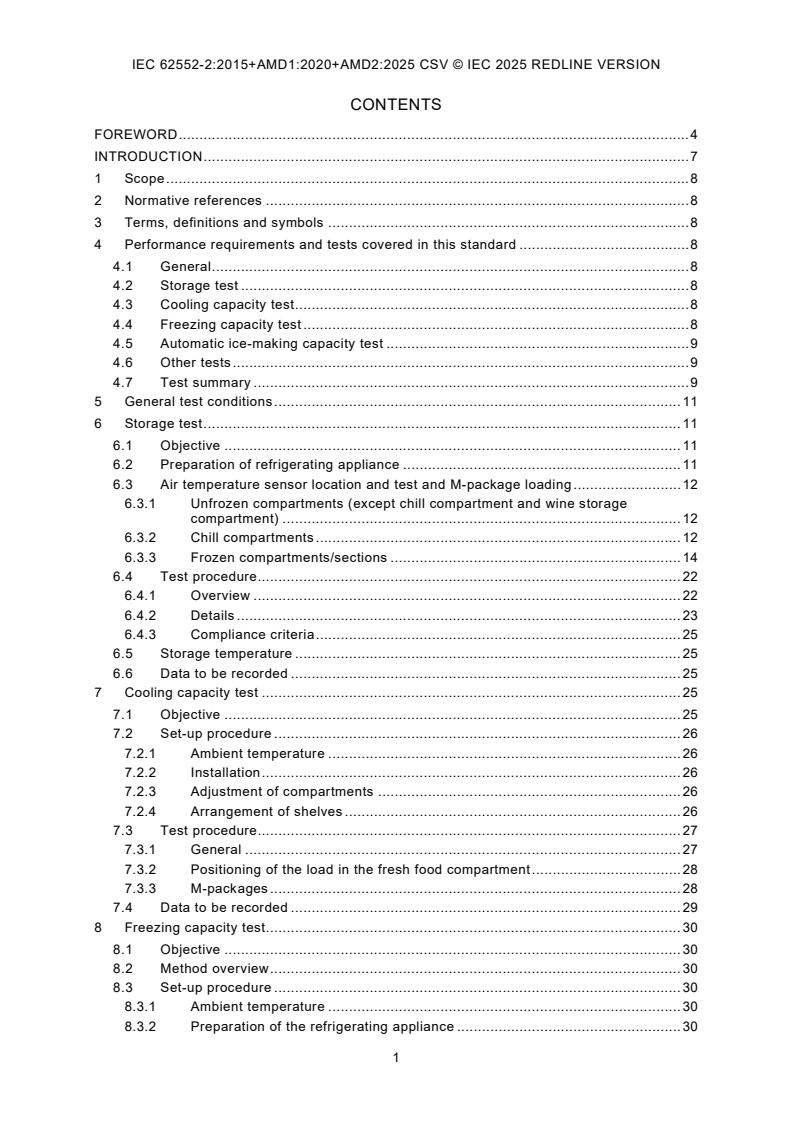
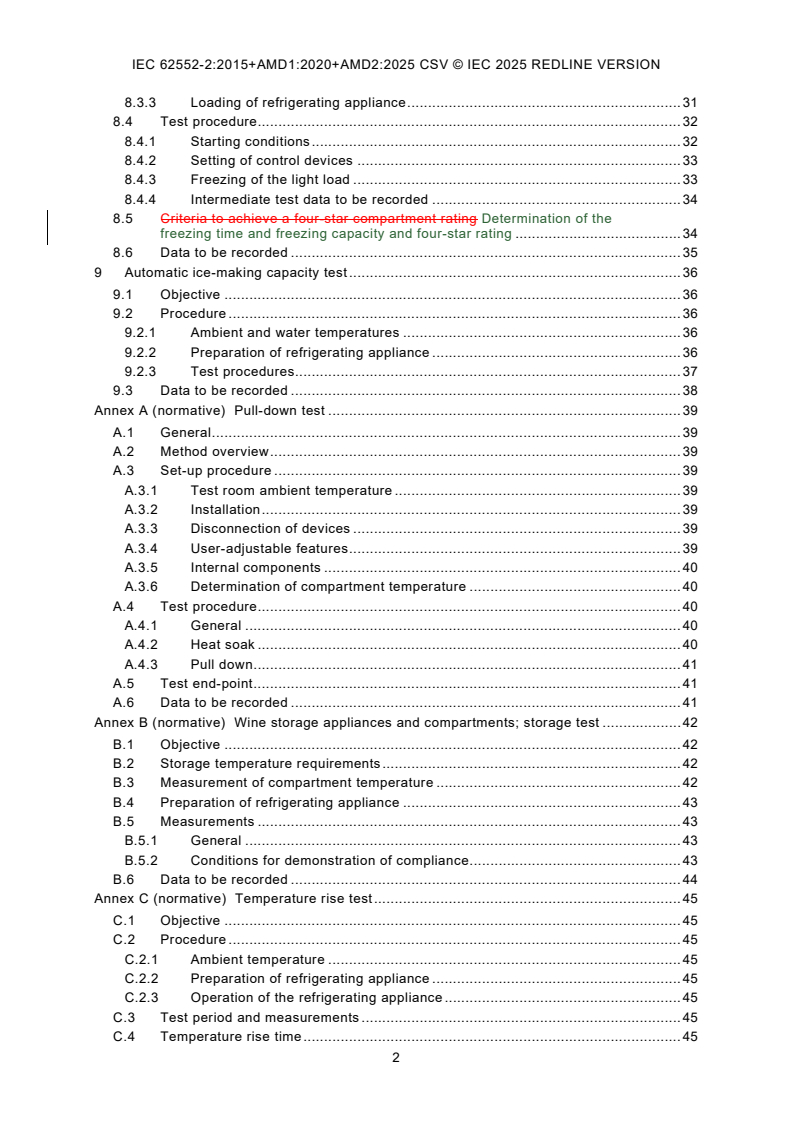
CONTENTS
FOREWORD . 4
INTRODUCTION . 7
1 Scope . 8
2 Normative references . 8
3 Terms, definitions and symbols . 8
4 Performance requirements and tests covered in this standard . 8
4.1 General . 8
4.2 Storage test . 8
4.3 Cooling capacity test . 8
4.4 Freezing capacity test . 8
4.5 Automatic ice-making capacity test . 9
4.6 Other tests . 9
4.7 Test summary . 9
5 General test conditions . 11
6 Storage test . 11
6.1 Objective . 11
6.2 Preparation of refrigerating appliance . 11
6.3 Air temperature sensor location and test and M-package loading . 12
6.3.1 Unfrozen compartments (except chill compartment and wine storage
compartment) . 12
6.3.2 Chill compartments . 12
6.3.3 Frozen compartments/sections . 14
6.4 Test procedure. 22
6.4.1 Overview . 22
6.4.2 Details . 23
6.4.3 Compliance criteria . 25
6.5 Storage temperature . 25
6.6 Data to be recorded . 25
7 Cooling capacity test . 25
7.1 Objective . 25
7.2 Set-up procedure . 26
7.2.1 Ambient temperature . 26
7.2.2 Installation . 26
7.2.3 Adjustment of compartments . 26
7.2.4 Arrangement of shelves . 26
7.3 Test procedure. 27
7.3.1 General . 27
7.3.2 Positioning of the load in the fresh food compartment . 28
7.3.3 M-packages . 28
7.4 Data to be recorded . 29
8 Freezing capacity test. 30
8.1 Objective . 30
8.2 Method overview . 30
8.3 Set-up procedure . 30
8.3.1 Ambient temperature . 30
8.3.2 Preparation of the refrigerating appliance . 30
8.3.3 Loading of refrigerating appliance . 31
8.4 Test procedure. 32
8.4.1 Starting conditions . 32
8.4.2 Setting of control devices . 33
8.4.3 Freezing of the light load . 33
8.4.4 Intermediate test data to be recorded . 34
8.5 Criteria to achieve a four-star compartment rating Determination of the
freezing time and freezing capacity and four-star rating . 34
8.6 Data to be recorded . 35
9 Automatic ice-making capacity test . 36
9.1 Objective . 36
9.2 Procedure . 36
9.2.1 Ambient and water temperatures . 36
9.2.2 Preparation of refrigerating appliance . 36
9.2.3 Test procedures. 37
9.3 Data to be recorded . 38
Annex A (normative) Pull-down test . 39
A.1 General . 39
A.2 Method overview . 39
A.3 Set-up procedure . 39
A.3.1 Test room ambient temperature . 39
A.3.2 Installation . 39
A.3.3 Disconnection of devices . 39
A.3.4 User-adjustable features . 39
A.3.5 Internal components . 40
A.3.6 Determination of compartment temperature . 40
A.4 Test procedure. 40
A.4.1 General . 40
A.4.2 Heat soak . 40
A.4.3 Pull down . 41
A.5 Test end-point . 41
A.6 Data to be recorded . 41
Annex B (normative) Wine storage appliances and compartments; storage test . 42
B.1 Objective . 42
B.2 Storage temperature requirements . 42
B.3 Measurement of compartment temperature . 42
B.4 Preparation of refrigerating appliance . 43
B.5 Measurements . 43
B.5.1 General . 43
B.5.2 Conditions for demonstration of compliance . 43
B.6 Data to be recorded . 44
Annex C (normative) Temperature rise test . 45
C.1 Objective . 45
C.2 Procedure . 45
C.2.1 Ambient temperature . 45
C.2.2 Preparation of refrigerating appliance . 45
C.2.3 Operation of the refrigerating appliance . 45
C.3 Test period and measurements . 45
C.4 Temperature rise time . 45
C.5 Data to be recorded . 46
Annex D (normative) Water vapour condensation test . 47
D.1 Objective . 47
D.2 Procedure . 47
D.2.1 Ambient temperature . 47
D.2.2 Relative humidity . 47
D.2.3 Preparation of refrigerating appliance . 47
D.2.4 Operation of the refrigerating appliance . 47
D.2.5 Test period . 48
D.3 Observations . 48
D.4 Data to be recorded . 48
Figure 5 – Package placement illustration for non flat surfaces . 16
Figure 1 – Location of packages in frozen compartment, showing clearances (1 of 2) . 18
Figure 2 – Location of test packages and M-packages, in frozen compartment (1 of 3) . 20
Figure 3 – Storage test sequence illustration . 24
Figure 4 – Filling of a shelf with test packages and M-packages for cooling
capacity test . 29
Figure D.1 – Condensation codes . 48
Table 1 – Test summary . 10
Table 2 – Compartment temperatures . 11
Table 3 – Chill compartment storage load . 14
Table 4 – Requirements for periods S and E . 23
Table 5 – M-Packages in the light load . 34
Table A.1 – Pull-down temperatures for compartments . 41
Table D.1 – Humidity conversions . 47
INTERNATIONAL ELECTROTECHNICAL COMMISSION
____________
Household refrigerating appliances -
Characteristics and test methods -
Part 2: Performance requirements
FOREWORD
1) The International Electrotechnical Commission (IEC) is a worldwide organization for standardization comprising
all national electrotechnical committees (IEC National Committees). The object of IEC is to promote
international co-operation on all questions concerning standardization in the electrical and electronic fields. To
this end and in addition to other activities, IEC publishes International Standards, Technical Specifications,
Technical Reports, Publicly Available Specifications (PAS) and Guides (hereafter referred to as “IEC
Publication(s)”). Their preparation is entrusted to technical committees; any IEC National Committee interested
in the subject dealt with may participate in this preparatory work. International, governmental and non-
governmental organizations liaising with the IEC also participate in this preparation. IEC collaborates closely
with the International Organization for Standardization (ISO) in accordance with conditions determined by
agreement between the two organizations.
2) The formal decisions or agreements of IEC on technical matters express, as nearly as possible, an international
consensus of opinion on the relevant subjects since each technical committee has representation from all
interested IEC National Committees.
3) IEC Publications have the form of recommendations for international use and are accepted by IEC National
Committees in that sense. While all reasonable efforts are made to ensure that the technical content of IEC
Publications is accurate, IEC cannot be held responsible for the way in which they are used or for any
misinterpretation by any end user.
4) In order to promote international uniformity, IEC National Committees undertake to apply IEC Publications
transparently to the maximum extent possible in their national and regional publications. Any divergence
between any IEC Publication and the corresponding national or regional publication shall be clearly indicated in
the latter.
5) IEC itself does not provide any attestation of conformity. Independent certification bodies provide conformity
assessment services and, in some areas, access to IEC marks of conformity. IEC is not responsible for any
services carried out by independent certification bodies.
6) All users should ensure that they have the latest edition of this publication.
7) No liability shall attach to IEC or its directors, employees, servants or agents including individual experts and
members of its technical committees and IEC National Committees for any personal injury, property damage or
other damage of any nature whatsoever, whether direct or indirect, or for costs (including legal fees) and
expenses arising out of the publication, use of, or reliance upon, this IEC Publication or any other IEC
Publications.
8) Attention is drawn to the Normative references cited in this publication. Use of the referenced publications is
indispensable for the correct application of this publication.
9) IEC draws attention to the possibility that the implementation of this document may involve the use of (a)
patent(s). IEC takes no position concerning the evidence, validity or applicability of any claimed patent rights in
respect thereof. As of the date of publication of this document, IEC had not received notice of (a) patent(s),
which may be required to implement this document. However, implementers are cautioned that this may not
represent the latest information, which may be obtained from the patent database available at
https://patents.iec.ch. IEC shall not be held responsible for identifying any or all such patent rights.
This consolidated version of the official IEC Standard and its amendments has been prepared
for user convenience.
IEC 62552-2 edition 1.2 contains the first edition (2015-02) [documents 59M/62/FDIS and
59M/65/RVD], its amendment 1 (2020-11) [documents 59M/127/FDIS and 59M/133/RVD] and
its amendment 2 [documents 59M/187/FDIS and 59M/191/RVD].
In this Redline version, a vertical line in the margin shows where the technical content is
modified by amendments 1 and 2. Additions are in green text, deletions are in strikethrough
red text. A separate Final version with all changes accepted is available in this publication.
International Standard IEC 62552-2 has been prepared by subcommittee 59M: Performance
of electrical household and similar cooling and freezing appliances, of IEC technical
committee 59: Performance of household and similar electrical appliances
IEC 62552-1, IEC 62552-2 and IEC 62552-3 together constitute a technical revision and
include the following significant technical changes with respect to IEC 62552:2007:
a) All parts of the standard have been largely rewritten and updated to cope with new testing
requirements, new product configurations, the advent of electronic product controls and
computer based test-room data collection and processing equipment.
b) In Part 1 there are some changes to test room equipment specifications and the setup for
testing to provide additional flexibility especially when testing multiple appliances in a
single test room.
c) For more efficient analysis and to better characterise the key product characteristics
under different operating conditions, the test data from many of the energy tests in Part 3
is now split into components (such as steady state operation and defrost and recovery).
The approach to determination of energy consumption has been completely revised, with
many internal checks now included to ensure that data complying with the requirements of
the standard is as accurate as possible and of high quality.
d) Part 3 of the standard now provides a method to quantify each of the relevant energy
components and approaches on how these can be combined to estimate energy under
different conditions on the expectation that different regions will select components and
weightings that are most applicable when setting both their local performance and energy
efficiency criteria while using a single set of global test measurements.
e) For energy consumption measurements in Part 3, no thermal mass (test packages) is
included in any compartment and compartment temperatures are based on the average of
air temperature sensors (compared to the temperature in the warmest test package).
There are also significant differences in the position of temperature sensors in unfrozen
compartments.
f) The energy consumption test in Part 3 now has two specified ambient temperatures (16°C
and 32°C).
g) While, in Part 2 (this part) test packages are still used for the storage test to confirm
performance in different operating conditions, in Part 1 they have been standardised to
one size (100 mm × 100 mm × 50 mm) to simply loading and reduce test variability. A
clearance of at least 15 mm is now specified between test packages and the compartment
liner.
h) A load processing energy efficiency test has been added in Part 3.
i) A tank-type ice making energy efficiency test has been added in Part 3.
j) A cooling capacity test has been added in Part 2 (this part).
k) A pull-down test has been added in Part 2 (this part).
l) Shelf area and storage volume measurement methods are no longer included. In Part 3
the volume measurement has been revised to be the total internal volume with only
components necessary for the satisfactory operation of the refrigeration system
considered as being in place.
m) Tests (both performance (Part 2 – this part) and energy (Part 3)) have been added for
wine storage appliances.
The following print types are used in this international standard:
– requirements: in roman type;
– test variables: in italic type;
– notes: in small roman type.
– words in bold are defined in IEC 62552-1:2015.
This publication has been drafted in accordance with the ISO/IEC Directives, Part 2.
A list of all parts in the IEC 62252 series, published under the general title Household
refrigerating appliances – characteristics and test methods, can be found on the IEC website.
The committee has decided that the contents of this document and its amendment will remain
unchanged until the stability date indicated on the IEC website under webstore.iec.ch in the
data related to the specific document. At this date, the document will be
– reconfirmed,
– withdrawn, or
– revised.
INTRODUCTION
IEC 62552 is split into 3 parts as follows:
• Part 1: Scope, definitions, instrumentation, test room and set up of refrigerating products;
• Part 2: General performance requirements for refrigerating appliances and methods for
testing them (this part);
• Part 3: Energy consumption and volume determination.
1 Scope
This part of IEC 62552 specifies the essential characteristics of household and similar
refrigerating appliances cooled by internal natural convection or forced air circulation, and
specifies establishes test methods for checking these characteristics.
This part of IEC 62552 describes the methods for the determination of performance
requirements. Although there is some commonality in the set-ups for different tests (and so it
may be an advantage to apply them all to one sample), these are separate tests to evaluate
specific characteristics of the sample being tested. This part of IEC 62552 does not specify a
procedure to generalise the results from sample test results to a prediction of the
characteristics of the whole population from which that sample was selected.
2 Normative references
The following documents, in whole or in part, are normatively referenced in this document and
are indispensable for its application. For dated references, only the edition cited applies. For
undated references, the latest edition of the referenced document (including any
amendments) applies.
IEC 62552-1:2015, Household refrigerating appliances – Characteristics and test methods –
Part 1: General requirements
IEC 62552-3:2015, Household refrigerating appliances – Characteristics and test methods –
Part 3: Energy consumption and volume
3 Terms, definitions and symbols
For the purposes of this document, the terms, definitions and symbols given in
IEC 62552-1:2015 apply.
4 Performance requirements and tests covered in this standard
4.1 General
This standard sets out tests to assess the performance of household and similar refrigerating
appliances. While this standard does not require these tests to be performed, when they are
performed, they shall be carried out as specified.
4.2 Storage test
The storage test is used to establish whether the refrigerating appliance is capable of
maintaining suitable internal storage temperatures in a range of ambient conditions defined
under the climate classes for which it is rated. See Clause 6.
4.3 Cooling capacity test
The cooling capacity test is used to measure the load processing capability of fresh food
compartments by determining the time to pull down a specified test load from ambient to a
specified temperature. See Clause 7.
4.4 Freezing capacity test
The freezing capacity test is used to measure the load processing capability of frozen
compartments by determining the time to pull down a specified test load from ambient to a
specified temperature. This test is required to establish whether a frozen compartment also
qualifies for a four-star performance rating. See Clause 8.
4.5 Automatic ice-making capacity test
The ice-making capacity test is used to determine the quantity of new ice cubes that can be
produced over a specified period of time. See Clause 9.
4.6 Other tests
Other tests that may not be required to be performed are found in the annexes.
These tests are
a) Pull-down test (Annex A): This test is used to measure the reserve refrigerating capacity
of a refrigerating appliance.
b) Wine storage test (Annex B): This test is used to check compliance with the requirements
of Part 2 at appropriate ambient temperatures for the various climate classes.
c) Temperature rise test (Annex C): This test is used to determine the time taken for the
temperature to rise in the warmest test package from –18ºC to –9ºC after the power is
disconnected. It is applicable to refrigerating appliances with one or more three-star or
four-star compartments.
d) Water vapour condensation test (Annex D): This test is used to determine the extent of
water condensation on the external surface of the refrigerating appliance under
specified ambient conditions.
4.7 Test summary
Table 1 provides a summary of the tests to be performed.
Table 1 – Test summary
Clause / Ambient Pantry Fresh Chill Zero star 1 and 3 and 4 Temperature
Annex and cellar food 2 star star requirements
and Test after test has
started
Clause 6 Various Packages No No Yes To hold initial
Storage values
Yes 1 star: Type a
Type b Other: Type a
or b
Initial temp Mean Instant Mean Max
Clause 7 25 °C Packages No Type b No No No For test load
Cooling final only
Initial temp Table 2 +4 °C ± Table 2 Maximum/ Average/
capacity
minimum minimum
0,5 K
Clause 8 25 °C Packages M-packages only Yes No Yes Yes excursion
Freezing and final
Type b Type b Type a
capacity
Initial temp Table 2 Not Maximum/minimum Average
measured
Clause 9 25 °C Packages No No
Auto ice-
Initial temp As for Table 2 Average
making
Annex A 43 °C Packages No Final only
Pull-down
Max Initial temp 43 °C
Maximum temperature according climate class rating
Annex C 25 °C Packages As for the storage Type b No Type a For –18 °C
Temp rise test compartments
only
No
Initial temp Not specified –18 °C
Annex D 25 °C for Packages No To hold initial
Condensa- SN and N values
Initial temp ≤ energy test temperatures as in Table 1 in IEC 62552-3:2015
tion 32 °C for
ST and T
NOTE 1 For definitions of symbols, see 3.7 in IEC 62552-1:2015.
NOTE 2 In the event of any discrepancy between data in this table and the individual test procedures, the test
procedures take precedence.
NOTE 3 Wine storage test parameters are specified in Annex B.
Table 2 – Compartment temperatures
°C
Compartment type
Fresh food Three- Two-star One-star Zero-star Chill Cellar Pantry
star and
four-star
a a a
T , T , T T*** T** T* T T T T
1m 2m ma zma cci cma pma
T
3m
b b
0 ≤ T , ≤ +4 ≤ −18 ≤−12 ≤ −6 ≤0 –3 ≤ T ≤ +3 +2 ≤ T +14
1m cci cma
T , T ≤ ≤ +14 ≤ T
2m 3m pma
+8 ≤ +20
average average maximum maximum maximum average instantaneous average average
a
The superscripts attached to the symbol T correspond to the three-star and four-star, two-star or one-star
compartment temperature.
b
During a defrost and recovery period, these storage temperatures of frost-free refrigerating appliances are
permitted to rise by no more than 3 K with respect to the storage temperature during period S (see 6.4). The
storage temperature is defined as the maximum temperature of any M-package during a given time period (see
Figure 3).
NOTE For definitions of symbols, see 3.7 in IEC 62552-1:2015
5 General test conditions
Unless otherwise noted, test room set-up and instrumentation shall be as specified in
Annex A of IEC 62552-1:2015.
Unless otherwise noted, installation and set-up of shelves, drawers, bins, flaps and controls
etc. shall be as specified in Annex B of IEC 62552-1:2015.
6 Storage test
6.1 Objective
The purpose of this test is to check that the refrigerating appliance is capable of maintaining
specified internal temperatures at different ambient temperatures.
Under the conditions specified in this clause (Clause 6) and at the ambient temperatures for
the appropriate climate classes as specified in A.3.2.3 of IEC 62552-1:2015, the refrigerating
appliance shall be capable of maintaining, simultaneously, the required compartment
temperatures (within the permitted temperature deviations during the defrost and recovery
period) as given in Table 2.
To meet these test requirements, there shall be, for each any ambient temperature between
and including the minimum and maximum ambient temperatures defined by the rated climate
class, at least one control setting at which all compartments meet the specified internal
temperatures. The control(s) however, may be adjusted for testing at different ambients
ambient temperatures.
NOTE Because the frozen compartment loading is largely the same as that for the freezing capacity test, there
may be an advantage in doing these tests consecutively.
6.2 Preparation of refrigerating appliance
The test room ambient shall be as specified in A.3.2.3 of IEC 62552-1:2015.
The refrigerating appliance shall be installed in the test room in accordance with Annex B of
IEC 62552-1:2015.
Refrigerating appliances with anti-condensation heater(s) which are permanently on during
normal use shall be tested with the heater(s) operating.
Anti-condensation heaters which can be manually controlled by the user shall be switched on
and, if adjustable, they shall be set at their maximum heating rate.
Anti-condensation heaters which are automatically controlled shall be allowed to operate
normally.
The empty refrigerating appliance should be set up and operated until it has reached
equilibrium at or close to the temperatures specified in Table 2.
The unloaded refrigerating appliance should be set up and operated until it has reached
equilibrium at, or close to, the temperatures specified in Table 2.
Thermal storage devices shall be placed in the dedicated positions in the respective
compartments, in accordance with the manufacturer's instructions, and shall be independent
of the location of the test packages. Instructions for loose placement of thermal storage
devices in the appliance do not define dedicated positions.
NOTE An instruction without specific indication of location or placement of the thermal storage devices is an
example of loose placement.
If dedicated positions are absent, the thermal storage devices shall be removed from the
compartment.
Any automatic icemaker shall be configured so that no new ice is made during the test, but
shall otherwise remain operational. However, connection to a water supply may be omitted if it
can be demonstrated that the absence or presence of a connection to a water supply would
make no difference to the results of this test.
6.3 Air temperature sensor location and test and M-package loading
6.3.1 Unfrozen compartments (except chill compartment and wine storage
compartment)
For determining the storage temperatures of these compartments, air temperature sensors
shall be located in accordance with D.2.2 of IEC 62552-1:2015/AMD1:2020.
NOTE See Annex B, Wine storage appliances and compartments; storage test.
6.3.2 Chill compartments
6.3.2.1 General
All test packages and M-packages shall be as specified in Clause C.2 b) of
IEC 62552-1:2015.
For determining the storage temperature of any chill compartment, the storage load shall
be in accordance with 6.3.2.2.
The temperature T (see Table 2) shall be measured in M-packages positioned or
cci
suspended so that their largest surface is horizontal. They may be positioned directly on the
floor of the compartment/drawer but shall always be at least 15 mm away from all walls and
ceilings and from the other packages of the test load.
In these compartments, M-packages shall be placed in diagonally opposite corners.
In the case of a compartment with special subdivisions (shelves, etc.) which are part of the
design, if the dimensions are too small to allow the horizontal positioning of the M-packages,
it is permissible to position them vertically.
If the dimensions are too small to accommodate an M-package (for example in door shelves),
a special support shall be used to position the M-package next to the shelf and as close as
possible to the door liner.
The temperature of the chill compartment is the instantaneous temperature of any M-
package in that compartment. The temperatures and conditions specified in Table 2 shall
apply.
The temperatures of the chill compartment T are the instantaneous temperatures of each
cci
M-package in that compartment. The temperatures and conditions specified in Table 2 shall
apply.
All test packages and M-packages shall be positioned or suspended so that their largest
surface is horizontal. They may be positioned directly on the floor of the compartment or
drawer, but shall always be at least 25 mm away from all walls and ceilings and from the other
packages of the test load. The test packages and M-packages shall be positioned as far as
possible in the corners of the compartment and at two vertical levels:
a) bottom level, which is the lowest horizontal surface intended for storage;
b) top level, where the packages have 25 mm clearance from the compartment ceiling.
Supports can be used to position the packages.
Loading of packages shall be in the following order:
1) front left corner of the bottom level;
2) back right corner of the top level;
3) front right corner of the top level;
4) left back corner of the bottom level;
5) front left corner of the top level;
6) back right corner of the bottom level;
7) front right corner of the bottom level;
8) left back corner of the top level;
9) centre of the bottom level;
10) centre of the top level.
Loading shall start using M-packages, up to the amount specified in Table 3. After the last M-
package, normal test packages shall be loaded until the total number of packages is reached.
If a package cannot be placed in accordance with the required order, its position shall be
skipped, and the number of packages shall be reduced. The number of M-packages shall not
be reduced.
In the case of a compartment with special subdivisions (shelves, etc.) that are part of the
design, if the dimensions are too small to allow the horizontal positioning of the M-packages,
it is permissible to position them vertically.
If the dimensions are too small to accommodate an M-package (for example in door shelves),
a special support shall be used to position the M-package next to the shelf and as close as
possible to the door liner.
6.3.2.2 Chill compartment storage load
The compartment shall be loaded with the number of packages specified in Table 3.
There shall always be at least two M-packages and test packages may be replaced by M-
packages.
Table 3 – Chill compartment storage load
Volume, V, of chill compartment Total number of packages M-packages
(l)
V < 10 2 2
10 ≤ V < 20 3 2
20 ≤ V < 30 4 2
30 ≤ V < 40 5 3
40 ≤ V < 50 6 3
50 ≤ V < 60 7 4
60 ≤ V < 70 8 4
70 ≤ V < 80 9 5
V ≥ 80 10 5
6.3.3 Frozen compartments/sections
6.3.3.1 General
Temperatures shall be measured in M-packages, which are distributed throughout the load of
test packages as specified in the test package placement (6.3.3.3). They shall be placed as
specified in 6.3.3.4.
The temperature of each section, or compartment, is the maximum temperature of any M-
package in that section or compartment. The temperatures and conditions specified in
Table 2 shall apply.
6.3.3.2 Packages
All packages (test packages and M-packages) shall be as specified in Annex C of
IEC 62552-1:2015.
The packages shall have previously been brought to the approximate compartment
temperature as set out in Table 2.
Wetting of packages to freeze them together is not permitted but to keep packages aligned in
a stack, they may be strapped together with non-metallic strapping.
The use of spacers to maintain free air spaces between stacks of packages is permissible
provided that the spacers are of the smallest practicable cross-section and of low thermal
mass and conductivity and are placed in such a way that they do not significantly interfere
with normal air circulation. A few 15 mm diameter spherical plastic beads threaded on vertical
ties strapping stacks of packages together would meet these requirements.
6.3.3.3 Package placement
6.3.3.3.1 General
Packages shall be placed as follows:
a) The compartment (Including any door storage) shall be filled with as many packages as
possible while still complying with the air passage and clearance requirements in 6.3.3.3.2
and 6.3.3.3.3.
b) Packages on shelves or in containers shall be placed so that the front of the front row is
in line with the front of the shelf or container and they shall be arranged symmetrically
about the front-to-back centre line of the shelf or container. Where lack of symmetry in
the compartment makes this impossible, the stacking shall be as symmetrical as
possible. In any case, the front of the front row shall be in line with the front of the shelf
or the front of the container.
c) Stacks shall be made directly on each horizontal surface intended for storage (see
Figures 1 and 2). The packages shall be stacked vertically (i.e. with each package fully
covering the one below with no off-sets in the stacks).
– Except for door storage, the packages shall be placed with their largest surface
horizontal.
Shelves with ribs, etc. are considered to be horizontal surfaces. If necessary, packers
may be used in shelf depressions to stabilise stacks.
Surfaces intended for storage with ribs, depressions, slight inclinations, etc. are treated as
horizontal surfaces. If necessary, packers may be used to stabilise stacks (see Figure 5).
NOTE Inclinations of less than 15 mm per 100 mm, which are equal to the width or length of a test package,
are considered slight inclinations.
a) Package placement on a she
...
IEC 62552-2 ®
Edition 1.0 2015-02
INTERNATIONAL
STANDARD
NORME
INTERNATIONALE
Household refrigerating appliances – Characteristics and test methods –
Part 2: Performance requirements
Appareils de réfrigération à usage ménager – Caractéristiques et méthodes
d'essai –
Partie 2 – Exigences de performances
All rights reserved. Unless otherwise specified, no part of this publication may be reproduced or utilized in any form
or by any means, electronic or mechanical, including photocopying and microfilm, without permission in writing from
either IEC or IEC's member National Committee in the country of the requester. If you have any questions about IEC
copyright or have an enquiry about obtaining additional rights to this publication, please contact the address below or
your local IEC member National Committee for further information.
Droits de reproduction réservés. Sauf indication contraire, aucune partie de cette publication ne peut être reproduite
ni utilisée sous quelque forme que ce soit et par aucun procédé, électronique ou mécanique, y compris la photocopie
et les microfilms, sans l'accord écrit de l'IEC ou du Comité national de l'IEC du pays du demandeur. Si vous avez des
questions sur le copyright de l'IEC ou si vous désirez obtenir des droits supplémentaires sur cette publication, utilisez
les coordonnées ci-après ou contactez le Comité national de l'IEC de votre pays de résidence.
IEC Central Office Tel.: +41 22 919 02 11
3, rue de Varembé Fax: +41 22 919 03 00
CH-1211 Geneva 20 info@iec.ch
Switzerland www.iec.ch
About the IEC
The International Electrotechnical Commission (IEC) is the leading global organization that prepares and publishes
International Standards for all electrical, electronic and related technologies.
About IEC publications
The technical content of IEC publications is kept under constant review by the IEC. Please make sure that you have the
latest edition, a corrigenda or an amendment might have been published.
IEC Catalogue - webstore.iec.ch/catalogue Electropedia - www.electropedia.org
The stand-alone application for consulting the entire The world's leading online dictionary of electronic and
bibliographical information on IEC International Standards, electrical terms containing more than 30 000 terms and
Technical Specifications, Technical Reports and other definitions in English and French, with equivalent terms in 15
documents. Available for PC, Mac OS, Android Tablets and additional languages. Also known as the International
iPad. Electrotechnical Vocabulary (IEV) online.
IEC publications search - www.iec.ch/searchpub IEC Glossary - std.iec.ch/glossary
The advanced search enables to find IEC publications by a More than 60 000 electrotechnical terminology entries in
variety of criteria (reference number, text, technical English and French extracted from the Terms and Definitions
committee,…). It also gives information on projects, replaced clause of IEC publications issued since 2002. Some entries
and withdrawn publications. have been collected from earlier publications of IEC TC 37,
77, 86 and CISPR.
IEC Just Published - webstore.iec.ch/justpublished
Stay up to date on all new IEC publications. Just Published IEC Customer Service Centre - webstore.iec.ch/csc
details all new publications released. Available online and If you wish to give us your feedback on this publication or
also once a month by email. need further assistance, please contact the Customer Service
Centre: csc@iec.ch.
A propos de l'IEC
La Commission Electrotechnique Internationale (IEC) est la première organisation mondiale qui élabore et publie des
Normes internationales pour tout ce qui a trait à l'électricité, à l'électronique et aux technologies apparentées.
A propos des publications IEC
Le contenu technique des publications IEC est constamment revu. Veuillez vous assurer que vous possédez l’édition la
plus récente, un corrigendum ou amendement peut avoir été publié.
Catalogue IEC - webstore.iec.ch/catalogue Electropedia - www.electropedia.org
Application autonome pour consulter tous les renseignements
Le premier dictionnaire en ligne de termes électroniques et
bibliographiques sur les Normes internationales,
électriques. Il contient plus de 30 000 termes et définitions en
Spécifications techniques, Rapports techniques et autres
anglais et en français, ainsi que les termes équivalents dans
documents de l'IEC. Disponible pour PC, Mac OS, tablettes
15 langues additionnelles. Egalement appelé Vocabulaire
Android et iPad.
Electrotechnique International (IEV) en ligne.
Recherche de publications IEC - www.iec.ch/searchpub
Glossaire IEC - std.iec.ch/glossary
Plus de 60 000 entrées terminologiques électrotechniques, en
La recherche avancée permet de trouver des publications IEC
en utilisant différents critères (numéro de référence, texte, anglais et en français, extraites des articles Termes et
comité d’études,…). Elle donne aussi des informations sur les Définitions des publications IEC parues depuis 2002. Plus
projets et les publications remplacées ou retirées. certaines entrées antérieures extraites des publications des
CE 37, 77, 86 et CISPR de l'IEC.
IEC Just Published - webstore.iec.ch/justpublished
Service Clients - webstore.iec.ch/csc
Restez informé sur les nouvelles publications IEC. Just
Published détaille les nouvelles publications parues. Si vous désirez nous donner des commentaires sur cette
Disponible en ligne et aussi une fois par mois par email. publication ou si vous avez des questions contactez-nous:
csc@iec.ch.
IEC 62552-2 ®
Edition 1.0 2015-02
INTERNATIONAL
STANDARD
NORME
INTERNATIONALE
Household refrigerating appliances – Characteristics and test methods –
Part 2: Performance requirements
Appareils de réfrigération à usage ménager – Caractéristiques et méthodes
d'essai –
Partie 2 – Exigences de performances
INTERNATIONAL
ELECTROTECHNICAL
COMMISSION
COMMISSION
ELECTROTECHNIQUE
INTERNATIONALE
ICS 97.030 ISBN 978-2-8322-2232-4
– 2 – IEC 62552-2:2015 © IEC 2015
CONTENTS
FOREWORD . 5
INTRODUCTION . 8
1 Scope . 9
2 Normative references . 9
3 Terms, definitions and symbols. 9
4 Performance requirements and tests covered in this standard . 9
4.1 General . 9
4.2 Storage test . 9
4.3 Cooling capacity test . 10
4.4 Freezing capacity test . 10
4.5 Automatic ice-making capacity test . 10
4.6 Other tests . 10
4.7 Test summary . 10
5 General test conditions . 12
6 Storage test . 12
6.1 Objective . 12
6.2 Preparation of refrigerating appliance . 12
6.3 Air temperature sensor location and test and M-package loading . 13
6.3.1 Unfrozen compartments (except chill compartment and wine storage
compartment) . 13
6.3.2 Chill compartments . 13
6.3.3 Frozen compartments/sections . 14
6.4 Test procedure . 20
6.4.1 Overview . 20
6.4.2 Details . 21
6.4.3 Compliance criteria . 22
6.5 Storage temperature . 22
6.6 Data to be recorded . 22
7 Cooling capacity test . 23
7.1 Objective . 23
7.2 Set-up procedure . 23
7.2.1 Ambient temperature . 23
7.2.2 Installation . 23
7.2.3 Adjustment of compartments . 24
7.2.4 Arrangement of shelves . 24
7.3 Test procedure . 24
7.3.1 General . 24
7.3.2 Positioning of the load in the fresh food compartment . 25
7.3.3 M-packages . 26
7.4 Data to be recorded . 27
8 Freezing capacity test . 28
8.1 Objective . 28
8.2 Method overview . 28
8.3 Set-up procedure . 28
8.3.1 Ambient temperature . 28
8.3.2 Preparation of the refrigerating appliance . 28
8.3.3 Loading of refrigerating appliance . 29
8.4 Test procedure . 30
8.4.1 Starting conditions . 30
8.4.2 Setting of control devices . 30
8.4.3 Freezing of the light load . 30
8.4.4 Intermediate test data to be recorded . 31
8.5 Criteria to achieve a four-star compartment rating . 31
8.6 Data to be recorded . 31
9 Automatic ice-making capacity test . 32
9.1 Objective . 32
9.2 Procedure . 32
9.2.1 Ambient and water temperatures . 32
9.2.2 Preparation of refrigerating appliance . 32
9.2.3 Test procedures . 33
9.3 Data to be recorded . 34
Annex A (normative) Pull-down test . 35
A.1 General . 35
A.2 Method overview . 35
A.3 Set-up procedure . 35
A.3.1 Test room ambient temperature . 35
A.3.2 Installation . 35
A.3.3 Disconnection of devices . 35
A.3.4 User-adjustable features . 35
A.3.5 Internal components . 36
A.3.6 Determination of compartment temperature . 36
A.4 Test procedure . 36
A.4.1 General . 36
A.4.2 Heat soak . 36
A.4.3 Pull down . 36
A.5 Test end-point . 36
A.6 Data to be recorded . 37
Annex B (normative) Wine storage appliances and compartments; storage test . 38
B.1 Objective . 38
B.2 Storage temperature requirements . 38
B.3 Measurement of compartment temperature . 38
B.4 Preparation of refrigerating appliance . 39
B.5 Measurements . 39
B.5.1 General . 39
B.5.2 Conditions for demonstration of compliance . 39
B.6 Data to be recorded . 39
Annex C (normative) Temperature rise test . 41
C.1 Objective . 41
C.2 Procedure . 41
C.2.1 Ambient temperature . 41
C.2.2 Preparation of refrigerating appliance . 41
C.2.3 Operation of the refrigerating appliance . 41
C.3 Test period and measurements . 41
– 4 – IEC 62552-2:2015 © IEC 2015
C.4 Temperature rise time . 41
C.5 Data to be recorded . 41
Annex D (normative) Water vapour condensation test . 42
D.1 Objective . 42
D.2 Procedure . 42
D.2.1 Ambient temperature . 42
D.2.2 Relative humidity . 42
D.2.3 Preparation of refrigerating appliance . 42
D.2.4 Operation of the refrigerating appliance . 42
D.2.5 Test period . 43
D.3 Observations . 43
D.4 Data to be recorded . 43
Figure 1 – Location of packages in frozen compartment, showing clearances . 16
Figure 2 – Location of test packages and M-packages, in frozen compartment . 18
Figure 3 – Storage test sequence . 22
Figure 4 – Filling of a shelf with test packages and M-packages for cooling capacity test . 27
Figure D.1 – Condensation codes . 43
Table 1 – Test summary . 11
Table 2 – Compartment temperatures . 11
Table 3 – Chill compartment storage load . 13
Table 4 – Requirements for periods S and E . 21
Table A.1 – Pull-down temperatures for compartments . 37
Table D.1 – Humidity conversions . 42
INTERNATIONAL ELECTROTECHNICAL COMMISSION
____________
HOUSEHOLD REFRIGERATING APPLIANCES –
CHARACTERISTICS AND TEST METHODS –
Part 2: Performance requirements
FOREWORD
1) The International Electrotechnical Commission (IEC) is a worldwide organization for standardization comprising
all national electrotechnical committees (IEC National Committees). The object of IEC is to promote
international co-operation on all questions concerning standardization in the electrical and electronic fields. To
this end and in addition to other activities, IEC publishes International Standards, Technical Specifications,
Technical Reports, Publicly Available Specifications (PAS) and Guides (hereafter referred to as “IEC
Publication(s)”). Their preparation is entrusted to technical committees; any IEC National Committee interested
in the subject dealt with may participate in this preparatory work. International, governmental and non-
governmental organizations liaising with the IEC also participate in this preparation. IEC collaborates closely
with the International Organization for Standardization (ISO) in accordance with conditions determined by
agreement between the two organizations.
2) The formal decisions or agreements of IEC on technical matters express, as nearly as possible, an international
consensus of opinion on the relevant subjects since each technical committee has representation from all
interested IEC National Committees.
3) IEC Publications have the form of recommendations for international use and are accepted by IEC National
Committees in that sense. While all reasonable efforts are made to ensure that the technical content of IEC
Publications is accurate, IEC cannot be held responsible for the way in which they are used or for any
misinterpretation by any end user.
4) In order to promote international uniformity, IEC National Committees undertake to apply IEC Publications
transparently to the maximum extent possible in their national and regional publications. Any divergence
between any IEC Publication and the corresponding national or regional publication shall be clearly indicated in
the latter.
5) IEC itself does not provide any attestation of conformity. Independent certification bodies provide conformity
assessment services and, in some areas, access to IEC marks of conformity. IEC is not responsible for any
services carried out by independent certification bodies.
6) All users should ensure that they have the latest edition of this publication.
7) No liability shall attach to IEC or its directors, employees, servants or agents including individual experts and
members of its technical committees and IEC National Committees for any personal injury, property damage or
other damage of any nature whatsoever, whether direct or indirect, or for costs (including legal fees) and
expenses arising out of the publication, use of, or reliance upon, this IEC Publication or any other IEC
Publications.
8) Attention is drawn to the Normative references cited in this publication. Use of the referenced publications is
indispensable for the correct application of this publication.
9) Attention is drawn to the possibility that some of the elements of this IEC Publication may be the subject of
patent rights. IEC shall not be held responsible for identifying any or all such patent rights.
International Standard IEC 62552-2 has been prepared by subcommittee 59M: Performance
of electrical household and similar cooling and freezing appliances, of IEC technical
committee 59: Performance of household and similar electrical appliances
IEC 62552-1, IEC 62552-2 and IEC 62552-3 cancel and replace the first edition of IEC 62552
published in 2007. IEC 62552-1, IEC 62552-2 and IEC 62552-3 together constitute a technical
revision and include the following significant technical changes with respect to
IEC 62552:2007:
a) All parts of the standard have been largely rewritten and updated to cope with new testing
requirements, new product configurations, the advent of electronic product controls and
computer based test-room data collection and processing equipment.
b) In Part 1 there are some changes to test room equipment specifications and the setup for
testing to provide additional flexibility especially when testing multiple appliances in a
single test room.
– 6 – IEC 62552-2:2015 © IEC 2015
c) For more efficient analysis and to better characterise the key product characteristics
under different operating conditions, the test data from many of the energy tests in Part 3
is now split into components (such as steady state operation and defrost and recovery).
The approach to determination of energy consumption has been completely revised, with
many internal checks now included to ensure that data complying with the requirements of
the standard is as accurate as possible and of high quality.
d) Part 3 of the standard now provides a method to quantify each of the relevant energy
components and approaches on how these can be combined to estimate energy under
different conditions on the expectation that different regions will select components and
weightings that are most applicable when setting both their local performance and energy
efficiency criteria while using a single set of global test measurements.
e) For energy consumption measurements in Part 3, no thermal mass (test packages) is
included in any compartment and compartment temperatures are based on the average of
air temperature sensors (compared to the temperature in the warmest test package).
There are also significant differences in the position of temperature sensors in unfrozen
compartments.
f) The energy consumption test in Part 3 now has two specified ambient temperatures (16°C
and 32°C).
g) While, in Part 2 (this part) test packages are still used for the storage test to confirm
performance in different operating conditions, in Part 1 they have been standardised to
one size (100 mm × 100 mm × 50 mm) to simply loading and reduce test variability. A
clearance of at least 15 mm is now specified between test packages and the compartment
liner.
h) A load processing energy efficiency test has been added in Part 3.
i) A tank-type ice making energy efficiency test has been added in Part 3.
j) A cooling capacity test has been added in Part 2 (this part).
k) A pull-down test has been added in Part 2 (this part).
l) Shelf area and storage volume measurement methods are no longer included. In Part 3
the volume measurement has been revised to be the total internal volume with only
components necessary for the satisfactory operation of the refrigeration system
considered as being in place.
m) Tests (both performance (Part 2 – this part) and energy (Part 3)) have been added for
wine storage appliances.
The following print types are used in this international standard:
– requirements: in roman type;
– test variables: in italic type;
– notes: in small roman type.
– words in bold are defined in IEC 62552-1:2015.
The text of this standard is based on the following documents:
FDIS Report on voting
59M/62/FDIS 59M/65/RVD
Full information on the voting for the approval of this standard can be found in the report on
voting indicated in the above table.
This publication has been drafted in accordance with the ISO/IEC Directives, Part 2.
A list of all parts in the IEC 62252 series, published under the general title Household
refrigerating appliances – characteristics and test methods, can be found on the IEC website.
The committee has decided that the contents of this publication will remain unchanged until
the stability date indicated on the IEC web site under "http://webstore.iec.ch" in the data
related to the specific publication. At this date, the publication will be
• reconfirmed,
• withdrawn,
• replaced by a revised edition, or
• amended.
– 8 – IEC 62552-2:2015 © IEC 2015
INTRODUCTION
IEC 62552 is split into 3 parts as follows:
• Part 1: Scope, definitions, instrumentation, test room and set up of refrigerating products;
• Part 2: General performance requirements for refrigerating appliances and methods for
testing them (this part);
• Part 3: Energy consumption and volume determination.
HOUSEHOLD REFRIGERATING APPLIANCES –
CHARACTERISTICS AND TEST METHODS –
Part 2: Performance requirements
1 Scope
This part of IEC 62552 specifies the essential characteristics of household refrigerating
appliances cooled by internal natural convection or forced air circulation, and specifies test
methods for checking the characteristics.
This part of IEC 62552 describes the methods for the determination of performance
requirements. Although there is some commonality in the set-ups for different tests (and so it
may be an advantage to apply them all to one sample), these are separate tests to evaluate
specific characteristics of the sample being tested. This part of IEC 62552 does not specify a
procedure to generalise the results from sample test results to a prediction of the
characteristics of the whole population from which that sample was selected.
2 Normative references
The following documents, in whole or in part, are normatively referenced in this document and
are indispensable for its application. For dated references, only the edition cited applies. For
undated references, the latest edition of the referenced document (including any
amendments) applies.
IEC 62552-1:2015, Household refrigerating appliances – Characteristics and test methods –
Part 1: General requirements
IEC 62552-3:2015, Household refrigerating appliances – Characteristics and test methods –
Part 3: Energy consumption and volume
3 Terms, definitions and symbols
For the purposes of this document, the terms, definitions and symbols given in
IEC 62552-1:2015 apply.
4 Performance requirements and tests covered in this standard
4.1 General
This standard sets out tests to assess the performance of household and similar refrigerating
appliances. While this standard does not require these tests to be performed, when they are
performed, they shall be carried out as specified.
4.2 Storage test
The storage test is used to establish whether the refrigerating appliance is capable of
maintaining suitable internal storage temperatures in a range of ambient conditions defined
under the climate classes for which it is rated. See Clause 6.
– 10 – IEC 62552-2:2015 © IEC 2015
4.3 Cooling capacity test
The cooling capacity test is used to measure the load processing capability of fresh food
compartments by determining the time to pull down a specified test load from ambient to a
specified temperature. See Clause 7.
4.4 Freezing capacity test
The freezing capacity test is used to measure the load processing capability of frozen
compartments by determining the time to pull down a specified test load from ambient to a
specified temperature. This test is required to establish whether a frozen compartment also
qualifies for a four-star performance rating. See Clause 8.
4.5 Automatic ice-making capacity test
The ice-making capacity test is used to determine the quantity of new ice cubes that can be
produced over a specified period of time. See Clause 9.
4.6 Other tests
Other tests that may not be required to be performed are found in the annexes.
These tests are
a) Pull-down test (Annex A): This test is used to measure the reserve refrigerating capacity
of a refrigerating appliance.
b) Wine storage test (Annex B): This test is used to check compliance with the requirements
of Part 2 at appropriate ambient temperatures for the various climate classes.
c) Temperature rise test (Annex C): This test is used to determine the time taken for the
temperature to rise in the warmest test package from –18ºC to –9ºC after the power is
disconnected. It is applicable to refrigerating appliances with one or more three-star or
four-star compartments.
d) Water vapour condensation test (Annex D): This test is used to determine the extent of
water condensation on the external surface of the refrigerating appliance under
specified ambient conditions.
4.7 Test summary
Table 1 provides a summary of the tests to be performed.
Table 1 – Test summary
Temperature
Clause /
Pantry Fresh 1 and 3 and requirements
Annex Ambient Chill zero star
and cellar food 2 star 4 star after test has
and Test
started
Packages No Yes No Yes
Clause 6 To hold initial
Various
Storage values
Initial temp Mean Instant Mean Max
Packages No
Clause 7
For test load
Cooling 25 °C
Maximum/ Average/
+4 °C ± final only
Initial temp Table 2 Table 2
capacity
0,5 K minimum minimum
Packages M-packages only Yes No Yes
Clause 8
Yes excursion
Freezing 25 °C
Not
and final
Initial temp Table 2 Maximum/minimum
capacity
measured
Clause 9 Packages No
Auto ice- 25 °C No
Initial temp As for Table 2 Maximum/minimum
making
Packages No
Annex A
43 °C Final only
Pull-down
Initial temp 43 °C
Packages As for the storage test
For –18 °C
Annex C
25 °C compartments
Temp rise
Initial temp Not specified –18 °C
only
25 °C for Packages No
Annex D
SN and N To hold initial
Condensat
32 °C for values
Initial temp ≤ energy test temperatures as in Table 1 in IEC 62552-3:2015
ion
ST and T
NOTE 1 For definitions of symbols, see 3.7 in IEC 62552-1:2015.
NOTE 2 In the event of any discrepancy between data in this Table and the individual test procedures, the test
procedures take precedence.
NOTE 3 Wine storage test parameters are specified in Annex B.
Table 2 – Compartment temperatures
°C
Compartment type
Fresh food Three- Two-star One-star Zero-star Chill Cellar Pantry
star and
four-star
a a a
T , T , T T*** T** T* T T T T
1m 2m ma zma cci cma pma
T
3m
b b
0 ≤ T , ≤ +4 ≤ −18 ≤−12 ≤ −6 ≤0 –3 ≤ T ≤ +3 +2 ≤ T +14
1m cci cma
T , T ≤ ≤ +14 ≤ T
2m 3m pma
+8 ≤ +20
average average maximum maximum maximum average instantaneous average average
a
The superscripts attached to the symbol T correspond to the three-star and four-star, two-star or one-star
compartment temperature.
b
During a defrost and recovery period, these storage temperatures of frost-free refrigerating appliances are
permitted to rise by no more than 3 K.
NOTE For definitions of symbols, see 3.7 in IEC 62552-1:2015
– 12 – IEC 62552-2:2015 © IEC 2015
5 General test conditions
Unless otherwise noted, test room set-up and instrumentation shall be as specified in Annex A
of IEC 62552-1:2015.
Unless otherwise noted, installation and set-up of shelves, drawers, bins, flaps and controls
etc. shall be as specified in Annex B of IEC 62552-1:2015.
6 Storage test
6.1 Objective
The purpose of this test is to check that the refrigerating appliance is capable of maintaining
specified internal temperatures at different ambient temperatures.
Under the conditions specified in this clause (Clause 6) and at the ambient temperatures for
the appropriate climate classes as specified in A.3.2.3 of IEC 62552-1:2015, the refrigerating
appliance shall be capable of maintaining, simultaneously, the required compartment
temperatures (within the permitted temperature deviations during the defrost and recovery
period) as given in Table 2.
To meet these test requirements, there shall be, for each ambient temperature, at least one
control setting at which all compartments meet the specified internal temperatures. The
control(s) however, may be adjusted for testing at different ambients.
NOTE Because the frozen compartment loading is largely the same as that for the freezing capacity test, there
may be an advantage in doing these tests consecutively.
6.2 Preparation of refrigerating appliance
The test room ambient shall be as specified in A.3.2.3 of IEC 62552-1:2015.
The refrigerating appliance shall be installed in the test room in accordance with Annex B of
IEC 62552-1:2015.
Refrigerating appliances with anti-condensation heater(s) which are permanently on during
normal use shall be tested with the heater(s) operating.
Anti-condensation heaters which can be manually controlled by the user shall be switched on
and, if adjustable, they shall be set at their maximum heating rate.
Anti-condensation heaters which are automatically controlled shall be allowed to operate
normally.
The empty refrigerating appliance should be set up and operated until it has reached
equilibrium at or close to the temperatures specified in Table 2.
Any automatic icemaker shall be configured so that no new ice is made during the test, but
shall otherwise remain operational. However, connection to a water supply may be omitted if it
can be demonstrated that the absence or presence of a connection to a water supply would
make no difference to the results of this test.
6.3 Air temperature sensor location and test and M-package loading
6.3.1 Unfrozen compartments (except chill compartment and wine storage
compartment)
For determining the storage temperatures of these compartments, air temperature sensors
shall be located in accordance with D.2.2 of IEC 62552-1:2015.
NOTE See Annex B, Wine storage appliances and compartments; storage test.
6.3.2 Chill compartments
6.3.2.1 General
All test packages and M-packages shall be as specified in Clause C.2 b) of
IEC 62552-1:2015.
For determining the storage temperature of any chill compartment, the storage load shall
be in accordance with 6.3.2.2.
The temperature T (see Table 2) shall be measured in M-packages positioned or
cci
suspended so that their largest surface is horizontal. They may be positioned directly on the
floor of the compartment/drawer but shall always be at least 15 mm away from all walls and
ceilings and from the other packages of the test load.
In these compartments, M-packages shall be placed in diagonally opposite corners.
In the case of a compartment with special subdivisions (shelves, etc.) which are part of the
design, if the dimensions are too small to allow the horizontal positioning of the M-packages,
it is permissible to position them vertically.
If the dimensions are too small to accommodate an M-package (for example in door shelves),
a special support shall be used to position the M-package next to the shelf and as close as
possible to the door liner.
The temperature of the chill compartment is the instantaneous temperature of any M-
package in that compartment. The temperatures and conditions specified in Table 2 shall
apply.
6.3.2.2 Chill compartment storage load
The compartment shall be loaded with the number of packages specified in Table 3.
There shall always be at least two M-packages and test packages may be replaced by M-
packages.
Table 3 – Chill compartment storage load
Number of packages
Volume, V, of chill compartment
(l)
V < 10
10 ≤ V < 20 3
20 ≤ V < 30
30 ≤ V < 40
40 ≤ V < 50 6
50 ≤ V < 60
60 ≤ V < 70
70 ≤ V < 80 9
– 14 – IEC 62552-2:2015 © IEC 2015
V ≥ 80 10
6.3.3 Frozen compartments/sections
6.3.3.1 General
Temperatures shall be measured in M-packages, which are distributed throughout the load of
test packages as specified in the test package placement (6.3.3.3). They shall be placed as
specified in 6.3.3.4.
The temperature of each section, or compartment, is the maximum temperature of any M-
package in that section or compartment. The temperatures and conditions specified in
Table 2 shall apply.
6.3.3.2 Packages
All packages (test packages and M-packages) shall be as specified in Annex C of
IEC 62552-1:2015.
The packages shall have previously been brought to the approximate compartment
temperature as set out in Table 2.
Wetting of packages to freeze them together is not permitted but to keep packages aligned in
a stack, they may be strapped together with non-metallic strapping.
The use of spacers to maintain free air spaces between stacks of packages is permissible
provided that the spacers are of the smallest practicable cross-section and of low thermal
mass and conductivity and are placed in such a way that they do not significantly interfere
with normal air circulation. A few 15 mm diameter spherical plastic beads threaded on vertical
ties strapping stacks of packages together would meet these requirements.
6.3.3.3 Package placement
6.3.3.3.1 General
Packages shall be placed as follows:
a) The compartment (Including any door storage) shall be filled with as many packages as
possible while still complying with the air passage and clearance requirements in 6.3.3.3.2
and 6.3.3.3.3.
b) Packages on shelves shall be placed so that the front of the front row is in line with the
front of the shelf and they shall be arranged symmetrically about the front-to-back centre
line of the shelf. Where lack of symmetry in the compartment makes this impossible, the
stacking shall be as symmetrical as possible.
c) Stacks shall be made directly on each horizontal surface intended for storage (see
Figures 1 and 2). The packages shall be stacked vertically (i.e. with each package fully
covering the one below with no off-sets in the stacks).
– Except for door storage, the packages shall be placed with their largest surface
horizontal.
Shelves with ribs, etc. are considered to be horizontal surfaces. If necessary, packers
may be used in shelf depressions to stabilise stacks.
d) Packages in door storage shall be placed so that the free air spaces between the
packages and the inner surface of the door and between the packages and the retainer
are equal.
– For door storage, if there is not enough space to place packages horizontally they shall
be placed vertically. If there is sufficient height available packages placed vertically
shall be stacked (see Figure 2 e)).
If required, because of the bottom shape of the door storage, minimal packaging may be
used to keep the packages central and vertical.
e) When the vertical surface is the inner surface of a door, the stacks shall be loaded as
follows:
– if there is a marked load limit line, the packages shall be loaded up to that line (see
Figure 1 a);
– if there is no load limit line, but a natural load limit, the packages shall be loaded up
to that limit (see Figure 1 b)).
Internal doors, edges of shelves, baskets and flaps are considered natural load limits.
f) When the intersection of a horizontal loading surface and a vertical surface is radiused,
the bottom package of any stack shall be placed in direct contact with the horizontal
loading surface (see Figure 1 e)).
g) If a subdivision is provided specifically for non-automatic making and storing of ice and is
not removable without the use of tools, the ice cube trays shall be filled with water, and
the contents frozen and placed in position before the compartment is loaded with
packages; otherwise, the ice cube trays and the subdivisions shall be removed and the
whole compartment loaded with packages.
h) In a refrigerating appliance fitted with an automatic icemaker, any dedicated ice storage
bin shall remain in place and be filled with packages.
6.
...
IEC 62552-2 ®
Edition 1.1 2020-11
CONSOLIDATED VERSION
INTERNATIONAL
STANDARD
NORME
INTERNATIONALE
colour
inside
Household refrigerating appliances – Characteristics and test methods –
Part 2: Performance requirements
Appareils de réfrigération à usage ménager – Caractéristiques et méthodes
d'essai –
Partie 2 – Exigences de performances
All rights reserved. Unless otherwise specified, no part of this publication may be reproduced or utilized in any form
or by any means, electronic or mechanical, including photocopying and microfilm, without permission in writing from
either IEC or IEC's member National Committee in the country of the requester. If you have any questions about IEC
copyright or have an enquiry about obtaining additional rights to this publication, please contact the address below or
your local IEC member National Committee for further information.
Droits de reproduction réservés. Sauf indication contraire, aucune partie de cette publication ne peut être reproduite
ni utilisée sous quelque forme que ce soit et par aucun procédé, électronique ou mécanique, y compris la photocopie
et les microfilms, sans l'accord écrit de l'IEC ou du Comité national de l'IEC du pays du demandeur. Si vous avez des
questions sur le copyright de l'IEC ou si vous désirez obtenir des droits supplémentaires sur cette publication, utilisez
les coordonnées ci-après ou contactez le Comité national de l'IEC de votre pays de résidence.
IEC Central Office Tel.: +41 22 919 02 11
3, rue de Varembé info@iec.ch
CH-1211 Geneva 20 www.iec.ch
Switzerland
About the IEC
The International Electrotechnical Commission (IEC) is the leading global organization that prepares and publishes
International Standards for all electrical, electronic and related technologies.
About IEC publications
The technical content of IEC publications is kept under constant review by the IEC. Please make sure that you have the
latest edition, a corrigendum or an amendment might have been published.
IEC publications search - webstore.iec.ch/advsearchform Electropedia - www.electropedia.org
The advanced search enables to find IEC publications by a The world's leading online dictionary on electrotechnology,
variety of criteria (reference number, text, technical containing more than 22 000 terminological entries in English
committee,…). It also gives information on projects, replaced and French, with equivalent terms in 16 additional languages.
and withdrawn publications. Also known as the International Electrotechnical Vocabulary
(IEV) online.
IEC Just Published - webstore.iec.ch/justpublished
Stay up to date on all new IEC publications. Just Published IEC Glossary - std.iec.ch/glossary
details all new publications released. Available online and 67 000 electrotechnical terminology entries in English and
once a month by email. French extracted from the Terms and definitions clause of
IEC publications issued between 2002 and 2015. Some
IEC Customer Service Centre - webstore.iec.ch/csc entries have been collected from earlier publications of IEC
If you wish to give us your feedback on this publication or TC 37, 77, 86 and CISPR.
need further assistance, please contact the Customer Service
Centre: sales@iec.ch.
A propos de l'IEC
La Commission Electrotechnique Internationale (IEC) est la première organisation mondiale qui élabore et publie des
Normes internationales pour tout ce qui a trait à l'électricité, à l'électronique et aux technologies apparentées.
A propos des publications IEC
Le contenu technique des publications IEC est constamment revu. Veuillez vous assurer que vous possédez l’édition la
plus récente, un corrigendum ou amendement peut avoir été publié.
Recherche de publications IEC - Electropedia - www.electropedia.org
webstore.iec.ch/advsearchform Le premier dictionnaire d'électrotechnologie en ligne au
La recherche avancée permet de trouver des publications IEC monde, avec plus de 22 000 articles terminologiques en
en utilisant différents critères (numéro de référence, texte, anglais et en français, ainsi que les termes équivalents dans
comité d’études,…). Elle donne aussi des informations sur les 16 langues additionnelles. Egalement appelé Vocabulaire
projets et les publications remplacées ou retirées. Electrotechnique International (IEV) en ligne.
IEC Just Published - webstore.iec.ch/justpublished Glossaire IEC - std.iec.ch/glossary
Restez informé sur les nouvelles publications IEC. Just 67 000 entrées terminologiques électrotechniques, en anglais
Published détaille les nouvelles publications parues. et en français, extraites des articles Termes et définitions des
Disponible en ligne et une fois par mois par email. publications IEC parues entre 2002 et 2015. Plus certaines
entrées antérieures extraites des publications des CE 37, 77,
Service Clients - webstore.iec.ch/csc 86 et CISPR de l'IEC.
Si vous désirez nous donner des commentaires sur cette
publication ou si vous avez des questions contactez-nous:
sales@iec.ch.
IEC 62552-2 ®
Edition 1.1 2020-11
CONSOLIDATED VERSION
INTERNATIONAL
STANDARD
NORME
INTERNATIONALE
colour
inside
Household refrigerating appliances – Characteristics and test methods –
Part 2: Performance requirements
Appareils de réfrigération à usage ménager – Caractéristiques et méthodes
d'essai –
Partie 2 – Exigences de performances
INTERNATIONAL
ELECTROTECHNICAL
COMMISSION
COMMISSION
ELECTROTECHNIQUE
INTERNATIONALE
ICS 97.030 ISBN 978-2-8322-9138-2
IEC 62552-2 ®
Edition 1.1 2020-11
CONSOLIDATED VERSION
REDLINE VERSION
VERSION REDLINE
colour
inside
Household refrigerating appliances – Characteristics and test methods –
Part 2: Performance requirements
Appareils de réfrigération à usage ménager – Caractéristiques et méthodes
d'essai –
Partie 2 – Exigences de performances
– 2 – IEC 62552-2:2015+AMD1:2020 CSV
© IEC 2020
CONTENTS
FOREWORD . 5
INTRODUCTION . 8
1 Scope . 9
2 Normative references . 9
3 Terms, definitions and symbols. 9
4 Performance requirements and tests covered in this standard . 9
4.1 General . 9
4.2 Storage test . 9
4.3 Cooling capacity test . 10
4.4 Freezing capacity test . 10
4.5 Automatic ice-making capacity test . 10
4.6 Other tests . 10
4.7 Test summary . 10
5 General test conditions . 12
6 Storage test . 12
6.1 Objective . 12
6.2 Preparation of refrigerating appliance . 12
6.3 Air temperature sensor location and test and M-package loading . 13
6.3.1 Unfrozen compartments (except chill compartment and wine storage
compartment) . 13
6.3.2 Chill compartments . 13
6.3.3 Frozen compartments/sections . 15
6.4 Test procedure . 22
6.4.1 Overview . 22
6.4.2 Details . 23
6.4.3 Compliance criteria . 24
6.5 Storage temperature . 25
6.6 Data to be recorded . 25
7 Cooling capacity test . 25
7.1 Objective . 25
7.2 Set-up procedure . 25
7.2.1 Ambient temperature . 25
7.2.2 Installation . 26
7.2.3 Adjustment of compartments . 26
7.2.4 Arrangement of shelves . 26
7.3 Test procedure . 27
7.3.1 General . 27
7.3.2 Positioning of the load in the fresh food compartment . 27
7.3.3 M-packages . 28
7.4 Data to be recorded . 29
8 Freezing capacity test . 30
8.1 Objective . 30
8.2 Method overview . 30
8.3 Set-up procedure . 30
8.3.1 Ambient temperature . 30
© IEC 2020
8.3.2 Preparation of the refrigerating appliance . 30
8.3.3 Loading of refrigerating appliance . 31
8.4 Test procedure . 32
8.4.1 Starting conditions . 32
8.4.2 Setting of control devices . 33
8.4.3 Freezing of the light load . 33
8.4.4 Intermediate test data to be recorded . 33
8.5 Criteria to achieve a four-star compartment rating . 34
8.6 Data to be recorded . 34
9 Automatic ice-making capacity test . 35
9.1 Objective . 35
9.2 Procedure . 35
9.2.1 Ambient and water temperatures . 35
9.2.2 Preparation of refrigerating appliance . 35
9.2.3 Test procedures . 36
9.3 Data to be recorded . 37
Annex A (normative) Pull-down test . 38
A.1 General . 38
A.2 Method overview . 38
A.3 Set-up procedure . 38
A.3.1 Test room ambient temperature . 38
A.3.2 Installation . 38
A.3.3 Disconnection of devices . 38
A.3.4 User-adjustable features . 38
A.3.5 Internal components . 39
A.3.6 Determination of compartment temperature . 39
A.4 Test procedure . 39
A.4.1 General . 39
A.4.2 Heat soak . 39
A.4.3 Pull down . 40
A.5 Test end-point . 40
A.6 Data to be recorded . 40
Annex B (normative) Wine storage appliances and compartments; storage test . 41
B.1 Objective . 41
B.2 Storage temperature requirements . 41
B.3 Measurement of compartment temperature . 41
B.4 Preparation of refrigerating appliance . 42
B.5 Measurements . 42
B.5.1 General . 42
B.5.2 Conditions for demonstration of compliance . 42
B.6 Data to be recorded . 42
Annex C (normative) Temperature rise test . 44
C.1 Objective . 44
C.2 Procedure . 44
C.2.1 Ambient temperature . 44
C.2.2 Preparation of refrigerating appliance . 44
C.2.3 Operation of the refrigerating appliance . 44
C.3 Test period and measurements . 44
– 4 – IEC 62552-2:2015+AMD1:2020 CSV
© IEC 2020
C.4 Temperature rise time . 44
C.5 Data to be recorded . 44
Annex D (normative) Water vapour condensation test . 45
D.1 Objective . 45
D.2 Procedure . 45
D.2.1 Ambient temperature . 45
D.2.2 Relative humidity . 45
D.2.3 Preparation of refrigerating appliance . 45
D.2.4 Operation of the refrigerating appliance . 45
D.2.5 Test period . 46
D.3 Observations . 46
D.4 Data to be recorded . 46
Figure 1 – Location of packages in frozen compartment, showing clearances (1 of 2) . 18
Figure 2 – Location of test packages and M-packages, in frozen compartment (1 of 3) . 20
Figure 3 – Storage test sequence illustration . 24
Figure 4 – Filling of a shelf with test packages and M-packages for cooling capacity
test . 29
Figure 5 – Package placement illustration for non flat surfaces . 16
Figure D.1 – Condensation codes . 46
Table 1 – Test summary . 11
Table 2 – Compartment temperatures . 12
Table 3 – Chill compartment storage load . 15
Table 4 – Requirements for periods S and E . 23
Table 5 – M-Packages in the light load . 33
Table A.1 – Pull-down temperatures for compartments . 40
Table D.1 – Humidity conversions . 45
© IEC 2020
INTERNATIONAL ELECTROTECHNICAL COMMISSION
____________
HOUSEHOLD REFRIGERATING APPLIANCES –
CHARACTERISTICS AND TEST METHODS –
Part 2: Performance requirements
FOREWORD
1) The International Electrotechnical Commission (IEC) is a worldwide organization for standardization comprising
all national electrotechnical committees (IEC National Committees). The object of IEC is to promote
international co-operation on all questions concerning standardization in the electrical and electronic fields. To
this end and in addition to other activities, IEC publishes International Standards, Technical Specifications,
Technical Reports, Publicly Available Specifications (PAS) and Guides (hereafter referred to as “IEC
Publication(s)”). Their preparation is entrusted to technical committees; any IEC National Committee interested
in the subject dealt with may participate in this preparatory work. International, governmental and non-
governmental organizations liaising with the IEC also participate in this preparation. IEC collaborates closely
with the International Organization for Standardization (ISO) in accordance with conditions determined by
agreement between the two organizations.
2) The formal decisions or agreements of IEC on technical matters express, as nearly as possible, an international
consensus of opinion on the relevant subjects since each technical committee has representation from all
interested IEC National Committees.
3) IEC Publications have the form of recommendations for international use and are accepted by IEC National
Committees in that sense. While all reasonable efforts are made to ensure that the technical content of IEC
Publications is accurate, IEC cannot be held responsible for the way in which they are used or for any
misinterpretation by any end user.
4) In order to promote international uniformity, IEC National Committees undertake to apply IEC Publications
transparently to the maximum extent possible in their national and regional publications. Any divergence
between any IEC Publication and the corresponding national or regional publication shall be clearly indicated in
the latter.
5) IEC itself does not provide any attestation of conformity. Independent certification bodies provide conformity
assessment services and, in some areas, access to IEC marks of conformity. IEC is not responsible for any
services carried out by independent certification bodies.
6) All users should ensure that they have the latest edition of this publication.
7) No liability shall attach to IEC or its directors, employees, servants or agents including individual experts and
members of its technical committees and IEC National Committees for any personal injury, property damage or
other damage of any nature whatsoever, whether direct or indirect, or for costs (including legal fees) and
expenses arising out of the publication, use of, or reliance upon, this IEC Publication or any other IEC
Publications.
8) Attention is drawn to the Normative references cited in this publication. Use of the referenced publications is
indispensable for the correct application of this publication.
9) Attention is drawn to the possibility that some of the elements of this IEC Publication may be the subject of
patent rights. IEC shall not be held responsible for identifying any or all such patent rights.
This consolidated version of the official IEC Standard and its amendment has been
prepared for user convenience.
IEC 62552-2 edition 1.1 contains the first edition (2015-02) [documents 59M/62/FDIS and
59M/65/RVD] and its amendment 1 (2020-11) [documents 59M/127/FDIS and
59M/133/RVD].
In this Redline version, a vertical line in the margin shows where the technical content
is modified by amendment 1. Additions are in green text, deletions are in strikethrough
red text. A separate Final version with all changes accepted is available in this
publication.
– 6 – IEC 62552-2:2015+AMD1:2020 CSV
© IEC 2020
International Standard IEC 62552-2 has been prepared by subcommittee 59M: Performance
of electrical household and similar cooling and freezing appliances, of IEC technical
committee 59: Performance of household and similar electrical appliances
IEC 62552-1, IEC 62552-2 and IEC 62552-3 together constitute a technical revision and
include the following significant technical changes with respect to IEC 62552:2007:
a) All parts of the standard have been largely rewritten and updated to cope with new testing
requirements, new product configurations, the advent of electronic product controls and
computer based test-room data collection and processing equipment.
b) In Part 1 there are some changes to test room equipment specifications and the setup for
testing to provide additional flexibility especially when testing multiple appliances in a
single test room.
c) For more efficient analysis and to better characterise the key product characteristics
under different operating conditions, the test data from many of the energy tests in Part 3
is now split into components (such as steady state operation and defrost and recovery).
The approach to determination of energy consumption has been completely revised, with
many internal checks now included to ensure that data complying with the requirements of
the standard is as accurate as possible and of high quality.
d) Part 3 of the standard now provides a method to quantify each of the relevant energy
components and approaches on how these can be combined to estimate energy under
different conditions on the expectation that different regions will select components and
weightings that are most applicable when setting both their local performance and energy
efficiency criteria while using a single set of global test measurements.
e) For energy consumption measurements in Part 3, no thermal mass (test packages) is
included in any compartment and compartment temperatures are based on the average of
air temperature sensors (compared to the temperature in the warmest test package).
There are also significant differences in the position of temperature sensors in unfrozen
compartments.
f) The energy consumption test in Part 3 now has two specified ambient temperatures (16°C
and 32°C).
g) While, in Part 2 (this part) test packages are still used for the storage test to confirm
performance in different operating conditions, in Part 1 they have been standardised to
one size (100 mm × 100 mm × 50 mm) to simply loading and reduce test variability. A
clearance of at least 15 mm is now specified between test packages and the compartment
liner.
h) A load processing energy efficiency test has been added in Part 3.
i) A tank-type ice making energy efficiency test has been added in Part 3.
j) A cooling capacity test has been added in Part 2 (this part).
k) A pull-down test has been added in Part 2 (this part).
l) Shelf area and storage volume measurement methods are no longer included. In Part 3
the volume measurement has been revised to be the total internal volume with only
components necessary for the satisfactory operation of the refrigeration system
considered as being in place.
m) Tests (both performance (Part 2 – this part) and energy (Part 3)) have been added for
wine storage appliances.
The following print types are used in this international standard:
– requirements: in roman type;
– test variables: in italic type;
– notes: in small roman type.
– words in bold are defined in IEC 62552-1:2015.
This publication has been drafted in accordance with the ISO/IEC Directives, Part 2.
© IEC 2020
A list of all parts in the IEC 62252 series, published under the general title Household
refrigerating appliances – characteristics and test methods, can be found on the IEC website.
The committee has decided that the contents of the base publication and its amendment will
remain unchanged until the stability date indicated on the IEC web site under
"http://webstore.iec.ch" in the data related to the specific publication. At this date, the
publication will be
• reconfirmed,
• withdrawn,
• replaced by a revised edition, or
• amended.
IMPORTANT – The 'colour inside' logo on the cover page of this publication indicates
that it contains colours which are considered to be useful for the correct
understanding of its contents. Users should therefore print this document using a
colour printer.
– 8 – IEC 62552-2:2015+AMD1:2020 CSV
© IEC 2020
INTRODUCTION
IEC 62552 is split into 3 parts as follows:
• Part 1: Scope, definitions, instrumentation, test room and set up of refrigerating products;
• Part 2: General performance requirements for refrigerating appliances and methods for
testing them (this part);
• Part 3: Energy consumption and volume determination.
© IEC 2020
HOUSEHOLD REFRIGERATING APPLIANCES –
CHARACTERISTICS AND TEST METHODS –
Part 2: Performance requirements
1 Scope
This part of IEC 62552 specifies the essential characteristics of household and similar
refrigerating appliances cooled by internal natural convection or forced air circulation, and
specifies establishes test methods for checking these characteristics.
This part of IEC 62552 describes the methods for the determination of performance
requirements. Although there is some commonality in the set-ups for different tests (and so it
may be an advantage to apply them all to one sample), these are separate tests to evaluate
specific characteristics of the sample being tested. This part of IEC 62552 does not specify a
procedure to generalise the results from sample test results to a prediction of the
characteristics of the whole population from which that sample was selected.
2 Normative references
The following documents, in whole or in part, are normatively referenced in this document and
are indispensable for its application. For dated references, only the edition cited applies. For
undated references, the latest edition of the referenced document (including any
amendments) applies.
IEC 62552-1:2015, Household refrigerating appliances – Characteristics and test methods –
Part 1: General requirements
IEC 62552-3:2015, Household refrigerating appliances – Characteristics and test methods –
Part 3: Energy consumption and volume
3 Terms, definitions and symbols
For the purposes of this document, the terms, definitions and symbols given in
IEC 62552-1:2015 apply.
4 Performance requirements and tests covered in this standard
4.1 General
This standard sets out tests to assess the performance of household and similar refrigerating
appliances. While this standard does not require these tests to be performed, when they are
performed, they shall be carried out as specified.
4.2 Storage test
The storage test is used to establish whether the refrigerating appliance is capable of
maintaining suitable internal storage temperatures in a range of ambient conditions defined
under the climate classes for which it is rated. See Clause 6.
– 10 – IEC 62552-2:2015+AMD1:2020 CSV
© IEC 2020
4.3 Cooling capacity test
The cooling capacity test is used to measure the load processing capability of fresh food
compartments by determining the time to pull down a specified test load from ambient to a
specified temperature. See Clause 7.
4.4 Freezing capacity test
The freezing capacity test is used to measure the load processing capability of frozen
compartments by determining the time to pull down a specified test load from ambient to a
specified temperature. This test is required to establish whether a frozen compartment also
qualifies for a four-star performance rating. See Clause 8.
4.5 Automatic ice-making capacity test
The ice-making capacity test is used to determine the quantity of new ice cubes that can be
produced over a specified period of time. See Clause 9.
4.6 Other tests
Other tests that may not be required to be performed are found in the annexes.
These tests are
a) Pull-down test (Annex A): This test is used to measure the reserve refrigerating capacity
of a refrigerating appliance.
b) Wine storage test (Annex B): This test is used to check compliance with the requirements
of Part 2 at appropriate ambient temperatures for the various climate classes.
c) Temperature rise test (Annex C): This test is used to determine the time taken for the
temperature to rise in the warmest test package from –18ºC to –9ºC after the power is
disconnected. It is applicable to refrigerating appliances with one or more three-star or
four-star compartments.
d) Water vapour condensation test (Annex D): This test is used to determine the extent of
water condensation on the external surface of the refrigerating appliance under
specified ambient conditions.
4.7 Test summary
Table 1 provides a summary of the tests to be performed.
© IEC 2020
Table 1 – Test summary
Clause / Ambient Pantry Fresh Chill Zero star 1 and 3 and 4 Temperature
Annex and cellar food 2 star star requirements
and Test after test has
started
Clause 6 Various Packages No Yes No Yes
To hold initial
Storage values
Type b 1 star: Type a
Other: Type a
or b
Initial temp Mean Instant Mean Max
Clause 7 For test load
25 °C Packages No Type b No No No
Cooling final only
Initial temp Table 2 Table 2 Maximum/ Average/
+4 °C ±
capacity
minimum minimum
0,5 K
Clause 8 25 °C Packages M-packages only Yes No Yes Yes excursion
Freezing and final
Type b Type b Type a
capacity
Initial temp Table 2 Not Maximum/minimum
measured
Clause 9 25 °C Packages No No
Auto ice-
Initial temp As for Table 2 Maximum/minimum
making
Annex A 43 °C Packages No Final only
Pull-down
Max Initial temp 43 °C
Maximum temperature according climate class rating
Annex C As for the storage For –18 °C
25 °C Packages Type b No Type a
Temp rise test compartments
only
No
Initial temp Not specified –18 °C
Annex D 25 °C for Packages No To hold initial
Condensa- SN and N values
Initial temp ≤ energy test temperatures as in Table 1 in IEC 62552-3:2015
tion 32 °C for
ST and T
NOTE 1 For definitions of symbols, see 3.7 in IEC 62552-1:2015.
NOTE 2 In the event of any discrepancy between data in this table and the individual test procedures, the test
procedures take precedence.
NOTE 3 Wine storage test parameters are specified in Annex B.
– 12 – IEC 62552-2:2015+AMD1:2020 CSV
© IEC 2020
Table 2 – Compartment temperatures
°C
Compartment type
Fresh food Three- Two-star One-star Zero-star Chill Cellar Pantry
star and
four-star
a a a
T , T , T T*** T** T* T T T T
1m 2m ma zma cci cma pma
T
3m
b b
0 ≤ T , ≤ +4 ≤ −18 ≤−12 ≤ −6 ≤0 –3 ≤ T ≤ +3 +2 ≤ T +14
1m cci cma
T , T ≤ ≤ +14 ≤ T
2m 3m pma
+8 ≤ +20
average average maximum maximum maximum average instantaneous average average
a
The superscripts attached to the symbol T correspond to the three-star and four-star, two-star or one-star
compartment temperature.
b
During a defrost and recovery period, these storage temperatures of frost-free refrigerating appliances are
permitted to rise by no more than 3 K with respect to the storage temperature during period S (see 6.4). The
storage temperature is defined as the maximum temperature of any M-package during a given time period (see
Figure 3).
NOTE For definitions of symbols, see 3.7 in IEC 62552-1:2015
5 General test conditions
Unless otherwise noted, test room set-up and instrumentation shall be as specified in Annex A
of IEC 62552-1:2015.
Unless otherwise noted, installation and set-up of shelves, drawers, bins, flaps and controls
etc. shall be as specified in Annex B of IEC 62552-1:2015.
6 Storage test
6.1 Objective
The purpose of this test is to check that the refrigerating appliance is capable of maintaining
specified internal temperatures at different ambient temperatures.
Under the conditions specified in this clause (Clause 6) and at the ambient temperatures for
the appropriate climate classes as specified in A.3.2.3 of IEC 62552-1:2015, the refrigerating
appliance shall be capable of maintaining, simultaneously, the required compartment
temperatures (within the permitted temperature deviations during the defrost and recovery
period) as given in Table 2.
To meet these test requirements, there shall be, for each any ambient temperature between
and including the minimum and maximum ambient temperatures defined by the rated climate
class, at least one control setting at which all compartments meet the specified internal
temperatures. The control(s) however, may be adjusted for testing at different ambients
ambient temperatures.
NOTE Because the frozen compartment loading is largely the same as that for the freezing capacity test, there
may be an advantage in doing these tests consecutively.
6.2 Preparation of refrigerating appliance
The test room ambient shall be as specified in A.3.2.3 of IEC 62552-1:2015.
© IEC 2020
The refrigerating appliance shall be installed in the test room in accordance with Annex B of
IEC 62552-1:2015.
Refrigerating appliances with anti-condensation heater(s) which are permanently on during
normal use shall be tested with the heater(s) operating.
Anti-condensation heaters which can be manually controlled by the user shall be switched on
and, if adjustable, they shall be set at their maximum heating rate.
Anti-condensation heaters which are automatically controlled shall be allowed to operate
normally.
The empty refrigerating appliance should be set up and operated until it has reached
equilibrium at or close to the temperatures specified in Table 2.
The unloaded refrigerating appliance should be set up and operated until it has reached
equilibrium at, or close to, the temperatures specified in Table 2.
Thermal storage devices shall be placed in the dedicated positions in the respective
compartments, in accordance with the manufacturer's instructions, and shall be independent
of the location of the test packages. Instructions for loose placement of thermal storage
devices in the appliance do not define dedicated positions.
NOTE An instruction without specific indication of location or placement of the thermal storage devices is an
example of loose placement.
If dedicated positions are absent, the thermal storage devices shall be removed from the
compartment.
Any automatic icemaker shall be configured so that no new ice is made during the test, but
shall otherwise remain operational. However, connection to a water supply may be omitted if it
can be demonstrated that the absence or presence of a connection to a water supply would
make no difference to the results of this test.
6.3 Air temperature sensor location and test and M-package loading
6.3.1 Unfrozen compartments (except chill compartment and wine storage
compartment)
For determining the storage temperatures of these compartments, air temperature sensors
shall be located in accordance with D.2.2 of IEC 62552-1:2015/AMD1:2020.
NOTE See Annex B, Wine storage appliances and compartments; storage test.
6.3.2 Chill compartments
6.3.2.1 General
All test packages and M-packages shall be as specified in Clause C.2 b) of
IEC 62552-1:2015.
For determining the storage temperature of any chill compartment, the storage load shall
be in accordance with 6.3.2.2.
The temperature T (see Table 2) shall be measured in M-packages positioned or
cci
suspended so that their largest surface is horizontal. They may be positioned directly on the
floor of the compartment/drawer but shall always be at least 15 mm away from all walls and
ceilings and from the other packages of the test load.
– 14 – IEC 62552-2:2015+AMD1:2020 CSV
© IEC 2020
In these compartments, M-packages shall be placed in diagonally opposite corners.
In the case of a compartment with special subdivisions (shelves, etc.) which are part of the
design, if the dimensions are too small to allow the horizontal positioning of the M-packages,
it is permissible to position them vertically.
If the dimensions are too small to accommodate an M-package (for example in door shelves),
a special support shall be used to position the M-package next to the shelf and as close as
possible to the door liner.
The temperature of the chill compartment is the instantaneous temperature of any M-
package in that compartment. The temperatures and conditions specified in Table 2 shall
apply.
The temperatures of the chill compartment T are the instantaneous temperatures of each
cci
M-package in that compartment. The temperatures and conditions specified in Table 2 shall
apply.
All test packages and M-packages shall be positioned or suspended so that their largest
surface is horizontal. They may be positioned directly on the floor of the compartment or
drawer, but shall always be at least 25 mm away from all walls and ceilings and from the other
packages of the test load. The test packages and M-packages shall be positioned as far as
possible in the corners of the compartment and at two vertical levels:
a) bottom level, which is the lowest horizontal surface intended for storage;
b) top level, where the packages have 25 mm clearance from the compartment ceiling.
Supports can be used to position the packages.
Loading of packages shall be in the following order:
1) front left corner of the bottom level;
2) back right corner of the top level;
3) front right corner of the top level;
4) left back corner of the bottom level;
5) front left corner of the top level;
6) back right corner of the bottom level;
7) front right corner of the bottom level;
8) left back corner of the top level;
9) centre of the bottom level;
10) centre of the top level.
Loading shall start using M-packages, up to the amount specified in Table 3. After the last M-
package, normal test packages shall be loaded until the total number of packages is reached.
If a package cannot be placed in accordance with the required order, its position shall be
skipped, and the number of packages shall be reduced. The number of M-packages shall not
be reduced.
In the case of a compartment with special subdivisions (shelves, etc.) that are part of the
design, if the dimensions are too small to allow the horizontal positioning of the M-packages,
it is permissible to position them vertically.
If the dimensions are too small to accommodate an M-package (for example in door shelves),
a special support shall be used to position the M-package next to the shelf and as close as
possible to the door liner.
© IEC 2020
6.3.2.2 Chill compartment storage load
The compartment shall be loaded with the number of packages specified in Table 3.
There shall always be at least two M-packages and test packages may be repl
...