

IEC 63076:2019
(Main)Railway applications - Rolling stock - Electrical equipment in trolley buses - Safety requirements and current collection systems
General Information
- Abstract
IEC 63076:2019 applies to electrical systems aboard vehicles of the trolley bus type, as defined in 3.1, fed with a nominal line voltage (Un) between 600 V DC and 750 V DC. This document defines the requirements and constructional advice, especially to avoid electrical danger to the public and to staff. Where special requirements exist for trolley buses, advice is given for mechanical and functional safety, as well as for protection against fire. This publication is based on EN 50502:2015. This document covers vehicles intended for public transportation. This document applies to:
- trolley buses without on-board isolation interface from the contact line,
- buses with a current rail for guidance in the road surface,
- guided buses with bipolar roof current collectors.
- Status
- Published
- Publication Date
- 08-Feb-2023
- Technical Committee
- TC 9 - Electrical equipment and systems for railways
- Drafting Committee
- MT 63076 - TC 9/MT 63076
- Current Stage
- PPUB - Publication issued
- Start Date
- 13-Sep-2019
- Completion Date
- 27-Sep-2019
Buy Documents
IEC 63076:2019 - Railway applications - Rolling stock - Electrical equipment in trolley buses - Safety requirements and current collection systems Released:9/13/2019

IEC 63076:2019+AMD1:2023 CSV - Railway applications - Rolling stock - Electrical equipment in trolley buses - Safety requirements and current collection systems Released:2/9/2023
Overview
IEC 63076:2019 is an international standard published by the International Electrotechnical Commission (IEC) that specifically addresses electrical equipment safety and current collection systems in trolley buses. It applies to trolley buses operating on a nominal line voltage between 600 V DC and 750 V DC, focusing on vehicles used in public transportation. The standard outlines safety requirements for electrical systems aboard trolley buses, emphasizing protection against electrical hazards for both the public and operating personnel. It provides constructional guidance as well as functional safety and fire protection advice tailored to trolley bus applications.
This document is based on the European standard EN 50502:2015 and covers:
- Trolley buses without on-board isolation from the contact line
- Buses using a current rail embedded in the road surface
- Guided buses with bipolar roof current collectors
IEC 63076 ensures harmonization of safety and electrical practices across trolley bus rolling stock, supporting the development of reliable and safe electrical systems in modern trolley buses.
Key Topics
Voltage Ranges and Classifications
The standard defines operating voltages, insulation voltages, test voltages, and overvoltages for trolley bus electrical systems. It classifies voltage bands to ensure appropriate insulation and safety measures are applied at each level.Construction and Safety Criteria
IEC 63076 specifies protection criteria against direct and indirect electrical contacts, requirements for physical elements like steps, stanchions, handrails, and access platforms, as well as door mechanisms and interlocking features. It also covers cabling, leakage current detectors, capacitors, equipotential bonding, electromagnetic compatibility (EMC), and overvoltage protection systems.Current Collection Systems
Detailed requirements guide the design and installation of current collectors that interface with the overhead contact line or road-embedded current rail, ensuring reliable power transfer and minimizing safety risks.Electrical Components Categorized by Voltage Bands
Components in different voltage bands (band I, II, and III) have distinct requirements for insulation, separation, and electrical testing. The standard covers traction equipment, auxiliary systems, heating, ventilation, and associated cabling.Verification and Testing Procedures
IEC 63076 prescribes comprehensive testing protocols for new trolley buses, overhauled vehicles, and periodic in-service inspections. These tests include insulation resistance measurements, leakage current detection, and verification of safety devices to maintain electrical safety throughout the vehicle lifecycle.Protection Against Fire and Mechanical Safety
Additional guidance ensures the electrical equipment installation supports fire safety protocols and maintains mechanical integrity in operational environments.
Applications
IEC 63076 is essential for:
- Trolley Bus Manufacturers to design and build electrically safe rolling stock that comply with international safety standards.
- Public Transportation Authorities seeking to implement or upgrade trolley bus fleets with reliable and safe electrical systems.
- Maintenance and Testing Facilities responsible for routine inspections and overhaul activities to ensure ongoing compliance with safety requirements.
- Regulatory Bodies establishing compliance verification and certification criteria for trolley bus electrical systems.
- Electrical Engineers and System Integrators designing current collection and power distribution systems in trolley buses in urban transit networks.
This standard supports the global deployment of trolley bus systems by providing a consistent framework for electrical safety, contributing to safer public transport infrastructure and improved reliability of electric traction vehicles.
Related Standards
- EN 50502:2015 – The European standard on which IEC 63076 is based, focusing on electrical equipment in trolley buses and current collection systems.
- IEC 60077 series – Standards addressing electrical equipment of railway rolling stock, relevant to traction and power systems.
- IEC 61373 – Railway applications – Rolling stock equipment – Shock and vibration tests, useful for ensuring mechanical safety of electrical components.
- IEC 60571 – Electronic equipment used on rolling stock, dealing with reliability and environmental requirements.
- IEC 61850 – Communication networks and systems in substations, applicable for modern control and monitoring of electric systems.
By aligning trolley bus electrical safety systems with these references, IEC 63076 ensures comprehensive risk management, technical robustness, and interoperability within public transportation networks.
By adhering to the IEC 63076:2019 standard, trolley bus manufacturers and operators can ensure enhanced electrical safety and efficient current collection, reducing risk to passengers and personnel while optimizing vehicle operation under DC voltages between 600 V and 750 V. This contributes to sustainable, safe, and reliable modern electric public transportation.
Relations
- Effective Date
- 05-Sep-2023
Buy Documents
IEC 63076:2019 - Railway applications - Rolling stock - Electrical equipment in trolley buses - Safety requirements and current collection systems Released:9/13/2019
IEC 63076:2019+AMD1:2023 CSV - Railway applications - Rolling stock - Electrical equipment in trolley buses - Safety requirements and current collection systems Released:2/9/2023
Get Certified
Connect with accredited certification bodies for this standard

IRIS Certification (UNIFE)
International Railway Industry Standard certification.

TÜV SÜD Rail GmbH
TÜV SÜD railway certification services.

Bureau Veritas Railway Certification
Railway and transportation certification.
Sponsored listings
Frequently Asked Questions
IEC 63076:2019 is a standard published by the International Electrotechnical Commission (IEC). Its full title is "Railway applications - Rolling stock - Electrical equipment in trolley buses - Safety requirements and current collection systems". This standard covers: IEC 63076:2019 applies to electrical systems aboard vehicles of the trolley bus type, as defined in 3.1, fed with a nominal line voltage (Un) between 600 V DC and 750 V DC. This document defines the requirements and constructional advice, especially to avoid electrical danger to the public and to staff. Where special requirements exist for trolley buses, advice is given for mechanical and functional safety, as well as for protection against fire. This publication is based on EN 50502:2015. This document covers vehicles intended for public transportation. This document applies to: - trolley buses without on-board isolation interface from the contact line, - buses with a current rail for guidance in the road surface, - guided buses with bipolar roof current collectors.
IEC 63076:2019 applies to electrical systems aboard vehicles of the trolley bus type, as defined in 3.1, fed with a nominal line voltage (Un) between 600 V DC and 750 V DC. This document defines the requirements and constructional advice, especially to avoid electrical danger to the public and to staff. Where special requirements exist for trolley buses, advice is given for mechanical and functional safety, as well as for protection against fire. This publication is based on EN 50502:2015. This document covers vehicles intended for public transportation. This document applies to: - trolley buses without on-board isolation interface from the contact line, - buses with a current rail for guidance in the road surface, - guided buses with bipolar roof current collectors.
IEC 63076:2019 is classified under the following ICS (International Classification for Standards) categories: 45.060.01 - Railway rolling stock in general. The ICS classification helps identify the subject area and facilitates finding related standards.
IEC 63076:2019 has the following relationships with other standards: It is inter standard links to IEC 63076:2019/AMD1:2023. Understanding these relationships helps ensure you are using the most current and applicable version of the standard.
IEC 63076:2019 is available in PDF format for immediate download after purchase. The document can be added to your cart and obtained through the secure checkout process. Digital delivery ensures instant access to the complete standard document.
Standards Content (Sample)
IEC 63076 ®
Edition 1.0 2019-09
INTERNATIONAL
STANDARD
NORME
INTERNATIONALE
Railway applications – Rolling stock – Electrical equipment in trolley buses –
Safety requirements and current collection systems
Applications ferroviaires – Matériel roulant – Équipements électriques des
trolleybus – Exigences de sécurité et systèmes de captage de courant
All rights reserved. Unless otherwise specified, no part of this publication may be reproduced or utilized in any form
or by any means, electronic or mechanical, including photocopying and microfilm, without permission in writing from
either IEC or IEC's member National Committee in the country of the requester. If you have any questions about IEC
copyright or have an enquiry about obtaining additional rights to this publication, please contact the address below or
your local IEC member National Committee for further information.
Droits de reproduction réservés. Sauf indication contraire, aucune partie de cette publication ne peut être reproduite
ni utilisée sous quelque forme que ce soit et par aucun procédé, électronique ou mécanique, y compris la photocopie
et les microfilms, sans l'accord écrit de l'IEC ou du Comité national de l'IEC du pays du demandeur. Si vous avez des
questions sur le copyright de l'IEC ou si vous désirez obtenir des droits supplémentaires sur cette publication, utilisez
les coordonnées ci-après ou contactez le Comité national de l'IEC de votre pays de résidence.
IEC Central Office Tel.: +41 22 919 02 11
3, rue de Varembé info@iec.ch
CH-1211 Geneva 20 www.iec.ch
Switzerland
About the IEC
The International Electrotechnical Commission (IEC) is the leading global organization that prepares and publishes
International Standards for all electrical, electronic and related technologies.
About IEC publications
The technical content of IEC publications is kept under constant review by the IEC. Please make sure that you have the
latest edition, a corrigendum or an amendment might have been published.
IEC publications search - webstore.iec.ch/advsearchform Electropedia - www.electropedia.org
The advanced search enables to find IEC publications by a The world's leading online dictionary on electrotechnology,
variety of criteria (reference number, text, technical containing more than 22 000 terminological entries in English
committee,…). It also gives information on projects, replaced and French, with equivalent terms in 16 additional languages.
and withdrawn publications. Also known as the International Electrotechnical Vocabulary
(IEV) online.
IEC Just Published - webstore.iec.ch/justpublished
Stay up to date on all new IEC publications. Just Published IEC Glossary - std.iec.ch/glossary
details all new publications released. Available online and 67 000 electrotechnical terminology entries in English and
once a month by email. French extracted from the Terms and Definitions clause of
IEC publications issued since 2002. Some entries have been
IEC Customer Service Centre - webstore.iec.ch/csc collected from earlier publications of IEC TC 37, 77, 86 and
If you wish to give us your feedback on this publication or CISPR.
need further assistance, please contact the Customer Service
Centre: sales@iec.ch.
A propos de l'IEC
La Commission Electrotechnique Internationale (IEC) est la première organisation mondiale qui élabore et publie des
Normes internationales pour tout ce qui a trait à l'électricité, à l'électronique et aux technologies apparentées.
A propos des publications IEC
Le contenu technique des publications IEC est constamment revu. Veuillez vous assurer que vous possédez l’édition la
plus récente, un corrigendum ou amendement peut avoir été publié.
Recherche de publications IEC - Electropedia - www.electropedia.org
webstore.iec.ch/advsearchform Le premier dictionnaire d'électrotechnologie en ligne au
La recherche avancée permet de trouver des publications IEC monde, avec plus de 22 000 articles terminologiques en
en utilisant différents critères (numéro de référence, texte, anglais et en français, ainsi que les termes équivalents dans
comité d’études,…). Elle donne aussi des informations sur les 16 langues additionnelles. Egalement appelé Vocabulaire
projets et les publications remplacées ou retirées. Electrotechnique International (IEV) en ligne.
IEC Just Published - webstore.iec.ch/justpublished Glossaire IEC - std.iec.ch/glossary
Restez informé sur les nouvelles publications IEC. Just 67 000 entrées terminologiques électrotechniques, en anglais
Published détaille les nouvelles publications parues. et en français, extraites des articles Termes et Définitions des
Disponible en ligne et une fois par mois par email. publications IEC parues depuis 2002. Plus certaines entrées
antérieures extraites des publications des CE 37, 77, 86 et
Service Clients - webstore.iec.ch/csc CISPR de l'IEC.
Si vous désirez nous donner des commentaires sur cette
publication ou si vous avez des questions contactez-nous:
sales@iec.ch.
IEC 63076 ®
Edition 1.0 2019-09
INTERNATIONAL
STANDARD
NORME
INTERNATIONALE
Railway applications – Rolling stock – Electrical equipment in trolley buses –
Safety requirements and current collection systems
Applications ferroviaires – Matériel roulant – Équipements électriques des
trolleybus – Exigences de sécurité et systèmes de captage de courant
INTERNATIONAL
ELECTROTECHNICAL
COMMISSION
COMMISSION
ELECTROTECHNIQUE
INTERNATIONALE
ICS 45.060.01 ISBN 978-2-8322-7364-7
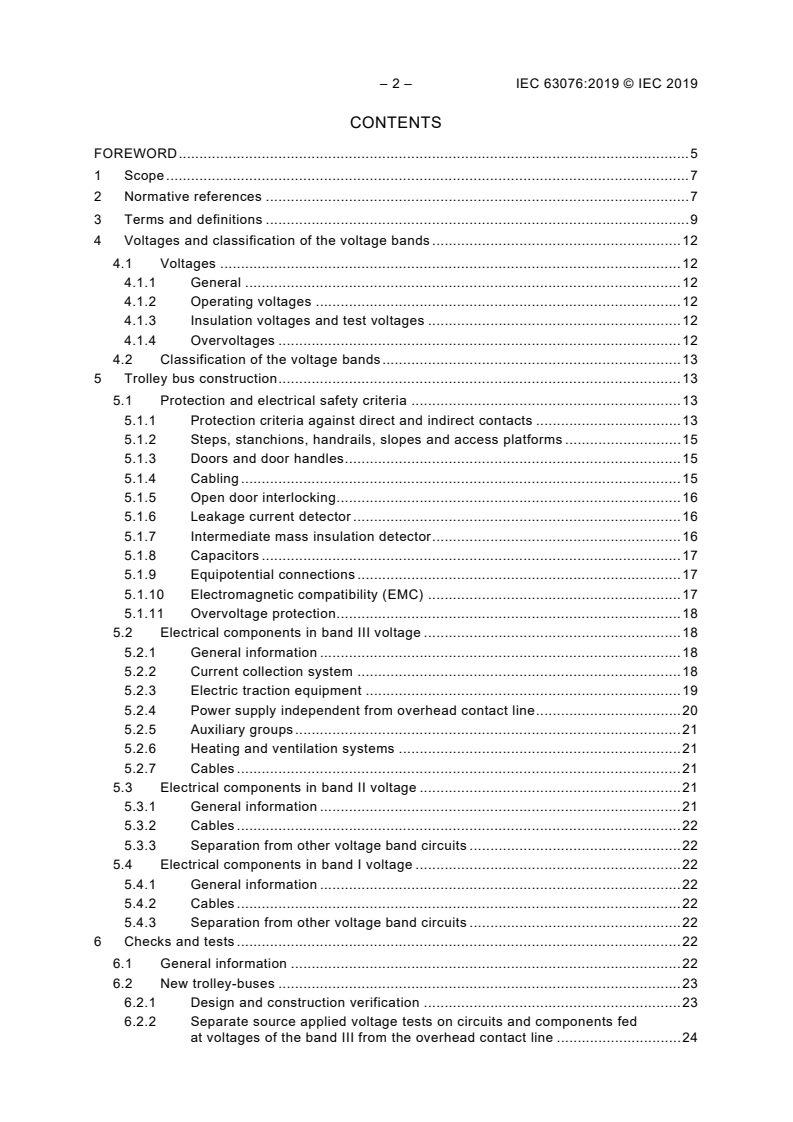
– 2 – IEC 63076:2019 © IEC 2019
CONTENTS
FOREWORD . 5
1 Scope . 7
2 Normative references . 7
3 Terms and definitions . 9
4 Voltages and classification of the voltage bands . 12
4.1 Voltages . 12
4.1.1 General . 12
4.1.2 Operating voltages . 12
4.1.3 Insulation voltages and test voltages . 12
4.1.4 Overvoltages . 12
4.2 Classification of the voltage bands . 13
5 Trolley bus construction . 13
5.1 Protection and electrical safety criteria . 13
5.1.1 Protection criteria against direct and indirect contacts . 13
5.1.2 Steps, stanchions, handrails, slopes and access platforms . 15
5.1.3 Doors and door handles . 15
5.1.4 Cabling . 15
5.1.5 Open door interlocking . 16
5.1.6 Leakage current detector . 16
5.1.7 Intermediate mass insulation detector . 16
5.1.8 Capacitors . 17
5.1.9 Equipotential connections . 17
5.1.10 Electromagnetic compatibility (EMC) . 17
5.1.11 Overvoltage protection . 18
5.2 Electrical components in band III voltage . 18
5.2.1 General information . 18
5.2.2 Current collection system . 18
5.2.3 Electric traction equipment . 19
5.2.4 Power supply independent from overhead contact line . 20
5.2.5 Auxiliary groups . 21
5.2.6 Heating and ventilation systems . 21
5.2.7 Cables . 21
5.3 Electrical components in band II voltage . 21
5.3.1 General information . 21
5.3.2 Cables . 22
5.3.3 Separation from other voltage band circuits . 22
5.4 Electrical components in band I voltage . 22
5.4.1 General information . 22
5.4.2 Cables . 22
5.4.3 Separation from other voltage band circuits . 22
6 Checks and tests . 22
6.1 General information . 22
6.2 New trolley-buses . 23
6.2.1 Design and construction verification . 23
6.2.2 Separate source applied voltage tests on circuits and components fed
at voltages of the band III from the overhead contact line . 24
6.2.3 Separate source applied voltage tests on circuits and components fed
at voltages of the band III insulated from the overhead contact line . 24
6.2.4 Separate source applied voltage tests on circuits and components fed
at voltages of the band II . 25
6.2.5 Tests of the insulation of entrance areas . 26
6.2.6 Insulation resistance values for circuits and components supplied at
band III voltages from the line voltage . 26
6.2.7 Insulation resistance tests for circuits and components supplied at the
line voltage . 26
6.2.8 Insulation resistance values for circuits and components supplied at
band III voltages insulated from the line voltage . 28
6.2.9 Insulation resistance tests for circuits and components supplied at band
III voltages insulated from the line voltage . 28
6.2.10 Insulation resistance values for circuits and components supplied at a
voltage of band II . 29
6.2.11 Insulation resistance tests for circuits and components supplied at a
voltage of band II . 29
6.3 Overhauled trolley-bus . 29
6.3.1 Tests and verification of the electrical equipment . 29
6.3.2 Measurements and value of the insulation resistance . 29
6.3.3 Insulation resistance tests . 29
6.3.4 Trolley bus after minor or maintenance repairs . 30
6.4 On-duty trolley-bus (periodic checks) . 30
6.4.1 Insulation decay and provisions required . 30
6.4.2 Periodical checks and tests of the insulation during maintenance . 30
6.4.3 Periodical checks and tests of the insulation . 31
6.5 Leakage detectors (overhaul, definitions, thresholds) . 31
6.5.1 Operating voltages and temperature ranges . 31
6.5.2 Operation and alarm of the detector. 31
6.5.3 Limits and calibration of the detector . 32
6.5.4 Periodic efficiency checks . 38
Annex A (normative) Constructional detailed provisions . 42
General . 42
Attachment of the current collection system and other components . 42
Insulations . 42
Ventilation. 43
Accessibility . 43
Location of the main circuit breaker . 43
Inlet and outlet points of cables . 43
Cabling . 43
Test terminal board . 43
Insulation leakage pre-alarm . 43
Equipment connected to different voltage band circuits . 44
Segregation of band III circuits. 44
Batteries and other energy storage devices . 44
Fuel cells . 45
Environmental conditions . 45
Annex B (informative) Open door interlocking . 46
Bibliography . 47
– 4 – IEC 63076:2019 © IEC 2019
Figure 1 – Insulation overview – Trolley buses . 14
Figure 2 – Maximum displacement between vehicle centreline and catenary centreline . 18
Figure 3 – Test circuits . 25
Figure 4 – Megaohmmeter connection . 27
Figure 5 – Megaohmmeter connection . 28
Figure 6 – Leakage current monitoring . 33
Figure 7 – Insulation resistance monitoring . 34
Figure 8 – Touch voltage monitoring with sliding wires . 35
Figure 9 – Touch voltage monitoring with grounded overhead contact line . 36
Figure 10 – Compensation of the voltage drop on the grounded overhead contact line . 37
Figure 11 – Voltage development with a load connected to the overhead contact line . 38
Figure 12 – Function check of the leakage current monitoring . 39
Figure 13 – Function check of the insulation resistance monitor . 40
Figure 14 – Function check of the touch voltage monitor with vehicle mass (chassis) . 41
Figure 15 – Function check of the touch voltage monitor with sliding wires . 41
Table 1 – Nominal voltages and their permissible limits in values and duration . 12
Table 2 – Insulation voltages and power frequency test voltages . 12
Table 3 – Overvoltages . 12
Table 4 – Voltages bands for trolley busses . 13
Table 5 – Summary of electric tests . 31
INTERNATIONAL ELECTROTECHNICAL COMMISSION
____________
RAILWAY APPLICATIONS – ROLLING STOCK –
ELECTRICAL EQUIPMENT IN TROLLEY BUSES – SAFETY
REQUIREMENTS AND CURRENT COLLECTION SYSTEMS
FOREWORD
1) The International Electrotechnical Commission (IEC) is a worldwide organization for standardization comprising
all national electrotechnical committees (IEC National Committees). The object of IEC is to promote
international co-operation on all questions concerning standardization in the electrical and electronic fields. To
this end and in addition to other activities, IEC publishes International Standards, Technical Specifications,
Technical Reports, Publicly Available Specifications (PAS) and Guides (hereafter referred to as “IEC
Publication(s)”). Their preparation is entrusted to technical committees; any IEC National Committee interested
in the subject dealt with may participate in this preparatory work. International, governmental and non-
governmental organizations liaising with the IEC also participate in this preparation. IEC collaborates closely
with the International Organization for Standardization (ISO) in accordance with conditions determined by
agreement between the two organizations.
2) The formal decisions or agreements of IEC on technical matters express, as nearly as possible, an international
consensus of opinion on the relevant subjects since each technical committee has representation from all
interested IEC National Committees.
3) IEC Publications have the form of recommendations for international use and are accepted by IEC National
Committees in that sense. While all reasonable efforts are made to ensure that the technical content of IEC
Publications is accurate, IEC cannot be held responsible for the way in which they are used or for any
misinterpretation by any end user.
4) In order to promote international uniformity, IEC National Committees undertake to apply IEC Publications
transparently to the maximum extent possible in their national and regional publications. Any divergence
between any IEC Publication and the corresponding national or regional publication shall be clearly indicated in
the latter.
5) IEC itself does not provide any attestation of conformity. Independent certification bodies provide conformity
assessment services and, in some areas, access to IEC marks of conformity. IEC is not responsible for any
services carried out by independent certification bodies.
6) All users should ensure that they have the latest edition of this publication.
7) No liability shall attach to IEC or its directors, employees, servants or agents including individual experts and
members of its technical committees and IEC National Committees for any personal injury, property damage or
other damage of any nature whatsoever, whether direct or indirect, or for costs (including legal fees) and
expenses arising out of the publication, use of, or reliance upon, this IEC Publication or any other IEC
Publications.
8) Attention is drawn to the Normative references cited in this publication. Use of the referenced publications is
indispensable for the correct application of this publication.
9) Attention is drawn to the possibility that some of the elements of this IEC Publication may be the subject of
patent rights. IEC shall not be held responsible for identifying any or all such patent rights.
International Standard IEC 63076 has been prepared by IEC technical committee 9: Electrical
equipment and systems for railways.
This publication is based on EN 50502:2015.
The text of this standard is based on the following documents:
FDIS Report on voting
9/2530/FDIS 9/2543/RVD
Full information on the voting for the approval of this standard can be found in the report on
voting indicated in the above table.
This publication has been drafted in accordance with the ISO/IEC Directives, Part 2.
– 6 – IEC 63076:2019 © IEC 2019
The committee has decided that the contents of this publication will remain unchanged until
the stability date indicated on the IEC web site under "http://webstore.iec.ch" in the data
related to the specific publication. At this date, the publication will be
• reconfirmed,
• withdrawn,
• replaced by a revised edition, or
• amended.
RAILWAY APPLICATIONS – ROLLING STOCK –
ELECTRICAL EQUIPMENT IN TROLLEY BUSES – SAFETY
REQUIREMENTS AND CURRENT COLLECTION SYSTEMS
1 Scope
This document applies to electrical systems aboard vehicles of the trolley bus type, as defined
in 3.1, fed with a nominal line voltage (U ) between 600 V DC and 750 V DC.
n
This document defines the requirements and constructional advice, especially to avoid
electrical danger to the public and to staff. Where special requirements exist for trolley buses,
advice is given for mechanical and functional safety, as well as for protection against fire.
This document covers vehicles intended for public transportation. This document applies to:
– trolley buses without on-board isolation interface from the contact line,
– buses with a current rail for guidance in the road surface,
– guided buses with bipolar roof current collectors.
This document does not apply to:
a) electric driven vehicles fitted only with an internal power supply:
1) hybrid vehicles,
2) diesel-electric vehicles,
3) fuel-cell vehicles,
4) battery-powered vehicles,
b) vehicles with safe protective bonding:
1) rubber-tyred commuter trains,
2) guided buses with power supplied by a separate current rail,
3) rail-guided buses with unipolar roof current collector,
c) vehicles operated outside publicly accessible areas:
1) electrically driven lorries on motorways.
Guidance and current rails are special solutions and, at this time, are not subject to
standardization, unlike trolley bus current collectors and overhead contact lines.
This document refers mainly to earthed networks, but reference is made also to galvanically
insulated networks.
2 Normative references
The following documents are referred to in the text in such a way that some or all of their
content constitutes requirements of this document. For dated references, only the edition
cited applies. For undated references, the latest edition of the referenced document (including
any amendments) applies.
IEC 60077 (all parts), Railway applications – Electric equipment for rolling stock
IEC 60077-1, Railway applications – Electric equipment for rolling stock – Part 1: General
service conditions and general rules
– 8 – IEC 63076:2019 © IEC 2019
IEC 60322, Railway applications – Electric equipment for rolling stock – Rules for power
resistors of open construction
IEC 60349 (all parts), Electric traction – Rotating electrical machines for rail and road vehicles
IEC 60479 (all parts), Effects of current on human beings and livestock
IEC 60479-1, Effects of current on human beings and livestock – Part 1: General aspects
IEC 60479-2, Effects of current on human beings and livestock – Part 2: Special aspects
IEC 60529, Degrees of protection provided by enclosures (IP Code)
IEC 60571, Railway applications – Electronic equipment used on rolling stock
IEC 60721-3-5, Classification of environmental conditions – Part 3: Classification of groups of
environmental parameters and their severities – Section 5: Ground vehicle installations
IEC 60850, Railway applications – Supply voltages of traction systems
IEC 61111, Live working – Electrical insulating matting
IEC 61133:2016, Railway applications – Rolling stock – Testing of rolling stock on completion
of construction and before entry into service
IEC 61287-1, Railway applications – Power converters installed on board rolling stock – Part
1: Characteristics and test methods
IEC 61373, Railway applications – Rolling stock equipment – Shock and vibration tests
IEC 61557-2, Electrical safety in low voltage distribution systems up to 1 000V a.c. and 1 500
V d.c. – Equipment for testing, measuring or monitoring of protective measures – Part 2:
Insulation resistance
IEC 61557-8, Electrical safety in low voltage distribution systems up to 1 000 V a.c. and 1 500
V d.c. – Equipment for testing, measuring or monitoring of protective measures – Part 8:
Insulation monitoring devices for IT systems
IEC 61851 (all parts), Electric vehicle conductive charging system
IEC 61881 (all parts), Railway applications – Rolling stock equipment – Capacitors for power
electronics
IEC 61991, Railway applications – Rolling stock – Protective provisions against electrical
hazards
IEC 62128-1, Railway applications – Fixed installations – Electrical safety, earthing and the
return circuit – Part 1: Protective provisions against electric shock
IEC 62196-1, Plugs, socket-outlets, vehicle connectors and vehicle inlets – Conductive
charging of electric vehicles – Part 1: General requirements
IEC 62236 (all parts), Railway applications – Electromagnetic compatibility
IEC 62497-1:2010, Railway applications – Insulation coordination – Part 1: Basic
requirements —Clearances and creepage distances for all electrical and electronic equipment
IEC 62498-1, Railway applications – Environmental conditions for equipment – Part 1:
Equipment on board rolling stock
IEC TS 62597, Measurement procedures of magnetic field levels generated by electronic and
electrical apparatus in the railway environment with respect to human exposure
IEC 62928, Railway applications – Rolling stock – Onboard lithium-ion traction batteries
IEC 62995, Railway applications – Rolling stock – Rules for installation of cabling
ISO 6469-3, Electrically propelled road vehicles – Safety specifications – Part 3: Electrical
safety
ISO 16750-2, Road vehicles – Environmental conditions and testing for electrical and
electronic equipment – Part 2: Electrical loads
ISO 16750-3, Road vehicles – Environmental conditions and testing for electrical and
electronic equipment – Part 3: Mechanical loads
ISO 23273, Fuel cell road vehicles – Safety specifications – Protection against hydrogen
hazards for vehicles fuelled with compressed hydrogen
3 Terms and definitions
For the purposes of this document, the following terms and definitions apply.
ISO and IEC maintain terminological databases for use in standardization at the following
addresses:
• IEC Electropedia: available at http://www.electropedia.org/
• ISO Online browsing platform: available at http://www.iso.org/obp
3.1
trolley bus
vehicle with rubber tyres (with limited lateral operating range or guided) without safe
protective bonding of the chassis, which operates with an electrical drive in the public area
accessible to persons and galvanically powered by an external supply line (overhead contact
line, current rail)
Note 1 to entry: The two poles of the supply line are either both galvanically insulated from earth or one insulated
and the other earthed. This can take place at a central point or at every feed (substation).
3.2
current-collection system
whole of the components, generally mounted on the vehicle's roof, having the task of taking
the current from the overhead contact lines to supply the equipment of the vehicle, both in
standing and in running conditions
3.3
mass
conductive part of an electrical component that is accessible and that is not
energized in normal conditions, but can become energized in fault conditions
Note 1 to entry: The equipment defined in 5.4.1 as normal bus vehicle components are not included in this term.
Note 2 to entry: The conductive parts of the chassis and of the bodywork are defined as the vehicle mass.
– 10 – IEC 63076:2019 © IEC 2019
3.4
intermediate mass
conductive part between two insulating parts of double-insulated equipment (protection,
enclosure, etc.), which shall not be accessible to the public
3.5
basic insulation
insulation for personal safety, between the electric parts that are subject to
energization and the intermediate mass, to provide basic protection against electric shock
3.6
supplementary insulation
insulation for personal safety between the intermediate mass and the vehicle
mass
3.7
double insulation
insulation comprising both basic insulation and supplementary insulation
[SOURCE: IEC 60050-195:1998, 195-06-08]
3.8
functional insulation
insulation not for personal safety, with lower requirements, that ensures the
function of the vehicle
Note 1 to entry: To some extent, the design is specified in the product standards.
3.9
nominal voltage
U
n
designated value for a system to which the general characteristics are referred
3.10
rated voltage range
U
Ne
voltage range that, together with rated current, defines the use of the
equipment and to which the applicable tests and the utilization categories are referred
3.11
highest permanent voltage
U
max1
maximum value of the voltage likely to be present indefinitely
[SOURCE: IEC 60850:2014, 3.4]
3.12
rated insulation voltage
U
Nm
value to which the dielectric test voltages and the creepage distances are
referred and which cannot, in any case, be lower than U
Ne
Note 1 to entry: When no value is defined by the purchaser for U , the highest permanent voltage U given
Nm max1
by IEC 60850 is due to be assumed.
3.13
power-frequency test voltage
U
a
RMS value of sinusoidal power-frequency voltage that the insulation of the given equipment
can withstand during tests made under specified conditions and for a specified duration
[SOURCE: IEC 60050-614:2016, 614-03-22]
3.14
highest non-permanent voltage
U
max2
maximum value of the voltage likely to be present for a limited period of time
[SOURCE: IEC 60850:2014, 3.5]
3.15
overvoltage
any voltage having a peak value exceeding the corresponding peak value of
maximum steady-state voltage at normal operating conditions
[SOURCE: IEC 60850:2014, 3.6]
3.16
long-term overvoltage
overvoltage higher than U , lasting typically for more than 20 ms, due to low-impedance
max2
phenomena, for example a rise in substation primary voltage
[SOURCE: IEC 60850:2014, 3.7, modified – Note1 to entry has been removed.]
3.17
highest long-term overvoltage
U
max3
voltage defined as the highest value of the long-term overvoltage for t = 20 ms
[SOURCE: IEC 60850:2014, 3.8, modified – The second sentence has been removed.]
3.18
dewirement
sudden and permanent detachment of one or both poles of the trolley from the overhead
contact line(s) while the trolley bus is running
3.19
overhead contact line
catenary
contact line that is placed above or beside the upper limit of the vehicle's clearance, which
supplies traction units with electrical energy via roof-mounted current collection equipment
Note 1 to entry: The characteristics of the overhead contact line are to be made known to the manufacturer,
together with the type of service, the environmental conditions and the road profile. Mechanical properties are
given in IEC 60913, minimum heights are given in IEC 62128-1.
[SOURCE: IEC 60050-811:2017, 811-33-02 – modified – Note 1 to entry has been added]
– 12 – IEC 63076:2019 © IEC 2019
4 Voltages and classification of the voltage bands
4.1 Voltages
4.1.1 General
The voltage definitions used in this document are those of IEC 60850 and IEC 62497-1, where
the following applies to direct voltage networks in compliance with IEC 60850.
4.1.2 Operating voltages
The equipment shall operate at the voltages, for overhead contact line systems, specified in
Table 1.
Table 1 – Nominal voltages and their permissible limits in values and duration
Nominal voltage Rated voltage range Highest permanent voltage Highest non-permanent voltage
U U U U
n Ne max1 max2
V DC V DC V DC V DC
600 400 to 720 720 800
750 500 to 900 900 1 000
NOTE In France, Belgium and the United Kingdom, different national regulations (IEC 60850) apply, which,
however, do not apply to trolley buses.
For vehicle wash plants, in accordance with IEC 62128-1, the maximum allowed voltage
is 120 V DC (voltage band II). In this case, the vehicle washing plant is not part of the
workshop where the maximum allowed voltage is 60 V DC (voltage band I).
4.1.3 Insulation voltages and test voltages
Insulation in accordance with IEC 62497-1 shall be designed and tested with reference to the
following voltages shown in Table 2.
Table 2 – Insulation voltages and power frequency test voltages
Nominal voltage Rated insulation voltage Power frequency test voltage
U U U
n Nm a
V DC V DC V DC
600 ≥ 720
refer to IEC 62497-1:2010,
Table B.1
750 ≥ 900
4.1.4 Overvoltages
The equipment shall withstand the overvoltages of the overhead contact line system specified
in Table 3.
Table 3 – Overvoltages
Nominal voltage Highest long-term overvoltage
U U
n max3
V DC V DC
600 1 270
750 1 270
4.2 Classification of the voltage bands
In accordance with IEC 61991, the voltage bands applicable to trolley buses are in
accordance with Table 4.
Table 4 – Voltages bands for trolley busses
Band Nominal voltage
V
AC DC
U ≤ 25 U ≤ 60
Ⅰ
n n
25 < U ≤ 50 60 < U ≤ 120
Ⅱ
n n
50 < U ≤ 1 000 120 < U ≤ 1 500
Ⅲ
n n
5 Trolley bus construction
5.1 Protection and electrical safety criteria
5.1.1 Protection criteria against direct and indirect contacts
The best criteria and arrangements shall be adopted in the design and in the manufacture of
trolley buses to avoid, or at least minimize to a non-dangerous level, all touch voltages and, in
particular, the voltage differential between mass and earth potentials and to detect leakages
before the associated voltages reach a dangerous level.
Limit values for touch voltages are specified in IEC 62128-1. Limit values for shock currents
are specified in the IEC 60479 series.
NOTE Different limit values for touch voltages apply in Switzerland (SR 734.2).
The requirements of IEC 61991 shall apply wherever applicable.
Since the highest hazard potential is present when touching the outside of the vehicle, the
requirements of IEC 61991 of a verifiable double insulation are supplemented by a third
insulation in the area of the doors, where passengers would be most likely to come into
contact with voltages.
If possible, the double insulation shall be designed such that a fault cannot bridge both paths
at the same time.
Layout of insulation distances depending on material and degree of pollution shall be carried
out in accordance with IEC 62497-1.
Always make sure, for external insulation, that part of the insulation remains protected from
moisture or dirt. If this is not possible, greater distances and/or other materials shall be
selected because of the higher minimum insulation resistances in systems with no protective
bonding (see Table 6).
Figure 1 provides an overview of the double insulation requested for this vehicle type in
IEC 61991 as well as of the third insulation of the doors.
The expansion of the basic insulation to double insulation always applies to all three types of
interfaces of the component:
– supplementary insulation of the mechanical mounting;
– supplementary insulation of the power supply module;
– supplementary insulation of the signal interfaces.
The marking by warning signs of installation spaces containing circuits with voltages of bands
II and III or power circuits of band I shall comply with IEC 61991.
– 14 – IEC 63076:2019 © IEC 2019
Key
1 conducting connection of substation output to earth, if applicable
2 conducting connection of DC onboard power supply to vehicle mass (chassis), if applicable
3 conducting connection between the neutral point of the transformer of the static converter and vehicle mass
(chassis) as protective conductor, if applicable (see also 7)
4 protection of direct contact of all intermediate masses (enclosure, roof insulation, underfloor installation)
5 supplementary insulation for implementation of the double insulation. Basic or functional insulation are
represented by enclosures, double insulation of cables is not depicted
6 conducting connection of all enclosures of three-phase AC loads (protective bonding if applicable)
7 conducting connection of all enclosures of three-phase AC loads and vehicle mass (chassis) as protective
conductor (see also 3)
8 supplementary insulation of entrance areas (doors, access platforms, push buttons) if applicable
9 double insulation inside devices (depicted only for static converter)
Figure 1 – Insulation overview – Trolley buses
The insulation resistance of outside insulation as a factor of the atmospheric conditions and
vehicles, which may have insulation defects, can fall short of the limit values for personal
safety.
For this reason, measures specified in this subclause shall be taken independently of the
overhead line network configuration (earthed or galvanically isolated).
5.1.2 Steps, stanchions, handrails, slopes and access platforms
To prevent persons entering or leaving the vehicle from sensations of discharge of the vehicle
mass (chassis) exceeding the threshold of perception, entrance areas shall be equipped with
insulating materials as protective impedances.
Steps, stanchions and handrails facing all doors shall be insulated from the vehicle mass
(chassis) or made of insulating material. Slopes and access platforms for handicapped
persons shall be insulated from the vehicle mass (chassis).
Entrance areas shall be designed with drip edges at the end of the base plate and with a drain
for ingressed water. Direct contact of surface water with other parts of the vehicle mass
(chassis) shall be prevented.
The function of protective impedance of entrance areas shall be ensured by regular cleaning
of the entrance areas and visual inspection of material by qualified staff. Detergents shall be
chosen to avoid chemical wear of the material.
During visual inspection, the material shall be closely examined for any damage that affects
the dielectric properties, such as fractures, cracks or pinholes (6.2.5). The dielectric
properties of the material shall comply with the requirements for basic insulation in 6.2.
A visual inspection of the cleaned entrance areas is required and is included in the periodic
insulation test procedure in 6.4.
5.1.3 Doors and door handles
All doors and relevant accessories, except for control equipment not accessible to the public,
shall be insulated from the vehicle mass (chassis) or made of insulating material.
To provide sufficient creepage distances, plastic door handles or outside sliding doors without
handles are recommended.
5.1.4 Cabling
Conduits of cables fed at voltages of band III shall be segregated from those containing
cables fed at voltages of bands I and II; band III conduits and trunking shall be easily
detectable by means of suitable markings.
In the case of double insulation conduits of band III, cables being part of different circuits
shall be segregated according to IEC 62995.
Rescue workers in cities with trolley buses and overhead contact lines are specially trained,
so special labelling in classic trolley buses with or without auxiliary power supplies with diesel
engine generators is not required, because the whole system can be switched off. An
exception is the cabling of energy storage devices, which shall be labelled orange up to the
first circuit breaker .
_____________
See ECE Regulation No. 100.
– 16 – IEC 63076:2019 © IEC 2019
5.1.5 Open door interlocking
Traction equipment shall be provided with an interlock to prevent the vehicle from starting
while the vehicle doors are open. This interlock device shall include a push button or a similar
padlocked device enabling the driver to by-pass the feature.
5.1.6 Leakage current detector
It is recommended, upon agreement between the manufacturer and the operator and matched
with the supply system, to equip trolley buses with an automatic measuring instrument,
defined as a leakage detector. Appropriate information shall be provided by the operator.
The device generates an optical/acoustic alarm signal when the insulating resistance between
the circuits fed at line voltage and the vehicle mass (chassis) falls below the permissible limit
values. Depending on the type of measuring method, exceeding the permissible touch voltage
or the permissible leakage current may also be used a
...
IEC 63076 ®
Edition 1.1 2023-02
CONSOLIDATED VERSION
INTERNATIONAL
STANDARD
NORME
INTERNATIONALE
colour
inside
Railway applications – Rolling stock – Electrical equipment in trolley buses –
Safety requirements and current collection systems
Applications ferroviaires – Matériel roulant – Équipements électriques des
trolleybus – Exigences de sécurité et systèmes de captage de courants
All rights reserved. Unless otherwise specified, no part of this publication may be reproduced or utilized in any form
or by any means, electronic or mechanical, including photocopying and microfilm, without permission in writing from
either IEC or IEC's member National Committee in the country of the requester. If you have any questions about IEC
copyright or have an enquiry about obtaining additional rights to this publication, please contact the address below or
your local IEC member National Committee for further information.
Droits de reproduction réservés. Sauf indication contraire, aucune partie de cette publication ne peut être reproduite ni
utilisée sous quelque forme que ce soit et par aucun procédé, électronique ou mécanique, y compris la photocopie et
les microfilms, sans l'accord écrit de l'IEC ou du Comité national de l'IEC du pays du demandeur. Si vous avez des
questions sur le copyright de l'IEC ou si vous désirez obtenir des droits supplémentaires sur cette publication, utilisez
les coordonnées ci-après ou contactez le Comité national de l'IEC de votre pays de résidence.
IEC Secretariat Tel.: +41 22 919 02 11
3, rue de Varembé info@iec.ch
CH-1211 Geneva 20 www.iec.ch
Switzerland
About the IEC
The International Electrotechnical Commission (IEC) is the leading global organization that prepares and publishes
International Standards for all electrical, electronic and related technologies.
About IEC publications
The technical content of IEC publications is kept under constant review by the IEC. Please make sure that you have the
latest edition, a corrigendum or an amendment might have been published.
IEC publications search - webstore.iec.ch/advsearchform IEC Products & Services Portal - products.iec.ch
The advanced search enables to find IEC publications by a Discover our powerful search engine and read freely all the
variety of criteria (reference number, text, technical publications previews. With a subscription you will always have
committee, …). It also gives information on projects, replaced access to up to date content tailored to your needs.
and withdrawn publications.
Electropedia - www.electropedia.org
IEC Just Published - webstore.iec.ch/justpublished
The world's leading online dictionary on electrotechnology,
Stay up to date on all new IEC publications. Just Published
containing more than 22 300 terminological entries in English
details all new publications released. Available online and once
and French, with equivalent terms in 19 additional languages.
a month by email.
Also known as the International Electrotechnical Vocabulary
(IEV) online.
IEC Customer Service Centre - webstore.iec.ch/csc
If you wish to give us your feedback on this publication or need
further assistance, please contact the Customer Service
Centre: sales@iec.ch.
A propos de l'IEC
La Commission Electrotechnique Internationale (IEC) est la première organisation mondiale qui élabore et publie des
Normes internationales pour tout ce qui a trait à l'électricité, à l'électronique et aux technologies apparentées.
A propos des publications IEC
Le contenu technique des publications IEC est constamment revu. Veuillez vous assurer que vous possédez l’édition la
plus récente, un corrigendum ou amendement peut avoir été publié.
Recherche de publications IEC - Découvrez notre puissant moteur de recherche et consultez
webstore.iec.ch/advsearchform gratuitement tous les aperçus des publications. Avec un
La recherche avancée permet de trouver des publications IEC abonnement, vous aurez toujours accès à un contenu à jour
en utilisant différents critères (numéro de référence, texte, adapté à vos besoins.
comité d’études, …). Elle donne aussi des informations sur les
projets et les publications remplacées ou retirées. Electropedia - www.electropedia.org
Le premier dictionnaire d'électrotechnologie en ligne au monde,
IEC Just Published - webstore.iec.ch/justpublished
avec plus de 22 300 articles terminologiques en anglais et en
Restez informé sur les nouvelles publications IEC. Just
français, ainsi que les termes équivalents dans 19 langues
Published détaille les nouvelles publications parues.
additionnelles. Egalement appelé Vocabulaire
Disponible en ligne et une fois par mois par email.
Electrotechnique International (IEV) en ligne.
Service Clients - webstore.iec.ch/csc
Si vous désirez nous donner des commentaires sur cette
publication ou si vous avez des questions contactez-nous:
sales@iec.ch.
IEC Products & Services Portal - products.iec.ch
IEC 63076 ®
Edition 1.1 2023-02
CONSOLIDATED VERSION
INTERNATIONAL
STANDARD
NORME
INTERNATIONALE
colour
inside
Railway applications – Rolling stock – Electrical equipment in trolley buses –
Safety requirements and current collection systems
Applications ferroviaires – Matériel roulant – Équipements électriques des
trolleybus – Exigences de sécurité et systèmes de captage de courants
INTERNATIONAL
ELECTROTECHNICAL
COMMISSION
COMMISSION
ELECTROTECHNIQUE
INTERNATIONALE
ICS 45.060.01 ISBN 978-2-8322-6476-8
IEC 63076 ®
Edition 1.1 2023-02
CONSOLIDATED VERSION
REDLINE VERSION
VERSION REDLINE
colour
inside
Railway applications – Rolling stock – Electrical equipment in trolley buses –
Safety requirements and current collection systems
Applications ferroviaires – Matériel roulant – Équipements électriques des
trolleybus – Exigences de sécurité et systèmes de captage de courants
– 2 – IEC 63076:2019+AMD1:2023 CSV
© IEC 2023
CONTENTS
FOREWORD . 5
1 Scope . 7
2 Normative references . 7
3 Terms and definitions . 9
4 Voltages and classification of the voltage bands . 12
4.1 Voltages . 12
4.1.1 General . 12
4.1.2 Operating voltages . 12
4.1.3 Insulation voltages and test voltages . 12
4.1.4 Overvoltages . 13
4.2 Classification of the voltage bands . 13
5 Trolley bus construction . 13
5.1 Protection and electrical safety criteria . 13
5.1.1 Protection criteria against direct and indirect contacts . 13
5.1.2 Steps, stanchions, handrails, slopes and access platforms . 16
5.1.3 Doors and door handles . 16
5.1.4 Cabling . 16
5.1.5 Open door interlocking . 17
5.1.6 Leakage current detector . 17
5.1.7 Intermediate mass insulation detector . 17
5.1.8 Capacitors . 18
5.1.9 Equipotential connections . 18
5.1.10 Electromagnetic compatibility (EMC) . 18
5.1.11 Overvoltage protection . 19
5.2 Electrical components in band III voltage . 19
5.2.1 General information . 19
5.2.2 Current collection system . 19
5.2.3 Electric traction equipment . 20
5.2.4 Power supply independent from overhead contact line . 21
5.2.5 Auxiliary groups . 22
5.2.6 Heating and ventilation systems . 22
5.2.7 Cables . 22
5.3 Electrical components in band II voltage . 23
5.3.1 General information . 23
5.3.2 Cables . 23
5.3.3 Separation from other voltage band circuits . 23
5.4 Electrical components in band I voltage . 23
5.4.1 General information . 23
5.4.2 Cables . 24
5.4.3 Separation from other voltage band circuits . 24
6 Checks and tests . 24
6.1 General information . 24
6.2 New trolley-buses . 25
6.2.1 Design and construction verification . 25
6.2.2 Separate source applied voltage tests on circuits and components fed
at voltages of the band III from the overhead contact line . 25
© IEC 2023
6.2.3 Separate source applied voltage tests on circuits and components fed
at voltages of the band III insulated from the overhead contact line . 26
6.2.4 Separate source applied voltage tests on circuits and components fed
at voltages of the band II . 27
6.2.5 Tests of the insulation of entrance areas . 28
6.2.6 Insulation resistance values for circuits and components supplied at
band III voltages from the line voltage . 28
6.2.7 Insulation resistance tests for circuits and components supplied at the
line voltage . 28
6.2.8 Insulation resistance values for circuits and components supplied at
band III voltages insulated from the line voltage . 29
6.2.9 Insulation resistance tests for circuits and components supplied at band
III voltages insulated from the line voltage . 30
6.2.10 Insulation resistance values for circuits and components supplied at a
voltage of band II . 30
6.2.11 Insulation resistance tests for circuits and components supplied at a
voltage of band II . 30
6.3 Overhauled trolley-bus . 31
6.3.1 Tests and verification of the electrical equipment . 31
6.3.2 Measurements and value of the insulation resistance . 31
6.3.3 Insulation resistance tests . 31
6.3.4 Trolley bus after minor or maintenance repairs . 31
6.4 On-duty trolley-bus (periodic checks) . 31
6.4.1 Insulation decay and provisions required . 31
6.4.2 Periodical checks and tests of the insulation during maintenance . 32
6.4.3 Periodical checks and tests of the insulation . 32
6.5 Leakage detectors (overhaul, definitions, thresholds) . 33
6.5.1 Operating voltages and temperature ranges . 33
6.5.2 Operation and alarm of the detector. 33
6.5.3 Limits and calibration of the detector . 34
6.5.4 Periodic efficiency checks . 40
Annex A (normative) Constructional detailed provisions . 44
A.1 General . 44
A.2 Attachment of the current collection system and other components . 44
A.3 Insulations . 44
A.4 Ventilation. 45
A.5 Accessibility . 45
A.6 Location of the main circuit breaker . 45
A.7 Inlet and outlet points of cables . 45
A.8 Cabling . 45
A.9 Test terminal board . 45
A.10 Insulation leakage pre-alarm . 45
A.11 Equipment connected to different voltage band circuits . 46
A.12 Segregation of band III circuits. 46
A.13 Batteries and other energy storage devices . 46
A.14 Fuel cells . 47
A.15 Environmental conditions . 47
Annex B (informative) Open door interlocking . 48
Bibliography . 49
– 4 – IEC 63076:2019+AMD1:2023 CSV
© IEC 2023
Figure 1 – Insulation overview – Trolley buses . 15
Figure 2 – Maximum displacement between vehicle centreline and catenary centreline . 20
Figure 3 – Test circuits . 27
Figure 4 – Megaohmmeter connection . 29
Figure 5 – Megaohmmeter connection . 30
Figure 6 – Leakage current monitoring . 35
Figure 7 – Insulation resistance monitoring . 36
Figure 8 – Touch voltage monitoring with sliding wires . 37
Figure 9 – Touch voltage monitoring with grounded overhead contact line . 38
Figure 10 – Compensation of the voltage drop on the grounded overhead contact line . 39
Figure 11 – Voltage development with a load connected to the overhead contact line . 40
Figure 12 – Function check of the leakage current monitoring . 41
Figure 13 – Function check of the insulation resistance monitor . 42
Figure 14 – Function check of the touch voltage monitor with vehicle mass (chassis) . 43
Figure 15 – Function check of the touch voltage monitor with sliding wires . 43
Table 1 – Nominal voltages and their permissible limits in values and duration . 12
Table 2 – Insulation voltages and power frequency test voltages .
Table 2 – Nominal voltages (U ), rated impulse voltages (U ) and short-duration
n Ni
power-frequency withstand voltage (U ) for circuits connected to the contact line . 13
a
Table 3 – Overvoltages . 13
Table 4 – Voltages bands for trolley busses . 13
Table 5 – Summary of electric tests . 33
© IEC 2023
INTERNATIONAL ELECTROTECHNICAL COMMISSION
____________
RAILWAY APPLICATIONS – ROLLING STOCK –
ELECTRICAL EQUIPMENT IN TROLLEY BUSES – SAFETY
REQUIREMENTS AND CURRENT COLLECTION SYSTEMS
FOREWORD
1) The International Electrotechnical Commission (IEC) is a worldwide organization for standardization comprising
all national electrotechnical committees (IEC National Committees). The object of IEC is to promote
international co-operation on all questions concerning standardization in the electrical and electronic fields. To
this end and in addition to other activities, IEC publishes International Standards, Technical Specifications,
Technical Reports, Publicly Available Specifications (PAS) and Guides (hereafter referred to as “IEC
Publication(s)”). Their preparation is entrusted to technical committees; any IEC National Committee interested
in the subject dealt with may participate in this preparatory work. International, governmental and non-
governmental organizations liaising with the IEC also participate in this preparation. IEC collaborates closely
with the International Organization for Standardization (ISO) in accordance with conditions determined by
agreement between the two organizations.
2) The formal decisions or agreements of IEC on technical matters express, as nearly as possible, an international
consensus of opinion on the relevant subjects since each technical committee has representation from all
interested IEC National Committees.
3) IEC Publications have the form of recommendations for international use and are accepted by IEC National
Committees in that sense. While all reasonable efforts are made to ensure that the technical content of IEC
Publications is accurate, IEC cannot be held responsible for the way in which they are used or for any
misinterpretation by any end user.
4) In order to promote international uniformity, IEC National Committees undertake to apply IEC Publications
transparently to the maximum extent possible in their national and regional publications. Any divergence
between any IEC Publication and the corresponding national or regional publication shall be clearly indicated in
the latter.
5) IEC itself does not provide any attestation of conformity. Independent certification bodies provide conformity
assessment services and, in some areas, access to IEC marks of conformity. IEC is not responsible for any
services carried out by independent certification bodies.
6) All users should ensure that they have the latest edition of this publication.
7) No liability shall attach to IEC or its directors, employees, servants or agents including individual experts and
members of its technical committees and IEC National Committees for any personal injury, property damage or
other damage of any nature whatsoever, whether direct or indirect, or for costs (including legal fees) and
expenses arising out of the publication, use of, or reliance upon, this IEC Publication or any other IEC
Publications.
8) Attention is drawn to the Normative references cited in this publication. Use of the referenced publications is
indispensable for the correct application of this publication.
9) Attention is drawn to the possibility that some of the elements of this IEC Publication may be the subject of
patent rights. IEC shall not be held responsible for identifying any or all such patent rights.
This consolidated version of the official IEC Standard and its amendment has been
prepared for user convenience.
IEC 63076 edition 1.1 contains the first edition (2019-09) [documents 9/2530/FDIS and
9/2543/RVD] and its amendment 1 (2023-02) [documents 9/2736/CDV and 9/2807/RVC].
In this Redline version, a vertical line in the margin shows where the technical content
is modified by amendment 1. Additions are in green text, deletions are in strikethrough
red text. A separate Final version with all changes accepted is available in this
publication.
– 6 – IEC 63076:2019+AMD1:2023 CSV
© IEC 2023
International Standard IEC 63076 has been prepared by IEC technical committee 9: Electrical
equipment and systems for railways.
This publication is based on EN 50502:2015.
This publication has been drafted in accordance with the ISO/IEC Directives, Part 2.
The committee has decided that the contents of the base publication and its amendment will
remain unchanged until the stability date indicated on the IEC web site under webstore.iec.ch
in the data related to the specific publication. At this date, the publication will be
• reconfirmed,
• withdrawn,
• replaced by a revised edition, or
• amended.
IMPORTANT – The 'colour inside' logo on the cover page of this publication indicates
that it contains colours which are considered to be useful for the correct
understanding of its contents. Users should therefore print this document using a
colour printer.
© IEC 2023
RAILWAY APPLICATIONS – ROLLING STOCK –
ELECTRICAL EQUIPMENT IN TROLLEY BUSES – SAFETY
REQUIREMENTS AND CURRENT COLLECTION SYSTEMS
1 Scope
This document applies to electrical systems aboard vehicles of the trolley bus type, as defined
in 3.1, fed with a nominal line voltage (U ) between 600 V DC and 750 V DC.
n
This document defines the requirements and constructional advice, especially to avoid
electrical danger to the public and to staff. Where special requirements exist for trolley buses,
advice is given for mechanical and functional safety, as well as for protection against fire.
This document covers vehicles intended for public transportation. This document applies to:
– trolley buses without on-board isolation interface from the contact line,
– buses with a current rail for guidance in the road surface,
– guided buses with bipolar roof current collectors.
This document does not apply to:
a) electric driven vehicles fitted only with an internal power supply:
1) hybrid vehicles,
2) diesel-electric vehicles,
3) fuel-cell vehicles,
4) battery-powered vehicles,
b) vehicles with safe protective bonding:
1) rubber-tyred commuter trains,
2) guided buses with power supplied by a separate current rail,
3) rail-guided buses with unipolar roof current collector,
c) vehicles operated outside publicly accessible areas:
1) electrically driven lorries on motorways.
Guidance and current rails are special solutions and, at this time, are not subject to
standardization, unlike trolley bus current collectors and overhead contact lines.
This document refers mainly to earthed networks, but reference is made also to galvanically
insulated networks.
2 Normative references
The following documents are referred to in the text in such a way that some or all of their
content constitutes requirements of this document. For dated references, only the edition
cited applies. For undated references, the latest edition of the referenced document (including
any amendments) applies.
IEC 60077 (all parts), Railway applications – Electric equipment for rolling stock
IEC 60077-1, Railway applications – Electric equipment for rolling stock – Part 1: General
service conditions and general rules
– 8 – IEC 63076:2019+AMD1:2023 CSV
© IEC 2023
IEC 60322, Railway applications – Electric equipment for rolling stock – Rules for power
resistors of open construction
IEC 60349 (all parts), Electric traction – Rotating electrical machines for rail and road vehicles
IEC 60479 (all parts), Effects of current on human beings and livestock
IEC 60479-1, Effects of current on human beings and livestock – Part 1: General aspects
IEC 60479-2, Effects of current on human beings and livestock – Part 2: Special aspects
IEC 60529, Degrees of protection provided by enclosures (IP Code)
IEC 60571, Railway applications – Electronic equipment used on rolling stock
IEC 60721-3-5, Classification of environmental conditions – Part 3: Classification of groups of
environmental parameters and their severities – Section 5: Ground vehicle installations
IEC 60850, Railway applications – Supply voltages of traction systems
IEC 61111, Live working – Electrical insulating matting
IEC 61133:2016, Railway applications – Rolling stock – Testing of rolling stock on completion
of construction and before entry into service
IEC 61287-1, Railway applications – Power converters installed on board rolling stock – Part
1: Characteristics and test methods
IEC 61373, Railway applications – Rolling stock equipment – Shock and vibration tests
IEC 61557-2, Electrical safety in low voltage distribution systems up to 1 000V a.c. and 1 500
V d.c. – Equipment for testing, measuring or monitoring of protective measures – Part 2:
Insulation resistance
IEC 61557-8, Electrical safety in low voltage distribution systems up to 1 000 V a.c. and 1 500
V d.c. – Equipment for testing, measuring or monitoring of protective measures – Part 8:
Insulation monitoring devices for IT systems
IEC 61851 (all parts), Electric vehicle conductive charging system
IEC 61881 (all parts), Railway applications – Rolling stock equipment – Capacitors for power
electronics
IEC 61991, Railway applications – Rolling stock – Protective provisions against electrical
hazards
IEC 62128-1, Railway applications – Fixed installations – Electrical safety, earthing and the
return circuit – Part 1: Protective provisions against electric shock
IEC 62196-1, Plugs, socket-outlets, vehicle connectors and vehicle inlets – Conductive
charging of electric vehicles – Part 1: General requirements
IEC 62236 (all parts), Railway applications – Electromagnetic compatibility
© IEC 2023
IEC 62497-1:2010, Railway applications – Insulation coordination – Part 1: Basic
requirements – Clearances and creepage distances for all electrical and electronic equipment
IEC 62497-1:2010/AMD1:2013
IEC 62498-1, Railway applications – Environmental conditions for equipment – Part 1:
Equipment on board rolling stock
IEC TS 62597, Measurement procedures of magnetic field levels generated by electronic and
electrical apparatus in the railway environment with respect to human exposure
IEC 62928, Railway applications – Rolling stock – Onboard lithium-ion traction batteries
IEC 62995, Railway applications – Rolling stock – Rules for installation of cabling
ISO 6469-3, Electrically propelled road vehicles – Safety specifications – Part 3: Electrical
safety
ISO 16750-2, Road vehicles – Environmental conditions and testing for electrical and
electronic equipment – Part 2: Electrical loads
ISO 16750-3, Road vehicles – Environmental conditions and testing for electrical and
electronic equipment – Part 3: Mechanical loads
ISO 23273, Fuel cell road vehicles – Safety specifications – Protection against hydrogen
hazards for vehicles fuelled with compressed hydrogen
3 Terms and definitions
For the purposes of this document, the following terms and definitions apply.
ISO and IEC maintain terminological databases for use in standardization at the following
addresses:
• IEC Electropedia: available at http://www.electropedia.org/
• ISO Online browsing platform: available at http://www.iso.org/obp
3.1
trolley bus
vehicle with rubber tyres (with limited lateral operating range or guided) without safe
protective bonding of the chassis, which operates with an electrical drive in the public area
accessible to persons and galvanically powered by an external supply line (overhead contact
line, current rail)
Note 1 to entry: The two poles of the supply line are either both galvanically insulated from earth or one insulated
and the other earthed. This can take place at a central point or at every feed (substation).
3.2
current-collection system
whole of the components, generally mounted on the vehicle's roof, having the task of taking
the current from the overhead contact lines to supply the equipment of the vehicle, both in
standing and in running conditions
3.3
mass
conductive part of an electrical component that is accessible and that is not
energized in normal conditions, but can become energized in fault conditions
Note 1 to entry: The equipment defined in 5.4.1 as normal bus vehicle components are not included in this term.
– 10 – IEC 63076:2019+AMD1:2023 CSV
© IEC 2023
Note 2 to entry: The conductive parts of the chassis and of the bodywork are defined as the vehicle mass.
3.4
intermediate mass
conductive part between two insulating parts of double-insulated equipment (protection,
enclosure, etc.), which shall not be accessible to the public
3.5
basic insulation
insulation for personal safety, between the electric parts that are subject to
energization and the intermediate mass, to provide basic protection against electric shock
3.6
supplementary insulation
insulation for personal safety between the intermediate mass and the vehicle
mass
3.7
double insulation
insulation comprising both basic insulation and supplementary insulation
[SOURCE: IEC 60050-195:1998, 195-06-08]
3.8
functional insulation
insulation not for personal safety, with lower requirements, that ensures the
function of the vehicle
Note 1 to entry: To some extent, the design is specified in the product standards.
3.9
nominal voltage
U
n
designated value for a system to which the general characteristics are referred
3.10
rated voltage range
U
Ne
voltage range that, together with rated current, defines the use of the
equipment and to which the applicable tests and the utilization categories are referred
3.11
highest permanent voltage
U
max1
maximum value of the voltage likely to be present indefinitely
[SOURCE: IEC 60850:2014, 3.4]
3.12
rated insulation voltage
U
Nm
value to which the dielectric test voltages and the creepage distances are
referred and which cannot, in any case, be lower than U
Ne
Note 1 to entry: When no value is defined by the purchaser for U , the highest permanent voltage U given
Nm max1
by IEC 60850 is due to be assumed.
© IEC 2023
3.13
power-frequency test voltage
U
a
RMS value of sinusoidal power-frequency voltage that the insulation of the given equipment
can withstand during tests made under specified conditions and for a specified duration
[SOURCE: IEC 60050-614:2016, 614-03-22]
3.14
highest non-permanent voltage
U
max2
maximum value of the voltage likely to be present for a limited period of time
[SOURCE: IEC 60850:2014, 3.5]
3.15
overvoltage
any voltage having a peak value exceeding the corresponding peak value of
maximum steady-state voltage at normal operating conditions
[SOURCE: IEC 60850:2014, 3.6]
3.16
long-term overvoltage
overvoltage higher than U , lasting typically for more than 20 ms, due to low-impedance
max2
phenomena, for example a rise in substation primary voltage
[SOURCE: IEC 60850:2014, 3.7, modified – Note1 to entry has been removed.]
3.17
highest long-term overvoltage
U
max3
voltage defined as the highest value of the long-term overvoltage for t = 20 ms
[SOURCE: IEC 60850:2014, 3.8, modified – The second sentence has been removed.]
3.18
dewirement
sudden and permanent detachment of one or both poles of the trolley from the overhead
contact line(s) while the trolley bus is running
3.19
overhead contact line
catenary
contact line that is placed above or beside the upper limit of the vehicle's clearance, which
supplies traction units with electrical energy via roof-mounted current collection equipment
Note 1 to entry: The characteristics of the overhead contact line are to be made known to the manufacturer,
together with the type of service, the environmental conditions and the road profile. Mechanical properties are
given in IEC 60913, minimum heights are given in IEC 62128-1.
[SOURCE: IEC 60050-811:2017, 811-33-02 – modified – Note 1 to entry has been added]
– 12 – IEC 63076:2019+AMD1:2023 CSV
© IEC 2023
3.20
rated impulse voltage
U
Ni
impulse voltage value assigned by the manufacturer to the equipment or a part of it,
characterising the specified withstand capability of its insulation against transient
overvoltages
Note 1 to entry: U is higher than or equal to the working peak voltage.
Ni
[SOURCE: IEC 62497-1:2010, 3.4.7]
4 Voltages and classification of the voltage bands
4.1 Voltages
4.1.1 General
The voltage definitions used in this document are those of IEC 60850 and IEC 62497-1, where
the following applies to direct voltage networks in compliance with IEC 60850.
4.1.2 Operating voltages
The equipment shall operate at the voltages, for overhead contact line systems, specified in
Table 1.
Table 1 – Nominal voltages and their permissible limits in values and duration
Nominal voltage Rated voltage range Highest permanent voltage Highest non-permanent voltage
U U U U
n Ne max1 max2
V DC V DC V DC V DC
600 400 to 720 720 800
750 500 to 900 900 1 000
NOTE In France, Belgium and the United Kingdom, different national regulations (IEC 60850) apply, which,
however, do not apply to trolley buses.
For vehicle wash plants, in accordance with IEC 62128-1, the maximum allowed voltage
is 120 V DC (voltage band II). In this case, the vehicle washing plant is not part of the
workshop where the maximum allowed voltage is 60 V DC (voltage band I).
4.1.3 Insulation voltages and test voltages
Insulation in accordance with IEC 62497-1 shall be designed and tested with reference to the
following voltages shown in Table 2.
Table 2 – Insulation voltages and power frequency test voltages
Nominal voltage Rated insulation voltage Power frequency test voltage
U U U
n Nm a
V DC V DC V DC
600 ≥ 720
refer to IEC 62497-1:2010,
Table B.1
750 ≥ 900
© IEC 2023
Table 2 – Nominal voltages (U ), rated impulse voltages (U ) and short-duration power-
n Ni
frequency withstand voltage (U ) for circuits connected to the contact line
a
Nominal Rated insulation Rated impulse voltage Power frequency test voltage
voltage voltage
U U U U
n Nm Ni a
V DC V DC V DC V DC
600 720 See IEC 62497-1:2010 and See IEC 62497-1:2010 and IEC 62497-
IEC 62497-1:2010/AMD1:2013, Table 1:2010/AMD1:2013,
750 ≥ 900
A.2 Table B.1
4.1.4 Overvoltages
The equipment shall withstand the overvoltages of the overhead contact line system specified
in Table 3.
Table 3 – Overvoltages
Nominal voltage Highest long-term overvoltage
U U
n max3
V DC V DC
600 1 270
750 1 270
4.2 Classification of the voltage bands
In accordance with IEC 61991, the voltage bands applicable to trolley buses are in
accordance with Table 4.
Table 4 – Voltages bands for trolley busses
Band Nominal voltage
V
AC DC
U ≤ 25 U ≤ 60
Ⅰ
n n
25 < U ≤ 50 60 < U ≤ 120
Ⅱ
n n
50 < U ≤ 1 000 120 < U ≤ 1 500
Ⅲ
n n
5 Trolley bus construction
5.1 Protection and electrical safety criteria
5.1.1 Protection criteria against direct and indirect contacts
The best criteria and arrangements shall be adopted in the design and in the manufacture of
trolley buses to avoid, or at least minimize to a non-dangerous level, all touch voltages and, in
particular, the voltage differential between mass and earth potentials and to detect leakages
before the associated voltages reach a dangerous level.
Limit values for touch voltages are specified in IEC 62128-1. Limit values for shock currents
are specified in the IEC 60479 series.
NOTE Different limit values for touch voltages apply in Switzerland (SR 734.2).
The requirements of IEC 61991 shall apply wherever applicable.
– 14 – IEC 63076:2019+AMD1:2023 CSV
© IEC 2023
Since the highest hazard potential is present when touching the outside of the vehicle, the
requirements of IEC 61991 of a verifiable double insulation are supplemented by a third
insulation in the area of the doors, where passengers would be most likely to come into
contact with voltages.
If possible, the double insulation shall be designed such that a fault cannot bridge both paths
at the same time.
Layout of insulation distances depending on material and degree of pollution shall be carried
out in accordance with IEC 62497-1.
Always make sure, for external insulation, that part of the insulation remains protected from
moisture or dirt. If this is not possible, greater distances and/or other materials shall be
selected because of the higher minimum insulation resistances in systems with no protective
bonding (see Table 6).
Figure 1 provides an overview of the double insulation requested for this vehicle type in
IEC 61991 as well as of the third insulation of the doors.
The expansion of the basic insulation to double insulation always applies to all three types of
interfaces of the component:
– supplementary insulation of the mechanical mounting;
– supplementary insulation of the power supply module;
– supplementary insulation of the signal interfaces.
The marking by warning signs of installation spaces containing circuits with voltages of bands
II and III or power circuits of band I shall comply with IEC 61991.
© IEC 2023
Key
1 conducting connection of substation output to earth, if applicable
2 conducting connection of DC onboard power supply to vehicle mass (chassis), if applicable
3 conducting connection between the neutral point of the transformer of the static converter and vehicle mass
(chassis) as protective conductor, if applicable (see also 7)
4 protection of direct contact of all intermediate masses (enclosure, roof insulation, underfloor installation)
5 supplementary insulation for implementation of the double insulation. Basic or functional insulation are
represented by enclosures, double insulation of cables is not depicted
6 conducting connection of all enclosures of three-phase AC loads (protective bonding if applicable)
7 conducting connection of all enclosures of three-phase AC loads and vehicle mass (chassis) as protective
conductor (see also 3)
8 supplementary insulation of entrance areas (doors, access platforms, push buttons) if applicable
9 double insulation inside devices (depicted only for static converter)
Figure 1 – Insulation overview – Trolley buses
– 16 – IEC 63076:2019+AMD1:2023 CSV
© IEC 2023
The insulation resistance of outside insulation as a factor of the atmospheric conditions and
vehicles, which may have insulation defects, can fall short of the limit values for personal
safety.
For this reason, measures specified in this subclause shall be taken independently of the
overhead line network configuration (earthed or galvanically isolated).
5.1.2 Steps, stanchions, handrails, slopes and access platforms
To prevent persons entering or leaving the vehicle from sensations of discharge of the vehicle
mass (chassis) exceeding the threshold of perception, entrance areas shall be equipped with
insulating materials as protective impedances.
Steps, stanchions and handrails facing all doors shall be insulated from the vehicle mass
(chassis) or made of insulating material. Slopes and access platforms for handicapped
persons shall be insulated from the vehicle mass (chassis).
Entrance areas shall be designed with drip edges at the end of the base plate and with a drain
for ingressed water. Direct contact of surface water with other parts of the vehicle mass
(chassis) shall be prevented.
The function of protective impedance of entrance areas shall be ensured by regular cleaning
of the entrance areas and visual inspection of material by qualified staff. Detergents shall be
chosen to avoid chemical wear of the material.
During visual inspection, the material shall be closely examined for any damage that affects
the dielectric properties, such as fractures, cracks or pinholes (6.2.5). The dielectric
properties of the material shall comply with the requirements for
...