

IEC 60143-4:2023
(Main)Series capacitors for power systems - Part 4: Thyristor controlled series capacitors
General Information
- Abstract
IEC 60143-4:2023 specifies the testing of thyristor controlled series capacitor (TCSC) installations used in series with transmission lines. This document also addresses issues that consider ratings for TCSC thyristor valve assemblies, capacitors, and reactors as well as TCSC control characteristics, protective features, cooling system and system operation.
IEC 60143-4:2023 cancels and replaces the first edition published in 2010. This edition constitutes a technical revision.
This edition includes the following significant technical changes with respect to the previous edition:
a) thyristor valve testing requirements refer to IEC 62823;
b) Formula (1) in Subclause 4.2 has been corrected;
c) Hardware-in-the-loop (HIL) tests, Subclause 7.5.4, replaces previously specified real time protection and control system test with network simulator.
- Status
- Published
- Publication Date
- 13-Dec-2023
- Technical Committee
- TC 33 - Power capacitors and their applications
- Drafting Committee
- MT 13 - TC 33/MT 13
- Current Stage
- PPUB - Publication issued
- Start Date
- 14-Dec-2023
- Completion Date
- 19-Jan-2024
Overview
IEC 60143-4:2023 is the latest international standard governing thyristor controlled series capacitors (TCSCs) used in power transmission systems. Issued by the International Electrotechnical Commission (IEC), this edition replaces the original 2010 version with significant technical revisions to enhance testing protocols and system operation guidelines for TCSC installations. Its scope covers the comprehensive testing, ratings, protection, control, and performance characteristics of TCSC components including thyristor valve assemblies, capacitors, reactors, and cooling systems.
This standard is essential for manufacturers, utilities, and engineers involved in power system stability and reliability improvement through the application of series capacitors. The document ensures that TCSCs meet rigorous criteria for safe operation, optimal control, and fault resilience in high-voltage transmission lines.
Key Topics
- Testing Requirements: Detailed protocols for type and routine tests of capacitors, reactors, and thyristor valves. The standard introduces hardware-in-the-loop (HIL) tests to simulate real-time performance, replacing previous real-time protection system tests.
- Ratings and Operating Conditions: Guidelines on voltage, current, and reactive power ratings considering operational ranges, transient overvoltages, duty cycles, and harmonics.
- TCSC Characteristics and Control: Description of thyristor valve control methods, firing angles, conduction intervals, and interaction effects when multiple TCSC units operate in parallel.
- Protection and Monitoring: Specifications for protective features and control systems to withstand faults, maintain operational integrity, and allow detailed performance monitoring.
- Cooling Systems: Requirements for cooling to ensure thyristor valve assemblies and associated components operate safely within temperature limits.
Important Revisions in IEC 60143-4:2023
- Alignment of thyristor valve testing with IEC 62823.
- Correction to formula defining TCSC reactance characteristics.
- Implementation of hardware-in-the-loop testing for control and protection systems.
Applications
Thyristor controlled series capacitors are widely used in electric power transmission networks to:
- Enhance Power Transfer Capability: By dynamically adjusting line reactance, TCSCs optimize power flow, enabling better system efficiency.
- Dampen Power Oscillations: Improve system stability through rapid reactive power modulation during transient events.
- Mitigate Subsynchronous Resonance (SSR): Protect turbine-generators and other sensitive equipment from damaging oscillations.
- Improve Voltage Regulation: Support system voltage stability during various load conditions.
- Facilitate Flexible AC Transmission Systems (FACTS): Serve as vital components in FACTS configurations for smarter grid control.
Power utilities leverage IEC 60143-4:2023 to ensure their TCSC installations comply with international best practices, thereby achieving safer and more reliable system operation, reduced risk of equipment damage, and optimized overall grid performance.
Related Standards
- IEC 62823 - Testing of thyristor valves to ensure compliance with performance and safety requirements.
- IEC 60143 Series - Covers other parts related to series capacitors applicable in power systems.
- IEEE Standards on FACTS Devices - Complementary guidelines on flexible AC transmission technologies integrating TCSCs.
- IEC 61992 Series - Pertinent to testing and ratings of power system equipment.
- Electropedia and IEC Vocabulary (IEV) - Provides definitions and terminology supporting clarity and uniform understanding of electrotechnical terms used in IEC 60143-4.
IEC 60143-4:2023 is the definitive source for stakeholders implementing or maintaining thyristor controlled series capacitors, providing robust frameworks for testing, rating, and operational excellence. Its adoption ensures conformity with cutting-edge international standards for modern power system stabilization solutions.
Relations
- Effective Date
- 05-Sep-2023
Get Certified
Connect with accredited certification bodies for this standard

IMQ S.p.A. (Certification)
Italian electrical product certification.

SLG Prüf- und Zertifizierungs GmbH
German testing and certification body.

UL Solutions
Global safety science company with testing, inspection and certification.
Sponsored listings
Frequently Asked Questions
IEC 60143-4:2023 is a standard published by the International Electrotechnical Commission (IEC). Its full title is "Series capacitors for power systems - Part 4: Thyristor controlled series capacitors". This standard covers: IEC 60143-4:2023 specifies the testing of thyristor controlled series capacitor (TCSC) installations used in series with transmission lines. This document also addresses issues that consider ratings for TCSC thyristor valve assemblies, capacitors, and reactors as well as TCSC control characteristics, protective features, cooling system and system operation. IEC 60143-4:2023 cancels and replaces the first edition published in 2010. This edition constitutes a technical revision. This edition includes the following significant technical changes with respect to the previous edition: a) thyristor valve testing requirements refer to IEC 62823; b) Formula (1) in Subclause 4.2 has been corrected; c) Hardware-in-the-loop (HIL) tests, Subclause 7.5.4, replaces previously specified real time protection and control system test with network simulator.
IEC 60143-4:2023 specifies the testing of thyristor controlled series capacitor (TCSC) installations used in series with transmission lines. This document also addresses issues that consider ratings for TCSC thyristor valve assemblies, capacitors, and reactors as well as TCSC control characteristics, protective features, cooling system and system operation. IEC 60143-4:2023 cancels and replaces the first edition published in 2010. This edition constitutes a technical revision. This edition includes the following significant technical changes with respect to the previous edition: a) thyristor valve testing requirements refer to IEC 62823; b) Formula (1) in Subclause 4.2 has been corrected; c) Hardware-in-the-loop (HIL) tests, Subclause 7.5.4, replaces previously specified real time protection and control system test with network simulator.
IEC 60143-4:2023 is classified under the following ICS (International Classification for Standards) categories: 29.240.99 - Other equipment related to power transmission and distribution networks; 31.060.70 - Power capacitors. The ICS classification helps identify the subject area and facilitates finding related standards.
IEC 60143-4:2023 has the following relationships with other standards: It is inter standard links to IEC 60143-4:2010. Understanding these relationships helps ensure you are using the most current and applicable version of the standard.
IEC 60143-4:2023 is available in PDF format for immediate download after purchase. The document can be added to your cart and obtained through the secure checkout process. Digital delivery ensures instant access to the complete standard document.
Standards Content (Sample)
IEC 60143-4 ®
Edition 2.0 2023-12
INTERNATIONAL
STANDARD
NORME
INTERNATIONALE
colour
inside
Series capacitors for power systems –
Part 4: Thyristor controlled series capacitors
Condensateurs série destinés à être installés sur des réseaux –
Partie 4: Condensateurs série commandés par thyristors
All rights reserved. Unless otherwise specified, no part of this publication may be reproduced or utilized in any form
or by any means, electronic or mechanical, including photocopying and microfilm, without permission in writing from
either IEC or IEC's member National Committee in the country of the requester. If you have any questions about IEC
copyright or have an enquiry about obtaining additional rights to this publication, please contact the address below or
your local IEC member National Committee for further information.
Droits de reproduction réservés. Sauf indication contraire, aucune partie de cette publication ne peut être reproduite ni
utilisée sous quelque forme que ce soit et par aucun procédé, électronique ou mécanique, y compris la photocopie et
les microfilms, sans l'accord écrit de l'IEC ou du Comité national de l'IEC du pays du demandeur. Si vous avez des
questions sur le copyright de l'IEC ou si vous désirez obtenir des droits supplémentaires sur cette publication, utilisez
les coordonnées ci-après ou contactez le Comité national de l'IEC de votre pays de résidence.
IEC Secretariat Tel.: +41 22 919 02 11
3, rue de Varembé info@iec.ch
CH-1211 Geneva 20 www.iec.ch
Switzerland
About the IEC
The International Electrotechnical Commission (IEC) is the leading global organization that prepares and publishes
International Standards for all electrical, electronic and related technologies.
About IEC publications
The technical content of IEC publications is kept under constant review by the IEC. Please make sure that you have the
latest edition, a corrigendum or an amendment might have been published.
IEC publications search - webstore.iec.ch/advsearchform IEC Products & Services Portal - products.iec.ch
The advanced search enables to find IEC publications by a Discover our powerful search engine and read freely all the
variety of criteria (reference number, text, technical publications previews. With a subscription you will always have
committee, …). It also gives information on projects, replaced access to up to date content tailored to your needs.
and withdrawn publications.
Electropedia - www.electropedia.org
IEC Just Published - webstore.iec.ch/justpublished
The world's leading online dictionary on electrotechnology,
Stay up to date on all new IEC publications. Just Published
containing more than 22 300 terminological entries in English
details all new publications released. Available online and once
and French, with equivalent terms in 19 additional languages.
a month by email.
Also known as the International Electrotechnical Vocabulary
(IEV) online.
IEC Customer Service Centre - webstore.iec.ch/csc
If you wish to give us your feedback on this publication or need
further assistance, please contact the Customer Service
Centre: sales@iec.ch.
A propos de l'IEC
La Commission Electrotechnique Internationale (IEC) est la première organisation mondiale qui élabore et publie des
Normes internationales pour tout ce qui a trait à l'électricité, à l'électronique et aux technologies apparentées.
A propos des publications IEC
Le contenu technique des publications IEC est constamment revu. Veuillez vous assurer que vous possédez l’édition la
plus récente, un corrigendum ou amendement peut avoir été publié.
Recherche de publications IEC - IEC Products & Services Portal - products.iec.ch
webstore.iec.ch/advsearchform Découvrez notre puissant moteur de recherche et consultez
La recherche avancée permet de trouver des publications IEC gratuitement tous les aperçus des publications. Avec un
en utilisant différents critères (numéro de référence, texte, abonnement, vous aurez toujours accès à un contenu à jour
comité d’études, …). Elle donne aussi des informations sur les adapté à vos besoins.
projets et les publications remplacées ou retirées.
Electropedia - www.electropedia.org
IEC Just Published - webstore.iec.ch/justpublished
Le premier dictionnaire d'électrotechnologie en ligne au monde,
Restez informé sur les nouvelles publications IEC. Just
avec plus de 22 300 articles terminologiques en anglais et en
Published détaille les nouvelles publications parues.
français, ainsi que les termes équivalents dans 19 langues
Disponible en ligne et une fois par mois par email.
additionnelles. Egalement appelé Vocabulaire
Electrotechnique International (IEV) en ligne.
Service Clients - webstore.iec.ch/csc
Si vous désirez nous donner des commentaires sur cette
publication ou si vous avez des questions contactez-nous:
sales@iec.ch.
IEC 60143-4 ®
Edition 2.0 2023-12
INTERNATIONAL
STANDARD
NORME
INTERNATIONALE
colour
inside
Series capacitors for power systems –
Part 4: Thyristor controlled series capacitors
Condensateurs série destinés à être installés sur des réseaux –
Partie 4: Condensateurs série commandés par thyristors
INTERNATIONAL
ELECTROTECHNICAL
COMMISSION
COMMISSION
ELECTROTECHNIQUE
INTERNATIONALE
ICS 29.240.99, 31.060.70 ISBN 978-2-8322-8029-4
– 2 – IEC 60143-4:2023 © IEC 2023
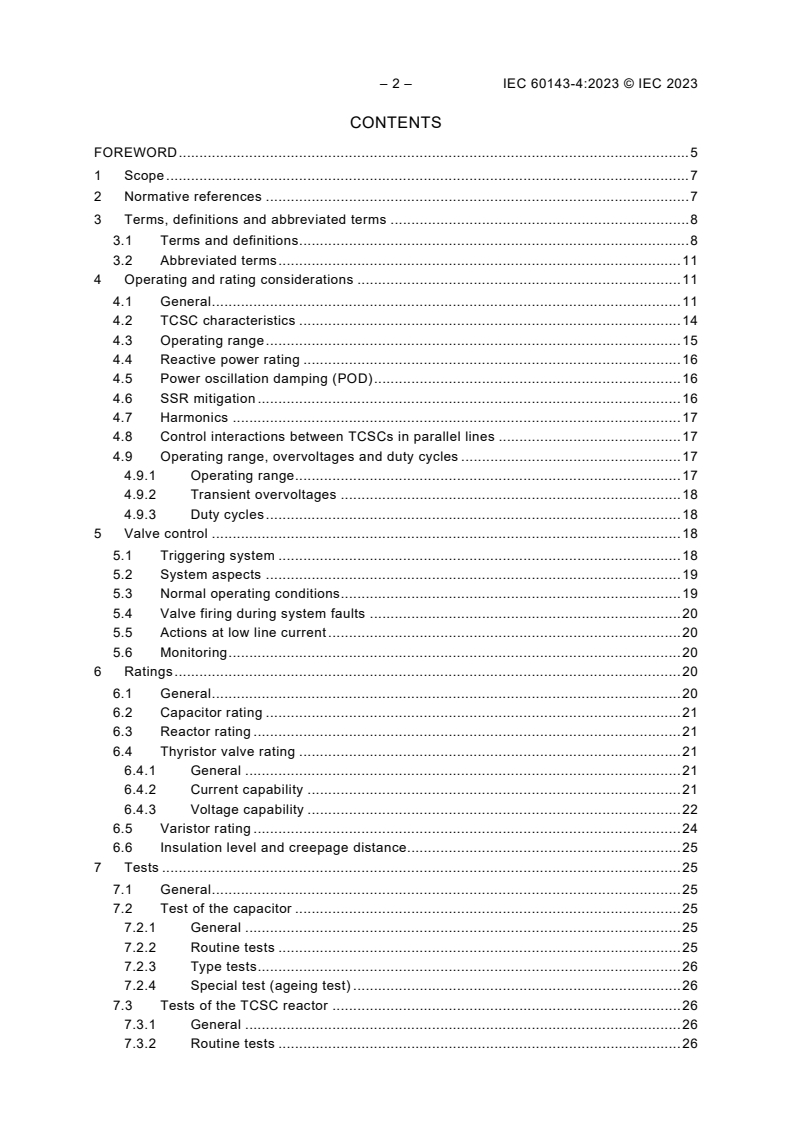
CONTENTS
FOREWORD . 5
1 Scope . 7
2 Normative references . 7
3 Terms, definitions and abbreviated terms . 8
3.1 Terms and definitions . 8
3.2 Abbreviated terms . 11
4 Operating and rating considerations . 11
4.1 General . 11
4.2 TCSC characteristics . 14
4.3 Operating range . 15
4.4 Reactive power rating . 16
4.5 Power oscillation damping (POD) . 16
4.6 SSR mitigation . 16
4.7 Harmonics . 17
4.8 Control interactions between TCSCs in parallel lines . 17
4.9 Operating range, overvoltages and duty cycles . 17
4.9.1 Operating range . 17
4.9.2 Transient overvoltages . 18
4.9.3 Duty cycles . 18
5 Valve control . 18
5.1 Triggering system . 18
5.2 System aspects . 19
5.3 Normal operating conditions . 19
5.4 Valve firing during system faults . 20
5.5 Actions at low line current . 20
5.6 Monitoring . 20
6 Ratings . 20
6.1 General . 20
6.2 Capacitor rating . 21
6.3 Reactor rating . 21
6.4 Thyristor valve rating . 21
6.4.1 General . 21
6.4.2 Current capability . 21
6.4.3 Voltage capability . 22
6.5 Varistor rating . 24
6.6 Insulation level and creepage distance. 25
7 Tests . 25
7.1 General . 25
7.2 Test of the capacitor . 25
7.2.1 General . 25
7.2.2 Routine tests . 25
7.2.3 Type tests . 26
7.2.4 Special test (ageing test) . 26
7.3 Tests of the TCSC reactor . 26
7.3.1 General . 26
7.3.2 Routine tests . 26
7.3.3 Type tests . 27
7.3.4 Special tests . 27
7.4 Tests of thyristor valves . 27
7.4.1 General . 27
7.4.2 Routine tests . 27
7.4.3 Type tests . 28
7.5 Tests of protection and control system . 28
7.5.1 General . 28
7.5.2 Routine tests . 28
7.5.3 Type tests . 29
7.5.4 Special tests − Hardware-in-the-loop (HIL) tests . 29
8 Guidance for selection of rating and operation . 30
8.1 General . 30
8.2 Thyristor controlled series capacitor . 31
8.2.1 AC transmission system . 31
8.2.2 TCSC operational objectives . 32
8.2.3 TCSC ratings . 32
8.3 Thyristor valves . 34
8.4 Capacitors and reactors . 34
8.4.1 General . 34
8.4.2 Capacitor considerations . 34
8.4.3 Reactor considerations . 34
8.5 Fault duty cycles for varistor rating . 35
8.6 Valve cooling system . 36
8.7 TCSC control and protection . 36
8.7.1 General . 36
8.7.2 Control . 37
8.7.3 Protection . 39
8.7.4 Monitoring and recording . 39
8.8 Precommissioning and commissioning tests . 40
8.8.1 General . 40
8.8.2 Pre-commissioning tests . 40
8.8.3 Station tests . 41
Bibliography . 43
Figure 1 – Typical nomenclature of a TCSC installation . 12
Figure 2 – TCSC subsegment . 13
Figure 3 – TCSC steady state waveforms for control angle α and conduction interval σ. 14
Figure 4 – TCSC apparent reactance characteristics according to Formula (1),
with λ = 2,5 . 15
Figure 5 – Example of TCSC operating range for POD (left) and SSR mitigation (right) . 15
Figure 6 – Valve base electronics (VBE) . 18
Figure 7 – Valve electronics (VE) . 19
Figure 8 – Thyristor valve voltage in a TCSC . 23
Figure 9 – Typical block diagram of a real time TCSC protection and control system
simulation environment . 30
Figure 10 – Example of operating range diagram for TCSC . 33
– 4 – IEC 60143-4:2023 © IEC 2023
Table 1 – Peak and RMS voltage relationships . 13
Table 2 – Typical external fault duty cycle with unsuccessful high speed auto-reclosing . 35
Table 3 – Typical duty cycle for internal fault with successful high speed auto-reclosing . 35
Table 4 – Typical duty cycle for internal fault with unsuccessful high speed auto-
reclosing . 36
INTERNATIONAL ELECTROTECHNICAL COMMISSION
____________
SERIES CAPACITORS FOR POWER SYSTEMS –
Part 4: Thyristor controlled series capacitors
FOREWORD
1) The International Electrotechnical Commission (IEC) is a worldwide organization for standardization comprising
all national electrotechnical committees (IEC National Committees). The object of IEC is to promote international
co-operation on all questions concerning standardization in the electrical and electronic fields. To this end and
in addition to other activities, IEC publishes International Standards, Technical Specifications, Technical Reports,
Publicly Available Specifications (PAS) and Guides (hereafter referred to as “IEC Publication(s)”). Their
preparation is entrusted to technical committees; any IEC National Committee interested in the subject dealt with
may participate in this preparatory work. International, governmental and non-governmental organizations liaising
with the IEC also participate in this preparation. IEC collaborates closely with the International Organization for
Standardization (ISO) in accordance with conditions determined by agreement between the two organizations.
2) The formal decisions or agreements of IEC on technical matters express, as nearly as possible, an international
consensus of opinion on the relevant subjects since each technical committee has representation from all
interested IEC National Committees.
3) IEC Publications have the form of recommendations for international use and are accepted by IEC National
Committees in that sense. While all reasonable efforts are made to ensure that the technical content of IEC
Publications is accurate, IEC cannot be held responsible for the way in which they are used or for any
misinterpretation by any end user.
4) In order to promote international uniformity, IEC National Committees undertake to apply IEC Publications
transparently to the maximum extent possible in their national and regional publications. Any divergence between
any IEC Publication and the corresponding national or regional publication shall be clearly indicated in the latter.
5) IEC itself does not provide any attestation of conformity. Independent certification bodies provide conformity
assessment services and, in some areas, access to IEC marks of conformity. IEC is not responsible for any
services carried out by independent certification bodies.
6) All users should ensure that they have the latest edition of this publication.
7) No liability shall attach to IEC or its directors, employees, servants or agents including individual experts and
members of its technical committees and IEC National Committees for any personal injury, property damage or
other damage of any nature whatsoever, whether direct or indirect, or for costs (including legal fees) and
expenses arising out of the publication, use of, or reliance upon, this IEC Publication or any other IEC
Publications.
8) Attention is drawn to the Normative references cited in this publication. Use of the referenced publications is
indispensable for the correct application of this publication.
9) IEC draws attention to the possibility that the implementation of this document may involve the use of (a)
patent(s). IEC takes no position concerning the evidence, validity or applicability of any claimed patent rights in
respect thereof. As of the date of publication of this document, IEC had not received notice of (a) patent(s), which
may be required to implement this document. However, implementers are cautioned that this may not represent
the latest information, which may be obtained from the patent database available at https://patents.iec.ch. IEC
shall not be held responsible for identifying any or all such patent rights.
IEC 60143-4 has been prepared by IEC technical committee 33: Power capacitors and their
applications. It is an International Standard.
This second edition cancels and replaces the first edition published in 2010. This edition
constitutes a technical revision.
This edition includes the following significant technical changes with respect to the previous
edition:
a) thyristor valve testing requirements refer to IEC 62823;
b) Formula (1) in Subclause 4.2 has been corrected;
c) Hardware-in-the-loop (HIL) tests, Subclause 7.5.4, replaces previously specified real time
protection and control system test with network simulator.
– 6 – IEC 60143-4:2023 © IEC 2023
The text of this International Standard is based on the following documents:
Draft Report on voting
33/696/FDIS 33/702/RVD
Full information on the voting for its approval can be found in the report on voting indicated in
the above table.
The language used for the development of this International Standard is English.
This part of IEC 60143 is to be used in conjunction with the following standards:
– IEC 60143-1:2015,
– IEC 60143-2:2012,
– IEC 60143-3:2015.
This document was drafted in accordance with ISO/IEC Directives, Part 2, and developed in
accordance with ISO/IEC Directives, Part 1 and ISO/IEC Directives, IEC Supplement, available
at www.iec.ch/members_experts/refdocs. The main document types developed by IEC are
described in greater detail at www.iec.ch/publications.
A list of all parts of IEC 60143 series, under the general title Series capacitors for power
systems, can be found on the iec website.
The committee has decided that the contents of this document will remain unchanged until the
stability date indicated on the IEC website under webstore.iec.ch in the data related to the
specific document. At this date, the document will be
• reconfirmed,
• withdrawn, or
• revised.
IMPORTANT – The "colour inside" logo on the cover page of this document indicates
that it contains colours which are considered to be useful for the correct understanding
of its contents. Users should therefore print this document using a colour printer.
SERIES CAPACITORS FOR POWER SYSTEMS –
Part 4: Thyristor controlled series capacitors
1 Scope
This part of IEC 60143 specifies the testing of thyristor controlled series capacitor (TCSC)
installations used in series with transmission lines. This document also addresses issues that
consider ratings for TCSC thyristor valve assemblies, capacitors, and reactors as well as TCSC
control characteristics, protective features, cooling system and system operation.
2 Normative references
The following documents are referred to in the text in such a way that some or all of their content
constitutes requirements of this document. For dated references, only the edition cited applies.
For undated references, the latest edition of the referenced document (including any
amendments) applies.
NOTE If there is a conflict between this part of IEC 60143 and a standard listed below in Clause 2, this document
prevails.
IEC 60050-436, International Electrotechnical Vocabulary (IEV) – Part 436: Power capacitors
IEC 60068-2-2, Environmental testing – Part 2-2: Tests – Tests B: Dry heat
IEC 60068-2-78, Environmental testing – Part 2-78: Tests – Test Cab: Damp heat, steady state
IEC 60076-1, Power transformers – Part 1: General
IEC 60076-6:2007, Power transformers – Part 6: Reactors
IEC 60143-1:2015, Series capacitors for power systems – Part 1: General
IEC 60143-2:2012, Series capacitors for power systems – Part 2: Protective equipment for
series capacitor banks
IEC 60143-3:2015, Series capacitors for power systems – Part 3: Internal fuses
IEC 60255-21 (all parts), Electrical relays – Vibration, shock, bump and seismic tests on
measuring relays and protection equipment
IEC 60255-27, Measuring relays and protection equipment − Part 27: Product safety
requirements
IEC 61000-4 (all parts), Electromagnetic compatibility (EMC) − Part 4: Testing and
measurement techniques
IEC 61000-4-11, Electromagnetic compatibility (EMC) − Part 4-11: Testing and measurement
techniques − Voltage dips, short interruptions and voltage variations immunity tests for
equipment with input current up to 16 A per phase
– 8 – IEC 60143-4:2023 © IEC 2023
IEC 61000-4-29, Electromagnetic compatibility (EMC) – Part 4-29: Testing and measurement
techniques – Voltage dips, short interruptions and voltage variations on d.c. input port immunity
tests
IEC 62823:2015, Thyristor valves for thyristor controlled series capacitors (TCSC) – Electrical
testing
IEC 62823:2015/AMD1:2019
NOTE Additional useful references, not explicitly referenced in the text, are listed in the Bibliography.
3 Terms, definitions and abbreviated terms
For the purposes of this document, the terms and definitions given in IEC 60143-1,
IEC 60143-2, IEC 60143-3, some taken from IEC 60050-436, and the following apply.
ISO and IEC maintain terminology databases for use in standardization at the following
addresses:
• IEC Electropedia: available at https://www.electropedia.org/
• ISO Online browsing platform: available at https://www.iso.org/obp
NOTE In some instances, the IEC definitions can be either too broad or too restrictive. In such a case, an additional
definition or note has been included.
3.1 Terms and definitions
3.1.1
thyristor valve
electrically combined assembly of thyristor levels, complete with all connections, auxiliary
components and mechanical structures, which can be connected in series with each phase of
the reactor or capacitor of a TCSC
3.1.2
bypass current
current flowing through the bypass switch, protective device, thyristor valve, or other devices,
in parallel with the series capacitor, when the series capacitor is bypassed
3.1.3
temporary overload
short duration (typically 30 min) overload capability of the TCSC at rated frequency and ambient
temperature range
SEE: Figure 5 and Figure 10.
3.1.4
dynamic overload
short duration (typically 10 s) overload capability of the TCSC at rated frequency and ambient
temperature range
SEE: Figure 5 and Figure 10.
3.1.5
thyristor-controlled series capacitor
TCSC
assembly of thyristor valves, TCSC reactor(s), capacitors, and associated auxiliaries, such as
structures, support insulators, switches, and protective devices, with control equipment required
for a complete operating installation
3.1.6
valve electronics
VE
electronic circuits at valve potential(s) that perform control functions
3.1.7
TCSC reactor
one or more reactors connected in series with the thyristor valve
SEE: Figure 1, item 7.
Note 1 to entry: In the context of TCSCs, the valve varistor is typically defined by its ability to limit the voltage
across a thyristor valve to a specified protective level while absorbing energy. The valve varistor is designed to
withstand the temporary overvoltage and continuous operating voltage across the thyristor valve.
3.1.8
valve blocking
operation to prevent further firing of a thyristor valve by inhibiting triggering
3.1.9
valve base electronics
VBE
electronic unit, at earth potential, which is the interface between the control system of the TCSC
and the thyristor valves
3.1.10
capacitor current
I
C
current through the series capacitor
SEE: Figure 2.
3.1.11
line current
I
L
power frequency line current
SEE: Figure 2.
3.1.12
rated current
I
N
) at which the TCSC should be capable of continuous operation with rated
RMS line current (I
L
reactance (X ) and rated voltage (U )
N N
3.1.13
valve current
I
V
current through the thyristor valve
SEE: Figure 2.
3.1.14
capacitor voltage
U
C
voltage across the TCSC
SEE: Figure 2.
– 10 – IEC 60143-4:2023 © IEC 2023
3.1.15
protective level
U
PL
magnitude of the maximum peak of the power frequency voltage appearing across the
overvoltage protector during a power system fault
Note 1 to entry: The protective level can be expressed in terms of the actual peak voltage across a segment or in
terms of the per unit of the peak of the rated voltage across the capacitor.
3.1.16
rated TCSC voltage
U
N
power frequency voltage across each phase of the TCSC that can be continuously controlled
), rated current (I ), frequency, and reference ambient temperature range
at rated reactance (X
N N
3.1.17
apparent reactance
X(α)
TCSC apparent power frequency reactance as a function of thyristor control angle (α)
SEE Figure 4.
3.1.18
nominal frequency
f
N
frequency of the system in which the TCSC is intended to be used
3.1.19
rated capacitance
C
N
capacitance value for which the TCSC capacitor has been designed
3.1.20
physical reactance
X
C
power frequency reactance for each phase of the TCSC bank with thyristors blocked and a
capacitor internal dielectric temperature of 20 °C
X =×12πfC
( )
C NN
3.1.21
boost factor
k
B
ratio of X(α) divided by X
C
Note 1 to entry: k = X(α) / X
B C
3.1.22
rated reactance
X
N
rated power frequency reactance for each phase of the TCSC with rated line I and rated boost
N
factor
3.1.23
conduction interval
σ
that part of a cycle during which a thyristor valve is in the conducting state, σ = 2β
SEE: Figure 3.
3.1.24
control angle
α
time expressed in electrical angular measure from the capacitor voltage (U ) zero crossing to
C
the starting of current conduction through the thyristor valve
SEE: Figure 3.
3.1.25
internal fault
line fault occurring within the protected line section containing the series capacitor bank
3.1.26
external fault
line fault occurring outside the protected line section containing the series capacitor bank
3.2 Abbreviated terms
FSC fixed series capacitors
MC master control
POD power oscillation damping
RTU remote terminal unit
SCADA supervisory control and data acquisition
SER sequence events recorder
SSR sub-synchronous resonance
RMS root-mean-square
BLK blocked (mode of operation)
BP bypass (mode of operation)
CAP capacitive boost (mode of operation)
HMI human machine interface
4 Operating and rating considerations
4.1 General
Transmission line series reactance can be compensated by combinations of fixed series
capacitors and TCSC banks (see Figure 1). TCSC banks use one or more controllable modules
to achieve the range of performance requirements specified by the purchaser. This clause
discusses requirements of TCSC operating and rating considerations.
The TCSC circuit configurations discussed in this document (see Figure 2) consider three basic
operating modes:
• BLK operation with thyristors blocked (no current through the thyristor valve),
• BP operation with continuous thyristor current,
• CAP operation with a capacitive boost.
– 12 – IEC 60143-4:2023 © IEC 2023
Key
1 TCSC bank (1-phase) 8 thyristor valve
2 controllable subsegment 9 current limiting damping circuit
3 additional controllable subsegments when 10 bypass gap
required
4 additional FSC segment when required 11 bypass switch
5 capacitor units 12 external bypass disconnector
6 varistor 13 external isolating disconnector
7 TCSC reactor 14 external grounding switch
Figure 1 – Typical nomenclature of a TCSC installation
Figure 2 – TCSC subsegment
The definition of control angle (α) with reference to voltage zero crossing is selected to be
consistent with other power electronic devices (see Figure 3). However, it should be noticed
that many TCSC control systems use the line current waveform as an important control
reference.
When a TCSC is operating in CAP mode, the current in the thyristor valve branch can boost the
voltage across the capacitor, resulting in an apparent capacitive reactance larger than the
physical capacitor reactance, see Figure 4. In a TCSC application, the increased capacitive
reactance would increase the line current. The current pulses through the thyristor valve distorts
the capacitor voltage (U ). The distorted waveform means that the capacitor voltage includes
C
non-power frequency components and that the relationship between total RMS and total peak
voltage is not 2 as in the case for a pure sinusoidal waveform, see Table 1.
Table 1 – Peak and RMS voltage relationships
Normalized Power Power
Total RMS Total peak
Boost factor discharge frequency RMS frequency peak
voltage voltage
frequency, λ voltage voltage
k
p.u. p.u p.u p.u p.u
B
1,0 2,5 1,0 1,41 1,00 1,41
2,0 2,5 2,0 2,83 2,02 2,55
3,0 2,5 3,0 4,24 3,05 3,70
1,0 3,5 1,0 1,41 1,00 1,41
2,0 3,5 2,0 2,83 2,03 2,54
3,0 3,5 3,0 4,24 3,07 3,67
– 14 – IEC 60143-4:2023 © IEC 2023
Figure 3 – TCSC steady state waveforms for control angle α and conduction interval σ
4.2 TCSC characteristics
TCSC characteristics are determined from the series capacitor (C) and reactor (L) circuit
parameters shown in Figure 2. The steady state apparent reactance X(α) as a function of
thyristor control angle (α) can be calculated from Formula (1), see [1] .
1 2 λβ2cos sin2β
X α 1+ λtanλβ− tanβ−−β
( ) ( ) (1)
22
2πf C π1λλ− −1 2
N
where
β is half the conduction interval (π-α);
α is control angle from capacitor voltage zero;
λ is the normalized discharge frequency ;
2πf LC
N
C is the series capacitor capacitance;
L is the TCSC reactor inductance.
___________
Numbers in square brackets refer to the Bibliography.
=
Figure 4 – TCSC apparent reactance characteristics
according to Formula (1), with λ = 2,5
4.3 Operating range
The operating range is one of the most important factors for rating of a TCSC. It has a major
impact on the main circuit components stresses and shall therefore be clearly specified by the
purchaser. The TCSC shall be designed to withstand operation with the different reactances
and line currents within the specified operating range. The required operating range shall be
defined by system studies performed by the purchaser and be clearly stated in the specification
with a set of curves of the apparent fundamental frequency TCSC reactance or boost factor (k )
B
versus the line current as indicated in Figure 5. The required operating range depends on the
purpose of the TCSC. Generally, a TCSC for power oscillation damping (POD) requires a larger
operating range than a TCSC for SSR-mitigation.
a) Example of TCSC operating range for POD b) Example of TCSC operating range for SSR mitigation
Figure 5 – Example of TCSC operating range for POD (left) and SSR mitigation (right)
– 16 – IEC 60143-4:2023 © IEC 2023
The operating range does not extend all the way to zero line current because steady-state firing
of a thyristor valve is not possible at very low thyristor valve voltages and currents. All thyristors
and associated firing and monitoring electronics have a minimum voltage below which firing
and condition monitoring is not possible. In addition, some thyristor valves have power supplies
for the firing circuits that can place additional constraints on the firing of the thyristor valve
when the line current is low. This results in a minimum line current and boost factor (k ) below
B
which operation in CAP mode is not feasible. This can have implications on the application and
operation of the TCSC. The impact of series compensation is of limited value at low line
currents. If SSR is a concern, it is recommended that the TCSC be bypassed at line current
levels below which operation in CAP mode cannot be maintained.
4.4 Reactive power rating
When a TCSC is operating in capacitive boost mode, the reactive power seen by the power
system differs from the reactive power of the capacitors. The reactive power output of a TCSC
and the reactive power of the capacitors are given by Formulae (2) and (3):
Q =3××kI× (2)
TCSC B L
ωC
Q =3××kI× (3)
CAP B L
ωC
The nominal reactive power rating of the TCSC shall be defined as the reactive power output
given by Q in the above expressions with rated boost (k ), line current (I ) equal to the
TCSC B L
rated line current and 1/ωC equal to the physical reactance.
4.5 Power oscillation damping (POD)
Power oscillation damping (POD) is a specialized subset of closed loop reactance control which
can be realized by modulating the TCSC reactance in response to transmission system
conditions to dampen power system oscillations. By using BP mode during power oscillations,
the damping performance of a TCSC can be increased significantly since this extends the
reactance range of a TCSC to a lower inductive reactance.
A TCSC for POD applications shall fulfil the following fundamental requirements:
• The POD controller shall be able to handle system disturbances that results in power
oscillations through zero and be insensitive to the direction of the average power flow.
• The POD controller shall be able to handle large system disturbances. This means that the
structure of the POD controller shall be such that the desired phase shift between the input
and output signal of the TCSC is maintained independently of the magnitude of the power
oscillation.
• The TCSC control system shall be able to handle mode switching from CAP to BP and BP
to CAP during power oscillation damping.
4.6 SSR mitigation
When properly designed and applied, TCSC can provide a degree of SSR mitigation when
operated with a boost factor greater than one. The TCSC can help mitigate the resonant SSR
series combination that results from fixed series capacitors.
If the TCSC application requires that SSR concerns be addressed, it is recommended that
studies be performed involving detailed models of the power system, the nearby turbine
generators and the TCSC. This recommendation is heightened in situations when the power
system includes a combination of fixed series capacitors and TCSC and the combined series
compensation exceeds 50 %. If the studies indicate that fixed series capacitors with the desired
level of compensation will result in an SSR problem, the TCSC supplier shall be actively
involved in the SSR studies.
A TCSC can only provide SSR mitigation if the valves are firing on a continuous basis. The
result is that for the TCSC to meet the SSR mitigation objectives, its operating region shall be
constrained to a boost factor equal to or greater than the minimum value at which it provides
the desired SSR-mitigation. The degree of mitigation can be a function of the control angle but
it is desirable that the TCSC control system can provide a sub-synchronous impedance that
depends as little as possible on the boost factor.
In an application where SSR mitigation is critical, the operation of the TCSC under low line
current condition shall be reviewed, see 4.3.
4.7 Harmonics
A TCSC operating in CAP mode will produce harmonics. The magnitude of the harmonics
depends on the operating point in terms of line current and boost factor.
In applications where TCSC is used for SSR-mitigation or power oscillation damping purposes,
the TCSC normally operates with the nominal boost factor and only temporarily operates during
system disturbances with a higher boost factor. Therefore, harmonic requirements on such
TCSC installation shall be given for nominal operation, i.e. rated line current and nominal boost
factor.
Harmonic requirements for a TCSC shall be given in terms of maximum allowed voltage
distortion caused by the TCSC at the busses connecting the series compensated line segment.
Harmonic studies for a TCSC installation are suggested to be performed by using the entire
network considering the difficulty of computing correct harmonic network equivalents.
4.8 Control interactions between TCSCs in parallel lines
In situation where two TCSCs are located on parallel lines, there is a risk for control interactions
between the TCSCs during system disturbances. To reduce the risk for harmful interactions
between parallel connected TCSCs, the following is recommended:
• The POD controllers to use the same input signals, i.e. the sum of the power flow on the
parallel circuits.
• The POD controllers to have similar dynamics.
• The reactance controllers to have similar dynamics and respond in similar ways when hitting
limits.
• The degree of compensation of a line segment at maximum boost factor should be well
below 100 %.
4.9 Operating range, overvoltages and duty cycles
4.9.1 Operating range
The TCSC shall be capable of withstanding the operation within the specified continuous and
temporary operating ranges. The operating range is generally specified by the purchaser.
– 18 – IEC 60143-4:2023 © IEC 2023
4.9.2 Transient overvoltages
The TCSC shall be suitable for repeated operations at transient overvoltages caused by power
system faults, with the highest possible value U that is expected to occur across the TCSC
PL
terminals. The transient overvoltage is normally limited by a varistor overvoltage protector.
4.9.3 Duty cycles
The TCSC equipment shall be designed to withstand the required sequences of faults, dynamic
overload, temporary overload, and continuous currents as specified by the purchaser. These
sequences form the duty cycles that all of the components of the TCSC bank shall be designed
to withstand. The duty cycle shall be consistent with the manner in which the surrounding power
system will be operated for both internal and external faults. The purchaser shall define duty
cycles for faults of normal and extended duration and for faults of different types (three-phase
and single phase). Phase-to-phase faults shall be considered if specifically defined by the
purchaser. Examples of typical duty cycles are found in 8.5.
The purchaser shall specify a power system equivalent to be used in the studies of external
and internal faults for equipment rating.
Although the focus of this subclause is duty cycles involving power system faults, it is
understood that the TCSC shall be designed to operate
...