

IEC 62343-2-1:2019
(Main)Dynamic modules - Part 2-1: Reliability qualification - Test template
General Information
- Abstract
IEC 62343-2-1:2019 provides a reliability qualification test template for dynamic modules (DMs). The template describes the reliability qualification test items and provides information on requirements or options. Example test conditions are given for information purposes in Annex A. For reliability qualification purposes, some information about the internal components, parts and interconnections is needed. These internal parts are treated as black boxes. This document gives requirements for the evaluation of DM reliability by combining the reliability of such internal black boxes. The object of this reliability qualification test template is to provide a framework for the reliability qualification tests for DMs. Developers of reliability qualification tests for DMs determine the test conditions for each test item by referring to the examples in Annex A.
Keywords: dynamic modules (DMs), test requirements for DMs
- Status
- Published
- Publication Date
- 13-Dec-2023
- Technical Committee
- SC 86C - Fibre optic systems, sensing and active devices
- Drafting Committee
- WG 5 - TC 86/SC 86C/WG 5
- Current Stage
- PPUB - Publication issued
- Start Date
- 16-Sep-2019
- Completion Date
- 01-Oct-2019
Buy Documents
IEC 62343-2-1:2019 - Dynamic modules - Part 2-1: Reliability qualification - Test template Released:9/16/2019

IEC 62343-2-1:2019+AMD1:2023 CSV - Dynamic modules - Part 2-1: Reliability qualification - Test template Released:12/14/2023
Overview
IEC 62343-2-1:2019, titled Dynamic modules – Part 2-1: Reliability qualification – Test template, is an international standard published by the International Electrotechnical Commission (IEC). This standard provides a structured framework as a reliability qualification test template for dynamic modules (DMs), which are critical fiber optic devices used across a wide spectrum of optical networking applications. Given the diverse functionalities of dynamic modules - including optical path switching, wavelength management, and optical channel power monitoring - IEC 62343-2-1 addresses the complexities in standardizing reliability tests by offering a flexible yet comprehensive test item template complemented by example test conditions.
This document aims to guide manufacturers and test developers in performing consistent and adaptive reliability qualification, treating internal components as "black boxes" to systematically combine and evaluate their reliability credentials.
Key Topics
Reliability Qualification Test Template
The standard delineates key test items needed for evaluating the reliability of dynamic modules, providing a modular overview rather than fixed requirements. This adaptability helps cater to the many types and complex functions of DMs.Black Box Approach
IEC 62343-2-1 emphasizes assessing internal components of dynamic modules as black boxes, simplifying the evaluation of reliability by focusing on combined external behavior rather than intricate internal specifics.Test Conditions and Examples (Annex A)
The document provides illustrative reliability qualification test conditions to inform test developers. These examples serve as starting points for determining appropriate test parameters for each reliability test item.Pass/Fail Criteria and Failure Mode Analysis (Annex B)
Supplementary guidance is given for interpreting test results, including defining pass/fail criteria and leveraging Failure Mode Effect Analysis (FMEA) to better understand failure mechanisms and ensure proper qualification.Scope and Applicability
IEC 62343-2-1 applies to a broad range of dynamic modules used in fiber optic systems, including those for dispersion management and optical channel power control, providing an internationally recognized framework for developers seeking to demonstrate product reliability.
Applications
IEC 62343-2-1 is invaluable for companies involved in the design, manufacturing, and testing of dynamic modules (DMs) used in modern optical networks. Applications include:
Telecommunications Infrastructure
Ensuring reliability of optical components that manage wavelength routing, switching, and power regulation within fiber optic networks.Data Centers and Cloud Networks
Reliability qualification of DMs is critical for maintaining high uptime and data integrity in high-speed optical links.Optical Monitoring and Maintenance
Testing dynamic modules responsible for channel power and wavelength monitoring to guarantee sustained performance under operating conditions.Quality Assurance and Compliance
Manufacturers leverage this test template to plan and execute qualification tests that meet international standards, assist in certification processes, and foster global market acceptance.
Related Standards
IEC 62343 Series
IEC 62343-2-1 complements other parts of the IEC 62343 series, which cover general guidelines and broader aspects of dynamic modules.IEC 62343-2 (Previous Editions)
This standard replaces IEC 62343-2:2014, evolving from earlier editions to provide a more flexible and update-to-date approach to reliability qualification of dynamic modules.ISO/IEC Directives Part 2
The development of this standard conforms to ISO/IEC directives to ensure harmonization and international recognition.Telecommunication and Fiber Optic Standards
While focused on reliability qualification templates, IEC 62343-2-1 interfaces with broader fiber optic and telecommunication standards to ensure consistency in product development and testing.
Keywords: dynamic modules (DMs), reliability qualification, reliability test template, optical modules testing, fiber optic devices, test conditions for DMs, IEC 62343, optical network components reliability.
By adopting IEC 62343-2-1:2019, manufacturers and test developers gain a reliable, internationally harmonized template to evaluate dynamic modules-enhancing product quality and supporting global interoperability in fiber optic technologies.
Relations
- Effective Date
- 05-Sep-2023
- Effective Date
- 05-Sep-2023
Buy Documents
IEC 62343-2-1:2019 - Dynamic modules - Part 2-1: Reliability qualification - Test template Released:9/16/2019
IEC 62343-2-1:2019+AMD1:2023 CSV - Dynamic modules - Part 2-1: Reliability qualification - Test template Released:12/14/2023
Get Certified
Connect with accredited certification bodies for this standard

ANCE
Mexican certification and testing association.

Intertek Slovenia
Intertek testing, inspection, and certification services in Slovenia.

LNE (Laboratoire National de Métrologie et d'Essais)
French national laboratory for metrology and testing.
Sponsored listings
Frequently Asked Questions
IEC 62343-2-1:2019 is a standard published by the International Electrotechnical Commission (IEC). Its full title is "Dynamic modules - Part 2-1: Reliability qualification - Test template". This standard covers: IEC 62343-2-1:2019 provides a reliability qualification test template for dynamic modules (DMs). The template describes the reliability qualification test items and provides information on requirements or options. Example test conditions are given for information purposes in Annex A. For reliability qualification purposes, some information about the internal components, parts and interconnections is needed. These internal parts are treated as black boxes. This document gives requirements for the evaluation of DM reliability by combining the reliability of such internal black boxes. The object of this reliability qualification test template is to provide a framework for the reliability qualification tests for DMs. Developers of reliability qualification tests for DMs determine the test conditions for each test item by referring to the examples in Annex A. Keywords: dynamic modules (DMs), test requirements for DMs
IEC 62343-2-1:2019 provides a reliability qualification test template for dynamic modules (DMs). The template describes the reliability qualification test items and provides information on requirements or options. Example test conditions are given for information purposes in Annex A. For reliability qualification purposes, some information about the internal components, parts and interconnections is needed. These internal parts are treated as black boxes. This document gives requirements for the evaluation of DM reliability by combining the reliability of such internal black boxes. The object of this reliability qualification test template is to provide a framework for the reliability qualification tests for DMs. Developers of reliability qualification tests for DMs determine the test conditions for each test item by referring to the examples in Annex A. Keywords: dynamic modules (DMs), test requirements for DMs
IEC 62343-2-1:2019 is classified under the following ICS (International Classification for Standards) categories: 33.180.01 - Fibre optic systems in general. The ICS classification helps identify the subject area and facilitates finding related standards.
IEC 62343-2-1:2019 has the following relationships with other standards: It is inter standard links to IEC 62343-2:2014, IEC 62343-2-1:2019/AMD1:2023. Understanding these relationships helps ensure you are using the most current and applicable version of the standard.
IEC 62343-2-1:2019 is available in PDF format for immediate download after purchase. The document can be added to your cart and obtained through the secure checkout process. Digital delivery ensures instant access to the complete standard document.
Standards Content (Sample)
IEC 62343-2-1 ®
Edition 1.0 2019-09
INTERNATIONAL
STANDARD
NORME
INTERNATIONALE
Dynamic modules –
Part 2-1: Reliability qualification – Test template
Modules dynamiques –
Partie 2-1: Qualification de fiabilité – Modèle d'essai
All rights reserved. Unless otherwise specified, no part of this publication may be reproduced or utilized in any form
or by any means, electronic or mechanical, including photocopying and microfilm, without permission in writing from
either IEC or IEC's member National Committee in the country of the requester. If you have any questions about IEC
copyright or have an enquiry about obtaining additional rights to this publication, please contact the address below or
your local IEC member National Committee for further information.
Droits de reproduction réservés. Sauf indication contraire, aucune partie de cette publication ne peut être reproduite
ni utilisée sous quelque forme que ce soit et par aucun procédé, électronique ou mécanique, y compris la photocopie
et les microfilms, sans l'accord écrit de l'IEC ou du Comité national de l'IEC du pays du demandeur. Si vous avez des
questions sur le copyright de l'IEC ou si vous désirez obtenir des droits supplémentaires sur cette publication, utilisez
les coordonnées ci-après ou contactez le Comité national de l'IEC de votre pays de résidence.
IEC Central Office Tel.: +41 22 919 02 11
3, rue de Varembé info@iec.ch
CH-1211 Geneva 20 www.iec.ch
Switzerland
About the IEC
The International Electrotechnical Commission (IEC) is the leading global organization that prepares and publishes
International Standards for all electrical, electronic and related technologies.
About IEC publications
The technical content of IEC publications is kept under constant review by the IEC. Please make sure that you have the
latest edition, a corrigendum or an amendment might have been published.
IEC publications search - webstore.iec.ch/advsearchform Electropedia - www.electropedia.org
The advanced search enables to find IEC publications by a The world's leading online dictionary on electrotechnology,
variety of criteria (reference number, text, technical containing more than 22 000 terminological entries in English
committee,…). It also gives information on projects, replaced and French, with equivalent terms in 16 additional languages.
and withdrawn publications. Also known as the International Electrotechnical Vocabulary
(IEV) online.
IEC Just Published - webstore.iec.ch/justpublished
Stay up to date on all new IEC publications. Just Published IEC Glossary - std.iec.ch/glossary
details all new publications released. Available online and 67 000 electrotechnical terminology entries in English and
once a month by email. French extracted from the Terms and Definitions clause of
IEC publications issued since 2002. Some entries have been
IEC Customer Service Centre - webstore.iec.ch/csc collected from earlier publications of IEC TC 37, 77, 86 and
If you wish to give us your feedback on this publication or CISPR.
need further assistance, please contact the Customer Service
Centre: sales@iec.ch.
A propos de l'IEC
La Commission Electrotechnique Internationale (IEC) est la première organisation mondiale qui élabore et publie des
Normes internationales pour tout ce qui a trait à l'électricité, à l'électronique et aux technologies apparentées.
A propos des publications IEC
Le contenu technique des publications IEC est constamment revu. Veuillez vous assurer que vous possédez l’édition la
plus récente, un corrigendum ou amendement peut avoir été publié.
Recherche de publications IEC - Electropedia - www.electropedia.org
webstore.iec.ch/advsearchform Le premier dictionnaire d'électrotechnologie en ligne au
La recherche avancée permet de trouver des publications IEC monde, avec plus de 22 000 articles terminologiques en
en utilisant différents critères (numéro de référence, texte, anglais et en français, ainsi que les termes équivalents dans
comité d’études,…). Elle donne aussi des informations sur les 16 langues additionnelles. Egalement appelé Vocabulaire
projets et les publications remplacées ou retirées. Electrotechnique International (IEV) en ligne.
IEC Just Published - webstore.iec.ch/justpublished Glossaire IEC - std.iec.ch/glossary
Restez informé sur les nouvelles publications IEC. Just 67 000 entrées terminologiques électrotechniques, en anglais
Published détaille les nouvelles publications parues. et en français, extraites des articles Termes et Définitions des
Disponible en ligne et une fois par mois par email. publications IEC parues depuis 2002. Plus certaines entrées
antérieures extraites des publications des CE 37, 77, 86 et
Service Clients - webstore.iec.ch/csc CISPR de l'IEC.
Si vous désirez nous donner des commentaires sur cette
publication ou si vous avez des questions contactez-nous:
sales@iec.ch.
IEC 62343-2-1 ®
Edition 1.0 2019-09
INTERNATIONAL
STANDARD
NORME
INTERNATIONALE
Dynamic modules –
Part 2-1: Reliability qualification – Test template
Modules dynamiques –
Partie 2-1: Qualification de fiabilité – Modèle d'essai
INTERNATIONAL
ELECTROTECHNICAL
COMMISSION
COMMISSION
ELECTROTECHNIQUE
INTERNATIONALE
ICS 33.180.01 ISBN 978-2-8322-7356-2
– 2 – IEC 62343-2-1:2019 IEC 2019
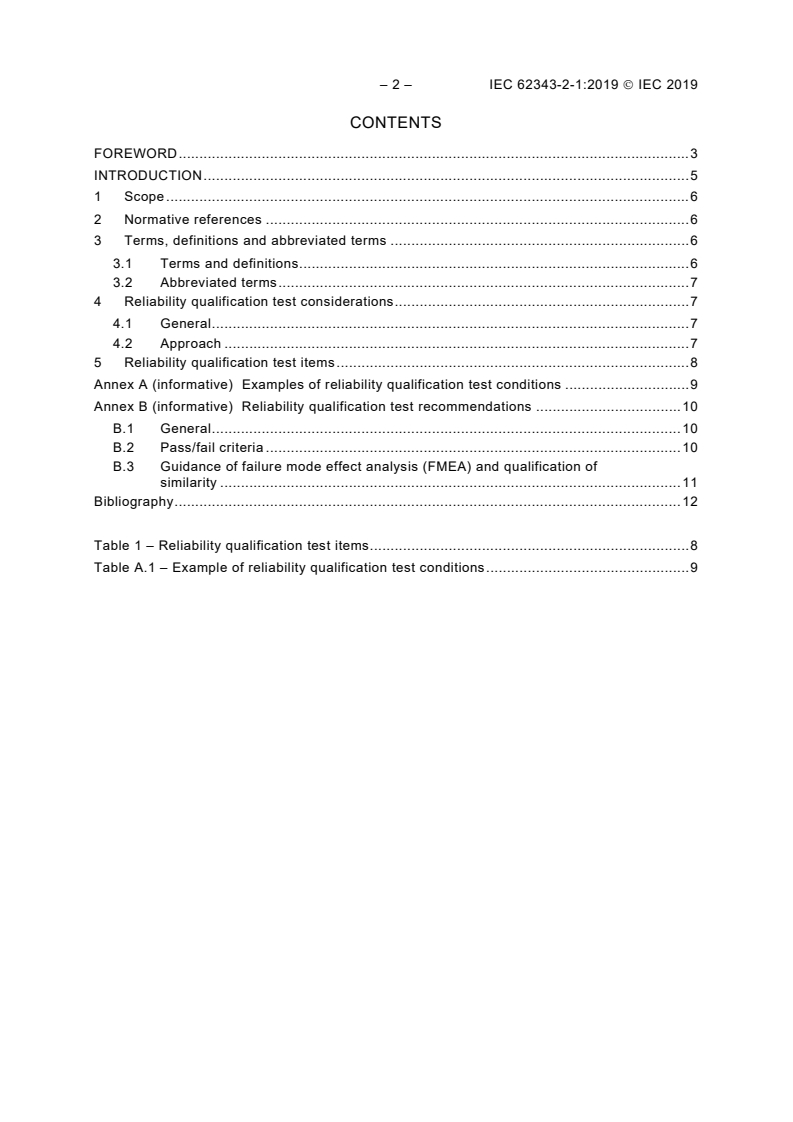
CONTENTS
FOREWORD . 3
INTRODUCTION . 5
1 Scope . 6
2 Normative references . 6
3 Terms, definitions and abbreviated terms . 6
3.1 Terms and definitions . 6
3.2 Abbreviated terms . 7
4 Reliability qualification test considerations . 7
4.1 General . 7
4.2 Approach . 7
5 Reliability qualification test items . 8
Annex A (informative) Examples of reliability qualification test conditions . 9
Annex B (informative) Reliability qualification test recommendations . 10
B.1 General . 10
B.2 Pass/fail criteria . 10
B.3 Guidance of failure mode effect analysis (FMEA) and qualification of
similarity . 11
Bibliography . 12
Table 1 – Reliability qualification test items . 8
Table A.1 – Example of reliability qualification test conditions . 9
INTERNATIONAL ELECTROTECHNICAL COMMISSION
____________
DYNAMIC MODULES –
Part 2-1: Reliability qualification – Test template
FOREWORD
1) The International Electrotechnical Commission (IEC) is a worldwide organization for standardization comprising
all national electrotechnical committees (IEC National Committees). The object of IEC is to promote
international co-operation on all questions concerning standardization in the electrical and electronic fields. To
this end and in addition to other activities, IEC publishes International Standards, Technical Specifications,
Technical Reports, Publicly Available Specifications (PAS) and Guides (hereafter referred to as "IEC
Publication(s)"). Their preparation is entrusted to technical committees; any IEC National Committee interested
in the subject dealt with may participate in this preparatory work. International, governmental and non-
governmental organizations liaising with the IEC also participate in this preparation. IEC collaborates closely
with the International Organization for Standardization (ISO) in accordance with conditions determined by
agreement between the two organizations.
2) The formal decisions or agreements of IEC on technical matters express, as nearly as possible, an international
consensus of opinion on the relevant subjects since each technical committee has representation from all
interested IEC National Committees.
3) IEC Publications have the form of recommendations for international use and are accepted by IEC National
Committees in that sense. While all reasonable efforts are made to ensure that the technical content of IEC
Publications is accurate, IEC cannot be held responsible for the way in which they are used or for any
misinterpretation by any end user.
4) In order to promote international uniformity, IEC National Committees undertake to apply IEC Publications
transparently to the maximum extent possible in their national and regional publications. Any divergence
between any IEC Publication and the corresponding national or regional publication shall be clearly indicated in
the latter.
5) IEC itself does not provide any attestation of conformity. Independent certification bodies provide conformity
assessment services and, in some areas, access to IEC marks of conformity. IEC is not responsible for any
services carried out by independent certification bodies.
6) All users should ensure that they have the latest edition of this publication.
7) No liability shall attach to IEC or its directors, employees, servants or agents including individual experts and
members of its technical committees and IEC National Committees for any personal injury, property damage or
other damage of any nature whatsoever, whether direct or indirect, or for costs (including legal fees) and
expenses arising out of the publication, use of, or reliance upon, this IEC Publication or any other IEC
Publications.
8) Attention is drawn to the normative references cited in this publication. Use of the referenced publications is
indispensable for the correct application of this publication.
9) Attention is drawn to the possibility that some of the elements of this IEC Publication may be the subject of
patent rights. IEC shall not be held responsible for identifying any or all such patent rights.
International Standard IEC 62343-2-1 has been prepared by subcommittee 86C: Fibre optic
systems and active devices, of IEC technical committee 86: Fibre optics.
This first edition cancels and replaces the second edition of IEC 62343-2 published in 2014.
This edition constitutes a technical revision.
This edition includes the following significant technical changes with respect to
IEC 62343-2:2014:
a) addition of an Introduction to the background of this document;
b) replacement of "Reliability qualification consideration" by "reliability qualification test
consideration";
c) deletion of the consideration of "Design 1" and "Design 2" and change of the contents of
"Approach" in "Reliability qualification test considerations";
d) deletion of the details in "Reliability qualification requirements" and replacement by
"Reliability qualification test items";
– 4 – IEC 62343-2-1:2019 IEC 2019
e) deletion of "Reliability calculations" from the sum of failure rates of constituting parts;
f) Integration of "Pass/fail criteria" and "Guidance of FMEA" into Annex B (informative);
g) Simplification of test items and conditions in Annex A and change of title of Annex A to
"Examples of reliability qualification test conditions".
The text of this International Standard is based on the following documents:
CDV Report on voting
86C/1567/CDV 86C/1594/RVC
Full information on the voting for the approval of this International Standard can be found in
the report on voting indicated in the above table.
This document has been drafted in accordance with the ISO/IEC Directives, Part 2.
A list of all parts in the IEC 62343 series, published under the general title Dynamic modules,
can be found on the IEC website.
The committee has decided that the contents of this document will remain unchanged until the
stability date indicated on the IEC website under "http://webstore.iec.ch" in the data related to
the specific document. At this date, the document will be
• reconfirmed,
• withdrawn,
• replaced by a revised edition, or
• amended.
NOTICE
This document contains material that is Copyright © 2006, Telcordia Technologies, Inc.
("Telcordia"). All rights reserved.
The reader is advised that this IEC document and Telcordia source(s) may differ, and the
context and use of said material in this IEC document may differ from that of Telcordia.
TELCORDIA MAKES NO REPRESENTATION OR WARRANTY, EXPRESS OR IMPLIED,
WITH RESPECT TO THE SUFFICIENCY, ACCURACY, OR UTILITY OF ANY INFORMATION
OR OPINION CONTAINED HEREIN. ANY USE OF OR RELIANCE UPON SAID
INFORMATION OR OPINION IS AT THE RISK OF THE USER. TELCORDIA SHALL NOT BE
LIABLE FOR ANY DAMAGE OR INJURY INCURRED BY ANY PERSON ARISING OUT OF
THE SUFFICIENCY, ACCURACY, OR UTILITY OF ANY INFORMATION OR OPINION
CONTAINED HEREIN.
INTRODUCTION
Dynamic modules (DMs) are relatively new fibre optic devices. In the industry, there is no de-
facto standard of reliability qualification test requirements for DMs. Also, there are many types
and functions of DMs, such as optical path switching, wavelength management, chromatic
dispersion management, optical channel power management, and optical channel powers and
wavelength monitoring. Therefore, it is difficult to standardize the reliability qualification test
requirements because their functionality is so diverse. For DMs, a reliability qualification test
template rather than particular requirements has been standardized.
The first edition of IEC 62343-2, Dynamic modules – Part 2: Reliability qualification, was
published in 2011, and the second edition was published in 2014. A survey on reliability
qualification test items and conditions was carried out in Japan, China, North America and
Europe in 2015 and 2016. The survey revealed that several reliability test conditions were
inconsistent with those in IEC 62343-2:2014, and the responses indicated a lack of consensus.
As a result of the discussion in SC 86C, it was agreed that it was impossible to unify the test
conditions for the reliability qualification of DMs. Instead of a reliability qualification document,
it was decided to prepare this template for a reliability qualification test for DMs.
Consequently, IEC 62343-2:2014 will be withdrawn and replaced upon publication of this
document.
– 6 – IEC 62343-2-1:2019 IEC 2019
DYNAMIC MODULES –
Part 2-1: Reliability qualification – Test template
1 Scope
This part of IEC 62343 provides a reliability qualification test template for dynamic modules
(DMs). The template describes the reliability qualification test items and provides information
on requirements or options. Example test conditions are given for information purposes in
Annex A.
For reliability qualification purposes, some information about the internal components, parts
and interconnections is needed. These internal parts are treated as black boxes. This
document gives requirements for the evaluation of DM reliability by combining the reliability of
such internal black boxes.
The object of this reliability qualification test template is to provide a framework for the
reliability qualification tests for DMs. Developers of reliability qualification tests for DMs
determine the test conditions for each test item by referring to the examples in Annex A.
2 Normative references
The following documents are referred to in the text in such a way that some or all of their
content constitutes requirements of this document. For dated references, only the edition
cited applies. For undated references, the latest edition of the referenced document (including
any amendments) applies.
IEC 62343, Dynamic modules – General and guidance
3 Terms, definitions and abbreviated terms
3.1 Terms and definitions
For the purpose of this document, terms and definitions given in IEC 62343 and the following
apply.
ISO and IEC maintain terminological databases for use in standardization at the following
addresses:
• IEC Electropedia: available at http://www.electropedia.org/
• ISO Online browsing platform: available at http://www.iso.org/obp
3.1.1
failure
non-compliance to product specification or change in parameters as set by the standard or
agreed by the customer and supplier
3.1.2
qualification
formal test process to determine whether or not the product is suitable for applications
Note 1 to entry: "Pass or fail" is the expected outcome.
Note 2 to entry: This is different from a reliability test, which is an engineering test designed to understand the
reliability consideration or estimate the reliability of the product; pass or fail is not the main result.
3.1.3
reliability
probability of performing required functions at specified operating and environmental
conditions over time
Note 1 to entry: The reliability of a DM is expressed by either of the following two parameters: mean time between
failure (MTBF) and failure in time (FIT):
• the MTBF is the mean period of DM continuous operation without any failure at specified operating and
environmental conditions;
• the FIT is the number of failures expected in 10 device-hours at specified operating and environmental
conditions.
3.2 Abbreviated terms
Each abbreviated term introduced in this document is explained in the text at least the first
time it appears. However, for an easier understanding of the whole text, the following is a list
of all abbreviated terms used in this document:
DM dynamic module
EMC electro-magnetic compatibility
FIT failure in time
FMEA failure mode and effects analysis
IL insertion loss
LCD liquid crystal device
MEMS micro electro-mechanical system
MTBF mean time between failure
RH relative humidity
4 Reliability qualification test considerations
4.1 General
Since dynamic modules (DMs) are relatively new products in the commercial market and
involve different technologies, the requirements included in this document will be reviewed as
technology progresses.
4.2 Approach
It is worth emphasizing the fundamental approach of reliability qualification adopted in this
document.
a) Any parts that can be effectively qualified on their individual levels shall be qualified at
that level. Their qualification shall be based on IEC standards or other industrial standards
in the absence of such IEC standards.
b) The qualification tests required at the DM level should be based on the degradation
mechanisms and failure modes that cannot be effectively detected in the lower part levels.
At the DM level, the qualification tests need not attempt to discover or identify those
degradation mechanisms and failure modes that can be discovered at lower assembly
levels than the final product level. For example, if all parts in the DM can be effectively
tested for damp heat-accelerated degradations, there is no need to repeat the damp heat
test at the DM level.
c) Specific test items for specific DMs should be considered as follows:
– shock and vibration test for micro electro-mechanical system (MEMS) engines;
– low temperature storage test for liquid crystal devices (LCDs) engines;
– 8 – IEC 62343-2-1:2019 IEC 2019
– intermittent test for LCDs and mechanical engines;
– high power test for modules which have glue and/or coating film in the optical path;
– high and low temperature operating test for thermal-optic engine;
– switching durability test for MEMS and mechanical engines.
Annex B provides guidance on reliability qualification test items and conditions.
5 Reliability qualification test items
Clause 5 defines reliability qualification test items (see Table 1). Some test items are
requirements; others are optional. Table 1 shows the reliability qualification test items. The
right column shows requirements (R) or optional items (O). Reliability qualification developers
shall test the required items and can add tests for the optional items.
Table 1 – Reliability qualification test items
Test categories Test items R or O
Mechanical test Operating mechanical shock R
Operating mechanical vibration R
Non-operating mechanical shock R
Non-operating mechanical vibration R
Non-operating unpacked drop R
Non-operating packed vibration O
Non-operating packed drop R
Temperature and humidity test Non-operating high temperature R
Non-operating low temperature R
Non-operating temperature cycling R
Non-operating temperature shock O
Non-operating damp heat R
Operating temperature cycling R
Operating temperature humidity cycling O
Electro-magnetic compatibility Electro-magnetic compatibility R
High optical power Operating high optical power R
Fibre integrity Operating fibre pull R
Key
R: Requirement
O: Optional
Annex A
(informative)
Examples of reliability qualification test conditions
Table A.1 shows examples of reliability qualification test conditions. The reliability
qualification test developer may select the condition or define other conditions by referring to
Table A.1.
Table A.1 – Example of reliability qualification test conditions
Test items Example of test conditions Remarks
Operating mechanical shock 98 m/s , 0,3 ms half-sine shock pulse, 3 axes
Condition No. 1
Operating mechanical
vibration 2
Swept sine wave at a level of 9,8 m/s , 3 mm max.
displacement, 5 Hz to 100 Hz, 0,1 oct/min, 3 axes
Condition No. 2
Swept sine wave at a level of 19,6 m/s , 100 Hz to
200 Hz, 8 oct/min, 3 axes
Condition No. 1
Swept sine wave at a level of 9,8 m/s , 3 mm max.
displacement, 5 Hz to 100 Hz, 0,1 oct/min, 3 axes
2 000 m/s , 3 axes, 2 impacts/direction (12 impacts
Non-operating mechanical
total),
shock
Nominal 1,33 ms, half sine pulse
for 0,125 kg < m (mass) ≤ 0,225 kg
500 m/s , 3 axes, 2 impacts/direction (12 impacts total)
Nominal 5 ms, half sine pulse
for 0,225 kg < m ≤ 1 kg
100 mm height for m ≤ 10 kg
Non-operating unpacked drop
75 mm height for 10 kg < m ≤ 25 kg
5 Hz to 50 Hz, 0,1 oct/min, 15 m/s , then 50 Hz to
Non-operating vibration
500 Hz, 0,25 oct/min., 29,4 m/s
10 Hz to 2 000 Hz, 196 m/s maximum acceleration
5 Hz to 20 Hz, 0,01 g /Hz, 20 Hz to 200 Hz,
Packed vibration
–3 dB/oct
1 m height for ≤ 10 kg mass
Packed drop
Non-operating high
85 °C, 2 000 h
temperature
–40 °C, 72 h
Non-operating low temperature
–40 °C to +70 °C, 100 cycles
Non-operating temperature
a
cycling
–40 °C to +85 °C, 100 cycles
85 °C, 85 % RH, 1 000 h
Non-operating damp heat Telcordia GR-1312
85 °C, 85 % RH, 500 h
Operating temperature
–10 °C to +60 °C, 20 % RH to 85 % RH
humidity cycling
Under consideration
EMC
2 mm: 20 N to 100 N, 3 times, 5 s pulls Test procedure:
Operating fibre pull
900 µm: 10 N, 3 times, 5 s pulls IEC 61300-2-4
250 µm: 5 N, 3 times, 5 s pulls Duration:
Telcordia GR-1312
Under consideration
High optical power
Under consideration
Sample size
a
The detail conditions of duration and temperature transition rate should be determined for consideration of
thermal capacity of the DUT. The useful information of the temperature cycling test is described in IEC 60068-2-
14, Test Nb.
– 10 – IEC 62343-2-1:2019 IEC 2019
Annex B
(informative)
Reliability qualification test recommendations
B.1 General
For the purposes of this document, each internal component, part, and interconnection should
be treated as a black box. It is also important to point out that the parts in the DM include
fibre splices, fibre routing, and fibre anchoring, as well as how the fibre exits from the housing
and how parts are mounted.
This document is based on the assumption that the reliability of a DM can be evaluated with
sufficient confidence from the failure in time (FIT) rates of its internal black boxes when the
assembly process of the constituents has been qualified.
There are degradation and failures not due to part failures, for example fibre routing and fibre
holders. The quality and reliability of the assembling, for example fibre routing, should be
assessed and qualified through process evaluation and qualification.
The internal black boxes often constituting a DM are:
• passive optical components, including patch cords, pigtails, connectors and splices;
• active optical components;
• electronics, including PCBs, electrical connectors, etc.;
• others (e.g. the fibre splicing, fibre routing, and fibre anchoring, as well as how the fibre
exits from the housing and how components are mounted).
DM manufacturers should declare the number and type of the internal black boxes
constituting the DM and give the failure rates (in FITs) for each black box.
The DM failure rate should be calculated by suitably combining the failure rates in FITs of its
black boxes. The model and assumptions used in the DM failure rate calculation should be
provided and justified for review, if the DM manufacturer has so requested.
B.2 Pass/fail criteria
It should be noted that the commonly used failure criterion of a drift higher than 0,5 dB in
insertion loss (IL) is a guideline. For dense wavelength division multiplexing (DWDM) DMs,
such as wavelength blockers, centre wavelength drift should be defined as a failure criterion.
The actual and practical criteria should be developed based on the degradation allowed for
the expected life of the product.
EXAMPLE
• The acceleration factor of the testing condition to the operating condition is 50.
• The beginning-of-life parametric measurement is 1,0 dB below the end-of-life specification.
• The expected life is assumed to be 20 years.
• The allowed degradation for a 2 000 h testing is: (1,0 × 50 × 2 000) / (20 × 365,25 × 24) = 0,57 dB.
Readers should note that IL is not the only parameter that should be considered for pass/fail,
but that other parameters are also to be included.
B.3 Guidance of failure mode effect analysis (FMEA) and qualification of
similarity
It is worth emphasizing that the reliability assessment or qualification tests should be based
on the degradation mechanisms and failure modes. The appropriate accelerated tests can be
developed once the degradation mechanisms, failure modes, and their acceleration factors
are understood. To begin with, the failure mode and effects analysis (FMEA) should be
developed. A set of reliability tests should be planned and conducted as the result of FMEA.
The testing results can be used to develop additional tests or refined tests to better
understand the degradation mechanisms or develop the acceleration models.
Where a range of dynamic modules is produced by a DM manufacturer, there may be some
significant similarity between different type codes. A combination of results from different test
programmes, where appropriate, is therefore permitted.
Consideration should be given to the fact that minor differences in technology or processing
can sometimes have a major impact on reliability, whilst not being apparent during quality
assessment.
At minimum, FMEA should be carried out for all varieties of products that are considered
"similar" and claimed to be "qualified" by "similarity". FMEA should be done thoroughly in
order to be an effective tool to consider "qualified-by-similarity". Its thoroughness can be
checked against the failure mode analysis (FMA) to manufacturing drop-out and customer
returns.
Evidence should be presented to demonstrate that all results are directly relevant.
– 12 – IEC 62343-2-1:2019 IEC 2019
Bibliography
IEC 60068-2-14, Environmental testing – Part 2-14: Tests – Test N: Change of temperature
IEC 61300 (all parts), Fibre optic interconnecting devices and passive components – Basic
tests and measurement procedures
IEC 61300-2-4, Fibre optic interconnecting devices and passive components – Basic test and
measurement procedures – Part 2-4: Tests – Fibre or cable retention
IEC 62005-9-1, Fibre optic interconnecting devices and passive components – Reliability –
Part 9-1: Qualification of passive optical components
IEC 62005-9-2, Reliability of fibre optic interconnecting devices and passive optical
components – Part 9-2: Reliability qualification for single fibre optic connector sets – Single
mode
IEC TR 62343-6-6, Dynamic modules – Part 6-6: Design guide – Failure mode effect analysis
for optical units of dynamic modules
IEC 62572-3, Fibre optic active components and devices – Reliability standards – Part 3:
Laser modules used for telecommunication
United States Code of Federal Regulations (CFR) – Title 47 – Chapter I – Subchapter A –
Part 15, Telecommunication – Federal Communications Commission (FCC) – General – Radio
frequency devices
EN 55032, Electromagnetic compatibility of multimedia equipment – Emission Requirements
MIL-STD-883, Test Method Standard Microcircuits (Method 2003, Solderability)
Telcordia TR-NWT-000870, Electrostatic Discharge Control in the Manufacture of
Telecommunications Equipment
Telcordia GR-63-CORE, NEBS Requirements: Physical Protection
Telcordia GR-1089-CORE, Electromagnetic Compatibility and Electrical Safety –
Generic Criteria for Network Telecommunications Equipment
Telcordia GR-1209-CORE, Generic Requirements for Passive Optical Components
Telcordia GR-1312-CORE, Generic Requirements for Optical Fiber Amplifiers and Proprietary
Den
...
IEC 62343-2-1 ®
Edition 1.1 2023-12
CONSOLIDATED VERSION
INTERNATIONAL
STANDARD
NORME
INTERNATIONALE
colour
inside
Dynamic modules –
Part 2-1: Reliability qualification – Test template
Modules dynamiques –
Partie 2-1: Qualification de fiabilité – Modèle d'essai
All rights reserved. Unless otherwise specified, no part of this publication may be reproduced or utilized in any form
or by any means, electronic or mechanical, including photocopying and microfilm, without permission in writing from
either IEC or IEC's member National Committee in the country of the requester. If you have any questions about IEC
copyright or have an enquiry about obtaining additional rights to this publication, please contact the address below or
your local IEC member National Committee for further information.
Droits de reproduction réservés. Sauf indication contraire, aucune partie de cette publication ne peut être reproduite ni
utilisée sous quelque forme que ce soit et par aucun procédé, électronique ou mécanique, y compris la photocopie et
les microfilms, sans l'accord écrit de l'IEC ou du Comité national de l'IEC du pays du demandeur. Si vous avez des
questions sur le copyright de l'IEC ou si vous désirez obtenir des droits supplémentaires sur cette publication, utilisez
les coordonnées ci-après ou contactez le Comité national de l'IEC de votre pays de résidence.
IEC Secretariat Tel.: +41 22 919 02 11
3, rue de Varembé info@iec.ch
CH-1211 Geneva 20 www.iec.ch
Switzerland
About the IEC
The International Electrotechnical Commission (IEC) is the leading global organization that prepares and publishes
International Standards for all electrical, electronic and related technologies.
About IEC publications
The technical content of IEC publications is kept under constant review by the IEC. Please make sure that you have the
latest edition, a corrigendum or an amendment might have been published.
IEC publications search - webstore.iec.ch/advsearchform IEC Products & Services Portal - products.iec.ch
The advanced search enables to find IEC publications by a Discover our powerful search engine and read freely all the
variety of criteria (reference number, text, technical publications previews. With a subscription you will always have
committee, …). It also gives information on projects, replaced access to up to date content tailored to your needs.
and withdrawn publications.
Electropedia - www.electropedia.org
IEC Just Published - webstore.iec.ch/justpublished
The world's leading online dictionary on electrotechnology,
Stay up to date on all new IEC publications. Just Published
containing more than 22 300 terminological entries in English
details all new publications released. Available online and once
and French, with equivalent terms in 19 additional languages.
a month by email.
Also known as the International Electrotechnical Vocabulary
(IEV) online.
IEC Customer Service Centre - webstore.iec.ch/csc
If you wish to give us your feedback on this publication or need
further assistance, please contact the Customer Service
Centre: sales@iec.ch.
A propos de l'IEC
La Commission Electrotechnique Internationale (IEC) est la première organisation mondiale qui élabore et publie des
Normes internationales pour tout ce qui a trait à l'électricité, à l'électronique et aux technologies apparentées.
A propos des publications IEC
Le contenu technique des publications IEC est constamment revu. Veuillez vous assurer que vous possédez l’édition la
plus récente, un corrigendum ou amendement peut avoir été publié.
Recherche de publications IEC - Découvrez notre puissant moteur de recherche et consultez
webstore.iec.ch/advsearchform gratuitement tous les aperçus des publications. Avec un
La recherche avancée permet de trouver des publications IEC abonnement, vous aurez toujours accès à un contenu à jour
en utilisant différents critères (numéro de référence, texte, adapté à vos besoins.
comité d’études, …). Elle donne aussi des informations sur les
projets et les publications remplacées ou retirées. Electropedia - www.electropedia.org
Le premier dictionnaire d'électrotechnologie en ligne au monde,
IEC Just Published - webstore.iec.ch/justpublished
avec plus de 22 300 articles terminologiques en anglais et en
Restez informé sur les nouvelles publications IEC. Just
français, ainsi que les termes équivalents dans 19 langues
Published détaille les nouvelles publications parues.
additionnelles. Egalement appelé Vocabulaire
Disponible en ligne et une fois par mois par email.
Electrotechnique International (IEV) en ligne.
Service Clients - webstore.iec.ch/csc
Si vous désirez nous donner des commentaires sur cette
publication ou si vous avez des questions contactez-nous:
sales@iec.ch.
IEC Products & Services Portal - products.iec.ch
IEC 62343-2-1 ®
Edition 1.1 2023-12
CONSOLIDATED VERSION
INTERNATIONAL
STANDARD
NORME
INTERNATIONALE
colour
inside
Dynamic modules –
Part 2-1: Reliability qualification – Test template
Modules dynamiques –
Partie 2-1: Qualification de fiabilité – Modèle d'essai
INTERNATIONAL
ELECTROTECHNICAL
COMMISSION
COMMISSION
ELECTROTECHNIQUE
INTERNATIONALE
ICS 33.180.01 ISBN 978-2-8322-8054-6
IEC 62343-2-1 ®
Edition 1.1 2023-12
CONSOLIDATED VERSION
REDLINE VERSION
VERSION REDLINE
colour
inside
Dynamic modules –
Part 2-1: Reliability qualification – Test template
Modules dynamiques –
Partie 2-1: Qualification de fiabilité – Modèle d'essai
– 2 – IEC 62343-2-1:2019+AMD1:2023 CSV
IEC 2023
CONTENTS
FOREWORD . 3
INTRODUCTION . 6
1 Scope . 7
2 Normative references . 7
3 Terms, definitions and abbreviated terms . 7
3.1 Terms and definitions . 7
3.2 Abbreviated terms . 8
4 Reliability qualification test considerations . 8
4.1 General . 8
4.2 Approach . 8
5 Reliability qualification test items . 9
Annex A (informative) Examples of reliability qualification test conditions . 10
Annex B (informative) Reliability qualification test recommendations . 11
B.1 General . 11
B.2 Pass/fail criteria . 11
B.3 Guidance of failure mode effect analysis (FMEA) and qualification of
similarity . 12
Bibliography . 13
Table 1 – Reliability qualification test items . 9
Table A.1 – Example of reliability qualification test conditions . 10
IEC 2023
INTERNATIONAL ELECTROTECHNICAL COMMISSION
____________
DYNAMIC MODULES –
Part 2-1: Reliability qualification – Test template
FOREWORD
1) The International Electrotechnical Commission (IEC) is a worldwide organization for standardization comprising
all national electrotechnical committees (IEC National Committees). The object of IEC is to promote
international co-operation on all questions concerning standardization in the electrical and electronic fields. To
this end and in addition to other activities, IEC publishes International Standards, Technical Specifications,
Technical Reports, Publicly Available Specifications (PAS) and Guides (hereafter referred to as "IEC
Publication(s)"). Their preparation is entrusted to technical committees; any IEC National Committee interested
in the subject dealt with may participate in this preparatory work. International, governmental and non-
governmental organizations liaising with the IEC also participate in this preparation. IEC collaborates closely
with the International Organization for Standardization (ISO) in accordance with conditions determined by
agreement between the two organizations.
2) The formal decisions or agreements of IEC on technical matters express, as nearly as possible, an international
consensus of opinion on the relevant subjects since each technical committee has representation from all
interested IEC National Committees.
3) IEC Publications have the form of recommendations for international use and are accepted by IEC National
Committees in that sense. While all reasonable efforts are made to ensure that the technical content of IEC
Publications is accurate, IEC cannot be held responsible for the way in which they are used or for any
misinterpretation by any end user.
4) In order to promote international uniformity, IEC National Committees undertake to apply IEC Publications
transparently to the maximum extent possible in their national and regional publications. Any divergence
between any IEC Publication and the corresponding national or regional publication shall be clearly indicated in
the latter.
5) IEC itself does not provide any attestation of conformity. Independent certification bodies provide conformity
assessment services and, in some areas, access to IEC marks of conformity. IEC is not responsible for any
services carried out by independent certification bodies.
6) All users should ensure that they have the latest edition of this publication.
7) No liability shall attach to IEC or its directors, employees, servants or agents including individual experts and
members of its technical committees and IEC National Committees for any personal injury, property damage or
other damage of any nature whatsoever, whether direct or indirect, or for costs (including legal fees) and
expenses arising out of the publication, use of, or reliance upon, this IEC Publication or any other IEC
Publications.
8) Attention is drawn to the normative references cited in this publication. Use of the referenced publications is
indispensable for the correct application of this publication.
9) Attention is drawn to the possibility that some of the elements of this IEC Publication may be the subject of
patent rights. IEC shall not be held responsible for identifying any or all such patent rights.
This consolidated version of the official IEC Standard and its amendment has been
prepared for user convenience.
IEC 62343-2-1 edition 1.1 contains the first edition (2019-09) [documents 86C/1567/CDV
and 86C/1594/RVC] and its amendment 1 (2023-12) [documents 86C/1868/CDV and
86C/1888/RVC].
In this Redline version, a vertical line in the margin shows where the technical content
is modified by amendment 1. Additions are in green text, deletions are in strikethrough
red text. A separate Final version with all changes accepted is available in this
publication.
– 4 – IEC 62343-2-1:2019+AMD1:2023 CSV
IEC 2023
International Standard IEC 62343-2-1 has been prepared by subcommittee 86C: Fibre optic
systems and active devices, of IEC technical committee 86: Fibre optics.
This first edition constitutes a technical revision.
This edition includes the following significant technical changes with respect to
IEC 62343-2:2014:
a) addition of an Introduction to the background of this document;
b) replacement of "Reliability qualification consideration" by "reliability qualification test
consideration";
c) deletion of the consideration of "Design 1" and "Design 2" and change of the contents of
"Approach" in "Reliability qualification test considerations";
d) deletion of the details in "Reliability qualification requirements" and replacement by
"Reliability qualification test items";
e) deletion of "Reliability calculations" from the sum of failure rates of constituting parts;
f) Integration of "Pass/fail criteria" and "Guidance of FMEA" into Annex B (informative);
g) Simplification of test items and conditions in Annex A and change of title of Annex A to
"Examples of reliability qualification test conditions".
This document has been drafted in accordance with the ISO/IEC Directives, Part 2.
A list of all parts in the IEC 62343 series, published under the general title Dynamic modules,
can be found on the IEC website.
The committee has decided that the contents of this document and its amendment will remain
unchanged until the stability date indicated on the IEC website under webstore.iec.ch in the
data related to the specific document. At this date, the document will be
• reconfirmed,
• withdrawn, or
• revised.
IMPORTANT – The 'colour inside' logo on the cover page of this publication indicates
that it contains colours which are considered to be useful for the correct
understanding of its contents. Users should therefore print this document using a
colour printer.
IEC 2023
NOTICE
This document contains material that is Copyright © 2006, Telcordia Technologies, Inc.
("Telcordia"). All rights reserved.
The reader is advised that this IEC document and Telcordia source(s) may differ, and the
context and use of said material in this IEC document may differ from that of Telcordia.
TELCORDIA MAKES NO REPRESENTATION OR WARRANTY, EXPRESS OR IMPLIED,
WITH RESPECT TO THE SUFFICIENCY, ACCURACY, OR UTILITY OF ANY INFORMATION
OR OPINION CONTAINED HEREIN. ANY USE OF OR RELIANCE UPON SAID
INFORMATION OR OPINION IS AT THE RISK OF THE USER. TELCORDIA SHALL NOT BE
LIABLE FOR ANY DAMAGE OR INJURY INCURRED BY ANY PERSON ARISING OUT OF
THE SUFFICIENCY, ACCURACY, OR UTILITY OF ANY INFORMATION OR OPINION
CONTAINED HEREIN.
– 6 – IEC 62343-2-1:2019+AMD1:2023 CSV
IEC 2023
INTRODUCTION
Dynamic modules (DMs) are relatively new fibre optic devices. In the industry, there is no de-
facto standard of reliability qualification test requirements for DMs. Also, there are many types
and functions of DMs, such as optical path switching, wavelength management, chromatic
dispersion management, optical channel power management, and optical channel powers and
wavelength monitoring. Therefore, it is difficult to standardize the reliability qualification test
requirements because their functionality is so diverse. For DMs, a reliability qualification test
template rather than particular requirements has been standardized.
The first edition of IEC 62343-2, Dynamic modules – Part 2: Reliability qualification, was
published in 2011, and the second edition was published in 2014. A survey on reliability
qualification test items and conditions was carried out in Japan, China, North America and
Europe in 2015 and 2016. The survey revealed that several reliability test conditions were
inconsistent with those in IEC 62343-2:2014, and the responses indicated a lack of consensus.
As a result of the discussion in SC 86C, it was agreed that it was impossible to unify the test
conditions for the reliability qualification of DMs. Instead of a reliability qualification document,
it was decided to prepare this template for a reliability qualification test for DMs.
Consequently, IEC 62343-2:2014 will be withdrawn and replaced upon publication of this
document.
IEC 2023
DYNAMIC MODULES –
Part 2-1: Reliability qualification – Test template
1 Scope
This part of IEC 62343 provides a reliability qualification test template for dynamic modules
(DMs). The template describes the reliability qualification test items and provides information
on requirements or options. Example test conditions are given for information purposes in
Annex A.
For reliability qualification purposes, some information about the internal components, parts
and interconnections is needed. These internal parts are treated as black boxes. This
document gives requirements for the evaluation of DM reliability by combining the reliability of
such internal black boxes.
The object of this reliability qualification test template is to provide a framework for the
reliability qualification tests for DMs. Developers of reliability qualification tests for DMs
determine the test conditions for each test item by referring to the examples in Annex A.
2 Normative references
The following documents are referred to in the text in such a way that some or all of their
content constitutes requirements of this document. For dated references, only the edition
cited applies. For undated references, the latest edition of the referenced document (including
any amendments) applies.
IEC 62343, Dynamic modules – General and guidance
3 Terms, definitions and abbreviated terms
3.1 Terms and definitions
For the purpose of this document, terms and definitions given in IEC 62343 and the following
apply.
ISO and IEC maintain terminological databases for use in standardization at the following
addresses:
• IEC Electropedia: available at http://www.electropedia.org/
• ISO Online browsing platform: available at http://www.iso.org/obp
3.1.1
failure
non-compliance to product specification or change in parameters as set by the standard or
agreed by the customer and supplier
3.1.2
qualification
formal test process to determine whether or not the product is suitable for applications
Note 1 to entry: "Pass or fail" is the expected outcome.
– 8 – IEC 62343-2-1:2019+AMD1:2023 CSV
IEC 2023
Note 2 to entry: This is different from a reliability test, which is an engineering test designed to understand the
reliability consideration or estimate the reliability of the product; pass or fail is not the main result.
3.1.3
reliability
probability of performing required functions at specified operating and environmental
conditions over time
Note 1 to entry: The reliability of a DM is expressed by either of the following two parameters: mean time between
failure (MTBF) and failure in time (FIT):
• the MTBF is the mean period of DM continuous operation without any failure at specified operating and
environmental conditions;
• the FIT is the number of failures expected in 10 device-hours at specified operating and environmental
conditions.
3.2 Abbreviated terms
Each abbreviated term introduced in this document is explained in the text at least the first
time it appears. However, for an easier understanding of the whole text, the following is a list
of all abbreviated terms used in this document:
DM dynamic module
EMC electro-magnetic compatibility
FIT failure in time
FMEA failure mode and effects analysis
IL insertion loss
LCD liquid crystal device
MEMS micro electro-mechanical system
MTBF mean time between failure
RH relative humidity
4 Reliability qualification test considerations
4.1 General
Since dynamic modules (DMs) are relatively new products in the commercial market and
involve different technologies, the requirements included in this document will be reviewed as
technology progresses.
4.2 Approach
It is worth emphasizing the fundamental approach of reliability qualification adopted in this
document.
a) Any parts that can be effectively qualified on their individual levels shall be qualified at
that level. Their qualification shall be based on IEC standards or other industrial standards
in the absence of such IEC standards.
b) The qualification tests required at the DM level should be based on the degradation
mechanisms and failure modes that cannot be effectively detected in the lower part levels.
At the DM level, the qualification tests need not attempt to discover or identify those
degradation mechanisms and failure modes that can be discovered at lower assembly
levels than the final product level. For example, if all parts in the DM can be effectively
tested for damp heat-accelerated degradations, there is no need to repeat the damp heat
test at the DM level.
c) Specific test items for specific DMs should be considered as follows:
– shock and vibration test for micro electro-mechanical system (MEMS) engines;
– low temperature storage test for liquid crystal devices (LCDs) engines;
IEC 2023
– intermittent test for LCDs and mechanical engines;
– high power test for modules which have glue and/or coating film in the optical path;
– high and low temperature operating test for thermal-optic engine;
– switching durability test for MEMS and mechanical engines.
Annex B provides guidance on reliability qualification test items and conditions.
5 Reliability qualification test items
Clause 5 defines reliability qualification test items (see Table 1). Some test items are
requirements; others are optional. Table 1 shows the reliability qualification test items. The
right column shows requirements (R) or optional items (O). Reliability qualification developers
shall test the required items and can add tests for the optional items.
Table 1 – Reliability qualification test items
Test categories Test items R or O
Mechanical test Operating mechanical shock R
Operating mechanical vibration R
Non-operating mechanical shock R
Non-operating mechanical vibration R
Non-operating unpacked drop RO
Non-operating packed vibration O
Non-operating packed drop R
Temperature and humidity test Non-operating high temperature R
Non-operating low temperature R
Non-operating temperature cycling R
Non-operating temperature shock O
Non-operating damp heat R
Operating temperature cycling R
Operating temperature humidity cycling O
Electro-magnetic compatibility Electro-magnetic compatibility R
High optical power Operating high optical power R
Fibre integrity Operating fibre pull R
Key
R: Requirement
O: Optional
– 10 – IEC 62343-2-1:2019+AMD1:2023 CSV
IEC 2023
Annex A
(informative)
Examples of reliability qualification test conditions
Table A.1 shows examples of reliability qualification test conditions. The reliability
qualification test developer may select the condition or define other conditions by referring to
Table A.1.
Table A.1 – Example of reliability qualification test conditions
Test items Example of test conditions Remarks
Operating mechanical shock 98 m/s , 0,3 ms half-sine shock pulse, 3 axes
Condition No. 1
Operating mechanical
vibration 2
Swept sine wave at a level of 9,8 m/s , 3 mm max.
displacement, 5 Hz to 100 Hz, 0,1 oct/min, 3 axes
Condition No. 2
Swept sine wave at a level of 19,6 m/s , 100 Hz to
200 Hz, 8 oct/min, 3 axes
Condition No. 1
Swept sine wave at a level of 9,8 m/s , 3 mm max.
displacement, 5 Hz to 100 Hz, 0,1 oct/min, 3 axes
2 000 m/s , 3 axes, 2 impacts/direction (12 impacts
Non-operating mechanical
total),
shock
Nominal 1,33 ms, half sine pulse
for 0,125 kg < m (mass) ≤ 0,225 kg
500 m/s , 3 axes, 2 impacts/direction (12 impacts total)
Nominal 5 ms, half sine pulse
for 0,225 kg < m ≤ 1 kg
100 mm height for m ≤ 10 kg
Non-operating unpacked drop
75 mm height for 10 kg < m ≤ 25 kg
5 Hz to 50 Hz, 0,1 oct/min, 15 m/s , then 50 Hz to
Non-operating vibration
500 Hz, 0,25 oct/min., 29,4 m/s
10 Hz to 2 000 Hz, 196 m/s maximum acceleration
5 Hz to 20 Hz, 0,01 g /Hz, 20 Hz to 200 Hz,
Packed vibration
–3 dB/oct
1 m height for ≤ 10 kg mass
Packed drop
Non-operating high
85 °C, 2 000 h
temperature
–40 °C, 72 h
Non-operating low temperature
–40 °C to +70 °C, 100 cycles
Non-operating temperature
a
cycling
–40 °C to +85 °C, 100 cycles
85 °C, 85 % RH, 1 000 h
Non-operating damp heat Telcordia GR-1312
85 °C, 85 % RH, 500 h
Operating temperature
–10 °C to +60 °C, 20 % RH to 85 % RH
humidity cycling
Under consideration
EMC
2 mm: 20 N to 100 N, 3 times, 5 s pulls Test procedure:
Operating fibre pull
900 µm: 10 N, 3 times, 5 s pulls IEC 61300-2-4
250 µm: 5 N, 3 times, 5 s pulls Duration:
Telcordia GR-1312
Under consideration
High optical power
Under consideration
Sample size
a
The detail conditions of duration and temperature transition rate should be determined for consideration of
thermal capacity of the DUT. The useful information of the temperature cycling test is described in IEC 60068-2-
14, Test Nb.
IEC 2023
Annex B
(informative)
Reliability qualification test recommendations
B.1 General
For the purposes of this document, each internal component, part, and interconnection should
be treated as a black box. It is also important to point out that the parts in the DM include
fibre splices, fibre routing, and fibre anchoring, as well as how the fibre exits from the housing
and how parts are mounted.
This document is based on the assumption that the reliability of a DM can be evaluated with
sufficient confidence from the failure in time (FIT) rates of its internal black boxes when the
assembly process of the constituents has been qualified.
There are degradation and failures not due to part failures, for example fibre routing and fibre
holders. The quality and reliability of the assembling, for example fibre routing, should be
assessed and qualified through process evaluation and qualification.
The internal black boxes often constituting a DM are:
• passive optical components, including patch cords, pigtails, connectors and splices;
• active optical components;
• electronics, including PCBs, electrical connectors, etc.;
• others (e.g. the fibre splicing, fibre routing, and fibre anchoring, as well as how the fibre
exits from the housing and how components are mounted).
DM manufacturers should declare the number and type of the internal black boxes
constituting the DM and give the failure rates (in FITs) for each black box.
The DM failure rate should be calculated by suitably combining the failure rates in FITs of its
black boxes. The model and assumptions used in the DM failure rate calculation should be
provided and justified for review, if the DM manufacturer has so requested.
B.2 Pass/fail criteria
It should be noted that the commonly used failure criterion of a drift higher than 0,5 dB in
insertion loss (IL) is a guideline. For dense wavelength division multiplexing (DWDM) DMs,
such as wavelength blockers, centre wavelength drift should be defined as a failure criterion.
The actual and practical criteria should be developed based on the degradation allowed for
the expected life of the product.
EXAMPLE
• The acceleration factor of the testing condition to the operating condition is 50.
• The beginning-of-life parametric measurement is 1,0 dB below the end-of-life specification.
• The expected life is assumed to be 20 years.
• The allowed degradation for a 2 000 h testing is: (1,0 × 50 × 2 000) / (20 × 365,25 × 24) = 0,57 dB.
Readers should note that IL is not the only parameter that should be considered for pass/fail,
but that other parameters are also to be included.
– 12 – IEC 62343-2-1:2019+AMD1:2023 CSV
IEC 2023
B.3 Guidance of failure mode effect analysis (FMEA) and qualification of
similarity
It is worth emphasizing that the reliability assessment or qualification tests should be based
on the degradation mechanisms and failure modes. The appropriate accelerated tests can be
developed once the degradation mechanisms, failure modes, and their acceleration factors
are understood. To begin with, the failure mode and effects analysis (FMEA) should be
developed. A set of reliability tests should be planned and conducted as the result of FMEA.
The testing results can be used to develop additional tests or refined tests to better
understand the degradation mechanisms or develop the acceleration models.
Where a range of dynamic modules is produced by a DM manufacturer, there may be some
significant similarity between different type codes. A combination of results from different test
programmes, where appropriate, is therefore permitted.
Consideration should be given to the fact that minor differences in technology or processing
can sometimes have a major impact on reliability, whilst not being apparent during quality
assessment.
At minimum, FMEA should be carried out for all varieties of products that are considered
"similar" and claimed to be "qualified" by "similarity". FMEA should be done thoroughly in
order to be an effective tool to consider "qualified-by-similarity". Its thoroughness can be
checked against the failure mode analysis (FMA) to manufacturing drop-out and customer
returns.
Evidence should be presented to demonstrate that all results are directly relevant.
IEC 2023
Bibliography
IEC 60068-2-14, Environmental testing – Part 2-14: Tests – Test N: Change of temperature
IEC 61300 (all parts), Fibre optic interconnecting devices and passive components – Basic
tests and measurement procedures
IEC 61300-2-4, Fibre optic interconnecting devices and passive components – Basic test and
measurement procedures – Part 2-4: Tests – Fibre or cable retention
IEC 62005-9-1, Fibre optic interconnecting devices and passive components – Reliability –
Part 9-1: Qualification of passive optical components
IEC 62005-9-2, Reliability of fibre optic interconnecting devices and passive optical
components – Part 9-2: Reliability qualification for single fibre optic connector sets – Single
mode
IEC TR 62343-6-6, Dynamic modules – Part 6-6: Design guide – Failure mode effect analysis
for optical units of dynamic modules
IEC 62572-3, Fibre optic active components and devices – Reliability standards – Part 3:
Laser modules used for telecommunication
United States Code of Federal Regulations (CFR) – Title 47 – Chapter I – Subchapter A –
Part 15, Telecommunication – Federal Communications Commission (FCC) – General – Radio
frequency devices
EN 55032, Electromagnetic compatibility of multimedia equipment – Emission Requirements
MIL-STD-883, Test Method Standard Microcircuits (Method 2003, Solderability)
Telcordia TR-NWT-000870, Electrostatic Discharge Control in the Manufacture of
Telecommunications Equipment
Telcordia GR-63-CORE, NEBS Requirements: Physical Protection
Telcordia GR-1089-CORE, Electromagnetic Compatibility and Electrical Safety –
Generic Criteria for Network Telecommunications Equipment
Telcordia GR-1209-CORE, Generic Requirements for Passive Optical Components
Telcordia GR-1312-CORE, Generic Requirements for Optical Fiber Amplifiers and Proprietary
Dense Wavelength-Division Multiplexed Systems
UL 94, UL Standard for Safety Tests for Flammability of Plastic Materials for Parts in Devices
and Appliances
___________
– 14 – IEC 62343-2-1:2019+AMD1:2023 CSV
IEC 2023
SOMMAIRE
AVANT-PROPOS . 15
INTRODUCTION . 18
1 Domaine d'application . 19
2 Références normatives . 19
3 Termes, définitions et termes abrégés . 19
3.1 Termes et définitions . 19
3.2 Termes abrégés . 20
4 Considérations sur les essais de qualification de fiabilité . 20
4.1 Généralités . 20
4.2 Approche . 20
5 Eléments d'essai de qualification de fiabilité . 21
Annexe A (informative) Exemples de conditions d'essai de qualification de la fiabilité . 22
Annexe B (informative) Recommandations concernant les essais de qualification de la
fiabilité . 24
B.1 Généralités . 24
B.2 Critères d'acceptation/de rejet . 24
B.3 Recommandations sur l'analyse des modes de défaillances et de leurs effets
(AMDE) et sur la qualification par similitude . 25
Bibliographie . 26
Tableau 1 – Eléments d'essai de qualification de fiabilité . 21
Tableau A.1 – Exemples de conditions d'essai de qualification de la fiabilité. 22
IEC 2023
COMMISSION ÉLECTROTECHNIQUE INTERNATIONALE
____________
MODULES DYNAMIQUES –
Partie 2-1: Qualification de fiabilité – Modèle d'essai
AVANT-PROPOS
1) La Commission Electrotechnique Internationale (IEC) est une organisation mondiale de normalisation
composée de l'ensemble des comités électrotechniques nationaux (Comités nationaux de l'IEC). L’IEC a pour
objet de favoriser la coopération internationale pour toutes les questions de normalisation dans les domaines
de l'électricité et de l'électronique. A cet effet, l'IEC – entre autres activités – publie des Normes internationales,
des Spécifications techniques, des Rapports techniques, des Spécifications accessibles au public (PAS) et des
Guides (ci-après dénommés "Publication(s) de l'IEC"). Leur élaboration est confiée à des comités d'études, aux
travaux desquels tout Comité national intéressé par le sujet traité peut participer. Les organisations
internationales, gouvernementales et non gouvernementales, en liaison avec l'IEC, participent également aux
travaux. L’IEC collabore étroitement avec l'Organisation Internationale de Normalisation (ISO), selon des
conditions fixées par accord entre les deux organisations.
2) Les décisions ou accords officiels de l'IEC concernant les questions techniques représentent, dans la mesure
du possible, un accord international sur les sujets étudiés, étant donné que les Comités nationaux de l'IEC
intéressés sont représentés dans chaque comité d’études.
3) Les Publications de l'IEC se présentent sous la forme de recommandations internationales et sont agréées
comme telles par les Comités nationaux de l'IEC. Tous les efforts raisonnables sont entrepris afin que l'IEC
s'assure de l'exactitude du contenu technique de ses publications; l'IEC ne peut pas être tenue responsable de
l'éventuelle mauvaise utilisation ou interprétation qui en est faite par un quelconque utilisateur final.
4) Dans le but d'encourager l'uniformité internationale, les Comités nationaux de l'IEC s'engagent, dans toute la
mesure possible, à appliquer de façon transparente les Publications de l'IEC dans leurs publications nationales
et régionales. Toutes divergences entre toutes Publications de l'IEC et toutes publications nationales ou
régionales correspondantes doivent être indiquées en termes clairs dans ces dernières.
5) L'IEC elle-même ne fournit aucune attestation de conformité. Des organismes de certification indépendants
fournissent des services d'évaluation de conformité et, dans certains secteurs, accèdent aux marques de
conformité de l’IEC. L'IEC n'est responsable d'aucun des services effectués par les organismes de certification
indépendants.
6) Tous les utilisateurs doivent s'assurer qu'ils sont en possession de la dernière édition de cette publication.
7) Aucune responsabilité ne doit être imputée à l'IEC, à ses administrateurs, employés, auxiliaires ou mandataires,
y compris ses experts particuliers et les membres de ses comités d'études et des Comités nationaux de l'IEC,
pour tout préjudice causé en cas de dommages corporels et matériels, ou de tout autre dommage de quelque
nature que ce soit, directe ou indirecte, ou pour supporter les coûts (y compris les frais de justice) et les
dépenses découlant de la publication ou de l'utilisation de cette Publication de l'IEC ou de toute autre
Publication de l'IEC, ou au crédit qui lui est accordé.
8) L'attention est attirée sur les références normatives citées dans cette publication. L'utilisation de publications
référencées est obligatoire pour une application correcte de la présente publication.
9) L'attention est attirée sur le fait que certains des éléments de la présente publication de l'IEC peuvent faire
l'objet de droits de brevet. L'IEC ne saurait être tenue pour responsable de ne pas avoir identifié de tels droits
de brevets et averti de leur existence.
Cette version consolidée de la Norme IEC officielle et de son amendement a été
préparée pour la commodité de l'utilisateur.
L’IEC 62343-2-1 édition 1.1 contient la première édition (2019-09) [documents
86C/1567/CDV et 86C/1594/RVC] et son amendement 1 (2023-12) [documents
86C/1868/CDV et 86C/1888/RVC].
Dans cette version Redline, une ligne verticale dans la marge indique où le contenu
technique est modifié par l'amendement 1. Les ajouts sont en vert, les suppressions
sont en rouge, barrées. Une version Finale avec toutes les modifications acceptées est
disponible dans cette publication.
– 16 – IEC 62343-2-1:2019+AMD1:2023 CSV
IEC 2023
La Norme internationale IEC 62343-2-1 a été établie par le sous-comité 86C: Systèmes et
dispositifs actifs à fibres optiques, du comité d’études 86 de l'IEC: Fibres optiques.
Cette première édition constitue une révision technique.
La présente édition inclut les modifications techniques majeures suivantes par rapport à
l'IEC 62343-2:2014:
a) ajout d'une introduction sur le contexte du présent document;
b) remplacement de "Considérations sur la qualification de fiabilité" par "Considérations sur
les essais de qualification de fiabilité";
c) suppression des considérations "Conception 1" et "Conception 2" et modification du
contenu du paragraphe "Approche" dans les "Considérations sur les essais de
qualification de fiabilité";
d) suppression des détails dans "Exigences de qualification de fiabilité" et remplacement par
"Eléments d'essai de qualification de fiabilité";
e) suppression de "Calculs de fiabilité" de la somme des taux de défaillance des constituants;
f) déplacement de "Critères d'acceptation/de rejet" et de "Recommandations sur l'analyse
des modes de défaillances et de leurs effets (AMDE)" à l'Annexe B (informative);
g) Simplification des éléments d'essai et des conditions dans l'Annexe A et modification du
titre de l'Annexe A qui devient "Exemples de conditions d'essai de qualification de la
fiabilité ".
Ce document a été rédigé selon les Directives ISO/IEC, Partie 2.
Une liste de toutes les parties de la série IEC 62343, publiées sous le titre général Modules
dynamiques, peut être consultée sur le site web de l'IEC.
Le comité a décidé que le contenu de ce document et de son amendement ne sera pas
modifié avant la date de stabilité indiquée sur le site web de l'IEC sous webstore.iec.ch dans
les données relatives au document recherché. À cette date, le document sera
• reconduit,
• supprimé, ou
• révisé.
IMPORTANT – Le logo "colour inside" qui se trouve sur la page de couverture de cette
publication indique qu'elle contient des couleurs qui sont considérées comme utiles à
une bonne compréhension de son contenu. Les utilisateurs devraient, par conséquent,
imprimer cette publication en utilisant une imprimante couleur.
IEC 2023
AVERTISSEMENT
Le présent document contient du matériel qui est protégé par le Copyright © 2006, Telcordia
Technologies, Inc. ("Telcordia"). Tous droits réservés.
Le lecteur est informé que le présent document IEC et la (les) source(s) de Telcordia peuvent
différer, et que le contexte et l'utilisation dudit matériel dans le présent document IEC peuvent
différer de ceux de Telcordia. TELCORDIA NE FAIT AUCUNE REPRESENTATION OU
GARANTIE, EXPRESSE OU IMPLICITE, EN CE QUI CONCERNE LA SUFFISANCE,
L'EXACTITUDE, OU L'UTILITE DE TOUTE INFORMATION OU OPINION CONTENUES DANS
CE DOCUMENT. TOUTE UTILISATION OU CONFIANCE ENVERS LADITE INFORMATION,
OU OPINION EST AUX RISQUES DE L'UTILISATEUR. TELCORDIA N'EST RESPONSABLE
D'AUCUN DOMMAGE NI BLESSURES ENCOURUS PAR TOUTE PERSONNE DUS A LA
SUFFISANCE, L'EXACTITUDE, OU L'UTILITE DE TOUTE INFORMATION OU OPINION
CONTENUES DANS CE DOCUMENT.
– 18 – IEC 62343-2-1:2019+AMD1:2023 CSV
IEC 2023
INTRODUCTION
Les modules dynamiques (DM: Dynamic Module) sont des dispositifs fibroniques relativement
récents. Il n'existe pas dans l'industrie de norme de facto couvrant les exigences relatives aux
essais de qualification de la fiabilité pour les modules dynamiques. De plus, il existe de
nombreux types de modules dynamiques avec différentes fonctions telles que la commutation
des chemins optiques, la gestion des longueurs d'onde, la gestion de la dispersion
chromatique, la gestion de la puissance des canaux de transmission optique et la surveillance
des longueurs d'onde et des puissances des canaux de transmission optique. Les
fonctionnalités sont donc tellement variées qu'il est difficile de normaliser les exigences
relatives aux essais de qualification de la fiabilité. Pour les modules dynamiques, un modèle
d'essai de qualification de la fiabilité plutôt que des exigences particulières a été normalisé.
La première édition de l'IEC 62343-2, Modules dynamiques – Partie 2: Qualification de
fiabilité, a été publiée en 2011, et la deuxième édition a été publiée en 2014. Une étude sur
les éléments et les conditio
...