

IEC 60730-2-8:2000
(Main)Automatic electrical controls for household and similar use - Part 2-8: Particular requirements for electrically operated water valves, including mechanical requirements
General Information
- Abstract
Applies to electrically operated water valves for use in, or in association with, equipment for household and similar use (for applications such as heating, air conditioning and similar). Specifies requirements for electrical features of water valves and for mechanical features that affect their intended operation. Applies to the inherent safety, to the operating valves and to the testing of these automatic electrical controls.
- Status
- Published
- Publication Date
- 15-Dec-2015
- Technical Committee
- TC 72 - Automatic electrical controls
- Drafting Committee
- WG 9 - TC 72/WG 9
- Current Stage
- DELPUB - Deleted Publication
- Start Date
- 28-Aug-2018
- Completion Date
- 31-May-2017
Buy Documents
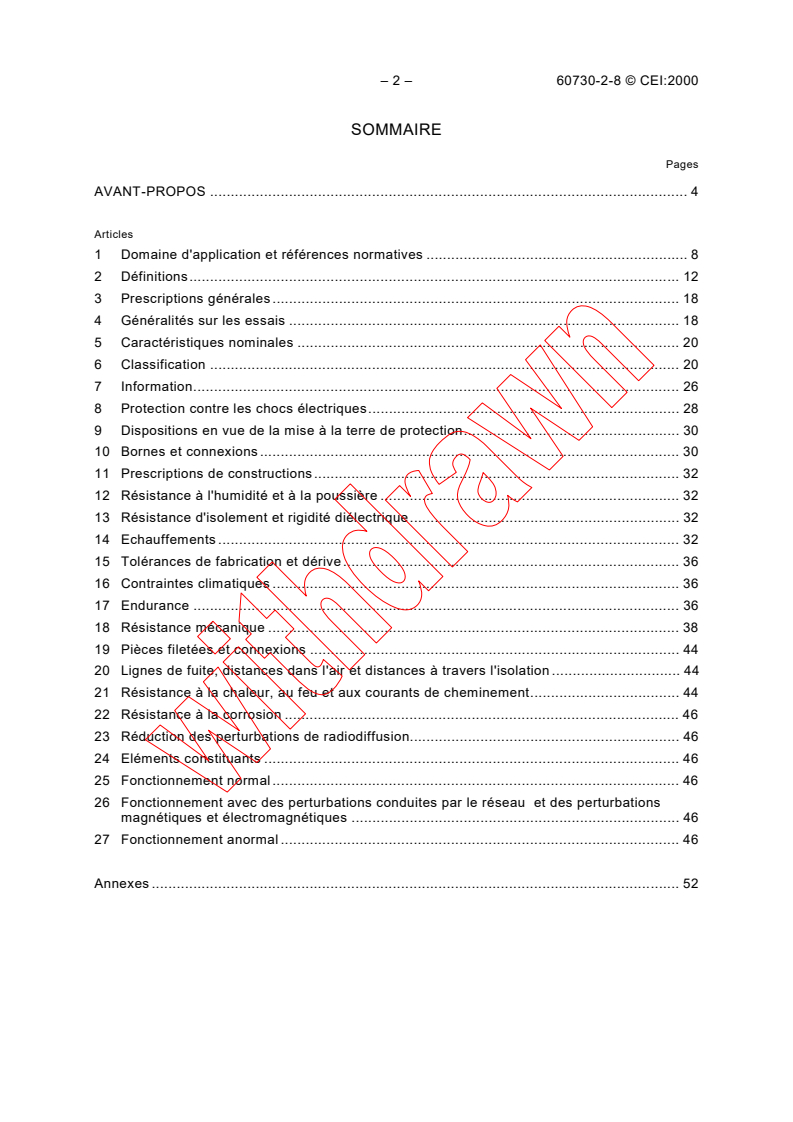
IEC 60730-2-8:2000 - Automatic electrical controls for household and similar use - Part 2-8: Particular requirements for electrically operated water valves, including mechanical requirements Released:2/29/2000
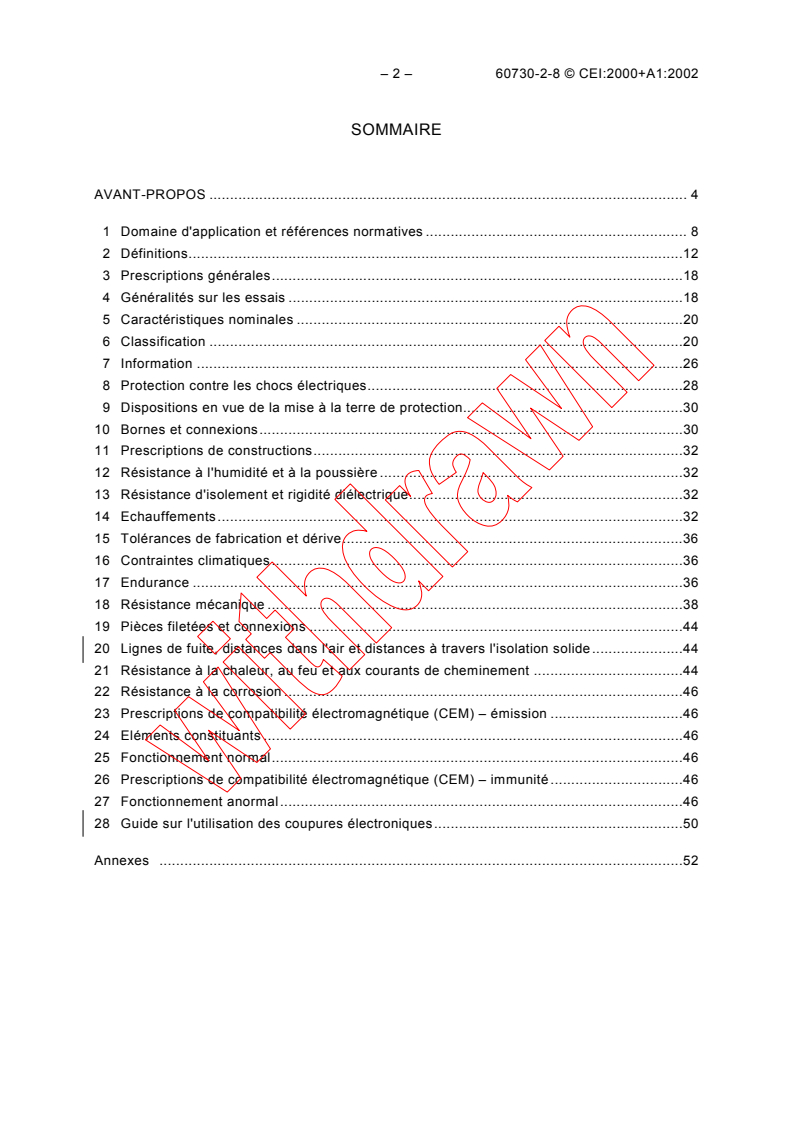
IEC 60730-2-8:2000+AMD1:2002 CSV - Automatic electrical controls for household and similar use - Part 2-8: Particular requirements for electrically operated water valves, including mechanical requirements Released:1/30/2003

IEC 60730-2-8:2000+AMD1:2002+AMD2:2015 CSV - Automatic electrical controls for household and similar use - Part 2-8: Particular requirements for electrically operated watervalves, including mechanical requirements Released:12/16/2015
Overview
IEC 60730-2-8:2000 is an international standard published by the International Electrotechnical Commission (IEC) that sets particular requirements for electrically operated water valves used in household and similar applications. This standard complements the general requirements defined in IEC 60730-1 by focusing on specific aspects related to the safety, performance, and mechanical construction of automatic electrical controls for water valves. These valves are primarily employed in equipment such as heating systems, air conditioning units, and other household appliances that utilize electricity, gas, oil, solid fuel, solar thermal energy, or combinations thereof.
The standard covers both electrical and mechanical requirements to ensure reliable operation, inherent safety, and compliance with testing procedures. It addresses critical elements such as insulation, moisture resistance, electromagnetic compatibility, mechanical strength, and electrical ratings to guarantee the durability and safety of electrically operated water valves in residential environments.
Key Topics
Scope and Applicability
IEC 60730-2-8 applies specifically to electrically operated water valves associated with household and similar equipment. It includes valves used in a broad range of systems functioning with various energy sources including electricity and renewable energies like solar thermal.Electrical Safety and Performance Requirements
The standard outlines protection against electric shock, insulation resistance, electric strength, and requirements for terminals and terminations. It ensures the valves’ electrical components meet safety norms to prevent hazards during operation.Mechanical Construction and Durability
Mechanical requirements focus on aspects such as mechanical strength, threaded parts and connections, corrosion resistance, and protection against environmental factors like moisture and dust. These ensure valves maintain integrity during normal and abnormal conditions.Testing and Endurance
IEC 60730-2-8 specifies testing methodologies for normal operation, abnormal scenarios, and long-term endurance. This includes tests for manufacturing deviations, environmental stress, heating effects, and electromagnetic compatibility (both emission and immunity).Classification and Information
The standard classifies water valves based on their operation and provides guidelines on necessary information and documentation to be provided by manufacturers for correct application and installation.Electromagnetic Compatibility (EMC)
Requirements related to EMI emission and immunity are included to prevent interference with other electronic devices and ensure stable operation within electronic environments.
Applications
IEC 60730-2-8 is essential for manufacturers, designers, and quality assurance professionals working with automatic electrical water valves in household and similar equipment. Typical applications include:
Heating Systems
Electrically operated valves control water flow and temperature in boilers, radiators, and underfloor heating setups ensuring efficient and safe heating management.Air Conditioning and Climate Control
Water valves regulate the water circuits in HVAC systems, contributing to precise temperature regulation and energy efficiency.Solar Thermal Systems
Valves compliant with IEC 60730-2-8 requirements are used in solar water heating to ensure functional control and safety under varying environmental conditions.Household Appliances
Applicable to appliances incorporating water control, such as washing machines and dishwashers, where precise water valve operation is critical for performance and safety.
Utilizing components conforming to this standard helps mitigate operational risks, ensures reliable valve function, and enhances consumer safety.
Related Standards
IEC 60730-1 - Automatic electrical controls for household and similar use – Part 1: General requirements – the foundational standard outlining general safety and performance criteria for automatic electrical controls.
IEC 60730 series - Covers various parts detailing specific requirements for different types of automatic controls in household and industrial environments.
ISO/IEC Directives, Part 3 - Guides the drafting and maintenance of international electrotechnical standards, under which IEC 60730-2-8 was developed.
EMC Standards (e.g., IEC 61000 series) - Related to electromagnetic compatibility testing requirements referenced within IEC 60730-2-8.
Keywords: IEC 60730-2-8, electrically operated water valves, water valve safety, automatic electrical controls, household water valve standards, electrically operated valves, mechanical requirements, electrical safety, IEC standards, water valve testing, electromagnetic compatibility, IEC electrotechnical standards.
Relations
- Effective Date
- 05-Sep-2023
- Effective Date
- 05-Sep-2023
- Effective Date
- 05-Sep-2023
- Effective Date
- 05-Sep-2023
Buy Documents
IEC 60730-2-8:2000 - Automatic electrical controls for household and similar use - Part 2-8: Particular requirements for electrically operated water valves, including mechanical requirements Released:2/29/2000
IEC 60730-2-8:2000+AMD1:2002 CSV - Automatic electrical controls for household and similar use - Part 2-8: Particular requirements for electrically operated water valves, including mechanical requirements Released:1/30/2003
IEC 60730-2-8:2000+AMD1:2002+AMD2:2015 CSV - Automatic electrical controls for household and similar use - Part 2-8: Particular requirements for electrically operated watervalves, including mechanical requirements Released:12/16/2015
Frequently Asked Questions
IEC 60730-2-8:2000 is a standard published by the International Electrotechnical Commission (IEC). Its full title is "Automatic electrical controls for household and similar use - Part 2-8: Particular requirements for electrically operated water valves, including mechanical requirements". This standard covers: Applies to electrically operated water valves for use in, or in association with, equipment for household and similar use (for applications such as heating, air conditioning and similar). Specifies requirements for electrical features of water valves and for mechanical features that affect their intended operation. Applies to the inherent safety, to the operating valves and to the testing of these automatic electrical controls.
Applies to electrically operated water valves for use in, or in association with, equipment for household and similar use (for applications such as heating, air conditioning and similar). Specifies requirements for electrical features of water valves and for mechanical features that affect their intended operation. Applies to the inherent safety, to the operating valves and to the testing of these automatic electrical controls.
IEC 60730-2-8:2000 is classified under the following ICS (International Classification for Standards) categories: 97.120 - Automatic controls for household use. The ICS classification helps identify the subject area and facilitates finding related standards.
IEC 60730-2-8:2000 has the following relationships with other standards: It is inter standard links to IEC 60730-2-8:2000/AMD2:2015, IEC 60730-2-8:2000/AMD1:2002, IEC 60730-2-8:2018, IEC 60730-2-8:1992/AMD2:1997. Understanding these relationships helps ensure you are using the most current and applicable version of the standard.
IEC 60730-2-8:2000 is available in PDF format for immediate download after purchase. The document can be added to your cart and obtained through the secure checkout process. Digital delivery ensures instant access to the complete standard document.
Standards Content (Sample)
NORME CEI
INTERNATIONALE IEC
60730-2-8
INTERNATIONAL
Deuxième édition
STANDARD
Second edition
2000-02
Dispositifs de commande électrique automatiques
à usage domestique et analogue –
Partie 2-8:
Règles particulières pour les électrovannes
hydrauliques, y compris les prescriptions
mécaniques
Automatic electrical controls
for household and similar use –
Part 2-8:
Particular requirements for electrically operated
water valves, including mechanical requirements
Numéro de référence
Reference number
CEI/IEC 60730-2-8:2000
Numéros des publications Numbering
Depuis le 1er janvier 1997, les publications de la CEI As from 1 January 1997 all IEC publications are
sont numérotées à partir de 60000. issued with a designation in the 60000 series.
Publications consolidées Consolidated publications
Les versions consolidées de certaines publications de Consolidated versions of some IEC publications
la CEI incorporant les amendements sont disponibles. including amendments are available. For example,
Par exemple, les numéros d’édition 1.0, 1.1 et 1.2 edition numbers 1.0, 1.1 and 1.2 refer, respectively, to
indiquent respectivement la publication de base, la the base publication, the base publication incor-
publication de base incorporant l’amendement 1, et la porating amendment 1 and the base publication
publication de base incorporant les amendements 1 incorporating amendments 1 and 2.
et 2.
Validité de la présente publication Validity of this publication
Le contenu technique des publications de la CEI est The technical content of IEC publications is kept
constamment revu par la CEI afin qu'il reflète l'état under constant review by the IEC, thus ensuring that
actuel de la technique. the content reflects current technology.
Des renseignements relatifs à la date de reconfir- Information relating to the date of the reconfirmation
mation de la publication sont disponibles dans le of the publication is available in the IEC catalogue.
Catalogue de la CEI.
Les renseignements relatifs à des questions à l’étude et Information on the subjects under consideration and
des travaux en cours entrepris par le comité technique work in progress undertaken by the technical
qui a établi cette publication, ainsi que la liste des committee which has prepared this publication, as well
publications établies, se trouvent dans les documents ci- as the list of publications issued, is to be found at the
dessous: following IEC sources:
• «Site web» de la CEI* • IEC web site*
• Catalogue des publications de la CEI • Catalogue of IEC publications
Publié annuellement et mis à jour Published yearly with regular updates
régulièrement (On-line catalogue)*
(Catalogue en ligne)*
• Bulletin de la CEI
• IEC Bulletin
Disponible à la fois au «site web» de la CEI*
Available both at the IEC web site* and
et comme périodique imprimé
as a printed periodical
Terminologie, symboles graphiques
Terminology, graphical and letter
et littéraux
symbols
En ce qui concerne la terminologie générale, le lecteur
For general terminology, readers are referred to
se reportera à la CEI 60050: Vocabulaire Electro-
IEC 60050: International Electrotechnical Vocabulary
technique International (VEI).
(IEV).
Pour les symboles graphiques, les symboles littéraux
For graphical symbols, and letter symbols and signs
et les signes d'usage général approuvés par la CEI, le
approved by the IEC for general use, readers are
lecteur consultera la CEI 60027: Symboles littéraux à
referred to publications IEC 60027: Letter symbols to
utiliser en électrotechnique, la CEI 60417: Symboles
be used in electrical technology, IEC 60417: Graphical
graphiques utilisables sur le matériel. Index, relevé et
symbols for use on equipment. Index, survey and
compilation des feuilles individuelles, et la CEI 60617:
compilation of the single sheets and IEC 60617:
Symboles graphiques pour schémas.
Graphical symbols for diagrams.
* Voir adresse «site web» sur la page de titre.
* See web site address on title page.
NORME CEI
INTERNATIONALE IEC
60730-2-8
INTERNATIONAL
Deuxième édition
STANDARD
Second edition
2000-02
Dispositifs de commande électrique automatiques
à usage domestique et analogue –
Partie 2-8:
Règles particulières pour les électrovannes
hydrauliques, y compris les prescriptions
mécaniques
Automatic electrical controls
for household and similar use –
Part 2-8:
Particular requirements for electrically operated
water valves, including mechanical requirements
IEC 2000 Droits de reproduction réservés Copyright - all rights reserved
Aucune partie de cette publication ne peut être reproduite ni No part of this publication may be reproduced or utilized in
utilisée sous quelque forme que ce soit et par aucun procédé, any form or by any means, electronic or mechanical,
électronique ou mécanique, y compris la photocopie et les including photocopying and microfilm, without permission in
microfilms, sans l'accord écrit de l'éditeur. writing from the publisher.
International Electrotechnical Commission 3, rue de Varembé Geneva, Switzerland
Telefax: +41 22 919 0300 e-mail: inmail@iec.ch IEC web site http://www.iec.ch
CODE PRIX
Commission Electrotechnique Internationale
W
PRICE CODE
International Electrotechnical Commission
Pour prix, voir catalogue en vigueur
For price, see current catalogue
– 2 – 60730-2-8 © CEI:2000
SOMMAIRE
Pages
AVANT-PROPOS . 4
Articles
1 Domaine d'application et références normatives . 8
2 Définitions. 12
3 Prescriptions générales . 18
4 Généralités sur les essais . 18
5 Caractéristiques nominales . 20
6 Classification .20
7 Information. 26
8 Protection contre les chocs électriques. 28
9 Dispositions en vue de la mise à la terre de protection. 30
10 Bornes et connexions . 30
11 Prescriptions de constructions. 32
12 Résistance à l'humidité et à la poussière . 32
13 Résistance d'isolement et rigidité diélectrique. 32
14 Echauffements . 32
15 Tolérances de fabrication et dérive. 36
16 Contraintes climatiques . 36
17 Endurance .36
18 Résistance mécanique . 38
19 Pièces filetées et connexions . 44
20 Lignes de fuite, distances dans l'air et distances à travers l'isolation . 44
21 Résistance à la chaleur, au feu et aux courants de cheminement. 44
22 Résistance à la corrosion . 46
23 Réduction des perturbations de radiodiffusion. 46
24 Eléments constituants . 46
25 Fonctionnement normal. 46
26 Fonctionnement avec des perturbations conduites par le réseau et des perturbations
magnétiques et électromagnétiques . 46
27 Fonctionnement anormal . 46
Annexes . 52
60730-2-8 © IEC:2000 – 3 –
CONTENTS
Page
FOREWORD . 5
Clause
1 Scope and normative references . 9
2 Definitions. 13
3 General requirements. 19
4 General notes on tests . 19
5 Rating . 21
6 Classification .21
7 Information. 27
8 Protection against electric shock . 29
9 Provision for protective earthing . 31
10 Terminals and terminations . 31
11 Constructional requirements. 33
12 Moisture and dust resistance. 33
13 Electric strength and insulation resistance . 33
14 Heating . 33
15 Manufacturing deviation and drift. 37
16 Environmental stress. 37
17 Endurance .37
18 Mechanical strength . 39
19 Threaded parts and connections. 45
20 Creepage distances, clearances and distances through insulation . 45
21 Resistance to heat, fire and tracking. 45
22 Resistance to corrosion. 47
23 Electromagnetic compatibility (EMC) requirements – emission . 47
24 Components. 47
25 Normal operation. 47
26 Electromagnetic compatibility (EMC) requirements – immunity. 47
27 Abnormal operation . 47
Annexes . . 53
– 4 – 60730-2-8 © CEI:2000
COMMISSION ÉLECTROTECHNIQUE INTERNATIONALE
____________
DISPOSITIFS DE COMMANDE ÉLECTRIQUE AUTOMATIQUES
À USAGE DOMESTIQUE ET ANALOGUE –
Partie 2-8: Règles particulières pour les électrovannes hydrauliques,
y compris les prescriptions mécaniques
AVANT-PROPOS
1) La CEI (Commission Electrotechnique Internationale) est une organisation mondiale de normalisation composée
de l'ensemble des comités électrotechniques nationaux (Comités nationaux de la CEI). La CEI a pour objet de
favoriser la coopération internationale pour toutes les questions de normalisation dans les domaines de
l'électricité et de l'électronique. A cet effet, la CEI, entre autres activités, publie des Normes internationales.
Leur élaboration est confiée à des comités d'études, aux travaux desquels tout Comité national intéressé par le
sujet traité peut participer. Les organisations internationales, gouvernementales et non gouvernementales, en
liaison avec la CEI, participent également aux travaux. La CEI collabore étroitement avec l'Organisation
Internationale de Normalisation (ISO), selon des conditions fixées par accord entre les deux organisations.
2) Les décisions ou accords officiels de la CEI concernant les questions techniques représentent, dans la mesure
du possible un accord international sur les sujets étudiés, étant donné que les Comités nationaux intéressés
sont représentés dans chaque comité d’études.
3) Les documents produits se présentent sous la forme de recommandations internationales. Ils sont publiés
comme normes, spécifications techniques, rapports techniques ou guides et agréés comme tels par les Comités
nationaux.
4) Dans le but d'encourager l'unification internationale, les Comités nationaux de la CEI s'engagent à appliquer de
façon transparente, dans toute la mesure possible, les Normes internationales de la CEI dans leurs normes
nationales et régionales. Toute divergence entre la norme de la CEI et la norme nationale ou régionale
correspondante doit être indiquée en termes clairs dans cette dernière.
5) La CEI n’a fixé aucune procédure concernant le marquage comme indication d’approbation et sa responsabilité
n’est pas engagée quand un matériel est déclaré conforme à l’une de ses normes.
6) L’attention est attirée sur le fait que certains des éléments de la présente Norme internationale peuvent faire
l’objet de droits de propriété intellectuelle ou de droits analogues. La CEI ne saurait être tenue pour
responsable de ne pas avoir identifié de tels droits de propriété et de ne pas avoir signalé leur existence.
La Norme internationale CEI 60730-2-8 a été établie par le Comité d'Etudes 72 de la CEI:
Commandes automatiques pour appareils domestiques.
Cette deuxième édition annule et remplace la première édition parue en 1992, l'amendement 1
(1994) et l'amendement 2 (1997). Cette deuxième édition constitue une révision technique.
Le texte de cette deuxième édition est issu des documents suivants:
FDIS Rapport de vote
72/428/FDIS 72/439/RVD
Le rapport de vote indiqué dans le tableau ci-dessus donne toute information sur le vote ayant
abouti à l'approbation de cette norme.
Cette publication a été rédigée selon les Directives ISO/CEI, Partie 3.
La présente partie 2-8 est destinée à être utilisée conjointement avec la CEI 60730-1. Elle a
été établie sur la base de la deuxième édition (1993) de cette publication modifiée par
l'amendement 1 (1994) et l'amendement 2 (1997). Les éditions ou amendements futurs de la
CEI 60730-1 pourront être pris en considération.
60730-2-8 © IEC:2000 – 5 –
INTERNATIONAL ELECTROTECHNICAL COMMISSION
___________
AUTOMATIC ELECTRICAL CONTROLS FOR HOUSEHOLD
AND SIMILAR USE –
Part 2-8: Particular requirements for electrically operated water valves,
including mechanical requirements
FOREWORD
1) The IEC (International Electrotechnical Commission) is a worldwide organization for standardization comprising
all national electrotechnical committees (IEC National Committees). The object of the IEC is to promote
international co-operation on all questions concerning standardization in the electrical and electronic fields. To
this end and in addition to other activities, the IEC publishes International Standards. Their preparation is
entrusted to technical committees; any IEC National Committee interested in the subject dealt with may
participate in this preparatory work. International, governmental and non-governmental organizations liaising
with the IEC also participate in this preparation. The IEC collaborates closely with the International Organization
for Standardization (ISO) in accordance with conditions determined by agreement between the two
organizations.
2) The formal decisions or agreements of the IEC on technical matters express, as nearly as possible, an
international consensus of opinion on the relevant subjects since each technical committee has representation
from all interested National Committees.
3) The documents produced have the form of recommendations for international use and are published in the form
of standards, technical specifications, technical reports or guides and they are accepted by the National
Committees in that sense.
4) In order to promote international unification, IEC National Committees undertake to apply IEC International
Standards transparently to the maximum extent possible in their national and regional standards. Any
divergence between the IEC Standard and the corresponding national or regional standard shall be clearly
indicated in the latter.
5) The IEC provides no marking procedure to indicate its approval and cannot be rendered responsible for any
equipment declared to be in conformity with one of its standards.
6) Attention is drawn to the possibility that some of the elements of this International Standard may be the subject
of patent rights. The IEC shall not be held responsible for identifying any or all such patent rights.
International Standard IEC 60730-2-8 has been prepared by IEC technical committee 72:
Automatic controls for household use.
This second edition cancels and replaces the first edition published in 1992, amendment 1
(1994) and amendment 2 (1997). This second edition constitutes a technical revision.
The text of this second edition is based on the following documents:
FDIS Report on voting
72/428/FDIS 72/439/RVD
Full information on the voting for the approval of this standard can be found in the report on
voting indicated in the above table.
This publication has been drafted in accordance with the ISO/IEC Directives, Part 3.
This part 2-8 is intended to be used in conjunction with IEC 60730-1. It was established on the
basis of the second edition (1993) of that publication and its amendments 1 (1994) and 2
(1997). Consideration may be given to future editions of, or amendments to, IEC 60730-1.
– 6 – 60730-2-8 © CEI:2000
Cette partie 2-8 complète ou modifie les articles correspondants de la CEI 60730-1 de façon à
la transformer en norme CEI: Règles de sécurité pour les électrovannes hydrauliques, y
compris les prescriptions mécaniques.
Lorsque cette édition spécifie «addition», «modification» ou «remplacement», la prescription, la
modalité d'essai ou le commentaire correspondant de la partie 1 doivent être adaptés en
conséquence.
Lorsque aucune modification n'est nécessaire, la partie 2-8 indique que l'article ou le
paragraphe approprié est applicable.
Afin d'obtenir une norme complètement internationale, il a été nécessaire d'examiner des
prescriptions différentes résultant de l'expérience acquise dans diverses parties du monde, et
de reconnaître les différences nationales dans les réseaux d'alimentation électrique et les
règles d'installations.
Dans cette partie 2-8, les notes concernant les pratiques nationales différentes sont contenues dans les
paragraphes suivants:
– 14.7.4, note 101
– 16.2.1
– 27.2.101
– annexe CC
– tableau DD.1.2.1, note 1
– tableau DD.6, note 1
– H.26.9
Dans cette publication:
1) Les caractères d'imprimerie suivants sont utilisés:
– Prescriptions proprement dites: caractères romains.
– Modalités d'essai: caractères italiques.
– Commentaires: petits caractères romains.
2) Les paragraphes, notes, tableaux et figures complémentaires, à ceux de la partie 1 sont
numérotés à partir de 101, les annexes additionnelles sont référencées AA, BB, etc.
Le comité a décidé que le contenu de cette publication ne sera pas modifié avant 2002-06.
A cette date, la publication sera
• reconduite;
• supprimée;
• remplacée par une édition révisée, ou
• amendée.
60730-2-8 © IEC:2000 – 7 –
This part 2-8 supplements or modifies the corresponding clauses in IEC 60730-1 so as to
convert that publication into the IEC standard: Safety requirements for electrically operated
water valves, including mechanical requirements.
Where this part 2-8 states "addition", "modification", or "replacement", the relevant require-
ment, test specification or explanatory matter in part 1 should be adapted accordingly.
Where no change is necessary, part 2-8 indicates that the relevant clause or subclause
applies.
In the development of a fully international standard, it has been necessary to take into
consideration the differing requirements resulting from practical experience in various parts of
the world and to recognize the variation in national electrical systems and wiring rules.
In this part 2-8, the "in some countries" notes regarding differing national practices are contained in the following
subclauses:
– 14.7.4, note 101
– 16.2.1
– 27.2.101
– annex CC
– table DD.1.2.1, note 1
– table DD.6, note 1
– H.26.9
In this publication:
1) The following print types are used:
– Requirements proper: in roman type.
– Test specifications: in italic type.
– Notes: in smaller roman type.
2) Subclauses, notes, tables or figures which are additional to those in part 1 are numbered
starting from 101, additional annexes are lettered AA, BB, etc.
The committee has decided that the contents of this publication will remain unchanged until
2002-06. At this date, the publication will be
• reconfirmed;
• withdrawn;
• replaced by a revised edition, or
• amended.
– 8 – 60730-2-8 © CEI:2000
DISPOSITIFS DE COMMANDE ÉLECTRIQUE AUTOMATIQUES
À USAGE DOMESTIQUE ET ANALOGUE –
Partie 2-8: Règles particulières pour les électrovannes hydrauliques,
y compris les prescriptions mécaniques
1 Domaine d'application et références normatives
L'article de la partie 1 est remplacé comme suit:
Remplacement:
1.1 Cette partie 2-8 s'applique aux électrovannes hydrauliques destinées à être utilisées dans
ou en association avec des appareils domestiques et à usage analogue pouvant utiliser de
l'électricité, des combustibles gazeux, liquides ou solides, de l'énergie thermique solaire, etc.
ou une combinaison de ces énergies, pour des applications comme le chauffage, la
climatisation et applications similaires.
Cette partie 2-8 s'applique également aux électrovannes hydrauliques destinées aux appareils
électrodomestiques entrant dans le cadre de la CEI 60335.
1.1.1 Cette partie 2-8 précise les prescriptions applicables aux caractéristiques électriques
des vannes hydrauliques et aux caractéristiques mécaniques des vannes qui ont un effet sur
leur fonctionnement prévu.
1.1.2 Cette partie 2-8 s'applique à la sécurité intrinsèque, aux valeurs de fonctionnement, aux
séquences de travail lorsqu'elles sont associées à la protection des appareils, ainsi qu'aux
essais des dispositifs de commande électrique automatiques utilisés dans ou en association
avec des appareils domestiques et analogues.
Les électrovannes hydrauliques pour les appareils qui ne sont pas destinés aux usages
domestiques courants mais qui néanmoins peuvent être utilisés par le grand public, tels que
des appareils destinés à être utilisés par des usagers non avertis dans les magasins, chez les
artisans et dans les fermes, sont compris dans le domaine d'application de cette partie 2-8.
Cette partie 2-8 ne s'applique pas aux électrovannes hydrauliques conçues exclusivement pour
les usages industriels.
Cette partie 2-8 ne s'applique pas:
– aux électrovannes hydrauliques dont le diamètre de raccordement dépasse DN 50;
– aux électrovannes hydrauliques pour lesquelles la pression nominale admissible est
supérieure à 1,6 MPa;
– aux distributeurs de produits alimentaires;
– aux distributeurs de détergents;
– aux vannes de vapeur.
60730-2-8 © IEC:2000 – 9 –
AUTOMATIC ELECTRICAL CONTROLS FOR HOUSEHOLD
AND SIMILAR USE –
Part 2-8: Particular requirements for electrically operated water valves,
including mechanical requirements
1 Scope and normative references
This clause of part 1 is replaced as follows:
Replacement:
1.1 This part 2-8 applies to electrically operated water valves for use in, on or in association
with equipment for household and similar use that may use electricity, gas, oil, solid fuel, solar
thermal energy, etc. or a combination thereof, including heating, air-conditioning and similar
applications.
This part 2-8 is also applicable to electrically operated water valves for appliances within the
scope of IEC 60335.
1.1.1 This part 2-8 contains requirements for electrical features of water valves and
requirements for mechanical features of valves that affect their intended operation.
1.1.2 This part 2-8 applies to the inherent safety, to the operating values, operating
sequences where such are associated with equipment protection, and to the testing of
automatic electrical controls used in, on or in association with household and similar
equipment.
Electrically operated valves for equipment not intended for normal household use but which
may nevertheless be used by the public, such as equipment intended to be used by laymen in
shops, in light industry and on farms, are within the scope of this part 2-8.
This part 2-8 does not apply to electrically operated water valves designed exclusively for
industrial applications.
This part 2-8 does not apply to:
– electrically operated water valves of nominal connection size above DN 50;
– electrically operated water valves for admissible nominal pressure rating above 1,6 MPa;
– food dispensers;
– detergent dispensers;
– steam valves.
– 10 – 60730-2-8 © CEI:2000
Dans cette partie 2-8, quand il peut être utilisé sans ambiguïté, le terme:
– «vanne» est toujours utilisé pour désigner une électrovanne hydraulique (organe de
manoeuvre et corps de la vanne);
– «organe de manoeuvre» signifie «mécanisme commandé électriquement ou appareil
d'entraînement»;
– «corps de vanne» signifie «ensemble corps de vanne»;
– «appareil» comprend «appareil» et «système de commande».
1.1.3 Cette partie 2-8 s'applique aussi aux organes de manoeuvre et aux corps de vannes qui
sont conçus pour être adaptés l'un à l'autre.
1.1.4 Cette partie 2-8 s'applique aux vannes individuelles, aux vannes utilisées comme partie
d'un système et aux vannes qui sont mécaniquement intégrées à des commandes multi-
fonctionnelles ayant des sorties non électriques.
NOTE L'attention est attirée sur le fait que, dans de nombreux pays, des règlements et des prescriptions d'essais
supplémentaires sont établis par les autorités ou les compagnies des eaux.
1.5 Références normatives
L'article de la partie 1 est applicable avec les exceptions suivantes:
Additions:
ISO 7-1:1994, Filetages de tuyauteries pour raccordement avec étanchéité dans le filet –
Partie 1: Dimensions, tolérances et désignation
ISO 65:1981, Tubes en acier au carbone filetable selon ISO 7-1
ISO 228-1:1994, Filetages de tuyauterie pour raccordement sans étanchéité dans le filet –
Partie 1: Dimensions, tolérances et désignation.
ISO 630:1995, Aciers de construction métallique – Tôles, larges-plats, barres, poutrelles et
profilés
ISO 1179:1981, Raccordements de tuyauteries, filetés selon ISO 228-1, pour tubes à
extrémités lisses en acier et autres tubes métalliques dans les applications industrielles
ISO 4144:1979, Raccords en acier inoxydable, filetés suivant l'ISO 7-1
ISO 4400:1994, Transmissions hydrauliques et pneumatiques – Connecteurs électriques à trois
broches avec contact de sécurité – Caractéristiques et exigences
ISO 6952:1994, Transmissions hydrauliques et pneumatiques – Connecteurs électriques à
deux broches avec contact de sécurité – Caractéristiques et exigences
60730-2-8 © IEC:2000 – 11 –
Throughout this part 2-8, where it can be used unambiguously, the term:
– "valve" is used to denote an electrically operated water valve (including actuator and valve
body assembly);
– "actuator" means "electrically operated mechanism or prime mover";
– "valve body" means "valve body assembly";
– "equipment" includes "appliance" and "control system".
1.1.3 This part 2-8 also applies to actuators and to valve bodies which are designed to be
fitted to each other.
1.1.4 This part 2-8 applies to individual valves, valves utilized as part of a system and valves
mechanically integral with multi-functional controls having non-electrical outputs.
NOTE Attention is drawn to the fact that, in many countries, additional test requirements and by-laws have been
established by the water authorities or companies.
1.5 Normative references
This clause of part 1 is applicable except as follows:
Addition:
ISO 7-1:1994, Pipe threads where pressure-tight joints are made on the threads – Part 1:
Dimensions, tolerances and designation
ISO 65:1981, Carbon steel tubes suitable for screwing in accordance with ISO 7-1
ISO 228-1:1994, Pipe threads where pressure-tight joints are not made on the threads – Part 1:
Dimensions, tolerances and designation
ISO 630:1995, Structural steels – Plates, wide flats, bars sections and profiles
ISO 1179:1981, Pipe connections threaded to ISO 228-1 for plain end steel and other metal
tubes in industrial applications
ISO 4144:1979, Stainless steel fittings threaded to ISO 7-1
ISO 4400:1994, Fluid power systems and components – Three-pin electrical plug connectors
with earth contact – Characteristics and requirements
ISO 6952:1994, Fluid power systems and components – Two-pin electrical plug connectors
with earth contact – Characteristics and requirements
– 12 – 60730-2-8 © CEI:2000
2 Définitions
L'article de la partie 1 est applicable avec les exceptions suivantes:
2.2 Définitions des différents types de dispositifs de commande en fonction
de l'application
2.2.17
électrovanne
Addition:
NOTE Une vanne semi-automatique qui est ouverte manuellement et se ferme automatiquement ou vice versa est
également couverte par cette définition.
Définitions complémentaires:
2.2.17.101
vanne
dispositif comportant un organe de manoeuvre raccordé à un ensemble corps de vanne et
utilisé pour arrêter ou réguler le débit de fluide par la fermeture totale ou partielle d'un orifice
2.2.17.102
vanne hydraulique
vanne destinée à être raccordée à une alimentation d'eau et à contrôler le débit d'eau
NOTE Une vanne hydraulique produit une action de type 1. Les dispositifs de coupure incorporés dans les
électrovannes produisent une action de type 1 ou de type 2.
2.2.17.103
vanne hydraulique de chauffage
vanne destinée à commander la circulation d'eau dans les systèmes de chauffage
2.2.17.104
organe de manoeuvre
appareil d'entraînement ou mécanisme actionné électriquement et qui sert à provoquer
l'ouverture ou la fermeture d'une vanne
NOTE 1 Un organe de manoeuvre peut être intégré dans la vanne; il peut aussi être fixé sur l'ensemble de corps
de vanne ou fourni comme composant séparé.
NOTE 2 Un organe de manoeuvre peut également comporter la vanne et la pièce de fermeture.
2.2.17.105
ensemble de corps de vanne
ensemble composé du corps de la vanne, des raccords d'entrée et de sortie, du siège de la
vanne, de la pièce de fermeture et de l'axe ou tige
NOTE Dans certains cas, la tige et la pièce de fermeture peuvent être une partie de l'organe de manoeuvre.
2.2.17.106
corps de vanne
partie de l'ensemble du corps de vanne qui est soumise à la pression du réseau. Il comporte
les passages du débit d'eau et les raccordements
2.2.17.107
dimension nominale
désignation numérique de taille qui est commune à tous les composants d'un système
conducteur de fluide, à l'exception des composants désignés par leur diamètre extérieur ou par
les dimensions de leur filetage
60730-2-8 © IEC:2000 – 13 –
2 Definitions
This clause of part 1 is applicable, except as follows:
2.2 Definitions of types of control according to purpose
2.2.17
electrically operated valve
Addition:
NOTE A semi-automatic valve that is opened manually and closes automatically or vice versa is also covered by
this definition.
Additional definitions:
2.2.17.101
valve
device consisting of an actuator connected to a valve body assembly and used to stop or
regulate flow of fluid by the closure or partial closure of an orifice
2.2.17.102
water valve
valve intended to be connected to a water supply and to control water flow
NOTE A water valve is a type 1 action. Switching devices incorporated in water valves are type 1 or 2 actions.
2.2.17.103
heating-water valve
valve intended to control the water circulation in heating systems
2.2.17.104
actuator
electrically operated mechanism or prime mover used to effect the opening or closing action of
a valve
NOTE 1 An actuator may be integral with the valve, fixed to the valve body assembly or delivered as a separate
component.
NOTE 2 An actuator may also include the valve and closure member.
2.2.17.105
valve body assembly
assembly comprising the valve body, inlet and outlet end connections, the valve seat, closure
member and stem or shaft
NOTE In some cases, the stem and closure member may be part of the actuator.
2.2.17.106
valve body
part of the valve body assembly which is the main pressure boundary. It provides the water flow
passage-ways with end connections
2.2.17.107
nominal size
numerical designation of size which is common to all components in a fluid-conducting system
other than components designated by outside diameter or by thread size
– 14 – 60730-2-8 © CEI:2000
NOTE 1 Cette taille peut être désignée par les lettres «DN» suivies d'un nombre entier convenable mais
uniquement à titre de référence.
NOTE 2 Certaines normes internationales anciennes désignent la dimension nominale par le diamètre nominal
mais, pour les besoins de cette norme, les deux expressions sont synonymes.
2.2.17.108
pression nominale
désignation numérique de la valeur de pression
NOTE Elle peut être désignée par les lettres «PN» («Pressure Number») suivies d'un nombre entier convenable,
uniquement à titre de référence.
2.2.17.109
raccord
configuration du corps de la vanne prévue pour constituer un joint étanche en pression avec le
système conducteur de fluide
2.2.17.110
siège de la vanne
surface de l'orifice de la vanne qui entre entièrement en contact avec la pièce de fermeture
2.2.17.111
pièce de fermeture
partie mobile de la vanne qui est placée dans le flux pour modifier le débit au travers de la
vanne
NOTE Une pièce de fermeture peut être un obturateur, une bille, un disque, une pale, un clapet, etc.
2.2.17.112
tige
composant qui relie l’organe de manoeuvre à la pièce de fermeture et la positionne
NOTE 1 Pour les vannes à système tournant, le mot «arbre» doit être utilisé à la place de «tige».
NOTE 2 Dans certains dispositifs de commande, la tige peut faire partie de l'organe de manoeuvre.
2.2.17.113
accessoire
tout dispositif tel que réducteur, détendeur, coude ou pièce en T qui est fixé directement à un
raccord de l'ensemble du corps de la vanne
2.3 Définitions concernant les fonctions des dispositifs de commande
2.3.29
Modifier la définition existante comme suit:
Supprimer «(pression assignée maximale)».
Définitions complémentaires:
2.3.101
vanne tout ou rien
vanne qui est ouverte ou fermée, sans aucune position intermédiaire
2.3.102
vanne normalement fermée
vanne qui est fermée lorsqu'elle n'est pas alimentée électriquement
60730-2-8 © IEC:2000 – 15 –
NOTE 1 It may be designated by "DN" followed by a convenient round number, for reference purposes only.
NOTE 2 Some older international standards refer to nominal size as nominal diameter but, for the purpose of this
standard, the two terms are synonymous.
2.2.17.108
nominal pressure rating
numerical designation of pressure rating
NOTE It may be designated by the letters "PN" (also referred to as the pressure number) followed by a convenient
round number, for reference purposes only.
2.2.17.109
end connection
valve body configuration provided to make a pressure-tight joint to the fluid-conducting system
2.2.17.110
valve seat
surface of the orifice within the valve which makes full contact with the closure member
2.2.17.111
closure member
movable part of the valve which is positioned in the flow path to modify the rate of flow through
the valve
NOTE A closure member may be a plug, ball, disc, vane, gate, etc.
2.2.17.112
stem
component which connects the actuator to, and positions, the closure member
NOTE 1 For rotary valves the word "shaft" should be used in place of "stem".
NOTE 2 In some controls the stem may be part of the actuator.
2.2.17.113
fitting
any device such as a reducer, expander, elbow, or T-piece which is attached directly to an end-
connection of the valve body assembly
2.3 Definitions relating to the function of controls
2.3.29
Amend the existing definition as follows:
Delete “(maximum rated pressure)”.
Additional definitions:
2.3.101
on-off valve
valve which is open or closed, without any intermediate positions
2.3.102
normally closed valve
valve which is closed when not electrically energized
– 16 – 60730-2-8 © CEI:2000
2.3.103
vanne normalement ouverte
vanne qui est ouverte lorsqu'elle n'est pas alimentée électriquement
2.3.104
vanne à débit variable
vanne présentant un débit variable entre des limites de débit prédéterminées
2.3.105
vanne de diversion
vanne comportant une ou plusieurs entrées et sorties et capable de permettre un débit avec
une combinaison quelconque d'entrées vers des sorties
2.3.106
position fermée
position de l’organe de la pièce de fermeture telle que de l'eau ne s'écoule pas du côté sortie
de la vanne
2.3.107
course
déplacement de la pièce de fermeture à partir de sa position fermée
2.3.108
course nominale
déplacement de la pièce de fermeture entre la position fermée et la position de pleine
ouverture
2.3.109
position ouverte
position de la pièce de fermeture telle que l'eau s'écoule du côté sortie de la vanne
2.3.110
position de pleine ouverture
position de la pièce de fermeture telle que la quantité d'eau traversant la vanne corresponde
au débit nominal
2.3.111
débit
volume d'eau traversant la vanne par unité de temps
2.3.112
débit nominal
débit pour la course nominale dans les conditions de référence normalisées de température et
de pression déclarées pour une différence de pression donnée
2.3.113
facteur de débit
facteur spécifiant la quantité d'eau qui peut traverser la vanne pour une différence de pression
spécifiée
NOTE 1 Le facteur de débit peut également être appelé coefficient de débit.
NOTE 2 La relation entre les différents facteurs de débit utilisés est indiquée à l'annexe AA.
2.3.114
différentiel maximal de pression de fonctionnement
différence de pression maximale déclarée entre l'entrée et la sortie de la vanne et pour laquelle
l'organe de manoeuvre peut faire fonctionner la pièce de fermeture
60730-2-8 © IEC:2000 – 17 –
2.3.103
normally open valve
valve which is open when not electrically energized
2.3.104
modulating valve
valve which has a variable flow rate between predetermined flow limits
2.3.105
diverting valve
valve with one or more inputs and outputs which may permit flow from any combination of
inputs to outputs
2.3.106
closed position
position of the closure member when there is no water flow from the outlet side of the valve
2.3.107
travel
displacement of the closure member from the closed position
2.3.108
rated travel
displacement of the closure member from the closed position to the full open position
2.3.109
open position
position of the closure member when there is a flow of water from the outlet side of the valve
2.3.110
fully open position
position of the closure member so that the amount of water flowing through the valve is in
accordance with the rated flow rate
2.3.111
flow rate
volume of water flowing through the valve in unit time
2.3.112
rated flow rate
flow rate at the rated travel under standard reference conditions of temperature and pressure
declared at a given pressure difference
2.3.113
flow factor
factor specifying the amount of water which can pass through the valve at a specified pressure
difference
NOTE 1 The flow factor may be referred to as flow coefficient.
NOTE 2 The relationship between the different flow factors in use is indicated in annex AA.
2.3.114
maximum operating pressure differential
declared maximum difference in pressure between inlet and outlet ports of the valve against
which the actuator can operate the closure member
– 18 – 60730-2-8 © CEI:2000
2.3.115
différentiel minimal de pression de fonctionnement
différence de pression minimale déclarée à laquelle la vanne s'ouvre ou se ferme
2.3.116
Vacant
2.3.117
coup de bélier
pression transitoire excessive qui peut exister dans certains systèmes d'adduction d'eau, à la
suite de la fermeture d'une vanne dans les conditions prévues
2.3.118
pression transitoire
courte pointe de pression dépassant la pression stable normale du système d'adduction
lorsque la vanne est fermée
2.3.119
vanne à caractéristique anti-coup de bélier
vanne ne provoquant ni chute de pression excessive à l'ouverture, ni pression transitoire
excessive à la fermeture, lorsqu'elle est reliée directement, sans précaution spéciale, au
réseau d'alimentation en eau où un coup de bélier peut avoir lieu
2.13 Définitions diverses
Définitions complémentaires:
2.13.101
eau potable
alimentation en eau destinée à être consommée par l'être humain
NOTE Texte anglais uniquement.
2.13.102
eau non potable
alimentation en eau qui n'est pas destinée à être consommée par l'être humain
3 Prescriptions générales
L'article de la partie 1 est applicable.
4 Généralités sur les essais
L'article de la partie 1 est applicable avec les exceptions suivantes:
4.1 Conditions d’essai
4.1.2 Addition:
Sauf spécification contraire de cette norme, la température de l’eau pour les essais doit être
maintenue à (20 ± 5) °C.
60730-2-8 © IEC:2000 – 19 –
2.3.115
minimum operating pressure differential
declared minimum pressure difference at which the valve opens or closes
2.3.116
Void
2.3.117
water hammer
excessive transient pressure which can occur
...
NORME CEI
INTERNATIONALE IEC
60730-2-8
INTERNATIONAL
Edition 2.1
STANDARD
2003-01
Edition 2:2000 consolidée par l'amendement 1:2002
Edition 2:2000 consolidated with amendment 1:2002
Dispositifs de commande électrique automatiques
à usage domestique et analogue –
Partie 2-8:
Règles particulières pour les électrovannes
hydrauliques, y compris les prescriptions
mécaniques
Automatic electrical controls for household
and similar use –
Part 2-8:
Particular requirements for electrically operated
water valves, including mechanical requirements
Numéro de référence
Reference number
CEI/IEC 60730-2-8:2000+A1:2002
Numérotation des publications Publication numbering
Depuis le 1er janvier 1997, les publications de la CEI As from 1 January 1997 all IEC publications are
sont numérotées à partir de 60000. Ainsi, la CEI 34-1 issued with a designation in the 60000 series. For
devient la CEI 60034-1. example, IEC 34-1 is now referred to as IEC 60034-1.
Editions consolidées Consolidated editions
Les versions consolidées de certaines publications de la The IEC is now publishing consolidated versions of its
CEI incorporant les amendements sont disponibles. Par publications. For example, edition numbers 1.0, 1.1
exemple, les numéros d’édition 1.0, 1.1 et 1.2 indiquent and 1.2 refer, respectively, to the base publication,
respectivement la publication de base, la publication de the base publication incorporating amendment 1 and
base incorporant l’amendement 1, et la publication de the base publication incorporating amendments 1
base incorporant les amendements 1 et 2. and 2.
Informations supplémentaires Further information on IEC publications
sur les publications de la CEI
Le contenu technique des publications de la CEI est The technical content of IEC publications is kept
constamment revu par la CEI afin qu'il reflète l'état under constant review by the IEC, thus ensuring that
actuel de la technique. Des renseignements relatifs à the content reflects current technology. Information
cette publication, y compris sa validité, sont dispo- relating to this publication, including its validity, is
nibles dans le Catalogue des publications de la CEI available in the IEC Catalogue of publications
(voir ci-dessous) en plus des nouvelles éditions, (see below) in addition to new editions, amendments
amendements et corrigenda. Des informations sur les and corrigenda. Information on the subjects under
sujets à l’étude et l’avancement des travaux entrepris consideration and work in progress undertaken by the
par le comité d’études qui a élaboré cette publication, technical committee which has prepared this
ainsi que la liste des publications parues, sont publication, as well as the list of publications issued,
également disponibles par l’intermédiaire de: is also available from the following:
• Site web de la CEI (www.iec.ch) • IEC Web Site (www.iec.ch)
• Catalogue des publications de la CEI • Catalogue of IEC publications
Le catalogue en ligne sur le site web de la CEI The on-line catalogue on the IEC web site
(http://www.iec.ch/searchpub/cur_fut.htm) vous permet (http://www.iec.ch/searchpub/cur_fut.htm) enables
de faire des recherches en utilisant de nombreux you to search by a variety of criteria including text
critères, comprenant des recherches textuelles, par searches, technical committees and date of
comité d’études ou date de publication. Des publication. On-line information is also available
informations en ligne sont également disponibles sur on recently issued publications, withdrawn and
les nouvelles publications, les publications rempla- replaced publications, as well as corrigenda.
cées ou retirées, ainsi que sur les corrigenda.
• IEC Just Published • IEC Just Published
Ce résumé des dernières publications parues This summary of recently issued publications
(http://www.iec.ch/online_news/justpub/jp_entry.htm) (http://www.iec.ch/online_news/justpub/jp_entry.htm)
est aussi disponible par courrier électronique. is also available by email. Please contact the
Veuillez prendre contact avec le Service client Customer Service Centre (see below) for further
(voir ci-dessous) pour plus d’informations. information.
• Service clients • Customer Service Centre
Si vous avez des questions au sujet de cette If you have any questions regarding this
publication ou avez besoin de renseignements publication or need further assistance, please
supplémentaires, prenez contact avec le Service contact the Customer Service Centre:
clients:
Email: custserv@iec.ch Email: custserv@iec.ch
Tél: +41 22 919 02 11 Tel: +41 22 919 02 11
Fax: +41 22 919 03 00 Fax: +41 22 919 03 00
.
NORME CEI
INTERNATIONALE IEC
60730-2-8
INTERNATIONAL
Edition 2.1
STANDARD
2003-01
Edition 2:2000 consolidée par l'amendement 1:2002
Edition 2:2000 consolidated with amendment 1:2002
Dispositifs de commande électrique automatiques
à usage domestique et analogue –
Partie 2-8:
Règles particulières pour les électrovannes
hydrauliques, y compris les prescriptions
mécaniques
Automatic electrical controls for household
and similar use –
Part 2-8:
Particular requirements for electrically operated
water valves, including mechanical requirements
IEC 2003 Droits de reproduction réservés Copyright - all rights reserved
Aucune partie de cette publication ne peut être reproduite ni No part of this publication may be reproduced or utilized in any
utilisée sous quelque forme que ce soit et par aucun procédé, form or by any means, electronic or mechanical, including
électronique ou mécanique, y compris la photocopie et les photocopying and microfilm, without permission in writing from
microfilms, sans l'accord écrit de l'éditeur. the publisher.
International Electrotechnical Commission, 3, rue de Varembé, PO Box 131, CH-1211 Geneva 20, Switzerland
Telephone: +41 22 919 02 11 Telefax: +41 22 919 03 00 E-mail: inmail@iec.ch Web: www.iec.ch
CODE PRIX
CM
Commission Electrotechnique Internationale
PRICE CODE
International Electrotechnical Commission
Международная Электротехническая Комиссия
Pour prix, voir catalogue en vigueur
For price, see current catalogue
– 2 – 60730-2-8 © CEI:2000+A1:2002
SOMMAIRE
AVANT-PROPOS . 4
1 Domaine d'application et références normatives . 8
2 Définitions.12
3 Prescriptions générales.18
4 Généralités sur les essais .18
5 Caractéristiques nominales .20
6 Classification .20
7 Information .26
8 Protection contre les chocs électriques.28
9 Dispositions en vue de la mise à la terre de protection.30
10 Bornes et connexions.30
11 Prescriptions de constructions.32
12 Résistance à l'humidité et à la poussière .32
13 Résistance d'isolement et rigidité diélectrique.32
14 Echauffements.32
15 Tolérances de fabrication et dérive.36
16 Contraintes climatiques .36
17 Endurance .36
18 Résistance mécanique .38
19 Pièces filetées et connexions .44
20 Lignes de fuite, distances dans l'air et distances à travers l'isolation solide.44
21 Résistance à la chaleur, au feu et aux courants de cheminement .44
22 Résistance à la corrosion .46
23 Prescriptions de compatibilité électromagnétique (CEM) – émission .46
24 Eléments constituants .46
25 Fonctionnement normal.46
26 Prescriptions de compatibilité électromagnétique (CEM) – immunité.46
27 Fonctionnement anormal.46
28 Guide sur l'utilisation des coupures électroniques.50
Annexes .52
60730-2-8 © IEC:2000+A1:2002 – 3 –
CONTENTS
FOREWORD . 5
1 Scope and normative references . 9
2 Definitions.13
3 General requirements.19
4 General notes on tests .19
5 Rating.21
6 Classification .21
7 Information .27
8 Protection against electric shock .29
9 Provision for protective earthing .31
10 Terminals and terminations .31
11 Constructional requirements.33
12 Moisture and dust resistance.33
13 Electric strength and insulation resistance .33
14 Heating .33
15 Manufacturing deviation and drift.37
16 Environmental stress.37
17 Endurance .37
18 Mechanical strength .39
19 Threaded parts and connections .45
20 Creepage distances, clearances and distances through solid insulation .45
21 Resistance to heat, fire and tracking.45
22 Resistance to corrosion.47
23 Electromagnetic compatibility (EMC) requirements – emission.47
24 Components .47
25 Normal operation .47
26 Electromagnetic compatibility (EMC) requirements – immunity.47
27 Abnormal operation.47
28 Guidance on the use of electronic disconnection.51
Annexes.53
– 4 – 60730-2-8 © CEI:2000+A1:2002
COMMISSION ÉLECTROTECHNIQUE INTERNATIONALE
____________
DISPOSITIFS DE COMMANDE ÉLECTRIQUE AUTOMATIQUES
À USAGE DOMESTIQUE ET ANALOGUE –
Partie 2-8: Règles particulières pour les électrovannes hydrauliques,
y compris les prescriptions mécaniques
AVANT-PROPOS
1) La CEI (Commission Electrotechnique Internationale) est une organisation mondiale de normalisation composée
de l'ensemble des comités électrotechniques nationaux (Comités nationaux de la CEI). La CEI a pour objet de
favoriser la coopération internationale pour toutes les questions de normalisation dans les domaines de
l'électricité et de l'électronique. A cet effet, la CEI, entre autres activités, publie des Normes internationales.
Leur élaboration est confiée à des comités d'études, aux travaux desquels tout Comité national intéressé par le
sujet traité peut participer. Les organisations internationales, gouvernementales et non gouvernementales, en
liaison avec la CEI, participent également aux travaux. La CEI collabore étroitement avec l'Organisation
Internationale de Normalisation (ISO), selon des conditions fixées par accord entre les deux organisations.
2) Les décisions ou accords officiels de la CEI concernant les questions techniques représentent, dans la mesure
du possible, un accord international sur les sujets étudiés, étant donné que les Comités nationaux intéressés
sont représentés dans chaque comité d’études.
3) Les documents produits se présentent sous la forme de recommandations internationales. Ils sont publiés
comme normes, spécifications techniques, rapports techniques ou guides et agréés comme tels par les Comités
nationaux.
4) Dans le but d'encourager l'unification internationale, les Comités nationaux de la CEI s'engagent à appliquer de
façon transparente, dans toute la mesure possible, les Normes internationales de la CEI dans leurs normes
nationales et régionales. Toute divergence entre la norme de la CEI et la norme nationale ou régionale
correspondante doit être indiquée en termes clairs dans cette dernière.
5) La CEI n’a fixé aucune procédure concernant le marquage comme indication d’approbation et sa responsabilité
n’est pas engagée quand un matériel est déclaré conforme à l’une de ses normes.
6) L’attention est attirée sur le fait que certains des éléments de la présente Norme internationale peuvent faire
l’objet de droits de propriété intellectuelle ou de droits analogues. La CEI ne saurait être tenue pour
responsable de ne pas avoir identifié de tels droits de propriété et de ne pas avoir signalé leur existence.
La Norme internationale CEI 60730-2-8 a été établie par le comité d'études 72 de la CEI:
Commandes automatiques pour appareils domestiques.
La présente version consolidée de la CEI 60730-2-8 comprend la deuxième édition (2000)
[documents 72/428/FDIS et 72/439/RVD] et son amendement 1 (2002) [documents
72/553/FDIS et 72/557/RVD].
Le contenu technique de cette version consolidée est donc identique à celui de l'édition de
base et à son amendement; cette version a été préparée par commodité pour l'utilisateur.
Elle porte le numéro d'édition 2.1.
Une ligne verticale dans la marge indique où la publication de base a été modifiée par
l’amendement 1.
Cette publication a été rédigée selon les Directives ISO/CEI, Partie 3.
La présente partie 2-8 est conçue pour être utilisée avec la CEI 60730-1. Elle a été établie sur
la base de l'édition 3.0 (1999) de cette publication. Les éditions ou amendements futurs de la
CEI 60730-1 pourront être pris en compte.
Cette partie 2-8 complète ou modifie les articles correspondants de la CEI 60730-1 de façon à la
transformer en norme CEI: Règles de sécurité pour les électrovannes hydrauliques, y compris
les prescriptions mécaniques.
60730-2-8 © IEC:2000+A1:2002 – 5 –
INTERNATIONAL ELECTROTECHNICAL COMMISSION
____________
AUTOMATIC ELECTRICAL CONTROLS FOR HOUSEHOLD
AND SIMILAR USE –
Part 2-8: Particular requirements for electrically operated water valves,
including mechanical requirements
FOREWORD
1) The IEC (International Electrotechnical Commission) is a worldwide organization for standardization comprising
all national electrotechnical committees (IEC National Committees). The object of the IEC is to promote
international co-operation on all questions concerning standardization in the electrical and electronic fields. To
this end and in addition to other activities, the IEC publishes International Standards. Their preparation is
entrusted to technical committees; any IEC National Committee interested in the subject dealt with may
participate in this preparatory work. International, governmental and non-governmental organizations liaising
with the IEC also participate in this preparation. The IEC collaborates closely with the International Organization
for Standardization (ISO) in accordance with conditions determined by agreement between the two
organizations.
2) The formal decisions or agreements of the IEC on technical matters express, as nearly as possible, an
international consensus of opinion on the relevant subjects since each technical committee has representation
from all interested National Committees.
3) The documents produced have the form of recommendations for international use and are published in the form
of standards, technical specifications, technical reports or guides and they are accepted by the National
Committees in that sense.
4) In order to promote international unification, IEC National Committees undertake to apply IEC International
Standards transparently to the maximum extent possible in their national and regional standards. Any
divergence between the IEC Standard and the corresponding national or regional standard shall be clearly
indicated in the latter.
5) The IEC provides no marking procedure to indicate its approval and cannot be rendered responsible for any
equipment declared to be in conformity with one of its standards.
6) Attention is drawn to the possibility that some of the elements of this International Standard may be the subject
of patent rights. The IEC shall not be held responsible for identifying any or all such patent rights.
International Standard IEC 60730-2-8 has been prepared by IEC technical committee 72:
Automatic controls for household use.
This consolidated version of IEC 60730-2-8 consists of the second edition (2000) [documents
72/428/FDIS and 72/439/RVD] and its amendment 1 (2002) [documents 72/553/FDIS and
72/557/RVD].
The technical content is therefore identical to the base edition and its amendment and has
been prepared for user convenience.
It bears the edition number 2.1.
A vertical line in the margin shows where the base publication has been modified by
amendment 1.
This publication has been drafted in accordance with the ISO/IEC Directives, Part 3.
This part 2-8 is intended to be used in conjunction with IEC 60730-1. It was established on the
basis of the third edition (1999) of that publication. Consideration may be given to future
editions of, or amendments to IEC 60730-1.
This part 2-8 supplements or modifies the corresponding clauses in IEC 60730-1 so as to
convert that publication into the IEC standard: Safety requirements for electrically operated
water valves, including mechanical requirements.
– 6 – 60730-2-8 © CEI:2000+A1:2002
Lorsque cette édition spécifie «addition», «modification» ou «remplacement», la prescription, la
modalité d'essai ou le commentaire correspondant de la partie 1 doivent être adaptés en
conséquence.
Lorsque aucune modification n'est nécessaire, la partie 2-8 indique que l'article ou le
paragraphe approprié est applicable.
Afin d'obtenir une norme complètement internationale, il a été nécessaire d'examiner des
prescriptions différentes résultant de l'expérience acquise dans diverses parties du monde, et
de reconnaître les différences nationales dans les réseaux d'alimentation électrique et les
règles d'installations.
Les notes concernant des pratiques nationales différentes sont contenues dans les éléments suivants:
− tableau 7.2, points 113 et 114
− 14.7.4, note 101
− 16.2.1
− 27.2.101.1
− 27.101
− H.26.2.1
− annexe CC
− tableau DD.1.2.1, note 1
− tableau DD.6, note 1
Dans cette publication:
1) Les caractères d'imprimerie suivants sont utilisés:
– Prescriptions proprement dites: caractères romains.
– Modalités d'essai: caractères italiques.
– Commentaires: petits caractères romains.
2) Les paragraphes, notes, tableaux et figures complémentaires à ceux de la partie 1 sont
numérotés à partir de 101, les annexes additionnelles sont référencées AA, BB, etc.
Le comité a décidé que le contenu de la publication de base et de ses amendements ne sera
pas modifié avant 2005. A cette date, la publication sera:
• reconduite;
• supprimée;
• remplacée par une édition révisée, ou
• amendée.
60730-2-8 © IEC:2000+A1:2002 – 7 –
Where this part 2-8 states "addition", "modification", or "replacement", the relevant require-
ment, test specification or explanatory matter in part 1 should be adapted accordingly.
Where no change is necessary, part 2-8 indicates that the relevant clause or subclause
applies.
In the development of a fully international standard, it has been necessary to take into
consideration the differing requirements resulting from practical experience in various parts of
the world and to recognize the variation in national electrical systems and wiring rules.
The “in some countries” notes regarding differing national practices are contained in the following elements:
− table 7.2, items 113 and 114
− 14.7.4, note 101
− 16.2.1
− 27.2.101.1
− 27.101
− H.26.2.1
− annex CC
− table DD.1.2.1, note 1
− table DD.6, note 1
In this publication:
1) The following print types are used:
– Requirements proper: in roman type.
– Test specifications: in italic type.
– Notes: in smaller roman type.
2) Subclauses, notes, tables or figures which are additional to those in part 1 are numbered
starting from 101, additional annexes are lettered AA, BB, etc.
The committee has decided that the contents of the base publication and its amendments will
remain unchanged until 2005. At this date, the publication will be
• reconfirmed;
• withdrawn;
• replaced by a revised edition, or
• amended.
– 8 – 60730-2-8 © CEI:2000+A1:2002
DISPOSITIFS DE COMMANDE ÉLECTRIQUE AUTOMATIQUES
À USAGE DOMESTIQUE ET ANALOGUE –
Partie 2-8: Règles particulières pour les électrovannes hydrauliques,
y compris les prescriptions mécaniques
1 Domaine d'application et références normatives
L'article de la partie 1 est remplacé comme suit:
Remplacement:
1.1 Cette partie 2-8 s'applique aux électrovannes hydrauliques destinées à être utilisées dans
ou en association avec des appareils domestiques et à usage analogue pouvant utiliser de
l'électricité, des combustibles gazeux, liquides ou solides, de l'énergie thermique solaire, etc.
ou une combinaison de ces énergies, pour des applications comme le chauffage, la
climatisation et applications similaires.
Cette partie 2-8 s'applique également aux électrovannes hydrauliques destinées aux appareils
électrodomestiques entrant dans le cadre de la CEI 60335.
1.1.1 Cette partie 2-8 précise les prescriptions applicables aux caractéristiques électriques
des vannes hydrauliques et aux caractéristiques mécaniques des vannes qui ont un effet sur
leur fonctionnement prévu.
1.1.2 Cette partie 2-8 s'applique à la sécurité intrinsèque, aux valeurs de fonctionnement, aux
séquences de travail lorsqu'elles sont associées à la protection des appareils, ainsi qu'aux
essais des dispositifs de commande électrique automatiques utilisés dans ou en association
avec des appareils domestiques et analogues.
Les électrovannes hydrauliques pour les appareils qui ne sont pas destinés aux usages
domestiques courants mais qui néanmoins peuvent être utilisés par le grand public, tels que
des appareils destinés à être utilisés par des usagers non avertis dans les magasins, chez les
artisans et dans les fermes, sont compris dans le domaine d'application de cette partie 2-8.
Cette partie 2-8 ne s'applique pas aux électrovannes hydrauliques conçues exclusivement pour
les usages industriels.
Cette partie 2-8 ne s'applique pas:
– aux électrovannes hydrauliques dont le diamètre de raccordement dépasse DN 50;
– aux électrovannes hydrauliques pour lesquelles la pression nominale admissible est
supérieure à 1,6 MPa;
– aux distributeurs de produits alimentaires;
– aux distributeurs de détergents;
– aux vannes de vapeur.
60730-2-8 © IEC:2000+A1:2002 – 9 –
AUTOMATIC ELECTRICAL CONTROLS FOR HOUSEHOLD
AND SIMILAR USE –
Part 2-8: Particular requirements for electrically operated water valves,
including mechanical requirements
1 Scope and normative references
This clause of part 1 is replaced as follows:
Replacement:
1.1 This part 2-8 applies to electrically operated water valves for use in, on or in association
with equipment for household and similar use that may use electricity, gas, oil, solid fuel, solar
thermal energy, etc. or a combination thereof, including heating, air-conditioning and similar
applications.
This part 2-8 is also applicable to electrically operated water valves for appliances within the
scope of IEC 60335.
1.1.1 This part 2-8 contains requirements for electrical features of water valves and
requirements for mechanical features of valves that affect their intended operation.
1.1.2 This part 2-8 applies to the inherent safety, to the operating values, operating
sequences where such are associated with equipment protection, and to the testing of
automatic electrical controls used in, on or in association with household and similar
equipment.
Electrically operated valves for equipment not intended for normal household use but which
may nevertheless be used by the public, such as equipment intended to be used by laymen in
shops, in light industry and on farms, are within the scope of this part 2-8.
This part 2-8 does not apply to electrically operated water valves designed exclusively for
industrial applications.
This part 2-8 does not apply to:
– electrically operated water valves of nominal connection size above DN 50;
– electrically operated water valves for admissible nominal pressure rating above 1,6 MPa;
– food dispensers;
– detergent dispensers;
– steam valves.
– 10 – 60730-2-8 © CEI:2000+A1:2002
Dans cette partie 2-8, quand il peut être utilisé sans ambiguïté, le terme:
– «vanne» est toujours utilisé pour désigner une électrovanne hydraulique (organe de
manoeuvre et corps de la vanne);
– «organe de manoeuvre» signifie «mécanisme commandé électriquement ou appareil
d'entraînement»;
– «corps de vanne» signifie «ensemble corps de vanne»;
– «appareil» comprend «appareil» et «système de commande».
1.1.3 Cette partie 2-8 s'applique aussi aux organes de manoeuvre et aux corps de vannes qui
sont conçus pour être adaptés l'un à l'autre.
1.1.4 Cette partie 2-8 s'applique aux vannes individuelles, aux vannes utilisées comme partie
d'un système et aux vannes qui sont mécaniquement intégrées à des commandes multi-
fonctionnelles ayant des sorties non électriques.
NOTE L'attention est attirée sur le fait que, dans de nombreux pays, des règlements et des prescriptions d'essais
supplémentaires sont établis par les autorités ou les compagnies des eaux.
1.5 Références normatives
L'article de la partie 1 est applicable avec les exceptions suivantes:
Additions:
ISO 7-1:1994, Filetages de tuyauteries pour raccordement avec étanchéité dans le filet –
Partie 1: Dimensions, tolérances et désignation
ISO 65:1981, Tubes en acier au carbone filetable selon ISO 7-1
ISO 228-1:1994, Filetages de tuyauterie pour raccordement sans étanchéité dans le filet –
Partie 1: Dimensions, tolérances et désignation.
ISO 630:1995, Aciers de construction métallique – Tôles, larges-plats, barres, poutrelles et
profilés
ISO 1179:1981, Raccordements de tuyauteries, filetés selon ISO 228-1, pour tubes à
extrémités lisses en acier et autres tubes métalliques dans les applications industrielles
ISO 4144:1979, Raccords en acier inoxydable, filetés suivant l'ISO 7-1
ISO 4400:1994, Transmissions hydrauliques et pneumatiques – Connecteurs électriques à trois
broches avec contact de sécurité – Caractéristiques et exigences
ISO 6952:1994, Transmissions hydrauliques et pneumatiques – Connecteurs électriques à
deux broches avec contact de sécurité – Caractéristiques et exigences
60730-2-8 © IEC:2000+A1:2002 – 11 –
Throughout this part 2-8, where it can be used unambiguously, the term:
– "valve" is used to denote an electrically operated water valve (including actuator and valve
body assembly);
– "actuator" means "electrically operated mechanism or prime mover";
– "valve body" means "valve body assembly";
– "equipment" includes "appliance" and "control system".
1.1.3 This part 2-8 also applies to actuators and to valve bodies which are designed to be
fitted to each other.
1.1.4 This part 2-8 applies to individual valves, valves utilized as part of a system and valves
mechanically integral with multi-functional controls having non-electrical outputs.
NOTE Attention is drawn to the fact that, in many countries, additional test requirements and by-laws have been
established by the water authorities or companies.
1.5 Normative references
This clause of part 1 is applicable except as follows:
Addition:
ISO 7-1:1994, Pipe threads where pressure-tight joints are made on the threads – Part 1:
Dimensions, tolerances and designation
ISO 65:1981, Carbon steel tubes suitable for screwing in accordance with ISO 7-1
ISO 228-1:1994, Pipe threads where pressure-tight joints are not made on the threads – Part 1:
Dimensions, tolerances and designation
ISO 630:1995, Structural steels – Plates, wide flats, bars sections and profiles
ISO 1179:1981, Pipe connections threaded to ISO 228-1 for plain end steel and other metal
tubes in industrial applications
ISO 4144:1979, Stainless steel fittings threaded to ISO 7-1
ISO 4400:1994, Fluid power systems and components – Three-pin electrical plug connectors
with earth contact – Characteristics and requirements
ISO 6952:1994, Fluid power systems and components – Two-pin electrical plug connectors
with earth contact – Characteristics and requirements
– 12 – 60730-2-8 © CEI:2000+A1:2002
2 Définitions
L'article de la partie 1 est applicable avec les exceptions suivantes:
2.2 Définitions des différents types de dispositifs de commande en fonction
de l'application
2.2.17
électrovanne
Addition:
NOTE Une vanne semi-automatique qui est ouverte manuellement et se ferme automatiquement ou vice versa est
également couverte par cette définition.
Définitions complémentaires:
2.2.17.101
vanne
dispositif comportant un organe de manoeuvre raccordé à un ensemble corps de vanne et
utilisé pour arrêter ou réguler le débit de fluide par la fermeture totale ou partielle d'un orifice
2.2.17.102
vanne hydraulique
vanne destinée à être raccordée à une alimentation d'eau et à contrôler le débit d'eau
NOTE Une vanne hydraulique produit une action de type 1. Les dispositifs de coupure incorporés dans les
électrovannes produisent une action de type 1 ou de type 2.
2.2.17.103
vanne hydraulique de chauffage
vanne destinée à commander la circulation d'eau dans les systèmes de chauffage
2.2.17.104
organe de manoeuvre
appareil d'entraînement ou mécanisme actionné électriquement et qui sert à provoquer
l'ouverture ou la fermeture d'une vanne
NOTE 1 Un organe de manoeuvre peut être intégré dans la vanne; il peut aussi être fixé sur l'ensemble de corps
de vanne ou fourni comme composant séparé.
NOTE 2 Un organe de manoeuvre peut également comporter la vanne et la pièce de fermeture.
2.2.17.105
ensemble de corps de vanne
ensemble composé du corps de la vanne, des raccords d'entrée et de sortie, du siège de la
vanne, de la pièce de fermeture et de l'axe ou tige
NOTE Dans certains cas, la tige et la pièce de fermeture peuvent être une partie de l'organe de manoeuvre.
2.2.17.106
corps de vanne
partie de l'ensemble du corps de vanne qui est soumise à la pression du réseau. Il comporte
les passages du débit d'eau et les raccordements
2.2.17.107
dimension nominale
désignation numérique de taille qui est commune à tous les composants d'un système
conducteur de fluide, à l'exception des composants désignés par leur diamètre extérieur ou par
les dimensions de leur filetage
NOTE 1 Cette taille peut être désignée par les lettres «DN» suivies d'un nombre entier convenable mais
uniquement à titre de référence.
NOTE 2 Certaines normes internationales anciennes désignent la dimension nominale par le diamètre nominal
mais, pour les besoins de cette norme, les deux expressions sont synonymes.
60730-2-8 © IEC:2000+A1:2002 – 13 –
2 Definitions
This clause of part 1 is applicable, except as follows:
2.2 Definitions of types of control according to purpose
2.2.17
electrically operated valve
Addition:
NOTE A semi-automatic valve that is opened manually and closes automatically or vice versa is also covered by
this definition.
Additional definitions:
2.2.17.101
valve
device consisting of an actuator connected to a valve body assembly and used to stop or
regulate flow of fluid by the closure or partial closure of an orifice
2.2.17.102
water valve
valve intended to be connected to a water supply and to control water flow
NOTE A water valve is a type 1 action. Switching devices incorporated in water valves are type 1 or 2 actions.
2.2.17.103
heating-water valve
valve intended to control the water circulation in heating systems
2.2.17.104
actuator
electrically operated mechanism or prime mover used to effect the opening or closing action of
a valve
NOTE 1 An actuator may be integral with the valve, fixed to the valve body assembly or delivered as a separate
component.
NOTE 2 An actuator may also include the valve and closure member.
2.2.17.105
valve body assembly
assembly comprising the valve body, inlet and outlet end connections, the valve seat, closure
member and stem or shaft
NOTE In some cases, the stem and closure member may be part of the actuator.
2.2.17.106
valve body
part of the valve body assembly which is the main pressure boundary. It provides the water flow
passage-ways with end connections
2.2.17.107
nominal size
numerical designation of size which is common to all components in a fluid-conducting system
other than components designated by outside diameter or by thread size
NOTE 1 It may be designated by "DN" followed by a convenient round number, for reference purposes only.
NOTE 2 Some older international standards refer to nominal size as nominal diameter but, for the purpose of this
standard, the two terms are synonymous.
– 14 – 60730-2-8 © CEI:2000+A1:2002
2.2.17.108
pression nominale
désignation numérique de la valeur de pression
NOTE Elle peut être désignée par les lettres «PN» («Pressure Number») suivies d'un nombre entier convenable,
uniquement à titre de référence.
2.2.17.109
raccord
configuration du corps de la vanne prévue pour constituer un joint étanche en pression avec le
système conducteur de fluide
2.2.17.110
siège de la vanne
surface de l'orifice de la vanne qui entre entièrement en contact avec la pièce de fermeture
2.2.17.111
pièce de fermeture
partie mobile de la vanne qui est placée dans le flux pour modifier le débit au travers de la
vanne
NOTE Une pièce de fermeture peut être un obturateur, une bille, un disque, une pale, un clapet, etc.
2.2.17.112
tige
composant qui relie l’organe de manoeuvre à la pièce de fermeture et la positionne
NOTE 1 Pour les vannes à système tournant, le mot «arbre» doit être utilisé à la place de «tige».
NOTE 2 Dans certains dispositifs de commande, la tige peut faire partie de l'organe de manoeuvre.
2.2.17.113
accessoire
tout dispositif tel que réducteur, détendeur, coude ou pièce en T qui est fixé directement à un
raccord de l'ensemble du corps de la vanne
2.3 Définitions concernant les fonctions des dispositifs de commande
2.3.29
Modifier la définition existante comme suit:
Supprimer «(pression assignée maximale)».
Définitions complémentaires:
2.3.101
vanne tout ou rien
vanne qui est ouverte ou fermée, sans aucune position intermédiaire
2.3.102
vanne normalement fermée
vanne qui est fermée lorsqu'elle n'est pas alimentée électriquement
60730-2-8 © IEC:2000+A1:2002 – 15 –
2.2.17.108
nominal pressure rating
numerical designation of pressure rating
NOTE It may be designated by the letters "PN" (also referred to as the pressure number) followed by a convenient
round number, for reference purposes only.
2.2.17.109
end connection
valve body configuration provided to make a pressure-tight joint to the fluid-conducting system
2.2.17.110
valve seat
surface of the orifice within the valve which makes full contact with the closure member
2.2.17.111
closure member
movable part of the valve which is positioned in the flow path to modify the rate of flow through
the valve
NOTE A closure member may be a plug, ball, disc, vane, gate, etc.
2.2.17.112
stem
component which connects the actuator to, and positions, the closure member
NOTE 1 For rotary valves the word "shaft" should be used in place of "stem".
NOTE 2 In some controls the stem may be part of the actuator.
2.2.17.113
fitting
any device such as a reducer, expander, elbow, or T-piece which is attached directly to an end-
connection of the valve body assembly
2.3 Definitions relating to the function of controls
2.3.29
Amend the existing definition as follows:
Delete “(maximum rated pressure)”.
Additional definitions:
2.3.101
on-off valve
valve which is open or closed, without any intermediate positions
2.3.102
normally closed valve
valve which is closed when not electrically energized
– 16 – 60730-2-8 © CEI:2000+A1:2002
2.3.103
vanne normalement ouverte
vanne qui est ouverte lorsqu'elle n'est pas alimentée électriquement
2.3.104
vanne à débit variable
vanne présentant un débit variable entre des limites de débit prédéterminées
2.3.105
vanne de diversion
vanne comportant une ou plusieurs entrées et sorties et capable de permettre un débit avec
une combinaison quelconque d'entrées vers des sorties
2.3.106
position fermée
position de l’organe de la pièce de fermeture telle que de l'eau ne s'écoule pas du côté sortie
de la vanne
2.3.107
course
déplacement de la pièce de fermeture à partir de sa position fermée
2.3.108
course nominale
déplacement de la pièce de fermeture entre la position fermée et la position de pleine
ouverture
2.3.109
position ouverte
position de la pièce de fermeture telle que l'eau s'écoule du côté sortie de la vanne
2.3.110
position de pleine ouverture
position de la pièce de fermeture telle que la quantité d'eau traversant la vanne corresponde
au débit nominal
2.3.111
débit
volume d'eau traversant la vanne par unité de temps
2.3.112
débit nominal
débit pour la course nominale dans les conditions de référence normalisées de température et
de pression déclarées pour une différence de pression donnée
2.3.113
facteur de débit
facteur spécifiant la quantité d'eau qui peut traverser la vanne pour une différence de pression
spécifiée
NOTE 1 Le facteur de débit peut également être appelé coefficient de débit.
NOTE 2 La relation entre les différents facteurs de débit utilisés est indiquée à l'annexe AA.
2.3.114
différentiel maximal de pression de fonctionnement
différence de pression maximale déclarée entre l'entrée et la sortie de la vanne et pour laquelle
l'organe de manoeuvre peut faire fonctionner la pièce de fermeture
60730-2-8 © IEC:2000+A1:2002 – 17 –
2.3.103
normally open valve
valve which is open when not electrically energized
2.3.104
modulating valve
valve which has a variable flow rate between predetermined flow limits
2.3.105
diverting valve
valve with one or more inputs and outputs which may permit flow from any combination of
inputs to outputs
2.3.106
closed position
position of the closure member when there is no water flow from the outlet side of the valve
2.3.107
travel
displacement of the closure member from the closed position
2.3.108
rated travel
displacement of the closure member from the closed position to the full open position
2.3.109
open position
position of the closure member when there is a flow of water from the outlet side of the valve
2.3.110
fully open position
position of the closure member so that the amount of water flowing through the valve is in
accordance with the rated flow rate
2.3.111
flow rate
volume of water flowing through the valve in unit time
2.3.112
rated flow rate
flow rate at the rated travel under standard reference conditions of temperature and pressure
declared at a given pressure difference
2.3.113
flow factor
factor specifying the amount of water which can pass through the valve at a specified pressure
difference
NOTE 1 The flow factor may be referred to as flow coefficient.
NOTE 2 The relationship between the different flow factors in use is indicated in annex AA.
2.3.114
maximum operating pressure differential
declared maximum difference in pressure between inlet and outlet ports of the valve against
which the actuator can operate the closure member
– 18 – 60730-2-8 © CEI:2000+A1:2002
2.3.115
différentiel minimal de pression de fonctionnement
différence de pression minimale déclarée à laquelle la vanne s'ouvre ou se ferme
2.3.116
Vacant
2.3.117
coup de bélier
pression transitoire excessive qui peut exister dans certains systèmes d'adduction d'eau, à la
suite de la fermeture d'une vanne dans les conditions prévues
2.3.118
pression transitoire
courte pointe de pression dépassant la pression stable normale du système d'
...
IEC 60730-2-8 ®
Edition 2.2 2015-11
CONSOLIDATED VERSION
INTERNATIONAL
STANDARD
NORME
INTERNATIONALE
colour
inside
Automatic electrical controls for household and similar use –
Part 2-8: Particular requirements for electrically operated water valves, including
mechanical requirements
Dispositifs de commande électrique automatiques à usage domestique et
analogue –
Partie 2-8: Règles particulières pour les électrovannes hydrauliques, y compris
les prescriptions mécaniques
All rights reserved. Unless otherwise specified, no part of this publication may be reproduced or utilized in any form
or by any means, electronic or mechanical, including photocopying and microfilm, without permission in writing from
either IEC or IEC's member National Committee in the country of the requester. If you have any questions about IEC
copyright or have an enquiry about obtaining additional rights to this publication, please contact the address below or
your local IEC member National Committee for further information.
Droits de reproduction réservés. Sauf indication contraire, aucune partie de cette publication ne peut être reproduite
ni utilisée sous quelque forme que ce soit et par aucun procédé, électronique ou mécanique, y compris la photocopie
et les microfilms, sans l'accord écrit de l'IEC ou du Comité national de l'IEC du pays du demandeur. Si vous avez des
questions sur le copyright de l'IEC ou si vous désirez obtenir des droits supplémentaires sur cette publication, utilisez
les coordonnées ci-après ou contactez le Comité national de l'IEC de votre pays de résidence.
IEC Central Office Tel.: +41 22 919 02 11
3, rue de Varembé Fax: +41 22 919 03 00
CH-1211 Geneva 20 info@iec.ch
Switzerland www.iec.ch
About the IEC
The International Electrotechnical Commission (IEC) is the leading global organization that prepares and publishes
International Standards for all electrical, electronic and related technologies.
About IEC publications
The technical content of IEC publications is kept under constant review by the IEC. Please make sure that you have the
latest edition, a corrigenda or an amendment might have been published.
IEC Catalogue - webstore.iec.ch/catalogue Electropedia - www.electropedia.org
The stand-alone application for consulting the entire The world's leading online dictionary of electronic and
bibliographical information on IEC International Standards, electrical terms containing more than 30 000 terms and
Technical Specifications, Technical Reports and other definitions in English and French, with equivalent terms in 15
documents. Available for PC, Mac OS, Android Tablets and additional languages. Also known as the International
iPad. Electrotechnical Vocabulary (IEV) online.
IEC publications search - www.iec.ch/searchpub IEC Glossary - std.iec.ch/glossary
The advanced search enables to find IEC publications by a More than 60 000 electrotechnical terminology entries in
variety of criteria (reference number, text, technical English and French extracted from the Terms and Definitions
committee,…). It also gives information on projects, replaced clause of IEC publications issued since 2002. Some entries
and withdrawn publications. have been collected from earlier publications of IEC TC 37,
77, 86 and CISPR.
IEC Just Published - webstore.iec.ch/justpublished
Stay up to date on all new IEC publications. Just Published IEC Customer Service Centre - webstore.iec.ch/csc
details all new publications released. Available online and If you wish to give us your feedback on this publication or
also once a month by email. need further assistance, please contact the Customer Service
Centre: csc@iec.ch.
A propos de l'IEC
La Commission Electrotechnique Internationale (IEC) est la première organisation mondiale qui élabore et publie des
Normes internationales pour tout ce qui a trait à l'électricité, à l'électronique et aux technologies apparentées.
A propos des publications IEC
Le contenu technique des publications IEC est constamment revu. Veuillez vous assurer que vous possédez l’édition la
plus récente, un corrigendum ou amendement peut avoir été publié.
Catalogue IEC - webstore.iec.ch/catalogue Electropedia - www.electropedia.org
Application autonome pour consulter tous les renseignements
Le premier dictionnaire en ligne de termes électroniques et
bibliographiques sur les Normes internationales,
électriques. Il contient plus de 30 000 termes et définitions en
Spécifications techniques, Rapports techniques et autres
anglais et en français, ainsi que les termes équivalents dans
documents de l'IEC. Disponible pour PC, Mac OS, tablettes
15 langues additionnelles. Egalement appelé Vocabulaire
Android et iPad.
Electrotechnique International (IEV) en ligne.
Recherche de publications IEC - www.iec.ch/searchpub
Glossaire IEC - std.iec.ch/glossary
La recherche avancée permet de trouver des publications IEC Plus de 60 000 entrées terminologiques électrotechniques, en
en utilisant différents critères (numéro de référence, texte, anglais et en français, extraites des articles Termes et
comité d’études,…). Elle donne aussi des informations sur les Définitions des publications IEC parues depuis 2002. Plus
projets et les publications remplacées ou retirées. certaines entrées antérieures extraites des publications des
CE 37, 77, 86 et CISPR de l'IEC.
IEC Just Published - webstore.iec.ch/justpublished
Service Clients - webstore.iec.ch/csc
Restez informé sur les nouvelles publications IEC. Just
Published détaille les nouvelles publications parues. Si vous désirez nous donner des commentaires sur cette
Disponible en ligne et aussi une fois par mois par email. publication ou si vous avez des questions contactez-nous:
csc@iec.ch.
IEC 60730-2-8 ®
Edition 2.2 2015-11
CONSOLIDATED VERSION
INTERNATIONAL
STANDARD
NORME
INTERNATIONALE
colour
inside
Automatic electrical controls for household and similar use –
Part 2-8: Particular requirements for electrically operated water valves,
including mechanical requirements
Dispositifs de commande électrique automatiques à usage domestique et
analogue –
Partie 2-8: Règles particulières pour les électrovannes hydrauliques, y compris
les prescriptions mécaniques
INTERNATIONAL
ELECTROTECHNICAL
COMMISSION
COMMISSION
ELECTROTECHNIQUE
INTERNATIONALE
ICS 97.120 ISBN 978-2-8322-3063-3
IEC 60730-2-8 ®
Edition 2.2 2015-11
CONSOLIDATED VERSION
REDLINE VERSION
VERSION REDLINE
colour
inside
Automatic electrical controls for household and similar use –
Part 2-8: Particular requirements for electrically operated water valves, including
mechanical requirements
Dispositifs de commande électrique automatiques à usage domestique et
analogue –
Partie 2-8: Règles particulières pour les électrovannes hydrauliques, y compris
les prescriptions mécaniques
– 2 – IEC 60730-2-8:2000+AMD1:2002
+AMD2:2015 CSV © IEC 2015
CONTENTS
FOREWORD . 3
1 Scope and normative references . 6
2 Definitions . 7
3 General requirements . 11
4 General notes on tests . 11
5 Rating . 11
6 Classification . 12
7 Information . 15
8 Protection against electric shock . 16
9 Provision for protective earthing . 17
10 Terminals and terminations . 17
11 Constructional requirements . 17
12 Moisture and dust resistance . 18
13 Electric strength and insulation resistance . 18
14 Heating . 18
15 Manufacturing deviation and drift . 19
16 Environmental stress . 20
17 Endurance . 20
18 Mechanical strength . 21
19 Threaded parts and connections . 24
20 Creepage distances, clearances and distances through solid insulation . 24
21 Resistance to heat, fire and tracking . 24
22 Resistance to corrosion . 24
23 Electromagnetic compatibility (EMC) requirements – emission . 24
24 Components . 24
25 Normal operation . 25
26 Electromagnetic compatibility (EMC) requirements – immunity . 25
27 Abnormal operation. 25
28 Guidance on the use of electronic disconnection . 28
Annexes . 30
+AMD2:2015 CSV © IEC 2015
INTERNATIONAL ELECTROTECHNICAL COMMISSION
___________
AUTOMATIC ELECTRICAL CONTROLS FOR HOUSEHOLD
AND SIMILAR USE –
Part 2-8: Particular requirements for electrically operated water valves,
including mechanical requirements
FOREWORD
1) The International Electrotechnical Commission (IEC) is a worldwide organization for standardization comprising
all national electrotechnical committees (IEC National Committees). The object of IEC is to promote
international co-operation on all questions concerning standardization in the electrical and electronic fields. To
this end and in addition to other activities, IEC publishes International Standards, Technical Specifications,
Technical Reports, Publicly Available Specifications (PAS) and Guides (hereafter referred to as “IEC
Publication(s)”). Their preparation is entrusted to technical committees; any IEC National Committee interested
in the subject dealt with may participate in this preparatory work. International, governmental and non-
governmental organizations liaising with the IEC also participate in this preparation. IEC collaborates closely
with the International Organization for Standardization (ISO) in accordance with conditions determined by
agreement between the two organizations.
2) The formal decisions or agreements of IEC on technical matters express, as nearly as possible, an international
consensus of opinion on the relevant subjects since each technical committee has representation from all
interested IEC National Committees.
3) IEC Publications have the form of recommendations for international use and are accepted by IEC National
Committees in that sense. While all reasonable efforts are made to ensure that the technical content of IEC
Publications is accurate, IEC cannot be held responsible for the way in which they are used or for any
misinterpretation by any end user.
4) In order to promote international uniformity, IEC National Committees undertake to apply IEC Publications
transparently to the maximum extent possible in their national and regional publications. Any divergence
between any IEC Publication and the corresponding national or regional publication shall be clearly indicated in
the latter.
5) IEC itself does not provide any attestation of conformity. Independent certification bodies provide conformity
assessment services and, in some areas, access to IEC marks of conformity. IEC is not responsible for any
services carried out by independent certification bodies.
6) All users should ensure that they have the latest edition of this publication.
7) No liability shall attach to IEC or its directors, employees, servants or agents including individual experts and
members of its technical committees and IEC National Committees for any personal injury, property damage or
other damage of any nature whatsoever, whether direct or indirect, or for costs (including legal fees) and
expenses arising out of the publication, use of, or reliance upon, this IEC Publication or any other IEC
Publications.
8) Attention is drawn to the Normative references cited in this publication. Use of the referenced publications is
indispensable for the correct application of this publication.
9) Attention is drawn to the possibility that some of the elements of this IEC Publication may be the subject of
patent rights. IEC shall not be held responsible for identifying any or all such patent rights.
This consolidated version of the official IEC Standard and its amendments has been prepared
for user convenience.
IEC 60730-2-8 edition 2.2 contains the second edition (2000-02) [documents 72/428/FDIS and
72/439/RVD], its amendment 1 (2002-11) [documents 72/553/FDIS and 72/557/RVD] and its
amendment 2 (2015-11) [documents 72/1011A/FDIS and 72/1025/RVD].
In this Redline version, a vertical line in the margin shows where the technical content is
modified by amendments 1 and 2. Additions are in green text, deletions are in strikethrough red
text. A separate Final version with all changes accepted is available in this publication.
– 4 – IEC 60730-2-8:2000+AMD1:2002
+AMD2:2015 CSV © IEC 2015
In this Redline version, a vertical line in the margin shows where the technical content is
modified by amendments 1 and 2. Additions are in green text, deletions are in
strikethrough red text. A separate Final version with all changes accepted is available in
this publication.
International Standard IEC 60730-2-8 has been prepared by IEC technical committee 72:
Automatic controls for household use.
This publication has been drafted in accordance with the ISO/IEC Directives, Part 3.
This part 2-8 is intended to be used in conjunction with IEC 60730-1. It was established on the
basis of the second fourth edition (1993 2010) of that publication and its amendments 1 (1994)
and 2 (1997). Consideration may be given to future editions of, or amendments to,
IEC 60730-1.
This part 2-8 supplements or modifies the corresponding clauses in IEC 60730-1 so as to
convert that publication into the IEC standard: Safety requirements for electrically operated
water valves, including mechanical requirements.
Where this part 2-8 states "addition", "modification", or "replacement", the relevant require-
ment, test specification or explanatory matter in part 1 should be adapted accordingly.
Where no change is necessary, part 2-8 indicates that the relevant clause or subclause
applies.
In the development of a fully international standard, it has been necessary to take into
consideration the differing requirements resulting from practical experience in various parts of
the world and to recognize the variation in national electrical systems and wiring rules.
In this part 2-8, The "in some countries" notes regarding differing national practices are contained in the following
subclauses elements:
– Table 1, items 113 and 114
– 14.7.4, note 101
– 16.2.1
– 27.2.101 27.2.3.1
– annex CC
– table DD.1.2.1, note 1
– table DD.6, note 1
– H.26.9
In this publication:
1) The following print types are used:
– Requirements proper: in roman type.
– Test specifications: in italic type.
– Notes: in smaller roman type.
2) Subclauses, notes, tables or figures which are additional to those in part 1 are numbered
starting from 101, additional annexes are lettered AA, BB, etc.
+AMD2:2015 CSV © IEC 2015
The committee has decided that the contents of the base publication and its amendments will
remain unchanged until the stability date indicated on the IEC web site under
"http://webstore.iec.ch" in the data related to the specific publication. At this date, the
publication will be
• reconfirmed,
• withdrawn,
• replaced by a revised edition, or
• amended.
IMPORTANT – The 'colour inside' logo on the cover page of this publication indicates
that it contains colours which are considered to be useful for the correct understanding
of its contents. Users should therefore print this document using a colour printer.
– 6 – IEC 60730-2-8:2000+AMD1:2002
+AMD2:2015 CSV © IEC 2015
AUTOMATIC ELECTRICAL CONTROLS FOR HOUSEHOLD
AND SIMILAR USE –
Part 2-8: Particular requirements for electrically operated water valves,
including mechanical requirements
1 Scope and normative references
This clause of part 1 is replaced applicable as follows:
Replacement:
1.1 This part 2-8 applies to electrically operated water valves for use in, on or in association
with equipment for household and similar use that may use electricity, gas, oil, solid fuel, solar
thermal energy, etc. or a combination thereof, including heating, air-conditioning and similar
applications. The equipment may use electricity, gas, oil, solid fuel, solar thermal energy, etc.,
or a combination thereof.
1.1.1 This part 2-8 applies to the inherent safety, to the operating values, operating times
and operating sequences where such are associated with equipment protection safety, and to
the testing of automatic electrical controls devices used in, on or in association with, household
and similar equipment.
1.1.2 This part 2-8 contains requirements for electrical features of water valves and
requirements for mechanical features of valves that affect their intended operation.
This part 2-8 is also applicable to electrically operated water valves for appliances within the
scope of IEC 60335.
Electrically operated valves for equipment not intended for normal household use but which
may nevertheless be used by the public, such as equipment intended to be used by laymen in
shops, in light industry and on farms, are within the scope of this part 2-8.
This part 2-8 does not apply to:
– electrically operated water valves of nominal connection size above DN 50;
– electrically operated water valves for admissible nominal pressure rating above 1,6 MPa;
– food dispensers;
– detergent dispensers;
– steam valves;
– electrically operated water valves designed exclusively for industrial applications.
1.1.2 Throughout this part 2-8, where it can be used unambiguously, the term:
– "valve" is used to denote an electrically operated water valve (including actuator and valve
body assembly);
– "actuator" means "electrically operated mechanism or prime mover";
– "valve body" means "valve body assembly";
– "equipment" includes "appliance" and "control system".
+AMD2:2015 CSV © IEC 2015
1.1.3 This part 2-8 also applies to actuators and to valve bodies which are designed to be
fitted to each other.
1.1.4 This part 2-8 applies to individual valves, valves utilized as part of a system and valves
mechanically integral with multi-functional controls having non-electrical outputs.
NOTE Attention is drawn to the fact that, in many countries, additional test requirements and by-laws have been
established by the water authorities or companies.
1.5 Normative references
This clause of part 1 is applicable except as follows:
Addition:
IEC 60335 (all parts), Household and similar electrical appliances – Safety
IEC 60730-1:2010, Automatic electrical controls – Part 1: General requirements
ISO 7-1:1994, Pipe threads where pressure-tight joints are made on the threads – Part 1:
Dimensions, tolerances and designation
ISO 65:1981, Carbon steel tubes suitable for screwing in accordance with ISO 7-1
ISO 228-1:1994, Pipe threads where pressure-tight joints are not made on the threads – Part 1:
Dimensions, tolerances and designation
ISO 630:1995, Structural steels – Plates, wide flats, bars sections and profiles
ISO 1179:1981, Pipe connections threaded to ISO 228-1 for plain end steel and other metal
tubes in industrial applications
ISO 1179-1, Connections for general use and fluid power – Ports and stud ends with ISO 228-1
threads with elastomeric or metal-to-metal sealing – Part 1:Threaded ports
ISO 4144:1979, Pipework – Stainless steel fittings threaded in accordance with ISO 7-1
ISO 4400:1994, Fluid power systems and components – Three-pin electrical plug connectors
with earth contact – Characteristics and requirements
ISO 6952:1994, Fluid power systems and components – Two-pin electrical plug connectors
with earth contact – Characteristics and requirements
2 Definitions
This clause of part 1 is applicable, except as follows:
2.2 Definitions of types of control according to purpose
– 8 – IEC 60730-2-8:2000+AMD1:2002
+AMD2:2015 CSV © IEC 2015
2.2.17
electrically operated valve
Addition:
NOTE A semi-automatic valve that is opened manually and closes automatically or vice versa is also covered by
this definition.
Additional definitions:
2.2.17.101
valve
device consisting of an actuator connected to a valve body assembly and used to stop or
regulate flow of fluid by the closure or partial closure of an orifice
2.2.17.102
water valve
valve intended to be connected to a water supply and to control water flow
NOTE A water valve is a type 1 action. Switching devices incorporated in water valves are type 1 or 2 actions.
2.2.17.103
heating-water valve
valve intended to control the water circulation in heating systems
2.2.17.104
actuator
electrically operated mechanism or prime mover used to effect the opening or closing action of
a valve
NOTE 1 An actuator may be integral with the valve, fixed to the valve body assembly or delivered as a separate
component.
NOTE 2 An actuator may also include the valve and closure member.
2.2.17.105
valve body assembly
assembly comprising the valve body, inlet and outlet end connections, the valve seat, closure
member and stem or shaft
NOTE In some cases, the stem and closure member may be part of the actuator.
2.2.17.106
valve body
part of the valve body assembly which is the main pressure boundary. It provides the water flow
passage-ways with end connections
2.2.17.107
nominal size
numerical designation of size which is common to all components in a fluid-conducting system
other than components designated by outside diameter or by thread size
NOTE 1 It may be designated by "DN" followed by a convenient round number, for reference purposes only.
NOTE 2 Some older international standards refer to nominal size as nominal diameter but, for the purpose of this
standard, the two terms are synonymous.
2.2.17.108
nominal pressure rating
numerical designation of pressure rating
NOTE It may be designated by the letters "PN" (also referred to as the pressure number) followed by a convenient
round number, for reference purposes only.
+AMD2:2015 CSV © IEC 2015
2.2.17.109
end connection
valve body configuration provided to make a pressure-tight joint to the fluid-conducting system
2.2.17.110
valve seat
surface of the orifice within the valve which makes full contact with the closure member
2.2.17.111
closure member
movable part of the valve which is positioned in the flow path to modify the rate of flow through
the valve
NOTE A closure member may be a plug, ball, disc, vane, gate, etc.
2.2.17.112
stem
component which connects the actuator to, and positions, the closure member
NOTE 1 For rotary valves the word "shaft" should be used in place of "stem".
NOTE 2 In some controls the stem may be part of the actuator.
2.2.17.113
fitting
any device such as a reducer, expander, elbow, or T-piece which is attached directly to an end-
connection of the valve body assembly
2.3 Definitions relating to the function of controls
2.3.29
Amend the existing definition as follows:
Delete “(maximum rated pressure)”.
Additional definitions:
2.3.101
on-off valve
valve which is open or closed, without any intermediate positions
2.3.102
normally closed valve
valve which is closed when not electrically energized
2.3.103
normally open valve
valve which is open when not electrically energized
2.3.104
modulating valve
valve which has a variable flow rate between predetermined flow limits
2.3.105
diverting valve
valve with one or more inputs and outputs which may permit flow from any combination of
inputs to outputs
– 10 – IEC 60730-2-8:2000+AMD1:2002
+AMD2:2015 CSV © IEC 2015
2.3.106
closed position
position of the closure member when there is no water flow from the outlet side of the valve
2.3.107
travel
displacement of the closure member from the closed position
2.3.108
rated travel
displacement of the closure member from the closed position to the full open position
2.3.109
open position
position of the closure member when there is a flow of water from the outlet side of the valve
2.3.110
fully open position
position of the closure member so that the amount of water flowing through the valve is in
accordance with the rated flow rate
2.3.111
flow rate
volume of water flowing through the valve in unit time
2.3.112
rated flow rate
flow rate at the rated travel under standard reference conditions of temperature and pressure
declared at a given pressure difference
2.3.113
flow factor
factor specifying the amount of water which can pass through the valve at a specified pressure
difference
NOTE 1 The flow factor may be referred to as flow coefficient.
NOTE 2 The relationship between the different flow factors in use is indicated in annex AA.
2.3.114
maximum operating pressure differential
declared maximum difference in pressure between inlet and outlet ports of the valve against
which the actuator can operate the closure member
2.3.115
minimum operating pressure differential
declared minimum pressure difference at which the valve opens or closes
2.3.116
Void
2.3.117
water hammer
excessive transient pressure which can occur in some water supply systems as a result of
closing a valve as intended
+AMD2:2015 CSV © IEC 2015
2.3.118
transient pressure
short-time pressure surge exceeding the normal stable supply pressure in the closed condition
of the valve
2.3.119
valve with anti-water-hammer characteristics
valve that does not cause an excessive pressure drop when opening and no excessive
transient pressure when closing if connected directly, without special precautions to water
supply mains applications where water-hammer may occur
2.13 Miscellaneous definitions
Additional definitions:
2.13.101
drinking-water
water supply which is intended to be suitable for human consumption
NOTE In some standards, “drinking-water” is referred to as “potable water”.
2.13.102
non-drinking-water
water supply which is not intended for human consumption
3 General requirements
This clause of part 1 is applicable.
4 General notes on tests
This clause of part 1 is applicable, except as follows:
4.1 Conditions of test
4.1.2 Addition:
Unless otherwise specified in this standard, water temperature for the tests shall be maintained
at a temperature of (20 ± 5) °C.
4.2 Samples required
4.2.1 Addition:
One sample is required for each test of clause 27.
NOTE By agreement between manufacturer and testing authority, one sample may be submitted to more than one
test.
5 Rating
This clause of part 1 is applicable.
– 12 – IEC 60730-2-8:2000+AMD1:2002
+AMD2:2015 CSV © IEC 2015
6 Classification
This clause of part 1 is applicable, except as follows:
6.3.12 – electrically operated valve
Addition:
6.3.12.101 – water valve
6.5.2 According to degree of protection provided by enclosures against harmful ingress of
water (see IEC 60529)
Replacement of the second explanatory paragraph as follows:
NOTE Preferred degrees of protection provided by enclosures are:
IP20, IP30, IP40, IP54, IP65.
Values differing from these preferred values are allowed.
6.7 According to ambient temperature limits of the switch head:
Modification:
Read "valve" for "control" and "actuator" for "switch head".
6.8 According to protection against electric shock:
6.8.3 Replacement:
For an independently mounted valve or a valve integrated or incorporated in an assembly
utilizing a non-electrical source:
Additional subclauses:
6.8.101 For a single actuator:
6.8.101.1 – of class 0;
6.8.101.2 – of class 0I;
6.8.101.3 – of class I;
6.8.101.4 – of class II;
6.8.101.5 – of class III.
6.10 Not applicable.
6.11 Addition:
Water valves shall be subjected to a minimum of 6 000 automatic cycles.
Additional subclauses:
6.101 According to type of end-connections
6.101.1 Valves provided with internally threaded end-connections with either:
+AMD2:2015 CSV © IEC 2015
ISO 7-1 or NPT thread when pressure-tight joints are made on the thread, or
ISO 228-1 thread when pressure-tight joints are not made on the thread, but via an additional
sealing washer.
6.101.2 Valves provided with externally threaded end-connections for:
a) compression fittings, or
b) washered union connection, or
c) cone seated union connection, or
d) threaded pipe connections either according to ISO 7-1, ISO 228-1 or NPT thread.
6.101.3 Valves provided with flanged end-connections suitable for connection to flanges with
or without adaptors.
6.101.4 Valves provided with end-connections with neck-end for soldered or welded
connections.
6.101.5 Valves provided with end-connections with hose tails for use with flexible tubing.
6.102 According to features of electrically operated water valves
6.102.1 According to the size and capacity:
Size and capacity to be specified in dimension of inlet and outlet connections and flow factor.
6.102.2 According to the type of operation:
Direct or pilot controlled with or without minimum pressure differential limit.
6.102.3 According to function:
Description of function regarding the number of water connections and the valve position when
de-energized.
6.102.4 According to material of wetted parts:
Includes the material identification of all internal parts in contact with water such as the body
and the sealing material.
6.102.5 According to construction of the closure member:
The valve may be a direct operated or pilot valve controlled diaphragm or piston-operated
poppet type or spool type closing member.
6.102.6 According to construction of the actuator:
Examples are: electromagnetic; electric motor; electrically heated wax or bi-metal controlled
actuator with actuator stem in contact with or shielded from the water.
6.103 According to temperature, pressure and type of the water controlled
Valves for controlling:
– 14 – IEC 60730-2-8:2000+AMD1:2002
+AMD2:2015 CSV © IEC 2015
6.103.1 Cold drinking-water supply with a maximum temperature of 25 °C;
6.103.2 Hot drinking-water supply with a maximum temperature of 90 °C;
6.103.3 Cold non-drinking-water supply with a maximum temperature of 25 °C;
6.103.4 Hot non-drinking-water supply with a maximum temperature of 90 °C;
6.103.5 Circulation heating water with a maximum temperature of between 50 °C and 120 °C;
Replacement:
6.103.6 Water with a maximum rated temperature other than indicated above;
6.103.7 Water flow in systems with a maximum pressure of 0,1 MPa;
6.103.8 Water flow in systems with a maximum pressure of 0,6 MPa;
6.103.9 Water flow in systems with a maximum pressure of 0,86 MPa;
6.103.10 Water flow in systems with a maximum pressure of 1,0 MPa;
6.103.11 Water flow in systems with a maximum pressure of 1,6 MPa;
Additional subclause:
6.103.12 Water flow in systems with a maximum system pressure other than indicated above.
6.104 According to nominal size and thread size of end connections
Designation of thread Nominal size
1/8 DN 6
1/4 DN 8
3/8 DN 10
1/2 DN 15
3/4 DN 20
1 DN 25
1 1/4 DN 32
1 1/2 DN 40
2 DN 50
NOTE The designation "DN" followed by the appropriate
convenient round number is normally only loosely related to
manufacturing dimensions and corresponds for reference purposes
only approximately to the internal diameter expressed in
millimetres of the water system.
+AMD2:2015 CSV © IEC 2015
7 Information
This clause of part 1 is applicable, except as follows:
Table 7.2 1
Modification:
Replace the following items by:
Require- Information Clause or Method
ment subclause
7 The type of load controlled by each circuit (for valves with switching 6.2, 14, 17, C
7)
devices) 23.1.1
22 Temperature limits of the actuator, if T lower than 0 °C, or T other 6.7, 14.5, D
min max
than 55 °C 14.7, 17.3
23 Not applicable
26 Not applicable
28 Not applicable
29 Type of disconnection or interruption provided by each circuit (for valves 6.9, 2.4 X
with switching devices)
36 to 38 Not applicable
101)
39 Type 1 or type 2 action (for valves with switching devices) 6.4 D
40 Additional features of type 1 or type 2 actions (for valves with switching 6.4.3, 11.4 D
101)
devices)
41 Manufacturing deviation and condition of test appropriate to deviation (for 11.4.3, 15, X
valves with switching devices) 17.14, 2.11.1
42 Drift (for valves with switching devices) 11.4.3, 15, X
2.11.2
43 to 44 Not applicable
46 to 48 Not applicable
49 Control pollution situation of actuator 6.5.3 D
Add the following additional items:
Require- Information Clause or Method
ment subclause
101 Power consumption in watts or in VA or current rating C
102 Maximum operating pressure differential in MPa (or in bar) 2.3.114 D
103 Minimum operating pressure differential in MPa (or in bar) 2.3.115 D
104 Maximum working pressure in MPa (or in bar) 2.3.116 D
2.3.29, 6.103
105 Flow direction indicated by an arrow (on valve body) C
106 Maximum water temperature in °C 6.103 D
107 Suitable for drinking-water or non-drinking-water 6.103, 18.102 D
108 For valves intended to be cleaned in normal use, the method of 18.1.101 D
disassembling, cleaning, reassembling and maintenance
109 If valve is intended to be used in water supply installations where water 18.101.3 X
hammer may occur and test method per Annex AA BB or EE
110 Material identification of wetted parts 6.102.4 X
111 Valve features 6.101, 6.102 D
– 16 – IEC 60730-2-8:2000+AMD1:2002
+AMD2:2015 CSV © IEC 2015
112 Plastic valves intended to be hand-tightened 18.103.5 D
113 Valves incorporated in those household appliances covered by the IEC 14.5.107, D
60335 series where the loss of water supply or dry valve is considered as 27.101
an abnormal use condition.
114 For valves identified under item 113, details of any limitation of operating 27.101.2 D
time (duty cycle).
115 Water valve intended to be used in accordance with IEC 60335 18.101.3 D
The water valve itself is type 1 action.
Not applicable in Canada, Japan and the USA.
Not applicable in Canada, Japan, and the USA.
7.4 Additional requirements for marking
This clause of part 1 is applicable except as follows:
7.4.4 Add the following note: is not applicable.
NOTE This is not applicable to seals, O-rings, springs, and the like.
8 Protection against electric shock
This clause of part 1 is applicable, except as follows:
8.1.4 Addition:
For class II water valves, reinforced insulation shall not be in direct contact with the water.
Additional subclause:
8.1.101 Valves which are declared capable of being cleaned in normal use shall be so
constructed that there is adequate protection against accidental contact with live parts during
cleaning.
Compliance is checked by inspection and by a simulated cleaning operation as described
below:
If the actuator can be removed from the valve body assembly without disconnecting the
electrical wiring the removed actuator shall still meet the requirements for its class of
construction. Removal shall not affect electrical characteristics.
If the actuator can only be removed from the valve body assembly after removing the electrical
wiring:
a) the inspection and simulated cleaning operation shall be made in accordance with the
manufacturer's instructions in the documentation.
b) if a plug connector is used this removal shall be impossible before the plug connector is
disconnected. Plug connectors for actuators with earth connection shall be so designed that
the disconnection of the electrical supply takes place prior to the disconnection of the
earthed wire.
NOTE For plug connectors, reference is made to ISO 4400 and ISO 6952.
+AMD2:2015 CSV © IEC 2015
9 Provision for protective earthing
This clause of part 1 is applicable.
10 Terminals and terminations
This clause of part 1 is applicable, except as follows:
10.1 Terminals and terminations for external copper conductors
10.1.1.1 Delete the last explanatory paragraph.
10.1.16 Replace the first sentence by:
Where flying lead (pig tail) connections are used, the lead or leads shall be no smaller than
0,75 mm with insulation having a nominal thickness not less than 0,6 mm and shall be a
minimum of 450 mm long as measured from the coil to the end of the lead, except if the flying
lead is intended to be connected to the wiring within the valve enclosure, the flying lead shall
be at least 150 mm long.
10.1.16.1 Replace the first sentence by:
Flying leads shall be provided with strain relief for attachment method Z to prevent mechanical
stress from being transmitted to terminals for internal wiring.
Compliance is checked by inspection and by applying a pull of 44 N for 1 min. During the pull
the lead shall not be damaged and shall not have been displaced longitudinally by more than
2 mm after the test. Creepage distances and clearances shall not have been reduced to less
than the value specified in clause 20.
10.2 Terminals and terminations for internal conductors
Addition:
NOTE 1 The requirements of 10.2 also apply to terminals and terminations of controls which are intended to be
used for internal wiring which is external to the equipment.
NOTE 2 The requirements of 10.2 apply to terminals and terminations deliberately designed to accept special
connectors such as the plug connectors described in ISO 4400 and ISO 6952.
NOTE 3 The requirements of 10.2 apply to terminals and terminations deliberately designed for connection of pilot
duty loads.
11 Constructional requirements
This clause of part 1 is applicable, except as follows:
11.3 Modification:
For "controls" read "valves with auxiliary switches" throughout the whole of this subclause.
11.3.9 Replacement:
11.3.9.1 Operation of a manually actuated mechanism of a valve shall not subject parts to
distortion or damage to the extent that their intended function is impaired.
– 18 – IEC 60730-2-8:2000+AMD1:2002
+AMD2:2015 CSV © IEC 2015
Compliance is checked by operation and inspection.
11.3.9.2 Operating parts shall be separated from conductors to be connected to the valve by
barriers or by their physical location so that such operating parts are not obstructed by stowed
wiring.
Compliance is checked by operation and inspection.
Additional subclause:
11.101 Separation of wetted parts from electrical parts
There shall be no leakage of water to the electrical parts.
Compliance is checked by inspection after the pressure test of 18.101.1.
12 Moisture and dust resistance
This clause of part 1 is applicable.
13 Electric strength and insulation resistance
This clause of part 1 is applicable.
14 Heating
This clause of part 1 is applicable, except as follows:
Replacement:
14.4.3.1 Not applicable.
Additional subclauses:
14.4.101 If stalling of the motorized electric actuator drive shaft is part of normal operation,
then the drive shaft of motorized actuators shall be stalled and temperatures measured after
steady-state conditions are reached. The temperatures shall comply with the values of Table
14.1 13. In addition, if any protective device provided does not cycle under stalled conditions,
then the electric actuator is also considered to comply with the requirements of 27.2.3 and
27.2.101 if applicable.
14.4.102 If stalling of the motorized electric actuator drive shaft is not part of normal
operation, then the values of Table 14.1 13 do not apply during stalling. The electric actuator
shall comply with the requirements of 27.2.3 and 27.2.101 if applicable.
14.5 Replacement:
Actuators of valves are tested at room temperature or in appropriate heating and/or
refrigerating apparatus and fitted so such that the conditions in 14.5.1, 14.5.2, 14.5.101 to
14.5. inclusive 14.5.104, and 14.5.107 are obtained.
+AMD2:2015 CSV © IEC 2015
14.5.1 For the test of 14.5.7 the ambient temperature of the actuator is maintained in the
range of 15 °C to 30 °C, the resulting measured temperature being corrected to a 25 °C
reference.
14.5.2 For the test of 14.5.8 the ambient temperature of the actuator is maintained at T .
max
14.5.3 14.5.101 If the valve includes switching devices or other auxiliary circuits, all such
circuits shall be loaded to carry rated current during the temperature test.
14.5.4 14.5.102 A modulating valve shall be ca
...