

IEC TS 62132-9:2014
(Main)Integrated circuits - Measurement of electromagnetic immunity - Part 9: Measurement of radiated immunity - Surface scan method
General Information
- Abstract
IEC TS 62132-9:2014 provides a test procedure, which defines a method for evaluating the effect of near electric, magnetic or electromagnetic field components on an integrated circuit (IC). This diagnostic procedure is intended for IC architectural analysis such as floor planning and power distribution optimization. This test procedure is applicable to testing an IC mounted on any circuit board that is accessible to the scanning probe. In some cases it is useful to scan not only the IC but also its environment. For comparison of surface scan immunity between different ICs, the standardized test board defined in IEC 62132-1 should be used. This measurement method provides a mapping of the sensitivity (immunity) to electric- or magnetic-near-field disturbance over the IC. The resolution of the test is determined by the capability of the test probe and the precision of the Probe-positioning system. This method is intended for use up to 6 GHz. Extending the upper limit of frequency is possible with existing probe technology but is beyond the scope of this specification. The tests described in this document are carried out in the frequency domain using continuous wave (CW), amplitude modulated (AM) or pulse modulated (PM) signals.
- Status
- Published
- Publication Date
- 20-Aug-2014
- Technical Committee
- SC 47A - Integrated circuits
- Drafting Committee
- WG 9 - TC 47/SC 47A/WG 9
- Current Stage
- PPUB - Publication issued
- Start Date
- 21-Aug-2014
- Completion Date
- 30-Nov-2014
Buy Documents

IEC TS 62132-9:2014 - Integrated circuits - Measurement of electromagnetic immunity - Part 9: Measurement of radiated immunity - Surface scan method Released:8/21/2014
Overview
IEC TS 62132-9:2014 is an important technical specification from the International Electrotechnical Commission (IEC) focused on the measurement of electromagnetic immunity of integrated circuits (ICs). Specifically, it addresses the measurement of radiated immunity using the surface scan method. This standard provides detailed test procedures to evaluate how near-field electric, magnetic, or electromagnetic disturbances affect ICs. Targeted at IC developers and test engineers, it supports architectural analysis such as floor planning and power distribution optimization to enhance IC design robustness.
The surface scan method applies to ICs mounted on any accessible circuit board, enabling a spatially resolved mapping of sensitivity to electromagnetic interference (EMI). This mapping helps identify vulnerable regions on the IC surface when exposed to electromagnetic disturbances up to 6 GHz frequency.
Key Topics
Test Procedure and Setup
The standard describes a comprehensive test procedure using near-field probes to scan an IC surface and its environment when necessary. The test setup includes RF disturbance generators, shielding, calibrated near-field probes (electric and magnetic), and precision probe-positioning systems.Measurement Characteristics
Measurements are carried out in the frequency domain using continuous wave (CW), amplitude modulated (AM), or pulse modulated (PM) signals. The test results yield a spatial distribution map of electromagnetic immunity over the IC surface, helping to understand localized vulnerabilities.Frequency Range and Resolution
The measurement technique supports surface scanning up to 6 GHz, depending on probe capabilities. The resolution is dependent on the precision of the scanning probe and positioning system.Standardized Comparison
For benchmarking IC surface scan immunity, IEC 62132-1 defines standardized test boards. Following this helps to ensure consistent comparability between different ICs and manufacturers.Calibration and Data Acquisition
The document provides insights into calibration procedures for near-field probes, as well as best practices for data acquisition and post-processing to generate meaningful immunity sensitivity maps.
Applications
IEC TS 62132-9:2014 has practical relevance across various domains involving integrated circuits:
IC Design and Validation
Integrated circuit architects and test engineers use the surface scan method to identify electromagnetic susceptibility, enabling optimization of IC floorplan and power distribution networks.Quality Assurance and Compliance Testing
Manufacturers apply this standard as part of rigorous EMI immunity testing to ensure durability and compliance with electromagnetic compatibility (EMC) requirements.Failure Analysis and Diagnostic Testing
Mapping electromagnetic sensitivity assists in diagnosing failures caused by radiated disturbances, aiding troubleshooting and improving device reliability.Research and Development
The test method supports R&D activities focusing on improving electromagnetic immunity of advanced semiconductor devices and packages.
Related Standards
IEC 62132-1
Defines standardized test boards for electromagnetic immunity measurement of integrated circuits, ensuring consistent comparative test conditions.IEC 62132 Series
Covers different parts related to electromagnetic immunity testing of ICs including conducted immunity, and other immunity measurement methods.IEC Electromagnetic Compatibility (EMC) Standards
Complementary standards addressing EMC requirements in consumer and industrial electronics, ensuring devices operate reliably within their electromagnetic environments.
Summary
IEC TS 62132-9:2014 offers a systematic and precise approach to measuring the radiated electromagnetic immunity of integrated circuits using the surface scan method. By enabling detailed spatial mapping of IC sensitivity to electric and magnetic near-field disturbances, it supports enhanced IC design, quality control, and failure analysis processes. Employing calibrated scanning probes within a defined frequency range and standardized test conditions ensures reliable and reproducible results. This IEC technical specification is indispensable for engineers and manufacturers committed to producing robust, EMC-compliant integrated circuits fit for modern electronic systems.
Relations
- Effective Date
- 10-Feb-2026
Buy Documents
IEC TS 62132-9:2014 - Integrated circuits - Measurement of electromagnetic immunity - Part 9: Measurement of radiated immunity - Surface scan method Released:8/21/2014
Frequently Asked Questions
IEC TS 62132-9:2014 is a technical specification published by the International Electrotechnical Commission (IEC). Its full title is "Integrated circuits - Measurement of electromagnetic immunity - Part 9: Measurement of radiated immunity - Surface scan method". This standard covers: IEC TS 62132-9:2014 provides a test procedure, which defines a method for evaluating the effect of near electric, magnetic or electromagnetic field components on an integrated circuit (IC). This diagnostic procedure is intended for IC architectural analysis such as floor planning and power distribution optimization. This test procedure is applicable to testing an IC mounted on any circuit board that is accessible to the scanning probe. In some cases it is useful to scan not only the IC but also its environment. For comparison of surface scan immunity between different ICs, the standardized test board defined in IEC 62132-1 should be used. This measurement method provides a mapping of the sensitivity (immunity) to electric- or magnetic-near-field disturbance over the IC. The resolution of the test is determined by the capability of the test probe and the precision of the Probe-positioning system. This method is intended for use up to 6 GHz. Extending the upper limit of frequency is possible with existing probe technology but is beyond the scope of this specification. The tests described in this document are carried out in the frequency domain using continuous wave (CW), amplitude modulated (AM) or pulse modulated (PM) signals.
IEC TS 62132-9:2014 provides a test procedure, which defines a method for evaluating the effect of near electric, magnetic or electromagnetic field components on an integrated circuit (IC). This diagnostic procedure is intended for IC architectural analysis such as floor planning and power distribution optimization. This test procedure is applicable to testing an IC mounted on any circuit board that is accessible to the scanning probe. In some cases it is useful to scan not only the IC but also its environment. For comparison of surface scan immunity between different ICs, the standardized test board defined in IEC 62132-1 should be used. This measurement method provides a mapping of the sensitivity (immunity) to electric- or magnetic-near-field disturbance over the IC. The resolution of the test is determined by the capability of the test probe and the precision of the Probe-positioning system. This method is intended for use up to 6 GHz. Extending the upper limit of frequency is possible with existing probe technology but is beyond the scope of this specification. The tests described in this document are carried out in the frequency domain using continuous wave (CW), amplitude modulated (AM) or pulse modulated (PM) signals.
IEC TS 62132-9:2014 is classified under the following ICS (International Classification for Standards) categories: 31.200 - Integrated circuits. Microelectronics. The ICS classification helps identify the subject area and facilitates finding related standards.
IEC TS 62132-9:2014 has the following relationships with other standards: It is inter standard links to EN 62132-1:2016. Understanding these relationships helps ensure you are using the most current and applicable version of the standard.
IEC TS 62132-9:2014 is available in PDF format for immediate download after purchase. The document can be added to your cart and obtained through the secure checkout process. Digital delivery ensures instant access to the complete standard document.
Standards Content (Sample)
IEC TS 62132-9 ®
Edition 1.0 2014-08
TECHNICAL
SPECIFICATION
SPECIFICATION
TECHNIQUE
colour
inside
Integrated circuits – Measurement of electromagnetic immunity –
Part 9: Measurement of radiated immunity – Surface scan method
Circuits intégrés – Mesure de l'immunité électromagnétique –
Partie 9: Mesure de l'immunité rayonnée – Méthode de balayage en surface
All rights reserved. Unless otherwise specified, no part of this publication may be reproduced or utilized in any form
or by any means, electronic or mechanical, including photocopying and microfilm, without permission in writing from
either IEC or IEC's member National Committee in the country of the requester. If you have any questions about IEC
copyright or have an enquiry about obtaining additional rights to this publication, please contact the address below or
your local IEC member National Committee for further information.
Droits de reproduction réservés. Sauf indication contraire, aucune partie de cette publication ne peut être reproduite
ni utilisée sous quelque forme que ce soit et par aucun procédé, électronique ou mécanique, y compris la photocopie
et les microfilms, sans l'accord écrit de l'IEC ou du Comité national de l'IEC du pays du demandeur. Si vous avez des
questions sur le copyright de l'IEC ou si vous désirez obtenir des droits supplémentaires sur cette publication, utilisez
les coordonnées ci-après ou contactez le Comité national de l'IEC de votre pays de résidence.
IEC Central Office Tel.: +41 22 919 02 11
3, rue de Varembé Fax: +41 22 919 03 00
CH-1211 Geneva 20 info@iec.ch
Switzerland www.iec.ch
About the IEC
The International Electrotechnical Commission (IEC) is the leading global organization that prepares and publishes
International Standards for all electrical, electronic and related technologies.
About IEC publications
The technical content of IEC publications is kept under constant review by the IEC. Please make sure that you have the
latest edition, a corrigenda or an amendment might have been published.
IEC Catalogue - webstore.iec.ch/catalogue Electropedia - www.electropedia.org
The stand-alone application for consulting the entire The world's leading online dictionary of electronic and
bibliographical information on IEC International Standards, electrical terms containing more than 30 000 terms and
Technical Specifications, Technical Reports and other definitions in English and French, with equivalent terms in 14
documents. Available for PC, Mac OS, Android Tablets and additional languages. Also known as the International
iPad. Electrotechnical Vocabulary (IEV) online.
IEC publications search - www.iec.ch/searchpub IEC Glossary - std.iec.ch/glossary
The advanced search enables to find IEC publications by a More than 55 000 electrotechnical terminology entries in
variety of criteria (reference number, text, technical English and French extracted from the Terms and Definitions
committee,…). It also gives information on projects, replaced clause of IEC publications issued since 2002. Some entries
and withdrawn publications. have been collected from earlier publications of IEC TC 37,
77, 86 and CISPR.
IEC Just Published - webstore.iec.ch/justpublished
Stay up to date on all new IEC publications. Just Published IEC Customer Service Centre - webstore.iec.ch/csc
details all new publications released. Available online and If you wish to give us your feedback on this publication or
also once a month by email. need further assistance, please contact the Customer Service
Centre: csc@iec.ch.
A propos de l'IEC
La Commission Electrotechnique Internationale (IEC) est la première organisation mondiale qui élabore et publie des
Normes internationales pour tout ce qui a trait à l'électricité, à l'électronique et aux technologies apparentées.
A propos des publications IEC
Le contenu technique des publications IEC est constamment revu. Veuillez vous assurer que vous possédez l’édition la
plus récente, un corrigendum ou amendement peut avoir été publié.
Catalogue IEC - webstore.iec.ch/catalogue Electropedia - www.electropedia.org
Application autonome pour consulter tous les renseignements
Le premier dictionnaire en ligne de termes électroniques et
bibliographiques sur les Normes internationales,
électriques. Il contient plus de 30 000 termes et définitions en
Spécifications techniques, Rapports techniques et autres
anglais et en français, ainsi que les termes équivalents dans
documents de l'IEC. Disponible pour PC, Mac OS, tablettes
14 langues additionnelles. Egalement appelé Vocabulaire
Android et iPad.
Electrotechnique International (IEV) en ligne.
Recherche de publications IEC - www.iec.ch/searchpub
Glossaire IEC - std.iec.ch/glossary
La recherche avancée permet de trouver des publications IEC Plus de 55 000 entrées terminologiques électrotechniques, en
en utilisant différents critères (numéro de référence, texte, anglais et en français, extraites des articles Termes et
comité d’études,…). Elle donne aussi des informations sur les Définitions des publications IEC parues depuis 2002. Plus
projets et les publications remplacées ou retirées. certaines entrées antérieures extraites des publications des
CE 37, 77, 86 et CISPR de l'IEC.
IEC Just Published - webstore.iec.ch/justpublished
Service Clients - webstore.iec.ch/csc
Restez informé sur les nouvelles publications IEC. Just
Published détaille les nouvelles publications parues. Si vous désirez nous donner des commentaires sur cette
Disponible en ligne et aussi une fois par mois par email. publication ou si vous avez des questions contactez-nous:
csc@iec.ch.
IEC TS 62132-9 ®
Edition 1.0 2014-08
TECHNICAL
SPECIFICATION
SPECIFICATION
TECHNIQUE
colour
inside
Integrated circuits – Measurement of electromagnetic immunity –
Part 9: Measurement of radiated immunity – Surface scan method
Circuits intégrés – Mesure de l'immunité électromagnétique –
Partie 9: Mesure de l'immunité rayonnée – Méthode de balayage en surface
INTERNATIONAL
ELECTROTECHNICAL
COMMISSION
COMMISSION
ELECTROTECHNIQUE
PRICE CODE
INTERNATIONALE
U
CODE PRIX
ICS 31.200 ISBN 978-2-8322-1808-2
– 2 – IEC TS 62132-9:2014 © IEC 2014
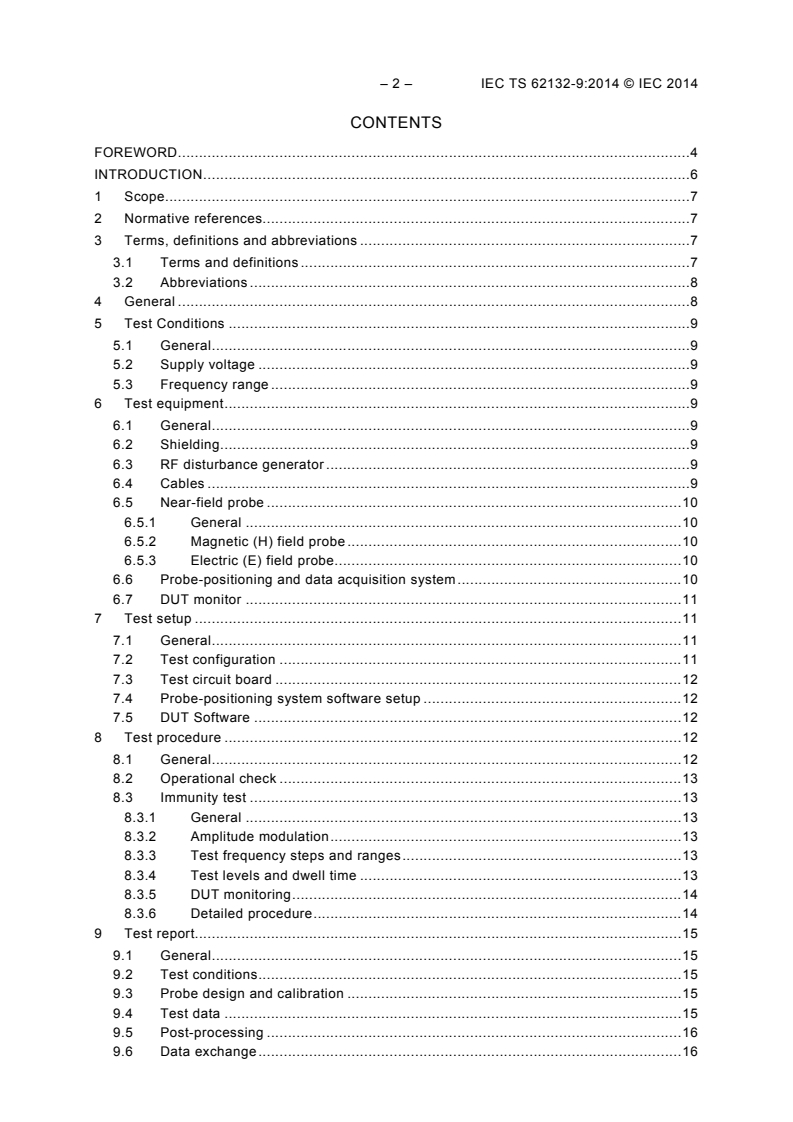
CONTENTS
FOREWORD . 4
INTRODUCTION . 6
1 Scope . 7
2 Normative references. 7
3 Terms, definitions and abbreviations . 7
3.1 Terms and definitions . 7
3.2 Abbreviations . 8
4 General . 8
5 Test Conditions . 9
5.1 General . 9
5.2 Supply voltage . 9
5.3 Frequency range . 9
6 Test equipment . 9
6.1 General . 9
6.2 Shielding . 9
6.3 RF disturbance generator . 9
6.4 Cables . 9
6.5 Near-field probe . 10
6.5.1 General . 10
6.5.2 Magnetic (H) field probe . 10
6.5.3 Electric (E) field probe . 10
6.6 Probe-positioning and data acquisition system . 10
6.7 DUT monitor . 11
7 Test setup . 11
7.1 General . 11
7.2 Test configuration . 11
7.3 Test circuit board . 12
7.4 Probe-positioning system software setup . 12
7.5 DUT Software . 12
8 Test procedure . 12
8.1 General . 12
8.2 Operational check . 13
8.3 Immunity test . 13
8.3.1 General . 13
8.3.2 Amplitude modulation . 13
8.3.3 Test frequency steps and ranges . 13
8.3.4 Test levels and dwell time . 13
8.3.5 DUT monitoring . 14
8.3.6 Detailed procedure . 14
9 Test report. 15
9.1 General . 15
9.2 Test conditions . 15
9.3 Probe design and calibration . 15
9.4 Test data . 15
9.5 Post-processing . 16
9.6 Data exchange . 16
Annex A (informative) Calibration of near-field probes . 17
A.1 General . 17
A.2 Test equipment . 20
A.3 Calibration setup . 20
A.4 Calibration procedure . 20
Annex B (informative) Electric and magnetic field probes . 22
B.1 General . 22
B.2 Probe electrical description . 22
B.3 Probe physical description . 22
B.3.1 Probe construction . 22
B.3.2 Electric field probe . 23
B.3.3 Magnetic field probe . 23
Annex C (informative) Coordinate systems . 24
C.1 General . 24
C.2 Cartesian coordinate system . 24
C.3 Cylindrical coordinate system . 25
C.4 Spherical coordinate system . 26
C.5 Coordinate system conversion . 26
Bibliography . 27
Figure 1 – Example of a probe-positioning system . 11
Figure 2 – Test setup . 12
Figure 3 – Example of data overlaid on an image of the DUT . 16
Figure A.1 – Typical probe factor in dB (Ω.m ) against frequency . 19
Figure A.2 – Typical probe factor in dB (S/m ) against frequency . 19
Figure A.3 – Probe calibration setup . 20
Figure B.1 – Basic structure of electric and magnetic field probe schematics . 22
Figure B.2 – Example of electric field probe construction (E ). 23
Z
Figure B.3 – Example of magnetic field probe construction (H or H ) . 23
X Y
Figure C.1 – Right-hand Cartesian coordinate system (preferred) . 24
Figure C.2 – Left-hand Cartesian coordinate system . 25
Figure C.3 – Cylindrical coordinate system . 25
Figure C.4 – Spherical coordinate system. 26
Table 1 – Frequency step size versus frequency range . 13
Table A.1 – Probe factor linear units . 18
Table A.2 – Probe factor logarithmic units . 18
Table C.1 – Coordinate system conversion . 26
– 4 – IEC TS 62132-9:2014 © IEC 2014
INTERNATIONAL ELECTROTECHNICAL COMMISSION
____________
INTEGRATED CIRCUITS –
MEASUREMENT OF ELECTROMAGNETIC IMMUNITY –
Part 9: Measurement of radiated immunity –
Surface scan method
FOREWORD
1) The International Electrotechnical Commission (IEC) is a worldwide organization for standardization comprising
all national electrotechnical committees (IEC National Committees). The object of IEC is to promote
international co-operation on all questions concerning standardization in the electrical and electronic fields. To
this end and in addition to other activities, IEC publishes International Standards, Technical Specifications,
Technical Reports, Publicly Available Specifications (PAS) and Guides (hereafter referred to as “IEC
Publication(s)”). Their preparation is entrusted to technical committees; any IEC National Committee interested
in the subject dealt with may participate in this preparatory work. International, governmental and non-
governmental organizations liaising with the IEC also participate in this preparation. IEC collaborates closely
with the International Organization for Standardization (ISO) in accordance with conditions determined by
agreement between the two organizations.
2) The formal decisions or agreements of IEC on technical matters express, as nearly as possible, an international
consensus of opinion on the relevant subjects since each technical committee has representation from all
interested IEC National Committees.
3) IEC Publications have the form of recommendations for international use and are accepted by IEC National
Committees in that sense. While all reasonable efforts are made to ensure that the technical content of IEC
Publications is accurate, IEC cannot be held responsible for the way in which they are used or for any
misinterpretation by any end user.
4) In order to promote international uniformity, IEC National Committees undertake to apply IEC Publications
transparently to the maximum extent possible in their national and regional publications. Any divergence
between any IEC Publication and the corresponding national or regional publication shall be clearly indicated in
the latter.
5) IEC itself does not provide any attestation of conformity. Independent certification bodies provide conformity
assessment services and, in some areas, access to IEC marks of conformity. IEC is not responsible for any
services carried out by independent certification bodies.
6) All users should ensure that they have the latest edition of this publication.
7) No liability shall attach to IEC or its directors, employees, servants or agents including individual experts and
members of its technical committees and IEC National Committees for any personal injury, property damage or
other damage of any nature whatsoever, whether direct or indirect, or for costs (including legal fees) and
expenses arising out of the publication, use of, or reliance upon, this IEC Publication or any other IEC
Publications.
8) Attention is drawn to the Normative references cited in this publication. Use of the referenced publications is
indispensable for the correct application of this publication.
9) Attention is drawn to the possibility that some of the elements of this IEC Publication may be the subject of
patent rights. IEC shall not be held responsible for identifying any or all such patent rights.
The main task of IEC technical committees is to prepare International Standards. In
exceptional circumstances, a technical committee may propose the publication of a technical
specification when
• the required support cannot be obtained for the publication of an International Standard,
despite repeated efforts, or
• the subject is still under technical development or where, for any other reason, there is the
future but no immediate possibility of an agreement on an International Standard.
Technical specifications are subject to review within three years of publication to decide
whether they can be transformed into International Standards.
IEC TS 62132-9, which is a technical specification, has been prepared by subcommittee 47A:
Integrated circuits, of IEC technical committee 47: Semiconductor devices.
The text of this technical specification is based on the following documents:
Enquiry draft Report on voting
47A/924/DTS 47A/936/RVC
Full information on the voting for the approval of this technical specification can be found in
the report on voting indicated in the above table.
This publication has been drafted in accordance with the ISO/IEC Directives, Part 2.
A list of all parts in the IEC 62132 series, published under the general title Integrated
circuits – Measurement of electromagnetic immunity, can be found on the IEC website.
The committee has decided that the contents of this publication will remain unchanged until
the stability date indicated on the IEC web site under "http://webstore.iec.ch" in the data
related to the specific publication. At this date, the publication will be
• transformed into an International standard,
• reconfirmed,
• withdrawn,
• replaced by a revised edition, or
• amended.
IMPORTANT – The 'colour inside' logo on the cover page of this publication indicates
that it contains colours which are considered to be useful for the correct
understanding of its contents. Users should therefore print this document using a
colour printer.
– 6 – IEC TS 62132-9:2014 © IEC 2014
INTRODUCTION
Techniques for generating near-fields over integrated circuits and their surrounding
environment can identify the areas susceptible to radiation, which could cause errors in the
device. The ability to associate magnetic or electric field strengths with a particular location
on a device can provide valuable information for improvement of an IC both in terms of
functionality and EMC performance.
Near-field scan techniques have considerably evolved over recent years. The improved
efficiency, bandwidth and spatial resolution of the probes offer analysis of integrated circuits
operating into the gigahertz range. Post-processing can considerably enhance the resolution
of a near-field scan test bench and the measured data can be shown in various ways per
user’s choice.
INTEGRATED CIRCUITS –
MEASUREMENT OF ELECTROMAGNETIC IMMUNITY –
Part 9: Measurement of radiated immunity –
Surface scan method
1 Scope
This part of IEC 62132 provides a test procedure, which defines a method for evaluating the
effect of near electric, magnetic or electromagnetic field components on an integrated circuit
(IC). This diagnostic procedure is intended for IC architectural analysis such as floor planning
and power distribution optimization. This test procedure is applicable to testing an IC mounted
on any circuit board that is accessible to the scanning probe. In some cases it is useful to
scan not only the IC but also its environment. For comparison of surface scan immunity
between different ICs, the standardized test board defined in IEC 62132-1 should be used.
This measurement method provides a mapping of the sensitivity (immunity) to electric- or
magnetic-near-field disturbance over the IC. The resolution of the test is determined by the
capability of the test probe and the precision of the Probe-positioning system. This method is
intended for use up to 6 GHz. Extending the upper limit of frequency is possible with existing
probe technology but is beyond the scope of this specification. The tests described in this
document are carried out in the frequency domain using continuous wave (CW), amplitude
modulated (AM) or pulse modulated (PM) signals.
2 Normative references
The following documents, in whole or in part, are normatively referenced in this document and
are indispensable for its application. For dated references, only the edition cited applies. For
undated references, the latest edition of the referenced document (including any
amendments) applies.
IEC 60050 (all parts), International Electrotechnical Vocabulary (available at
)
IEC 62132-1, Integrated circuits – Measurement of electromagnetic immunity, 150 kHz to
1 GHz – Part 1: General conditions and definitions
IEC TS 61967-3, Integrated circuits – Measurement of electromagnetic emissions, 150 kHz to
1 GHz – Part 3: Measurement of radiated emissions – Surface scan method
3 Terms, definitions and abbreviations
3.1 Terms and definitions
For the purpose of this document, the definitions and definitions given in IEC 62132-1,
IEC 60050-131 and IEC 60050-161, as well as the following apply.
3.1.1
altitude
distance between the tip of the near-field probe and the reference plane of the scan (e.g. the
PCB, the upper surface of the package)
– 8 – IEC TS 62132-9:2014 © IEC 2014
Note 1 to entry: The term “altitude” refers to the vertical direction in a Cartesian coordinate system (Z-axis) in
this document.
[SOURCE: IEC 61967-3:2014, 3.1.1]
3.1.2
probe factor
ratio of electric or magnetic field strength at a specified location in near-field evaluation to the
signal level measured at the output connection or applied to the input connection of a probe
[SOURCE: IEC 61967-3:2014, 3.1.2]
3.1.3
spatial resolution
aptitude of a probe to distinguish measured field between two points
[SOURCE: IEC 61967-3:2014, 3.1.3]
3.2 Abbreviations
DUT: device under test
NFS: near-field scan
PCB: printed circuit board
[SOURCE: IEC 61967-3:2014, 3.2]
4 General
The electric and magnetic fields applied by scanning over the surface of an IC yields
information on the relative sensitivity of blocks within the IC package. It enables the
comparisons between different architectures to facilitate improvements in RF immunity of the
IC. Default criteria are defined to determine the immunity level at a specific location.
Characterizing an IC involves the acquisition of a series of measurements of applied power to
the probe at specific frequencies. Each scan over a die or package collects a large amount of
data depending on the number of locations scanned and the number of frequencies measured
at each location. Because of the required precision and the amount of measured data, this
test method uses a computer-controlled probe-positioning and test system to achieve
accurate and repeatable probe data. Control software shall be prepared or adapted to control
the optical, precision stepper motors typically used in such systems. This method also
requires an analysis and handling of a large amount of data typically performed by dedicated
software programs. The scanning time depends on the number of frequencies, the number of
locations tested, and the capability of the data collection system.
Due to the wide array of IC processes, packaging technologies, and their physical dimensions,
this document does not specify the designs of probe-positioning systems or near-field probes.
The designs of the positioning system and the probes depend on the desired testing
frequency range, spatial resolution, field type, and the performance of the available
components (such as stepper motors).
The spatial resolution depends on the physical dimensions and construction of the probe. If
the spatial resolution is known it shall be included in the test report.
The altitude of the probe above the IC surface is not specified. The actual probe height shall
be described in the test report.
The probe position step size shall be chosen to fully utilize the spatial resolution while
minimizing the number of measurement points. Step size can be smaller in particular areas of
the die or package for higher resolution. With post-processing the data for higher resolution,
the spatial resolution at the measurement can be reduced, which allows larger step size.
5 Test Conditions
5.1 General
Test conditions shall meet the requirements as described in IEC 62132-1. In addition, the
following test conditions shall apply.
5.2 Supply voltage
A supply voltage should follow the IC manufacturer’s specification. If a user uses other
voltage, it shall be documented in the test report.
5.3 Frequency range
An effective frequency range of this radiated immunity measurement procedure is 150 kHz to
6 GHz. If a single probe is not able to cover the whole frequency range, the frequency range
may be divided into sub-ranges to allow the use of multiple probes, each of which suits
individual frequency sub-range.
6 Test equipment
6.1 General
Test equipment shall meet the requirements as described in IEC 62132-1. In addition, the
following test equipment requirements shall apply.
6.2 Shielding
Double shielded or semi-rigid coaxial cables are recommended for interconnections between
the probe and the measuring equipment. Depending on the RF power applied to the near-field
probe, it may also be necessary to carry out the tests in a shielded room.
6.3 RF disturbance generator
An RF disturbance generator with sufficient power-handling capabilities shall be used. The RF
disturbance generator consists of an RF signal source with or without a modulation function,
as required, and an optional RF power amplifier. The power amplifier shall be capable of
handling the type of disturbing signal used (CW, AM or PM) without creating undue distortion.
The VSWR (Voltage Standing Wave Ratio) at the output of the RF disturbance generator shall
be less than 1,5 over the frequency range being measured. The output power of the RF
disturbance generator terminated with a 50 Ω load shall have accuracy of +/- 0,5 dB or
smaller.
NOTE Near-field probes usually present very poor return loss. If the probe does not present a good impedance
match, the electric or magnetic field strength generated by the probe will vary with frequency. Moreover, in order to
avoid damage to the power amplifier, specific care is to be taken during power amplifier selection in regards to its
stability and ability to sustain high reflected power. If necessary, an attenuator capable of sustaining the power
level can be inserted between the RF disturbance generator and the probe.
6.4 Cables
The scanning motion of the probe requires the use of flexible cables between the certain
elements of the setup. Care shall be taken to choose cables that are durable for the scanning
motion of the probe besides maintaining their high frequency performance. The cable losses
as a function of frequency should be included in the test report.
– 10 – IEC TS 62132-9:2014 © IEC 2014
Owing to the repeated movement of the cables, which can accelerate their deterioration,
calibration of the cables shall be carried out regularly. When the test frequency is higher than
1 GHz, the cables shall be calibrated before each test.
6.5 Near-field probe
6.5.1 General
The near-field probe employed for surface scanning can take various forms depending on
users’ preferences, the type of field to be measured, the capabilities of the RF disturbance
generator, and the desired spatial resolution of the test. Probe calibration is detailed in
Annex A. Calibration of the probe provides the field strength at a given distance in the axis of
the probe. In practice the probe is used to inject a disturbance into a DUT which, by its
presence, modifies the field strength and direction at the point of interest. It is possible to use
. Some probes generate a field only in
post-processing to correct any distortion of the field [1]
a specific direction. In order to generate fields in several directions, it is necessary to change
the probe or rotate it during the scan process. A brief description of the probe(s) used for the
testing shall be included in the test report. In order to improve the return loss of the probe, it
is good practice to place a suitable resistive load in series with the probe or to insert an
attenuator close to the probe. Various types of near-field probe are discussed in 6.5.2 and
6.5.3.
6.5.2 Magnetic (H) field probe
For magnetic field tests, a single turn, miniature magnetic loop probe is often used. The
typical probe is composed of wire, coaxial cable, PCB traces, or any other suitable material.
An example of a magnetic field probe is shown in Annex B and in IEC 61967-6 [2].
6.5.3 Electric (E) field probe
For electric field tests, a miniature electric field probe is typically used. The typical probe is
composed of wire, coaxial cable, PCB traces, or any other suitable material. An example of
electric field probe is shown in Annex B.
6.6 Probe-positioning and data acquisition system
A precise probe-positioning system and data acquisition system are required. The probe-
positioning system shall be able to move the probe in at least two axes (parallel to the DUT
surface) and shall be capable of positioning the probe with a mechanical step at least ten
times less than the minimum required step size. Although this specification describes the use
of Cartesian scanning (X, Y and, optionally, Z-axis), polar and cylindrical scanning are also
possible. Annex C defines the three coordinate systems and how the position information can
be converted between them. When using Cartesian coordinates, the right-hand system is
preferred. If the left-hand system is used, it shall be indicated in the test report. In some
cases the probe-positioning system has a mechanical structure to rotate the probe for
adjusting probe orientation. It may be controlled by the data acquisition system.
The x, y and z position of the near-field probe may be out of alignment after the rotation. Care
should be taken to compensate the resulting offset by repositioning the probe.
An example of a probe-positioning system is shown in Figure 1. Although not shown in
Figure 1, the DUT is installed on a test circuit board that is typically mounted on a test fixture
to improve stability.
_____________
Numbers in square brackets refer to the Bibliography.
The data acquisition system is typically a computer with software enabling the desired scan
parameters, controlling the measuring instrument and the probe scanning system, and
acquiring the data. The system configurations and the controlling software shall be described
in the test report.
6.7 DUT monitor
The DUT shall be monitored to detect any degradation of the performance. The monitoring
equipment shall not be adversely affected by the injected RF disturbance signal.
Gantry
z
y
x
Probe
DUT
2 or 3 – axis positioning system
IEC
Figure 1 – Example of a probe-positioning system
7 Test setup
7.1 General
Test setup shall meet the requirements as described in IEC 62132-1. In addition, the following
test setup requirements shall apply.
7.2 Test configuration
The general test setup is shown in Figure 2.
– 12 – IEC TS 62132-9:2014 © IEC 2014
RF disturbance generator
Power amplifier
Directional
RF signal source
(Optional)
coupler
P P
reverse forward
Power
meter
Control and
Probe
data acquisition
positioning
Probe
system
system
Default
monitor
DUT
IEC
Figure 2 – Test setup
7.3 Test circuit board
The test circuit board, on which the DUT is mounted and scanned, may be any board
accessible to the scanning probe. If ICs are to be evaluated for comparison purposes, they
shall be tested on identical PCBs. The PCB may be an application PCB or a standardized test
circuit board designed in accordance with IEC 62132-1.
The test circuit board shall be firmly installed in the probe-positioning system to enhance test
reproducibility. This shall be accomplished by the use of a test fixture having a minimum
impact on the radiated field.
7.4 Probe-positioning system software setup
After the DUT and its test circuit board are set up, verify that the probe-positioning system
software is configured for the desired scan parameters, in particular those concerning the
desired area to be scanned. Ensure that there are no obstacles that could damage the probe
within the desired scan area. Some scanner software requires reference points to compensate
for alignment errors, origin offsets, etc., as well as to improve the reproducibility of the tests.
Cameras, lasers and other such artifices may be used to assist the alignment. Images of the
DUT may be recorded and used as a background for the field tests (see 9.4). The brief
description of such procedures shall be included in the test report.
7.5 DUT Software
Appropriate software shall be implemented in the DUT during the measurement to meet the
requirements of IEC 62132-1. The description of the software shall be included in the test
report.
8 Test procedure
8.1 General
The test procedure shall be in accordance with IEC 62132-1 except as modified herein. These
default test conditions are intended to assure a consistent test environment. The following
steps shall be performed:
a) operational check (see 8.2);
b) immunity test (see 8.3).
If other test conditions are applied, they shall be documented in the test report.
8.2 Operational check
Energize the DUT and complete an operational check to verify proper function of the device
(i.e. Run DUT software) in the ambient test condition. During the operational check, the RF
disturbance generator and any monitoring equipment shall be powered; however, the output
of the RF disturbance generator shall be disabled and the probe positioned well away from
the DUT. The performance of the DUT shall not be degraded by ambient conditions.
8.3 Immunity test
8.3.1 General
With the test circuit board energized and the DUT operated in the intended test mode,
measure the level of the injected RF disturbance signal over the desired frequency range,
while monitoring the DUT for performance degradation.
8.3.2 Amplitude modulation
The RF disturbance signal can be:
• CW (continuous wave, no modulation)
• sinusoidal modulated with 80 % amplitude modulated by a 1 kHz sine wave, and
• pulse modulated with 50 % duty cycle and 1 kHz pulse repetition rate.
• other modulation can be applied if appropriate.
8.3.3 Test frequency steps and ranges
The RF immunity of the DUT is generally evaluated in the frequency range from 150 kHz to
6 GHz. Test frequencies shall be applied according to Table 1.
Table 1 – Frequency step size versus frequency range
Frequency range (MHz) 0,15 to 1 1 to 100 100 to 1 000 1 000 to 6 000
Linear steps (MHz) ≤0,1 ≤1 ≤10 ≤20
Logarithmic steps
≤5 % increment
Immunity scanning over a wide range of frequencies is extremely time-consuming. In order to
reduce the test time, the RF immunity of the DUT may be evaluated only at and near critical
frequencies. Critical frequencies are frequencies critical to DUT; including crystal frequencies,
oscillator frequencies, clock frequencies, data frequencies; which are generated by, received
by, or operated on by the DUT.
8.3.4 Test levels and dwell time
The applied test level shall be incrementally changed and the DUT shall be monitored
according to 8.3.6.2. The step size and test level shall be documented in the test report.
At each test level and frequency, the RF disturbance signal shall be applied for the time
necessary for the DUT to respond and for the monitoring system to detect any performance
degradation (typically 1 s).
– 14 – IEC TS 62132-9:2014 © IEC 2014
8.3.5 DUT monitoring
The DUT shall be monitored to identify its susceptibility using the appropriate test equipment,
as required in IEC 62132-1.
8.3.6 Detailed procedure
8.3.6.1 Field strength determination
At each test frequency, the signal generator setting shall be determined to achieve the
desired field strength by applying the appropriate probe factor depending on the altitude of
the probe as described in Annex A.
The small size of probes often limits the power level that can be applied. Excessive applied
power may change the probe performance or, at worst, permanently damage it. Care should
be taken to limit the applied power to avoid such effects.
8.3.6.2 Immunity test flow
The brief test processes are described below.
The procedure depends on the configuration of the DUT, the test equipment, the positioning
system and data acquisition system, as well as users’ preferences. For example, it is possible
to position the probe at a specific location, measure data over the whole range of frequencies
and then move to the next location. However, it may be preferred to measure data at a
specific frequency over the entire surface before changing the test frequency and rescanning
the entire surface.
Before starting the immunity test, a maximum signal level to be applied to the probe shall be
defined. This maximum signal level may depend on various criteria including the maximum
power rating of the probe, the maximum output level of the RF disturbance generator, a field
strength considered dangerous for the DUT (e.g. potentially causing permanent damage to
the DUT).
At each location and frequency one of the following two methods can be employed for this test:
a) The output of the RF disturbance generator shall be set at a low value (e.g. 20 dB below
the predefined maximum signal level) and slowly increased up to the predefined maximum
signal level while monitoring the DUT for performance degradation. Any performance
degradation at or below the predefined maximum signal level shall be recorded.
b) The output of the RF disturbance generator shall be set at a predefined maximum signal
level while monitoring the DUT for performance degradation. Any performance
degradation at the predefined maximum signal level shall be recorded. The output of the
RF disturbance generator shall then be reduced until normal function returns. This level
shall also be recorded.
If the DUT’s responses are different between the two methods, performing both a) and b)
methods is recommended. Additionally, in some cases it might be necessary to reset or
restart the DUT to come back to proper operation.
For the probe that generates a field in a single-direction, the probe may rotate automatically
at each location to generate, for example, X- and Y-fields. If the rotation is manual, it is usual
to scan the entire surface with the probe fixed in one direction and then turn it by 90° before
rescanning the surface. A similar procedure is used if the probe is changed to switch from, for
example, an applied field in the XY-plane to a field in the Z plane. In all cases care shall be
taken to ensure the angle and position of the probes, after change, with respect to the DUT.
Scans can be made in a plane that is parallel or perpendicular to the surface of the IC or in a
series of planes to form a three-dimensional mapping. The test frequency can be varied to
evaluate the effect of frequency on the immunity pattern of the IC. The distance between
multiple test planes f
...