

IEC 62885-9:2019
(Main)Surface cleaning appliances - Part 9: Floor treatment machines with or without traction drive, for commercial use - Methods for measuring the performance
General Information
- Abstract
IEC 62885-9:2019 lists the characteristic performance parameters for walk-behind and ride-on floor scrubbers and sweepers and other floor cleaning machines in accordance with IEC 60335-2-72:2016.
The intent is to serve the manufacturers in describing parameters for their manuals and their literature. This may include all or some of the parameters listed in this definition document.
This first edition of IEC 62885-9 cancels and replaces IEC 62826:2014 and constitutes a technical revision.
This edition includes the following significant technical changes with respect to IEC 62826:2014
a) reference to a dated version of IEC 60335-2-72 to ensure consistency between the two standards;
b) a new calculation for the nominal current consumption in 22.1;
c) a new calculation for the maximum net run-time of commercial floor treatment machines in 22.2;
d) update of the Bibliography.
- Status
- Published
- Publication Date
- 13-Oct-2019
- Technical Committee
- SC 59F - Surface cleaning appliances
- Drafting Committee
- WG 6 - TC 59/SC 59F/WG 6
- Current Stage
- PPUB - Publication issued
- Start Date
- 14-Oct-2019
- Completion Date
- 21-Oct-2019
Buy Documents

IEC 62885-9:2019 - Surface cleaning appliances - Part 9: Floor treatment machines with or without traction drive, for commercial use - Methods for measuring the performance Released:10/14/2019
Overview
The IEC 62885-9:2019 standard titled Surface cleaning appliances - Part 9: Floor treatment machines with or without traction drive, for commercial use - Methods for measuring the performance is an International Electrotechnical Commission (IEC) publication addressing performance evaluation of commercial floor cleaning equipment. This standard defines testing methods and performance parameters specifically for walk-behind and ride-on floor scrubbers, sweepers, and other floor treatment machines.
IEC 62885-9:2019 updates and replaces the earlier IEC 62826:2014 edition, introducing technical revisions for consistency with IEC 60335-2-72:2016 and enhancing test calculations such as nominal current consumption and maximum net run-time for battery-powered machines. It guides manufacturers in preparing accurate and standardized performance data for product manuals and promotional literature, promoting transparency and comparability in commercial floor cleaning appliances.
Key Topics
- Scope and Purpose: Establishes characteristic performance parameters for commercial floor treatment machines, ensuring clear manufacturer documentation.
- Testing Conditions: Specifies atmospheric conditions, machine loading, and machine setup criteria to maintain consistent test environments.
- Performance Parameters:
- Working path widths (scrubbing, sweeping, squeegee dimensions)
- Minimum aisle turn-around width and machine transport width
- Weight classifications including gross vehicle, empty, and transport weights
- Scrub deck down force and pressure
- Rotational speed of pads, brushes, and brooms (loaded and unloaded)
- Maximum floor load and wheel contact pressure
- Operational speeds (working mode and transport mode)
- Acoustic and Vibration Measurements:
- Sound power and pressure levels during operation
- Hand-arm and whole-body vibration assessments
- Fluid Handling Capacities:
- Solution flow rate
- Rated hopper volume
- Solution and recovery tank capacities
- Recovery tank drain time
- Water coverage performance
- Energy and Power Metrics:
- Battery amp-hour capacity
- Calculated run time for battery-powered machines
- Rated power input/output for combustion engines and electric motors
- Airflow and Filtration:
- Air flow measurement during sweeping/scrubbing
- Maximum vacuum pressure
- Filter area assessment
Applications
IEC 62885-9:2019 serves a vital role in multiple practical areas:
- Manufacturers: Provides a standardized framework for measuring, calculating, and reporting key performance parameters to ensure consistency across product literature and technical manuals.
- Quality Assurance: Assists manufacturers and testing agencies in verifying that commercial floor treatment machines meet defined operational criteria and safety requirements.
- Procurement and Specification: Guides facility managers, cleaning contractors, and industrial buyers in comparing machine capabilities based on objective, internationally recognized test results.
- Product Development: Supports R&D by establishing performance benchmarks, encouraging innovation in efficiency, ergonomics, and environmental impact reduction.
- Regulatory Compliance: Aligns with IEC 60335-2-72:2016 safety standards, facilitating compliance with regional and global regulations for commercial cleaning equipment.
Related Standards
- IEC 60335-2-72:2016 - Safety requirements for floor treatment machines, providing essential context for performance tests in IEC 62885-9:2019.
- IEC 62826:2014 - The previous version of this performance measurement standard, officially cancelled and replaced by IEC 62885-9:2019.
- Other parts of the IEC 62885 series - Covering various surface cleaning appliances and test methods for other cleaning machine types.
- Regional standards and environmental regulations may also interface with IEC 62885-9 to ensure machine safety, noise, and vibration levels comply with local legislation.
Keywords: IEC 62885-9, floor treatment machines, commercial floor scrubbers, floor sweepers, cleaning appliance performance, performance measurement methods, commercial cleaning equipment standards, machine testing methods, IEC cleaning standards, battery run time calculation, scrub deck pressure, noise level measurement, vibration assessment, solution flow rate standard, air flow measurement in cleaning machines.
Relations
- Effective Date
- 05-Sep-2023
Buy Documents
IEC 62885-9:2019 - Surface cleaning appliances - Part 9: Floor treatment machines with or without traction drive, for commercial use - Methods for measuring the performance Released:10/14/2019
Frequently Asked Questions
IEC 62885-9:2019 is a standard published by the International Electrotechnical Commission (IEC). Its full title is "Surface cleaning appliances - Part 9: Floor treatment machines with or without traction drive, for commercial use - Methods for measuring the performance". This standard covers: IEC 62885-9:2019 lists the characteristic performance parameters for walk-behind and ride-on floor scrubbers and sweepers and other floor cleaning machines in accordance with IEC 60335-2-72:2016. The intent is to serve the manufacturers in describing parameters for their manuals and their literature. This may include all or some of the parameters listed in this definition document. This first edition of IEC 62885-9 cancels and replaces IEC 62826:2014 and constitutes a technical revision. This edition includes the following significant technical changes with respect to IEC 62826:2014 a) reference to a dated version of IEC 60335-2-72 to ensure consistency between the two standards; b) a new calculation for the nominal current consumption in 22.1; c) a new calculation for the maximum net run-time of commercial floor treatment machines in 22.2; d) update of the Bibliography.
IEC 62885-9:2019 lists the characteristic performance parameters for walk-behind and ride-on floor scrubbers and sweepers and other floor cleaning machines in accordance with IEC 60335-2-72:2016. The intent is to serve the manufacturers in describing parameters for their manuals and their literature. This may include all or some of the parameters listed in this definition document. This first edition of IEC 62885-9 cancels and replaces IEC 62826:2014 and constitutes a technical revision. This edition includes the following significant technical changes with respect to IEC 62826:2014 a) reference to a dated version of IEC 60335-2-72 to ensure consistency between the two standards; b) a new calculation for the nominal current consumption in 22.1; c) a new calculation for the maximum net run-time of commercial floor treatment machines in 22.2; d) update of the Bibliography.
IEC 62885-9:2019 is classified under the following ICS (International Classification for Standards) categories: 97.080 - Cleaning appliances. The ICS classification helps identify the subject area and facilitates finding related standards.
IEC 62885-9:2019 has the following relationships with other standards: It is inter standard links to IEC 62826:2014. Understanding these relationships helps ensure you are using the most current and applicable version of the standard.
IEC 62885-9:2019 is available in PDF format for immediate download after purchase. The document can be added to your cart and obtained through the secure checkout process. Digital delivery ensures instant access to the complete standard document.
Standards Content (Sample)
IEC 62885-9 ®
Edition 1.0 2019-10
INTERNATIONAL
STANDARD
NORME
INTERNATIONALE
Surface cleaning appliances –
Part 9: Floor treatment machines with or without traction drive, for commercial
use – Methods for measuring the performance
Appareils de nettoyage des sols –
Partie 9: Machines de traitement des sols avec ou sans commande de dispositif
de déplacement, à usage commercial – Méthodes de mesure de l'aptitude à la
fonction
All rights reserved. Unless otherwise specified, no part of this publication may be reproduced or utilized in any form
or by any means, electronic or mechanical, including photocopying and microfilm, without permission in writing from
either IEC or IEC's member National Committee in the country of the requester. If you have any questions about IEC
copyright or have an enquiry about obtaining additional rights to this publication, please contact the address below or
your local IEC member National Committee for further information.
Droits de reproduction réservés. Sauf indication contraire, aucune partie de cette publication ne peut être reproduite
ni utilisée sous quelque forme que ce soit et par aucun procédé, électronique ou mécanique, y compris la photocopie
et les microfilms, sans l'accord écrit de l'IEC ou du Comité national de l'IEC du pays du demandeur. Si vous avez des
questions sur le copyright de l'IEC ou si vous désirez obtenir des droits supplémentaires sur cette publication, utilisez
les coordonnées ci-après ou contactez le Comité national de l'IEC de votre pays de résidence.
IEC Central Office Tel.: +41 22 919 02 11
3, rue de Varembé info@iec.ch
CH-1211 Geneva 20 www.iec.ch
Switzerland
About the IEC
The International Electrotechnical Commission (IEC) is the leading global organization that prepares and publishes
International Standards for all electrical, electronic and related technologies.
About IEC publications
The technical content of IEC publications is kept under constant review by the IEC. Please make sure that you have the
latest edition, a corrigendum or an amendment might have been published.
IEC publications search - webstore.iec.ch/advsearchform Electropedia - www.electropedia.org
The advanced search enables to find IEC publications by a The world's leading online dictionary on electrotechnology,
variety of criteria (reference number, text, technical containing more than 22 000 terminological entries in English
committee,…). It also gives information on projects, replaced and French, with equivalent terms in 16 additional languages.
and withdrawn publications. Also known as the International Electrotechnical Vocabulary
(IEV) online.
IEC Just Published - webstore.iec.ch/justpublished
Stay up to date on all new IEC publications. Just Published IEC Glossary - std.iec.ch/glossary
details all new publications released. Available online and 67 000 electrotechnical terminology entries in English and
once a month by email. French extracted from the Terms and Definitions clause of
IEC publications issued since 2002. Some entries have been
IEC Customer Service Centre - webstore.iec.ch/csc collected from earlier publications of IEC TC 37, 77, 86 and
If you wish to give us your feedback on this publication or CISPR.
need further assistance, please contact the Customer Service
Centre: sales@iec.ch.
A propos de l'IEC
La Commission Electrotechnique Internationale (IEC) est la première organisation mondiale qui élabore et publie des
Normes internationales pour tout ce qui a trait à l'électricité, à l'électronique et aux technologies apparentées.
A propos des publications IEC
Le contenu technique des publications IEC est constamment revu. Veuillez vous assurer que vous possédez l’édition la
plus récente, un corrigendum ou amendement peut avoir été publié.
Recherche de publications IEC - Electropedia - www.electropedia.org
webstore.iec.ch/advsearchform Le premier dictionnaire d'électrotechnologie en ligne au
La recherche avancée permet de trouver des publications IEC monde, avec plus de 22 000 articles terminologiques en
en utilisant différents critères (numéro de référence, texte, anglais et en français, ainsi que les termes équivalents dans
comité d’études,…). Elle donne aussi des informations sur les 16 langues additionnelles. Egalement appelé Vocabulaire
projets et les publications remplacées ou retirées. Electrotechnique International (IEV) en ligne.
IEC Just Published - webstore.iec.ch/justpublished Glossaire IEC - std.iec.ch/glossary
Restez informé sur les nouvelles publications IEC. Just 67 000 entrées terminologiques électrotechniques, en anglais
Published détaille les nouvelles publications parues. et en français, extraites des articles Termes et Définitions des
Disponible en ligne et une fois par mois par email. publications IEC parues depuis 2002. Plus certaines entrées
antérieures extraites des publications des CE 37, 77, 86 et
Service Clients - webstore.iec.ch/csc CISPR de l'IEC.
Si vous désirez nous donner des commentaires sur cette
publication ou si vous avez des questions contactez-nous:
sales@iec.ch.
IEC 62885-9 ®
Edition 1.0 2019-10
INTERNATIONAL
STANDARD
NORME
INTERNATIONALE
Surface cleaning appliances –
Part 9: Floor treatment machines with or without traction drive, for commercial
use – Methods for measuring the performance
Appareils de nettoyage des sols –
Partie 9: Machines de traitement des sols avec ou sans commande de dispositif
de déplacement, à usage commercial –Méthodes de mesure de l'aptitude à la
fonction
INTERNATIONAL
ELECTROTECHNICAL
COMMISSION
COMMISSION
ELECTROTECHNIQUE
INTERNATIONALE
ICS 97.080 ISBN 978-2-8322-7419-4
– 2 – IEC 62885-9:2019 © IEC 2019
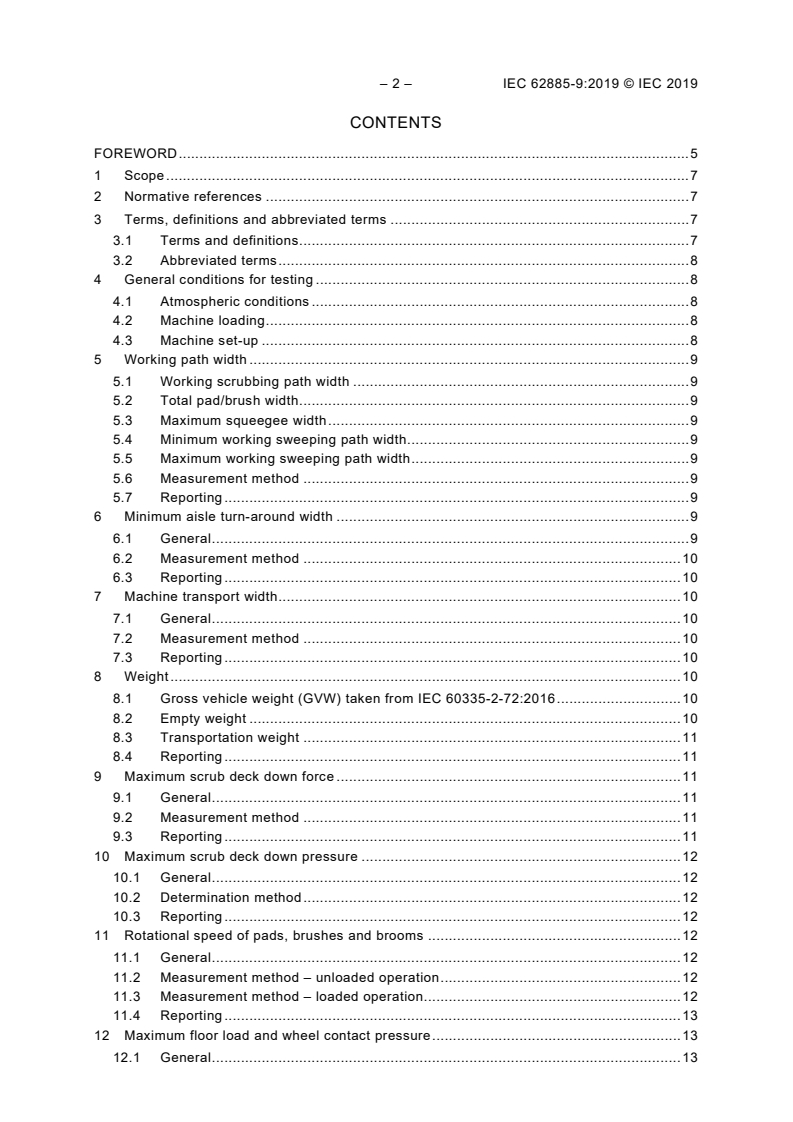
CONTENTS
FOREWORD . 5
1 Scope . 7
2 Normative references . 7
3 Terms, definitions and abbreviated terms . 7
3.1 Terms and definitions . 7
3.2 Abbreviated terms . 8
4 General conditions for testing . 8
4.1 Atmospheric conditions . 8
4.2 Machine loading . 8
4.3 Machine set-up . 8
5 Working path width . 9
5.1 Working scrubbing path width . 9
5.2 Total pad/brush width . 9
5.3 Maximum squeegee width . 9
5.4 Minimum working sweeping path width . 9
5.5 Maximum working sweeping path width . 9
5.6 Measurement method . 9
5.7 Reporting . 9
6 Minimum aisle turn-around width . 9
6.1 General . 9
6.2 Measurement method . 10
6.3 Reporting . 10
7 Machine transport width . 10
7.1 General . 10
7.2 Measurement method . 10
7.3 Reporting . 10
8 Weight . 10
8.1 Gross vehicle weight (GVW) taken from IEC 60335-2-72:2016 . 10
8.2 Empty weight . 10
8.3 Transportation weight . 11
8.4 Reporting . 11
9 Maximum scrub deck down force . 11
9.1 General . 11
9.2 Measurement method . 11
9.3 Reporting . 11
10 Maximum scrub deck down pressure . 12
10.1 General . 12
10.2 Determination method . 12
10.3 Reporting . 12
11 Rotational speed of pads, brushes and brooms . 12
11.1 General . 12
11.2 Measurement method – unloaded operation . 12
11.3 Measurement method – loaded operation . 12
11.4 Reporting . 13
12 Maximum floor load and wheel contact pressure . 13
12.1 General . 13
12.2 Measurement method . 13
12.3 Reporting . 13
13 Speed . 13
13.1 Maximum transport mode speed (power-driven machines) . 13
13.2 Maximum working mode speed . 13
13.3 Measurement method . 13
13.4 Reporting . 13
14 Sound . 13
14.1 Sound power level . 13
14.2 Sound pressure Level . 14
14.3 Measurement method . 14
14.4 Reporting . 14
15 Vibration . 14
15.1 Hand-arm system vibration total value . 14
15.2 Whole-body vibration total value . 14
15.3 Measurement method . 14
15.4 Reporting . 14
16 Solution flow rate . 14
16.1 General . 14
16.2 Measurement method . 14
16.3 Reporting . 14
17 Rated hopper volume capacity . 15
17.1 General . 15
17.2 Measurement method . 15
17.3 Reporting . 15
18 Tank capacity – solution tank and recovery tank . 15
18.1 General . 15
18.2 Measurement method – solution tank . 15
18.3 Measurement method – recovery tank . 15
18.4 Reporting . 15
19 Recovery tank drain time . 16
19.1 General . 16
19.2 Measurement method . 16
19.3 Reporting . 16
20 Water coverage test . 16
20.1 General . 16
20.2 Machine preparation . 16
20.3 Measurement method . 16
20.4 Reporting . 17
21 Battery amp-hour capacity . 17
21.1 General . 17
21.2 Reporting . 17
22 Calculated battery-powered – (max.) machine run time . 17
22.1 Calculation of nominal current consumption . 17
22.2 Maximum net run-time . 18
23 Rated power . 18
23.1 Rated power for combustion engines (output power) . 18
– 4 – IEC 62885-9:2019 © IEC 2019
23.2 Rated power input . 18
23.3 Rated power for electric motors . 18
23.4 Reporting . 19
24 Air flow of sweeping/scrubbing machines . 19
24.1 General . 19
24.2 Measurement methods . 19
24.3 Reporting . 19
25 Maximum vacuum . 19
25.1 General . 19
25.2 Measurement method . 19
25.3 Reporting . 19
26 Filter area . 19
26.1 General . 19
26.2 Measurement method . 20
26.3 Reporting . 20
27 Productivity . 20
Annex A (normative) Evaluation of wheel contact pressure on hard floors and floor
loading of floor cleaning machines . 21
A.1 Mean pressure of wheels . 21
A.2 Weight of the operable machine . 21
A.3 Evaluation of mean wheel contact pressure . 21
A.4 Evaluation of the working load . 22
A.5 Data sheet . 23
Bibliography . 24
Figure A.1 – Method for evaluating a wheel footprint . 22
Figure A.2 – Method for evaluating the footprint of double-castors . 22
INTERNATIONAL ELECTROTECHNICAL COMMISSION
____________
SURFACE CLEANING APPLIANCES –
Part 9: Floor treatment machines with or without traction drive,
for commercial use – Methods for measuring the performance
FOREWORD
1) The International Electrotechnical Commission (IEC) is a worldwide organization for standardization comprising
all national electrotechnical committees (IEC National Committees). The object of IEC is to promote
international co-operation on all questions concerning standardization in the electrical and electronic fields. To
this end and in addition to other activities, IEC publishes International Standards, Technical Specifications,
Technical Reports, Publicly Available Specifications (PAS) and Guides (hereafter referred to as “IEC
Publication(s)”). Their preparation is entrusted to technical committees; any IEC National Committee interested
in the subject dealt with may participate in this preparatory work. International, governmental and non-
governmental organizations liaising with the IEC also participate in this preparation. IEC collaborates closely
with the International Organization for Standardization (ISO) in accordance with conditions determined by
agreement between the two organizations.
2) The formal decisions or agreements of IEC on technical matters express, as nearly as possible, an international
consensus of opinion on the relevant subjects since each technical committee has representation from all
interested IEC National Committees.
3) IEC Publications have the form of recommendations for international use and are accepted by IEC National
Committees in that sense. While all reasonable efforts are made to ensure that the technical content of IEC
Publications is accurate, IEC cannot be held responsible for the way in which they are used or for any
misinterpretation by any end user.
4) In order to promote international uniformity, IEC National Committees undertake to apply IEC Publications
transparently to the maximum extent possible in their national and regional publications. Any divergence
between any IEC Publication and the corresponding national or regional publication shall be clearly indicated in
the latter.
5) IEC itself does not provide any attestation of conformity. Independent certification bodies provide conformity
assessment services and, in some areas, access to IEC marks of conformity. IEC is not responsible for any
services carried out by independent certification bodies.
6) All users should ensure that they have the latest edition of this publication.
7) No liability shall attach to IEC or its directors, employees, servants or agents including individual experts and
members of its technical committees and IEC National Committees for any personal injury, property damage or
other damage of any nature whatsoever, whether direct or indirect, or for costs (including legal fees) and
expenses arising out of the publication, use of, or reliance upon, this IEC Publication or any other IEC
Publications.
8) Attention is drawn to the Normative references cited in this publication. Use of the referenced publications is
indispensable for the correct application of this publication.
9) Attention is drawn to the possibility that some of the elements of this IEC Publication may be the subject of
patent rights. IEC shall not be held responsible for identifying any or all such patent rights.
International Standard IEC 62885-9 has been prepared by subcommittee SC 59F: Surface
cleaning appliances, of IEC technical committee TC 59: Performance of household and similar
electrical appliances.
This first edition of IEC 62885-9 cancels and replaces IEC 62826:2014 and constitutes a
technical revision.
This edition includes the following significant technical changes with respect to IEC
62826:2014
a) reference to a dated version of IEC 60335-2-72 to ensure consistency between the two
standards;
b) a new calculation for the nominal current consumption in 22.1;
c) a new calculation for the maximum net run-time of commercial floor treatment
machines in 22.2;
d) update of the Bibliography.
– 6 – IEC 62885-9:2019 © IEC 2019
The text of this standard is based on the following documents:
CDV Report on voting
59F/359/CDV 59F/371/RVC
Full information on the voting for the approval of this standard can be found in the report on
voting indicated in the above table.
This publication has been drafted in accordance with the ISO/IEC Directives, Part 2.
A list of all parts in the IEC 62885 series, published under the general title Surface cleaning
appliances, can be found on the IEC website.
The committee has decided that the contents of this publication will remain unchanged until
the stability date indicated on the IEC web site under "http://webstore.iec.ch" in the data
related to the specific publication. At this date, the publication will be
• reconfirmed,
• withdrawn,
• replaced by a revised edition, or
• amended.
SURFACE CLEANING APPLIANCES –
Part 9: Floor treatment machines with or without traction drive,
for commercial use – Methods for measuring the performance
1 Scope
This part of IEC 62885 lists the characteristic performance parameters for walk-behind and
ride-on floor scrubbers and sweepers and other floor cleaning machines in accordance with
IEC 60335-2-72:2016.
The intent is to serve the manufacturers in describing parameters for their manuals and their
literature. This may include all or some of the parameters listed in this definition document.
2 Normative references
The following documents are referred to in the text in such a way that some or all of their
content constitutes requirements of this document. For dated references, only the edition
cited applies. For undated references, the latest edition of the referenced document (including
any amendments) applies.
IEC 60335-1:2010, Household and similar electrical appliances – Safety – Part 1: General
requirements
IEC 60335-1:2010/AMD 1:2013
IEC 60335-2-69, Household and similar electrical appliances – Safety – Part 2-69: Particular
requirements for wet and dry vacuum cleaners, including power brush, for commercial use
IEC 60335-2-72:2016, Household and similar electrical appliances – Safety – Part 2-72:
Particular requirements for floor treatment machines with or without traction drive, for
commercial use
ISO 1585, Road vehicles – Engine test code – Net power
EN 12281, Printing and business paper – Requirements for copy paper for dry toner imaging
processes
3 Terms, definitions and abbreviated terms
3.1 Terms and definitions
For the purposes of this document, the terms and definitions of IEC 60335-2-72:2016 and the
following apply.
ISO and IEC maintain terminological databases for use in standardization at the following
addresses:
• IEC Electropedia: available at http://www.electropedia.org/
• ISO Online browsing platform: available at http://www.iso.org/obp
___________
There exists a consolidated edition 5.1 (2013) that comprises edition 5 (2010) and its Amendment 1 (2013).
– 8 – IEC 62885-9:2019 © IEC 2019
3.1.1
pad
cleaning tool of round, oval or other shape, attached to a scrubber in order to clean the
surface (floor) by abrasive rotations
Note 1 to entry: It consists of a coarse or fine synthetic membrane. The abrasiveness can be recognized by the
colour. The structure (open/closed) determines the suitability for high/low speeds.
3.1.2
brush
cleaning tool of round, oval or other shape, attached to a scrubber in order to clean the
surface (floor) by abrasive rotations
Note 1 to entry: It consists of natural or synthetic fibres of different kinds of hardness fixed in a holder. The
hardness is subject to the tasks to be executed, such as scrubbing, polishing or shampooing.
3.1.3
broom
cleaning tool of round shape, attached to a sweeper in order to clean the surface (floor)
Note 1 to entry: Regarding the automatic cleaning brooms, distinction can be made between the main broom
(main cylindrical brush) and the side broom. The main broom is located normally close to the hopper. The bristles
of the main broom are normally arranged as straight, spiral or spiral-vee lines of bristles. Thereby they generate
the necessary skidding and there is room enough for bigger particles between the lines of bristles. The function of
the side broom is to sweep away dirt from corners and borders towards the course of the main broom.
3.2 Abbreviated terms
FOPS falling-object protective structures
GVW gross vehicle weight
ROPS roll over protection system
4 General conditions for testing
4.1 Atmospheric conditions
Where required, the test procedures and measurements shall be carried out under the
following conditions:
Standard atmosphere: 23/50
Temperature: (23 ± 2) °C
Relative humidity: (50 ± 5) %
Air pressure: 86 kPa to 106 kPa
Temperature and humidity conditions within the specified ranges are required for good
repeatability and reproducibility. Care should be taken to avoid changes during a test.
4.2 Machine loading
The machine is loaded for testing to its GVW, as specified in 8.1, unless otherwise stated.
4.3 Machine set-up
Machine settings shall be as described under normal operation as defined in
IEC 60335-2-72:2016, except as noted elsewhere in this document. Throughout the
measurements, the same type of pad or brush has to be used.
5 Working path width
5.1 Working scrubbing path width
The path the machine cleans, based solely on the width of the brushes or pads. This is the
width that is exposed to the full cleaning process, to indicate the effective cleaning width of
the machine, not the outside physical width of the machine.
5.2 Total pad/brush width
The nominal width of the cleaning pads or brushes, not taking into account overlap of the
pads or brushes. The purpose of this value is to communicate to the end user the size of the
pads or brushes that are to be used with the machine.
NOTE This value can be given as follows (example): W = 300 mm for a single pad, or W = 2 × 300 mm for
Pad Pad
two pads.
5.3 Maximum squeegee width
The path that is covered by the squeegee while operating in a straight line.
5.4 Minimum working sweeping path width
The path the machine sweeps based solely on the nominal width of the main broom, to
indicate the effective sweeping width of the machine, not the outside physical width of the
machine.
5.5 Maximum working sweeping path width
The path the machine sweeps based solely on the nominal width of the main broom and the
side brooms. It is intended to indicate the effective sweeping width of the machine, not the
outside physical width of the machine.
5.6 Measurement method
The working path width is the measured width of the floor that is swept or wetted and
scrubbed while cleaning in a straight line. All measurements shall be carried out with the
machine in the minimum down force setting.
NOTE 1 The more down force that is applied to brushes, the larger the overall diameter of the contact circle with
the floor. Testing at the minimum setting will minimise this effect.
NOTE 2 The maximum working path width can be visually detected and measured by letting the
brooms/pads/brushes work on a wax coated floor or a soiled floor (e.g. with sand for sweepers and paint for
scrubbers).
5.7 Reporting
The values shall be given for a standard machine, and the widths for machines fitted with
options shall be noted separately. The values are reported in mm.
6 Minimum aisle turn-around width
6.1 General
The minimum aisle width the machine can turn around in without reversing is an indication of
the manoeuvrability of the machine during operation.
– 10 – IEC 62885-9:2019 © IEC 2019
6.2 Measurement method
Aisle turn-around width is measured as the minimum distance between two parallel vertical
planes that allows the machine to turn 180°, during normal operation, without contacting
either of the planes. The planes used shall be higher than the highest elements of the
machine under test. The test has to be carried out in both directions.
Flexible components such as squeegees or brushes are allowed to contact the planes.
6.3 Reporting
The value is reported in mm. If the test results for both directions are different, then both
figures shall be reported.
7 Machine transport width
7.1 General
The minimum width the machine can pass through, to indicate the manoeuvrability of the
machine during transport, not the effective cleaning width of the machine.
7.2 Measurement method
Machine width is measured as the minimum distance between two parallel vertical planes that
allows the machine to pass between the planes, while moving in a straight line. Any
removable machine part taken off as indicated in the operating manual for this measurement
shall be reported with the result.
7.3 Reporting
The value is reported in mm for each machine configuration.
8 Weight
8.1 Gross vehicle weight (GVW) taken from IEC 60335-2-72:2016
The maximum allowable fully laden weight of the machine and its payload, as ready for use,
to indicate the maximum weight of the machine.
The GVW includes, if applicable, full clean water tanks, empty dirty water tanks (half full for
recycling systems), hopper and dust bags loaded at rated weight capacity, the largest
recommended batteries, all options such as cords, hoses, wands, cleaning agents, brooms,
brushes, air conditioning and cabins. For ride-on machines, the GVW shall include a standard
operator weighing 75 kg.
NOTE 1 A sweeper with a full hopper is not ready for use, but is the heaviest configuration for a sweeper.
NOTE 2 GVW could be apportioned into front and rear axle weight.
8.2 Empty weight
The empty weight of the operational machine, to indicate the maximum weight of the machine
without options and batteries.
NOTE This value along with the weight of the container and packaging can be used to calculate the shipping
weight.
The empty weight of the operational machine shall exclude
– traction batteries,
– options (e.g. driver cabin, FOPS, ROPS, second and third side broom, front mounted
sweeping attachment for scrubbers),
– waste water,
– cleaning detergent,
– swept debris,
– fresh water (in the case of scrubbers or combined machines), and
– the operator’s weight.
The weight of options and batteries can be noted separately.
8.3 Transportation weight
The transportation weight of the machine, in kilograms, which includes the batteries but
excludes options (e.g. driver cabin, FOPS, second and third side broom, front-mounted
sweeping attachment for scrubbers), fresh water (in the case of scrubbers or combined
machines), and the weight of a standard operator (75 kg).
8.4 Reporting
The values are reported in kg. The actual mass may vary by ±5 %.
9 Maximum scrub deck down force
9.1 General
The maximum down-force on the floor is intended to be an indication of the maximum
scrubbing force that can be generated by the machine in normal operation, without
overloading motors or circuit protection devices.
9.2 Measurement method
Maximum scrub deck down force is measured as the reactive force while operating the
machine in a stationary position, with the deck on a smooth stainless-steel surface (not more
than 1,5 mm above or under the ground plane).
NOTE Squeegees that are mounted on the scrubbing unit will affect the result of the measurement. This is
acceptable for the purpose of this measurement.
9.3 Reporting
The reported value in N is the recorded maximum force that the measurement does not drop
below during a 15 s measurement period, using clean tap water. For a cylindrical deck, the
manufacturer shall specify the type of brush material to be used. For a disc deck, a typical
medium grade pad shall be used.
The brush or pad material type and the machine scrub setting shall be stated in the report.
If the machine design is such that the down force varies as the power input changes, the
minimum value during the 15 s measurement period shall be recorded. All side skirts that
contact the stainless-steel plate during the test shall be positioned, or fixed, so that they are
capable of supporting as much weight as they would if the machine were propelled forward.
– 12 – IEC 62885-9:2019 © IEC 2019
10 Maximum scrub deck down pressure
10.1 General
The scrub deck down pressure is calculated as the force per pad/brush contact area.
10.2 Determination method
The scrub deck down pressure is calculated by dividing the scrub deck down force
(see Clause 9) by the complete pad or brush contact area.
The contact area can be visualized (and subsequently measured) by letting the pad or brush
work on a wax-coated floor or a soiled (painted) floor. For cylindrical brushes or pads, the
area inside of the rectangular pattern that the pad/brush visualized on the floor is relevant.
Alternatively, the contact area of disc brushes or pads may be calculated as follows:
A=π⋅ rr−
( oi )
where
r is the outer radius of the contact area (total pad or brush width, see 5.2);
o
r is the inner radius of the contact area, i.e. the internal area without bristles, if applicable.
i
For orbiting scrub systems, the contact area shall be calculated.
NOTE Owing to the orbiting system, a visualization as previously described would enlarge the measured area
incorrectly.
10.3 Reporting
Maximum scrub deck down pressure is reported in N/cm . The type of pad or brush should be
noted along with the machine scrub setting used during this measurement.
11 Rotational speed of pads, brushes and brooms
11.1 General
The rotational speed indicates the number of revolutions per minute that the cleaning
attachment will attain at the stated load.
11.2 Measurement method – unloaded operation
Maximum rotational speed attainable without the cleaning attachment in contact with the floor.
The nominal speed of the output shaft of the pad/brush/broom motor gearbox combination can
be taken as indication for the maximum rotational speed.
NOTE It can be impossible to measure this value because machine controls switch off the drive of the unloaded
cleaning attachment.
11.3 Measurement method – loaded operation
Maximum rotational speed attainable while operating the cleaning attachment under maximum
scrub deck down force (see Clause 9).
11.4 Reporting
The rotational speed is reported in r/min.
12 Maximum floor load and wheel contact pressure
12.1 General
The maximum pressure exerted onto a floor surface by any wheel or caster on the machine
during expected operation or transport mode.
These parameters are intended to indicate the suitability of the machine for specific floor
surfaces. The values can be compared against the static load limit rating of the floor surface.
12.2 Measurement method
The maximum floor load shall be measured in accordance with Annex A on concrete precast
paving slabs that conform to IEC 60335-2-72:2016.
12.3 Reporting
The value is reported in accordance with Annex A.
13 Speed
13.1 Maximum transport mode speed (power-driven machines)
The transport speed of the machine, moving in a straightforward direction, on a flat smooth
surface. This parameter is intended to indicate the maximum transport speed of the machine,
with no other machine functions operating.
13.2 Maximum working mode speed
The working speed, as defined by the manufacturer, at which the machine is travelling in a
straight, forward direction, on a straight, flat, smooth concrete surface. This parameter is
intended to indicate the recommended maximum working speed of the machine, with all floor
cleaning functions of the machine operating simultaneously.
13.3 Measurement method
Transport mode speed is measured after acceleration to the maximum speed is achieved.
Working mode speed is measured after acceleration to the working speed is achieved.
13.4 Reporting
The values are reported in km/h.
14 Sound
14.1 Sound power level
The overall A-weighted emission sound power level of the machine, to indicate of the total
sound power emitted by the machine.
– 14 – IEC 62885-9:2019 © IEC 2019
14.2 Sound pressure Level
The overall A-weighted emission sound pressure level, at the operator's position, to indicate
the noise that the operator is exposed to during the normal operation of the machine.
14.3 Measurement method
Measurement in accordance with measurement of emission of acoustical noise as given in
IEC 60335-2-72:2016.
14.4 Reporting
The values and the uncertainties are reported in dB(A).
15 Vibration
15.1 Hand-arm system vibration total value
For all machines, the vibration total value to which the hand-arm system is subjected shall be
measured.
15.2 Whole-body vibration total value
For ride-on machines and walk-behind machines with a sulky, the highest root mean square
value of weighted acceleration to which the whole body is subjected shall be measured.
15.3 Measurement method
Measurement in accordance with measurement of emission of vibration as given in
IEC 60335-2-72:2016.
15.4 Reporting
The values including their uncertainties are reported in m/s .
16 Solution flow rate
16.1 General
The amount of solution (water only) sprayed or dispensed to the brushes at each flow setting,
to indicate the average continuous solution flow rate during normal operation.
16.2 Measurement method
Solution flow rate shall be measured with the solution tank at half of its full useful capacity, as
determined in Clause 18.
NOTE 1 The solution flow rate can vary depending upon head pressure.
NOTE 2 The flow rate can be measured and calculated by various methods. One method is to weigh the machine
at the start and end of a defined time period, calculate the weight differential, divide this value by the weight of
water to determine the volume of water, and then divide the volume by the test time to get the flow rate. Another
method is to use a flow meter to take this measurement.
16.3 Reporting
The value is reported in l/min at each flow or scrub setting. If the flow rate is variable, the
maximum value shall be reported along with the available range, for example 0 l/min to 10
l/min.
17 Rated hopper volume capacity
17.1 General
The maximum functional volume of debris that a hopper may hold in normal operation, to
indicate the useful volume of the respective hopper. This value is the sum of the struck
capacity of the hopper (quantity of fluid the hopper could hold) and the heaped capacity
(quantity of dry debris that could be piled above the top of the struck capacity).
17.2 Measur
...