

IEC 62595-1-2:2024
(Main)Display lighting unit - Part 1-2: Terminology and letter symbols
General Information
- Abstract
IEC 62595-1-2:2024 gives the preferred terms, their definitions and symbols, for display lighting units such as backlight units of transmissive and transflective displays, and frontlight units of reflective displays, with the objective of using standardized terminology when publications are prepared.
- Status
- Published
- Publication Date
- 15-Dec-2024
- Technical Committee
- TC 110 - Electronic displays
- Drafting Committee
- WG 19 - TC 110/WG 19
- Current Stage
- PPUB - Publication issued
- Start Date
- 16-Dec-2024
- Completion Date
- 17-Jan-2025
Overview
IEC 62595-1-2:2024 is an international standard published by the International Electrotechnical Commission (IEC). Titled Display lighting unit – Part 1-2: Terminology and letter symbols, this standard establishes preferred terms, definitions, and letter symbols for display lighting units. These include backlight units (BLUs) in transmissive and transflective displays, as well as frontlight units (FLUs) in reflective displays. The primary aim is to ensure uniform, consistent terminology and symbol usage in technical publications, facilitating clear communication and standardization across the global display technology industry.
Key Topics
This standard provides a comprehensive classification of terminology for display lighting units, including:
- Fundamental terms for display lighting units: Definitions for backlight units, frontlight units, edge-lit and direct-lit BLUs, dynamic and static BLUs, and multi-primary light sources.
- Terms related to passive optical components: Standardized names and definitions for light-guide plates (LGPs), light-guide films (LGFs), diffusers, prism films, reflector films, and micro-structured optical elements used in display lighting.
- Terms regarding spatio-temporal modulation: Concepts such as local dimming, block and segment structures, dimming blocks, boosting blocks, and support elements like bezels and housings.
- Descriptions for solid-state light sources: Terminology for LED, OLED, and laser-based light sources, including RGB LEDs and multi-chromatic units.
- Letter symbols: IEC 62595-1-2:2024 also assigns standardized symbols for key quantities and units used in technical and engineering documents related to display lighting.
The document is structured to support easy reference and correct categorization of terms, helping manufacturers, designers, and engineers use consistent language across the display lighting industry.
Applications
IEC 62595-1-2:2024 is crucial in several practical contexts:
- Engineering Design and Product Development: Facilitates uniform documentation and communication when developing display lighting units for LCDs, OLEDs, electronic paper, and other non-emissive displays.
- Technical Publications and Standards Compliance: Ensures that technical datasheets, white papers, and engineering specifications use harmonized terminology, aiding in clearer understanding and implementation.
- Manufacturing and Quality Control: Supports manufacturers and quality control teams in ensuring products meet global expectations by using agreed-upon terminology for display lighting components.
- Cross-Sector Collaboration: Enables collaboration and knowledge sharing between international partners, suppliers, and customers by minimizing misunderstandings related to terminology and symbols.
- Education and Training: A valuable resource for instructional materials in engineering curricula, helping students learn standardized definitions and symbols relevant to modern display technologies.
Related Standards
For effective application and to ensure interoperability, IEC 62595-1-2:2024 should be referenced alongside several related standards:
- IEC 60050-845 – International Electrotechnical Vocabulary (IEV): Lighting: The foundational vocabulary resource for all lighting-related terms, widely used across electrical and electronic standards.
- IEC 62595 Series – Display Lighting Unit Standards: Other parts in this series cover measurement methods, safety, performance, and additional technical details for display backlight and frontlight units.
- IEC/ISO Standards for Electronic Displays: Collaboration with ISO standards ensures broader compatibility, especially for LCD, OLED, and electronic paper technologies.
Using IEC 62595-1-2:2024 ensures that organizations across the display technology supply chain adhere to internationally recognized terminology and symbols, promoting clarity, quality, and interoperability in the development and use of advanced display lighting solutions.
Relations
- Effective Date
- 05-Sep-2023
Frequently Asked Questions
IEC 62595-1-2:2024 is a standard published by the International Electrotechnical Commission (IEC). Its full title is "Display lighting unit - Part 1-2: Terminology and letter symbols". This standard covers: IEC 62595-1-2:2024 gives the preferred terms, their definitions and symbols, for display lighting units such as backlight units of transmissive and transflective displays, and frontlight units of reflective displays, with the objective of using standardized terminology when publications are prepared.
IEC 62595-1-2:2024 gives the preferred terms, their definitions and symbols, for display lighting units such as backlight units of transmissive and transflective displays, and frontlight units of reflective displays, with the objective of using standardized terminology when publications are prepared.
IEC 62595-1-2:2024 is classified under the following ICS (International Classification for Standards) categories: 31.120 - Electronic display devices; 31.260 - Optoelectronics. Laser equipment. The ICS classification helps identify the subject area and facilitates finding related standards.
IEC 62595-1-2:2024 has the following relationships with other standards: It is inter standard links to IEC 62595-1-2:2016. Understanding these relationships helps ensure you are using the most current and applicable version of the standard.
IEC 62595-1-2:2024 is available in PDF format for immediate download after purchase. The document can be added to your cart and obtained through the secure checkout process. Digital delivery ensures instant access to the complete standard document.
Standards Content (Sample)
IEC 62595-1-2 ®
Edition 3.0 2024-12
INTERNATIONAL
STANDARD
colour
inside
Display lighting unit –
Part 1-2: Terminology and letter symbols
All rights reserved. Unless otherwise specified, no part of this publication may be reproduced or utilized in any form
or by any means, electronic or mechanical, including photocopying and microfilm, without permission in writing from
either IEC or IEC's member National Committee in the country of the requester. If you have any questions about IEC
copyright or have an enquiry about obtaining additional rights to this publication, please contact the address below or
your local IEC member National Committee for further information.
IEC Secretariat Tel.: +41 22 919 02 11
3, rue de Varembé info@iec.ch
CH-1211 Geneva 20 www.iec.ch
Switzerland
About the IEC
The International Electrotechnical Commission (IEC) is the leading global organization that prepares and publishes
International Standards for all electrical, electronic and related technologies.
About IEC publications
The technical content of IEC publications is kept under constant review by the IEC. Please make sure that you have the
latest edition, a corrigendum or an amendment might have been published.
IEC publications search - webstore.iec.ch/advsearchform IEC Products & Services Portal - products.iec.ch
The advanced search enables to find IEC publications by a Discover our powerful search engine and read freely all the
variety of criteria (reference number, text, technical publications previews, graphical symbols and the glossary.
committee, …). It also gives information on projects, replaced With a subscription you will always have access to up to date
and withdrawn publications. content tailored to your needs.
IEC Just Published - webstore.iec.ch/justpublished
Electropedia - www.electropedia.org
Stay up to date on all new IEC publications. Just Published
The world's leading online dictionary on electrotechnology,
details all new publications released. Available online and once
containing more than 22 500 terminological entries in English
a month by email.
and French, with equivalent terms in 25 additional languages.
Also known as the International Electrotechnical Vocabulary
IEC Customer Service Centre - webstore.iec.ch/csc
(IEV) online.
If you wish to give us your feedback on this publication or need
further assistance, please contact the Customer Service
Centre: sales@iec.ch.
IEC 62595-1-2 ®
Edition 3.0 2024-12
INTERNATIONAL
STANDARD
colour
inside
Display lighting unit –
Part 1-2: Terminology and letter symbols
INTERNATIONAL
ELECTROTECHNICAL
COMMISSION
ICS 31.120; 31.260 ISBN 978-2-8327-0094-5
– 2 – IEC 62595-1-2:2024 © IEC 2024
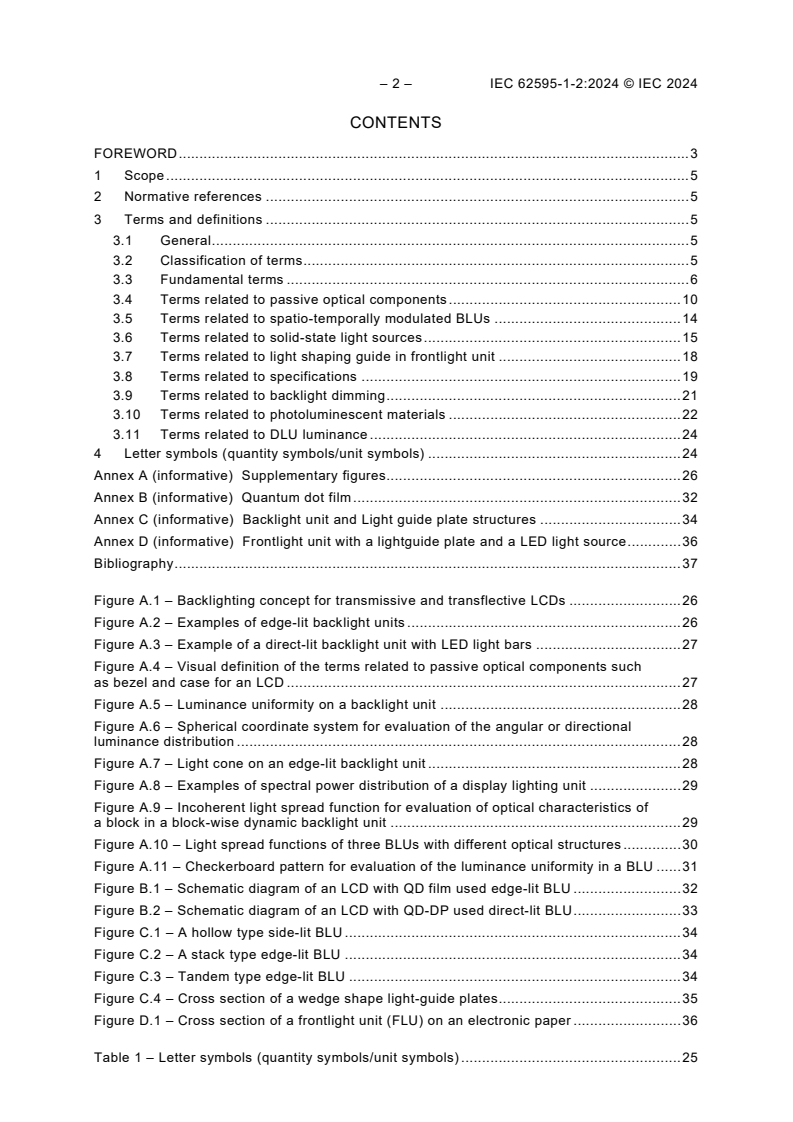
CONTENTS
FOREWORD . 3
1 Scope . 5
2 Normative references . 5
3 Terms and definitions . 5
3.1 General . 5
3.2 Classification of terms . 5
3.3 Fundamental terms . 6
3.4 Terms related to passive optical components . 10
3.5 Terms related to spatio-temporally modulated BLUs . 14
3.6 Terms related to solid-state light sources . 15
3.7 Terms related to light shaping guide in frontlight unit . 18
3.8 Terms related to specifications . 19
3.9 Terms related to backlight dimming . 21
3.10 Terms related to photoluminescent materials . 22
3.11 Terms related to DLU luminance . 24
4 Letter symbols (quantity symbols/unit symbols) . 24
Annex A (informative) Supplementary figures. 26
Annex B (informative) Quantum dot film . 32
Annex C (informative) Backlight unit and Light guide plate structures . 34
Annex D (informative) Frontlight unit with a lightguide plate and a LED light source . 36
Bibliography . 37
Figure A.1 – Backlighting concept for transmissive and transflective LCDs . 26
Figure A.2 – Examples of edge-lit backlight units . 26
Figure A.3 – Example of a direct-lit backlight unit with LED light bars . 27
Figure A.4 – Visual definition of the terms related to passive optical components such
as bezel and case for an LCD . 27
Figure A.5 – Luminance uniformity on a backlight unit . 28
Figure A.6 – Spherical coordinate system for evaluation of the angular or directional
luminance distribution . 28
Figure A.7 – Light cone on an edge-lit backlight unit . 28
Figure A.8 – Examples of spectral power distribution of a display lighting unit . 29
Figure A.9 – Incoherent light spread function for evaluation of optical characteristics of
a block in a block-wise dynamic backlight unit . 29
Figure A.10 – Light spread functions of three BLUs with different optical structures . 30
Figure A.11 – Checkerboard pattern for evaluation of the luminance uniformity in a BLU . 31
Figure B.1 – Schematic diagram of an LCD with QD film used edge-lit BLU . 32
Figure B.2 – Schematic diagram of an LCD with QD-DP used direct-lit BLU . 33
Figure C.1 – A hollow type side-lit BLU . 34
Figure C.2 – A stack type edge-lit BLU . 34
Figure C.3 – Tandem type edge-lit BLU . 34
Figure C.4 – Cross section of a wedge shape light-guide plates . 35
Figure D.1 – Cross section of a frontlight unit (FLU) on an electronic paper . 36
Table 1 – Letter symbols (quantity symbols/unit symbols) . 25
INTERNATIONAL ELECTROTECHNICAL COMMISSION
____________
DISPLAY LIGHTING UNIT –
Part 1-2: Terminology and letter symbols
FOREWORD
1) The International Electrotechnical Commission (IEC) is a worldwide organization for standardization comprising
all national electrotechnical committees (IEC National Committees). The object of IEC is to promote international
co-operation on all questions concerning standardization in the electrical and electronic fields. To this end and
in addition to other activities, IEC publishes International Standards, Technical Specifications, Technical Reports,
Publicly Available Specifications (PAS) and Guides (hereafter referred to as "IEC Publication(s)"). Their
preparation is entrusted to technical committees; any IEC National Committee interested in the subject dealt with
may participate in this preparatory work. International, governmental and non-governmental organizations liaising
with the IEC also participate in this preparation. IEC collaborates closely with the International Organization for
Standardization (ISO) in accordance with conditions determined by agreement between the two organizations.
2) The formal decisions or agreements of IEC on technical matters express, as nearly as possible, an international
consensus of opinion on the relevant subjects since each technical committee has representation from all
interested IEC National Committees.
3) IEC Publications have the form of recommendations for international use and are accepted by IEC National
Committees in that sense. While all reasonable efforts are made to ensure that the technical content of IEC
Publications is accurate, IEC cannot be held responsible for the way in which they are used or for any
misinterpretation by any end user.
4) In order to promote international uniformity, IEC National Committees undertake to apply IEC Publications
transparently to the maximum extent possible in their national and regional publications. Any divergence between
any IEC Publication and the corresponding national or regional publication shall be clearly indicated in the latter.
5) IEC itself does not provide any attestation of conformity. Independent certification bodies provide conformity
assessment services and, in some areas, access to IEC marks of conformity. IEC is not responsible for any
services carried out by independent certification bodies.
6) All users should ensure that they have the latest edition of this publication.
7) No liability shall attach to IEC or its directors, employees, servants or agents including individual experts and
members of its technical committees and IEC National Committees for any personal injury, property damage or
other damage of any nature whatsoever, whether direct or indirect, or for costs (including legal fees) and
expenses arising out of the publication, use of, or reliance upon, this IEC Publication or any other IEC
Publications.
8) Attention is drawn to the Normative references cited in this publication. Use of the referenced publications is
indispensable for the correct application of this publication.
9) IEC draws attention to the possibility that the implementation of this document may involve the use of (a)
patent(s). IEC takes no position concerning the evidence, validity or applicability of any claimed patent rights in
respect thereof. As of the date of publication of this document, IEC had not received notice of (a) patent(s), which
may be required to implement this document. However, implementers are cautioned that this may not represent
the latest information, which may be obtained from the patent database available at https://patents.iec.ch. IEC
shall not be held responsible for identifying any or all such patent rights.
IEC 62595-1-2 has been prepared by IEC technical committee 110: Electronic displays. It is an
International Standard.
This third edition cancels and replaces the second edition published in 2016. This edition
constitutes a technical revision.
This edition includes the following significant technical changes with respect to the previous
edition:
a) new terms are added considering recent advances in display lighting unit (DLU) technology;
b) some of the terms and definitions are corrected and revised, particularly to be consistent
with IEC 60050 policy;
c) clause structure is updated for categorizing terms correctly;
– 4 – IEC 62595-1-2:2024 © IEC 2024
d) some of the figures in informative Annex A and their captions are revised for better
understanding;
e) an informative Annex B is added for pictorial definition of the backlight unit structure.
f) an informative Annex C is added for pictorial definition of the backlight unit varieties and
light-guide plate shapes.
The text of this International Standard is based on the following documents:
Draft Report on voting
110/1698/FDIS 110/1725/RVD
Full information on the voting for its approval can be found in the report on voting indicated in
the above table.
The language used for the development of this International Standard is English.
This document was drafted in accordance with ISO/IEC Directives, Part 2, and developed in
accordance with ISO/IEC Directives, Part 1 and ISO/IEC Directives, IEC Supplement, available
at www.iec.ch/members_experts/refdocs. The main document types developed by IEC are
described in greater detail at www.iec.ch/publications.
A list of all parts in the IEC 62595 series, published under the general title Display lighting unit,
can be found on the IEC website.
The committee has decided that the contents of this document will remain unchanged until the
stability date indicated on the IEC website under webstore.iec.ch in the data related to the
specific document. At this date, the document will be
• reconfirmed,
• withdrawn, or
• revised.
IMPORTANT – The "colour inside" logo on the cover page of this document indicates
that it contains colours which are considered to be useful for the correct understanding
of its contents. Users should therefore print this document using a colour printer.
DISPLAY LIGHTING UNIT –
Part 1-2: Terminology and letter symbols
1 Scope
This part of IEC 62595 gives the preferred terms, their definitions and symbols, for display
lighting units such as backlight units of transmissive and transflective displays, and frontlight
units of reflective displays, with the objective of using standardized terminology when
publications are prepared.
2 Normative references
The following documents are referred to in the text in such a way that some or all of their content
constitutes requirements of this document. For dated references, only the edition cited applies.
For undated references, the latest edition of the referenced document (including any
amendments) applies.
IEC 60050-845, International Electrotechnical Vocabulary (IEV) – Part 845: Lighting (available
at www.electropedia.org)
3 Terms and definitions
3.1 General
For the purposes of this document, the terms and definitions given in IEC 60050-845 and the
following apply.
ISO and IEC maintain terminology databases for use in standardization at the following
addresses:
• IEC Electropedia: available at https://www.electropedia.org/
• ISO Online browsing platform: available at https://www.iso.org/obp
3.2 Classification of terms
Terms for display lighting units, such as backlight units and frontlight units are classified as
follows:
a) Fundamental terms (3.3);
b) Terms related to passive optical components (3.4);
c) Terms related to spatio-temporally modulated BLUs (3.5);
d) Terms related to solid-state light sources (3.6);
e) Terms related to light shaping guide in frontlight unit (3.7);
f) Terms related to specifications (3.8);
g) Terms related to backlight dimming (3.9);
h) Terms related to photoluminescent materials (3.10);
___________
Identical to CIE 17.4.
– 6 – IEC 62595-1-2:2024 © IEC 2024
i) Terms related to DLU luminance (3.11).
The following definitions are applied for international standardization of the display lighting units.
For background to the terms in 3.3 to 3.11, refer to [1] to [27] .
3.3 Fundamental terms
3.3.1
display lighting unit
DLU
lighting unit for recognition of the displayed images on a non-emissive electronic display device
Note 1 to entry: A display lighting unit illuminates a spatio-temporal light modulator (STLM or SLM), for example a
liquid crystal panel, which together constitute an electronic display.
3.3.2
backlight unit
BLU
display lighting unit that is set at the rear of a non-emissive electronic display device which is
a spatio-temporal light modulator (STLM or SLM) device such as a transmissive or transflective
liquid crystal (LC) device
Note 1 to entry: For an example, see Figure A.1.
Note 2 to entry: Terms included in this document are mainly adopted from the references listed in the Bibliography.
3.3.3
edge-lit backlight unit
backlight unit in which an optically transparent medium (typically light-guide plate) is used in
proximity with the light source(s) for introducing the light into the medium from one or multiple
sides of the medium to illuminate a liquid crystal display or device (LCD)
Note 1 to entry: For an example, see Figure A.2.
Note 2 to entry: The "edge-lit backlight unit" is sometimes called "side-lit backlight unit", "edge-light backlight unit"
or "side-light backlight unit".
Note 3 to entry: For information on backlight unit, see [1] to [17].
3.3.4
direct-lit backlight unit
backlight unit in which a light cavity is used in combination with light source(s) that is(are)
mounted inside the cavity, for illuminating a transmissive LC device mounted on the light cavity
for image reconstruction
Note 1 to entry: For an example, see Figure A.3.
3.3.5
side-driven direct-lit backlight unit
backlight unit in which a light chamber is used in combination with light sources(s) that is(are)
mounted on the inner sides of the light cavity for illuminating a panel mounted on the cavity for
image reconstruction
Note 1 to entry: For an example, see Figure C.1.
___________
Numbers in square brackets refer to the Bibliography.
3.3.6
static backlight unit
single or integrated planar illumination system that operates with steady-state direct or
alternating current and is free from temporal modulation of the spectral power distribution
3.3.7
dynamic backlight unit
single or integrated illumination units, the light output of which are spatially or temporally
modulated, or both, in synchronization with the display's input signal, with any image formation
or analysing unit of the display, or with ambient environment sensors
3.3.8
blinking backlight unit
backlight unit without spatial modulation that is switched on and off synchronously with and at
the same frequency as the vertical synchronization input signal of the display
3.3.9
scanning backlight unit
backlight unit that is divided optically or spatially into several line blocks and is periodically
switched on and off, block by block, synchronously with the display's scan drivers
3.3.10
directional backlight unit
backlight unit that collimates emergent light into a predefined solid angle or directs the
collimated emergent light toward a spatial zone or surface on the back side of the LC device
3.3.11
diffractive BLU
functional BLU that includes a lightguide plate or film with micro or sub micro-gratings on one
of its surfaces, for example the light introduction surface, rear surface or front light emerging
surface for diffracting the light in a predefined direction or a solid angle
3.3.12
multi-directional backlight unit
backlight unit in which the light sources (LEDs or LDs) are mounted in an array around a micro-
or submicron-featured light-guide plate (LGP) or film (LGF), for sequentially switching to obtain
directional light for reconstructing a 3D image on the SLM (LC) device
Note 1 to entry: LED and LD are defined in "Terms related to solid-state light sources" (3.6).
3.3.13
segmented backlight unit
backlight unit that is divided into blocks or segments for synchronization with the driving of an
SLM (LC) device for individually illuminating each block or segment of the SLM (LC) device
3.3.14
scanning directional backlight unit
directional BLU that continuously or distinctively illuminates a wide solid angle or an area in
front of the backlight unit, i.e., the backside of the LC device, by consecutively switching (on
and off) the spatially distributed light source array on the side surfaces of the light-guide plate
(LGP)
– 8 – IEC 62595-1-2:2024 © IEC 2024
3.3.15
field-alternating LC display lighting unit
unit having a single light-guide plate or which is spatially divided into top and bottom, with
distinctive upper and lower light source groups for illuminating an SLM (LC) device in which an
image is divided into top and bottom parts to reconstruct the upper and lower parts of an image
alternately on the SLM (LC) device for compensating the response time of the SLM
Note 1 to entry: Sometimes "field-alternating" is called "top and bottom flashing".
Note 2 to entry: There is an explanation for field alternate LCD backlight unit, as follows: "Backlight unit that
includes a single light-guide plate (LGP) or stacked LGPs for illuminating an SLM (LC) device, in which an image is
divided into a left and right image in which the two images are oriented in different directions and where the left and
right images are displayed alternately on the SLM (LC) device in order to create a 3D image display". Sometimes
this backlight unit is called "field-alternating" or "left and right alternating flashing".
3.3.16
spatio-temporal switching backlight unit
backlight unit that is divided optically or spatially into several horizontal blocks and periodically
switched on and off from top to bottom under a time table for illuminating or flashing red, green,
or blue light in synchronization with a field-sequential colour LC device with or without micro
colour filters
3.3.17
single-side light emission backlight unit
backlight unit that emits light either from a front surface or rear surface for illuminating a single
SLM (LC) device
Note 1 to entry: A BLU has front and rear surfaces of illumination. A special case is using two LC panels each on
the front and rear.
3.3.18
narrow-band backlight unit
backlight unit with light emitters, at least one of which has a full-width half-maximum (FWHM)
of maximum 5 nm
3.3.19
mobility enhanced backlight unit
optical components with reduced weight and power consumption used in DLU, i.e., for enhanced
portability
3.3.20
LGP-corner driven backlight unit
edge-lit backlight unit in which the light is driven from one or several flattened corners of a
rectangular light-guide plate using single or multiple light sources
3.3.21
stack backlight unit
backlight unit in which more than one single light control medium or light-guide plate is used in
stack form in the structure for additional light shaping capability
Note 1 to entry: For an example, see Figure C.2.
3.3.22
tandem backlight unit
backlight unit that is an integration of multiple distinct and overlapped edge-lit backlight units
Note 1 to entry: For an example, see Figure C.3.
3.3.23
wide SPD backlight unit
backlight unit that uses light sources of three or more emission peaks in order to produce a
wide colour gamut on an SLM (LC) device
Note 1 to entry: The colour gamut of a QD-based LCD module depends on the respective peak wavelength (PWL)
and full-width half-maximum (FWHM) of the three primary colours (R, G, B), and other optical units in the LCD module
including the lightguide plate (LGP), diffuser plate and colour filter.
Note 2 to entry: The colour gamut in "lighting and imaging" (IEV 845-32-007) has been defined as "volume, area,
or solid in a colour space, consisting of all those colours that are either; present in a specific scene, artwork,
photograph, photomechanical, or other reproduction; or capable of being created using a particular output device
and/or medium". Refer to Note 3.
Note 3 to entry: In reproduction and media applications only the volume or solid in a colour space is regarded as
colour gamut. In applications such as signal lighting the colour gamut is an area.
3.3.24
light-emitting diode backlight unit
LED backlight unit
backlight unit that uses LEDs as light sources
Note 1 to entry: Sometimes the "light-emitting diode (LED) backlight unit" is called "LED backlight unit".
3.3.25
laser backlight unit
backlight unit that uses laser(s) as light source(s)
3.3.26
laser diode backlight unit
LD backlight unit
laser backlight unit that uses LD(s) as light source(s)
Note 1 to entry: Sometimes the "laser diode backlight unit" is called "LD backlight unit".
3.3.27
RGB backlight unit
backlight unit that uses LEDs with primary colours of red, green, and blue, such as six-primary
(R G B with R G B ), quasi-monochromatic LEDs or monochromatic LDs as light sources
1 1 1 2 2 2
3.3.28
three-primary (R,G,B) backlight unit
backlight unit that uses three primary colours of red, green, and blue quasi-monochromatic
LEDs or monochromatic LDs as light sources
3.3.29
six-primary (R ,G ,B ,R ,G ,B ) backlight unit
1 1 1 2 2 2
backlight unit employing two groups of red, green and blue light sources for illuminating an SLM
(LC) device which is used for reproduction of colours of photographs
3.3.30
single-flash backlight unit
backlight unit that flashes periodically and is synchronized with an SLM (LC) device for the
purpose of inserting a grey frame in order to enhance the moving image quality on the display
Note 1 to entry: The BLU is synchronized with the LCD, to be switched off when the black is written on the panel.
– 10 – IEC 62595-1-2:2024 © IEC 2024
3.3.31
multi-flash backlight unit
spatially linear segmented backlight unit for scanning or field-sequential colour display that
flashes periodically and is synchronized with the SLM (LC) device for the purpose of inserting
colour fields (displayed image with single colour) or grey fields in order to enhance the displayed
image quality on the display or spatially combining the different spectra for displaying colour
images
3.3.32
multi-chromatic backlight unit
backlight unit that consists of multiple primaries or multiple quasi-monochromatic or more than
three primaries light sources to illuminate an LC device for display of a wide colour gamut to be
used for soft proofing, such as in printing applications, or alternative wide colour gamut
applications
3.3.33
frontlight unit
FLU
transparent medium with side illuminating light sources that is set on the front side of non-
emissive electronic display devices such as a reflective or transflective (partially transmissive
or partially reflective) SLM (LC) panel or electronic paper display
Note 1 to entry: For an example, see Annex D.
Note 2 to entry: For information on frontlight unit, see [18] to [22].
3.4 Terms related to passive optical components
3.4.1
light-guide plate
LGP
optically transparent medium with a thick and solid structure that is generally employed in an
edge-lit backlight unit or frontlight unit for forming the required light distribution spatially for
transmissive, transflective or reflective SLM (LC) display devices
Note 1 to entry: For an example, see Annex C.
3.4.2
light-guide film
LGF
optically transparent medium with a thin and flexible structure that is employed instead of a
light-guide plate (LGP) in an edge-lit backlight unit or frontlight unit for forming the required
light distribution spatially for a transmissive, transflective or reflective SLM (LC) display devices
3.4.3
micro-featured light-guide plate
micro-featured light-guide film
optically transparent medium characterized by optical micro- or submicron-structures for
shaping spatially or angularly the required light distribution in an edge-lit backlight or frontlight
unit for illuminating a transmissive, transflective or reflective SLM (LC) device
3.4.4
slab light-guide plate
slab light-guide film
light-guide plate or light-guide film that has a plane or plate-like geometrical shape
3.4.5
wedge light-guide plate
wedge light-guide film
light-guide plate or light-guide film with a trapezoidal wedge shape that can be a half of a
trapezoidal wedge plate (upper or lower part) in which the light from a source is introduced from
either thicker side
3.4.6
inverted wedge light-guide plate
inverted wedge light-guide film
light-guide plate or light-guide film with a single or double wedge in which the light is introduced
from the thinner side
Note 1 to entry: For an example, see Figure C.4.
3.4.7
double-side micro-featured light-guide plate
double-side micro-featured light-guide film
light-guide plate or light-guide film structured with light reflecting micro-reflectors or light
deflecting micro-deflector arrays on the rear or front surface for shaping and extracting the
propagating light
3.4.8
diffusing light-guide plate
diffusing light-guide film
light-guide plate or light-guide film structured with light diffusing micro-structures on its rear,
front, or both surfaces for light shaping, or a structure for light shaping that is constructed with
light-diffusing materials such as beads
3.4.9
reflective light-guide plate
reflective light-guide film
light-guide plate or light-guide film structured with optical micro-reflectors on the rear surface
for extracting light from the front surface
3.4.10
deflective light-guide plate
deflective light-guide film
light-guide plate or light-guide film structured with optical micro-deflective elements on the front
surface for the purpose of deflecting the emergent light rays from the front surface of the light-
guide plate or light-guide film
3.4.11
dispersive light-guide plate
dispersive light-guide film
light-guide plate or light-guide film structured with micro-optical elements for dispersing the
emergent light from the light-guide plate or light-guide film
3.4.12
polarizing light-guide plate
polarizing light-guide film
light-guide plate or film which to a certain degree preserves the polarization of the light source
or polarizes the light of the light source before emitting it from the LGP/LGF front surface
3.4.13
diffuser film
optical film that functions as a light-diffusing component in a display lighting unit
Note 1 to entry: For an example, see Figure A.4.
– 12 – IEC 62595-1-2:2024 © IEC 2024
3.4.14
prism film
optical film that possesses discrete prism lines or continuous prism lines with triangular
prismatic cross-section structures for collimating or deflecting (on its surface) the rays that are
incident on the rear surface of the film
3.4.15
circular prism film
film that possesses a geometrically circular prism structure with a triangular prismatic cross
section for collimating and deflecting azimuthally the incident light rays striking the prism's inner
surfaces
3.4.16
luminance enhancement film
brightness enhancement film
BEF
light-collimating film in which the incident light on its rear surface, i.e., the inner surface of the
triangular cross section, is collimated on its front surface, i.e., the V-shape prism side, resulting
in luminance enhancement
Note 1 to entry: For an example, see Figure A.4.
Note 2 to entry: In the display industry the "luminance enhancement/enhancing film" is called "brightness
enhancement film", so-called "BEF".
3.4.17
dual brightness enhancement film
DBEF
light recycling film used in an LCD backlight unit to recycle the light that is normally lost in the
rear polarizer of the LC panel
3.4.18
circular polarizer film
CP film
type of polarizer that selectively blocks certain polarizations of light waves, reducing glare and
improving colour saturation in photography and displays by allowing only light with a specific,
i.e., left or right circular polarization orientation to pass through
Note 1 to entry: See [27].
3.4.19
inverted prism film
optical film with an array of line prisms in which the tips of the triangular prismatic cross-section
are directed towards the light-guide plate in a display lighting unit
3.4.20
total-internal-reflection film
TIR film
light turning film
optical film such as an inverted prism film that has a light-ray deflecting function based on the
total internal reflection
3.4.21
reflector film
film for reflecting back the light that emerges from the surfaces next to the front surface, i.e.,
LC panel side, of the light-guide plate or light-guide film
3.4.22
light-collimating film
optical film having V- or U-shape prismatic structures on front surface and which collimates the
incident light on its front surface where the triangular prisms exist
3.4.23
micro-deflector element
optical micro-structure with light ray deflection function structured on the front or rear surface
of a micro-featured light-guide plate or light-guide film
3.4.24
micro-reflector element
optical micro- or submicron-structure with light ray reflection function at TIR, structured on the
front or rear or both surfaces of the micro-featured light-guide plate or light-guide film
Note 1 to entry: Sometimes the micro-reflector element is a submicron-reflector element.
3.4.25
micro-diffusive element
optical micro- or submicron-structure with a light ray dispersing function structured on the front
or rear or both surfaces of the micro-featured light-guide plate or light-guide film
Note 1 to entry: Sometimes the element size is less than a single micron, so that the micro-diffusive element is
called submicron-diffusive element.
3.4.26
specular light reflector film
optical film which is coated with metal such as silver, aluminium or structured with multiple
optical layers for reflection of incident light without diffusion of the incident light
3.4.27
partially specular light reflector
optical reflector film with specular reflection characteristic and partially light diffusing
characteristic
3.4.28
light-diffusing reflector
optical film that scatters back the incident light toward the light introduction side
3.4.29
light-source reflector
piece of metal or paper with a highly reflective surface that is used for introducing or re-
reflecting light that travels in other directions rather than towards the light control medium in a
backlight unit
3.4.30
light-guide reflector
piece of metal or paper with a highly reflective surface that is used on the rear or side surfaces
of a light-guide plate or light-guide film for reflecting back the light that emerges from the rear
surface or side surfaces of the light guide-plate or light-guide film
3.4.31
light cone
solid angle into which the light radiates from the front surface of a backlight or frontlight unit, or
light-guide plate or film
Note 1 to entry: For an example, see Figure A.7.
– 14 – IEC 62595-1-2:2024 © IEC 2024
3.5 Terms related to spatio-temporally modulated BLUs
3.5.1
block
segment of a two-dimensionally divided backlight unit for synchronization with
an SLM (LC) device for the purpose of local dimming
3.5.2
partition
piece of metal, coated paper or light diffusing reflector for optically isolating
the segments or blocks of a one- or two-dimensionally divided backlight unit to control or reduce
the amount of leakage light or cross-talk between the segments and smoothing the viewed
display image on the SLM (LC) panel
Note 1 to entry: Sometimes the "partition" is called "rib".
3.5.3
addressed block
segment of spatially divided backlight unit for two-dimensional dimming (local dimming) that
cooperates with the locally addressed SLM (LC) device for improving image quality and power
savings
3.5.4
dimming block
segment of a spatially divided backlight unit that dims in response to written data of a local
segment of an LC device
3.5.5
boosting block
local boosting block
segment of a spatially divided backlight unit that boosts in response to written data of a local
segment of an SLM (LC) device
Note 1 to entry: The boosting function can be applied to a whole BLU, linearly divided or block-wise BLU.
3.5.6
hollow backlight
light-controlling hollow cavity structured by optically micro- or submicron-features or surrounded
by optically micro- or submicron-structured films for directing light toward the rear of an SLM
(LC) device
Note 1 to entry: For an example, see Figure C.1.
3.5.7
light cavity
light box whose inner side is optically characterized for light shaping and extracting and is used
in a direct-lit backlight unit
Note 1 to entry: For an example, see Figure C.1.
3.5.8
bezel
geometrically shaped metal or non-metal front frame at the periphery of the
display screen for mechanically fixing together an LC device and a backlight unit
Note 1 to entry: For an example, see Figure A.4.
3.5.9
case
housing of the backlight unit
Note 1 to entry: For an example, see Figure A.4.
3.5.10
flexible printed circuit
FPC
piece of flexible material such as polyimide that has a printed circuit on its
surface for electrically driving the light sources and complementary electrical devices in a
backlight unit
Note 1 to entry: For an example, see Figure A.4.
3.5.11
metal core printed circuit board
MCPCB
solid metal board on which an electric circuit has been printed for mounting
solid-state light sources and for use as a heat sink in the backlight unit structure
Note 1 to entry: For an example, see Figure A.4.
3.6 Terms related to solid-state light sources
3.6.1
pseudo-white LED
solid-state light source that has a LED die (chip) emitting blue light and typically yttrium
aluminium garnet (YAG) phosphor for converting a part of the blue light into yellow colour for
generating white light based on complementary colour mixing
Note 1 to entry: For display applications, tri-chromatic emitters are not pseudo-white.
Note 2 to entry: The definition is not limited to LED, OLED or laser.
3.6.2
RGB LED
combination of solid-state quasi-monochromatic, i.e., having a spectrum of wider than 5 nm,
light sources with primary colours
Note 1 to entry: RGB LED can also be defined as a set of LED dies (chips) with quasi-monochromatic light of
primaries that are packed together to mix additionally and obtain a white light at a predefined area on a backlight
unit.
3.6.3
ultra-violet stimulated white LED
UV-white LED
solid-state light source with a LED die (chip) emitting light in the ultraviolet wavelength range
that stimulates a combination of blue, green and red phosphors to create light having white
colour
3.6.4
near UV stimulated white LED
NUV-white LED
solid-state white light source with a LED die (chip) emitting light in the near ultraviolet
wavelength range (e.g., 380 nm to 410 nm) and a combination of blue, green and red phosphors
that are stimulated by the light of the LED die
3.6.5
RG-white LED
solid-state white light source with a LED die (chip) emitting blue light that stimulates red (R)
and green (G) phosphors which are added to the cavity of the LED package
– 16 – IEC 62595-1-2:2024 © IEC 2024
3.6.6
quasi-monochromatic LED
LED die emitting light at a dominant wavelength and possessing a relatively wide bandwidth
3.6.7
LED light bar
strip light source in which multiple binned top firing or side firing LEDs are mounted along the
length of the strip to create a linearly uniform distribution of illuminance in the display lighting
unit
Note 1 to entry: For an example, see Figure A.3.
Note 2 to entry: A light bar with binned top or side firing LEDs can be used in a side-illuminating BLU in which a
LGP or a hollow cavity BLU is used.
3.6.8
side-view light bar
light bar that employs LEDs with a side-fire radiation pattern
3.6.9
top-view light bar
light bar that employs LEDs with a top-fire radiation pattern
3.6.10
bulk-coupling light bar
light bar that employs omni-directional LEDs in which the light from the LEDs is coupled into
the body of the light-guide plate or light-guide film, that is, in the holes made in the bulk-LGP
or film-LGP
3.6.11
omni-directional light bar
light bar that employs LEDs with an omni-directional radiation pattern
3.6.12
uniform chromaticity light bar
light bar possessing uniform chromaticity, i.e., non-distinguishable chromatic differences across
the bar
3.6.13
light bar tolerance
light bar output tolerance which is specified for a backlight unit (BLU), determined at a set
distance from the light bar, and applied to various BLU types, including bulk-coupling, LGP
edge-coupling, and hollow cavity direct-lit with LEDs placed underneath or at the sides of the
cavity
3.6.14
light bar spatial intensity distribution
spatial intensity distribution over and along the light bar or at a pre-defined direction and
distance from the light bar
3.6.15
light bar directional intensity distribution
luminous intensity distribution along a predefined tilt angle with respect to light bar surface
normal which is defined in the spherical coordinate system
3.6.16
coloured light bar
light source such as cyan or magenta that is paired with combinations of QD or perovskite film
to form a wide colour gamut lighting solution
3.6.17
laser module
display light source that generates an optical output by merging the
emitted light from multiple laser devices
3.6.18
monochromatic laser module
display light source that produces an optical output by merging the
emitted light from numerous laser devices, all falling within a wavelength range of 10 nm
3.6.19
multi-colour laser module
display light source which generates an optical output by merging the
emitted light from various laser devices, each emitting at distinct monochromatic wavelengths
3.6.20
RGB laser module
source of illumination used in display units, utilizing emitted light from
red, green, and blue monochromatic laser devices to create its optical output
3.6.21
wall-plug efficiency
WPE
ratio of the optical output power produced by a laser module to the electrical
input power it receives
3.6.22
near field pattern
NFP
spatial distribution of characteristics such as intensity, radiation, or energy
of an electromagnetic or acoustic wave in close proximity to the source or emitter, rather than
at a distance where the wave has fully developed its far-field properties
3.6.23
far field pattern
FFP
monochromatic FFP
power distribution of the laser module's output which is assessed on a plane
situated at a notably greater distance than W /λ, wherein λ denotes the wavelength expressed
in nm and W signifies the largest dimension present within the output aperture expressed in nm
3.6.24
colorimetric far field pattern
colorimetric FFP
colour FFP
chromaticity distribution of the laser module's output which is gauged upon
a plane located at a co
...