

IEC 62287-1:2010
(Main)Maritime navigation and radiocommunication equipment and systems - Class B shipborne equipment of the automatic identification system (AIS) - Part 1: Carrier-sense time division multiple access (CSTDMA) techniques
General Information
- Abstract
IEC 62287-1:2010 specifies the minimum operational and performance requirements, methods of testing and required test results for Class B shipborne AIS equipment using CSTDMA techniques. This standard takes into account other associated IEC International Standards and existing national standards, as applicable. It is applicable for AIS equipment used on craft that are not covered by the mandatory carriage requirement of AIS under SOLAS Chapter V. The major technical changes with respect to the first edition are the following. The reference to the relevant recommendation of the ITU has been updated from M.1371-1 to M.1371-4 with some consequential small changes. A previous option of providing short safety-related messages in 6.5.1.5 has been removed on advice from the IMO. A new requirement for a default MMSI has been added in 6.4 and a further new requirement for protection from invalid control commands has been added in 6.8. Some test methods have been updated and, in particular, small revisions have been made to the frequencies used for testing in some of the test methods.
- Status
- Published
- Publication Date
- 25-Apr-2013
- Technical Committee
- TC 80 - Maritime navigation and radiocommunication equipment and systems
- Drafting Committee
- WG 15 - TC 80/WG 15
- Current Stage
- DELPUB - Deleted Publication
- Start Date
- 05-Apr-2017
- Completion Date
- 28-Aug-2026
Buy Documents

IEC 62287-1:2010+AMD1:2013 CSV - Maritime navigation and radiocommunication equipment and systems - Class B shipborne equipment of the automatic identification system (AIS) - Part 1: Carrier-sense time division multiple access (CSTDMA) techniques Released:4/26/2013
IEC 62287-1:2010 - Maritime navigation and radiocommunication equipment and systems - Class B shipborne equipment of the automatic identification system (AIS) - Part 1: Carrier-sense time division multiple access (CSTDMA) techniques Released:11/25/2010

IEC 62287-1:2010+AMD1:2013 CSV - Maritime navigation and radiocommunication equipment and systems - Class B shipborne equipment of the automatic identification system (AIS) - Part 1: Carrier-sense time division multiple access (CSTDMA) techniques Released:4/26/2013

IEC 62287-1:2010 - Maritime navigation and radiocommunication equipment and systems - Class B shipborne equipment of the automatic identification system (AIS) - Part 1: Carrier-sense time division multiple access (CSTDMA) techniques Released:11/25/2010
Overview
IEC 62287-1:2010 - "Maritime navigation and radiocommunication equipment and systems - Class B shipborne equipment of the automatic identification system (AIS) - Part 1: Carrier-sense time division multiple access (CSTDMA) techniques" - specifies the minimum operational and performance requirements, test methods, and required test results for Class B shipborne AIS that use CSTDMA. The standard applies to AIS fitted on craft not subject to mandatory SOLAS carriage requirements (i.e., Class B devices for non‑SOLAS vessels). It incorporates and aligns with associated IEC and national standards, and updates references to the ITU recommendation M.1371-4.
Key topics and requirements
- Scope & applicability: Requirements specific to Class B AIS using CSTDMA for non‑SOLAS craft.
- Performance requirements: Minimum operational behavior, GNSS position reporting, identification (including a new requirement for a default MMSI), and AIS information content and update intervals.
- Protection & safety: New requirement for protection from invalid control commands to prevent unauthorized or corrupted control inputs.
- Physical and radio requirements: Transmitter/receiver characteristics, frequency channels, carrier‑sense timing, modulation and spectrum, and TDMA synchronization.
- Protocol layers: Specifications for physical, link (MAC/DLS/LME), network and transport layer behaviors relevant to CSTDMA operation.
- Testing and verification: Detailed test conditions, environmental and EMC tests, operational tests (modes such as autonomous/assigned/polled), and specific link‑layer tests. Some test methods and test frequencies were revised in this edition.
- Conformance changes: Removal of a previous option for short safety‑related messages (per IMO advice); reference update to ITU M.1371-4.
Applications and who uses it
- Marine electronics manufacturers: Design and validate Class B AIS transceivers (CSTDMA‑based) to meet performance and safety requirements.
- Test laboratories and certification bodies: Perform standardized tests and issue compliance verification for product approval.
- Shipyards and system integrators: Ensure interoperable AIS installations on leisure craft, fishing vessels and other non‑SOLAS craft.
- Flag administrations and regulators: Reference for guidance when recommending AIS carriage or issuing national approvals.
- Fleet operators and maritime safety professionals: Understand device capabilities, limitations and failure modes to improve situational awareness and safety.
Related standards
- ITU Recommendation M.1371-4 (AIS message structure and protocol) - updated reference in this edition.
- SOLAS Chapter V - regulatory context for mandatory AIS carriage (IEC 62287-1 applies to non‑SOLAS craft).
- Other associated IEC and national maritime communications standards (referenced within the document).
Keywords: IEC 62287-1, Class B AIS, CSTDMA, automatic identification system, maritime navigation, AIS testing, MMSI, ITU M.1371-4, SOLAS.
Relations
- Effective Date
- 05-Sep-2023
- Effective Date
- 05-Sep-2023
- Effective Date
- 05-Sep-2023
Buy Documents
IEC 62287-1:2010+AMD1:2013 CSV - Maritime navigation and radiocommunication equipment and systems - Class B shipborne equipment of the automatic identification system (AIS) - Part 1: Carrier-sense time division multiple access (CSTDMA) techniques Released:4/26/2013
IEC 62287-1:2010 - Maritime navigation and radiocommunication equipment and systems - Class B shipborne equipment of the automatic identification system (AIS) - Part 1: Carrier-sense time division multiple access (CSTDMA) techniques Released:11/25/2010
IEC 62287-1:2010+AMD1:2013 CSV - Maritime navigation and radiocommunication equipment and systems - Class B shipborne equipment of the automatic identification system (AIS) - Part 1: Carrier-sense time division multiple access (CSTDMA) techniques Released:4/26/2013
IEC 62287-1:2010 - Maritime navigation and radiocommunication equipment and systems - Class B shipborne equipment of the automatic identification system (AIS) - Part 1: Carrier-sense time division multiple access (CSTDMA) techniques Released:11/25/2010
Get Certified
Connect with accredited certification bodies for this standard

DNV
DNV is an independent assurance and risk management provider.

Lloyd's Register
Lloyd's Register is a global professional services organisation specialising in engineering and technology.

FSC International
Forest Stewardship Council certification.
Sponsored listings
Frequently Asked Questions
IEC 62287-1:2010 is a standard published by the International Electrotechnical Commission (IEC). Its full title is "Maritime navigation and radiocommunication equipment and systems - Class B shipborne equipment of the automatic identification system (AIS) - Part 1: Carrier-sense time division multiple access (CSTDMA) techniques". This standard covers: IEC 62287-1:2010 specifies the minimum operational and performance requirements, methods of testing and required test results for Class B shipborne AIS equipment using CSTDMA techniques. This standard takes into account other associated IEC International Standards and existing national standards, as applicable. It is applicable for AIS equipment used on craft that are not covered by the mandatory carriage requirement of AIS under SOLAS Chapter V. The major technical changes with respect to the first edition are the following. The reference to the relevant recommendation of the ITU has been updated from M.1371-1 to M.1371-4 with some consequential small changes. A previous option of providing short safety-related messages in 6.5.1.5 has been removed on advice from the IMO. A new requirement for a default MMSI has been added in 6.4 and a further new requirement for protection from invalid control commands has been added in 6.8. Some test methods have been updated and, in particular, small revisions have been made to the frequencies used for testing in some of the test methods.
IEC 62287-1:2010 specifies the minimum operational and performance requirements, methods of testing and required test results for Class B shipborne AIS equipment using CSTDMA techniques. This standard takes into account other associated IEC International Standards and existing national standards, as applicable. It is applicable for AIS equipment used on craft that are not covered by the mandatory carriage requirement of AIS under SOLAS Chapter V. The major technical changes with respect to the first edition are the following. The reference to the relevant recommendation of the ITU has been updated from M.1371-1 to M.1371-4 with some consequential small changes. A previous option of providing short safety-related messages in 6.5.1.5 has been removed on advice from the IMO. A new requirement for a default MMSI has been added in 6.4 and a further new requirement for protection from invalid control commands has been added in 6.8. Some test methods have been updated and, in particular, small revisions have been made to the frequencies used for testing in some of the test methods.
IEC 62287-1:2010 is classified under the following ICS (International Classification for Standards) categories: 47.020.70 - Navigation and control equipment. The ICS classification helps identify the subject area and facilitates finding related standards.
IEC 62287-1:2010 has the following relationships with other standards: It is inter standard links to IEC 62287-1:2010/AMD1:2013, IEC 62287-1:2006, IEC 62287-1:2017. Understanding these relationships helps ensure you are using the most current and applicable version of the standard.
IEC 62287-1:2010 is available in PDF format for immediate download after purchase. The document can be added to your cart and obtained through the secure checkout process. Digital delivery ensures instant access to the complete standard document.
Standards Content (Sample)
IEC 62287-1 ®
Edition 2.1 2013-04
INTERNATIONAL
STANDARD
colour
inside
Maritime navigation and radiocommunication equipment and systems – Class B
shipborne equipment of the automatic identification system (AIS) –
Part 1: Carrier-sense time division multiple access (CSTDMA) techniques
All rights reserved. Unless otherwise specified, no part of this publication may be reproduced or utilized in any form
or by any means, electronic or mechanical, including photocopying and microfilm, without permission in writing from
either IEC or IEC's member National Committee in the country of the requester.
If you have any questions about IEC copyright or have an enquiry about obtaining additional rights to this publication,
please contact the address below or your local IEC member National Committee for further information.
IEC Central Office Tel.: +41 22 919 02 11
3, rue de Varembé Fax: +41 22 919 03 00
CH-1211 Geneva 20 info@iec.ch
Switzerland www.iec.ch
About the IEC
The International Electrotechnical Commission (IEC) is the leading global organization that prepares and publishes
International Standards for all electrical, electronic and related technologies.
About IEC publications
The technical content of IEC publications is kept under constant review by the IEC. Please make sure that you have the
latest edition, a corrigenda or an amendment might have been published.
Useful links:
IEC publications search - www.iec.ch/searchpub Electropedia - www.electropedia.org
The advanced search enables you to find IEC publications The world's leading online dictionary of electronic and
by a variety of criteria (reference number, text, technical electrical terms containing more than 30 000 terms and
committee,…). definitions in English and French, with equivalent terms in
It also gives information on projects, replaced and additional languages. Also known as the International
withdrawn publications. Electrotechnical Vocabulary (IEV) on-line.
IEC Just Published - webstore.iec.ch/justpublished Customer Service Centre - webstore.iec.ch/csc
Stay up to date on all new IEC publications. Just Published If you wish to give us your feedback on this publication
details all new publications released. Available on-line and or need further assistance, please contact the
also once a month by email. Customer Service Centre: csc@iec.ch.
IEC 62287-1 ®
Edition 2.1 2013-04
INTERNATIONAL
STANDARD
colour
inside
Maritime navigation and radiocommunication equipment and systems – Class B
shipborne equipment of the automatic identification system (AIS) –
Part 1: Carrier-sense time division multiple access (CSTDMA) techniques
INTERNATIONAL
ELECTROTECHNICAL
COMMISSION
ICS 47.020.70 ISBN 978-2-8322-0793-2
– 2 – 62287-1ã IEC:2010+A1:2013(E)
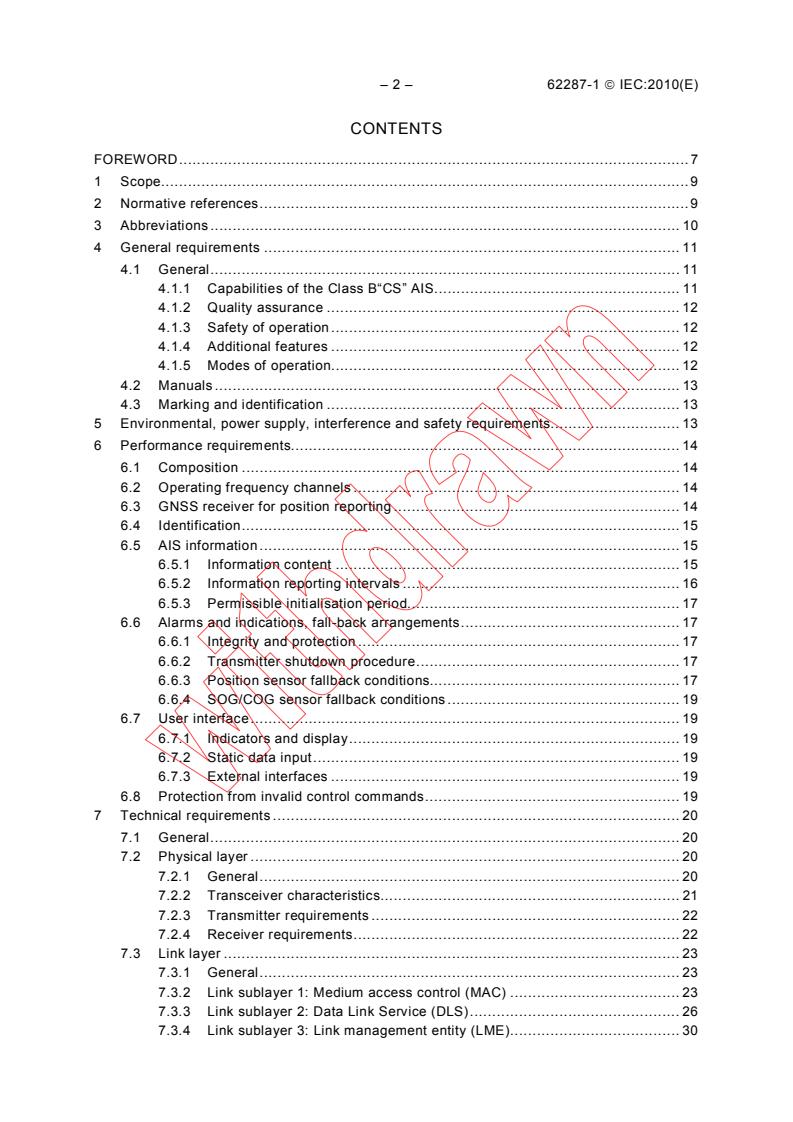
CONTENTS
FOREW ORD . 7
INTRODUCTION to Amendment 1 .9
1 Scope . 10
2 Normative references . 10
3 Abbreviations . 11
4 General requirements . 12
4.1 General . 12
4.1.1 Capabilities of the Class B“CS” AIS. 12
4.1.2 Quality assurance . 13
4.1.3 Safety of operation . 13
4.1.4 Additional features . 13
4.1.5 Modes of operation. 13
4.2 Manuals . 14
4.3 Marking and identification . 14
5 Environmental, power supply, interference and safety requirements. 14
6 Performance requirements. 15
6.1 Composition . 15
6.2 Operating frequency channels . 15
6.3 GNSS receiver for position reporting . 15
6.4 Identification . 16
6.5 AIS information . 16
6.5.1 Information content . 16
6.5.2 Information reporting intervals . 17
6.5.3 Permissible initialisation period. 18
6.6 Alarms and indications, fall-back arrangements . 18
6.6.1 Integrity and protection . 18
6.6.2 Transmitter shutdown procedure . 18
6.6.3 Position sensor fallback conditions. 18
6.6.4 SOG/COG sensor fallback conditions . 20
6.7 User interface . 20
6.7.1 Indicators and display . 20
6.7.2 Static data input . 20
6.7.3 External interfaces . 20
6.8 Protection from invalid control commands . 20
7 Technical requirements . 21
7.1 General . 21
7.2 Physical layer . 21
7.2.1 General . 21
7.2.2 Transceiver characteristics . 22
7.2.3 Transmitter requirements . 23
7.2.4 Receiver requirements . 23
7.3 Link layer . 24
7.3.1 General . 24
7.3.2 Link sublayer 1: Medium access control (MAC) . 24
7.3.3 Link sublayer 2: Data Link Service (DLS) . 27
62287-1ã IEC:2010+A1:2013(E) – 3 –
7.3.4 Link sublayer 3: Link management entity (LME) . 31
7.4 Network layer . 40
7.4.1 General . 40
7.4.2 Dual channel operation . 40
7.4.3 Channel management . 41
7.4.4 Distribution of transmission packets . 41
7.4.5 Data link congestion resolution . 41
7.5 Transport layer . 41
7.5.1 General . 41
7.5.2 Transmission packets . 42
7.5.3 Sequencing of data packets . 42
7.6 Digital selective calling (DSC) . 42
8 Test conditions . 42
8.1 General . 42
8.2 Normal and extreme test conditions . 42
8.2.1 Normal test conditions . 42
8.2.2 Extreme test conditions. 42
8.3 Test signals . 42
8.3.1 Standard test signal number 1 . 43
8.3.2 Standard test signal number 2 . 43
8.3.3 Standard test signal number 3 . 43
8.3.4 Standard test signal number 4 . 43
8.3.5 Standard test signal number 5 . 43
8.4 Test arrangements . 44
8.4.1 Standard test environment . 44
8.4.2 Modes of operation of the transmitter . 45
8.4.3 Common test conditions for protection from invalid controls . 45
8.4.4 Measurement uncertainties . 45
9 Power supply, environmental and EMC tests . 46
9.1 Test summary . 46
9.2 Vibration/shock . 47
9.2.1 Vibration . 47
9.2.2 Shock . 47
9.3 Performance tests/checks . 47
9.4 Undervoltage test (brown out) . 48
9.4.1 Purpose . 48
9.4.2 Method of test . 48
9.4.3 Required result . 48
10 Operational tests . 48
10.1 General . 48
10.1.1 Quality assurance . 48
10.1.2 Safety of operation . 48
10.1.3 Additional features . 48
10.2 Modes of operation . 49
10.2.1 Autonomous mode . 49
10.2.2 Assigned mode . 50
10.2.3 Polled mode/interrogation response . 51
10.3 Messages extending one time period . 52
10.3.1 Method of measurement . 52
– 4 – 62287-1ã IEC:2010+A1:2013(E)
10.3.2 Required results . 52
10.4 Channel selection . 52
10.4.1 Valid channels . 52
10.4.2 Invalid channels . 52
10.5 Internal GNSS receiver . 52
10.6 AIS information . 53
10.6.1 Information content . 53
10.6.2 Information update rates . 54
10.7 Initialisation period . 55
10.7.1 Method of measurement . 55
10.7.2 Required results . 55
10.8 Alarms and indications, fall-back arrangements . 56
10.8.1 Built-in integrity test . 56
10.8.2 Transceiver protection . 56
10.8.3 Transmitter shutdown procedure . 56
10.8.4 Position sensor fallback conditions. 56
10.8.5 Speed sensors . 57
10.9 User interface . 57
10.9.1 Display . 57
10.9.2 Message display . 58
10.9.3 Static data input . 58
10.9.4 External interfaces . 58
11 Physical tests . 58
11.1 TDMA transmitter . 58
11.1.1 Frequency error . 59
11.1.2 Carrier power . 59
11.1.3 Transmission spectrum . 60
11.1.4 Modulation accuracy . 61
11.1.5 Transmitter output power versus time function . 62
11.2 TDMA receivers . 63
11.2.1 Sensitivity . 63
11.2.2 Error behaviour at high input levels . 63
11.2.3 Co-channel rejection. 64
11.2.4 Adjacent channel selectivity . 65
11.2.5 Spurious response rejection . 65
11.2.6 Intermodulation response rejection . 68
11.2.7 Blocking or desensitisation . 69
11.3 Conducted spurious emissions . 70
11.3.1 Spurious emissions from the receiver . 70
11.3.2 Spurious emissions from the transmitter . 70
12 Specific tests of link layer . 71
12.1 TDMA synchronisation . 71
12.1.1 Synchronisation test sync mode 1 . 71
12.1.2 Synchronisation test sync mode 2 . 72
12.1.3 Synchronisation test with UTC . 72
12.2 Carrier-sense tests . 72
12.2.1 Threshold level . 72
12.2.2 Carrier-sense timing . 74
12.3 VDL state/reservations . 75
62287-1ã IEC:2010+A1:2013(E) – 5 –
12.3.1 Method of measurement . 75
12.3.2 Required results . 75
12.4 Data encoding (bit stuffing) . 75
12.4.1 Method of measurement . 75
12.4.2 Required results . 75
12.5 Frame check sequence . 75
12.5.1 Method of measurement . 75
12.5.2 Required results . 75
12.6 Slot allocation (channel access protocol) . 75
12.6.1 Autonomous mode allocation . 75
12.6.2 DSC listening periods . 76
12.7 Assigned operation . 76
12.7.1 Assignment priority . 76
12.7.2 Entering rate assignment . 76
12.7.3 Reverting from rate assignment . 77
12.7.4 Reverting from quiet mode . 77
12.7.5 Retry of interrogation response . 77
12.8 Message formats. 77
12.8.1 Received messages . 77
12.8.2 Transmitted messages . 78
13 Specific tests of network layer. 78
13.1 Regional area designation by VDL message . 78
13.1.1 Method of measurement . 78
13.1.2 Required results . 79
13.2 Regional area designation by serial message or manually . 79
13.2.1 Method of measurement . 79
13.2.2 Required result . 79
13.3 Management of received regional operating settings . 79
13.3.1 Replacement or erasure of dated or remote regional operating
settings . 79
13.3.2 Channel management by addressed Message 22 . 80
13.3.3 Invalid regional operating areas . 80
13.3.4 Continuation of autonomous mode reporting rate . 81
13.3.5 Other conditions . 81
Annex A (informative) Results of computer simulations and testing of CSTDMA
technology . 82
Annex B (informative) Description of the system . 85
Annex C (normative) DSC channel management . 86
Annex D (informative) Channel management regions . 93
Bibliography . 94
Figure 1 – OSI layer model . 21
Figure 2 – Carrier-Sense timing . 25
Figure 3 – Power versus time mask . 26
Figure 4 – Transmission packet . 27
Figure 5 – Training sequence . 29
Figure 6 – Transmission timing . 31
Figure 7 – Example for CSTDMA access . 32
– 6 – 62287-1ã IEC:2010+A1:2013(E)
Figure 8 – Format for repeating four-packet cluster . 43
Figure 9 – Measurement arrangement for carrier power . 59
Figure 10 – Emission mask . 60
Figure 11 – Measurement arrangement for modulation accuracy . 61
Figure 12 – Measurement arrangement. 63
Figure 13 – Measurement arrangement with two generators. 64
Figure 14 – SINAD or PER/BER measuring equipment . 66
Figure 15 – Measurement arrangement for intermodulation . 68
Figure 16 – Configuration for carrier-sense threshold test . 73
Figure 17 – Regional area scenario . 78
Figure A.1 – Effect on Class A AIS messages of Class B messages . 82
Figure A.2 – Reception of messages by Class A AIS . 83
Figure A.3 – Reception of messages by Class B AIS . 83
Figure A.4 – Range achieved by a Class A AIS from Class B AIS . 84
Figure D.1 – Channel management regions used for test given in 13.3.1 . 93
Table 1 – Position sensor fallback conditions . 19
Table 2 – Use of accuracy (PA) flag . 19
Table 3 – Transceiver characteristics . 22
Table 4 – Transmitter parameters . 23
Table 5 – Receiver parameters . 24
Table 6 – Definition of timings for Figure 3 . 26
Table 7 – Start-buffer . 28
Table 8 – Summary of the transmission packet . 30
Table 9 – Transmission timing . 30
Table 10 – Access parameters . 32
Table 11 – Use of VDL messages by a Class B”CS” AIS . 35
Table 12 – Number of data bits for use with Message 14 . 36
Table 13 – Contents of Message 18 . 37
Table 14 – Message 24 Part A . 38
Table 15 – Message 24 Part B . 38
Table 16 – Contents of Message 23 . 39
Table 17 – Reporting Interval Settings for use with Message 23 . 40
Table 18 – Channel management . 41
Table 19 – Content of first two packets . 43
Table 20 – Fixed PRS data derived from ITU-T.O.153 . 44
Table 21 – Test summary . 46
Table 22 – Peak frequency deviation versus time. 62
Table 23 – Frequencies for inter-modulation test . 69
Table 24 – Required threshold test results . 74
Table 25 – Required carrier-sense timing results . 74
Table 26 – Required channels in use . 79
Table C.1 – DSC monitoring times. 87
62287-1 IEC:2010+A1:2013(E) – 7 –
INTERNATIONAL ELECTROTECHNICAL COMMISSION
____________
MARITIME NAVIGATION AND RADIOCOMMUNICATION
EQUIPMENT AND SYSTEMS –
CLASS B SHIPBORNE EQUIPMENT OF
THE AUTOMATIC IDENTIFICATION SYSTEM (AIS) –
Part 1: Carrier-sense time division multiple access
(CSTDMA) techniques
FOREWORD
1) The International Electrotechnical Commission (IEC) is a worldwide organization for standardization comprising
all national electrotechnical committees (IEC National Committees). The object of IEC is to promote
international co-operation on all questions concerning standardization in the electrical and electronic fields. To
this end and in addition to other activities, IEC publishes International Standards, Technical Specifications,
Technical Reports, Publicly Available Specifications (PAS) and Guides (hereafter referred to as “IEC
Publication(s)”). Their preparation is entrusted to technical committees; any IEC National Committee interested
in the subject dealt with may participate in this preparatory work. International, governmental and non-
governmental organizations liaising with the IEC also participate in this preparation. IEC collaborates closely
with the International Organization for Standardization (ISO) in accordance with conditions determined by
agreement between the two organizations.
2) The formal decisions or agreements of IEC on technical matters express, as nearly as possible, an international
consensus of opinion on the relevant subjects since each technical committee has representation from all
interested IEC National Committees.
3) IEC Publications have the form of recommendations for international use and are accepted by IEC National
Committees in that sense. While all reasonable efforts are made to ensure that the technical content of IEC
Publications is accurate, IEC cannot be held responsible for the way in which they are used or for any
misinterpretation by any end user.
4) In order to promote international uniformity, IEC National Committees undertake to apply IEC Publications
transparently to the maximum extent possible in their national and regional publications. Any divergence
between any IEC Publication and the corresponding national or regional publication shall be clearly indicated in
the latter.
5) IEC itself does not provide any attestation of conformity. Independent certification bodies provide conformity
assessment services and, in some areas, access to IEC marks of conformity. IEC is not responsible for any
services carried out by independent certification bodies.
6) All users should ensure that they have the latest edition of this publication.
7) No liability shall attach to IEC or its directors, employees, servants or agents including individual experts and
members of its technical committees and IEC National Committees for any personal injury, property damage or
other damage of any nature whatsoever, whether direct or indirect, or for costs (including legal fees) and
expenses arising out of the publication, use of, or reliance upon, this IEC Publication or any other IEC
Publications.
8) Attention is drawn to the Normative references cited in this publication. Use of the referenced publications is
indispensable for the correct application of this publication.
9) Attention is drawn to the possibility that some of the elements of this IEC Publication may be the subject of
patent rights. IEC shall not be held responsible for identifying any or all such patent rights.
This consolidated version of IEC 62287-1 consists of the second edition (2010)
[documents 80/605/FDIS and 80/608/RVD] and its amendment 1 (2013) [documents
80/680/CDV and 80/695/RVC]. It bears the edition number 2.1.
The technical content is therefore identical to the base edition and its amendment and
has been prepared for user convenience. A vertical line in the margin shows where the
base publication has been modified by amendment 1. Additions and deletions are
displayed in red, with deletions being struck through.
– 8 – 62287-1ã IEC:2010+A1:2013(E)
International Standard IEC 62287-1 has been prepared by IEC technical committee 80:
Maritime navigation and radiocommunication equipment and systems.
The major technical changes with respect to the first edition are the following. The reference
to the relevant recommendation of the ITU has been updated from M.1371-1 to M.1371-4 with
some consequential small changes. A previous option of providing short safety-related
messages in 6.5.1.5 has been removed on advice from the IMO. A new requirement for a
default MMSI has been added in 6.4 and a further new requirement for protection from invalid
control commands has been added in 6.8. Some test methods have been updated and, in
particular, small revisions have been made to the frequencies used for testing in some of the
test methods. The introduction has been deleted since it is only of historic interest.
Some editorial rearrangement has been made.
This publication has been drafted in accordance with the ISO/IEC Directives, Part 2.
A list of all parts of the IEC 62287 series published under the general title Maritime navigation
and radiocommunication equipment and systems – Class B shipborne equipment of the
automatic identification system (AIS), can be found on the IEC website.
The committee has decided that the contents of the base publication and its amendment will
remain unchanged until the stability date indicated on the IEC web site under
"http://webstore.iec.ch" in the data related to the specific publication. At this date, the
publication will be
reconfirmed,
withdrawn,
replaced by a revised edition, or
amended.
A bilingual version of this publication may be issued at a later date.
IMPORTANT – The 'colour inside' logo on the cover page of this publication indicates
that it contains colours which are considered to be useful for the correct
understanding of its contents. Users should therefore print this document using a
colour printer.
62287-1ã IEC:2010+A1:2013(E) – 9 –
INTRODUCTION to Amendment 1
This amendment clarifies the conditions required for input of external GNSS position, the
associated tests and required results.
– 10 – 62287-1ã IEC:2010+A1:2013(E)
MARITIME NAVIGATION AND RADIOCOMMUNICATION
EQUIPMENT AND SYSTEMS –
CLASS B SHIPBORNE EQUIPMENT OF
THE AUTOMATIC IDENTIFICATION SYSTEM (AIS) –
Part 1: Carrier-sense time division multiple access
(CSTDMA) techniques
1 Scope
This part of IEC 62287 specifies the minimum operational and performance requirements,
methods of testing and required test results for Class B shipborne AIS equipment using
CSTDMA techniques. This standard takes into account other associated IEC International
Standards and existing national standards, as applicable.
It is applicable for AIS equipment used on craft that are not covered by the mandatory
carriage requirement of AIS under SOLAS Chapter V.
An AIS station intended to operate in receive-only mode is not considered a Class B
shipborne mobile AIS station.
2 Normative references
The following referenced documents are indispensable for the application of this document.
For dated references, only the edition cited applies. For undated references, the latest edition
of the referenced document (including any amendments) applies.
IEC 60945:2002, Maritime navigation and radiocommunication equipment and systems –
General requirements – Methods of testing and required test results
IEC 61108 (all parts), Maritime navigation and radiocommunication equipment and systems –
Global navigation satellite systems (GNSS)
IEC 61162 (all parts), Maritime navigation and radiocommunication equipment and systems –
Digital interfaces
IEC 61993-2, Maritime navigation and radiocommunication equipment and systems –
Automatic identification systems (AIS) – Part 2: Class A shipborne equipment of the universal
automatic identification system (AIS) – Operational and performance requirements, methods
of test and required test results
IEC 62320-1, Maritime navigation and radiocommunication equipment and systems –
Automatic identification systems (AIS) – Part 1: AIS Base Stations – Minimum operational and
performance requirements, methods of testing and required test results
IMO MSC.140(76), Recommendation for the protection of the AIS VHF data link
ITU-R Recommendation M.493-13, Digital selective-calling system for use in the maritime
mobile service
ITU-R Recommendation M.825-3, Characteristics of a transponder system using digital
selective calling techniques for use with vessel traffic services and ship-to-ship identification
62287-1ã IEC:2010+A1:2013(E) – 11 –
ITU-R Recommendation M.1084-4, Interim solutions for improved efficiency in the use of the
band 156-174 MHz by stations in the maritime mobile service
ITU-R Recommendation M.1371-4, Technical characteristics for a universal shipborne
automatic identification system using time division multiple access in the VHF maritime mobile
band
ITU Radio Regulations, Appendix 18, http://www.itu.int/publ/R-REG-RR/en
3 Abbreviations
AIS Automatic Identification System
BER Bit Error Rate
BT Bandwidth Time product
COG Course Over Ground
CP Candidate Period
CPU Central Processing Unit
CRC Cyclic Redundancy Check
CS Carrier-Sense
CSTDMA Carrier-Sense Time Division Multiple Access
DGNSS Differential Global Navigation Satellite System
DLS Data Link Service
DSC Digital Selective Calling
ECDIS Electronic Chart Display and Information System
EPFS Electronic Position Fixing System
ETA Estimated Time of Arrival
EUT Equipment Under Test
FCS Frame Check Sequence
FM Frequency Modulation
GMSK Gaussian Minimum Shift Keying
GNSS Global Navigation Satellite System
HDG Heading
HDLC High level Data Link Control
HSC High Speed Craft
IHO International Hydrographic Office
IMO International Maritime Organization
Lat Latitude
LME Link Management Entity
Lon Longitude
LR Long Range
MAC Medium Access Control
MMSI Maritime Mobile Service Identity
NM Nautical Miles (1 NM = 1 852 m)
NRZI Non Return to Zero Inverted
NTT Nominal Transmission Time
– 12 – 62287-1ã IEC:2010+A1:2013(E)
NUC Not Under Command
OSI Open System Interconnection model
P Steady state RF output power
ss
PER Packet Error Rate
PI Presentation Interface
PRS Pseudo Random Sequence
RAIM Receiver Autonomous Integrity Monitoring
RF Radio Frequency
RI Reporting Interval
Rx Receive
SINAD Signal Interference Noise and Distortion ratio
SOG Speed Over Ground
SOLAS International Convention for the Safety Of Life At Sea
TDMA Time Division Multiple Access
TI Transmission Interval
Tx Transmit
UTC Universal Time Co-ordinated
VDL VHF Data Link
VHF Very High Frequency
VSWR Voltage Standing Wave Ratio
VTS Vessel Traffic Services
NOTE Abbreviations related to the IEC 61162 series are not included in the above list. For their meaning refer to
that standard.
4 General requirements
4.1 General
4.1.1 Capabilities of the Class B“CS” AIS
The Class B“CS” AIS shall improve the safety of navigation by assisting in the efficient
navigation of ships and small craft, protection of the environment, and operation of Vessel
Traffic Services (VTS). Small craft are vessels which are not required to comply with the
mandatory carriage requirements of SOLAS Chapter V, Regulation 19.
The Class B“CS” AIS shall be capable of providing information from small craft, automatically,
continuously and with the required accuracy and update rate:
– in a ship-to-ship mode for collision avoidance;
– as a means for littoral States to obtain information about the craft; and
– as a VTS tool, i.e. ship-to-shore (traffic management).
The Class B”CS” AIS station shall be inter-operable and compatible with Class A or other
Class B shipborne mobile AIS stations or any other AIS station operating on the AIS VHF
Data Link. In particular, Class B”CS” AIS stations shall receive other stations, shall be
received by other stations and shall not degrade the integrity of the AIS VHF Data Link.
The Class B”CS” AIS shall only transmit if it has verified that the time period intended for
transmission does not interfere with transmissions made by AIS equipment defined in ITU-R
62287-1ã IEC:2010+A1:2013(E) – 13 –
M.1371-4 A1/2 (excluding Class B“CS”). Transmissions of the Class B”CS” AIS shall not
exceed one nominal time period (except when responding to a base station with Message 19).
4.1.2 Quality assurance
(see 10.1.1)
Manufacturers shall have a quality control system audited by a competent authority to ensure
continuous compliance with the requirements of this standard. Alternatively, the manufacturer
may use final product verification procedures where a competent authority verifies compliance
with the requirements of this standard before the product is put to the market.
NOTE The ISO 9000 series, as applicable, meets the requirements of a quality control system.
4.1.3 Safety of operation
(see 10.1.2)
It shall not be possible for the operator to augment, amend or erase any program software in
the equipment required for operation in accordance with the equipment standard. Data used
during operation and stored in the system shall be protected in such a way, that necessary
modifications and amendments by the user cannot affect its integrity and correctness.
4.1.4 Additional features
(see 10.1.3)
Where equipment provides a facility that is additional to the minimum requirements of this
standard, the operation and, as far as is reasonably practicable, the malfunction of such an
additional facility shall not degrade the performance of the equipment.
4.1.5 Modes of operation
4.1.5.1 General
The system shall be capable of operating in a number of modes as described below subject to
the transmission of messages by a competent authority. It shall not retransmit received
messages.
4.1.5.2 Autonomous and continuous mode
(see 10.2.1)
An "autonomous and continuous" mode for operation in all areas transmitting Message 18 for
scheduled position reporting and Message 24 for static data.
The Class B”CS” AIS shall be able to receive and process messages at any time except
during time periods of transmission.
4.1.5.3 Assigned mode
(see 10.2.2)
An "assigned" mode for operation in an area subject to a competent authority responsible for
traffic monitoring so that the reporting interval, silent mode and/or transceiver behaviour may
be set remotely by that authority using group assignment by Message 23.
– 14 – 62287-1ã IEC:2010+A1:2013(E)
4.1.5.4 Interrogation mode
(see 10.2.3)
A “polling" or “controlled” mode where the Class B“CS” AIS responds to interrogations by
Messages 18 and 24 from a Class A AIS, a SAR aircraft or a base station. A base station
interrogation for Message 19 specifying transmission offset shall also be answered. An
interrogation overrides a silent period defined by Message 23 (see 7.3.4.4.4).
NOTE Since Message 19 is a message occupying two time periods, this requires the reservation of the respective
time periods by Message 20 prior to interrogation.
A Class B“CS” AIS shall not interrogate other stations.
4.2 Manuals
The manuals shall include:
· the type of external connectors if applicable;
· the required information for correct siting of the antennas;
·
...
IEC 62287-1 ®
Edition 2.0 2010-11
INTERNATIONAL
STANDARD
colour
inside
Maritime navigation and radiocommunication equipment and systems – Class B
shipborne equipment of the automatic identification system (AIS) –
Part 1: Carrier-sense time division multiple access (CSTDMA) techniques
All rights reserved. Unless otherwise specified, no part of this publication may be reproduced or utilized in any form
or by any means, electronic or mechanical, including photocopying and microfilm, without permission in writing from
either IEC or IEC's member National Committee in the country of the requester.
If you have any questions about IEC copyright or have an enquiry about obtaining additional rights to this publication,
please contact the address below or your local IEC member National Committee for further information.
IEC Central Office
3, rue de Varembé
CH-1211 Geneva 20
Switzerland
Email: inmail@iec.ch
Web: www.iec.ch
About the IEC
The International Electrotechnical Commission (IEC) is the leading global organization that prepares and publishes
International Standards for all electrical, electronic and related technologies.
About IEC publications
The technical content of IEC publications is kept under constant review by the IEC. Please make sure that you have the
latest edition, a corrigenda or an amendment might have been published.
§ Catalogue of IEC publications: www.iec.ch/searchpub
The IEC on-line Catalogue enables you to search by a variety of criteria (reference number, text, technical committee,…).
It also gives information on projects, withdrawn and replaced publications.
§ IEC Just Published: www.iec.ch/online_news/justpub
Stay up to date on all new IEC publications. Just Published details twice a month all new publications released. Available
on-line and also by email.
§ Electropedia: www.electropedia.org
The world's leading online dictionary of electronic and electrical terms containing more than 20 000 terms and definitions
in English and French, with equivalent terms in additional languages. Also known as the International Electrotechnical
Vocabulary online.
§ Customer Service Centre: www.iec.ch/webstore/custserv
If you wish to give us your feedback on this publication or need further assistance, please visit the Customer Service
Centre FAQ or contact us:
Email: csc@iec.ch
Tel.: +41 22 919 02 11
Fax: +41 22 919 03 00
IEC 62287-1 ®
Edition 2.0 2010-11
INTERNATIONAL
STANDARD
colour
inside
Maritime navigation and radiocommunication equipment and systems – Class B
shipborne equipment of the automatic identification system (AIS) –
Part 1: Carrier-sense time division multiple access (CSTDMA) techniques
INTERNATIONAL
ELECTROTECHNICAL
COMMISSION
PRICE CODE
XD
ICS 47.020.70 ISBN 978-2-88912-257-8
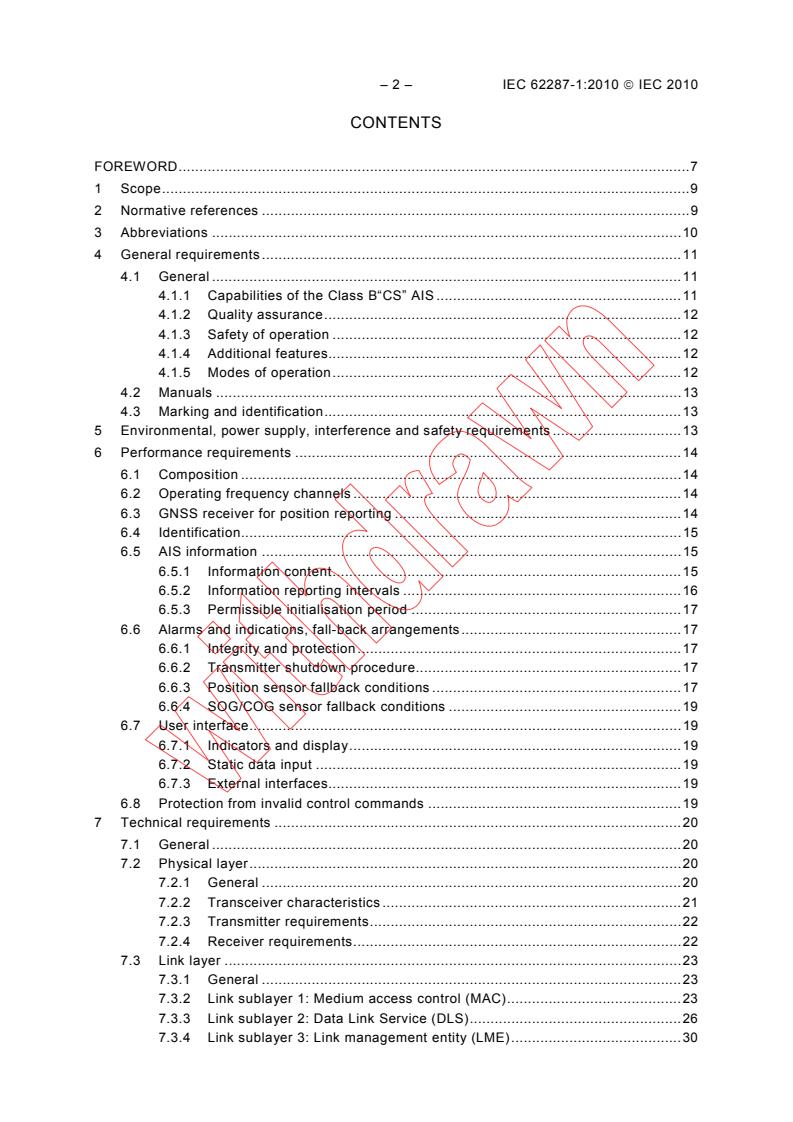
– 2 – 62287-1 ã IEC:2010(E)
CONTENTS
FOREW ORD . 7
1 Sc o pe . 9
2 Normative references . 9
3 Abbreviations . 10
4 General requirements . 11
4.1 General . 11
4.1.1 Capabilities of the Class B“CS” AIS. 11
4.1.2 Quality assurance . 12
4.1.3 Safety of operation . 12
4.1.4 Additional features . 12
4.1.5 Modes of operation. 12
4.2 Manuals . 13
4.3 Marking and identification . 13
5 Environmental, power supply, interference and safety requirements. 13
6 Performance requirements. 14
6.1 Composition . 14
6.2 Operating frequency channels . 14
6.3 GNSS receiver for position reporting . 14
6.4 Identification . 15
6.5 AIS information . 15
6.5.1 Information content . 15
6.5.2 Information reporting intervals . 16
6.5.3 Permissible initialisation period. 17
6.6 Alarms and indications, fall-back arrangements . 17
6.6.1 Integrity and protection . 17
6.6.2 Transmitter shutdown procedure . 17
6.6.3 Position sensor fallback conditions. 17
6.6.4 SOG/COG sensor fallback conditions . 19
6.7 User interface . 19
6.7.1 Indicators and display . 19
6.7.2 Static data input . 19
6.7.3 External interfaces . 19
6.8 Protection from invalid control commands . 19
7 Technical requirements . 20
7.1 General . 20
7.2 Physical layer . 20
7.2.1 General . 20
7.2.2 Transceiver characteristics . 21
7.2.3 Transmitter requirements . 22
7.2.4 Receiver requirements . 22
7.3 Link layer . 23
7.3.1 General . 23
7.3.2 Link sublayer 1: Medium access control (MAC) . 23
7.3.3 Link sublayer 2: Data Link Service (DLS) . 26
7.3.4 Link sublayer 3: Link management entity (LME) . 30
62287-1 ã IEC:2010(E) – 3 –
7.4 Network layer . 39
7.4.1 General . 39
7.4.2 Dual channel operation . 39
7.4.3 Channel management . 40
7.4.4 Distribution of transmission packets . 40
7.4.5 Data link congestion resolution . 40
7.5 Transport layer . 40
7.5.1 General . 40
7.5.2 Transmission packets . 41
7.5.3 Sequencing of data packets . 41
7.6 Digital selective calling (DSC) . 41
8 Test conditions . 41
8.1 General . 41
8.2 Normal and extreme test conditions . 41
8.2.1 Normal test conditions . 41
8.2.2 Extreme test conditions. 41
8.3 Test signals . 41
8.3.1 Standard test signal number 1 . 42
8.3.2 Standard test signal number 2 . 42
8.3.3 Standard test signal number 3 . 42
8.3.4 Standard test signal number 4 . 42
8.3.5 Standard test signal number 5 . 42
8.4 Test arrangements . 43
8.4.1 Standard test environment . 43
8.4.2 Modes of operation of the transmitter . 44
8.4.3 Common test conditions for protection from invalid controls . 44
8.4.4 Measurement uncertainties . 44
9 Power supply, environmental and EMC tests . 45
9.1 Test summary . 45
9.2 Vibration/shock . 46
9.2.1 Vibration . 46
9.2.2 Shock . 46
9.3 Performance tests/checks . 46
9.4 Undervoltage test (brown out) . 47
9.4.1 Purpose . 47
9.4.2 Method of test . 47
9.4.3 Required result . 47
10 Operational tests . 47
10.1 General . 47
10.1.1 Quality assurance . 47
10.1.2 Safety of operation . 47
10.1.3 Additional features . 47
10.2 Modes of operation . 48
10.2.1 Autonomous mode . 48
10.2.2 Assigned mode . 49
10.2.3 Polled mode/interrogation response . 50
10.3 Messages extending one time period . 51
10.3.1 Method of measurement . 51
10.3.2 Required results . 51
– 4 – 62287-1 ã IEC:2010(E)
10.4 Channel selection . 51
10.4.1 Valid channels . 51
10.4.2 Invalid channels . 51
10.5 Internal GNSS receiver . 51
10.6 AIS information . 52
10.6.1 Information content . 52
10.6.2 Information update rates . 53
10.7 Initialisation period . 54
10.7.1 Method of measurement . 54
10.7.2 Required results . 54
10.8 Alarms and indications, fall-back arrangements . 54
10.8.1 Built-in integrity test . 55
10.8.2 Transceiver protection . 55
10.8.3 Transmitter shutdown procedure . 55
10.8.4 Position sensor fallback conditions. 55
10.8.5 Speed sensors . 56
10.9 User interface . 56
10.9.1 Display . 56
10.9.2 Message display . 56
10.9.3 Static data input . 57
10.9.4 External interfaces . 57
11 Physical tests . 57
11.1 TDMA transmitter . 57
11.1.1 Frequency error . 57
11.1.2 Carrier power . 58
11.1.3 Transmission spectrum . 59
11.1.4 Modulation accuracy . 60
11.1.5 Transmitter output power versus time function . 61
11.2 TDMA receivers . 62
11.2.1 Sensitivity . 62
11.2.2 Error behaviour at high input levels . 62
11.2.3 Co-channel rejection. 63
11.2.4 Adjacent channel selectivity . 64
11.2.5 Spurious response rejection . 64
11.2.6 Intermodulation response rejection . 67
11.2.7 Blocking or desensitisation . 68
11.3 Conducted spurious emissions . 69
11.3.1 Spurious emissions from the receiver . 69
11.3.2 Spurious emissions from the transmitter . 69
12 Specific tests of link layer . 70
12.1 TDMA synchronisation . 70
12.1.1 Synchronisation test sync mode 1 . 70
12.1.2 Synchronisation test sync mode 2 . 71
12.1.3 Synchronisation test with UTC . 71
12.2 Carrier-sense tests . 71
12.2.1 Threshold level . 71
12.2.2 Carrier-sense timing . 73
12.3 VDL state/reservations . 74
12.3.1 Method of measurement . 74
62287-1 ã IEC:2010(E) – 5 –
12.3.2 Required results . 74
12.4 Data encoding (bit stuffing) . 74
12.4.1 Method of measurement . 74
12.4.2 Required results . 74
12.5 Frame check sequence . 74
12.5.1 Method of measurement . 74
12.5.2 Required results . 74
12.6 Slot allocation (channel access protocol) . 74
12.6.1 Autonomous mode allocation . 74
12.6.2 DSC listening periods . 75
12.7 Assigned operation . 75
12.7.1 Assignment priority . 75
12.7.2 Entering rate assignment . 75
12.7.3 Reverting from rate assignment . 76
12.7.4 Reverting from quiet mode . 76
12.7.5 Retry of interrogation response . 76
12.8 Message formats. 76
12.8.1 Received messages . 76
12.8.2 Transmitted messages . 77
13 Specific tests of network layer. 77
13.1 Regional area designation by VDL message . 77
13.1.1 Method of measurement . 77
13.1.2 Required results . 78
13.2 Regional area designation by serial message or manually . 78
13.2.1 Method of measurement . 78
13.2.2 Required result . 78
13.3 Management of received regional operating settings . 78
13.3.1 Replacement or erasure of dated or remote regional operating
settings . 78
13.3.2 Channel management by addressed Message 22 . 79
13.3.3 Invalid regional operating areas . 79
13.3.4 Continuation of autonomous mode reporting rate . 80
13.3.5 Other conditions . 80
Annex A (informative) Results of computer simulations and testing of CSTDMA
technology . 81
Annex B (informative) Description of the system . 84
Annex C (normative) DSC channel management . 85
Annex D (informative) Channel management regions . 92
Bibliography . 93
Figure 1 – OSI layer model . 20
Figure 2 – Carrier-Sense timing . 24
Figure 3 – Power versus time mask . 25
Figure 4 – Transmission packet . 26
Figure 5 – Training sequence . 28
Figure 6 – Transmission timing . 30
Figure 7 – Example for CSTDMA access . 31
Figure 8 – Format for repeating four-packet cluster . 42
– 6 – 62287-1 ã IEC:2010(E)
Figure 9 – Measurement arrangement for carrier power . 58
Figure 10 – Emission mask . 59
Figure 11 – Measurement arrangement for modulation accuracy . 60
Figure 12 – Measurement arrangement. 62
Figure 13 – Measurement arrangement with two generators. 63
Figure 14 – SINAD or PER/BER measuring equipment . 65
Figure 15 – Measurement arrangement for intermodulation . 67
Figure 16 – Configuration for carrier-sense threshold test . 72
Figure 17 – Regional area scenario . 77
Figure A.1 – Effect on Class A AIS messages of Class B messages . 81
Figure A.2 – Reception of messages by Class A AIS . 82
Figure A.3 – Reception of messages by Class B AIS . 82
Figure A.4 – Range achieved by a Class A AIS from Class B AIS . 83
Figure D.1 – Channel management regions used for test given in 13.3.1 . 92
Table 1 – Position sensor fallback conditions . 18
Table 2 – Use of accuracy (PA) flag . 18
Table 3 – Transceiver characteristics . 21
Table 4 – Transmitter parameters . 22
Table 5 – Receiver parameters . 23
Table 6 – Definition of timings for Figure 3 . 25
Table 7 – Start-buffer . 27
Table 8 – Summary of the transmission packet . 29
Table 9 – Transmission timing . 29
Table 10 – Access parameters . 31
Table 11 – Use of VDL messages by a Class B”CS” AIS . 34
Table 12 – Number of data bits for use with Message 14 . 35
Table 13 – Contents of Message 18 . 36
Table 14 – Message 24 Part A . 37
Table 15 – Message 24 Part B . 37
Table 16 – Contents of Message 23 . 38
Table 17 – Reporting Interval Settings for use with Message 23 . 39
Table 18 – Channel management . 40
Table 19 – Content of first two packets . 42
Table 20 – Fixed PRS data derived from ITU-T.O.153 . 43
Table 21 – Test summary . 45
Table 22 – Peak frequency deviation versus time. 61
Table 23 – Frequencies for inter-modulation test . 68
Table 24 – Required threshold test results . 73
Table 25 – Required carrier-sense timing results . 73
Table 26 – Required channels in use . 78
Table C.1 – DSC monitoring times. 86
62287-1 ã IEC:2010(E) – 7 –
INTERNATIONAL ELECTROTECHNICAL COMMISSION
____________
MARITIME NAVIGATION AND RADIOCOMMUNICATION
EQUIPMENT AND SYSTEMS –
CLASS B SHIPBORNE EQUIPMENT OF
THE AUTOMATIC IDENTIFICATION SYSTEM (AIS) –
Part 1: Carrier-sense time division multiple access
(CSTDMA) techniques
FOREWORD
1) The International Electrotechnical Commission (IEC) is a worldwide organization for standardization comprising
all national electrotechnical committees (IEC National Committees). The object of IEC is to promote
international co-operation on all questions concerning standardization in the electrical and electronic fields. To
this end and in addition to other activities, IEC publishes International Standards, Technical Specifications,
Technical Reports, Publicly Available Specifications (PAS) and Guides (hereafter referred to as “IEC
Publication(s)”). Their preparation is entrusted to technical committees; any IEC National Committee interested
in the subject dealt with may participate in this preparatory work. International, governmental and non-
governmental organizations liaising with the IEC also participate in this preparation. IEC collaborates closely
with the International Organization for Standardization (ISO) in accordance with conditions determined by
agreement between the two organizations.
2) The formal decisions or agreements of IEC on technical matters express, as nearly as possible, an international
consensus of opinion on the relevant subjects since each technical committee has representation from all
interested IEC National Committees.
3) IEC Publications have the form of recommendations for international use and are accepted by IEC National
Committees in that sense. While all reasonable efforts are made to ensure that the technical content of IEC
Publications is accurate, IEC cannot be held responsible for the way in which they are used or for any
misinterpretation by any end user.
4) In order to promote international uniformity, IEC National Committees undertake to apply IEC Publications
transparently to the maximum extent possible in their national and regional publications. Any divergence
between any IEC Publication and the corresponding national or regional publication shall be clearly indicated in
the latter.
5) IEC itself does not provide any attestation of conformity. Independent certification bodies provide conformity
assessment services and, in some areas, access to IEC marks of conformity. IEC is not responsible for any
services carried out by independent certification bodies.
6) All users should ensure that they have the latest edition of this publication.
7) No liability shall attach to IEC or its directors, employees, servants or agents including individual experts and
members of its technical committees and IEC National Committees for any personal injury, property damage or
other damage of any nature whatsoever, whether direct or indirect, or for costs (including legal fees) and
expenses arising out of the publication, use of, or reliance upon, this IEC Publication or any other IEC
Publications.
8) Attention is drawn to the Normative references cited in this publication. Use of the referenced publications is
indispensable for the correct application of this publication.
9) Attention is drawn to the possibility that some of the elements of this IEC Publication may be the subject of
patent rights. IEC shall not be held responsible for identifying any or all such patent rights.
International Standard IEC 62287-1 has been prepared by IEC technical committee 80:
Maritime navigation and radiocommunication equipment and systems.
This second edition cancels and replaces the first edition published in 2006, and constitutes a
technical revision.
The major technical changes with respect to the first edition are the following. The reference
to the relevant recommendation of the ITU has been updated from M.1371-1 to M.1371-4 with
some consequential small changes. A previous option of providing short safety-related
messages in 6.5.1.5 has been removed on advice from the IMO. A new requirement for a
default MMSI has been added in 6.4 and a further new requirement for protection from invalid
control commands has been added in 6.8. Some test methods have been updated and, in
– 8 – 62287-1 ã IEC:2010(E)
particular, small revisions have been made to the frequencies used for testing in some of the
test methods. The introduction has been deleted since it is only of historic interest.
Some editorial rearrangement has been made.
The text of this standard is based on the following documents:
FDIS Report on voting
80/605/FDIS 80/608/RVD
Full information on the voting for the approval of this standard can be found in the report on
voting indicated in the above table.
This publication has been drafted in accordance with the ISO/IEC Directives, Part 2.
A list of all parts of the IEC 62287 series published under the general title Maritime navigation
and radiocommunication equipment and systems – Class B shipborne equipment of the
automatic identification system (AIS), can be found on the IEC website.
The committee has decided that the contents of this publication will remain unchanged until
the stability date indicated on the IEC web site under "http://webstore.iec.ch" in the data
related to the specific publication. At this date, the publication will be
reconfirmed,
withdrawn,
replaced by a revised edition, or
amended.
A bilingual version of this publication may be issued at a later date.
IMPORTANT – The 'colour inside' logo on the cover page of this publication indicates
that it contains colours which are considered to be useful for the correct
understanding of its contents. Users should therefore print this document using a
colour printer.
62287-1 ã IEC:2010(E) – 9 –
MARITIME NAVIGATION AND RADIOCOMMUNICATION
EQUIPMENT AND SYSTEMS –
CLASS B SHIPBORNE EQUIPMENT OF
THE AUTOMATIC IDENTIFICATION SYSTEM (AIS) –
Part 1: Carrier-sense time division multiple access
(CSTDMA) techniques
1 Scope
This part of IEC 62287 specifies the minimum operational and performance requirements,
methods of testing and required test results for Class B shipborne AIS equipment using
CSTDMA techniques. This standard takes into account other associated IEC International
Standards and existing national standards, as applicable.
It is applicable for AIS equipment used on craft that are not covered by the mandatory
carriage requirement of AIS under SOLAS Chapter V.
An AIS station intended to operate in receive-only mode is not considered a Class B
shipborne mobile AIS station.
2 Normative references
The following referenced documents are indispensable for the application of this document.
For dated references, only the edition cited applies. For undated references, the latest edition
of the referenced document (including any amendments) applies.
IEC 60945:2002, Maritime navigation and radiocommunication equipment and systems –
General requirements – Methods of testing and required test results
IEC 61108 (all parts), Maritime navigation and radiocommunication equipment and systems –
Global navigation satellite systems (GNSS)
IEC 61162 (all parts), Maritime navigation and radiocommunication equipment and systems –
Digital interfaces
IEC 61993-2, Maritime navigation and radiocommunication equipment and systems –
Automatic identification systems (AIS) – Part 2: Class A shipborne equipment of the universal
automatic identification system (AIS) – Operational and performance requirements, methods
of test and required test results
IEC 62320-1, Maritime navigation and radiocommunication equipment and systems –
Automatic identification systems (AIS) – Part 1: AIS Base Stations – Minimum operational and
performance requirements, methods of testing and required test results
IMO MSC.140(76), Recommendation for the protection of the AIS VHF data link
ITU-R Recommendation M.493-13, Digital selective-calling system for use in the maritime
mobile service
ITU-R Recommendation M.825-3, Characteristics of a transponder system using digital
selective calling techniques for use with vessel traffic services and ship-to-ship identification
– 10 – 62287-1 ã IEC:2010(E)
ITU-R Recommendation M.1084-4, Interim solutions for improved efficiency in the use of the
band 156-174 MHz by stations in the maritime mobile service
ITU-R Recommendation M.1371-4, Technical characteristics for a universal shipborne
automatic identification system using time division multiple access in the VHF maritime mobile
band
ITU Radio Regulations, Appendix 18, http://www.itu.int/publ/R-REG-RR/en
3 Abbreviations
AIS Automatic Identification System
BER Bit Error Rate
BT Bandwidth Time product
COG Course Over Ground
CP Candidate Period
CPU Central Processing Unit
CRC Cyclic Redundancy Check
CS Carrier-Sense
CSTDMA Carrier-Sense Time Division Multiple Access
DGNSS Differential Global Navigation Satellite System
DLS Data Link Service
DSC Digital Selective Calling
ECDIS Electronic Chart Display and Information System
EPFS Electronic Position Fixing System
ETA Estimated Time of Arrival
EUT Equipment Under Test
FCS Frame Check Sequence
FM Frequency Modulation
GMSK Gaussian Minimum Shift Keying
GNSS Global Navigation Satellite System
HDG Heading
HDLC High level Data Link Control
HSC High Speed Craft
IHO International Hydrographic Office
IMO International Maritime Organization
Lat Latitude
LME Link Management Entity
Lon Longitude
LR Long Range
MAC Medium Access Control
MMSI Maritime Mobile Service Identity
NM Nautical Miles (1 NM = 1 852 m)
NRZI Non Return to Zero Inverted
NTT Nominal Transmission Time
62287-1 ã IEC:2010(E) – 11 –
NUC Not Under Command
OSI Open System Interconnection model
P Steady state RF output power
ss
PER Packet Error Rate
PI Presentation Interface
PRS Pseudo Random Sequence
RAIM Receiver Autonomous Integrity Monitoring
RF Radio Frequency
RI Reporting Interval
Rx Receive
SINAD Signal Interference Noise and Distortion ratio
SOG Speed Over Ground
SOLAS International Convention for the Safety Of Life At Sea
TDMA Time Division Multiple Access
TI Transmission Interval
Tx Transmit
UTC Universal Time Co-ordinated
VDL VHF Data Link
VHF Very High Frequency
VSWR Voltage Standing Wave Ratio
VTS Vessel Traffic Services
NOTE Abbreviations related to the IEC 61162 series are not included in the above list. For their meaning refer to
that standard.
4 General requirements
4.1 General
4.1.1 Capabilities of the Class B“CS” AIS
The Class B“CS” AIS shall improve the safety of navigation by assisting in the efficient
navigation of ships and small craft, protection of the environment, and operation of Vessel
Traffic Services (VTS). Small craft are vessels which are not required to comply with the
mandatory carriage requirements of SOLAS Chapter V, Regulation 19.
The Class B“CS” AIS shall be capable of providing information from small craft, automatically,
continuously and with the required accuracy and update rate:
– in a ship-to-ship mode for collision avoidance;
– as a means for littoral States to obtain information about the craft; and
– as a VTS tool, i.e. ship-to-shore (traffic management).
The Class B”CS” AIS station shall be inter-operable and compatible with Class A or other
Class B shipborne mobile AIS stations or any other AIS station operating on the AIS VHF
Data Link. In particular, Class B”CS” AIS stations shall receive other stations, shall be
received by other stations and shall not degrade the integrity of the AIS VHF Data Link.
The Class B”CS” AIS shall only transmit if it has verified that the time period intended for
transmission does not interfere with transmissions made by AIS equipment defined in ITU-R
– 12 – 62287-1 ã IEC:2010(E)
M.1371-4 A1/2 (excluding Class B“CS”). Transmissions of the Class B”CS” AIS shall not
exceed one nominal time period (except when responding to a base station with Message 19).
4.1.2 Quality assurance
(see 10.1.1)
Manufacturers shall have a quality control system audited by a competent authority to ensure
continuous compliance with the requirements of this standard. Alternatively, the manufacturer
may use final product verification procedures where a competent authority verifies compliance
with the requirements of this standard before the product is put to the market.
NOTE The ISO 9000 series, as applicable, meets the requirements of a quality control system.
4.1.3 Safety of operation
(see 10.1.2)
It shall not be possible for the operator to augment, amend or erase any program software in
the equipment required for operation in accordance with the equipment standard. Data used
during operation and stored in the system shall be protected in such a way, that necessary
modifications and amendments by the user cannot affect its integrity and correctness.
4.1.4 Additional features
(see 10.1.3)
Where equipment provides a facility that is additional to the minimum requirements of this
standard, the operation and, as far as is reasonably practicable, the malfunction of such an
additional facility shall not degrade the performance of the equipment.
4.1.5 Modes of operation
4.1.5.1 General
The system shall be capable of operating in a number of modes as described below subject to
the transmission of messages by a competent authority. It shall not retransmit received
messages.
4.1.5.2 Autonomous and continuous mode
(see 10.2.1)
An "autonomous and continuous" mode for operation in all areas transmitting Message 18 for
scheduled position reporting and Message 24 for static data.
The Class B”CS” AIS shall be able to receive and process messages at any time except
during time periods of transmission.
4.1.5.3 Assigned mode
(see 10.2.2)
An "assigned" mode for operation in an area subject to a competent authority responsible for
traffic monitoring so that the reporting interval, silent mode and/or transceiver behaviour may
be set remotely by that authority using group assignment by Message 23.
62287-1 ã IEC:2010(E) – 13 –
4.1.5.4 Interrogation mode
(see 10.2.3)
A “polling" or “controlled” mode where the Class B“CS” AIS responds to interrogations by
Messages 18 and 24 from a Class A AIS, a SAR aircraft or a base station. A base station
interrogation for Message 19 specifying transmission offset shall also be answered. An
interrogation overrides a silent period defined by Message 23 (see 7.3.4.4.4).
NOTE Since Message 19 is a message occupying two time periods, this requires the reservation of the respective
time periods by Message 20 prior to interrogation.
A Class B“CS” AIS shall not interrogate other stations.
4.2 Manuals
The manuals shall include:
· the type of external connectors if applicable;
· the required information for correct siting of the antennas;
· the required information for compass safe distance.
4.3 Marking and identification
Each unit of the equipment shall be marked externally with the following information which,
where practicable, shall be clearly visible when the equipment is installed in its recommended
position:
· identification of the manufacturer;
· equipment type number or model identification;
· s
...
IEC 62287-1 ®
Edition 2.1 2013-04
CONSOLIDATED
VERSION
VERSION
CONSOLIDÉE
colour
inside
Maritime navigation and radiocommunication equipment and systems – Class B
shipborne equipment of the automatic identification system (AIS) –
Part 1: Carrier-sense time division multiple access (CSTDMA) techniques
Matériels et systèmes de navigation et de radiocommunication maritimes –
Transpondeur embarqué du système d'identification automatique (AIS) de
classe B –
Partie 1: Technique d'accès multiple par répartition dans le temps avec écoute
de porteuse (CSTDMA)
All rights reserved. Unless otherwise specified, no part of this publication may be reproduced or utilized in any form
or by any means, electronic or mechanical, including photocopying and microfilm, without permission in writing from
either IEC or IEC's member National Committee in the country of the requester. If you have any questions about IEC
copyright or have an enquiry about obtaining additional rights to this publication, please contact the address below or
your local IEC member National Committee for further information.
Droits de reproduction réservés. Sauf indication contraire, aucune partie de cette publication ne peut être reproduite
ni utilisée sous quelque forme que ce soit et par aucun procédé, électronique ou mécanique, y compris la photocopie
et les microfilms, sans l'accord écrit de l'IEC ou du Comité national de l'IEC du pays du demandeur. Si vous avez des
questions sur le copyright de l'IEC ou si vous désirez obtenir des droits supplémentaires sur cette publication, utilisez
les coordonnées ci-après ou contactez le Comité national de l'IEC de votre pays de résidence.
IEC Central Office Tel.: +41 22 919 02 11
3, rue de Varembé Fax: +41 22 919 03 00
CH-1211 Geneva 20 info@iec.ch
Switzerland www.iec.ch
About the IEC
The International Electrotechnical Commission (IEC) is the leading global organization that prepares and publishes
International Standards for all electrical, electronic and related technologies.
About IEC publications
The technical content of IEC publications is kept under constant review by the IEC. Please make sure that you have the
latest edition, a corrigenda or an amendment might have been published.
IEC Catalogue - webstore.iec.ch/catalogue Electropedia - www.electropedia.org
The stand-alone application for consulting the entire The world's leading online dictionary of electronic and
bibliographical information on IEC International Standards, electrical terms containing 20 000 terms and definitions in
Technical Specifications, Technical Reports and other English and French, with equivalent terms in 15 additional
documents. Available for PC, Mac OS, Android Tablets and languages. Also known as the International Electrotechnical
iPad. Vocabulary (IEV) online.
IEC publications search - www.iec.ch/searchpub IEC Glossary - std.iec.ch/glossary
The advanced search enables to find IEC publications by a 65 000 electrotechnical terminology entries in English and
variety of criteria (reference number, text, technical French extracted from the Terms and Definitions clause of
committee,…). It also gives information on projects, replaced IEC publications issued since 2002. Some entries have been
and withdrawn publications. collected from earlier publications of IEC TC 37, 77, 86 and
CISPR.
IEC Just Published - webstore.iec.ch/justpublished
Stay up to date on all new IEC publications. Just Published IEC Customer Service Centre - webstore.iec.ch/csc
details all new publications released. Available online and If you wish to give us your feedback on this publication or
also once a month by email. need further assistance, please contact the Customer Service
Centre: csc@iec.ch.
A propos de l'IEC
La Commission Electrotechnique Internationale (IEC) est la première organisation mondiale qui élabore et publie des
Normes internationales pour tout ce qui a trait à l'électricité, à l'électronique et aux technologies apparentées.
A propos des publications IEC
Le contenu technique des publications IEC est constamment revu. Veuillez vous assurer que vous possédez l’édition la
plus récente, un corrigendum ou amendement peut avoir été publié.
Catalogue IEC - webstore.iec.ch/catalogue Electropedia - www.electropedia.org
Application autonome pour consulter tous les renseignements
Le premier dictionnaire en ligne de termes électroniques et
bibliographiques sur les Normes internationales,
électriques. Il contient 20 000 termes et définitions en anglais
Spécifications techniques, Rapports techniques et autres
et en français, ainsi que les termes équivalents dans 15
documents de l'IEC. Disponible pour PC, Mac OS, tablettes
langues additionnelles. Egalement appelé Vocabulaire
Android et iPad.
Electrotechnique International (IEV) en ligne.
Recherche de publications IEC - www.iec.ch/searchpub
Glossaire IEC - std.iec.ch/glossary
La recherche avancée permet de trouver des publications IEC
65 000 entrées terminologiques électrotechniques, en anglais
en utilisant différents critères (numéro de référence, texte,
et en français, extraites des articles Termes et Définitions des
comité d’études,…). Elle donne aussi des informations sur les
publications IEC parues depuis 2002. Plus certaines entrées
projets et les publications remplacées ou retirées.
antérieures extraites des publications des CE 37, 77, 86 et
CISPR de l'IEC.
IEC Just Published - webstore.iec.ch/justpublished
Restez informé sur les nouvelles publications IEC. Just Service Clients - webstore.iec.ch/csc
Published détaille les nouvelles publications parues. Si vous désirez nous donner des commentaires sur cette
Disponible en ligne et aussi une fois par mois par email. publication ou si vous avez des questions contactez-nous:
csc@iec.ch.
IEC 62287-1 ®
Edition 2.1 2013-04
CONSOLIDATED
VERSION
VERSION
CONSOLIDÉE
colour
inside
Maritime navigation and radiocommunication equipment and systems – Class B
shipborne equipment of the automatic identification system (AIS) –
Part 1: Carrier-sense time division multiple access (CSTDMA) techniques
Matériels et systèmes de navigation et de radiocommunication maritimes –
Transpondeur embarqué du système d'identification automatique (AIS) de
classe B –
Partie 1: Technique d'accès multiple par répartition dans le temps avec écoute
de porteuse (CSTDMA)
INTERNATIONAL
ELECTROTECHNICAL
COMMISSION
COMMISSION
ELECTROTECHNIQUE
INTERNATIONALE
ICS 47.020.70 ISBN 978-2-8322-3131-9
IEC 62287-1 ®
Edition 2.1 2013-04
REDLINE VERSION
VERSION REDLINE
colour
inside
Maritime navigation and radiocommunication equipment and systems – Class B
shipborne equipment of the automatic identification system (AIS) –
Part 1: Carrier-sense time division multiple access (CSTDMA) techniques
Matériels et systèmes de navigation et de radiocommunication maritimes –
Transpondeur embarqué du système d'identification automatique (AIS) de
classe B –
Partie 1: Technique d'accès multiple par répartition dans le temps avec écoute
de porteuse (CSTDMA)
– 2 – IEC 62287-1:2010+AMD1:2013 CSV
IEC 2013
CONTENTS
FO R EW O RD . 8
INTRODUCTION to Amendment 1 . 10
1 Sc op e . 11
2 Normative references . 11
3 Abbreviations . 12
4 General requirem ents . 13
4.1 General . 13
4.1.1 Capabilities of the Class B“CS” AIS . 13
4.1.2 Quality assurance . 14
4.1.3 Safety of operation . 14
4.1.4 Additional features. 14
4.1.5 Modes of operation . 14
4.2 Manuals . 15
4.3 Marking and identification . 15
5 Environmental, power supply, interference and safety requirements . 15
6 Performance requirements . 16
6.1 Composition . 16
6.2 Operating frequency channels . 16
6.3 GNSS receiver for position reporting . 16
6.4 Id e nt if ic at i o n . 17
6.5 AIS information . 17
6.5.1 Information content . 17
6.5.2 Information reporting intervals . 18
6.5.3 Permissible initialisation period . 19
6.6 Alarms and indications, fall-back arrang em en ts . 19
6.6.1 Integrity and protection . 19
6.6.2 Transmitter shutdown procedure. 19
6.6.3 Position sensor fallback conditions . 19
6.6.4 SOG/COG sensor fallback conditions . 21
6.7 User interface . 21
6.7.1 Indicators and display . 21
6.7.2 Static data input . 21
6.7.3 External in t erf ac es . 21
6.8 Protection from invalid control commands . 21
7 Technical requirements . 22
7.1 General . 22
7.2 Physical layer . 22
7.2.1 General . 22
7.2.2 Transceiver characteristics . 23
7.2.3 Transmitter requirements . 24
7.2.4 Receiver requirements . 24
7.3 Link layer . 25
7.3.1 General . 25
7.3.2 Link sublayer 1: Medium access control (MAC) . 25
7.3.3 Link sublayer 2: Data Link Service (DLS) . 28
IEC 2013
7.3.4 Link sublayer 3: Link management entity (LME) . 32
7.4 Network layer . 41
7.4.1 General . 41
7.4.2 Dual channel operation . 41
7.4.3 Channel management . 42
7.4.4 Distribution of transmission packets. 42
7.4.5 Data link congestion resolution . 42
7.5 Transport layer . 42
7.5.1 General . 42
7.5.2 Transmission packets . 43
7.5.3 Sequencing of data packets . 43
7.6 Digital selective calling (DSC) . 43
8 Test conditions . 43
8.1 General . 43
8.2 Normal and extreme test conditions. 43
8.2.1 Normal test conditions . 43
8.2.2 Extreme test conditions . 43
8.3 Test signals . 43
8.3.1 Standard test signal number 1 . 44
8.3.2 Standard test signal number 2 . 44
8.3.3 Standard test signal number 3 . 44
8.3.4 Standard test signal number 4 . 44
8.3.5 Standard test signal number 5 . 44
8.4 Test arrangements . 45
8.4.1 Standard test e n v ir onm e n t . 45
8.4.2 Modes of operation of the transmitter . 46
8.4.3 Common test conditions for protection from invalid controls . 46
8.4.4 Measurement uncertainties . 46
9 Power supply, environmental and EMC tests . 47
9.1 Test summary . 47
9.2 Vibration/shock . 48
9.2.1 V i b r a t io n . 48
9.2.2 Shock . 48
9.3 Performance tests/checks . 48
9.4 Undervoltage test (brown out) . 49
9.4.1 P u r p os e . 49
9.4.2 Method of test . 49
9.4.3 Required result . 49
10 Operational tests . 49
10.1 General . 49
10.1.1 Quality assurance . 49
10.1.2 Safety of operation . 49
10.1.3 Additional features. 49
10.2 Modes of operation . 50
10.2.1 Autonomous mode . 50
10.2.2 Assigned mode . 51
10.2.3 Polled mode/interrogation response . 52
10.3 Messages extending one time period . 53
10.3.1 Method of measurement . 53
– 4 – IEC 62287-1:2010+AMD1:2013 CSV
IEC 2013
10.3.2 Required results . 53
10.4 Channel selection . 53
10.4.1 Valid channels . 53
10.4.2 Invalid channels . 53
10.5 Internal GNSS receiver . 53
10.6 AIS information . 54
10.6.1 Information content . 54
10.6.2 Information update rates . 55
10.7 Initialisation period . 56
10.7.1 Method of measurement . 56
10.7.2 Required results . 56
10.8 Alarms and indications, fall-back arrang em en ts . 56
10.8.1 Built-in integrity test . 57
10.8.2 Transceiver protection . 57
10.8.3 Transmitter shutdown procedure. 57
10.8.4 Position sensor fallback conditions . 57
10.8.5 Speed sensors . 58
10.9 User interface . 58
10.9.1 Display . 58
10.9.2 Message display . 58
10.9.3 Static data input . 59
10.9.4 External in t erf ac es . 59
11 Physical tests . 59
11.1 TDMA transmitter . 59
11.1.1 Fre qu e nc y err or . 59
11.1.2 Carrier power . 60
11.1.3 Transmission spectrum . 61
11.1.4 Modulation accuracy . 62
11.1.5 Transmitter output power versus time function . 63
11.2 TDMA receivers . 64
11.2.1 S ens i ti v i t y . 64
11.2.2 Error behaviour at high input levels . 64
11.2.3 Co-channel rejection . 65
11.2.4 Adjacent channel selectivity . 66
11.2.5 Spurious response rejection . 66
11.2.6 Intermodulation response rejection . 69
11.2.7 Blocking or desensitisation . 70
11.3 Conducted spurious emissions . 71
11.3.1 Spurious emissions from the receiver . 71
11.3.2 Spurious emissions from the transmitter . 71
12 Specific tests of link layer . 72
12.1 TDMA synchronisation. 72
12.1.1 Synchronisation test sync mode 1. 72
12.1.2 Synchronisation test sync mode 2. 73
12.1.3 Synchronisation test with UTC . 73
12.2 Carrier-sense tests . 73
12.2.1 Threshold level . 73
12.2.2 Carrier-sense timing . 75
12.3 VDL state/reservations . 76
IEC 2013
12.3.1 Method of measurement . 76
12.3.2 Required results . 76
12.4 Data encoding (bit stuffing) . 76
12.4.1 Method of measurement . 76
12.4.2 Required results . 76
12.5 Frame check sequence . 76
12.5.1 Method of measurement . 76
12.5.2 Required results . 76
12.6 Slot allocation (channel access protocol) . 76
12.6.1 Autonomous mode allocation . 76
12.6.2 DSC listening periods . 77
12.7 Assigned operation . 77
12.7.1 Assignment priority . 77
12.7.2 Entering rate assignment . 77
12.7.3 Reverting from rate assignment . 78
12.7.4 Reverting from quiet mode. 78
12.7.5 Retry of interrogation response. 78
12.8 Message formats . 78
12.8.1 Received messages . 78
12.8.2 Transmitted messages. 79
13 Specific tests of network layer . 79
13.1 Regional area designation by VDL message . 79
13.1.1 Method of measurement . 79
13.1.2 Required results . 80
13.2 Regional area designation by serial message or manually . 80
13.2.1 Method of measurement . 80
13.2.2 Required result . 80
13.3 Management of received regional operating settings . 80
13.3.1 Replacement or erasure of dated or remote regional operating
settings . 80
13.3.2 Channel management by addressed Message 22 . 81
13.3.3 Invalid regional operating areas . 81
13.3.4 Continuation of autonomous mode reporting rate . 82
13.3.5 Other conditions . 82
Annex A (informative) Results of computer simulations and testing of CSTDMA
technology . 83
A.1 Computer simulations . 83
A.2 Carrier-sense tests . 84
A.3 Range tests . 85
A.4 Conclusion . 85
Annex B (informative) Description of the system . 86
Annex C (normative) DSC channel management . 87
C.1 DSC functionality . 87
C.2 DSC time sharing . 87
C.3 DSC functionality tests . 88
C.3.1 General . 88
C.3.2 Regional area designation . 88
C.3.3 Scheduling . 88
C.3.4 DSC flag in Message 18 . 88
– 6 – IEC 62287-1:2010+AMD1:2013 CSV
IEC 2013
C.3.5 DSC monitoring time plan . 88
C.3.6 Replacement or erasure of dated or remote regional operating
settings . 89
C.3.7 Test of addressed telecommand . 89
C.3.8 Invalid regional operating areas . 90
C.4 DSC receiver tests . 90
C.4.1 General . 90
C.4.2 Maximum sensitivity . 90
C.4.3 Error behaviour at high input levels . 91
C.4.4 Co-channel rejection . 91
C.4.5 Adjacent channel selectivity . 91
C.4.6 Spurious response rejection . 92
C.4.7 Intermodulation response rejection . 92
C.4.8 Blocking or desensitisation . 93
Annex D (informative) Channel management regions . 94
Bibliography . 95
Figure 1 – OSI layer model . 22
Figure 2 – Carrier-sense timing . 26
Figure 3 – Power versus time mask . 27
Figure 4 – Transmission packet . 28
Figure 5 – Training sequence. 30
Figure 6 – Transmission timing . 32
Figure 7 – Example for CSTDMA access . 33
Figure 8 – Format for repeating four-packet cluster . 44
Figure 9 – Measurement arrangement for carrier power . 60
Figure 10 – Emission mask . 61
Figure 11 – Measurement arrangement for modulation accuracy . 62
Figure 12 – Measurement arrangement . 64
Figure 13 – Measurement arrangement with two generators . 65
Figure 14 – SINAD or PER/BER measuring equipment . 67
Figure 15 – Measurement arrangement for intermodulation . 69
Figure 16 – Configuration for carrier-sense threshold test . 74
Figure 17 – Regional area scenario . 79
Figure A.1 – Effect on Class A AIS messages of Class B messages . 83
Figure A.2 – Reception of messages by Class A AIS . 84
Figure A.3 – Reception of messages by Class B AIS . 84
Figure A.4 – Range achieved by a Class A AIS from Class B AIS . 85
Figure D.1 – Channel management regions used for test given in 13.3.1 . 94
Table 1 – Position sensor fallback cond i t io ns . 20
Table 2 – Use of accuracy (PA) flag . 20
Table 3 – Transceiver characteristics . 23
Table 4 – Transmitter parameters . 24
Table 5 – Receiver parameters . 25
IEC 2013
Table 6 – Definition of timings for Figure 3 . 27
Table 7 – Start-buffer . 29
Table 8 – Summary of the transmission packet . 31
Table 9 – Transmission timing . 31
Table 10 – Access parameters . 33
Table 11 – Use of VDL messages by a Class B”CS” AIS . 36
Table 12 – Number of data bits for use with Message 14 . 37
Table 13 – Contents of Message 18 . 38
Table 14 – Message 24 Part A . 39
Table 15 – Message 24 Part B . 39
Table 16 – Contents of Message 23 . 40
Table 17 – Reporting interval settings for use with Message 23 . 41
Table 18 – Channel management . 42
Table 19 – Content of first two packets . 44
Table 20 – Fixed PRS data derived from ITU-T O.153 . 45
Table 21 – Test summary . 47
Table 22 – Peak frequency deviation versus time . 63
Table 23 – Frequencies for inter-modulation test . 70
Table 24 – Required threshold test results . 75
Table 25 – Required carrier-sense timing results . 75
Table 26 – Required channels in use . 80
Table C.1 – DSC monitoring times . 88
– 8 – IEC 62287-1:2010+AMD1:2013 CSV
IEC 2013
INTERNATIONAL ELECTROTECHNICAL COMMISSION
____________
MARITIME NAVIGATION AND RADIOCOMMUNICATION
EQUIPMENT AND SYSTEMS –
CLASS B SHIPBORNE EQUIPMENT OF
THE AUTOMATIC IDENTIFICATION SYSTEM (AIS) –
Part 1: Carrier-sense time division multiple access
(CSTDMA) techniques
FOREWORD
1) The International Electrotechnical Commission (IEC) is a worldwide organization for standardization comprising
all national electrotechnical committees (IEC National Committees). The object of IEC is to promote
international co-operation on all questions concerning standardization in the electrical and electronic fields. To
this end and in addition to other activities, IEC publishes International Standards, Technical Specifications,
Technical Reports, Publicly Available Specifications (PAS) and Guides (hereafter referred to as “IEC
Publication(s)”). Their preparation is entrusted to technical committees; any IEC National Committee interested
in the subject dealt with may participate in this preparatory work. International, governmental and non-
governmental organizations liaising with the IEC also participate in this preparation. IEC collaborates closely
with the International Organization for Standardization (ISO) in accordance with conditions determined by
agreement between the two organizations.
2) The formal decisions or agreements of IEC on technical matters express, as nearly as possible, an international
consensus of opinion on the relevant subjects since each technical committee has representation from all
interested IEC National Committees.
3) IEC Publications have the form of recommendations for international use and are accepted by IEC National
Committees in that sense. While all reasonable efforts are made to ensure that the technical content of IEC
Publications is accurate, IEC cannot be held responsible for the way in which they are used or for any
misinterpretation by any end user.
4) In order to promote international uniformity, IEC National Committees undertake to apply IEC Publications
transparently to the maximum extent possible in their national and regional publications. Any divergence
between any IEC Publication and the corresponding national or regional publication shall be clearly indicated in
the latter.
5) IEC itself does not provide any attestation of conformity. Independent certification bodies provide conformity
assessment services and, in some areas, access to IEC marks of conformity. IEC is not responsible for any
services carried out by independent certification bodies.
6) All users should ensure that they have the latest edition of this publication.
7) No liability shall attach to IEC or its directors, employees, servants or agents including individual experts and
members of its technical committees and IEC National Committees for any personal injury, property damage or
other damage of any nature whatsoever, whether direct or indirect, or for costs (including legal fees) and
expenses arising out of the publication, use of, or reliance upon, this IEC Publication or any other IEC
Publications.
8) Attention is drawn to the Normative references cited in this publication. Use of the referenced publications is
indispensable for the correct application of this publication.
9) Attention is drawn to the possibility that some of the elements of this IEC Publication may be the subject of
patent rights. IEC shall not be held responsible for identifying any or all such patent rights.
DISCLAIMER
This Consolidated version is not an official IEC Standard and has been prepared for
user convenience. Only the current versions of the standard and its amendment(s)
are to be considered the official documents.
This Consolidated version of IEC 62287-1 bears the edition number 2.1. It consists of
the second edition (2010-11) [documents 80/605/FDIS and 60/608/RVD] and its
amendment 1 (2013-04) [documents 80/680/CDV and 80/695/RVC]. The technical content
is identical to the base edition and its amendment.
IEC 2013
In this Redline version, a vertical line in the margin shows where the technical content
is modified by amendment 1. Additions are in green text, deletions are in strikethrough
red text. A separate Final version with all changes accepted is available in this
publication.
International Standard IEC 62287-1 has been prepared by IEC technical committee 80:
Maritime navigation and radiocommunication equipment and systems.
The major technical changes with respect to the first edition are the following. The reference
to the relevant recommendation of the ITU has been updated from M.1371-1 to M.1371-4 with
some consequential small changes. A previous option of providing short safety-related
messages in 6.5.1.5 has been removed on advice from the IMO. A new requirement for a
default MMSI has been added in 6.4 and a further new requirement for protection from invalid
control commands has been added in 6.8. Some test methods have been updated and, in
particular, small revisions have been made to the frequencies used for testing in some of the
test methods. The introduction has been deleted since it is only of historic interest.
Some editorial rearrangement has been made.
The French version of this standard has not been voted upon.
This publication has been drafted in accordance with the ISO/IEC Directives, Part 2.
A list of all parts of the IEC 62287 series published under the general title Maritime navigation
and radiocommunication equipment and systems – Class B shipborne equipment of the
automatic identification system (AIS), can be found on the IEC website.
The committee has decided that the contents of the base publication and its amendment will
remain unchanged until the stability date indicated on the IEC web site under
"http://webstore.iec.ch" in the data related to the specific publication. At this date, the
publication will be
• reconfirmed,
• withdrawn,
• replaced by a revised edition, or
• amended.
IMPORTANT – The 'colour inside' logo on the cover page of this publication in
...
IEC 62287-1 ®
Edition 2.0 2010-11
INTERNATIONAL
STANDARD
NORME
INTERNATIONALE
colour
inside
Maritime navigation and radiocommunication equipment and systems – Class B
shipborne equipment of the automatic identification system (AIS) –
Part 1: Carrier-sense time division multiple access (CSTDMA) techniques
Matériels et systèmes de navigation et de radiocommunication maritimes –
Transpondeur embarqué du système d'identification automatique (AIS) de
classe B –
Partie 1: Technique d'accès multiple par répartition dans le temps avec écoute
de porteuse (CSTDMA)
All rights reserved. Unless otherwise specified, no part of this publication may be reproduced or utilized in any form
or by any means, electronic or mechanical, including photocopying and microfilm, without permission in writing from
either IEC or IEC's member National Committee in the country of the requester. If you have any questions about IEC
copyright or have an enquiry about obtaining additional rights to this publication, please contact the address below or
your local IEC member National Committee for further information.
Droits de reproduction réservés. Sauf indication contraire, aucune partie de cette publication ne peut être reproduite
ni utilisée sous quelque forme que ce soit et par aucun procédé, électronique ou mécanique, y compris la photocopie
et les microfilms, sans l'accord écrit de l'IEC ou du Comité national de l'IEC du pays du demandeur. Si vous avez des
questions sur le copyright de l'IEC ou si vous désirez obtenir des droits supplémentaires sur cette publication, utilisez
les coordonnées ci-après ou contactez le Comité national de l'IEC de votre pays de résidence.
IEC Central Office Tel.: +41 22 919 02 11
3, rue de Varembé Fax: +41 22 919 03 00
CH-1211 Geneva 20 info@iec.ch
Switzerland www.iec.ch
About the IEC
The International Electrotechnical Commission (IEC) is the leading global organization that prepares and publishes
International Standards for all electrical, electronic and related technologies.
About IEC publications
The technical content of IEC publications is kept under constant review by the IEC. Please make sure that you have the
latest edition, a corrigenda or an amendment might have been published.
IEC Catalogue - webstore.iec.ch/catalogue Electropedia - www.electropedia.org
The stand-alone application for consulting the entire The world's leading online dictionary of electronic and
bibliographical information on IEC International Standards, electrical terms containing 20 000 terms and definitions in
Technical Specifications, Technical Reports and other English and French, with equivalent terms in 15 additional
documents. Available for PC, Mac OS, Android Tablets and languages. Also known as the International Electrotechnical
iPad. Vocabulary (IEV) online.
IEC publications search - www.iec.ch/searchpub IEC Glossary - std.iec.ch/glossary
The advanced search enables to find IEC publications by a 65 000 electrotechnical terminology entries in English and
variety of criteria (reference number, text, technical French extracted from the Terms and Definitions clause of
committee,…). It also gives information on projects, replaced IEC publications issued since 2002. Some entries have been
and withdrawn publications. collected from earlier publications of IEC TC 37, 77, 86 and
CISPR.
IEC Just Published - webstore.iec.ch/justpublished
Stay up to date on all new IEC publications. Just Published IEC Customer Service Centre - webstore.iec.ch/csc
details all new publications released. Available online and If you wish to give us your feedback on this publication or
also once a month by email. need further assistance, please contact the Customer Service
Centre: csc@iec.ch.
A propos de l'IEC
La Commission Electrotechnique Internationale (IEC) est la première organisation mondiale qui élabore et publie des
Normes internationales pour tout ce qui a trait à l'électricité, à l'électronique et aux technologies apparentées.
A propos des publications IEC
Le contenu technique des publications IEC est constamment revu. Veuillez vous assurer que vous possédez l’édition la
plus récente, un corrigendum ou amendement peut avoir été publié.
Catalogue IEC - webstore.iec.ch/catalogue Electropedia - www.electropedia.org
Application autonome pour consulter tous les renseignements
Le premier dictionnaire en ligne de termes électroniques et
bibliographiques sur les Normes internationales,
électriques. Il contient 20 000 termes et définitions en anglais
Spécifications techniques, Rapports techniques et autres
et en français, ainsi que les termes équivalents dans 15
documents de l'IEC. Disponible pour PC, Mac OS, tablettes
langues additionnelles. Egalement appelé Vocabulaire
Android et iPad.
Electrotechnique International (IEV) en ligne.
Recherche de publications IEC - www.iec.ch/searchpub
Glossaire IEC - std.iec.ch/glossary
65 000 entrées terminologiques électrotechniques, en anglais
La recherche avancée permet de trouver des publications IEC
en utilisant différents critères (numéro de référence, texte, et en français, extraites des articles Termes et Définitions des
comité d’études,…). Elle donne aussi des informations sur les publications IEC parues depuis 2002. Plus certaines entrées
projets et les publications remplacées ou retirées. antérieures extraites des publications des CE 37, 77, 86 et
CISPR de l'IEC.
IEC Just Published - webstore.iec.ch/justpublished
Service Clients - webstore.iec.ch/csc
Restez informé sur les nouvelles publications IEC. Just
Published détaille les nouvelles publications parues. Si vous désirez nous donner des commentaires sur cette
Disponible en ligne et aussi une fois par mois par email. publication ou si vous avez des questions contactez-nous:
csc@iec.ch.
IEC 62287-1 ®
Edition 2.0 2010-11
INTERNATIONAL
STANDARD
NORME
INTERNATIONALE
colour
inside
Maritime navigation and radiocommunication equipment and systems – Class B
shipborne equipment of the automatic identification system (AIS) –
Part 1: Carrier-sense time division multiple access (CSTDMA) techniques
Matériels et systèmes de navigation et de radiocommunication maritimes –
Transpondeur embarqué du système d'identification automatique (AIS) de
classe B –
Partie 1: Technique d'accès multiple par répartition dans le temps avec écoute
de porteuse (CSTDMA)
INTERNATIONAL
ELECTROTECHNICAL
COMMISSION
COMMISSION
ELECTROTECHNIQUE
INTERNATIONALE
ICS 47.020.70 ISBN 978-2-8322-3109-8
– 2 – IEC 62287-1:2010 IEC 2010
CONTENTS
FO R EW O RD . 7
1 Sc op e . . 9
2 Normative references . 9
3 Abbreviations . 10
4 General requirem ents . 11
4.1 General . 11
4.1.1 Capabilities of the Class B“CS” AIS . 11
4.1.2 Quality assurance . 12
4.1.3 Safety of operation . 12
4.1.4 Additional features. 12
4.1.5 Modes of operation . 12
4.2 Manuals . 13
4.3 Marking and identification . 13
5 Environmental, power supply, interference and safety requirements . 13
6 Performance requirements . 14
6.1 Composition . 14
6.2 Operating frequency channels . 14
6.3 GNSS receiver for position reporting . 14
6.4 Id e nt if ic at i o n . 15
6.5 AIS information . 15
6.5.1 Information content . 15
6.5.2 Information reporting intervals . 16
6.5.3 Permissible initialisation period . 17
6.6 Alarms and indications, fall-back arrang em en ts . 17
6.6.1 Integrity and protection . 17
6.6.2 Transmitter shutdown procedure. 17
6.6.3 Position sensor fallback conditions . 17
6.6.4 SOG/COG sensor fallback conditions . 19
6.7 User interface . 19
6.7.1 Indicators and display . 19
6.7.2 Static data input . 19
6.7.3 External in t erf ac es . 19
6.8 Protection from invalid control commands . 19
7 Technical requirements . 20
7.1 General . 20
7.2 Physical layer . 20
7.2.1 General . 20
7.2.2 Transceiver characteristics . 21
7.2.3 Transmitter requirements . 22
7.2.4 Receiver requirements . 22
7.3 Link layer . 23
7.3.1 General . 23
7.3.2 Link sublayer 1: Medium access control (MAC) . 23
7.3.3 Link sublayer 2: Data Link Service (DLS) . 26
7.3.4 Link sublayer 3: Link management entity (LME) . 30
7.4 Network layer . 39
7.4.1 General . 39
7.4.2 Dual channel operation . 39
7.4.3 Channel management . 40
7.4.4 Distribution of transmission packets. 40
7.4.5 Data link congestion resolution . 40
7.5 Transport layer . 40
7.5.1 General . 40
7.5.2 Transmission packets . 41
7.5.3 Sequencing of data packets . 41
7.6 Digital selective calling (DSC) . 41
8 Test conditions . 41
8.1 General . 41
8.2 Normal and extreme test conditions. 41
8.2.1 Normal test conditions . 41
8.2.2 Extreme test conditions . 41
8.3 Test signals . 41
8.3.1 Standard test signal number 1 . 42
8.3.2 Standard test signal number 2 . 42
8.3.3 Standard test signal number 3 . 42
8.3.4 Standard test signal number 4 . 42
8.3.5 Standard test signal number 5 . 42
8.4 Test arrangements . 43
8.4.1 Standard test e n v ir onm e n t . 43
8.4.2 Modes of operation of the transmitter . 44
8.4.3 Common test conditions for protection from invalid controls . 44
8.4.4 Measurement uncertainties . 44
9 Power supply, environmental and EMC tests . 45
9.1 Test summary . 45
9.2 Vibration/shock . 46
9.2.1 V i b r a t io n . 46
9.2.2 Shock . 46
9.3 Performance tests/checks . 46
9.4 Undervoltage test (brown out) . 47
9.4.1 P u r p os e . 47
9.4.2 Method of test . 47
9.4.3 Required result . 47
10 Operational tests . 47
10.1 General . 47
10.1.1 Quality assurance . 47
10.1.2 Safety of operation . 47
10.1.3 Additional features. 47
10.2 Modes of operation . 48
10.2.1 Autonomous mode . 48
10.2.2 Assigned mode . 49
10.2.3 Polled mode/interrogation response . 50
10.3 Messages extending one time period . 51
10.3.1 Method of measurement . 51
10.3.2 Required results . 51
– 4 – IEC 62287-1:2010 IEC 2010
10.4 Channel selection . 51
10.4.1 Valid channels . 51
10.4.2 Invalid channels . 51
10.5 Internal GNSS receiver . 51
10.6 AIS information . 52
10.6.1 Information content . 52
10.6.2 Information update rates . 53
10.7 Initialisation period . 54
10.7.1 Method of measurement . 54
10.7.2 Required results . 54
10.8 Alarms and indications, fall-back arrang em en ts . 54
10.8.1 Built-in integrity test . 55
10.8.2 Transceiver protection . 55
10.8.3 Transmitter shutdown procedure. 55
10.8.4 Position sensor fallback conditions . 55
10.8.5 Speed sensors . 56
10.9 User interface . 56
10.9.1 Display . 56
10.9.2 Message display . 56
10.9.3 Static data input . 57
10.9.4 External in t erf ac es . 57
11 Physical tests . 57
11.1 TDMA transmitter . 57
11.1.1 Fre qu e nc y err or . 57
11.1.2 Carrier power . 58
11.1.3 Transmission spectrum . 59
11.1.4 Modulation accuracy . 60
11.1.5 Transmitter output power versus time function . 61
11.2 TDMA receivers . 62
11.2.1 S ens i ti v i t y . 62
11.2.2 Error behaviour at high input levels . 62
11.2.3 Co-channel rejection . 63
11.2.4 Adjacent channel selectivity . 64
11.2.5 Spurious response rejection . 64
11.2.6 Intermodulation response rejection . 67
11.2.7 Blocking or desensitisation . 68
11.3 Conducted spurious emissions . 69
11.3.1 Spurious emissions from the receiver . 69
11.3.2 Spurious emissions from the transmitter . 69
12 Specific tests of link layer . 70
12.1 TDMA synchronisation. 70
12.1.1 Synchronisation test sync mode 1. 70
12.1.2 Synchronisation test sync mode 2. 71
12.1.3 Synchronisation test with UTC . 71
12.2 Carrier-sense tests . 71
12.2.1 Threshold level . 71
12.2.2 Carrier-sense timing . 73
12.3 VDL state/reservations . 74
12.3.1 Method of measurement . 74
12.3.2 Required results . 74
12.4 Data encoding (bit stuffing) . 74
12.4.1 Method of measurement . 74
12.4.2 Required results . 74
12.5 Frame check sequence . 74
12.5.1 Method of measurement . 74
12.5.2 Required results . 74
12.6 Slot allocation (channel access protocol) . 74
12.6.1 Autonomous mode allocation . 74
12.6.2 DSC listening periods . 75
12.7 Assigned operation . 75
12.7.1 Assignment priority . 75
12.7.2 Entering rate assignment . 75
12.7.3 Reverting from rate assignment . 76
12.7.4 Reverting from quiet mode. 76
12.7.5 Retry of interrogation response. 76
12.8 Message formats . 76
12.8.1 Received messages . 76
12.8.2 Transmitted messages. 77
13 Specific tests of network layer . 77
13.1 Regional area designation by VDL message . 77
13.1.1 Method of measurement . 77
13.1.2 Required results . 78
13.2 Regional area designation by serial message or manually . 78
13.2.1 Method of measurement . 78
13.2.2 Required result . 78
13.3 Management of received regional operating settings . 78
13.3.1 Replacement or erasure of dated or remote regional operating
settings . 78
13.3.2 Channel management by addressed Message 22 . 79
13.3.3 Invalid regional operating areas . 79
13.3.4 Continuation of autonomous mode reporting rate . 80
13.3.5 Other conditions . 80
Annex A (informative) Results of computer simulations and testing of CSTDMA
technology . 81
Annex B (informative) Description of the system . 84
Annex C (normative) DSC channel management . 85
Annex D (informative) Channel management regions . 92
Bibliography . 93
Figure 1 – OSI layer model . 20
Figure 2 – Carrier-Sense timing . 24
Figure 3 – Power versus time mask . 25
Figure 4 – Transmission packet . 26
Figure 5 – Training sequence. 28
Figure 6 – Transmission timing . 30
Figure 7 – Example for CSTDMA access . 31
Figure 8 – Format for repeating four-packet cluster . 42
– 6 – IEC 62287-1:2010 IEC 2010
Figure 9 – Measurement arrangement for carrier power . 58
Figure 10 – Emission mask . 59
Figure 11 – Measurement arrangement for modulation accuracy . 60
Figure 12 – Measurement arrangement . 62
Figure 13 – Measurement arrangement with two generators . 63
Figure 14 – SINAD or PER/BER measuring equipment . 65
Figure 15 – Measurement arrangement for intermodulation . 67
Figure 16 – Configuration for carrier-sense threshold test . 72
Figure 17 – Regional area scenario . 77
Figure A.1 – Effect on Class A AIS messages of Class B messages . 81
Figure A.2 – Reception of messages by Class A AIS . 82
Figure A.3 – Reception of messages by Class B AIS . 82
Figure A.4 – Range achieved by a Class A AIS from Class B AIS . 83
Figure D.1 – Channel management regions used for test given in 13.3.1 . 92
Table 1 – Position sensor fallback cond i t io ns . 18
Table 2 – Use of accuracy (PA) flag . 18
Table 3 – Transceiver characteristics . 21
Table 4 – Transmitter parameters . 22
Table 5 – Receiver parameters . 23
Table 6 – Definition of timings for Figure 3 . 25
Table 7 – Start-buffer . 27
Table 8 – Summary of the transmission packet . 29
Table 9 – Transmission timing . 29
Table 10 – Access parameters . 31
Table 11 – Use of VDL messages by a Class B”CS” AIS . 34
Table 12 – Number of data bits for use with Message 14 . 35
Table 13 – Contents of Message 18 . 36
Table 14 – Message 24 Part A . 37
Table 15 – Message 24 Part B . 37
Table 16 – Contents of Message 23 . 38
Table 17 – Reporting Interval Settings for use with Message 23 . 39
Table 18 – Channel management . 40
Table 19 – Content of first two packets . 42
Table 20 – Fixed PRS data derived from ITU-T.O.153 . 43
Table 21 – Test summary . 45
Table 22 – Peak frequency deviation versus time . 61
Table 23 – Frequencies for inter-modulation test . 68
Table 24 – Required threshold test results . 73
Table 25 – Required carrier-sense timing results . 73
Table 26 – Required channels in use . 78
Table C.1 – DSC monitoring times . 86
INTERNATIONAL ELECTROTECHNICAL COMMISSION
____________
MARITIME NAVIGATION AND RADIOCOMMUNICATION
EQUIPMENT AND SYSTEMS –
CLASS B SHIPBORNE EQUIPMENT OF
THE AUTOMATIC IDENTIFICATION SYSTEM (AIS) –
Part 1: Carrier-sense time division multiple access
(CSTDMA) techniques
FOREWORD
1) The International Electrotechnical Commission (IEC) is a worldwide organization for standardization comprising
all national electrotechnical committees (IEC National Committees). The object of IEC is to promote
international co-operation on all questions concerning standardization in the electrical and electronic fields. To
this end and in addition to other activities, IEC publishes International Standards, Technical Specifications,
Technical Reports, Publicly Available Specifications (PAS) and Guides (hereafter referred to as “IEC
Publication(s)”). Their preparation is entrusted to technical committees; any IEC National Committee interested
in the subject dealt with may participate in this preparatory work. International, governmental and non-
governmental organizations liaising with the IEC also participate in this preparation. IEC collaborates closely
with the International Organization for Standardization (ISO) in accordance with conditions determined by
agreement between the two organizations.
2) The formal decisions or agreements of IEC on technical matters express, as nearly as possible, an international
consensus of opinion on the relevant subjects since each technical committee has representation from all
interested IEC National Committees.
3) IEC Publications have the form of recommendations for international use and are accepted by IEC National
Committees in that sense. While all reasonable efforts are made to ensure that the technical content of IEC
Publications is accurate, IEC cannot be held responsible for the way in which they are used or for any
misinterpretation by any end user.
4) In order to promote international uniformity, IEC National Committees undertake to apply IEC Publications
transparently to the maximum extent possible in their national and regional publications. Any divergence
between any IEC Publication and the corresponding national or regional publication shall be clearly indicated in
the latter.
5) IEC itself does not provide any attestation of conformity. Independent certification bodies provide conformity
assessment services and, in some areas, access to IEC marks of conformity. IEC is not responsible for any
services carried out by independent certification bodies.
6) All users should ensure that they have the latest edition of this publication.
7) No liability shall attach to IEC or its directors, employees, servants or agents including individual experts and
members of its technical committees and IEC National Committees for any personal injury, property damage or
other damage of any nature whatsoever, whether direct or indirect, or for costs (including legal fees) and
expenses arising out of the publication, use of, or reliance upon, this IEC Publication or any other IEC
Publications.
8) Attention is drawn to the Normative references cited in this publication. Use of the referenced publications is
indispensable for the correct application of this publication.
9) Attention is drawn to the possibility that some of the elements of this IEC Publication may be the subject of
patent rights. IEC shall not be held responsible for identifying any or all such patent rights.
International Standard IEC 62287-1 has been prepared by IEC technical committee 80:
Maritime navigation and radiocommunication equipment and systems.
This bilingual version (2016-01) corresponds to the English version, published in 2010-11.
This second edition cancels and replaces the first edition published in 2006, and constitutes a
technical revision.
The major technical changes with respect to the first edition are the following. The reference
to the relevant recommendation of the ITU has been updated from M.1371-1 to M.1371-4 with
some consequential small changes. A previous option of providing short safety-related
messages in 6.5.1.5 has been removed on advice from the IMO. A new requirement for a
default MMSI has been added in 6.4 and a further new requirement for protection from invalid
– 8 – IEC 62287-1:2010 IEC 2010
control commands has been added in 6.8. Some test methods have been updated and, in
particular, small revisions have been made to the frequencies used for testing in some of the
test methods. The introduction has been deleted since it is only of historic interest.
Some editorial rearrangement has been made.
The text of this standard is based on the following documents:
FDIS Report on voting
80/605/FDIS 80/608/RVD
Full information on the voting for the approval of this standard can be found in the report on
voting indicated in the above table.
The French version of this standard has not been voted upon.
This publication has been drafted in accordance with the ISO/IEC Directives, Part 2.
A list of all parts of the IEC 62287 series published under the general title Maritime navigation
and radiocommunication equipment and systems – Class B shipborne equipment of the
automatic identification system (AIS), can be found on the IEC website.
The committee has decided that the contents of this publication will remain unchanged until
the stability date indicated on the IEC web site under "http://webstore.iec.ch" in the data
related to the specific publication. At this date, the publication will be
• reconfirmed,
• withdrawn,
• replaced by a revised edition, or
• amended.
IMPORTANT – The 'colour inside' logo on the cover page of this publication indicates
that it contains colours which are considered to be useful for the correct
understanding of its contents. Users should therefore print this document using a
colour printer.
MARITIME NAVIGATION AND RADIOCOMMUNICATION
EQUIPMENT AND SYSTEMS –
CLASS B SHIPBORNE EQUIPMENT OF
THE AUTOMATIC IDENTIFICATION SYSTEM (AIS) –
Part 1: Carrier-sense time division multiple access
(CSTDMA) techniques
1 Scope
This part of IEC 62287 specifies the minimum operational and performance requirements,
methods of testing and required test results for Class B shipborne AIS equipment using
CSTDMA techniques. This standard takes into account other associated IEC International
Standards and existing national standards, as applicable.
It is applicable for AIS equipment used on craft that are not covered by the mandatory
carriage requirement of AIS under SOLAS Chapter V.
An AIS station intended to operate in receive-only mode is not considered a Class B
shipborne mobile AIS station.
2 Normative references
The following referenced documents are indispensable for the application of this document.
For dated references, only the edition cited applies. For undated references, the latest edition
of the referenced document (including any amendments) applies.
IEC 60945:2002, Maritime navigation and radiocommunication equipment and systems –
General requirements – Methods of testing and required test results
IEC 61108 (all parts), Maritime navigation and radiocommunication equipment and systems –
Global navigation satellite systems (GNSS)
IEC 61162 (all parts), Maritime navigation and radiocommunication equipment and systems –
Digital interfaces
IEC 61993-2, Maritime navigation and radiocommunication equipment and systems –
Automatic identification systems (AIS) – Part 2: Class A shipborne equipment of the universal
automatic identification system (AIS) – Operational and performance requirements, methods
of test and required test results
IEC 62320-1, Maritime navigation and radiocommunication equipment and systems –
Automatic identification systems (AIS) – Part 1: AIS Base Stations – Minimum operational and
performance requirements, methods of testing and required test results
IMO MSC.140(76), Recommendation for the protection of the AIS VHF data link
ITU-R Recommendation M.493-13, Digital selective-calling system for use in the maritime
mobile service
ITU-R Recommendation M.825-3, Characteristics of a transponder system using digital
selective calling techniques for use with vessel traffic services and ship-to-ship identification
– 10 – IEC 62287-1:2010 IEC 2010
ITU-R Recommendation M.1084-4, Interim solutions for improved efficiency in the use of the
band 156-174 MHz by stations in the maritime mobile service
ITU-R Recommendation M.1371-4, Technical characteristics for a universal shipborne
automatic identification system using time division multiple access in the VHF maritime mobile
band
ITU Radio Regulations, Appendix 18, http://www.itu.int/publ/R-REG-RR/en
3 Abbreviations
AIS Automatic Identification System
BER Bit Error Rate
BT Bandwidth Time product
COG Course Over Ground
CP Candidate Period
CPU Central Processing Unit
CRC Cyclic Redundancy Check
CS Carrier-Sense
CSTDMA Carrier-Sense Time Division Multiple Access
DGNSS Differential Global Navigation Satellite System
DLS Data Link Service
DSC Digital Selective Calling
ECDIS Electronic Chart Display and Information System
EPFS Electronic Position Fixing System
ETA Estimated Time of Arrival
EUT Equipment Under Test
FCS Frame Check Sequence
FM Frequency Modulation
GMSK Gaussian Minimum Shift Keying
GNSS Global Navigation Satellite System
HDG Heading
HDLC High level Data Link Control
HSC High Speed Craft
IHO International Hydrographic Office
IMO International Maritime Organization
Lat Latitude
LME Link Management Entity
Lon Longitude
LR Long Range
MAC Medium Access Control
MMSI Maritime Mobile Service Identity
NM Nautical Miles (1 NM = 1 852 m)
NRZI Non Return to Zero Inverted
NTT Nominal Transmission Time
NUC Not Unde
...