


IEC 61910-1:2014
(Main)Medical electrical equipment - Radiation dose documentation - Part 1: Radiation dose structured reports for radiography and radioscopy
General Information
- Abstract
IEC 61910-1:2014 applies to radiation dose structured reports produced by X ray equipment that falls within the scope of IEC 60601-2-43:2010 or IEC 60601-2-54:2009. This document does not impose specific requirements on the accuracy of the reported or displayed data. Existing standards or regulations can have applicable requirements for accuracy and precision. This standard provides specific units and quantities and prescribes data storage formats. This document does not present any requirements on the form of display of dose information to operators or other individuals. The objective of this International Standard is to specify the minimum dataset to be used for reporting dosimetric and related information associated with the production of projection radiological images. This first edition cancels and replaces IEC/PAS 61910-1, published in 2007. It constitutes a technical revision which includes the following significant technical changes with respect to IEC/PAS 61910-1:2007:
- the previously defined three conformance levels have been restructured to two;
- the mapping between DICOM and IEC terms is explicitly described in an annex and is decoupled from the conformance level content requirements;
- and a general update to the revised contents of the DICOM RDSR definition has occurred.
- Status
- Published
- Publication Date
- 23-Sep-2014
- Technical Committee
- SC 62B - Medical imaging equipment, software, and systems
- Current Stage
- PPUB - Publication issued
- Start Date
- 24-Sep-2014
- Completion Date
- 31-Oct-2014
Overview
IEC 61910-1:2014 is an international standard developed by the International Electrotechnical Commission (IEC) focused on radiation dose documentation for medical electrical equipment used in radiography and radioscopy. Specifically, it applies to radiation dose structured reports (RDSRs) generated by X-ray equipment within the scope of IEC 60601-2-43:2010 and IEC 60601-2-54:2009 standards. This standard defines a minimum dataset, specific units, quantities, and data storage formats for consistent and effective reporting of dosimetric information involved in producing projection radiological images.
This standard does not regulate the accuracy or precision of radiation dose data, as those are addressed by other applicable standards and regulations. Additionally, it does not prescribe how dose information should be displayed to operators or healthcare providers.
Key highlights of IEC 61910-1:2014 include the restructuring of conformance levels from three to two, explicit mapping between DICOM (Digital Imaging and Communications in Medicine) and IEC terms, and alignment with the updated DICOM RDSR definition.
Key Topics
Scope and Applicability: Covers radiation dose structured reports from X-ray equipment used in diagnostic radiography and radioscopy aligned with IEC 60601-2-43 and IEC 60601-2-54.
Conformance Levels: Defines two conformance levels for dose documentation:
- Basic dose documentation – essential dose data reporting.
- Extended dose documentation – enhanced reporting with additional relevant information.
Data Format and Storage: Specifies units and data storage formats, integrating with the DICOM standard for uniform transmission, storage, and retrieval of radiation dose information.
Data Flow and Transmission: Details methods for streaming and final transmission of radiation dose reports within medical imaging workflows.
Annexes: Provide insightful background on biological rationale, coordinate systems, geometry, and detailed connection between DICOM/RDSR elements and IEC terminologies.
Applications
Medical Imaging Equipment Manufacturers: Enables standard-compliant implementation of radiation dose structured reports within X-ray devices used in radiography and radioscopy, improving interoperability between medical systems.
Healthcare Facilities and Radiology Departments: Facilitates structured and consistent documentation of patient radiation doses, which is essential for patient safety, dose tracking, and regulatory compliance.
Radiation Safety and Regulatory Bodies: Provides a standardized framework to assess dose documentation quality and harmonize practices across healthcare providers and vendors.
Software Developers and Integrators: Supports integration of structured radiation dose data into hospital information systems (HIS), picture archiving and communication systems (PACS), and dose monitoring solutions by leveraging the IEC 61910-1 and DICOM standards.
Related Standards
IEC 60601-2-43:2010 – Medical electrical equipment – Particular requirements for the safety of X-ray equipment for interventional procedures.
IEC 60601-2-54:2009 – Medical electrical equipment – Particular requirements for safety and essential performance of mammographic X-ray equipment.
DICOM Standard (Particularly Radiation Dose Structured Reports) – A key standard for handling, storing, printing, and transmitting information in medical imaging.
IHE Radiation Exposure Monitoring Profile – Integrates and enhances the use of radiation dose structured reports within healthcare IT environments.
By adhering to IEC 61910-1:2014, stakeholders in medical imaging ensure consistent and standardized radiation dose documentation, which supports improved patient safety, regulatory compliance, and interoperability within healthcare infrastructures globally.
Relations
- Effective Date
- 05-Sep-2023
Get Certified
Connect with accredited certification bodies for this standard

BSI Group
BSI (British Standards Institution) is the business standards company that helps organizations make excellence a habit.

TÜV Rheinland
TÜV Rheinland is a leading international provider of technical services.

TÜV SÜD
TÜV SÜD is a trusted partner of choice for safety, security and sustainability solutions.
Sponsored listings
Frequently Asked Questions
IEC 61910-1:2014 is a standard published by the International Electrotechnical Commission (IEC). Its full title is "Medical electrical equipment - Radiation dose documentation - Part 1: Radiation dose structured reports for radiography and radioscopy". This standard covers: IEC 61910-1:2014 applies to radiation dose structured reports produced by X ray equipment that falls within the scope of IEC 60601-2-43:2010 or IEC 60601-2-54:2009. This document does not impose specific requirements on the accuracy of the reported or displayed data. Existing standards or regulations can have applicable requirements for accuracy and precision. This standard provides specific units and quantities and prescribes data storage formats. This document does not present any requirements on the form of display of dose information to operators or other individuals. The objective of this International Standard is to specify the minimum dataset to be used for reporting dosimetric and related information associated with the production of projection radiological images. This first edition cancels and replaces IEC/PAS 61910-1, published in 2007. It constitutes a technical revision which includes the following significant technical changes with respect to IEC/PAS 61910-1:2007: - the previously defined three conformance levels have been restructured to two; - the mapping between DICOM and IEC terms is explicitly described in an annex and is decoupled from the conformance level content requirements; - and a general update to the revised contents of the DICOM RDSR definition has occurred.
IEC 61910-1:2014 applies to radiation dose structured reports produced by X ray equipment that falls within the scope of IEC 60601-2-43:2010 or IEC 60601-2-54:2009. This document does not impose specific requirements on the accuracy of the reported or displayed data. Existing standards or regulations can have applicable requirements for accuracy and precision. This standard provides specific units and quantities and prescribes data storage formats. This document does not present any requirements on the form of display of dose information to operators or other individuals. The objective of this International Standard is to specify the minimum dataset to be used for reporting dosimetric and related information associated with the production of projection radiological images. This first edition cancels and replaces IEC/PAS 61910-1, published in 2007. It constitutes a technical revision which includes the following significant technical changes with respect to IEC/PAS 61910-1:2007: - the previously defined three conformance levels have been restructured to two; - the mapping between DICOM and IEC terms is explicitly described in an annex and is decoupled from the conformance level content requirements; - and a general update to the revised contents of the DICOM RDSR definition has occurred.
IEC 61910-1:2014 is classified under the following ICS (International Classification for Standards) categories: 11.040.50 - Radiographic equipment. The ICS classification helps identify the subject area and facilitates finding related standards.
IEC 61910-1:2014 has the following relationships with other standards: It is inter standard links to IEC PAS 61910-1:2007. Understanding these relationships helps ensure you are using the most current and applicable version of the standard.
IEC 61910-1:2014 is available in PDF format for immediate download after purchase. The document can be added to your cart and obtained through the secure checkout process. Digital delivery ensures instant access to the complete standard document.
Standards Content (Sample)
IEC 61910-1 ®
Edition 1.0 2014-09
INTERNATIONAL
STANDARD
NORME
INTERNATIONALE
Medical electrical equipment – Radiation dose documentation –
Part 1: Radiation dose structured reports for radiography and radioscopy
Appareils électromédicaux – Documentation sur la dose de rayonnement –
Partie 1: Rapports structurés sur la dose de rayonnement pour la radiographie
et la radioscopie
All rights reserved. Unless otherwise specified, no part of this publication may be reproduced or utilized in any form
or by any means, electronic or mechanical, including photocopying and microfilm, without permission in writing from
either IEC or IEC's member National Committee in the country of the requester. If you have any questions about IEC
copyright or have an enquiry about obtaining additional rights to this publication, please contact the address below or
your local IEC member National Committee for further information.
Droits de reproduction réservés. Sauf indication contraire, aucune partie de cette publication ne peut être reproduite
ni utilisée sous quelque forme que ce soit et par aucun procédé, électronique ou mécanique, y compris la photocopie
et les microfilms, sans l'accord écrit de l'IEC ou du Comité national de l'IEC du pays du demandeur. Si vous avez des
questions sur le copyright de l'IEC ou si vous désirez obtenir des droits supplémentaires sur cette publication, utilisez
les coordonnées ci-après ou contactez le Comité national de l'IEC de votre pays de résidence.
IEC Central Office Tel.: +41 22 919 02 11
3, rue de Varembé Fax: +41 22 919 03 00
CH-1211 Geneva 20 info@iec.ch
Switzerland www.iec.ch
About the IEC
The International Electrotechnical Commission (IEC) is the leading global organization that prepares and publishes
International Standards for all electrical, electronic and related technologies.
About IEC publications
The technical content of IEC publications is kept under constant review by the IEC. Please make sure that you have the
latest edition, a corrigenda or an amendment might have been published.
IEC Catalogue - webstore.iec.ch/catalogue Electropedia - www.electropedia.org
The stand-alone application for consulting the entire The world's leading online dictionary of electronic and
bibliographical information on IEC International Standards, electrical terms containing more than 30 000 terms and
Technical Specifications, Technical Reports and other definitions in English and French, with equivalent terms in 14
documents. Available for PC, Mac OS, Android Tablets and additional languages. Also known as the International
iPad. Electrotechnical Vocabulary (IEV) online.
IEC publications search - www.iec.ch/searchpub IEC Glossary - std.iec.ch/glossary
The advanced search enables to find IEC publications by a More than 55 000 electrotechnical terminology entries in
variety of criteria (reference number, text, technical English and French extracted from the Terms and Definitions
committee,…). It also gives information on projects, replaced clause of IEC publications issued since 2002. Some entries
and withdrawn publications. have been collected from earlier publications of IEC TC 37,
77, 86 and CISPR.
IEC Just Published - webstore.iec.ch/justpublished
Stay up to date on all new IEC publications. Just Published IEC Customer Service Centre - webstore.iec.ch/csc
details all new publications released. Available online and If you wish to give us your feedback on this publication or
also once a month by email. need further assistance, please contact the Customer Service
Centre: csc@iec.ch.
A propos de l'IEC
La Commission Electrotechnique Internationale (IEC) est la première organisation mondiale qui élabore et publie des
Normes internationales pour tout ce qui a trait à l'électricité, à l'électronique et aux technologies apparentées.
A propos des publications IEC
Le contenu technique des publications IEC est constamment revu. Veuillez vous assurer que vous possédez l’édition la
plus récente, un corrigendum ou amendement peut avoir été publié.
Catalogue IEC - webstore.iec.ch/catalogue Electropedia - www.electropedia.org
Application autonome pour consulter tous les renseignements
Le premier dictionnaire en ligne de termes électroniques et
bibliographiques sur les Normes internationales,
électriques. Il contient plus de 30 000 termes et définitions en
Spécifications techniques, Rapports techniques et autres
anglais et en français, ainsi que les termes équivalents dans
documents de l'IEC. Disponible pour PC, Mac OS, tablettes
14 langues additionnelles. Egalement appelé Vocabulaire
Android et iPad.
Electrotechnique International (IEV) en ligne.
Recherche de publications IEC - www.iec.ch/searchpub
Glossaire IEC - std.iec.ch/glossary
Plus de 55 000 entrées terminologiques électrotechniques, en
La recherche avancée permet de trouver des publications IEC
en utilisant différents critères (numéro de référence, texte, anglais et en français, extraites des articles Termes et
comité d’études,…). Elle donne aussi des informations sur les Définitions des publications IEC parues depuis 2002. Plus
projets et les publications remplacées ou retirées. certaines entrées antérieures extraites des publications des
CE 37, 77, 86 et CISPR de l'IEC.
IEC Just Published - webstore.iec.ch/justpublished
Service Clients - webstore.iec.ch/csc
Restez informé sur les nouvelles publications IEC. Just
Published détaille les nouvelles publications parues. Si vous désirez nous donner des commentaires sur cette
Disponible en ligne et aussi une fois par mois par email. publication ou si vous avez des questions contactez-nous:
csc@iec.ch.
IEC 61910-1 ®
Edition 1.0 2014-09
INTERNATIONAL
STANDARD
NORME
INTERNATIONALE
Medical electrical equipment – Radiation dose documentation –
Part 1: Radiation dose structured reports for radiography and radioscopy
Appareils électromédicaux – Documentation sur la dose de rayonnement –
Partie 1: Rapports structurés sur la dose de rayonnement pour la radiographie
et la radioscopie
INTERNATIONAL
ELECTROTECHNICAL
COMMISSION
COMMISSION
ELECTROTECHNIQUE
PRICE CODE
INTERNATIONALE
CODE PRIX V
ICS 11.040.50 ISBN 978-2-8322-1869-3
– 2 – IEC 61910-1:2014 © IEC 2014
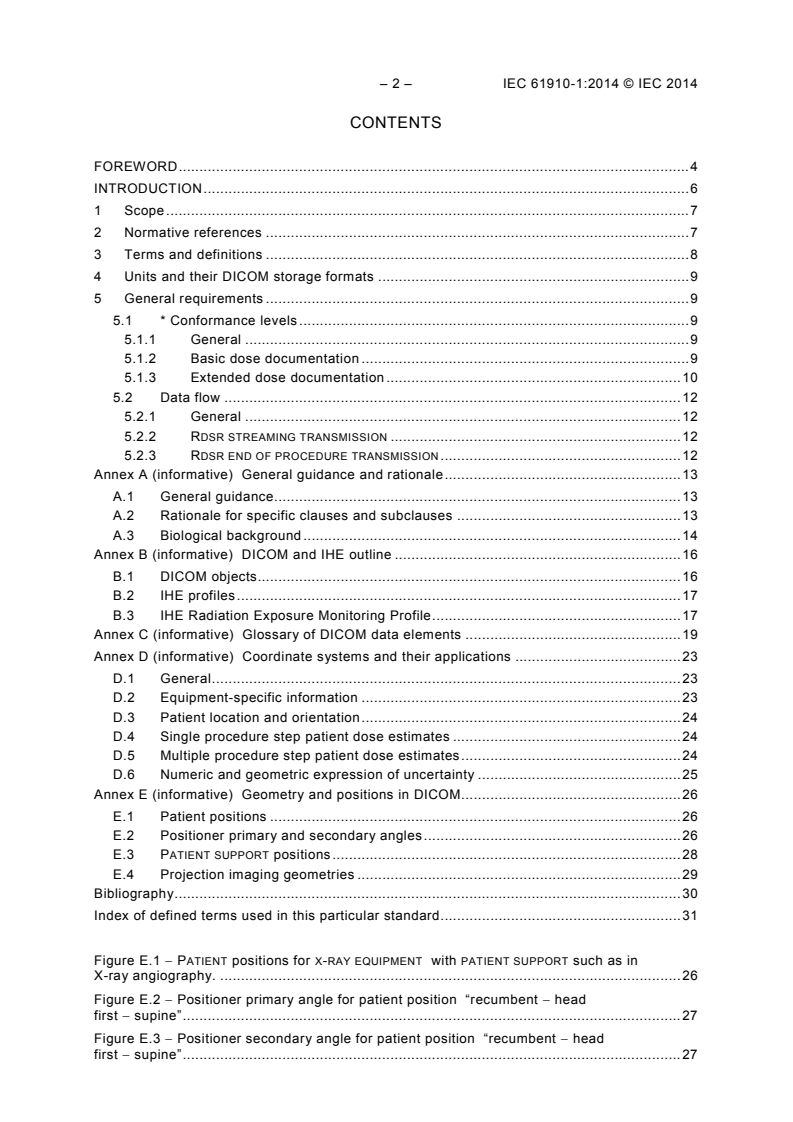
CONTENTS
FOREWORD . 4
INTRODUCTION . 6
1 Scope . 7
2 Normative references . 7
3 Terms and definitions . 8
4 Units and their DICOM storage formats . 9
5 General requirements . 9
5.1 * Conformance levels . 9
5.1.1 General . 9
5.1.2 Basic dose documentation . 9
5.1.3 Extended dose documentation . 10
5.2 Data flow . 12
5.2.1 General . 12
5.2.2 RDSR STREAMING TRANSMISSION . 12
5.2.3 RDSR END OF PROCEDURE TRANSMISSION . 12
Annex A (informative) General guidance and rationale . 13
A.1 General guidance . 13
A.2 Rationale for specific clauses and subclauses . 13
A.3 Biological background . 14
Annex B (informative) DICOM and IHE outline . 16
B.1 DICOM objects. 16
B.2 IHE profiles . 17
B.3 IHE Radiation Exposure Monitoring Profile . 17
Annex C (informative) Glossary of DICOM data elements . 19
Annex D (informative) Coordinate systems and their applications . 23
D.1 General . 23
D.2 Equipment-specific information . 23
D.3 Patient location and orientation . 24
D.4 Single procedure step patient dose estimates . 24
D.5 Multiple procedure step patient dose estimates . 24
D.6 Numeric and geometric expression of uncertainty . 25
Annex E (informative) Geometry and positions in DICOM. 26
E.1 Patient positions . 26
E.2 Positioner primary and secondary angles . 26
E.3 PATIENT SUPPORT positions . 28
E.4 Projection imaging geometries . 29
Bibliography . 30
Index of defined terms used in this particular standard . 31
Figure E.1 − PATIENT positions for X-RAY EQUIPMENT with PATIENT SUPPORT such as in
X-ray angiography. . 26
Figure E.2 − Positioner primary angle for patient position “recumbent − head
first − supine” . 27
Figure E.3 − Positioner secondary angle for patient position “recumbent − head
first − supine” . 27
Figure E.4 − Positioner primary angle for patient position “recumbent − head
first − prone” . 28
Figure E.5 − Positioner secondary angle for patient position “recumbent − feet
first − supine” . 28
Figure E.6 − Position vectors defining the position of the PATIENT SUPPORT . 29
Figure E.7 − Distance-related DICOM attributes for X-RAY EQUIPMENT with C-arm and
PATIENT SUPPORT such as in X-ray angiography . 29
Table C.1 – DICOM data elements . 19
– 4 – IEC 61910-1:2014 © IEC 2014
INTERNATIONAL ELECTROTECHNICAL COMMISSION
____________
MEDICAL ELECTRICAL EQUIPMENT –
RADIATION DOSE DOCUMENTATION –
Part 1: Radiation dose structured reports
for radiography and radioscopy
FOREWORD
1) The International Electrotechnical Commission (IEC) is a worldwide organization for standardization comprising
all national electrotechnical committees (IEC National Committees). The object of IEC is to promote
international co-operation on all questions concerning standardization in the electrical and electronic fields. To
this end and in addition to other activities, IEC publishes International Standards, Technical Specifications,
Technical Reports, Publicly Available Specifications (PAS) and Guides (hereafter referred to as “IEC
Publication(s)”). Their preparation is entrusted to technical committees; any IEC National Committee interested
in the subject dealt with may participate in this preparatory work. International, governmental and non-
governmental organizations liaising with the IEC also participate in this preparation. IEC collaborates closely
with the International Organization for Standardization (ISO) in accordance with conditions determined by
agreement between the two organizations.
2) The formal decisions or agreements of IEC on technical matters express, as nearly as possible, an international
consensus of opinion on the relevant subjects since each technical committee has representation from all
interested IEC National Committees.
3) IEC Publications have the form of recommendations for international use and are accepted by IEC National
Committees in that sense. While all reasonable efforts are made to ensure that the technical content of IEC
Publications is accurate, IEC cannot be held responsible for the way in which they are used or for any
misinterpretation by any end user.
4) In order to promote international uniformity, IEC National Committees undertake to apply IEC Publications
transparently to the maximum extent possible in their national and regional publications. Any divergence
between any IEC Publication and the corresponding national or regional publication shall be clearly indicated in
the latter.
5) IEC itself does not provide any attestation of conformity. Independent certification bodies provide conformity
assessment services and, in some areas, access to IEC marks of conformity. IEC is not responsible for any
services carried out by independent certification bodies.
6) All users should ensure that they have the latest edition of this publication.
7) No liability shall attach to IEC or its directors, employees, servants or agents including individual experts and
members of its technical committees and IEC National Committees for any personal injury, property damage or
other damage of any nature whatsoever, whether direct or indirect, or for costs (including legal fees) and
expenses arising out of the publication, use of, or reliance upon, this IEC Publication or any other IEC
Publications.
8) Attention is drawn to the Normative references cited in this publication. Use of the referenced publications is
indispensable for the correct application of this publication.
9) Attention is drawn to the possibility that some of the elements of this IEC Publication may be the subject of
patent rights. IEC shall not be held responsible for identifying any or all such patent rights.
This International Standard has been prepared by subcommittee 62B: Diagnostic imaging
equipment, of IEC technical committee 62: Electrical equipment in medical practice.
This first edition cancels and replaces IEC/PAS 61910-1, published in 2007. It constitutes a
technical revision.
This edition includes the following significant technical changes with respect to
IEC/PAS 61910-1:2007:
The previously defined three conformance levels have been restructured to two. The mapping
between DICOM and IEC terms is explicitly described in an annex and is decoupled from the
conformance level content requirements. A general update to the revised contents of the
DICOM RDSR definition has occurred.
The text of this standard is based on the following documents:
FDIS Report on voting
62B/948/FDIS 62B/952/RVD
Full information on the voting for the approval of this standard can be found in the report on
voting indicated in the above table.
This publication has been drafted in accordance with the ISO/IEC Directives, Part 2.
In this standard, the following print types are used:
– Requirements and definitions: roman type.
– Test specifications: italic type.
– Informative material appearing outside of tables, such as notes, examples and references: smaller type.
Normative text of tables is also in a smaller type.
– TERMS DEFINED IN CLAUSE 3 OF THIS STANDARD OR IN OTHER IEC PUBLICATIONS REFERENCED IN
THIS STANDARD: SMALL CAPITALS.
In referring to the structure of this standard, the term
– “clause” means one of the numbered divisions within the table of contents, inclusive of all
subdivisions (e.g., Clause 5 includes subclauses 5.1, 5.2, etc.);
– “subclause” means a numbered subdivision of a clause (e.g., 5.1, 5.2 and 5.2.1 are all
subclauses of Clause 5).
References to clauses within this standard are preceded by the term “Clause” followed by the
clause number. References to subclauses within this particular standard are by number only.
In this standard, the conjunctive “or” is used as an “inclusive or”, so a statement is true if any
combination of the conditions is true.
The verbal forms used in this standard conform to usage described in Annex H of the ISO/IEC
Directives, Part 2. For the purposes of this standard, the auxiliary verb:
– “shall” means that compliance with a requirement or a test is mandatory for compliance
with this standard;
– “should” means that compliance with a requirement or a test is recommended but is not
mandatory for compliance with this standard;
– “may” is used to describe a permissible way to achieve compliance with a requirement or
test.
An asterisk (*) as the first character of a title or at the beginning of a paragraph or table title
indicates that there is guidance or rationale related to that item in Annex A.
The committee has decided that the contents of this publication will remain unchanged until
the stability date indicated on the IEC web site under "http://webstore.iec.ch" in the data
related to the specific publication. At this date, the publication will be
• reconfirmed,
• withdrawn,
• replaced by a revised edition, or
• amended.
– 6 – IEC 61910-1:2014 © IEC 2014
INTRODUCTION
Documentation of the amount of IONIZING RADIATION used during a RADIOLOGICAL procedure is
valuable for several reasons. For all procedures dose documentation provides information
needed to estimate radiogenic risk to the population. It also plays a role in general
institutional quality assurance by providing data for performance validation against
established RADIATION dose reference levels. Detailed documentation makes a significant
contribution to clinical management of PATIENTS following those interventional procedures that
might induce tissue reactions.
The transition from imaging on film to digital imaging opened the possibility of automatically
recording dose and other data with the images. The Digital Imaging and Communications in
Medicine (DICOM) protocol traditionally provides some relevant facilities for doing this in
image headers. This has had several limitations. The most obvious of these is the lack of a
means for storing dose data without storing images. Thus, radioscopic data was seldom
stored; and no dose data was stored if the images were not stored.
Improving dose documentation was addressed jointly by the International Electrotechnical
Commission (IEC) and the DICOM Standards Committee. Supplement 94 to the DICOM
standard was approved in 2005 and incorporated since the 2006 edition of the standard. The
DICOM standard now provides the technical format needed to store the entire description of
the dose used to perform a single imaging procedure. This first edition of IEC 61910-1
replaces the Publicly Available Specification (PAS) and can become a companion document
to IEC 60601-2-43 and IEC 60601-2-54. It defines the reporting of relevant RADIATION dose
information and establishes conformance levels for dose documentation, to be referred to by
requirements in the aforementioned equipment standards. The conformance levels represent
a combination of increasing PATIENT risk and an increasing interest in quality assurance. The
basic dose documentation conformance level is intended for X-RAY EQUIPMENT that produces
dose levels below significant deterministic thresholds for all INTENDED USES. The extended
dose documentation conformance level is intended for X-RAY EQUIPMENT used for procedures
that could cause significant tissue reactions.
The process resulting from this work is summarized as follows. Information is gathered into a
radiation dose structured report (RDSR). This new object is designed to be stored in a picture
archiving and communication system (PACS), in a medical informatics system, in a
freestanding dose management workstation, or in the X-RAY EQUIPMENT itself. A performed
procedure step (resulting in a single RDSR) is related to the RADIATION applied to a single
PATIENT by a single piece of X-RAY EQUIPMENT in one session. The data structure permits the
transfer of entire studies at once or the streaming of information per individual IRRADIATION-
EVENT. The Integrating the Healthcare Enterprise (IHE) Radiation Exposure Monitoring (REM)
Profile describes an IT architecture for the creation, storage, analysis and distribution
(including submission to centralized registries) of DICOM RDSR objects.
MEDICAL ELECTRICAL EQUIPMENT –
RADIATION DOSE DOCUMENTATION –
Part 1: Radiation dose structured reports
for radiography and radioscopy
1 Scope
This International Standard applies to RADIATION DOSE STRUCTURED REPORTS (RDSR) produced
by X-RAY EQUIPMENT that falls within the scope of IEC 60601-2-43:2010 or IEC 60601-2-
54:2009.
NOTE 1 The intent is to develop and publish similar documents for other X-ray imaging modalities capable of
producing RDSRs.
NOTE 2 This document does not impose specific requirements on the accuracy of the reported or displayed data.
Existing standards or regulations can have applicable requirements for accuracy and precision.
This standard provides specific units and quantities and prescribes data storage formats.
NOTE 3 The data formats are specified such that the numerical uncertainty attributable to the format is likely to
be small compared to other data uncertainties.
NOTE 4 This document does not present any requirements on the form of display of dose information to
OPERATORS or other individuals.
The objective of this International Standard is to specify the minimum dataset to be used for
reporting dosimetric and related information associated with the production of projection
RADIOLOGICAL IMAGES.
NOTE 5 The data fields and report structure are intended to facilitate the collection of dosimetric data useful for:
management of procedures delivering significant dose, facility quality programs, establishment of reference levels,
education.
NOTE 6 A public structure facilitates data analysis by any appropriate individual or organization.
2 Normative references
The following documents, in whole or in part, are normatively referenced in this document and
are indispensable for its application. For dated references, only the edition cited applies. For
undated references, the latest edition of the referenced document (including any
amendments) applies.
IEC 60601-1:2005, Medical electrical equipment – Part 1: General requirements for basic
safety and essential performance
IEC 60601-1:2005/AMD1:2012
IEC 60601-1-3:2008, Medical electrical equipment – Part 1-3: General requirements for basic
safety and essential performance – Collateral Standard: Radiation protection in diagnostic X-
ray equipment
IEC 60601-1-3:2008/AMD1:2013
IEC 60601-2-43:2010, Medical electrical equipment – Part 2-43: Particular requirements for
the basic safety and essential performance of X-ray equipment for interventional procedures
– 8 – IEC 61910-1:2014 © IEC 2014
IEC 60601-2-54:2009, Medical electrical equipment – Part 2-54: Particular requirements for
the basic safety and essential performance of X-ray equipment for radiography and
radioscopy
IEC TR 60788:2004, Medical electrical equipment – Glossary of defined terms
3 Terms and definitions
For the purposes of this document, the terms and definitions given in IEC 60601-1:2005 +
IEC 60601-1:2005/AMD1:2012, IEC 60601-1-3:2008 + IEC 60601-1-3:2008/AMD1:2013,
IEC 60601-2-43:2010, IEC 60601-2-54:2009, IEC TR 60788:2004 and the following apply.
3.1
* IRRADIATION-EVENT
LOADING of X-RAY EQUIPMENT caused by a single continuous actuation of the equipment’s
IRRADIATION SWITCH, from the start of the LOADING TIME of the first pulse until the LOADING TIME
trailing edge of the final pulse
Note 1 to entry: An IRRADIATION-EVENT can produce a single image (e.g. chest-radiograph) or a series of images
(e.g. RADIOSCOPY, Cine or DSA acquisition).
Note 2 to entry: The RADIOLOGICAL IMAGES resulting from an IRRADIATION-EVENT can be stored in the X-RAY
EQUIPMENT or image archive or not.
Note 3 to entry: Corresponding statement in the DICOM standard [1] PS 3.16, Annex D: An IRRADIATION-EVENT is
the occurrence of radiation being applied to a patient in a single continuous time-frame between the start (release)
and the stop (cease) of the irradiation. Any on-off switching of the irradiation source during the event shall not be
treated as separate events, rather the event includes the time between start and stop of irradiation as triggered by
the user. E.g., a pulsed fluoro X-ray acquisition shall be treated as a single IRRADIATION-EVENT.
Note 4 to entry: LOADING TIME is defined in IEC 60601-1-3:2008, 3.37, and described in IEC 60601-2-54:2009,
203.4.101.3.
3.2
ACTOR
information system or component of information system that produces, manages, or acts on
categories of information required by operational activities in the RESPONSIBLE ORGANIZATION
Note 1 to entry: Details on IHE terms are provided in Clauses B.2 and B.3
Note 2 to entry: See IHE Radiology Technical Framework:2011 [2], Volume 1, Section 1.6.1.
3.3
RADIATION DOSE STRUCTURED REPORT
RDSR
structured digital record of RADIATION dose delivered to a PATIENT during a RADIOLOGICAL
procedure, encoded as DICOM dose structured report object
3.4
* RDSR STREAMING TRANSMISSION
process of sending the current partial RDSR after completion of each IRRADIATION-EVENT
3.5
RDSR END OF PROCEDURE TRANSMISSION
process of sending a final RDSR after completion or discontinuation of a RADIOLOGICAL
procedure
Note 1 to entry: Resetting the dose indicators defines the end of the previous RADIOLOGICAL procedure.
____________
Numbers in square brackets refer to the Bibliography.
4 Units and their DICOM storage formats
The numerical values of all quantities shall be stored in a format such that storage rounding
introduces less than 1,0 % total additional uncertainty.
5 General requirements
5.1 * Conformance levels
5.1.1 General
The RDSR shall conform to one of the following levels: basic dose documentation or extended
dose documentation.
NOTE 1 The basic dose documentation conformance level is intended for X-RAY EQUIPMENT that produces dose
levels below significant deterministic thresholds for all INTENDED USES. The extended dose documentation
conformance level is intended for X-RAY EQUIPMENT used for procedures that could cause significant tissue
reactions.
NOTE 2 In case of equipment component failure leading to incomplete RDSR, these are preferred over no RDSR for
the period of such failure.
5.1.2 Basic dose documentation
The RDSR conforming to basic dose documentation shall contain, at least, the following
elements (DICOM Type 1 or 2 or “M” or “U”) in the applicable TID and RDSR header
depending on the type of X-RAY EQUIPMENT:
NOTE Applicability of TID is defined in the condition statements in [1] PS 3.16.
In TID 10004 (Accumulated Projection X-Ray Dose):
• Dose (RP) Total
• Dose Area Product Total
• Distance Source to Reference Point
• If the equipment is providing this information:
– Total Number of Radiographic Frames
• If there was RADIOSCOPY:
– Total Fluoro Time
TID 10006 (Accumulated Cassette-based Projection Radiography Dose):
• Total Number of Radiographic Frames
In TID 10007 (Accumulated Integrated Projection Radiography Dose)
• Dose Area Product Total
• If the equipment is providing this information:
– Total Number of Radiographic Frames
In the RDSR header:
• Device Serial Number
• Manufacturer
• Manufacturer’s Model Name
• Software Versions
– 10 – IEC 61910-1:2014 © IEC 2014
• Date, Time for the Series
The RDSR conforming to basic dose documentation should contain, in addition, the following
elements (DICOM Type 2 or 3 or “U”):
In the RDSR header:
• Institution Name
• Patient’s Size
• Patient’s Weight
• Patient’s Name
• Patient ID
• Patient’s Birth Date
• Referenced Request Sequence (with Requested Procedure Description or Requested
Procedure Code Sequence)
• Performed Procedure Code Sequence
In TID 10001 (Projection X-Ray Radiation Dose)
• Use TID 1002 (Observer Context) with “Person Observer’s Role in this Procedure” set to
“Irradiation Administering”
In TID 10002 (Accumulated X-Ray Dose):
• Calibration Factor(s)
• Calibration Date
• Calibration Responsible Party
• Calibration Protocol
In TID 10003 (Irradiation Event X-Ray Data):
• Acquisition Protocol
• DateTime Started
• Irradiation Event Type
NOTE 1 The Dose Measurement Device is an independent device with a traceable calibration.
NOTE 2 The Calibration Responsible Party element in the Calibration data contains the information about the
party responsible for the most recent calibration service.
NOTE 3 The RDSR contains the values displayed at the equipment, no Calibration Factor delivered in TID 10002
is applied.
5.1.3 Extended dose documentation
The RDSR conforming to extended dose documentation shall comply with 5.1.2 and shall
contain, in addition, the following elements (DICOM Type 2 or 3 or “M” or “U”):
In TID 10001 (Projection X-Ray Radiation Dose)
• Use TID 1002 (Observer Context) with “Person Observer’s Role in this Procedure” set to
“Irradiation Administering”
In TID 10002 (Accumulated X-Ray Dose):
• Calibration Factor(s)
• Calibration Date
• Calibration Responsible Party
• Calibration Protocol
In TID 10003 (Irradiation Event X-Ray Data) and sub-templates:
• Acquisition Protocol
• DateTime Started
• Irradiation Event Type
• Dose Related Distance Measurements (“Distance Source to Reference Point”)
• Dose Related Distance Measurements (“Distance Source to Detector”)
• If the equipment is isocentric:
– Dose Related Distance Measurements (“Distance Source to ISOCENTER”)
• If the equipment has a PATIENT SUPPORT and means to determine one or more of the
following:
– Dose Related Distance Measurements (“Table Longitudinal Position”)
– Dose Related Distance Measurements (“Table Lateral Position”)
– Dose Related Distance Measurements (“Table Height Position”)
– Table Head Tilt Angle
– Table Horizontal Rotation Angle
– Table Cradle Tilt Angle
– If the PATIENT SUPPORT moved during the IRRADIATION-EVENT:
• Dose Related Distance Measurements (“Table Longitudinal End Position”)
• Dose Related Distance Measurements (“Table Lateral End Position”)
• Dose Related Distance Measurements (“Table Height End Position”)
• Either Column Angulation or (Positioner Primary Angle and Positioner Secondary Angle)
• If the positioner moved during the IRRADIATION-EVENT:
– Positioner Primary End Angle
– Positioner Secondary End Angle
• Patient Table Relationship
• Patient Orientation
• Patient Orientation Modifier
• Collimated Field Area
• Collimated Field Height
• Collimated Field Width
• For each ADDED FILTER that does not spatially modulate the X-RAY BEAM
– X-Ray Filter Type
– X-Ray Filter Material
– X-Ray Filter Thickness Minimum
– X-Ray Filter Thickness Maximum
• KVP
• X-Ray Tube Current
• Pulse Width
• Focal Spot Size
• Number of Pulses
– 12 – IEC 61910-1:2014 © IEC 2014
• Acquisition Plane
• Dose (RP)
• Dose Area Product
• Irradiation Duration
In TID 10004 (Accumulated Projection X-Ray Data):
• Total Number of Radiographic Frames
The RDSR conforming to extended dose documentation should contain, in addition, the
following element (Type “U”):
In TID 10003 (Irradiation Event X-Ray Data):
• If pulsed RADIOSCOPY is used:
– Pulse Rate
The RDSR conforming to extended dose documentation may contain, in addition, the following
element (Type “U”):
In TID 10003 (Irradiation Event X-Ray Data):
• “Patient Equivalent Thickness” value on which automatic exposure control (AEC) is based.
5.2 Data flow
5.2.1 General
An RDSR shall be created and exported for each RADIOLOGICAL procedure.
RDSR shall be sent to one or more destinations, such as an image manager/archive ACTOR
The
or a dose information consumer ACTOR.
NOTE The RDSR is a part of the PATIENT’S medical record. All relevant local regulations pertaining to distribution,
security and retention of medical records are therefore applicable.
5.2.2 RDSR STREAMING TRANSMISSION
The RDSR transmitted with RDSR STREAMING TRANSMISSION shall have the following
characteristics:
• The IRRADIATION-EVENT X-ray data shall include all IRRADIATION-EVENTs in the current
procedure step, up to and including the IRRADIATION-EVENT that triggered this transmission.
• The “Scope of Accumulation” RDSR element shall be set to “Procedure Step To This
Point”.
NOTE RDSR STREAMING TRANSMISSION is not intended for transfer to image manager/archive ACTORS.
5.2.3 RDSR END OF PROCEDURE TRANSMISSION
The RDSR transmitted with RDSR END OF PROCEDURE TRANSMISSION shall have the following
characteristics:
• The IRRADIATION-EVENT X-ray data shall include all IRRADIATION-EVENTs in the current
procedure step.
• The “Scope of Accumulation” RDSR element shall be set to “Performed Procedure Step”.
Annex A
(informative)
General guidance and rationale
A.1 General guidance
The methods for improved dose reporting were jointly developed by IEC SC 62B, DICOM
(Working Groups 2 and 6) and the IHE Radiology Technical Committee. This document is the
IEC portion of this project.
This standard specifies the required dose information for two conformance levels, provides
key definitions and clarifies how several values can be derived.
DICOM PS 3.16 [1] specifies how the dose information and related details for both
accumulated summaries and individual IRRADIATION-EVENTs are encoded as DICOM structured
report data. (See templates TID 10001 and referenced sub-templates). Definitions from the
DICOM Standard and used in this standard are listed in Annex C.
DICOM PS 3.3 specifies how the structured report data are embedded into a DICOM Dose
object (with proper PATIENT and procedure step metadata) for transmission, storage and
retrieval using DICOM protocols (See DICOM PS 3.3, A.35.8). The module tables referenced
in DICOM PS 3.3, A.35.8 define the specific data attributes.
IHE Radiology Technical Framework [2] specifies an architecture and implementation
guidance for the creation, distribution and management of DICOM Dose objects along with
compliance requirements for systems such as modalities, archives, dose reporters and dose
registries. See IHE Radiation Exposure Monitoring Profile Supplement.
See Annex B for more details on DICOM objects, IHE profiles and the IHE REM profile.
Information is usually available (in the X-RAY EQUIPMENT) for each IRRADIATION-EVENT. This
information may include system configuration and settings, imaging geometry, x-ray
generation and filtration details, dosimetric information, and other data.
Information describing each of the IRRADIATION-EVENTs associated with a RADIOLOGICAL
procedure may be grouped together and encoded as a DICOM structured report dataset. This
dataset plus an appropriate header constitute a DICOM X-Ray radiation dose structured
report object. Such a DICOM dose object is an example of a RADIATION DOSE STRUCTURED
REPORT (RDSR).
Elements of the IRRADIATION-EVENT relevant to image review may also be placed into the
DICOM image object header when images are stored. An image object may contain a single
frame or a series of frames (multi-frame).
IRRADIATION-EVENT data is stored in a DICOM dose object and included in procedure
summaries, even if the images produced by that IRRADIATION are not stored.
A.2 Rationale for specific clauses and subclauses
The following rationale for specific clauses and subclauses is numbered in parallel with the
clause and subclause numbers in the body of this document.
– 14 – IEC 61910-1:2014 © IEC 2014
Subclause 3.1 – IRRADIATION-EVENT
This term is introduced to subdivide a procedure step into a series of elements small enough
to permit near-real time dose analysis and reconstruction and, further, to enable a detailed
retrospective dose analysis of the procedure for quality improvement and audit.
Many IRRADIATION-EVENTs that occur during a RADIOLOGICAL procedure, such as those used for
RADIOSCOPY, are only of transient medical value. The images produced by these events are
seldom stored.
Capturing the dose and dose related quantities (including geometry details) from all
IRRADIATION-EVENTs provides complete documentation of the use of RADIATION during the
procedure.
Subclause 3.4 – RDSR STREAMING TRANSMISSION
RDSR STREAMING TRANSMISSION data flow is intended to enable near-real time dose analysis
per IRRADIATION-EVENT during a procedure and thus to provide immediate feedback to the
OPERATOR. Real-time analysis might include dose mapping.
Sending a new RDSR that contains all the IRRADIATION-EVENTS in the procedure step and an
updated summary provides the receiving system with the most complete available data on a
particular procedure step. It is assumed that the receiver will discard earlier partial reports
after receiving a later partial report or a complete report.
Subclause 5.1 – Conformance levels
The RADIATION risks to which PATIENTS are exposed are a function of RADIATION levels.
Therefore, the data needed from X-RAY EQUIPMENT corresponds to the RADIATION level
associated with NORMAL USE of that X-RAY EQUIPMENT.
The two conformance levels defined in this standard attempt to provide information
commensurate with increasing risk from the types of procedure.
Higher level of conformance provides more information that can be of use for public health
purposes.
The basic dose documentation conformance level is intended to supply:
– basic dose information;
– general patient and physician information;
– basic tools for quality management;
– educational information.
The extended dose documentation conformance level is intended to supply:
– dose information for managing potential tissue reactions;
– specific patient and procedure information;
– advanced tools for quality management;
– educational information.
A.3 Biological background
Medical uses of ionizing radiation have associated risks. These risks can be reduced by
minimizing the use of radiation for diagnostic purposes or for the visual guidance of
therapeutic interventions. However, the quality of an X-ray image will decrease if too little
radiation is used to create it. The lack of sufficient radiation for the intended purpose is almost
always immediately visible to a radiologist. In the era of digital images, the use of too much
radiation is much less apparent. Documenting radiation usage is of increasing importance in
this environment.
Radiation effects are divided into two classes: “stochastic” and “tissue reaction”.
Stochastic injuries occur when a radiation event damages the DNA in a single cell beyond its
ability to repair itself. Depending on the type of cell, this causes cellular death, genetic
mutation, or malignant transformation. There is a very small chance that this will occur after
any single RADIOLOGICAL procedure. However, the dose-response model (see [3]) used by the
International Commission on Radiation Protection (ICRP) predicts that a number of events will
occur in an irradiated population. Dose documentation of all procedure steps provides the
information needed to assess this risk as well as information that can be used to manage
radiation usage for particular examinations in individual institutions. Epidemiological studies
of radiation induced risk may have a time span of decades between data collection and data
analysis.
Tissue reactions occur when large numbers of cells are killed by radiation. This often
produces an observable injury. This occurs as the result of a large radiation dose, such as it
might be generated by a prolonged interventional procedure. Typical results are skin injuries
and hair loss. More extensive dose documentation is needed for these cases. This
documentation provides information needed for clinical care after a RADIOLOGICAL procedure
and for planning a subsequent procedure step.
– 16 – IEC 61910-1:2014 © IEC 2014
Annex B
(informative)
DICOM and IHE outline
B.1 DICOM objects
The following description is copied from the DICOM Standard PS 3.1 [1], section 6.3.
PS 3.3 of the DICOM Standard specifies a number of Information Object Classes
which provide an abstract definition of real-world entities applicable to communication
of digital medical images and related information (e.g., waveforms, structured reports,
radiation dose structured reports, etc.). Each Information Object Class definition
consists of a description of its purpose and the Attributes which define it. An
Information Object Class does not include the values for the Attributes which comprise
its definition.
Two types of Information Object Classes are defined: normalized and composite.
Normalized Information Object Classes include only those Attributes inherent to the
real-world entity. For example the study Information Object Class, which is defined as
normalized, contains study date and study time Attributes because they are inherent in
an actual study. Patient name, however, is not an Attribute of the study Information
Object Class because it is inherent to the patient on whom t
...