

IEC 60068-2-14:2023
(Main)Environmental testing - Part 2-14: Tests - Test N: Change of temperature
General Information
- Abstract
IEC 60068-2-14:2023 provides tests with specified ambient temperature changes to analyse their impacts on specimens. This seventh edition cancels and replaces the sixth edition published in 2009. This edition constitutes a technical revision. This edition includes the following significant technical changes with respect to the previous edition:
a) updating of the figures for clarification purposes;
b) updating of specimen temperature(s) and severities as well as tolerances for change of temperature tests;
c) revision of standardized requirements for test reports for Tests Na and Nb.
- Status
- Published
- Publication Date
- 26-Jul-2023
- Technical Committee
- TC 104 - Environmental conditions, classification and methods of test
- Drafting Committee
- MT 16 - TC 104/MT 16
- Current Stage
- PPUB - Publication issued
- Start Date
- 27-Jul-2023
- Completion Date
- 25-Aug-2023
Buy Documents
IEC 60068-2-14:2023 RLV - Environmental testing - Part 2-14: Tests - Test N: Change of temperature Released:7/27/2023
IEC 60068-2-14:2023 - Environmental testing - Part 2-14: Tests - Test N: Change of temperature Released:7/27/2023
Overview
IEC 60068-2-14:2023 - Environmental testing - Part 2-14: Tests - Test N: Change of temperature - is the seventh edition (2023) of the international standard that specifies methods to evaluate the effects of ambient temperature changes on specimens. This technical revision updates figures, specimen temperatures, severities and temperature tolerances, and revises standardized test-report requirements for Tests Na and Nb. The standard defines test procedures for rapid and controlled temperature changes to assess thermal robustness and reliability.
Key Topics and Requirements
- Test types: Defines three change-of-temperature methods commonly referenced as Test Na (rapid change with prescribed transfer time), Test Nb (specified rate of change) and Test Nc (two-fluid-bath method).
- Test parameters: Specifies how to select high and low conditioning temperatures, exposure times, rate of change (dT/dt), number of cycles, and transfer time (t) to represent field conditions.
- Severities and tolerances: Provides updated severities and temperature tolerances, and includes Annex C with exemplary tolerance tables for preferred temperature and rate combinations.
- Test equipment and setup: Describes thermal cabinet arrangements (one- or two-chamber methods), mounting/supporting of specimens, and precautions for condensation and thermal gradients.
- Preconditioning and recovery: Specifies preconditioning, recovery intervals, and criteria for initial and final measurements.
- Reporting requirements: Revised standardized requirements for test reports for Tests Na and Nb - detailing the information to be recorded and reported for reproducibility and compliance.
- Informative guidance: Annex A (consequences of improper severities) and Annex B (thermal responsiveness of materials and geometries) aid test selection and interpretation.
Applications
IEC 60068-2-14 is used to evaluate how temperature transients and cycling affect:
- Electronic assemblies, PCBs and components
- Automotive and aerospace systems exposed to rapid temperature changes
- Telecommunications and outdoor equipment subject to diurnal cycles
- Industrial controls, consumer electronics and medical devices for reliability and lifetime prediction
Use this standard to perform temperature cycling, thermal shock, and environmental qualification tests that simulate real-world temperature changes and validate product robustness.
Who should use this standard
- Test engineers and thermal laboratories implementing environmental testing
- R&D and reliability teams designing for thermal stress
- Quality assurance and compliance officers preparing test reports
- Certification bodies and manufacturers seeking consistent, repeatable temperature-change testing
Related standards
- IEC 60068 series (Environmental testing)
- IEC 60068-2-1 (Cold test) and IEC 60068-2-2 (Dry heat test) - for effects due solely to low or high temperature exposures
Keywords: IEC 60068-2-14, change of temperature test, environmental testing, thermal cycling, Test Na, Test Nb, Test Nc, temperature tolerances, thermal shock, specimen.
Relations
- Effective Date
- 01-Jul-2026
- Revises
IEC 60068-2-14:2009 - Environmental testing - Part 2-14: Tests - Test N: Change of temperature - Effective Date
- 05-Sep-2023
Buy Documents
IEC 60068-2-14:2023 RLV - Environmental testing - Part 2-14: Tests - Test N: Change of temperature Released:7/27/2023
IEC 60068-2-14:2023 - Environmental testing - Part 2-14: Tests - Test N: Change of temperature Released:7/27/2023
Get Certified
Connect with accredited certification bodies for this standard

IMP NDT d.o.o.
Non-destructive testing services. Radiography, ultrasonic, magnetic particle, penetrant, visual inspection.
Inštitut za kovinske materiale in tehnologije
Institute of Metals and Technology. Materials testing, metallurgical analysis, NDT.
Q Techna d.o.o.
NDT and quality assurance specialist. 30+ years experience. NDT personnel certification per ISO 9712, nuclear and thermal power plant inspections, QA/
Sponsored listings
Frequently Asked Questions
IEC 60068-2-14:2023 is a standard published by the International Electrotechnical Commission (IEC). Its full title is "Environmental testing - Part 2-14: Tests - Test N: Change of temperature". This standard covers: IEC 60068-2-14:2023 provides tests with specified ambient temperature changes to analyse their impacts on specimens. This seventh edition cancels and replaces the sixth edition published in 2009. This edition constitutes a technical revision. This edition includes the following significant technical changes with respect to the previous edition: a) updating of the figures for clarification purposes; b) updating of specimen temperature(s) and severities as well as tolerances for change of temperature tests; c) revision of standardized requirements for test reports for Tests Na and Nb.
IEC 60068-2-14:2023 provides tests with specified ambient temperature changes to analyse their impacts on specimens. This seventh edition cancels and replaces the sixth edition published in 2009. This edition constitutes a technical revision. This edition includes the following significant technical changes with respect to the previous edition: a) updating of the figures for clarification purposes; b) updating of specimen temperature(s) and severities as well as tolerances for change of temperature tests; c) revision of standardized requirements for test reports for Tests Na and Nb.
IEC 60068-2-14:2023 is classified under the following ICS (International Classification for Standards) categories: 19.040 - Environmental testing. The ICS classification helps identify the subject area and facilitates finding related standards.
IEC 60068-2-14:2023 has the following relationships with other standards: It is inter standard links to EN ISO 8100-2:2026, IEC 60068-2-14:2009. Understanding these relationships helps ensure you are using the most current and applicable version of the standard.
IEC 60068-2-14:2023 is available in PDF format for immediate download after purchase. The document can be added to your cart and obtained through the secure checkout process. Digital delivery ensures instant access to the complete standard document.
Standards Content (Sample)
IEC 60068-2-14 ®
Edition 7.0 2023-07
REDLINE VERSION
INTERNATIONAL
STANDARD
colour
inside
Environmental testing –
Part 2-14: Tests – Test N: Change of temperature
All rights reserved. Unless otherwise specified, no part of this publication may be reproduced or utilized in any form
or by any means, electronic or mechanical, including photocopying and microfilm, without permission in writing from
either IEC or IEC's member National Committee in the country of the requester. If you have any questions about IEC
copyright or have an enquiry about obtaining additional rights to this publication, please contact the address below or
your local IEC member National Committee for further information.
IEC Secretariat Tel.: +41 22 919 02 11
3, rue de Varembé info@iec.ch
CH-1211 Geneva 20 www.iec.ch
Switzerland
About the IEC
The International Electrotechnical Commission (IEC) is the leading global organization that prepares and publishes
International Standards for all electrical, electronic and related technologies.
About IEC publications
The technical content of IEC publications is kept under constant review by the IEC. Please make sure that you have the
latest edition, a corrigendum or an amendment might have been published.
IEC publications search - webstore.iec.ch/advsearchform IEC Products & Services Portal - products.iec.ch
The advanced search enables to find IEC publications by a Discover our powerful search engine and read freely all the
variety of criteria (reference number, text, technical publications previews. With a subscription you will always have
committee, …). It also gives information on projects, replaced access to up to date content tailored to your needs.
and withdrawn publications.
Electropedia - www.electropedia.org
IEC Just Published - webstore.iec.ch/justpublished
The world's leading online dictionary on electrotechnology,
Stay up to date on all new IEC publications. Just Published
containing more than 22 300 terminological entries in English
details all new publications released. Available online and once
and French, with equivalent terms in 19 additional languages.
a month by email.
Also known as the International Electrotechnical Vocabulary
(IEV) online.
IEC Customer Service Centre - webstore.iec.ch/csc
If you wish to give us your feedback on this publication or need
further assistance, please contact the Customer Service
Centre: sales@iec.ch.
IEC 60068-2-14 ®
Edition 7.0 2023-07
REDLINE VERSION
INTERNATIONAL
STANDARD
colour
inside
Environmental testing –
Part 2-14: Tests – Test N: Change of temperature
INTERNATIONAL
ELECTROTECHNICAL
COMMISSION
ICS 19.040 ISBN 978-2-8322-7338-8
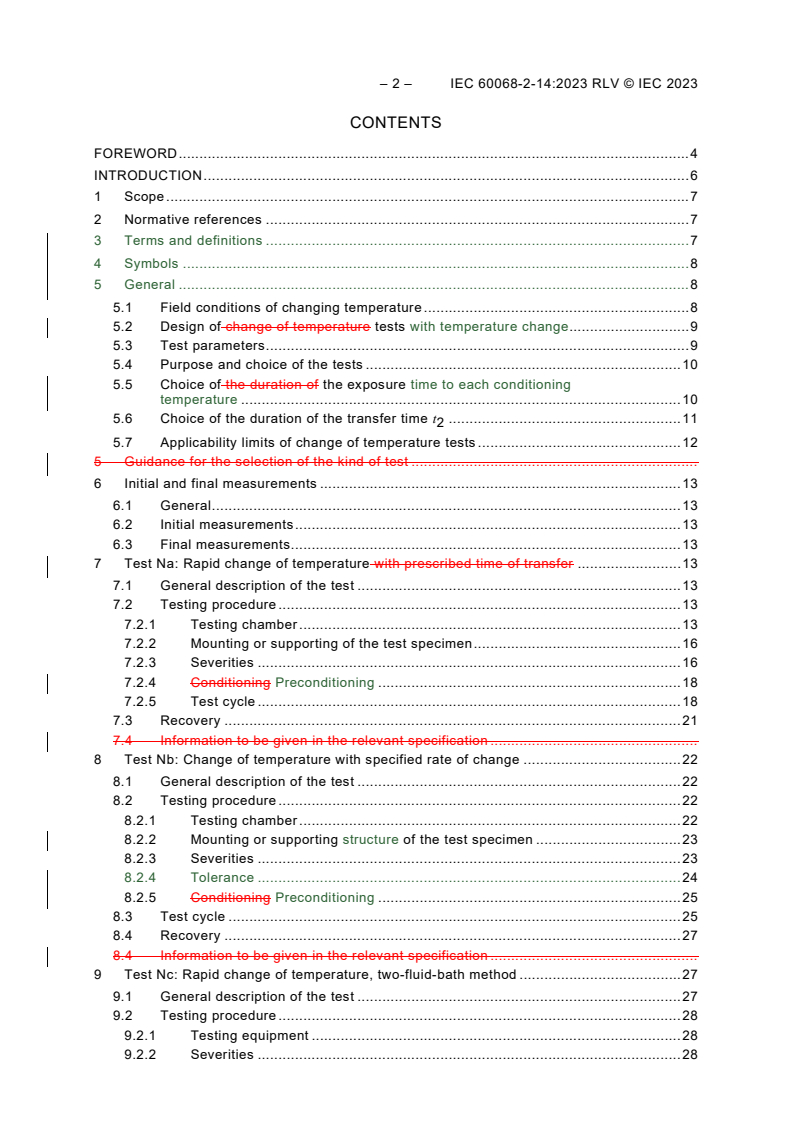
– 2 – IEC 60068-2-14:2023 RLV © IEC 2023
CONTENTS
FOREWORD . 4
INTRODUCTION . 6
1 Scope . 7
2 Normative references . 7
3 Terms and definitions . 7
4 Symbols . 8
5 General . 8
5.1 Field conditions of changing temperature . 8
5.2 Design of change of temperature tests with temperature change . 9
5.3 Test parameters . 9
5.4 Purpose and choice of the tests . 10
5.5 Choice of the duration of the exposure time to each conditioning
temperature . 10
5.6 Choice of the duration of the transfer time t . 11
5.7 Applicability limits of change of temperature tests . 12
5 Guidance for the selection of the kind of test .
6 Initial and final measurements . 13
6.1 General . 13
6.2 Initial measurements . 13
6.3 Final measurements . 13
7 Test Na: Rapid change of temperature with prescribed time of transfer . 13
7.1 General description of the test . 13
7.2 Testing procedure . 13
7.2.1 Testing chamber . 13
7.2.2 Mounting or supporting of the test specimen . 16
7.2.3 Severities . 16
7.2.4 Conditioning Preconditioning . 18
7.2.5 Test cycle . 18
7.3 Recovery . 21
7.4 Information to be given in the relevant specification .
8 Test Nb: Change of temperature with specified rate of change . 22
8.1 General description of the test . 22
8.2 Testing procedure . 22
8.2.1 Testing chamber . 22
8.2.2 Mounting or supporting structure of the test specimen . 23
8.2.3 Severities . 23
8.2.4 Tolerance . 24
8.2.5 Conditioning Preconditioning . 25
8.3 Test cycle . 25
8.4 Recovery . 27
8.4 Information to be given in the relevant specification .
9 Test Nc: Rapid change of temperature, two-fluid-bath method . 27
9.1 General description of the test . 27
9.2 Testing procedure . 28
9.2.1 Testing equipment . 28
9.2.2 Severities . 28
9.2.3 Conditioning . 28
9.3 Test cycle . 28
9.4 Recovery . 30
9.5 Information to be given in the relevant specification .
10 Information to be given in the test report. 31
Annex A (informative) Potential consequences of improper severities . 33
Annex B (informative) Thermal responsiveness of different materials and geometries . 34
Annex C (normative) Auxiliary table with exemplary temperature tolerances ±σT for
preferred combinations of high and low conditioning temperatures and rates of
temperature change (Test Nb) . 35
Bibliography . 41
Figure 1 – Determination of test duration time (t ) the exposure time t of the specimen
1 1
to each conditioning temperature . 11
Figure 2 – Schematic representation of examples of thermal test cabinets and test
procedure with two separate test chambers . 14
Figure 3 – Schematic representation of examples of thermal test cabinets with one test
chamber . 15
Figure 4 – Possibility of condensation during rapid temperature change . 16
Figure 5 – Possibility of condensation during transfer of the specimen . 16
Figure 6 – Increased severity of Test Na . 17
Figure 2 – Na test cycle .
Figure 7 – Na test cycle, one-chamber method . 19
Figure 8 – Na test cycle, two-chamber method . 21
Figure 9 – Tolerance for fluctuation of test temperatures . 25
Figure 10 – Nb test cycle . 26
Figure 11 – Test times for intermediate operation of specimens . 27
Figure 12 – Nc test cycle . 30
Figure A.1 – Delayed temperature change of the specimen . 33
Figure B.1 – Rate of temperature change of specimen with differing thermal
responsiveness . 34
Figure C.1 – Tolerance for fluctuation of test temperatures for exemplary test
parameters . 36
Table C.1 – Applicable temperature tolerances ±σ in K for preferred combinations of
T
high and low conditioning temperatures and rates of temperature change dT . 37
R
– 4 – IEC 60068-2-14:2023 RLV © IEC 2023
INTERNATIONAL ELECTROTECHNICAL COMMISSION
____________
ENVIRONMENTAL TESTING –
Part 2-14: Tests – Test N: Change of temperature
FOREWORD
1) The International Electrotechnical Commission (IEC) is a worldwide organization for standardization comprising
all national electrotechnical committees (IEC National Committees). The object of IEC is to promote international
co-operation on all questions concerning standardization in the electrical and electronic fields. To this end and
in addition to other activities, IEC publishes International Standards, Technical Specifications, Technical Reports,
Publicly Available Specifications (PAS) and Guides (hereafter referred to as “IEC Publication(s)”). Their
preparation is entrusted to technical committees; any IEC National Committee interested in the subject dealt with
may participate in this preparatory work. International, governmental and non-governmental organizations liaising
with the IEC also participate in this preparation. IEC collaborates closely with the International Organization for
Standardization (ISO) in accordance with conditions determined by agreement between the two organizations.
2) The formal decisions or agreements of IEC on technical matters express, as nearly as possible, an international
consensus of opinion on the relevant subjects since each technical committee has representation from all
interested IEC National Committees.
3) IEC Publications have the form of recommendations for international use and are accepted by IEC National
Committees in that sense. While all reasonable efforts are made to ensure that the technical content of IEC
Publications is accurate, IEC cannot be held responsible for the way in which they are used or for any
misinterpretation by any end user.
4) In order to promote international uniformity, IEC National Committees undertake to apply IEC Publications
transparently to the maximum extent possible in their national and regional publications. Any divergence between
any IEC Publication and the corresponding national or regional publication shall be clearly indicated in the latter.
5) IEC itself does not provide any attestation of conformity. Independent certification bodies provide conformity
assessment services and, in some areas, access to IEC marks of conformity. IEC is not responsible for any
services carried out by independent certification bodies.
6) All users should ensure that they have the latest edition of this publication.
7) No liability shall attach to IEC or its directors, employees, servants or agents including individual experts and
members of its technical committees and IEC National Committees for any personal injury, property damage or
other damage of any nature whatsoever, whether direct or indirect, or for costs (including legal fees) and
expenses arising out of the publication, use of, or reliance upon, this IEC Publication or any other IEC
Publications.
8) Attention is drawn to the Normative references cited in this publication. Use of the referenced publications is
indispensable for the correct application of this publication.
9) IEC draws attention to the possibility that the implementation of this document may involve the use of (a)
patent(s). IEC takes no position concerning the evidence, validity or applicability of any claimed patent rights in
respect thereof. As of the date of publication of this document, IEC had not received notice of (a) patent(s), which
may be required to implement this document. However, implementers are cautioned that this may not represent
the latest information, which may be obtained from the patent database available at https://patents.iec.ch or
www.iso.org/patents. IEC shall not be held responsible for identifying any or all such patent rights.
This redline version of the official IEC Standard allows the user to identify the changes
made to the previous edition IEC 60068-2-14:2009. A vertical bar appears in the margin
wherever a change has been made. Additions are in green text, deletions are in
strikethrough red text.
IEC 60068-2-14 has been prepared by IEC technical committee 104: Environmental conditions,
classification and methods of test. It is an International Standard.
This seventh edition cancels and replaces the sixth edition published in 2009. This edition
constitutes a technical revision.
This edition includes the following significant technical changes with respect to the previous
edition:
a) updating of the figures for clarification purposes;
b) updating of specimen temperature(s) and severities as well as tolerances for change of
temperature tests;
c) revision of standardized requirements for test reports for Tests Na and Nb.
The text of this International Standard is based on the following documents:
Draft Report on voting
104/991/FDIS 104/1016/RVD
Full information on the voting for its approval can be found in the report on voting indicated in
the above table.
The language used for the development of this International Standard is English.
This document was drafted in accordance with ISO/IEC Directives, Part 2, and developed in
accordance with ISO/IEC Directives, Part 1 and ISO/IEC Directives, IEC Supplement, available
at www.iec.ch/members_experts/refdocs. The main document types developed by IEC are
described in greater detail at www.iec.ch/publications.
A list of all parts in the IEC 60068 series, published under the general title Environmental testing,
can be found on the IEC website.
The committee has decided that the contents of this document will remain unchanged until the
stability date indicated on the IEC website under webstore.iec.ch in the data related to the
specific document. At this date, the document will be
• reconfirmed,
• withdrawn,
• replaced by a revised edition, or
• amended.
IMPORTANT – The "colour inside" logo on the cover page of this document indicates that it
contains colours which are considered to be useful for the correct understanding of its
contents. Users should therefore print this document using a colour printer.
– 6 – IEC 60068-2-14:2023 RLV © IEC 2023
INTRODUCTION
A change of temperature test is intended to determine the effect on the specimen of a change
of temperature or a succession of changes of temperature.
It is not intended to show effects that are due only to high or low temperatures caused by low
or high temperature exposure. For these effects, the cold test or the dry heat test, as specified
in IEC 60068-2-1 and IEC 60068-2-2, should be used.
The effect of such change of temperature tests is determined by
– values of high and low conditioning temperature between which the change is to be effected
affected,
– the conditioning times for which the test specimen is kept at these temperatures,
– the rate of change between these temperatures,
– the number of cycles of conditioning,
– the amount of heat transfer into or from the specimen,
– the thermal conductivity and the materials of the specimen,
– the rate of change of the specimen’s temperature on its surface (respectively in relevant
positions) or in its core.
Guidance on the choice of suitable test parameters for inclusion in the detail specification is
given throughout this document.
ENVIRONMENTAL TESTING –
Part 2-14: Tests – Test N: Change of temperature
1 Scope
This part of IEC 60068 provides a test to determine the ability of components, equipment or
other articles to withstand rapid changes of ambient temperature. The exposure times adequate
to accomplish this will depend upon the nature of the specimen.
This document provides tests with specified ambient temperature changes to analyse their
impacts on specimens.
2 Normative references
The following documents are referred to in the text in such a way that some or all of their content
constitutes requirements of this document. For dated references, only the edition cited applies.
For undated references, the latest edition of the referenced document (including any
amendments) applies.
IEC 60068 (all parts), Environmental testing
IEC 60068-2-1, Environmental testing – Part 2-1: Tests – Test A: Cold
IEC 60068-2-2, Environmental testing – Part 2-2: Tests – Test B: Dry heat
IEC 60068-2-17, Environmental testing – Part 2-17: Tests – Test Q: Sealing
IEC Guide 104, The preparation of safety publications and the use of basic safety publications
and group safety publications
3 Terms and definitions
For the purposes of this document, the terms and definitions given in IEC 60068-2-1 and
IEC 60068-2-2 apply.
ISO and IEC maintain terminology databases for use in standardization at the following
addresses:
• IEC Electropedia: available at https://www.electropedia.org/
• ISO Online browsing platform: available at https://www.iso.org/obp
– 8 – IEC 60068-2-14:2023 RLV © IEC 2023
4 Symbols
temperature difference between high conditioning temperature T and low
B
D
conditioning temperature T
A
low conditioning temperature
T
A
decreased low conditioning temperature
T
Ad
high conditioning temperature
T
B
increased high conditioning temperature
T
Bi
temperature of standard atmospheric conditions for measurement and tests
T
STD
(15 °C to 35 °C)
temperature difference between the specimen and the test medium (e.g. air)
ΔT
s
temperature change rate (Test Nb)
dT
R
stabilization time of specimen temperature
t
s
stabilization time of specimen temperature during the first cycle, starting from
t
s*
laboratory air temperature
exposure time of the specimen to each conditioning temperature
t
transfer time of the specimen from one test chamber to another (two-chamber
t
test method)
applicable temperature tolerance of the medium temperature during temperature
±𝜎𝜎
T
transition (Test Nb)
applicable temperature tolerance of the medium temperature during the constant
±𝜎𝜎
Tconst
conditioning
5 General
5.1 Field conditions of changing temperature
It is common in electronic equipment and components that changes of temperature occur. Parts
inside equipment undergo slower changes of temperature than those on an external surface
when the equipment is not switched on.
Rapid changes of temperature may can be expected
– when equipment is transported from warm indoor into cold outdoor environments into cold
open air conditions or vice versa,
– when equipment is suddenly cooled by rainfall or immersion in cold water,
– when equipment is attached or in close proximity to components leading to high thermal
stress (e.g. combustion engines, central processing units),
– when equipment is artificially cooled or heated,
– in externally mounted airborne equipment or when equipment is located in unheated aircraft
or cargo holds,
– under certain conditions of transportation and storage.
Components will undergo stresses due to changing temperature when high temperature
gradients build up in an equipment after being switched on, for example in the neighbourhood
proximity of high wattage power resistors, radiation can cause rise of the surface temperature
in neighbouring on close components while other portionsremain cold.
Artificially cooled components may can be subjected to rapid temperature changes when the
cooling system is switched on. Rapid changes of temperature in components may can also be
induced during manufacturing processes or the transportation of equipment. Both the number
and amplitude of temperature changes, the time interval between them and the thermal
responsiveness of the equipment (or specimen) are important.
4 General
5.2 Design of change of temperature tests with temperature change
Change of temperature Tests Na, Nb and Nc comprise alternate periods at a high and at a low
temperature with well-defined transfers from one temperature to the other. The conditioning run
from the laboratory ambient temperature to the first conditioning temperature, then to the
second conditioning temperature, then back to the laboratory ambient temperature is
considered as one test cycle.
5.3 Test parameters
Test parameters comprise the following:
– laboratory ambient;
– high temperature;
– low temperature;
– duration of exposure;
– transfer time or rate of change;
– number of test cycles.
The high and low temperatures are understood to be ambient temperatures which will be
reached by most specimens with a certain time-lag.
Only in exceptional cases may they be specified outside the normal storage or operating
temperature range of the object under test.
Test parameters comprise the following:
– laboratory ambient conditions (mainly temperature and humidity);
– high conditioning temperature T ;
B
– increased high conditioning temperature T , if applicable;
Bi
– low conditioning temperature T ;
A
– decreased low conditioning temperature T , if applicable;
Ad
– exposure time t of the specimen to each conditioning temperature;
– transfer time t or temperature change rate dT ;
2 R
– number of test cycles.
As these tests are intended to validate the effects of temperature changes on the specimen,
the specimen’s characteristics should always be taken into consideration (if not specified
otherwise):
– thermal responsiveness of the specimen in affected areas or the core;
– 10 – IEC 60068-2-14:2023 RLV © IEC 2023
• thermal conductivity;
• specific heat capacity;
– density;
– geometry;
– mass.
The experimental determination of these characteristics is recommended, if unknown and not
specified otherwise.
The test is accelerated because the number of severe changes of temperature in a given period
is greater than that which will occur under field conditions.
The high and low conditioning temperatures are understood to be ambient temperatures which
will be reached by most specimens with a certain time lag. It is recommended to consider the
specimen’s characteristics when specifying the test. Annex A gives further information on
potential consequences of improper severities of tests.
Only in exceptional cases should these temperatures be specified outside the normal storage
or operating temperature range of the object under test.
NOTE If the specimen’s characteristics (mass, density, geometry) prevent the specified rate of change, the
temperatures can be specified outside the normal storage or operating temperatures to increase the severity of the
intended test, if not specified otherwise.
5.4 Purpose and choice of the tests
Change of temperature testing is recommended in the following cases:
– evaluation of electrical performance after a specified number of rapid changes of
temperature, Test Na or Test Nc;
– evaluation of the suitability of mechanical components, and of materials and combinations
of materials to withstand rapid changes of temperature, Test Na or Test Nc;
– evaluation of the suitability of construction of components to withstand artificial stressing,
Test Na or Test Nc;
– evaluation of electrical performance during as a consequence of a change of temperature,
Test Nb;
– evaluation of mechanical performance during as a consequence of a change of temperature,
Test Nb.
The change of temperature tests specified in the IEC 60068 series is not intended to evaluate
the difference in material constants or electrical performance when operating under temperature
stability at the two extremes of temperature the conditioning temperatures T and T .
A B
5.5 Choice of the duration of the exposure time to each conditioning temperature
The duration of the exposure should be based on the requirements stated in 7.2.3, 8.2.3 or
9.2.2, or as stated in the relevant specification, keeping in mind the following points:
a) The exposure begins as soon as the specimen is in the new environment.
b) Stabilization occurs when the temperature difference (∆T) between the specimen and the
test medium (ΔT ) is within 3 K to 5 K, or as stated in the test specification. The stabilization
s
period, (time of specimen temperature t ), is from the start of exposure until the time moment
s
when the temperature is within the specified difference. A representative point (or points)
on the specimen may can be used for this measurement.
c) The test duration, t , shall be longer than the specimen stabilization time, t . The exposure
1 s
time t of the specimen to each conditioning temperature shall be longer than the
stabilization time of the specimen temperature t . Figure 1 provides a graphical
s
representation of the process. This may It is possible that this will not be appropriate for
heat generating specimens.
Temperature of
the specimen
T
B
∆T
t
s
t
T
A
Time
IEC 2237/08
Figure 1 – Determination of test duration time (t ) the exposure time t of the specimen
1 1
to each conditioning temperature
5.6 Choice of the duration of the transfer time t
If, in the case of the two-chamber method, because of the large size of the specimens the
transfer time cannot be made in 3 min, the transfer time may be increased without an
appreciable influence on the test results as follows:
t ≤ 0,05 t
2 s
where
t is the duration of the transfer time;
t is the stabilisation period of the specimen.
s
Temperature
– 12 – IEC 60068-2-14:2023 RLV © IEC 2023
If, for example owing to the large size of the specimens, the transfer time t cannot be kept
within 3 min, the transfer time can be increased with a negligible influence on the test results
as follows:
t ≤ 0,05 t
2 s
This applies for the two-chamber test (see 7.2.1) method only. When using the one-chamber
test method, period t is not applicable.
5.7 Applicability limits of change of temperature tests
Inside a specimen, the temperature change rate depends on the heat conduction of its materials,
the spatial distribution of its heat capacity as well as on its dimensions and surface area. A
representative point (or points) on (or inside) the specimen can be used for the measurement
of the temperature change rates.
NOTE 1 The rate of temperature change of specimens made of the same material and mass can vary if their surfaces
differ from each other.
The change of temperature at one point on the surface of a specimen follows approximately an
exponential law. Inside large specimens, such alternate exponential rises and decreases may
can lead to periodic and approximately sinusoidal changes of temperature with much lower
amplitudes than the applied temperature swing. Annex B gives further information on the
thermal responsiveness of different materials and geometries.
The mechanism of heat transfer between the test specimen and the conditioning medium in the
chamber or bath should be taken into account considered. Liquid in motion leads to very high
rates of change of temperature on the surface of the specimens and still air to very low rates.
NOTE 2 If more than one specimen is tested in the same test chamber, a uniform incoming airflow can be disturbed.
For further information on the relation of airflow and specimen temperature, IEC 60068-3-1 can be helpful.
The two-bath method with water as a conditioning medium (Test Nc) should be restricted to
specimens which are either sealed or are by their nature insensitive to water, since their
performance and properties may can deteriorate by immersion.
In particular cases, such as with specimens sensitive to water, a test with liquid other than water
may need to should be specified. When designing such a test, the characteristics of heat
transfer of the liquid, which may can differ from those of water, shall be taken into account
considered.
NOTE 3 To assess the applicability of the two-bath method, evaluations from Test Q: Sealing (IEC 60068-2-17)
may can be helpful.
5 Guidance for the selection of the kind of test
The severity of the test will increase with the increase in the temperature difference, the
increase in rate of temperature change, and the heat transfer to the specimen.
The application of Tests N is preferred as part of a sequence of tests. It is possible that some
types of damage may will not become apparent by the final measurements of a Test N but may
will appear only during subsequent tests (e.g. Test Q: Sealing, Test F: Vibration or Test D:
Accelerated damp heat).
An exemplary sequence of tests can be IEC 60068-2-17 Test Q: Sealing, IEC 60068-2-6 Test
Fc: Vibration (sinusoidal), IEC 60068-2-30 Test Db: Damp heat, cyclic (12 h + 12 h cycle) or
IEC 60068-2-67 Test Cy: Damp heat.
The change of temperature Test Nc (Two-bath method) should not be used as an alternative to
Test Q (Sealing).
When specifying a change of temperature test, the properties of the objects under test which
are affected by conditions of changing temperature, and their possible failure mechanisms,
should be kept in mind. The initial and the final measurements should be specified accordingly.
6 Initial and final measurements
6.1 General
Tests Na, Nb and Nc all use the same initial and final measurements.
6.2 Initial measurements
The specimen shall be visually examined and electrically and mechanically checked, as
required by the relevant specification.
6.3 Final measurements
The specimen shall be visually examined and electrically and mechanically checked, as
required by the relevant specification.
7 Test Na: Rapid change of temperature with prescribed time of transfer
7.1 General description of the test
This test determines the ability of components, equipment or other articles to withstand rapid
changes of ambient temperature. The exposure times adequate to accomplish this will depend
upon the nature of the specimen. The specimen shall be either in the unpacked, switched-off,
ready for use state, or as otherwise specified in the relevant specification. The specimen is
exposed to rapid changes of temperature in air, or in a suitable inert gas, by alternating
exposure to a low temperature and to a high conditioning temperature.
7.2 Testing procedure
7.2.1 Testing chamber
Two separate chambers (two-chamber method, see Figure 2) or one rapid temperature change
rate chamber (one-chamber method, see Figure 3) may can be used. If two chambers are used,
one for the low temperature and one for the high temperature, the location shall be such as to
allow transfer of the specimen from one chamber to the other within the prescribed specified
time. Either manual or automatic transfer methods may can be used.
The chambers shall be capable of maintaining the atmosphere at the appropriate temperature
for the test in any region where the specimen is placed.
After insertion of the test specimens, the air temperature shall be within the specified tolerance
after a time of not more than 10 % of the exposure time.
Some two-chamber method systems are known as thermal shock test cabinets. These systems
combine characteristics of two separate test chambers and are equipped with a mobile lifting
cage (applies for horizontal shock test chambers as well) for the automatic transfer of the
specimens from one chamber to another (see Figure 2).
Damper shock test cabinets are another embodiment of a one-chamber test system. These
systems contain two conditioning and one test chamber. The test chamber is alternately
exposed to conditioned air from a hot respectively cold conditioning chamber via air flaps (see
– 14 – IEC 60068-2-14:2023 RLV © IEC 2023
Figure 3). No physical transfer is required and the transfer time t is not applicable, when using
this kind of test systems.
Damper shock test cabinets with a stationary test chamber, a hot chamber and a cold chamber
are commonly capable of two-zone tests with hot respectively cold exposure. Some are capable
of three-zone tests, including exposure to ambient air.
NOTE 1 Damper and basket-type test cabinets are often used for Test Na. Depending on the performance, two
separate chambers or one rapid temperature change rate chamber are often used for Test Na as well. One rapid
temperature change rate chamber is often used for Test Nb.
Key
A hot chamber B cold chamber C specimen
D mobile cage E stationary test space
Figure 2 – Schematic representation of examples of thermal test cabinets
and test procedure with two separate test chambers
Key
A hot chamber B cold chamber C specimen
D air flaps E stationary test space
Figure 3 – Schematic representation of examples of thermal
test cabinets with one test chamber
The chambers should be capable of maintaining the working space at the required temperatures.
After insertion of the test specimens, the temperature of the test medium shall be within the
specified tolerance after a time of not more than 10 % of the exposure time t of the specimen
to each conditioning temperature. The temperature of the test medium refers to the control
sensor of the test chamber, if not specified otherwise.
Owing to the specimen’s lower rate of temperature change, its temperature can fall below the
dew point temperature when bringing the specimens in the hot test environment (see Figure 4)
or exposing them to ambient laboratory air (see Figure 5). During the rapid change to the high
temperature T or when transferring the specimens from the cold chamber to the hot chamber,
B
condensation of ambient air humidity should always be taken into consideration.
NOTE 2 Depending on the heat capacity and mass of the specimen, this phenomenon can be more or less
pronounced.
Dehumidification during heating phases or compressed air dryers can be used to prevent
condensation on the specimen’s surface, if necessary.
– 16 – IEC 60068-2-14:2023 RLV © IEC 2023
Figure 4 – Possibility of condensation during rapid temperature change
Figure 5 – Possibility of condensation during transfer of the specimen
7.2.2 Mounting or supporting of the test specimen
The thermal conduction of the mounting or supports shall be low, such that for practical
purposes the specimen is thermally isolated, if not specified otherwise. When testing several
specimens simultaneously they shall be so placed that free circulation shall be provided
between specimens, and between specimens and chamber surfaces.
7.2.3 Severities
The severity of the test is defined by the combination of the two temperatures, the transfer time,
the exposure time of the specimen and the number of cycles.
The lower low conditioning temperature T shall be specified in the relevant specification and
A
should shall be chosen from the test temperatures of either IEC 60068-2-1 and or IEC 60068-
2-2 or both, if not specified otherwise.
The higher high conditioning temperature T shall be specified in the relevant specification and
B
should shall be chosen from the test temperatures of either IEC 60068-2-1 and or IEC 60068-
2-2 or both, if not specified otherwise.
The exposure time t of to each of the two conditioning temperatures depends on the heat
capacity of the specimen. It may can be 3 h, 2 h, 1 h, 30 min or 10 min, or as specified in the
relevant specification. Where no exposure period is specified in the relevant specification, it is
understood to be 3 h.
NOTE The 10 min exposure time often applies to the testing of small specimens that achieve temperature
stabilization without a significant time lag.
If temperature stabilization of the specimens cannot be achieved within the chosen exposure
time, for example owing to a high heat capacity of the specimens, the severity of the test can
be temporarily increased. The severity shall only be increased until temperature stabilization is
achieved. A representative point (or points) on (or inside) the specimen can be used for this
measurement. A higher severity of the test is achieved by increasing the temperature difference
between the low conditioning temperature T and the high conditioning temperature T . Figure 6
A B
provides a graphical representation of an increased severity.
Key
A start of first cycle
B end of first cycle and start of second cycle
Figure 6 – Increased severity of Test Na
The decreased low conditioning temperature T and the increased high conditioning
Ad
temperature T should be chosen from the test temperatures of either IEC 60068-2-1 or
Bi
IEC 60068-2-2 or both, if not specified otherwise.
When choosing the increased high conditioning temperature T and the decreased low
Bi
conditioning temperature T the temperature limits of the specimen should be respected to
Ad
avoid possible damage caused by the chosen temperature differences, if not specified
otherwise. The chosen conditioning temperatures shall be given in the test report.
The preferred number of test cycles is 5, unless otherwise specified in the relevant specification.
NOTE The 10 min exposure time applies to the testing of small specimens.
– 18 – IEC 60068-2-14:2023 RLV © IEC 2023
7.2.4 Conditioning Preconditioning
The specimen and the temperature in the test chamber shall be at the ambient temperature of
the laboratory, +25 °C ± 5 K standard atmospheric conditions for measurement and test T ,
STD
15 °C to 35 °C. If required by the relevant specification, the specimen shall be brought into
operating conditions.
7.2.5 Test cycle
The test specimen shall be exposed to the cold temperature, T .
A
The temperature, T , shall be maintained for the specified period t . t includes an initial time,
A 1 1
not longer than 0,1 t for temperature stabilization of the air temperature in the chamber (see
7.2.1).
NOTE 1 The exposure time is measured from the moment of insertion of the specimen into the chamber.
The specimen shall then be exposed to the hot temperature, T , in a period, t , which should
B 2
not be more than 3 min.
t shall include the time need for the removal from one chamber and the insertion into the
second chamber as well as any dwell time at the ambient temperature of the laboratory.
NOTE 2 For specimens with a large mass, the transfer time from one chamber to another may be increased as
specified in the relevant standard or specification.
T shall be maintained for the specified period, t . t includes an initial time, not longer than 0,1
B 1 1
t for temperature stabilization of the air temperature in the chamber (see 7.2.1).
NOTE 3 The exposure time is measured from the moment of insertion of the specimen into the chamber.
For the next cycle the specimen shall be exposed to the cold temperature, T , in a transfer time,
A
t , which shall not be more than 3 min.
The first cycle comprises the two exposure times, t , and the two transfer times, t (see
1 2
Figure 2).
< t /10 < t /10
1 1
TB
A
Time
B
t t
1 t 1 t
2 2
T
A
First cycle
IEC 2238/08
Key
A start of first cycle
B end of first cycle and start of second cycle
NOTE The dotted curve is explained above.
Figure 2 – Na test cycle
At the end of the last cycle the specimen shall be subjected to the recovery procedures
a) One-chamber test met
...
IEC 60068-2-14 ®
Edition 7.0 2023-07
INTERNATIONAL
STANDARD
NORME
INTERNATIONALE
Environmental testing –
Part 2-14: Tests – Test N: Change of temperature
Essais d'environnement –
Partie 2-14: Essais – Essai N: Variation de température
All rights reserved. Unless otherwise specified, no part of this publication may be reproduced or utilized in any form
or by any means, electronic or mechanical, including photocopying and microfilm, without permission in writing from
either IEC or IEC's member National Committee in the country of the requester. If you have any questions about IEC
copyright or have an enquiry about obtaining additional rights to this publication, please contact the address below or
your local IEC member National Committee for further information.
Droits de reproduction réservés. Sauf indication contraire, aucune partie de cette publication ne peut être reproduite ni
utilisée sous quelque forme que ce soit et par aucun procédé, électronique ou mécanique, y compris la photocopie et
les microfilms, sans l'accord écrit de l'IEC ou du Comité national de l'IEC du pays du demandeur. Si vous avez des
questions sur le copyright de l'IEC ou si vous désirez obtenir des droits supplémentaires sur cette publication, utilisez
les coordonnées ci-après ou contactez le Comité national de l'IEC de votre pays de résidence.
IEC Secretariat Tel.: +41 22 919 02 11
3, rue de Varembé info@iec.ch
CH-1211 Geneva 20 www.iec.ch
Switzerland
About the IEC
The International Electrotechnical Commission (IEC) is the leading global organization that prepares and publishes
International Standards for all electrical, electronic and related technologies.
About IEC publications
The technical content of IEC publications is kept under constant review by the IEC. Please make sure that you have the
latest edition, a corrigendum or an amendment might have been published.
IEC publications search - webstore.iec.ch/advsearchform IEC Products & Services Portal - products.iec.ch
The advanced search enables to find IEC publications by a Discover our powerful search engine and read freely all the
variety of criteria (reference number, text, technical publications previews. With a subscription you will always have
committee, …). It also gives information on projects, replaced access to up to date content tailored to your needs.
and withdrawn publications.
Electropedia - www.electropedia.org
IEC Just Published - webstore.iec.ch/justpublished
The world's leading online dictionary on electrotechnology,
Stay up to date on all new IEC publications. Just Published
containing more than 22 300 terminological entries in English
details all new publications released. Available online and once
and French, with equivalent terms in 19 additional languages.
a month by email.
Also known as the International Electrotechnical Vocabulary
(IEV) online.
IEC Customer Service Centre - webstore.iec.ch/csc
If you wish to give us your feedback on this publication or need
further assistance, please contact the Customer Service
Centre: sales@iec.ch.
A propos de l'IEC
La Commission Electrotechnique Internationale (IEC) est la première organisation mondiale qui élabore et publie des
Normes internationales pour tout ce qui a trait à l'électricité, à l'électronique et aux technologies apparentées.
A propos des publications IEC
Le contenu technique des publications IEC est constamment revu. Veuillez vous assurer que vous possédez l’édition la
plus récente, un corrigendum ou amendement peut avoir été publié.
Recherche de publications IEC - IEC Products & Services Portal - products.iec.ch
webstore.iec.ch/advsearchform Découvrez notre puissant moteur de recherche et consultez
La recherche avancée permet de trouver des publications IEC gratuitement tous les aperçus des publications. Avec un
en utilisant différents critères (numéro de référence, texte, abonnement, vous aurez toujours accès à un contenu à jour
comité d’études, …). Elle donne aussi des informations sur les adapté à vos besoins.
projets et les publications remplacées ou retirées.
Electropedia - www.electropedia.org
IEC Just Published - webstore.iec.ch/justpublished
Le premier dictionnaire d'électrotechnologie en ligne au monde,
Restez informé sur les nouvelles publications IEC. Just
avec plus de 22 300 articles terminologiques en anglais et en
Published détaille les nouvelles publications parues.
français, ainsi que les termes équivalents dans 19 langues
Disponible en ligne et une fois par mois par email.
additionnelles. Egalement appelé Vocabulaire
Electrotechnique International (IEV) en ligne.
Service Clients - webstore.iec.ch/csc
Si vous désirez nous donner des commentaires sur cette
publication ou si vous avez des questions contactez-nous:
sales@iec.ch.
IEC 60068-2-14 ®
Edition 7.0 2023-07
INTERNATIONAL
STANDARD
NORME
INTERNATIONALE
Environmental testing –
Part 2-14: Tests – Test N: Change of temperature
Essais d'environnement –
Partie 2-14: Essais – Essai N: Variation de température
INTERNATIONAL
ELECTROTECHNICAL
COMMISSION
COMMISSION
ELECTROTECHNIQUE
INTERNATIONALE
ICS 19.040 ISBN 978-2-8322-7265-7
– 2 – IEC 60068-2-14:2023 © IEC 2023
CONTENTS
FOREWORD . 4
INTRODUCTION . 6
1 Scope . 7
2 Normative references . 7
3 Terms and definitions . 7
4 Symbols . 8
5 General . 8
5.1 Field conditions of changing temperature . 8
5.2 Design of tests with temperature change . 9
5.3 Test parameters . 9
5.4 Purpose and choice of the tests . 10
5.5 Choice of the exposure time to each conditioning temperature . 10
5.6 Choice of the duration of the transfer time t . 11
5.7 Applicability limits of change of temperature tests . 11
6 Initial and final measurements . 12
6.1 General . 12
6.2 Initial measurements . 12
6.3 Final measurements . 12
7 Test Na: Rapid change of temperature . 12
7.1 General description of the test . 12
7.2 Testing procedure . 12
7.2.1 Testing chamber . 12
7.2.2 Mounting or supporting of the test specimen . 15
7.2.3 Severities . 15
7.2.4 Preconditioning . 16
7.2.5 Test cycle . 17
7.3 Recovery . 19
8 Test Nb: Change of temperature with specified rate of change . 19
8.1 General description of the test . 19
8.2 Testing procedure . 20
8.2.1 Testing chamber . 20
8.2.2 Mounting or supporting structure of the test specimen . 20
8.2.3 Severities . 20
8.2.4 Tolerance . 21
8.2.5 Preconditioning . 22
8.3 Test cycle . 22
8.4 Recovery . 23
9 Test Nc: Rapid change of temperature, two-fluid-bath method . 24
9.1 General description of the test . 24
9.2 Testing procedure . 24
9.2.1 Testing equipment . 24
9.2.2 Severities . 24
9.2.3 Conditioning . 24
9.3 Test cycle . 25
9.4 Recovery . 25
10 Information to be given in the test report. 26
Annex A (informative) Potential consequences of improper severities . 27
Annex B (informative) Thermal responsiveness of different materials and geometries . 28
Annex C (normative) Auxiliary table with exemplary temperature tolerances ±σ for
T
preferred combinations of high and low conditioning temperatures and rates of
temperature change (Test Nb) . 29
Bibliography . 35
Figure 1 – Determination of the exposure time t of the specimen to each conditioning
temperature . 11
Figure 2 – Schematic representation of examples of thermal test cabinets and test
procedure with two separate test chambers . 13
Figure 3 – Schematic representation of examples of thermal test cabinets with one test
chamber . 14
Figure 4 – Possibility of condensation during rapid temperature change . 15
Figure 5 – Possibility of condensation during transfer of the specimen . 15
Figure 6 – Increased severity of Test Na . 16
Figure 7 – Na test cycle, one-chamber method . 17
Figure 8 – Na test cycle, two-chamber method . 19
Figure 9 – Tolerance for fluctuation of test temperatures . 22
Figure 10 – Nb test cycle . 23
Figure 11 – Test times for intermediate operation of specimens . 23
Figure 12 – Nc test cycle . 25
Figure A.1 – Delayed temperature change of the specimen . 27
Figure B.1 – Rate of temperature change of specimen with differing thermal
responsiveness . 28
Figure C.1 – Tolerance for fluctuation of test temperatures for exemplary test
parameters . 30
Table C.1 – Applicable temperature tolerances ±σ in K for preferred combinations of
T
high and low conditioning temperatures and rates of temperature change dT . 31
R
– 4 – IEC 60068-2-14:2023 © IEC 2023
INTERNATIONAL ELECTROTECHNICAL COMMISSION
____________
ENVIRONMENTAL TESTING –
Part 2-14: Tests – Test N: Change of temperature
FOREWORD
1) The International Electrotechnical Commission (IEC) is a worldwide organization for standardization comprising
all national electrotechnical committees (IEC National Committees). The object of IEC is to promote international
co-operation on all questions concerning standardization in the electrical and electronic fields. To this end and
in addition to other activities, IEC publishes International Standards, Technical Specifications, Technical Reports,
Publicly Available Specifications (PAS) and Guides (hereafter referred to as “IEC Publication(s)”). Their
preparation is entrusted to technical committees; any IEC National Committee interested in the subject dealt with
may participate in this preparatory work. International, governmental and non-governmental organizations liaising
with the IEC also participate in this preparation. IEC collaborates closely with the International Organization for
Standardization (ISO) in accordance with conditions determined by agreement between the two organizations.
2) The formal decisions or agreements of IEC on technical matters express, as nearly as possible, an international
consensus of opinion on the relevant subjects since each technical committee has representation from all
interested IEC National Committees.
3) IEC Publications have the form of recommendations for international use and are accepted by IEC National
Committees in that sense. While all reasonable efforts are made to ensure that the technical content of IEC
Publications is accurate, IEC cannot be held responsible for the way in which they are used or for any
misinterpretation by any end user.
4) In order to promote international uniformity, IEC National Committees undertake to apply IEC Publications
transparently to the maximum extent possible in their national and regional publications. Any divergence between
any IEC Publication and the corresponding national or regional publication shall be clearly indicated in the latter.
5) IEC itself does not provide any attestation of conformity. Independent certification bodies provide conformity
assessment services and, in some areas, access to IEC marks of conformity. IEC is not responsible for any
services carried out by independent certification bodies.
6) All users should ensure that they have the latest edition of this publication.
7) No liability shall attach to IEC or its directors, employees, servants or agents including individual experts and
members of its technical committees and IEC National Committees for any personal injury, property damage or
other damage of any nature whatsoever, whether direct or indirect, or for costs (including legal fees) and
expenses arising out of the publication, use of, or reliance upon, this IEC Publication or any other IEC
Publications.
8) Attention is drawn to the Normative references cited in this publication. Use of the referenced publications is
indispensable for the correct application of this publication.
9) IEC draws attention to the possibility that the implementation of this document may involve the use of (a)
patent(s). IEC takes no position concerning the evidence, validity or applicability of any claimed patent rights in
respect thereof. As of the date of publication of this document, IEC had not received notice of (a) patent(s), which
may be required to implement this document. However, implementers are cautioned that this may not represent
the latest information, which may be obtained from the patent database available at https://patents.iec.ch or
www.iso.org/patents. IEC shall not be held responsible for identifying any or all such patent rights.
IEC 60068-2-14 has been prepared by IEC technical committee 104: Environmental conditions,
classification and methods of test. It is an International Standard.
This seventh edition cancels and replaces the sixth edition published in 2009. This edition
constitutes a technical revision.
This edition includes the following significant technical changes with respect to the previous
edition:
a) updating of the figures for clarification purposes;
b) updating of specimen temperature(s) and severities as well as tolerances for change of
temperature tests;
c) revision of standardized requirements for test reports for Tests Na and Nb.
The text of this International Standard is based on the following documents:
Draft Report on voting
104/991/FDIS 104/1016/RVD
Full information on the voting for its approval can be found in the report on voting indicated in
the above table.
The language used for the development of this International Standard is English.
This document was drafted in accordance with ISO/IEC Directives, Part 2, and developed in
accordance with ISO/IEC Directives, Part 1 and ISO/IEC Directives, IEC Supplement, available
at www.iec.ch/members_experts/refdocs. The main document types developed by IEC are
described in greater detail at www.iec.ch/publications.
A list of all parts in the IEC 60068 series, published under the general title Environmental testing,
can be found on the IEC website.
The committee has decided that the contents of this document will remain unchanged until the
stability date indicated on the IEC website under webstore.iec.ch in the data related to the
specific document. At this date, the document will be
• reconfirmed,
• withdrawn,
• replaced by a revised edition, or
• amended.
– 6 – IEC 60068-2-14:2023 © IEC 2023
INTRODUCTION
A change of temperature test is intended to determine the effect on the specimen of a change
of temperature or a succession of changes of temperature.
It is not intended to show effects that are caused by low or high temperature exposure. For
these effects, the cold test or the dry heat test, as specified in IEC 60068-2-1 and
IEC 60068-2-2, should be used.
The effect of change of temperature tests is determined by
– values of high and low conditioning temperature between which the change is to be affected,
– the conditioning times for which the test specimen is kept at these temperatures,
– the rate of change between these temperatures,
– the number of cycles of conditioning,
– the amount of heat transfer into or from the specimen,
– the thermal conductivity and the materials of the specimen,
– the rate of change of the specimen’s temperature on its surface (respectively in relevant
positions) or in its core.
Guidance on the choice of suitable test parameters for inclusion in the detail specification is
given throughout this document.
ENVIRONMENTAL TESTING –
Part 2-14: Tests – Test N: Change of temperature
1 Scope
This document provides tests with specified ambient temperature changes to analyse their
impacts on specimens.
2 Normative references
The following documents are referred to in the text in such a way that some or all of their content
constitutes requirements of this document. For dated references, only the edition cited applies.
For undated references, the latest edition of the referenced document (including any
amendments) applies.
IEC 60068-2-1, Environmental testing – Part 2-1: Tests – Test A: Cold
IEC 60068-2-2, Environmental testing – Part 2-2: Tests – Test B: Dry heat
3 Terms and definitions
For the purposes of this document, the terms and definitions given in IEC 60068-2-1 and
IEC 60068-2-2 apply.
ISO and IEC maintain terminology databases for use in standardization at the following
addresses:
• IEC Electropedia: available at https://www.electropedia.org/
• ISO Online browsing platform: available at https://www.iso.org/obp
– 8 – IEC 60068-2-14:2023 © IEC 2023
4 Symbols
temperature difference between high conditioning temperature T and low
B
D
conditioning temperature T
A
low conditioning temperature
T
A
decreased low conditioning temperature
T
Ad
high conditioning temperature
T
B
increased high conditioning temperature
T
Bi
temperature of standard atmospheric conditions for measurement and tests
T
STD
(15 °C to 35 °C)
temperature difference between the specimen and the test medium (e.g. air)
ΔT
s
temperature change rate (Test Nb)
dT
R
stabilization time of specimen temperature
t
s
stabilization time of specimen temperature during the first cycle, starting from
t
s*
laboratory air temperature
exposure time of the specimen to each conditioning temperature
t
transfer time of the specimen from one test chamber to another (two-chamber
t
test method)
applicable temperature tolerance of the medium temperature during temperature
±𝜎𝜎
T
transition (Test Nb)
applicable temperature tolerance of the medium temperature during the constant
±𝜎𝜎
Tconst
conditioning
5 General
5.1 Field conditions of changing temperature
It is common in electronic equipment and components that changes of temperature occur. Parts
inside equipment undergo slower changes of temperature than those on an external surface
when the equipment is not switched on.
Rapid changes of temperature can be expected
– when equipment is transported from warm indoor into cold outdoor environments or vice
versa,
– when equipment is suddenly cooled by rainfall or immersion in cold water,
– when equipment is attached or in close proximity to components leading to high thermal
stress (e.g. combustion engines, central processing units),
– when equipment is artificially cooled or heated,
– in externally mounted airborne equipment or when equipment is located in unheated aircraft
or cargo holds,
– under certain conditions of transportation and storage.
Components will undergo stresses due to changing temperature when high temperature
gradients build up in an equipment after being switched on, for example in the proximity of high
power resistors, radiation can cause rise of the surface temperature on close components while
other portions remain cold.
Artificially cooled components can be subjected to rapid temperature changes when the cooling
system is switched on. Rapid changes of temperature in components can also be induced during
manufacturing processes or the transportation of equipment. Both the number and amplitude of
temperature changes, the time interval between them and the thermal responsiveness of the
equipment (or specimen) are important.
5.2 Design of tests with temperature change
Change of temperature Tests Na, Nb and Nc comprise alternate periods at a high and a low
temperature with well-defined transfers from one temperature to the other. The conditioning run
from the laboratory ambient temperature to the first conditioning temperature, then to the
second conditioning temperature, then back to the laboratory ambient temperature is
considered as one test cycle.
5.3 Test parameters
Test parameters comprise the following:
– laboratory ambient conditions (mainly temperature and humidity);
– high conditioning temperature T ;
B
– increased high conditioning temperature T , if applicable;
Bi
– low conditioning temperature T ;
A
– decreased low conditioning temperature T , if applicable;
Ad
– exposure time t of the specimen to each conditioning temperature;
– transfer time t or temperature change rate dT ;
2 R
– number of test cycles.
As these tests are intended to validate the effects of temperature changes on the specimen,
the specimen’s characteristics should always be taken into consideration (if not specified
otherwise):
– thermal responsiveness of the specimen in affected areas or the core;
• thermal conductivity;
• specific heat capacity;
– density;
– geometry;
– mass.
The experimental determination of these characteristics is recommended, if unknown and not
specified otherwise.
The test is accelerated because the number of severe changes of temperature in a given period
is greater than that which will occur under field conditions.
The high and low conditioning temperatures are understood to be ambient temperatures which
will be reached by most specimens with a certain time lag. It is recommended to consider the
specimen’s characteristics when specifying the test. Annex A gives further information on
potential consequences of improper severities of tests.
– 10 – IEC 60068-2-14:2023 © IEC 2023
Only in exceptional cases should these temperatures be specified outside the normal storage
or operating temperature range of the object under test.
NOTE If the specimen’s characteristics (mass, density, geometry) prevent the specified rate of change, the
temperatures can be specified outside the normal storage or operating temperatures to increase the severity of the
intended test, if not specified otherwise.
5.4 Purpose and choice of the tests
Change of temperature testing is recommended in the following cases:
– evaluation of electrical performance after a specified number of rapid changes of
temperature, Test Na or Test Nc;
– evaluation of the suitability of mechanical components, and of materials and combinations
of materials to withstand rapid changes of temperature, Test Na or Test Nc;
– evaluation of the suitability of construction of components to withstand artificial stressing,
Test Na or Test Nc;
– evaluation of electrical performance as a consequence of a change of temperature, Test Nb;
– evaluation of mechanical performance as a consequence of a change of temperature,
Test Nb.
The change of temperature tests specified in the IEC 60068 series is not intended to evaluate
the difference in material constants or electrical performance when operating under the
conditioning temperatures T and T .
A B
5.5 Choice of the exposure time to each conditioning temperature
The duration of the exposure should be based on the requirements stated in 7.2.3, 8.2.3 or
9.2.2, or as stated in the relevant specification, keeping in mind the following points:
a) The exposure begins as soon as the specimen is in the new environment.
b) Stabilization occurs when the temperature difference between the specimen and the test
medium (ΔT ) is within 5 K, or as stated in the test specification. The stabilization time of
s
specimen temperature t is from the start of exposure until the moment when the
s
temperature is within the specified difference. A representative point (or points) on the
specimen can be used for this measurement.
c) The exposure time t of the specimen to each conditioning temperature shall be longer than
the stabilization time of the specimen temperature t . Figure 1 provides a graphical
s
representation of the process. It is possible that this will not be appropriate for heat
generating specimens.
Figure 1 – Determination of the exposure time t of the specimen
to each conditioning temperature
5.6 Choice of the duration of the transfer time t
If, for example owing to the large size of the specimens, the transfer time t cannot be kept
within 3 min, the transfer time can be increased with a negligible influence on the test results
as follows:
t ≤ 0,05 t
2 s
This applies for the two-chamber test (see 7.2.1) method only. When using the one-chamber
is not applicable.
test method, period t
5.7 Applicability limits of change of temperature tests
Inside a specimen, the temperature change rate depends on the heat conduction of its materials,
the spatial distribution of its heat capacity as well as on its dimensions and surface area. A
representative point (or points) on (or inside) the specimen can be used for the measurement
of the temperature change rates.
NOTE 1 The rate of temperature change of specimens made of the same material and mass can vary if their surfaces
differ from each other.
The change of temperature at one point on the surface of a specimen follows approximately an
exponential law. Inside large specimens, such alternate exponential rises and decreases can
lead to periodic and approximately sinusoidal changes of temperature with much lower
amplitudes than the applied temperature swing. Annex B gives further information on the
thermal responsiveness of different materials and geometries.
The mechanism of heat transfer between the test specimen and the conditioning medium in the
chamber or bath should be considered. Liquid in motion leads to very high rates of change of
temperature on the surface of the specimens and still air to very low rates.
NOTE 2 If more than one specimen is tested in the same test chamber, a uniform incoming airflow can be disturbed.
For further information on the relation of airflow and specimen temperature, IEC 60068-3-1 can be helpful.
The two-bath method with water as a conditioning medium (Test Nc) should be restricted to
specimens which are either sealed or are by their nature insensitive to water, since their
performance and properties can deteriorate by immersion.
– 12 – IEC 60068-2-14:2023 © IEC 2023
In particular cases, such as with specimens sensitive to water, a test with liquid other than water
should be specified. When designing such a test, the characteristics of heat transfer of the
liquid, which can differ from those of water, shall be considered.
NOTE 3 To assess the applicability of the two-bath method, evaluations from Test Q: Sealing (IEC 60068-2-17) can
be helpful.
The application of Tests N is preferred as part of a sequence of tests. It is possible that some
types of damage will not become apparent by the final measurements of a Test N but will appear
only during subsequent tests.
An exemplary sequence of tests can be IEC 60068-2-17 Test Q: Sealing, IEC 60068-2-6 Test
Fc: Vibration (sinusoidal), IEC 60068-2-30 Test Db: Damp heat, cyclic (12 h + 12 h cycle) or
IEC 60068-2-67 Test Cy: Damp heat.
The change of temperature Test Nc (Two-bath method) should not be used as an alternative to
Test Q (Sealing).
When specifying a change of temperature test, the properties of the objects under test which
are affected by conditions of changing temperature, and their possible failure mechanisms,
should be kept in mind. The initial and the final measurements should be specified accordingly.
6 Initial and final measurements
6.1 General
Tests Na, Nb and Nc all use the same initial and final measurements.
6.2 Initial measurements
The specimen shall be visually examined and electrically and mechanically checked, as
required by the relevant specification.
6.3 Final measurements
The specimen shall be visually examined and electrically and mechanically checked, as
required by the relevant specification.
7 Test Na: Rapid change of temperature
7.1 General description of the test
This test determines the ability of components, equipment or other articles to withstand rapid
changes of ambient temperature. The exposure times adequate to accomplish this will depend
upon the nature of the specimen. The specimen shall be either in the unpacked, switched-off,
ready for use state, or as otherwise specified in the relevant specification. The specimen is
exposed to rapid changes of temperature in air, or in a suitable inert gas, by alternating
exposure to a low and a high conditioning temperature.
7.2 Testing procedure
7.2.1 Testing chamber
Two separate chambers (two-chamber method, see Figure 2) or one rapid temperature change
rate chamber (one-chamber method, see Figure 3) can be used. If two chambers are used, one
for the low temperature and one for the high temperature, the location shall be such as to allow
transfer of the specimen from one chamber to the other within the specified time. Either manual
or automatic transfer methods can be used.
Some two-chamber method systems are known as thermal shock test cabinets. These systems
combine characteristics of two separate test chambers and are equipped with a mobile lifting
cage (applies for horizontal shock test chambers as well) for the automatic transfer of the
specimens from one chamber to another (see Figure 2).
Damper shock test cabinets are another embodiment of a one-chamber test system. These
systems contain two conditioning and one test chamber. The test chamber is alternately
exposed to conditioned air from a hot respectively cold conditioning chamber via air flaps (see
Figure 3). No physical transfer is required and the transfer time t is not applicable, when using
this kind of test systems.
Damper shock test cabinets with a stationary test chamber, a hot chamber and a cold chamber
are commonly capable of two-zone tests with hot respectively cold exposure. Some are capable
of three-zone tests, including exposure to ambient air.
NOTE 1 Damper and basket-type test cabinets are often used for Test Na. Depending on the performance, two
separate chambers or one rapid temperature change rate chamber are often used for Test Na as well. One rapid
temperature change rate chamber is often used for Test Nb.
Key
A hot chamber B cold chamber C specimen
D mobile cage E stationary test space
Figure 2 – Schematic representation of examples of thermal test cabinets
and test procedure with two separate test chambers
– 14 – IEC 60068-2-14:2023 © IEC 2023
Key
A hot chamber B cold chamber C specimen
D air flaps E stationary test space
Figure 3 – Schematic representation of examples of thermal
test cabinets with one test chamber
The chambers should be capable of maintaining the working space at the required temperatures.
After insertion of the test specimens, the temperature of the test medium shall be within the
specified tolerance after a time of not more than 10 % of the exposure time t of the specimen
to each conditioning temperature. The temperature of the test medium refers to the control
sensor of the test chamber, if not specified otherwise.
Owing to the specimen’s lower rate of temperature change, its temperature can fall below the
dew point temperature when bringing the specimens in the hot test environment (see Figure 4)
or exposing them to ambient laboratory air (see Figure 5). During the rapid change to the high
temperature T or when transferring the specimens from the cold chamber to the hot chamber,
B
condensation of ambient air humidity should always be taken into consideration.
NOTE 2 Depending on the heat capacity and mass of the specimen, this phenomenon can be more or less
pronounced.
Dehumidification during heating phases or compressed air dryers can be used to prevent
condensation on the specimen’s surface, if necessary.
Figure 4 – Possibility of condensation during rapid temperature change
Figure 5 – Possibility of condensation during transfer of the specimen
7.2.2 Mounting or supporting of the test specimen
The thermal conduction of the mounting or supports shall be low, such that for practical
purposes the specimen is thermally isolated, if not specified otherwise. When testing several
specimens simultaneously they shall be so placed that free circulation shall be provided
between specimens, and between specimens and chamber surfaces.
7.2.3 Severities
The severity of the test is defined by the combination of the two temperatures, the transfer time,
the exposure time of the specimen and the number of cycles.
The low conditioning temperature T shall be specified in the relevant specification and shall
A
be chosen from the test temperatures of either IEC 60068-2-1 or IEC 60068-2-2 or both, if not
specified otherwise.
The high conditioning temperature T shall be specified in the relevant specification and shall
B
be chosen from the test temperatures of either IEC 60068-2-1 or IEC 60068-2-2 or both, if not
specified otherwise.
– 16 – IEC 60068-2-14:2023 © IEC 2023
The exposure time t to each of the two conditioning temperatures depends on the heat capacity
of the specimen. It can be 3 h, 2 h, 1 h, 30 min or 10 min, or as specified in the relevant
specification. Where no exposure period is specified in the relevant specification, it is
understood to be 3 h.
NOTE The 10 min exposure time often applies to the testing of small specimens that achieve temperature
stabilization without a significant time lag.
If temperature stabilization of the specimens cannot be achieved within the chosen exposure
time, for example owing to a high heat capacity of the specimens, the severity of the test can
be temporarily increased. The severity shall only be increased until temperature stabilization is
achieved. A representative point (or points) on (or inside) the specimen can be used for this
measurement. A higher severity of the test is achieved by increasing the temperature difference
between the low conditioning temperature T and the high conditioning temperature T . Figure 6
A B
provides a graphical representation of an increased severity.
Key
A start of first cycle
B end of first cycle and start of second cycle
Figure 6 – Increased severity of Test Na
The decreased low conditioning temperature T and the increased high conditioning
Ad
temperature T should be chosen from the test temperatures of either IEC 60068-2-1 or
Bi
IEC 60068-2-2 or both, if not specified otherwise.
When choosing the increased high conditioning temperature T and the decreased low
Bi
conditioning temperature T the temperature limits of the specimen should be respected to
Ad
avoid possible damage caused by the chosen temperature differences, if not specified
otherwise. The chosen conditioning temperatures shall be given in the test report.
The preferred number of test cycles is 5, unless otherwise specified in the relevant specification.
7.2.4 Preconditioning
The specimen and the temperature in the test chamber shall be at the temperature of standard
atmospheric conditions for measurement and test T , 15 °C to 35 °C. If required by the
STD
relevant specification, the specimen shall be brought into operating conditions.
7.2.5 Test cycle
a) One-chamber test method
The specimen shall be brought into the test chamber and be exposed to the temperature change
to the low conditioning temperature T (see Figure 7).
A
The low conditioning temperature T shall be maintained for the specified exposure time t
A 1
(see 5.5). t includes an initial time, not longer than 0,1 t for temperature stabilization of the
1 1
test medium.
Figure 7 – Na test cycle, one-chamber method
NOTE 1 The exposure time is measured from the beginning of change of temperature within the chamber.
Temperature stabilization of the specimen (ΔT ) can be achieved in the specified period t (see
s 1
Figure 7), if not specified otherwise. The time required for this is indicated with t .
s
NOTE 2 In some cases it can become necessary to extend t to promote temperature equalization of the specimen
or to initiate a certain relaxation process.
The specimen shall then be exposed to the temperature change to the high conditioning
temperature T .
B
The high conditioning temperature T shall be maintained for the specified exposure time t . t
B 1 1
includes an initial time, not longer than 0,1 t for temperature stabilization of the test medium.
Temperature stabilization of the specimen (ΔT ) can be achieved in the specified period t (see
s 1
.
Figure 7), if not specified otherwise. The time required for this is indicated with t
s
NOTE 3 In some cases it can become necessary to extend t to promote temperature equalization of the specimen
or to initiate a certain relaxation process.
For the next cycle the specimen shall be exposed to the low conditioning temperature T .
A
One cycle comprises the exposure time t to both conditioning temperatures. At the end of the
last cycle, the specimen shall be subjected to the recovery procedure (see 7.3).
– 18 – IEC 60068-2-14:2023 © IEC 2023
NOTE 4 There are no transfer times required for the one-chamber test method.
b) Two-chamber test method
The test specimen shall be brought into the cold chamber and be exposed to the low
conditioning temperature T .
A
The low conditioning temperature T shall be maintained for the specified exposure time t
A 1
(see 5.5). t includes an initial time, not longer than 0,1 t , for temperature stabilization of the
1 1
air temperature in the chamber (see Figure 8).
NOTE 5 The exposure time is measured from the moment of insertion of the specimen into the chamber.
Temperature stabilization of the specimen (ΔT ) can be achieved in the specified period t
s 1
(see Figure 8), if not specified otherwise. The time required for this is indicated with t .
s
NOTE 6 In some cases it can become necessary to extend t to promote temperature equalization of the specimen
or to initiate a certain relaxation process.
The specimen shall then be brought into the hot chamber in a transfer time t , which should not
be more than 3 min, and be exposed to the high conditioning temperature T .
B
shall include the time needed for the removal from one chamber and the
The transfer time t
i
...