

IEC TS 63337:2024
(Main)Basic qualification of DC-link film capacitors for automotive use - General requirements, test conditions and tests
General Information
- Abstract
IEC TS 63337:2024 provides requirements, test conditions and tests to validate characteristics including the service life of customized DC-link film capacitors for use in motor vehicle components.
Standard DC-link capacitors qualified according to other IEC standards or AEC-Q200 are excluded from the scope of this document.
The requirements, test conditions and tests listed in this document apply to customized film capacitors developed for use in motor vehicle power electronics for the application as a DC-link capacitor in HV applications or in the intermediate circuit of the 48 V on-board electrical system.
These qualification requirements can be expanded or adapted for the application of technologically innovative designs, if necessary. The content and scope of supplements is therefore to be specified and documented in coordination between the responsible parties prior to sourcing.
Power electronics in the motor vehicle need to be tested in accordance with the environmental qualification standards of the vehicle manufacturers.
The tests in this document do not replace the tests specified in the Component Requirement Specifications for complete vehicle components or additional or deviating further requirements, test conditions and tests described therein.
This document contains no tests to validate the thermal interface between capacitors, power electronics and the cooling system on the component level.
- Status
- Published
- Publication Date
- 15-Feb-2024
- Technical Committee
- TC 40 - Capacitors and resistors for electronic equipment
- Drafting Committee
- PT 63337 - TC 40/PT 63337
- Current Stage
- PPUB - Publication issued
- Start Date
- 16-Feb-2024
- Completion Date
- 01-Mar-2024
Overview
IEC TS 63337:2024 - Basic qualification of DC-link film capacitors for automotive use specifies general requirements, test conditions and tests to validate the electrical, mechanical and environmental characteristics - including service life - of customized DC‑link film capacitors intended for motor‑vehicle power electronics. The technical specification applies to capacitors used as DC‑link components in HV applications and in the intermediate circuit of the 48 V on‑board electrical system. Standard DC‑link capacitors already qualified under other IEC standards or AEC‑Q200 are explicitly excluded.
Key topics and requirements
- Scope and exclusions: Focus on customized film capacitors for automotive power electronics; not a replacement for full component‑level vehicle tests or AEC‑Q200-qualified parts.
- Electrical characterisation: Capacitance, insulation resistance, ESR (equivalent series resistance), ESL (equivalent series inductance) and external insulation checks.
- Mechanical characterisation: Geometry, visual inspection and dimensional checks.
- Environmental and exposure tests: Thermal shock, damp heat (steady state), high‑temperature load (overload and operating life), vibration, charge/discharge cycles and short‑circuit testing.
- Service life and qualification: Methods to assess lifetime behaviour under specified electrical and thermal stresses; sampling, parameter tests and acceptance criteria.
- Test sequencing & documentation: Test sequence diagrams, required measurements, and reporting guidance; annexes include example data sheet and rules for qualification after design changes.
- Limitations: No tests in this TS validate the thermal interface between capacitors, power electronics and the cooling system at the component level.
- Flexibility for innovation: Qualification requirements can be expanded or adapted for technologically innovative designs; supplements must be agreed and documented between stakeholders prior to sourcing.
Applications and practical value
- Ensures consistent qualification and reliability of DC‑link film capacitors used in automotive inverters, converters and power electronics modules.
- Useful for:
- Capacitor manufacturers preparing automotive product qualifications
- Automotive OEMs and Tier‑1 suppliers specifying capacitor acceptance criteria
- Test laboratories performing component qualification and lifetime testing
- Design and reliability engineers validating DC‑link performance in HV and 48 V systems
- Helps reduce field failures, guide supplier selection, and provide repeatable test evidence for procurement and compliance.
Related standards
- AEC‑Q200 (automotive electronic components) - parts qualified under AEC‑Q200 are outside this TS’s scope.
- Other IEC standards for capacitors (general IEC publications) - IEC TS 63337 complements but does not replace component‑level or vehicle manufacturer environmental qualification standards.
Keywords: IEC TS 63337:2024, DC-link film capacitors, automotive qualification, HV applications, 48 V system, capacitor service life, AEC‑Q200, power electronics testing.
Frequently Asked Questions
IEC TS 63337:2024 is a technical specification published by the International Electrotechnical Commission (IEC). Its full title is "Basic qualification of DC-link film capacitors for automotive use - General requirements, test conditions and tests". This standard covers: IEC TS 63337:2024 provides requirements, test conditions and tests to validate characteristics including the service life of customized DC-link film capacitors for use in motor vehicle components. Standard DC-link capacitors qualified according to other IEC standards or AEC-Q200 are excluded from the scope of this document. The requirements, test conditions and tests listed in this document apply to customized film capacitors developed for use in motor vehicle power electronics for the application as a DC-link capacitor in HV applications or in the intermediate circuit of the 48 V on-board electrical system. These qualification requirements can be expanded or adapted for the application of technologically innovative designs, if necessary. The content and scope of supplements is therefore to be specified and documented in coordination between the responsible parties prior to sourcing. Power electronics in the motor vehicle need to be tested in accordance with the environmental qualification standards of the vehicle manufacturers. The tests in this document do not replace the tests specified in the Component Requirement Specifications for complete vehicle components or additional or deviating further requirements, test conditions and tests described therein. This document contains no tests to validate the thermal interface between capacitors, power electronics and the cooling system on the component level.
IEC TS 63337:2024 provides requirements, test conditions and tests to validate characteristics including the service life of customized DC-link film capacitors for use in motor vehicle components. Standard DC-link capacitors qualified according to other IEC standards or AEC-Q200 are excluded from the scope of this document. The requirements, test conditions and tests listed in this document apply to customized film capacitors developed for use in motor vehicle power electronics for the application as a DC-link capacitor in HV applications or in the intermediate circuit of the 48 V on-board electrical system. These qualification requirements can be expanded or adapted for the application of technologically innovative designs, if necessary. The content and scope of supplements is therefore to be specified and documented in coordination between the responsible parties prior to sourcing. Power electronics in the motor vehicle need to be tested in accordance with the environmental qualification standards of the vehicle manufacturers. The tests in this document do not replace the tests specified in the Component Requirement Specifications for complete vehicle components or additional or deviating further requirements, test conditions and tests described therein. This document contains no tests to validate the thermal interface between capacitors, power electronics and the cooling system on the component level.
IEC TS 63337:2024 is classified under the following ICS (International Classification for Standards) categories: 31.060.99 - Other capacitors. The ICS classification helps identify the subject area and facilitates finding related standards.
IEC TS 63337:2024 is available in PDF format for immediate download after purchase. The document can be added to your cart and obtained through the secure checkout process. Digital delivery ensures instant access to the complete standard document.
Standards Content (Sample)
IEC TS 63337 ®
Edition 1.0 2024-02
TECHNICAL
SPECIFICATION
colour
inside
Basic qualification of DC-link film capacitors for automotive use – General
requirements, test conditions and tests
All rights reserved. Unless otherwise specified, no part of this publication may be reproduced or utilized in any form
or by any means, electronic or mechanical, including photocopying and microfilm, without permission in writing from
either IEC or IEC's member National Committee in the country of the requester. If you have any questions about IEC
copyright or have an enquiry about obtaining additional rights to this publication, please contact the address below or
your local IEC member National Committee for further information.
IEC Secretariat Tel.: +41 22 919 02 11
3, rue de Varembé info@iec.ch
CH-1211 Geneva 20 www.iec.ch
Switzerland
About the IEC
The International Electrotechnical Commission (IEC) is the leading global organization that prepares and publishes
International Standards for all electrical, electronic and related technologies.
About IEC publications
The technical content of IEC publications is kept under constant review by the IEC. Please make sure that you have the
latest edition, a corrigendum or an amendment might have been published.
IEC publications search - webstore.iec.ch/advsearchform IEC Products & Services Portal - products.iec.ch
The advanced search enables to find IEC publications by a Discover our powerful search engine and read freely all the
variety of criteria (reference number, text, technical publications previews, graphical symbols and the glossary.
committee, …). It also gives information on projects, replaced With a subscription you will always have access to up to date
and withdrawn publications. content tailored to your needs.
IEC Just Published - webstore.iec.ch/justpublished
Electropedia - www.electropedia.org
Stay up to date on all new IEC publications. Just Published
The world's leading online dictionary on electrotechnology,
details all new publications released. Available online and once
containing more than 22 500 terminological entries in English
a month by email.
and French, with equivalent terms in 25 additional languages.
Also known as the International Electrotechnical Vocabulary
IEC Customer Service Centre - webstore.iec.ch/csc
(IEV) online.
If you wish to give us your feedback on this publication or need
further assistance, please contact the Customer Service
Centre: sales@iec.ch.
IEC TS 63337 ®
Edition 1.0 2024-02
TECHNICAL
SPECIFICATION
colour
inside
Basic qualification of DC-link film capacitors for automotive use – General
requirements, test conditions and tests
INTERNATIONAL
ELECTROTECHNICAL
COMMISSION
ICS 31.060.99 ISBN 978-2-8322-8180-2
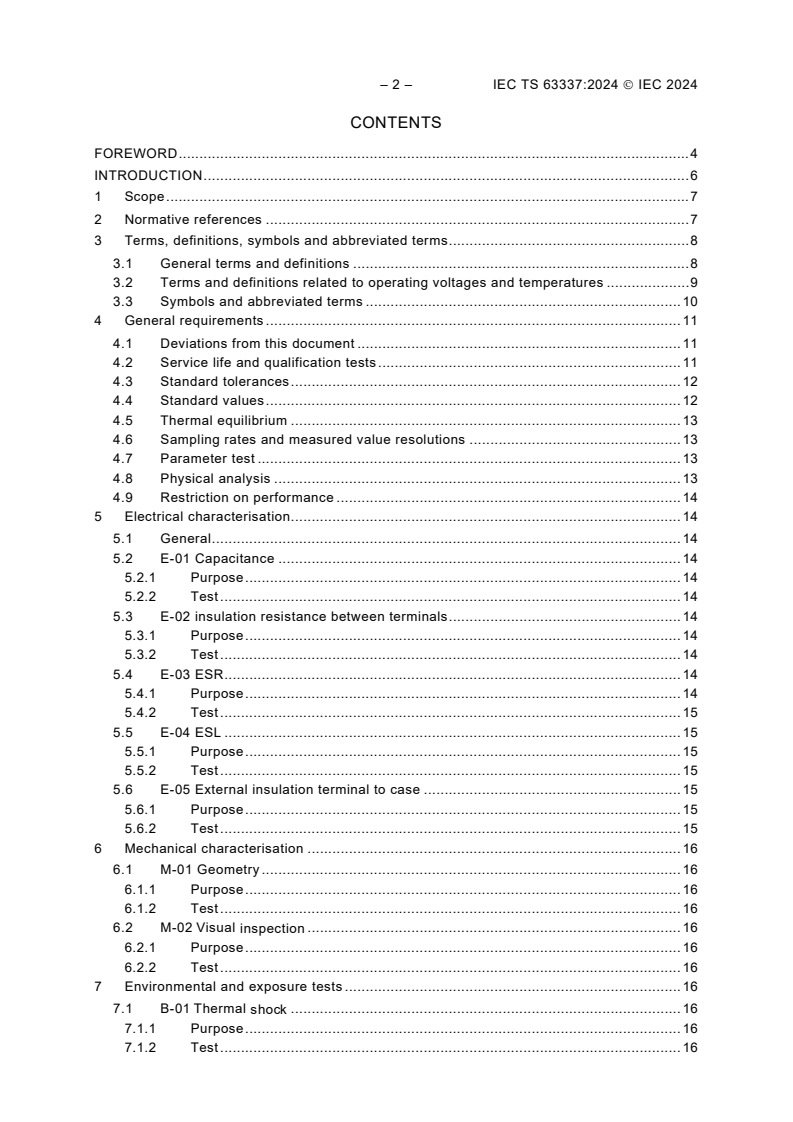
– 2 – IEC TS 63337:2024 IEC 2024
CONTENTS
FOREWORD . 4
INTRODUCTION . 6
1 Scope . 7
2 Normative references . 7
3 Terms, definitions, symbols and abbreviated terms . 8
3.1 General terms and definitions . 8
3.2 Terms and definitions related to operating voltages and temperatures . 9
3.3 Symbols and abbreviated terms . 10
4 General requirements . 11
4.1 Deviations from this document . 11
4.2 Service life and qualification tests . 11
4.3 Standard tolerances . 12
4.4 Standard values . 12
4.5 Thermal equilibrium . 13
4.6 Sampling rates and measured value resolutions . 13
4.7 Parameter test . 13
4.8 Physical analysis . 13
4.9 Restriction on performance . 14
5 Electrical characterisation. 14
5.1 General . 14
5.2 E-01 Capacitance . 14
5.2.1 Purpose . 14
5.2.2 Test . 14
5.3 E-02 insulation resistance between terminals . 14
5.3.1 Purpose . 14
5.3.2 Test . 14
5.4 E-03 ESR . 14
5.4.1 Purpose . 14
5.4.2 Test . 15
5.5 E-04 ESL . 15
5.5.1 Purpose . 15
5.5.2 Test . 15
5.6 E-05 External insulation terminal to case . 15
5.6.1 Purpose . 15
5.6.2 Test . 15
6 Mechanical characterisation . 16
6.1 M-01 Geometry . 16
6.1.1 Purpose . 16
6.1.2 Test . 16
6.2 M-02 Visual . 16
inspection
6.2.1 Purpose . 16
6.2.2 Test . 16
7 Environmental and exposure tests . 16
7.1 B-01 Thermal shock . 16
7.1.1 Purpose . 16
7.1.2 Test . 16
7.2 B-02 Damp heat, steady state . 17
7.2.1 Purpose . 17
7.2.2 Test . 17
7.3 B-03 High temperature load . 17
7.3.1 Purpose . 17
7.3.2 Condition A: high temperature – overload . 17
7.3.3 Condition B: high temperature – operating life . 17
7.4 B-04 Vibration . 18
7.4.1 Purpose . 18
7.4.2 Test (typical profile) . 18
7.5 B-05 Charge/ discharge test . 19
7.5.1 Purpose . 19
7.5.2 Test . 19
7.6 B-06 Short-circuit test . 19
7.6.1 Purpose . 19
7.6.2 Test . 20
7.7 Acceptance criteria . 20
8 Test sequence diagram . 21
9 Flammability (if required) . 22
Annex A (informative) Example data sheet . 23
Annex B (normative) Guideline for qualification in case of changes . 25
B.1 General . 25
B.2 Basic Qualification-Table Application (completion by component manufacturer) . 25
B.3 Evaluation Levels are categorized as follows . 25
B.3.1 Categories . 25
B.3.2 Important notes . 25
Annex C (normative) ISO 21498-1, Voltage class B definitions in relation to capacitor
specifications . 34
C.1 General . 34
C.2 Voltage sub-classes and operating status . 34
C.3 Working voltage . 36
C.4 Overvoltage limit . 36
C.5 Relation to capacitor specifications . 36
Bibliography . 38
Figure 1 – Vibration profile . 19
Figure 2 – Test sequence . 21
Figure C.1 – Example of a voltage – time profile in relation to voltage limits . 35
Table 1 – Example for a design service life . 11
Table 2 – Definitions of standard tolerances for set values . 12
Table 3 – Definitions of accuracy for measured values . 12
Table 4 – Definitions of standard values . 12
Table 5 – Parameters of the vibration profile . 18
Table C.1 – Voltage sub-classes . 34
Table C.2 – Component operating status . 35
Table C.3 – Relation of capacitor specification terms to voltage range . 36
Table C.4 – Relation between operation and test conditions . 37
– 4 – IEC TS 63337:2024 IEC 2024
INTERNATIONAL ELECTROTECHNICAL COMMISSION
____________
BASIC QUALIFICATION OF DC-LINK FILM
CAPACITORS FOR AUTOMOTIVE USE –
GENERAL REQUIREMENTS, TEST CONDITIONS AND TESTS
FOREWORD
1) The International Electrotechnical Commission (IEC) is a worldwide organization for standardization comprising
all national electrotechnical committees (IEC National Committees). The object of IEC is to promote international
co-operation on all questions concerning standardization in the electrical and electronic fields. To this end and
in addition to other activities, IEC publishes International Standards, Technical Specifications, Technical Reports,
Publicly Available Specifications (PAS) and Guides (hereafter referred to as "IEC Publication(s)"). Their
preparation is entrusted to technical committees; any IEC National Committee interested in the subject dealt with
may participate in this preparatory work. International, governmental and non-governmental organizations liaising
with the IEC also participate in this preparation. IEC collaborates closely with the International Organization for
Standardization (ISO) in accordance with conditions determined by agreement between the two organizations.
2) The formal decisions or agreements of IEC on technical matters express, as nearly as possible, an international
consensus of opinion on the relevant subjects since each technical committee has representation from all
interested IEC National Committees.
3) IEC Publications have the form of recommendations for international use and are accepted by IEC National
Committees in that sense. While all reasonable efforts are made to ensure that the technical content of IEC
Publications is accurate, IEC cannot be held responsible for the way in which they are used or for any
misinterpretation by any end user.
4) In order to promote international uniformity, IEC National Committees undertake to apply IEC Publications
transparently to the maximum extent possible in their national and regional publications. Any divergence between
any IEC Publication and the corresponding national or regional publication shall be clearly indicated in the latter.
5) IEC itself does not provide any attestation of conformity. Independent certification bodies provide conformity
assessment services and, in some areas, access to IEC marks of conformity. IEC is not responsible for any
services carried out by independent certification bodies.
6) All users should ensure that they have the latest edition of this publication.
7) No liability shall attach to IEC or its directors, employees, servants or agents including individual experts and
members of its technical committees and IEC National Committees for any personal injury, property damage or
other damage of any nature whatsoever, whether direct or indirect, or for costs (including legal fees) and
expenses arising out of the publication, use of, or reliance upon, this IEC Publication or any other IEC
Publications.
8) Attention is drawn to the Normative references cited in this publication. Use of the referenced publications is
indispensable for the correct application of this publication.
9) IEC draws attention to the possibility that the implementation of this document may involve the use of (a)
patent(s). IEC takes no position concerning the evidence, validity or applicability of any claimed patent rights in
respect thereof. As of the date of publication of this document, IEC had not received notice of (a) patent(s), which
may be required to implement this document. However, implementers are cautioned that this may not represent
the latest information, which may be obtained from the patent database available at https://patents.iec.ch. IEC
shall not be held responsible for identifying any or all such patent rights.
IEC TS 63337 has been prepared by IEC technical committee 40: Capacitors and resistors for
electronic equipment. It is a Technical Specification.
The text of this Technical Specification is based on the following documents:
Draft Report on voting
40/3093/DTS 40/3117/RVDTS
Full information on the voting for its approval can be found in the report on voting indicated in
the above table.
The language used for the development of this Technical Specification is English.
This document was drafted in accordance with ISO/IEC Directives, Part 2, and developed in
accordance with ISO/IEC Directives, Part 1 and ISO/IEC Directives, IEC Supplement, available
at www.iec.ch/members_experts/refdocs. The main document types developed by IEC are
described in greater detail at www.iec.ch/publications.
The committee has decided that the contents of this document will remain unchanged until the
stability date indicated on the IEC website under webstore.iec.ch in the data related to the
specific document. At this date, the document will be
• reconfirmed,
• withdrawn, or
• revised.
IMPORTANT – The "colour inside" logo on the cover page of this document indicates
that it contains colours which are considered to be useful for the correct understanding
of its contents. Users should therefore print this document using a colour printer.
– 6 – IEC TS 63337:2024 IEC 2024
INTRODUCTION
This Technical Specification is based on a publication of the "ZVEI/ECPE Film Capacitors Core
Group" working group with representatives from vehicle, device and capacitor manufacturers.
It is adopted to the electrical specifications valid for electrically propelled vehicles – voltage
class B systems, as given in ISO 21498-1.
Because AEC-Q200 is not applicable for the capacitors considered here, this document defines
a set of tests to ensure the basic suitability of the capacitor for application as a DC-link capacitor
in HV applications or in the intermediate circuit of the 48 V on-board electrical system.
This Technical Specification makes no claim to completeness. Automotive manufacturers and
device manufacturers are free to request additional state-of-the-art tests at any time. It is also
important to understand that a basic qualification as described in this document cannot replace
a comprehensive technology qualification being performed in advance of product development.
As the individual manufacturers can make changes, only the company standards of the
respective manufacturers created on the basis of this Technical Specification apply.
BASIC QUALIFICATION OF DC-LINK FILM
CAPACITORS FOR AUTOMOTIVE USE –
GENERAL REQUIREMENTS, TEST CONDITIONS AND TESTS
1 Scope
This document provides requirements, test conditions and tests to validate characteristics
including the service life of customized DC-link film capacitors for use in motor vehicle
components.
Standard DC-link capacitors qualified according to other IEC standards or AEC-Q200 are
excluded from the scope of this document.
The requirements, test conditions and tests listed in this document apply to customized film
capacitors developed for use in motor vehicle power electronics for the application as a DC-link
capacitor in HV applications or in the intermediate circuit of the 48 V on-board electrical system.
These qualification requirements can be expanded or adapted for the application of
technologically innovative designs, if necessary. The content and scope of supplements is
therefore to be specified and documented in coordination between the responsible parties prior
to sourcing.
Power electronics in the motor vehicle need to be tested in accordance with the environmental
qualification standards of the vehicle manufacturers.
The tests in this document do not replace the tests specified in the Component Requirement
Specifications for complete vehicle components or additional or deviating further requirements,
test conditions and tests described therein.
This document contains no tests to validate the thermal interface between capacitors, power
electronics and the cooling system on the component level.
2 Normative references
The following documents are referred to in the text in such a way that some or all of their content
constitutes requirements of this document. For dated references, only the edition cited applies.
For undated references, the latest edition of the referenced document (including any
amendments) applies.
IEC 60068-1, Environmental testing – Part 1: General and guidance
IEC 60068-2-2, Environmental testing – Part 2-2: Tests – Test B: Dry heat
IEC 60068-2-14, Environmental testing – Part 2-14: Tests – Test N: Change of temperature
IEC 60068-2-64, Environmental testing – Part 2-64: Tests – Test Fh: Vibration, broadband
random and guidance
IEC 60068-2-78, Environmental testing – Part 2-78: Tests – Test Cab: Damp heat, steady state
IEC 60384-1:2021, Fixed capacitors for use in electronic equipment – Part 1: Generic
specification
– 8 – IEC TS 63337:2024 IEC 2024
IEC 60695-11-10, Fire hazard testing – Part 11-10: Test flames – 50 W horizontal and vertical
flame test methods
IEC 60695-2-12, Fire hazard testing – Part 2-12: Glowing/hot-wire based test methods – Glow-
wire flammability index (GWFI) test method for materials
IEC 61071:2017, Capacitors for power electronics
ISO/IEC 17025, General requirements for the competence of testing and calibration
laboratories
ISO 21498-1:2021, Electrically propelled road vehicles – Electrical specifications and tests for
voltage class B systems and components – Part 1: Voltage sub-classes and characteristics
3 Terms, definitions, symbols and abbreviated terms
For the purposes of this document, the following terms and definitions apply.
ISO and IEC maintain terminology databases for use in standardization at the following
addresses:
• IEC Electropedia: available at https://www.electropedia.org/
• ISO Online browsing platform: available at https://www.iso.org/obp
3.1 General terms and definitions
3.1.1
component
complete device, control unit or mechatronic (with housing)
3.1.2
component element
single part of a component
Note 1 to entry: In this document, “component element” designates a capacitor as described in the Scope.
3.1.3
system
functionally linked components, e.g. power train consisting of electric machine, power
electronics, control
3.1.4
device under test
component element to be tested, system or the component to be tested
3.1.5
vehicle pre-conditioning
vehicle climate control prior to departure using energy from the mains supply
3.2 Terms and definitions related to operating voltages and temperatures
3.2.1
working voltage
U
op
DC voltage that can occur in an electric system under normal operating conditions according to
the customer's specifications, disregarding transients and ripple
Note 1 to entry: The working voltage shall be less than the rated DC voltage.
[SOURCE: ISO 21498-1:2021, 3.16 modified – "AC voltage (rms) or" has been deleted and
Note 1 to entry has been added.]
3.2.2
overvoltage
U
max
maximum permissible voltage which can be applied to a capacitor for a specified duration at
the specified temperature
Note 1 to entry: The maximum permissible voltage specified for a capacitor includes transients, ripple or other
disturbances, which can appear within the system under abnormal operating conditions. The duration, number and
accumulated duration of overvoltage events need to be agreed between manufacturer and user.
Note 2 to entry: This definition additional to that of the rated DC voltage 3.2.3 is necessary to reflect the customer
specifications valid for electrically propelled vehicles (mission profiles), which include normal operation at battery
voltage and abnormal operation (overvoltage events), see Annex C for details.
3.2.3
rated DC voltage
U
RDC
U
NDC
maximum operating voltage of either polarity but of a non-reversing type waveform,
for which the capacitor has been designed for continuous operation disregarding transients
Note 1 to entry: The rated DC voltage of the capacitor is aligned with the maximum battery voltage, for which the
system is designed. It does not include overvoltage events, like transients. See Annex C for details.
Note 2 to entry: The rated voltage in this specification is different from the general "rated voltage" which is defined
in IEC 60384-1 in order to align it to the specification of operating conditions in motor vehicle power electronics.
Note 3 to entry: In IEC 61071 the symbol U is used, but since the letter "N" normally stands for "nominal" it is
NDC
replaced in this document by "R".
[SOURCE: IEC 61071:2017, 3.18 modified – "maximum operating peak voltage” has been
replaced by “maximum operating voltage”, "disregarding transients" has been added at the end
of the definition, Note 1, Note 2 and Note 3 to entry have been added.]
3.2.4
maximum operating temperature
T
max
highest temperature at which the capacitor can be operated under steady state
conditions for a specified duration
Note 1 to entry: T is the temperature of the case measured at the hottest point of the case if no self-heating
max
occurs, or the hotspot temperature inside the case under ripple current load condition. The terminations are part of
the external surface of the case.
Note 2 to entry: The temperature time profiles shall be agreed between manufacturer and user.
[SOURCE: IEC 61071:2017, 3.34, modified – "highest temperature of the case" has been
replaced by "highest temperature", "for a specified duration" has been added, as well as Note 1
and Note 2 to entry.]
– 10 – IEC TS 63337:2024 IEC 2024
3.2.5
hotspot temperature
the highest temperature present inside the capacitor dielectric
Note 1 to entry: The hot spot temperature cannot be directly measured in operation. Normally the position of a hot
spot and the temperature increase by ripple current load is determined by use of simulation tools and verified by
measuring the temperature increase at a sample specially prepared with thermal sensors.
[SOURCE: IEC 61071:2017, 3.35, modified – Note 1 to entry has been added.]
3.3 Symbols and abbreviated terms
For the purposes of this document and the subordinate specifications, the following symbols
and abbreviated terms apply.
C capacitance
C initial capacitance on the new part
C nominal capacitance
N
∆C measured change in capacitance after exposure
∆T rise or change in temperature in general
ESL equivalent series inductance
ESR equivalent series resistance
f frequency
HV high voltage
I current
R insulation resistance
iso
RH relative humidity
T room temperature
RT
T ambient temperature of a capacitor
amb
T maximum operating temperature (3.2.4)
max
T minimum ambient temperature (lower category temperature, typically -40°C)
min
T operating temperature
op
tanδ loss factor
U operating voltage
op
U rated DC voltage (3.2.3)
RDC
overvoltage limit, test voltage for high temperature overvoltage test
U
max
U test voltage
t
(dU/dt ) set value for charge/discharge test
pulse
(dU/dt ) set value for the short-circuit test
short
U isolation voltage of the terminals (T – Terminal) to the case (C – Case)
TC
4 General requirements
4.1 Deviations from this document
Any deviations from this Technical Specification are listed on the cover sheet of the company
standards (in justified exceptional cases, deviations may be represented in the body of the
standard in italics). If, in individual cases, modifications to individual test sections are required,
such modifications shall be agreed upon separately between the departments responsible of
the manufacturer and the user.
4.2 Service life and qualification tests
A vehicle with an electric power train is typically described with the design service life
parameters given in Table 1.
Table 1 – Example for a design service life
Service life 15 years
Mileage 300 000 km
Operating hours, driving 8 000 h
Operating hours, charging/ 30 000 h (22 000 h charging + 8 000 h vehicle
pre-conditioning pre-conditioning)
The tests described in Clause 5 to Clause 7 are intended to validate the characteristics and
service life of capacitors for use in the vehicle.
The basis of the specified tests are the currently-known failure mechanisms and the motor
vehicle-specific application profiles of power electronics.
The validation includes:
a) Electrical characterisation (frequency-dependent)
– E-01 Capacitance;
– E-02 Insulation resistance;
– E-03 ESR;
– E-04 ESL;
– E-05 Insulation strength to surrounding area (e.g. housing).
b) Mechanical characterisation
– M-01 Geometry;
– M-02 Visual inspection.
c) Environmental tests / exposure tests
– B -01 Thermal shock;
– B-02 Damp heat, steady state;
– B-03 High temperature;
– B-04 Vibration;
– B-05 Charge/discharge test;
– B-06 Short-circuit test.
The characterisation measurements are intended to determine the basic functional
characteristics and mechanical data of component elements. They shall be performed before,
during and after the test.
– 12 – IEC TS 63337:2024 IEC 2024
The environmental tests simulate the exposure of components in the vehicle, and thereby, of
the component element.
In addition, applicable safety requirements are described in Clause 9.
In Annex A, an example for data sheet and test report is given.
Annex B lists test to be performed in case of changes to the capacitors.
Annex C provides further explanation of the relation between voltages, temperatures and
operating conditions.
4.3 Standard tolerances
Tolerances refer to the set value and the measured value. Ensure that the specified tolerances
are complied with independent of the tolerances of the test system. If no other tolerances are
specified in the individual tests, use the tolerances from Table 2 or Table 3.
If two tolerance values are specified, the first value listed specifies the upper tolerance and the
second value listed specifies the lower tolerance of the value range.
Table 2 – Definitions of standard tolerances for set values
Frequencies ±1 %
Temperatures ±2 °C
Indirectly determined temperatures ±5 °C
Humidity ±5 %
Times +5 %; –0 %
Voltage ±2 %
Currents ±2 %
Table 3 – Definitions of accuracy for measured values
Insulation resistance –5 %
Capacitance ±0,5 %
Voltage ±0,5 %
Currents ±0,5 %
4.4 Standard values
Unless otherwise specified, the standard values for measurement in accordance with Table 4
shall apply.
Table 4 – Definitions of standard values
defined as 23 °C ± 5 °C
T
Room temperature
RT
RH = 25 % to 75 % relative humidity (in
Humidity
accordance with IEC 60068-1)
T
Test temperature
RT
4.5 Thermal equilibrium
A component exposed to a constant ambient temperature under defined operating conditions is
regarded as continuous temperature controlled when the temperature of any part of the
component has not deviated from the target temperature by more than 5 K at any point in time.
The time until this thermal equilibrium is reached shall be defined experimentally by the
manufactures and specified in the testing documentation. In case of temperature cycling tests,
after reaching the specified temperature benchmark value for continuous-temperature control,
the units under test shall additionally be held for a defined time to allow mechanical stress to
place strains on the components. This additional holding time is specified for the respective test.
4.6 Sampling rates and measured value resolutions
The sampling rate and bandwidth of the measuring system shall be adapted to the respective
test. All measured values with all maximum values (peaks) shall be recorded.
The resolution of the measured values shall be adapted to the respective test. It shall be
guaranteed that voltage peaks that occur do not lead to overflow or are not measurable if the
resolution is too low. Data reduction/abstraction (e.g. limit value monitoring) shall not suppress
anomalies.
When the measured values for the lifetime tests are defined, it shall be ensured that the
measured values are recorded with sufficient granularity with respect to the expected lifetime to
ensure that the End-of-Life can be determined reliably and precisely.
4.7 Parameter test
The parameter test is intended for the characterisation of the electrical and mechanical
characteristics of the units under test before (to ensure that only faultless units under test are
entered into qualification tests) and after the individual test sequences. It should yield
information about the characteristic parameters of the capacitors, which may vary due to
variations in production and the stress they are exposed to during the individual tests. Unless
otherwise stated, the individual test steps of the parameter tests shall be conducted,
documented and the deviations from the specified tolerances evidenced before and after the
individual test respectively.
The objective of the measurements and tests is to:
• ensure the absence of defects of all units under test;
• ensure the fulfilment of all the requirements;
• prove the functional behaviour and the accuracy of all functions;
• characterise the units under test.
4.8 Physical analysis
The physical analysis is a detailed analysis of failed parts.
The physical analysis of successfully tested parts is performed according to individual
agreement between parties.
Proceed as follows:
• perform and document the non-destructive tests/analyses;
• identify/coordinate further tests/analyses with the specialist client department responsible
on the basis of the results of the non-destructive tests/analyses;
• perform and document the destructive tests/analyses;
• archive the specimens and damaged parts.
– 14 – IEC TS 63337:2024 IEC 2024
The change in the unit under test comparable with initial conditions shall be evaluated. The
results shall be documented in the test report.
4.9 Restriction on performance
The test lab shall be organised and operated in accordance with ISO/IEC 17025. All test
equipment used for measuring shall be calibrated in accordance with ISO/IEC 17025 (or as is
specified or recommended by the manufacturer), and based on the National Institute of
Standards (e.g. in Germany PTB; National Metrology Institute of Germany) or another
equivalent national test lab. The test devices, workshop equipment, installations and testing
procedures used shall not distort the behaviour of the unit under test. These shall be
documented in the test report together with the precisions and the calibration expiration date.
5 Electrical characterisation
5.1 General
The objective of the electrical characterisation is to determine changes in the electrical
parameters due to the tests carried out. The measurements shall therefore be performed in the
same way before and after the tests.
5.2 E-01 Capacitance
5.2.1 Purpose
The measurement is intended to determine the capacitance of the unit under test.
5.2.2 Test
The measurement shall be carried out with the following parameters:
– test temperature T ;
RT
– test voltage small signal measurement;
– frequency 100 Hz (120 Hz) or 1 kHz, optional 10 kHz as agreed with the user.
NOTE The capacitance value can slightly vary, when measured with different frequencies.
5.3 E-02 insulation resistance between terminals
5.3.1 Purpose
The measurement is intended to determine the insulation resistance of the unit under test.
5.3.2 Test
The measurement shall be carried out with the following parameters:
– test temperature T and T ;
RT max
– test voltage U ;
RDC
– frequency 0 Hz (DC);
– measurement time 60 s after the test voltage is reached.
5.4 E-03 ESR
5.4.1 Purpose
The measurement is intended to determine the equivalent series resistance of the unit under
test at the terminal in accordance with the measuring point in the data sheet.
5.4.2 Test
The measurement shall be carried out with the following parameters:
– test temperature T ;
RT
– test voltage small signal measurement;
– frequency 1 kHz, 10 kHz, 20 kHz or in accordance with the data sheet.
5.5 E-04 ESL
5.5.1 Purpose
The measurement is intended to determine the equivalent series inductance of the unit under
test at the terminal in accordance with the measuring point in the data sheet.
5.5.2 Test
The measurement shall be carried out with the following parameters:
– test temperature T ;
RT
– test voltage Small signal measurement;
– frequency 1 MHz (reference value); optional 10 MHz, 30 MHz, up to 100 MHz as
agreed with the user.
5.6 E-05 External insulation terminal to case
5.6.1 Purpose
The measurement is intended to test the insulation strength of the unit under test against the
environment. If the unit under test has a metal case, the test shall be performed between the
case and the electrically interconnected connections.
For capacitors in a non-metallic case, a metal foil shall be fixed to the body of the capacitor at
positions as agreed between the manufacturer and the user, considering the required creepage
distance and clearance. The test voltage shall be applied between inner connections and the
foil.
5.6.2 Test
The measurement shall be carried out with the following parameters:
– test temperature T ;
RT
– Test voltage U U ≤ 60 V: 750 V;
t RDC
– U ≤ 500 V 2 830 V;
RDC
– U > 500 V √2 × (2 × U + 1 000) V;
RDC RDC
– frequency 0 Hz (DC);
– duration of test 60 s in each polarity.
If Y-capacitors are integrated into a DC-link capacitor unit, test details and test voltages shall
be agreed between manufacturer and user under consideration of the insulation requirements
for the Y-capacitors and the DC link capacitor.
– 16 – IEC TS 63337:2024 IEC 2024
6 Mechanical characterisation
6.1 M-01 Geometry
6.1.1 Purpose
The measurement is intended to determine the geometric data of the unit under test related to
the drawing. All measured values shall be within the specified tolerances.
At least length, width, height as well as the position of the electrical and mechanical connections
shall be measured for the mechanical characterisation. Electrical or mechanical connections,
which are intended to be deformed during measurement or testing can be omitted from that
measurement, if agreed between manufacturer and user.
6.1.2 Test
The measurement shall be carried out with the following parameters:
– Test temperature T
RT
6.2 M-02 Visual inspection
6.2.1 Purpose
This test is intended to evaluate the appearance of the unit under test.
The visual inspection should detect anomalies such as cracking in the potting and housing,
corrosion of the connections, etc. A photograph shall be included in the test report in a resolution
corresponding to the current state-of-the-art.
6.2.2 Test
The measurement shall be carried out with the following parameters:
– Test temperature T
RT
7 Environmental and exposure tests
7.1 B-01 Thermal shock
7.1.1 Purpose
This test simulates the component element's thermal exposure to shock-like temperature
changes during vehicle operation. It is intended to validate the component element in terms of
fault profiles, such as cracking, delamination and short circuits due to thermal changes.
7.1.2 Test
The test shall be performed in accordance with IEC 60068-2-14, Na with the following
parameters:
– lower test temperature −40 °C;
– upper test temperature T ;
max
– number of cycles 1 000;
– holding time at least 5 min after thermal equilibrium;
– test voltage none.
7.2 B-02 Damp heat, steady state
7.2.1 Purpose
This accelerated test simulates the exposure of the component element to damp heat during
the vehicle service life. The test is intended to validate the quality and reliability of the
component element to faults caused by damp heat such as corrosion, migration/ dendrite growth,
swelling and degradation of plastics.
7.2.2 Test
The test shall be performed in accordance with IEC 60068-2-78 with the following parameters:
– test temperature 65 °C;
– test humidity 93 % RH, no condensation;
– duration of test 1 750 h (reference condition);
50 h of the test time with U at the end of the
– test voltage 1 700 h without U
RDC RDC
test.
NOTE Deviating (more severe) test conditions can be required by users.
7.3 B-03 High temperature load
7.3.1 Purpose
The accelerated test condition A and condition B simulate the thermal exposure of the
component elements during the vehicle service life under overload and normal operating
conditions. They are intended to validate the quality and reliability of the component element
with respect to faults that occur due to thermal exposure such as diffusion, migration and
oxidation.
The total test time, combination and duration of overload condition A and operating life condition
B shall be determined and agreed between manufacturer and user under consideration of
acceleration factors and the time-voltage profile. For example, condition A and condition B may
be combined in a way, that a part of the duration of condition A is performed in the beginning
phase of the test (e.g. after 168 h or
...