


IEC 60335-2-77:1996
(Main)Safety of household and similar electrical appliances - Part 2: Particular requirements for pedestrian controlled mains-operated lawnmowers
General Information
- Abstract
Deals with the safety of pedestrian controlled mains-operated electrical cylinder or rotary lawnmowers designed primarily for use around the home or for similar purposes, their rated voltage being not more than 250 V single phase. It does not apply to lawn trimmers, lawn edge trimmers, lawn edgers, flail mowers, sickle-bar mowers, or agricultural mowers.
- Status
- Published
- Publication Date
- 04-Dec-1996
- Technical Committee
- TC 116 - Safety of motor-operated electric tools
- Current Stage
- DELPUB - Deleted Publication
- Start Date
- 31-Jul-2002
- Completion Date
- 28-Aug-2026
Overview
IEC 60335-2-77:1996 is an international standard developed by the International Electrotechnical Commission (IEC) that specifies safety requirements for pedestrian controlled mains-operated lawnmowers. It applies primarily to electrical cylinder or rotary lawnmowers designed for domestic and similar use, with a rated voltage not exceeding 250 V single phase. The standard excludes other types such as lawn trimmers, edgers, flail mowers, sickle-bar mowers, or agricultural mowers.
This standard is part of the IEC 60335 series focusing on the safety of household and similar electrical appliances with this part addressing particular requirements for pedestrian controlled mains-operated lawnmowers. It is intended to ensure the safety of consumers and operators by defining requirements related to construction, protection, testing, and marking of such equipment.
Key Topics
- Scope and Definitions: Clarifies the types of lawnmowers covered, their typical use cases, and exclusions for clarity and applicability.
- General Safety Requirements: Includes provisions around protection against access to live parts, prevention of mechanical and electrical hazards, and stable construction.
- Starting and Operation Controls: Addresses safe motor starting mechanisms to prevent accidental operation.
- Electrical Safety: Covers requirements for insulation, leakage current, dielectric strength, and protection against electric shock.
- Mechanical Safety and Stability: Provides guidelines to ensure mechanical robustness, resistance to rust, vibration limits, and overall device stability to avoid hazards during operation.
- Marking and Instructions: Specifies mandatory markings and user information to promote safe handling and usage.
- Testing Procedures: Details on endurance, abnormal operation, moisture resistance, heat and fire resistance, and electrical performance tests.
Applications
IEC 60335-2-77:1996 is essential for manufacturers, testers, and regulatory bodies involved with design, production, and certification of pedestrian controlled mains-operated lawnmowers for residential or similar environments. The standard helps:
- Ensure electrical lawnmowers are safe for consumer use under normal and abnormal conditions.
- Guide manufacturing practices that reduce risks associated with electrical shock, mechanical failures, or operational hazards.
- Provide a benchmark for compliance that supports market acceptance and legal conformity.
- Inform product development for safer and more reliable lawn care appliances.
- Assist quality control laboratories in performing consistent safety testing.
Related Standards
- IEC 60335-1: General requirements for the safety of household and similar electrical appliances; IEC 60335-2-77 is designed to be used in conjunction with the most recent edition of IEC 60335-1.
- IEC 50 (International Electrotechnical Vocabulary): Provides terminology definitions that support understanding of technical terms used in IEC 60335-2-77.
- IEC 27, IEC 417, IEC 617, IEC 878: Cover graphical and letter symbols referenced in electrical appliance documentation and markings.
- ISO Standards: Collaboration between IEC and ISO ensures harmonized international standards particularly related to safety and quality.
Keywords: IEC 60335-2-77, lawnmower safety standard, pedestrian controlled lawnmowers, mains-operated lawnmowers, electrical appliance safety, household lawn equipment, electrical safety testing, IEC lawnmower requirements, electrical shock protection, mechanical safety standards.
Relations
- Effective Date
- 05-Sep-2023
Get Certified
Connect with accredited certification bodies for this standard

Control Union Certifications
Global certification for agriculture and sustainability.

ECOCERT
Organic and sustainability certification.

FSC International
Forest Stewardship Council certification.
Sponsored listings
Frequently Asked Questions
IEC 60335-2-77:1996 is a standard published by the International Electrotechnical Commission (IEC). Its full title is "Safety of household and similar electrical appliances - Part 2: Particular requirements for pedestrian controlled mains-operated lawnmowers". This standard covers: Deals with the safety of pedestrian controlled mains-operated electrical cylinder or rotary lawnmowers designed primarily for use around the home or for similar purposes, their rated voltage being not more than 250 V single phase. It does not apply to lawn trimmers, lawn edge trimmers, lawn edgers, flail mowers, sickle-bar mowers, or agricultural mowers.
Deals with the safety of pedestrian controlled mains-operated electrical cylinder or rotary lawnmowers designed primarily for use around the home or for similar purposes, their rated voltage being not more than 250 V single phase. It does not apply to lawn trimmers, lawn edge trimmers, lawn edgers, flail mowers, sickle-bar mowers, or agricultural mowers.
IEC 60335-2-77:1996 is classified under the following ICS (International Classification for Standards) categories: 65.060.70 - Horticultural equipment. The ICS classification helps identify the subject area and facilitates finding related standards.
IEC 60335-2-77:1996 has the following relationships with other standards: It is inter standard links to IEC 60335-2-77:2002. Understanding these relationships helps ensure you are using the most current and applicable version of the standard.
IEC 60335-2-77:1996 is available in PDF format for immediate download after purchase. The document can be added to your cart and obtained through the secure checkout process. Digital delivery ensures instant access to the complete standard document.
Standards Content (Sample)
NORME
CEI
INTERNATIONALE
IEC
335-2-77
INTERNATIONAL
Première édition
STANDARD
First edition
1996-11
Sécurité des appareils électrodomestiques
et analogues –
Partie 2:
Règles particulières pour les tondeuses
à gazon fonctionnant sur le réseau et
à conducteur à pied
Safety of household and similar
electrical appliances –
Part 2:
Particular requirements for pedestrian
controlled mains-operated lawnmowers
Numéro de référence
Reference number
CEI/IEC 335-2-77: 1996
Validité de la présente publication Validity of this publication
Le contenu technique des publications de la CEI est cons- The technical content of IEC publications is kept under
tamment revu par la CEI afin qu'il reflète l'état actuel de constant review by the IEC, thus ensuring that the content
la technique. reflects current technology.
Des renseignements relatifs à la date de reconfirmation de Information relating to the date of the reconfirmation of the
la publication sont disponibles auprès du Bureau Central de publication is available from the IEC Central Office.
la CEI.
Les renseignements relatifs à ces révisions, à l'établis- Information on the revision work, the issue of revised
sement des éditions révisées et aux amendements peuvent editions and amendments may be obtained from IEC
être obtenus auprès des Comités nationaux de la CEI et National Committees and from the following IEC
dans les documents ci-dessous: sources:
• Bulletin de la CEI • IEC Bulletin
• Annuaire de la CEI • IEC Yearbook
Publié annuellement Published yearly
• Catalogue des publications de la CEI • Catalogue of IEC publications
Publié annuellement et mis à jour régulièrement Published yearly with regular updates
Terminologie Terminology
En ce qui concerne la terminologie générale, le lecteur se For general terminology, readers are referred to IEC 50:
reportera à la CEI 50: Vocabulaire Electrotechnique Inter- International Electrotechnical Vocabulary (IEV), which is
national (VEI), qui se présente sous forme de chapitres issued in the form of separate chapters each dealing
séparés traitant chacun d'un sujet défini. Des détails with a specific field. Full details of the IEV will be
complets sur le VEI peuvent être obtenus sur demande. supplied on request. See also the IEC Multilingual
Voir également le dictionnaire multilingue de la CEI. Dictionary.
Les termes et définitions figurant dans la présente publi- The terms and definitions contained in the present publi-
cation ont été soit tirés du VEI, soit spécifiquement cation have either been taken from the IEV or have been
approuvés aux fins de cette publication. specifically approved for the purpose of this publication.
Symboles graphiques et littéraux Graphical and letter symbols
Pour les symboles graphiques, les symboles littéraux et les For graphical symbols, and letter symbols and signs
signes d'usage général approuvés par la CEI, le lecteur approved by the IEC for general use, readers are referred to
consultera: publications:
– la CEI 27: Symboles littéraux à utiliser en – IEC 27: Letter symbols to be used in electrical
électro-technique; technology;
– la CEI 417: Symboles graphiques utilisables – IEC 417: Graphical symbols for use on
sur le matériel. Index, relevé et compilation des equipment. Index, survey and compilation of the
feuilles individuelles; single sheets;
– la CEI 617: Symboles graphiques pour – IEC 617: Graphical symbols for diagrams;
schémas;
et pour les appareils électromédicaux, and for medical electrical equipment,
– la CEI 878: Symboles graphiques pour – IEC 878: Graphical symbols for electromedical
équipements électriques en pratique médicale. equipment in medical practice.
Les symboles et signes contenus dans la présente publi- The symbols and signs contained in the present publication
cation ont été soit tirés de la CEI 27, de la CEI 417, de la have either been taken from IEC 27, IEC 417, IEC 617
CEI 617 et/ou de la CEI 878, soit spécifiquement approuvés and/or IEC 878, or have been specifically approved for the
aux fins de cette publication. purpose of this publication.
Publications de la CEI établies par le IEC publications prepared by the same
même comité d'études technical committee
L'attention du lecteur est attirée sur les listes figurant à la fin The attention of readers is drawn to the end pages of this
de cette publication, qui énumèrent les publications de la publication which list the IEC publications issued by the
CEI préparées par le comité d'études qui a établi la technical committee which has prepared the present
présente publication. publication.
NORME
CEI
INTERNATIONALE
IEC
335-2-77
INTERNATIONAL
Première édition
STANDARD
First edition
1996-11
Sécurité des appareils électrodomestiques
et analogues –
Partie 2:
Règles particulières pour les tondeuses
à gazon fonctionnant sur le réseau et
à conducteur à pied
Safety of household and similar
electrical appliances –
Part 2:
Particular requirements for pedestrian
controlled mains-operated lawnmowers
CEI 1996 Droits de reproduction réservés Copyright - all rights reserved
Aucune partie de cette publication ne peut être reproduite ni No part of this publication may be reproduced or utilized
utilisée sous quelque forme que ce soit et par aucun procédé, in any form or by any means, electronic or mechanical,
électronique ou mécanique, y compris la photocopie et les including photocopying and microfilm, without permission
microfilms, sans l'accord écrit de l'éditeur. in writing from the publisher
Bureau central de la Commission Electrotechnique Internationale 3, rue de Varembé Genève, Suisse
CODE PRIX
Commission Electrotechnique Internationale
XA
International Electrotechnical Commission PRICE CODE
Pour prix, voir catalogue en vigueur
For price, see current catalogue
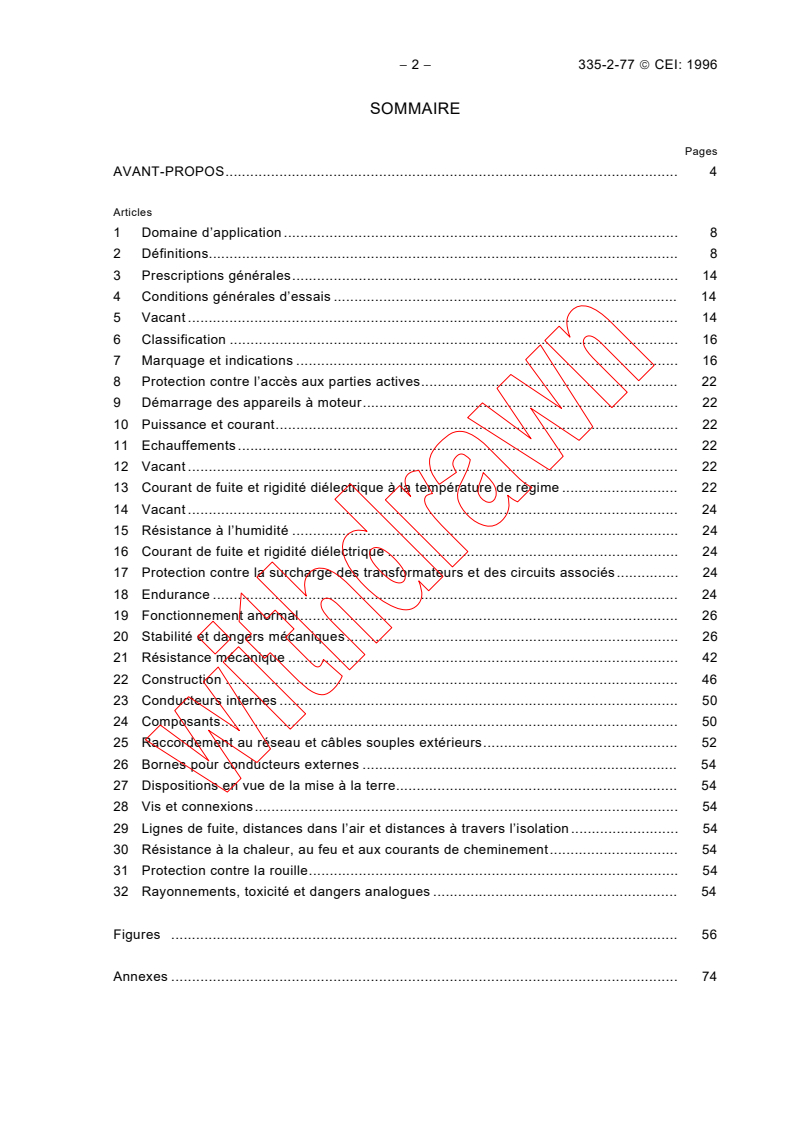
− 2 − 335-2-77 CEI: 1996
SOMMAIRE
Pages
AVANT-PROPOS. 4
Articles
1 Domaine d’application . 8
2 Définitions. 8
3 Prescriptions générales. 14
4 Conditions générales d’essais . 14
5 Vacant . 14
6 Classification . 16
7 Marquage et indications . 16
8 Protection contre l’accès aux parties actives. 22
9 Démarrage des appareils à moteur. 22
10 Puissance et courant. 22
11 Echauffements. 22
12 Vacant . 22
13 Courant de fuite et rigidité diélectrique à la température de régime . 22
14 Vacant . 24
15 Résistance à l’humidité . 24
16 Courant de fuite et rigidité diélectrique . 24
17 Protection contre la surcharge des transformateurs et des circuits associés. 24
18 Endurance . 24
19 Fonctionnement anormal. 26
20 Stabilité et dangers mécaniques. 26
21 Résistance mécanique . 42
22 Construction . 46
23 Conducteurs internes . 50
24 Composants. 50
25 Raccordement au réseau et câbles souples extérieurs. 52
26 Bornes pour conducteurs externes . 54
27 Dispositions en vue de la mise à la terre. 54
28 Vis et connexions. 54
29 Lignes de fuite, distances dans l’air et distances à travers l’isolation . 54
30 Résistance à la chaleur, au feu et aux courants de cheminement. 54
31 Protection contre la rouille. 54
32 Rayonnements, toxicité et dangers analogues . 54
Figures . 56
Annexes . 74
335-2-77 IEC:1996 − 3 −
CONTENTS
Page
FOREWORD. 5
Clause
1 Scope . 9
2 Definitions. 9
3 General requirement . 15
4 General conditions for the tests . 15
5 Void. 15
6 Classification . 17
7 Marking and instructions . 17
8 Protection against access to live parts. 23
9 Starting of motor-operated appliances . 23
10 Power input and current . 23
11 Heating. 23
12 Void. 23
13 Leakage current and electric strength at operating temperature . 23
14 Void. 25
15 Moisture resistance . 25
16 Leakage current and electric strength. 25
17 Overload protection of transformers and associated circuits. 25
18 Endurance . 25
19 Abnormal operation. 27
20 Stability and mechanical hazards. 27
21 Mechanical strength . 43
22 Construction . 47
23 Internal wiring . 51
24 Components . 51
25 Supply connection and external flexible cables and cords . 53
26 Terminals for external conductors. 55
27 Provision for earthing . 55
28 Screws and connections. 55
29 Creepage distances, clearances and distances through insulation. 55
30 Resistance to heat, fire and tracking. 55
31 Resistance to rusting. 55
32 Radiation, toxicity and similar hazards. 55
Figures . 57
Annexes . 75
− 4 − 335-2-77 CEI: 1996
COMMISSION ÉLECTROTECHNIQUE INTERNATIONALE
_________
SÉCURITÉ DES APPAREILS ÉLECTRODOMESTIQUES
ET ANALOGUES –
Partie 2: Règles particulières pour les tondeuses à gazon
fonctionnant sur le réseau et à conducteur à pied
AVANT-PROPOS
1) La CEI (Commission Electrotechnique Internationale) est une organisation mondiale de normalisation
composée de l'ensemble des comités électrotechniques nationaux (Comités nationaux de la CEI). La CEI a
pour objet de favoriser la coopération internationale pour toutes les questions de normalisation dans les
domaines de l'électricité et de l'électronique. A cet effet, la CEI, entre autres activités, publie des Normes
Internationales. Leur élaboration est confiée à des comités d'études, aux travaux desquels tout Comité
national intéressé par le sujet traité peut participer. Les organisations internationales, gouvernementales et
non gouvernementales, en liaison avec la CEI, participent également aux travaux. La CEI collabore
étroitement avec l'Organisation Internationale de Normalisation (ISO), selon des conditions fixées par accord
entre les deux organisations.
2) Les décisions ou accords officiels de la CEI concernant les questions techniques, représentent, dans la
mesure du possible un accord international sur les sujets étudiés, étant donné que les Comités nationaux
intéressés sont représentés dans chaque comité d’études.
3) Les documents produits se présentent sous la forme de recommandations internationales. Ils sont publiés
comme normes, rapports techniques ou guides et agréés comme tels par les Comités nationaux.
4) Dans le but d'encourager l'unification internationale, les Comités nationaux de la CEI s'engagent à appliquer
de façon transparente, dans toute la mesure possible, les Normes internationales de la CEI dans leurs normes
nationales et régionales. Toute divergence entre la norme CEI et la norme nationale ou régionale
correspondante doit être indiquée en termes clairs dans cette dernière.
5) La CEI n’a fixé aucune procédure concernant le marquage comme indication d’approbation et sa
responsabilité n’est pas engagée quand un matériel est déclaré conforme à l’une de ses normes.
6) L’attention est attirée sur le fait que certains des éléments de la présente Norme internationale peuvent faire
l’objet de droits de propriété intellectuelle ou de droits analogues. La CEI ne saurait être tenue pour
responsable de ne pas avoir identifié de tels droits de propriété et de ne pas avoir signalé leur existence.
La présente partie de la Norme internationale CEI 335 a été établie par le sous-comité 61F:
Sécurité des outils électroportatifs à moteur, du comité d’études 61 de la CEI: Sécurité des
appareils électrodomestiques et analogues.
Elle constitue la première édition de la CEI 335-2-77.
Le texte de cette norme est issu des documents suivants:
FDIS Rapport de vote
61F/123/FDIS 61F/131/RVD
Le rapport de vote indiqué dans le tableau ci-dessus donne toute information sur le vote ayant
abouti à l'approbation de cette partie.
La présente partie 2 doit être utilisée conjointement avec la dernière édition de la CEI 335-1 et
ses amendements. Elle a été établie sur la base de la troisième édition (1991) de cette norme.
335-2-77 IEC:1996 − 5 −
INTERNATIONAL ELECTROTECHNICAL COMMISSION
_________
SAFETY OF HOUSEHOLD AND SIMILAR
ELECTRICAL APPLIANCES –
Part 2: Particular requirements for pedestrian controlled
mains-operated lawnmowers
FOREWORD
1) The IEC (International Electrotechnical Commission) is a worldwide organization for standardization
comprising all national electrotechnical committees (IEC National Committees). The object of the IEC is to
promote international co-operation on all questions concerning standardization in the electrical and electronic
fields. To this end and in addition to other activities, the IEC publishes International Standards. Their
preparation is entrusted to technical committees; any IEC National Committee interested in the subject dealt
with may participate in this preparatory work. International, governmental and non-governmental organizations
liaising with the IEC also participate in this preparation. The IEC collaborates closely with the International
Organization for Standardization (ISO) in accordance with conditions determined by agreement between the
two organizations.
2) The formal decisions or agreements of the IEC on technical matters, express as nearly as possible, an
international consensus of opinion on the relevant subjects since each technical committee has representation
from all interested National Committees.
3) The documents produced have the form of recommendations for international use and are published in the
form of standards, technical reports or guides and they are accepted by the National Committees in that
sense.
4) In order to promote international unification, IEC National Committees undertake to apply IEC International
Standards transparently to the maximum extent possible in their national and regional standards. Any
divergence between the IEC Standard and the corresponding national or regional standard shall be clearly
indicated in the latter.
5) The IEC provides no marking procedure to indicate its approval and cannot be rendered responsible for any
equipment declared to be in conformity with one of its standards.
6) Attention is drawn to the possibility that some of the elements of this International Standard may be the
subject of patent rights. IEC shall not be held responsible for identifying any or all such patent rights.
This part of International Standard IEC 335 has been prepared by IEC subcommittee 61F:
Safety of hand-held motor-operated electric tools, of IEC technical committee 61: Safety of
household and similar electrical appliances.
It forms the first edition of IEC 335-2-77.
The text of this standard is based on the following documents:
FDIS Report on voting
61F/123/FDIS 61F/131/RVD
Full information on the voting for the approval of this standard can be found in the report on
voting indicated in the above table.
This part 2 is to be used in conjunction with the latest edition of IEC 335-1 and its amendments.
It was established on the basis of the third edition (1991) of that standard.
− 6 − 335-2-77 CEI: 1996
La présente partie 2 complète ou modifie les articles correspondants de la CEI 335-1 de façon
à la transformer en norme CEI: Règles de sécurité pour les tondeuses à gazon fonctionnant sur
le réseau et à conducteur à pied.
Lorsqu’un paragraphe particulier de la partie 1 n’est pas mentionné dans cette partie 2, ce
paragraphe s’applique pour autant qu’il est raisonnable. Lorsque la présente norme spécifie
«addition», «modification» ou «remplacement», le texte correspondant de la partie 1 doit être
adapté en conséquence.
NOTES
1 Les caractères d’imprimerie suivants sont utilisés:
− prescriptions: caractères romains;
− modalités d’essais: caractères italiques;
− notes: petits caractères romains.
Les termes figurant en caractères gras dans le texte sont définis à l’article 2. Lorsqu’une définition de la partie
1 concerne un adjectif, l’adjectif et le nom associé figurent également en gras dans cette partie 2.
2 Les paragraphes et figures complémentaires à ceux de la partie 1 sont numérotés à partir de 101. Les
annexes complémentaires à celles de la partie 1 sont appelées AA, BB, etc.
335-2-77 IEC:1996 − 7 −
This part 2 supplements or modifies the corresponding clauses in IEC 335-1, so as to convert it
into the IEC standard: Safety requirements for pedestrian controlled mains-operated
lawnmowers.
Where a particular subclause of part 1 is not mentioned in this part 2, that subclause applies as
far as is reasonable. Where this standard states “addition”, “modification” or “replacement”, the
relevant text in part 1 is to be adopted accordingly.
NOTES
1 The following print type are used:
− requirements: in roman type;
− test specifications: in italic type;
− notes: in small roman type;
Words in bold in the text are defined in clause 2. When a definition of part 1 concerns an adjective, in this
part the adjective and the associated noun are also in bold.
2 Subclauses and tables which are additional to those in part 1 are numbered starting from 101. Annexes
which are additional to those in part 1 are lettered AA, BB, etc.
− 8 − 335-2-77 CEI: 1996
SÉCURITÉ DES APPAREILS ÉLECTRODOMESTIQUES
ET ANALOGUES –
Partie 2: Règles particulières pour les tondeuses à gazon
fonctionnant sur le réseau et à conducteur à pied
1 Domaine d’application
L’article de la partie 1 est applicable avec les exceptions suivantes:
1.1 Remplacement:
La présente norme traite de la sécurité des tondeuses à gazon, à lames hélicoïdales ou à
axe vertical, électriques fonctionnant sur le réseau et à conducteur à pied, spécialement
conçues pour une utilisation autour de la maison ou pour des usages analogues, dont la
tension assignée n'est pas supérieure à 250 V monophasé.
La présente norme ne s'applique pas aux coupe-gazons, aux coupe-bordures de gazon, aux
coupe-bordures, aux tondeuses à fléaux, aux tondeuses à barre de coupe ou aux
tondeuses agricoles.
Les prescriptions de la présente norme ne s'appliquent pas aux tondeuses à axe vertical si
l'organe de coupe est constitué d'un ou de plusieurs filaments non métalliques, ou d'un ou de
plusieurs éléments de coupe non métalliques montés d'une manière pivotante sur une unité
centrale, en général circulaire. L'action de coupe de ces organes de coupe dépend de la force
centrifuge. L'énergie cinétique de chaque organe de coupe ne doit pas dépasser 10 J. Les
organes de coupe ne doivent pas être remplaçables par des équivalents métalliques ou par
d'autres matériaux rigides fournis par le fabricant.
La présente norme ne tient pas compte en général
− de l'utilisation des appareils par de jeunes enfants ou par des personnes handicapées
sans surveillance;
− de l'emploi de l'appareil comme jouet par de jeunes enfants.
NOTE – L'attention est attirée sur le fait que
− pour les appareils destinés à être utilisés dans les pays tropicaux, des prescriptions spéciales peuvent être
nécessaires;
− dans de nombreux pays, des prescriptions complémentaires sont imposées par les organismes nationaux de
la santé publique, par les organismes nationaux responsables de la protection des travailleurs, et par des
organismes analogues.
2 Définitions
L’article de la partie 1 est applicable avec les exceptions suivantes:
2.2.9 Remplacement:
conditions de fonctionnement normal: Fonctionnement de l’appareil dans les conditions
suivantes: l'appareil est alimenté sous la tension assignée avec la charge nécessaire pour
atteindre la puissance assignée.
335-2-77 IEC:1996 − 9 −
SAFETY OF HOUSEHOLD AND SIMILAR
ELECTRICAL APPLIANCES –
Part 2: Particular requirements for pedestrian controlled
mains-operated lawnmowers
1 Scope
This clause of part 1 is applicable except as follows:
1.1 Replacement:
This standard deals with the safety of pedestrian controlled mains-operated electrical,
cylinder or rotary lawnmowers designed primarily for use around the home or for similar
purposes, their rated voltage being not more than 250 V single phase.
This standard does not apply to lawn trimmers, lawn edge trimmers, lawn edgers, flail
mowers, sickle-bar mowers, or agricultural mowers.
Rotary mowers are excluded from the requirements of this standard if the cutting means is
either one or more non-metallic filaments, or one or more non-metallic cutting elements
pivotally mounted on a generally circular central drive unit. These cutting means shall rely on
centrifugal force to achieve cutting. The kinetic energy of a single cutting means will not
exceed 10 J, the cutting means not being replaceable with metallic or other rigid material
equivalents supplied by the manufacturer.
This standard does not in general take into account
− the use of appliances by young children or infirm persons without supervision;
− playing with the appliance by young children.
NOTE – Attention is drawn to the fact that:
− for appliances intended to be used in tropical countries special requirements may be necessary;
− in many countries additional requirements are specified by the national health authorities, the national
authorities responsible for the protection of labour, and similar authorities.
2 Definitions
This clause of part 1 is applicable except as follows:
2.2.9 Replacement:
normal operation: Operation of the appliance under the following conditions: the appliance is
operated at rated voltage with the load necessary to attain rated power input.
− 10 − 335-2-77 CEI: 1996
2.101 lame: Terme utilisé dans les avertissements et dans les instructions pour désigner
l'organe de coupe (voir 2.104).
2.102 système de freinage: Combinaison d’un ou de plusieurs freins et des moyens
appropriés de transmission et de commande.
2.103 commande: Moyen ou dispositif qui commande le fonctionnement de l'appareil, ou tout
fonctionnement spécifique s'y rapportant.
2.104 organe de coupe: Dispositif utilisé pour réaliser l'action de coupe sur une tondeuse à
gazon.
2.105 enceinte de l'organe de coupe (carter): Pièce ou assemblage qui sert de moyen de
protection autour de l'organe de coupe.
2.106 circonférence de coupe: Trajectoire décrite par le point extrême de l'organe de
coupe lorsqu'il tourne autour de l'axe de son arbre.
2.107 positions de coupe: Chaque réglage de hauteur de l'organe de coupe prévu par le
fabricant pour couper l'herbe.
2.108 largeur de coupe: Largeur de coupe mesurée en travers de l'organe de coupe,
perpendiculairement au sens d'avancement, et calculée à partir des dimensions de l'organe de
coupe ou du (des) diamètre(s) de la (des) circonférence(s) de coupe.
2.109 tondeuse à lames hélicoïdales: Tondeuse à gazon avec un ou plusieurs organes de
coupe tournant autour d’un axe horizontal pour effectuer une action de cisaillement avec une
barre ou un couteau de coupe fixe.
2.110 goulotte d'éjection: Extension de l’enceinte de l'organe de coupe à partir de
l'ouverture d'éjection, généralement utilisée pour diriger l'éjection du matériau provenant de
l'organe de coupe.
2.111 ouverture d'éjection: Trou ou ouverture dans l’enceinte de l'organe de coupe par où
l'herbe peut être éjectée.
2.112 tondeuse à fléaux: Appareil coupant l'herbe avec de nombreux éléments coupants
oscillant librement qui tournent autour d'un axe parallèle au plan de coupe et coupent par
impact.
2.113 bac de ramassage: Elément ou combinaison d'éléments qui constitue un dispositif pour
collecter l'herbe tondue ou les débris.
2.114 protecteur: Partie de l'appareil ou élément intégré protégeant l'opérateur et/ou une
tierce personne.
2.115 poignée: Toutes les parties susceptibles d'être tenues à la main pour guider l'appareil
en utilisation prévue.
2.116 impact: Projectile d'essai traversant complètement toutes les couches du matériau de
la cible d'essai.
2.117 tondeuse à coussin d'air: Tondeuse à gazon qui utilise un coussin d’air au lieu de
roues comme support sur le sol.
335-2-77 IEC:1996 − 11 −
2.101 blade: Term used in warnings and instructions to denote cutting means (see 2.104).
2.102 braking system: A combination of one or more brakes and related means of operation
and control.
2.103 control: A means or device which controls the operation of the appliance or any
specific operating function thereof.
2.104 cutting means: The mechanism used to provide the cutting action of a lawnmower.
2.105 cutting means enclosure (housing): The part or assembly which provides the
protective means around the cutting means.
2.106 cutting means tip circle: The path described by the outermost point of the cutting
means as it rotates about its shaft axis.
2.107 cutting positions: Any height setting of the cutting means designated by the
manufacturer for cutting grass.
2.108 cutting width: The width of cut measured across the cutting means at right angles to
the direction of travel and calculated from the dimensions of the cutting means or the
diameter(s) of the cutting means tip circle(s).
2.109 cylinder mower: A lawnmower with one or more cutting means rotating about a
horizontal axis to provide a shearing action with a fixed cutter bar or knife.
2.110 discharge chute: An extension of the cutting means enclosure from the discharge
opening, generally used to control the discharge of material from the cutting means.
2.111 discharge opening: A gap or opening in the cutting means enclosure through which
grass may be discharged.
2.112 flail mower: A grasscutting appliance with a multiplicity of free-swinging cutting
elements that rotate about an axis parallel to the cutting plane and cut by impact.
2.113 grass catcher: A part or combination of parts which provide a means for collecting
grass clippings or debris.
2.114 guard: A part of the appliance or a component incorporated to provide protection for the
operator and/or bystander.
2.115 handle: All parts likely to be hand-held for guiding the appliance in intended use.
2.116 hit: The test projectile passing completely through all layers of the target material.
2.117 hover mower: A lawnmower which uses a cushion of air instead of wheels as a ground
support.
− 12 − 335-2-77 CEI: 1996
2.118 utilisation prévue: Tout usage de l'appareil raisonnablement prévisible, comme décrit
dans les instructions d'utilisation, et qui est compatible avec des activités telles que coupe du
gazon, démarrage, arrêt, ou branchement à (ou débranchement d') une source de puissance.
2.119 coupe-bordure: Appareil à moteur pouvant couper l'herbe et la terre habituellement
dans un plan vertical.
2.120 coupe-bordure de gazon: Appareil à moteur à couper l'herbe destiné à couper les
bords de pelouse, habituellement dans un plan vertical.
2.121 tondeuse à gazon (tondeuse): Appareil à couper l'herbe dont l'organe de coupe
fonctionne dans un plan approximativement parallèle au sol et qui utilise le sol pour déterminer
la hauteur de coupe à l'aide de roues, de coussin d'air ou de patins, etc. et un moteur
électrique comme source de puissance.
2.122 coupe-gazon: Appareil à moteur à couper l'herbe, dont l'opérateur détermine le plan de
fonctionnement de l'organe de coupe et la hauteur de coupe et qui peut être éventuellement
assisté d'une roue, d'un patin, etc.
2.123 vitesse maximale du moteur en utilisation: Plus grande vitesse du moteur que l'on
puisse obtenir lorsqu'il est réglé conformément aux spécifications et/ou aux instructions du
fabricant et qu'il fonctionne avec l'organe de coupe embrayé.
2.124 équipement de tonte: Organe de coupe conçu pour être facilement détaché de
l'appareil et, généralement, pour permettre à l'appareil d'être utilisé dans d'autres buts.
2.125 tondeuse hacheuse: Tondeuse à axe vertical sans ouvertures d'éjection dans
l’enceinte de l’organe de coupe.
2.126 (fonctionnement) à vide: Charge minimale accessible à la tension assignée. (Pour
les tondeuses à lames hélicoïdales, aucun organe de coupe n’est au contact des barres ou
des couteaux de coupe fixes.
2.127 commande de l'opérateur: Toute commande nécessitant une mise en action par
l'opérateur pour effectuer des fonctions spécifiques.
2.128 commande de présence de l'opérateur: Commande conçue de façon à interrompre
automatiquement la puissance vers un dispositif de déplacement lorsque la force exercée par
l'opérateur est interrompue.
2.129 zone de l'opérateur: Zone destinée aux opérateurs travaillant avec une tondeuse à
gazon (voir figure 101).
2.130 frein de stationnement: Dispositif incorporé dans l’appareil, lorsqu’il fonctionne,
permettant d'empêcher l'appareil à l'arrêt de bouger et pouvant rester appliqué en l'absence de
l'opérateur.
2.131 tondeuse pour conducteur à pied: Appareil à couper l'herbe, soit poussé, soit
autotracté, commandé normalement par l'opérateur marchant derrière l'unité.
2.132 source de puissance: Moteur qui fournit l'énergie mécanique pour créer un
mouvement linéaire et/ou rotatif.
335-2-77 IEC:1996 − 13 −
2.118 intended use: Any use of the appliance which is reasonably foreseeable, as described
in the user instructions, and which is consistent with such activities as cutting grass, starting,
stopping, or connecting to (or disconnecting) from a power source.
2.119 lawn edger: A powered appliance suitable for cutting lawn and soil, usually in a vertical
plane.
2.120 lawn edge trimmer: A powered grasscutting appliance for trimming lawn edges, usually
in a vertical plane.
2.121 lawnmower (mower): A grasscutting appliance where the cutting means operates in a
plane approximately parallel to the ground and which uses the ground to determine the height
of cut by means of wheels, air cushion or skids, etc., and which utilises an electric motor for a
power source.
2.122 lawn trimmer: A powered grasscutting appliance where the operator determines the
plane of operation of the cutting means and the height of cut, possibly assisted by a wheel or
skid, etc.
2.123 maximum operating motor speed: The highest motor speed obtained when adjusted
in accordance with the manufacturer’s specifications and/or instructions, with the cutting
means engaged.
2.124 mowing attachment: A cutting means designed to be easily detached from the
appliance, generally to allow the appliance to be used for other purposes.
2.125 mulching mower: A rotary mower without discharge openings in the cutting means
enclosure.
2.126 no-load: The minimum load attainable at rated voltage (for cylinder mowers there is
no cylinder to fixed cutter bar or knife contact).
2.127 operator control: Any control requiring operator actuation to perform specific
functions.
2.128 operator presence control: A control designed so that it will automatically interrupt
power to a drive when the operator’s actuating force is removed.
2.129 operator zone: The operator zone for persons operating a lawnmower is presented in
figure 101.
2.130 parking brake: A device incorporated in the appliance which, when operated, prevents
the appliance from moving from a stationary position and remains applied without the operator
present.
2.131 pedestrian controlled mower: A grasscutting appliance, either pushed or self-
propelled, normally controlled by the operator walking behind the unit.
2.132 power source: A motor which provides mechanical energy for linear and/or rotational
movement.
− 14 − 335-2-77 CEI: 1996
2.133 tondeuse à axe vertical: Tondeuse à gazon dans laquelle l’organe de coupe,
coupant par impact, tourne autour d’un axe normal au plan de coupe.
2.134 frein de service: Moyen principal conçu pour ralentir et arrêter l'appareil à partir de sa
vitesse de déplacement au sol.
2.135 tondeuse à barre de coupe: Tondeuse à gazon qui utilise une source de puissance
pour créer un mouvement alternatif sur un ou des couteaux pour effectuer une action de
cisaillement avec une contre-lame fixe ou un couteau mobile.
2.136 temps d'arrêt: Temps écoulé entre le moment où l'organe de manoeuvre de
l'interrupteur est relâché et le moment où l'appareil ou les organes s'arrêtent.
2.137 ligne de projection (des tondeuses à lames hélicoïdales): Ligne supérieure dans un
plan vertical, tangentielle à la périphérie du cylindre de coupe dans le sens de rotation et qui ne
coupe pas un protecteur ou une portion de l'appareil (voir figure 110).
2.138 risque lié aux projections d'objets: Eventualité de dommages causés par des objets
projetés par l'organe de coupe en mouvement.
2.139 dispositif de transmission: Moyens (ou systèmes) utilisés pour transmettre l'énergie
de la source de puissance au dispositif d'entraînement au sol.
3 Prescriptions générales
L’article de la partie 1 est applicable avec l’exception suivante:
3.101 Lorsque des équipements de tonte sont disponibles chez le fabricant d’origine, et que
ces équipements modifient l'utilisation de la tondeuse à gazon, l'appareil complété doit encore
être conforme aux prescriptions de sécurité électrique de la présente norme.
La vérification est effectuée par examen et par les essais correspondants, si applicable.
4 Conditions générales d'essai
L’article de la partie 1 est applicable avec les exceptions suivantes:
4.5 Addition:
Pendant les essais, l’organe de coupe est réglé et lubrifié conformément aux instructions du
fabricant relatives à l'essai.
NOTE – Par exemple, les organes de coupe des tondeuses à lames hélicoïdales peuvent devenir
inopérantes, après une longue période en réglage normal, par manque de lubrification, etc. normalement
réalisée par l'herbe.
4.6 Addition:
Les dispositifs de commande de vitesse électroniques sont réglés pour la plus grande vitesse.
5 Vacant
335-2-77 IEC:1996 − 15 −
2.133 rotary mower: A lawnmower in which the cutting means, cutting by impact, rotates
about an axis (axes) normal to the cutting plane.
2.134 service brake: The designated primary means for decelerating and stopping a machine
from its ground travel speed.
2.135 sickle bar mower: A lawnmower which uses a power source to reciprocate a knife or
knives to provide a shearing action with a stationary cutter bar or movable knife.
2.136 stopping time: The time elapsed between the instant when the actuator is released
and the instant at which the appliance or component comes to a stop.
2.137 throw line (cylinder mowers): The steepest line in a vertical plane, tangential to the
periphery of the cutting cylinder in the direction of rotation, which does not intersect a guard or
portion of the appliance. (See figure 110.)
2.138 thrown object hazard: The potential for injury caused by object(s) propelled by the
moving cutting means.
2.139 traction drive: The means (system) used to transmit power from the power source to
the ground drive means.
3 General requirement
This clause of part 1 is applicable except as follows:
3.101 Where mowing attachments are available from the original manufacturer which modify
the use of a lawnmower, the complete appliance shall still comply with the electrical safety
requirements of this standard.
Compliance is checked by inspection and by the relevant tests, where applicable.
4 General conditions for the tests
This clause of part 1 is applicable except as follows:
4.5 Addition:
During the tests, the cutting means are adjusted and lubricated in accordance with the
manufacturer’s instructions specific to the test.
NOTE – For example, cylinder mower cutting means may not be able to run for extended periods at
normal adjustment because of lack of lubrication, etc., normally provided by the grass.
4.6 Addition:
Electronic speed control devices are set for the highest speed.
5 Void
− 16 − 335-2-77 CEI: 1996
6 Classification
L’article de la partie 1 est applicable avec les exceptions suivantes:
6.1 Remplacement:
Les appareils doivent être de l'une des classes suivantes par rapport à la protection contre les
chocs électriques: classe II ou classe III
La vérification est effectuée par examen et par les essais correspondants.
6.2 Addition:
Les appareils doivent être au moins IPX4.
7 Marquage et indications
L'article de la partie 1 est applicable avec les exceptions suivantes:
7.1 Addition:
L'appareil doit porter en substance l'avertissement suivant, placé de manière évidente. Les
lettres, noires sur fond jaune, doivent avoir une hauteur minimale de 3 mm. Si des symboles ou
pictogrammes appropriés ISO/CEI sont disponibles, ils doivent être utilisés. Les marquages ou
symboles donnant des consignes de prudence doivent être situés près du risque concerné.
AVERTISSEMENT
ARRÊTER LE MOTEUR ET DÉBRANCHER LA PRISE DE COURANT AVANT DE RÉGLER, DE
NETTOYER OU SI LE CABLE EST EMMÊLÉ OU ENDOMMAGÉ.
LIRE LA NOTICE D'INSTRUCTIONS.
MAINTENIR LE CÂBLE D'ALIMENTATION ÉLOIGNÉ DES LAMES DE COUPE.
LES LAMES CONTINUENT DE TOURNER APRÈS L'ARRÊT DE L'APPAREIL.
Pour les tondeuses à axe vertical:
− l’organe de coupe doit porter un marquage d’identification.
− si un adaptateur du bac de ramassage est utilisé, des instructions doivent être fixées à
la tondeuse près de l’ouverture d’éjection et de l’adaptateur du bac de ramassage
indiquant que la tondeuse ne doit pas être mise en fonctionnement sans que le bac de
ramassage complet ou le protecteur soit en place.
7.6 Addition:
NOTE 101 – Des informations pour les symboles d'opérateur peuvent être trouvées dans l'ISO 3767-1 et l’ISO
3767-3, et dans l'ISO 3864 pour les couleurs.
335-2-77 IEC:1996 − 17 −
6 Classification
This clause of part 1 is applicable except as follows:
6.1 Replacement:
Appliances shall be of one of the following classes with respect to protection against electric
shock: class II or class III.
Compliance is checked by inspection and by the relevant tests.
6.2 Addition:
Appliances shall be at least IPX4.
7 Marking and instructions
This clause of part 1 is applicable except as follows:
7.1 Addition:
The substance of the following warning shall be placed in a prominent position on the
appliance. The letters shall be a minimum of 3 mm high in black on a yellow background.
Where appropriate IEC/ISO symbols or pictograms are available, they shall be used. Marking or
symbols giving cautionary information shall be lo
...