

IEC 60139:2000
(Main)Preparation of outline drawings for cathode-ray tubes, their components, connections and gauges
General Information
- Abstract
IEC 60139:2000 gives guidance on the preparation of outline drawings of cathode-ray tubes (CRTs), tube components, tube sub-assemblies and ancillary components with the object of encouraging the same practice when publications are prepared in different countries. These recommendations are contained in the specimen drawings, descriptive text and in the tables of required dimensions.
- Status
- Published
- Publication Date
- 20-Dec-2000
- Technical Committee
- TC 110 - Electronic displays
- Current Stage
- PPUB - Publication issued
- Start Date
- 21-Dec-2000
- Completion Date
- 31-Dec-2000
Buy Documents
IEC 60139:2000 - Preparation of outline drawings for cathode-ray tubes, their components, connections and gauges Released:12/21/2000
IEC 60139:2000 - Preparation of outline drawings for cathode-ray tubes, their components, connections and gauges Released:12/21/2000
Overview - IEC 60139:2000 (Outline drawings for CRTs)
IEC 60139:2000 provides guidance for the preparation of outline drawings of cathode‑ray tubes (CRTs), their components, connections and gauges. The aim is to promote consistent drawing practices across countries so publications and technical documentation are compatible and unambiguous. The standard contains specimen drawings, descriptive text and tables of required dimensions to document a generic CRT design and its sub‑assemblies.
Key topics and technical requirements
- Scope and intent
- Guidance for outline drawings of CRTs, tube components, sub‑assemblies and ancillary parts with uniform conventions.
- Required views
- Typical drawings: front, top, side and diagonal views. Additional front view or mounting lug detail where implosion protection or mounting is integral.
- Specific drawing content
- Panel, funnel, base, reference line (yoke) gauge, beam‑clearance gauge, and ancillary equipment.
- Specimen figures and tabular dimension layouts (figures 1–18) illustrate recommended presentation.
- Geometry and terminology
- Definitions for terms such as principal axis, major/minor axis, beam clearance, anode button, centre face thickness (CFT), reference (yoke) line, Z‑point, etc.
- Dimensioning rules
- Show all dimensions necessary to assure clearances, mating with accessories and safe operation.
- Angles may be given in degrees/minutes/seconds or decimal form; equal angles can be denoted by a single value when obvious.
- Units, symbols and references
- Encourages use of SI units and standard electrical symbols (referenced normative documents listed below).
- Safety and fit
- Guidance on implosion bands, mounting lugs, clearance regions, beam impact avoidance and mechanical mating features.
Practical applications and users
Who uses IEC 60139:
- CRT manufacturers and glass producers for consistent outline documentation.
- Mechanical and electrical designers, drafters and CAD teams preparing product drawings.
- Supplier and OEM engineering for accessory and mounting compatibility.
- Quality, procurement and regulatory teams verifying conformance of outline drawings.
- Standards bodies and technical authors preparing international publications.
Practical benefits:
- Ensures interoperable mechanical interfaces (bases, lugs, anode buttons).
- Reduces design ambiguity when sharing drawings internationally.
- Helps verify beam clearance and safety‑critical dimensions for reliable CRT operation.
Related standards
Normative references cited in IEC 60139 include:
- IEC 60027‑1 (letter symbols in electrical technology)
- IEC 60050 (International Electrotechnical Vocabulary)
- IEC 60617 (graphical symbols)
- ISO 1000 (SI units and recommendations)
Keywords: IEC 60139, CRT outline drawings, cathode‑ray tube drawings, CRT components, beam clearance gauge, yoke reference line, drawing standard.
Buy Documents
IEC 60139:2000 - Preparation of outline drawings for cathode-ray tubes, their components, connections and gauges Released:12/21/2000
IEC 60139:2000 - Preparation of outline drawings for cathode-ray tubes, their components, connections and gauges Released:12/21/2000
Frequently Asked Questions
IEC 60139:2000 is a standard published by the International Electrotechnical Commission (IEC). Its full title is "Preparation of outline drawings for cathode-ray tubes, their components, connections and gauges". This standard covers: IEC 60139:2000 gives guidance on the preparation of outline drawings of cathode-ray tubes (CRTs), tube components, tube sub-assemblies and ancillary components with the object of encouraging the same practice when publications are prepared in different countries. These recommendations are contained in the specimen drawings, descriptive text and in the tables of required dimensions.
IEC 60139:2000 gives guidance on the preparation of outline drawings of cathode-ray tubes (CRTs), tube components, tube sub-assemblies and ancillary components with the object of encouraging the same practice when publications are prepared in different countries. These recommendations are contained in the specimen drawings, descriptive text and in the tables of required dimensions.
IEC 60139:2000 is classified under the following ICS (International Classification for Standards) categories: 31.100 - Electronic tubes. The ICS classification helps identify the subject area and facilitates finding related standards.
IEC 60139:2000 is available in PDF format for immediate download after purchase. The document can be added to your cart and obtained through the secure checkout process. Digital delivery ensures instant access to the complete standard document.
Standards Content (Sample)
INTERNATIONAL IEC
STANDARD
Second edition
2000-12
Preparation of outline drawings for
cathode-ray tubes, their components,
connections and gauges
Préparation des dessins d'encombrement
des tubes à rayons cathodiques, de leurs composants,
de leurs connexions et de leurs calibres
Reference number
Publication numbering
As from 1 January 1997 all IEC publications are issued with a designation in the
60000 series. For example, IEC 34-1 is now referred to as IEC 60034-1.
Consolidated editions
The IEC is now publishing consolidated versions of its publications. For example,
edition numbers 1.0, 1.1 and 1.2 refer, respectively, to the base publication, the
base publication incorporating amendment 1 and the base publication incorporating
amendments 1 and 2.
Further information on IEC publications
The technical content of IEC publications is kept under constant review by the IEC,
thus ensuring that the content reflects current technology. Information relating to
this publication, including its validity, is available in the IEC Catalogue of
publications (see below) in addition to new editions, amendments and corrigenda.
Information on the subjects under consideration and work in progress undertaken
by the technical committee which has prepared this publication, as well as the list
of publications issued, is also available from the following:
• IEC Web Site (www.iec.ch)
• Catalogue of IEC publications
The on-line catalogue on the IEC web site (www.iec.ch/catlg-e.htm) enables
you to search by a variety of criteria including text searches, technical
committees and date of publication. On-line information is also available on
recently issued publications, withdrawn and replaced publications, as well as
corrigenda.
• IEC Just Published
This summary of recently issued publications (www.iec.ch/JP.htm) is also
available by email. Please contact the Customer Service Centre (see below) for
further information.
• Customer Service Centre
If you have any questions regarding this publication or need further assistance,
please contact the Customer Service Centre:
Email: custserv@iec.ch
Tel: +41 22 919 02 11
Fax: +41 22 919 03 00
INTERNATIONAL IEC
STANDARD
Second edition
2000-12
Preparation of outline drawings for
cathode-ray tubes, their components,
connections and gauges
Préparation des dessins d'encombrement
des tubes à rayons cathodiques, de leurs composants,
de leurs connexions et de leurs calibres
IEC 2000 Copyright - all rights reserved
No part of this publication may be reproduced or utilized in any form or by any means, electronic or
mechanical, including photocopying and microfilm, without permission in writing from the publisher.
International Electrotechnical Commission 3, rue de Varembé Geneva, Switzerland
Telefax: +41 22 919 0300 e-mail: inmail@iec.ch IEC web site http://www.iec.ch
Commission Electrotechnique Internationale
PRICE CODE
U
International Electrotechnical Commission
For price, see current catalogue
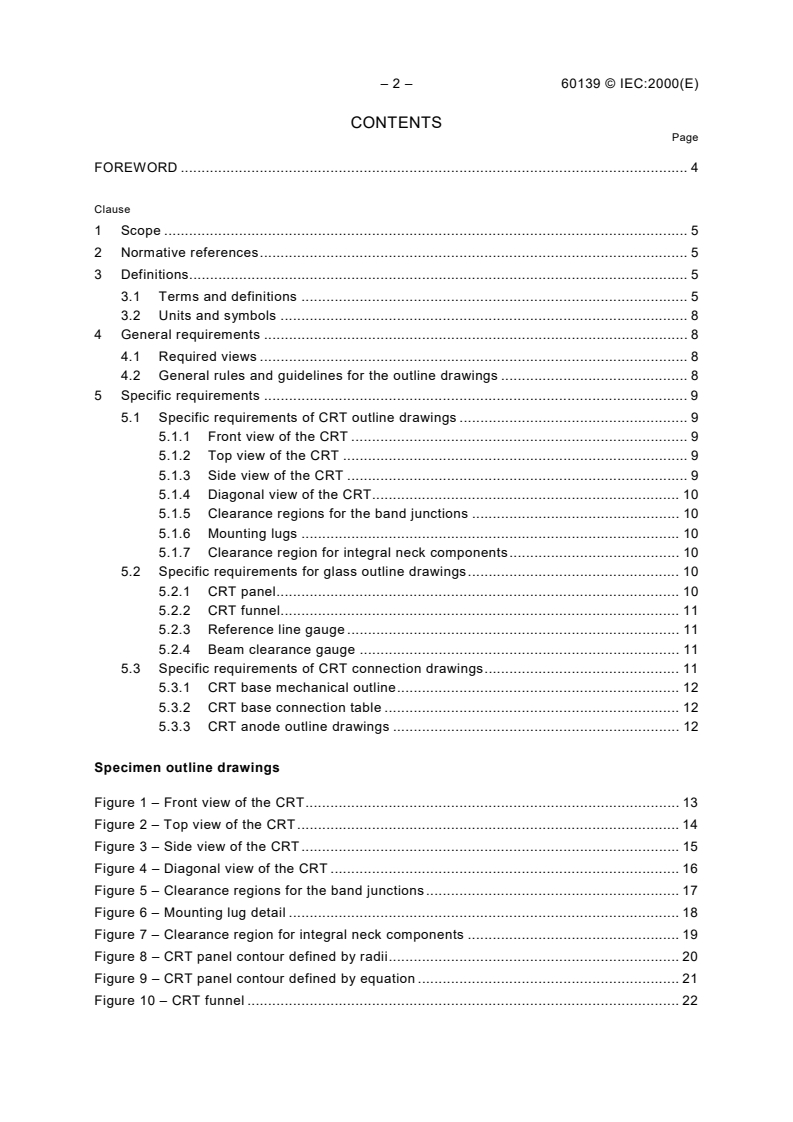
– 2 – 60139 © IEC:2000(E)
CONTENTS
Page
FOREWORD . 4
Clause
1 Scope . 5
2 Normative references. 5
3 Definitions. 5
3.1 Terms and definitions . 5
3.2 Units and symbols . 8
4 General requirements . 8
4.1 Required views . 8
4.2 General rules and guidelines for the outline drawings . 8
5 Specific requirements . 9
5.1 Specific requirements of CRT outline drawings . 9
5.1.1 Front view of the CRT . 9
5.1.2 Top view of the CRT . 9
5.1.3 Side view of the CRT . 9
5.1.4 Diagonal view of the CRT. 10
5.1.5 Clearance regions for the band junctions . 10
5.1.6 Mounting lugs . 10
5.1.7 Clearance region for integral neck components. 10
5.2 Specific requirements for glass outline drawings. 10
5.2.1 CRT panel. 10
5.2.2 CRT funnel. 11
5.2.3 Reference line gauge . 11
5.2.4 Beam clearance gauge . 11
5.3 Specific requirements of CRT connection drawings. 11
5.3.1 CRT base mechanical outline. 12
5.3.2 CRT base connection table . 12
5.3.3 CRT anode outline drawings . 12
Specimen outline drawings
Figure 1 – Front view of the CRT. 13
Figure 2 – Top view of the CRT . 14
Figure 3 – Side view of the CRT. 15
Figure 4 – Diagonal view of the CRT . 16
Figure 5 – Clearance regions for the band junctions. 17
Figure 6 – Mounting lug detail . 18
Figure 7 – Clearance region for integral neck components . 19
Figure 8 – CRT panel contour defined by radii. 20
Figure 9 – CRT panel contour defined by equation . 21
Figure 10 – CRT funnel . 22
60139 © IEC:2000(E) – 3 –
Page
Figure 11 – CRT funnel contour table . 23
Figure 12 – Yoke reference line gauge defined by equation. 24
Figure 13 – Yoke reference line gauge defined by radii . 25
Figure 14 – Beam clearance gauge defined by equation. 26
Figure 15 – Beam clearance gauge defined by radii . 27
Figure 16 – CRT base mechanical outline . 28
Figure 17 – Example of CRT base connection table . 29
Figure 18 – CRT anode button . 30
– 4 – 60139 © IEC:2000(E)
INTERNATIONAL ELECTROTECHNICAL COMMISSION
____________
PREPARATION OF OUTLINE DRAWINGS FOR CATHODE-RAY TUBES,
THEIR COMPONENTS, CONNECTIONS AND GAUGES
FOREWORD
1) The IEC (International Electrotechnical Commission) is a worldwide organization for standardization comprising
all national electrotechnical committees (IEC National Committees). The object of the IEC is to promote
international co-operation on all questions concerning standardization in the electrical and electronic fields. To
this end and in addition to other activities, the IEC publishes International Standards. Their preparation is
entrusted to technical committees; any IEC National Committee interested in the subject dealt with may
participate in this preparatory work. International, governmental and non-governmental organizations liaising
with the IEC also participate in this preparation. The IEC collaborates closely with the International
Organization for Standardization (ISO) in accordance with conditions determined by agreement between the
two organizations.
2) The formal decisions or agreements of the IEC on technical matters express, as nearly as possible, an
international consensus of opinion on the relevant subjects since each technical committee has representation
from all interested National Committees.
3) The documents produced have the form of recommendations for international use and are published in the form
of standards, technical specifications, technical reports or guides and they are accepted by the National
Committees in that sense.
4) In order to promote international unification, IEC National Committees undertake to apply IEC International
Standards transparently to the maximum extent possible in their national and regional standards. Any
divergence between the IEC Standard and the corresponding national or regional standard shall be clearly
indicated in the latter.
5) The IEC provides no marking procedure to indicate its approval and cannot be rendered responsible for any
equipment declared to be in conformity with one of its standards.
6) Attention is drawn to the possibility that some of the elements of this International Standard may be the subject
of patent rights. The IEC shall not be held responsible for identifying any or all such patent rights.
International Standard IEC 60139 has been prepared by IEC technical committee 39:
Electronic tubes.
This second edition cancels and replaces the first edition, published in 1962, and constitutes
a technical revision.
The text of this standard is based on the following documents:
FDIS Report on voting
39/254/FDIS 39/256/RVD
Full information on the voting for the approval of this standard can be found in the report on
voting indicated in the above table.
This publication has been drafted in accordance with the ISO/IEC Directives, Part 3.
The committee has decided that the contents of this publication will remain unchanged until
2005. At this date, the publication will be
reconfirmed;
withdrawn;
replaced by a revised edition, or
amended.
60139 © IEC:2000(E) – 5 –
PREPARATION OF OUTLINE DRAWINGS FOR CATHODE-RAY TUBES,
THEIR COMPONENTS, CONNECTIONS AND GAUGES
1 Scope
This International Standard gives guidance on the preparation of outline drawings of cathode-
ray tubes (CRTs), tube components, tube sub-assemblies and ancillary components with the
object of encouraging the same practice when publications are prepared in different countries.
These recommendations are contained in the specimen drawings, descriptive text and in the
tables of required dimensions.
2 Normative references
The following normative documents contain provisions which, through reference in this text,
constitute provisions of this International Standard. For dated references, subsequent
amendments to, or revisions of, any of these publications do not apply. However, parties to
agreements based on this International Standard are encouraged to investigate the possibility
of applying the most recent editions of the normative documents indicated below. For undated
references, the latest edition of the normative document referred to applies. Members of IEC
and ISO maintain registers of currently valid International Standards.
IEC 60027-1:1995, Letter symbols to be used in electrical technology – Part 1: General
IEC 60050 (all parts), International Electrotechnical Vocabulary (IEV)
IEC 60617 (all parts), Graphical symbols for diagrams
ISO 1000: SI units and recommendations for the use of their multiples and of certain other
units
3 Definitions
3.1 Terms and definitions
For the purpose of this International Standard, the following definitions apply.
3.1.1
anode button
conductive contact which provides electrical continuity from the outside of the insulating
envelope to the anode electrode inside the tube
3.1.2
axes of the CRT
3.1.2.1
principal axis
axis perpendicular to the panel and the phosphor screen which passes through the centre
point of the panel, the funnel, deflection yoke region and the electron gun
– 6 – 60139 © IEC:2000(E)
3.1.2.2
major axis
axis in the direction of the longer dimension of the CRT screen which passes through and is
perpendicular to the principal axis, normally the horizontal axis
3.1.2.3
minor axis
axis along the shorter dimension of the CRT screen which passes through and is
perpendicular to the principal axis, normally the vertical axis
3.1.2.4
diagonal axis
axis connecting opposite corners of the CRT screen
3.1.3
band
hardware that surrounds the CRT panel and 1) holds the mounting lugs and implosion safety
hardware to the CRT, 2) applies compressive loads to the panel for mechanical safety and 3)
contains the panel glass temporarily in the event of breakage
NOTE This band may be mechanically tensioned and joined at a junction; it may be joined to the CRT with resin,
or it may also be a single piece that is thermally shrunk over the panel (so called shrink-fit).
3.1.4
beam clearance
clearance between the electron beam path and the flare region of the funnel connecting the
CRT neck to the body of the funnel
NOTE Prevention of beam impact on the glass is critical for proper operation.
3.1.5
centre face thickness (CFT)
thickness of the panel at its centre
3.1.6
corner angle
angle between the major axis and a diagonal of the nominal screen of the design aspect ratio
3.1.7
deflection angles
angles subtended by the major axis, minor axis and diagonal dimensions of the screen as
viewed from yoke reference line
3.1.8
design aspect ratio
design value of the ratio of the long to short dimensions of a rectangular area, typically
expressed as a ratio of whole integers such as “4 by 3” or “16 by 9”
3.1.9
diagonal
line joining opposing corners
3.1.10
frit seal line
line formed by the frit joint between the panel and funnel
3.1.11
heel radius
radius of the blend between the principal panel surface and the panel skirt
60139 © IEC:2000(E) – 7 –
3.1.12
integral neck components
devices attached to the neck and/or funnel of the CRT by the manufacturer
3.1.13
lug
mounting hardware that has a blade section generally furnished with a mounting hole to
receive a mounting bolt
3.1.14
magnetic shield
ferromagnetic cone, roughly the shape of the funnel, that excludes external magnetic fields
from the electron beam region
3.1.15
mould-match line
line of maximum dimension of the moulded part, located at the mating plane of the two halves
of a mould
3.1.16
mounting system
hardware attached to the CRT that facilitates mounting the CRT
3.1.17
projected screen dimensions
screen dimensions as they appear to a viewer outside the CRT (at infinite distance)
NOTE The dimensions are projected along optical paths from the screen surface onto a plane perpendicular to
the principal CRT axis.
3.1.18
reference line
yoke reference line
fundamental plane for measurement and control of the funnel geometry
3.1.19
sagittal height
height from a plane tangential to the surface (of the panel) at its centre
3.1.20
screen diagonal
diagonal of the largest rectangle of the design aspect ratio inscribed within the screen
boundary
3.1.21
useful screen dimensions
projected dimensions of the inner surface of the glass panel determined useful by the CRT
glass manufacturer
3.1.22
useful phosphor screen dimensions
projected dimensions of the phosphor screen determined useful by the CRT manufacturer
3.1.23
z-axis
axis of a CRT component or CRT gauge typically aligned with the principal axis of the CRT
– 8 – 60139 © IEC:2000(E)
3.1.24
Z-point
reference point on the external surface of the panel along the diagonal
3.2 Units and symbols
Units, graphical symbols and letter symbols should, wherever possible, be taken from the
publications listed in clause 2 of this standard.
When further items are required they should be derived in accordance with the principles of
these publications.
4 General requirements
This standard prescribes the outline drawing views and the dimensions and descriptions
required for documenting a generic CRT design. The recommendations for each drawing are
specified in 5.1, 5.2, 5.3 and specimen drawings are shown in figure 1 through figure 18.
If the phosphor screen extent is hidden by the band, the degree of vignetting should be
indicated on one of the views.
4.1 Required views
In general, the views required to describe a rectangular CRT shall be the front, top, side and
diagonal. When the implosion protection and mounting system is integral to the tube, a
second front view and the mounting lug outline drawing may be included.
The components of the CRT (panel, funnel, base, reference line gauge, beam clearance
gauge and ancillary equipment) are part of the outline drawing information.
Monochrome and projection CRTs may not require all of the entries. If the dimensions
mentioned in the tabular layout below the specimen outline drawings are applicable to the
tube to be described, they shall be given on the outline sheet.
If the CRT has appendages or features not described in this standard, additional views shall
be included to fully describe them.
4.2 General rules and guidelines for the outline drawings
The specific guidelines for each drawing have been chosen based on balancing the amount of
detail and quantity of dimensions on each drawing. If future designs require more or less
detail on certain views, it is appropriate to relocate dimensional information to other views so
long as the information is retained in an unambiguous manner.
The drawing shall show all dimensions necessary to assure clearances and mating with
auxiliary accessories.
Drawings need not be drawn to scale, but they shall be roughly in proportion and, where
necessary for clarity, an enlarged detail drawing shall be used.
Angles shall be indicated as follows:
a) by quoting the value in degrees and minutes and seconds or in decimal notation. Where
this is not practical, the value may be quoted in fractions of degrees;
b) where it is self-evident that a number of angles are of equal value, the value of only one of
those angles shall be quoted.
60139 © IEC:2000(E) – 9 –
5 Specific requirements
5.1 Specific requirements of CRT outline drawings
The following views and related dimensions shall be inc
...
IEC 60139 ®
Edition 2.0 2000-12
INTERNATIONAL
STANDARD
NORME
INTERNATIONALE
Preparation of outline drawings for cathode-ray tubes, their components,
connections and gauges
Préparation des dessins d'encombrement des tubes à rayons cathodiques, de
leurs composants, de leurs connexions et de leurs calibres
All rights reserved. Unless otherwise specified, no part of this publication may be reproduced or utilized in any form
or by any means, electronic or mechanical, including photocopying and microfilm, without permission in writing from
either IEC or IEC's member National Committee in the country of the requester. If you have any questions about IEC
copyright or have an enquiry about obtaining additional rights to this publication, please contact the address below or
your local IEC member National Committee for further information.
Droits de reproduction réservés. Sauf indication contraire, aucune partie de cette publication ne peut être reproduite
ni utilisée sous quelque forme que ce soit et par aucun procédé, électronique ou mécanique, y compris la photocopie
et les microfilms, sans l'accord écrit de l'IEC ou du Comité national de l'IEC du pays du demandeur. Si vous avez des
questions sur le copyright de l'IEC ou si vous désirez obtenir des droits supplémentaires sur cette publication, utilisez
les coordonnées ci-après ou contactez le Comité national de l'IEC de votre pays de résidence.
IEC Central Office Tel.: +41 22 919 02 11
3, rue de Varembé Fax: +41 22 919 03 00
CH-1211 Geneva 20 info@iec.ch
Switzerland www.iec.ch
About the IEC
The International Electrotechnical Commission (IEC) is the leading global organization that prepares and publishes
International Standards for all electrical, electronic and related technologies.
About IEC publications
The technical content of IEC publications is kept under constant review by the IEC. Please make sure that you have the
latest edition, a corrigenda or an amendment might have been published.
IEC Catalogue - webstore.iec.ch/catalogue Electropedia - www.electropedia.org
The stand-alone application for consulting the entire The world's leading online dictionary of electronic and
bibliographical information on IEC International Standards, electrical terms containing more than 30 000 terms and
Technical Specifications, Technical Reports and other definitions in English and French, with equivalent terms in 15
documents. Available for PC, Mac OS, Android Tablets and additional languages. Also known as the International
iPad. Electrotechnical Vocabulary (IEV) online.
IEC publications search - www.iec.ch/searchpub IEC Glossary - std.iec.ch/glossary
The advanced search enables to find IEC publications by a More than 60 000 electrotechnical terminology entries in
variety of criteria (reference number, text, technical English and French extracted from the Terms and Definitions
committee,…). It also gives information on projects, replaced clause of IEC publications issued since 2002. Some entries
and withdrawn publications. have been collected from earlier publications of IEC TC 37,
77, 86 and CISPR.
IEC Just Published - webstore.iec.ch/justpublished
Stay up to date on all new IEC publications. Just Published IEC Customer Service Centre - webstore.iec.ch/csc
details all new publications released. Available online and If you wish to give us your feedback on this publication or
also once a month by email. need further assistance, please contact the Customer Service
Centre: csc@iec.ch.
A propos de l'IEC
La Commission Electrotechnique Internationale (IEC) est la première organisation mondiale qui élabore et publie des
Normes internationales pour tout ce qui a trait à l'électricité, à l'électronique et aux technologies apparentées.
A propos des publications IEC
Le contenu technique des publications IEC est constamment revu. Veuillez vous assurer que vous possédez l’édition la
plus récente, un corrigendum ou amendement peut avoir été publié.
Catalogue IEC - webstore.iec.ch/catalogue Electropedia - www.electropedia.org
Application autonome pour consulter tous les renseignements
Le premier dictionnaire en ligne de termes électroniques et
bibliographiques sur les Normes internationales,
électriques. Il contient plus de 30 000 termes et définitions en
Spécifications techniques, Rapports techniques et autres
anglais et en français, ainsi que les termes équivalents dans
documents de l'IEC. Disponible pour PC, Mac OS, tablettes
15 langues additionnelles. Egalement appelé Vocabulaire
Android et iPad.
Electrotechnique International (IEV) en ligne.
Recherche de publications IEC - www.iec.ch/searchpub
Glossaire IEC - std.iec.ch/glossary
Plus de 60 000 entrées terminologiques électrotechniques, en
La recherche avancée permet de trouver des publications IEC
en utilisant différents critères (numéro de référence, texte, anglais et en français, extraites des articles Termes et
comité d’études,…). Elle donne aussi des informations sur les Définitions des publications IEC parues depuis 2002. Plus
projets et les publications remplacées ou retirées. certaines entrées antérieures extraites des publications des
CE 37, 77, 86 et CISPR de l'IEC.
IEC Just Published - webstore.iec.ch/justpublished
Service Clients - webstore.iec.ch/csc
Restez informé sur les nouvelles publications IEC. Just
Published détaille les nouvelles publications parues. Si vous désirez nous donner des commentaires sur cette
Disponible en ligne et aussi une fois par mois par email. publication ou si vous avez des questions contactez-nous:
csc@iec.ch.
IEC 60139 ®
Edition 2.0 2000-12
INTERNATIONAL
STANDARD
NORME
INTERNATIONALE
Preparation of outline drawings for cathode-ray tubes, their components,
connections and gauges
Préparation des dessins d'encombrement des tubes à rayons cathodiques, de
leurs composants, de leurs connexions et de leurs calibres
INTERNATIONAL
ELECTROTECHNICAL
COMMISSION
COMMISSION
ELECTROTECHNIQUE
INTERNATIONALE
ICS 31.100 ISBN 978-2-8322-3066-4
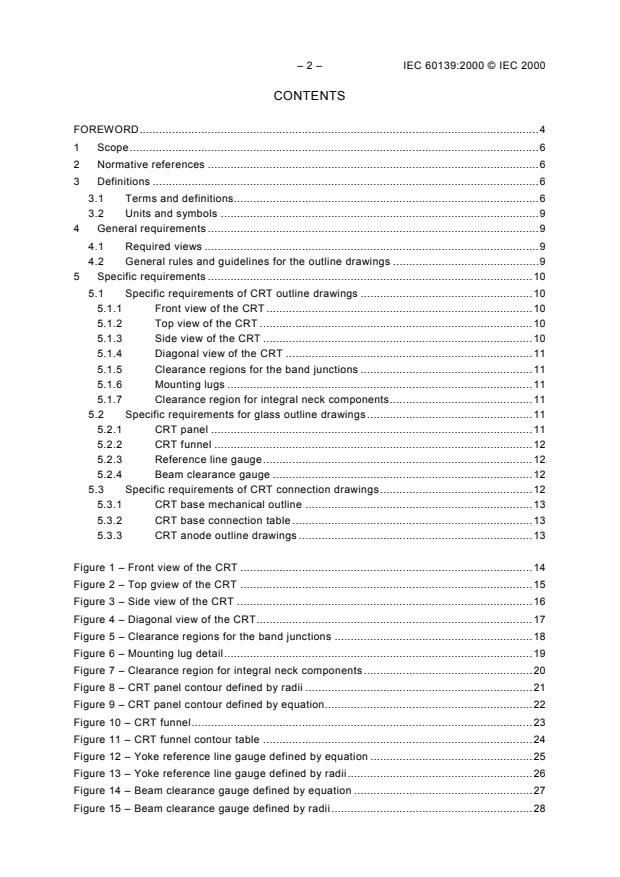
– 2 – IEC 60139:2000 © IEC 2000
CONTENTS
FOREWORD . 4
1 Scope . 6
2 Normative references . 6
3 Definitions . 6
3.1 Terms and definitions. 6
3.2 Units and symbols . 9
4 General requirements . 9
4.1 Required views . 9
4.2 General rules and guidelines for the outline drawings . 9
5 Specific requirements . 10
5.1 Specific requirements of CRT outline drawings . 10
5.1.1 Front view of the CRT . 10
5.1.2 Top view of the CRT . 10
5.1.3 Side view of the CRT . 10
5.1.4 Diagonal view of the CRT . 11
5.1.5 Clearance regions for the band junctions . 11
5.1.6 Mounting lugs . 11
5.1.7 Clearance region for integral neck components . 11
5.2 Specific requirements for glass outline drawings . 11
5.2.1 CRT panel . 11
5.2.2 CRT funnel . 12
5.2.3 Reference line gauge . 12
5.2.4 Beam clearance gauge . 12
5.3 Specific requirements of CRT connection drawings . 12
5.3.1 CRT base mechanical outline . 13
5.3.2 CRT base connection table . 13
5.3.3 CRT anode outline drawings . 13
Figure 1 – Front view of the CRT . 14
Figure 2 – Top gview of the CRT . 15
Figure 3 – Side view of the CRT . 16
Figure 4 – Diagonal view of the CRT . 17
Figure 5 – Clearance regions for the band junctions . 18
Figure 6 – Mounting lug detail . 19
Figure 7 – Clearance region for integral neck components . 20
Figure 8 – CRT panel contour defined by radii . 21
Figure 9 – CRT panel contour defined by equation. 22
Figure 10 – CRT funnel . 23
Figure 11 – CRT funnel contour table . 24
Figure 12 – Yoke reference line gauge defined by equation . 25
Figure 13 – Yoke reference line gauge defined by radii . 26
Figure 14 – Beam clearance gauge defined by equation . 27
Figure 15 – Beam clearance gauge defined by radii . 28
Figure 16 – CRT base mechanical outline . 29
Figure 17 – Example of CRT base connection table . 30
Figure 18 – CRT anode button . 31
– 4 – IEC 60139:2000 © IEC 2000
INTERNATIONAL ELECTROTECHNICAL COMMISSION
____________
PREPARATION OF OUTLINE DRAWINGS FOR CATHODE-RAY TUBES,
THEIR COMPONENTS, CONNECTIONS AND GAUGES
FOREWORD
1) The IEC (International Electrotechnical Commission) is a worldwide organization for standardization comprising
all national electrotechnical committees (IEC National Committees). The object of the IEC is to promote
international co-operation on all questions concerning standardization in the electrical and electronic fields. To
this end and in addition to other activities, the IEC publishes International Standards. Their preparation is
entrusted to technical committees; any IEC National Committee interested in the subject dealt with may
participate in this preparatory work. International, governmental and non-governmental organizations liaising
with the IEC also participate in this preparation. The IEC collaborates closely with the International
Organization for Standardization (ISO) in accordance with conditions determined by agreement between the
two organizations.
2) The formal decisions or agreements of the IEC on technical matters express, as nearly as possible, an
international consensus of opinion on the relevant subjects since each technical committee has representation
from all interested National Committees.
3) The documents produced have the form of recommendations for international use and are published in the form
of standards, technical specifications, technical reports or guides and they are accepted by the National
Committees in that sense.
4) In order to promote international unification, IEC National Committees undertake to apply IEC International
Standards transparently to the maximum extent possible in their national and regional standards. Any
divergence between the IEC Standard and the corresponding national or regional standard shall be clearly
indicated in the latter.
5) The IEC provides no marking procedure to indicate its approval and cannot be rendered responsible for any
equipment declared to be in conformity with one of its standards.
6) Attention is drawn to the possibility that some of the elements of this International Standard may be the subject
of patent rights. The IEC shall not be held responsible for identifying any or all such patent rights.
International Standard IEC 60139 has been prepared by IEC technical committee 39:
Electronic tubes.
This second edition cancels and replaces the first edition, published in 1962, and constitutes
a technical revision.
This bilingual version (2015-12) corresponds to the monolingual English version, published in
2000-12.
The text of this standard is based on the following documents:
FDIS Report on voting
39/254/FDIS 39/256/RVD
Full information on the voting for the approval of this standard can be found in the report on
voting indicated in the above table.
The French version of this standard has not been voted upon.
This publication has been drafted in accordance with the ISO/IEC Directives, Part 3.
The committee has decided that the contents of this publication will remain unchanged until
2005. At this date, the publication will be
• reconfirmed;
• withdrawn;
• replaced by a revised edition, or
• amended.
– 6 – IEC 60139:2000 © IEC 2000
PREPARATION OF OUTLINE DRAWINGS FOR CATHODE-RAY TUBES,
THEIR COMPONENTS, CONNECTIONS AND GAUGES
1 Scope
This International Standard gives guidance on the preparation of outline drawings of cathode-
ray tubes (CRTs), tube components, tube sub-assemblies and ancillary components with the
object of encouraging the same practice when publications are prepared in different countries.
These recommendations are contained in the specimen drawings, descriptive text and in the
tables of required dimensions.
2 Normative references
The following normative documents contain provisions which, through reference in this text,
constitute provisions of this International Standard. For dated references, subsequent
amendments to, or revisions of, any of these publications do not apply. However, parties to
agreements based on this International Standard are encouraged to investigate the possibility
of applying the most recent editions of the normative documents indicated below. For undated
references, the latest edition of the normative document referred to applies. Members of IEC
and ISO maintain registers of currently valid International Standards.
IEC 60027-1:1995, Letter symbols to be used in electrical technology – Part 1: General
IEC 60050 (all parts), International Electrotechnical Vocabulary (IEV)
IEC 60617 (all parts), Graphical symbols for diagrams
ISO 1000, SI units and recommendations for the use of their multiples and of certain other
units
3 Definitions
3.1 Terms and definitions
For the purpose of this International Standard, the following definitions apply.
3.1.1
anode button
conductive contact which provides electrical continuity from the outside of the insulating
envelope to the anode electrode inside the tube
3.1.2
axes of the CRT
3.1.2.1
principal axis
axis perpendicular to the panel and the phosphor screen which passes through the centre
point of the panel, the funnel, deflection yoke region and the electron gun
3.1.2.2
major axis
axis in the direction of the longer dimension of the CRT screen which passes through and is
perpendicular to the principal axis, normally the horizontal axis
3.1.2.3
minor axis
axis along the shorter dimension of the CRT screen which passes through and is
perpendicular to the principal axis, normally the vertical axis
3.1.2.4
diagonal axis
axis connecting opposite corners of the CRT screen
3.1.3
band
hardware that surrounds the CRT panel and 1) holds the mounting lugs and implosion safety
hardware to the CRT, 2) applies compressive loads to the panel for mechanical safety and 3)
contains the panel glass temporarily in the event of breakage
NOTE This band may be mechanically tensioned and joined at a junction; it may be joined to the CRT with resin,
or it may also be a single piece that is thermally shrunk over the panel (so called shrink-fit).
3.1.4
beam clearance
clearance between the electron beam path and the flare region of the funnel connecting the
CRT neck to the body of the funnel
NOTE Prevention of beam impact on the glass is critical for proper operation.
3.1.5
centre face thickness (CFT)
thickness of the panel at its centre
3.1.6
corner angle
angle between the major axis and a diagonal of the nominal screen of the design aspect ratio
3.1.7
deflection angles
angles subtended by the major axis, minor axis and diagonal dimensions of the screen as
viewed from yoke reference line
3.1.8
design aspect ratio
design value of the ratio of the long to short dimensions of a rectangular area, typically
expressed as a ratio of whole integers such as “4 by 3” or “16 by 9”
3.1.9
diagonal
line joining opposing corners
3.1.10
frit seal line
line formed by the frit joint between the panel and funnel
– 8 – IEC 60139:2000 © IEC 2000
3.1.11
heel radius
radius of the blend between the principal panel surface and the panel skirt
3.1.12
integral neck components
devices attached to the neck and/or funnel of the CRT by the manufacturer
3.1.13
lug
mounting hardware that has a blade section generally furnished with a mounting hole to
receive a mounting bolt
3.1.14
magnetic shield
ferromagnetic cone, roughly the shape of the funnel, that excludes external magnetic fields
from the electron beam region
3.1.15
mould-match line
line of maximum dimension of the moulded part, located at the mating plane of the two halves
of a mould
3.1.16
mounting system
hardware attached to the CRT that facilitates mounting the CRT
3.1.17
projected screen dimensions
screen dimensions as they appear to a viewer outside the CRT (at infinite distance)
NOTE The dimensions are projected along optical paths from the screen surface onto a plane perpendicular to
the principal CRT axis.
3.1.18
reference line
yoke reference line
fundamental plane for measurement and control of the funnel geometry
3.1.19
sagittal height
height from a plane tangential to the surface (of the panel) at its centre
3.1.20
screen diagonal
diagonal of the largest rectangle of the design aspect ratio inscribed within the screen
boundary
3.1.21
useful screen dimensions
projected dimensions of the inner surface of the glass panel determined useful by the CRT
glass manufacturer
3.1.22
useful phosphor screen dimensions
projected dimensions of the phosphor screen determined useful by the CRT manufacturer
3.1.23
z-axis
axis of a CRT component or CRT gauge typically aligned with the principal axis of the CRT
3.1.24
Z-point
reference point on the external surface of the panel along the diagonal
3.2 Units and symbols
Units, graphical symbols and letter symbols should, wherever possible, be taken from the
publications listed in clause 2 of this standard.
When further items are required they should be derived in accordance with the principles of
these publications.
4 General requirements
This standard prescribes the outline drawing views and the dimensions and descriptions
required for documenting a generic CRT design. The recommendations for each drawing are
specified in 5.1, 5.2, 5.3 and specimen drawings are shown in figure 1 through figure 18.
If the phosphor screen extent is hidden by the band, the degree of vignetting should be
indicated on one of the views.
4.1 Required views
In general, the views required to describe a rectangular CRT shall be the front, top, side and
diagonal. When the implosion protection and mounting system is integral to the tube, a
second front view and the mounting lug outline drawing may be included.
The components of the CRT (panel, funnel, base, reference line gauge, beam clearance
gauge and ancillary equipment) are part of the outline drawing information.
Monochrome and projection CRTs may not require all of the entries. If the dimensions
mentioned in the tabular layout below the specimen outline drawings are applicable to the
tube to be described, they shall be given on the outline sheet.
If the CRT has appendages or features not described in this standard, additional views shall
be included to fully describe them.
4.2 General rules and guidelines for the outline drawings
The specific guidelines for each drawing have been chosen based on balancing the amount of
detail and quantity of dimensions on each drawing. If future designs require more or less
detail on certain views, it is appropriate to relocate dimensional information to other views so
long as the information is retained in an unambiguous manner.
The drawing shall show all dimensions necessary to assure clearances and mating with
auxiliary accessories.
Drawings need not be drawn to scale, but they shall be roughly in proportion and, where
necessary for clarity, an enlarged detail drawing shall be used.
Angles shall be indicated as follows:
– 10 – IEC 60139:2000 © IEC 2000
a) by quoting the value in degrees and minutes and seconds or in decimal notation. Where
this is not practical, the value may be quoted in fractions of degrees;
b) where it is self-evident that a number of angles are of equal value, the value of only one of
those angles shall be quoted.
5 Specific requirements
5.1 Specific requirements of CRT outline drawings
The following views and related dimensions shall be included where appropriate. Where it is
possible to combine this data into fewer views, this is permissible. Where additional types of
dimensions are deemed useful, they may be included.
Each of the following subclauses identifies the suggested data for a drawing. Data can be
shown on other drawings if it is more convenient.
5.1.1 Front view of the CRT
The front view shall provide values for the following list of dimensions, as shown in figure 1:
• dimension of the CRT including mounting system;
• clearance for the band junction when positioned on the minor or major axis;
• distances between the centres of the CRT mounting holes;
• design aspect ratio;
• dimensions of the minimum, nominal and maximum useful phosphor screen;
• curvature of the useful phosphor (if not straight);
• location of the “Z-point”;
• electron gun positions (designated R, G, B);
• clock position of the anode connector.
5.1.2 Top view of the CRT
The top (or bottom) view shall show the anode connector and provide values for the following
list of dimensions, as shown in figure 2:
• neck outside diameter;
• location for the convergence device;
• area for reliable contact to the outer conductive coating;
• major axis dimensions of the band;
• base and anode connector type designations.
5.1.3 Side view of the CRT
The side view shall provide values for the following list of dimensions, as shown in figure 3:
• overall length of the CRT;
• reference line location;
• frit seal line location;
• anode contact location;
• description of the implosion system (i.e. tension band, shrink fit, etc.).
5.1.4 Diagonal view of the CRT
The diagonal view shall provide values for the following list of dimensions, as shown in
figure 4:
• reference line gauge designation;
• sagittal height of panel at the “Z-point”;
• location of the mounting lug;
• location of the band;
• maximum dimension of the CRT forward of the mounting lug.
5.1.5 Clearance regions for the band junctions
The clearance regions for the band junction view shall provide values for the following list of
dimensions, as shown in figure 5:
• tube dimensions including band but not junction;
• tube dimensions including junction;
• location of the junction.
5.1.6 Mounting lugs
The mounting lug view shall provide an adequate description of the mounting lug for
interfacing to the cabinet. The drawing is for illustration purposes only and the choice of the
best dimensions to indicate the shape of the blade and foot of the mounting lug is left to the
registrant. The drawing shall include the following items, as shown in figure 6:
• diameter of the mounting lug hole;
• thickness of the mounting lug;
• outline.
5.1.7 Clearance region for integral neck components
A view of the clearance regions for tubes having integral neck components shall provide
definition of the extent of such components. The drawing, figure 7, is for illustration purposes
only and the choice of the best dimensions to indicate this clearance space is left to the
registrant.
5.2 Specific requirements for glass outline drawings
The glass parts and their gauges shall be shown in adequate detail to show the outside
surface of the finished CRT.
5.2.1 CRT panel
The outline drawing of the panel shall provide values for the following list of dimensions:
• dimensions of the panel along the axes at the mould match line;
• centre face thickness;
• overall height of the panel;
• angle to the corner of the panel from the major axis;
• dimensions of the minimum useful screen outline;
• inside and outside panel contours (by blended radii or equations).
– 12 – IEC 60139:2000 © IEC 2000
Two specimen drawings are shown, figure 8 for the contour defined by the blended radii
method and figure 9 for the contour defined by the equation method.
5.2.2 CRT funnel
The outline drawing of the funnel shall provide values for the following list of dimensions:
• dimensions of the funnel along the axes at the mould match line;
• neck diameter;
• anode button type designation;
• location of the anode button;
• location of the reference line from the seal edge;
• angle from the major axis to the corner of the funnel;
• corner radius;
• outside contour.
Two specimen drawings are shown, figure 10 for the general dimensions and figure 11 for the
contour definition table.
5.2.3 Reference line gauge
The outline drawing for a reference line gauge shall provide values for the following list of
dimensions:
• gauge diameters;
• gauge heights;
• contour definition (by blended radii or by equation).
Two specimen drawings are shown, figure 12 using the equation method and figure 13 for the
blended radii method.
5.2.4 Beam clearance gauge
The outline drawing for a beam clearance gauge shall provide values for the following list of
dimensions:
• gauge diameters;
• gauge heights;
• contour definition (by blended radii or by equation).
Two specimen drawings are shown, figure 14 for the surface defined by the equation method
and figure 15 for the surface defined by the blended radii method.
5.3 Specific requirements of CRT connection drawings
The CRT base has a high degree of variability in non-critical dimensions. Drawings are
expected to be variable and figures 16 and 17 are for illustration. The anode contact geometry
may be variable. The outline drawings should provide information as to the metal contact and
its surrounding glass contours.
5.3.1 CRT base mechanical outline
The CRT base mechanical outline shall provide values for the following list of dimensions, as
illustrated in figure 16:
• pin circle diameter;
• pin diameters;
• pin length;
• pin 1 position with respect to the major axis of the CRT;
• critical details of guide surfaces, keyways, fillets, silos, etc.
5.3.2 CRT base connection table
The CRT base connection table shall indicate the electron gun electrode connected to each
base pin, as illustrated in figure 17.
5.3.3 CRT anode outline drawings
The anode contact views shall indicate the dimensional features of the anode connector
adequately to permit design of the mating connector, as shown in figure 18.
– 14 – IEC 60139:2000 © IEC 2000
IEC 2550/2000
Key
Useful phosphor screen outline; diagonal (D), width (W) and height (H)
Clearance region for band junction
Designation Description Dimension type
W1 Width of the CRT including mounting system Max.
H1 Height of the CRT including mounting system Max.
H3 Height including band but excluding junction Max.
W2 Width of the centres of the CRT mounting lug holes Nom.
H2 Height of the centres of the CRT mounting lug holes Nom.
D Useful phosphor screen diagonal Min., Nom., Max.
W Useful phosphor screen width Min., Nom., Max.
H Useful phosphor screen height Min., Nom., Max.
X1 Major axis coordinate of the “Z-point” Nom.
Y1 Minor axis coordinate of the “Z-point” Nom.
R1 Side radius of the useful screen edge (if not straight) Nom.
R2 Corner radius of the useful screen edge (if not straight) Nom.
R3 Bottom radius of the useful screen edge (if not straight) Nom.
Clearance for band junction (see 5.1.5 and figure 5 for alternate configuration)
X2 Lateral extent left of centre Max.
X3 Lateral extent right of centre Max.
Y2 Thickness Max.
R,G,B Electron gun sequence (left-to-right order)
Design aspect ratio
Design aspect ratio of the useful phosphor screen (W:H) Nom.
Figure 1 – Front view of the CRT
IEC 2551/2000
Key
Contact area of external conductive coating
Plane of beam correction device
Insulating coating
Designation Description Dimension
type
C Neck outside diameter Tol.
J Distance from the plane for locating the beam correction device to end of base Nom.
Contact area of external conductive coating
G Seal line to nearest edge Max.
H Seal line to farthest edge Tol.
I Opening for anode contact Max.
Major axis dimensions of the band (excluding clearance for the junction)
L Width at the panel mould-match line including the band Max.
Connector type designation
Base type designation
Anode type designation
Deflection angle
AV Major axis deflection angle Nom.
Figure 2 – Top gview of the CRT
– 16 – IEC 60139:2000 © IEC 2000
Key
IEC 2552/2000
Yoke reference line
Designation Description Dimension
type
A Overall length Min., Max.
B Reference line from end of base Nom.
D Centre face to reference line Nom.
E Centre of face to frit seal line Nom.
F Anode contact to end of base Nom.
Text Description of the implosion system
AW Minor axis deflection angle Nom.
Figure 3 – Side view of the CRT
Key IEC 2553/2000
Seal line
Z-point
Designation Description Dimension
type
Reference line gauge designation
Sagittal height at minimum screen diagonal and lug location
AH Projected distance from centre of face to Z-point along the tube axis Nom.
AI Z-point to front of lug Tol.
AJ Z-point to front edge of band Min.
Dimension at the mould match line including hardware forward of the mounting lug plane
K Diagonal axis Max.
AU Diagonal deflection angle Nom.
Figure 4 – Diagonal view of the CRT
– 18 – IEC 60139:2000 © IEC 2000
IEC 2554/2000
Key
Clearance for band junction
Designation Description Dimension
type
A Height of tube including band but not junction Max.
Case of top or bottom junction mounting
X1 Axis to nearest edge Min.
X2 Axis to farthest edge Max.
Y3 Thickness Max.
B Height of tube including band junctions Max.
Case of left or right junction mounting
Y1 Axis to nearest edge Min.
Y2 Axis to farthest edge Max.
X3 Thickness Max.
C Width of tube including band junction Max.
Figure 5 – Clearance regions for the band junctions
IEC 2555/2000
Designation Description Dimension
type
AP Hole diameter Tol.
AX Thickness Tol.
AQ, AR, AS, The choice of the other dimensions sufficient to describe the outline of the lug Max.
AT is left to the discretion of the registrant
Figure 6 – Mounting lug detail
– 20 – IEC 60139:2000 © IEC 2000
IEC 2556/2000
Designation Description Dimension
type
C1, C2, C3, The choice of the dimensions to describe the volume that should remain clear Max.
C4, C5 for the neck components is left to the discretion of the registrant.
Figure 7 – Clearance region for integral neck components
IEC 2557/2000
Key
Useful screen outline
If surface is compound, show all radii and their origins
Designation Description Dimension type
A Dimension of the panel across the major axis at mould match line Max.
B Dimension of the panel across the minor axis at mould match line Max.
C Dimension of the largest diagonal of the panel Max.
CFT Centre face thickness Nom.
OAH Overall height of the panel along the tube axis Nom.
D Useful screen diagonal along the corner angle Min., Nom., Max.
E Corner angle Nom.
H Useful screen height Min., Nom., Max.
W Useful screen width Min., Nom., Max.
R1 Top and bottom radii of useful screen outline Nom.
R2 Corner radii of useful screen outline (if not square cornered) Nom.
R3 Side radii of useful screen outline Nom.
Xs Major axis co-ordinate of the centre of the corner radii of the useful screen Nom.
Ys Minor axis co-ordinate of the centre of the corner radii of the useful screen Nom.
Xp Major axis co-ordinate of the centre of the corner radii of the panel Nom.
Yp Minor axis co-ordinate of the centre of the corner radii of the panel Nom.
R4 Outside corner radii at mould match line Nom.
R5 Outside heel radius of the panel Nom.
R6 Radius of curvature of the screen surface of the panel Nom.
R7 Radius of curvature of the outside contour of the panel Nom.
Figure 8 – CRT panel contour defined by radii
– 22 – IEC 60139:2000 © IEC 2000
IEC 2558/2000
Key
Useful screen outline dimensions: D, H and W
Designation Description Dimension type
A Dimension of the major axis at the mould match line Max.
B Dimension of the minor axis at the mould match line Max.
C Largest diagonal dimension at the mould match line Max.
CFT Centre face thickness Nom.
OAH Overall height of the panel along the tube axis Nom.
D Useful screen diagonal along the corner angle Min., Nom., Max.
E Corner angle Nom.
H Useful screen height Min., Nom., Max.
W Useful screen width Min., Nom., Max.
R1 Top and bottom radii of useful screen outline Nom.
R2 Corner radii of useful screen outline (if not square cornered) Nom.
R3 Side radii of useful screen outline Nom.
Xs Major axis co-ordinate of the centre of the corner radii of the useful screen Nom.
Ys Minor axis co-ordinate of the centre of the corner radii of the useful screen Nom.
Xp Major axis co-ordinate of the centre of the corner radii of the panel Nom.
Yp Minor axis co-ordinate of the centre of the corner radii of the panel Nom.
R4 Outside corner radii at the mould match line Nom.
R5 Outside heel radius Nom.
ZI(XI,YI) Equation of the inside panel contour Nom.
ZO(XO,YO) Equation of the outside panel contour Nom.
Figure 9 – CRT panel contour defined by equation
IEC 2559/2000
Key
Alignment pad
Anode button (show actual location)
Neck splice line
Seal edge
Mould match line
Reference line
Designation Description Dimension
type
A Major axis dimension at the mould match line Max.
B Minor axis dimension at the mould match line Max.
C Diagonal axis dimension at the mould match line Max.
D Neck diameter Max.
E Distance from the anode button from the reference line Nom.
F Distance from the reference line to the seal edge Nom.
G Angle between the diagonal and major axes Nom.
H Distance from the YRL to the neck splice Nom.
J Maximum diameter of the neck at the splice line Nom.
R1 Outside corner radii at mould match line Nom.
– Reference line gauge designation
– Beam clearance gauge designation
Figure 10 – CRT funnel
– 24 – IEC 60139:2000 © IEC 2000
Key IEC 2560/2000
Seal edge
Mould match line
Reference line
Diagonal
Distance Major Minor
from axis axis
Diagonal
10° 20° 30° 40° 50° 60° 70° 80°
seal edge axis
0° 90°
(K)
Mould match
… Radial co-ordinates of the outside funnel contour (H) at the
elevation from the seal edge (K) specified in the left column
…
and at the angle from the major axis specified at the top of the
column.
…
…
…
…
…
…
…
…
Reference
line
Figure 11 – CRT funnel contour table
IEC 2561/2000
Key
Reference line
Designation Description Dimension
type
A Diameter of the neck side of the gauge Nom.
B Diameter of the flare side of the gauge Nom.
C Diameter of the flare opening Nom.
D Diameter at the reference line Nom.
E Diameter of the neck side opening (relieved) Nom.
F Overall gauge height Nom.
G Height of gauge above the reference line Nom.
H Distance from reference line to Z axis origin Nom.
J Length of chamfer above Z axis origin Nom.
K Total length of chamfer Nom.
X(Z) Equation of the gauge contour Nom.
Figure 12 – Yoke reference line gauge defined by equation
– 26 – IEC 60139:2000 © IEC 2000
IEC 2562/2000
Key
Reference line
Designation Description Dimension
type
A Diameter of the base Nom.
B Diameter of the top Nom.
C Diameter of the bulb side opening Nom.
D Diameter at the reference line Nom.
E Diameter of the neck side opening (relieved) Nom.
F Overall gauge height Nom.
G Height of gauge above the reference line Nom.
H Distance from reference line to Z axis origin Nom.
J Length of chamfer above Z axis origin Nom.
K Total length of chamfer Nom.
L1 Distance from reference line to centre of contour radius Nom.
M1 Offset of the centre of the contour radius Nom.
R1 Radius of the contour Nom.
L2, M2, R2, etc. Additional sets of contour radius dimensions (as appropriate) Nom.
Figure 13 – Yoke reference line gauge defined by radii
IEC 2563/2000
Key
If gauge is fluted, show flute definition, extent
If gauge is not round, describe
Bottom of gauge
Reference line
Designation Description Dimension
type
A Diameter of the flare side of the gauge Nom.
B Diameter of the gauge at the reference line Nom.
C Diameter of the neck side gauge extension Nom.
D Overall height of the gauge Nom.
E Height of the gauge from the reference line on the flare side Nom.
F Distance from reference line to the Z-axis origin Nom.
G Length of active gauge surface on the flare side of the reference line Nom.
J Length of the extension above the Z axis origin Nom.
H Total length of the extension Nom.
X(Z) Equation of gauge contour radius at level Z Nom.
Figure 14 – Beam clearance gauge defined by equation
– 28 – IEC 60139:2000 © IEC 2000
IEC 2564/2000
Key
If gauge is fluted, show flute definition, extent
If gauge is not round, describe
Bottom of gauge
Reference line
Designation Description Dimension
type
A Diameter of the flare side of the gauge Nom.
B Diameter of the gauge at the reference line Nom.
C Diameter of the neck side gauge extension Nom.
D Overall height of the gauge Nom.
E Height of the gauge from the reference line on the flare side Nom.
F Distance from reference line to the Z-axis origin Nom.
G Length of the active gauge surface on the flare side of the reference line Nom.
H Total length of the extension Nom.
J Length of the extension above the Z axis origin Nom.
M1 Distance from the reference line to the centre of the contour radius Nom.
N1 Offset of the centre of the contour radius from the gauge axis Nom.
R1 Radius of the contour Nom.
M2, N2, R2, etc. Additional sets of contour radius dimensions (as appropriate) Nom.
Figure 15 – Beam clearance gauge defined by radii
IEC 2565/2000
Designation Description Dimension
type
A CRT neck diameter Max.
B Pin support fillet diameter Max.
C Base height Tol.
D Silo height Max.
E Pin support fillet height Tol.
F Exposed pin length Max.
G Pin diameter Tol.
J Wafer height Nom.
K Pin circle diameter Tol.
L Wafer diameter Max.
M Silo wall thickness Tol.
R Silo fillet radius Nom.
a Pin spacing angle (or half angle) Nom.
b Silo extent angle (or half angle) Nom.
Base orientation (pin 1 to major axis of the CRT in degrees) Nom.
Figure 16 – CRT base mechanical outline
– 30 – IEC 60139:2000 © IEC 2000
IEC 2566/2000
Pin number Electrode
Pin 1 Grid no. 3
Pin 4 IC (do not use)
Pin 5 Grid no. 1
Pin 6 Cathode of green beam
Pin 7 Grid no. 2
Pin 8 Cathode of red beam
Pin 9 Heater
Pin 10 Heater
Pin 11 Cathode of blue beam
Pin 12 IC (do not use)
Figure 17 – Example of CRT base connection table
IEC 2567/2000
Designation Description Dimension
type
A Connector opening diameter Min., Max.
B Outside diameter Max.
C Connector metal thickness Nom.
D Recess depth Min.
E Height of connector rim above funnel body Max.
F Height of connector rim above adjacent glass Max.
G Heigh
...