

IEC 63391:2024
(Main)Active millimetre-wave systems for security screening of humans - General requirements
General Information
- Abstract
IEC 63391:2024 applies to security screening systems that utilize active millimetre-wave (MMW) imaging to inspect persons who are not inside vehicles, containers, or enclosures. Specifically, this document applies to systems used to detect objects carried on the body of the individual being screened at a security checkpoint. This document applies to systems that screen people using radiation in the range between 3 GHz and 150 GHz (100 mm to 2 mm).
This document specifies the technical requirements, test methods, and signage of the active MMW systems for security screening of humans.
This document does not specify minimum or baseline requirements of image quality, automated threat recognition (ATR) performance, nor does it specify a minimum detection time
- Status
- Published
- Publication Date
- 02-Oct-2024
- Technical Committee
- SC 45B - Radiation protection instrumentation
- Drafting Committee
- WG 17 - TC 45/SC 45B/WG 17
- Current Stage
- PPUB - Publication issued
- Start Date
- 03-Oct-2024
- Completion Date
- 04-Oct-2024
Overview
IEC 63391:2024 - "Active millimetre-wave systems for security screening of humans – General requirements" - defines technical requirements, test methods, and signage for active millimetre‑wave (MMW) security screening systems operating between 3 GHz and 150 GHz (100 mm to 2 mm). The standard applies to systems that use active MMW imaging to detect objects carried on a person (not in vehicles, containers or enclosures). It sets requirements for safe, repeatable testing and product documentation but does not prescribe minimum image quality, baseline automated threat recognition (ATR) performance, or minimum detection times.
Key topics and technical requirements
IEC 63391 covers practical, testable elements needed for system development, testing and deployment:
- Scope and definitions relevant to MMW security screening and ATR terminology.
- Environmental conditions and climatic testing to verify reliable operation in expected field environments.
- Major test instruments and tools required for conformity testing.
- Appearance and structure requirements and test methods for mechanical and human‑interface aspects.
- Functionality and performance test methods, including imaging performance and detection-time measurement procedures (note: it does not set minimum performance thresholds).
- Power requirements and testing for supply conditions and robustness.
- Safety: electromagnetic radiation safety, electrical and mechanical safety provisions to protect screened persons and operators.
- Electromagnetic compatibility (EMC): immunity and emission testing per IEC EMC series.
- System noise, environmental and mechanical compliance testing, and a testing overview with recommended test positions and fault conditions.
- Marking and documentation requirements, including signage to inform subjects and operators.
Practical applications and who uses this standard
IEC 63391 is intended for stakeholders involved in the lifecycle of active MMW security systems:
- Manufacturers and OEMs designing millimetre‑wave imaging systems.
- Test laboratories and conformity assessment bodies developing and performing standardized test plans.
- Security integrators and system installers specifying equipment for airports, mass‑transit hubs, critical infrastructure, event security and other checkpoints.
- Procurement teams and regulators who need objective, reproducible test methods and safety guidance for specification and acceptance.
- Research and development teams validating prototypes against recognized test procedures.
Related Standards (if applicable)
Relevant referenced documents include IEC environmental and EMC standards (IEC 60068, IEC 61000 series), safety standards (IEC 60204‑1, IEC 61010‑1), and exposure guidance such as IEEE C95.1‑2019 and ICNIRP. IEEE N42.59 (imaging performance) is noted as related for performance measurement.
Keywords: IEC 63391, active millimetre‑wave, MMW security screening, millimeter‑wave imaging, ATR, test methods, electromagnetic safety, EMC, signage.
Get Certified
Connect with accredited certification bodies for this standard

BSMI (Bureau of Standards, Metrology and Inspection)
Taiwan's standards and inspection authority.
CIS Institut d.o.o.
Personal Protective Equipment (PPE) certification body. Notified Body NB-2890 for EU Regulation 2016/425 PPE.

Kiwa BDA Testing
Building and construction product certification.
Sponsored listings
Frequently Asked Questions
IEC 63391:2024 is a standard published by the International Electrotechnical Commission (IEC). Its full title is "Active millimetre-wave systems for security screening of humans - General requirements". This standard covers: IEC 63391:2024 applies to security screening systems that utilize active millimetre-wave (MMW) imaging to inspect persons who are not inside vehicles, containers, or enclosures. Specifically, this document applies to systems used to detect objects carried on the body of the individual being screened at a security checkpoint. This document applies to systems that screen people using radiation in the range between 3 GHz and 150 GHz (100 mm to 2 mm). This document specifies the technical requirements, test methods, and signage of the active MMW systems for security screening of humans. This document does not specify minimum or baseline requirements of image quality, automated threat recognition (ATR) performance, nor does it specify a minimum detection time
IEC 63391:2024 applies to security screening systems that utilize active millimetre-wave (MMW) imaging to inspect persons who are not inside vehicles, containers, or enclosures. Specifically, this document applies to systems used to detect objects carried on the body of the individual being screened at a security checkpoint. This document applies to systems that screen people using radiation in the range between 3 GHz and 150 GHz (100 mm to 2 mm). This document specifies the technical requirements, test methods, and signage of the active MMW systems for security screening of humans. This document does not specify minimum or baseline requirements of image quality, automated threat recognition (ATR) performance, nor does it specify a minimum detection time
IEC 63391:2024 is classified under the following ICS (International Classification for Standards) categories: 13.280 - Radiation protection; 17.240 - Radiation measurements. The ICS classification helps identify the subject area and facilitates finding related standards.
IEC 63391:2024 is available in PDF format for immediate download after purchase. The document can be added to your cart and obtained through the secure checkout process. Digital delivery ensures instant access to the complete standard document.
Standards Content (Sample)
IEC 63391 ®
Edition 1.0 2024-10
INTERNATIONAL
STANDARD
Active millimetre-wave systems for security screening of humans – General
requirements
All rights reserved. Unless otherwise specified, no part of this publication may be reproduced or utilized in any form
or by any means, electronic or mechanical, including photocopying and microfilm, without permission in writing from
either IEC or IEC's member National Committee in the country of the requester. If you have any questions about IEC
copyright or have an enquiry about obtaining additional rights to this publication, please contact the address below or
your local IEC member National Committee for further information.
IEC Secretariat Tel.: +41 22 919 02 11
3, rue de Varembé info@iec.ch
CH-1211 Geneva 20 www.iec.ch
Switzerland
About the IEC
The International Electrotechnical Commission (IEC) is the leading global organization that prepares and publishes
International Standards for all electrical, electronic and related technologies.
About IEC publications
The technical content of IEC publications is kept under constant review by the IEC. Please make sure that you have the
latest edition, a corrigendum or an amendment might have been published.
IEC publications search - webstore.iec.ch/advsearchform IEC Products & Services Portal - products.iec.ch
The advanced search enables to find IEC publications by a Discover our powerful search engine and read freely all the
variety of criteria (reference number, text, technical publications previews, graphical symbols and the glossary.
committee, …). It also gives information on projects, replaced With a subscription you will always have access to up to date
and withdrawn publications. content tailored to your needs.
IEC Just Published - webstore.iec.ch/justpublished
Electropedia - www.electropedia.org
Stay up to date on all new IEC publications. Just Published
The world's leading online dictionary on electrotechnology,
details all new publications released. Available online and once
containing more than 22 500 terminological entries in English
a month by email.
and French, with equivalent terms in 25 additional languages.
Also known as the International Electrotechnical Vocabulary
IEC Customer Service Centre - webstore.iec.ch/csc
(IEV) online.
If you wish to give us your feedback on this publication or need
further assistance, please contact the Customer Service
Centre: sales@iec.ch.
IEC 63391 ®
Edition 1.0 2024-10
INTERNATIONAL
STANDARD
Active millimetre-wave systems for security screening of humans – General
requirements
INTERNATIONAL
ELECTROTECHNICAL
COMMISSION
ICS 13.280; 17.240 ISBN 978-2-8322-9676-9
– 2 – IEC 63391:2024 © IEC 2024
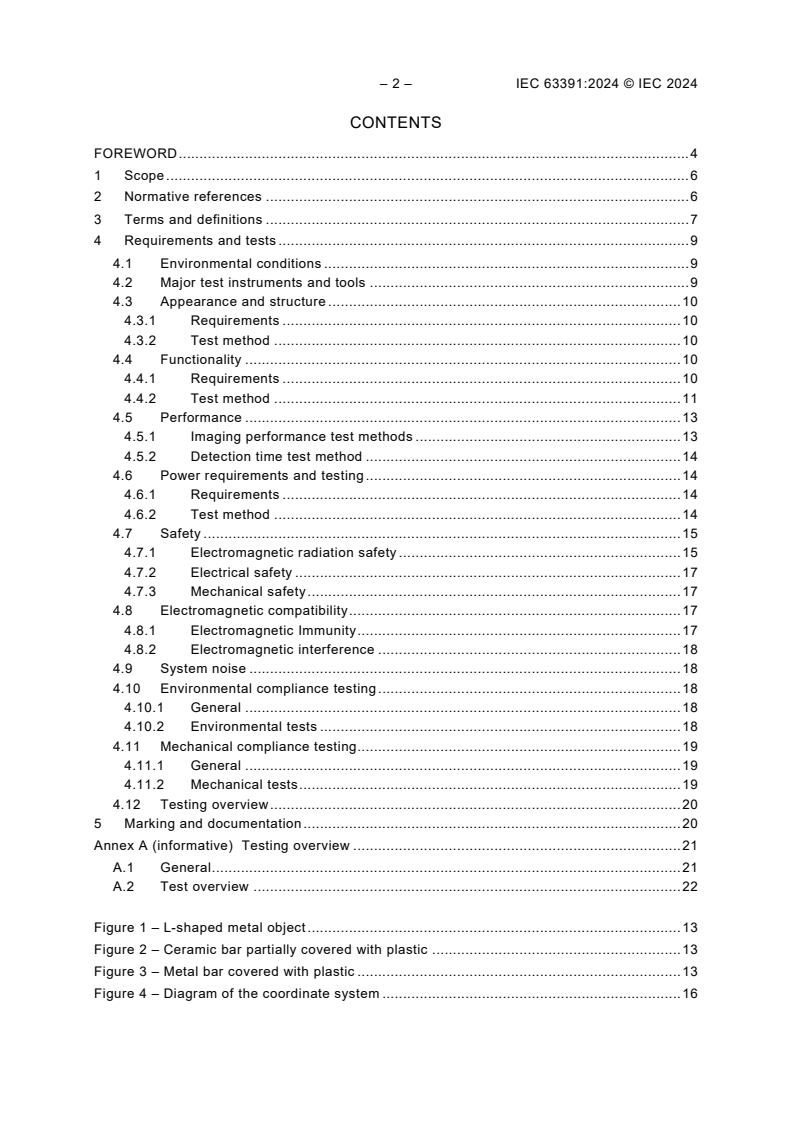
CONTENTS
FOREWORD . 4
1 Scope . 6
2 Normative references . 6
3 Terms and definitions . 7
4 Requirements and tests . 9
4.1 Environmental conditions . 9
4.2 Major test instruments and tools . 9
4.3 Appearance and structure . 10
4.3.1 Requirements . 10
4.3.2 Test method . 10
4.4 Functionality . 10
4.4.1 Requirements . 10
4.4.2 Test method . 11
4.5 Performance . 13
4.5.1 Imaging performance test methods . 13
4.5.2 Detection time test method . 14
4.6 Power requirements and testing . 14
4.6.1 Requirements . 14
4.6.2 Test method . 14
4.7 Safety . 15
4.7.1 Electromagnetic radiation safety . 15
4.7.2 Electrical safety . 17
4.7.3 Mechanical safety . 17
4.8 Electromagnetic compatibility . 17
4.8.1 Electromagnetic Immunity . 17
4.8.2 Electromagnetic interference . 18
4.9 System noise . 18
4.10 Environmental compliance testing . 18
4.10.1 General . 18
4.10.2 Environmental tests . 18
4.11 Mechanical compliance testing . 19
4.11.1 General . 19
4.11.2 Mechanical tests . 19
4.12 Testing overview . 20
5 Marking and documentation . 20
Annex A (informative) Testing overview . 21
A.1 General . 21
A.2 Test overview . 22
Figure 1 – L-shaped metal object . 13
Figure 2 – Ceramic bar partially covered with plastic . 13
Figure 3 – Metal bar covered with plastic . 13
Figure 4 – Diagram of the coordinate system . 16
Table 1 – Major instruments and tools . 9
Table 2 – Man-made fault conditions . 11
Table 3 – ATR test items . 12
Table 4 – ATR test positions . 12
Table 5 – Test conditions of the supplies . 14
Table 6 – The specified positions inside the system . 16
Table 7 – The specified positions outside the system . 16
Table 8 – Environmental tests . 19
Table 9 – Mechanical tests . 20
Table A.1 – Test overview . 22
– 4 – IEC 63391:2024 © IEC 2024
INTERNATIONAL ELECTROTECHNICAL COMMISSION
____________
ACTIVE MILLIMETRE-WAVE SYSTEMS FOR SECURITY
SCREENING OF HUMANS – GENERAL REQUIREMENTS
FOREWORD
1) The International Electrotechnical Commission (IEC) is a worldwide organization for standardization comprising
all national electrotechnical committees (IEC National Committees). The object of IEC is to promote international
co-operation on all questions concerning standardization in the electrical and electronic fields. To this end and
in addition to other activities, IEC publishes International Standards, Technical Specifications, Technical Reports,
Publicly Available Specifications (PAS) and Guides (hereafter referred to as "IEC Publication(s)"). Their
preparation is entrusted to technical committees; any IEC National Committee interested in the subject dealt with
may participate in this preparatory work. International, governmental and non-governmental organizations liaising
with the IEC also participate in this preparation. IEC collaborates closely with the International Organization for
Standardization (ISO) in accordance with conditions determined by agreement between the two organizations.
2) The formal decisions or agreements of IEC on technical matters express, as nearly as possible, an international
consensus of opinion on the relevant subjects since each technical committee has representation from all
interested IEC National Committees.
3) IEC Publications have the form of recommendations for international use and are accepted by IEC National
Committees in that sense. While all reasonable efforts are made to ensure that the technical content of IEC
Publications is accurate, IEC cannot be held responsible for the way in which they are used or for any
misinterpretation by any end user.
4) In order to promote international uniformity, IEC National Committees undertake to apply IEC Publications
transparently to the maximum extent possible in their national and regional publications. Any divergence between
any IEC Publication and the corresponding national or regional publication shall be clearly indicated in the latter.
5) IEC itself does not provide any attestation of conformity. Independent certification bodies provide conformity
assessment services and, in some areas, access to IEC marks of conformity. IEC is not responsible for any
services carried out by independent certification bodies.
6) All users should ensure that they have the latest edition of this publication.
7) No liability shall attach to IEC or its directors, employees, servants or agents including individual experts and
members of its technical committees and IEC National Committees for any personal injury, property damage or
other damage of any nature whatsoever, whether direct or indirect, or for costs (including legal fees) and
expenses arising out of the publication, use of, or reliance upon, this IEC Publication or any other IEC
Publications.
8) Attention is drawn to the Normative references cited in this publication. Use of the referenced publications is
indispensable for the correct application of this publication.
9) IEC draws attention to the possibility that the implementation of this document may involve the use of (a)
patent(s). IEC takes no position concerning the evidence, validity or applicability of any claimed patent rights in
respect thereof. As of the date of publication of this document, IEC had not received notice of (a) patent(s), which
may be required to implement this document. However, implementers are cautioned that this may not represent
the latest information, which may be obtained from the patent database available at https://patents.iec.ch. IEC
shall not be held responsible for identifying any or all such patent rights.
IEC 63391 has been prepared by subcommittee 45B: Radiation protection instrumentation, of
IEC technical committee 45: Nuclear instrumentation. It is an International Standard.
The text of this International Standard is based on the following documents:
Draft Report on voting
45B/1064/FDIS 45B/1072/RVD
Full information on the voting for its approval can be found in the report on voting indicated in
the above table.
The language used for the development of this International Standard is English.
This document was drafted in accordance with ISO/IEC Directives, Part 2, and developed in
accordance with ISO/IEC Directives, Part 1 and ISO/IEC Directives, IEC Supplement, available
at www.iec.ch/members_experts/refdocs. The main document types developed by IEC are
described in greater detail at www.iec.ch/publications.
The committee has decided that the contents of this document will remain unchanged until the
stability date indicated on the IEC website under webstore.iec.ch in the data related to the
specific document. At this date, the document will be
• reconfirmed,
• withdrawn, or
• revised.
– 6 – IEC 63391:2024 © IEC 2024
ACTIVE MILLIMETRE-WAVE SYSTEMS FOR SECURITY
SCREENING OF HUMANS – GENERAL REQUIREMENTS
1 Scope
This document applies to security screening systems that utilize active millimetre-wave (MMW)
imaging to inspect persons who are not inside vehicles, containers, or enclosures. Specifically,
this document applies to systems used to detect objects carried on the body of the individual
being screened at a security checkpoint. This document applies to systems that screen people
using radiation in the range between 3 GHz and 150 GHz (100 mm to 2 mm).
This document specifies the technical requirements, test methods, and signage of the active
MMW systems for security screening of humans.
This document does not specify minimum or baseline requirements of image quality, automated
threat recognition (ATR) performance, nor does it specify a minimum detection time.
2 Normative references
The following documents are referred to in the text in such a way that some or all of their content
constitutes requirements of this document. For dated references, only the edition cited applies.
For undated references, the latest edition of the referenced document (including any
amendments) applies.
IEC 60068-2-1:2007, Environmental testing – Part 2-1: Tests – Test A: Cold
IEC 60068-2-2:2007, Environmental testing – Part 2-2: Tests – Test B: Dry heat
IEC 60068-2-6:2007, Environmental testing – Part 2-6: Tests – Test Fc: Vibration (sinusoidal)
IEC 60068-2-27:2008, Environmental testing – Part 2-27: Tests – Test Ea and guidance: Shock
IEC 60068-2-78:2012, Environmental testing – Part 2-78: Tests – Test Cab: Damp heat, steady
state
IEC 60204-1:2016, Safety of machinery – Electrical equipment of machines – Part 1: General
requirements
IEC 60204-1:2016/AMD1:2021
IEC 60529:1989, Degrees of protection provided by enclosures (IP Code)
IEC 60529:1989/AMD1:1999
IEC 60529:1989/AMD2:2013
IEC 61000-4-2:2008, Electromagnetic compatibility (EMC) – Part 4-2: Testing and
measurement techniques – Electrostatic discharge immunity test
IEC 61000-4-3:2020, Electromagnetic compatibility (EMC) – Part 4-3: Testing and
measurement techniques – Radiated, radio-frequency, electromagnetic field immunity test
IEC 61000-4-4:2012, Electromagnetic compatibility (EMC) – Part 4-4: Testing and
measurement techniques – Electrical fast transient/burst immunity test
IEC 61000-4-5:2014, Electromagnetic compatibility (EMC) – Part 4-5: Testing and
measurement techniques – Surge immunity test
IEC 61000-4-5:2014/AMD1:2017
IEC 61000-4-6:2023, Electromagnetic compatibility (EMC) – Part 4-6: Testing and
measurement techniques – Immunity to conducted disturbances, induced by radio-frequency
fields
IEC 61000-4-11:2020, Electromagnetic compatibility (EMC) – Part 4-11: Testing and
measurement techniques – Voltage dips, short interruptions and voltage variations immunity
tests for equipment with input current up to 16 A per phase
IEC 61000-6-1:2016, Electromagnetic compatibility (EMC) – Part 6-1: Generic standards –
Immunity standard for residential, commercial and light-industrial environments
IEC 61000-6-3:2020, Electromagnetic compatibility (EMC) – Part 6-3: Generic standards –
Emission standard for equipment in residential environments
IEC 61010-1:2010, Safety requirements for electrical equipment for measurement, control, and
laboratory use – Part 1: General requirements
IEC 61010-1:2010/AMD1:2016
ISO 3744:2010, Acoustics – Determination of sound power levels and sound energy levels of
noise sources using sound pressure-Engineering methods for an essentially free field over a
reflecting plane
ISO/IEC 18033-3:2010, Information technology – Security techniques – Encryption algorithms
– Part 3: Block ciphers
ISO/IEC 18033-3:2010/AMD1:2021
IEEE Std. C95.1-2019, Safety Levels with Respect to Human Exposure to Electric, Magnetic,
and Electromagnetic Fields, 0 kHz to 300 GHz
IEEE N42.59, Standard for Measuring the Imaging Performance of Active Millimeter-Wave
Systems for Security Screening of Humans (balloted March 2024)
ICNIRP Guidelines for Limiting Exposure to Time-Varying Electric, Magnetic and
Electromagnetic Fields (up to 300 GHz)
3 Terms and definitions
For the purposes of this document, the following terms and definitions apply.
ISO and IEC maintain terminology databases for use in standardization at the following
addresses:
• IEC Electropedia: available at https://www.electropedia.org/
• ISO Online browsing platform: available at https://www.iso.org/obp
3.1
automated target recognition
ATR
automated software or algorithms used for anomaly detection, which includes threats, but not
necessarily identification of particular objects or threats
Note 1 to entry: A MMW system with an ATR is designed to automatically indicate the location of the items carried
by an inspected person.
– 8 – IEC 63391:2024 © IEC 2024
3.2
contrast resolution
measure of the extent to which targets with similar reflectivity can be distinguished as having
distinct grayscale values in a MMW image
3.3
contrast scaling
mapping of the reflected signal to the grayscale values in a MMW imaging system
3.4
depth
direction perpendicular to the y-axis and intersecting the centre of the imaging aperture
Note 1 to entry: Figure 4 defines the system axes.
3.5
depth response
full width at half maximum in the depth direction of the reflected signal that is obtained from
imaging a thin, highly-reflective object using a MMW system
3.6
detection
action of finding and indicating the location of an item carried or concealed by an inspected
person
Note 1 to entry: Only applies to systems with ATR.
3.7
detection time
time duration from the initiation of the scan to the display of the automatically-generated
detection result
Note 1 to entry: For a system without ATR, detection time refers to the time duration from the initiation of the scan
to the display of the acquired image.
3.8
effective depth resolution
measured spatial resolution in the depth direction
3.9
false alarm
alarm where no item is carried by an inspected person
Note 1 to entry: Only applies to systems with ATR.
3.10
horizontal illumination coverage
measure of the visible width of a vertical cylinder in the x-z plane in a MMW image
Note 1 to entry: Figure 4 defines the system axes.
3.11
lateral resolution
measure of the extent to which closely spaced objects can be separately distinguished in
directions lateral to the plane of the test object
Note 1 to entry: The resolution criterion is a modulation transfer function (MTF) of at least 0,2 in an imaged test
pattern.
3.12
minimum detectability
size of the smallest sphere consistently detected above noise in a MMW image
3.13
system
instrument under test, specifically a security screening device, that uses millimetre-wave
radiation to detect items carried or concealed by inspected persons
3.14
vertical field of view
measure of the vertical extent of the inspection volume using the image signal response from a
uniform object
3.15
vertical illumination uniformity
measure of image signal homogeneity measured vertically along an extended uniform object
4 Requirements and tests
4.1 Environmental conditions
Unless otherwise specified, the environmental conditions at the test location shall be as
described in 4.3.1 of IEC 61010-1:2010. The temperature shall be between 15 °C and 35 °C.
The relative humidity shall not be more than 75 %. The air pressure shall be between 75 kPa
and 106 kPa.
4.2 Major test instruments and tools
Table 1 describes the technical requirements of the major instruments and tools recommended
for the tests.
Table 1 – Major instruments and tools
Line Instrument name Technical requirements
Range: 0 to 1 Ω
1 Ground resistance tester
Precision: ± 3 %
Rated voltage: 500 V
2 Insulation resistance meter Range: 0 to 500 MΩ
Precision: ± 10 %
Range: 0,03 mA to 20 mA
3 Leakage current tester
Precision: ± 5 %
4 Dielectric tester Range: 0 kV to 5 kV
Frequency range: 25 Hz to 8 kHz. The measurements
5 Sound level meter
shall be made with an A-weighting filter applied.
The frequency range shall cover the working
frequency range of the system. The polarization mode
6 Spectrum analyser and connecting antenna
of the measurement antenna shall be the same as that
of the system.
---------------------- Pag
...