

IEC 60838-1:2004
(Main)Miscellaneous lampholders - Part 1: General requirements and tests
General Information
- Abstract
This part of IEC 60838 applies to lampholders of miscellaneous types intended for building-in (to be used with general purpose light sources, projection lamps, floodlighting lamps and street-lighting lamps with caps as listed in annex A) and the methods of test to be used in determining the safe use of lamps in lampholders. This part of IEC 60838 also covers lampholders which are integral with a luminaire. It covers the requirements for the lampholder only.
- Status
- Published
- Publication Date
- 15-Jun-2011
- Technical Committee
- SC 34B - Fit systems for light sources
- Current Stage
- DELPUB - Deleted Publication
- Start Date
- 19-May-2016
- Completion Date
- 28-Aug-2026
Buy Documents
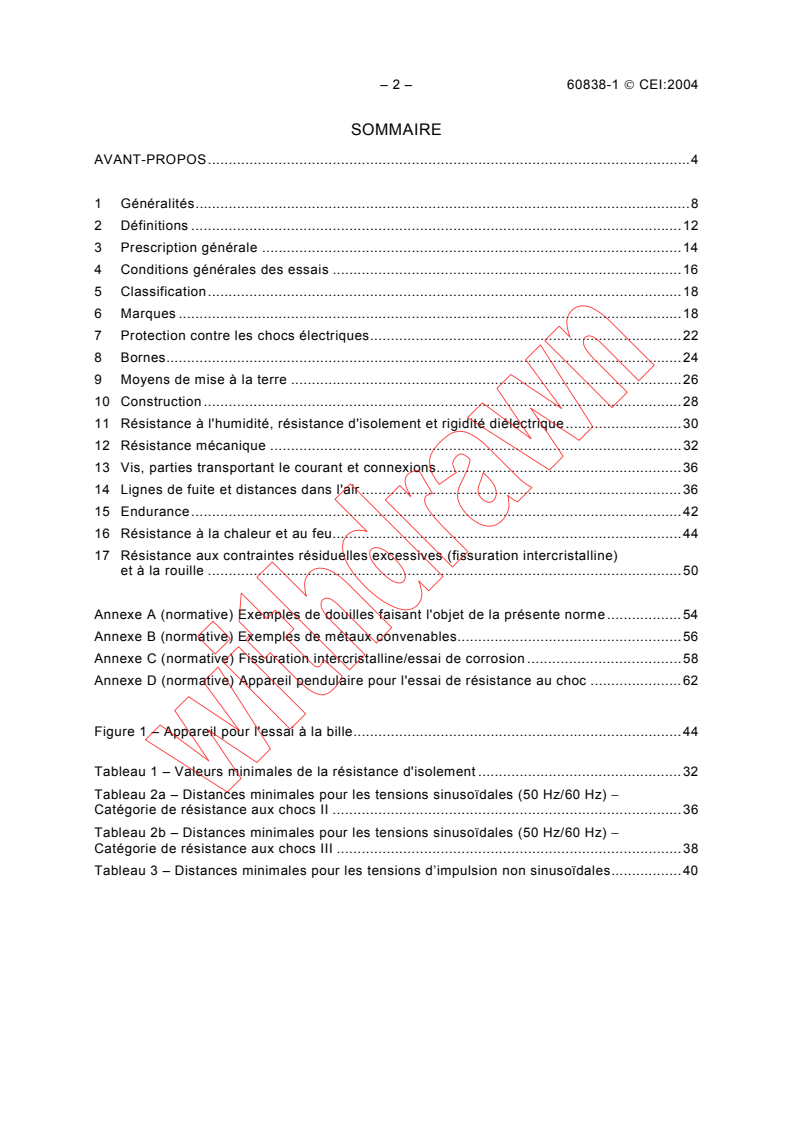
IEC 60838-1:2004 - Miscellaneous lampholders - Part 1: General requirements and tests Released:10/7/2004
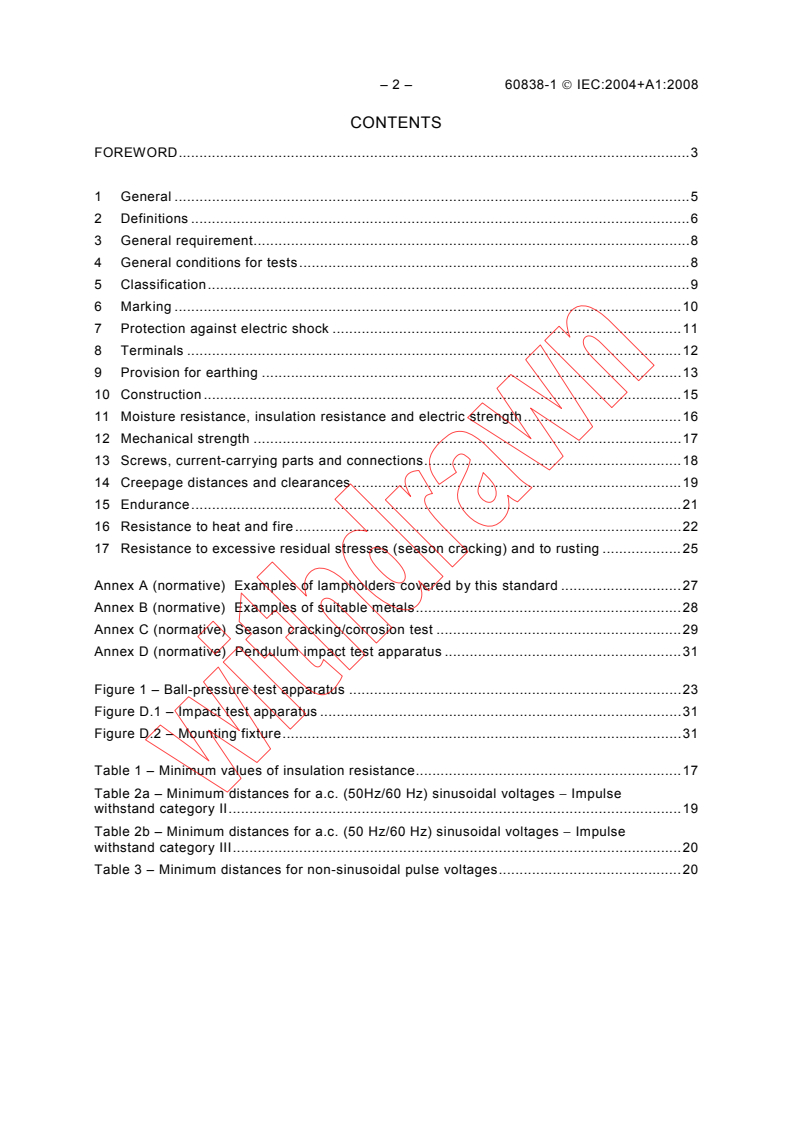
IEC 60838-1:2004+AMD1:2008 CSV - Miscellaneous lampholders - Part 1: General requirements and tests Released:8/28/2008
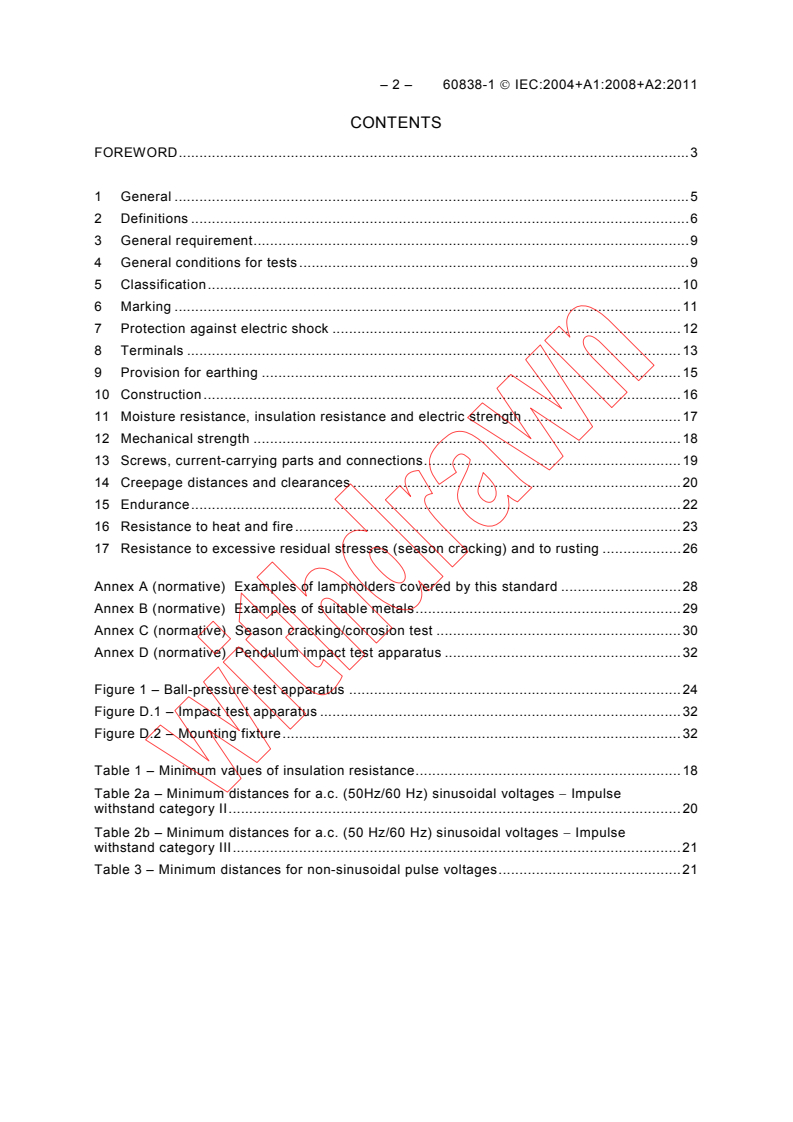
IEC 60838-1:2004+AMD1:2008+AMD2:2011 CSV - Miscellaneous lampholders - Part 1: General requirements and tests Released:6/16/2011
Overview
IEC 60838-1:2004, titled Miscellaneous Lampholders – Part 1: General Requirements and Tests, is an international standard published by the International Electrotechnical Commission (IEC). It defines the requirements and testing methods for miscellaneous types of lampholders intended for building-in applications, including those integrated within luminaires. The standard specifically applies to lampholders used with general-purpose light sources such as projection lamps, floodlighting lamps, and street-lighting lamps with specific caps as outlined in annex A.
The standard ensures safety, reliability, and compatibility of lampholders with electrical lighting equipment by detailing construction, electrical, and mechanical performance criteria. It focuses exclusively on lampholder requirements and excludes specific standards for tubular fluorescent lamps, Edison screw, and bayonet lampholders, which are covered separately.
Key Topics
Scope and Applicability
IEC 60838-1 applies to built-in lampholders intended for various lamp types and covers integral lampholders in luminaires. It includes lampholders enclosed within outer shells similar to Edison screw types.General Requirements
The standard specifies essential construction features, rated voltage and current, temperature ratings, and safety protections to ensure lampholders operate safely in their designated environments.Testing Methods
It outlines comprehensive tests for:- Electric shock protection
- Insulation resistance and electric strength
- Mechanical strength, including impact and endurance
- Heat and fire resistance, such as glow-wire and needle-flame tests
- Resistance to corrosion and season cracking
Markings and Classification
Lampholders must be clearly marked with details such as rated voltage and current, manufacturer identification, and protection class to guarantee traceability and compliance.Safety Features
Requirements covering terminals, earthing provisions, creepage distances, and clearances are detailed to reduce risks of electric shock, short circuits, and fire hazards.Test Annexes
Includes normative annexes with examples of lampholders under the standard, suitable materials, corrosion tests, and test apparatus descriptions.
Applications
IEC 60838-1 is essential for manufacturers, testing laboratories, and certification bodies involved in the design, production, and approval of electrical lampholders used in:
Building-in Lampholder Installations
For integration into lighting fixtures, luminaires, and other electrical assemblies requiring safe, reliable lamp connections.General Purpose Lighting
Compatibility with common lamp types used in residential, commercial, and industrial lighting such as floodlights and street lamps.Safety and Quality Assurance
Ensures lampholders meet international safety standards and perform reliably under various environmental conditions, including temperature variations, mechanical stress, and exposure to moisture.Regulatory Compliance
Assists manufacturers in meeting global regulatory demands, helping products access international markets with recognized safety certifications.
Related Standards
IEC 60838-1 works alongside several related international standards, creating a comprehensive framework for electrical lighting components and safety:
IEC 60061 (Parts 1–3)
Standardizes lamp caps and holders, including gauges controlling interchangeability and safety aspects.IEC 60238
Covers specific requirements for Edison screw lampholders, often referenced in testing for lampholders similar to those in IEC 60838-1.IEC 60598-1
Pertains to luminaires’ general requirements and tests, including complementary safety and performance tests applicable to integrated lampholders.IEC 60664-1
Details insulation coordination for low-voltage equipment, supporting electrical safety in lampholder designs.IEC 60695 (Parts 2-11 and 11-5)
Focuses on fire hazard testing, ensuring lampholder materials and designs are resistant to glow-wire and needle-flame exposures.ISO Standards for Coatings
Provide specifications for metal coatings on lampholder parts, relating to corrosion resistance and mechanical durability.
Conclusion
IEC 60838-1:2004 defines crucial general requirements and testing procedures to ensure miscellaneous lampholders used in building-in applications meet stringent safety and performance standards. Implementing this standard supports manufacturers and stakeholders in producing lampholders that guarantee secure electrical connections, operational reliability, and compliance with international safety norms. Understanding and applying IEC 60838-1 is vital for maintaining high-quality lighting components that perform safely across a wide range of lighting applications.
Relations
- Effective Date
- 05-Sep-2023
- Effective Date
- 05-Sep-2023
- Effective Date
- 05-Sep-2023
- Effective Date
- 05-Sep-2023
- Effective Date
- 05-Sep-2023
Buy Documents
IEC 60838-1:2004 - Miscellaneous lampholders - Part 1: General requirements and tests Released:10/7/2004
IEC 60838-1:2004+AMD1:2008 CSV - Miscellaneous lampholders - Part 1: General requirements and tests Released:8/28/2008
IEC 60838-1:2004+AMD1:2008+AMD2:2011 CSV - Miscellaneous lampholders - Part 1: General requirements and tests Released:6/16/2011
Get Certified
Connect with accredited certification bodies for this standard

IMQ S.p.A. (Certification)
Italian electrical product certification.

SLG Prüf- und Zertifizierungs GmbH
German testing and certification body.

UL Solutions
Global safety science company with testing, inspection and certification.
Sponsored listings
Frequently Asked Questions
IEC 60838-1:2004 is a standard published by the International Electrotechnical Commission (IEC). Its full title is "Miscellaneous lampholders - Part 1: General requirements and tests". This standard covers: This part of IEC 60838 applies to lampholders of miscellaneous types intended for building-in (to be used with general purpose light sources, projection lamps, floodlighting lamps and street-lighting lamps with caps as listed in annex A) and the methods of test to be used in determining the safe use of lamps in lampholders. This part of IEC 60838 also covers lampholders which are integral with a luminaire. It covers the requirements for the lampholder only.
This part of IEC 60838 applies to lampholders of miscellaneous types intended for building-in (to be used with general purpose light sources, projection lamps, floodlighting lamps and street-lighting lamps with caps as listed in annex A) and the methods of test to be used in determining the safe use of lamps in lampholders. This part of IEC 60838 also covers lampholders which are integral with a luminaire. It covers the requirements for the lampholder only.
IEC 60838-1:2004 is classified under the following ICS (International Classification for Standards) categories: 29.140.10 - Lamp caps and holders. The ICS classification helps identify the subject area and facilitates finding related standards.
IEC 60838-1:2004 has the following relationships with other standards: It is inter standard links to IEC 60838-1:2004/AMD2:2011, IEC 60838-1:2004/AMD1:2008, IEC 60838-1:1997/AMD1:1999, IEC 60838-1:1997/AMD2:2002, IEC 60838-1:2016. Understanding these relationships helps ensure you are using the most current and applicable version of the standard.
IEC 60838-1:2004 is available in PDF format for immediate download after purchase. The document can be added to your cart and obtained through the secure checkout process. Digital delivery ensures instant access to the complete standard document.
Standards Content (Sample)
NORME CEI
INTERNATIONALE
IEC
60838-1
INTERNATIONAL
Quatrième édition
STANDARD
Fourth edition
2004-10
Douilles diverses pour lampes –
Partie 1:
Prescriptions générales et essais
Miscellaneous lampholders –
Part 1:
General requirements and tests
Numéro de référence
Reference number
CEI/IEC 60838-1:2004
Numérotation des publications Publication numbering
Depuis le 1er janvier 1997, les publications de la CEI As from 1 January 1997 all IEC publications are
sont numérotées à partir de 60000. Ainsi, la CEI 34-1 issued with a designation in the 60000 series. For
devient la CEI 60034-1. example, IEC 34-1 is now referred to as IEC 60034-1.
Editions consolidées Consolidated editions
Les versions consolidées de certaines publications de la The IEC is now publishing consolidated versions of its
CEI incorporant les amendements sont disponibles. Par publications. For example, edition numbers 1.0, 1.1
exemple, les numéros d’édition 1.0, 1.1 et 1.2 indiquent and 1.2 refer, respectively, to the base publication,
respectivement la publication de base, la publication de the base publication incorporating amendment 1 and
base incorporant l’amendement 1, et la publication de the base publication incorporating amendments 1
base incorporant les amendements 1 et 2. and 2.
Informations supplémentaires Further information on IEC publications
sur les publications de la CEI
Le contenu technique des publications de la CEI est The technical content of IEC publications is kept
constamment revu par la CEI afin qu'il reflète l'état under constant review by the IEC, thus ensuring that
actuel de la technique. Des renseignements relatifs à the content reflects current technology. Information
cette publication, y compris sa validité, sont dispo- relating to this publication, including its validity, is
nibles dans le Catalogue des publications de la CEI available in the IEC Catalogue of publications
(voir ci-dessous) en plus des nouvelles éditions, (see below) in addition to new editions, amendments
amendements et corrigenda. Des informations sur les and corrigenda. Information on the subjects under
sujets à l’étude et l’avancement des travaux entrepris consideration and work in progress undertaken by the
par le comité d’études qui a élaboré cette publication, technical committee which has prepared this
ainsi que la liste des publications parues, sont publication, as well as the list of publications issued,
également disponibles par l’intermédiaire de: is also available from the following:
• Site web de la CEI (www.iec.ch) • IEC Web Site (www.iec.ch)
• Catalogue des publications de la CEI • Catalogue of IEC publications
Le catalogue en ligne sur le site web de la CEI The on-line catalogue on the IEC web site
(www.iec.ch/searchpub) vous permet de faire des (www.iec.ch/searchpub) enables you to search by a
recherches en utilisant de nombreux critères, variety of criteria including text searches,
comprenant des recherches textuelles, par comité technical committees and date of publication. On-
d’études ou date de publication. Des informations en line information is also available on recently
ligne sont également disponibles sur les nouvelles issued publications, withdrawn and replaced
publications, les publications remplacées ou retirées, publications, as well as corrigenda.
ainsi que sur les corrigenda.
• IEC Just Published • IEC Just Published
Ce résumé des dernières publications parues This summary of recently issued publications
(www.iec.ch/online_news/justpub) est aussi dispo- (www.iec.ch/online_news/justpub) is also available
nible par courrier électronique. Veuillez prendre by email. Please contact the Customer Service
contact avec le Service client (voir ci-dessous) Centre (see below) for further information.
pour plus d’informations.
• Service clients • Customer Service Centre
Si vous avez des questions au sujet de cette If you have any questions regarding this
publication ou avez besoin de renseignements publication or need further assistance, please
supplémentaires, prenez contact avec le Service contact the Customer Service Centre:
clients:
Email: custserv@iec.ch Email: custserv@iec.ch
Tél: +41 22 919 02 11 Tel: +41 22 919 02 11
Fax: +41 22 919 03 00 Fax: +41 22 919 03 00
.
NORME CEI
INTERNATIONALE
IEC
60838-1
INTERNATIONAL
Quatrième édition
STANDARD
Fourth edition
2004-10
Douilles diverses pour lampes –
Partie 1:
Prescriptions générales et essais
Miscellaneous lampholders –
Part 1:
General requirements and tests
IEC 2004 Droits de reproduction réservés Copyright - all rights reserved
Aucune partie de cette publication ne peut être reproduite ni No part of this publication may be reproduced or utilized in any
utilisée sous quelque forme que ce soit et par aucun procédé, form or by any means, electronic or mechanical, including
électronique ou mécanique, y compris la photocopie et les photocopying and microfilm, without permission in writing from
microfilms, sans l'accord écrit de l'éditeur. the publisher.
International Electrotechnical Commission, 3, rue de Varembé, PO Box 131, CH-1211 Geneva 20, Switzerland
Telephone: +41 22 919 02 11 Telefax: +41 22 919 03 00 E-mail: inmail@iec.ch Web: www.iec.ch
CODE PRIX
V
PRICE CODE
Commission Electrotechnique Internationale
International Electrotechnical Commission
МеждународнаяЭлектротехническаяКомиссия
Pour prix, voir catalogue en vigueur
For price, see current catalogue
– 2 – 60838-1 CEI:2004
SOMMAIRE
AVANT-PROPOS.4
1 Généralités.8
2 Définitions.12
3 Prescription générale.14
4 Conditions générales des essais .16
5 Classification.18
6 Marques.18
7 Protection contre les chocs électriques.22
8 Bornes.24
9 Moyens de mise à la terre .26
10 Construction.28
11 Résistance à l'humidité, résistance d'isolement et rigidité diélectrique.30
12 Résistance mécanique.32
13 Vis, parties transportant le courant et connexions.36
14 Lignes de fuite et distances dans l'air .36
15 Endurance.42
16 Résistance à la chaleur et au feu.44
17 Résistance aux contraintes résiduelles excessives (fissuration intercristalline)
et à la rouille .50
Annexe A (normative) Exemples de douilles faisant l'objet de la présente norme.54
Annexe B (normative) Exemples de métaux convenables.56
Annexe C (normative) Fissuration intercristalline/essai de corrosion .58
Annexe D (normative) Appareil pendulaire pour l'essai de résistance au choc .62
Figure 1 – Appareil pour l'essai à la bille.44
Tableau 1 – Valeurs minimales de la résistance d'isolement .32
Tableau 2a – Distances minimales pour les tensions sinusoïdales (50 Hz/60 Hz) −
Catégorie de résistance aux chocs II .36
Tableau 2b – Distances minimales pour les tensions sinusoïdales (50 Hz/60 Hz) −
Catégorie de résistance aux chocs III .38
Tableau 3 – Distances minimales pour les tensions d’impulsion non sinusoïdales.40
60838-1 IEC:2004 – 3 –
CONTENTS
FOREWORD.5
1 General.9
2 Definitions.13
3 General requirement.15
4 General conditions for tests.17
5 Classification.19
6 Marking.19
7 Protection against electric shock .23
8 Terminals.25
9 Provision for earthing.27
10 Construction.29
11 Moisture resistance, insulation resistance and electric strength.31
12 Mechanical strength.33
13 Screws, current-carrying parts and connections.37
14 Creepage distances and clearances .37
15 Endurance.43
16 Resistance to heat and fire.45
17 Resistance to excessive residual stresses (season cracking) and to rusting .51
Annex A (normative) Examples of lampholders covered by this standard .55
Annex B (normative) Examples of suitable metals.57
Annex C (normative) Season cracking/corrosion test .59
Annex D (normative) Pendulum impact test apparatus .63
Figure 1 – Ball-pressure test apparatus .45
Table 1 – Minimum values of insulation resistance.33
Table 2a – Minimum distances for a.c. (50Hz/60 Hz) sinusoidal voltages − Impulse
withstand category II.37
Table 2b – Minimum distances for a.c. (50 Hz/60 Hz) sinusoidal voltages − Impulse
withstand category III.39
Table 3 – Minimum distances for non-sinusoidal pulse voltages.41
– 4 – 60838-1 CEI:2004
COMMISSION ÉLECTROTECHNIQUE INTERNATIONALE
____________
DOUILLES DIVERSES POUR LAMPES –
Partie 1: Prescriptions générales et essais
AVANT-PROPOS
1) La Commission Electrotechnique Internationale (CEI) est une organisation mondiale de normalisation
composée de l'ensemble des comités électrotechniques nationaux (Comités nationaux de la CEI). La CEI a
pour objet de favoriser la coopération internationale pour toutes les questions de normalisation dans les
domaines de l'électricité et de l'électronique. A cet effet, la CEI – entre autres activités – publie des Normes
internationales, des Spécifications techniques, des Rapports techniques, des Spécifications accessibles au
public (PAS) et des Guides (ci-après dénommés "Publication(s) de la CEI"). Leur élaboration est confiée à des
comités d'études, aux travaux desquels tout Comité national intéressé par le sujet traité peut participer. Les
organisations internationales, gouvernementales et non gouvernementales, en liaison avec la CEI, participent
également aux travaux. La CEI collabore étroitement avec l'Organisation Internationale de Normalisation (ISO),
selon des conditions fixées par accord entre les deux organisations.
2) Les décisions ou accords officiels de la CEI concernant les questions techniques représentent, dans la mesure
du possible, un accord international sur les sujets étudiés, étant donné que les Comités nationaux de la CEI
intéressés sont représentés dans chaque comité d’études.
3) Les Publications de la CEI se présentent sous la forme de recommandations internationales et sont agréées
comme telles par les Comités nationaux de la CEI. Tous les efforts raisonnables sont entrepris afin que la CEI
s'assure de l'exactitude du contenu technique de ses publications; la CEI ne peut pas être tenue responsable
de l'éventuelle mauvaise utilisation ou interprétation qui en est faite par un quelconque utilisateur final.
4) Dans le but d'encourager l'uniformité internationale, les Comités nationaux de la CEI s'engagent, dans toute la
mesure possible, à appliquer de façon transparente les Publications de la CEI dans leurs publications
nationales et régionales. Toutes divergences entre toutes Publications de la CEI et toutes publications
nationales ou régionales correspondantes doivent être indiquées en termes clairs dans ces dernières.
5) La CEI n’a prévu aucune procédure de marquage valant indication d’approbation et n'engage pas sa
responsabilité pour les équipements déclarés conformes à une de ses Publications.
6) Tous les utilisateurs doivent s'assurer qu'ils sont en possession de la dernière édition de cette publication.
7) Aucune responsabilité ne doit être imputée à la CEI, à ses administrateurs, employés, auxiliaires ou
mandataires, y compris ses experts particuliers et les membres de ses comités d'études et des Comités
nationaux de la CEI, pour tout préjudice causé en cas de dommages corporels et matériels, ou de tout autre
dommage de quelque nature que ce soit, directe ou indirecte, ou pour supporter les coûts (y compris les frais
de justice) et les dépenses découlant de la publication ou de l'utilisation de cette Publication de la CEI ou de
toute autre Publication de la CEI, ou au crédit qui lui est accordé.
8) L'attention est attirée sur les références normatives citées dans cette publication. L'utilisation de publications
référencées est obligatoire pour une application correcte de la présente publication.
9) L’attention est attirée sur le fait que certains des éléments de la présente Publication de la CEI peuvent faire
l’objet de droits de propriété intellectuelle ou de droits analogues. La CEI ne saurait être tenue pour
responsable de ne pas avoir identifié de tels droits de propriété et de ne pas avoir signalé leur existence.
La Norme internationale CEI 60838-1 a été établie par le sous-comité 34B: Culots et douilles,
du comité d'études 34 de la CEI: Lampes et équipements associés.
Cette quatrième édition annule et remplace la troisième édition parue en 1997 et ses
amendements 1 (1999) et 2 (2002). Cette quatrième édition constitue un révision technique.
Dans cette édition, les nouvelles prescriptions concernant les lignes de fuite et distances
dans l’air ont été adoptées; elles sont actuellement en cours d’examen par le SC 34D pour
modifier les normes luminaires de la famille CEI 60598.
Elle inclue également les prescriptions complémentaires concernant l’essai des douilles pour
lampes à deux culots R7s/RX7s.
60838-1 IEC:2004 – 5 –
INTERNATIONAL ELECTROTECHNICAL COMMISSION
____________
MISCELLANEOUS LAMPHOLDERS –
Part 1: General requirements and tests
FOREWORD
1) The International Electrotechnical Commission (IEC) is a worldwide organization for standardization comprising
all national electrotechnical committees (IEC National Committees). The object of IEC is to promote
international co-operation on all questions concerning standardization in the electrical and electronic fields. To
this end and in addition to other activities, IEC publishes International Standards, Technical Specifications,
Technical Reports, Publicly Available Specifications (PAS) and Guides (hereafter referred to as “IEC
Publication(s)”). Their preparation is entrusted to technical committees; any IEC National Committee interested
in the subject dealt with may participate in this preparatory work. International, governmental and non-
governmental organizations liaising with the IEC also participate in this preparation. IEC collaborates closely
with the International Organization for Standardization (ISO) in accordance with conditions determined by
agreement between the two organizations.
2) The formal decisions or agreements of IEC on technical matters express, as nearly as possible, an international
consensus of opinion on the relevant subjects since each technical committee has representation from all
interested IEC National Committees.
3) IEC Publications have the form of recommendations for international use and are accepted by IEC National
Committees in that sense. While all reasonable efforts are made to ensure that the technical content of IEC
Publications is accurate, IEC cannot be held responsible for the way in which they are used or for any
misinterpretation by any end user.
4) In order to promote international uniformity, IEC National Committees undertake to apply IEC Publications
transparently to the maximum extent possible in their national and regional publications. Any divergence
between any IEC Publication and the corresponding national or regional publication shall be clearly indicated in
the latter.
5) IEC provides no marking procedure to indicate its approval and cannot be rendered responsible for any
equipment declared to be in conformity with an IEC Publication.
6) All users should ensure that they have the latest edition of this publication.
7) No liability shall attach to IEC or its directors, employees, servants or agents including individual experts and
members of its technical committees and IEC National Committees for any personal injury, property damage or
other damage of any nature whatsoever, whether direct or indirect, or for costs (including legal fees) and
expenses arising out of the publication, use of, or reliance upon, this IEC Publication or any other IEC
Publications.
8) Attention is drawn to the Normative references cited in this publication. Use of the referenced publications is
indispensable for the correct application of this publication.
9) Attention is drawn to the possibility that some of the elements of this IEC Publication may be the subject of
patent rights. IEC shall not be held responsible for identifying any or all such patent rights.
International Standard IEC 60838-1 has been prepared by subcommittee 34B: Lamp caps and
holders, of IEC technical committee 34: Lamps and related equipment.
This fourth edition cancels and replaces the third edition published in 1997 and its
amendments 1 (1999) and 2 (2002). This fourth edition constitutes a technical revision.
In this edition the new requirements for creepage distances and clearances have been
adopted which are currently circulated by SC34D to amend the IEC 60598 family of luminaire
standards.
It also includes additional requirements regarding testing of lampholders for double-ended
R7s/RX7s lamps.
– 6 – 60838-1 CEI:2004
Le texte de cette norme est issu des documents suivants:
FDIS Rapport de vote
34B/1152/FDIS 34B/1171/RVD
Le rapport de vote indiqué dans le tableau ci-dessus donne toute information sur le vote ayant
abouti à l'approbation de cette norme.
Cette publication a été rédigée selon les Directives ISO/CEI, Partie 2.
La CEI 60838 comprend les parties suivantes, présentées sous le titre général Douilles
diverses pour lampes:
Partie 1: Prescriptions générales et essais
Partie 2-1: Règles particulières – Douilles S14
Le comité a décidé que le contenu de cette publication ne sera pas modifié avant la date de
maintenance indiquée sur le site web de la CEI sous "http://webstore.iec.ch" dans les
données relatives à la publication recherchée. A cette date, la publication sera
• reconduite,
• supprimée,
• remplacée par une édition révisée, ou
• amendée.
60838-1 IEC:2004 – 7 –
The text of this standard is based on the following documents:
FDIS Report on voting
34B/1152/FDIS 34B/1171/RVD
Full information on the voting for the approval of this standard can be found in the report on
voting indicated in the above table.
This publication has been drafted in accordance with the ISO/IEC Directives, Part 2.
IEC 60838 consists of the following parts, under the general title Miscellaneous lampholders:
Part 1: General requirements and tests
Part 2-1: Particular requirements – Lampholders S14
The committee has decided that the contents of this publication will remain unchanged until
the maintenance result date indicated on the IEC web site under "http://webstore.iec.ch" in
the data related to the specific publication. At this date, the publication will be
• reconfirmed;
• withdrawn;
• replaced by a revised edition, or
• amended.
– 8 – 60838-1 CEI:2004
DOUILLES DIVERSES POUR LAMPES –
Partie 1: Prescriptions générales et essais
1 Généralités
1.1 Domaine d'application
La présente partie de la CEI 60838 s'applique aux douilles de types divers prévues pour être
incorporées (et destinées à être utilisées avec les sources lumineuses à usage général, les
lampes de projection, les lampes d'illumination et les lampes pour l'éclairage public dotées du
culot et répertoriées à titre d'exemple dans l'Annexe A) ainsi qu'aux méthodes d'essai à
appliquer pour démontrer la sécurité d'utilisation des lampes dans les douilles.
La présente partie de la CEI 60838 couvre également les douilles intégrées dans un
luminaire. Elle couvre seulement les prescriptions de la douille.
La présente partie de la CEI 60838 couvre également les douilles intégrées dans un écran
extérieur semblables aux douilles à vis Edison. De telles douilles sont alors essayées selon
les paragraphes 8.4; 8.5; 8.6; 9.3; 10.7; 11; 12.2; 12.5; 12.6; 12.7; 13; 15.3; 15.4; 15.5 et 15.9
de la CEI 60238.
Il convient que les douilles conçues avec un filetage rond pour bague support d’abat-jour
satisfassent à la CEI 60399.
Les exigences relatives aux douilles pour lampes tubulaires à fluorescence, aux douilles à vis
Edison et aux douilles à baïonnette font l'objet de normes séparées.
1.2 Références normatives
Les documents de référence suivants sont indispensables pour l'application du présent
document. Pour les références datées, seule l'édition citée s'applique. Pour les références
non datées, la dernière édition du document de référence s'applique (y compris les éventuels
amendements).
NOTE En ce qui concerne la CEI 60598-1, les références citées dans le présent document sont susceptibles de
changer.
CEI 60061(toutes les parties), Culots de lampes et douilles ainsi que calibres pour le contrôle
de l'interchangeabilité et de la sécurité
CEI 60061-1: Culots de lampes et douilles ainsi que calibres pour le contrôle de
l'interchangeabilité et de la sécurité – Partie 1: Culots de lampes
CEI 60061-2: Culots de lampes et douilles ainsi que calibres pour le contrôle de
l'interchangeabilité et de la sécurité – Partie 2: Douilles
CEI 60061-3: Culots de lampes et douilles ainsi que calibres pour le contrôle de
l'interchangeabilité et de la sécurité – Partie 3: Calibres
CEI 60068-2-20: 1979, Essais d'environnement – Deuxième partie : Essais – Essai T:
Soudure
CEI 60068-2-75: 1997, Essais d'environnement – Partie 2-75: Essais – Essai Eh: Essais aux
marteaux
60838-1 IEC:2004 – 9 –
MISCELLANEOUS LAMPHOLDERS –
Part 1: General requirements and tests
1 General
1.1 Scope
This part of IEC 60838 applies to lampholders of miscellaneous types intended for building-in
(to be used with general purpose light sources, projection lamps, floodlighting lamps and
street-lighting lamps with caps as listed in annex A) and the methods of test to be used in
determining the safe use of lamps in lampholders.
This part of IEC 60838 also covers lampholders which are integral with a luminaire. It covers
the requirements for the lampholder only.
This part of IEC 60838 also covers lampholders integrated in an outer shell and dome similar
to Edison screw lampholders. Such lampholders are further tested in accordance with the
following subclauses of IEC 60238: 8.4; 8.5; 8.6; 9.3; 10.7; 11; 12.2; 12.5; 12.6; 12.7; 13;
15.3; 15.4; 15.5 and 15.9.
Lampholders designed with a barrel thread for shade holder rings should comply with
IEC 60399.
Requirements for lampholders for tubular fluorescent lamps, Edison screw lampholders and
bayonet lampholders are covered by separate standards.
1.2 Normative references
The following referenced documents are indispensable for the application of this document.
For dated references, only the edition cited applies. For undated references, the latest edition
of the referenced document (including any amendments) applies.
NOTE With regard to IEC 60598-1, the references cited in this document are liable to change.
IEC 60061(all parts), Lamp caps and holders together with gauges for the control of
interchangeability and safety
IEC 60061-1: Lamp caps and holders together with gauges for the control of
interchangeability and safety – Part 1: Lamp caps
IEC 60061-2: Lamp caps and holders together with gauges for the control of
interchangeability and safety – Part 2: Lampholders
IEC 60061-3: Lamp caps and holders together with gauges for the control of
interchangeability and safety – Part 3: Gauges
IEC 60068-2-20:1979, Environmental testing – Part 2: Tests – Test T: Soldering
IEC 60068-2-75:1997, Environmental testing – Part 2-75: Tests – Test Eh: Hammer tests
– 10 – 60838-1 CEI:2004
CEI 60112:1979, Méthode de détermination des indices de résistance et de tenue au
cheminement des matériaux isolants solides
CEI 60227 (toutes les parties), Conducteurs et câbles isolés au polychlorure de vinyle, de
tension nominale au plus égale à 450/750 V
CEI 60238:2004, Douilles à vis Edison pour lampes
CEI 60245 (toutes les parties), Conducteurs et câbles isolés au caoutchouc -Tension
assignée au plus égale à 450/750 V
CEI 60352-1: Connexions sans soudure – Partie 1: Connexions enroulées – Règles
générales, méthodes d’essai et guide pratique
CEI 60399: Feuilles de normes pour filetage à filets ronds pour douilles E14 et E27 avec
bague support d’abat-jour
1)
CEI 60529:1989, Degrés de protection procurés par les enveloppes
Amendement 1(1999)
CEI 60598-1: Luminaires – Partie 1: Prescriptions générales et essais
CEI 60664-1:1992, Coordination de l’isolement des matériels dans les systèmes (réseaux) à
2)
basse tension – Partie 1: Principes, prescriptions et essais
Amendement 1 (2000)
Amendement 2 (2002)
CEI 60695-2-2: Essais relatifs au risque du feu – Partie 2: Méthodes d'essai – Section 2:
Essai au brûleur-aiguille
CEI 60695-2-11: Essais relatifs aux risques du feu – Partie 2-11: Essais au fil
incandescent/chauffant – Méthode d'essai d'inflammabilité pour produits finis
ISO 1456:2003, Revêtements métalliques – Dépôts électrolytiques de nickel plus chrome et
de cuivre plus nickel plus chrome
ISO 2081:1986, Revêtements métalliques – Dépôts électrolytiques de zinc sur fer ou acier
ISO 2093:1986, Dépôts électrolytiques d'étain – Spécifications et méthodes d'essai
ISO 4046-4:2002, Papier, carton, pâtes et termes connexes – Vocabulaire – Partie 4:
Catégories et produits transformés de papier et de carton
___________
1)
Il existe une édition consolidée 2.1 (2000) comprenant l'édition 2.0 et son amendement 1 (1999).
2)
Il existe une édition consolidée 1.2 (2002) comprenant l'édition 1.0 (1992), l’amendement 1 (2000) et
l’amendement 2 (2002).
60838-1 IEC:2004 – 11 –
IEC 60112:1979, Method for the determination of the proof and the comparative tracking
indices of solid insulating materials
IEC 60227 (all parts), Polyvinyl chloride insulated cables of rated voltages up to and including
450/750 V
IEC 60238:2004, Edison screw lampholders
IEC 60245 (all parts), Rubber insulated cables – Rated voltages up to and including
450/750 V
IEC 60352-1, Solderless connections – Part 1: Wrapped connections – General requirements,
test methods and practical guidance
IEC 60399: Standard sheets for barrel thread for E14 and E27 lampholders with shade holder
ring
1)
IEC 60529:1989, Degrees of protection provided by enclosures (IP code)
Amendment 1 (1999)
IEC 60598-1: Luminaires – Part 1: General requirements and tests
IEC 60664-1:1992, Insulation co-ordination for equipment within low-voltage systems – Part 1:
2)
Principles, requirements and tests
Amendment 1 (2000)
Amendment 2 (2002)
IEC 60695-2-2, Fire hazard testing – Part 2: Test methods – Section 2: Needle-flame test
IEC 60695-2-11, Fire hazard testing – Part 2-11: Glowing/hot-wire based test methods –
Glow-wire flammability test method for end products
ISO 1456:2003, Metallic coatings – Electrodeposited coatings of nickel plus chromium and of
copper plus nickel plus chromium
ISO 2081:1986, Metallic coatings – Electroplated coatings of zinc on iron or steel
ISO 2093:1986, Electroplated coatings of tin – Specification and test methods
ISO 4046-4:2002, Paper, board, pulps and related terms – Vocabulary – Part 4: Paper and
board grades and converted products
___________
1)
A consolidated edition 2.1 (2001) exists that includes edition 2.0 (1989) and its Amendment 1 (1999).
2)
A consolidated edition 1.2 (2002) exists that includes edition 1.0 (1992), its amendment 1 (2000) and
amendment 2 (2002).
– 12 – 60838-1 CEI:2004
2 Définitions
Pour les besoins de la présente Norme internationale, les définitions suivantes s'appliquent.
2.1
tension assignée
valeur déclarée par le fabricant comme étant la tension de travail la plus élevée pour laquelle
la douille a été prévue
2.2
tension de travail
tension efficace la plus élevée pouvant être mesurée aux extrémités de tout isolant (les
transitoires étant négligées) lorsque la lampe fonctionne dans les conditions normales ou
lorsqu'elle est retirée
2.3
courant assigné
courant déclaré par le fabricant comme étant le courant le plus élevé pour lequel la douille a
été prévue
2.4
douille à incorporer
douille conçue pour être incorporée dans un luminaire, une enceinte additionnelle ou un
dispositif analogue
2.4.1
douille non protégée
douille à incorporer, conçue de telle sorte qu'elle exige des moyens additionnels, une
enveloppe par exemple, pour satisfaire aux prescriptions de la présente norme concernant la
protection contre les chocs électriques
2.4.2
douille protégée
douille à incorporer conçue de telle sorte qu'elle satisfait, par elle-même, aux prescriptions de
la présente norme concernant la protection contre les chocs électriques
2.5
température de fonctionnement assignée
température la plus élevée pour laquelle la douille a été conçue
2.6
tension d'impulsion assignée
valeur de crête la plus élevée des impulsions de tension à laquelle la douille est capable de
résister
2.7
connecteur de la lampe
ensemble de dispositifs de contact conçus spécialement pour établir le contact électrique
mais ne servant pas de support à la lampe
2.8
essai de type
essai ou série d'essais effectués sur un échantillon d'essai de type dans le but de vérifier la
conformité de la conception d'un produit donné aux prescriptions de la norme correspondante
60838-1 IEC:2004 – 13 –
2 Definitions
For the purpose of this International Standard, the following definitions apply.
2.1
rated voltage
the voltage declared by the manufacturer to indicate the highest working voltage for which the
lampholder is intended
2.2
working voltage
the highest r.m.s. voltage that may occur across any insulation, transients being disregarded,
both when the lamp is operating under normal conditions and when the lamp is removed
2.3
rated current
the current declared by the manufacturer to indicate the highest current for which the
lampholder is intended
2.4
lampholder for building-in
a lampholder designed to be built into a luminaire, an additional enclosure or the like
2.4.1
unenclosed lampholder
a lampholder for building-in so designed that it requires additional means, for example
enclosures, to meet the requirements of this standard with regard to protection against
electric shock
2.4.2
enclosed lampholder
a lampholder for building-in so designed that it fulfils on its own the requirements of this
standard with regard to protection against electric shock
2.5
rated operating temperature
The highest temperature for which the lampholder is designed
2.6
rated pulse voltage
the highest peak value of pulse voltages the holder is able to withstand
2.7
lamp connectors
a set of contacts specially designed to provide for electrical contact but not supporting the
lamp
2.8
type test
a test or series of tests made on a type test sample, for the purpose of checking compliance
of the design of a given product with the requirements of the relevant standard
– 14 – 60838-1 CEI:2004
2.9
échantillon d'essai de type
échantillon constitué de un ou plusieurs spécimens similaires présentés par le fabricant ou le
vendeur responsable en vue de l'essai de type
2.10
partie active
partie conductrice susceptible de causer un choc électrique
2.11
catégorie de tenue aux chocs
chiffre définissant une condition de surtension transitoire
NOTE Les catégories de tenue aux chocs I, II, III et IV sont utilisées.
a) But de la classification des catégories de tenue aux chocs
Les catégories de tenue aux chocs servent à différencier les différents degrés de validité des équipements en ce
qui concerne les attentes requises en matière de continuité de service et de tolérance des risques de défauts.
En sélectionnant les niveaux de tenue aux chocs des équipements, la coordination de l’isolement peut être réalisée
pour l’installation complète en réduisant le risque de défaut à un niveau acceptable qui servira de base dans la
maîtrise de la surtension.
Un chiffre plus élevé désignant la catégorie de tenue aux chocs indique une tenue aux chocs l’équipement plus
élevée et permet un plus grand choix de méthodes pour la maîtrise de la surtension.
Le concept de catégorie de tenue aux chocs est utilisé pour les équipements directement alimentés par le réseau.
b) Description des catégories de tenue aux chocs
Un équipement de catégorie de tenue aux chocs I est un équipement destiné a être connecté à l’installation fixe
des bâtiments. Des moyens de protection sont pris à l’extérieur de l’équipement – soit dans l’installation fixe soit
entre l’installation fixe et l’équipement – pour limiter les surtensions transitoires à un niveau donné.
Un équipement de catégorie de tenue aux chocs II est un équipement destiné a être connecté à l’installation fixe
des bâtiments.
Un équipement de catégorie de tenue aux chocs III est un équipement qui constitue une partie de l’installation fixe
et des autres équipements dont le degré de validité attendu est plus élevé.
Un équipement de catégorie de tenue aux chocs IV est destiné à être utilisé à proximité ou dans les installations
électriques des bâtiments en amont du tableau de distribution.
2.12
circuit primaire
circuit directement connecté au réseau alternatif. Il comporte, par exemple, les moyens de
connexion au réseau alternatif, les enroulements primaires des transformateurs, moteurs et
autres dispositifs en charge
2.13
circuit secondaire
circuit qui n’a pas de connexion directe avec le circuit primaire en tirant sa puissance d’un
transformateur, convertisseur ou système d’isolation équivalent, ou d’un accumulateur
Exception: les autotransformateurs. Bien qu'ayant une connexion directe avec le circuit
primaire, leur partie connectée est également considérée comme un circuit secondaire au
sens de la présente définition.
NOTE Les régimes transitoires dans de tels circuits sont amortis par l’enroulement primaire correspondant. Les
ballasts inductifs réduisent également la valeur de la tension des régimes transitoires. En conséquence, les
composants situés après un circuit primaire ou après un ballast inductif peuvent être adaptés à une catégorie de
tenue aux chocs un niveau plus bas, c’est-à-dire une catégorie de tenue aux chocs II.
3 Prescription générale
Les douilles doivent être conçues et construites de façon qu'en usage normal leur fonction-
nement soit sûr et ne présente aucun danger pour les personnes et l'environnement.
En général, la conformité est vérifiée en exécutant la totalité des essais spécifiés.
60838-1 IEC:2004 – 15 –
2.9
type test sample
a sample consisting of one or more similar specimens submitted by the manufacturer or
responsible vendor for the purpose of a type test
2.10
live part
a conductive part which may cause an electric shock
2.11
impulse withstand category
a numeral defining a transient overvoltage condition
NOTE Impulse withstand categories I, II, III and IV are used.
a) Purpose of classification of impulse withstand categories
Impulse withstand categories are to distinguish different degrees of availability of equipment with regard to
required expectations on continuity of service and on an acceptable risk of failure.
By selection of impulse withstand levels of equipment, insulation co-ordination can be achieved in the whole
installation reducing the risk of failure to an acceptable level providing a basis for overvoltage control.
A higher characteristic numeral of an impulse withstand category indicates a higher specific impulse withstand of
the equipment and offers a wider choice of methods for overvoltage control.
The concept of impulse withstand categories is used for equipment energized directly from the mains.
b) Description of impulse withstand categories
Equipment of impulse withstand category I is equipment which is intended to be connected to the fixed electrical
installations of buildings. Protective means are taken outside the equipment – either in the fixed installation or
between the fixed installation and the equipment – to limit transient overvoltages to the specific level.
Equipment of impulse withstand category II is equipment to be connected to the fixed electrical installations of
buildings.
Equipment of impulse withstand category III is equipment which is part of the fixed electrical installations and other
equipment where a higher degree of availability is expected.
Equipment of impulse withstand category IV is for use at or in the proximity of the origin of the electrical
installations of buildings upstream of the main distribution board.
2.12
primary circuit
a circuit which is directly connected to the AC mains supply. It includes, for example, the
means for connection to the AC mains supply, the primary windings of transformers, motors
and other loading devices
2.13
secondary circuit
a circuit which has no direct connection to a primary circuit and derives its power from a
transformer, converter or equivalent isolation device, or from a battery
Exception: autotransformers. Although having direct connection to a primary circuit, the
tapped part of them is also deemed to be a secondary circuit in the above sense.
NOTE Mains transients in such a circuit are attenuated by the corresponding primary windings. Also inductive
ballasts reduce the mains transient voltage height. Therefore, components located after a primary circuit or after an
inductive ballast can be suited for an impulse withstand category of one step lower, i.e. for impulse withstand
category II.
3 General requirement
Lampholders shall be so designed and constructed that in normal use they function reliably
and cause no danger to persons or surroundings.
In general, compliance is checked by carrying out all the tests specified.
– 16 – 60838-1 CEI:2004
4 Conditions générales des essais
4.1 Les essais prescrits par la présente norme sont des essais de type.
NOTE Les prescriptions et tolérances admises par la norme s'appliquent aux essais auxquels est soumis
l'échantillon d'essai de type présenté en tant que tel. La conformité de l'échantillon d'essai de type ne garantit pas
la conformité de la totalité de la production d'un fabricant aux prescriptions de la présente norme de sécurité. La
conformité de la production est de la responsabilité du fabricant et il convient que sa vérification fasse appel, en
plus de l'essai de type, aux essais de routine et aux procédures d'assurance de la qualité.
3)
Pour plus amples informations, voir la CEI 60061-4 (l’insertion de lignes directrices sur les essais de conformité
en cours de fabrication est actuellement en préparation.)
4.2 Sauf spécification contraire, les essais sont exécutés à la température ambiante de
20 °C ± 5 °C, la douille étant placée dans la position la plus défavorable de l'utilisation
normale.
Si une douille est déclarée accepter différents systèmes d’assemblage pour lampe, elle doit
satisfaire aux prescriptions de chacun des systèmes mentionnés.
La conformité est vérifiée avec des lots d’échantillons séparés selon 4.3.
Si l’utilisation successive de différents systèmes d’assemblage pour lampe est permise par le
fabricant, seulement un lot d’échantillons est utilisé pour vérifier la conformité à toutes les
prescriptions.
Pour tous les essais, le système et son calibre correspondant le plus critique doivent être
utilisés, et dans la séquence la plus sévère.
4.3 Les essais et inspections sont exécutés dans l'ordre des articles, sur un total de
– 10 paires de douilles appariées pour être utilisées avec des lampes linéaires à deux
culots;
NOTE Si une paire de douilles est constituée de douilles identiques, il suffit qu'une seule de ces douilles soit
soumises à la totalité des essais, excepté ceux de 7, 10.2, 10.3, 12, 15 et 16.6 pour lesquels la paire est
nécessaire.
– 10 spécimens prévus pour les lampes à culot unique,
l'ordre des articles étan
...
IEC 60838-1
Edition 4.1 2008-08
INTERNATIONAL
STANDARD
NORME
INTERNATIONALE
Miscellaneous lampholders –
Part 1: General requirements and tests
Douilles diverses pour lampes –
Partie 1: Prescriptions générales et essais
All rights reserved. Unless otherwise specified, no part of this publication may be reproduced or utilized in any form or by
any means, electronic or mechanical, including photocopying and microfilm, without permission in writing from either IEC or
IEC's member National Committee in the country of the requester.
If you have any questions about IEC copyright or have an enquiry about obtaining additional rights to this publication,
please contact the address below or your local IEC member National Committee for further information.
Droits de reproduction réservés. Sauf indication contraire, aucune partie de cette publication ne peut être reproduite
ni utilisée sous quelque forme que ce soit et par aucun procédé, électronique ou mécanique, y compris la photocopie
et les microfilms, sans l'accord écrit de la CEI ou du Comité national de la CEI du pays du demandeur.
Si vous avez des questions sur le copyright de la CEI ou si vous désirez obtenir des droits supplémentaires sur cette
publication, utilisez les coordonnées ci-après ou contactez le Comité national de la CEI de votre pays de résidence.
IEC Central Office
3, rue de Varembé
CH-1211 Geneva 20
Switzerland
Email: inmail@iec.ch
Web: www.iec.ch
About the IEC
The International Electrotechnical Commission (IEC) is the leading global organization that prepares and publishes
International Standards for all electrical, electronic and related technologies.
About IEC publications
The technical content of IEC publications is kept under constant review by the IEC. Please make sure that you have the
latest edition, a corrigenda or an amendment might have been published.
ƒ Catalogue of IEC publications: www.iec.ch/searchpub
The IEC on-line Catalogue enables you to search by a variety of criteria (reference number, text, technical committee,…).
It also gives information on projects, withdrawn and replaced publications.
ƒ IEC Just Published: www.iec.ch/online_news/justpub
Stay up to date on all new IEC publications. Just Published details twice a month all new publications released. Available
on-line and also by email.
ƒ Electropedia: www.electropedia.org
The world's leading online dictionary of electronic and electrical terms containing more than 20 000 terms and definitions
in English and French, with equivalent terms in additional languages. Also known as the International Electrotechnical
Vocabulary online.
ƒ Customer Service Centre: www.iec.ch/webstore/custserv
If you wish to give us your feedback on this publication or need further assistance, please visit the Customer Service
Centre FAQ or contact us:
Email: csc@iec.ch
Tel.: +41 22 919 02 11
Fax: +41 22 919 03 00
A propos de la CEI
La Commission Electrotechnique Internationale (CEI) est la première organisation mondiale qui élabore et publie des
normes internationales pour tout ce qui a trait à l'électricité, à l'électronique et aux technologies apparentées.
A propos des publications CEI
Le contenu technique des publications de la CEI est constamment revu. Veuillez vous assurer que vous possédez
l’édition la plus récente, un corrigendum ou amendement peut avoir été publié.
ƒ Catalogue des publications de la CEI: www.iec.ch/searchpub/cur_fut-f.htm
Le Catalogue en-ligne de la CEI vous permet d’effectuer des recherches en utilisant différents critères (numéro de référence,
texte, comité d’études,…). Il donne aussi des informations sur les projets et les publications retirées ou remplacées.
ƒ Just Published CEI: www.iec.ch/online_news/justpub
Restez informé sur les nouvelles publications de la CEI. Just Published détaille deux fois par mois les nouvelles
publications parues. Disponible en-ligne et aussi par email.
ƒ Electropedia: www.electropedia.org
Le premier dictionnaire en ligne au monde de termes électroniques et électriques. Il contient plus de 20 000 termes et
définitions en anglais et en français, ainsi que les termes équivalents dans les langues additionnelles. Egalement appelé
Vocabulaire Electrotechnique International en ligne.
ƒ Service Clients: www.iec.ch/webstore/custserv/custserv_entry-f.htm
Si vous désirez nous donner des commentaires sur cette publication ou si vous avez des questions, visitez le FAQ du
Service clients ou contactez-nous:
Email: csc@iec.ch
Tél.: +41 22 919 02 11
Fax: +41 22 919 03 00
IEC 60838-1
Edition 4.1 2008-08
INTERNATIONAL
STANDARD
NORME
INTERNATIONALE
Miscellaneous lampholders –
Part 1: General requirements and tests
Douilles diverses pour lampes –
Partie 1: Prescriptions générales et essais
INTERNATIONAL
ELECTROTECHNICAL
COMMISSION
COMMISSION
ELECTROTECHNIQUE
PRICE CODE
INTERNATIONALE
CL
CODE PRIX
ICS 29.140.10 ISBN 2-8318-9962-1
– 2 – 60838-1 © IEC:2004+A1:2008
CONTENTS
FOREWORD.3
1 General.5
2 Definitions.6
3 General requirement.8
4 General conditions for tests.8
5 Classification.9
6 Marking.10
7 Protection against electric shock .11
8 Terminals.12
9 Provision for earthing .13
10 Construction.15
11 Moisture resistance, insulation resistance and electric strength.16
12 Mechanical strength.17
13 Screws, current-carrying parts and connections.18
14 Creepage distances and clearances .19
15 Endurance.21
16 Resistance to heat and fire.22
17 Resistance to excessive residual stresses (season cracking) and to rusting .25
Annex A (normative) Examples of lampholders covered by this standard .27
Annex B (normative) Examples of suitable metals.28
Annex C (normative) Season cracking/corrosion test .29
Annex D (normative) Pendulum impact test apparatus .31
Figure 1 – Ball-pressure test apparatus .23
Figure D.1 – Impact test apparatus .31
Figure D.2 – Mounting fixture.31
Table 1 – Minimum values of insulation resistance.17
Table 2a – Minimum distances for a.c. (50Hz/60 Hz) sinusoidal voltages − Impulse
withstand category II.19
Table 2b – Minimum distances for a.c. (50 Hz/60 Hz) sinusoidal voltages − Impulse
withstand category III.20
Table 3 – Minimum distances for non-sinusoidal pulse voltages.20
60838-1 © IEC:2004+A1:2008 – 3 –
INTERNATIONAL ELECTROTECHNICAL COMMISSION
____________
MISCELLANEOUS LAMPHOLDERS –
Part 1: General requirements and tests
FOREWORD
1) The International Electrotechnical Commission (IEC) is a worldwide organization for standardization comprising
all national electrotechnical committees (IEC National Committees). The object of IEC is to promote
international co-operation on all questions concerning standardization in the electrical and electronic fields. To
this end and in addition to other activities, IEC publishes International Standards, Technical Specifications,
Technical Reports, Publicly Available Specifications (PAS) and Guides (hereafter referred to as “IEC
Publication(s)”). Their preparation is entrusted to technical committees; any IEC National Committee interested
in the subject dealt with may participate in this preparatory work. International, governmental and non-
governmental organizations liaising with the IEC also participate in this preparation. IEC collaborates closely
with the International Organization for Standardization (ISO) in accordance with conditions determined by
agreement between the two organizations.
2) The formal decisions or agreements of IEC on technical matters express, as nearly as possible, an international
consensus of opinion on the relevant subjects since each technical committee has representation from all
interested IEC National Committees.
3) IEC Publications have the form of recommendations for international use and are accepted by IEC National
Committees in that sense. While all reasonable efforts are made to ensure that the technical content of IEC
Publications is accurate, IEC cannot be held responsible for the way in which they are used or for any
misinterpretation by any end user.
4) In order to promote international uniformity, IEC National Committees undertake to apply IEC Publications
transparently to the maximum extent possible in their national and regional publications. Any divergence
between any IEC Publication and the corresponding national or regional publication shall be clearly indicated in
the latter.
5) IEC provides no marking procedure to indicate its approval and cannot be rendered responsible for any
equipment declared to be in conformity with an IEC Publication.
6) All users should ensure that they have the latest edition of this publication.
7) No liability shall attach to IEC or its directors, employees, servants or agents including individual experts and
members of its technical committees and IEC National Committees for any personal injury, property damage or
other damage of any nature whatsoever, whether direct or indirect, or for costs (including legal fees) and
expenses arising out of the publication, use of, or reliance upon, this IEC Publication or any other IEC
Publications.
8) Attention is drawn to the Normative references cited in this publication. Use of the referenced publications is
indispensable for the correct application of this publication.
9) Attention is drawn to the possibility that some of the elements of this IEC Publication may be the subject of
patent rights. IEC shall not be held responsible for identifying any or all such patent rights.
International Standard IEC 60838-1 has been prepared by subcommittee 34B: Lamp caps and
holders, of IEC technical committee 34: Lamps and related equipment.
This consolidated version of IEC 60838-1 consists of the fourth edition (2004) [documents
34B/1152/FDIS and 34B/1171/RVD] and its amendment 1 (2008) [documents 34B/1384/FDIS
and 34B/1400/RVD].
The technical content is therefore identical to the base edition and its amendment and has
been prepared for user convenience.
It bears the edition number 4.1.
A vertical line in the margin shows where the base publication has been modified by
amendment 1.
In this edition the new requirements for creepage distances and clearances have been
adopted which are currently circulated by SC34D to amend the IEC 60598 family of luminaire
standards.
– 4 – 60838-1 © IEC:2004+A1:2008
It also includes additional requirements regarding testing of lampholders for double-ended
R7s/RX7s lamps.
This publication has been drafted in accordance with the ISO/IEC Directives, Part 2.
IEC 60838 consists of the following parts, under the general title Miscellaneous lampholders:
Part 1: General requirements and tests
Part 2-1: Particular requirements – Lampholders S14
The committee has decided that the contents of the base publication and its amendments will
remain unchanged until the maintenance result date indicated on the IEC web site under
"http://webstore.iec.ch" in the data related to the specific publication. At this date,
the publication will be
• reconfirmed,
• withdrawn,
• replaced by a revised edition, or
• amended.
60838-1 © IEC:2004+A1:2008 – 5 –
MISCELLANEOUS LAMPHOLDERS –
Part 1: General requirements and tests
1 General
1.1 Scope
This part of IEC 60838 applies to lampholders of miscellaneous types intended for building-in
(to be used with general purpose light sources, projection lamps, floodlighting lamps and
street-lighting lamps with caps as listed in annex A) and the methods of test to be used in
determining the safe use of lamps in lampholders.
This part of IEC 60838 also covers lampholders which are integral with a luminaire. It covers
the requirements for the lampholder only.
This part of IEC 60838 also covers lampholders integrated in an outer shell and dome similar
to Edison screw lampholders. Such lampholders are further tested in accordance with the
following subclauses of IEC 60238: 8.4; 8.5; 8.6; 9.3; 10.7; 11; 12.2; 12.5; 12.6; 12.7; 13;
15.3; 15.4; 15.5 and 15.9.
Requirements for lampholders for tubular fluorescent lamps, Edison screw lampholders and
bayonet lampholders are covered by separate standards.
1.2 Normative references
The following referenced documents are indispensable for the application of this document.
For dated references, only the edition cited applies. For undated references, the latest edition
of the referenced document (including any amendments) applies.
NOTE With regard to IEC 60598-1, the references cited in this document are liable to change.
IEC 60061(all parts), Lamp caps and holders together with gauges for the control of
interchangeability and safety
IEC 60061-1: Lamp caps and holders together with gauges for the control of
interchangeability and safety – Part 1: Lamp caps
IEC 60061-2: Lamp caps and holders together with gauges for the control of
interchangeability and safety – Part 2: Lampholders
IEC 60061-3: Lamp caps and holders together with gauges for the control of
interchangeability and safety – Part 3: Gauges
IEC 60068-2-20:1979, Environmental testing – Part 2: Tests – Test T: Soldering
IEC 60068-2-75:1997, Environmental testing – Part 2-75: Tests – Test Eh: Hammer tests
IEC 60112:1979, Method for the determination of the proof and the comparative tracking
indices of solid insulating materials
IEC 60227 (all parts), Polyvinyl chloride insulated cables of rated voltages up to and including
450/750 V
IEC 60238:2004, Edison screw lampholders
– 6 – 60838-1 © IEC:2004+A1:2008
IEC 60245 (all parts), Rubber insulated cables – Rated voltages up to and including
450/750 V
IEC 60352-1, Solderless connections – Part 1: Wrapped connections – General requirements,
test methods and practical guidance
IEC 60399: Standard sheets for barrel thread for E14 and E27 lampholders with shade holder
ring
1)
IEC 60529:1989, Degrees of protection provided by enclosures (IP code)
Amendment 1 (1999)
IEC 60598-1: Luminaires – Part 1: General requirements and tests
IEC 60664-1:1992, Insulation co-ordination for equipment within low-voltage systems – Part 1:
2)
Principles, requirements and tests
Amendment 1 (2000)
Amendment 2 (2002)
IEC 60695-2-11, Fire hazard testing – Part 2-11: Glowing/hot-wire based test methods –
Glow-wire flammability test method for end products
IEC 60695-11-5:2004, Fire hazard testing – Part 11-5: Test flames – Needle-flame test
method – Apparatus, confirmatory test arrangement and guidance
ISO 1456:2003, Metallic coatings – Electrodeposited coatings of nickel plus chromium and of
copper plus nickel plus chromium
ISO 2081:1986, Metallic coatings – Electroplated coatings of zinc on iron or steel
ISO 2093:1986, Electroplated coatings of tin – Specification and test methods
ISO 4046-4:2002, Paper, board, pulps and related terms – Vocabulary – Part 4: Paper and
board grades and converted products
2 Definitions
For the purpose of this International Standard, the following definitions apply.
2.1
rated voltage
the voltage declared by the manufacturer to indicate the highest working voltage for which the
lampholder is intended
2.2
working voltage
the highest r.m.s. voltage that may occur across any insulation, transients being disregarded,
both when the lamp is operating under normal conditions and when the lamp is removed
2.3
rated current
the current declared by the manufacturer to indicate the highest current for which the
lampholder is intended
___________
1)
A consolidated edition 2.1 (2001) exists that includes edition 2.0 (1989) and its Amendment 1 (1999).
2)
A consolidated edition 1.2 (2002) exists that includes edition 1.0 (1992), its amendment 1 (2000) and
amendment 2 (2002).
60838-1 © IEC:2004+A1:2008 – 7 –
2.4
lampholder for building-in
a lampholder designed to be built into a luminaire, an additional enclosure or the like
2.4.1
unenclosed lampholder
a lampholder for building-in so designed that it requires additional means, for example
enclosures, to meet the requirements of this standard with regard to protection against
electric shock
2.4.2
enclosed lampholder
a lampholder for building-in so designed that it fulfils on its own the requirements of this
standard with regard to protection against electric shock
2.5
rated operating temperature
The highest temperature for which the lampholder is designed
2.6
rated pulse voltage
the highest peak value of pulse voltages the holder is able to withstand
2.7
lamp connectors
a set of contacts specially designed to provide for electrical contact but not supporting the
lamp
2.8
type test
a test or series of tests made on a type test sample, for the purpose of checking compliance
of the design of a given product with the requirements of the relevant standard
2.9
type test sample
a sample consisting of one or more similar specimens submitted by the manufacturer or
responsible vendor for the purpose of a type test
2.10
live part
a conductive part which may cause an electric shock
2.11
impulse withstand category
a numeral defining a transient overvoltage condition
NOTE Impulse withstand categories I, II, III and IV are used.
a) Purpose of classification of impulse withstand categories
Impulse withstand categories are to distinguish different degrees of availability of equipment with regard to
required expectations on continuity of service and on an acceptable risk of failure.
By selection of impulse withstand levels of equipment, insulation co-ordination can be achieved in the whole
installation reducing the risk of failure to an acceptable level providing a basis for overvoltage control.
A higher characteristic numeral of an impulse withstand category indicates a higher specific impulse withstand of
the equipment and offers a wider choice of methods for overvoltage control.
The concept of impulse withstand categories is used for equipment energized directly from the mains.
– 8 – 60838-1 © IEC:2004+A1:2008
b) Description of impulse withstand categories
Equipment of impulse withstand category I is equipment which is intended to be connected to the fixed electrical
installations of buildings. Protective means are taken outside the equipment – either in the fixed installation or
between the fixed installation and the equipment – to limit transient overvoltages to the specific level.
Equipment of impulse withstand category II is equipment to be connected to the fixed electrical installations of
buildings.
Equipment of impulse withstand category III is equipment which is part of the fixed electrical installations and other
equipment where a higher degree of availability is expected.
Equipment of impulse withstand category IV is for use at or in the proximity of the origin of the electrical
installations of buildings upstream of the main distribution board.
2.12
primary circuit
a circuit which is directly connected to the AC mains supply. It includes, for example, the
means for connection to the AC mains supply, the primary windings of transformers, motors
and other loading devices
2.13
secondary circuit
a circuit which has no direct connection to a primary circuit and derives its power from a
transformer, converter or equivalent isolation device, or from a battery
Exception: autotransformers. Although having direct connection to a primary circuit, the
tapped part of them is also deemed to be a secondary circuit in the above sense.
NOTE Mains transients in such a circuit are attenuated by the corresponding primary windings. Also inductive
ballasts reduce the mains transient voltage height. Therefore, components located after a primary circuit or after an
inductive ballast can be suited for an impulse withstand category of one step lower, i.e. for impulse withstand
category II.
3 General requirement
Lampholders shall be so designed and constructed that in normal use they function reliably
and cause no danger to persons or surroundings.
In general, compliance is checked by carrying out all the tests specified.
4 General conditions for tests
4.1 Tests according to this standard are type tests.
NOTE The requirements and tolerances permitted by the standard are related to testing of type test sample
submitted for that purpose. Compliance of type test sample does not ensure compliance of the whole production of
a manufacturer with this safety standard. Conformity of production is the responsibility of the manufacturer and
should include routine tests and quality assurance in addition to type testing.
3)
For further information see IEC 60061-4 (inclusion of guidance on conformity testing during manufacture is in
preparation).
4.2 Unless otherwise specified, the tests are made at an ambient temperature of
20 °C ± 5 °C and with the holder in the most unfavourable position for normal use.
If a lampholder is declared to accept different lamp fits, it shall comply with the requirements
of each of the fits mentioned.
Compliance is checked with separate sets of specimens according to 4.3.
___________
3)
IEC 60061-4: Lamp caps and holders together with gauges for the control of interchangeability and safety –
Part 4: Guidelines and general information
60838-1 © IEC:2004+A1:2008 – 9 –
If the use of different lamp fits in turn is permitted by the manufacturer, only one set of
specimens is used to check compliance with all requirements.
For all tests the most critical of the relevant fits and gauges shall be used and in the most
onerous sequence.
4.3 The tests and inspections are carried out in the order of the clauses, on a total of
– 10 pairs of matching holders intended for linear double-capped lamps;
NOTE If a pair of holders consists of identical holders, it is sufficient that one holder instead of one pair is
subjected to all the tests, except for the tests of clause 7, 10.2, 10.3, clause 12, clause 15 and 16.6 where
pairs are needed.
– 10 specimens intended for single-capped lamps;
in the order of the clauses, as follows:
– three pairs or three specimens: clauses 3 up to and including 14 (except for 8.2);
NOTE The tests of 8.2 are carried out on the number of separate specimens as required by the relevant
standards.
– three pairs or three specimens: clause 15 and 16.6;
– one pair or one specimen: 16.1;
– one pair or one specimen: 16.3;
– one pair or one specimen: 16.4;
– one pair or one specimen: 16.5 and clause 17.
Together with these units, the manufacturer's mounting instructions (see 6.3) shall be
supplied.
In such cases, where according to the mounting instructions the rated pulse voltage of the
holder can only be achieved with a cap inserted, suitable caps shall be supplied together with
the type test sample. The relevant tests are then carried out with a cap inserted.
4.4 Lampholders are deemed to comply with this standard if no specimen fails in the
complete series of tests specified in 4.3.
If one specimen fails in one test, that test and the preceding ones which may have influenced
the result of that test are repeated on another set of specimens for the number required by
4.3, all of which shall then comply with the repeated tests and with the subsequent tests.
Lampholders are deemed not to comply with this standard if there are more failures than one.
The applicant may submit, together with the first set of specimens, the additional set which
may be needed in case of failure of one specimen. The testing station shall then, without
further request, test the additional specimens and will reject only if a further failure occurs.
If the additional set of specimens is not submitted at the same time, a failure of one specimen
will entail the rejection.
5 Classification
Lampholders are classified as follows.
5.1 According to their installation conditions:
– unenclosed lampholders;
– enclosed lampholders.
– 10 – 60838-1 © IEC:2004+A1:2008
5.2 According to their resistance to heat:
– for rated operating temperatures up to and including 80 °C;
– for rated operating temperatures over 80 °C (T-marked lampholders).
The measuring point for the operating temperature is that area of the lampholder which makes
electrical contact with the lamp cap/base. If the heat resistance of insulating parts, terminals
and leads of the lampholder deviates from this operating temperature, these different values
shall be stated in the manufacturer's catalogue and are checked after appropriate installation
in a luminaire or other additional enclosure, when that equipment is tested according to its
own standard.
6 Marking
6.1 Lampholders shall be marked with the following mandatory markings:
a) mark of origin (this may take the form of a trade mark, manufacturer's identification mark
or the name of the responsible vendor);
b) either a unique catalogue number or an identifying reference.
NOTE An identifying reference may include numbers, letters, colour, etc., to identify the lampholder by reference
to the manufacturer's catalogue or similar literature.
If a combination of lampholder components determines the lampholder designation, for example an assembly of a
lamp connector and a retaining spring, the combination should be clearly identifiable.
Compliance is checked by inspection.
6.2 In addition to the above mandatory markings, the following information shall be given
either on the lampholder or be made available in the manufacturer's catalogue or the like:
a) the rated voltage in volts and rated pulse voltage in kilovolts (kV), if applicable;
NOTE Some lampholders still show rated voltages higher than 500 V. This is an earlier way of expressing the
permissible pulse voltage via a rated voltage. For such lampholders, the creepage distances and clearances
can be found in IEC 60598-1.
b) the rated current in amperes;
c) the rated operating temperature T, if greater than 80 °C, in steps of 10 °C;
d) the conductor sizes for which the terminal is designed.
If symbols are used, these shall be as follows.
For electrical rating:
– volt: V;
– ampere: A;
– watt: W;
– pulse voltage: kV.
NOTE Alternatively, for volt and ampere ratings, figures may be used alone, the figure for the rated current being
marked before or above that for the rated voltage and separated from the latter by an oblique stroke or line.
Therefore the marking of current and voltage may be as follows:
2 A 250 V or 2/250 or
For the rated pulse voltage, the symbol shall be preceded by its value (e.g. 5 kV).
For rated operating temperature:
the symbol T shall be followed by its value in °C (e.g. T 300).
60838-1 © IEC:2004+A1:2008 – 11 –
For cross-section of conductors:
the relevant value or values in the case of a range, in square millimetres (mm ), shall be
followed by a small square (e.g. 0,5 □).
Compliance is checked by inspection.
For lampholders according to this standard, the distances for impulse withstand category II
are usually applicable. For holders in equipment where a higher degree of availability is
expected, distances for impulse withstand category III may be applicable. This information
has to be indicated in the manufacturer's catalogue or the like.
Lampholders complying with the electrical strength test for double or reinforced insulation and
having creepage distances and clearances equivalent to double or reinforced insulation offer
an adequate level of protection for the use in luminaries where they are accessible in normal
use. Such lampholders are addressed as lampholders for use in class II applications. This
information shall be indicated in the manufacturer’s catalogue or the like.
NOTE 3 Values for creepage distances and clearances as well as test voltages for the electrical strength test for
double or reinforced insulation are given in IEC 60598-1.
To achieve sufficient creepage distances and clearances to outer accessible surfaces,
additional attachments could be used. In some cases, these dimensions might be achieved
only after mounting the lampholder in the luminaire. Relevant information should be provided
in the manufacturer’s catalogue or the like.
6.3 The instructions supplied by the holder manufacturer or responsible vendor shall contain
all the information required to ensure correct mounting and operation of the connectors or
holders.
NOTE The information may be part of the manufacturer's or responsible vendor's catalogue.
Compliance is checked by inspection.
6.4 Marking shall be durable and easily legible.
Compliance is checked by inspection and by trying to remove the marking by rubbing lightly
for 15 s with a piece of cloth soaked with water and for a further 15 s with a piece of cloth
soaked with petroleum spirit.
After the test the marking shall still be legible.
NOTE The petroleum spirit used should consist of a solvent hexane with a content of aromatics of maximum
0,1 volume percentage, a kauri-butanol value of 29, an initial boiling point of approximately 65 °C, a dry-point of
approximately 69 °C and a specific density of approximately 0,68 g/cm .
7 Protection against electric shock
7.1 Enclosed lampholders shall be so constructed that, when the holder has been built in or
installed and wired as in normal use, their live parts are not accessible
– without a lamp inserted;
– with the appropriate lamp inserted, and
– during insertion or removal of the lamp.
For lampholders which have been in use for a long time, such as B22d-3, BY22d, G22, G38,
P28s, P30s and P40, the above requirement applies only with the appropriate lamp inserted.
The insertion of only one pin of the lamp (in case of caps with more than one pin) to the first
point of contact with live parts shall be prevented.
– 12 – 60838-1 © IEC:2004+A1:2008
Lampholders G22 and G38 are exempted from this requirement.
Compliance is checked by means of the standard test finger specified in IEC 60529.This test
finger is applied in every possible position with a force not exceeding 10 N, an electrical
indicator being used to show contact with live parts.
It is recommended that a voltage of not less than 40 V be used.
The lampholders are mounted as in normal use, i.e. on a supporting surface or the like with
the most unfavourable conductor size fitted for which it is intended before being subjected to
the above test.
Unenclosed lampholders are only tested after appropriate installation in a luminaire or other
additional enclosure when that equipment is tested according to its own standard.
7.2 Lampholders for double-ended lamps shall be so constructed that, when the two holders
have been built in or installed and wired as in normal use, their live parts are not accessible
– without a lamp inserted;
– with the appropriate lamp inserted, and
– during insertion and removal of the lamp.
In case of lampholders R7s/RX7s, a test which simulates insertion or removal of the lamp is
not available because in both cases testing has to be done against the spring force of the
single contact. This situation does not give the repeatability required for judgement.
Therefore, this test is replaced by one with the lamp inserted.
Compliance is checked in accordance with IEC 60061 or unless otherwise specified in
IEC 60061, with the standard test finger.
8 Terminals
8.1 Lampholders shall be provided with at least one of the following means of connection:
– screw-type terminals;
– screwless terminals;
– tabs or pins for push-on connections;
– posts for wire wrapping;
– soldering lugs;
– connecting leads (tails).
Terminal screws and nuts shall have a metric ISO thread.
Lampholders with screwless terminals, unless intended for sale to luminaire or equipment
manufacturers, shall be provided with terminals which are equally satisfactory with both rigid
(solid or stranded) conductors and flexible cables or cords.
Other means of connection than those specified are permitted provided they are equal in
performance to the methods listed. An example for such a means of connection is a contact of
a lampholder for extra low voltage halogen lamps providing electrical connection to a metal
part of the luminaire during lampholder assembly.
Compliance is checked by the tests of 8.2 or 8.3 respectively.
60838-1 © IEC:2004+A1:2008 – 13 –
8.2 Terminals shall comply with the following requirements.
– Screw-type terminals shall comply with clause 14 of IEC 60598-1.
– Screwless terminals shall comply with clause 15 of IEC 60598-1.
– Tabs or pins for push-on connections shall comply with clause 15 of IEC 60598-1.
– Posts for wire wrapping shall comply with IEC 60352-1. Wire wrapping applies only to
single solid round wire for internal wiring.
– Soldering lugs shall comply with the requirements for good solderability. Suitable require-
ments can be found in IEC 60068-2-20.
– Connecting leads (tails) shall comply with the requirements prescribed in 8.3.
For T-marked lampholders, the terminals are tested at the rated operating temperature,
unless otherwise stated by the manufacturer.
Lampholders for extra low voltage halogen lamps, having a contact providing electrical
connection to a metal part of the luminaire during lampholder assembly are for use of
luminaire manufacturers only and are not for retail sale.
The conditions for a reliable installation and operation shall be given in the lampholder
manufacturer’s or responsible vendor’s documents, in particular restrictions on the use of
materials, essential dimensions and tolerances for lampholder fixation in the luminaire.
Lampholder contacts providing electrical connection to a metal part of the luminaire during
lampholder assembly shall comply with the requirements of IEC 60598-1, Section 15.
Compliance is checked by the relevant tests.
8.3 Connecting leads (tails) shall be connected to the lampholder by soldering, welding,
crimping or any other at least equivalent method.
Leads shall consist of insulated conductors. The insulation of the leads shall be at least equal
in their mechanical and electrical properties to those specified in IEC 60227 or IEC 60245 or
comply with the relevant requirements given in 5.3 of IEC 60598-1.
Insulation of the free end of the leads may be stripped.
Fixing of the leads to the holder shall withstand the mechanical efforts which may occur in
normal use.
Compliance is checked by inspection and by the following test which is made after the test of
clause 15 on the same three specimens.
Each connecting lead is subjected to a pull of 20 N. The pull is applied without jerks for 1 min
in the most unfavourable direction. During the test, leads should not move from their fixing.
If, however, certain pull directions are not allowed according to the mounting instructions this
shall be taken into account.
After the test, the lampholders shall show no damage within the meaning of this standard.
9 Provision for earthing
9.1 Lampholders, with provision for earthing other than those provided with connecting
leads, shall have at least one earthing terminal.
Compliance is checked by inspection.
– 14 – 60838-1 © IEC:2004+A1:2008
NOTE Lampholders intended to be earthed but not provided with an earthing terminal or with connecting leads
are not for retail sale.
9.2 Accessible metal parts of lampholders with an earthing terminal which may become live
in the event of an insulation fault shall be permanently and reliably connected to the earthing
terminal.
Accessible metal parts of lampholders without an earthing terminal which may become live in
the event of an insulation fault shall allow reliable earthing.
There shall be earth continuity between external metal parts unless these are screened from
live parts by double or reinforced insulation.
Compliance is checked by the following test:
Lampholders provided with an earthing terminal are fitted with a rigid conductor of the
smallest cross-sectional area for which the holder is intended.
Immediately after the electric strength test of 11.2.2, the resistance between the means of
earthing and the external metal parts, if applicable, is measured. In case of lampholders
provided with an earthing terminal, this is done between the point where the conductor leaves
the earthing terminal and the external metal parts, if applicable.
In case of lampholders without an earthing terminal this is done between that area of the
lampholder where it is earthed in the luminaire and the external metal parts.
A current of at least 10 A, derived from a source with a no-load voltage not exceeding 12 V,
shall be passed for 1 min between the earthing terminal or earthing contact and each of the
accessible metal parts in turn.
The voltage drop between the earthing terminal or earthing contact and the accessible metal
part shall be measured and the resistance calculated from the current and the voltage drop. In
no case shall the resistance exceed 0,1 Ω.
NOTE For the purpose of this requirement, small isolated metal screws and the like for fixing bases or covers are
not deemed to be accessible parts which may become live in the event of an insulation fault.
9.3 Earthing terminals shall comply with the requirements of clause 8.
Their clamping means shall be adequately locked against accidental loosening, and it shall
not be possible to loosen screw terminals by hand and screwless terminals unintentionally by
hand.
Compliance is checked by inspection and by the tests of clause 8.
NOTE In general, the designs commonly used for current-carrying terminals (complying with the requirements of
this standard) provide sufficient resilience to comply with the latter requirement; for other designs, special
provisions such as the use of an adequate resilient part which is not likely to be removed inadvertently may be
necessary.
9.4 The metal of earthing terminals shall be such that there is no risk of corrosion resulting
from contact with the copper of the earthing conductor.
The screw or the body of the earthing terminal shall be of brass or other metal no less
resistant to corrosion and the contact surfaces shall be bare metal.
Compliance is checked by inspection.
NOTE The risk of corrosion is particularly great when copper is in contact with aluminium.
60838-1 © IEC:2004+A1:2008 – 15 –
9.5 Metal parts of the cord anchorage, including clamping screws, shall be insulated from the
earthing circuit.
Compliance is checked by inspection.
10 Construction
10.1 Wood, cotton, silk, paper and similar hygroscopic materials are not allowed as
insulation unless suitably impregnated. Lacquer or enamel are not deemed to provide
insulation.
Compliance is checked by inspection.
10.2 Lampholders shall be so designed that a lamp can be easily inserted and removed and
cannot work loose due to vibration or temperature variation.
Lampholder dimensions shall comply with IEC standards in so far as they exist.
Compliance for such lampholders is checked in accordance with IEC 60061-2 and by the test
of 10.4.
10.3 Lampholders R7s and RX7s having their contacts declared of silver, shall be so
designed that the contact area has a thickness of at least 0,25 mm.
Compliance is checked by measurement.
NOTE The thickness may be measured by means of a magnifying glass (approximately 6x magnification) scaled
at tenths of a millimetre (0,1 mm). It may be necessary to cut the contact and measure the thickness of the silver.
10.4 Contacts and all other current-carrying parts shall be so constructed as to prevent
excessive temperature rise.
Compliance is checked by the following test.
The holder contacts are bridged by means of a testcap, having nominal dimensions, inserted
in the holder, the terminals of which are fitted with conductors of the maximum cross-sectional
area for which the holder is intended.
NOTE 1 It is not necessary for the test cap to have keys if they only have keying function.
NOTE 2 Nominal values are understood to be the medium values.
In the case of lamp bases, loose contact pins should be used.
In the case of holders for double-ended lamps, a dummy lamp is used having both ends
electrically connected. The contacts shall be representative of those of an actual lamp.
For multi-contact holders, the appropriate contacts of the test cap are bridged to carry the
rated current.
Care should be taken that the contacts of the test cap have good electrical conductivity, for
example, brass. That part of the lamp dummy representing the bulb should be shielded with
insulating material.
The contacts shall be carefully cleaned and polished before carrying out the tests.
The lampholder is loaded for 1 h with 1,25 times its rated current.
– 16 – 60838-1 © IEC:2004+A1:2008
The temperature rise of the contacts shall not exceed 45 K. This temperature is determined
with the aid of melting particles or by thermocouples, not by means of thermometers.
NOTE Pellets of beeswax (diameter 3 mm, melting temperature 65 °C) may be used as melting particles provided
that the ambient temperature equals 20 °C.
10.5 Lampholders designed with a barrel thread for shade holder rings and shade holder
rings shall comply with IEC 60399.
Compliance is
...
IEC 60838-1 ®
Edition 4.2 2011-06
INTERNATIONAL
STANDARD
NORME
INTERNATIONALE
Miscellaneous lampholders –
Part 1: General requirements and tests
Douilles diverses pour lampes –
Partie 1: Prescriptions générales et essais
All rights reserved. Unless otherwise specified, no part of this publication may be reproduced or utilized in any form or by
any means, electronic or mechanical, including photocopying and microfilm, without permission in writing from either IEC or
IEC's member National Committee in the country of the requester.
If you have any questions about IEC copyright or have an enquiry about obtaining additional rights to this publication,
please contact the address below or your local IEC member National Committee for further information.
Droits de reproduction réservés. Sauf indication contraire, aucune partie de cette publication ne peut être reproduite
ni utilisée sous quelque forme que ce soit et par aucun procédé, électronique ou mécanique, y compris la photocopie
et les microfilms, sans l'accord écrit de la CEI ou du Comité national de la CEI du pays du demandeur.
Si vous avez des questions sur le copyright de la CEI ou si vous désirez obtenir des droits supplémentaires sur cette
publication, utilisez les coordonnées ci-après ou contactez le Comité national de la CEI de votre pays de résidence.
IEC Central Office
3, rue de Varembé
CH-1211 Geneva 20
Switzerland
Email: inmail@iec.ch
Web: www.iec.ch
About the IEC
The International Electrotechnical Commission (IEC) is the leading global organization that prepares and publishes
International Standards for all electrical, electronic and related technologies.
About IEC publications
The technical content of IEC publications is kept under constant review by the IEC. Please make sure that you have the
latest edition, a corrigenda or an amendment might have been published.
Catalogue of IEC publications: www.iec.ch/searchpub
The IEC on-line Catalogue enables you to search by a variety of criteria (reference number, text, technical committee,…).
It also gives information on projects, withdrawn and replaced publications.
IEC Just Published: www.iec.ch/online_news/justpub
Stay up to date on all new IEC publications. Just Published details twice a month all new publications released. Available
on-line and also by email.
Electropedia: www.electropedia.org
The world's leading online dictionary of electronic and electrical terms containing more than 20 000 terms and definitions
in English and French, with equivalent terms in additional languages. Also known as the International Electrotechnical
Vocabulary online.
Customer Service Centre: www.iec.ch/webstore/custserv
If you wish to give us your feedback on this publication or need further assistance, please visit the Customer Service
Centre FAQ or contact us:
Email: csc@iec.ch
Tel.: +41 22 919 02 11
Fax: +41 22 919 03 00
A propos de la CEI
La Commission Electrotechnique Internationale (CEI) est la première organisation mondiale qui élabore et publie des
normes internationales pour tout ce qui a trait à l'électricité, à l'électronique et aux technologies apparentées.
A propos des publications CEI
Le contenu technique des publications de la CEI est constamment revu. Veuillez vous assurer que vous possédez
l’édition la plus récente, un corrigendum ou amendement peut avoir été publié.
Catalogue des publications de la CEI: www.iec.ch/searchpub/cur_fut-f.htm
Le Catalogue en-ligne de la CEI vous permet d’effectuer des recherches en utilisant différents critères (numéro de référence,
texte, comité d’études,…). Il donne aussi des informations sur les projets et les publications retirées ou remplacées.
Just Published CEI: www.iec.ch/online_news/justpub
Restez informé sur les nouvelles publications de la CEI. Just Published détaille deux fois par mois les nouvelles
publications parues. Disponible en-ligne et aussi par email.
Electropedia: www.electropedia.org
Le premier dictionnaire en ligne au monde de termes électroniques et électriques. Il contient plus de 20 000 termes et
définitions en anglais et en français, ainsi que les termes équivalents dans les langues additionnelles. Egalement appelé
Vocabulaire Electrotechnique International en ligne.
Service Clients: www.iec.ch/webstore/custserv/custserv_entry-f.htm
Si vous désirez nous donner des commentaires sur cette publication ou si vous avez des questions, visitez le FAQ du
Service clients ou contactez-nous:
Email: csc@iec.ch
Tél.: +41 22 919 02 11
Fax: +41 22 919 03 00
IEC 60838-1 ®
Edition 4.2 2011-06
INTERNATIONAL
STANDARD
NORME
INTERNATIONALE
Miscellaneous lampholders –
Part 1: General requirements and tests
Douilles diverses pour lampes –
Partie 1: Prescriptions générales et essais
INTERNATIONAL
ELECTROTECHNICAL
COMMISSION
COMMISSION
ELECTROTECHNIQUE
PRICE CODE
INTERNATIONALE
CODE PRIX CN
ICS 29.140.10 ISBN 978-2-88912-516-6
– 2 – 60838-1 IEC:2004+A1:2008+A2:2011
CONTENTS
FOREWORD . 3
1 General . 5
2 Definitions . 6
3 General requirement . 9
4 General conditions for tests . 9
5 Classification . 10
6 Marking . 11
7 Protection against electric shock . 12
8 Terminals . 13
9 Provision for earthing . 15
10 Construction . 16
11 Moisture resistance, insulation resistance and electric strength . 17
12 Mechanical strength . 18
13 Screws, current-carrying parts and connections . 19
14 Creepage distances and clearances . 20
15 Endurance . 22
16 Resistance to heat and fire . 23
17 Resistance to excessive residual stresses (season cracking) and to rusting . 26
Annex A (normative) Examples of lampholders covered by this standard . 28
Annex B (normative) Examples of suitable metals . 29
Annex C (normative) Season cracking/corrosion test . 30
Annex D (normative) Pendulum impact test apparatus . 32
Figure 1 – Ball-pressure test apparatus . 24
Figure D.1 – Impact test apparatus . 32
Figure D.2 – Mounting fixture . 32
Table 1 – Minimum values of insulation resistance . 18
Table 2a – Minimum distances for a.c. (50Hz/60 Hz) sinusoidal voltages − Impulse
withstand category II . 20
Table 2b – Minimum distances for a.c. (50 Hz/60 Hz) sinusoidal voltages − Impulse
withstand category III . 21
Table 3 – Minimum distances for non-sinusoidal pulse voltages . 21
60838-1 IEC:2004+A1:2008+A2:2011 – 3 –
INTERNATIONAL ELECTROTECHNICAL COMMISSION
____________
MISCELLANEOUS LAMPHOLDERS –
Part 1: General requirements and tests
FOREWORD
1) The International Electrotechnical Commission (IEC) is a worldwide organization for standardization comprising
all national electrotechnical committees (IEC National Committees). The object of IEC is to promote
international co-operation on all questions concerning standardization in the electrical and electronic fields. To
this end and in addition to other activities, IEC publishes International Standards, Technical Specifications,
Technical Reports, Publicly Available Specifications (PAS) and Guides (hereafter referred to as “IEC
Publication(s)”). Their preparation is entrusted to technical committees; any IEC National Committee interested
in the subject dealt with may participate in this preparatory work. International, governmental and non-
governmental organizations liaising with the IEC also participate in this preparation. IEC collaborates closely
with the International Organization for Standardization (ISO) in accordance with conditions determined by
agreement between the two organizations.
2) The formal decisions or agreements of IEC on technical matters express, as nearly as possible, an international
consensus of opinion on the relevant subjects since each technical committee has representation from all
interested IEC National Committees.
3) IEC Publications have the form of recommendations for international use and are accepted by IEC National
Committees in that sense. While all reasonable efforts are made to ensure that the technical content of IEC
Publications is accurate, IEC cannot be held responsible for the way in which they are used or for any
misinterpretation by any end user.
4) In order to promote international uniformity, IEC National Committees undertake to apply IEC Publications
transparently to the maximum extent possible in their national and regional publications. Any divergence
between any IEC Publication and the corresponding national or regional publication shall be clearly indicated in
the latter.
5) IEC itself does not provide any attestation of conformity. Independent certification bodies provide conformity
assessment services and, in some areas, access to IEC marks of conformity. IEC is not responsible for any
services carried out by independent certification bodies.
6) All users should ensure that they have the latest edition of this publication.
7) No liability shall attach to IEC or its directors, employees, servants or agents including individual experts and
members of its technical committees and IEC National Committees for any personal injury, property damage or
other damage of any nature whatsoever, whether direct or indirect, or for costs (including legal fees) and
expenses arising out of the publication, use of, or reliance upon, this IEC Publication or any other IEC
Publications.
8) Attention is drawn to the Normative references cited in this publication. Use of the referenced publications is
indispensable for the correct application of this publication.
9) Attention is drawn to the possibility that some of the elements of this IEC Publication may be the subject of
patent rights. IEC shall not be held responsible for identifying any or all such patent rights.
International Standard IEC 60838-1 has been prepared by subcommittee 34B: Lamp caps and
holders, of IEC technical committee 34: Lamps and related equipment.
This consolidated version of IEC 60838-1 consists of the fourth edition (2004) [documents
34B/1152/FDIS and 34B/1171/RVD], its amendment 1 (2008) [documents 34B/1384/FDIS and
34B/1400/RVD] and its amendment 2 (2011) [documents 34B/1581/FDIS and 34B/1594/RVD].
The technical content is therefore identical to the base edition and its amendments and has
been prepared for user convenience.
It bears the edition number 4.2.
A vertical line in the margin shows where the base publication has been modified by
amendments 1 and 2.
– 4 – 60838-1 IEC:2004+A1:2008+A2:2011
In this edition the new requirements for creepage distances and clearances have been
adopted which are currently circulated by SC34D to amend the IEC 60598 family of luminaire
standards.
It also includes additional requirements regarding testing of lampholders for double-ended
R7s/RX7s lamps.
This publication has been drafted in accordance with the ISO/IEC Directives, Part 2.
IEC 60838 consists of the following parts, under the general title Miscellaneous lampholders:
Part 1: General requirements and tests
Part 2-1: Particular requirements – Lampholders S14
The committee has decided that the contents of the base publication and its amendments will
remain unchanged until the maintenance result date indicated on the IEC web site under
"http://webstore.iec.ch" in the data related to the specific publication. At this date,
the publication will be
• reconfirmed,
• withdrawn,
• replaced by a revised edition, or
• amended.
60838-1 IEC:2004+A1:2008+A2:2011 – 5 –
MISCELLANEOUS LAMPHOLDERS –
Part 1: General requirements and tests
1 General
1.1 Scope
This part of IEC 60838 applies to lampholders of miscellaneous types intended for building-in
(to be used with general purpose light sources, projection lamps, floodlighting lamps and
street-lighting lamps with caps as listed in annex A) and the methods of test to be used in
determining the safe use of lamps in lampholders.
This part of IEC 60838 also covers lampholders which are integral with a luminaire. It covers
the requirements for the lampholder only.
This part of IEC 60838 also covers lampholders integrated in an outer shell and dome similar
to Edison screw lampholders. Such lampholders are further tested in accordance with the
following subclauses of IEC 60238: 8.4; 8.5; 8.6; 9.3; 10.7; 11; 12.2; 12.5; 12.6; 12.7; 13;
15.3; 15.4; 15.5 and 15.9.
Requirements for lampholders for tubular fluorescent lamps, Edison screw lampholders and
bayonet lampholders are covered by separate standards.
1.2 Normative references
The following referenced documents are indispensable for the application of this document.
For dated references, only the edition cited applies. For undated references, the latest edition
of the referenced document (including any amendments) applies.
NOTE With regard to IEC 60598-1, the references cited in this document are liable to change.
IEC 60061(all parts), Lamp caps and holders together with gauges for the control of
interchangeability and safety
IEC 60061-1: Lamp caps and holders together with gauges for the control of
interchangeability and safety – Part 1: Lamp caps
IEC 60061-2: Lamp caps and holders together with gauges for the control of
interchangeability and safety – Part 2: Lampholders
IEC 60061-3: Lamp caps and holders together with gauges for the control of
interchangeability and safety – Part 3: Gauges
IEC 60068-2-20:1979, Environmental testing – Part 2: Tests – Test T: Soldering
IEC 60068-2-75:1997, Environmental testing – Part 2-75: Tests – Test Eh: Hammer tests
IEC 60112:1979, Method for the determination of the proof and the comparative tracking
indices of solid insulating materials
IEC 60227 (all parts), Polyvinyl chloride insulated cables of rated voltages up to and including
450/750 V
IEC 60238:2004, Edison screw lampholders
– 6 – 60838-1 IEC:2004+A1:2008+A2:2011
IEC 60245 (all parts), Rubber insulated cables – Rated voltages up to and including
450/750 V
IEC 60352-1, Solderless connections – Part 1: Wrapped connections – General requirements,
test methods and practical guidance
IEC 60399: Standard sheets for barrel thread for E14 and E27 lampholders with shade holder
ring
IEC 60417, Graphical symbols for use on equipment
1)
IEC 60529:1989, Degrees of protection provided by enclosures (IP code)
Amendment 1 (1999)
IEC 60598-1: Luminaires – Part 1: General requirements and tests
IEC 60664-1:1992, Insulation co-ordination for equipment within low-voltage systems – Part 1:
2)
Principles, requirements and tests
Amendment 1 (2000)
Amendment 2 (2002)
IEC 60695-2-11, Fire hazard testing – Part 2-11: Glowing/hot-wire based test methods –
Glow-wire flammability test method for end products
IEC 60695-11-5:2004, Fire hazard testing – Part 11-5: Test flames – Needle-flame test
method – Apparatus, confirmatory test arrangement and guidance
ISO 1456:2003, Metallic coatings – Electrodeposited coatings of nickel plus chromium and of
copper plus nickel plus chromium
ISO 2081:1986, Metallic coatings – Electroplated coatings of zinc on iron or steel
ISO 2093:1986, Electroplated coatings of tin – Specification and test methods
ISO 4046-4:2002, Paper, board, pulps and related terms – Vocabulary – Part 4: Paper and
board grades and converted products
2 Definitions
For the purpose of this International Standard, the following definitions apply.
2.1
rated voltage
the voltage declared by the manufacturer to indicate the highest working voltage for which the
lampholder is intended
2.2
working voltage
the highest r.m.s. voltage that may occur across any insulation, transients being disregarded,
both when the lamp is operating under normal conditions and when the lamp is removed
___________
1)
A consolidated edition 2.1 (2001) exists that includes edition 2.0 (1989) and its Amendment 1 (1999).
2)
A consolidated edition 1.2 (2002) exists that includes edition 1.0 (1992), its amendment 1 (2000) and
amendment 2 (2002).
60838-1 IEC:2004+A1:2008+A2:2011 – 7 –
2.3
rated current
the current declared by the manufacturer to indicate the highest current for which the
lampholder is intended
2.4
lampholder for building-in
a lampholder designed to be built into a luminaire, an additional enclosure or the like
2.4.1
unenclosed lampholder
a lampholder for building-in so designed that it requires additional means, for example
enclosures, to meet the requirements of this standard with regard to protection against
electric shock
2.4.2
enclosed lampholder
a lampholder for building-in so designed that it fulfils on its own the requirements of this
standard with regard to protection against electric shock
2.5
rated operating temperature
The highest temperature for which the lampholder is designed
2.6
rated pulse voltage
the highest peak value of pulse voltages the holder is able to withstand
2.7
lamp connectors
a set of contacts specially designed to provide for electrical contact but not supporting the
lamp
2.8
type test
a test or series of tests made on a type test sample, for the purpose of checking compliance
of the design of a given product with the requirements of the relevant standard
2.9
type test sample
a sample consisting of one or more similar specimens submitted by the manufacturer or
responsible vendor for the purpose of a type test
2.10
live part
a conductive part which may cause an electric shock
2.11
impulse withstand category
a numeral defining a transient overvoltage condition
NOTE Impulse withstand categories I, II, III and IV are used.
a) Purpose of classification of impulse withstand categories
Impulse withstand categories are to distinguish different degrees of availability of equipment with regard to
required expectations on continuity of service and on an acceptable risk of failure.
By selection of impulse withstand levels of equipment, insulation co-ordination can be achieved in the whole
installation reducing the risk of failure to an acceptable level providing a basis for overvoltage control.
– 8 – 60838-1 IEC:2004+A1:2008+A2:2011
A higher characteristic numeral of an impulse withstand category indicates a higher specific impulse withstand of
the equipment and offers a wider choice of methods for overvoltage control.
The concept of impulse withstand categories is used for equipment energized directly from the mains.
b) Description of impulse withstand categories
Equipment of impulse withstand category I is equipment which is intended to be connected to the fixed electrical
installations of buildings. Protective means are taken outside the equipment – either in the fixed installation or
between the fixed installation and the equipment – to limit transient overvoltages to the specific level.
Equipment of impulse withstand category II is equipment to be connected to the fixed electrical installations of
buildings.
Equipment of impulse withstand category III is equipment which is part of the fixed electrical installations and other
equipment where a higher degree of availability is expected.
Equipment of impulse withstand category IV is for use at or in the proximity of the origin of the electrical
installations of buildings upstream of the main distribution board.
2.12
primary circuit
a circuit which is directly connected to the AC mains supply. It includes, for example, the
means for connection to the AC mains supply, the primary windings of transformers, motors
and other loading devices
2.13
secondary circuit
a circuit which has no direct connection to a primary circuit and derives its power from a
transformer, converter or equivalent isolation device, or from a battery
Exception: autotransformers. Although having direct connection to a primary circuit, the
tapped part of them is also deemed to be a secondary circuit in the above sense.
NOTE Mains transients in such a circuit are attenuated by the corresponding primary windings. Also inductive
ballasts reduce the mains transient voltage height. Therefore, components located after a primary circuit or after an
inductive ballast can be suited for an impulse withstand category of one step lower, i.e. for impulse withstand
category II.
2.14
basic insulation
insulation applied to live parts to provide basic protection against electric shock
NOTE Basic insulation does not necessarily include insulation used exclusively for functional purposes.
2.15
supplementary insulation
independent insulation applied in addition to basic insulation in order to provide protection
against electric shock in the event of a failure of basic insulation
2.16
double insulation
insulation comprising both basic insulation and supplementary insulation
2.17
reinforced insulation
single insulation system applied to live parts, which provides a degree of protection against
electric shock equivalent to double insulation under the conditions specified
NOTE The term "insulation system" does not imply that the insulation must be one homogeneous piece. It may
comprise several layers which cannot be tested singly as supplementary or basic insulation.
2.18
enclosed reinforced insulated lampholder
lampholder for building-in so designed that on its own it fulfils the requirements for double or
reinforced insulated parts in class II applications
60838-1 IEC:2004+A1:2008+A2:2011 – 9 –
2.19
partly reinforced insulated lampholder
lampholder for building-in, so designed that some parts of the lampholder require additional
means to fulfil the requirements with regard to double or reinforced insulation
NOTE In some cases, the dimensions might be achieved only after mounting into the luminaire.
2.20
polarized lampholder
lampholder for building-in, specially designed for asymmetric rated pulse voltages, where the
rated ignition voltage (higher rated pulse voltage) is designated to a fixed contact
3 General requirement
Lampholders shall be so designed and constructed that in normal use they function reliably
and cause no danger to persons or surroundings.
In general, compliance is checked by carrying out all the tests specified.
4 General conditions for tests
4.1 Tests according to this standard are type tests.
NOTE The requirements and tolerances permitted by the standard are related to testing of type test sample
submitted for that purpose. Compliance of type test sample does not ensure compliance of the whole production of
a manufacturer with this safety standard. Conformity of production is the responsibility of the manufacturer and
should include routine tests and quality assurance in addition to type testing.
3)
For further information see IEC 60061-4 (inclusion of guidance on conformity testing during manufacture is in
preparation).
4.2 Unless otherwise specified, the tests are made at an ambient temperature of
20 °C ± 5 °C and with the holder in the most unfavourable position for normal use.
If a lampholder is declared to accept different lamp fits, it shall comply with the requirements
of each of the fits mentioned.
Compliance is checked with separate sets of specimens according to 4.3.
If the use of different lamp fits in turn is permitted by the manufacturer, only one set of
specimens is used to check compliance with all requirements.
For all tests the most critical of the relevant fits and gauges shall be used and in the most
onerous sequence.
4.3 The tests and inspections are carried out in the order of the clauses, on a total of
– 10 pairs of matching holders intended for linear double-capped lamps;
NOTE If a pair of holders consists of identical holders, it is sufficient that one holder instead of one pair is
subjected to all the tests, except for the tests of clause 7, 10.2, 10.3, clause 12, clause 15 and 16.6 where
pairs are needed.
– 10 specimens intended for single-capped lamps;
in the order of the clauses, as follows:
– three pairs or three specimens: clauses 3 up to and including 14 (except for 8.2);
___________
3)
IEC 60061-4: Lamp caps and holders together with gauges for the control of interchangeability and safety –
Part 4: Guidelines and general information
– 10 – 60838-1 IEC:2004+A1:2008+A2:2011
NOTE The tests of 8.2 are carried out on the number of separate specimens as required by the relevant
standards.
– three pairs or three specimens: clause 15 and 16.6;
– one pair or one specimen: 16.1;
– one pair or one specimen: 16.3;
– one pair or one specimen: 16.4;
– one pair or one specimen: 16.5 and clause 17.
Together with these units, the manufacturer's mounting instructions (see 6.3) shall be
supplied.
In such cases, where according to the mounting instructions the rated pulse voltage of the
holder can only be achieved with a cap inserted, suitable caps shall be supplied together with
the type test sample. The relevant tests are then carried out with a cap inserted.
4.4 Lampholders are deemed to comply with this standard if no specimen fails in the
complete series of tests specified in 4.3.
If one specimen fails in one test, that test and the preceding ones which may have influenced
the result of that test are repeated on another set of specimens for the number required by
4.3, all of which shall then comply with the repeated tests and with the subsequent tests.
Lampholders are deemed not to comply with this standard if there are more failures than one.
The applicant may submit, together with the first set of specimens, the additional set which
may be needed in case of failure of one specimen. The testing station shall then, without
further request, test the additional specimens and will reject only if a further failure occurs.
If the additional set of specimens is not submitted at the same time, a failure of one specimen
will entail the rejection.
5 Classification
Lampholders are classified as follows.
5.1 According to their installation conditions
− unenclosed lampholders;
− enclosed lampholders;
− partly reinforced insulated lampholders;
− enclosed reinforced insulated lampholders.
NOTE Where a lampholder is used with a working voltage of 50 % or less of its maximum rating, it may be
regarded as equivalent to a reinforced insulated lampholder.
5.2 According to their resistance to heat:
– for rated operating temperatures up to and including 80 °C;
– for rated operating temperatures over 80 °C (T-marked lampholders).
The measuring point for the operating temperature is that area of the lampholder which makes
electrical contact with the lamp cap/base. If the heat resistance of insulating parts, terminals
and leads of the lampholder deviates from this operating temperature, these different values
shall be stated in the manufacturer's catalogue and are checked after appropriate installation
in a luminaire or other additional enclosure, when that equipment is tested according to its
own standard.
60838-1 IEC:2004+A1:2008+A2:2011 – 11 –
5.3 According to polarization
− non-polarized lampholders;
− polarized lampholders.
6 Marking
6.1 Lampholders shall be marked with the following mandatory markings:
a) mark of origin (this may take the form of a trade mark, manufacturer's identification mark
or the name of the responsible vendor);
b) either a unique catalogue number or an identifying reference.
NOTE Available technical documentation of the manufacturer like printed catalogues or online catalogues should
allow a clear identification of a lampholder either by a unique catalogue number or by an identifying reference on
the holder, specifying the essential characteristic features and the basic design of the product supplemented by a
clear description. Variations of the basic design like for example different cable length, fixing means, colours etc.,
which do not affect safety or performance of the lampholder, may be disregarded in the type reference marked on
the product. Variations included in the type testing procedure are listed in the corresponding test reports.
If a combination of lampholder components determines the lampholder designation, for example an assembly of a
lamp connector and a retaining spring, the combination should be clearly identifiable.
Compliance is checked by inspection.
6.2 In addition to the above mandatory markings, the following information shall be given
either on the lampholder or be made available in the manufacturer's catalogue or the like:
a) the rated voltage in volts and rated pulse voltage in kilovolts (kV), if applicable. For
polarized lampholders, the rated voltage in volts and the pair of rated pulse voltages;
NOTE Some lampholders still show rated voltages higher than 500 V. This is an earlier way of expressing the
permissible pulse voltage via a rated voltage. For such lampholders, the creepage distances and clearances
can be found in IEC 60598-1.
b) the rated current in amperes;
c) the rated operating temperature T, if greater than 80 °C, in steps of 10 °C;
d) the conductor sizes for which the terminal is designed;
e) the high voltage arrow (see IEC 60417-5036:2002-10) for polarized lampholders to identify
the connection for the higher pulse voltage, if applicable. It shall be visible close to the
relevant terminal or wire entry during lampholder installation.
If symbols are used, these shall be as follows.
For electrical rating:
– volt: V;
– ampere: A;
– watt: W;
– pulse voltage: kV;
− high pulse voltage terminal/wire on polarized lampholders: (see
IEC 60417-5036:2002-10)
NOTE 1 Alternatively, for volt and ampere ratings, figures may be used alone, the figure for the rated current
being marked before or above that for the rated voltage and separated from the latter by an oblique stroke or line.
Therefore the marking of current and voltage may be as follows:
2 A 250 V or 2/250 or
– 12 – 60838-1 IEC:2004+A1:2008+A2:2011
For the rated pulse voltage, the symbol shall be preceded by its value (e. g. 5 kV). For
polarized lampholders, the two rated pulse voltages shall be separated by an oblique stroke
(e. g. 15/2,5 kV).
NOTE 2 The figure marked before the oblique stroke represents the higher pulse voltage, the figure behind
represents the rated pulse voltage based on the impulse withstand category of the lampholder.
Compliance is checked by inspection.
For lampholders according to this standard, the distances for impulse withstand category II
are usually applicable. For holders in equipment where a higher degree of availability is
expected, distances for impulse withstand category III may be applicable. This information
has to be indicated in the manufacturer's catalogue or the like.
Enclosed reinforced insulated lampholders offer an adequate level of protection for use in
luminaires where they are accessible in normal use. This information shall be indicated in the
manufacturer’s catalogue or the like.
For partly reinforced insulated lampholders, sufficient creepage distances and clearances to
outer accessible surfaces will require additional protection to some parts of the lampholder by
the luminaire design or by use of additional attachment(s) or cover(s). This information shall
be indicated in the manufacturer’s catalogue or the like.
6.3 The instructions supplied by the holder manufacturer or responsible vendor shall contain
all the information required to ensure correct mounting and operation of the connectors or
holders.
NOTE The information may be part of the manufacturer's or responsible vendor's catalogue.
Compliance is checked by inspection.
6.4 Marking shall be durable and easily legible.
Compliance is checked by inspection and by trying to remove the marking by rubbing lightly
for 15 s with a piece of cloth soaked with water and for a further 15 s with a piece of cloth
soaked with petroleum spirit.
After the test the marking shall still be legible.
NOTE The petroleum spirit used should consist of a solvent hexane with a content of aromatics of maximum
0,1 volume percentage, a kauri-butanol value of 29, an initial boiling point of approximately 65 °C, a dry-point of
approximately 69 °C and a specific density of approximately 0,68 g/cm .
7 Protection against electric shock
7.1 Enclosed lampholders shall be so constructed that, when the holder has been built in or
installed and wired as in normal use, their live parts are not accessible
– without a lamp inserted;
– with the appropriate lamp inserted, and
– during insertion or removal of the lamp.
For lampholders which have been in use for a long time, such as B22d-3, BY22d, G22, G38,
P28s, P30s and P40, the above requirement applies only with the appropriate lamp inserted.
The insertion of only one pin of the lamp (in case of caps with more than one pin) to the first
point of contact with live parts shall be prevented.
Lampholders G22 and G38 are exempted from this requirement.
60838-1 IEC:2004+A1:2008+A2:2011 – 13 –
Compliance is checked by means of the standard test finger specified in IEC 60529.This test
finger is applied in every possible position with a force not exceeding 10 N, an electrical
indicator being used to show contact with live parts.
It is recommended that a voltage of not less than 40 V be used.
The lampholders are mounted as in normal use, i.e. on a supporting surface or the like with
the most unfavourable conductor size fitted for which it is intended before being subjected to
the above test.
Unenclosed lampholders are only tested after appropriate installation in a luminaire or other
additional enclosure when that equipment is tested according to its own standard.
7.2 Lampholders for double-ended lamps shall be so constructed that, when the two holders
have been built in or installed and wired as in normal use, their live parts are not accessible
– without a lamp inserted;
– with the appropriate lamp inserted, and
– during insertion and removal of the lamp.
In case of lampholders R7s/RX7s, a test which simulates insertion or removal of the lamp is
not available because in both cases testing has to be done against the spring force of the
single contact. This situation does not give the repeatability required for judgement.
Therefore, this test is replaced by one with the lamp inserted.
Compliance is checked in accordance with IEC 60061 or unless otherwise specified in
IEC 60061, with the standard test finger.
8 Terminals
8.1 Lampholders shall be provided with at least one of the following means of connection:
– screw-type terminals;
– screwless terminals;
– tabs or pins for push-on connections;
– posts for wire wrapping;
– soldering lugs;
– connecting leads (tails).
Terminal screws and nuts shall have a metric ISO thread.
Lampholders with screwless terminals, unless intended for sale to luminaire or equipment
manufacturers, shall be provided with terminals which are equally satisfactory with both rigid
(solid or stranded) conductors and flexible cables or cords.
Other means of connection than those specified are permitted provided they are equal in
performance to the methods listed. An example for such a means of connection is a contact of
a lampholder for extra low voltage halogen lamps providing electrical connection to a metal
part of the luminaire during lampholder assembly.
Compliance is checked by the tests of 8.2 or 8.3 respectively.
– 14 – 60838-1 IEC:2004+A1:2008+A2:2011
8.2 Terminals shall comply with the following requirements.
– Screw-type terminals shall comply with clause 14 of IEC 60598-1.
– Screwless terminals shall comply with clause 15 of IEC 60598-1.
– Tabs or pins for push-on connections shall comply with clause 15 of IEC 60598-1.
– Posts for wire wrapping shall comply with IEC 60352-1. Wire wrapping applies only to
single solid round wire for internal wiring.
– Soldering lugs shall comply with the requirements for good solderability. Suitable require-
ments can be found in IEC 60068-2-20.
– Connecting leads (tails) shall comply with the requirements prescribed in 8.3.
For T-marked lampholders, the terminals are tested at the rated operating temperature,
unless otherwise stated by the manufacturer.
Lampholders for extra low voltage halogen lamps, having a contact providing electrical
connection to a metal part of the luminaire during lampholder assembly are for use of
luminaire manufacturers only and are not for retail sale.
The conditions for a reliable installation and operation shall be given in the lampholder
manufacturer’s or responsible vendor’s documents, in particular restrictions on the use of
materials, essential dimensions and tolerances for lampholder fixation in the luminaire.
Lampholder contacts providing electrical connection to a metal part of the luminaire during
lampholder assembly shall comply with the requirements of IEC 60598-1, Section 15.
Compliance is checked by the relevant tests.
8.3 Connecting leads (tails) shall be connected to the lampholder by soldering, welding,
crimping or any other at least equivalent method.
Leads shall consist of insulated conductors. The insulation of the leads shall be at least equal
in their mechanical and electrical properties to those specified in IEC 60227 or IEC 60245 or
comply with the relevant requirements given in 5.3 of IEC 60598-1.
Insulation of the free end of the leads may be stripped.
Fixing of the leads to the holder shall withstand the mechanical efforts which may occur in
normal use.
Compliance is checked by inspection and by the following test which is made after the test of
clause 15 on the same three specimens.
Each connecting lead is subjected to a pull of 20 N. The pull is applied without jerks for 1 min
in the most unfavourable direction. During the test, leads should not move from their fixing.
If, however, certain pull directions are not allowed according to the mounting instructions this
shall be taken into account.
After the test, the lampholders shall show no damage within the meaning of this standard.
60838-1 IEC:2004+A1:2008+A2:2011 – 15 –
9 Provision for earthing
9.1 Lampholders, with provision for earthing other than those provided with connecting
leads, shall have at least one earthing terminal.
Compliance is checked by inspection.
NOTE Lampholders intended to be earthed but not provided with an earthing terminal or with connecting leads
are not for retail sale.
9.2 Accessible metal parts of lampholders with an earthing terminal which may become live
in the event of an insulation fault shall be permanently and reliably connected to the earthing
terminal.
Accessible metal parts of lampholders without an earthing terminal which may become live in
the event of an insulation fault shall allow reliable earthing.
There shall be earth continuity between external metal parts unless these are screened from
live parts by double or reinforced insulation.
Compliance is checked by the following test:
Lampholders provided with an earthing terminal are fitted with a rigid conductor of the
smallest cross-sectional area for which the holder is intended.
Immediately after the electric strength test of 11.2.2, the resistance between the means of
earthing and the external metal parts, if applicable, is measured. In case of lampholders
provided with an earthing terminal, this is done between the point where the conductor leaves
the earthing terminal and the external metal parts, if applicable.
In case of lampholders without an earthing terminal this is done between that area of the
lampholder where it is earthed in the luminaire and the external metal parts.
A current of at least 10 A, derived from a source with a no-load voltage not exceeding 12 V,
shall be passed for 1 min between the earthing terminal or earthing contact and each of the
accessible metal parts in turn.
The voltage drop between the earthing terminal or earthing contact and the accessible metal
part shall be measured and the resistance calculated from the current and the voltage drop. In
no case shall the resistance exceed 0,1 Ω.
NOTE For the purpose of this requirement, small isolated metal screws and the like for fixing bases or covers are
not deemed to be accessible parts which may become live in the event of an insulation fault.
9.3 Earthing terminals shall comply with the requirements of clause 8.
Their clamping means shall be adequately locked against accidental loosening, and it shall
not be possible to loosen screw terminals by hand and screwless terminals unintentionally by
hand.
Compliance is checked by inspection and by the tests of clause 8.
NOTE In general, the designs commonly used for current-carrying terminals (complying with the requirements of
this standard) provide sufficient resilience to comply with the latter requirement; for other designs, special
provisions such as the use of an adequate resilient part which is not likely to be removed inadvertently may be
necessary.
– 16 – 60838-1 IEC:2004+A1:2008+A2:2011
9.4 The metal of earthing terminals shall be such that there is no risk of corrosion resulting
from contact with the copper of the earthing conductor.
The screw or the body of the earthing terminal shall be of brass or other metal no less
resistant to
...