

IEC 60898-1:2015
(Main)Electrical accessories - Circuit-breakers for overcurrent protection for household and similar installations - Part 1: Circuit-breakers for a.c. operation
General Information
- Abstract
IEC 60898-1:2015 applies to a.c. air-break circuit-breakers for operation at 50 Hz, 60 Hz or 50/60 Hz, having a rated voltage not exceeding 440 V (between phases), a rated current not exceeding 125 A and a rated short-circuit capacity not exceeding 25 000 A. This second edition cancels and replaces the first edition published in 2002, Amendment 1:2002 and Amendment 2:2003. This edition constitutes a technical revision. This edition includes the following significant technical changes with respect to the previous edition:
a) Revision of 9.5 Terminals
b) Revision of the test of glow wire
c) Simplification of the figures for short circuit tests.
The contents of the corrigendum of November 2015 have been included in this copy. This bilingual version (2016-11) corresponds to the English version, published in 2015-03. The French version of this standard has not been voted upon.
- Status
- Published
- Publication Date
- 12-Dec-2019
- Technical Committee
- SC 23E - Circuit-breakers and similar equipment for household use
- Drafting Committee
- WG 1 - TC 23/SC 23E/WG 1
- Current Stage
- PPUB - Publication issued
- Start Date
- 23-Mar-2015
- Completion Date
- 15-Apr-2015
Buy Documents
IEC 60898-1:2015 - Electrical accessories - Circuit-breakers for overcurrent protection for household and similar installations - Part 1: Circuit-breakers for a.c. operation Released:3/23/2015
IEC 60898-1:2015 - Electrical accessories - Circuit-breakers for overcurrent protection for household and similar installations - Part 1: Circuit-breakers for a.c. operation Released:3/23/2015

IEC 60898-1:2015+AMD1:2019 CSV - Electrical accessories - Circuit-breakers for overcurrent protection for household and similar installations - Part 1: Circuit-breakers for a.c. operation Released:12/13/2019
Overview
IEC 60898-1:2015 is the International Electrotechnical Commission standard for a.c. circuit‑breakers for overcurrent protection in household and similar installations. It applies to air‑break circuit‑breakers for 50 Hz, 60 Hz or 50/60 Hz operation with a rated voltage ≤ 440 V (between phases), rated current ≤ 125 A and rated short‑circuit capacity ≤ 25 000 A. Edition 2.0 (2015) is a technical revision of the 2002 edition and includes key updates such as revisions to terminals, the glow‑wire test, and simplified figures for short‑circuit tests.
Key Topics and Requirements
- Scope and classification: Defines device types, pole configurations and mounting/terminal options for household circuit‑breakers.
- Rated values and characteristics: Specifies rated voltage, current, frequency, short‑circuit capacity and tripping characteristics (time‑current and instantaneous behaviour).
- Construction and safety: Requirements for mechanical design, clearances and creepage distances, protection against electric shock, and marking.
- Terminals and connections: Revised requirements and tests for screw‑type terminals and reliability of current‑carrying parts.
- Thermal and dielectric performance: Temperature‑rise limits, dielectric strength at power frequency and impulse withstand voltage.
- Short‑circuit performance: Type tests for short‑circuit behaviour, measurement of I²t and peak current, and verification after short‑circuit tests; figures and procedures simplified in this edition.
- Fire and heat resistance: Updated glow‑wire test requirements and resistance to abnormal heat and fire.
- Mechanical and electrical endurance: Tests for durability, mechanical shock, and power‑loss measurement.
- Test regime and marking: Detailed type tests, test sequences, number of samples, and mandatory marking/identification information.
Applications and Who Uses This Standard
IEC 60898-1:2015 is essential for:
- Circuit‑breaker manufacturers designing and certifying miniature and household breakers.
- Test laboratories and certification bodies performing type‑approval and conformity testing.
- Electrical specifiers, installers and contractors ensuring compliance with safety and performance requirements in residential and similar installations.
- Regulators and procurement teams referencing standard requirements for product acceptance and building codes.
- R&D and quality engineers validating terminal reliability, short‑circuit performance and thermal limits.
This standard supports safe, interoperable overcurrent protection in residential distribution boards, consumer units and similar installations.
Related standards
- Part of the IEC 60898 family (overcurrent protection for household installations).
- See normative references listed in IEC 60898‑1:2015 for additional harmonized test and vocabulary standards relevant to electrical accessories and testing.
Relations
- Referred By
EN ISO 16315:2026 - Small craft - Electrical systems used for electrical propulsion (ISO 16315:2026) - Effective Date
- 29-Jul-2026
- Effective Date
- 08-Jul-2026
- Effective Date
- 05-Sep-2023
- Effective Date
- 05-Sep-2023
- Effective Date
- 05-Sep-2023
- Effective Date
- 05-Sep-2023
- Effective Date
- 05-Sep-2023
Buy Documents
IEC 60898-1:2015 - Electrical accessories - Circuit-breakers for overcurrent protection for household and similar installations - Part 1: Circuit-breakers for a.c. operation Released:3/23/2015
IEC 60898-1:2015 - Electrical accessories - Circuit-breakers for overcurrent protection for household and similar installations - Part 1: Circuit-breakers for a.c. operation Released:3/23/2015
IEC 60898-1:2015+AMD1:2019 CSV - Electrical accessories - Circuit-breakers for overcurrent protection for household and similar installations - Part 1: Circuit-breakers for a.c. operation Released:12/13/2019
Get Certified
Connect with accredited certification bodies for this standard

IMQ S.p.A. (Certification)
Italian electrical product certification.

SLG Prüf- und Zertifizierungs GmbH
German testing and certification body.

UL Solutions
Global safety science company with testing, inspection and certification.
Sponsored listings
Frequently Asked Questions
IEC 60898-1:2015 is a standard published by the International Electrotechnical Commission (IEC). Its full title is "Electrical accessories - Circuit-breakers for overcurrent protection for household and similar installations - Part 1: Circuit-breakers for a.c. operation". This standard covers: IEC 60898-1:2015 applies to a.c. air-break circuit-breakers for operation at 50 Hz, 60 Hz or 50/60 Hz, having a rated voltage not exceeding 440 V (between phases), a rated current not exceeding 125 A and a rated short-circuit capacity not exceeding 25 000 A. This second edition cancels and replaces the first edition published in 2002, Amendment 1:2002 and Amendment 2:2003. This edition constitutes a technical revision. This edition includes the following significant technical changes with respect to the previous edition: a) Revision of 9.5 Terminals b) Revision of the test of glow wire c) Simplification of the figures for short circuit tests. The contents of the corrigendum of November 2015 have been included in this copy. This bilingual version (2016-11) corresponds to the English version, published in 2015-03. The French version of this standard has not been voted upon.
IEC 60898-1:2015 applies to a.c. air-break circuit-breakers for operation at 50 Hz, 60 Hz or 50/60 Hz, having a rated voltage not exceeding 440 V (between phases), a rated current not exceeding 125 A and a rated short-circuit capacity not exceeding 25 000 A. This second edition cancels and replaces the first edition published in 2002, Amendment 1:2002 and Amendment 2:2003. This edition constitutes a technical revision. This edition includes the following significant technical changes with respect to the previous edition: a) Revision of 9.5 Terminals b) Revision of the test of glow wire c) Simplification of the figures for short circuit tests. The contents of the corrigendum of November 2015 have been included in this copy. This bilingual version (2016-11) corresponds to the English version, published in 2015-03. The French version of this standard has not been voted upon.
IEC 60898-1:2015 is classified under the following ICS (International Classification for Standards) categories: 29.120.50 - Fuses and other overcurrent protection devices. The ICS classification helps identify the subject area and facilitates finding related standards.
IEC 60898-1:2015 has the following relationships with other standards: It is inter standard links to EN ISO 16315:2026, EN ISO 16315:2016, IEC 60898-1:2015/AMD1:2019, IEC 60898-1:2015/COR1:2015, IEC 60898-1:2002, IEC 60898-1:2002/AMD1:2002, IEC 60898-1:2002/AMD2:2003. Understanding these relationships helps ensure you are using the most current and applicable version of the standard.
IEC 60898-1:2015 is available in PDF format for immediate download after purchase. The document can be added to your cart and obtained through the secure checkout process. Digital delivery ensures instant access to the complete standard document.
Standards Content (Sample)
IEC 60898-1 ®
Edition 2.0 2015-03
INTERNATIONAL
STANDARD
Electrical accessories – Circuit-breakers for overcurrent protection for
household and similar installations –
Part 1: Circuit-breakers for a.c. operation
All rights reserved. Unless otherwise specified, no part of this publication may be reproduced or utilized in any form
or by any means, electronic or mechanical, including photocopying and microfilm, without permission in writing from
either IEC or IEC's member National Committee in the country of the requester. If you have any questions about IEC
copyright or have an enquiry about obtaining additional rights to this publication, please contact the address below or
your local IEC member National Committee for further information.
IEC Central Office Tel.: +41 22 919 02 11
3, rue de Varembé Fax: +41 22 919 03 00
CH-1211 Geneva 20 info@iec.ch
Switzerland www.iec.ch
About the IEC
The International Electrotechnical Commission (IEC) is the leading global organization that prepares and publishes
International Standards for all electrical, electronic and related technologies.
About IEC publications
The technical content of IEC publications is kept under constant review by the IEC. Please make sure that you have the
latest edition, a corrigenda or an amendment might have been published.
IEC Catalogue - webstore.iec.ch/catalogue Electropedia - www.electropedia.org
The stand-alone application for consulting the entire The world's leading online dictionary of electronic and
bibliographical information on IEC International Standards, electrical terms containing more than 30 000 terms and
Technical Specifications, Technical Reports and other definitions in English and French, with equivalent terms in 15
documents. Available for PC, Mac OS, Android Tablets and additional languages. Also known as the International
iPad. Electrotechnical Vocabulary (IEV) online.
IEC publications search - www.iec.ch/searchpub IEC Glossary - std.iec.ch/glossary
The advanced search enables to find IEC publications by a More than 60 000 electrotechnical terminology entries in
variety of criteria (reference number, text, technical English and French extracted from the Terms and Definitions
committee,…). It also gives information on projects, replaced clause of IEC publications issued since 2002. Some entries
and withdrawn publications. have been collected from earlier publications of IEC TC 37,
77, 86 and CISPR.
IEC Just Published - webstore.iec.ch/justpublished
Stay up to date on all new IEC publications. Just Published IEC Customer Service Centre - webstore.iec.ch/csc
details all new publications released. Available online and If you wish to give us your feedback on this publication or
also once a month by email. need further assistance, please contact the Customer Service
Centre: csc@iec.ch.
IEC 60898-1 ®
Edition 2.0 2015-03
INTERNATIONAL
STANDARD
Electrical accessories – Circuit-breakers for overcurrent protection for
household and similar installations –
Part 1: Circuit-breakers for a.c. operation
INTERNATIONAL
ELECTROTECHNICAL
COMMISSION
ICS 29.120.50 ISBN 978-2-8322-2422-9
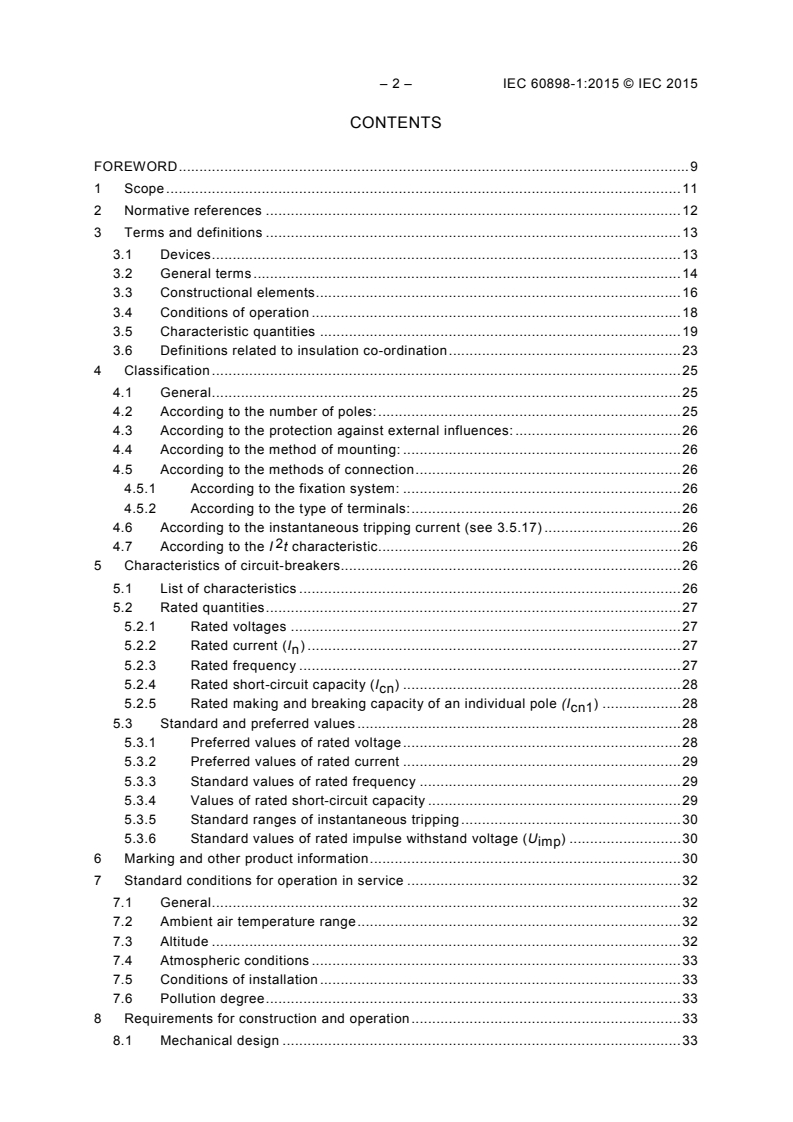
– 2 – IEC 60898-1:2015 © IEC 2015
CONTENTS
FOREWORD . 9
1 Scope . 11
2 Normative references . 12
3 Terms and definitions . 13
3.1 Devices . 13
3.2 General terms . 14
3.3 Constructional elements . 16
3.4 Conditions of operation . 18
3.5 Characteristic quantities . 19
3.6 Definitions related to insulation co-ordination . 23
4 Classification . 25
4.1 General . 25
4.2 According to the number of poles: . 25
4.3 According to the protection against external influences: . 26
4.4 According to the method of mounting: . 26
4.5 According to the methods of connection . 26
4.5.1 According to the fixation system: . 26
4.5.2 According to the type of terminals: . 26
4.6 According to the instantaneous tripping current (see 3.5.17) . 26
4.7 According to the I t characteristic. 26
5 Characteristics of circuit-breakers. 26
5.1 List of characteristics . 26
5.2 Rated quantities . 27
5.2.1 Rated voltages . 27
5.2.2 Rated current (I ) . 27
n
5.2.3 Rated frequency . 27
5.2.4 Rated short-circuit capacity (I ) . 28
cn
5.2.5 Rated making and breaking capacity of an individual pole (I ) . 28
cn1
5.3 Standard and preferred values . 28
5.3.1 Preferred values of rated voltage . 28
5.3.2 Preferred values of rated current . 29
5.3.3 Standard values of rated frequency . 29
5.3.4 Values of rated short-circuit capacity . 29
5.3.5 Standard ranges of instantaneous tripping . 30
5.3.6 Standard values of rated impulse withstand voltage (U ) . 30
imp
6 Marking and other product information . 30
7 Standard conditions for operation in service . 32
7.1 General . 32
7.2 Ambient air temperature range . 32
7.3 Altitude . 32
7.4 Atmospheric conditions . 33
7.5 Conditions of installation . 33
7.6 Pollution degree . 33
8 Requirements for construction and operation . 33
8.1 Mechanical design . 33
8.1.1 General . 33
8.1.2 Mechanism . 33
8.1.3 Clearances and creepage distances (see Annex B) . 35
8.1.4 Screws, current-carrying parts and connections . 37
8.1.5 Terminals for external conductors . 38
8.1.6 Non-interchangeability . 40
8.1.7 Mechanical mounting of plug-in type circuit-breakers . 41
8.2 Protection against electric shock . 41
8.3 Dielectric properties and isolating capability . 41
8.3.1 General . 41
8.3.2 Dielectric strength at power frequency . 42
8.3.3 Isolating capability . 42
8.3.4 Dielectric strength at rated impulse withstand voltage (U ) . 42
imp
8.4 Temperature-rise . 42
8.4.1 Temperature-rise limits . 42
8.4.2 Ambient air temperature . 42
8.5 Uninterrupted duty . 43
8.6 Automatic operation . 43
8.6.1 Standard time-current zone . 43
8.6.2 Conventional quantities . 44
8.6.3 Tripping characteristic . 44
8.7 Mechanical and electrical endurance . 45
8.8 Performance at short-circuit currents . 45
8.9 Resistance to mechanical shock and impact . 45
8.10 Resistance to heat . 45
8.11 Resistance to abnormal heat and to fire . 46
8.12 Resistance to rusting . 46
8.13 Power loss . 46
9 Tests . 46
9.1 Type tests and test sequences . 46
9.2 Test conditions . 47
9.3 Test of indelibility of marking . 48
9.4 Test of reliability of screws, current-carrying parts and connections . 48
9.5 Tests of reliability of screw-type terminals for external copper conductors. 50
9.6 Test of protection against electric shock . 51
9.7 Test of dielectric properties . 52
9.7.1 Resistance to humidity . 52
9.7.2 Insulation resistance of the main circuit . 52
9.7.3 Dielectric strength of the main circuit . 53
9.7.4 Insulation resistance and dielectric strength of auxiliary circuits. 54
9.7.5 Verification of impulse withstand voltages (across clearances and
across solid insulation) and of leakage current across open contacts . 54
9.8 Test of temperature-rise and measurement of power loss . 57
9.8.1 Ambient air temperature . 57
9.8.2 Test procedure . 58
9.8.3 Measurement of the temperature of parts . 58
9.8.4 Temperature-rise of a part . 58
9.8.5 Measurement of power loss . 58
9.9 28-day test . 58
– 4 – IEC 60898-1:2015 © IEC 2015
9.10 Test of tripping characteristic . 59
9.10.1 General . 59
9.10.2 Test of time-current characteristic . 59
9.10.3 Test of instantaneous tripping, of correct opening of the contacts and of
the trip-free function . 59
9.10.4 Test of effect of single-pole loading on the tripping characteristic of
multipole circuit-breakers . 60
9.10.5 Test of effect of ambient temperature on the tripping characteristic . 60
9.11 Verification of mechanical and electrical endurance . 61
9.11.1 General test conditions . 61
9.11.2 Test procedure . 61
9.11.3 Condition of the circuit-breaker after test . 62
9.12 Short-circuit tests . 62
9.12.1 General . 62
9.12.2 Values of test quantities . 63
9.12.3 Tolerances on test quantities . 63
9.12.4 Test circuit for short-circuit performance . 63
9.12.5 Power factor of the test circuit . 65
9.12.6 Measurement and verification of I t and of the peak current (I ) . 65
p
9.12.7 Calibration of the test circuit . 65
9.12.8 Interpretation of records . 65
9.12.9 Condition of the circuit-breaker for test . 66
9.12.10 Behaviour of the circuit-breaker during short-circuit tests . 67
9.12.11 Test procedure . 67
9.12.12 Verification of the circuit breaker after short circuit tests.: . 72
9.13 Mechanical stresses . 73
9.13.1 Mechanical shock . 73
9.13.2 Resistance to mechanical stresses and impact . 74
9.14 Test of resistance to heat . 77
9.15 Resistance to abnormal heat and to fire . 78
9.16 Test of resistance to rusting . 79
Annex A (informative) Determination of short-circuit power factor . 93
A.1 General . 93
A.2 Method 1 – Determination from d.c. component . 93
A.3 Method 2 – Determination with pilot generator . 93
Annex B (normative) Determination of clearances and creepage distances . 94
B.1 General . 94
B.2 Orientation and location of a creepage distance . 94
B.3 Creepage distances where more than one material is used . 94
B.4 Creepage distances split by floating conductive part . 94
B.5 Measurement of creepage distances and clearances . 94
Annex C (normative) Test sequences and number of samples . 99
C.1 Test sequences . 99
C.2 Number of samples to be submitted for full test procedure and acceptance
criteria . 101
C.3 Number of samples to be submitted for simplified test procedure . 101
Annex D (informative) Co-ordination under short-circuit conditions between a circuit-
breaker and another short-circuit protective device (SCPD) associated in the same
circuit . 105
D.1 General . 105
D.2 Overview. 105
D.3 General requirements for the co-ordination of a circuit-breaker with another
SCPD . 106
D.3.1 General consideration . 106
D.3.2 Take-over current . 106
D.3.3 Behaviour of C in association with another SCPD . 106
D.4 Type and characteristics of the associated SCPD . 106
D.5 Verification of selectivity . 107
D.6 Verification of back-up protection . 107
D.6.1 Determination of the take-over current . 107
D.6.2 Verification of back-up protection . 107
D.6.3 Tests for verification of back-up protection . 108
D.6.4 Results to be obtained . 109
Annex E (normative) Special requirements for auxiliary circuits for safety extra-low
voltage . 112
Annex F (informative) Examples of terminals . 113
Annex G (informative) Correspondence between ISO and AWG copper conductors . 116
Annex H (normative) Arrangement for short-circuit test . 117
Annex I (normative) Routine tests . 120
I.1 General . 120
I.2 Tripping tests . 120
I.3 Verification of clearances between open contacts . 120
Annex J (normative) Particular requirements for circuit-breakers with screwless type
terminals for external copper conductors. 121
J.1 Scope . 121
J.2 Normative references . 121
J.3 Terms and definitions . 121
J.4 Classification . 122
J.5 Characteristics of circuit-breakers . 122
J.6 Marking . 122
J.7 Standard conditions for operation in service . 122
J.8 Constructional requirements . 123
J.8.1 Connection or disconnection of conductors . 123
J.8.2 Dimensions of connectable conductors . 123
J.8.3 Connectable cross-sectional areas . 124
J.8.4 Insertion and disconnection of conductors . 124
J.8.5 Design and construction of terminals . 124
J.8.6 Resistance to ageing . 125
J.9 Tests . 125
J.9.1 Test of reliability of screwless terminals . 125
J.9.2 Tests of reliability of terminals for external conductors: mechanical
strength . 126
J.9.3 Cycling test. 126
J.10 Reference documents . 128
Annex K (normative) Particular requirements for circuit-breakers with flat quick-
connect terminations . 130
K.1 Scope . 130
K.2 Normative references . 130
– 6 – IEC 60898-1:2015 © IEC 2015
K.3 Terms and definitions . 130
K.4 Classification . 131
K.5 Characteristics of circuit-breakers . 131
K.6 Marking . 131
K.7 Standard conditions for operation in service . 131
K.8 Constructional requirements . 131
K.8.1 Clearances and creepage distances (see Annex B) . 131
K.8.2 Terminals for external conductors . 132
K.9 Tests . 132
K.9.1 Mechanical overload-force . 132
K.10 Reference documents . 136
Annex L (normative) Specific requirements for circuit-breakers with screw-type
terminals for external untreated aluminium conductors and with aluminium screw-type
terminals for use with copper or with aluminium conductors . 137
L.1 Scope . 137
L.2 Normative references . 137
L.3 Terms and definitions . 137
L.4 Classification . 138
L.5 Characteristics of circuit-breakers . 138
L.6 Marking . 138
L.7 Standard conditions for operation in service . 138
L.8 Constructional requirements . 139
L.9 Tests . 139
L.9.1 Test conditions . 141
L.9.2 Current cycling test . 141
Bibliography . 147
Figure 1 – Thread forming tapping screw (3.3.22) . 79
Figure 2 – Thread cutting tapping screw (3.3.23) . 79
Figure 3 – Typical diagram for all short circuit tests except for 9.12.11.2.2) . 80
Figure 4 – Typical diagram for short circuit tests according to 9.12.11.2.2) . 81
Figure 5 – Detail of impedance Z and Z . 81
Figure 6 – Example of short-circuit making or breaking test record in the case of a
single-pole device on single phase a.c. . 83
Figure 7 – Mechanical shock test apparatus (9.13.1) . 84
Figure 8 – Standard test finger (9.6) . 85
Figure 9 – Mechanical impact test apparatus (9.13.2) . 86
Figure 10 – Striking element for pendulum for mechanical impact test apparatus
(9.13.2) . 87
Figure 11 – Mounting support for mechanical impact test (9.13.2) . 88
Figure 12 – Example of mounting for a rear fixed circuit-breaker for mechanical impact
test (9.13.2) . 89
Figure 13 – Example of mounting of a panel board type circuit-breaker for mechanical
impact test (9.13.2) . 90
Figure 14 – Application of force for mechanical test on a rail-mounted circuit-breaker
(9.13.2.3) . 91
Figure 15 – Ball-pressure test apparatus. 91
Figure 16 – Example of application of force for mechanical test on two-pole plug-in
circuit-breaker, the holding in position of which depends solely on the plug-in
connections (9.13.2.4) . 92
Figure 17 – Diagrammatic representation (9.15) . 92
Figure B.1 – Examples of methods of measuring creepage distances and clearances . 98
Figure D.1 – Overcurrent co-ordination between a circuit-breaker and a fuse or back-
up protection by a fuse – Operating characteristics . 110
Figure D.2 – Total selectivity between two circuit-breakers . 110
Figure D.3 – Back-up protection by a circuit-breaker – Operating characteristics . 111
Figure F.1 – Examples of pillar terminals . 113
Figure F.2 – Examples of screw terminals and stud terminals . 114
Figure F.3 – Examples of saddle terminals. 115
Figure F.4 – Examples of lug terminals . 115
Figure H.1 – Test arrangement . 118
Figure H.2 – Grid circuit . 118
Figure H.3 – Grid circuit . 119
Figure J.1 – Connecting samples . 126
Figure J.2 – Examples of screwless-type terminals . 128
Figure K.1 – Example of position of the thermocouple for measurement of the
temperature-rise . 133
Figure K.2 – Dimensions of male tabs . 134
Figure K.3 – Dimensions of round dimple detents (see Figure K.2) . 135
Figure K.4 – Dimensions of rectangular dimple detents (see Figure K.2) . 135
Figure K.5 – Dimensions of hole detents . 135
Figure K.6 – Dimensions of female connectors . 136
Figure L.1 – General arrangement for the test . 145
Figure L.2 . 145
Figure L.3 . 146
Figure L.4 . 146
Figure L.5 . 146
Figure L.6 . 146
Table 1 – Preferred values of rated voltage . 29
Table 2 – Ranges of instantaneous tripping . 30
Table 3 – Rated impulse withstand voltage as a function of the nominal voltage of the
installation . 30
Table 4 – Minimum clearances and creepage distances . 36
Table 5 – Connectable cross-sections of copper conductors for screw-type terminals . 39
Table 6 – Temperature-rise values . 42
Table 7 – Time-current operating characteristics . 44
Table 8 – Maximum power loss per pole . 46
Table 9 – List of type tests . 47
Table 10 – Cross-sectional areas (S) of test copper conductors corresponding to the
rated currents . 48
Table 11 – Screw thread diameters and applied torques . 49
– 8 – IEC 60898-1:2015 © IEC 2015
Table 12 – Pulling forces . 50
Table 13 – Test voltage of auxiliary circuits . 54
Table 14 – Test voltage for verification of impulse withstand voltage . 56
Table 15 – Test voltage for verifying the suitability for isolation, referred to the rated
impulse withstand voltage of the circuit breakers and the altitude where the test is
carried out . 57
Table 16 – Applicability of short-circuit tests . 63
Table 17 – Power factor ranges of the test circuit . 65
Table 18 – Ratio k between service short-circuit capacity (I ) and rated short-circuit
cs
capacity (I ) . 69
cn
Table 19 – Test procedure for I in the case of single- and two-pole circuit-breakers . 70
cs
Table 20 – Test procedure for I in the case of three- and four-pole circuit-breakers . 70
cs
Table 21 – Test procedure for I in the case of three-phase tests for single-pole
cs
circuit-breakers of rated voltage 230/400 V . 71
Table 22 – The test procedure for I . 71
cn
Table 23 – Test procedure for I in the case of three-phase tests for single-pole
cn
circuit-breakers of rated voltage 230/400 V . 72
Table C.1 – Test sequences . 100
Table C.2 – Number of samples for full test procedure . 101
Table C.3 – Reduction of samples for series of circuit-breakers having different
numbers of poles . 103
Table C.4 – Test sequences for a series of circuit-breakers being of different
instantaneous tripping classifications . 104
Table J.1 – Connectable conductors . 124
Table J.2 – Cross-sections of copper conductors connectable to screwless-type
terminals . 124
Table J.3 – Pull forces . 126
Table K.1 – Informative table on colour code of female connectors in relationship with
the cross section of the conductor . 131
Table K.2 – Overload test forces . 132
Table K.3 – Dimensions of tabs . 133
Table K.4 – Dimensions of female connectors . 136
Table L.1 – Marking for terminals . 138
Table L.2 – Connectable cross-sections of aluminium conductors for screw-type
terminals . 139
Table L.3 – List of tests according to the material of conductors and terminals . 140
Table L.4 – Connectable conductors and their theoretical diameters . 140
Table L.5 – Cross sections (S) of aluminium test conductors corresponding to the
rated currents . 141
Table L.6 – Test conductor length . 142
Table L.7 – Equalizer and busbar dimensions . 142
Table L.8 – Test current as a function of rated current . 144
Table L.9 – Example of calculation for determining the average temperature deviation D . 144
INTERNATIONAL ELECTROTECHNICAL COMMISSION
____________
ELECTRICAL ACCESSORIES –
CIRCUIT-BREAKERS FOR OVERCURRENT PROTECTION
FOR HOUSEHOLD AND SIMILAR INSTALLATIONS –
Part 1: Circuit-breakers for a.c. operation
FOREWORD
1) The International Electrotechnical Commission (IEC) is a worldwide organization for standardization comprising
all national electrotechnical committees (IEC National Committees). The object of IEC is to promote
international co-operation on all questions concerning standardization in the electrical and electronic fields. To
this end and in addition to other activities, IEC publishes International Standards, Technical Specifications,
Technical Reports, Publicly Available Specifications (PAS) and Guides (hereafter referred to as “IEC
Publication(s)”). Their preparation is entrusted to technical committees; any IEC National Committee interested
in the subject dealt with may participate in this preparatory work. International, governmental and non-
governmental organizations liaising with the IEC also participate in this preparation. IEC collaborates closely
with the International Organization for Standardization (ISO) in accordance with conditions determined by
agreement between the two organizations.
2) The formal decisions or agreements of IEC on technical matters express, as nearly as possible, an international
consensus of opinion on the relevant subjects since each technical committee has representation from all
interested IEC National Committees.
3) IEC Publications have the form of recommendations for international use and are accepted by IEC National
Committees in that sense. While all reasonable efforts are made to ensure that the technical content of IEC
Publications is accurate, IEC cannot be held responsible for the way in which they are used or for any
misinterpretation by any end user.
4) In order to promote international uniformity, IEC National Committees undertake to apply IEC Publications
transparently to the maximum extent possible in their national and regional publications. Any divergence
between any IEC Publication and the corresponding national or regional publication shall be clearly indicated in
the latter.
5) IEC itself does not provide any attestation of conformity. Independent certification bodies provide conformity
assessment services and, in some areas, access to IEC marks of conformity. IEC is not responsible for any
services carried out by independent certification bodies.
6) All users should ensure that they have the latest edition of this publication.
7) No liability shall attach to IEC or its directors, employees, servants or agents including individual experts and
members of its technical committees and IEC National Committees for any personal injury, property damage or
other damage of any nature whatsoever, whether direct or indirect, or for costs (including legal fees) and
expenses arising out of the publication, use of, or reliance upon, this IEC Publication or any other IEC
Publications.
8) Attention is drawn
...
IEC 60898-1 ®
Edition 2.0 2015-03
INTERNATIONAL
STANDARD
NORME
INTERNATIONALE
Electrical accessories – Circuit-breakers for overcurrent protection for
household and similar installations –
Part 1: Circuit-breakers for a.c. operation
Petit appareillage électrique – Disjoncteurs pour la protection contre les
surintensités pour installations domestiques et analogues –
Partie 1: Disjoncteurs pour le fonctionnement en courant alternatif
All rights reserved. Unless otherwise specified, no part of this publication may be reproduced or utilized in any form
or by any means, electronic or mechanical, including photocopying and microfilm, without permission in writing from
either IEC or IEC's member National Committee in the country of the requester. If you have any questions about IEC
copyright or have an enquiry about obtaining additional rights to this publication, please contact the address below or
your local IEC member National Committee for further information.
Droits de reproduction réservés. Sauf indication contraire, aucune partie de cette publication ne peut être reproduite
ni utilisée sous quelque forme que ce soit et par aucun procédé, électronique ou mécanique, y compris la photocopie
et les microfilms, sans l'accord écrit de l'IEC ou du Comité national de l'IEC du pays du demandeur. Si vous avez des
questions sur le copyright de l'IEC ou si vous désirez obtenir des droits supplémentaires sur cette publication, utilisez
les coordonnées ci-après ou contactez le Comité national de l'IEC de votre pays de résidence.
IEC Central Office Tel.: +41 22 919 02 11
3, rue de Varembé Fax: +41 22 919 03 00
CH-1211 Geneva 20 info@iec.ch
Switzerland www.iec.ch
About the IEC
The International Electrotechnical Commission (IEC) is the leading global organization that prepares and publishes
International Standards for all electrical, electronic and related technologies.
About IEC publications
The technical content of IEC publications is kept under constant review by the IEC. Please make sure that you have the
latest edition, a corrigenda or an amendment might have been published.
IEC Catalogue - webstore.iec.ch/catalogue Electropedia - www.electropedia.org
The stand-alone application for consulting the entire The world's leading online dictionary of electronic and
bibliographical information on IEC International Standards, electrical terms containing 20 000 terms and definitions in
Technical Specifications, Technical Reports and other English and French, with equivalent terms in 15 additional
documents. Available for PC, Mac OS, Android Tablets and languages. Also known as the International Electrotechnical
iPad. Vocabulary (IEV) online.
IEC publications search - www.iec.ch/searchpub IEC Glossary - std.iec.ch/glossary
The advanced search enables to find IEC publications by a 65 000 electrotechnical terminology entries in English and
variety of criteria (reference number, text, technical French extracted from the Terms and Definitions clause of
committee,…). It also gives information on projects, replaced IEC publications issued since 2002. Some entries have been
and withdrawn publications. collected from earlier publications of IEC TC 37, 77, 86 and
CISPR.
IEC Just Published - webstore.iec.ch/justpublished
Stay up to date on all new IEC publications. Just Published IEC Customer Service Centre - webstore.iec.ch/csc
details all new publications released. Available online and If you wish to give us your feedback on this publication or
also once a month by email. need further assistance, please contact the Customer Service
Centre: csc@iec.ch.
A propos de l'IEC
La Commission Electrotechnique Internationale (IEC) est la première organisation mondiale qui élabore et publie des
Normes internationales pour tout ce qui a trait à l'électricité, à l'électronique et aux technologies apparentées.
A propos des publications IEC
Le contenu technique des publications IEC est constamment revu. Veuillez vous assurer que vous possédez l’édition la
plus récente, un corrigendum ou amendement peut avoir été publié.
Catalogue IEC - webstore.iec.ch/catalogue Electropedia - www.electropedia.org
Application autonome pour consulter tous les renseignements
Le premier dictionnaire en ligne de termes électroniques et
bibliographiques sur les Normes internationales,
électriques. Il contient 20 000 termes et définitions en anglais
Spécifications techniques, Rapports techniques et autres
et en français, ainsi que les termes équivalents dans 15
documents de l'IEC. Disponible pour PC, Mac OS, tablettes
langues additionnelles. Egalement appelé Vocabulaire
Android et iPad.
Electrotechnique International (IEV) en ligne.
Recherche de publications IEC - www.iec.ch/searchpub
Glossaire IEC - std.iec.ch/glossary
65 000 entrées terminologiques électrotechniques, en anglais
La recherche avancée permet de trouver des publications IEC
en utilisant différents critères (numéro de référence, texte, et en français, extraites des articles Termes et Définitions des
comité d’études,…). Elle donne aussi des informations sur les publications IEC parues depuis 2002. Plus certaines entrées
projets et les publications remplacées ou retirées. antérieures extraites des publications des CE 37, 77, 86 et
CISPR de l'IEC.
IEC Just Published - webstore.iec.ch/justpublished
Service Clients - webstore.iec.ch/csc
Restez informé sur les nouvelles publications IEC. Just
Published détaille les nouvelles publications parues. Si vous désirez nous donner des commentaires sur cette
Disponible en ligne et aussi une fois par mois par email. publication ou si vous avez des questions contactez-nous:
csc@iec.ch.
IEC 60898-1 ®
Edition 2.0 2015-03
INTERNATIONAL
STANDARD
NORME
INTERNATIONALE
Electrical accessories – Circuit-breakers for overcurrent protection for
household and similar installations –
Part 1: Circuit-breakers for a.c. operation
Petit appareillage électrique – Disjoncteurs pour la protection contre les
surintensités pour installations domestiques et analogues –
Partie 1: Disjoncteurs pour le fonctionnement en courant alternatif
INTERNATIONAL
ELECTROTECHNICAL
COMMISSION
COMMISSION
ELECTROTECHNIQUE
INTERNATIONALE
ICS 29.120.50 ISBN 978-2-8322-3744-1
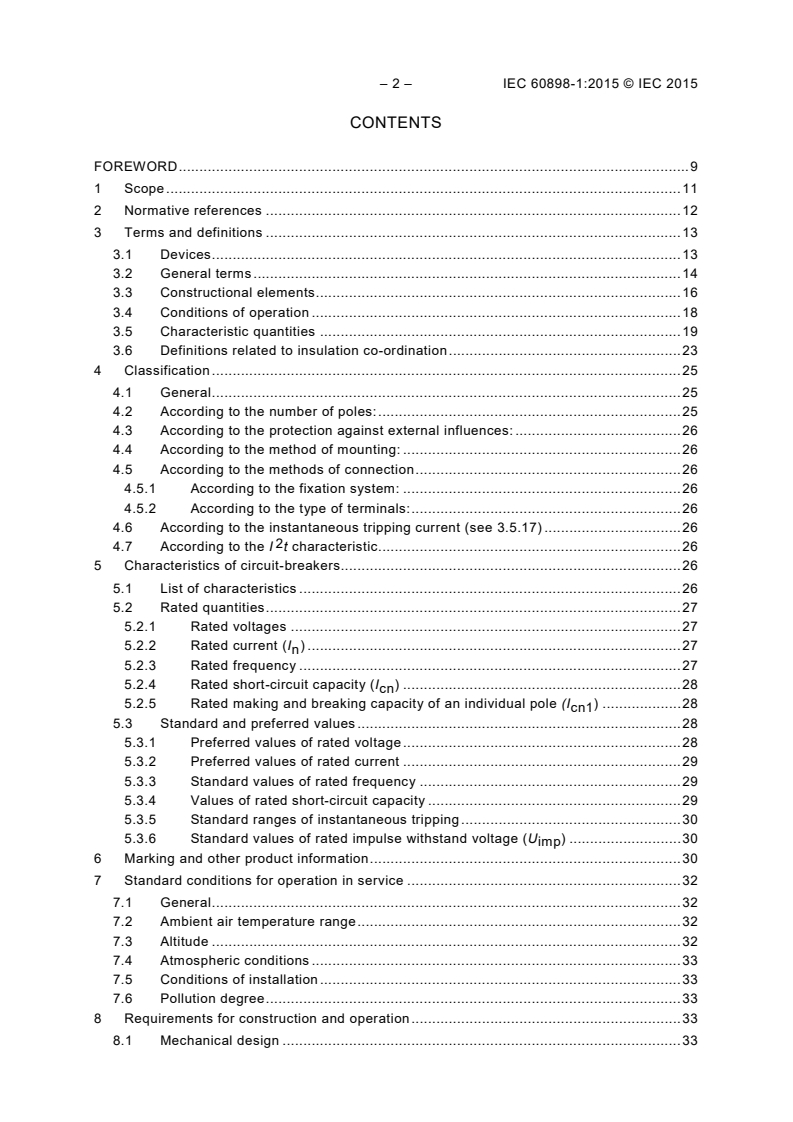
– 2 – IEC 60898-1:2015 © IEC 2015
CONTENTS
FOREWORD . 9
1 Scope . 11
2 Normative references . 12
3 Terms and definitions . 13
3.1 Devices . 13
3.2 General terms . 14
3.3 Constructional elements . 16
3.4 Conditions of operation . 18
3.5 Characteristic quantities . 19
3.6 Definitions related to insulation co-ordination . 23
4 Classification . 25
4.1 General . 25
4.2 According to the number of poles: . 25
4.3 According to the protection against external influences: . 26
4.4 According to the method of mounting: . 26
4.5 According to the methods of connection . 26
4.5.1 According to the fixation system: . 26
4.5.2 According to the type of terminals: . 26
4.6 According to the instantaneous tripping current (see 3.5.17) . 26
4.7 According to the I t characteristic. 26
5 Characteristics of circuit-breakers. 26
5.1 List of characteristics . 26
5.2 Rated quantities . 27
5.2.1 Rated voltages . 27
5.2.2 Rated current (I ) . 27
n
5.2.3 Rated frequency . 27
5.2.4 Rated short-circuit capacity (I ) . 28
cn
5.2.5 Rated making and breaking capacity of an individual pole (I ) . 28
cn1
5.3 Standard and preferred values . 28
5.3.1 Preferred values of rated voltage . 28
5.3.2 Preferred values of rated current . 29
5.3.3 Standard values of rated frequency . 29
5.3.4 Values of rated short-circuit capacity . 29
5.3.5 Standard ranges of instantaneous tripping . 30
5.3.6 Standard values of rated impulse withstand voltage (U ) . 30
imp
6 Marking and other product information . 30
7 Standard conditions for operation in service . 32
7.1 General . 32
7.2 Ambient air temperature range . 32
7.3 Altitude . 32
7.4 Atmospheric conditions . 33
7.5 Conditions of installation . 33
7.6 Pollution degree . 33
8 Requirements for construction and operation . 33
8.1 Mechanical design . 33
8.1.1 General . 33
8.1.2 Mechanism . 33
8.1.3 Clearances and creepage distances (see Annex B) . 35
8.1.4 Screws, current-carrying parts and connections . 37
8.1.5 Terminals for external conductors . 38
8.1.6 Non-interchangeability . 40
8.1.7 Mechanical mounting of plug-in type circuit-breakers . 41
8.2 Protection against electric shock . 41
8.3 Dielectric properties and isolating capability . 41
8.3.1 General . 41
8.3.2 Dielectric strength at power frequency . 42
8.3.3 Isolating capability . 42
8.3.4 Dielectric strength at rated impulse withstand voltage (U ) . 42
imp
8.4 Temperature-rise . 42
8.4.1 Temperature-rise limits . 42
8.4.2 Ambient air temperature . 42
8.5 Uninterrupted duty . 43
8.6 Automatic operation . 43
8.6.1 Standard time-current zone . 43
8.6.2 Conventional quantities . 44
8.6.3 Tripping characteristic . 44
8.7 Mechanical and electrical endurance . 45
8.8 Performance at short-circuit currents . 45
8.9 Resistance to mechanical shock and impact . 45
8.10 Resistance to heat . 45
8.11 Resistance to abnormal heat and to fire . 46
8.12 Resistance to rusting . 46
8.13 Power loss . 46
9 Tests . 46
9.1 Type tests and test sequences . 46
9.2 Test conditions . 47
9.3 Test of indelibility of marking . 48
9.4 Test of reliability of screws, current-carrying parts and connections . 48
9.5 Tests of reliability of screw-type terminals for external copper conductors. 50
9.6 Test of protection against electric shock . 51
9.7 Test of dielectric properties . 52
9.7.1 Resistance to humidity . 52
9.7.2 Insulation resistance of the main circuit . 52
9.7.3 Dielectric strength of the main circuit . 53
9.7.4 Insulation resistance and dielectric strength of auxiliary circuits. 54
9.7.5 Verification of impulse withstand voltages (across clearances and
across solid insulation) and of leakage current across open contacts . 54
9.8 Test of temperature-rise and measurement of power loss . 57
9.8.1 Ambient air temperature . 57
9.8.2 Test procedure . 58
9.8.3 Measurement of the temperature of parts . 58
9.8.4 Temperature-rise of a part . 58
9.8.5 Measurement of power loss . 58
9.9 28-day test . 58
– 4 – IEC 60898-1:2015 © IEC 2015
9.10 Test of tripping characteristic . 59
9.10.1 General . 59
9.10.2 Test of time-current characteristic . 59
9.10.3 Test of instantaneous tripping, of correct opening of the contacts and of
the trip-free function . 59
9.10.4 Test of effect of single-pole loading on the tripping characteristic of
multipole circuit-breakers . 60
9.10.5 Test of effect of ambient temperature on the tripping characteristic . 60
9.11 Verification of mechanical and electrical endurance . 61
9.11.1 General test conditions . 61
9.11.2 Test procedure . 61
9.11.3 Condition of the circuit-breaker after test . 62
9.12 Short-circuit tests . 62
9.12.1 General . 62
9.12.2 Values of test quantities . 63
9.12.3 Tolerances on test quantities . 63
9.12.4 Test circuit for short-circuit performance . 63
9.12.5 Power factor of the test circuit . 65
9.12.6 Measurement and verification of I t and of the peak current (I ) . 65
p
9.12.7 Calibration of the test circuit . 65
9.12.8 Interpretation of records . 65
9.12.9 Condition of the circuit-breaker for test . 66
9.12.10 Behaviour of the circuit-breaker during short-circuit tests . 67
9.12.11 Test procedure . 67
9.12.12 Verification of the circuit breaker after short circuit tests.: . 72
9.13 Mechanical stresses . 73
9.13.1 Mechanical shock . 73
9.13.2 Resistance to mechanical stresses and impact . 74
9.14 Test of resistance to heat . 77
9.15 Resistance to abnormal heat and to fire . 78
9.16 Test of resistance to rusting . 79
Annex A (informative) Determination of short-circuit power factor . 93
A.1 General . 93
A.2 Method 1 – Determination from d.c. component . 93
A.3 Method 2 – Determination with pilot generator . 93
Annex B (normative) Determination of clearances and creepage distances . 94
B.1 General . 94
B.2 Orientation and location of a creepage distance . 94
B.3 Creepage distances where more than one material is used . 94
B.4 Creepage distances split by floating conductive part . 94
B.5 Measurement of creepage distances and clearances . 94
Annex C (normative) Test sequences and number of samples . 99
C.1 Test sequences . 99
C.2 Number of samples to be submitted for full test procedure and acceptance
criteria . 101
C.3 Number of samples to be submitted for simplified test procedure . 101
Annex D (informative) Co-ordination under short-circuit conditions between a circuit-
breaker and another short-circuit protective device (SCPD) associated in the
same circuit . 105
D.1 General . 105
D.2 Overview. 105
D.3 General requirements for the co-ordination of a circuit-breaker with another
SCPD . 106
D.3.1 General consideration . 106
D.3.2 Take-over current . 106
D.3.3 Behaviour of C in association with another SCPD . 106
D.4 Type and characteristics of the associated SCPD . 106
D.5 Verification of selectivity . 107
D.6 Verification of back-up protection . 107
D.6.1 Determination of the take-over current . 107
D.6.2 Verification of back-up protection . 107
D.6.3 Tests for verification of back-up protection . 108
D.6.4 Results to be obtained . 109
Annex E (normative) Special requirements for auxiliary circuits for safety extra-low
voltage . 112
Annex F (informative) Examples of terminals . 113
Annex G (informative) Correspondence between ISO and AWG copper conductors . 116
Annex H (normative) Arrangement for short-circuit test . 117
Annex I (normative) Routine tests . 120
I.1 General . 120
I.2 Tripping tests . 120
I.3 Verification of clearances between open contacts . 120
Annex J (normative) Particular requirements for circuit-breakers with screwless type
terminals for external copper conductors . 121
J.1 Scope . 121
J.2 Normative references . 121
J.3 Terms and definitions . 121
J.4 Classification . 122
J.5 Characteristics of circuit-breakers . 122
J.6 Marking . 122
J.7 Standard conditions for operation in service . 122
J.8 Constructional requirements . 123
J.8.1 Connection or disconnection of conductors . 123
J.8.2 Dimensions of connectable conductors . 123
J.8.3 Connectable cross-sectional areas . 124
J.8.4 Insertion and disconnection of conductors . 124
J.8.5 Design and construction of terminals . 124
J.8.6 Resistance to ageing . 125
J.9 Tests . 125
J.9.1 Test of reliability of screwless terminals . 125
J.9.2 Tests of reliability of terminals for external conductors: mechanical
strength . 126
J.9.3 Cycling test. 126
J.10 Reference documents . 128
Annex K (normative) Particular requirements for circuit-breakers with flat quick-
connect terminations . 130
K.1 Scope . 130
K.2 Normative references . 130
– 6 – IEC 60898-1:2015 © IEC 2015
K.3 Terms and definitions . 130
K.4 Classification . 131
K.5 Characteristics of circuit-breakers . 131
K.6 Marking . 131
K.7 Standard conditions for operation in service . 131
K.8 Constructional requirements . 131
K.8.1 Clearances and creepage distances (see Annex B) . 131
K.8.2 Terminals for external conductors . 132
K.9 Tests . 132
K.9.1 Mechanical overload-force . 132
K.10 Reference documents . 136
Annex L (normative) Specific requirements for circuit-breakers with screw-type
terminals for external untreated aluminium conductors and with aluminium screw-
type terminals for use with copper or with aluminium conductors . 137
L.1 Scope . 137
L.2 Normative references . 137
L.3 Terms and definitions . 137
L.4 Classification . 138
L.5 Characteristics of circuit-breakers . 138
L.6 Marking . 138
L.7 Standard conditions for operation in service . 138
L.8 Constructional requirements . 139
L.9 Tests . 139
L.9.1 Test conditions . 141
L.9.2 Current cycling test . 141
Bibliography . 147
Figure 1 – Thread forming tapping screw (3.3.22) . 79
Figure 2 – Thread cutting tapping screw (3.3.23) . 79
Figure 3 – Typical diagram for all short circuit tests except for 9.12.11.2.2) . 80
Figure 4 – Typical diagram for short circuit tests according to 9.12.11.2.2) . 81
Figure 5 – Detail of impedance Z and Z . 81
Figure 6 – Example of short-circuit making or breaking test record in the case of a
single-pole device on single phase a.c. . 83
Figure 7 – Mechanical shock test apparatus (9.13.1) . 84
Figure 8 – Standard test finger (9.6) . 85
Figure 9 – Mechanical impact test apparatus (9.13.2) . 86
Figure 10 – Striking element for pendulum for mechanical impact test apparatus
(9.13.2) . 87
Figure 11 – Mounting support for mechanical impact test (9.13.2) . 88
Figure 12 – Example of mounting for a rear fixed circuit-breaker for mechanical impact
test (9.13.2) . 89
Figure 13 – Example of mounting of a panel board type circuit-breaker for mechanical
impact test (9.13.2) . 90
Figure 14 – Application of force for mechanical test on a rail-mounted circuit-breaker
(9.13.2.4) . 91
Figure 15 – Ball-pressure test apparatus. 91
Figure 16 – Example of application of force for mechanical test on two-pole plug-in
circuit-breaker, the holding in position of which depends solely on the plug-in
connections (9.13.2.5) . 92
Figure 17 – Diagrammatic representation (9.15) . 92
Figure B.1 – Examples of methods of measuring creepage distances and clearances . 98
Figure D.1 – Overcurrent co-ordination between a circuit-breaker and a fuse or back-
up protection by a fuse – Operating characteristics . 110
Figure D.2 – Total selectivity between two circuit-breakers . 110
Figure D.3 – Back-up protection by a circuit-breaker – Operating characteristics . 111
Figure F.1 – Examples of pillar terminals . 113
Figure F.2 – Examples of screw terminals and stud terminals . 114
Figure F.3 – Examples of saddle terminals. 115
Figure F.4 – Examples of lug terminals . 115
Figure H.1 – Test arrangement . 118
Figure H.2 – Grid circuit . 118
Figure H.3 – Grid circuit . 119
Figure J.1 – Connecting samples . 126
Figure J.2 – Examples of screwless-type terminals . 128
Figure K.1 – Example of position of the thermocouple for measurement of the
temperature-rise . 133
Figure K.2 – Dimensions of male tabs . 134
Figure K.3 – Dimensions of round dimple detents (see Figure K.2) . 135
Figure K.4 – Dimensions of rectangular dimple detents (see Figure K.2) . 135
Figure K.5 – Dimensions of hole detents . 135
Figure K.6 – Dimensions of female connectors . 136
Figure L.1 – General arrangement for the test . 145
Figure L.2 . 145
Figure L.3 . 146
Figure L.4 . 146
Figure L.5 . 146
Figure L.6 . 146
Table 1 – Preferred values of rated voltage . 29
Table 2 – Ranges of instantaneous tripping . 30
Table 3 – Rated impulse withstand voltage as a function of the nominal voltage of the
installation . 30
Table 4 – Minimum clearances and creepage distances . 36
Table 5 – Connectable cross-sections of copper conductors for screw-type terminals . 39
Table 6 – Temperature-rise values . 42
Table 7 – Time-current operating characteristics . 44
Table 8 – Maximum power loss per pole . 46
Table 9 – List of type tests . 47
Table 10 – Cross-sectional areas (S) of test copper conductors corresponding to the
rated currents . 48
Table 11 – Screw thread diameters and applied torques . 49
– 8 – IEC 60898-1:2015 © IEC 2015
Table 12 – Pulling forces . 50
Table 13 – Test voltage of auxiliary circuits . 54
Table 14 – Test voltage for verification of impulse withstand voltage . 56
Table 15 – Test voltage for verifying the suitability for isolation, referred to the rated
impulse withstand voltage of the circuit breakers and the altitude where the test is
carried out . 57
Table 16 – Applicability of short-circuit tests . 63
Table 17 – Power factor ranges of the test circuit . 65
Table 18 – Ratio k between service short-circuit capacity (I ) and rated short-circuit
cs
capacity (I ) . 69
cn
Table 19 – Test procedure for I in the case of single- and two-pole circuit-breakers . 70
cs
Table 20 – Test procedure for I in the case of three- and four-pole circuit-breakers . 70
cs
Table 21 – Test procedure for I in the case of three-phase tests for single-pole
cs
circuit-breakers of rated voltage 230/400 V . 71
Table 22 – The test procedure for I . 71
cn
Table 23 – Test procedure for I in the case of three-phase tests for single-pole
cn
circuit-breakers of rated voltage 230/400 V . 72
Table C.1 – Test sequences . 100
Table C.2 – Number of samples for full test procedure . 101
Table C.3 – Reduction of samples for series of circuit-breakers having different
numbers of poles . 103
Table C.4 – Test sequences for a series of circuit-breakers being of different
instantaneous tripping classifications . 104
Table J.1 – Connectable conductors . 124
Table J.2 – Cross-sections of copper conductors connectable to screwless-type
terminals . 124
Table J.3 – Pull forces . 126
Table K.1 – Informative table on colour code of female connectors in relationship with
the cross section of the conductor . 131
Table K.2 – Overload test forces . 132
Table K.3 – Dimensions of tabs . 133
Table K.4 – Dimensions of female connectors . 136
Table L.1 – Marking for terminals . 138
Table L.2 – Connectable cross-sections of aluminium conductors for screw-type
terminals . 139
Table L.3 – List of tests according to the material of conductors and terminals . 140
Table L.4 – Connectable conductors and their theoretical diameters . 140
Table L.5 – Cross sections (S) of aluminium test conductors corresponding to the
rated currents . 141
Table L.6 – Test conductor length . 142
Table L.7 – Equalizer and busbar dimensions . 142
Table L.8 – Test current as a function of rated current . 144
Table L.9 – Example of
...
IEC 60898-1 ®
Edition 2.1 2019-12
CONSOLIDATED VERSION
INTERNATIONAL
STANDARD
NORME
INTERNATIONALE
colour
inside
Electrical accessories – Circuit-breakers for overcurrent protection
for household and similar installations –
Part 1: Circuit-breakers for a.c. operation
Petit appareillage électrique – Disjoncteurs pour la protection
contre les surintensités pour installations domestiques et analogues –
Partie 1: Disjoncteurs pour le fonctionnement en courant alternatif
All rights reserved. Unless otherwise specified, no part of this publication may be reproduced or utilized in any form
or by any means, electronic or mechanical, including photocopying and microfilm, without permission in writing from
either IEC or IEC's member National Committee in the country of the requester. If you have any questions about IEC
copyright or have an enquiry about obtaining additional rights to this publication, please contact the address below or
your local IEC member National Committee for further information.
Droits de reproduction réservés. Sauf indication contraire, aucune partie de cette publication ne peut être reproduite
ni utilisée sous quelque forme que ce soit et par aucun procédé, électronique ou mécanique, y compris la photocopie
et les microfilms, sans l'accord écrit de l'IEC ou du Comité national de l'IEC du pays du demandeur. Si vous avez des
questions sur le copyright de l'IEC ou si vous désirez obtenir des droits supplémentaires sur cette publication, utilisez
les coordonnées ci-après ou contactez le Comité national de l'IEC de votre pays de résidence.
IEC Central Office Tel.: +41 22 919 02 11
3, rue de Varembé info@iec.ch
CH-1211 Geneva 20 www.iec.ch
Switzerland
About the IEC
The International Electrotechnical Commission (IEC) is the leading global organization that prepares and publishes
International Standards for all electrical, electronic and related technologies.
About IEC publications
The technical content of IEC publications is kept under constant review by the IEC. Please make sure that you have the
latest edition, a corrigendum or an amendment might have been published.
IEC publications search - webstore.iec.ch/advsearchform Electropedia - www.electropedia.org
The advanced search enables to find IEC publications by a The world's leading online dictionary on electrotechnology,
variety of criteria (reference number, text, technical containing more than 22 000 terminological entries in English
committee,…). It also gives information on projects, replaced and French, with equivalent terms in 16 additional languages.
and withdrawn publications. Also known as the International Electrotechnical Vocabulary
(IEV) online.
IEC Just Published - webstore.iec.ch/justpublished
Stay up to date on all new IEC publications. Just Published IEC Glossary - std.iec.ch/glossary
details all new publications released. Available online and 67 000 electrotechnical terminology entries in English and
once a month by email. French extracted from the Terms and Definitions clause of
IEC publications issued since 2002. Some entries have been
IEC Customer Service Centre - webstore.iec.ch/csc collected from earlier publications of IEC TC 37, 77, 86 and
If you wish to give us your feedback on this publication or CISPR.
need further assistance, please contact the Customer Service
Centre: sales@iec.ch.
A propos de l'IEC
La Commission Electrotechnique Internationale (IEC) est la première organisation mondiale qui élabore et publie des
Normes internationales pour tout ce qui a trait à l'électricité, à l'électronique et aux technologies apparentées.
A propos des publications IEC
Le contenu technique des publications IEC est constamment revu. Veuillez vous assurer que vous possédez l’édition la
plus récente, un corrigendum ou amendement peut avoir été publié.
Recherche de publications IEC - Electropedia - www.electropedia.org
webstore.iec.ch/advsearchform Le premier dictionnaire d'électrotechnologie en ligne au
La recherche avancée permet de trouver des publications IEC monde, avec plus de 22 000 articles terminologiques en
en utilisant différents critères (numéro de référence, texte, anglais et en français, ainsi que les termes équivalents dans
comité d’études,…). Elle donne aussi des informations sur les 16 langues additionnelles. Egalement appelé Vocabulaire
projets et les publications remplacées ou retirées. Electrotechnique International (IEV) en ligne.
IEC Just Published - webstore.iec.ch/justpublished Glossaire IEC - std.iec.ch/glossary
Restez informé sur les nouvelles publications IEC. Just 67 000 entrées terminologiques électrotechniques, en anglais
Published détaille les nouvelles publications parues. et en français, extraites des articles Termes et Définitions des
Disponible en ligne et une fois par mois par email. publications IEC parues depuis 2002. Plus certaines entrées
antérieures extraites des publications des CE 37, 77, 86 et
Service Clients - webstore.iec.ch/csc CISPR de l'IEC.
Si vous désirez nous donner des commentaires sur cette
publication ou si vous avez des questions contactez-nous:
sales@iec.ch.
IEC 60898-1 ®
Edition 2.1 2019-12
CONSOLIDATED VERSION
INTERNATIONAL
STANDARD
NORME
INTERNATIONALE
colour
inside
Electrical accessories – Circuit-breakers for overcurrent protection
for household and similar installations –
Part 1: Circuit-breakers for a.c. operation
Petit appareillage électrique – Disjoncteurs pour la protection
contre les surintensités pour installations domestiques et analogues –
Partie 1: Disjoncteurs pour le fonctionnement en courant alternatif
INTERNATIONAL
ELECTROTECHNICAL
COMMISSION
COMMISSION
ELECTROTECHNIQUE
INTERNATIONALE
ICS 29.120.50 ISBN 978-2-8322-7736-2
IEC 60898-1 ®
Edition 2.1 2019-12
CONSOLIDATED VERSION
REDLINE VERSION
VERSION REDLINE
colour
inside
Electrical accessories – Circuit-breakers for overcurrent protection
for household and similar installations –
Part 1: Circuit-breakers for a.c. operation
Petit appareillage électrique – Disjoncteurs pour la protection
contre les surintensités pour installations domestiques et analogues –
Partie 1: Disjoncteurs pour le fonctionnement en courant alternatif
– 2 – IEC 60898-1:2015+AMD1:2019 CSV
© IEC 2019
CONTENTS
FOREWORD . 8
1 Scope . 10
2 Normative references . 11
3 Terms and definitions . 12
3.1 Devices . 12
3.2 General terms . 13
3.3 Constructional elements . 15
3.4 Conditions of operation . 18
3.5 Characteristic quantities . 18
3.6 Definitions related to insulation co-ordination . 23
4 Classification . 25
4.1 General . 25
4.2 According to the number of poles: . 25
4.3 According to the protection against external influences: . 25
4.4 According to the method of mounting: . 25
4.5 According to the methods of connection . 25
4.5.1 According to the fixation system: . 25
4.5.2 According to the type of terminals: . 26
4.6 According to the instantaneous tripping current (see 3.5.17) . 26
4.7 According to the I t characteristic. 26
5 Characteristics of circuit-breakers. 26
5.1 List of characteristics . 26
5.2 Rated quantities . 27
5.2.1 Rated voltages . 27
5.2.2 Rated current (I ) . 27
n
5.2.3 Rated frequency . 27
5.2.4 Rated short-circuit capacity (I ) . 27
cn
5.3 Standard and preferred values . 28
5.3.1 Preferred values of rated voltage . 28
5.3.2 Preferred values of rated current . 28
5.3.3 Standard values of rated frequency . 28
5.3.4 Values of rated short-circuit capacity . 29
5.3.5 Standard ranges of instantaneous tripping . 29
5.3.6 Standard values of rated impulse withstand voltage (U ) . 29
imp
6 Marking and other product information . 30
7 Standard conditions for operation in service . 32
7.1 General . 32
7.2 Ambient air temperature range . 32
7.3 Altitude . 32
7.4 Atmospheric conditions . 32
7.5 Conditions of installation . 32
7.6 Pollution degree . 32
8 Requirements for construction and operation . 32
8.1 Mechanical design . 32
8.1.1 General . 32
© IEC 2019
8.1.2 Mechanism . 33
8.1.3 Clearances and creepage distances and solid insulation (see Annex B) . 34
8.1.4 Screws, current-carrying parts and connections . 40
8.1.5 Terminals for external conductors . 40
8.1.6 Non-interchangeability . 43
8.1.7 Mechanical mounting of plug-in type circuit-breakers . 43
8.2 Protection against electric shock . 43
8.3 Dielectric properties and isolating capability . 44
8.3.1 General . 44
8.3.2 Dielectric strength at power frequency . 44
8.3.3 Isolating capability . 44
8.3.4 Dielectric strength at rated impulse withstand voltage (U ) . 44
imp
8.4 Temperature-rise . 44
8.4.1 Temperature-rise limits . 44
8.4.2 Ambient air temperature . 45
8.5 Uninterrupted duty . 45
8.6 Automatic operation . 45
8.6.1 Standard time-current zone . 45
8.6.2 Conventional quantities . 46
8.6.3 Tripping characteristic . 46
8.7 Mechanical and electrical endurance . 47
8.8 Performance at short-circuit currents . 47
8.9 Resistance to mechanical shock and impact . 47
8.10 Resistance to heat . 48
8.11 Resistance to abnormal heat and to fire . 48
8.12 Resistance to rusting . 48
8.13 Power loss . 48
8.14 Electromagnetic immunity . 48
8.15 Electromagnetic emission . 48
9 Tests . 49
9.1 Type tests and test sequences . 49
9.2 Test conditions . 49
9.3 Test of indelibility of marking . 50
9.4 Test of reliability of screws, current-carrying parts and connections . 51
9.5 Tests of reliability of screw-type terminals for external copper conductors. 52
9.6 Test of protection against electric shock . 54
9.7 Test of dielectric properties . 54
9.7.1 Resistance to humidity . 60
9.7.2 Insulation resistance of the main circuit . 61
9.7.3 Dielectric strength of the main circuit . 61
9.7.4 Insulation resistance and dielectric strength of auxiliary circuits. 62
9.7.5 Verification of impulse withstand voltages (across clearances and
across solid insulation) and of leakage current across open contacts . 63
9.8 Test of temperature-rise and measurement of power loss . 66
9.8.1 Ambient air temperature . 66
9.8.2 Test procedure . 66
9.8.3 Measurement of the temperature of parts . 66
9.8.4 Temperature-rise of a part . 66
9.8.5 Measurement of power loss . 66
– 4 – IEC 60898-1:2015+AMD1:2019 CSV
© IEC 2019
9.9 28-day test . 67
9.10 Test of tripping characteristic . 67
9.10.1 General . 67
9.10.2 Test of time-current characteristic . 67
9.10.3 Test of instantaneous tripping, of correct opening of the contacts and of
the trip-free function . 68
9.10.4 Test of effect of single-pole loading on the tripping characteristic of
multipole circuit-breakers . 69
9.10.5 Test of effect of ambient temperature on the tripping characteristic . 69
9.11 Verification of mechanical and electrical endurance . 69
9.11.1 General test conditions . 69
9.11.2 Test procedure . 70
9.11.3 Condition of the circuit-breaker after test . 70
9.12 Short-circuit tests . 70
9.12.1 General . 70
9.12.2 Values of test quantities . 71
9.12.3 Tolerances on test quantities . 72
9.12.4 Test circuit for short-circuit performance . 72
9.12.5 Power factor of the test circuit . 73
9.12.6 Measurement and verification of I t and of the peak current (I ) . 73
p
9.12.7 Calibration of the test circuit . 73
9.12.8 Interpretation of records . 74
9.12.9 Condition of the circuit-breaker for test . 74
9.12.10 Behaviour of the circuit-breaker during short-circuit tests . 75
9.12.11 Test procedure . 76
9.12.12 Verification of the circuit breaker after short circuit tests.: . 81
9.13 Mechanical stresses . 81
9.13.1 Mechanical shock . 81
9.13.2 Resistance to mechanical stresses and impact . 82
9.14 Test of resistance to heat . 85
9.15 Resistance to abnormal heat and to fire . 86
9.16 Test of resistance to rusting . 87
Annex A (informative) Determination of short-circuit power factor . 102
Annex B (normative) Determination of clearances and creepage distances . 103
Annex C (normative) Test sequences and number of samples . 108
Annex D (informative) Co-ordination under short-circuit conditions between a circuit-
breaker and another short-circuit protective device (SCPD) associated in the same
circuit . 114
Annex E (normative) Special requirements for auxiliary circuits for safety extra-low
voltage . 121
Annex F (informative) Examples of terminals . 122
Annex G (informative) Correspondence between ISO and AWG copper conductors . 125
Annex H (normative) Arrangement for short-circuit test . 126
Annex I (normative) Routine tests . 129
Annex J (normative) Particular requirements for circuit-breakers with screwless-type
terminals for external copper conductors. 130
Annex K (normative) Particular requirements for circuit-breakers with flat quick-
connect terminations . 147
© IEC 2019
Annex L (normative) Specific requirements for circuit-breakers with screw-type
terminals for external untreated aluminium conductors and with aluminium screw-type
terminals for use with copper or with aluminium conductors . 154
Bibliography . 164
Figure 1 – Thread forming tapping screw (3.3.22) . 88
Figure 2 – Thread cutting tapping screw (3.3.23) . 88
Figure 3 – Typical diagram for all short circuit tests except for 9.12.11.2.2) . 88
Figure 4 – Typical diagram for short circuit tests according to 9.12.11.2.2) . 89
Figure 5 – Detail of impedance Z and Z . 89
Figure 6 – Example of short-circuit making or breaking test record in the case of a
single-pole device on single phase a.c. AC . 92
Figure 7 – Mechanical shock test apparatus (9.13.1) . 93
Figure 8 – Standard test finger (9.6) . 94
Figure 9 – Mechanical impact test apparatus (9.13.2) . 95
Figure 10 – Striking element for pendulum for mechanical impact test apparatus
(9.13.2) . 96
Figure 11 – Mounting support for mechanical impact test (9.13.2) . 97
Figure 12 – Example of mounting for a rear fixed of a flush-type circuit-breaker for
mechanical impact test (9.13.2) . 98
Figure 13 – Example of mounting of a panel board type circuit-breaker for mechanical
impact test (9.13.2) . 99
Figure 14 – Application of force for mechanical test on a rail-mounted circuit-breaker
(9.13.2.4) . 100
Figure 15 – Ball-pressure test apparatus. 100
Figure 16 – Example of application of force for mechanical test on two-pole plug-in
circuit-breaker, the holding in position of which depends solely on the plug-in
connections (9.13.2.5) . 101
Figure 17 – Diagrammatic representation (9.15) . 101
Figure B.1 – Examples of methods of measuring creepage distances and clearances . 107
Figure D.1 – Overcurrent co-ordination between a circuit-breaker and a fuse or back-
up protection by a fuse – Operating characteristics . 119
Figure D.2 – Total selectivity between two circuit-breakers . 119
Figure D.3 – Back-up protection by a circuit-breaker – Operating characteristics . 120
Figure F.1 – Examples of pillar terminals . 122
Figure F.2 – Examples of screw terminals and stud terminals . 123
Figure F.3 – Examples of saddle terminals. 124
Figure F.4 – Examples of lug terminals . 124
Figure H.1 – Example of test arrangement . 127
Figure H.2 – Grid circuit . 127
Figure H.3 – Grid circuit . 128
Figure J.1 – Connecting samples Example of test set-up . 144
Figure J.2 – Examples of screwless-type terminals . 145
Figure K.1 – Example of position of the thermocouple for measurement of the
temperature-rise . 150
Figure K.2 – Dimensions of male tabs . 151
– 6 – IEC 60898-1:2015+AMD1:2019 CSV
© IEC 2019
Figure K.3 – Dimensions of round dimple detents (see Figure K.2) . 152
Figure K.4 – Dimensions of rectangular dimple detents (see Figure K.2) . 152
Figure K.5 – Dimensions of hole detents . 153
Figure K.6 – Dimensions of female connectors . 153
Figure L.1 – General arrangement for the test . 162
Figure L.2 . 162
Figure L.3 . 163
Figure L.4 . 163
Figure L.5 . 163
Figure L.6 . 163
Table 1 – Preferred values of rated voltage . 28
Table 2 – Ranges of instantaneous tripping . 29
Table 3 – Rated impulse withstand voltage as a function of the nominal voltage of the
installation . 30
Table 4 – Minimum clearances and creepage distances . 38
Table 5 – Connectable cross-sections of copper conductors for screw-type terminals . 41
Table 6 – Temperature-rise values . 45
Table 7 – Time-current operating characteristics . 46
Table 8 – Maximum power loss per pole . 48
Table 9 – List of type tests . 49
Table 10 – Cross-sectional areas (S) of test copper conductors corresponding to the
rated currents . 50
Table 11 – Screw thread diameters and applied torques . 52
Table 12 – Pulling forces . 53
Table 13 – Test voltage of auxiliary circuits . 63
Table 14 – Test voltage for verification of impulse withstand voltage . 65
Table 15 – Test voltage for verifying the suitability for isolation, referred to the rated
impulse withstand voltage of the circuit breakers and the altitude where the test is
carried out . 65
Table 16 – Applicability of short-circuit tests . 71
Table 17 – Power factor ranges of the test circuit . 73
Table 18 – Ratio k between service short-circuit capacity (I ) and rated short-circuit
cs
capacity (I ) . 78
cn
Table 19 – Test procedure for I in the case of single- and two-pole circuit-breakers . 78
cs
Table 20 – Test procedure for I in the case of three- and four-pole circuit-breakers . 79
cs
Table 21 – Test procedure for I in the case of three-phase tests for single-pole
cs
circuit-breakers of rated voltage 230/400 V . 79
Table 22 – The test procedure for I . 80
cn
Table 23 – Test procedure for I in the case of three-phase tests for single-pole
cn
circuit-breakers of rated voltage 230/400 V . 80
Table C.1 – Test sequences . 109
Table C.2 – Number of samples for full test procedure . 110
Table C.3 – Reduction of samples for series of circuit-breakers having different
numbers of poles . 112
© IEC 2019
Table C.4 – Test sequences for a series of circuit-breakers being of different
instantaneous tripping classifications . 113
Table J.1 – Connectable Conductors and their theoretical diameters . 141
Table J.2 – Cross-sections of copper conductors connectable to screwless-type
terminals . 141
Table J.3 – Pull forces . 143
Table K.1 – Informative table on colour code of female connectors in relationship with
the cross section of the conductor . 148
Table K.2 – Overload test forces . 149
Table K.3 – Dimensions of tabs . 150
Table K.4 – Dimensions of female connectors . 153
Table L.1 – Marking for terminals . 155
Table L.2 – Connectable cross-sections of aluminium conductors for screw-type
terminals . 156
Table L.3 – List of tests according to the material of conductors and terminals . 157
Table L.4 – Connectable conductors and their theoretical diameters . 157
Table L.5 – Cross sections (S) of aluminium test conductors corresponding to the
rated currents . 158
Table L.6 – Test conductor length . 159
Table L.7 – Equalizer and busbar dimensions . 159
Table L.8 – Test current as a function of rated current . 161
Table L.9 – Example of calculation for determining the average temperature
deviation D . 161
– 8 – IEC 60898-1:2015+AMD1:2019 CSV
© IEC 2019
INTERNATIONAL ELECTROTECHNICAL COMMISSION
____________
ELECTRICAL ACCESSORIES –
CIRCUIT-BREAKERS FOR OVERCURRENT PROTECTION
FOR HOUSEHOLD AND SIMILAR INSTALLATIONS –
Part 1: Circuit-breakers for a.c. operation
FOREWORD
1) The International Electrotechnical Commission (IEC) is a worldwide organization for standardization comprising
all national electrotechnical committees (IEC National Committees). The object of IEC is to promote
international co-operation on all questions concerning standardization in the electrical and electronic fields. To
this end and in addition to other activities, IEC publishes International Standards, Technical Specifications,
Technical Reports, Publicly Available Specifications (PAS) and Guides (hereafter referred to as “IEC
Publication(s)”). Their preparation is entrusted to technical committees; any IEC National Committee interested
in the subject dealt with may participate in this preparatory work. International, governmental and non-
governmental organizations liaising with the IEC also participate in this preparation. IEC collaborates closely
with the International Organization for Standardization (ISO) in accordance with conditions determined by
agreement between the two organizations.
2) The formal decisions or agreements of IEC on technical matters express, as nearly as possible, an international
consensus of opinion on the relevant subjects since each technical committee has representation from all
interested IEC National Committees.
3) IEC Publications have the form of recommendations for international use and are accepted by IEC National
Committees in that sense. While all reasonable efforts are made to ensure that the technical content of IEC
Publications is accurate, IEC cannot be held responsible for the way in which they are used or for any
misinterpretation by any end user.
4) In order to promote international uniformity, IEC National Committees undertake to apply IEC Publications
transparently to the maximum extent possible in their national and regional publications. Any divergence
between any IEC Publication and the corresponding national or regional publication shall be clearly indicated in
the latter.
5) IEC itself does not provide any attestation of conformity. Independent certification bodies provide conformity
assessment services and, in some areas, access to IEC marks of conformity. IEC is not responsible for any
services carried out by independent certification bodies.
6) All users should ensure that they have the latest edition of this publication.
7) No liability shall attach to IEC or its directors, employees, servants or agents including individual experts and
members of its technical committees and IEC National Committees for any personal injury, property damage or
other damage of any nature whatsoever, whether direct or indirect, or for costs (including legal fees) and
expenses arising out of the publication, use of, or reliance upon, this IEC Publication or any other IEC
Publications.
8) Attention is drawn to the Normative references cited in this publication. Use of the referenced publications is
indispensable for the correct application of this publication.
9) Attention is drawn to the possibility that some of the elements of this IEC Publication may be the subject of
patent rights. IEC shall not be held responsible for identifying any or all such patent rights.
This consolidated version of the official IEC Standard and its amendment has been
prepared for user convenience.
IEC 60898-1 edition 2.1 contains the second edition (2015-03) [documents 23E/881/FDIS
and 23E/894/RVD] and its corrigendum (2015-11), its amendment 1 (2019-12) [documents
23E/1156/FDIS and 23E/1157/RVD] and its corrigendum (2020-03). The contents of the
corrigendum of the amendment only applies to the French version.
In this Redline version, a vertical line in the margin shows where the technical
content is modified by amendment 1. Additions are in green text, deletions are in
strikethrough red text. A separate Final version with all changes accepted is available in
this publication.
© IEC 2019
International Standard IEC 60898-1 has been prepared by sub-committee 23E: Circuit-
breakers and similar equipment for household use, of IEC technical committee 23: Electrical
accessories.
This second edition constitutes a technical revision.
This edition includes the following significant technical changes with respect to the previous
edition:
a) Revision of 9.5 Terminals
b) Revision of the test of glow wire
c) Simplification of the figures for short circuit tests.
This publication has been drafted in accordance with the ISO/IEC Directives, Part 2.
The following differing practices of a less permanent nature exist in the countries indicated
below.
– Annex J, Clause J.1: Upper limit of current for use of screwless terminals is 16 A (CZ, DK,
NL and CH; upper limit of current for use of screwless terminals is 30 A (Japan).
– J.3.3: Only universal screwless-type terminals are accepted (AT, BE, CN, DK, DE, ES, FR,
IT, PT, SE and CH).
In this standard, the following print types are used:
– Requirements proper: in roman type.
– Test specifications: in italic type.
Explanatory matter: in smaller roman type.
–
A list of all parts in the IEC 60898 series, published under the general title Electrical
accessories – Circuit-breakers for overcurrent protection for household and similar
installations, can be found on the IEC website.
The committee has decided that the contents of the base publication and its amendment will
remain unchanged until the stability date indicated on the IEC web site under
"http://webstore.iec.ch" in the data related to the specific publication. At this date, the
publication will be
• reconfirmed,
• withdrawn,
• replaced by a revised edition, or
• amended.
IMPORTANT – The 'colour inside' logo on the cover page of this publication indicates
that it contains colours which are considered to be useful for the correct
understanding of its contents. Users should therefore print this document using a
colour printer.
– 10 – IEC 60898-1:2015+AMD1:2019 CSV
© IEC 2019
ELECTRICAL ACCESSORIES –
CIRCUIT-BREAKERS FOR OVERCURRENT PROTECTION
FOR HOUSEHOLD AND SIMILAR INSTALLATIONS –
Part 1: Circuit-breakers for a.c. operation
1 Scope
This part of IEC 60898 applies to a.c. air-break circuit-breakers for operation at 50 Hz, 60 Hz
or 50/60 Hz, having a rated voltage not exceeding 440 V (between phases), a rated current
not exceeding 125 A and a rated short-circuit capacity not exceeding 25 000 A.
As far as possible, it is in line with the requirements contained in IEC 60947-2.
NOTE 1 Additional requirements are necessary for circuit-breakers used in locations having more severe
overvoltage conditions.
These circuit-breakers are intended for the protection against overcurrents of wiring
installations of buildings and similar applications; they are designed for use by uninstructed
people and for not being maintained do not require maintenance.
They are intended for use in an environment with pollution degree 2 and overvoltage
category III.
For an environment with a higher pollution degree, enclosures giving the appropriate degree
of protection are used.
They are suitable for isolation.
Circuit-breakers of this standard, with exception of those rated 120 V or 120/240 V
(see Table 1), are suitable for use in IT systems.
This standard also applies to circuit-breakers having more than one rated current, provided
that the means for changing from one discrete rating to another is not accessible in normal
service and that the rating cannot be changed without the use of a tool.
This standard does not apply to
– circuit-brea
...