


IEC TS 63049:2017
(Main)Terrestrial photovoltaic (PV) systems - Guidelines for effective quality assurance in PV systems installation, operation and maintenance
General Information
- Abstract
IEC TS 63049:2017(E) provides the minimum activities deemed necessary to implement an effective quality assurance program for the managing and reducing of risk in the installation and operation of photovoltaic (PV) systems. This document defines requirements for certifying that an entity has and uses a quality assurance program to prevent, or reduce errors and learns from any new errors in installation, operation and maintenance of a PV system. The object of this document is to provide more confidence in the performance and reliability of certified PV systems. By being installed and operated under a Quality Assurance program in accordance with this document, PV systems are expected to operate as designed and as expected based on product warranties.
- Status
- Published
- Publication Date
- 05-Sep-2017
- Technical Committee
- TC 82 - Solar photovoltaic energy systems
- Drafting Committee
- WG 3 - TC 82/WG 3
- Current Stage
- PPUB - Publication issued
- Start Date
- 06-Sep-2017
- Completion Date
- 06-Oct-2017
Overview
IEC TS 63049:2017 - Terrestrial photovoltaic (PV) systems: Guidelines for effective quality assurance in PV systems installation, operation and maintenance - is a Technical Specification from the International Electrotechnical Commission (IEC). It defines the minimum activities required to implement an effective quality assurance (QA) program that manages and reduces risk during PV system installation and O&M. The document is intended to increase confidence in system performance and reliability and can be used as a standalone QA scheme or alongside ISO 9001 and the IECRE certification framework.
Key Topics and Requirements
IEC TS 63049:2017 focuses on practical QA controls across the PV lifecycle. Major technical topics include:
- Records and documentation: requirements for record generation, validation and a records management system covering shipment, transport, unpacking, installation and as-built documentation.
- Resource management: training programs, skills matrix and succession planning to ensure qualified installation and O&M personnel.
- Installation requirements: project management, determination of technical requirements, customer communication, procurement controls, installation processes, tools and equipment, and control of measuring and test equipment.
- Monitoring & measurement: inspection, verification of purchased products, commissioning checks, ongoing monitoring, measurement methods and control of non-conformances.
- Operations & maintenance (O&M): spare parts management, maintenance planning and tracking, system monitoring and use of performance data for continual improvement.
- Audit and continual improvement: internal audits, corrective/preventive actions and learning loops to reduce repeat errors.
- Annexes: normative training content tables for both installation and O&M personnel.
Practical Applications
IEC TS 63049:2017 is designed to be applied where structured QA delivers measurable risk reduction and improved long-term performance:
- Implementing a QA program for large-scale PV plants and utility projects
- Establishing company-level procedures for installation and O&M teams
- Preparing for third‑party certification under the IECRE framework
- Reducing warranty claims and improving asset availability through documented QA and learning processes
Who Should Use It
- PV EPC contractors and installation teams
- O&M service providers and asset managers
- Project owners and investors seeking higher confidence in performance
- Certification bodies and auditors assessing QA programs
- Regulators and utilities defining procurement or compliance requirements
Related Standards
- ISO 9001 (quality management systems) - often complementary but IEC TS 63049 provides PV‑specific QA detail
- IEC component and system standards developed by IEC TC 82 (photovoltaic energy systems)
- IECRE certification schemes (for conformity assessment in renewable energy)
IEC TS 63049:2017 is a practical, PV‑specific guide to reduce errors, improve reliability and formalize QA across installation and O&M activities.
Get Certified
Connect with accredited certification bodies for this standard

DNV
DNV is an independent assurance and risk management provider.

Lloyd's Register
Lloyd's Register is a global professional services organisation specialising in engineering and technology.
DNV Energy Systems
Energy and renewable energy certification.
Sponsored listings
Frequently Asked Questions
IEC TS 63049:2017 is a technical specification published by the International Electrotechnical Commission (IEC). Its full title is "Terrestrial photovoltaic (PV) systems - Guidelines for effective quality assurance in PV systems installation, operation and maintenance". This standard covers: IEC TS 63049:2017(E) provides the minimum activities deemed necessary to implement an effective quality assurance program for the managing and reducing of risk in the installation and operation of photovoltaic (PV) systems. This document defines requirements for certifying that an entity has and uses a quality assurance program to prevent, or reduce errors and learns from any new errors in installation, operation and maintenance of a PV system. The object of this document is to provide more confidence in the performance and reliability of certified PV systems. By being installed and operated under a Quality Assurance program in accordance with this document, PV systems are expected to operate as designed and as expected based on product warranties.
IEC TS 63049:2017(E) provides the minimum activities deemed necessary to implement an effective quality assurance program for the managing and reducing of risk in the installation and operation of photovoltaic (PV) systems. This document defines requirements for certifying that an entity has and uses a quality assurance program to prevent, or reduce errors and learns from any new errors in installation, operation and maintenance of a PV system. The object of this document is to provide more confidence in the performance and reliability of certified PV systems. By being installed and operated under a Quality Assurance program in accordance with this document, PV systems are expected to operate as designed and as expected based on product warranties.
IEC TS 63049:2017 is classified under the following ICS (International Classification for Standards) categories: 27.160 - Solar energy engineering. The ICS classification helps identify the subject area and facilitates finding related standards.
IEC TS 63049:2017 is available in PDF format for immediate download after purchase. The document can be added to your cart and obtained through the secure checkout process. Digital delivery ensures instant access to the complete standard document.
Standards Content (Sample)
IEC TS 63049 ®
Edition 1.0 2017-09
TECHNICAL
SPECIFICATION
Terrestrial photovoltaic (PV) systems – Guidelines for effective quality
assurance in PV systems installation, operation and maintenance
All rights reserved. Unless otherwise specified, no part of this publication may be reproduced or utilized in any form
or by any means, electronic or mechanical, including photocopying and microfilm, without permission in writing from
either IEC or IEC's member National Committee in the country of the requester. If you have any questions about IEC
copyright or have an enquiry about obtaining additional rights to this publication, please contact the address below or
your local IEC member National Committee for further information.
IEC Central Office Tel.: +41 22 919 02 11
3, rue de Varembé Fax: +41 22 919 03 00
CH-1211 Geneva 20 info@iec.ch
Switzerland www.iec.ch
About the IEC
The International Electrotechnical Commission (IEC) is the leading global organization that prepares and publishes
International Standards for all electrical, electronic and related technologies.
About IEC publications
The technical content of IEC publications is kept under constant review by the IEC. Please make sure that you have the
latest edition, a corrigenda or an amendment might have been published.
IEC Catalogue - webstore.iec.ch/catalogue Electropedia - www.electropedia.org
The stand-alone application for consulting the entire The world's leading online dictionary of electronic and
bibliographical information on IEC International Standards, electrical terms containing 20 000 terms and definitions in
Technical Specifications, Technical Reports and other English and French, with equivalent terms in 16 additional
documents. Available for PC, Mac OS, Android Tablets and languages. Also known as the International Electrotechnical
iPad. Vocabulary (IEV) online.
IEC publications search - www.iec.ch/searchpub IEC Glossary - std.iec.ch/glossary
The advanced search enables to find IEC publications by a 65 000 electrotechnical terminology entries in English and
variety of criteria (reference number, text, technical French extracted from the Terms and Definitions clause of
committee,…). It also gives information on projects, replaced IEC publications issued since 2002. Some entries have been
and withdrawn publications. collected from earlier publications of IEC TC 37, 77, 86 and
CISPR.
IEC Just Published - webstore.iec.ch/justpublished
Stay up to date on all new IEC publications. Just Published IEC Customer Service Centre - webstore.iec.ch/csc
details all new publications released. Available online and If you wish to give us your feedback on this publication or
also once a month by email. need further assistance, please contact the Customer Service
Centre: csc@iec.ch.
IEC TS 63049 ®
Edition 1.0 2017-09
TECHNICAL
SPECIFICATION
Terrestrial photovoltaic (PV) systems – Guidelines for effective quality
assurance in PV systems installation, operation and maintenance
INTERNATIONAL
ELECTROTECHNICAL
COMMISSION
ICS 27.160 ISBN 978-2-8322-4806-5
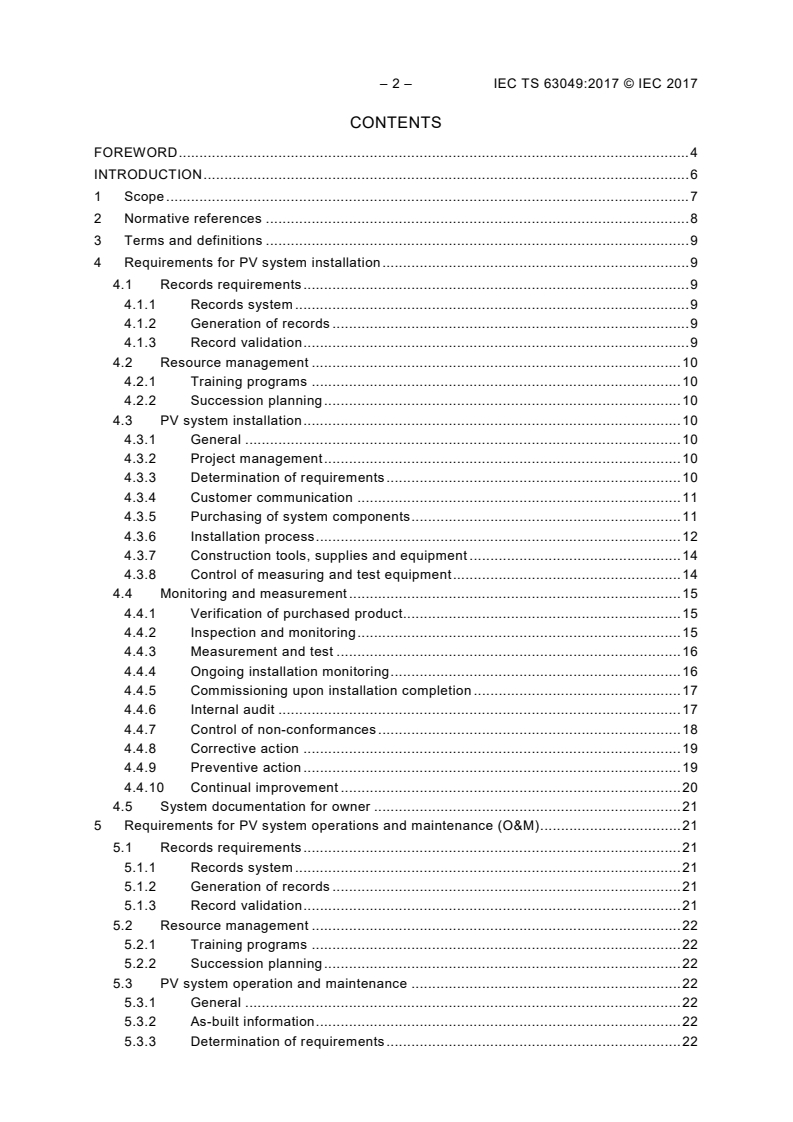
– 2 – IEC TS 63049:2017 © IEC 2017
CONTENTS
FOREWORD . 4
INTRODUCTION . 6
1 Scope . 7
2 Normative references . 8
3 Terms and definitions . 9
4 Requirements for PV system installation . 9
4.1 Records requirements . 9
4.1.1 Records system . 9
4.1.2 Generation of records . 9
4.1.3 Record validation . 9
4.2 Resource management . 10
4.2.1 Training programs . 10
4.2.2 Succession planning . 10
4.3 PV system installation . 10
4.3.1 General . 10
4.3.2 Project management . 10
4.3.3 Determination of requirements . 10
4.3.4 Customer communication . 11
4.3.5 Purchasing of system components . 11
4.3.6 Installation process . 12
4.3.7 Construction tools, supplies and equipment . 14
4.3.8 Control of measuring and test equipment . 14
4.4 Monitoring and measurement . 15
4.4.1 Verification of purchased product. 15
4.4.2 Inspection and monitoring . 15
4.4.3 Measurement and test . 16
4.4.4 Ongoing installation monitoring . 16
4.4.5 Commissioning upon installation completion . 17
4.4.6 Internal audit . 17
4.4.7 Control of non-conformances . 18
4.4.8 Corrective action . 19
4.4.9 Preventive action . 19
4.4.10 Continual improvement . 20
4.5 System documentation for owner . 21
5 Requirements for PV system operations and maintenance (O&M) . 21
5.1 Records requirements . 21
5.1.1 Records system . 21
5.1.2 Generation of records . 21
5.1.3 Record validation . 21
5.2 Resource management . 22
5.2.1 Training programs . 22
5.2.2 Succession planning . 22
5.3 PV system operation and maintenance . 22
5.3.1 General . 22
5.3.2 As-built information . 22
5.3.3 Determination of requirements . 22
5.3.4 Customer communication . 23
5.3.5 Spare and replacement parts . 23
5.3.6 Tools, measuring, and test equipment . 23
5.3.7 Maintenance planning and tracking . 24
5.4 System monitoring . 25
5.5 Internal audit . 25
5.5.1 General . 25
5.5.2 Records requirements. 26
5.6 Continual improvement . 26
5.6.1 General . 26
5.6.2 Use of system performance data for continual improvement . 26
Annex A (normative) . 28
Annex B (normative) . 29
Table A.1 – Technical content to be addressed when training workers – Installation
(see 4.2.1.1) . 28
Table B.1 – Technical content to be addressed when training workers – Operation and
maintenance (see 5.2.1.1) . 29
– 4 – IEC TS 63049:2017 © IEC 2017
INTERNATIONAL ELECTROTECHNICAL COMMISSION
____________
TERRESTRIAL PHOTOVOLTAIC (PV) SYSTEMS –
GUIDELINES FOR EFFECTIVE QUALITY ASSURANCE
IN PV SYSTEMS INSTALLATION, OPERATION AND MAINTENANCE
FOREWORD
1) The International Electrotechnical Commission (IEC) is a worldwide organization for standardization comprising
all national electrotechnical committees (IEC National Committees). The object of IEC is to promote
international co-operation on all questions concerning standardization in the electrical and electronic fields. To
this end and in addition to other activities, IEC publishes International Standards, Technical Specifications,
Technical Reports, Publicly Available Specifications (PAS) and Guides (hereafter referred to as “IEC
Publication(s)”). Their preparation is entrusted to technical committees; any IEC National Committee interested
in the subject dealt with may participate in this preparatory work. International, governmental and non-
governmental organizations liaising with the IEC also participate in this preparation. IEC collaborates closely
with the International Organization for Standardization (ISO) in accordance with conditions determined by
agreement between the two organizations.
2) The formal decisions or agreements of IEC on technical matters express, as nearly as possible, an international
consensus of opinion on the relevant subjects since each technical committee has representation from all
interested IEC National Committees.
3) IEC Publications have the form of recommendations for international use and are accepted by IEC National
Committees in that sense. While all reasonable efforts are made to ensure that the technical content of IEC
Publications is accurate, IEC cannot be held responsible for the way in which they are used or for any
misinterpretation by any end user.
4) In order to promote international uniformity, IEC National Committees undertake to apply IEC Publications
transparently to the maximum extent possible in their national and regional publications. Any divergence
between any IEC Publication and the corresponding national or regional publication shall be clearly indicated in
the latter.
5) IEC itself does not provide any attestation of conformity. Independent certification bodies provide conformity
assessment services and, in some areas, access to IEC marks of conformity. IEC is not responsible for any
services carried out by independent certification bodies.
6) All users should ensure that they have the latest edition of this publication.
7) No liability shall attach to IEC or its directors, employees, servants or agents including individual experts and
members of its technical committees and IEC National Committees for any personal injury, property damage or
other damage of any nature whatsoever, whether direct or indirect, or for costs (including legal fees) and
expenses arising out of the publication, use of, or reliance upon, this IEC Publication or any other IEC
Publications.
8) Attention is drawn to the Normative references cited in this publication. Use of the referenced publications is
indispensable for the correct application of this publication.
9) Attention is drawn to the possibility that some of the elements of this IEC Publication may be the subject of
patent rights. IEC shall not be held responsible for identifying any or all such patent rights.
The main task of IEC technical committees is to prepare International Standards. In
exceptional circumstances, a technical committee may propose the publication of a technical
specification when
• the required support cannot be obtained for the publication of an International Standard,
despite repeated efforts, or
• the subject is still under technical development or where, for any other reason, there is the
future but no immediate possibility of an agreement on an International Standard.
Technical specifications are subject to review within three years of publication to decide
whether they can be transformed into International Standards.
Technical Specification IEC 63049 has been prepared by IEC technical committee 82: Solar
photovoltaic energy systems.
The text of this technical specification is based on the following documents:
Enquiry draft Report on voting
82/1234/DTS 82/1283A/RVDTS
Full information on the voting for the approval of this technical specification can be found in
the report on voting indicated in the above table.
This document has been drafted in accordance with the ISO/IEC Directives, Part 2.
The committee has decided that the contents of this publication will remain unchanged until
the stability date indicated on the IEC website under "http://webstore.iec.ch" in the data
related to the specific publication. At this date, the publication will be
• transformed into an International standard,
• reconfirmed,
• withdrawn,
• replaced by a revised edition, or
• amended.
A bilingual version of this publication may be issued at a later date.
– 6 – IEC TS 63049:2017 © IEC 2017
INTRODUCTION
It is frequently observed that problems with PV systems may be related to the system
installation in one of multiple ways. Successful completion and continuous operation of PV
systems depend on appropriate training of workers, appropriate oversight of their work, and a
continual improvement system to learn from identified problems.
In order to supplement multiple IEC standards for qualification of the components and to
guide the design of systems, it is useful to have oversight of the installation process. Some
installation companies use an ISO 9001 quality management system, but this is a relatively
uncommon practice and those that do certify to ISO 9001 may omit some critical elements.
Similarly, after completion of the installation, practices for operation and maintenance of a PV
system vary widely with variable success.
This document was created to identify critical technical elements that should be included in
Quality Assurance programs and, where useful, to provide more specific management
requirements than are found in ISO 9001. This document is designed to be implemented as a
self-contained certification or in conjunction with ISO 9001.
TERRESTRIAL PHOTOVOLTAIC (PV) SYSTEMS –
GUIDELINES FOR EFFECTIVE QUALITY ASSURANCE
IN PV SYSTEMS INSTALLATION, OPERATION AND MAINTENANCE
1 Scope
This document provides the minimum activities deemed necessary to implement an effective
Quality Assurance program for the managing and reducing of risk in the installation and
operation of photovoltaic (PV) systems. This document defines requirements for certifying that
an entity has and uses a Quality Assurance program to prevent, or reduce errors and learns
from any new errors in:
a) installation, and
b) operation and maintenance of a PV system.
The object of this document is to provide more confidence in the performance and reliability of
certified PV systems. By being installed and operated under a Quality Assurance program in
accordance with this document, PV systems are expected to operate as designed and as
expected based on product warranties.
This document is developed to facilitate implementation of the quality control scheme under
the IECRE program, for those who choose to use the IECRE program ("IEC system for
certification to standards relating to equipment for use in renewable energy applications").
NOTE This document has been written primarily to apply to large PV plants and similar schemes. Requirements
for residential systems and smaller scale installers are being considered for a future version of this document. This
document also assumes these requirements apply to the prime contractor who, in turn, is responsible to hold
subcontractors and other service providers to the intent of these requirements.
This document is applicable to all PV systems independent of design and technology, i.e. flat
panel, Concentrator Photovoltaic (CPV). Quality controls for CPV and nonconventional
flat-plate systems will differ somewhat from those of more conventional designs; this
document has not considered these differences and is expected to be generally applicable to
all PV systems.
This document covers processes starting from the shipment of components out to the
installation site and including the transport, unpacking, racking, construction, module
installation process and processes associated with operation and maintenance of the PV
system.
Compliance to a Quality Management System (QMS) such as ISO 9001 will meet many
requirements in this document. The requirements that are unique to this document can be
combined with the ISO 9001 audits for those organizations that are already registered to
ISO 9001:2015. For the organizations who do not have ISO 9001 registration by a certified
body, the entirety of this document applies.
Assessments with respect to this document may be completed to certify a Quality Assurance
program for the installation process, for operations and maintenance processes or for both
processes.
Clause 4 describes requirements for the installation process; Clause 5 describes
requirements for operation and maintenance.
Maintenance of PV systems is often lumped into the catchall term “operations and
maintenance” (O&M) This document does not address business or management operational
– 8 – IEC TS 63049:2017 © IEC 2017
processes (e.g. forecasting, utility pricing incentives, etc.) or other considerations driven by
factors outside of basic system working condition, safety and performance.
2 Normative references
The following documents are referred to in the text in such a way that some or all of their
content constitutes requirements of this document. For dated references, only the edition
cited applies. For undated references, the latest edition of the referenced document (including
any amendments) applies.
IEC 60364 (all parts), Low-voltage electrical installations
IEC 60364-7-712, Low voltage electrical installation – Part 7-712: Requirements for special
installations or locations – Solar photovoltaic (PV) power supply systems
IEC 61215 (all parts), Terrestrial photovoltaic (PV) modules – Design qualification and type
approval
IEC TS 61724-2, Photovoltaic system performance – Part 2: Capacity evaluation method
IEC TS 61724-3, Photovoltaic system performance – Part 3: Energy evaluation method
IEC 61730 (all parts), Photovoltaic (PV) module safety qualification
IEC TS 61836, Solar photovoltaic energy systems – Terms, definitions and symbols
IEC 62109 (all parts), Safety of power converters for use in photovoltaic power systems
IEC 62446-1, Photovoltaic (PV) systems – Requirements for testing, documentation and
maintenance – Part 1: Grid connected PV systems – Documentation, commissioning tests and
inspection
IEC 62446-2, Photovoltaic (PV) systems – Requirements for testing, documentation and
maintenance – Part 2: Grid connected PV systems – Maintenance of PV systems (to be
published)
IEC 62446-3, Photovoltaic (PV) systems – Requirements for testing, documentation and
maintenance – Part 3: Photovoltaic modules and plants – Outdoor infrared thermography
IEC 62548, Photovoltaic (PV) arrays – Design requirements
IEC TS 62738, Ground-mounted photovoltaic power plants – Design guidelines and
recommendations
IEC 62759-1, Photovoltaic (PV) modules – Transportation testing – Part 1: Transportation and
shipping of module package units
IEC TS 62915, Photovoltaic (PV) modules – Retesting for type approval, design and safety
qualification
IEC TS 62941, Terrestrial photovoltaic (PV) modules – Guideline for increased confidence in
PV module design qualification and type approval
ISO 9000, Quality management systems – Fundamentals and vocabulary
ISO 9001:2015, Quality management systems – Requirements
ISO 19011, Guidelines for auditing management systems
3 Terms and definitions
For the purposes of this document, the terms and definitions in ISO 9000, IEC TS 61836 and
the following apply.
ISO and IEC maintain terminological databases for use in standardization at the following
addresses:
• IEC Electropedia: available at http://www.electropedia.org/
• ISO Online browsing platform: available at http://www.iso.org/obp
3.1
condition adverse to quality
all-inclusive term used in reference to any of the following: failures, malfunctions, deficiencies,
defective items, and non-conformances; such a condition is significant if, uncorrected, it could
have a serious effect on safety or operability
4 Requirements for PV system installation
4.1 Records requirements
4.1.1 Records system
A records system(s) shall be established by the organization responsible prior to the start of
installation activities. Requirements of local standards or regulations for documentation need
to be considered to determine minimum documentation for PV systems.
The organization shall define the controls needed for the identification, storage, protection,
retrieval, retention and disposition of records.
Records established to provide evidence of conformity to requirements and of the effective
operation of the Quality Assurance program shall be controlled.
Records shall remain legible, readily identifiable and retrievable.
4.1.2 Generation of records
The applicable design specifications, procurement documents, contract documents, test
procedures, operational procedures, or other documents shall specify the records to be
generated, supplied, or retained by or for the project owner.
Documented information that is designated to become records shall be accurate, and
completed appropriate to the work accomplished.
4.1.3 Record validation
Documented information shall be considered to be valid records only if stamped, initialled, or
signed and dated by authorized personnel or otherwise authenticated, e.g. electronically
validated.
– 10 – IEC TS 63049:2017 © IEC 2017
4.2 Resource management
4.2.1 Training programs
4.2.1.1 General
The organization shall maintain a (periodic) training program for all personnel (not just
employees) involved with the design and installation of PV projects. In addition to safety,
professional, and other requirements, training should include familiarity with relevant sections
of the technical photovoltaic documents described in Annex A and methods for handling
modules.
4.2.1.2 Records requirements
Documented information of employee training relevant to the installation project shall include
the type of training and date of completion.
4.2.2 Succession planning
The organization shall plan for succession for key functions that affect customer satisfaction,
quality, reliability, safety, and performance, including the installation engineer.
4.3 PV system installation
4.3.1 General
The organization is required to implement the requirements in accordance with this document
for the needed planning and development of processes for PV system installation.
In planning PV system installation, the organization shall determine the following, as
appropriate:
a) quality objectives and requirements for the installation;
b) the need to establish processes and documents, and to provide resources specific to the
installation;
c) required verification, validation, monitoring, measurement, inspection and test activities
specific to the installation and the criteria for installation acceptance;
d) records needed to provide evidence that the installation processes and the completed
installation meet requirements.
The output of this planning shall be in a form suitable for the organization's method of
operations.
4.3.2 Project management
As appropriate to the organization and the project, the organization shall plan and manage PV
system installation in a structured and controlled manner to meet requirements at acceptable
risk, within resource and schedule constraints.
4.3.3 Determination of requirements
4.3.3.1 General
The organization shall consider requirements and guidelines contained in IEC 62548,
IEC TS 62738, IEC 60364, IEC 60364-7-712, and local codes, as applicable. The final
requirements shall be documented.
The installation processes shall reflect lessons learned from root cause analysis of problems
with previous PV systems, and response to customer complaints or other experience with
previously installed PV systems. Input data for this process shall be proactively collected
including:
a) Analysis of performance of PV systems relative to the expected performance during the
warranty period or longer.
b) Periodic inspections of the PV systems to identify evidence of problems. Visual
inspections may be supplemented by infrared and luminescent imaging.
This information may be collected and reviewed directly by the organization responsible for
installation or indirectly in partnership with another entity. Regardless of the method of
collection of the information, the organization shall include this proactively collected data
when determining requirements.
4.3.3.2 Records requirements
Documented information shall be kept as a record of design reviews to ensure that all designs
meet the requirements of IEC 62548, IEC TS 62738, IEC 60364, and IEC 60364-7-712, as
applicable, before acceptance to begin construction, and to enable the information to be
adequately communicated during implementation.
The design reviews should include a constructability and a serviceability review in order to
identify potential problems.
Additionally, the documented information should include information about the assembly
process, especially where variability in some processes could result in subsequent field
failures. A key example is the handling of modules, since poor handling can result in cracked
cells or shattered glass.
4.3.4 Customer communication
4.3.4.1 General
A process shall be developed to ensure proactive communication with customers (e.g. the
owner) when a problem is identified with a relevant system.
A process shall be developed to respond to customer issues during the installation process by
understanding the problem, evaluating the root cause, identifying a solution, implementing
that solution to the satisfaction of the customer within a reasonable timeframe.
4.3.4.2 Records requirements
Records of root cause, corrective actions, and customer communications shall be maintained
as defined in the records system created in 4.1.
4.3.5 Purchasing of system components
4.3.5.1 General
All system components shall be procured to conform to specifications of the design, including
assurance that manufacturing was completed to a qualified design. The manufacturer should
have an effectively implemented QMS. See, for example, the relevant parts of IEC 61215,
IEC 61730, IEC TS 62941 and IEC TS 62915 and how these have been considered during
implementation of IEC TS 62738 and IEC 62548.
4.3.5.2 Purchasing process and associated records requirements
The organization shall ensure that purchased system components conform to specified
purchase requirements and relevant standards. The type and extent of control applied to the
supplier and the purchased system components shall be dependent upon the effect of the
purchased system components on system performance.
– 12 – IEC TS 63049:2017 © IEC 2017
The organization shall evaluate and select suppliers based on their ability to supply system
components in accordance with the stated requirements. Criteria for selection, evaluation, re-
evaluation, and possible disqualification shall be established.
Records of the results of supplier evaluations and any necessary actions arising from the
evaluation shall be retained.
4.3.5.3 Purchasing information
Purchasing documents shall contain complete and unambiguous information describing the
product ordered, including, where appropriate:
a) the type, class, grade or other unique identification,
b) the title or other positive identification, and applicable issues of specifications, drawing,
process requirements, inspection instructions, relevant standards and other relevant
technical data, including requirements for approval or qualification of product, procedures,
process equipment and personnel, and
c) the quality system standard (if applicable) to be applied.
The organization shall review and approve purchasing documents for adequacy of the
specified requirements prior to release.
4.3.6 Installation process
4.3.6.1 Control of installation process
4.3.6.1.1 General
The organization shall plan and carry out the installation process under controlled conditions.
Controlled conditions shall include, as applicable:
a) the availability of information that describes the characteristics required,
b) the availability of work standards, as necessary,
c) consistency of assembly process, such as the handling of modules during assembly,
d) the use of suitable facilities, tools, and equipment, including the availability and use of
measuring and test equipment, and
e) the implementation of monitoring and measurement.
4.3.6.1.2 Records requirements
Documented information of reviews of any changes made to the system design or installation
process during system installation shall be retained.
This requirement is applicable to any changes in the design including:
a) components record, including factory test report,
b) system layout record, including size and location of components,
c) transportation record, including on the road vibration meter report,
d) system wiring record, including cable size and route table,
e) storage record, including periodic temperature and humidity report (where component
preservation required),
f) module clamping record, including tightening torque check,
g) assembly records such as module handling record, including all stages of transportation
and manual handling (see IEC 62759-1).
Additionally, records should be retained to document control of the installation process,
including audits, non-conformances, and corrective actions, and as defined by the records
system developed in 4.1 and 4.4.
4.3.6.2 Validation of installation processes
The organization shall validate any processes for installation where the resulting output
cannot be verified by subsequent monitoring, measurement or test and, as a consequence,
deficiencies become apparent only after the system is in use.
NOTE Examples of such processes include welding of structure during installation, crimping of wires, riveting of
structures, handling of modules, and torqueing of fasteners.
Validation shall demonstrate the ability of these processes to achieve planned results.
The organization shall establish arrangements for these processes including, as applicable:
a) defined criteria for review and approval of the processes,
b) approval of equipment and qualification of personnel,
c) use of specific methods and procedures,
d) re-validation,
e) requirements for records.
4.3.6.3 Component identification and traceability
The organization shall identify the material/component by suitable means throughout
installation.
The organization shall identify the material/component status with respect to monitoring and
measurement requirements throughout installation.
Where traceability is a requirement, the organization shall control the unique identification of
the material/component and retain records.
At a minimum, the organization shall record the component manufacturer and part numbers.
For critical components, unique identification number (e.g. serial number) shall also be
recorded, and any other required information.
4.3.6.4 Customer property
The organization shall exercise care with customer property (including intellectual property
and personal data) while it is under the organization's control or being used by the
organization.
The organization shall identify, verify, protect and safeguard customer property.
If any customer property is lost, damaged or otherwise found to be unsuitable for use, the
organization shall report this to the customer and retain records.
4.3.6.5 Component handling and storage
The organization shall protect the PV system components during delivery to the intended
destination (including qualification of packaging to IEC 62759-1) and during on-site storage in
order to maintain conformity to requirements.
Protection shall include identification, handling, packaging, storage and other protection from
damage. Protection shall also apply to the constituent parts of a PV system component.
– 14 – IEC TS 63049:2017 © IEC 2017
PV system components delivered to the work area shall be so positioned, or protected when
necessary, to ensure that the quality of the item will not be de-graded by the construction
activity or local environment at installation site.
The cleaning of important materials and equipment for the system that is necessary during
receiving, storage, and handling activities shall be in accordance with applicable requirements.
Cleaning compound should not cause any environmental impact and may be subject to local
regulations.
4.3.7 Construction tools, supplies and equipment
The use, location, and deployment of construction tools, supplies, and equipment shall be
controlled to keep access and work areas clear and to prevent conditions that will adversely
affect quality and/or safety of components and/or installation.
Depending on the local situation, it may be necessary to provide sources of power, water,
communication, and transportation (including roads that are of high enough quality that
traversing them will not cause damage to components). These resources should be put in
place in a timely way, typically at the time when the land is prepared to begin installation.
4.3.8 Control of measuring and test equipment
4.3.8.1 General
The organization shall determine the measurement and tests to be undertaken and the
measuring and test equipment needed to provide evidence of conformity of installation to
determined requirements.
The organization shall establish processes to ensure that measurement and test can be
carried out, and in a manner that is consistent with the measurement and test requirements.
4.3.8.2 Calibration
Measuring and test equipment shall be initially calibrated, and then maintained [verified and
adjusted (as required)] at prescribed intervals or, prior to use, against certified equipment
having known valid relationships to nationally or internationally recognized standards.
Calibration shall cover the intended measurement range.
If no recognized standards exist, the basis for calibration shall be documented.
4.3.8.3 Verification
The method and interval of verification for each item shall be defined, based on the type of
equipment required, accuracy, intended use, and other conditions affecting measurement
control.
Verification shall be performed when the accuracy of the equipment is suspected at any time
within the verification interval, and the frequency reviewed.
4.3.8.4 Non-conformance
When measuring and test equipment is found to be out of calibration (OOC), an evaluation
shall be made and documented of the validity of previous inspection or test results and of the
acceptability of items previously inspected or tested. OOC devices shall be tagged or
segregated and not used until they have been recalibrated. If any measuring or test
equipment is consistently found to be out of calibration, it shall be repaired or replaced.
4.3.8.5 Commercial devices
Calibration and control measures may not be required for rulers, tape measures, levels, and
other such devices, if normal commercial equipment provides adequate accuracy.
Inspection shall be performed on the condition of such devices at periodic intervals. These
devices shall be replaced when they lose their functionality, e.g. the graduations wear out or
are damaged.
4.3.8.6 Handling and storage
Measuring and test equipment shall be properly handled and stored to maintain accuracy.
4.3.8.7 Records requirements
Records of the results of calibration, verification, and non-conformance shall be retained and
equipment shall be suitably marked to indicate calibration status.
4.4 Monitoring and measurement
4.4.1 Verification of purchased product
The organization shall establish and implement the inspection or other activities necessary for
ensuring that purchased components meet specified purchase requirements.
Where the organization or its customer intends to perform verification at the supplier's
premises, the organization shall state the intended verification arrangements and method of
product release in the purchasing information.
4.4.2 Inspection and monitoring
Inspections required to verify conformance to specified requirements shall be planned and
executed per plan. Characteristics to be inspected and inspection methods to be employed
shall be specified. Inspection results shall be documented. Inspection for acceptance shall be
performed by persons other than those who performed or directly supervised the work being
inspected.
Inspection hold points may be required. These are points in the construction process for
which it is mandatory to stop work and work shall not proceed without the specific consent of
the designated representative. These specific hold points shall be indicated in documents
described in 4.3.1 c) and 4.3.6.2. Consent to approve demonstrated or waive specified
inspection hold points shall be recorded prior to continuation of work beyond the designated
hold point.
Inspection of items in-process or under construction shall be performed for work activities,
where necessary to verify conformity.
Where the conformity of the resulting output cannot be readily or economically verified,
monitoring of processing methods, equipment, and personnel shall be provided.
In some instances where either inspection or monitoring is inadequate, both inspection and
process monitoring should be performed.
Inspections shall be performed to verify that the prerequisites for control of construction
processes such as structural bolting, and concrete measuring, mixing, transporting, placing,
and curing have been accomplished. These inspections shall include verification of the
following:
a) the process has been qualified as required;
– 16 – IEC TS 63049:2017 © IEC 2017
b) process controls are in effect;
c) approved procedures, instruction manuals, or both, if required for specific equipment, are
available for use during construction;
d) the process is suitable for the particular application;
e) personnel, equipment (including measuring and testing equipment), and materials are
readily available and adequate to perform the work in accordance with drawing and
specification requirements.
Inspection of soils and earthwork shall include preparations for earthwork, as well as in-
process inspections of placing and compacting operation, to ensure conformance to
applicable requirements.
Controls, where required, shall be established and documented for the coordination and
sequencing of these activities at established inspection points, and during successive stages
of construction.
4.4.3 Measurement and test
4.4.3.1 General
The organization shall apply suitable methods for measurement and, where applicable, test of
the installation processes.
When determining suitable methods, the organization shall consider the type and extent of
measurement or test appropriate to each of its processes in relation to their impact on the
conformity to installation requirements.
• Calibrated torque wrenches shall be used when tightening clamps and connections that
are required by the design to be tightened to a specified torque.
When conformity is not achieved, correction and corrective action shall be taken, as
appropriate.
4.4.3.2 Test
Tests required to verify conformance to specified requirements and to demonstrate
satisfactory performance for operation shall be planned and executed. Characteristics to be
tested and corresponding test methods shall be specified. Test results shall be documented
and their conformance with acceptance criteria shall be evaluated.
Tests required to collect data, such as for siting or design input, shall be planned, executed,
documented, and evaluated.
4.4.4 Ongoing installation monitoring
In addition to the items above, the organization shall define an ongoing/periodic monitoring
program during installation to ensure that critical specifications are met. For example (where
applicable), that:
a) The right PV modules are used per dr
...