

IEC/IEEE 65700-19-03:2014
(Main)Bushings for DC application
General Information
- Abstract
IEC/IEEE 65700-19-03:2014 applies to outdoor and indoor bushings of any voltage used on DC systems, of capacitance graded or gas insulated types for use as components of oil-filled converter transformers and smoothing reactors, as well as air-to-air DC bushings. This standard makes reference to IEC 60137 for general terms and conditions and defines the special terms used, operating conditions, ratings, test procedures as well as general mechanical and electrical requirements for bushings for DC application. This standard replaces IEC 62199:2004, Bushings for DC application.
- Status
- Published
- Publication Date
- 09-Jul-2014
- Technical Committee
- SC 36A - Insulated bushings
- Drafting Committee
- MT 5 - TC 36/SC 36A/MT 5
Buy Documents
IEC/IEEE 65700-19-03:2014 - Bushings for DC application Released:7/10/2014


IEC/IEEE 65700-19-03:2014 - Bushings for DC application Released:1/24/2019
Overview
IEC/IEEE 65700-19-03:2014 - Bushings for DC application defines requirements for DC bushings used indoors and outdoors on DC systems. It covers capacitance-graded and gas-insulated bushings used as components of oil-filled converter transformers, smoothing reactors and air-to-air DC bushings. The standard specifies terminology, ratings, operating conditions, insulation levels, mechanical and electrical requirements, and detailed test procedures (type, routine and special). It replaces IEC 62199:2004 and cross-references IEC 60137 for general bushing terms and conditions.
Key Topics
- Scope and terminology: Definitions and symbols specific to bushings for DC application and differentiation from AC bushing requirements.
- Ratings and insulation levels: Rated continuous DC voltage, peak voltages, insulation coordination and pollution parameters relevant to DC systems.
- Operating conditions: Environmental, altitude and application factors that affect design, testing and installation of DC bushings.
- Mechanical requirements: Mounting, cantilever load capability and dimensional verification for interchangeability and safe installation.
- Electrical requirements and limits: Dielectric behavior under DC stress, partial discharge limits and polarity-reversal considerations.
- Comprehensive test program:
- Type tests (design verification): dry power-frequency withstand with partial discharge measurement, lightning impulse (BIL), switching impulse (SIL), temperature-rise, EMC and tightness/pressure tests.
- Routine tests: dielectric dissipation (tan δ), capacitance, BIL, DC applied voltage, polarity reversal and switching impulse tests with acceptance criteria.
- Special tests: artificial pollution, even/uneven wetting DC voltage tests and other site- or environment-specific checks.
- Installation, operation and maintenance guidance: Transport, storage, lifting, assembly, inspection, maintenance recommendations and failure reporting.
- Safety and environmental aspects: Electrical, mechanical and thermal safety considerations plus environmental recommendations.
Applications
Who uses IEC/IEEE 65700-19-03:2014 and why:
- Bushing manufacturers - to design and qualify DC bushings (capacitance-graded, gas-insulated).
- Transformer and reactor OEMs - to specify bushings for oil-filled converter transformers and smoothing reactors.
- Utilities, HVDC project engineers and asset owners - to set procurement, acceptance and maintenance criteria for DC installations.
- Testing laboratories - to perform type/routine/special tests, partial discharge and impulse withstand testing.
- Consultants and specifiers - to ensure compliance with recognized DC bushing standards in project specifications.
Keywords: bushings for DC, DC bushings, IEC/IEEE 65700-19-03, converter transformer bushings, smoothing reactor bushings, capacitance graded bushings, gas insulated bushings, partial discharge testing.
Related Standards
- IEC 60137 - General terms and conditions for bushings (normative reference).
- IEC 62199:2004 - Replaced by IEC/IEEE 65700-19-03:2014 (superseded document).
Relations
- Effective Date
- 05-Sep-2023
- Effective Date
- 05-Sep-2023
Buy Documents
IEC/IEEE 65700-19-03:2014 - Bushings for DC application Released:7/10/2014
IEC/IEEE 65700-19-03:2014 - Bushings for DC application Released:1/24/2019
Get Certified
Connect with accredited certification bodies for this standard

IMQ S.p.A. (Certification)
Italian electrical product certification.

SLG Prüf- und Zertifizierungs GmbH
German testing and certification body.

UL Solutions
Global safety science company with testing, inspection and certification.
Sponsored listings
Frequently Asked Questions
IEC/IEEE 65700-19-03:2014 is a standard published by the International Electrotechnical Commission (IEC). Its full title is "Bushings for DC application". This standard covers: IEC/IEEE 65700-19-03:2014 applies to outdoor and indoor bushings of any voltage used on DC systems, of capacitance graded or gas insulated types for use as components of oil-filled converter transformers and smoothing reactors, as well as air-to-air DC bushings. This standard makes reference to IEC 60137 for general terms and conditions and defines the special terms used, operating conditions, ratings, test procedures as well as general mechanical and electrical requirements for bushings for DC application. This standard replaces IEC 62199:2004, Bushings for DC application.
IEC/IEEE 65700-19-03:2014 applies to outdoor and indoor bushings of any voltage used on DC systems, of capacitance graded or gas insulated types for use as components of oil-filled converter transformers and smoothing reactors, as well as air-to-air DC bushings. This standard makes reference to IEC 60137 for general terms and conditions and defines the special terms used, operating conditions, ratings, test procedures as well as general mechanical and electrical requirements for bushings for DC application. This standard replaces IEC 62199:2004, Bushings for DC application.
IEC/IEEE 65700-19-03:2014 is classified under the following ICS (International Classification for Standards) categories: 01 - GENERALITIES. TERMINOLOGY. STANDARDIZATION. DOCUMENTATION; 29.080.20 - Bushings. The ICS classification helps identify the subject area and facilitates finding related standards.
IEC/IEEE 65700-19-03:2014 has the following relationships with other standards: It is inter standard links to IEC 62199:2004, IEC/IEEE 65700-19-03:2025. Understanding these relationships helps ensure you are using the most current and applicable version of the standard.
IEC/IEEE 65700-19-03:2014 is available in PDF format for immediate download after purchase. The document can be added to your cart and obtained through the secure checkout process. Digital delivery ensures instant access to the complete standard document.
Standards Content (Sample)
IEC/IEEE 65700-19-03 ®
Edition 1.0 2014-07
INTERNATIONAL
STANDARD
Bushings for DC application
All rights reserved. Unless otherwise specified, no part of this publication may be reproduced or utilized in any form
or by any means, electronic or mechanical, including photocopying and microfilm, without permission in writing being
secured. Requests for permission to reproduce should be addressed to either IEC at the address below or IEC’s
member National Committee in the country of the requester or from IEEE.
IEC Central Office Institute of Electrical and Electronics Engineers, Inc.
3, rue de Varembé 3 Park Avenue
CH-1211 Geneva 20 New York, NY 10016-5997
Switzerland United States of America
Tel.: +41 22 919 02 11 stds.ipr@ieee.org
Fax: +41 22 919 03 00 www.ieee.org
info@iec.ch
www.iec.ch
About the IEC
The International Electrotechnical Commission (IEC) is the leading global organization that prepares and publishes
International Standards for all electrical, electronic and related technologies.
About the IEEE
IEEE is the world’s largest professional association dedicated to advancing technological innovation and excellence for
the benefit of humanity. IEEE and its members inspire a global community through its highly cited publications,
conferences, technology standards, and professional and educational activities.
About IEC/IEEE publications
The technical content of IEC/IEEE publications is kept under constant review by the IEC and IEEE. Please make sure
that you have the latest edition, a corrigendum or an amendment might have been published.
IEC Catalogue - webstore.iec.ch/catalogue Electropedia - www.electropedia.org
The stand-alone application for consulting the entire The world's leading online dictionary of electronic and
bibliographical information on IEC International Standards, electrical terms containing more than 30 000 terms and
Technical Specifications, Technical Reports and other definitions in English and French, with equivalent terms in
documents. Available for PC, Mac OS, Android Tablets 14 additional languages. Also known as the International
and iPad. Electrotechnical Vocabulary (IEV) online.
IEC publications search - www.iec.ch/searchpub IEC Glossary - std.iec.ch/glossary
The advanced search enables to find IEC publications by a More than 55 000 electrotechnical terminology entries in
variety of criteria (reference number, text, technical English and French extracted from the Terms and
committee,…). It also gives information on projects, Definitions clause of IEC publications issued since 2002.
replaced and withdrawn publications. Some entries have been collected from earlier publications
of IEC TC 37, 77, 86 and CISPR.
IEC Just Published - webstore.iec.ch/justpublished
Stay up to date on all new IEC publications. Just Published IEC Customer Service Centre - webstore.iec.ch/csc
details all new publications released. Available online and If you wish to give us your feedback on this publication or
also once a month by email. need further assistance, please contact the Customer
Service Centre: csc@iec.ch.
IEC/IEEE 65700-19-03 ®
Edition 1.0 2014-07
INTERNATIONAL
STANDARD
Bushings for DC application
INTERNATIONAL
ELECTROTECHNICAL
COMMISSION
PRICE CODE
XA
ICS 29.080.20 ISBN 978-2-8322-1691-0
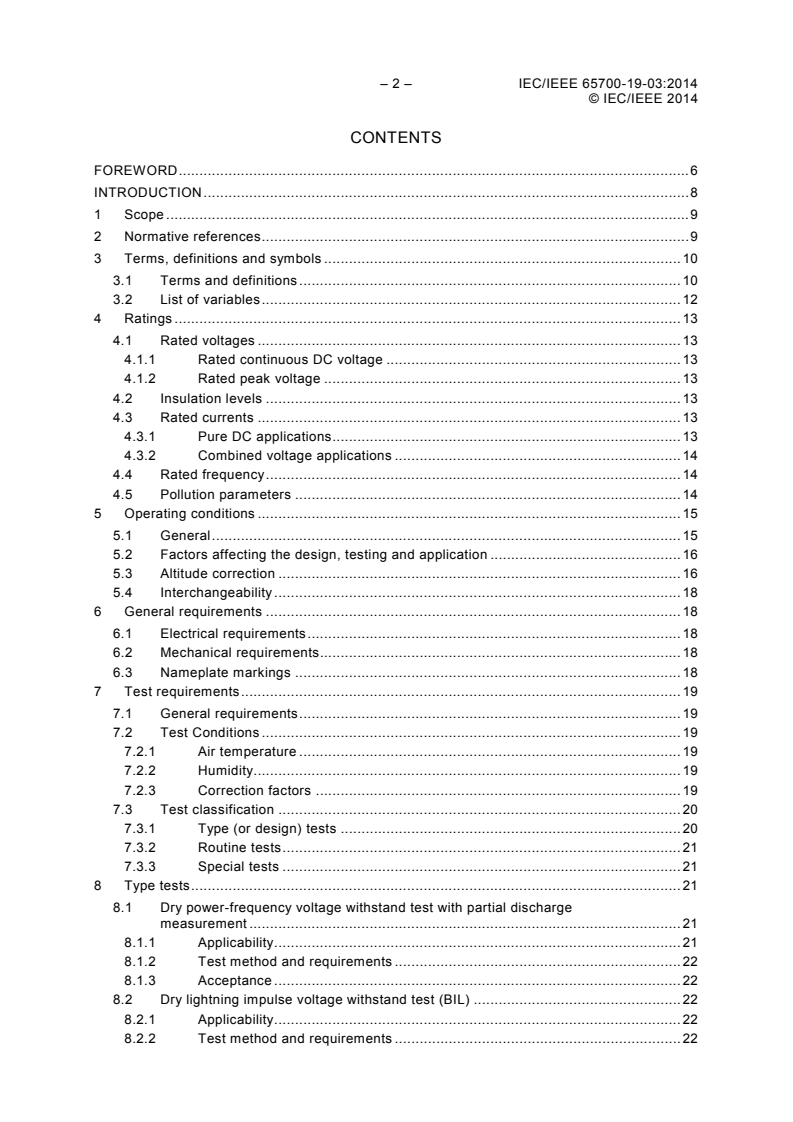
– 2 – IEC/IEEE 65700-19-03:2014
© IEC/IEEE 2014
CONTENTS
FOREWORD . 6
INTRODUCTION . 8
1 Scope . 9
2 Normative references . 9
3 Terms, definitions and symbols . 10
3.1 Terms and definitions . 10
3.2 List of variables . 12
4 Ratings . 13
4.1 Rated voltages . 13
4.1.1 Rated continuous DC voltage . 13
4.1.2 Rated peak voltage . 13
4.2 Insulation levels . 13
4.3 Rated currents . 13
4.3.1 Pure DC applications . 13
4.3.2 Combined voltage applications . 14
4.4 Rated frequency . 14
4.5 Pollution parameters . 14
5 Operating conditions . 15
5.1 General . 15
5.2 Factors affecting the design, testing and application . 16
5.3 Altitude correction . 16
5.4 Interchangeability . 18
6 General requirements . 18
6.1 Electrical requirements . 18
6.2 Mechanical requirements . 18
6.3 Nameplate markings . 18
7 Test requirements . 19
7.1 General requirements . 19
7.2 Test Conditions . 19
7.2.1 Air temperature . 19
7.2.2 Humidity . 19
7.2.3 Correction factors . 19
7.3 Test classification . 20
7.3.1 Type (or design) tests . 20
7.3.2 Routine tests . 21
7.3.3 Special tests . 21
8 Type tests . 21
8.1 Dry power-frequency voltage withstand test with partial discharge
measurement . 21
8.1.1 Applicability . 21
8.1.2 Test method and requirements . 22
8.1.3 Acceptance . 22
8.2 Dry lightning impulse voltage withstand test (BIL) . 22
8.2.1 Applicability . 22
8.2.2 Test method and requirements . 22
© IEC/IEEE 2014
8.2.3 Acceptance . 22
8.3 Dry or wet switching impulse voltage withstand test (SIL) . 22
8.3.1 Applicability . 22
8.3.2 Test method and requirements . 23
8.3.3 Acceptance . 23
8.4 Electromagnetic compatibility tests (EMC) . 23
8.4.1 Emission test . 23
8.4.2 Immunity test . 23
8.5 Temperature rise test . 23
8.5.1 Applicability . 23
8.5.2 Test method and requirements . 24
8.5.3 Acceptance . 24
8.6 Cantilever load withstand test . 25
8.6.1 Applicability . 25
8.6.2 Test method and requirements . 25
8.6.3 Acceptance . 26
8.7 Tightness test on liquid-filled, compound-filled and liquid-insulated bushings . 26
8.8 Internal pressure test on gas-filled, gas-insulated and gas-impregnated
bushings . 26
8.9 Verification of dimensions . 26
8.10 Draw-lead bushing cap pressure test . 26
8.10.1 Applicability . 26
8.10.2 Test method and requirements . 26
8.10.3 Acceptance . 26
9 Routine tests . 26
9.1 Measurement of dielectric dissipation factor (tan δ) and capacitances . 26
9.1.1 Applicability . 26
9.1.2 Test method and requirements . 26
9.1.3 Acceptance . 26
9.2 Dry lightning impulse voltage withstand test (BIL) . 27
9.2.1 Applicability . 27
9.2.2 Test method and requirements . 27
9.2.3 Acceptance . 27
9.3 Dry power-frequency voltage withstand test with partial discharge
measurement . 27
9.3.1 Applicability . 27
9.3.2 Test method and requirements . 27
9.3.3 Acceptance . 28
9.4 DC applied voltage withstand test with partial discharge measurement . 28
9.4.1 Applicability . 28
9.4.2 Test method and requirements . 29
9.4.3 Acceptance . 29
9.5 Polarity reversal test with partial discharge measurement . 30
9.5.1 Applicability . 30
9.5.2 Test method and requirements . 30
9.5.3 Acceptance . 31
9.6 Dry Switching impulse withstand test . 31
9.6.1 Applicability . 31
9.6.2 Test method and requirements . 32
– 4 – IEC/IEEE 65700-19-03:2014
© IEC/IEEE 2014
9.6.3 Acceptance . 32
9.7 Test of tap insulation . 32
9.8 Internal pressure test on gas-filled, gas-insulated and gas-impregnated
bushings . 32
9.9 Tightness test on liquid-filled, compound-filled and liquid-insulated bushings . 32
9.10 Tightness test on gas-filled, gas-insulated and gas-impregnated bushings . 32
9.11 Tightness test at the flange or other fixing device . 32
9.12 Visual inspection and dimensional check . 32
10 Special tests . 32
10.1 Artificial pollution test . 33
10.1.1 Applicability . 33
10.1.2 Test method and requirements . 33
10.1.3 Acceptance . 33
10.2 Even wetting DC voltage test . 33
10.2.1 Applicability . 33
10.2.2 Test method and requirements . 33
10.2.3 Acceptance . 34
10.3 Uneven wetting DC voltage test . 34
10.3.1 Applicability . 34
10.3.2 Test method and requirements . 34
10.3.3 Acceptance . 34
11 Recommendations for transport, storage, erection, operation and maintenance . 35
11.1 Conditions during transport, storage and installation . 35
11.2 Installation . 35
11.3 Unpacking and lifting . 35
11.4 Assembly . 35
11.4.1 Mounting . 35
11.4.2 Connections . 36
11.4.3 Final installation inspection . 36
11.5 Operation . 36
11.6 Maintenance . 37
11.6.1 General . 37
11.6.2 Recommendation for the manufacturer . 37
11.6.3 Recommendations for the user . 37
11.6.4 Failure report . 38
12 Safety . 39
12.1 Electrical aspects . 39
12.2 Mechanical aspects . 39
12.3 Thermal aspects . 39
13 Environmental aspects . 39
Annex A (informative) . 40
A.1 Bushings used in voltage source converters (VSC) HVDC schemes . 40
A.1.1 Introduction . 40
A.1.2 Design . 42
A.1.3 Tests . 43
A.1.4 Supporting Published Material . 43
Annex B (informative) . 44
© IEC/IEEE 2014
B.1 Temperature rise test methods for the determination of the equivalent test
current . 44
B.1.1 Introduction . 44
B.2 Basics concerning the losses in distorted operation . 44
B.3 Analytical calculation . 45
B.4 Finite element method calculation . 45
B.5 Calculation by enhancement factors as described in IEC 61378–1 . 46
B.6 Examples of calculation . 47
B.6.1 Calculation based on the analytical method . 48
B.6.2 Calculation based on Finite Element Method . 49
B.6.3 Calculation based on the enhancement factor according IEC 61378–1 . 50
B.7 References . 51
Bibliography . 52
Figure 1 – Altitude correction factor . 17
Figure 2 – Polarity reversal test profile. 30
Figure A.1 – Two-level VSC HVDC converter station applied in a bipolar scheme with
DC cable transmission . 41
Figure A.2 – Multi-level VSC HVDC converter station applied in a monopolar scheme
with DC overhead line transmission . 42
Table 1 – Temperature of ambient air and immersion media (see 5.1) . 15
Table 2 – Type, routine and special tests . 21
Table 3 – Minimum values of cantilever withstand load . 25
Table 4 – Maximum values of tan δ and tan δ increase . 27
Table 5 – Maximum values of partial discharge quantity . 28
Table B.1 – Valve side connected bushing current harmonic spectrum . 47
Table B.2 – Calculation based on the analytical method . 48
Table B.3 – Calculation based on Finite Element Method . 49
Table B.4 – Calculation based IEC 61378-1 enhancement factor F . 50
CE
– 6 – IEC/IEEE 65700-19-03:2014
© IEC/IEEE 2014
INTERNATIONAL ELECTROTECHNICAL COMMISSION
____________
BUSHINGS FOR DC APPLICATION
FOREWORD
1) The International Electrotechnical Commission (IEC) is a worldwide organization for standardization comprising
all national electrotechnical committees (IEC National Committees). The object of IEC is to promote
international co-operation on all questions concerning standardization in the electrical and electronic fields. To
this end and in addition to other activities, IEC publishes International Standards, Technical Specifications,
Technical Reports, Publicly Available Specifications (PAS) and Guides (hereafter referred to as “IEC
Publication(s)”). Their preparation is entrusted to technical committees; any IEC National Committee interested
in the subject dealt with may participate in this preparatory work. International, governmental and non-
governmental organizations liaising with the IEC also participate in this preparation.
IEEE Standards documents are developed within IEEE Societies and Standards Coordinating Committees of the
IEEE Standards Association (IEEE-SA) Standards Board. IEEE develops its standards through a consensus
development process, approved by the American National Standards Institute, which brings together volunteers
representing varied viewpoints and interests to achieve the final product. Volunteers are not necessarily
members of IEEE and serve without compensation. While IEEE administers the process and establishes rules to
promote fairness in the consensus development process, IEEE does not independently evaluate, test, or verify
the accuracy of any of the information contained in its standards. Use of IEEE Standards documents is wholly
voluntary. IEEE documents are made available for use subject to important notices and legal disclaimers (see
http://standards.ieee.org/IPR/disclaimers.html for more information).
IEC collaborates closely with IEEE in accordance with conditions determined by agreement between the two
organizations. This Dual Logo International Standard was jointly developed by the IEC and IEEE under the
terms of that agreement.
2) The formal decisions of IEC on technical matters express, as nearly as possible, an international consensus of
opinion on the relevant subjects since each technical committee has representation from all interested IEC
National Committees. The formal decisions of IEEE on technical matters, once consensus within IEEE Societies
and Standards Coordinating Committees has been reached, is determined by a balanced ballot of materially
interested parties who indicate interest in reviewing the proposed standard. Final approval of the IEEE
standards document is given by the IEEE Standards Association (IEEE-SA) Standards Board.
3) IEC/IEEE Publications have the form of recommendations for international use and are accepted by IEC
National Committees/IEEE Societies in that sense. While all reasonable efforts are made to ensure that the
technical content of IEC/IEEE Publications is accurate, IEC or IEEE cannot be held responsible for the way in
which they are used or for any misinterpretation by any end user.
4) In order to promote international uniformity, IEC National Committees undertake to apply IEC Publications
(including IEC/IEEE Publications) transparently to the maximum extent possible in their national and regional
publications. Any divergence between any IEC/IEEE Publication and the corresponding national or regional
publication shall be clearly indicated in the latter.
5) IEC and IEEE do not provide any attestation of conformity. Independent certification bodies provide conformity
assessment services and, in some areas, access to IEC marks of conformity. IEC and IEEE are not responsible
for any services carried out by independent certification bodies.
6) All users should ensure that they have the latest edition of this publication.
7) No liability shall attach to IEC or IEEE or their directors, employees, servants or agents including individual
experts and members of technical committees and IEC National Committees, or volunteers of IEEE Societies
and the Standards Coordinating Committees of the IEEE Standards Association (IEEE-SA) Standards Board, for
any personal injury, property damage or other damage of any nature whatsoever, whether direct or indirect, or
for costs (including legal fees) and expenses arising out of the publication, use of, or reliance upon, this
IEC/IEEE Publication or any other IEC or IEEE Publications.
8) Attention is drawn to the normative references cited in this publication. Use of the referenced publications is
indispensable for the correct application of this publication.
9) Attention is drawn to the possibility that implementation of this IEC/IEEE Publication may require use of material
covered by patent rights. By publication of this standard, no position is taken with respect to the existence or
validity of any patent rights in connection therewith. IEC or IEEE shall not be held responsible for identifying
Essential Patent Claims for which a license may be required, for conducting inquiries into the legal validity or
scope of Patent Claims or determining whether any licensing terms or conditions provided in connection with
submission of a Letter of Assurance, if any, or in any licensing agreements are reasonable or non-
discriminatory. Users of this standard are expressly advised that determination of the validity of any patent
rights, and the risk of infringement of such rights, is entirely their own responsibility.
© IEC/IEEE 2014
This International Standard has been prepared by a joint working group of sub-committee 36A:
Insulated bushings, of IEC technical committee 36: Insulators and Bushing subcommittee of
the IEEE-PES transformer committee .
The text of this standard is based on the following documents:
FDIS Report on voting
36A/173/FDIS 36A/174/RVD
Full information on the voting for the approval of this standard can be found in the report on
voting indicated in the above table.
This publication has been drafted in accordance with the ISO/IEC Directives, Part 2.
The committee has decided that the contents of this publication will remain unchanged until the
stability date indicated on the IEC web site under "http://webstore.iec.ch" in the data related to
the specific publication. At this date, the publication will be
• reconfirmed,
• withdrawn,
• replaced by a revised edition, or
• amended.
A bilingual version of this publication may be issued at a later date.
______________
A list of IEEE participants can be found at the following URL:
.
– 8 – IEC/IEEE 65700-19-03:2014
© IEC/IEEE 2014
INTRODUCTION
In this first edition of IEC/IEEE 65700-19-03, service experiences as well as established market
requirements have been harmonized with existing IEC and IEEE standards, primarily:
IEC 60137, Insulated bushings for alternating voltages above 1 000 V
IEC 62199, Bushings for DC application
IEEE Std C57.19.00™, IEEE Standard General Requirements and Test Procedures for Outdoor
Power Apparatus Bushings
IEEE Std C57.19.03™, IEEE Standard Requirements, Terminology and Test Code for Bushings
for DC Application
This dual numbered standard replaces the previous IEC and IEEE DC bushing standards.
Where applicable, reference is also made to the following standards:
IEC 61462, Composite insulators – Hollow insulators for use in outdoor and indoor electrical
equipment; and
IEC 62155, Hollow pressurized and unpressurized ceramic and glass insulators for use in
electrical equipment with rated voltages greater than 1 000 V.
Non-ceramic bushing insulators are widely used in DC applications and this standard applies to
similar qualification procedures on all types of insulators, except for the artificial pollution test.
Preparation of a bushing for an artificial pollution test destroys the surface of a composite
insulator and therefore cannot be performed on such bushings.
The range of type tests and routine tests has been carefully planned, considering that high
voltage direct current (HVDC) power transmission is a mature technology, but still with limited
service experience compared to AC systems and voltage coordination may vary with different
system HVDC design practices.
Work on IEEE Std C57.19.03 edition 1 was started in 1988 within the Working Group on
Bushings for DC Applications of the Bushing Subcommittee of the IEEE Transformers
Committee. The working group decided to address requirements for these bushings in a self-
standing document because many problems specific to this type of bushing were being
experienced within the industry and other available standards on bushings were inadequate for
this purpose. The main reference for the resulting document was its counterpart for ac
bushings, IEEE Std C57.19.00-1991 and IEC 60137. Requirements were also coordinated with
the CIGRE Joint Working Group 12/14.10 as well as with the HVDC Converter Transformer and
Smoothing Reactor Subcommittee of the IEEE Transformers Committee, which developed
standards for these HVDC apparatus during the same time frame.
IEEE Std C57.19.03:1996 was approved by the IEEE-SA Standards Board on 20 June 1996
and published on 6 January 1997. During the reaffirmation process for this document in 2002,
several errors in the document were reported. All known errors were corrected in a
corrigendum in December 2005. This revised standard includes the corrections made in the
corrigendum.
Work on IEC 62199 started in 2000 by IEC SC 36A, the insulated bushings subcommittee of
IEC TC 36, the insulators technical committee, and was largely based on IEEE Std C57.19.03.
Edition 1 was published in 2004.
After work on the revision of IEEE Std C57.19.03 was started by IEEE it was agreed at a
meeting of IEC TC36 in Sao Paulo in 2008 to approach IEEE to establish a Joint Maintenance
Team under the Dual Logo Standard procedure. This was agreed and work on the new
document IEC/IEEE 65700-19-03 was started in 2009.
© IEC/IEEE 2014
BUSHINGS FOR DC APPLICATION
1 Scope
This International Standard applies to outdoor and indoor bushings of any voltage used on DC
systems, of capacitance graded or gas insulated types for use as components of oil-filled
converter transformers and smoothing reactors, as well as air-to-air DC bushings. This
standard does not apply to the following:
• cable terminations (potheads);
• bushings for instrument transformers;
• bushings for test power supplies;
• bushings applied with gaseous insulation (other than air at atmospheric pressure) external
to the bushing;
• bushings for industrial application;
• bushings for traction application;
• bushings for distribution class transformers.
This standard makes reference to IEC 60137 for general terms and conditions and defines the
special terms used, operating conditions, ratings, test procedures as well as general
mechanical and electrical requirements for bushings for DC application.
2 Normative references
The following documents, in whole or in part, are normatively referenced in this document and
are indispensable for its application. For dated references, only the edition cited applies. For
undated references, the latest edition of the referenced document (including any amendments)
applies.
IEC 60050, International Electrotechnical Vocabulary (IEV). Available from:
http://www.electropedia.org/
IEC 60060-1:2010, High-voltage test techniques – Part 1: General definitions and test
requirements
IEC 60071-1, Insulation co-ordination – Part 1: Definitions, principles and rules
IEC 60071-5, Insulation co-ordination – Part 5: Procedures for high-voltage direct current
(HVDC) converter stations
IEC 60076-1, Power Transformers – Part 1: General
IEC 60076-2, Power Transformers – Part 2: Temperature rise for liquid-immersed transformers
IEC 60076-7, Power Transformers – Part 7: Loading guide for oil-immersed power transformers
IEC 60137:2008, Insulated bushings for alternating voltages above 1000 V
IEC 60270, High-voltage test techniques – Partial discharge measurements
– 10 – IEC/IEEE 65700-19-03:2014
© IEC/IEEE 2014
IEC 60296, Fluids for electrotechnical applications – Unused mineral insulating oils for
transformers and switchgear
IEC 60376, Specification of technical grade sulfur hexafluoride (SF6) for use in electrical
equipment
IEC 60480, Guidelines for the checking and treatment of sulfur hexafluoride (SF6) taken from
electrical equipment and specification for its re-use
IEC 60836, Specifications for unused silicone insulating liquids for electrotechnical purposes
IEC 60867, Insulating liquids - Specifications for unused liquids based on synthetic aromatic
hydrocarbons
IEC 61245, Artificial pollution tests on high-voltage insulators to be used on d.c. systems
IEC 61378-2, Converter transformers – Part 2: Transformers for HVDC Applications
IEC 61462, Composite hollow insulators – Pressurized and unpressurized insulators for use in
electrical equipment with rated voltage greater than 1 000 V – Definitions, test methods,
acceptance criteria and design recommendations
IEC 62155, Hollow pressurized and unpressurized ceramic and glass insulators for use in
electrical equipment with rated voltages greater than 1 000 V
CISPR 16-1 (all parts), Specification for radio disturbance and immunity measuring apparatus
and methods
CISPR 18-2, Radio interference characteristics of overhead power lines and high-voltage
equipment – Parts 2: Methods of measurement and procedure for determining limits
IEEE Std C57.19.00™-2004, IEEE General Requirements and Test Procedures for Outdoor
Apparatus Bushings (ANSI)
IEEE Standards Dictionary Online
3 Terms, definitions and symbols
3.1 Terms and definitions
For the purposes of this document, the terms and definitions given in IEC 60137, IEEE Std
C57.19.00, IEC 60050-471 and the IEEE Standards Dictionary Online, as well as the following,
apply.
3.1.1
DC bushing
bushing subject to DC voltage stress, i.e. bushings applied to the valve winding side of a
converter transformer, bushings applied to a DC smoothing reactor, wall bushing or a bushing
applied to a converter valve
______________
Subscription is available at http://www.ieee.org/portal/innovate/products/standard/standards_dictionary.html
© IEC/IEEE 2014
3.1.2
bushing for pure DC application
DC bushing subject to a DC voltage with only a small AC voltage ripple, such as applied on the
high voltage side of a DC converter valve
3.1.3
bushing for combined voltage application
DC bushing subject to a large AC voltage superimposed on a DC bias voltage, such as a
bushing applied to the valve winding side of a converter transformer
3.1.4
wall bushing
roof bushing
bushing intended to be mounted on the wall (roof) of a building such as a converter valve hall
3.1.5
tilted bushing
bushing intended to be mounted at an angle of 20° to 70° from the vertical
3.1.6
vertical bushing
bushing intended to be mounted vertically or at an angle not exceeding 20° from the vertical
3.1.7
horizontal bushing
bushing intended to be mounted horizontally or at an angle 70° to 90° from the vertical
3.1.8
draw-lead bushing
bushing that will allow use of a draw-lead conductor
3.1.9
draw-lead conductor
cable or solid conductor that has one end connected to the transformer or reactor winding and
the other end drawn through the central tube of the bushing and connected to the top of the
bushing
3.1.10
major insulation
insulation material providing the dielectric, which is necessary to maintain proper isolation
between the energised conductor and ground potential, consisting of internal insulation and the
insulation envelope(s)
3.1.11
internal insulation
Insulating material provided in a radial direction around the energised conductor in order to
insulate it from the ground potential
3.1.12
charging current
capacitive current
current resulting from charge absorbed by the capacitor formed by the capacitance of the
bushing
3.1.13
dissipation factor
tangent of the dielectric loss angle
– 12 – IEC/IEEE 65700-19-03:2014
© IEC/IEEE 2014
Note 1 to entry: For small values of dielectric loss, the dissipation factor is virtually equal to the insulation power
factor.
3.1.14
insulation power factor
ratio of the power dissipated in the insulation, in watts, to the product of the effective voltage
and current in volt-amperes, when tested under a sinusoidal voltage and prescribed conditions
Note 1 to entry: The insulation power factor is equal to the cosine of the phase angle between the voltage and the
resulting current when both the voltage and current are sinusoidal.
3.1.15
partial discharge
discharge that does not completely bridge the insulation between electrodes
Note 1 to entry: The term corona is preferably reserved for partial discharge in air around a conductor, but not
within the bushing assembly.
3.1.16
corona
external partial discharge due to ionisation of the air surrounding a conductor caused by a
voltage gradient exceeding a critical value
3.1.17
radio-interference voltage
RIV
high-frequency voltage generated as a result of partial discharge or corona, which may be
propagated by conduction, induction, radiation or a combined effect of all three
3.1.18
polarity
polarity of the DC voltage with respect to ground, for example positive or negative
3.1.19
polarity reversal
change of voltage polarity from positive to negative or from negative to positive polarity
3.1.20
insulating barriers
set of barriers which form part of the insulation structure of the converter transformer or
smoothing reactor at the oil end of the DC bushing
Note 1 to entry: Usually supplied for DC systems of nominal voltage above 150 kV.
3.1.21
leakage current
conduction current
current resulting from the resistance of the dielectric insulation and surface leakage
3.2 List of variables
I is the total equivalent (or test) DC current;
eq,DC
th
I is the magnitude of the h harmonic current in the transformer;
h
I is the applied fundamental frequency AC current during the thermal test;
test,AC
R is the resistance of the current carrying parts of the bushing under test at fundamental
AC
(or test) frequency;
R is the DC resistance of the load current carrying part of the bushing under test;
DC
© IEC/IEEE 2014
th
R is the AC resistance of the load current carrying part of the bushing at the h
h
harmonic;
U is the rated voltage (see 4.1.1 and 4.1.2);
U is the AC r.m.s. test voltage for measurement of partial discharge;
AC
U is the highest DC voltage per valve bridge;
dm
is the DC withstand test voltage;
U
DC
U is the polarity reversal test voltage (DC voltage);
pr
U is the maximum phase-to-phase AC operating voltage of the valve windings of the
vm
converter transformer on which the bushing will be assembled. The parameter also
applies to wall bushings installed on the ac-side of the converter valve;
N is the number of six-pulse bridges in series from the neutral of the DC line to the
rectifier bridge connected to the bushing when mounted on the converter transformer.
The parameter also applies to wall bushings installed on the ac-side of the converter
valve.
4 Ratings
4.1 Rated voltages
4.1.1 Rated continuous DC voltage
The rated continuous DC voltage is the maximum continuous DC voltage assigned to the
bushing by the manufacturer for specified operating conditions.
4.1.2 Rated peak voltage
The rated peak voltage is the maximum value of the combination of DC voltage plus peak AC
voltage that the bushing is required to withstand under the specified operating conditions.
4.2 Insulation levels
According to IEC 60071-5 the insulation levels for bushings used in DC applications do not
generally follow the standard values of insulation level given in IEC 60071-1. The purchaser
shall s
...
IEC/IEEE 65700-19-03 ®
Edition 1.0 2014-07
INTERNATIONAL
STANDARD
NORME
INTERNATIONALE
Bushings for DC application
Traversées pour application en courant continu
All rights reserved. Unless otherwise specified, no part of this publication may be reproduced or utilized in any form
or by any means, electronic or mechanical, including photocopying and microfilm, without permission in writing being
secured. Requests for permission to reproduce should be addressed to either IEC at the address below or IEC’s
member National Committee in the country of the requester or from IEEE.
IEC Central Office Institute of Electrical and Electronics Engineers, Inc.
3, rue de Varembé 3 Park Avenue
CH-1211 Geneva 20 New York, NY 10016-5997
Switzerland United States of America
Tel.: +41 22 919 02 11 stds.ipr@ieee.org
info@iec.ch www.ieee.org
www.iec.ch
About the IEC
The International Electrotechnical Commission (IEC) is the leading global organization that prepares and publishes
International Standards for all electrical, electronic and related technologies.
About the IEEE
IEEE is the world’s largest professional association dedicated to advancing technological innovation and excellence for
the benefit of humanity. IEEE and its members inspire a global community through its highly cited publications,
conferences, technology standards, and professional and educational activities.
About IEC/IEEE publications
The technical content of IEC/IEEE publications is kept under constant review by the IEC and IEEE. Please make sure
that you have the latest edition, a corrigendum or an amendment might have been published.
IEC Catalogue - webstore.iec.ch/catalogue Electropedia - www.electropedia.org
The stand-alone application for consulting the entire The world's leading online dictionary of electronic and
bibliographical information on IEC International Standards, electrical terms containing 21 000 terms and definitions in
Technical Specifications, Technical Reports and other English and French, with equivalent terms in 16 additional
documents. Available for PC, Mac OS, Android Tablets and languages. Also known as the International Electrotechnical
iPad. Vocabulary (IEV) online.
IEC publications search - webstore.iec.ch/advsearchform IEC Glossary - std.iec.ch/glossary
The advanced search enables to find IEC publications by a 67 000 electrotechnical terminology entries in English and
variety of criteria (reference number, text, technical French extracted from the Terms and Definitions clause of
committee,…). It also gives information on projects, replaced IEC publications issued since 2002. Some entries have been
and withdrawn publications. collected from earlier publications of IEC TC 37, 77, 86 and
CISPR.
IEC Just Published - webstore.iec.ch/justpublished
Stay up to date on all new IEC publications. Just Published IEC Customer Service Centre - webstore.iec.ch/csc
details all new publications released. Available online and If you wish to give us your feedback on this publication or
also once a month by email. need further assistance, please contact the Customer Service
Centre: sales@iec.ch.
IEC/IEEE 65700-19-03 ®
Edition 1.0 2014-07
INTERNATIONAL
STANDARD
NORME
INTERNATIONALE
Bushings for DC application
Traversées pour application en courant continu
INTERNATIONAL
ELECTROTECHNICAL
COMMISSION
COMMISSION
ELECTROTECHNIQUE
INTERNATIONALE
ICS 29.080.20 ISBN 978-2-8322-6336-5
– 2 – IEC/IEEE 65700-19-03:2014
© IEC/IEEE 2014
CONTENTS
FOREWORD . 6
INTRODUCTION . 8
1 Scope . 9
2 Normative references . 9
3 Terms, definitions and symbols . 10
3.1 Terms and definitions . 10
3.2 List of variables . 12
4 Ratings . 13
4.1 Rated voltages . 13
4.1.1 Rated continuous DC voltage . 13
4.1.2 Rated peak voltage . 13
4.2 Insulation levels . 13
4.3 Rated currents . 13
4.3.1 Pure DC applications . 13
4.3.2 Combined voltage applications . 14
4.4 Rated frequency . 14
4.5 Pollution parameters . 14
5 Operating conditions . 15
5.1 General . 15
5.2 Factors affecting the design, testing and application . 16
5.3 Altitude correction . 17
5.4 Interchangeability . 18
6 General requirements . 19
6.1 Electrical requirements . 19
6.2 Mechanical requirements . 19
6.3 Nameplate markings . 19
7 Test requirements . 20
7.1 General requirements . 20
7.2 Test Conditions . 20
7.2.1 Air temperature . 20
7.2.2 Humidity . 20
7.2.3 Correction factors . 20
7.3 Test classification . 21
7.3.1 Type (or design) tests . 21
7.3.2 Routine tests . 22
7.3.3 Special tests . 22
8 Type tests . 22
8.1 Dry power-frequency voltage withstand test with partial discharge
measurement . 22
8.1.1 Applicability . 22
8.1.2 Test method and requirements . 22
8.1.3 Acceptance . 22
8.2 Dry lightning impulse voltage withstand test (BIL) . 22
8.2.1 Applicability . 22
8.2.2 Test method and requirements . 22
© IEC/IEEE 2014
8.2.3 Acceptance . 23
8.3 Dry or wet switching impulse voltage withstand test (SIL) . 23
8.3.1 Applicability . 23
8.3.2 Test method and requirements . 23
8.3.3 Acceptance . 23
8.4 Electromagnetic compatibility tests (EMC) . 23
8.4.1 Emission test . 23
8.4.2 Immunity test . 24
8.5 Temperature rise test . 24
8.5.1 Applicability . 24
8.5.2 Test method and requirements . 24
8.5.3 Acceptance . 25
8.6 Cantilever load withstand test . 25
8.6.1 Applicability . 25
8.6.2 Test method and requirements . 25
8.6.3 Acceptance . 26
8.7 Tightness test on liquid-filled, compound-filled and liquid-insulated bushings . 26
8.8 Internal pressure test on gas-filled, gas-insulated and gas-impregnated
bushings . 26
8.9 Verification of dimensions . 27
8.10 Draw-lead bushing cap pressure test . 27
8.10.1 Applicability . 27
8.10.2 Test method and requirements . 27
8.10.3 Acceptance . 27
9 Routine tests . 27
9.1 Measurement of dielectric dissipation factor (tan δ) and capacitances . 27
9.1.1 Applicability . 27
9.1.2 Test method and requirements . 27
9.1.3 Acceptance . 27
9.2 Dry lightning impulse voltage withstand test (BIL) . 28
9.2.1 Applicability . 28
9.2.2 Test method and requirements . 28
9.2.3 Acceptance . 28
9.3 Dry power-frequency voltage withstand test with partial discharge
measurement . 28
9.3.1 Applicability . 28
9.3.2 Test method and requirements . 28
9.3.3 Acceptance . 29
9.4 DC applied voltage withstand test with partial discharge measurement . 29
9.4.1 Applicability . 29
9.4.2 Test method and requirements . 30
9.4.3 Acceptance . 30
9.5 Polarity reversal test with partial discharge measurement . 31
9.5.1 Applicability . 31
9.5.2 Test method and requirements . 31
9.5.3 Acceptance . 32
9.6 Dry Switching impulse withstand test . 32
9.6.1 Applicability . 32
9.6.2 Test method and requirements . 33
– 4 – IEC/IEEE 65700-19-03:2014
© IEC/IEEE 2014
9.6.3 Acceptance . 33
9.7 Test of tap insulation . 33
9.8 Internal pressure test on gas-filled, gas-insulated and gas-impregnated
bushings . 33
9.9 Tightness test on liquid-filled, compound-filled and liquid-insulated bushings . 33
9.10 Tightness test on gas-filled, gas-insulated and gas-impregnated bushings . 33
9.11 Tightness test at the flange or other fixing device . 33
9.12 Visual inspection and dimensional check . 33
10 Special tests . 33
10.1 Artificial pollution test . 34
10.1.1 Applicability . 34
10.1.2 Test method and requirements . 34
10.1.3 Acceptance . 34
10.2 Even wetting DC voltage test . 34
10.2.1 Applicability . 34
10.2.2 Test method and requirements . 34
10.2.3 Acceptance . 35
10.3 Uneven wetting DC voltage test . 35
10.3.1 Applicability . 35
10.3.2 Test method and requirements . 35
10.3.3 Acceptance . 35
11 Recommendations for transport, storage, erection, operation and maintenance . 36
11.1 Conditions during transport, storage and installation . 36
11.2 Installation . 36
11.3 Unpacking and lifting . 36
11.4 Assembly . 36
11.4.1 Mounting . 36
11.4.2 Connections . 37
11.4.3 Final installation inspection . 37
11.5 Operation . 37
11.6 Maintenance . 38
11.6.1 General . 38
11.6.2 Recommendation for the manufacturer . 38
11.6.3 Recommendations for the user . 38
11.6.4 Failure report . 39
12 Safety . 40
12.1 Electrical aspects . 40
12.2 Mechanical aspects . 40
12.3 Thermal aspects . 40
13 Environmental aspects . 40
Annex A (informative) . 41
A.1 Bushings used in voltage source converters (VSC) HVDC schemes . 41
A.1.1 Introduction . 41
A.1.2 Design . 43
A.1.3 Tests . 44
A.1.4 Supporting Published Material . 44
Annex B (informative) . 45
© IEC/IEEE 2014
B.1 Temperature rise test methods for the determination of the equivalent test
current . 45
B.1.1 Introduction . 45
B.2 Basics concerning the losses in distorted operation . 45
B.3 Analytical calculation . 46
B.4 Finite element method calculation . 46
B.5 Calculation by enhancement factors as described in IEC 61378–1 . 47
B.6 Examples of calculation . 48
B.6.1 Calculation based on the analytical method . 49
B.6.2 Calculation based on Finite Element Method . 50
B.6.3 Calculation based on the enhancement factor according IEC 61378–1 . 51
B.7 References . 52
Bibliography . 53
Figure 1 – Altitude correction factor . 18
Figure 2 – Polarity reversal test profile. 31
Figure A.1 – Two-level VSC HVDC converter station applied in a bipolar scheme with
DC cable transmission . 42
Figure A.2 – Multi-level VSC HVDC converter station applied in a monopolar scheme
with DC overhead line transmission . 43
Table 1 – Temperature of ambient air and immersion media (see 5.1) . 16
Table 2 – Type, routine and special tests . 21
Table 3 – Minimum values of cantilever withstand load . 26
Table 4 – Maximum values of tan δ and tan δ increase . 28
Table 5 – Maximum values of partial discharge quantity . 29
Table B.1 – Valve side connected bushing current harmonic spectrum . 48
Table B.2 – Calculation based on the analytical method . 49
Table B.3 – Calculation based on Finite Element Method . 50
Table B.4 – Calculation based IEC 61378-1 enhancement factor F . 51
CE
– 6 – IEC/IEEE 65700-19-03:2014
© IEC/IEEE 2014
INTERNATIONAL ELECTROTECHNICAL COMMISSION
____________
BUSHINGS FOR DC APPLICATION
FOREWORD
1) The International Electrotechnical Commission (IEC) is a worldwide organization for standardization comprising
all national electrotechnical committees (IEC National Committees). The object of IEC is to promote
international co-operation on all questions concerning standardization in the electrical and electronic fields. To
this end and in addition to other activities, IEC publishes International Standards, Technical Specifications,
Technical Reports, Publicly Available Specifications (PAS) and Guides (hereafter referred to as “IEC
Publication(s)”). Their preparation is entrusted to technical committees; any IEC National Committee interested
in the subject dealt with may participate in this preparatory work. International, governmental and non-
governmental organizations liaising with the IEC also participate in this preparation.
IEEE Standards documents are developed within IEEE Societies and Standards Coordinating Committees of the
IEEE Standards Association (IEEE-SA) Standards Board. IEEE develops its standards through a consensus
development process, approved by the American National Standards Institute, which brings together volunteers
representing varied viewpoints and interests to achieve the final product. Volunteers are not necessarily
members of IEEE and serve without compensation. While IEEE administers the process and establishes rules to
promote fairness in the consensus development process, IEEE does not independently evaluate, test, or verify
the accuracy of any of the information contained in its standards. Use of IEEE Standards documents is wholly
voluntary. IEEE documents are made available for use subject to important notices and legal disclaimers (see
http://standards.ieee.org/IPR/disclaimers.html for more information).
IEC collaborates closely with IEEE in accordance with conditions determined by agreement between the two
organizations. This Dual Logo International Standard was jointly developed by the IEC and IEEE under the
terms of that agreement.
2) The formal decisions of IEC on technical matters express, as nearly as possible, an international consensus of
opinion on the relevant subjects since each technical committee has representation from all interested IEC
National Committees. The formal decisions of IEEE on technical matters, once consensus within IEEE Societies
and Standards Coordinating Committees has been reached, is determined by a balanced ballot of materially
interested parties who indicate interest in reviewing the proposed standard. Final approval of the IEEE
standards document is given by the IEEE Standards Association (IEEE-SA) Standards Board.
3) IEC/IEEE Publications have the form of recommendations for international use and are accepted by IEC
National Committees/IEEE Societies in that sense. While all reasonable efforts are made to ensure that the
technical content of IEC/IEEE Publications is accurate, IEC or IEEE cannot be held responsible for the way in
which they are used or for any misinterpretation by any end user.
4) In order to promote international uniformity, IEC National Committees undertake to apply IEC Publications
(including IEC/IEEE Publications) transparently to the maximum extent possible in their national and regional
publications. Any divergence between any IEC/IEEE Publication and the corresponding national or regional
publication shall be clearly indicated in the latter.
5) IEC and IEEE do not provide any attestation of conformity. Independent certification bodies provide conformity
assessment services and, in some areas, access to IEC marks of conformity. IEC and IEEE are not responsible
for any services carried out by independent certification bodies.
6) All users should ensure that they have the latest edition of this publication.
7) No liability shall attach to IEC or IEEE or their directors, employees, servants or agents including individual
experts and members of technical committees and IEC National Committees, or volunteers of IEEE Societies
and the Standards Coordinating Committees of the IEEE Standards Association (IEEE-SA) Standards Board, for
any personal injury, property damage or other damage of any nature whatsoever, whether direct or indirect, or
for costs (including legal fees) and expenses arising out of the publication, use of, or reliance upon, this
IEC/IEEE Publication or any other IEC or IEEE Publications.
8) Attention is drawn to the normative references cited in this publication. Use of the referenced publications is
indispensable for the correct application of this publication.
9) Attention is drawn to the possibility that implementation of this IEC/IEEE Publication may require use of material
covered by patent rights. By publication of this standard, no position is taken with respect to the existence or
validity of any patent rights in connection therewith. IEC or IEEE shall not be held responsible for identifying
Essential Patent Claims for which a license may be required, for conducting inquiries into the legal validity or
scope of Patent Claims or determining whether any licensing terms or conditions provided in connection with
submission of a Letter of Assurance, if any, or in any licensing agreements are reasonable or non-
discriminatory. Users of this standard are expressly advised that determination of the validity of any patent
rights, and the risk of infringement of such rights, is entirely their own responsibility.
© IEC/IEEE 2014
This International Standard has been prepared by a joint working group of sub-committee 36A:
Insulated bushings, of IEC technical committee 36: Insulators and Bushing subcommittee of
the IEEE-PES transformer committee .
This bilingual version (2019-01) corresponds to the monolingual English version, published in
2014-07.
The text of this standard is based on the following documents:
FDIS Report on voting
36A/173/FDIS 36A/174/RVD
Full information on the voting for the approval of this standard can be found in the report on
voting indicated in the above table.
The French version of this standard has not been voted upon.
This publication has been drafted in accordance with the ISO/IEC Directives, Part 2.
The committee has decided that the contents of this publication will remain unchanged until the
stability date indicated on the IEC web site under "http://webstore.iec.ch" in the data related to
the specific publication. At this date, the publication will be
• reconfirmed,
• withdrawn,
• replaced by a revised edition, or
• amended.
______________
A list of IEEE participants can be found at the following URL:
.
– 8 – IEC/IEEE 65700-19-03:2014
© IEC/IEEE 2014
INTRODUCTION
In this first edition of IEC/IEEE 65700-19-03, service experiences as well as established market
requirements have been harmonized with existing IEC and IEEE standards, primarily:
IEC 60137, Insulated bushings for alternating voltages above 1 000 V
IEC 62199, Bushings for DC application
IEEE Std C57.19.00™, IEEE Standard General Requirements and Test Procedures for Outdoor
Power Apparatus Bushings
IEEE Std C57.19.03™, IEEE Standard Requirements, Terminology and Test Code for Bushings
for DC Application
This dual numbered standard replaces the previous IEC and IEEE DC bushing standards.
Where applicable, reference is also made to the following standards:
IEC 61462, Composite insulators – Hollow insulators for use in outdoor and indoor electrical
equipment; and
IEC 62155, Hollow pressurized and unpressurized ceramic and glass insulators for use in
electrical equipment with rated voltages greater than 1 000 V.
Non-ceramic bushing insulators are widely used in DC applications and this standard applies to
similar qualification procedures on all types of insulators, except for the artificial pollution test.
Preparation of a bushing for an artificial pollution test destroys the surface of a composite
insulator and therefore cannot be performed on such bushings.
The range of type tests and routine tests has been carefully planned, considering that high
voltage direct current (HVDC) power transmission is a mature technology, but still with limited
service experience compared to AC systems and voltage coordination may vary with different
system HVDC design practices.
Work on IEEE Std C57.19.03 edition 1 was started in 1988 within the Working Group on
Bushings for DC Applications of the Bushing Subcommittee of the IEEE Transformers
Committee. The working group decided to address requirements for these bushings in a self-
standing document because many problems specific to this type of bushing were being
experienced within the industry and other available standards on bushings were inadequate for
this purpose. The main reference for the resulting document was its counterpart for ac
bushings, IEEE Std C57.19.00-1991 and IEC 60137. Requirements were also coordinated with
the CIGRE Joint Working Group 12/14.10 as well as with the HVDC Converter Transformer and
Smoothing Reactor Subcommittee of the IEEE Transformers Committee, which developed
standards for these HVDC apparatus during the same time frame.
IEEE Std C57.19.03:1996 was approved by the IEEE-SA Standards Board on 20 June 1996
and published on 6 January 1997. During the reaffirmation process for this document in 2002,
several errors in the document were reported. All known errors were corrected in a
corrigendum in December 2005. This revised standard includes the corrections made in the
corrigendum.
Work on IEC 62199 started in 2000 by IEC SC 36A, the insulated bushings subcommittee of
IEC TC 36, the insulators technical committee, and was largely based on IEEE Std C57.19.03.
Edition 1 was published in 2004.
After work on the revision of IEEE Std C57.19.03 was started by IEEE it was agreed at a
meeting of IEC TC36 in Sao Paulo in 2008 to approach IEEE to establish a Joint Maintenance
Team under the Dual Logo Standard procedure. This was agreed and work on the new
document IEC/IEEE 65700-19-03 was started in 2009.
© IEC/IEEE 2014
BUSHINGS FOR DC APPLICATION
1 Scope
This International Standard applies to outdoor and indoor bushings of any voltage used on DC
systems, of capacitance graded or gas insulated types for use as components of oil-filled
converter transformers and smoothing reactors, as well as air-to-air DC bushings. This
standard does not apply to the following:
• cable terminations (potheads);
• bushings for instrument transformers;
• bushings for test power supplies;
• bushings applied with gaseous insulation (other than air at atmospheric pressure) external
to the bushing;
• bushings for industrial application;
• bushings for traction application;
• bushings for distribution class transformers.
This standard makes reference to IEC 60137 for general terms and conditions and defines the
special terms used, operating conditions, ratings, test procedures as well as general
mechanical and electrical requirements for bushings for DC application.
2 Normative references
The following documents, in whole or in part, are normatively referenced in this document and
are indispensable for its application. For dated references, only the edition cited applies. For
undated references, the latest edition of the referenced document (including any amendments)
applies.
IEC 60050, International Electrotechnical Vocabulary (IEV). Available from:
http://www.electropedia.org/
IEC 60060-1:2010, High-voltage test techniques – Part 1: General definitions and test
requirements
IEC 60071-1, Insulation co-ordination – Part 1: Definitions, principles and rules
IEC 60071-5, Insulation co-ordination – Part 5: Procedures for high-voltage direct current
(HVDC) converter stations
IEC 60076-1, Power Transformers – Part 1: General
IEC 60076-2, Power Transformers – Part 2: Temperature rise for liquid-immersed transformers
IEC 60076-7, Power Transformers – Part 7: Loading guide for oil-immersed power transformers
IEC 60137:2008, Insulated bushings for alternating voltages above 1000 V
IEC 60270, High-voltage test techniques – Partial discharge measurements
IEC 60296, Fluids for electrotechnical applications – Unused mineral insulating oils for
transformers and switchgear
– 10 – IEC/IEEE 65700-19-03:2014
© IEC/IEEE 2014
IEC 60376, Specification of technical grade sulfur hexafluoride (SF6) for use in electrical
equipment
IEC 60480, Guidelines for the checking and treatment of sulfur hexafluoride (SF6) taken from
electrical equipment and specification for its re-use
IEC 60836, Specifications for unused silicone insulating liquids for electrotechnical purposes
IEC 60867, Insulating liquids - Specifications for unused liquids based on synthetic aromatic
hydrocarbons
IEC 61245, Artificial pollution tests on high-voltage insulators to be used on d.c. systems
IEC 61378-2, Converter transformers – Part 2: Transformers for HVDC Applications
IEC 61462, Composite hollow insulators – Pressurized and unpressurized insulators for use in
electrical equipment with rated voltage greater than 1 000 V – Definitions, test methods,
acceptance criteria and design recommendations
IEC 62155, Hollow pressurized and unpressurized ceramic and glass insulators for use in
electrical equipment with rated voltages greater than 1 000 V
CISPR 16-1 (all parts), Specification for radio disturbance and immunity measuring apparatus
and methods
CISPR 18-2, Radio interference characteristics of overhead power lines and high-voltage
equipment – Parts 2: Methods of measurement and procedure for determining limits
IEEE Std C57.19.00™-2004, IEEE General Requirements and Test Procedures for Outdoor
Apparatus Bushings (ANSI)
IEEE Standards Dictionary Online
3 Terms, definitions and symbols
3.1 Terms and definitions
For the purposes of this document, the terms and definitions given in IEC 60137, IEEE Std
C57.19.00, IEC 60050-471 and the IEEE Standards Dictionary Online, as well as the following,
apply.
3.1.1
DC bushing
bushing subject to DC voltage stress, i.e. bushings applied to the valve winding side of a
converter transformer, bushings applied to a DC smoothing reactor, wall bushing or a bushing
applied to a converter valve
3.1.2
bushing for pure DC application
DC bushing subject to a DC voltage with only a small AC voltage ripple, such as applied on the
high voltage side of a DC converter valve
______________
Subscription is available at http://www.ieee.org/portal/innovate/products/standard/standards_dictionary.html
© IEC/IEEE 2014
3.1.3
bushing for combined voltage application
DC bushing subject to a large AC voltage superimposed on a DC bias voltage, such as a
bushing applied to the valve winding side of a converter transformer
3.1.4
wall bushing
roof bushing
bushing intended to be mounted on the wall (roof) of a building such as a converter valve hall
3.1.5
tilted bushing
bushing intended to be mounted at an angle of 20° to 70° from the vertical
3.1.6
vertical bushing
bushing intended to be mounted vertically or at an angle not exceeding 20° from the vertical
3.1.7
horizontal bushing
bushing intended to be mounted horizontally or at an angle 70° to 90° from the vertical
3.1.8
draw-lead bushing
bushing that will allow use of a draw-lead conductor
3.1.9
draw-lead conductor
cable or solid conductor that has one end connected to the transformer or reactor winding and
the other end drawn through the central tube of the bushing and connected to the top of the
bushing
3.1.10
major insulation
insulation material providing the dielectric, which is necessary to maintain proper isolation
between the energised conductor and ground potential, consisting of internal insulation and the
insulation envelope(s)
3.1.11
internal insulation
Insulating material provided in a radial direction around the energised conductor in order to
insulate it from the ground potential
3.1.12
charging current
capacitive current
current resulting from charge absorbed by the capacitor formed by the capacitance of the
bushing
3.1.13
dissipation factor
tangent of the dielectric loss angle
Note 1 to entry: For small values of dielectric loss, the dissipation factor is virtually equal to the insulation power
factor.
– 12 – IEC/IEEE 65700-19-03:2014
© IEC/IEEE 2014
3.1.14
insulation power factor
ratio of the power dissipated in the insulation, in watts, to the product of the effective voltage
and current in volt-amperes, when tested under a sinusoidal voltage and prescribed conditions
Note 1 to entry: The insulation power factor is equal to the cosine of the phase angle between the voltage and the
resulting current when both the voltage and current are sinusoidal.
3.1.15
partial discharge
discharge that does not completely bridge the insulation between electrodes
Note 1 to entry: The term corona is preferably reserved for partial discharge in air around a conductor, but not
within the bushing assembly.
3.1.16
corona
external partial discharge due to ionisation of the air surrounding a conductor caused by a
voltage gradient exceeding a critical value
3.1.17
radio-interference voltage
RIV
high-frequency voltage generated as a result of partial discharge or corona, which may be
propagated by conduction, induction, radiation or a combined effect of all three
3.1.18
polarity
polarity of the DC voltage with respect to ground, for example positive or negative
3.1.19
polarity reversal
change of voltage polarity from positive to negative or from negative to positive polarity
3.1.20
insulating barriers
set of barriers which form part of the insulation structure of the converter transformer or
smoothing reactor at the oil end of the DC bushing
Note 1 to entry: Usually supplied for DC systems of nominal voltage above 150 kV.
3.1.21
leakage current
conduction current
current resulting from the resistance of the dielectric insulation and surface leakage
3.2 List of variables
I is the total equivalent (or test) DC current;
eq,DC
th
I is the magnitude of the h harmonic current in the transformer;
h
is the applied fundamental frequency AC current during the thermal test;
I
test,AC
R is the resistance of the current carrying parts of the bushing under test at fundamental
AC
(or test) frequency;
is the DC resistance of the load current carrying part of the bushing under test;
R
DC
th
R is the AC resistance of the load current carrying part of the bushing at the h
h
harmonic;
is the rated voltage (see 4.1.1 and 4.1.2);
U
© IEC/IEEE 2014
U is the AC r.m.s. test voltage for measurement of partial discharge;
AC
U is the highest DC voltage per valve bridge;
dm
is the DC withstand test voltage;
U
DC
U is the polarity reversal test voltage (DC voltage);
pr
U is the maximum phase-to-phase AC operating voltage of the valve windings of the
vm
converter transformer on which the bushing will be assembled. The parameter also
applies to wall bushings installed on the ac-side of the converter valve;
N is the number of six-pulse bridges in series from the neutral of the DC line to the
rectifier bridge connected to the bushing when mounted on the converter transformer.
The parameter also applies to wall bushings installed on the ac-side of the converter
valve.
4 Ratings
4.1 Rated voltages
4.1.1 Rated continuous DC voltage
The rated continuous DC voltage is the maximum continuous DC voltage assigned to the
bushing by the manufacturer for specified operating conditions.
4.1.2 Rated peak voltage
T
...