

CISPR 25:2021
(Main)Vehicles, boats and internal combustion engines - Radio disturbance characteristics - Limits and methods of measurement for the protection of on-board receivers
General Information
- Abstract
CISPR 25:2021 contains limits and procedures for the measurement of radio disturbances in the frequency range of 150 kHz to 5 925 MHz. This document applies to vehicles, boats, internal combustion engines, trailers, devices and any electronic/electrical component intended for use in vehicles, boats, trailers and devices. Refer to International Telecommunications Union (ITU) publications for details of frequency allocations. The limits are intended to provide protection for on-board receivers installed (per the manufacturer’s guidelines) in a vehicle from disturbances produced by components/modules in the same vehicle. The receiver types to be protected are, for example, broadcast receivers (sound and television), land mobile radio, radio telephone, amateur, citizens' radio, Satellite Navigation (GPS etc.), Wi-Fi, V2X, and Bluetooth. This document does not include protection of electronic control systems from radio frequency (RF) emissions or from transient or pulse-type voltage fluctuations. These subjects are included in ISO publications. The limits in this document are recommended and subject to modification as agreed between the customer (e.g. vehicle manufacturer) and the supplier (e.g. component manufacturer). This document is also intended to be applied by vehicle manufacturers and suppliers which are to be added and connected to the vehicle harness or to an on-board power connector after delivery of the vehicle. This document defines test methods for use by vehicle manufacturers and suppliers, to assist in the design of vehicles and components and ensure controlled levels of on-board radio frequency emissions. The emission requirements in this document are not intended to be applicable to the intentional transmissions from a radio transmitter as defined by the ITU including their spurious emissions.
NOTE 1 This exclusion is limited to those intended transmitter emissions, which leave the EUT as radiated emissions and are coupled onto the wire line in the measurement setup. For conducted transmissions on frequencies intentionally produced by the radio part of an EUT, this exclusion does not apply.
NOTE 2 It is usual for customers and suppliers to use radio regulation standards to manage the effect of spurious emissions from a radio transmitter unless limits of spurious emission are agreed in the test plan.
This fifth edition cancels and replaces the fourth edition published in 2016. This edition constitutes a technical revision. This edition includes the following significant technical changes with respect to the previous edition:
inclusion of new frequency bands,
deletion of the annex on TEM cells,
inclusion of annexes on measurement uncertainty,
overall improvement.
- Status
- Published
- Publication Date
- 15-Dec-2021
- Current Stage
- PPUB - Publication issued
- Start Date
- 16-Dec-2021
- Completion Date
- 14-Jan-2022
Buy Documents
CISPR 25:2021 - Vehicles, boats and internal combustion engines - Radio disturbance characteristics - Limits and methods of measurement for the protection of on-board receivers Released:12/16/2021
Overview
CISPR 25:2021 is an international standard published by the International Electrotechnical Commission (IEC) that specifies limits and test methods for measuring radio disturbance characteristics in vehicles, boats, and internal combustion engines. The standard addresses a wide frequency range, from 150 kHz to 5,925 MHz, to protect on-board receivers from electromagnetic interference caused by various electronic and electrical components installed in vehicles and related devices.
This fifth edition of CISPR 25 introduces technical revisions, including the incorporation of new frequency bands, removal of the annex on TEM cells, and the addition of annexes detailing measurement uncertainty. It is essential for vehicle manufacturers, component suppliers, and test laboratories involved in the design, production, and validation of automotive and marine electronics.
Key Topics
Scope and Applicability
CISPR 25:2021 applies to vehicles, boats, trailers, internal combustion engines, and their electronic and electrical modules or components. It aims to protect on-board radio receivers from radio disturbances produced within the vehicle, ensuring compatibility of communication and navigation systems.Frequency Range and Limits
The standard covers radio disturbance measurements from 150 kHz to 5,925 MHz. The emission limits are designed to shield on-board receivers such as broadcast radio and television, land mobile radio, satellite navigation (GPS), Wi-Fi, Bluetooth, and vehicle-to-everything (V2X) communication systems.Measurement Methods
The document details comprehensive test methods including:- Conducted emissions testing using voltage and current probe methods
- Radiated emissions measurement in absorber-lined shielded enclosures (ALSE)
- Stripline methods for component and module testing These methodologies help determine the conformance of equipment under test (EUT) with prescribed limits.
Test Environments and Equipment
It defines requirements for shielded enclosures, spectrum analyzers, and artificial networks (AN) for creating controlled test environments. Specific procedures for setups during vehicle charging modes, powering conditions, and component simulations are also included.Exclusions and Complementary Standards
CISPR 25 excludes protection of electronic control systems from RF emissions or transient voltage fluctuations, which are covered in ISO standards. Intentional transmitter emissions are handled under radio regulation standards according to ITU guidelines.
Applications
Automotive Industry
Vehicle manufacturers and suppliers utilize CISPR 25 to verify that electrical and electronic systems do not exceed emissions limits, thereby ensuring compatibility with on-board receivers and minimizing interference risks.Marine and Trailer Electronics
The standard applies to boats and trailers equipped with internal combustion engines and advanced electronics, safeguarding radio communication and navigation devices on watercraft.Component Design and Validation
Component manufacturers refer to CISPR 25 to design modules with controlled electromagnetic emissions, facilitating integration into vehicles without causing interference.Charging Systems for Electric Vehicles
The standard addresses emissions measurement and limits during various electric vehicle (EV) charging modes, including AC and DC charging with or without communication, supporting the expanding EV market.Testing and Certification Labs
Test labs apply CISPR 25's procedures and limits to certify automotive and marine components, ensuring compliance with international electromagnetic compatibility (EMC) requirements.
Related Standards
ISO Standards on Electronic Control Systems
For protection related to RF emissions and pulse-type voltage fluctuations affecting electronic controls, ISO publications offer complementary guidelines.ITU Radio Regulations
ITU documents provide detailed frequency allocations and regulations for intentional radio transmissions, relevant for managing transmitter emissions and spurious emissions.Other CISPR Standards
CISPR 12 and CISPR 16 cover electromagnetic emissions in vehicles and measurement techniques, offering context and extended EMC requirements for automotive and marine equipment.Electric Vehicle EMC Standards
Related standards specify EMC tests for electric propulsion systems and chargers to achieve harmonized vehicle electromagnetic compliance.
Keywords: CISPR 25:2021, radio disturbance characteristics, vehicle EMC standards, electromagnetic compatibility, on-board receivers protection, automotive emission limits, conducted emissions, radiated emissions, internal combustion engines, electric vehicle charging, antenna measurement, IEC standards.
Relations
- Effective Date
- 05-Sep-2023
- Effective Date
- 05-Sep-2023
Buy Documents
CISPR 25:2021 - Vehicles, boats and internal combustion engines - Radio disturbance characteristics - Limits and methods of measurement for the protection of on-board receivers Released:12/16/2021
Get Certified
Connect with accredited certification bodies for this standard

ANCE
Mexican certification and testing association.

Intertek Slovenia
Intertek testing, inspection, and certification services in Slovenia.

LNE (Laboratoire National de Métrologie et d'Essais)
French national laboratory for metrology and testing.
Sponsored listings
Frequently Asked Questions
CISPR 25:2021 is a standard published by the International Electrotechnical Commission (IEC). Its full title is "Vehicles, boats and internal combustion engines - Radio disturbance characteristics - Limits and methods of measurement for the protection of on-board receivers". This standard covers: CISPR 25:2021 contains limits and procedures for the measurement of radio disturbances in the frequency range of 150 kHz to 5 925 MHz. This document applies to vehicles, boats, internal combustion engines, trailers, devices and any electronic/electrical component intended for use in vehicles, boats, trailers and devices. Refer to International Telecommunications Union (ITU) publications for details of frequency allocations. The limits are intended to provide protection for on-board receivers installed (per the manufacturer’s guidelines) in a vehicle from disturbances produced by components/modules in the same vehicle. The receiver types to be protected are, for example, broadcast receivers (sound and television), land mobile radio, radio telephone, amateur, citizens' radio, Satellite Navigation (GPS etc.), Wi-Fi, V2X, and Bluetooth. This document does not include protection of electronic control systems from radio frequency (RF) emissions or from transient or pulse-type voltage fluctuations. These subjects are included in ISO publications. The limits in this document are recommended and subject to modification as agreed between the customer (e.g. vehicle manufacturer) and the supplier (e.g. component manufacturer). This document is also intended to be applied by vehicle manufacturers and suppliers which are to be added and connected to the vehicle harness or to an on-board power connector after delivery of the vehicle. This document defines test methods for use by vehicle manufacturers and suppliers, to assist in the design of vehicles and components and ensure controlled levels of on-board radio frequency emissions. The emission requirements in this document are not intended to be applicable to the intentional transmissions from a radio transmitter as defined by the ITU including their spurious emissions. NOTE 1 This exclusion is limited to those intended transmitter emissions, which leave the EUT as radiated emissions and are coupled onto the wire line in the measurement setup. For conducted transmissions on frequencies intentionally produced by the radio part of an EUT, this exclusion does not apply. NOTE 2 It is usual for customers and suppliers to use radio regulation standards to manage the effect of spurious emissions from a radio transmitter unless limits of spurious emission are agreed in the test plan. This fifth edition cancels and replaces the fourth edition published in 2016. This edition constitutes a technical revision. This edition includes the following significant technical changes with respect to the previous edition: inclusion of new frequency bands, deletion of the annex on TEM cells, inclusion of annexes on measurement uncertainty, overall improvement.
CISPR 25:2021 contains limits and procedures for the measurement of radio disturbances in the frequency range of 150 kHz to 5 925 MHz. This document applies to vehicles, boats, internal combustion engines, trailers, devices and any electronic/electrical component intended for use in vehicles, boats, trailers and devices. Refer to International Telecommunications Union (ITU) publications for details of frequency allocations. The limits are intended to provide protection for on-board receivers installed (per the manufacturer’s guidelines) in a vehicle from disturbances produced by components/modules in the same vehicle. The receiver types to be protected are, for example, broadcast receivers (sound and television), land mobile radio, radio telephone, amateur, citizens' radio, Satellite Navigation (GPS etc.), Wi-Fi, V2X, and Bluetooth. This document does not include protection of electronic control systems from radio frequency (RF) emissions or from transient or pulse-type voltage fluctuations. These subjects are included in ISO publications. The limits in this document are recommended and subject to modification as agreed between the customer (e.g. vehicle manufacturer) and the supplier (e.g. component manufacturer). This document is also intended to be applied by vehicle manufacturers and suppliers which are to be added and connected to the vehicle harness or to an on-board power connector after delivery of the vehicle. This document defines test methods for use by vehicle manufacturers and suppliers, to assist in the design of vehicles and components and ensure controlled levels of on-board radio frequency emissions. The emission requirements in this document are not intended to be applicable to the intentional transmissions from a radio transmitter as defined by the ITU including their spurious emissions. NOTE 1 This exclusion is limited to those intended transmitter emissions, which leave the EUT as radiated emissions and are coupled onto the wire line in the measurement setup. For conducted transmissions on frequencies intentionally produced by the radio part of an EUT, this exclusion does not apply. NOTE 2 It is usual for customers and suppliers to use radio regulation standards to manage the effect of spurious emissions from a radio transmitter unless limits of spurious emission are agreed in the test plan. This fifth edition cancels and replaces the fourth edition published in 2016. This edition constitutes a technical revision. This edition includes the following significant technical changes with respect to the previous edition: inclusion of new frequency bands, deletion of the annex on TEM cells, inclusion of annexes on measurement uncertainty, overall improvement.
CISPR 25:2021 is classified under the following ICS (International Classification for Standards) categories: 33.100.10 - Emission; 33.100.20 - Immunity. The ICS classification helps identify the subject area and facilitates finding related standards.
CISPR 25:2021 has the following relationships with other standards: It is inter standard links to CISPR 25:2016/COR1:2017, CISPR 25:2016. Understanding these relationships helps ensure you are using the most current and applicable version of the standard.
CISPR 25:2021 is available in PDF format for immediate download after purchase. The document can be added to your cart and obtained through the secure checkout process. Digital delivery ensures instant access to the complete standard document.
Standards Content (Sample)
CISPR 25 ®
Edition 5.0 2021-12
INTERNATIONAL
STANDARD
NORME
INTERNATIONALE
colour
inside
INT ERNATIONAL SPECIAL COMMITTEE ON RADIO INTERFERENCE
C OMITÉ INTERNATIONAL SPÉCIAL DES PERTURBATIONS RADIOÉLECTRIQUES
Vehicles, boats and internal combustion engines – Radio disturbance
characteristics – Limits and methods of measurement for the protection of
on-board receivers
Véhicules, bateaux et moteurs à combustion interne – Caractéristiques des
perturbations radioélectriques – Limites et méthodes de mesure pour la
protection des récepteurs embarqués
All rights reserved. Unless otherwise specified, no part of this publication may be reproduced or utilized in any form
or by any means, electronic or mechanical, including photocopying and microfilm, without permission in writing from
either IEC or IEC's member National Committee in the country of the requester. If you have any questions about IEC
copyright or have an enquiry about obtaining additional rights to this publication, please contact the address below or
your local IEC member National Committee for further information.
Droits de reproduction réservés. Sauf indication contraire, aucune partie de cette publication ne peut être reproduite ni
utilisée sous quelque forme que ce soit et par aucun procédé, électronique ou mécanique, y compris la photocopie et
les microfilms, sans l'accord écrit de l'IEC ou du Comité national de l'IEC du pays du demandeur. Si vous avez des
questions sur le copyright de l'IEC ou si vous désirez obtenir des droits supplémentaires sur cette publication, utilisez
les coordonnées ci-après ou contactez le Comité national de l'IEC de votre pays de résidence.
IEC Central Office Tel.: +41 22 919 02 11
3, rue de Varembé info@iec.ch
CH-1211 Geneva 20 www.iec.ch
Switzerland
About the IEC
The International Electrotechnical Commission (IEC) is the leading global organization that prepares and publishes
International Standards for all electrical, electronic and related technologies.
About IEC publications
The technical content of IEC publications is kept under constant review by the IEC. Please make sure that you have the
latest edition, a corrigendum or an amendment might have been published.
IEC publications search - webstore.iec.ch/advsearchform IEC online collection - oc.iec.ch
The advanced search enables to find IEC publications by a Discover our powerful search engine and read freely all the
variety of criteria (reference number, text, technical publications previews. With a subscription you will always have
committee, …). It also gives information on projects, replaced access to up to date content tailored to your needs.
and withdrawn publications.
Electropedia - www.electropedia.org
IEC Just Published - webstore.iec.ch/justpublished
The world's leading online dictionary on electrotechnology,
Stay up to date on all new IEC publications. Just Published
containing more than 22 000 terminological entries in English
details all new publications released. Available online and once
and French, with equivalent terms in 18 additional languages.
a month by email.
Also known as the International Electrotechnical Vocabulary
(IEV) online.
IEC Customer Service Centre - webstore.iec.ch/csc
If you wish to give us your feedback on this publication or need
further assistance, please contact the Customer Service
Centre: sales@iec.ch.
A propos de l'IEC
La Commission Electrotechnique Internationale (IEC) est la première organisation mondiale qui élabore et publie des
Normes internationales pour tout ce qui a trait à l'électricité, à l'électronique et aux technologies apparentées.
A propos des publications IEC
Le contenu technique des publications IEC est constamment revu. Veuillez vous assurer que vous possédez l’édition la
plus récente, un corrigendum ou amendement peut avoir été publié.
Recherche de publications IEC - Découvrez notre puissant moteur de recherche et consultez
webstore.iec.ch/advsearchform gratuitement tous les aperçus des publications. Avec un
La recherche avancée permet de trouver des publications IEC abonnement, vous aurez toujours accès à un contenu à jour
en utilisant différents critères (numéro de référence, texte, adapté à vos besoins.
comité d’études, …). Elle donne aussi des informations sur les
projets et les publications remplacées ou retirées. Electropedia - www.electropedia.org
Le premier dictionnaire d'électrotechnologie en ligne au monde,
IEC Just Published - webstore.iec.ch/justpublished
avec plus de 22 000 articles terminologiques en anglais et en
Restez informé sur les nouvelles publications IEC. Just
français, ainsi que les termes équivalents dans 16 langues
Published détaille les nouvelles publications parues.
additionnelles. Egalement appelé Vocabulaire
Disponible en ligne et une fois par mois par email.
Electrotechnique International (IEV) en ligne.
Service Clients - webstore.iec.ch/csc
Si vous désirez nous donner des commentaires sur cette
publication ou si vous avez des questions contactez-nous:
sales@iec.ch.
IEC online collection - oc.iec.ch
CISPR 25 ®
Edition 5.0 2021-12
INTERNATIONAL
STANDARD
NORME
INTERNATIONALE
colour
inside
INT ERNATIONAL SPECIAL COMMITTEE ON RADIO INTERFERENCE
C OMITÉ INTERNATIONAL SPÉCIAL DES PERTURBATIONS RADIOÉLECTRIQUES
Vehicles, boats and internal combustion engines – Radio disturbance
characteristics – Limits and methods of measurement for the protection of
on-board receivers
Véhicules, bateaux et moteurs à combustion interne – Caractéristiques des
perturbations radioélectriques – Limites et méthodes de mesure pour la
protection des récepteurs embarqués
INTERNATIONAL
ELECTROTECHNICAL
COMMISSION
COMMISSION
ELECTROTECHNIQUE
INTERNATIONALE
ICS 33.100.10; 33.100.20 ISBN 978-2-8322-1061-6
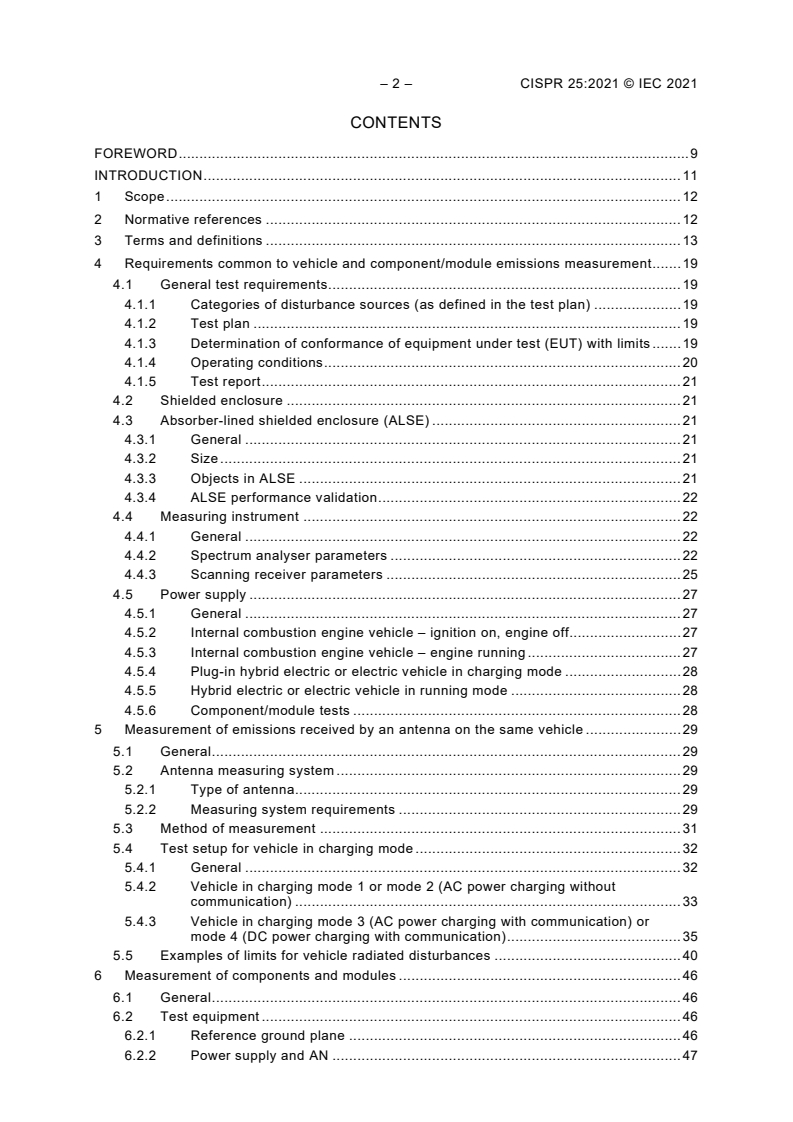
– 2 – CISPR 25:2021 © IEC 2021
CONTENTS
FOREWORD . 9
INTRODUCTION . 11
1 Scope . 12
2 Normative references . 12
3 Terms and definitions . 13
4 Requirements common to vehicle and component/module emissions measurement . 19
4.1 General test requirements . 19
4.1.1 Categories of disturbance sources (as defined in the test plan) . 19
4.1.2 Test plan . 19
4.1.3 Determination of conformance of equipment under test (EUT) with limits . 19
4.1.4 Operating conditions . 20
4.1.5 Test report . 21
4.2 Shielded enclosure . 21
4.3 Absorber-lined shielded enclosure (ALSE) . 21
4.3.1 General . 21
4.3.2 Size . 21
4.3.3 Objects in ALSE . 21
4.3.4 ALSE performance validation . 22
4.4 Measuring instrument . 22
4.4.1 General . 22
4.4.2 Spectrum analyser parameters . 22
4.4.3 Scanning receiver parameters . 25
4.5 Power supply . 27
4.5.1 General . 27
4.5.2 Internal combustion engine vehicle – ignition on, engine off. 27
4.5.3 Internal combustion engine vehicle – engine running . 27
4.5.4 Plug-in hybrid electric or electric vehicle in charging mode . 28
4.5.5 Hybrid electric or electric vehicle in running mode . 28
4.5.6 Component/module tests . 28
5 Measurement of emissions received by an antenna on the same vehicle . 29
5.1 General . 29
5.2 Antenna measuring system . 29
5.2.1 Type of antenna. 29
5.2.2 Measuring system requirements . 29
5.3 Method of measurement . 31
5.4 Test setup for vehicle in charging mode . 32
5.4.1 General . 32
5.4.2 Vehicle in charging mode 1 or mode 2 (AC power charging without
communication) . 33
5.4.3 Vehicle in charging mode 3 (AC power charging with communication) or
mode 4 (DC power charging with communication) . 35
5.5 Examples of limits for vehicle radiated disturbances . 40
6 Measurement of components and modules . 46
6.1 General . 46
6.2 Test equipment . 46
6.2.1 Reference ground plane . 46
6.2.2 Power supply and AN . 47
6.2.3 Load simulator . 47
6.3 Conducted emissions from components/modules – Voltage method . 47
6.3.1 General . 47
6.3.2 Test setup . 47
6.3.3 Test procedure . 48
6.3.4 Limits for conducted disturbances from components/modules – Voltage
method . 54
6.4 Conducted emissions from components/modules – current probe method . 54
6.4.1 General . 54
6.4.2 Test setup . 54
6.4.3 Test procedure . 55
6.4.4 Limits for conducted disturbances from components/modules – Current
probe method . 57
6.5 Radiated emissions from components/modules – ALSE method . 57
6.5.1 General . 57
6.5.2 Test setup . 58
6.5.3 Test procedure . 60
6.5.4 Limits for radiated disturbances from components/modules – ALSE
method . 65
6.6 Radiated emissions from components/modules – Stripline method . 72
Annex A (informative) Flow chart for checking the applicability of CISPR 25 to vehicles
and boats . 73
Annex B (normative) Antenna matching unit – Vehicle test . 74
B.1 Antenna matching unit parameters (150 kHz to 6,2 MHz) . 74
B.2 Antenna matching unit – verification . 74
B.2.1 General . 74
B.2.2 Gain measurement . 74
B.2.3 Test procedure . 74
B.3 Impedance measurement . 74
Annex C (informative) Sheath-current suppressor . 76
C.1 General information . 76
C.2 Suppressor construction . 76
Annex D (informative) Guidance for the determination of the noise floor of active
vehicle antennas . 77
Annex E (normative) Artificial Network (AN), High Voltage Artificial Network (HV-AN),
Direct Current charging Artificial Network (DC-charging-AN), Artificial Mains Network
(AMN) and Asymmetric Artificial Network (AAN). 80
E.1 General . 80
E.2 Artificial networks (AN) . 80
E.2.1 Component powered by LV . 80
E.2.2 Component powered by HV . 82
E.2.3 Direct Current charging Artificial Networks (DC-charging-AN) . 85
E.3 Artificial Mains Networks (AMN) . 86
E.4 Asymmetric Artificial Network (AAN) . 86
E.4.1 General . 86
E.4.2 Signal/control port with symmetric lines . 86
E.4.3 Wired network port with PLC on power lines . 87
E.4.4 Signal/control port with PLC (technology) on control pilot line . 88
E.4.5 Signal/control port with control pilot line . 89
– 4 – CISPR 25:2021 © IEC 2021
Annex F (informative) Radiated emissions from components/modules – Stripline
method . 91
F.1 General . 91
F.2 Test setup . 91
F.2.1 General . 91
F.2.2 Stripline impedance matching . 92
F.2.3 Location of the EUT . 92
F.2.4 Location and length of the test harness . 92
F.2.5 Location of the load simulator . 92
F.3 Test procedure. 92
F.4 Limits for radiated emissions from components/modules – Stripline method . 94
F.5 Stripline design . 96
Annex G (informative) Interference to mobile radio communication in the presence of
impulsive noise – Methods of judging degradation . 99
G.1 General . 99
G.2 Survey of methods of judging degradation to radio channel. 99
G.2.1 General . 99
G.2.2 Subjective tests . 99
G.2.3 Objective tests . 101
G.2.4 Conclusions relating to judgement of degradation . 101
Annex H (normative) Test methods for power supply systems for high voltages in
electric and hybrid vehicles . 102
H.1 General . 102
H.2 Test equipment . 102
H.2.1 Reference ground plane . 102
H.2.2 Power supply, AN, HV-AN, AMN and AAN . 103
H.2.3 Load simulator . 103
H.3 Conducted emission from components/modules on HV power lines – Voltage
method . 103
H.3.1 General . 103
H.3.2 Test setup . 104
H.3.3 Limits for conducted emission – Voltage method . 110
H.4 Conducted emission from components/modules on HV power lines – current
probe method . 111
H.4.1 General . 111
H.4.2 Test setup . 111
H.4.3 Limits for conducted emission – current probe method . 117
H.5 Radiated emissions from components/modules – ALSE method . 117
H.5.1 General . 117
H.5.2 Test setup . 117
H.5.3 Limits for radiated emissions – ALSE method . 123
H.6 Coupling between HV and LV systems . 123
H.6.1 General . 123
H.6.2 Measurement based on test setups defined in Clause 6. 123
H.6.3 Measurement of the HV-LV coupling attenuation . 130
Annex I (Informative) ALSE performance validation 150 kHz to 1 GHz . 133
I.1 General . 133
I.2 Validation method . 135
I.2.1 Overview . 135
I.2.2 Equipment . 135
I.2.3 Procedure . 138
I.2.4 Requirements . 147
Annex J (informative) Measurement instrumentation uncertainty – measurement of
emissions received by an antenna on the same vehicle . 148
J.1 General . 148
J.2 Uncertainty sources . 148
J.3 Measurand . 150
J.4 Input quantities to be considered . 150
J.4.1 General . 150
J.4.2 AM band with OEM passive vehicle antenna (high impedance) . 150
J.4.3 AM band with OEM active vehicle antenna (“matched 50 Ω” impedance) . 150
J.4.4 Others bands (e.g FM, DAB III, …) with OEM active vehicle antenna
(“matched 50 Ω” impedance) . 150
J.4.5 Others bands with reference antenna . 151
Annex K (informative) Uncertainty budgets for measurement of emissions received by
an antenna on the same vehicle . 156
K.1 General . 156
K.2 Typical CISPR 25 uncertainty budgets . 156
K.3 Receiver’s frequency step . 163
Annex L (informative) Measurement instrumentation uncertainty – Emissions from
components/modules – Test methods . 164
L.1 General . 164
L.2 Uncertainty sources . 164
L.3 Measurand . 168
L.4 Input quantities to be considered . 168
Annex M (informative) Uncertainty budgets for emissions from components/modules . 175
M.1 General . 175
M.2 Typical uncertainty budgets . 175
Annex N (informative) Items under consideration . 181
N.1 General . 181
N.2 Measurement techniques and limits . 181
N.3 ALSE performance validation method above 1 GHz . 181
N.4 Reconsideration of the scope of the document . 181
N.5 Reorganizing the document into separate parts similar to CISPR-16
document series . 181
N.6 Inclusion of test setups for WPT charging . 181
Bibliography . 182
Figure 1 – Method of determination of conformance for all frequency bands . 20
Figure 2 – Example of gain curve . 30
Figure 3 – Example of test setup – Vehicle-radiated emissions (front view with
monopole antenna) . 32
Figure 4 – Example of test setup for vehicle with the inlet located on vehicle side
(charging mode 1 or 2, AC powered, without communication) . 34
Figure 5 – Example of test setup for vehicle with the inlet located front / rear of vehicle
(charging mode 1 or 2, AC powered, without communication . 35
Figure 6 – Example of test setup for vehicle with the inlet located on vehicle side
(charging mode 3 or mode 4, with communication) . 38
– 6 – CISPR 25:2021 © IEC 2021
Figure 7 – Example of test setup for vehicle with the inlet located front /rear of vehicle
(charging mode 3 or mode 4, with communication) . 39
Figure 8 – Details of average limits for GPS, BDS,B1l and GLONASS bands –
Complete vehicle . 45
Figure 9 – Conducted emissions – Example of test setup for EUT with power return
line remotely grounded . 50
Figure 10 – Conducted emissions – Example of test setup for EUT with power return
line locally grounded . 51
Figure 11 – Conducted emissions – Example of test setup for alternators and
generators . 52
Figure 12 – Conducted emissions – Example of test setup for ignition system
components . 53
Figure 13 – Conducted emissions – Example of test setup for current probe
measurements . 56
Figure 14 – Test harness bending requirements. 59
Figure 15 – Example of test setup – rod antenna . 61
Figure 16 – Example of test setup – biconical antenna . 62
Figure 17 – Example of test setup – log-periodic antenna . 63
Figure 18 – Example of test setup – above 1 GHz – Horn antenna . 64
Figure 19 – Details of average limit for GPS, BDS, B1l and GLONASS bands –
Components . 72
Figure A.1 – Flow chart for checking the applicability of this document . 73
Figure B.1 – Verification setup . 75
Figure C.1 – Characteristic S of the sheath-current suppressor . 76
Figure D.1 – Example of vehicle test setup for equipment noise . 78
Figure D.2 – Example of vehicle test setup for antenna noise measurement . 79
Figure E.1 – Example of 5 µH AN schematic . 81
Figure E.2 – Characteristics of the AN impedance Z . 81
PB
Figure E.3 – Example of 5 µH HV-AN schematic . 83
Figure E.4 – Example of 5 µH HV-AN combination in a single shielded box . 84
Figure E.5 – Impedance matching network attached between HV-ANs and EUT . 85
Figure E.6 – Example of 5 μH DC-charging-AN schematic . 86
Figure E.7 – Example of an AAN for signal/control port with symmetric lines (e.g. CAN) . 87
Figure E.8 – Example of AAN with wired network port with PLC on AC or
DC power lines . 88
Figure E.9 – Example of AAN circuit for signal/control port with PLC on control pilot . 89
Figure E.10 – Example of AAN circuit for pilot line . 90
Figure F.1 – Example of a basic stripline test setup in a shielded enclosure . 93
Figure F.2 – Example for a 50 Ω stripline . 97
Figure F.3 – Example for a 90 Ω stripline . 98
Figure H.1 – Conducted emission – example for test setup for EUTs with shielded
power supply systems . 106
Figure H.2 – Conducted emission – example of test setup for EUTs with shielded
power supply systems with electric motor attached to the bench . 107
Figure H.3 – Conducted emission – Example of test setup for EUTs with shielded
power supply systems and inverter . 108
Figure H.4 – Conducted emission – Example of test setup for EUTs with shielded
power supply systems and charger device . 109
Figure H.5 – Conducted emission – Example of test setup current probe measurement
on HV lines for EUTs with shielded power supply systems . 113
Figure H.6 – Conducted emission – Example of test setup current probe measurement
on HV lines for EUTs with shielded power supply systems with electric motor attached
to the bench . 114
Figure H.7 – Conducted emission – Example of test setup current probe measurement
on HV lines for EUTs with shielded power supply systems and inverter . 115
Figure H.8 – Conducted emission – Example of test setup current probe measurement
on HV lines for EUTs with shielded power supply systems and charger device . 116
Figure H.9 – Radiated emission – Example of test setup measurement with biconical
antenna for EUTs with shielded power supply systems and with LV lines facing the
antenna . 119
Figure H.10 – Radiated emission – Example of test setup measurement with biconical
antenna for EUTs with shielded power supply systems with electric motor attached to
the bench and with LV lines facing the antenna . 120
Figure H.11 – Radiated emission – Example of test setup measurement with biconical
antenna for EUTs with shielded power supply systems and inverter and with LV lines
facing the antenna . 121
Figure H.12 – Radiated emission – Example of test setup measurement with biconical
antenna for EUTs with shielded power supply systems and charger device and with LV
lines facing the antenna . 122
Figure H.13 – Test setup for calibration of the test signal . 124
Figure H.14 – Example of test setup for conducted emissions – voltage method –
measurement on LV ports with injection on HV supply ports . 125
Figure H.15 – Example of test setup for conducted emissions – current probe method –
measurement on LV ports with injection on HV supply ports . 127
Figure H.16 – Example of test setup for radiated emissions – ALSE method –
measurement with biconical antenna with injection on HV supply ports . 129
Figure H.17 – Test setup for EUT S measurements . 131
Figure H.18 – Examples of requirements for coupling attenuation, a . 132
c
Figure I.1 – Examples of typical ALSE influence parameters over the 10 MHz to
100 MHz frequency range . 134
Figure I.2 – Visual representation of ALSE performance validation process . 135
Figure I.3 – Metallic sheet angles used as support for the rod . 137
Figure I.4 – Radiator side view 50 Ω terminations . 137
Figure I.5 – Photo of the radiator mounted on the ground reference plane . 137
Figure I.6 – Example VSWR measured from four radiation sources (without 10 dB
attenuator) . 138
Figure I.7 – Example setup for ALSE equivalent field strength measurement (rod
antenna shown for the frequency range from 150 kHz to 30 MHz) . 140
Figure I.8 – MoM-Model for the frequency range 30 MHz to 200 MHz . 142
Figure J.1 – Sources of measurement instrumentation uncertainty . 149
Figure K.1 – Example of measurement for frequency step uncertainty evaluation . 163
Figure L.1 – Sources of measurement instrumentation uncertainty – conducted
emissions from components/modules – Voltage method . 165
Figure L.2 – Sources of measurement instrumentation uncertainty – conducted
emissions from components/modules – Current probe method . 166
– 8 – CISPR 25:2021 © IEC 2021
Figure L.3 – Sources of measurement instrumentation uncertainty – radiated emissions
from components/modules – ALSE method . 167
Table 1 – Spectrum analyser parameters . 24
Table 2 – Scanning receiver parameters . 26
Table 3 – Antenna types . 29
Table 4 – Example for limits of disturbance – Complete vehicle – General . 40
Table 5 – Example for limits of disturbance – Complete vehicle – Digital mobile phone . 42
Table 6 – Examples of limits for conducted disturbances – Voltage method . 54
Table 7 – Examples of limits for conducted disturbances – Current probe method . 57
Table 8 – Examples of limits for radiated disturbances – ALSE method – General . 65
Table 9 – Examples of limits for radiated disturbances – ALSE method – Digital mobile
phone . 67
Table E.1 – Magnitude of the AN impedance Z . 82
PB
Table F.1 – Examples of limits for radiated disturbances – Stripline method . 94
Table H.1 – Example for HV limits for conducted voltage measurements at shielded
power supply devices (HV-LV coupling attenuation class A1) . 110
Table H.2 – Example of configurations for equipment without negative LV line . 131
Table H.3 – Example of configurations for equipment with negative LV line . 131
Table H.4 – Examples of requirements for minimum coupling attenuation, a . 132
c
Table I.1 – Reference data to be used for chamber validation . 142
Table J.1 – Input quantities to be considered for voltage at antenna terminal
measurements . 151
Table K.1 – Typical uncertainty budget – Voltage at antenna terminal – AM band with
OEM passive vehicle antenna (high impedance) . 156
Table K.2 – Typical uncertainty budget – Voltage at antenna terminal – AM band with
OEM active vehicle antenna (“matched 50 Ω” impedance) . 159
Table K.3 – Typical uncertainty budget – Voltage at antenna terminal – Others bands
with reference antenna . 161
Table L.1 – Input quantities to be considered for emissions from components/modules . 169
Table M.1 – Typical uncertainty budget – Conducted emissions from
components/modules – Voltage method and current probe method . 175
Table M.2 – Typical uncertainty budget – Radiated emissions from
components/modules – ALSE method . 177
INTERNATIONAL ELECTROTECHNICAL COMMISSION
INTERNATIONAL SPECIAL COMMITTEE ON RADIO INTERFERENCE
____________
VEHICLES, BOATS AND INTERNAL COMBUSTION ENGINES –
RADIO DISTURBANCE CHARACTERISTICS –
LIMITS AND METHODS OF MEASUREMENT FOR
THE PROTECTION OF ON-BOARD RECEIVERS
FOREWORD
1) The International Electrotechnical Commission (IEC) is a worldwide organization for standardization comprising
all national electrotechnical committees (IEC National Committees). The object of IEC is to promote international
co-operation on all questions concerning standardization in the electrical and electronic fields. To this end and
in addition to other activities, IEC publishes International Standards, Technical Specifications, Technical Reports,
Publicly Available Specifications (PAS) and Guides (hereafter referred to as “IEC Publication(s)”). Their
preparation is entrusted to technical committees; any IEC National Committee interested in the subject dealt with
may participate in this preparatory work. International, governmental and non-governmental organizations liaising
with the IEC also participate in this preparation. IEC collaborates closely with the International Organization for
Standardization (ISO) in accordance with conditions determined by agreement between the two organizations.
2) The formal decisions or agreements of IEC on technical matters express, as nearly as possible, an international
consensus of opinion on the relevant subjects since each technical committee has representation from all
interested IEC National Committees.
3) IEC Publications have the form of recommendations for international use and are accepted by IEC National
Committees in that sense. While all reasonable efforts are made to ensure that the technical content of IEC
Publications is accurate, IEC cannot be held responsible for the way in which they are used or for any
misinterpretation by any end user.
4) In order to promote international uniformity, IEC National Committees undertake to apply IEC Publications
transparently to the maximum extent possible in their national and regional publications. Any divergence between
any IEC Publication and the corresponding national or regional publication shall be clearly indicated in the latter.
5) IEC itself does not provide any attestation of conformity. Independent certification bodies provide conformity
assessment services and, in some areas, access to IEC marks of conformity. IEC is not responsible for any
services carried out by independent certification bodies.
6) All users should ensure that they have the latest edition of this publication.
7) No liability shall attach to IEC or its directors, employees, servants or agents including i
...