

IEC 62660-2:2010
(Main)Secondary lithium-ion cells for the propulsion of electric road vehicles - Part 2: Reliability and abuse testing
General Information
- Abstract
IEC 62660-2:2010 specifies test procedures to observe the reliability and abuse behaviour of secondary lithium-ion cells used for propulsion of electric vehicles including battery electric vehicles (BEV) and hybrid electric vehicles (HEV).
- Status
- Published
- Publication Date
- 15-Dec-2010
- Technical Committee
- TC 21 - Secondary cells and batteries
- Current Stage
- DELPUB - Deleted Publication
- Start Date
- 12-Dec-2018
- Completion Date
- 28-Aug-2026
Overview
IEC 62660-2:2010 is an international standard developed by the International Electrotechnical Commission (IEC) that sets out test procedures to evaluate the reliability and abuse behavior of secondary lithium-ion cells used in electric road vehicle propulsion. This includes both battery electric vehicles (BEV) and hybrid electric vehicles (HEV). As the adoption of electric vehicles grows globally, with increased focus on reducing CO2 emissions and enhancing energy security, ensuring the safety and durability of lithium-ion traction batteries becomes essential.
This standard specifically addresses the mechanical, thermal, and electrical abuse testing of lithium-ion cells to support the development of safer, more reliable battery packs and vehicle systems. It provides methodologies for observing cell performance under stress without prescribing pass-fail criteria, allowing for flexibility across varying battery and vehicle designs.
Key Topics
Scope and Purpose
Defines test conditions and procedures for secondary lithium-ion cells in automotive propulsion applications, focusing on their abuse tolerance and reliability under real-world stress factors.Test Conditions and Measuring Instruments
Specifies environmental parameters, measurement ranges for voltage, current, temperature, and other critical metrics essential for accurate testing.Mechanical Abuse Tests
- Vibration testing simulating vehicle operating conditions
- Mechanical shock assessments to evaluate cell response to sudden impacts
- Crush tests demonstrating tolerance to external physical deformation
Thermal Abuse Tests
- High temperature endurance testing to observe cell behavior under prolonged heat exposure
- Temperature cycling to simulate extreme temperature variations experienced by vehicles
Electrical Abuse Tests
- External short circuit testing to evaluate safety under fault conditions
- Overcharge and forced discharge testing to assess cell stability during abnormal electrical loads
Result Reporting
Standardized classifications and descriptive reporting for test outcomes to aid battery designers and manufacturers in evaluating cell robustness.
Applications
IEC 62660-2:2010 is crucial for stakeholders in the electric vehicle industry including:
- Battery manufacturers who require reliable test methodologies to verify cell safety and durability for automotive applications.
- Vehicle OEMs (Original Equipment Manufacturers) designing battery systems and packs that meet international reliability requirements.
- Testing laboratories and certification bodies performing abuse tests to validate battery cell performance in compliance with international norms.
- Battery system integrators and developers assessing cell behavior under mechanical, thermal, and electrical stress before pack assembly.
By following this standard, manufacturers can enhance the safety profiles of their lithium-ion cells, ensuring better performance in battery electric vehicles (BEVs) and hybrid electric vehicles (HEVs), thus accelerating the wide adoption of sustainable mobility solutions.
Related Standards
- IEC 62660-1: Specifies performance testing of secondary lithium-ion cells for electric vehicle propulsion, complementing the abuse and reliability focus of IEC 62660-2.
- ISO 12405 series (under consideration): Defines requirements for lithium-ion battery packs and systems, expanding on cell-level testing to complete battery assemblies.
- Other IEC standards covering portable and stationary lithium-ion batteries, providing broader context but differing in scope from automotive traction battery requirements.
By adopting IEC 62660-2:2010, the electric vehicle industry benefits from a globally harmonized framework for ensuring the safety, reliability, and abuse resilience of lithium-ion traction cells - key factors in advancing electric mobility and consumer confidence.
Keywords: IEC 62660-2, lithium-ion cells, electric vehicle propulsion, BEV, HEV, battery reliability testing, abuse testing, secondary lithium-ion batteries, battery safety standards, electric vehicle battery testing
Relations
- Effective Date
- 05-Sep-2023
Get Certified
Connect with accredited certification bodies for this standard

DNV
DNV is an independent assurance and risk management provider.

TÜV Rheinland
TÜV Rheinland is a leading international provider of technical services.

TÜV SÜD
TÜV SÜD is a trusted partner of choice for safety, security and sustainability solutions.
Sponsored listings
Frequently Asked Questions
IEC 62660-2:2010 is a standard published by the International Electrotechnical Commission (IEC). Its full title is "Secondary lithium-ion cells for the propulsion of electric road vehicles - Part 2: Reliability and abuse testing". This standard covers: IEC 62660-2:2010 specifies test procedures to observe the reliability and abuse behaviour of secondary lithium-ion cells used for propulsion of electric vehicles including battery electric vehicles (BEV) and hybrid electric vehicles (HEV).
IEC 62660-2:2010 specifies test procedures to observe the reliability and abuse behaviour of secondary lithium-ion cells used for propulsion of electric vehicles including battery electric vehicles (BEV) and hybrid electric vehicles (HEV).
IEC 62660-2:2010 is classified under the following ICS (International Classification for Standards) categories: 27.120 - Nuclear energy engineering; 29.220.20 - Acid secondary cells and batteries; 43.120 - Electric road vehicles. The ICS classification helps identify the subject area and facilitates finding related standards.
IEC 62660-2:2010 has the following relationships with other standards: It is inter standard links to IEC 62660-2:2018. Understanding these relationships helps ensure you are using the most current and applicable version of the standard.
IEC 62660-2:2010 is available in PDF format for immediate download after purchase. The document can be added to your cart and obtained through the secure checkout process. Digital delivery ensures instant access to the complete standard document.
Standards Content (Sample)
IEC 62660-2 ®
Edition 1.0 2010-12
INTERNATIONAL
STANDARD
NORME
INTERNATIONALE
colour
inside
Secondary lithium-ion cells for the propulsion of electric road vehicles –
Part 2: Reliability and abuse testing
Éléments d’accumulateurs lithium-ion pour la propulsion des véhicules routiers
électriques –
Partie 2: Essais de fiabilité et de traitement abusif
All rights reserved. Unless otherwise specified, no part of this publication may be reproduced or utilized in any form or by
any means, electronic or mechanical, including photocopying and microfilm, without permission in writing from either IEC or
IEC's member National Committee in the country of the requester.
If you have any questions about IEC copyright or have an enquiry about obtaining additional rights to this publication,
please contact the address below or your local IEC member National Committee for further information.
Droits de reproduction réservés. Sauf indication contraire, aucune partie de cette publication ne peut être reproduite
ni utilisée sous quelque forme que ce soit et par aucun procédé, électronique ou mécanique, y compris la photocopie
et les microfilms, sans l'accord écrit de la CEI ou du Comité national de la CEI du pays du demandeur.
Si vous avez des questions sur le copyright de la CEI ou si vous désirez obtenir des droits supplémentaires sur cette
publication, utilisez les coordonnées ci-après ou contactez le Comité national de la CEI de votre pays de résidence.
IEC Central Office
3, rue de Varembé
CH-1211 Geneva 20
Switzerland
Email: inmail@iec.ch
Web: www.iec.ch
About the IEC
The International Electrotechnical Commission (IEC) is the leading global organization that prepares and publishes
International Standards for all electrical, electronic and related technologies.
About IEC publications
The technical content of IEC publications is kept under constant review by the IEC. Please make sure that you have the
latest edition, a corrigenda or an amendment might have been published.
§ Catalogue of IEC publications: www.iec.ch/searchpub
The IEC on-line Catalogue enables you to search by a variety of criteria (reference number, text, technical committee,…).
It also gives information on projects, withdrawn and replaced publications.
§ IEC Just Published: www.iec.ch/online_news/justpub
Stay up to date on all new IEC publications. Just Published details twice a month all new publications released. Available
on-line and also by email.
§ Electropedia: www.electropedia.org
The world's leading online dictionary of electronic and electrical terms containing more than 20 000 terms and definitions
in English and French, with equivalent terms in additional languages. Also known as the International Electrotechnical
Vocabulary online.
§ Customer Service Centre: www.iec.ch/webstore/custserv
If you wish to give us your feedback on this publication or need further assistance, please visit the Customer Service
Centre FAQ or contact us:
Email: csc@iec.ch
Tel.: +41 22 919 02 11
Fax: +41 22 919 03 00
A propos de la CEI
La Commission Electrotechnique Internationale (CEI) est la première organisation mondiale qui élabore et publie des
normes internationales pour tout ce qui a trait à l'électricité, à l'électronique et aux technologies apparentées.
A propos des publications CEI
Le contenu technique des publications de la CEI est constamment revu. Veuillez vous assurer que vous possédez
l’édition la plus récente, un corrigendum ou amendement peut avoir été publié.
§ Catalogue des publications de la CEI: www.iec.ch/searchpub/cur_fut-f.htm
Le Catalogue en-ligne de la CEI vous permet d’effectuer des recherches en utilisant différents critères (numéro de référence,
texte, comité d’études,…). Il donne aussi des informations sur les projets et les publications retirées ou remplacées.
§ Just Published CEI: www.iec.ch/online_news/justpub
Restez informé sur les nouvelles publications de la CEI. Just Published détaille deux fois par mois les nouvelles
publications parues. Disponible en-ligne et aussi par email.
§ Electropedia: www.electropedia.org
Le premier dictionnaire en ligne au monde de termes électroniques et électriques. Il contient plus de 20 000 termes et
définitions en anglais et en français, ainsi que les termes équivalents dans les langues additionnelles. Egalement appelé
Vocabulaire Electrotechnique International en ligne.
§ Service Clients: www.iec.ch/webstore/custserv/custserv_entry-f.htm
Si vous désirez nous donner des commentaires sur cette publication ou si vous avez des questions, visitez le FAQ du
Service clients ou contactez-nous:
Email: csc@iec.ch
Tél.: +41 22 919 02 11
Fax: +41 22 919 03 00
IEC 62660-2 ®
Edition 1.0 2010-12
INTERNATIONAL
STANDARD
NORME
INTERNATIONALE
colour
inside
Secondary lithium-ion cells for the propulsion of electric road vehicles –
Part 2: Reliability and abuse testing
Éléments d’accumulateurs lithium-ion pour la propulsion des véhicules routiers
électriques –
Partie 2: Essais de fiabilité et de traitement abusif
INTERNATIONAL
ELECTROTECHNICAL
COMMISSION
COMMISSION
ELECTROTECHNIQUE
PRICE CODE
INTERNATIONALE
S
CODE PRIX
ICS 29.220.20, 43.120 ISBN 978-2-88912-302-5
– 2 – 62660-2 Ó IEC:2010
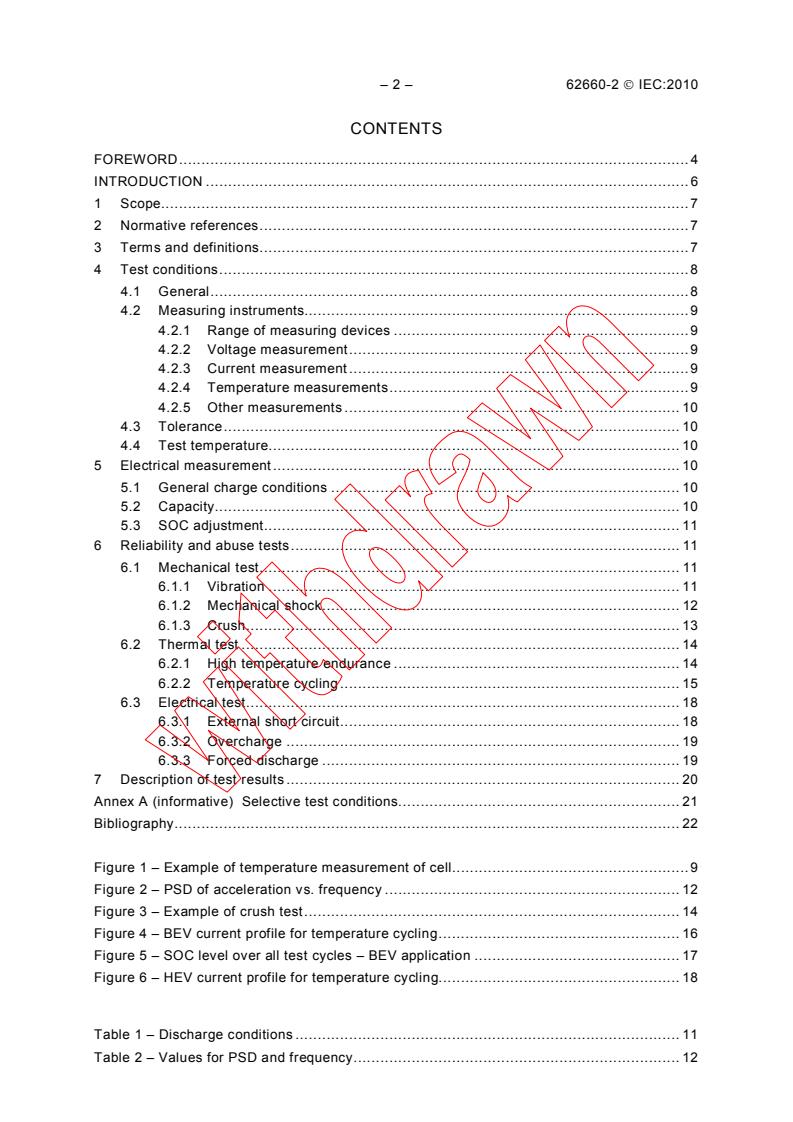
CONTENTS
FOREW ORD . 4
INTRODUCTION . 6
1 Sc o pe . 7
2 Normative references . 7
3 Terms and definitions . 7
4 Test conditions . 8
4.1 Ge n eral . 8
4.2 Measuring instruments. 9
4.2.1 Range of measuring devices . 9
4.2.2 Voltage measurement . 9
4.2.3 Current measurement . 9
4.2.4 Temperature measurements . 9
4.2.5 Other measurements . 10
4.3 Tolerance . 10
4.4 Test temperature. 10
5 Electrical measurement . 10
5.1 General charge conditions . 10
5.2 Capacity . 10
5.3 SOC adjustment . 11
6 Reliability and abuse tests . 11
6.1 Mechanical test . 11
6.1.1 Vibration . 11
6.1.2 Mechanical shock . 12
6.1.3 Crush . 13
6.2 Thermal test . 14
6.2.1 High temperature endurance . 14
6.2.2 Temperature cycling . 15
6.3 Electrical test . 18
6.3.1 External short circuit . 18
6.3.2 Overcharge . 19
6.3.3 Forced discharge . 19
7 Description of test results . 20
Annex A (informative) Selective test conditions. 21
Bibliography . 22
Figure 1 – Example of temperature measurement of cell. 9
Figure 2 – PSD of acceleration vs. frequency . 12
Figure 3 – Example of crush test . 14
Figure 4 – BEV current profile for temperature cycling . 16
Figure 5 – SOC level over all test cycles – BEV application . 17
Figure 6 – HEV current profile for temperature cycling. 18
Table 1 – Discharge conditions . 11
Table 2 – Values for PSD and frequency . 12
62660-2 Ó IEC:2010 – 3 –
Table 3 – Mechanical shock test – parameters . 13
Table 4 – Temperatures and time duration for temperature cycling . 15
Table 5 – Temperatures and time duration for temperature cycling . 16
Table 6 – Test steps and BEV current profile . 17
Table 7 – Test steps and HEV current profile. 18
Table A.1 – Capacity test conditions . 21
– 4 – 62660-2 Ó IEC:2010
INTERNATIONAL ELECTROTECHNICAL COMMISSION
____________
SECONDARY LITHIUM-ION CELLS FOR THE PROPULSION
OF ELECTRIC ROAD VEHICLES –
Part 2: Reliability and abuse testing
FOREWORD
1) The International Electrotechnical Commission (IEC) is a worldwide organization for standardization comprising
all national electrotechnical committees (IEC National Committees). The object of IEC is to promote
international co-operation on all questions concerning standardization in the electrical and electronic fields. To
this end and in addition to other activities, IEC publishes International Standards, Technical Specifications,
Technical Reports, Publicly Available Specifications (PAS) and Guides (hereafter referred to as “IEC
Publication(s)”). Their preparation is entrusted to technical committees; any IEC National Committee interested
in the subject dealt with may participate in this preparatory work. International, governmental and non-
governmental organizations liaising with the IEC also participate in this preparation. IEC collaborates closely
with the International Organization for Standardization (ISO) in accordance with conditions determined by
agreement between the two organizations.
2) The formal decisions or agreements of IEC on technical matters express, as nearly as possible, an international
consensus of opinion on the relevant subjects since each technical committee has representation from all
interested IEC National Committees.
3) IEC Publications have the form of recommendations for international use and are accepted by IEC National
Committees in that sense. While all reasonable efforts are made to ensure that the technical content of IEC
Publications is accurate, IEC cannot be held responsible for the way in which they are used or for any
misinterpretation by any end user.
4) In order to promote international uniformity, IEC National Committees undertake to apply IEC Publications
transparently to the maximum extent possible in their national and regional publications. Any divergence
between any IEC Publication and the corresponding national or regional publication shall be clearly indicated in
the latter.
5) IEC itself does not provide any attestation of conformity. Independent certification bodies provide conformity
assessment services and, in some areas, access to IEC marks of conformity. IEC is not responsible for any
services carried out by independent certification bodies.
6) All users should ensure that they have the latest edition of this publication.
7) No liability shall attach to IEC or its directors, employees, servants or agents including individual experts and
members of its technical committees and IEC National Committees for any personal injury, property damage or
other damage of any nature whatsoever, whether direct or indirect, or for costs (including legal fees) and
expenses arising out of the publication, use of, or reliance upon, this IEC Publication or any other IEC
Publications.
8) Attention is drawn to the Normative references cited in this publication. Use of the referenced publications is
indispensable for the correct application of this publication.
9) Attention is drawn to the possibility that some of the elements of this IEC Publication may be the subject of
patent rights. IEC shall not be held responsible for identifying any or all such patent rights.
International Standard IEC 62660-2 has been prepared by IEC technical committee 21:
Secondary cells and batteries.
The text of this standard is based on the following documents:
FDIS Report on voting
21/727/FDIS 21/731/RVD
Full information on the voting for the approval of this standard can be found in the report on
voting indicated in the above table.
This publication has been drafted in accordance with the ISO/IEC Directives, Part 2.
A list of all the parts in the IEC 62660 series, published under the general title Secondary lithium-ion
cells for the propulsion of electric road vehicles, can be found on the IEC website.
62660-2 Ó IEC:2010 – 5 –
The committee has decided that the contents of this amendment and the base publication will
remain unchanged until the stability date indicated on the IEC web site under
"http://webstore.iec.ch" in the data related to the specific publication. At this date, the
publication will be
• reconfirmed,
• withdrawn,
• replaced by a revised edition, or
• amended.
IMPORTANT – The “colour inside” logo on the cover page of this publication indicates
that it contains colours which are considered to be useful for the correct understanding
of its contents. Users should therefore print this publication using a colour printer.
– 6 – 62660-2 Ó IEC:2010
INTRODUCTION
The commercialisation of electric road vehicles including battery, hybrid and plug-in hybrid
electric vehicles has been accelerated in the global market, responding to the global concerns
on CO reduction and energy security. This, in turn, has led to rapidly increasing demand for
high-power and high-energy density traction batteries. Lithium-ion batteries are estimated to
be one of the most promising secondary batteries for the propulsion of electric vehicles. In the
light of rapidly diffusing hybrid electric vehicles and emerging battery and plug-in hybrid
electric vehicles, a standard method for testing reliability and abuse requirements of lithium-
ion batteries is indispensable for securing a basic level of safety and obtaining essential data
for the design of vehicle systems and battery packs.
This standard is to specify reliability and abuse testing for automobile traction lithium-ion cells
that basically differ from the other cells including those for portable and stationary
applications specified by the other IEC standards. For automobile application, it is important
to note the usage specificity; i.e. the designing diversity of automobile battery packs and
systems, and specific requirements for cells and batteries corresponding to each of such
designs. Based on these facts, the purpose of this standard is to provide a basic test
methodology with general versatility, which serves a function in common primary testing of
lithium ion cells to be used in a variety of battery systems. For the requirements for cells differ
depending on the system designs of battery pack or vehicle, and should be evaluated by the
users, this standard does not provide any pass-fail criteria for the tests, but specifies a
standard classification of descriptions for test results.
This standard is associated with ISO 12405-1-and ISO 12405-2 .
IEC 62660-1 specifies the performance testing of lithium-ion cells for electric vehicle
application.
———————
Under consideration.
62660-2 Ó IEC:2010 – 7 –
SECONDARY LITHIUM-ION CELLS FOR THE PROPULSION
OF ELECTRIC ROAD VEHICLES –
Part 2: Reliability and abuse testing
1 Scope
This part of IEC 62660 specifies test procedures to observe the reliability and abuse
behaviour of secondary lithium-ion cells used for propulsion of electric vehicles including
battery electric vehicles (BEV) and hybrid electric vehicles (HEV).
The objective of this standard is to specify the standard test procedures and conditions for
basic characteristics of lithium-ion cells for use in propulsion of battery and hybrid electric
vehicles. The tests are indispensable for obtaining essential data on reliability and abuse
behaviour of lithium-ion cells for use in various designs of battery systems and battery packs.
This standard provides standard classification of description of test results to be used for the
design of battery systems or battery packs.
NOTE 1 The reliability and abuse tests for the electrically connected lithium-ion cells may be performed with
reference to this standard.
NOTE 2 The test specification for lithium-ion battery packs and systems is defined in ISO 12405-1 and
ISO 12405-2 (under consideration).
2 Normative references
The following referenced documents are indispensable for the application of this document.
For dated references, only the edition cited applies. For undated references, the latest edition
of the referenced document (including any amendments) applies.
IEC 60050-482, International Electrotechnical Vocabulary – Part 482: Primary and secondary
cells and batteries
IEC 60068-2-64, Environmental testing – Part 2-64: Tests – Test Fh: Vibration, broadband
random and guidance
IEC 61434, Secondary cells and batteries containing alkaline or other non-acid electrolytes –
Guide to the designation of current in alkaline secondary cell and battery standards
ISO 16750-3, Road vehicles – Environmental conditions and testing for electrical and
electronic equipment – Part 3: Mechanical loads
ISO 16750-4, Road vehicles – Environmental conditions and testing for electrical and
electronic equipment – Part 4: Climatic loads
3 Terms and definitions
For the purposes of this document, the terms and definitions given in IEC 60050-482 and the
following apply.
– 8 – 62660-2 Ó IEC:2010
3.1
battery electric vehicle
BEV
electric vehicle with only a traction battery as power source for vehicle propulsion
3.2
hybrid electric vehicle
HEV
vehicle with both a rechargeable energy storage system and a fuelled power source for
propulsion
3.3
rated capacity
quantity of electricity C Ah (ampere-hours) for BEV and C Ah for HEV declared by the
3 1
manufacturer
3.4
reference test current
I
t
current in amperes which is expressed as
I (A) = C (Ah)/ 1 (h)
t n
where
C is the rated capacity of the cell ;
n
n is the time base (hours).
3.5
room temperature
temperature of 25 °C ± 2 K
3.6
secondary lithium ion cell
secondary single cell whose electrical energy is derived from the insertion/extraction
reactions of lithium ions between the anode and the cathode
NOTE 1 The secondary cell is a basic manufactured unit providing a source of electrical energy by direct
conversion of chemical energy. The cell consists of electrodes, separators, electrolyte, container and terminals,
and is designed to be charged electrically.
NOTE 2 In this standard, cell or secondary cells means the secondary lithium ion cell to be used for the
propulsion of electric road vehicles.
3.7
state of charge
SOC
available capacity in a battery expressed as a percentage of rated capacity
4 Test conditions
4.1 General
The details of the instrumentation used shall be provided in any report of results.
62660-2 Ó IEC:2010 – 9 –
4.2 Measuring instruments
4.2.1 Range of measuring devices
The instruments used shall enable the values of voltage and current to be measured. The
range of these instruments and measuring methods shall be chosen so as to ensure the
accuracy specified for each test.
For analogue instruments, this implies that the readings shall be taken in the last third of the
graduated scale.
Any other measuring instruments may be used provided they give an equivalent accuracy.
4.2.2 Voltage measurement
The resistance of the voltmeters used shall be at least 1 M W/V.
4.2.3 Current measurement
The entire assembly of ammeter, shunt and leads shall be of an accuracy class of 0,5 or
better.
4.2.4 Temperature measurements
The cell temperature shall be measured by use of a surface temperature measuring device
capable of an equivalent scale definition and accuracy of calibration as specified in 4.2.1. The
temperature should be measured at a location which most closely reflects the cell
temperature. The temperature may be measured at additional appropriate locations, if
necessary.
The examples for temperature measurement are shown in Figure 1. The instructions for
temperature measurement specified by the manufacturer shall be followed.
Prismatic or flat cell Cylindrical cell
Temperature measuring device
Cell
Cell Cell
Insulating material
IEC 2861/10
Figure 1 – Example of temperature measurement of cell
– 10 – 62660-2 Ó IEC:2010
4.2.5 Other measurements
Other values including capacity and power may be measured by use of a measuring device,
provided that it complies with 4.3.
4.3 Tolerance
The overall accuracy of controlled or measured values, relative to the specified or actual
values, shall be within these tolerances:
a) ±0,1 % for voltage;
b) ±1 % for current;
c) ±2 K for temperature;
d) ±0,1 % for time;
e) ±0,1 % for mass;
f) ±0,1 % for dimensions.
These tolerances comprise the combined accuracy of the measuring instruments, the
measurement technique used, and all other sources of error in the test procedure.
4.4 Test temperature
If not otherwise defined, before each test the cell shall be stabilized at the test temperature
for a minimum of 12 h. This period can be reduced if thermal stabilization is reached. Thermal
stabilization is considered to be reached if after one interval of 1 h, the change of cell
temperature is lower than 1 K.
Unless otherwise stated in this standard, cells shall be tested at room temperature using the
method declared by the manufacturer.
5 Electrical measurement
5.1 General charge conditions
Unless otherwise stated in this standard, prior to electrical measurement test, the cell shall
be charged as follows.
Prior to charging, the cell shall be discharged at room temperature at a constant current
described in Table 1 down to a end-of-discharge voltage specified by the manufacturer. Then,
the cell shall be charged according to the charging method declared by the manufacturer at
room temperature.
5.2 Capacity
Capacity of cell shall be measured in accordance with the following steps.
Step 1 – The cell shall be charged in accordance with 5.1.
After recharge, the cell temperature shall be stabilized in accordance with 4.4.
Step 2 – The cell shall be discharged at specified temperature at a constant current I (A) to
t
the end-of-discharge voltage that is provided by the manufacturer. The discharge current and
temperatures indicated in Table 1 shall be used.
NOTE In addition to Table 1, specific test conditions may be selected based on the agreement between the
manufacturer and the customer. Selective test conditions are shown in Table A.1 in Annex A.
62660-2 Ó IEC:2010 – 11 –
The method of designation of test current I is defined in IEC 61434.
t
Table 1 – Discharge conditions
Discharge current
A
Temperature
BEV application HEV application
°C
25 1/3 I 1 I
t t
Step 3 – Measure the discharge endurance duration until the specified end-of-discharge
voltage is reached, and calculate the capacity of cell expressed in Ah up to three significant
figures.
5.3 SOC adjustment
The test cells shall be charged as specified below. The SOC adjustment is the procedure to
be followed for preparing cells to the various SOCs for the tests in this standard.
Step 1 – The cell shall be charged in accordance with 5.1.
Step 2 – The cell shall be left at rest at room temperature in accordance with 4.4.
Step 3 – The cell shall be discharged at a constant current according to Table 1 for (100 –
n)/100 ´ 3 h for BEV application and (100 – n)/100 ´ 1 h for HEV application, where n is SOC
(%) to be adjusted for each test.
6 Reliability and abuse tests
For all the tests specified in this clause, the test installation shall be reported including fixing
and wiring of the cell.
6.1 Mechanical test
6.1.1 Vibration
This test is performed to characterize cell responses to vibration assumed in the use of
vehicle.
6.1.1.1 Test
The test shall be performed as follows.
a) Adjust the SOC of cell to 100 % for BEV application, and to 80 % for HEV application in
accordance with 5.3.
b) Perform the test referring to IEC 60068-2-64 random vibration. Use test duration of 8 h for
each plane of the test cell.
c) The r.m.s. acceleration value shall be 27,8 m/s . The power spectrum density (PSD) vs.
frequency is shown in Figure 2 and Table 2. The maximum frequency shall be 2 000 Hz.
– 12 – 62660-2 Ó IEC:2010
00,1,1
0,01
0,01
1 10 100 1 000 10 000
1 10 100 1000 10000
FreFreququeennccy (Hy [Hzz) ]
IEC 2877/10
Figure 2 – PSD of acceleration vs. frequency
Table 2 – Values for PSD and frequency
Frequency PSD
2 2
Hz (m/s ) /Hz
10 20
55 6,5
180 0,25
300 0,25
360 0,14
1 000 0,14
2 000 0,14
6.1.1.2 Test results
The following shall be measured and recorded as test results:
· cell voltage and capacity at the beginning and at the end of the test;
· conditions of cell at the end of test in accordance with the description specified in
Clause 7.
6.1.2 Mechanical shock
This test is performed to characterize cell responses to mechanical shocks assumed in the
use of vehicle.
2 2
PSPDSD ([((mm//ss²))²/H/Hzz)
62660-2 Ó IEC:2010 – 13 –
6.1.2.1 Test
The test shall be performed as follows.
a) Adjust the SOC of cell to 100 % for BEV application and to 80 % for HEV application in
accordance with 5.3.
b) Perform the test in accordance with ISO 16750-3 as shown in Table 3. Acceleration from
the shock in the test shall be applied in the same direction as the acceleration of the
shock that occurs in the vehicle. If the direction of the effect is not known, the cell shall be
tested in all six spatial directions.
Table 3 – Mechanical shock test – parameters
Pulse shape half-sinusoidal
Acceleration 500 m/s
Duration 6 ms
Number of shocks 10 per test direction
NOTE If more severe test parameters are requested by any regulation, such test conditions may be applied.
6.1.2.2 Test results
The following shall be measured and recorded as test results:
· cell voltage and capacity at the beginning and at the end of the test;
· conditions of cell at the end of test in accordance with the description specified in 7.
6.1.3 Crush
This test is performed to characterize cell responses to external load forces that may cause
deformation.
6.1.3.1 Test
The test shall be performed as follows.
a) Adjust the SOC of cell to 100 % for BEV application and 80 % for HEV application in
accordance with 5.3.
b) The cell shall be placed on an insulated flat surface and be crushed with a crushing tool of
round or semicircular bar, or sphere or hemisphere with a 150 mm diameter. It is
recommended to use the round bar to crush a cylindrical cell, and the sphere for a
prismatic cell (see Figure 3). The force for the crushing shall be applied in direction nearly
perpendicular to a layered face of positive and negative electrodes inside cell. The
crushing tool shall be selected so that the cell is deformed nearly in proportion to the
increase of crushing force.
c) The force shall be released when an abrupt voltage drop of one-third of the original cell
voltage occurs, or a deformation of 15 % or more of initial cell dimension occurs, or the
force of 1 000 times the weight of cell applied. The cells remain on test for 24 h or until the
case temperature declines by 20 % of the maximum temperature rise, whichever is the
sooner.
– 14 – 62660-2 Ó IEC:2010
Example A Example B
Crushing tool:
Crushing tool:
Hemisphere
Semicircular bar
Cylindrical cell Prismatic cell
: Crushing direction
IEC 2878/10
Figure 3 – Example of crush test
6.1.3.2 Test results
The following shall be measured and recorded as test results:
· form of crushing tool;
· crushing speed;
· cell voltage during the test;
· cell temperature during the test;
· conditions of cell at the end of test in accordance with the description specified in
Clause 7
6.2 Thermal test
6.2.1 High temperature endurance
This test is performed to characterize cell responses to high-temperature environment.
6.2.1.1 Test
The test shall be performed as follows.
a) Adjust the SOC of cell to 100 % for BEV application, and to 80 % for HEV application in
accordance with 5.3.
b) The cell, stabilized at room temperature, shall be placed in a gravity or circulating air-
convection oven. The oven temperature shall be raised at a rate of 5 K/min to a
temperature of 130 °C ± 2 K. The cell shall remain at this temperature for 30 min before
the test is discontinued.
NOTE If necessary, to prevent deformation, the cell may be maintained during the test in a manner that does not
violate the test purpose.
6.2.1.2 Test results
The following shall be measured and recorded as test results:
Ÿ conditions of cell at the end of test in accordance with the description specified in
Clause 7.
62660-2 Ó IEC:2010 – 15 –
It is recommended to measure the cell temperature and voltage, and oven temperature during
the test.
6.2.2 Temperature cycling
This test is performed to characterize thermal durability of cell by exposing at low and high
temperature environment alternately to cause expansion and contraction of cell components.
6.2.2.1 Test
Either of the test procedures specified in 6.2.2.1.1 or 6.2.2.1.2 shall be performed according
to the agreement between the customer and the manufacturer.
6.2.2.1.1 Test without electrical operation
The test shall be performed as follows.
a) Adjust the SOC of cell to 100 % for BEV application, and to 80 % for HEV application in
accordance with 5.3.
b) Perform the temperature cycling in accordance with ISO 16750-4 as shown in Table 4.
The minimum operating temperature shall be –40 °C or T specified by the manufacturer
min
and the maximum operating temperature shall be 85 °C or T specified by the
max
manufacturer. Perform 30 test cycles as specified.
Table 4 – Temperatures and time duration for temperature cycling
Cumulative time Temperature
min °C
0 25
60 T
min
T
min
210 25
T
max
T
max
480 25
6.2.2.1.2 Test with electrical operation
The test shall be performed as follows.
a) Adjust the SOC of cell to 80 % for BEV application, and to 60 % for HEV application in
accordance with 5.3.
b) Perform the temperature cycling in accordance with ISO 16750-4 as shown in Table 5.
The minimum operating temperature shall be –20 °C and the maximum operating
temperature shall be 65 °C.
c) Perform the following current profiles during each temperature cycle:
– BEV current profile in accordance with Figure 4 and Table 6;
– HEV current profile in accordance with Figure 6 and Table 7.
d) Perform 30 test cycles as specified.
– 16 – 62660-2 Ó IEC:2010
Table 5 – Temperatures and time duration for temperature cycling
Cumulative time Temperature
min °C
0 25
60 –20
150 –20
210 25
300 65
410 65
480 25
100 3
2,5
SOC
1,5
Discharge Temperature
0,5
C-rate
Charge
–0,5
–1
0 30 60 90 120 150 180 210 240 270 300 330 360 390 420 450 480
–10
–1,5
–20
–30 –2
Time (min)
IEC 2879/10
Figure 4 – BEV current profile for temperature cycling
SOC (%), T (°C)
C-rate
62660-2 Ó IEC:2010 – 17 –
Table 6 – Test steps and BEV current profile
BEV current profile Background information
Step time Cumulative time Delta SOC SOC
Step C-rate Example
min min % %
0 0 0 80
1 145 145 0 0 80
2 1 146 1 –1,67 78,33 1 min driving
3 64 210 0
4 12 222 0,5 –10 68,33 12 min driving
5 1 223 0
6 39 262 –0,2 13 81,33 charging
7 138 400 0
8 3 403 0,5 –2,5 78,83 3 min driving
9 77 480 0 78,83
SOC
BEV: all 30 test cycles
0 30 60 90 120 150 180 210 240
Time (min)
IEC 2880/10
Figure 5 – SOC level over all test cycles – BEV application
Figure 5 shows the SOC level over the cumulative test time for a BEV application.
SOC (%)
– 18 – 62660-2 Ó IEC:2010
SOC (%)
T (°C)
Discharge
10 C-rate
5 000 10 000 20 000 25 000
15 000
–10
Charge
–30
Time (s)
IEC 2881/10
Figure 6 – HEV current profile for temperature cycling
Table 7 – Test steps and HEV current profile
HEV current profile Background information
Step time Cumulative time Delta SOC SOC
Step C-rate Example
s s % %
0 0 0 60
1 8 700 8 700 0 60
2 5 8 705 10 –1,39 58,61 5 s cold start
3 5 695 14 400 0
4 10 14 410 –10 2,78 61,39 10 s recuperation
5 590 15 000 0
6 120 15 120 –5 16,7 78,09 2 min charging
7 480 15 600 0
8 120 15 720 5 –16,7 61,39 2 min driving
9 8 580 24 300 0
10 5 24 305 10 –1,39 60 5 s hot start
11 4 495 28 800 0 60
6.2.2.2 Test results
The following shall be measured and recorded as test results:
· cell voltage and capacity at the beginning and at the end of the test;
· conditions of cell at the end of test in accordance with the description specified in
Clause 7;
· cell voltage, current and temperature shall be continuously recorded during each cycle.
6.3 Electrical test
NOTE If necessary, to prevent deformation, the cell may be maintained during the test in a manner that does not
violate the test purpose.
6.3.1 External short circuit
This test is performed to characterize cell responses to external short circuit.
62660-2 Ó IEC:2010 – 19 –
6.3.1.1 Test
The test shall be performed as follows.
a) Adjust the SOC of cell to 100 % in accordance with 5.3.
b) Adjusted cell as above a) shall be stored at room temperature, and be then short-circuited
by connecting the positive and negative terminals with an external resistance for 10 min. A
total external resistance shall be equal to or less than 5 mW as agreed between the
customer and the manufacturer.
6.3.1.2 Test results
The following shall be measured and recorded as test results; the sample rate for voltage and
current recording shall be ≤ 10 ms:
· cell voltage during the test;
· cell current during the test. If the accuracy deviates from the requirements of 4.3, it shall
be reported;
· cell temperature during the test;
· total external resistance value
· conditions of cell at the end of test in accordance with the description specified in
Clause 7.
6.3.2 Overcharge
This test is performed to characterize cell responses to overcharge.
6.3.2.1 Test
The test shall be performed as follows.
a) Adjust the SOC of cell to 100 % in accordance with 5.3.
b) Continue charging the cell beyond the 100 % SOC with charging current 1 I for BEV
t
application and 5 I for HEV application at room temperature using a power supply
t
sufficient to provide the constant charging current. The overcharge test shall be
discontinued when the voltage of cell reaches twice the maximum voltage specified by the
manufacturer, or the quantity of electricity applied to the cell reaches 200 % SOC
equivalent.
6.3.2.2 Test results
The following shall be measured and recorded as test results:
· cell voltage during the test;
· cell current during the test;
· cell temperature during the test;
· conditions of cell at the end of test in accordance with the description specified in
Clause 7.
6.3.3 Forced discharge
This test is performed to characterize cell responses to over discharge.
6.3.3.1 Test
Discharge a fully discharged cell at 1 I A for 90 min.
t
– 20 – 62660-2 Ó IEC:2010
6.3.3.2 Test results
The following shall be measured and recorded as test results:
· cell voltage during the test;
· cell current during the test;
· cell temperature during the test;
· conditions of cell at the end of test in accordance with the description specified in
Clause 7.
7 Description of test results
The results of tests specified in this standard shall be recorded with the descriptions in
Table 8. Each test result may include multiple descriptions. The test results may be described
with relevant materials such as photos.
Table 8 – Test result description
Description Effect
No effect No effect. No change in appearance.
Deformation Change or deformation in appearance including swelling.
Venting Escape of liquid electrolyte from vent or venting with mist release.
Escape of liquid electrolyte from a part except vent, such as casing, sealing part and/or
Leakage
terminals.
Smoking Release of fume from vent.
Mechanical failure of a cell container case induced by an internal or external cause, resulting
Rupture
in exposure or spillage but not ejection of materials. Including smoking at the rupture
Fire Emission of flames from a cell.
Failure that occurs when a cell container opens violently and major components are forcibly
Explosion
expelled.
62660-2 Ó IEC:2010 – 21 –
Annex A
(informative)
Selective test conditions
This annex provides additional and selective conditions for the capacity test specified in 5.2.
The test conditions "r" are specified in this standard. In addition, the test conditions "a" as
shown in Table A.1 may be selected based on the agreement between the manufacturer and
the customer.
Table A.1 – Capacity test conditions
–20 °C 0 °C 25 °C 45 °C
0,2 I a a a a
t
1/3 I a r r r
t
BEV application
1 I a a a a
t
5 I a a a a
t
0,2 I a a a a
t
1/3 I a a a a
t
HEV application 1 I a r r r
t
10 I a a a a
t
I a a a a
dmax
If the data deviation is larger than that of 1 I and 1/3 I , it shall be indicated.
t t
– 22 – 62660-2 Ó IEC:2010
Bibliography
IEC 62660-1, Secondary lithium-ion cells for the propulsion of electric road vehicles – Part 1:
Performance testing
ISO 12405-1, Road vehicles – Electrically propelled road vehicles – Test specification for
lithium-ion battery packs and systems – Part 1: High power application
ISO 12405-2, Road vehicles – Electrically propelled road vehicles – Test specification for
lithium-ion battery packs and systems – Part 2: High energy application that defines tests and
related requirements for battery systems
___________
———————
To be published.
Under consideration.
Under consideration.
– 24 – 62660-2 Ó CEI:2010
SOMMAIRE
AVANT-PROPOS . 26
INTRODUCTION . 28
1 Domaine d’application . 29
2 Références normatives. 29
3 Termes et définitions . 30
4 Conditions d'essai . 31
4.1 Généralités . 31
4.2 Instruments de mesure . 31
4.2.1 Gamme des dispositifs de mesure. 31
4.2.2 Mesure de la tension . 31
4.2.3 Mesure du courant . 31
4.2.4 Mesure de la température . 31
4.2.5 Autres mesures . 32
4.3 Tolérances . 32
4.4 Température d'essai . 32
5 Mesures électriques . 33
5.1 Conditions de charge générales. 33
5.2 Capacité .
...