IEC 61157:2007/COR1:2008
(Corrigendum)Corrigendum 1 - Standard means for the reporting of the acoustic output of medical diagnostic ultrasonic equipment
Corrigendum 1 - Standard means for the reporting of the acoustic output of medical diagnostic ultrasonic equipment
General Information
Relations
Standards Content (Sample)
IEC 61157
(Second edition – 2007)
Standard means for the reporting of the acoustic output
of medical diagnostic ultrasonic equipment
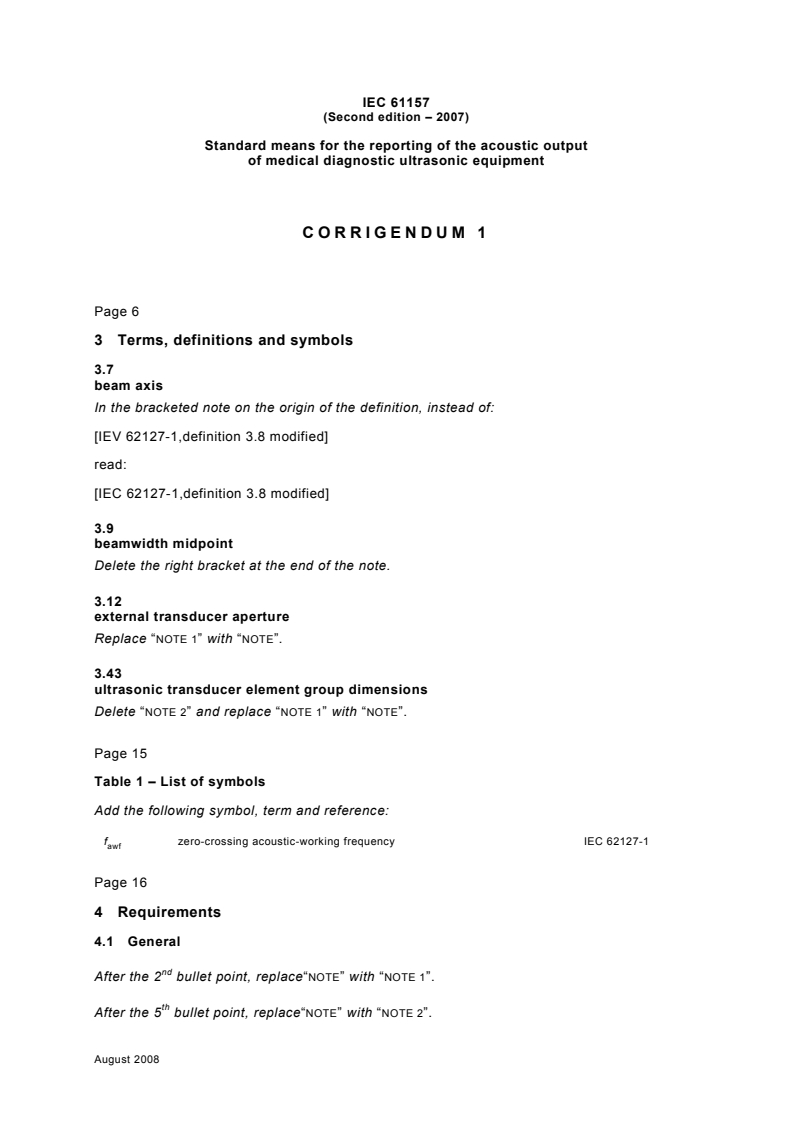
CORRIGENDUM 1
Page 6
3 Terms, definitions and symbols
3.7
beam axis
In the bracketed note on the origin of the definition, instead of:
[IEV 62127-1,definition 3.8 modified]
read:
[IEC 62127-1,definition 3.8 modified]
3.9
beamwidth midpoint
Delete the right bracket at the end of the note.
3.12
external transducer aperture
Replace “NOTE 1” with “NOTE”.
3.43
ultrasonic transducer element group dimensions
NOTE 2” and replace “NOTE 1” with “NOTE”.
Delete “
Page 15
Table 1 – List of symbols
Add the following symbol, term and reference:
f zero-crossing acoustic-working frequency IEC 62127-1
awf
Page 16
4 Requirements
4.1 General
nd
After the 2 bullet point, replace“NOTE” with “NOTE 1”.
th
After the 5 bullet point, replace“NOTE” with “NOTE 2”.
August 2008
Page 18
4.2.2 Detailed operating mode data sheets information format
nd
After the 2 paragraph,
...
This May Also Interest You
IEC TS 62791:2022 defines terms and specifies methods for quantifying detailed imaging performance of real-time, ultrasound B-mode scanners. Detail is assessed by imaging phantoms containing small, low-echo spherical targets in a tissue-mimicking background and analysing sphere detectability. Specifications are given for phantom properties. In addition, procedures are described for acquiring images, conducting qualitative analysis of sphere detectability, and carrying out quantitative analysis by detecting sphere locations and computing their contrast-to-noise ratios. With appropriate choices in design, results can be applied, for example:
• to assess the relative ability of scanner configurations (scanner make and model, scan head and console settings) to delineate the boundary of a tumour or identify specific features of tumours;
• to choose scanner control settings, such as frequency or the number and location of transmit foci, which maximize spatial resolution;
• to detect defects in probes causing enhanced sidelobes and spurious echoes.
The types of transducers used with these scanners include:
a) phased arrays,
b) linear arrays,
c) convex arrays,
d) mechanical sector scanners,
e) 3-D probes operating in 2-D imaging mode, and
f) 3-D probes operating in 3-D imaging mode for a limited number of sets of reconstructed 2 D images.
The test methodology is applicable for transducers operating in the 1 MHz to 23 MHz frequency range.
IEC TS 62791:2022 cancels and replaces the first edition published in 2015. This edition constitutes a technical revision.
This edition includes the following significant technical changes with respect to the previous edition.
a) It introduces necessary corrections to the analysis methods; these have been published in the literature.
b) It increases the range of contrast levels of low-echo spheres in phantoms that meet this Technical Specification. Previous specification was -20 dB, but two additional levels, -6 dB and either -30 dB or, if possible, -40 dB, are now specified.
c) It includes a wider range of uses of the methodology, including testing the effectiveness of scanner pre-sets for specific clinical tasks and detecting flaws in transducers and in beamforming.
d) It decreases the manufacturing cost by decreasing phantoms' dimensions and numbers of low-echo, backscattering spheres embedded in each phantom.
- Technical specification73 pagesEnglish languagesale 15% off
IEC TS 62791:2015(E) defines terms and specifies methods for quantifying the imaging performance of real-time, ultrasound B-mode scanners. The test methodology is applicable for transducers operating in the 2 MHz to 15 MHz frequency range.
- Technical specification60 pagesEnglish languagesale 15% off
- Standard16 pagesEnglish and French languagesale 15% off
IEC 61157:2007 specifies a standard means and format for the reporting of the acoustic output of medical diagnostic ultrasonic equipment. The numerical values for reporting purposes represent the average values for the maximum output conditions for a given discrete- or combined-operating mode and are derived from measurements made in water. Intensity parameters are specified in this standard, but these are regarded as derived quantities that are meaningful only under certain assumptions related to the ultrasonic field being measured. This International Standard is applicable to medical diagnostic ultrasonic equipment. It provides a set of traceable acoustic parameters describing the acoustic fields. It defines a standard means and format for the reporting of the acoustic output information. It also describes a reduced dataset recommended for equipment generating low acoustic output levels. This second edition cancels and replaces the first edition published in 1992. This edition constitutes a minor revision. The changes with respect to the previous edition are listed hereafter:
- maintenance on this standard and the referenced standards IEC 61161 and IEC 62127-1;
- and a clause on compliance has been added. The contents of the corrigendum of August 2008 have been included in this copy. The French version of this standard has not been voted upon.
- Standard32 pagesEnglish languagesale 15% off
- Standard66 pagesEnglish and French languagesale 15% off
- Standard68 pagesEnglish and French languagesale 15% off
IEC 60947-5-3:2013 series provides additional requirements to those given in IEC 60947-5-2. It addresses the fault performance aspects of proximity devices with a defined behaviour under fault conditions (PDDB). It does not address any other characteristics that can be required for specific applications. This second edition replaces the first edition published in 1999 and its amendment published in 2005. It is a technical revision. This edition includes the following significant technical changes with respect to the previous edition:
a) general principles of IEC 61508 series;
b) classification according to the requirements of IEC 62061;
c) classification according to ISO 13849-1.
This publication is to be read in conjunction with IEC 60947-1:2007 and IEC 60947-5-2:2007..
- Standard57 pagesEnglish and French languagesale 15% off
IEC 62541-100:2025 defines the information model associated with Devices. This document describes three models which build upon each other as follows:
• The (base) Device Model is intended to provide a unified view of devices and their hardware and software parts irrespective of the underlying device protocols.
• The Device Communication Model adds Network and Connection information elements so that communication topologies can be created.
• The Device Integration Host Model finally adds additional elements and rules required for host systems to manage integration for a complete system. It enables reflecting the topology of the automation system with the devices as well as the connecting communication networks.
This document also defines AddIns that can be used for the models in this document but also for models in other information models. They are:
• Locking model – a generic AddIn to control concurrent access,
• Software update model – an AddIn to manage software in a Device.
This second edition cancels and replaces the first edition published in 2015. This edition constitutes a technical revision.
This edition includes the following significant technical changes with respect to the previous edition:
a a ComponentType that can be used to model any HW or SW element of a device has been defined and a SoftwareType has been added as subtype of ComponentType;
b the new OPC UA interface concept and defined interfaces for Nameplate, DeviceHealth, and SupportInfo has been added.
c) a new model for Software Update (Firmware Update) has been added;
d) a new entry point for documents where each document is represented by a FileType instance has been specified;
e) a model that provides information about the lifetime, related limits and semantic of the lifetime of things like tools, material or machines has been added.
- Standard152 pagesEnglish languagesale 15% off
- Standard158 pagesFrench languagesale 15% off
- Standard310 pagesEnglish and French languagesale 15% off
IEC TR 61169-1-8:2025 provides a test method for voltage standing wave ratio (VSWR, hereinafter) of single RF connector by double-connector method. This document is applicable to single RF cable connectors and single microstrip RF connectors as well as single adapters if an estimation of the VSWR of a single completely installed RF-connector is used and a time domain feature is not available on the vector network analyzer.
- Technical report18 pagesEnglish languagesale 15% off
IEC 62541-13:2025 is available as IEC 62541-13:2025 RLV which contains the International Standard and its Redline version, showing all changes of the technical content compared to the previous edition.IEC 62541-13:2025 defines the information model associated with Aggregates. Programmatically produced aggregate examples are listed in Annex A. This third edition cancels and replaces the second edition published in 2020. This edition constitutes a technical revision.
This edition includes the following technical changes with respect to the previous edition:
a) Multiple fixes for the computation of aggregates
• The Raw status bit is always set for non-bad StatusCodes for the Start and End aggregates.
• Entries in the Interpolative examples Tables A2.2 Historian1, Historian2, and Historian3 have been changed from Good to Good, Raw status codes when the timestamp matches with the timestamp of the data source.
• Missing tables have been added for DurationInStateZero and DurationInStateNonZero.
• The value of zero has been removed for results with a StatusCode of bad.
• Data Type was listed as "Status Code" when it is "Double" for both Standard Deviation and both Variance Aggregates.
• Rounding Error in TimeAverage and TimeAverage2 have been corrected.
• The status codes have been corrected for the last two intervals and the value has been corrected in the last interval.
• The wording has been changed to be more consistent with the certification testing tool.
• UsedSlopedExtrapolation set to true for Historian2 and all examples locations needed new values or status' are modified.
• Values affected by percent good and percent bad have been updated.
• PercentGood/PercentBad are now accounted for in the calculation.
• TimeAverage uses SlopedInterpolation but the Time aggregate is incorrectly allowed to used Stepped Interpolation.
• Partial bit is now correctly calculated.
• Unclear sentence was removed.
• Examples have been moved to a CSV.
• The value and status code for Historian 3 have been updated.
• TimeAverage2 Historian1 now takes uncertain regions into account when calculating StatusCodes.
• TimeAverage2 Historian2 now takes uncertain regions into account when calculating StatusCodes.
• Total2 Historian1 now takes uncertain regions into account when calculating StatusCodes
• Total2 Historian2 now takes uncertain regions into account when calculating StatusCodes
• Maximum2 Historian1 now takes uncertain regions into account when calculating StatusCodes
• MaximumActualTime2 Historian1 now takes uncertain regions into account when calculating StatusCodes
• Minimum2 Historian1 now takes uncertain regions into account when calculating StatusCodes
• MinimumActualTime2 Historian1 now has the StatusCodes calculated while using the TreatUncertainAsBad flag.
• Range2 Historian1 now looks at TreatUncertainAsBad in the calculation of the StatusCodes.
• Clarifications have been made to the text defining how PercentGood/PercentBad are used. The table values and StatusCodes of the TimeAverage2 and Total2 aggregates have been corrected.
- Standard64 pagesEnglish languagesale 15% off
- Standard64 pagesFrench languagesale 15% off
- Standard128 pagesEnglish and French languagesale 15% off
IEC 62541-7: 2025 specifies value and structure of Profiles in the OPC Unified Architecture.
OPC UA Profiles are used to segregate features with regard to testing of OPC UA products and the nature of the testing. The scope of this document includes defining functionality that can only be tested. The definition of actual TestCases is not within the scope of this document, but the general categories of TestCases are covered by this document.
Most OPC UA applications will conform to several, but not all of the Profiles.
This fourth edition cancels and replaces the third edition published in 2020. This edition constitutes a technical revision.
This edition includes the following significant technical changes with respect to the previous edition:
a) Profiles and ConformanceUnits are not part of this document, but are solely managed in a public database as described in Clause 1.
- Standard160 pagesEnglish languagesale 15% off
- Standard173 pagesFrench languagesale 15% off
- Standard333 pagesEnglish and French languagesale 15% off
IEC 62541-10:2025 is available as IEC 62541-10:2025 RLV which contains the International Standard and its Redline version, showing all changes of the technical content compared to the previous edition.IEC 62541-10:2025 defines the Information Model associated with Programs in OPC Unified Architecture (OPC UA). This includes the description of the NodeClasses, standard Properties, Methods and Events and associated behaviour and information for Programs. The complete AddressSpace model including all NodeClasses and Attributes is specified in IEC 62541-3. The Services such as those used to invoke the Methods used to manage Programs are specified in IEC 62541-4. An example for a DomainDownload Program is defined in Annex A. This fourth edition cancels and replaces the third edition published in 2020. This edition constitutes a technical revision.
This edition includes the following significant technical changes with respect to the previous edition:
- StateMachine table format has been aligned.
- Standard42 pagesEnglish languagesale 15% off
- Standard45 pagesFrench languagesale 15% off
- Standard87 pagesEnglish and French languagesale 15% off


Questions, Comments and Discussion
Ask us and Technical Secretary will try to provide an answer. You can facilitate discussion about the standard in here.
Loading comments...