IEC 62325-451-2:2014/COR1:2016
(Corrigendum)Corrigendum 1 - Framework for energy market communications - Part 451-2: Scheduling business process and contextual model for CIM European market
Corrigendum 1 - Framework for energy market communications - Part 451-2: Scheduling business process and contextual model for CIM European market
Corrigendum 1 - Cadre pour les communications pour le marché de l'énergie - Partie 451-2: Processus métier de programmation et modèle contextuel pour le marché européen CIM
General Information
Relations
Standards Content (Sample)
IEC 2016
INTERNATIONAL ELECTROTECHNICAL COMMISSION
COMMISSION ÉLECTROTECHNIQUE INTERNATIONALE
____________
IEC 62325-451-2 IEC 62325-451-2
Edition 1.0 2014-05 Édition 1.0 2014-05
FRAMEWORK FOR ENERGY MARKET CADRE POUR LES COMMUNICATIONS POUR LE
COMMUNICATIONS – MARCHÉ DE L'ÉNERGIE –
Part 451-2: Scheduling business process and Partie 451-2: Processus métier de
contextual model for CIM European market programmation et modèle contextuel pour le
marché européen CIM
CO RRI G ENDU M 1
Corrections to the French version appear after the English text.
Les corrections à la version française sont données après le texte anglais.
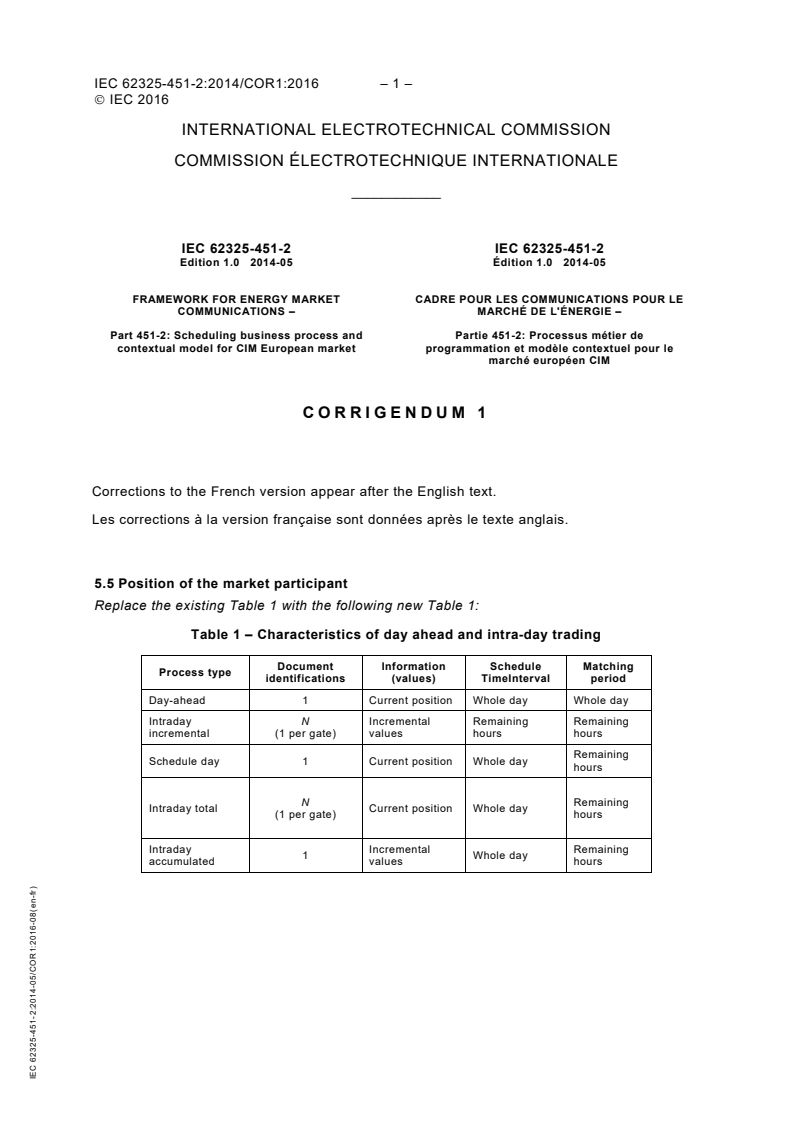
5.5 Position of the market participant
Replace the existing Table 1 with the following new Table 1:
Table 1 – Characteristics of day ahead and intra-day trading
Document Information Schedule Matching
Process type
identifications (values) TimeInterval period
Day-ahead 1 Current position Whole day Whole day
Intraday N Incremental Remaining Remaining
incremental (1 per gate) values hours hours
Remaining
Schedule day 1 Curren
...
This May Also Interest You
IEC 62351-7:2025 defines network and system management (NSM) data object models that are specific to power system operations. These NSM data objects will be used to monitor the health of networks and systems, to detect possible security intrusions, and to manage the performance and reliability of the information infrastructure. The goal is to define a set of abstract objects that will allow the remote monitoring of the health and condition of IEDs (Intelligent Electronic Devices), RTUs (Remote Terminal Units), DERs (Distributed Energy Resources) systems and other systems that are important to power system operations.
Power systems operations are increasingly reliant on information infrastructures, including communication networks, IEDs, and self-defining communication protocols. Therefore, management of the information infrastructure has become crucial to providing the necessary high levels of security and reliability in power system operations.
The telecommunication infrastructure that is in use for the transport of telecontrol and automation protocols is already subject to health and condition monitoring control, using the concepts developed in the IETF Simple Network Management Protocol (SNMP) standards for network management. However, power system specific devices (like teleprotection, telecontrol, substation automation, synchrophasors, inverters and protections) need instead a specific solution for monitoring their health.
The NSM objects provide monitoring data for IEC protocols used for power systems (IEC 61850, IEC 60870-5-104) and device specific environmental and security status. As a derivative of IEC 60870-5-104, IEEE 1815 DNP3 is also included in the list of monitored protocols. The NSM data objects use the naming conventions developed for IEC 61850, expanded to address NSM issues. For the sake of generality these data objects, and the data types of which they are comprised, are defined as abstract models of data objects.
In addition to the abstract model, in order to allow the integration of the monitoring of power system devices within the NSM environment in this part of IEC 62351, a mapping of objects to the SNMP protocol of Management Information Base (MIBs) is provided.
The objects that are already covered by existing MIBs are not defined here but are expected to be compliant with existing MIB standards. For example protocols including EST, SCEP, RADIUS, LDAP, GDOI are not in scope.
This edition of IEC 62351-7 cancels and replaces IEC 62351-7 published in 2017. This new edition constitutes a technical revision and includes the following significant technical changes with respect to IEC 62351-7:
a) Reviewed and enriched the NSM object data model;
b) UML model adopted for NSM objects description;
c) SNMP protocol MIBs translation included as Code Components
- Standard130 pagesEnglish languagesale 15% off
- Standard140 pagesFrench languagesale 15% off
- Standard270 pagesEnglish and French languagesale 15% off
IEC TR 62746-2:2025, which is a technical report, describes the main pillars of interoperability to assist different IEC Technical Committees in defining their interfaces and messages covering the whole chain between a Smart Grid and Smart Home/Building/Industrial area.
The main topics of this document are:
– To describe an architecture model from a logical point of view;
– To describe a set of user stories that describe a number of situations related to energy flexibility and demand side management as well as an outline of potential upcoming Smart Building and Smart Home scenarios. The set of user stories does not have the ambition to list all home and building (energy) management possibilities, but is meant as a set of examples that are used as input in use cases and to check that the set of use cases is complete;
– To describe a set of use cases based on the user stories and architecture. The use cases describe scenarios in which the communication between elements of the architecture are identified;
– To further detail the communication, identified in the use cases, by describing the messages and information to be exchanged.
This document can also be used as a blueprint for further smart home solutions like remote control, remote monitoring, ambient assistant living and so forth.
This technical report will be regularly revised by introducing new use cases and updating the current use cases. The use cases presented in this document are not going to be included in the IEC Use Case Management Repository (UCMR). The data models of some use cases presented here are defined in the second edition of IEC 62746-4 . The smart grid architecture model presented in this document is created in coordination with IEC TC13, SC23, and TC57
This second edition cancels and replaces the first edition published in 2015. This edition constitutes a technical revision.
This edition includes the following significant technical changes with respect to the previous edition:
a) The Architecture Model of the Smart Grid Coordination Group (Figure 6) has been replaced with the draft Architecture Model of TC57 in collaboration with SC23K and TC13;
b) The use cases from Edition 1 (2015) with the following IDs have been removed from the current document: JWG2000, JWG2001, JWG2010, JWG202x, JWG2041, JWG2042, JWG1111, WGSP2120, JWG30xx;
c) The use cases from Edition 1 (2015) with the following IDs: JWG1100, JWG1101, JWG-SPUC1102, and JWG1103 have been replaced with the use case JWG1100;
d) The following use cases have been added to the current document: JWG3000, JWG3001, JWG3002, JWG3003, JWG3004, JWG3005, JWG3006, JWG4000.
- Technical report229 pagesEnglish languagesale 15% off
IEC TR 61850-90-20:2025, which is a technical report, describes use cases of redundancy in systems.
This document considers use cases of duplication of function and devices and covers redundancy of information flow at message level. Functional safety is out of scope of this document. To keep focus on details relevant for this document, some figures and drawings do not show electrical wiring, redundant coils, etc, where this is not important for the use case.
This document is not a guideline on the design of redundancy systems; guidance on designing redundancy systems can be found in textbooks
- Technical report31 pagesEnglish languagesale 15% off
- Standard72 pagesEnglish languagesale 15% off
- Standard75 pagesFrench languagesale 15% off
- Standard147 pagesEnglish and French languagesale 15% off
IEC 61850-10:2012 specifies standard techniques for testing of conformance of client, server and sampled value devices and engineering tools, as well as specific measurement techniques to be applied when declaring performance parameters. The use of these techniques will enhance the ability of the system integrator to integrate IEDs easily, operate IEDs correctly, and support the applications as intended. The major technical changes with regard to the previous edition are as follows:
- updates to server device conformance test procedures;
- additions of certain test procedures (client device conformance, sampled values device conformance, (engineering) tool related conformance, GOOSE performance).
- Standard190 pagesEnglish languagesale 15% off
- Standard170 pagesEnglish and French languagesale 15% off
IEC TS 61850-6-3:2025, which is a Technical Specification, describes how to use and define formal rules, in a machine-processable format: OCL, that can be imported and interpreted by tools.
The following main use cases are supported:
– Validate SCL files at every stage of the specification and engineering process;
– Verify the conformity of a SCL file after completion of the upgrading/downgrading rules;
– Extend standard OCL rules with private OCL rules
The purpose of this document is limited to the publication of the format and method to write correct and structured rules. The rules themselves are published as code components of the corresponding IEC 61850 parts.
- Technical specification33 pagesEnglish languagesale 15% off
IEC 62488-1:2025 applies to the planning of analogue (APLC), digital (DPLC) and hybrid analogue-digital (ADPLC) power line carrier communication systems operating over HV electric power networks. The object of this document is to establish the planning of the services and performance parameters for the operational requirements to transmit and receive data efficiently and reliably.
Such analogue and digital power line carrier systems are used by the different electricity supply industries and integrated into their communication infrastructure using common communication technologies such as radio links, fibre optic and satellite networks
This second edition cancels and replaces the first edition published in 2012. This edition constitutes a technical revision.
This edition includes the following significant technical changes with respect to the previous edition:
a) Complete revision of this edition with respect to the previous edition with the main focus on planning of analogue and digital power line carrier systems operating over HV power networks;
b) A general structure of a bidirectional point-to-multipoint APLC, DPLC or ADPLC link has been introduced;
c) Introduction of a new approach for global frequency planning.
- Standard105 pagesEnglish languagesale 15% off
- Standard112 pagesFrench languagesale 15% off
- Standard217 pagesEnglish and French languagesale 15% off
- Technical specification3 pagesEnglish languagesale 15% off
IEC TS 60870-5-7:2025, which is a technical specification, describes messages and data formats for implementing IEC 62351-5:2023 for secure communication as an extension to IEC 60870-5-101 and IEC 60870-5-104.
The purpose of this document is to permit the receiver of any IEC 60870-5-101/-104 Application Protocol Data Unit (APDU) to verify that the APDU was transmitted by an authorized user and that the APDU was not modified in transit.
This document is also intended to be used, together with the definitions of IEC 62351-3:2023, in conjunction with the IEC 60870-5-104 companion standard.
The state machines, message sequences, and procedures for exchanging these messages are defined in IEC 62351-5:2023. This document describes only the message formats, selected options, critical operations, addressing considerations and other adaptations required to implement IEC 62351 in the IEC 60870-5-101 and IEC 60870-5-104 protocols.
In addition to the previous edition, this new edition of this document also addresses role-based access control, by utilizing the IEC 62351-8 RBAC approach and the already defined role to permission mapping from IEC 62351-5:2023.
The scope of this document does not include security for IEC 60870-5-102 or IEC 60870-5-103. IEC 60870-5-102 is in limited use only and will therefore not be addressed. Users of IEC 60870-5-103 desiring a secure solution need to implement IEC 61850 using the security measures from in IEC 62351 referenced in IEC 61850.
Management of keys, certificates or other cryptographic credentials within devices or on communication links other than IEC 60870-5-101/104 is out of the scope of this document and might be addressed by other IEC 62351 publications in the future.
This second edition cancels and replaces the first edition published in 2013. This edition constitutes a technical revision.
This edition includes the following significant technical changes with respect to the previous edition:
a) This edition has been completely revised with respect to the previous edition;
b) Alignment with updated versions of IEC 62351-3:2023 and IEC 62351-5:2023;
c) Definition of specific profiles for application layer and transport layer;
d) Introduction of Session Initiation Request to handle situations in which the called station reestablishes a connection;
e) Inclusion of multicast security for the unbalanced mode of IEC 60870-5-101 including key management;
f) Consideration of RBAC based on IEC 62351-8.
This Technical Specification is to be used in conjunction with IEC 62351-5:2023 and IEC 60870-5-104:2016.
- Technical specification50 pagesEnglish languagesale 15% off
IEC TR 61850-90-30:2025, which is a Technical Report, describes extensions of the SCL Substation/Process Section allowing the creation of a comprehensive, IED and hardware independent specification of an IEC 61850 based power system.
It addresses how to:
• decompose functions in SCL
• show function classifications in SCL
• relate functions with the SCL Substation and Process Section
• relate functions to Logical Nodes and IEDs/Specification IEDs
• present information flow between functions in a hardware/implementation independent way
• position Functions in relation to "Application Schemes", "Distributed Functions", "Protection Schemes"
• consider the relationship to Basic Application Profiles (BAP) defined in IEC TR 61850-7-6
The document addresses the engineering process as far as it is related to the specification of Functions and their instantiation in IEC 61850 based power system. This includes the impact on the SCL Process Section during system configuration.
The engineering process related to the definition of Applications and their instantiation is addressed in the Basic Application Profile Document (BAP) in IEC TR 61850-7-6.
The System Configuration process is described in IEC 61850-6.
Modifications and extensions of SCL are done in a way to guarantee backwards compatibility.
In addition, this document introduces:
• Some further elements to SCL that improve the content and usefulness of SSD files and facilitate the handling of SCL files for engineering purposes,
• New variants of IED specific files: ISD file and FSD files,
• Evolution of the engineering rights management, to first improve the usage of SED and add a new concept of System Configuration Collaboration (SCC file) which allows collaboration on the same project with different engineers.
- Technical report184 pagesEnglish languagesale 15% off


Questions, Comments and Discussion
Ask us and Technical Secretary will try to provide an answer. You can facilitate discussion about the standard in here.
Loading comments...