

IEC 61400-50-3:2022
(Main)Wind energy generation systems - Part 50-3: Use of nacelle-mounted lidars for wind measurements
General Information
- Abstract
IEC 61400-50-3:2022 describes procedures and methods that ensure that wind measurements using nacelle-mounted wind lidars are carried out and reported consistently and according to best practice. This document does not prescribe the purpose or use case of the wind measurements. However, as this document forms part of the IEC 61400 series of standards, it is anticipated that the wind measurements will be used in relation to some form of wind energy test or resource assessment.
The scope of this document is limited to forward-looking nacelle-mounted wind lidars (i.e. the measurement volume is located upstream of the turbine rotor).
This document aims to describe wind measurements using nacelle-mounted wind lidar with sufficient quality for the use case of power performance testing (according to IEC 61400-12-1:2017).
The contents of the corrigendum of November 2023 have been included in this copy.
- Status
- Published
- Publication Date
- 06-Jan-2022
- Technical Committee
- TC 88 - Wind energy generation systems
- Drafting Committee
- PT 61400-50-3 - TC 88/PT 61400-50-3
- Current Stage
- PPUB - Publication issued
- Start Date
- 07-Jan-2022
- Completion Date
- 21-Jan-2022


Overview
The IEC 61400-50-3:2022 standard provides comprehensive guidelines for the use of nacelle-mounted lidars in wind energy generation systems to perform accurate and consistent wind measurements. As part of the IEC 61400 series, this standard supports wind energy professionals in ensuring high-quality data collection, essential for power performance testing and resource assessment of wind turbines.
This edition focuses exclusively on forward-looking nacelle-mounted wind lidars, where the measurement volume is located upstream of the turbine rotor. The procedures and best practices outlined promote reliable data acquisition and reporting, enhancing confidence in wind measurements used for performance validation and operational optimization.
Key Topics
Measurement Methodology: Detailed methods to perform wind measurements with nacelle-mounted lidars, emphasizing the standard’s role in power performance testing per IEC 61400-12-1:2017.
Lidar Functional Requirements: Specifications regarding technical and operational aspects of the nacelle-mounted lidar systems, including installation and documentation standards.
Calibration and Uncertainty Management: Procedures for calibrating lidars with focus on:
- Verification of beam trajectory and geometry.
- Inclinometer calibration.
- Line-of-Sight (LOS) speed calibration and the associated uncertainty evaluation.
- Addressing environmental condition effects on measurement accuracy.
Wind Flow Reconstruction (WFR): Techniques for reconstructing wind parameters from lidar data, with uncertainty propagation control.
Measurement Campaign Preparation: Checklists and setups to ensure optimal data collection, accounting for obstacles, other turbines, and terrain effects.
Reporting and Data Handling: Standardized formats and contents for reporting measurement results, uncertainties, and sensor information.
Informative Annexes: Practical recommendations on installation, tilt and roll angle measurements, and assessing lidar influence on turbine behavior.
Applications
This standard is indispensable for wind energy engineers, researchers, and project developers who seek to:
Validate turbine power performance: Use nacelle-mounted lidar data to support or enhance power curve testing in line with IEC 61400 series requirements.
Conduct accurate wind resource assessments: Improve the quality and reliability of wind data for site evaluation and feasibility studies.
Optimize turbine operation: Utilize precise upstream wind measurements for power optimization, load mitigation, and predictive maintenance strategies.
Ensure regulatory and certification compliance: Meet international testing and certification standards by applying the unified measurement and reporting methods.
The standard’s focus on forward-looking lidars ensures precise, upstream wind data vital for understanding inflow dynamics and enhancing turbine control and performance.
Related Standards
IEC 61400-12-1:2017 – Wind Turbines – Power performance measurements of electricity producing wind turbines, providing foundational testing procedures applied in conjunction with nacelle-mounted lidar measurements.
IEC 61400 Series – Overall guidance on wind turbine design, performance assessment, and site evaluation.
IEC 61400-50-1 and IEC 61400-50-2 – Covering different types of remote sensing devices used for wind measurements, complementing the specific guidance of Part 50-3 for nacelle lidars.
IEC 61400-50 – General guidelines on the use of lidar and sodar devices in wind energy.
By integrating IEC 61400-50-3:2022 with these related standards, wind energy stakeholders maintain best practices across the full spectrum of design, assessment, operation, and certification.
Keywords: nacelle-mounted lidar, wind measurements, wind energy, IEC 61400-50-3, wind turbine performance, power performance testing, Wind Flow Reconstruction (WFR), lidar calibration, wind resource assessment, IEC wind energy standards, remote sensing in wind energy.
Relations
- Effective Date
- 06-Oct-2023
Get Certified
Connect with accredited certification bodies for this standard

DNV
DNV is an independent assurance and risk management provider.

Lloyd's Register
Lloyd's Register is a global professional services organisation specialising in engineering and technology.
DNV Energy Systems
Energy and renewable energy certification.
Sponsored listings
Frequently Asked Questions
IEC 61400-50-3:2022 is a standard published by the International Electrotechnical Commission (IEC). Its full title is "Wind energy generation systems - Part 50-3: Use of nacelle-mounted lidars for wind measurements". This standard covers: IEC 61400-50-3:2022 describes procedures and methods that ensure that wind measurements using nacelle-mounted wind lidars are carried out and reported consistently and according to best practice. This document does not prescribe the purpose or use case of the wind measurements. However, as this document forms part of the IEC 61400 series of standards, it is anticipated that the wind measurements will be used in relation to some form of wind energy test or resource assessment. The scope of this document is limited to forward-looking nacelle-mounted wind lidars (i.e. the measurement volume is located upstream of the turbine rotor). This document aims to describe wind measurements using nacelle-mounted wind lidar with sufficient quality for the use case of power performance testing (according to IEC 61400-12-1:2017). The contents of the corrigendum of November 2023 have been included in this copy.
IEC 61400-50-3:2022 describes procedures and methods that ensure that wind measurements using nacelle-mounted wind lidars are carried out and reported consistently and according to best practice. This document does not prescribe the purpose or use case of the wind measurements. However, as this document forms part of the IEC 61400 series of standards, it is anticipated that the wind measurements will be used in relation to some form of wind energy test or resource assessment. The scope of this document is limited to forward-looking nacelle-mounted wind lidars (i.e. the measurement volume is located upstream of the turbine rotor). This document aims to describe wind measurements using nacelle-mounted wind lidar with sufficient quality for the use case of power performance testing (according to IEC 61400-12-1:2017). The contents of the corrigendum of November 2023 have been included in this copy.
IEC 61400-50-3:2022 is classified under the following ICS (International Classification for Standards) categories: 27.180 - Wind turbine energy systems. The ICS classification helps identify the subject area and facilitates finding related standards.
IEC 61400-50-3:2022 has the following relationships with other standards: It is inter standard links to IEC 61400-50-3:2022/COR1:2023. Understanding these relationships helps ensure you are using the most current and applicable version of the standard.
IEC 61400-50-3:2022 is available in PDF format for immediate download after purchase. The document can be added to your cart and obtained through the secure checkout process. Digital delivery ensures instant access to the complete standard document.
Standards Content (Sample)
IEC 61400-50-3 ®
Edition 1.0 2022-01
INTERNATIONAL
STANDARD
NORME
INTERNATIONALE
colour
inside
Wind energy generation systems –
Part 50-3: Use of nacelle-mounted lidars for wind measurements
Systèmes de génération d'énergie éolienne –
Partie 50-3: Utilisation de lidars montés sur nacelle pour le mesurage du vent
All rights reserved. Unless otherwise specified, no part of this publication may be reproduced or utilized in any form
or by any means, electronic or mechanical, including photocopying and microfilm, without permission in writing from
either IEC or IEC's member National Committee in the country of the requester. If you have any questions about IEC
copyright or have an enquiry about obtaining additional rights to this publication, please contact the address below or
your local IEC member National Committee for further information.
Droits de reproduction réservés. Sauf indication contraire, aucune partie de cette publication ne peut être reproduite
ni utilisée sous quelque forme que ce soit et par aucun procédé, électronique ou mécanique, y compris la photocopie
et les microfilms, sans l'accord écrit de l'IEC ou du Comité national de l'IEC du pays du demandeur. Si vous avez des
questions sur le copyright de l'IEC ou si vous désirez obtenir des droits supplémentaires sur cette publication, utilisez
les coordonnées ci-après ou contactez le Comité national de l'IEC de votre pays de résidence.
IEC Secretariat Tel.: +41 22 919 02 11
3, rue de Varembé info@iec.ch
CH-1211 Geneva 20 www.iec.ch
Switzerland
About the IEC
The International Electrotechnical Commission (IEC) is the leading global organization that prepares and publishes
International Standards for all electrical, electronic and related technologies.
About IEC publications
The technical content of IEC publications is kept under constant review by the IEC. Please make sure that you have the
latest edition, a corrigendum or an amendment might have been published.
IEC publications search - webstore.iec.ch/advsearchform IEC Products & Services Portal - products.iec.ch
The advanced search enables to find IEC publications by a Discover our powerful search engine and read freely all the
variety of criteria (reference number, text, technical publications previews. With a subscription you will always
committee, …). It also gives information on projects, replaced have access to up to date content tailored to your needs.
and withdrawn publications.
Electropedia - www.electropedia.org
IEC Just Published - webstore.iec.ch/justpublished
The world's leading online dictionary on electrotechnology,
Stay up to date on all new IEC publications. Just Published
containing more than 22 300 terminological entries in English
details all new publications released. Available online and
and French, with equivalent terms in 19 additional languages.
once a month by email.
Also known as the International Electrotechnical Vocabulary
(IEV) online.
IEC Customer Service Centre - webstore.iec.ch/csc
If you wish to give us your feedback on this publication or
need further assistance, please contact the Customer Service
Centre: sales@iec.ch.
A propos de l'IEC
La Commission Electrotechnique Internationale (IEC) est la première organisation mondiale qui élabore et publie des
Normes internationales pour tout ce qui a trait à l'électricité, à l'électronique et aux technologies apparentées.
A propos des publications IEC
Le contenu technique des publications IEC est constamment revu. Veuillez vous assurer que vous possédez l’édition la
plus récente, un corrigendum ou amendement peut avoir été publié.
Recherche de publications IEC - IEC Products & Services Portal - products.iec.ch
webstore.iec.ch/advsearchform Découvrez notre puissant moteur de recherche et consultez
La recherche avancée permet de trouver des publications IEC gratuitement tous les aperçus des publications. Avec un
en utilisant différents critères (numéro de référence, texte, abonnement, vous aurez toujours accès à un contenu à jour
comité d’études, …). Elle donne aussi des informations sur adapté à vos besoins.
les projets et les publications remplacées ou retirées.
Electropedia - www.electropedia.org
IEC Just Published - webstore.iec.ch/justpublished
Le premier dictionnaire d'électrotechnologie en ligne au
Restez informé sur les nouvelles publications IEC. Just
monde, avec plus de 22 300 articles terminologiques en
Published détaille les nouvelles publications parues.
anglais et en français, ainsi que les termes équivalents dans
Disponible en ligne et une fois par mois par email.
19 langues additionnelles. Egalement appelé Vocabulaire
Electrotechnique International (IEV) en ligne.
Service Clients - webstore.iec.ch/csc
Si vous désirez nous donner des commentaires sur cette
publication ou si vous avez des questions contactez-nous:
sales@iec.ch.
IEC 61400-50-3 ®
Edition 1.0 2022-01
INTERNATIONAL
STANDARD
NORME
INTERNATIONALE
colour
inside
Wind energy generation systems –
Part 50-3: Use of nacelle-mounted lidars for wind measurements
Systèmes de génération d'énergie éolienne –
Partie 50-3: Utilisation de lidars montés sur nacelle pour le mesurage du vent
INTERNATIONAL
ELECTROTECHNICAL
COMMISSION
COMMISSION
ELECTROTECHNIQUE
INTERNATIONALE
ICS 27.180 ISBN 978-2-8322-1063-9
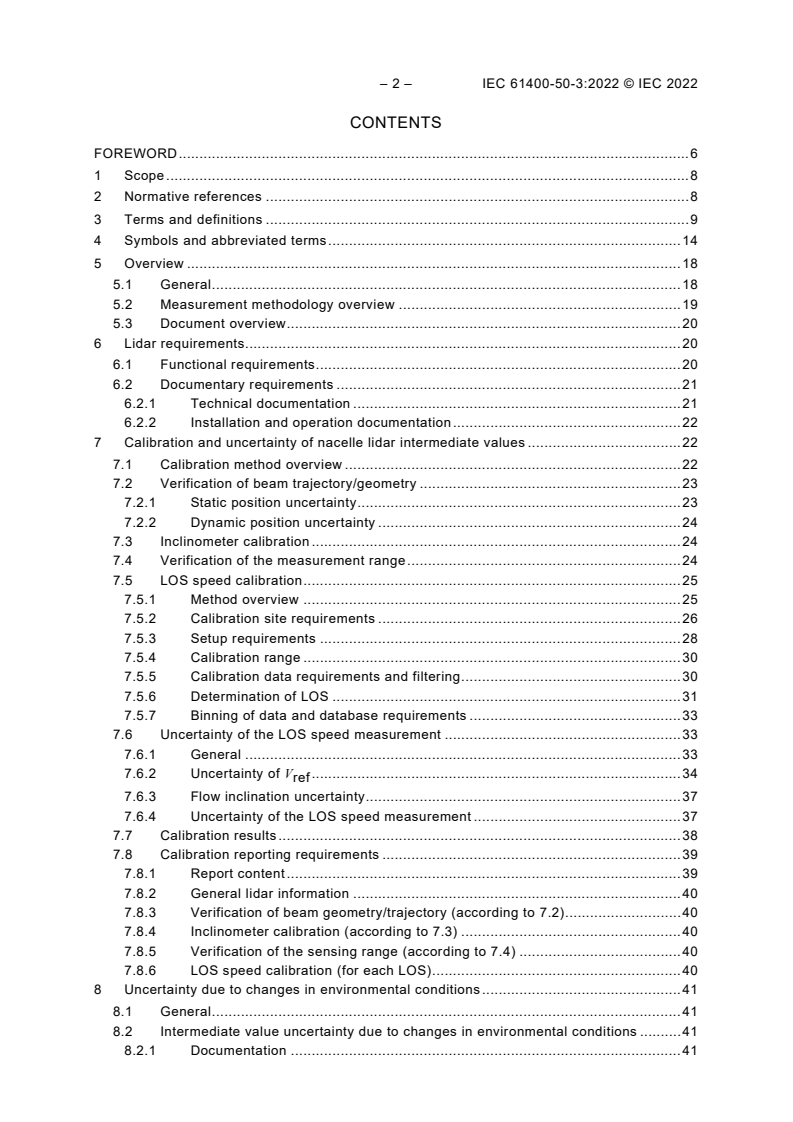
– 2 – IEC 61400-50-3:2022 © IEC 2022
CONTENTS
FOREWORD . 6
1 Scope . 8
2 Normative references . 8
3 Terms and definitions . 9
4 Symbols and abbreviated terms . 14
5 Overview . 18
5.1 General . 18
5.2 Measurement methodology overview . 19
5.3 Document overview . 20
6 Lidar requirements. 20
6.1 Functional requirements . 20
6.2 Documentary requirements . 21
6.2.1 Technical documentation . 21
6.2.2 Installation and operation documentation . 22
7 Calibration and uncertainty of nacelle lidar intermediate values . 22
7.1 Calibration method overview . 22
7.2 Verification of beam trajectory/geometry . 23
7.2.1 Static position uncertainty . 23
7.2.2 Dynamic position uncertainty . 24
7.3 Inclinometer calibration . 24
7.4 Verification of the measurement range . 24
7.5 LOS speed calibration . 25
7.5.1 Method overview . 25
7.5.2 Calibration site requirements . 26
7.5.3 Setup requirements . 28
7.5.4 Calibration range . 30
7.5.5 Calibration data requirements and filtering . 30
7.5.6 Determination of LOS . 31
7.5.7 Binning of data and database requirements . 33
7.6 Uncertainty of the LOS speed measurement . 33
7.6.1 General . 33
7.6.2 Uncertainty of V . 34
ref
7.6.3 Flow inclination uncertainty . 37
7.6.4 Uncertainty of the LOS speed measurement . 37
7.7 Calibration results . 38
7.8 Calibration reporting requirements . 39
7.8.1 Report content . 39
7.8.2 General lidar information . 40
7.8.3 Verification of beam geometry/trajectory (according to 7.2) . 40
7.8.4 Inclinometer calibration (according to 7.3) . 40
7.8.5 Verification of the sensing range (according to 7.4) . 40
7.8.6 LOS speed calibration (for each LOS) . 40
8 Uncertainty due to changes in environmental conditions . 41
8.1 General . 41
8.2 Intermediate value uncertainty due to changes in environmental conditions . 41
8.2.1 Documentation . 41
8.2.2 Method . 41
8.2.3 List of environmental variables to be considered . 42
8.2.4 Significance of uncertainty contribution . 42
8.3 Evidence-base supporting the adequacy of the WFR . 42
8.4 Requirements for reporting . 43
9 Uncertainty of reconstructed wind parameters . 44
9.1 Horizontal wind speed uncertainty . 44
9.2 Uncertainty propagation through WFR algorithm . 45
9.2.1 Propagation of intermediate value uncertainties u . 45
⟨V⟩,WFR
9.2.2 Uncertainties of other WFR parameters u . 46
WFR,par
9.3 Uncertainty associated with the WFR algorithm u . 46
ope,lidar
9.4 Uncertainty due to varying measurement height u . 46
⟨ΔV⟩,measHeight
9.5 Uncertainty due to lidar measurement inconsistency . 46
9.6 Combining uncertainties . 47
10 Preparation for specific measurement campaign . 47
10.1 Overview of procedure . 47
10.2 Pre-campaign check list . 47
10.3 Measurement set up . 48
10.3.1 Lidar installation . 48
10.3.2 Other sensors . 48
10.3.3 Nacelle position calibration . 49
10.4 Measurement sector . 49
10.4.1 General . 49
10.4.2 Assessment of influence from surrounding WTGs and obstacles . 49
10.4.3 Terrain assessment . 52
11 Measurement procedure . 53
11.1 General . 53
11.2 WTG operation. 53
11.3 Consistency check of valid measurement sector . 54
11.4 Data collection . 55
11.5 Data rejection . 56
11.6 Database . 56
11.7 Application of WFR algorithm . 56
11.8 Measurement height variations . 57
11.9 Lidar measurement monitoring . 57
12 Reporting format – relevant tables and figures specific to nacelle-mounted lidars . 57
12.1 General . 57
12.2 Specific measurement campaign site description . 57
12.3 Nacelle lidar information . 58
12.4 WTG information . 58
12.5 Database . 58
12.6 Plots . 59
12.7 Uncertainties. 59
Annex A (informative) Example calculation of uncertainty of reconstructed parameters
for WFR with two lines of sight . 60
A.1 Introduction to example case . 60
A.2 Uncertainty propagation through WFR algorithm . 61
A.3 Operational uncertainty of the lidar and WFR algorithm . 63
– 4 – IEC 61400-50-3:2022 © IEC 2022
A.4 Uncertainty contributions from variation of measurement height . 63
A.5 Wind speed consistency check. 64
A.6 Combined uncertainty . 64
Annex B (informative) Suggested method for the measurement of tilt and roll angles . 65
Annex C (informative) Recommendation for installation of lidars on the nacelle . 68
C.1 Positioning of lidar optical head on the nacelle. 68
C.2 Lidar optical head pre-tilt for fixed beam lidars . 69
C.3 Attachment points for the lidar . 70
Annex D (informative) Assessing the Influence of nacelle-mounted lidar on turbine
behaviour . 71
D.1 General . 71
D.2 Recommended consistency checks methods . 71
D.2.1 General . 71
D.2.2 Documentation-based approach . 71
D.2.3 Data-based approach using neighbouring WTG . 72
D.2.4 Data-based approach using only the WTG being assessed . 74
Bibliography . 78
Figure 1 – Example of opening angle β between two beams . 23
Figure 2 – Side elevation sketch of calibration setup . 26
Figure 3 – Plan view sketch of sensing and inflow areas . 27
Figure 4 – Sketch of a calibration setup . 30
Figure 5 – Example of lidar response to the wind direction and cosine fit . 32
Figure 6 – Example of LOS evaluation using the RSS process: RSS vs θ . 33
proj
Figure 7 – High level process for horizontal wind speed uncertainty propagation . 45
Figure 8 – Procedure flow chart . 47
Figure 9 – Plan view sketch of NML beams upstream of WTG being assessed and
neighbouring turbine wake . 49
Figure 10 – Sectors to exclude due to wakes of neighbouring and operating WTGs and
significant obstacles . 51
Figure 11 – Example of sectors to exclude due to wakes of a neighbouring turbine and
a significant obstacle . 52
Figure 12 – Example of full directional sector discretization . 53
Figure 13 – Lidar relative wind direction vs turbine yaw for a two-beam nacelle lidar
[Wagner R, 2013] . 54
Figure 14 – Example of LOS turbulence intensity vs turbine yaw, for a two-beam
nacelle lidar . 55
Figure B.1 – Pair of tilted and rolled lidar beams (red) shown in relation to the
reference position (grey) . 65
Figure B.2 – Opening angle between two beams symmetric with respect to the
horizontal plane(γ) and its projection onto the vertical plane of symmetry of the lidar
(γ ) 67
V
Figure C.1 – Example of a good (left) and bad (right) position for a 2-beam lidar . 68
Figure C.2 – Example of a good (left) and bad (right) position for a 4-beam lidar . 68
Figure C.3 – Sketch of lidar optical head pre-tilted downwards to measure at hub
height (example for a two beam lidar) . 70
Figure D.1 – Example of reporting the side-by-side comparison . 73
Figure D.2 – Example of the power ratio between two neighbouring turbines . 74
Figure D.3 – General process outline . 74
Figure D.4 – Example of binned ΔDir function for a setting where the lidar has not
Nac
significantly influenced the two nacelle wind direction sensors’ reported signals . 77
Table 1 – Summary of calibration uncertainty components . 38
Table 2 – Calibration table example . 39
Table 3 – Calibration table example (n=1…N; N is the total number of lines of sight
calibrated) . 39
Table A.1 – Uncertainty components and their correlations between different LOSs for
this example . 62
– 6 – IEC 61400-50-3:2022 © IEC 2022
INTERNATIONAL ELECTROTECHNICAL COMMISSION
____________
WIND ENERGY GENERATION SYSTEMS –
Part 50-3: Use of nacelle-mounted lidars for wind measurements
FOREWORD
1) The International Electrotechnical Commission (IEC) is a worldwide organization for standardization comprising
all national electrotechnical committees (IEC National Committees). The object of IEC is to promote international
co-operation on all questions concerning standardization in the electrical and electronic fields. To this end and
in addition to other activities, IEC publishes International Standards, Technical Specifications, Technical Reports,
Publicly Available Specifications (PAS) and Guides (hereafter referred to as "IEC Publication(s)”). Their
preparation is entrusted to technical committees; any IEC National Committee interested in the subject dealt with
may participate in this preparatory work. International, governmental and non-governmental organizations liaising
with the IEC also participate in this preparation. IEC collaborates closely with the International Organization for
Standardization (ISO) in accordance with conditions determined by agreement between the two organizations.
2) The formal decisions or agreements of IEC on technical matters express, as nearly as possible, an international
consensus of opinion on the relevant subjects since each technical committee has representation from all
interested IEC National Committees.
3) IEC Publications have the form of recommendations for international use and are accepted by IEC National
Committees in that sense. While all reasonable efforts are made to ensure that the technical content of IEC
Publications is accurate, IEC cannot be held responsible for the way in which they are used or for any
misinterpretation by any end user.
4) In order to promote international uniformity, IEC National Committees undertake to apply IEC Publications
transparently to the maximum extent possible in their national and regional publications. Any divergence between
any IEC Publication and the corresponding national or regional publication shall be clearly indicated in the latter.
5) IEC itself does not provide any attestation of conformity. Independent certification bodies provide conformity
assessment services and, in some areas, access to IEC marks of conformity. IEC is not responsible for any
services carried out by independent certification bodies.
6) All users should ensure that they have the latest edition of this publication.
7) No liability shall attach to IEC or its directors, employees, servants or agents including individual experts and
members of its technical committees and IEC National Committees for any personal injury, property damage or
other damage of any nature whatsoever, whether direct or indirect, or for costs (including legal fees) and
expenses arising out of the publication, use of, or reliance upon, this IEC Publication or any other IEC
Publications.
8) Attention is drawn to the Normative references cited in this publication. Use of the referenced publications is
indispensable for the correct application of this publication.
9) Attention is drawn to the possibility that some of the elements of this IEC Publication may be the subject of patent
rights. IEC shall not be held responsible for identifying any or all such patent rights.
International Standard IEC 61400-50-3 has been prepared by IEC technical committee TC 88:
Wind energy generation systems.
The text of this International Standard is based on the following documents:
Draft Report on voting
88/845/FDIS 88/853/RVD
Full information on the voting for its approval can be found in the report on voting indicated in
the above table.
The language used for the development of this International Standard is English.
This document was drafted in accordance with ISO/IEC Directives, Part 2, and developed in
accordance with ISO/IEC Directives, Part 1 and ISO/IEC Directives, IEC Supplement, available
at www.iec.ch/members_experts/refdocs. The main document types developed by IEC are
described in greater detail at www.iec.ch/standardsdev/publications.
The committee has decided that the contents of this document will remain unchanged until the
stability date indicated on the IEC website under webstore.iec.ch in the data related to the
specific document. At this date, the document will be
• reconfirmed,
• withdrawn,
• replaced by a revised edition, or
• amended.
IMPORTANT – The 'colour inside' logo on the cover page of this publication indicates that it
contains colours which are considered to be useful for the correct understanding of its
contents. Users should therefore print this document using a colour printer.
– 8 – IEC 61400-50-3:2022 © IEC 2022
WIND ENERGY GENERATION SYSTEMS –
Part 50-3: Use of nacelle-mounted lidars for wind measurements
1 Scope
The purpose of this part of IEC 61400 is to describe procedures and methods that ensure that
wind measurements using nacelle-mounted wind lidars are carried out and reported consistently
and according to best practice. This document does not prescribe the purpose or use case of
the wind measurements. However, as this document forms part of the IEC 61400 series of
standards, it is anticipated that the wind measurements will be used in relation to some form of
wind energy test or resource assessment.
The scope of this document is limited to forward-looking nacelle-mounted wind lidars (i.e. the
measurement volume is located upstream of the turbine rotor).
This document aims to be applicable to any type and make of nacelle-mounted wind lidar. The
method and requirements provided in this document are independent of the model and type of
instrument, and also of the measurement principle and should allow application to new types of
nacelle-mounted lidar.
This document aims to describe wind measurements using nacelle-mounted wind lidar with
sufficient quality for the use case of power performance testing (according to
IEC 61400-12-1:2017). Readers of this document should consider that other use cases may
have other specific requirements.
This document only provides guidance for measurements in flat terrain and offshore as defined
in IEC 61400-12-1:2017, Annex B. Application to complex terrain has been excluded from the
scope due to limited experience at the time of writing this document.
Corrections for induction zone or blockage effects are not included in the scope of this document.
However, such correction or uncertainty estimation due to blockage effects may be applied if
required by the use case, under the responsibility of the user.
The purpose of this document is to provide guidance for wind measurements. HSE requirements
(e.g. laser operation) are out of the scope of this document although they are important.
2 Normative references
The following documents are referred to in the text in such a way that some or all of their content
constitutes requirements of this document. For dated references, only the edition cited applies.
For undated references, the latest edition of the referenced document (including any
amendments) applies.
ISO/IEC 61400-12-1:2017, Wind energy generation systems – Part 12-1: Power performance
measurements of electricity producing wind turbines
ISO/IEC 61400-12-2:2013, Wind energy generation systems – Part 12-2: Power performance
of electricity-producing wind turbines based on nacelle anemometry
3 Terms and definitions
For the purposes of this document, the terms and definitions given in IEC 61400-12-1:2017 and
the following apply. ISO and IEC maintain terminological databases for use in standardization
at the following addresses:
• IEC Electropedia: available at https://www.electropedia.org/
• ISO Online browsing platform: available at https://www.iso.org/obp
3.1
carrier-to-noise ratio
CNR
measure of signal quality for a pulsed lidar defined as the ratio between the heterodyne current
power and the total noise power in the detection bandwidth
Note 1 to entry: By default, CNR is CNR wide band (𝐶𝐶𝐶𝐶𝐶𝐶 ). We can also define CNR narrow band (𝐶𝐶𝐶𝐶𝐶𝐶 ) as the
wb nb
ratio between the heterodyne current power and the noise power in the Doppler peak bandwidth. This does not
depend on spectral signal processing. CNR is different from Signal-to-Noise Ratio (SNR). SNR is the ratio between
the Doppler peak power and the noise power standard deviation.
Note 2 to entry: 𝑆𝑆𝐶𝐶𝐶𝐶 =𝐶𝐶𝐶𝐶𝐶𝐶 𝑛𝑛, with n: number of averaged pulses.
√
nb
3.2
continuous wave lidar
CW lidar
a lidar transmitting a laser signal of constant amplitude and frequency and receiving
backscattered light at the same time
3.3
correlated uncertainties
a pair of uncertainty components in which an unknown error on one of the components is
correlated to some degree to the error on the other component
Note 1 to entry: The value of the correlation coefficient can vary between -1 and 1.
[SOURCE: JCGM 100:2008; 5.2]
3.4
data availability
ratio between the number of measurement points accepted on the basis of a predefined data
quality and the maximum number of measurement points that can be acquired during a given
measurement period
3.5
final values
values provided by the nacelle lidar system for use in wind energy assessment applications
such as WTG power performance testing
Note 1 to entry: Therefore, the accuracy of the final value is the key consideration when using nacelle lidar in wind
energy applications. Examples of final values include (but are not limited to) horizontal wind speed and wind direction.
3.6
free wind speed
wind speed that would be present at the turbine location if the turbine was not there
– 10 – IEC 61400-50-3:2022 © IEC 2022
3.7
homodyne detection
measurement technique in which the received signal is mixed with a signal of the same
frequency as that of the transmitted signal
Note 1 to entry: The mixing product at the difference frequency contains information on the magnitude of the
Doppler shift induced in the received signal, but not whether that Doppler shift is positive or negative.
3.8
heterodyne detection
measurement technique in which the received signal is mixed with a signal of a different
frequency to that of the transmitted signal
Note 1 to entry: The mixing product at the difference frequency contains information on both the magnitude and the
sign of the Doppler shift induced in the received signal.
3.9
intermediate values
inputs to the wind field reconstruction (WFR) model or algorithm, which delivers final values as
output
Note 1 to entry: Examples of intermediate values include (but are not limited to) line of sight (LOS) speeds.
3.10
line of sight
LOS
direction originating at the laser source and oriented along the axis of the transmitted laser
beam, corresponding to the beam propagation path
3.11
line of sight speed
LOS speed
magnitude of the component of the wind velocity in the LOS
3.12
LOS speed turbulence intensity
ratio of the LOS speed standard deviation to the mean LOS speed, determined from the set of
measurement data samples of LOS speed, and taken over a specified period of time
Note 1 to entry: See Clause 6 for the characteristics of turbulence measured with lidar.
3.13
measurement
process of experimentally obtaining one or more quantity values that can reasonably be
attributed to a measurand
[SOURCE: JCGM_200_2012; 2.1]
3.14
measurement accuracy
closeness of agreement between a measured quantity value and a true quantity value of a
measurand
[SOURCE: JCGM_200_2012; 2.13]
3.15
measurement bias
estimate of a systematic measurement error
[SOURCE: JCGM_200_2012; 2.18]
3.16
measurement period
interval of time between the first and last measurements
[SOURCE: ISO 28902-1:2012, 3.10]
3.17
measurement uncertainty
non-negative parameter characterizing the dispersion of the quantity values being attributed to
a measurand, based on the information used
[SOURCE: JCGM_200_2012; 2.26]
3.18
nacelle-mounted lidar
NML
wind lidar mounted on the nacelle of a WTG generator
EXAMPLE A lidar placed in the spinner of a WTG is not considered nacelle-mounted in the case where it follows
the spinner's rotation about the rotor axis.
Note 1 to entry: A wind lidar can only be considered as nacelle-mounted if the lidar is fixed in the frame of reference
of the nacelle (but not the rotor frame of reference).
3.19
probe length
measure of the radial extent of the lidar probe volume, which can be defined in terms of the
distance between the two points at which the radial sensitivity of the lidar is half of its maximum
value: the full-width at half-maximum (FWHM) sensitivity
• For pulsed coherent lidars: The probe length is the distance between the FWHM levels of
the Velocity Range Weighting Function (VRWF).
• For pulsed incoherent lidars (direct detection lidars): The probe length is the distance
between the FWHM levels of the laser pulse. (assuming no range averaging).
• For CW coherent Lidars: The probe length is the distance between the FWHM levels of the
Lorentzian weighting function.
Note 1 to entry: The Velocity Range Weighting Function describes the relative efficiency of collecting velocity
information as a function of distance around the nominal range. An ideal weighting function would be a Dirac function
at 0 (the wind speed is measured at one point). The integral of the weighting function (from minus to plus infinity) is
equal to 1. The VRWF is the normalized convolution of the range gate profile with the pulse amplitude profile.
3.20
probe volume
volume located along the laser beam propagation path in which particles scattering light back
to the lidar system contribute significantly to the received signal
3.21
pulsed lidar
lidar transmitting a laser signal during a short time period (the pulse) at regular intervals and
receiving backscattered light between the pulses
3.22
remote sensing
technique for wind measurement where the instrument is distant from the locations where the
wind vector is sensed
– 12 – IEC 61400-50-3:2022 © IEC 2022
3.23
roll angle
angle of rotation of the lidar about the roll axis, with respect to the design orientation of the lidar
defined as horizontal
Note 1 to entry: The roll axis passes through the origin of the lidar coordinate system in a direction representative
of the average measurement direction of the lidar. The exact definition of the roll axis shall be documented by the
lidar manufacturer. For a scanning lidar it is suggested that the roll axis is defined as the unit vector with the same
direction as the average of the unit vectors describing the beam’s trajectory. For a fixed beam lidar it is suggested
that the roll axis is defined as the unit vector with the same direction as the average of the unit vectors describing
the lidar’s fixed beams.
3.24
scalar average
scalar number found by dividing the sum of scalar data by the number of items in the data set
3.25
scanning lidar
lidar in which the direction of a single transmitted beam is scanned
Note 1 to entry: In this document, two types of scanning lidars are considered:
1) Fixed-pattern-scanning lidar: the beam is scanned following a fixed, predefined trajectory (this trajectory is
typically planar or conical)
2) Programmable-scanning lidars: the beam is scanned in a programmable manner.
In contrast, a fixed-beam-geometry lidar is a lidar in which the laser beam is transmitted in a number of different, but
fixed, directions that are addressed sequentially or simultaneously.
3.26
specific measurement campaign
SMC
an implementation of a use case
3.27
tilt angle
angle of rotation of the lidar about the tilt axis, with respect to the design orientation of the lidar
defined as horizontal
Note 1 to entry: The tilt axis passes through the origin of the lidar coordinate system, is perpendicular to the roll
axis, and is horizontal when the lidar is in the design orientation defined as horizontal.
3.28
turbulence intensity
ratio of the wind speed standard deviation to the mean wind speed, determined from the same
set of measured data samples of wind speed, and taken over a specified period of time
[SOURCE: IEC 61400-1:2019, 3.58]
3.29
use case
combination of the following three elements:
• Data requirements: objectives arising from the application and independent of instrument
capabilities.
• Measurement method: lidar technique selected to fulfil the data requirements. The scope of
this guidance is restricted to methods using nacelle-mounted lidar and evaluation of their
accuracy under the operational conditions described.
• Operational conditions: circumstances that may influence measurement accuracy.
[SOURCE: CLIFTON, A. et al., 2018]
3.30
vector average
vector found by dividing the sum of vectors by the number of items in the dataset
3.31
wind direction
direction of the horizontal component of the wind velocity
3.32
wind field reconstruction
WFR
process of combining intermediate values, such as the LOS speeds associated with multiple
LOSs, to retrieve the final values relevant to the use case
3.33
wind lidar
remote sensing device that transmits energy from a laser source into the atmosphere and
analyses the signal reflected from particles being carried by the wind to measure the
characteristics of the wind
Note 1 to entry: The word "lidar” is used for wind lidar throughout this document.
Note 2 to entry: Most wind lidars working principles rely on the Doppler effect, where the frequency of the light
backscattered by particles moving with the wind is Doppler shifted.
3.34
wind measurement equipment
WME
meteorological mast or remote sensing device
[SOURCE: IEC 61400-12-1:2017,3.29]
3.35
wind shear
change of horizontal wind speed with height
Note 1 to entry: In this document, the focus is on the change of wind speed with height across the turbine rotor
span.
3.36
wind shear exponent
exponent of the power law model of the variation of horizontal wind speed with height above
the ground
Note 1 to entry: The power law formula is
α
z
vv= (1)
zz21
z
1
where
𝑣𝑣 is the horizontal wind speed at height 𝑧𝑧 ;
𝑧𝑧𝑧𝑧 𝑧𝑧
𝛼𝛼 is the wind shear exponent.
3.37
wind speed
magnitude of the local wind velocity
– 14 – IEC 61400-50-3:2022 © IEC 2022
Note 1 to entry: The horizontal wind speed is the magnitude of the projection of the wind velocity onto the horizontal
plane.
3.38
wind veer
change of wind direction with height across the WTG rotor
[SOURCE: IEC 61400-12-1:2017, 3.32]
3.39
wind velocity
vector pointing in the direction of motion of an infinitesimal volume of air surrounding the point
of consideration, the magnitude of the vector being equal to the speed of motion of this air
"parcel" (i.e. the local wind speed)
Note 1 to entry: The vector at any point is thus the time derivative of the position vector of the air "parcel" moving
through the point.
[SOURCE: IEC 61400-1:2019, 3.73, modified – "minute amount" has been changed to
"infinitesimal".]
3.40
yaw misalignment
angle resulting from the horizontal deviation of the WTG rotor axis from the wind direction
[SOURCE: IEC 61400-1:2019, 3.77, modified – "angle resulting from the" has been added]
4 Symbols and abbreviated terms
NOTE Symbols are specific to this document (not to be confused with other standards).
Abbreviation Description
CNR carrier-to-noise ratio
CW continuous wave
DLL dynamic-link library
EV environmental variable
FWHM full-width half-maximum
HSE health safety environment
LOS line of sight
NML Nacelle-mounted lidar
RSS residual sum of squares
SCADA supervisory control and data acquisition
SMC specific measurement campaign
SNR signal-to-noise ratio
VRWF velocity range weighting function
WFR wind field reconstruction
WME wind measurement equipment
WTG wind turbine generator
Variable Description Unit
𝐶𝐶 uncertainty component of a LOS speed, which is correlated m/s
𝑗𝑗
between left and right beam (Annex A)
Variable Description Unit
d horizontal distance between the terrain point and the calibration m
mast (7.5.2.2)
D rotor diameter of tested WTG m
D rotor diameter of the neighbouring turbine m
n
Dir correction angle between true north and nacelle orientation deg
OffsetCorr
angle 𝐷𝐷𝐷𝐷𝐷𝐷 (D.2.4)
𝑌𝑌𝑌𝑌𝑌𝑌,𝑇𝑇𝑇𝑇
Dir nacelle orientation relative to true north (D.2.4) deg
TrueNorth
Dir 10-min average turbine-reported relative wind direction of first deg
1,Nac,TR
sensor (D.2.4)
Dir 10-min average turbi
...