

IEC 60489-3:1988/AMD1:1999
(Amendment)Amendment 1 - Methods of measurement for radio equipment used in the mobile services - Part 3: Receivers employing A3E, F3E or G3E emissions
General Information
- Abstract
- Status
- Published
- Publication Date
- 29-Apr-1999
- Technical Committee
- TC 102 - Equipment used in radiocommunications for mobile services and for satellite communication systems
- Drafting Committee
- WG 7 - TC 102/WG 7
- Current Stage
- PPUB - Publication issued
- Start Date
- 30-Apr-1999
- Completion Date
- 31-May-1999
Overview
IEC 60489-3:1988/AMD1:1999 is an amendment to the IEC international standard defining methods of measurement for mobile‑service radio receivers that use A3E (AM), F3E (FM) or G3E (phase) emissions. It applies to receivers with audio‑frequency bandwidths generally not exceeding 10 kHz and is intended primarily for type tests and may also be used for acceptance tests. The amendment updates clause titles, adds new test methods (for expanders and impulsive‑noise tolerance), and introduces new annexes including Rayleigh fading simulators and accuracy guidance for diversity receiver sensitivity.
Key topics and technical requirements
- Sensitivity (MUS and SUS)
- Defines Measured Usable Sensitivity (MUS) and Specified Usable Sensitivity (SUS) and prescribes the measurement procedure to obtain standard signal‑to‑noise ratios at receiver output.
- Audio‑frequency band limitation
- Requires band‑limiting filters for reproducible noise and distortion measurements; speech tests reference the ITU‑T O.41 psophometric filter.
- Radio‑frequency coupling (RFCD)
- Measurements cover receivers with antenna terminals or integral antennas; RFCDs or test sites are specified for integral‑antenna tests.
- Expander characteristics (new clause)
- Methods for measuring expander overall amplitude response and attack/recovery times for angle‑modulated receivers.
- Impulsive‑noise tolerance (new title/clauses)
- Defines receiver ability to tolerate impulsive noise and gives measurement methodology referencing sensitivity (SUS or MUS).
- Selectivity and adjacent‑signal tests
- Standardizes adjacent‑signal selectivity, co‑channel rejection, blocking, and adjacent‑channel selectivity using SUS or MUS reference levels.
- Acceptable radio‑frequency displacement
- Procedure to determine frequency shift needed to restore standard S/N after input level changes.
- Annexes added
- Annex M on Rayleigh fading simulators and Annex N on measurement accuracy for diversity receivers.
Practical applications and users
- Equipment manufacturers - verify receiver performance during design validation and type testing.
- Test laboratories and certification bodies - perform standardized sensitivity, selectivity and impulsive‑noise tests for compliance.
- Regulators and procurement authorities - specify SUS/MUS and selectivity limits in specifications and tender documents.
- System integrators and network planners - use selectivity and sensitivity criteria to evaluate receiver suitability in interference‑limited or rural coverage scenarios.
Related standards
- IEC 60489‑1 (general measurement clauses and radio test arrangements) - this part is intended to be used in conjunction with IEC 60489‑1.
- ITU‑T Recommendation O.41 - psophometric filter for speech/noise weighting.
Keywords: IEC 60489-3, mobile radio receivers, A3E F3E G3E, receiver sensitivity, selectivity, impulsive-noise tolerance, expander characteristics, psophometric filter, RFCD, Rayleigh fading, diversity receiver.
Get Certified
Connect with accredited certification bodies for this standard

ANCE
Mexican certification and testing association.

Intertek Slovenia
Intertek testing, inspection, and certification services in Slovenia.

LNE (Laboratoire National de Métrologie et d'Essais)
French national laboratory for metrology and testing.
Sponsored listings
Frequently Asked Questions
IEC 60489-3:1988/AMD1:1999 is a standard published by the International Electrotechnical Commission (IEC). Its full title is "Amendment 1 - Methods of measurement for radio equipment used in the mobile services - Part 3: Receivers employing A3E, F3E or G3E emissions". This standard covers: Amendment 1 - Methods of measurement for radio equipment used in the mobile services - Part 3: Receivers employing A3E, F3E or G3E emissions
Amendment 1 - Methods of measurement for radio equipment used in the mobile services - Part 3: Receivers employing A3E, F3E or G3E emissions
IEC 60489-3:1988/AMD1:1999 is classified under the following ICS (International Classification for Standards) categories: 33.060.20 - Receiving and transmitting equipment; 33.060.30 - Radio relay and fixed satellite communications systems. The ICS classification helps identify the subject area and facilitates finding related standards.
IEC 60489-3:1988/AMD1:1999 is available in PDF format for immediate download after purchase. The document can be added to your cart and obtained through the secure checkout process. Digital delivery ensures instant access to the complete standard document.
Standards Content (Sample)
INTERNATIONAL
IEC
STANDARD
60489-3
AMENDMENT 1
1999-04
Amendment 1
Methods of measurement for radio equipment
used in the mobile services –
Part 3:
Receivers employing A3E, F3E
or G3E emissions
Amendement 1
Méthodes de mesure applicables au matériel
de radiocommunication utilisé dans les services mobiles –
Partie 3:
Récepteurs conçus pour les émissions A3E, F3E ou G3E
IEC 1999 Copyright - all rights reserved
International Electrotechnical Commission 3, rue de Varembé Geneva, Switzerland
Telefax: +41 22 919 0300 e-mail: inmail@iec.ch IEC web site http://www.iec.ch
Commission Electrotechnique Internationale
PRICE CODE
X
International Electrotechnical Commission
For price, see current catalogue
– 2 – 60489-3 Amend.1 IEC:1999(E)
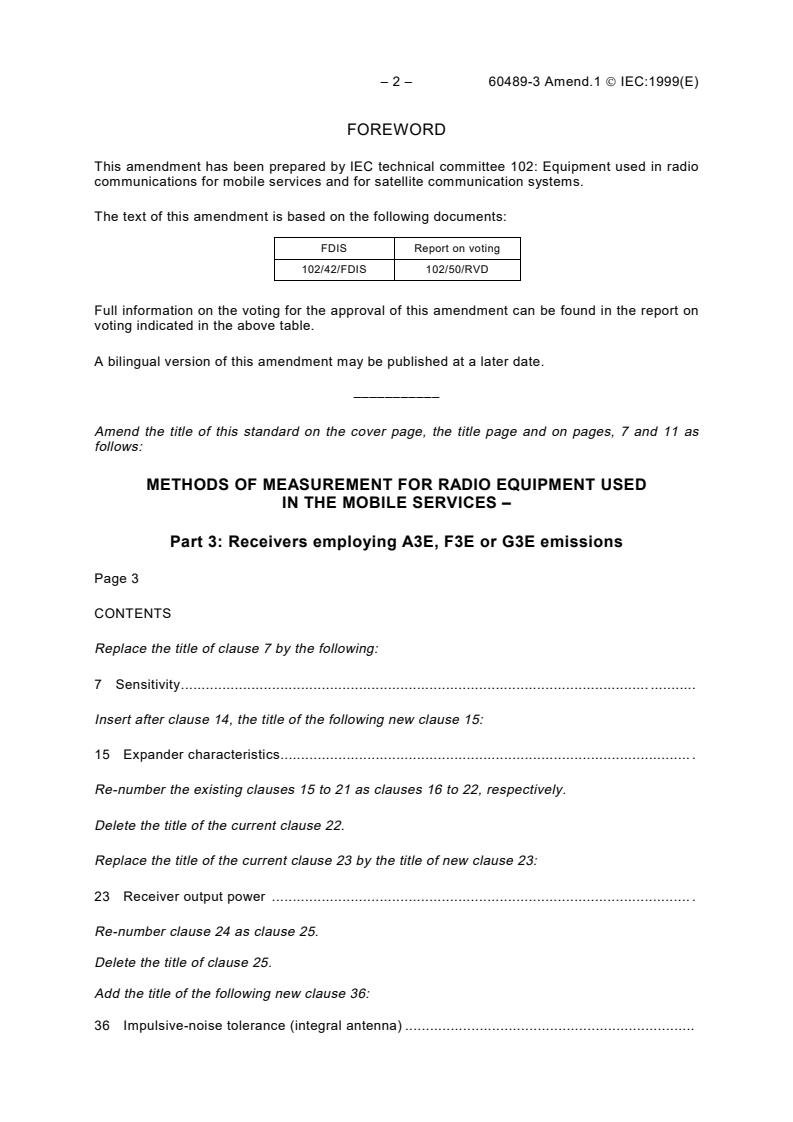
FOREWORD
This amendment has been prepared by IEC technical committee 102: Equipment used in radio
communications for mobile services and for satellite communication systems.
The text of this amendment is based on the following documents:
FDIS Report on voting
102/42/FDIS 102/50/RVD
Full information on the voting for the approval of this amendment can be found in the report on
voting indicated in the above table.
A bilingual version of this amendment may be published at a later date.
–––––––––––
Amend the title of this standard on the cover page, the title page and on pages, 7 and 11 as
follows:
METHODS OF MEASUREMENT FOR RADIO EQUIPMENT USED
IN THE MOBILE SERVICES –
Part 3: Receivers employing A3E, F3E or G3E emissions
Page 3
CONTENTS
Replace the title of clause 7 by the following:
7 Sensitivity. .
Insert after clause 14, the title of the following new clause 15:
15 Expander characteristics. .
Re-number the existing clauses 15 to 21 as clauses 16 to 22, respectively.
Delete the title of the current clause 22.
Replace the title of the current clause 23 by the title of new clause 23:
23 Receiver output power . .
Re-number clause 24 as clause 25.
Delete the title of clause 25.
Add the title of the following new clause 36:
36 Impulsive-noise tolerance (integral antenna) .
60489-3 Amend. 1 IEC:1999(E) – 3 –
Page 3
Delete the appendices F to L inclusive.
Add the following new annexes:
Annex M – Rayleigh fading simulators.
Annex N – Accuracy for diversity receiver sensitivity measurement .
Page 7
PREFACE
Add, on page 9, after 489-1 (1983), the following:
Amendment 1 (1986)
1)
Amendment 2
Insert, before 489-6 (1987) the following:
IEC 60489-2 (1991): Part 2: Transmitters employing A3E, F3E and G3E emissions
1)
Amendment 1
Add the following footnote, referring to both amendment 2 of IEC 60489-1 and amendment 1 of
IEC 60489-2:
Add, under 489-6 (1987) the following:
ITU-T Recommendation O.41(19/94): Psophometer for use on telephone-type circuits.
Page 11
SECTION ONE – GENERAL
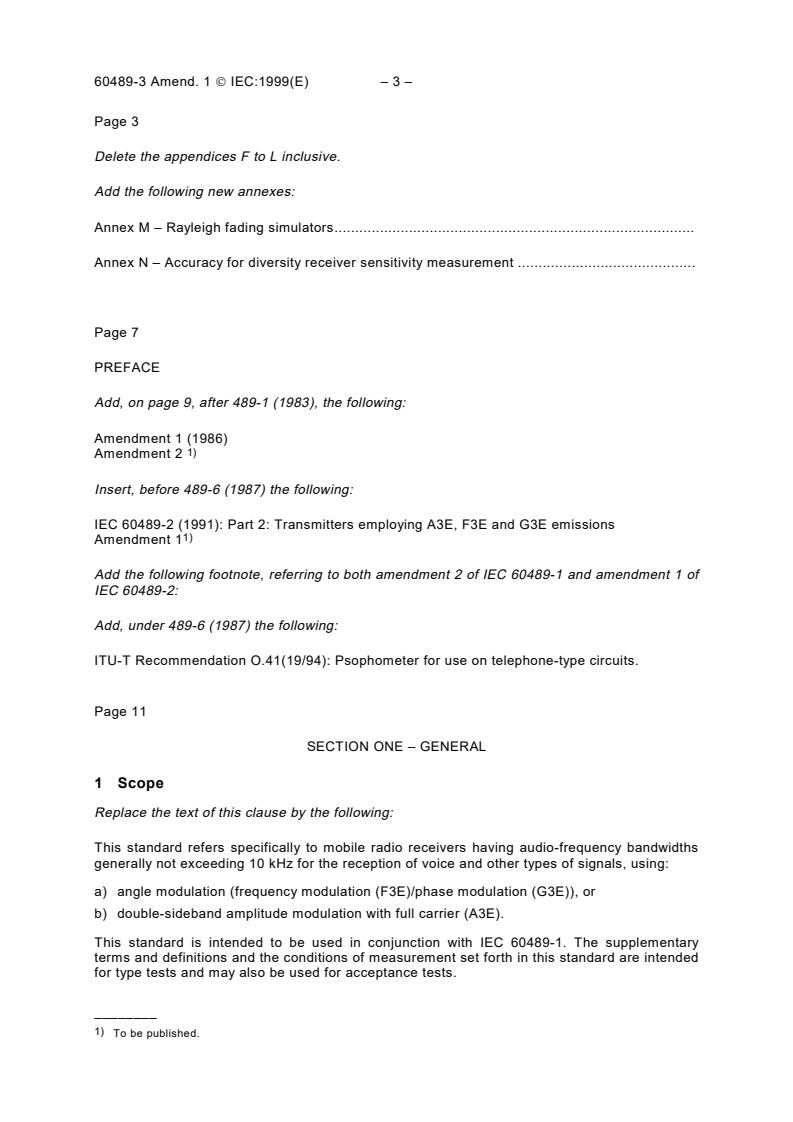
1 Scope
Replace the text of this clause by the following:
This standard refers specifically to mobile radio receivers having audio-frequency bandwidths
generally not exceeding 10 kHz for the reception of voice and other types of signals, using:
a) angle modulation (frequency modulation (F3E)/phase modulation (G3E)), or
b) double-sideband amplitude modulation with full carrier (A3E).
This standard is intended to be used in conjunction with IEC 60489-1. The supplementary
terms and definitions and the conditions of measurement set forth in this standard are intended
for type tests and may also be used for acceptance tests.
––––––––
1)
To be published.
– 4 – 60489-3 Amend.1 IEC:1999(E)
Page 21
5.10.1 Limitation of the audio-frequency band
Replace the text of this subclause by the following:
Because some properties, for example noise and audio-frequency harmonic distortion, depend
upon the audio-frequency bandwidth, reproducible results can be obtained only when the band
of audio-frequencies occupied by the demodulated signal is restricted to specified limits.
This restriction may be accomplished by means of a band-limiting filter preceding any audio-
frequency measuring device and adapted to the type of signals to be transmitted. The filter may
be incorporated within the measuring equipment. When measuring residual hum and noise,
only the low-pass portion of the filter should be specified.
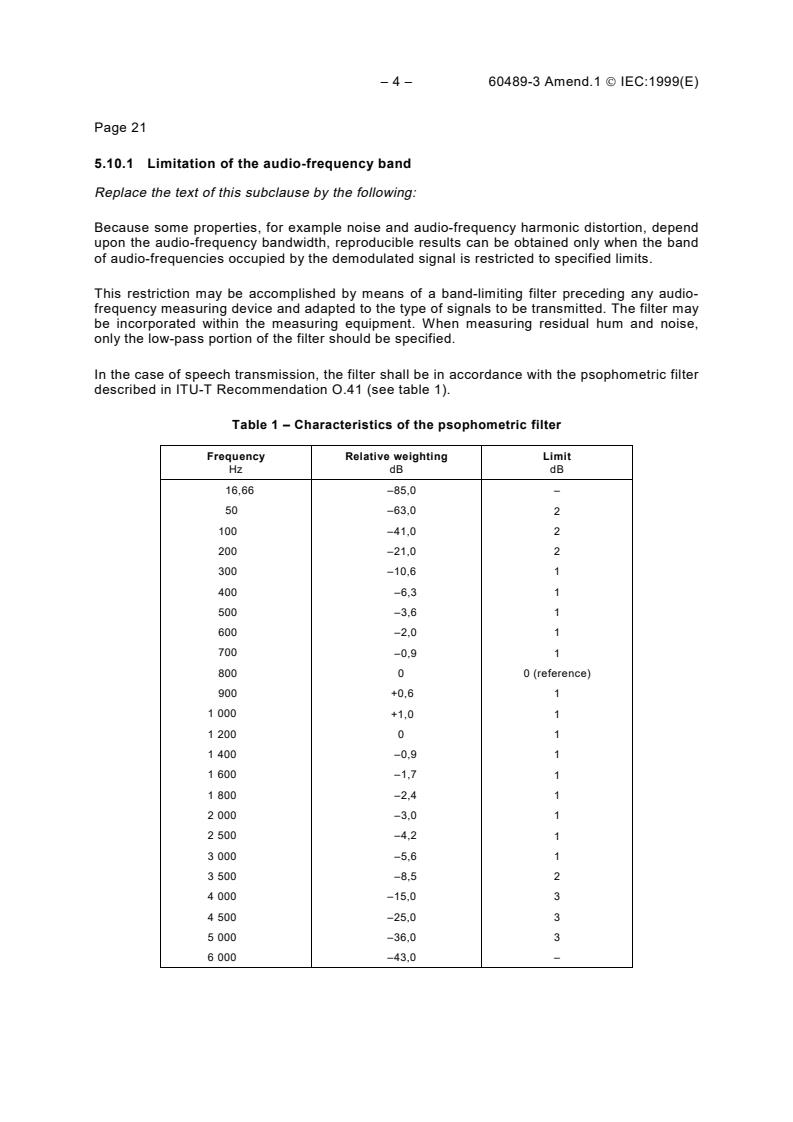
In the case of speech transmission, the filter shall be in accordance with the psophometric filter
described in ITU-T Recommendation O.41 (see table 1).
Table 1 – Characteristics of the psophometric filter
Frequency Relative weighting Limit
Hz dB dB
16,66 –85,0 –
–63,0 2
100 –41,0 2
200 –21,0 2
300 –10,6 1
400 –6,3
500 –3,6 1
600 –2,0 1
700 –0,9 1
800 0
0 (reference)
900 +0,6 1
1 000 +1,0 1
1 200 0 1
1 400 –0,9
1 600 –1,7 1
1 800 –2,4 1
2 000 –3,0 1
2 500 –4,2
3 000 –5,6 1
3 500 –8,5 2
4 000 –15,0 3
4 500 –25,0 3
5 000 –36,0 3
6 000 –43,0 –
60489-3 Amend. 1 IEC:1999(E) – 5 –
Page 23
6.4 Radio-frequency coupling device (RFCD)
Replace the text of this subclause by the following:
The measurements described in this standard are applicable to receivers having either antenna
terminals or an integral antenna.
Measurements of the radio-frequency parameter of receivers having an integral antenna are
performed in a test site or in an RFCD. See IEC 60489-1, annex A, for details of these.
Page 25
SECTION THREE – METHOD OF MEASUREMENT FOR RECEIVERS EQUIPPED
WITH SUITABLE ANTENNA TERMINALS
Replace the title and text of clause 7 by the following:
7 Sensitivity
7.1 Measured usable sensitivity (MUS)
7.1.1 Definition
Level of the input signal at a specified frequency with specified modulation which will result in
the standard signal-to-noise ratio (see 3.3) at the output of the receiver.
7.1.2 Method of measurement
a) Connect the equipment as illustrated in figure 3.
b) Apply the standard input signal to the receiver input terminals.
c) Adjust the receiver volume control to obtain the reference output level (see 3.1.2). Record
this level.
d) Adjust the input-signal level to produce the standard signal-to-noise ratio. Record this level.
e) If the audio output level obtained in d) is more than 3 dB below the level recorded in step
c), this fact should be recorded. The input-signal level at which the audio output level has
fallen by 3 dB should be recorded.
f) The measured usable sensitivity is the level recorded in step d). It is expressed as follows:
SND++
the measured usable sensitivity for a ratio of 12 dB is_____μV or dB (μV).
ND+
7.2 Specified usable sensitivity (SUS)
7.2.1 Definition
Level of the input signal specified by the regulatory authority, manufacturer or customer at the
specified input-signal frequency (see 5.5) with standard modulation (see 5.6) which results in a
signal-to-noise ratio, equal to or greater than the standard signal-to-noise ratio.
NOTE – To make meaningful measurements, the specified input-signal level should be chosen taking into account
the dispersion of the sensitivities of various equipment in defined environmental conditions.
– 6 – 60489-3 Amend.1 IEC:1999(E)
Page 27
8 Acceptable radio-frequency displacement
Replace the text of this clause by the following:
8.1 Definition
Change of input-signal frequency that is required to restore the standard signal-to-noise ratio
after an increase of the input-signal level by 6 dB from the sensitivity (SUS or MUS). The
acceptable radio-frequency displacement is then the smaller of the two possible radio-
frequency displacements.
NOTE – Radio-frequency displacement is an absolute value and an increase in the displacement is to move the
radio-frequency away from the nominal frequency.
8.2 Method of measurement
a) Connect the equipment as illustrated in figure 3.
b) Apply the standard input signal to the receiver input terminals.
c) Adjust the receiver gain control to obtain the reference output level (see 3.1.2). Record this
level.
d) Adjust the input-signal level to produce the standard signal-to-noise ratio or the sensitivity
(SUS). Record this level.
e) Increase the input signal level in step d) by 6 dB and then increase the input signal
frequency until the standard signal-to-noise ratio is again obtained. Record this frequency.
f) Repeat step e) for input signal frequencies below the standard input-signal frequency.
8.3 Presentation of results
a) Calculate and record the differences between the standard input-signal frequency of the
receiver and each of the frequencies recorded in steps e) and f), respectively.
b) The acceptable radio-frequency displacement (SUS or MUS) is the smaller of the two
values in step a).
c) Record the standard input-signal frequency.
Page 29
10.3 Presentation of results
Replace the existing subclause by the following:
Plot the values recorded in step e), in decibels relative to the level at 1 kHz, on the linear
ordinate of a graph, and the modulating frequency on the logarithmic abscissa.
Calculate the audio-frequency response deviations from reference audio-frequency response,
in decibels, taking the deviation at 1 000 Hz equal to 0 dB. The deviation from the reference
audio-frequency response, having de-emphasis of –6 dB/octave, shall be calculated according
to the data listed in the table below, unless otherwise specified in the equipment specification.
Modulation frequency 300 500 1 000 2 000 3 000 3 400
Hz
Reference value +10,5 +6,0 0 –6,0 –9,5 –10,6
dB
If de-emphasis is not provided in the receiver, flat audio-frequency response is considered as
reference one in the specified audio-frequency bandwidth.
60489-3 Amend. 1 IEC:1999(E) – 7 –
Page 35
Figure 5
Replace, in figure 5, "Reference Sensitivity" with "Sensitivity (SUS or MUS)".
Page 41
Insert the following new clause before the current clause 15:
15 Expander characteristics
This measurement is applicable to receivers intended for the reception of angle-modulated
signals.
15.1 Expander overall amplitude characteristics
15.1.1 Definition
Relationship between the deviation of the received carrier, at one frequency, and the audio
level or the receiver output.
15.1.2 Method of measurement
a) Connect a radio-frequency signal source to the input of the receiver.
b) Modulate the radio-frequency signal source with an audio-frequency tone of 1 kHz to obtain
25 % of the maximum permissible frequency (or phase) deviation.
c) Measure the audio level at the receiver output. This is the reference level.
d) Change the frequency deviation which is specified by users and manufacturers, and
measure the audio level at the receiver output.
e) Calculate the relative level at the receiver output, using the reference value obtained in step
c), for each frequency deviation measured in step d).
15.2 Expander attack and recovery time
15.2.1 Definitions
Expander attack time is the time between the instant when a step increase of carrier frequency
deviation is applied and the instant when the audio level at the receiver output rises to a value
equal to 0,75 times the new steady-state value.
Expander recovery time is the time between the instant when a step decrease of the carrier
frequency deviation is applied and the instant when the audio level at the receiver output falls
to a value equal to 1,5 times the new steady-state value.
15.2.2 Method of measurement
a) Connect a radio-frequency signal source to the input of the receiver.
b) Modulate the radio-frequency signal source with an audio tone frequency of 2 kHz to obtain
25 % of the maximum permissible frequency (or phase) deviation.
c) Measure the audio level at the receiver output.
d) Change the deviation of the radio-frequency signal source to 50 % of the maximum
permissible frequency (or phase) deviation.
e) Measure the level at receiver output. Note the result.
– 8 – 60489-3 Amend.1 IEC:1999(E)
f) Switch the deviation from 50 % to 25 % within 100 μs and measure the time for the audio
level of the speaker input to fall to 1,5 times the value recorded in step c). Record this time
as the recovery time.
g) Switch the deviation from 25 % to 50 % within 100 μs and measure the time taken for the
audio level at the receiver output to rise 0,75 times of the value recorded in step e). Record
this time as the attack time.
Page 41
15 Impulsive noise
Renumber this clause as clause 16.
15.2.1 Definition
Replace the text of this subclause by the following. The subclause number becomes 16.2.1.
Ability of a receiver to prevent impulsive noise from degrading the desired response at the
output of the receiver.
It is expressed as the ratio of
a) the median level of spectrum amplitude of the impulsive noise that causes a wanted signal,
which is 3 dB in excess of the sensitivity (SUS or MUS), to restore the standard signal-to-
noise ratio at the receiver output terminals
to
b) the wanted signal level (sensitivity (SUS) plus 3 dB) or the sensitivity (MUS) (the wanted
signal level is the sensitivity (MUS) plus 3 dB).
Page 43
15.2.2 Method of measurement
Replace, in this subclause, the number of which becomes 16.2.2 according to the new
numbering, Note 1 by the following:
NOTE 1 – The value of the sensitivity (SUS or MUS) determined in 7.1.2 or defined in 7.2.1 is required for this
measurement.
Replace c) of 15.2.2 by the following:
c) In the absence of the impulsive noise, apply the standard input signal to terminal A and B of
the combining network (see 5.3). Reduce its level to obtain the sensitivity (SUS or MUS) at
the input of the receiver.
15.2.3 Presentation of result
In the new 16.2.3, replace twice "reference sensitivity" with "sensitivity (SUS or MUS)".
60489-3 Amend. 1 IEC:1999(E) – 9 –
Page 45
16 Selectivity
Replace the text of this clause by the following. The new clause number becomes 17.
17.1 General
Selectivity is the ability of the receiver to discriminate between wanted and unwanted input
signals.
The methods of measurement described in this clause deal only with interference that
degrades the receiver output signal due to the simultaneous presence of a wanted and an
unwanted input-signal. It is to be noted, however, that unwanted signals may also be
objectionable when the wanted signal is not present.
The methods of measurement are described in a manner which allows the limit for the
selectivity of the receiver to be expressed either as
a) the ratio of the level of the unwanted input signal to the level of the wanted signal, which is
set to the SUS (see 7.2) plus 3 dB; this is expressed as "selectivity (SUS)";
or
b) the ratio of the level of the unwanted input signal level to the value of the sensitivity (MUS)
(see 7.1), the wanted signal being set 3 dB above the value of the MUS; this is expressed
as "selectivity (MUS)".
Figure 11 illustrates the two methods.
3 dB
3 dB
Selectivity measurement using Selectivity measurement using
specified usable sensitivity measured usable sensitivity
Figure 11 – Illustration of selectivity (SUS and MUS)
These two methods of measurement are intended to cover different practical applications.
The SUS method is intended to cover the case of mobile radio systems used in environments
having a high level of interference (e.g. in areas where the cell size is mainly determined by
interference) and where the frequency planning is based on parameters virtually common to all
radio systems implemented in that area.
– 10 – 60489-3 Amend.1 IEC:1999(E)
The MUS method is intended to cover the case of mobile radio systems used in environments
having a low level of interference (e.g. rural areas), where the actual measured usable
sensitivity (MUS) and radio-frequency coverage are the key factors, together with the overall
power budget of the links.
These two methods generally provide different results. In the special case where the sensitivity
(MUS) of a particular equipment is equal to the sensitivity (SUS), the level of the wanted and
unwanted signals used in both measurements will be the same, but the results calculated
according to the two methods will differ by 3 dB.
17.2 Adjacent signal selectivity (including co-channel rejection and blocking)
17.2.1 Definition
Ability of the receiver to minimize the degrading effect of an unwanted adjacent signal on the
desired response at the output of the receiver. It is the ratio, expressed in decibels, of
a) the level of an unwanted input signal that causes a wanted input signal, which is 3 dB in
excess of the sensitivity (SUS or MUS), to produce the standard signal-to-noise ratio
to
b) the wanted signal level (sensitivity (SUS) plus 3 dB), or the sensitivity (MUS) (the wanted
signal level is sensitivity (MUS) plus 3 dB).
Co-channel rejection is a particular case of adjacent signal selectivity where the difference
between the unwanted signal frequency and the standard input-signal frequency is a specified
amount less than 300 Hz.
Blocking is a particular case of adjacent signal selectivity where the difference between the
unwanted signal frequency and the standard input frequency is a specified amount greater than
1 % of the standard input-signal frequency.
17.2.2 Method of measurement
NOTE – Knowledge of the sensitivity (SUS or MUS) is required in this measurement.
a) Connect the equipment as illustrated in figure 3 and connect a second audio-frequency
signal generator (unwanted signal source) to terminal B of the appropriate matching or
combining network (see appendix A).
b) In the absence of the unwanted signal, apply the standard input signal to terminal A of the
combining network. Reduce its level to the level of the sensitivity (SUS or MUS). Record
this level in μV or dB(μV).
c) Increase the level of this wanted input signal by 3 dB.
d) Apply an unwanted input-signal, modulated with 400 Hz at a modulation depth of 60 % or at
60 % of the permissible frequency deviation, to terminal B of the combining network.
e) Adjust the unwanted signal frequency by a specified amount above and below the wanted
signal frequency and adjust the unwanted signal level each time so as to re-establish the
standard signal-to-noise ratio. Record these levels in μV or dB(μV).
f) Step e) may be repeated for other values of frequency displacement.
60489-3 Amend. 1 IEC:1999(E) – 11 –
17.2.3 Presentation of results
a) Calculate the ratios, in decibels, of the unwanted signal levels recorded in 17.2.2 step e) to
the level of the wanted signal. (The wanted signal level is 3 dB above the sensitivity (SUS)).
The smaller value is the adjacent signal selectivity (SUS) and is expressed in decibels,
or
b) Calculate the ratios, in decibels, of the unwanted signal levels recorded in 17.2.2 step e) to
the sensitivity (MUS). (The wanted signal level is 3 dB above the sensitivity (MUS)). The
smaller value is the adjacent-signal selectivity (MUS) and is expressed in decibels.
NOTE – The result may be displayed in a table.
17.3 Adjacent channel selectivity
Where the mobile radio service uses discrete channel spacings, the value of the adjacent
signal selectivity, measured with a signal spacing equal to the discrete channel spacing, may
be quoted as the value of the adjacent channel selectivity, for a given frequency spacing of the
channels.
17.4 Cross-modulation
This test is normally performed only on amplitude-modulation receivers.
17.4.1 Definition
Amplitude modulation of the wanted signal, within the receiver, by the modulation of an unwanted
signal.
It is expressed as the ratio of:
a) the level of an unwanted signal, with specified modulation, that results in a specified signal
level at the receiver output terminals,
to
b) the level of the wanted unmodulated input signal.
17.4.2 Method of measurement
a) Connect the equipment as illustrated in figure 3 and connect a second radio-frequency
signal generator (unwanted signal source) to terminal B of the appropriate matching or
combining network (see appendix A).
b) In the absence of the unwanted signal, apply the standard input signal (see 5.3 and 5.4) to
terminal A of the combining network. Record this level in μV or dB(μV).
c) Adjust the receiver volume control, if available, to produce the reference output level.
d) Remove the modulation from the wanted input signal.
e) Apply an unwanted signal with the standard modulation to terminal B of the combining
network and adjust the unwanted input signal to a frequency approximately 100 kHz above
or below the standard input-signal frequency. (For receivers in which the adjacent signal
selectivity at 100 kHz would affect the results, use a greater frequency separation.)
f) Increase the unwanted input signal level until the signal at the receiver output terminals is
20 dB below the reference output level. Record the unwanted input signal level in μV or
dB(μV).
NOTE – To test that the observed effect is cross-modulation, remove the wanted signal and verify that the
unwanted audio-frequency signal disappears from the receiver output terminals.
g) Calculate the ratio, in decibels, of the level recorded in step f) to the level in step b). The
smaller ratio is cross-modulation attenuation. If the effect of cross-modulation is required to
be stated as an absolute level, use the level recorded in step f).
– 12 – 60489-3 Amend.1 IEC:1999(E)
17.5 Spurious response immunity
17.5.1 Definition
Ability of the receiver to prevent a single unwanted spurious signal from degrading the desired
response at the output of the receiver. It is the ratio, expressed in decibels, of
a) the level of an unwanted input signal that causes a wanted input signal, which is 3 dB in
excess of the sensitivity (SUS or MUS), to produce the standard signal-to-noise ratio
to
b) the wanted signal level (sensitivity (SUS) plus 3 dB), or the sensitivity (MUS) (the wanted
signal level is sensitivity (MUS) plus 3 dB).
17.5.2 Method of measurement
a) Connect the equipment as illustrated in figure 3, and connect a second signal generator
(unwanted signal source) to terminal B of the appropriate matching or combining network
(see appendix A).
b) In the absence of the unwanted signal, apply the standard input signal to terminal A of the
combining network. Reduce its level to the level of the sensitivity (SUS or MUS). Record
this level in μV or dB(μV).
c) Increase the level of this wanted input signal by 3 dB.
d) Apply a high-level, unwanted input signal, for example, 90 dB (μV), modulated with 400 Hz
at a modulation depth of 60 %, or at 60 % of the permissible frequency deviation, as
appropriate for the class of emission, to terminal B of the combining network.
e) Vary the unwanted input-signal frequency over a specified range to search for a
degradation of the signal-to-noise ratio. When a response is found, carefully adjust the
frequency of the unwanted signal to maximize the degradation.
f) At the frequency of each spurious response, change the level of the unwanted input signal
until the standard signal-to-noise ratio is obtained at the receiver output terminals. Record
the frequency of the unwanted input-signal and record its level at the input of the receiver in
μV or dB(μV).
17.5.3 Presentation of results
a) Calculate the ratios, in decibels, of the unwanted signal levels recorded in 17.5.2 step f) to
the level of the wanted signal. (The wanted signal level is 3 dB above the sensitivity (SUS)).
The smaller value is the spurious response immunity (SUS) and is expressed in decibels,
or
b) calculate the ratios, in decibels, of the unwanted signal levels recorded in 17.5.2 step f) to
the sensitivity (MUS). (The wanted signal level is 3 dB above the sensitivity (MUS)). The
smaller value is the spurious response immunity (MUS) and is expressed in decibels.
Tabulate these ratios or the absolute values obtained in step f) together with the frequencies
recorded in step f). Record the nominal operating frequency.
60489-3 Amend. 1 IEC:1999(E) – 13 –
17.6 Intermodulation immunity
17.6.1 Definition
Ability of the receiver to prevent two unwanted adjacent signals which have specific frequency
relationship to the wanted signal frequency (see appendix D), from degrading the desired
response of the receiver output. It is the ratio, expressed in decibels, of
a) the common level of two unwanted input signals that cause a wanted input signal, which is
3 dB in excess of the sensitivity (SUS or MUS), to produce the standard signal-to-noise
ratio
to
b) the wanted signal level (sensitivity (SUS) plus 3 dB), or the sensitivity (MUS) (the wanted
signal level is sensitivity (MUS) plus 3 dB).
17.6.2 Method of measurement
a) Connect the equipment as illustrated in figure 3, and connect two additional signal
generators (unwanted signal sources) to terminals B and C of an appropriate matching or
combining network (see appendix A).
b) In the absence of the unwanted signal, apply the standard input signal to terminal A of the
combining network. Reduce its level to the level of the sensitivity (SUS or MUS). Record
this level in μV or dB(μV).
c) Increase the level of this wanted input signal by 3 dB.
d) Apply an unwanted unmodulated input signal from the generator connected to terminal B of
the combining network and adjust it to a specified frequency f (see appendix D).
n
e) Apply an unwanted unmodulated input signal from the generator connected to terminal C
of the combining network and adjust its frequency to a specified frequency f (see
r
appendix D).
f) Incrementally increase the levels of the two unwanted signals until the signal-to-noise ratio
is degraded.
g) Carefully adjust the frequency of one of the unwanted signals to maximize the degradation.
h) Adjust the levels of the unwanted signals to be equal at the receiver input and to produce
the standard signal-to-noise ratio at the receiver output. Record this level in μV or dB(μV).
17.6.3 Presentation of results
a) Calculate the ratios, in decibels, of the unwanted signal levels recorded in 17.6.2 step h) to
the level of the wanted signal. (The wanted signal level is 3 dB above the sensitivity (SUS).)
The smaller value is the intermodulation immunity (SUS) and is expressed in decibels,
or
b) calculate the ratios, in decibels, of the unwanted signal levels recorded in 17.6.2 step h) to
the sensitivity (MUS). (The wanted signal level is 3 dB above the sensitivity (MUS).) The
smaller value is the intermodulation immunity (MUS) and is expressed in decibels.
Record these ratios or the absolute values recorded in step h). Record the nominal operating
frequency.
NOTE – Measuring errors may result from intermodulation between generators, generator noise or receiver
desensitization. See appendix B for precautions regarding the signal generators.
– 14 – 60489-3 Amend.1 IEC:1999(E)
Page 55
17 Automatic gain control (AGC) characteristic
Replace the text of this clause and re-number the title and text as clause 18:
NOTE – This test is only applicable to the A3E mode.
18.1 Definition
Change in output level as a function of the level of the input signal.
18.2 Method of measurement
a) Connect the equipment as illustrated in figure 3.
b) Apply the standard input signal and increase its level to 100 dB(μV).
c) Adjust the receiver for the reference output level.
d) Progressively reduce the input signal level and record the output power for each level of the
input signal. Continue until sensitivity (SUS or MUS) is reached.
e) The measurement may be continued at lower input signal levels to determine the
performance at levels below the sensitivity (SUS or MUS).
f) The upper limit of automatic gain control characteristic is defined as input signal level value
at which the total distortion factor becomes equal to the specified value and signal level
change at the receiver output does not exceed the specified value. The lower limit of
automatic gain control characteristic is defined as the receiver output level value at the
input signal level equal to the sensitivity (SUS).
18.3 Presentation of results
Plot the relative output level in decibels on the linear ordinate of a graph and the input-signal
level in dB(μV) on the linear abscissa. Record the reference output level.
The performance of automatic gain control is expressed in the following form:
– specified signal level change at the receiver input by ___ dB versus signal level change at
the receiver output of ___ dB.
Alternatively, a table of values may be presented.
18.4 Dynamic automatic gain control characteristic
18.4.1 General
The dynamic automatic gain control characteristic is the transient effect upon the level of the
output signal caused by a sudden change of input signal level. It is defined in terms of its
attack and recovery times.
18.4.2 Definition – AGC attack time
Elapsed time from the instant at which the input signal level is suddenly increased by a
specified amount until the instant at which the level of the output signal reaches and remains
within 2 dB of the subsequent steady-state value.
60489-3 Amend. 1 IEC:1999(E) – 15 –
18.4.3 Method of measurement
a) Connect the equipment as illustrated in figure 3 and connect an oscilloscope in parallel with
the audio-frequency test load. Connect an electronically controlled attenuator capable of
providing a specified change in input-signal level, for example 20 dB, between the radio-
frequency signal source and the receiver input terminals.
b) Set the attenuator to its maximum attenuation.
c) Apply the standard input signal and reduce its level to sensitivity (SUS or MUS).
d) A receiver equipped with an accessible volume control should be adjusted to provide a level
of at least 20 dB below the rated audio-frequency output level.
e) Synchronize the calibrated horizontal sweep of the oscilloscope with the attenuator
actuating signal.
f) Actuate the attenuator.
g) Measure the time between the instant of actuating the attenuator and the instant after which
the output signal reaches and remains within 2 dB of the subsequent steady-state level
(points A and B in figure 7). This is the AGC attack time.
NOTE – A variation of this method is to use a dual-trace storage oscilloscope to show on one trace the radio-
frequency signal, and on the other trace the audio-frequency signal.
18.4.4 Definition – AGC recovery time
Elapsed time from the instant when the input signal level is suddenly decreased by a specified
amount until the instant at which the output signal reaches and remains within 2 dB of the
subsequent steady-state value.
18.4.5 Method of measurement
a) Carry out steps a) to f) in 18.4.3, but arrange to decrease the input signal level, for example
by 20 dB, at the moment of change.
The radio-frequency input signal level initially applied should be approximately 20 dB
greater than sensitivity (SUS or MUS).
b) Measure the time between the instant of actuating the attenuator and the instant after which
the output signal reaches and remains within 2 dB of the subsequent steady-state level
(points C and D in figure 7). This is the AGC recovery time.
NOTE – A variant of this method is to use a dual-trace storage oscilloscope to show on one trace the radio-
frequency signal, and on the other trace, the audio-frequency signal.
2 dB
2 dB
2 dB
2 dB
Time
2 dB
2 dB
2 dB
2 dB
Attack Recovery
time time
IEC 652/99
Figure 7 – Example of dynamic AGC characteristic
AF output signal V
– 16 – 60489-3 Amend.1 IEC:1999(E)
Page 59
18 Radiated spurious components
Replace the text of this clause by the following. The new clause number becomes 19:
The radiated spurious components are any radiation originating from within a receiver.
The radiated spurious components of a receiver may contain
– average radiated spurious components;
– maximum effective radiated spurious components;
– RFM (random field measurement) radiated spurious components;
– RFCD radiated spurious components.
The method of measurement for each of the above is the same as that for the radiated radio-
frequency power of transmitters described in 9.2 to 9.5 of IEC 60489-2 respectively, replacing
the words transmitter with receiver and radiated power with radiated spurious components.
Attention is necessary for the following difference between the radiated spurious components
and the radiated radio-frequency power of transmitters in proceeding with the measurement
mentioned in the subclause procedures.
1) The power levels of the radiated spurious components of receivers are far below the
radiated radio-frequency power of transmitters and these test sites or RFCD which have
higher coupling loss may not be able to measure low-level ones. A lower coupling loss test
site, RFCD or measurement condition should be chosen.
2) If the receiver has an antenna terminal, it shall be terminated in a test load having an
impedance equal to the nominal radio-frequency input impedance.
3) A transmitter transmits a frequency or frequencies which are known. However, frequencies
of the radiated spurious components may not be known, and searching for and identifying
them may be necessary. If necessary, closely couple a selective measuring device to the
receiver under test.
4) The polarization of the radiated spurious components may not be the same as the antenna
polarization. Confirmation of the radiation polarization may be necessary with measuring
antenna polarization change.
Page 63
Delete figure 8.
Page 65
19 Conducted spurious components
Change clause number to 20.
60489-3 Amend. 1 IEC:1999(E) – 17 –
Page 67
20 Evaluation of the receiving part of the equipment under duplex conditions
Change clause number to 21.
21 Receiver performance under conditions deviating from standard
test conditions
Change clause number to 22 and add, on page 71, the following new subclauses:
22.11 Sensitivity of two-branch diversity receiver under multipath propagation
conditions
22.11.1 Definition
RMS level of a Rayleigh faded input signal at a specified frequency with specified modulation
which will produce the averaged signal-to-noise ratio of 12 dB at the output of the receiver.
NOTE – The median value of the envelope is 1,6 dB less than the r.m.s. value.
22.11.2 Method of measurement
a) Connect the equipment as illustrated in figure 12 (see annex M for details of a dual channel
Rayleigh fading simulator).
b) Adjust the frequency of the radio-frequency signal generator (2) to one of the specified
nominal frequencies.
c) Modulate the radio-frequency signal generator (2) with a 1 000 Hz tone at standard
deviation using an audio-frequency signal generator (1).
d) Apply the output of the radio-frequency signal generator (2) to the dual channel Rayleigh
fading simulator (3) at the level specified by the manufacturer of the fading simulator.
e) Adjust the correlation factor of the simulator (3) to zero.
f) Adjust the velocity of the simulator (3) to a specified velocity. This may be specified as
"maximum Doppler frequency" (f ) or "velocity" (v). Record this value.
m
f = v/wavelength
m
g) Record the r.m.s. value of the output signals of the simulator in dB (μV).
h) Adjust the step attenuators (4,4') for equal levels into each receiver branch at a level that is
expected to yield the sensitivity of a two-branch diversity receiver under multipath
propagation conditions.
i) 1) Measure the true r.m.s. voltage level of S+N+D (signal + noise + distortion) Vi at the
output of the receiver during the time of measurement T. T shall be greater than 200/f (s).
m
In order to measure the average value of a time varying S+N+D, an averaging technique is
applied. The averaging process requires n data samples which are the instantaneous
values sampled by a frequency greater than 100 × f , or the integrated values during a sub-
m
multiple (less than one-fiftieth) of the measuring time T.
NOTE – The length of the measuring time T has been chosen in order to achieve a dispersion of 1 dB. See
annex N.
2) Calculate SND by the following equation adding the squares of the r.m.s. voltages
AVE
and dividing the sum by the number of samples:
n
Vi
∑
i
SND =
AVE
n
– 18 – 60489-3 Amend.1 IEC:1999(E)
j) 1) Using a distortion level meter with signal filtering characteristics as given in 6.2, measure
the true r.m.s. voltage level of N+D (noise + distortion) Vi ′ output of the receiver. Use the
same number
n of samples and test period as in i)1).
2) Add the squares of the r.m.s. voltage and divide the sum by the number of samples.
n
Vi'
∑
i
ND =
AVE
n
k) Calculate SINAD as follows from the number obtained in i)2) and j)2).
AVE
SND
AVE
SINAD = 20log
AVE
ND
AVE
l) 1) If SINAD < 11 dB, reduce both step attenuators by an equal amount, selected to
AVE
result in a measurement closer to 12 dB.
2) If SINAD > 13 dB, increase both step attenuators by an equal amount, selected to
AVE
result in a measurement closer to 12 dB.
1 2 5 6
4’
IEC 653/99
Key
1 Audio-frequency generator 4 4': step attenuator (1 dB step)
2 Radio-frequency generator 5 Diversity receiver under test
3 Dual channel Rayleigh fading simulator 6 SINAD meter
Figure 12 – Arrangement for measuring diversity receivers
m) Repeat i) 1) until SINAD = 12 ± 1 dB.
AVE
n) Using the procedures recommended by the manufacturer of the Rayleigh fading simulator,
and the attenuation settings of the step attenuators, determine the r.m.s. voltage of the
radio-frequency input to the receivers. Record this level as the sensitivity.
o) Repeat steps f) to n) for other fading rates as necessary for the type of equipment being
tested (see annex M).
22.11.3 Presentation of results
The sensitivity is expressed as follows:
the sensitivity for a SINAD of 12 dB is _μV or dB (μV) at _ fading rate.
SND++
NOTE 1 – SINAD is defined as
ND+
60489-3 Amend. 1 IEC:1999(E) – 19 –
Add the following new clause:
23 Receiver output power
23.1 Definition
Receiver output power at pure resistance load equal to the nominal value of actual load
impedance at 1 000 Hz.
23.2 Method of measurement
a) Connect the equipment as illustrated in figure 3.
b) Apply a standard input signal to the receiver input terminals.
c) Adjust the receiver volume control (if applicable) to obtain maximum output without
exceeding the permissible total distortion factor specified by the manufacturer.
d) Measure the receiver output voltage (V) in terms of r.m.s. value at the load.
e) Calculate the output power of the receiver according to the formula given below:
V
P =
R
where R is the resistance equal to the nominal value of the actual load impedance at 1 000 Hz.
Page 71
SECTION FOUR – METHODS OF MEASUREMENT FOR RECEIVERS
WITH INTEGRAL ANTENNAS
22 Reference (radiation) sensitivity
Replace the existing clause 22 by the following, and the new clause number becomes 24:
24 Radiation sensitivity
24.1 General
The radiation sensitivity of a receiver may contain
– reference radiation sensitivity (MUS);
– normal radiation sensitivity (SUS or MUS);
– RFM radiation sensitivity (SUS or MUS);
– RFCD radiation sensitivity (SUS or MUS);
– average radiation sensitivity (SUS or MUS);
– diversity radiation sensitivity (SUS or MUS).
Receivers having an integral antenna or having no facility for connecting the external
measuring equipment require special measuring arrangements. The arrangements for the
former ones are test sites or RFCDs and for the later ones are the baseband signal connection
arrangements. They are described in IEC 60489-1, annex A.
Deviations from standard atmospheric conditions may occur for measurements made out of
doors. The actual conditions, however, should not cause the measurement results to deviate
appreciably from those which have been obtained under standard test conditions.
– 20 – 60489-3 Amend.1 IEC:1999(E)
24.2 Reference radiation sensitivity (MUS)
24.2.1 Definition
Minimum field strength of a signal at a specified frequency with specified modulation which will
produce the standard signal-to-noise ratio at the output of the receiver. It will be found in a
direction of horizontal plane.
NOTE – The reference sensitivity can be measured in OATS (open area test sites), LRTS (low reflection test sites)
or AC (anechoic chambers). Measured values in OATS may differ from the values measured in the other two test
sites because of the ground reflected wave effect.
24.2.2 Method of measurement for equipment fitted with squelch circuits (MUS)
a) Choose the test site and the measuring distance suitable for the frequency, the
environmental conditions, the required measurement error and receiver dimensions, from
those described in annex A of IEC 60489-1.
b) Calibrate the test site and place the receiver under test as illustrated in a subclause for the
chosen test site in the above-mentioned annex.
c) Measure the squelch opening level according to the combination of the same method of
measurement for receivers equipped with suitable antenna terminals (see 13.1) and the
basic measuring procedure for radiation measurement described in the above-mentioned
subclause. Record this level in microvolts.
NOTE – In the case of an adjustable squelch, it is recommended to open it using an input signal level which
provides a signal-to-noise ratio between 10 dB and 20 dB, as estimated by a listening test.
d) Rotate the equipment under test 45° clockwise in a horizontal plane and measure this
direction squelch opening level by the same procedure used in step c).
e) Repeat step d) until values have been obtained for eight azimuth positions.
f) Make a table of results and, if desired, plot them as points on a polar diagram.
g) If the results indicate that at a particular azimuth angle the level is significantly less than at
other angles, determine the minimum level required to open the squelch, by proceeding as
follows.
In the vicinity of the assumed azimuth for the minimum level, select smaller azimuthal
rotation angles, for example 15°, and for each azimuthal position, measure the level.
Record the lowest level.
h) Transfer the equipment to an RFCD at a determined position and in a determined direction.
Apply the standard input signal to the RFCD, and adjust the level to just open the squelch.
Record this level in microvolts.
i) Adjust the output level of the radio-frequency signal generator to obtain the standard signal-
to-noise ratio at the output of the sound-level meter. Record the output level of the radio-
frequency generator in microvolts.
j) Calculate and record the ratio of the levels recorded in steps h) and i).
k) Multiply the level determined in step g) by the ratio recorded in step j) to obtain the
minimum field strength needed to produce the standard signal-to-noise ratio.
The field strength is the reference radiation sensitivity (MUS).
60489-3 Amend. 1 IEC:1999(E) – 21 –
24.2.3 Method of measurement for equipment not fitted with squelch circuits (MUS)
a) Choose the test site and the measuring distance suitable for the frequency, the
environmental conditions, the required measurement error and receiver dimensions from
those described in annex A of IEC 60489-1.
b) Calibrate the test site and place the receiver under test as illustrated in a subclause for the
chosen test site in the above-mentioned annex.
c) Measure the sensitivity (MUS) according to the combination of the same method of
measurement for receivers equipped with suitable antenna terminals (see 7.1) and the
basic measuring procedure for radiation measurement described in the above chosen
subclause. Record this level in microvolts.
d) Rotate the equipment under test 45° clockwise in a horizontal plane and measure this
direction sensitivity (MUS) by the same procedure used in step c).
e) Repeat step d) until values have been obtained for eight
...