

IEC 61977:2020
(Main)Fibre optic interconnecting devices and passive components - Fibre optic fixed filters - Generic specification
General Information
- Abstract
IEC 61977:2020 applies to the family of fibre optic filters. These components have all of the following general features:
- they are passive for the reason that they contain no optoelectronic or other transducing elements which can process the optical signal launched into the input port;
- they modify the spectral intensity distribution in order to select some wavelengths and inhibit others;
- they are fixed, i.e. the modification of the spectral intensity distribution is fixed and cannot be tuned;
- they have input and output ports or a common port (having both functions of input and output) for the transmission of optical power; the ports are optical fibre or optical fibre connectors;
- they differ according to their characteristics. They can be divided into the following categories:
- short-wave pass (only wavelengths lower than or equal to a specified value are passed);
- long-wave pass (only wavelengths greater than or equal to a specified value are passed);
- band-pass (only an optical window is allowed);
- notch (only an optical window is inhibited);
- gain flattening (compensating the spectral profile of the device).
It is also possible to have a combination of the above categories. This document provides the generic information including terminology of IEC 61753-04x series documents. Published IEC 61753-04x series documents are listed in the Bibliography. This document establishes uniform requirements for optical, mechanical and environmental properties. This fourth edition cancels and replaces the third edition published in 2015. This edition constitutes a technical revision. This edition includes the following significant technical changes with respect to the previous edition:
- change of the title and the scope for the limitation to fibre optic fixed filters;
- addition of new terms and definitions reflecting new title;
- removal of terms and definitions duplicated in IEC TS 62627-09;
- harmonization of the vertical axis of Figures 1 to 5;
- restructuration of Clause 4 reflecting the latest technical and market situation.
- Status
- Published
- Publication Date
- 08-Apr-2020
- Technical Committee
- SC 86B - Fibre optic interconnecting devices and passive components
- Drafting Committee
- WG 7 - TC 86/SC 86B/WG 7
- Current Stage
- PPUB - Publication issued
- Start Date
- 09-Apr-2020
- Completion Date
- 08-May-2020
Buy Documents
IEC 61977:2020 RLV - Fibre optic interconnecting devices and passive components - Fibre optic fixed filters - Generic specification Released:4/9/2020
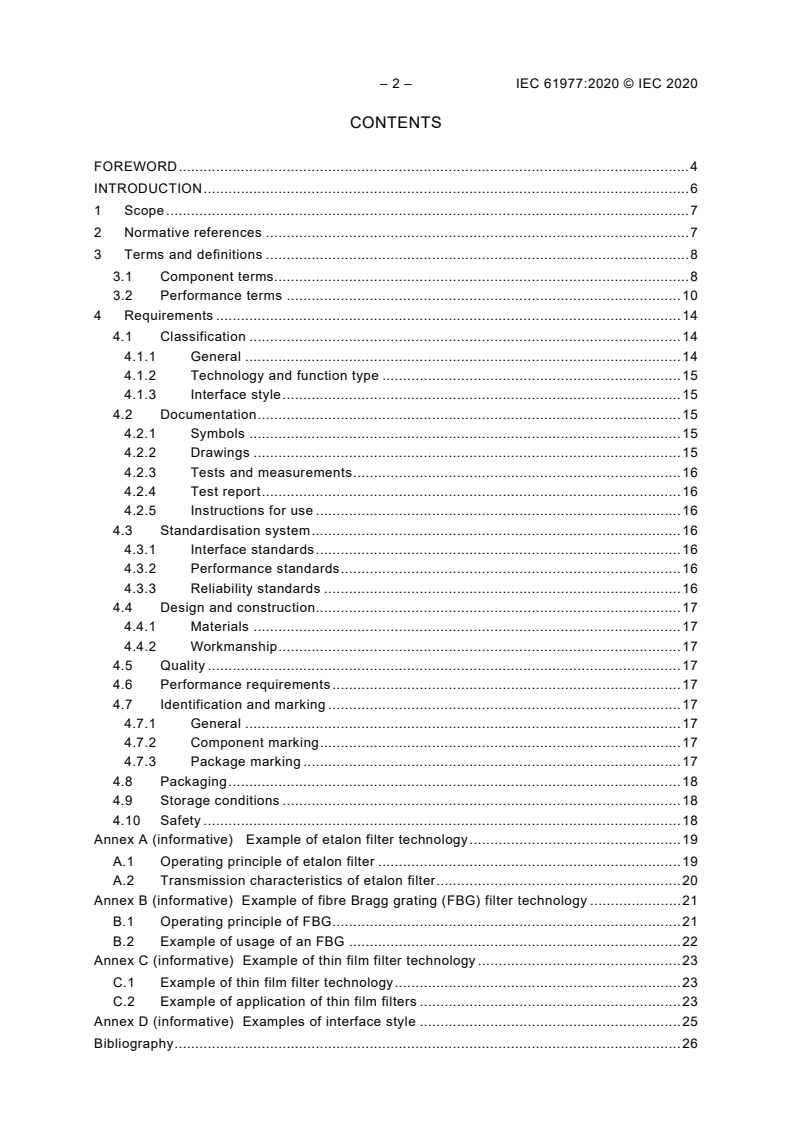
IEC 61977:2020 - Fibre optic interconnecting devices and passive components - Fibre optic fixed filters - Generic specification Released:4/9/2020
Overview
IEC 61977:2020 - Fibre optic interconnecting devices and passive components - Fibre optic fixed filters - Generic specification - is the fourth edition of the IEC generic specification for fibre optic fixed filters. It defines the family of passive, non‑tuneable optical filters that modify spectral intensity to select or suppress wavelengths and that interface via optical fibres or fibre connectors. The standard establishes uniform requirements for optical, mechanical and environmental properties and provides the terminology used in related IEC 61753‑04x documents.
Key topics and technical requirements
This generic specification covers classification, documentation and testable performance of fibre optic fixed filters:
- Filter categories: short‑wave pass, long‑wave pass, band‑pass, notch, and gain‑flattening filters (including hybrid/combinations).
- Passive and fixed operation: filters contain no optoelectronic transducers and are not tunable.
- Interfaces: input/output or common ports via optical fibre or optical fibre connectors.
- Requirements and clauses (high level):
- Classification and interface styles
- Documentation (drawings, symbols, instructions for use)
- Tests and measurements, and test reporting
- Design and construction: materials and workmanship
- Quality assurance and reliability considerations
- Identification, marking, packaging, storage and safety
- Performance descriptors: insertion loss, passband ripple, stopband characteristics, X dB bandwidth and similar spectral metrics (illustrated in the standard’s figures).
- Edition changes: this 2020 revision refocuses scope on fixed filters, adds new terms, removes duplicated definitions, harmonizes figure axes and restructures Clause 4 to reflect market and technical evolution.
Practical applications
IEC 61977:2020 is directly applicable where fixed spectral control in fibre networks or devices is required:
- Passive wavelength selection for DWDM/CWDM modules, multiplexers and demultiplexers
- Gain flattening modules for fibre amplifiers (EDFAs) to equalize spectral gain
- Notch or band‑pass filtering in sensing, instrumentation and measurement systems
- Stabilizing pump/laser wavelengths or protecting subsystems from unwanted spectral components
Practical benefits include consistent test methods, clear product classification for procurement, and standardized documentation that reduces integration risk in optical communications and passive component manufacturing.
Who should use this standard
- Component and subsystem manufacturers (design & quality teams)
- Test laboratories and QA organizations that perform optical and environmental testing
- Systems integrators and network equipment vendors specifying passive optical filters
- Procurement and compliance teams seeking uniform acceptance criteria
Related standards
- IEC 61753‑04x series (terminology and performance specifications referenced in the bibliography)
- IEC 63032 (for tuneable bandpass filters) - IEC 61977 focuses specifically on fixed filters
Keywords: IEC 61977:2020, fibre optic fixed filters, fibre optic filters, passive components, band‑pass filter, notch filter, gain flattening, optical fibre connectors, insertion loss, DWDM.
Relations
- Effective Date
- 05-Sep-2023
Buy Documents
IEC 61977:2020 RLV - Fibre optic interconnecting devices and passive components - Fibre optic fixed filters - Generic specification Released:4/9/2020
IEC 61977:2020 - Fibre optic interconnecting devices and passive components - Fibre optic fixed filters - Generic specification Released:4/9/2020
Get Certified
Connect with accredited certification bodies for this standard

ANCE
Mexican certification and testing association.

Intertek Slovenia
Intertek testing, inspection, and certification services in Slovenia.

LNE (Laboratoire National de Métrologie et d'Essais)
French national laboratory for metrology and testing.
Sponsored listings
Frequently Asked Questions
IEC 61977:2020 is a standard published by the International Electrotechnical Commission (IEC). Its full title is "Fibre optic interconnecting devices and passive components - Fibre optic fixed filters - Generic specification". This standard covers: IEC 61977:2020 applies to the family of fibre optic filters. These components have all of the following general features: - they are passive for the reason that they contain no optoelectronic or other transducing elements which can process the optical signal launched into the input port; - they modify the spectral intensity distribution in order to select some wavelengths and inhibit others; - they are fixed, i.e. the modification of the spectral intensity distribution is fixed and cannot be tuned; - they have input and output ports or a common port (having both functions of input and output) for the transmission of optical power; the ports are optical fibre or optical fibre connectors; - they differ according to their characteristics. They can be divided into the following categories: - short-wave pass (only wavelengths lower than or equal to a specified value are passed); - long-wave pass (only wavelengths greater than or equal to a specified value are passed); - band-pass (only an optical window is allowed); - notch (only an optical window is inhibited); - gain flattening (compensating the spectral profile of the device). It is also possible to have a combination of the above categories. This document provides the generic information including terminology of IEC 61753-04x series documents. Published IEC 61753-04x series documents are listed in the Bibliography. This document establishes uniform requirements for optical, mechanical and environmental properties. This fourth edition cancels and replaces the third edition published in 2015. This edition constitutes a technical revision. This edition includes the following significant technical changes with respect to the previous edition: - change of the title and the scope for the limitation to fibre optic fixed filters; - addition of new terms and definitions reflecting new title; - removal of terms and definitions duplicated in IEC TS 62627-09; - harmonization of the vertical axis of Figures 1 to 5; - restructuration of Clause 4 reflecting the latest technical and market situation.
IEC 61977:2020 applies to the family of fibre optic filters. These components have all of the following general features: - they are passive for the reason that they contain no optoelectronic or other transducing elements which can process the optical signal launched into the input port; - they modify the spectral intensity distribution in order to select some wavelengths and inhibit others; - they are fixed, i.e. the modification of the spectral intensity distribution is fixed and cannot be tuned; - they have input and output ports or a common port (having both functions of input and output) for the transmission of optical power; the ports are optical fibre or optical fibre connectors; - they differ according to their characteristics. They can be divided into the following categories: - short-wave pass (only wavelengths lower than or equal to a specified value are passed); - long-wave pass (only wavelengths greater than or equal to a specified value are passed); - band-pass (only an optical window is allowed); - notch (only an optical window is inhibited); - gain flattening (compensating the spectral profile of the device). It is also possible to have a combination of the above categories. This document provides the generic information including terminology of IEC 61753-04x series documents. Published IEC 61753-04x series documents are listed in the Bibliography. This document establishes uniform requirements for optical, mechanical and environmental properties. This fourth edition cancels and replaces the third edition published in 2015. This edition constitutes a technical revision. This edition includes the following significant technical changes with respect to the previous edition: - change of the title and the scope for the limitation to fibre optic fixed filters; - addition of new terms and definitions reflecting new title; - removal of terms and definitions duplicated in IEC TS 62627-09; - harmonization of the vertical axis of Figures 1 to 5; - restructuration of Clause 4 reflecting the latest technical and market situation.
IEC 61977:2020 is classified under the following ICS (International Classification for Standards) categories: 33.180.20 - Fibre optic interconnecting devices. The ICS classification helps identify the subject area and facilitates finding related standards.
IEC 61977:2020 has the following relationships with other standards: It is inter standard links to IEC 61977:2015. Understanding these relationships helps ensure you are using the most current and applicable version of the standard.
IEC 61977:2020 is available in PDF format for immediate download after purchase. The document can be added to your cart and obtained through the secure checkout process. Digital delivery ensures instant access to the complete standard document.
Standards Content (Sample)
IEC 61977 ®
Edition 4.0 2020-04
REDLINE VERSION
colour
inside
Fibre optic interconnecting devices and passive components – Fibre optic fixed
filters – Generic specification
All rights reserved. Unless otherwise specified, no part of this publication may be reproduced or utilized in any form
or by any means, electronic or mechanical, including photocopying and microfilm, without permission in writing from
either IEC or IEC's member National Committee in the country of the requester. If you have any questions about IEC
copyright or have an enquiry about obtaining additional rights to this publication, please contact the address below or
your local IEC member National Committee for further information.
IEC Central Office Tel.: +41 22 919 02 11
3, rue de Varembé info@iec.ch
CH-1211 Geneva 20 www.iec.ch
Switzerland
About the IEC
The International Electrotechnical Commission (IEC) is the leading global organization that prepares and publishes
International Standards for all electrical, electronic and related technologies.
About IEC publications
The technical content of IEC publications is kept under constant review by the IEC. Please make sure that you have the
latest edition, a corrigendum or an amendment might have been published.
IEC publications search - webstore.iec.ch/advsearchform Electropedia - www.electropedia.org
The advanced search enables to find IEC publications by a The world's leading online dictionary on electrotechnology,
variety of criteria (reference number, text, technical containing more than 22 000 terminological entries in English
committee,…). It also gives information on projects, replaced and French, with equivalent terms in 16 additional languages.
and withdrawn publications. Also known as the International Electrotechnical Vocabulary
(IEV) online.
IEC Just Published - webstore.iec.ch/justpublished
Stay up to date on all new IEC publications. Just Published IEC Glossary - std.iec.ch/glossary
details all new publications released. Available online and 67 000 electrotechnical terminology entries in English and
once a month by email. French extracted from the Terms and Definitions clause of
IEC publications issued since 2002. Some entries have been
IEC Customer Service Centre - webstore.iec.ch/csc collected from earlier publications of IEC TC 37, 77, 86 and
If you wish to give us your feedback on this publication or CISPR.
need further assistance, please contact the Customer Service
Centre: sales@iec.ch.
IEC 61977 ®
Edition 4.0 2020-04
REDLINE VERSION
colour
inside
Fibre optic interconnecting devices and passive components – Fibre optic fixed
filters – Generic specification
INTERNATIONAL
ELECTROTECHNICAL
COMMISSION
ICS 33.180.20 ISBN 978-2-8322-8186-4
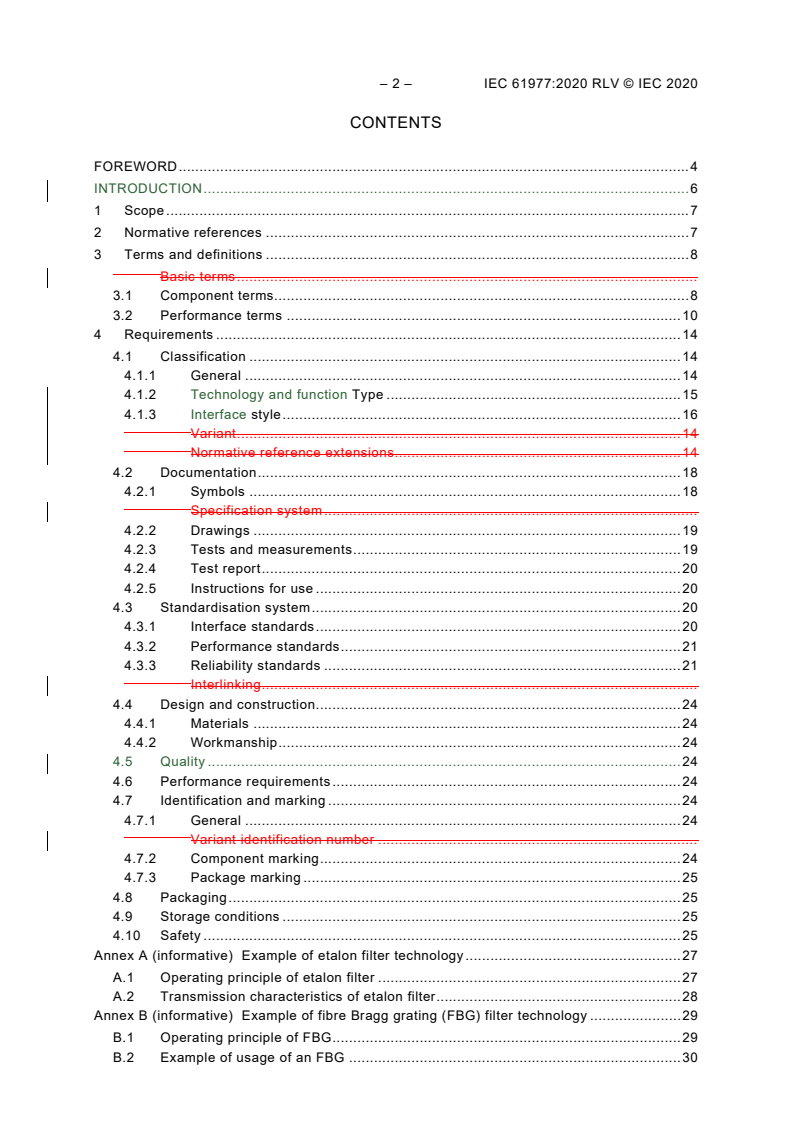
– 2 – IEC 61977:2020 RLV © IEC 2020
CONTENTS
FOREWORD . 4
INTRODUCTION . 6
1 Scope . 7
2 Normative references . 7
3 Terms and definitions . 8
Basic terms .
3.1 Component terms. 8
3.2 Performance terms . 10
4 Requirements . 14
4.1 Classification . 14
4.1.1 General . 14
4.1.2 Technology and function Type . 15
4.1.3 Interface style . 16
Variant . 14
Normative reference extensions. 14
4.2 Documentation . 18
4.2.1 Symbols . 18
Specification system .
4.2.2 Drawings . 19
4.2.3 Tests and measurements . 19
4.2.4 Test report . 20
4.2.5 Instructions for use . 20
4.3 Standardisation system . 20
4.3.1 Interface standards . 20
4.3.2 Performance standards . 21
4.3.3 Reliability standards . 21
Interlinking .
4.4 Design and construction . 24
4.4.1 Materials . 24
4.4.2 Workmanship . 24
4.5 Quality . 24
4.6 Performance requirements . 24
4.7 Identification and marking . 24
4.7.1 General . 24
Variant identification number .
4.7.2 Component marking . 24
4.7.3 Package marking . 25
4.8 Packaging . 25
4.9 Storage conditions . 25
4.10 Safety . 25
Annex A (informative) Example of etalon filter technology . 27
A.1 Operating principle of etalon filter . 27
A.2 Transmission characteristics of etalon filter . 28
Annex B (informative) Example of fibre Bragg grating (FBG) filter technology . 29
B.1 Operating principle of FBG . 29
B.2 Example of usage of an FBG . 30
Annex C (informative) Example of thin film filter technology . 31
C.1 Example of thin film filter technology . 31
C.2 Example of application of thin film filters . 31
Annex D (informative) Examples of interface style . 33
Bibliography . 34
Figure 1 – Illustration of passband ripple . 11
Figure 2 – Illustration of a stopband . 12
Figure 3 – Illustration of maximum insertion loss within a passband . 13
Figure 4 – Illustration of minimum insertion loss within a passband . 13
Figure 5 – Illustration of X dB bandwidth . 14
Figure 6 – Optic filter style configurations .
Figure 7 – Standards currently under preparation .
Figure A.1 – Schematic diagram of an etalon . 27
Figure A.2 – Transmission characteristic of an etalon . 28
Figure B.1 – Technology of a fibre Bragg grating . 29
Figure B.2 – Application of an optical add/drop module . 30
Figure B.3 – Application of an OTDR sensor . 30
Figure B.4 – Application of the wavelength stabilizer for a 980 nm pump LD . 30
Figure C.1 – Structure of a multilayer thin-film . 31
Figure C.2 – Application for a GFF for an optical fibre amplifier . 32
Figure C.3 – Application for a BPF for an optical fibre amplifier . 32
Figure D.1 – Examples of interface style for fibre optic fixed filters . 33
Table 1 – Example of a typical fibre optic fixed filter classification . 15
Table 2 – The IEC specification structure .
Table 3 – Standards interlink matrix .
Table 4 – Quality assurance options .
– 4 – IEC 61977:2020 RLV © IEC 2020
INTERNATIONAL ELECTROTECHNICAL COMMISSION
____________
FIBRE OPTIC INTERCONNECTING
DEVICES AND PASSIVE COMPONENTS –
FIBRE OPTIC FIXED FILTERS – GENERIC SPECIFICATION
FOREWORD
1) The International Electrotechnical Commission (IEC) is a worldwide organization for standardization comprising
all national electrotechnical committees (IEC National Committees). The object of IEC is to promote international
co-operation on all questions concerning standardization in the electrical and electronic fields. To this end and
in addition to other activities, IEC publishes International Standards, Technical Specifications, Technical Reports,
Publicly Available Specifications (PAS) and Guides (hereafter referred to as “IEC Publication(s)”). Their
preparation is entrusted to technical committees; any IEC National Committee interested in the subject dealt with
may participate in this preparatory work. International, governmental and non-governmental organizations liaising
with the IEC also participate in this preparation. IEC collaborates closely with the International Organization for
Standardization (ISO) in accordance with conditions determined by agreement between the two organizations.
2) The formal decisions or agreements of IEC on technical matters express, as nearly as possible, an international
consensus of opinion on the relevant subjects since each technical committee has representation from all
interested IEC National Committees.
3) IEC Publications have the form of recommendations for international use and are accepted by IEC National
Committees in that sense. While all reasonable efforts are made to ensure that the technical content of IEC
Publications is accurate, IEC cannot be held responsible for the way in which they are used or for any
misinterpretation by any end user.
4) In order to promote international uniformity, IEC National Committees undertake to apply IEC Publications
transparently to the maximum extent possible in their national and regional publications. Any divergence between
any IEC Publication and the corresponding national or regional publication shall be clearly indicated in the latter.
5) IEC itself does not provide any attestation of conformity. Independent certification bodies provide conformity
assessment services and, in some areas, access to IEC marks of conformity. IEC is not responsible for any
services carried out by independent certification bodies.
6) All users should ensure that they have the latest edition of this publication.
7) No liability shall attach to IEC or its directors, employees, servants or agents including individual experts and
members of its technical committees and IEC National Committees for any personal injury, property damage or
other damage of any nature whatsoever, whether direct or indirect, or for costs (including legal fees) and
expenses arising out of the publication, use of, or reliance upon, this IEC Publication or any other IEC Publications.
8) Attention is drawn to the Normative references cited in this publication. Use of the referenced publications is
indispensable for the correct application of this publication.
9) Attention is drawn to the possibility that some of the elements of this IEC Publication may be the subject of patent
rights. IEC shall not be held responsible for identifying any or all such patent rights.
DISCLAIMER
This Redline version is not an official Standard and is intended to provide the user
with an indication of what changes have been made to the previous version. Only the
IEC International Standard provided in this package is to be considered the official
Standard.
This Redline version provides you with a quick and easy way to compare all the changes
between this standard and its previous edition. A vertical bar appears in the margin
wherever a change has been made. Additions are in green text, deletions are in
strikethrough red text.
International Standard IEC 61977 has been prepared by subcommittee SC 86B: Fibre optic
interconnecting devices and passive components, of IEC technical committee TC 86: Fibre
optics.
This fourth edition cancels and replaces the third edition published in 2015. This edition
constitutes a technical revision.
This edition includes the following significant technical changes with respect to the previous
edition:
a) change of the title and the scope for the limitation to fibre optic fixed filters;
b) addition of new terms and definitions reflecting new title;
c) removal of terms and definitions duplicated in IEC TS 62627-09;
d) harmonization of the vertical axis of Figures 1 to 5;
e) restructuration of Clause 4 reflecting the latest technical and market situation.
The text of this International Standard is based on the following documents:
FDIS Report on voting
86B/4267/FDIS 86B/4286/RVD
Full information on the voting for the approval of this International Standard can be found in the
report on voting indicated in the above table.
This document has been drafted in accordance with the ISO/IEC Directives, Part 2.
The committee has decided that the contents of this document will remain unchanged until the
stability date indicated on the IEC website under "http://webstore.iec.ch" in the data related to
the specific document. At this date, the document will be
• reconfirmed,
• withdrawn,
• replaced by a revised edition, or
• amended.
IMPORTANT – The 'colour inside' logo on the cover page of this publication indicates
that it contains colours which are considered to be useful for the correct understanding
of its contents. Users should therefore print this document using a colour printer.
– 6 – IEC 61977:2020 RLV © IEC 2020
INTRODUCTION
There are two generic specifications for fibre optic filters: fibre optic fixed filters and fibre optic
tuneable filters. This document focuses on fibre optic fixed filters. Fibre optic tuneable bandpass
filter is standardized in IEC 63032.
FIBRE OPTIC INTERCONNECTING
DEVICES AND PASSIVE COMPONENTS –
FIBRE OPTIC FIXED FILTERS – GENERIC SPECIFICATION
1 Scope
This document applies to the family of fibre optic filters. These components have all of the
following general features:
– they are passive for the reason that they contain no optoelectronic or other transducing
elements which can process the optical signal launched into the input port;
– they modify the spectral intensity distribution in order to select some wavelengths and inhibit
others;
– they are fixed, i.e. the modification of the spectral intensity distribution is fixed and cannot
be tuned;
– they have input and output ports or a common port (having both functions of input and output)
for the transmission of optical power; the ports are optical fibre or optical fibre connectors;
– they differ according to their characteristics. They can be divided into the following
categories:
• short-wave pass (only wavelengths lower than or equal to a specified value are passed);
• long-wave pass (only wavelengths greater than or equal to a specified value are passed);
• band-pass (only an optical window is allowed);
• notch (only an optical window is inhibited);
• gain flattening (compensating the spectral profile of the device).
It is also possible to have a combination of the above categories.
This document provides the generic information including terminology of IEC 61753-04x series
documents. Published IEC 61753-04x series documents are listed in the Bibliography.
This document establishes uniform requirements for optical, mechanical and environmental
properties.
2 Normative references
The following documents are referred to in the text in such a way that some or all of their content
constitutes requirements of this document. For dated references, only the edition cited applies.
For undated references, the latest edition of the referenced document (including any
amendments) applies.
IEC 60027 (all parts), Letter symbols to be used in electrical technology
IEC 60050-731, International Electrotechnical Vocabulary (IEV) – Part 731: Optical fibre
communication (available at http://www.electropedia.org)
IEC 60617 (all parts), Graphical symbols for diagrams (available at http://std.iec.ch/iec60617)
IEC 60695-11-5, Fire hazard testing – Part 11-5: Test flames – Needle-flame test method –
Apparatus, confirmatory test arrangement and guidance
– 8 – IEC 61977:2020 RLV © IEC 2020
IEC 60825 (all parts), Safety of laser products
IEC 61300 (all parts), Fibre optic interconnecting devices and passive components – Basic test
and measurement procedures
IEC TR 61930, Fibre optic graphical symbology
IEC TS 62627-09, Fibre optic interconnecting devices and passive components – Vocabulary
for passive optical devices
ISO 129-1, Technical drawings product documentation (TPD) – Indication Presentation of
dimensions and tolerances – Part 1: General principles
ISO 286-1, Geometrical product specifications (GPS) – ISO code system for tolerances on
linear sizes – Part 1: Basis of tolerances, deviations and fits
ISO 1101, Geometrical product specifications (GPS) – Geometrical tolerancing – Tolerances of
form, orientation, location and run-out
ISO 8601, Data elements and interchange formats – Information interchange – Representation
of dates and times
ISO 8601-1, Date and time – Representations for information interchange – Part 1: Basic rules
3 Terms and definitions
For the purpose of this document, terms and definitions given in IEC 60050-731,
IEC TS 62627-09 and the following apply.
ISO and IEC maintain terminological databases for use in standardization at the following
addresses:
• IEC Electropedia: available at http://www.electropedia.org/
• ISO Online browsing platform: available at http://www.iso.org/obp
3.1 Basic terms
3.1.1
port
optical fibre or optical fibre connector attached to a passive component for the entry and/or exit
of the optical power (input and/or output port)
3.1 Component terms
3.1.1
bandpass filter
BPF
band-pass filterfibre optic filter designed to allow signals between two specific wavelengths to
pass
Note 1 to entry: This note applies to the French language only.
3.1.2
etalon
device consisting of a transparent plane-parallel plate with two reflecting surfaces, or two
parallel reflecting mirrors
Note 1 to entry: The varying transmission function of an etalon is caused by interference between the multiple
reflections of light between the two reflecting surfaces.
Note 2 to entry: Annex A describes the outline of etalon technology.
3.1.3
fibre Bragg grating
FBG
fibre optic device which has a short periodic variation to the refractive index of the fibre core
along the fibre
Note 1 to entry: An FBG can reflect particular wavelengths of light and transmit other wavelengths.
Note 2 to entry: Annex B describes the outline of FBG technology.
Note 3 to entry: This note applies to the French language only.
3.1.4
fibre optic filter
passive component used in fibre optic transmission system to modify the spectral intensity
distribution of a signal in order to transmit or attenuate some wavelengths and block some
others
Note 1 to entry: There are two types of fibre optic filters: fibre optic fixed filters and fibre optic tuneable filters.
Note 2 to entry: The wavelength band which transmits or attenuates the signal is called the passband. There may
be more than one passband.
3.1.5
fibre optic fixed filter
fibre optic filter which spectral profile is fixed
3.1.6
fibre optic tuneable filter
fibre optic filter which spectral profile is changeable
Note 1 to entry: Fibre optic tuneable bandpass filter is standardized in IEC 63032.
3.1.7
gain flattening filter
gain equalizer
GFF
GEQ
device fibre optic filter designed to have the inverse characteristic of the wavelength dependent
insertion loss of an optical device
Note 1 to entry: A GFF (GEQ) is used for the purpose of minimizing the wavelength dependent loss of a fibre optic
device.
Note 2 to entry: A GFF (GEQ) is typically used with (in) an optical amplifier.
Note 3 to entry: This note applies to the French language only.
Note 4 to entry: This note applies to the French language only.
– 10 – IEC 61977:2020 RLV © IEC 2020
3.1.8
long wavelength pass filter
LWPF
fibre optic filter that passes long wavelength signals but reduces the amplitude of short
wavelength signals
Note 1 to entry: This note applies to the French language only.
3.1.9
notch filter
fibre optic filter that passes all wavelengths except those in a stop band centred on a particular
wavelength
3.1.10
reflecting type fibre optic filter
fibre optic filter in which the input and output ports are coincident
wavelength selective reflecting device having two ports that reflects back the light to the launch
port at different wavelength range (OTDR monitoring range)
3.1.11
short wavelength pass filter
SWPF
fibre optic filter that passes short wavelength signals but reduces the amplitude of long
wavelength signals
Note 1 to entry: This note applies to the French language only.
3.1.12
thin-film filter
TFF
fibre optic filter which passes particular wavelength band(s) and reflects all other wavelengths
by using the interference effect of thin-film
Note 1 to entry: One of the typical TFF is a dielectric multi-layer film filter. Annex C describes the outline of TFF
technology.
Note 2 to entry: This note applies to the French language only.
3.1.13
transmitting type fibre optic filter
fibre optic filter in which the input and output ports are separated
3.2 Performance terms
3.2.1
operating wavelength
nominal wavelength λ , at which a fibre optic filter operates with the specified performances
h
Note 1 to entry: The term "operating wavelength" includes the nominally transmitting wavelength, and designated
attenuation/isolation wavelength.
3.2.2
operating wavelength range
specified range of wavelengths including all operating wavelengths
Note 1 to entry: It includes all passbands and isolation wavelength ranges.
3.2.3
passband
wavelength range within which a passive optical component is required to operate with optical
attenuation less than or equal to a specified optical attenuation value
Note 1 to entry: There may be one or more passbands for a fibre optic filter.
3.2.4
passband ripple
maximum peak-to-peak variation of the insertion loss (absolute value) over the passband
Note 1 to entry: See Figure 1.
a) Passband ripple at band edges b) Passband ripple in band
Figure 1 – Illustration of passband ripple
Note 2 to entry: For a wide wavelength division multiplexing (WWDM) fibre optic filter which has only one passband,
the term "spectral ripple" or "flatness" is used instead of "passband ripple".
3.2.5
insertion loss
attenuation
a
reduction of optical power in a passband, when transmitted between the ports of a two-port
through a fibre optic filter
Note 1 to entry: The insertion loss is expressed in decibels and defined as:
P
out
a = −10log
P
in
where
P is the optical power launched into one of the two ports the fibre optic filter;
in
P is the optical power received from the other port out of the fibre optic filter.
out
Note 2 to entry: The insertion loss (attenuation) is a function of wavelength.
3.2.6
free spectral range
FSR
difference between two adjacent operating wavelengths, in the case of a periodic spectral
response of a fibre optic filter, difference between two adjacent operating wavelengths
– 12 – IEC 61977:2020 RLV © IEC 2020
Note 1 to entry: This note applies to the French language only.
3.2.7
isolation wavelength
nominal wavelength λ (where λ ≠ λ ), that is nominally suppressed by a fibre optic filter
k h k
3.2.8
isolation wavelength range
stopband
specified range of wavelengths from λ to λ around the isolation wavelength λ , that are
kmin kmax k
nominally suppressed by a fibre optic filter
Note 1 to entry: There may be one or more isolation wavelength ranges (stopbands) for a fibre optic filter.
Note 2 to entry: The term "stopband" is an antonym of the term passband.
Note 3 to entry: See Figure 2.
Figure 2 – Illustration of a stopband
3.2.9
maximum insertion loss within a passband
maximum attenuation within a passband
maximum value of the insertion loss optical attenuation within a passband
Note 1 to entry: Figure 3 shows passband and maximum insertion loss within a passband.
Figure 3 – Illustration of maximum insertion loss within a passband
3.2.10
maximum slope of passband ripple
maximum value in fibre optic filter of the derivative of the insertion loss (for transmitting type
fibre optic filter) or return loss (for reflecting type fibre optic filter) as a function of wavelength
over the passband
3.2.11
minimum insertion loss within a passband
minimum attenuation within a passband
minimum value of the insertion loss optical attenuation within a passband
Note 1 to entry: Figure 4 shows passband and minimum insertion loss within a passband.
Figure 4 – Illustration of minimum insertion loss within a passband
3.2.12
return loss
a
RL
fraction of input power that is returned from a port of a fibre optic filter
– 14 – IEC 61977:2020 RLV © IEC 2020
Note 1 to entry: The return loss is expressed in decibels and defined as:
P
refl
a = −10log
RL 10
P
in
where
P is the optical power launched into the port;
in
P is the optical power received back from the same port.
refl
Note 2 to entry: The return loss is a function of wavelength.
3.2.13
wavelength dependent loss
variation of insertion loss of a fibre optic filter within passband(s)
Note 1 to entry: When there are two or more passbands, the wavelength dependent loss is generally defined as the
maximum value of passband ripples.
Note 2 to entry: The term "wavelength dependent loss" is generally used for LWPFs, SWPFs or relatively wide
passband filters. For BPF especially narrow passband filters, for example WDM application, passband ripple is
generally used.
3.2.14
X dB bandwidth
minimum band width which the variation of insertion loss (attenuation) is X dB within a passband
Note 1 to entry: X dB bandwidth shall be determined by considering the temperature dependency of wavelength,
polarization dependency, long term stability of wavelength, etc.
Note 2 to entry: X is typically used as 0,5, 1, 3 or 20.
Note 3 to entry: See Figure 5.
Figure 5 – Illustration of X dB bandwidth
4 Requirements
4.1 Classification
4.1.1 General
Filters are classified either totally or in part in the following categories:
– type;
– style;
– variant;
– environmental category;
– assessment level;
– normative reference extensions.
An example of a typical filter classification is given in Table 1:
Fibre optic fixed filters are classified either totally or in part in the following categories:
– technology and function type;
– interface style.
An example of a typical fibre optic fixed filter classification is given in Table 1.
Table 1 – Example of a typical fibre optic fixed filter classification
Type Fixed
Style – Configuration C
– Fibre type: IEC type A1a
– SC connector
Variant Means of mounting
Assessment level A
Items Classifications
Technology and function type Technology: TFF
Function: LWPF
Interface style Configuration B
Fibre type: IEC 60793-2 type B1
IEC 61754-4 (SC connector)
4.1.2 Technology and function Type
The optic filter type shall be defined by its intended function and optical performance. There
are several types of filters, for instance:
– long wavelength pass filter (LWPF);
– band-pass filter (BPF);
– short wavelength pass filter (SWPF);
– gain flattening filter (GFF)/ gain equalizer (GEQ);
– notch.
4.1.2.1 Technologies
The fibre optic fixed filter shall be defined by its technology type. There are several technology
types of filters, for instance:
– thin-film filter (TFF);
– fibre Bragg grating (FBG);
– etalon filter.
– 16 – IEC 61977:2020 RLV © IEC 2020
4.1.2.2 Functions
The fibre optic fixed filter type shall be defined by its intended function and optical performance.
There are several types of filters, for instance:
– long wavelength pass filter (LWPF);
– band-pass filter (BPF);
– short wavelength pass filter (SWPF);
– gain flattening filter (GFF)/ gain equalizer (GEQ);
– notch.
4.1.3 Interface style
The optic filter style shall be defined on the basis of the following elements:
– the input and output port configuration;
– the connector set type(s), if any.
The seven different input and output configurations can be scheduled as shown in Figure 6:
Filter
Pigtail
IEC
a) Configuration A – Device containing fibre optic pigtails without connector plug
Filter
Connector plug
IEC
b) Configuration B – Device containing integral fibres, with a connector plug on each fibre
Filter
IEC
c) Configuration C – Device containing fibre optic connectors as a part of the device housing
Filter
Pigtail
IEC
d) Configuration D – Device containing one fibre optic pigtail without connector plug
Filter
Connector plug
IEC
e) Configuration E – Device containing one fibre optic pigtail with a connector plug
Filter
IEC
f) Configuration F – Device containing one fibre optic connector as a part of the device housing
NOTE Configuration G is a device containing some combination of the interfacing features of the preceding
configurations.
Figure 6 – Optic filter style configurations
The fibre optic fixed filter style shall be defined on the basis of the following elements:
– the input and output port configuration;
– the connector set type(s), if any.
NOTE Examples of interface style are provided in Annex D.
4.1.4 Variant
The optic filter variant defines the feature that identifies the variety of structurally similar
components. Examples of feature variables which create variants are:
– cable type;
– fibre type;
– housing;
– orientation of ports;
– means of mounting.
4.1.5 Normative reference extensions
Normative reference extensions are used to identify independent standards specifications or
other reference documents integrated into relevant specifications.
Unless a specified exception is noted, additional requirements imposed by an extension are
mandatory. Usage is primarily intended to merge associated components to form hybrid devices,
or integrated functional application requirements that are dependent on technical expertise
other than fibre optics.
Some optical fibre filter configurations require special qualification provisions which shall not be
imposed universally. This accommodates individual component design configurations, specialized
field tooling, or specific application processes. In this case requirements are necessary to
guarantee repeatable performance or adequate safety, and provide additional guidance for
complete product specification. These extensions are mandatory whenever used to prepare,
assemble or install an optical fibre splice either for field application usage or preparation of
qualification test specimens. The relevant specification shall clarify all stipulations. However,
design and style dependent extensions shall not be imposed universally.
Some commercial or residential building applications may require direct reference to specific
safety codes and regulations or incorporate other specific material flammability or toxicity
requirements for specialized locations.
Specialized field tooling may require an extension to implement specific ocular safety, electrical
shock or burn hazard avoidance requirements, or require isolation procedures to prevent
potential ignition of combustible gases.
– 18 – IEC 61977:2020 RLV © IEC 2020
4.2 Documentation
4.2.1 Symbols
Graphical and letter symbols shall, whenever possible, be taken from
IEC 60027 (all parts), IEC 60617 and IEC TR 61930.
4.2.2 Specification system
4.2.2.1 General
This specification is part of the IEC specification system. Subsidiary specifications shall consist
of relevant specifications. This system is shown in Table 2. There are no sectional specifications
for filters.
Table 2 – The IEC specification structure
Specification level Examples of information to be included Applicable to
Basic Assessment system rules Two or more component families
or sub-families
Inspection rules
Optical measurement methods
Sampling plans
Identification rule
Marking standards
Dimensional standards
Terminology
Symbol
Preferred number series
SI units
Generic Specific terminology Component family
Specific symbols
Specific units
Preferred values
Marking
Selection of tests
Qualification approval and/or capability
approval procedures
Blank detail Quality conformance test schedule Groups of types having a
common test schedule
Inspection requirements
Information common to a number of types
Detail Individual values Individual type
Specific information
Completed quality conformance test
schedules
4.2.2.2 Blank detail specifications
The blank detail specification lists all of the parameters and features applicable to a fibre optic
filter, including the type, operating characteristics, housing configurations, test methods, and
performance requirements. The blank detail specification is applicable to any fibre optic filter
design and quality assessment requirement. The blank detail specification contains the
preferred format for stating the required information in the detail specification.
Blank detail specifications are not, by themselves, a specification level. They are associated
with the generic specification.
Each blank detail specification shall be limited to one environmental category.
Each blank detail specification shall contain
– the minimum mandatory test schedules and performance requirements,
– one or more assessment levels,
– the preferred format for stating the required information in the detail specification,
– in case of hybrid components, including connectors, addition of appropriate entry fields to
show the reference normative document, document title and issue date.
4.2.2.3 Detail specifications
A specific fibre optic filter is described by a corresponding detail specification, which is prepared
by filling in the blanks of the blank detail specification. Within the constraints imposed by this
generic specification, the blank detail specification may be filled in by any national committee
of the IEC, thereby defining a particular fibre optic filter as an IEC standard.
Detail specifications shall specify the following, as applicable:
– type (see 4.1.2);
– style (see 4.1.3);
– variant(s) (see 4.1.4);
– part identification number for each variant (see 4.6.2);
– drawings, dimensions required (see 4.2.3);
– quality assessment test schedules (see 4.2.5);
– performance requirements (see 4.5).
4.2.2 Drawings
4.2.2.1 General
The drawings and dimensions given in the relevant specifications shall not restrict detail
construction nor be used as manufacturing drawings.
4.2.2.2 Projection system
Either first angle or third angle projection shall be used for the drawings in documents covered
by this document. All drawings within a document shall use the same projection system and the
drawings shall state which system is used.
4.2.2.3 Dimensional system
All dimensions shall be given in accordance with ISO 129-1, ISO 286-1 and ISO 1101. The
metric system shall be used in all specifications. Dimensions shall not contain more than five
significant digits. When units are converted, a note shall be added in each relevant specification.
4.2.3 Tests and measurements
4.2.3.1 Tests and measurements procedures
The tests and measurements procedures for optical, mechanical, climatic and environmental
characteristics of fibre optic fixed filters to be used shall be defined and selected preferentially
from IEC 61300 (all parts). The size measurement method to be used shall be specified in the
– 20 – IEC 61977:2020 RLV © IEC 2020
relevant specification for dimensions which are specified within a total tolerance zone of
0,01 mm or less.
4.2.3.2 Reference components
Reference components (such as golden samples) for measurement purposes, if required, shall
be specified in the relevant specification.
4.2.4.3 Gauges
Gauges, if required, shall be specified in the relevant specification.
4.2.4 Test report
The test reports shall be prepared for each test conducted as required by a relevant
specification. The data sheets reports shall be included in the qualification test report and in
the periodic inspection report.
Data sheets Test reports shall contain the following information as a minimum:
– title and date of test;
– specimen description including the variant identification number (see 4.6.2);
– test equipment used;
– all applicable test details;
– all measurement values and observations.
4.2.5 Instructions for use
Instructions for use, when required, shall be given by the manufacturer.
4.3 Standardisation system
4.3.1 Interface standards
Interface standards provide both manufacturers and users with all the information they require
to make or use products conforming to the physical features of that standard interface. Interface
standards fully define the features essential for the mating and unmating of optical fibre
connectors and other components. They also serve to position the optical datum target, where
defined, relative to other reference data.
Interface standards ensure that connectors and adapters that comply with the standard will fit
together. The standards may also contain tolerance grades for ferrules and alignment devices.
Tolerance grades are used to provide different levels of alignment precision.
The interface dimensions may also be used to design other components that will mate with the
connectors. For example, an active device mount can be designed using the adapter interface
dimensions. The use of these dimensions combined with those of a standard plug, provides the
designer with assurance that the standard plugs will fit into the optical device mount. They also
provide the location of the plug’s optical datum target.
Standard interface dimensions do not, by themselves, guarantee optical performance. They
guarantee connector mating at a specified fit. Optical performance is currently guaranteed via
the manufacturing specification. Products from the same or different manufacturing
specifications using the same standard interface will always fit together. Guaranteed
performance can be given by any single manufacturer only for products delivered to the same
manufacturing specification. However, it can be reasonably expected that some level of
performance will be obtained by mating products from different manufacturing specifications,
although the level of performance cannot be expected to be any better than that of lower
specified performance.
Refer proper references when (in case) the connector is used, such as IEC 61754 (all parts).
4.3.2 Performance standards
Performance standards – IEC 61753 (all parts) – contain a series of tests and measurements
(which m
...
IEC 61977 ®
Edition 4.0 2020-04
INTERNATIONAL
STANDARD
NORME
INTERNATIONALE
Fibre optic interconnecting devices and passive components – Fibre optic fixed
filters – Generic specification
Dispositifs d’interconnexion et composants passifs fibroniques – Filtres
fibroniques fixes – Spécification générique
All rights reserved. Unless otherwise specified, no part of this publication may be reproduced or utilized in any form
or by any means, electronic or mechanical, including photocopying and microfilm, without permission in writing from
either IEC or IEC's member National Committee in the country of the requester. If you have any questions about IEC
copyright or have an enquiry about obtaining additional rights to this publication, please contact the address below or
your local IEC member National Committee for further information.
Droits de reproduction réservés. Sauf indication contraire, aucune partie de cette publication ne peut être reproduite ni
utilisée sous quelque forme que ce soit et par aucun procédé, électronique ou mécanique, y compris la photocopie et
les microfilms, sans l'accord écrit de l'IEC ou du Comité national de l'IEC du pays du demandeur. Si vous avez des
questions sur le copyright de l'IEC ou si vous désirez obtenir des droits supplémentaires sur cette publication, utilisez
les coordonnées ci-après ou contactez le Comité national de l'IEC de votre pays de résidence.
IEC Central Office Tel.: +41 22 919 02 11
3, rue de Varembé info@iec.ch
CH-1211 Geneva 20 www.iec.ch
Switzerland
About the IEC
The International Electrotechnical Commission (IEC) is the leading global organization that prepares and publishes
International Standards for all electrical, electronic and related technologies.
About IEC publications
The technical content of IEC publications is kept under constant review by the IEC. Please make sure that you have the
latest edition, a corrigendum or an amendment might have been published.
IEC publications search - webstore.iec.ch/advsearchform Electropedia - www.electropedia.org
The advanced search enables to find IEC publications by a The world's leading online dictionary on electrotechnology,
variety of criteria (reference number, text, technical containing more than 22 000 terminological entries in English
committee,…). It also gives information on projects, replaced and French, with equivalent terms in 16 additional languages.
and withdrawn publications. Also known as the International Electrotechnical Vocabulary
(IEV) online.
IEC Just Published - webstore.iec.ch/justpublished
Stay up to date on all new IEC publications. Just Published IEC Glossary - std.iec.ch/glossary
details all new publications released. Available online and once 67 000 electrotechnical terminology entries in English and
a month by email. French extracted from the Terms and Definitions clause of IEC
publications issued since 2002. Some entries have been
IEC Customer Service Centre - webstore.iec.ch/csc collected from earlier publications of IEC TC 37, 77, 86 and
If you wish to give us your feedback on this publication or need CISPR.
further assistance, please contact the Customer Service
Centre: sales@iec.ch.
A propos de l'IEC
La Commission Electrotechnique Internationale (IEC) est la première organisation mondiale qui élabore et publie des
Normes internationales pour tout ce qui a trait à l'électricité, à l'électronique et aux technologies apparentées.
A propos des publications IEC
Le contenu technique des publications IEC est constamment revu. Veuillez vous assurer que vous possédez l’édition la
plus récente, un corrigendum ou amendement peut avoir été publié.
Recherche de publications IEC - Le premier dictionnaire d'électrotechnologie en ligne au monde,
webstore.iec.ch/advsearchform avec plus de 22 000 articles terminologiques en anglais et en
La recherche avancée permet de trouver des publications IEC français, ainsi que les termes équivalents dans 16 langues
en utilisant différents critères (numéro de référence, texte, additionnelles. Egalement appelé Vocabulaire
comité d’études,…). Elle donne aussi des informations sur les Electrotechnique International (IEV) en ligne.
projets et les publications remplacées ou retirées.
Glossaire IEC - std.iec.ch/glossary
IEC Just Published - webstore.iec.ch/justpublished 67 000 entrées terminologiques électrotechniques, en anglais
Restez informé sur les nouvelles publications IEC. Just et en français, extraites des articles Termes et Définitions des
Published détaille les nouvelles publications parues. publications IEC parues depuis 2002. Plus certaines entrées
Disponible en ligne et une fois par mois par email. antérieures extraites des publications des CE 37, 77, 86 et
CISPR de l'IEC.
Service Clients - webstore.iec.ch/csc
Si vous désirez nous donner des commentaires sur cette
publication ou si vous avez des questions contactez-nous:
sales@iec.ch.
Electropedia - www.electropedia.org
IEC 61977 ®
Edition 4.0 2020-04
INTERNATIONAL
STANDARD
NORME
INTERNATIONALE
Fibre optic interconnecting devices and passive components – Fibre optic fixed
filters – Generic specification
Dispositifs d’interconnexion et composants passifs fibroniques – Filtres
fibroniques fixes – Spécification générique
INTERNATIONAL
ELECTROTECHNICAL
COMMISSION
COMMISSION
ELECTROTECHNIQUE
INTERNATIONALE
ICS 33.180.20 ISBN 978-2-8322-8110-9
– 2 – IEC 61977:2020 © IEC 2020
CONTENTS
FOREWORD . 4
INTRODUCTION . 6
1 Scope . 7
2 Normative references . 7
3 Terms and definitions . 8
3.1 Component terms. 8
3.2 Performance terms . 10
4 Requirements . 14
4.1 Classification . 14
4.1.1 General . 14
4.1.2 Technology and function type . 15
4.1.3 Interface style . 15
4.2 Documentation . 15
4.2.1 Symbols . 15
4.2.2 Drawings . 15
4.2.3 Tests and measurements . 16
4.2.4 Test report . 16
4.2.5 Instructions for use . 16
4.3 Standardisation system . 16
4.3.1 Interface standards . 16
4.3.2 Performance standards . 16
4.3.3 Reliability standards . 16
4.4 Design and construction . 17
4.4.1 Materials . 17
4.4.2 Workmanship . 17
4.5 Quality . 17
4.6 Performance requirements . 17
4.7 Identification and marking . 17
4.7.1 General . 17
4.7.2 Component marking . 17
4.7.3 Package marking . 17
4.8 Packaging . 18
4.9 Storage conditions . 18
4.10 Safety . 18
Annex A (informative) Example of etalon filter technology . 19
A.1 Operating principle of etalon filter . 19
A.2 Transmission characteristics of etalon filter . 20
Annex B (informative) Example of fibre Bragg grating (FBG) filter technology . 21
B.1 Operating principle of FBG . 21
B.2 Example of usage of an FBG . 22
Annex C (informative) Example of thin film filter technology . 23
C.1 Example of thin film filter technology . 23
C.2 Example of application of thin film filters . 23
Annex D (informative) Examples of interface style . 25
Bibliography . 26
Figure 1 – Illustration of passband ripple . 11
Figure 2 – Illustration of a stopband . 12
Figure 3 – Illustration of maximum insertion loss within a passband . 12
Figure 4 – Illustration of minimum insertion loss within a passband . 13
Figure 5 – Illustration of X dB bandwidth . 14
Figure A.1 – Schematic diagram of an etalon . 19
Figure A.2 – Transmission characteristic of an etalon . 20
Figure B.1 – Technology of a fibre Bragg grating . 21
Figure B.2 – Application of an optical add/drop module . 22
Figure B.3 – Application of an OTDR sensor . 22
Figure B.4 – Application of the wavelength stabilizer for a 980 nm pump LD . 22
Figure C.1 – Structure of a multilayer thin-film . 23
Figure C.2 – Application for a GFF for an optical fibre amplifier . 24
Figure C.3 – Application for a BPF for an optical fibre amplifier . 24
Figure D.1 – Examples of interface style for fibre optic fixed filters . 25
Table 1 – Example of a typical fibre optic fixed filter classification . 14
– 4 – IEC 61977:2020 © IEC 2020
INTERNATIONAL ELECTROTECHNICAL COMMISSION
____________
FIBRE OPTIC INTERCONNECTING
DEVICES AND PASSIVE COMPONENTS –
FIBRE OPTIC FIXED FILTERS – GENERIC SPECIFICATION
FOREWORD
1) The International Electrotechnical Commission (IEC) is a worldwide organization for standardization comprising
all national electrotechnical committees (IEC National Committees). The object of IEC is to promote international
co-operation on all questions concerning standardization in the electrical and electronic fields. To this end and
in addition to other activities, IEC publishes International Standards, Technical Specifications, Technical Reports,
Publicly Available Specifications (PAS) and Guides (hereafter referred to as “IEC Publication(s)”). Their
preparation is entrusted to technical committees; any IEC National Committee interested in the subject dealt with
may participate in this preparatory work. International, governmental and non-governmental organizations liaising
with the IEC also participate in this preparation. IEC collaborates closely with the International Organization for
Standardization (ISO) in accordance with conditions determined by agreement between the two organizations.
2) The formal decisions or agreements of IEC on technical matters express, as nearly as possible, an international
consensus of opinion on the relevant subjects since each technical committee has representation from all
interested IEC National Committees.
3) IEC Publications have the form of recommendations for international use and are accepted by IEC National
Committees in that sense. While all reasonable efforts are made to ensure that the technical content of IEC
Publications is accurate, IEC cannot be held responsible for the way in which they are used or for any
misinterpretation by any end user.
4) In order to promote international uniformity, IEC National Committees undertake to apply IEC Publications
transparently to the maximum extent possible in their national and regional publications. Any divergence between
any IEC Publication and the corresponding national or regional publication shall be clearly indicated in the latter.
5) IEC itself does not provide any attestation of conformity. Independent certification bodies provide conformity
assessment services and, in some areas, access to IEC marks of conformity. IEC is not responsible for any
services carried out by independent certification bodies.
6) All users should ensure that they have the latest edition of this publication.
7) No liability shall attach to IEC or its directors, employees, servants or agents including individual experts and
members of its technical committees and IEC National Committees for any personal injury, property damage or
other damage of any nature whatsoever, whether direct or indirect, or for costs (including legal fees) and
expenses arising out of the publication, use of, or reliance upon, this IEC Publication or any other IEC Publications.
8) Attention is drawn to the Normative references cited in this publication. Use of the referenced publications is
indispensable for the correct application of this publication.
9) Attention is drawn to the possibility that some of the elements of this IEC Publication may be the subject of patent
rights. IEC shall not be held responsible for identifying any or all such patent rights.
International Standard IEC 61977 has been prepared by subcommittee SC 86B: Fibre optic
interconnecting devices and passive components, of IEC technical committee TC 86: Fibre
optics.
This fourth edition cancels and replaces the third edition published in 2015. This edition
constitutes a technical revision.
This edition includes the following significant technical changes with respect to the previous
edition:
a) change of the title and the scope for the limitation to fibre optic fixed filters;
b) addition of new terms and definitions reflecting new title;
c) removal of terms and definitions duplicated in IEC TS 62627-09;
d) harmonization of the vertical axis of Figures 1 to 5;
e) restructuration of Clause 4 reflecting the latest technical and market situation.
The text of this International Standard is based on the following documents:
FDIS Report on voting
86B/4267/FDIS 86B/4286/RVD
Full information on the voting for the approval of this International Standard can be found in the
report on voting indicated in the above table.
This document has been drafted in accordance with the ISO/IEC Directives, Part 2.
The committee has decided that the contents of this document will remain unchanged until the
stability date indicated on the IEC website under "http://webstore.iec.ch" in the data related to
the specific document. At this date, the document will be
• reconfirmed,
• withdrawn,
• replaced by a revised edition, or
• amended.
– 6 – IEC 61977:2020 © IEC 2020
INTRODUCTION
There are two generic specifications for fibre optic filters: fibre optic fixed filters and fibre optic
tuneable filters. This document focuses on fibre optic fixed filters. Fibre optic tuneable bandpass
filter is standardized in IEC 63032.
FIBRE OPTIC INTERCONNECTING
DEVICES AND PASSIVE COMPONENTS –
FIBRE OPTIC FIXED FILTERS – GENERIC SPECIFICATION
1 Scope
This document applies to the family of fibre optic filters. These components have all of the
following general features:
– they are passive for the reason that they contain no optoelectronic or other transducing
elements which can process the optical signal launched into the input port;
– they modify the spectral intensity distribution in order to select some wavelengths and inhibit
others;
– they are fixed, i.e. the modification of the spectral intensity distribution is fixed and cannot
be tuned;
– they have input and output ports or a common port (having both functions of input and output)
for the transmission of optical power; the ports are optical fibre or optical fibre connectors;
– they differ according to their characteristics. They can be divided into the following
categories:
• short-wave pass (only wavelengths lower than or equal to a specified value are passed);
• long-wave pass (only wavelengths greater than or equal to a specified value are passed);
• band-pass (only an optical window is allowed);
• notch (only an optical window is inhibited);
• gain flattening (compensating the spectral profile of the device).
It is also possible to have a combination of the above categories.
This document provides the generic information including terminology of IEC 61753-04x series
documents. Published IEC 61753-04x series documents are listed in the Bibliography.
This document establishes uniform requirements for optical, mechanical and environmental
properties.
2 Normative references
The following documents are referred to in the text in such a way that some or all of their content
constitutes requirements of this document. For dated references, only the edition cited applies.
For undated references, the latest edition of the referenced document (including any
amendments) applies.
IEC 60027 (all parts), Letter symbols to be used in electrical technology
IEC 60050-731, International Electrotechnical Vocabulary (IEV) – Part 731: Optical fibre
communication (available at http://www.electropedia.org)
IEC 60617, Graphical symbols for diagrams (available at http://std.iec.ch/iec60617)
IEC 60825 (all parts), Safety of laser products
– 8 – IEC 61977:2020 © IEC 2020
IEC 61300 (all parts), Fibre optic interconnecting devices and passive components – Basic test
and measurement procedures
IEC TR 61930, Fibre optic graphical symbology
IEC TS 62627-09, Fibre optic interconnecting devices and passive components – Vocabulary
for passive optical devices
ISO 129-1, Technical product documentation (TPD) – Presentation of dimensions and
tolerances – Part 1: General principles
ISO 286-1, Geometrical product specifications (GPS) – ISO code system for tolerances on
linear sizes – Part 1: Basis of tolerances, deviations and fits
ISO 1101, Geometrical product specifications (GPS) – Geometrical tolerancing – Tolerances of
form, orientation, location and run-out
ISO 8601-1, Date and time – Representations for information interchange – Part 1: Basic rules
3 Terms and definitions
For the purpose of this document, terms and definitions given in IEC 60050-731,
IEC TS 62627-09 and the following apply.
ISO and IEC maintain terminological databases for use in standardization at the following
addresses:
• IEC Electropedia: available at http://www.electropedia.org/
• ISO Online browsing platform: available at http://www.iso.org/obp
3.1 Component terms
3.1.1
bandpass filter
BPF
fibre optic filter designed to allow signals between two specific wavelengths to pass
Note 1 to entry: This note applies to the French language only.
3.1.2
etalon
device consisting of a transparent plane-parallel plate with two reflecting surfaces, or two
parallel reflecting mirrors
Note 1 to entry: The varying transmission function of an etalon is caused by interference between the multiple
reflections of light between the two reflecting surfaces.
Note 2 to entry: Annex A describes the outline of etalon technology.
3.1.3
fibre Bragg grating
FBG
fibre optic device which has a short periodic variation to the refractive index of the fibre core
along the fibre
Note 1 to entry: An FBG can reflect particular wavelengths of light and transmit other wavelengths.
Note 2 to entry: Annex B describes the outline of FBG technology.
Note 3 to entry: This note applies to the French language only.
3.1.4
fibre optic filter
passive component used in fibre optic transmission system to modify the spectral intensity
distribution of a signal in order to transmit or attenuate some wavelengths and block some
others
Note 1 to entry: There are two types of fibre optic filters: fibre optic fixed filters and fibre optic tuneable filters.
Note 2 to entry: The wavelength band which transmits or attenuates the signal is called the passband. There may
be more than one passband.
3.1.5
fibre optic fixed filter
fibre optic filter which spectral profile is fixed
3.1.6
fibre optic tuneable filter
fibre optic filter which spectral profile is changeable
Note 1 to entry: Fibre optic tuneable bandpass filter is standardized in IEC 63032.
3.1.7
gain flattening filter
gain equalizer
GFF
GEQ
fibre optic filter designed to have the inverse characteristic of the wavelength dependent loss
of an optical device
Note 1 to entry: A GFF (GEQ) is used for the purpose of minimizing the wavelength dependent loss of a fibre optic
device.
Note 2 to entry: A GFF (GEQ) is typically used with (in) an optical amplifier.
Note 3 to entry: This note applies to the French language only.
Note 4 to entry: This note applies to the French language only.
3.1.8
long wavelength pass filter
LWPF
fibre optic filter that passes long wavelength signals but reduces the amplitude of short
wavelength signals
Note 1 to entry: This note applies to the French language only.
3.1.9
notch filter
fibre optic filter that passes all wavelengths except those in a stop band centred on a particular
wavelength
3.1.10
reflecting type fibre optic filter
wavelength selective reflecting device having two ports that reflects back the light to the launch
port at different wavelength range (OTDR monitoring range)
3.1.11
short wavelength pass filter
SWPF
fibre optic filter that passes short wavelength signals but reduces the amplitude of long
wavelength signals
– 10 – IEC 61977:2020 © IEC 2020
Note 1 to entry: This note applies to the French language only.
3.1.12
thin-film filter
TFF
fibre optic filter which passes particular wavelength band(s) and reflects all other wavelengths
by using the interference effect of thin-film
Note 1 to entry: One of the typical TFF is a dielectric multi-layer film filter. Annex C describes the outline of TFF
technology.
Note 2 to entry: This note applies to the French language only.
3.1.13
transmitting type fibre optic filter
fibre optic filter in which the input and output ports are separated
3.2 Performance terms
3.2.1
operating wavelength
nominal wavelength λ , at which a fibre optic filter operates with the specified performances
h
Note 1 to entry: The term "operating wavelength" includes the nominally transmitting wavelength, and designated
attenuation/isolation wavelength.
3.2.2
operating wavelength range
specified range of wavelengths including all operating wavelengths
Note 1 to entry: It includes all passbands and isolation wavelength ranges.
3.2.3
passband
wavelength range within which a passive optical component is required to operate with optical
attenuation less than or equal to a specified optical attenuation value
Note 1 to entry: There may be one or more passbands for a fibre optic filter.
3.2.4
passband ripple
maximum peak-to-peak variation of the insertion loss (absolute value) over the passband
Note 1 to entry: See Figure 1.
a) Passband ripple at band edges b) Passband ripple in band
Figure 1 – Illustration of passband ripple
Note 2 to entry: For a wide wavelength division multiplexing (WWDM) fibre optic filter which has only one passband,
the term "spectral ripple" or "flatness" is used instead of "passband ripple".
3.2.5
insertion loss
attenuation
a
reduction of optical power in a passband, when transmitted through a fibre optic filter
Note 1 to entry: The insertion loss is expressed in decibels and defined as:
P
out
a=−10log
P
in
where
P
is the optical power launched into the fibre optic filter;
in
P is the optical power received out of the fibre optic filter.
out
Note 2 to entry: The insertion loss (attenuation) is a function of wavelength.
3.2.6
free spectral range
FSR
difference between two adjacent operating wavelengths, in the case of a periodic spectral
response of a fibre optic filter
Note 1 to entry: This note applies to the French language only.
3.2.7
isolation wavelength
nominal wavelength λ (where λ ≠ λ ), that is nominally suppressed by a fibre optic filter
k h k
– 12 – IEC 61977:2020 © IEC 2020
3.2.8
isolation wavelength range
stopband
specified range of wavelengths from λ to λ around the isolation wavelength λ , that are
kmin kmax k
nominally suppressed by a fibre optic filter
Note 1 to entry: There may be one or more isolation wavelength ranges (stopbands) for a fibre optic filter.
Note 2 to entry: The term "stopband" is an antonym of the term passband.
Note 3 to entry: See Figure 2.
Figure 2 – Illustration of a stopband
3.2.9
maximum insertion loss within a passband
maximum attenuation within a passband
maximum value of the optical attenuation within a passband
Note 1 to entry: Figure 3 shows passband and maximum insertion loss within a passband.
Figure 3 – Illustration of maximum insertion loss within a passband
3.2.10
maximum slope of passband ripple
maximum value in fibre optic filter of the derivative of the insertion loss (for transmitting type
fibre optic filter) or return loss (for reflecting type fibre optic filter) as a function of wavelength
over the passband
3.2.11
minimum insertion loss within a passband
minimum attenuation within a passband
minimum value of the optical attenuation within a passband
Note 1 to entry: Figure 4 shows passband and minimum insertion loss within a passband.
Figure 4 – Illustration of minimum insertion loss within a passband
3.2.12
return loss
a
RL
fraction of input power that is returned from a port of a fibre optic filter
Note 1 to entry: The return loss is expressed in decibels and defined as:
P
refl
a =−10log
RL 10
P
in
where
P is the optical power launched into the port;
in
P is the optical power received back from the same port.
refl
Note 2 to entry: The return loss is a function of wavelength.
3.2.13
wavelength dependent loss
variation of insertion loss of a fibre optic filter within passband(s)
Note 1 to entry: When there are two or more passbands, the wavelength dependent loss is generally defined as the
maximum value of passband ripples.
Note 2 to entry: The term "wavelength dependent loss" is generally used for LWPFs, SWPFs or relatively wide
passband filters. For BPF especially narrow passband filters, for example WDM application, passband ripple is
generally used.
– 14 – IEC 61977:2020 © IEC 2020
3.2.14
X dB bandwidth
minimum band width which the variation of insertion loss (attenuation) is X dB within a passband
Note 1 to entry: X dB bandwidth shall be determined by considering the temperature dependency of wavelength,
polarization dependency, long term stability of wavelength, etc.
Note 2 to entry: X is typically used as 0,5, 1, 3 or 20.
Note 3 to entry: See Figure 5.
Figure 5 – Illustration of X dB bandwidth
4 Requirements
4.1 Classification
4.1.1 General
Fibre optic fixed filters are classified either totally or in part in the following categories:
– technology and function type;
– interface style.
An example of a typical fibre optic fixed filter classification is given in Table 1.
Table 1 – Example of a typical fibre optic fixed filter classification
Items Classifications
Technology and function type Technology: TFF
Function: LWPF
Interface style Configuration B
Fibre type: IEC 60793-2 type B1
IEC 61754-4 (SC connector)
4.1.2 Technology and function type
4.1.2.1 Technologies
The fibre optic fixed filter shall be defined by its technology type. There are several technology
types of filters, for instance:
– thin-film filter (TFF);
– fibre Bragg grating (FBG);
– etalon filter.
4.1.2.2 Functions
The fibre optic fixed filter type shall be defined by its intended function and optical performance.
There are several types of filters, for instance:
– long wavelength pass filter (LWPF);
– band-pass filter (BPF);
– short wavelength pass filter (SWPF);
– gain flattening filter (GFF)/ gain equalizer (GEQ);
– notch.
4.1.3 Interface style
The fibre optic fixed filter style shall be defined on the basis of the following elements:
– the input and output port configuration;
– the connector set type(s), if any.
NOTE Examples of interface style are provided in Annex D.
4.2 Documentation
4.2.1 Symbols
Graphical and letter symbols shall, whenever possible, be taken from
IEC 60027 (all parts), IEC 60617 and IEC TR 61930.
4.2.2 Drawings
4.2.2.1 General
The drawings and dimensions given in the relevant specifications shall not restrict detail
construction nor be used as manufacturing drawings.
4.2.2.2 Projection system
Either first angle or third angle projection shall be used for the drawings in documents covered
by this document. All drawings within a document shall use the same projection system and the
drawings shall state which system is used.
4.2.2.3 Dimensional system
All dimensions shall be given in accordance with ISO 129-1, ISO 286-1 and ISO 1101. The
metric system shall be used in all specifications. Dimensions shall not contain more than five
significant digits. When units are converted, a note shall be added in each relevant specification.
– 16 – IEC 61977:2020 © IEC 2020
4.2.3 Tests and measurements
4.2.3.1 Tests and measurements procedures
The tests and measurements procedures for optical, mechanical, climatic and environmental
characteristics of fibre optic fixed filters to be used shall be defined and selected preferentially
from IEC 61300 (all parts). The size measurement method to be used shall be specified in the
relevant specification for dimensions which are specified within a total tolerance zone of
0,01 mm or less.
4.2.3.2 Reference components
Reference components (such as golden samples) for measurement purposes, if required, shall
be specified in the relevant specification.
4.2.4 Test report
The test reports shall be prepared for each test conducted as required by a relevant
specification. The reports shall be included in the qualification test report and in the periodic
inspection report.
Test reports shall contain the following information as a minimum:
– title and date of test;
– test equipment used;
– all applicable test details;
– all measurement values and observations.
4.2.5 Instructions for use
Instructions for use, when required, shall be given by the manufacturer.
4.3 Standardisation system
4.3.1 Interface standards
Refer proper references when (in case) the connector is used, such as IEC 61754 (all parts).
4.3.2 Performance standards
Performance standards – IEC 61753 (all parts) – contain a series of tests and measurements
(which may or may not be grouped into a specified schedule depending on the requirements of
that standards) with clearly defined conditions, severities and pass/fail criteria. The tests are
intended to be run on a "one-off" basis to prove the ability of any product to satisfy the
"performance standards" requirement. Each performance standard has a different set of tests,
and/or severities (and/or groupings) representing the requirements of a market sector, user
group or system location.
A product that has been shown to meet all the requirements of a performance standard can be
declared as complying with a performance standard but should then be controlled by a quality
assurance/quality conformance programme.
4.3.3 Reliability standards
Reliability standards are intended to ensure that a component can meet performance
specifications under stated conditions for a stated time period.
4.4 Design and construction
4.4.1 Materials
4.4.1.1 General
All housing materials used in the construction shall be manufactured with materials which meet
the requirements of the relevant specification.
4.4.1.2 Non-flammable materials
When non-flammable materials are required, the requirements shall be specified, and reference
should be made to IEC 60695-11-5. If an alternate standard is used for non-flammable materials,
it shall be declared.
4.4.2 Workmanship
Components and associated hardware shall be manufactured to a uniform quality and shall be
free of sharp edges, burrs or other defects that would affect life, serviceability or appearance.
Particular attention shall be given to neatness and thoroughness of marking, plating, soldering,
bonding, etc.
4.5 Quality
Fibre optic fixed filters shall be controlled by the quality assessment procedures and declared.
4.6 Performance requirements
Fibre optic fixed filters shall meet the performance requirements specified in the relevant
specification.
4.7 Identification and marking
4.7.1 General
Components, associated hardware and shipping packages shall be permanently and legibly
identified and marked when required by the relevant specification.
4.7.2 Component marking
Component marking, if required, should be specified in the relevant specification. The preferred
order of marking is:
a) port identification (if required);
b) manufacturer's part number (including serial number, if applicable);
c) manufacturer's identification mark or logo.
If space does not allow for all the required marking on the component, each unit shall be
individually packaged with a data sheet containing all of the required information which is not
marked.
4.7.3 Package marking
Several devices may be packaged together for shipment.
Package marking, if required, shall be specified in the relevant specification. The preferred
order of marking is:
a) manufacturer's identification mark or logo;
b) manufacturer's part number.
– 18 – IEC 61977:2020 © IEC 2020
When applicable, individual unit packages (within the sealed package) should be marked with
the reference number of the certified record of released lots, the manufacturer's factory identity
code and the component identification.
4.8 Packaging
Packaging shall be securely without any damage to passive optical components during
transportation and storage.
Packages shall include instructions for use when required by the specification (see 4.2.5).
4.9 Storage conditions
Where short-term degradable materials, such as adhesives, are supplied with the package, the
manufacturer shall mark these with the expiry date according to ISO 8601-1 together with any
requirements or precautions concerning safety hazards or environmental conditions for storage.
4.10 Safety
Optical filters, when used on an optical fibre transmission system and/or equipment, may emit
potentially hazardous radiation from an uncapped or unterminated output port or fibre end.
The optical filter manufacturers shall provide sufficient information to alert system designers
and users about the potential hazard and shall indicate the required precautions and working
practices.
In addition, each relevant specification shall include the following:
WARNING – Care should be taken when handling small diameter fibre to prevent puncturing
the skin, especially in the eye area. Direct viewing of the end of an optical fibre or an optical
fibre connector, when it is propagating energy, is not recommended unless prior assurance has
been obtained as to the safety energy output level.
Reference shall be made to IEC 60825 (all parts), the relevant reference on safety.
Annex A
(informative)
Example of etalon filter technology
A.1 Operating principle of etalon filter
An etalon can be considered as an optical resonator. It consists of a transparent plane-parallel
plate with two reflecting surfaces, or two parallel highly reflecting mirrors. The varying
transmission function of an etalon is caused by interference between the multiple reflections of
light between the two reflecting surfaces (see Figure A.1).
The reflected beam depends on the wavelength (λ) of the light, the angle of incidence (θ), the
thickness of the etalon (d) and the refractive index of the material between the reflecting
surfaces (n).
If both surfaces have a reflection coefficient R, the transmission function [T(λ)] of the etalon is
given by:
(1− R)
T()λ =
δ
1−+RR4 sin ( )
( )
where δ is the phase delay between two partial waves:
4πdn cos(θ )
δ=
λ
Figure A.1 – Schematic diagram of an etalon
– 20 – IEC 61977:2020 © IEC 2020
A.2 Transmission characteristics of etalon filter
The wavelength separation between adjacent transmission peaks is shown in Figure A.2.
Figure A.2 – Transmission characteristic of an etalon
It is called the free spectral range (FSR), and full width half maximum (FWHM) is given by:
δλ
FSR
δλ =
FWHM
F
where F is the finesse and is given by:
δλ
π R
FSR
F ≈
δλ 1−R
FWHM
Etalons with high finesse show sharper transmission peaks with lower minimum transmission
coefficients. The peaks can be shifted by rotating the etalon with respect to the beam, due to
the angle dependence of the transmission.
=
Annex B
(informative)
Example of fibre Bragg grating (FBG) filter technology
B.1 Operating principle of FBG
An FBG has a periodic variation to the refractive index of the fibre core, as shown in Figure B.1,
and the periodic variation to the refractive index generates a wavelength specific mirror.
Therefore, an FBG can be used as an optical filter or as a wavelength-specific reflector.
Figure B.1 – Technology of a fibre Bragg grating
The fundamental principle of an FBG, is Bragg reflection. The refractive index is assumed to
have a periodic variation over a defined length. The reflected wavelength (λ ), called the Bragg
B
wavelength, is defined by the following relationship:
λ = 2nΛ
B
where
n is the average refractive index of the grating;
Λ is the period of the variation of the refractive index.
The bandwidth (Δλ), is given by:
2δnη
Δλ= λ
B
π
where
δn is the variation in the refractive index;
η is the fraction of power in the core.
The peak reflection [P (λ )] is approximately given by:
B B
Nηδn
2 0
P (λ )≈ tanh
B B
n
where
N is the number of periodic variations.
– 22 – IEC 61977:2020 © IEC 2020
B.2 Example of usage of an FBG
An FBG can reflect particular wavelengths of light and transmit other wavelengths. It is used
with an optical circulator in order to pick up reflected particular wavelengths as an optical
add/drop module, as shown in Figure B.2.
Figure B.2 – Application of an optical add/drop module
The second application shown in Figure B.3 is an optical time domain reflectometer (OTDR)
sensor.
Figure B.3 – Application of an OTDR sensor
The third application is the wavelength stabilizer for a 980 nm pump LD, as shown in Figure B.4.
Figure B.4 – Application of the wavelength stabilizer for a 980 nm pump LD
Annex C
(informative)
Example of thin film filter technology
C.1 Example of thin film filter technology
The fundamental structure of a thin-film filter is based on the Fabry-Perot etalon, which acts as
a band-pass filter. A signal at the passband wavelength passes through the filter, and other
wavelengths are reflected with a high reflectivity. The centre wavelength of the passband is
determined by the cavity length of the filter.
Multilayer thin-film filters are known as wavelength selective optical filters. A structure of
multilayer thin-film filters is that alternating layers of an optical coating are built up on a glass
substrate. By controlling the thickness and number of the layers, the wavelength of the
passband of the filter can be tuned and made as wide or narrow as desired (see Figure C.1).
The wavelength of the passband of the filter can be tuned also by the incident angle.
Key
...