

IEC TS 63266:2023
(Main)Representation of communication in power utility automation
General Information
- Abstract
IEC TS 63266:2023 specifies a structure for representation of exchanged information that is essential for testing and maintenance of the devices in power utility automation systems. It is mainly intended to be applied to communication equipment that communicate information in accordance with IEC 61850 (all parts) in at least one part of their communication flow.
The following communication equipment is included within the scope:
– optical instrument transformer;
– conventional instrument transformers related to IEC 61850 traffic;
– merging unit;
– stand-alone merging unit;
– protection, control and measuring devices with at least one IEC 61850 interface;
– switchgear control unit (breaker IED);
– switchgear providing IEC 61850 interface;
– IEC 61850 time synchronization device;
– IEC 61850 gateway (RTU) and station HMI;
– digital disturbance recorder / digital fault recorder;
– digital communication protocol gateways with at least one IEC 61850 interface;
– protection, control and measuring devices that utilise a proprietary protocol for communication with devices that have at least one IEC 61850 interface.
The following communication equipment, scheme and protocols are excluded from the scope:
– IEC 61850 Ethernet switches and network topology;
– PMU phasor measurement unit with at least one IEC 61850 interface;
– the full path of substation-to-substation communication;
EXAMPLE 1: The description of RGOOSE Publisher in substation A does not include the description of R GOOSE Subscriber in substation B.
– functions with only hardwired communication, e.g. direct analogue copper wired connection;
EXAMPLE 2: A current transformer connected to a protection relay with hardwired tripping of a circuit breaker.
– functions using only proprietary communication protocol systems;
EXAMPLE 3: A dedicated system for collecting disturbance recorder files with courier protocol or path from IEC 608705103 to IEC 60870-5-101 will not be presented in this document.
– protocol mappings to XMPP (IEC 61850-8-2).
This document forms a supplement to other documentation standards in power utility automation.
It also harmonizes the representation of the logical data flow structures based on IEC 61850 communication among different devices in order to provide a reference document that can be created for any IEC 61850 substation.
This document focuses in principle on the visualization of the digital information exchanged between IEDs and control or measurement devices in a power utility automation system. The information visualization does not refer to any graphical modelling but to a tabular format of presentation. The data in tabular format can be used as a basis for other kinds of visual presentation outside the scope of this document.
For representing all kinds of substation information, a single suitable tabular form is not possible to find. This document instead presents a limited number of high visual performance representation formats.
Presentation formats described in this document provide interactive visualization that assists users in analysing data and identifying some important and essential information in a more efficient way.
- Status
- Published
- Publication Date
- 14-Sep-2023
- Technical Committee
- TC 3 - Documentation, graphical symbols and representations of technical information
- Drafting Committee
- JWG 17 - TC 3/JWG 17
- Current Stage
- PPUB - Publication issued
- Start Date
- 15-Sep-2023
- Completion Date
- 22-Sep-2023
Overview - IEC TS 63266:2023
IEC TS 63266:2023 defines a structured way to represent digital communication in power utility automation systems, with emphasis on human‑readable documentation for testing, commissioning and maintenance. The Technical Specification standardizes a reference documentation called RCCA (Representation of Communication Configuration and Application) that harmonizes logical data flow descriptions between Intelligent Electronic Devices (IEDs) and other devices that use IEC 61850 communications. The document focuses on tabular presentation formats (rather than graphical modelling) and offers high‑performance, interactive visualization formats to improve readability and troubleshooting.
Key topics and technical requirements
- Scope of equipment covered: optical instrument transformers (LPIT), conventional instrument transformers related to IEC 61850 traffic, merging units (MUs and SAMUs), protection/control/measuring devices with IEC 61850 interfaces, switchgear IEDs, IEC 61850 time synchronization devices, gateways (RTU/HMI), digital disturbance/fault recorders, and protocol gateways.
- Excluded items: IEC 61850 Ethernet switches/topologies, PMU full substation‑to‑substation paths, strictly hardwired functions, systems using only proprietary protocols, and protocol mappings to XMPP (IEC 61850‑8‑2).
- Standardized representations: tabular templates for Sampled Values (SV), GOOSE publisher/subscriber relationships, client‑server (MMS) control and reporting, time synchronization (SNTP and PTP IEC/IEEE 61850‑9‑3), disturbance recorders, and protocol conversion gateways.
- RCCA objectives: a concise, consistent structure for exchanged information essential to field testing and maintenance; clarity for human users; and a basis for alternative visualizations outside the TS.
- Visualization requirement: focus on readable, interactive tables that help identify critical communication relationships, data streams and time‑synchronization paths.
Applications and users
- Primary uses: commissioning, testing, diagnostics, maintenance, acceptance reporting and lifecycle documentation for IEC 61850 substations.
- Who benefits: protection and control engineers, substation commissioning teams, system integrators, utility documentation specialists, IED vendors, and maintenance technicians.
- Practical value: simplifies verification of publisher/subscriber mappings (e.g., SV and GOOSE), documents time‑sync sources and PTP/SNTP relationships, supports disturbance data collection mapping, and clarifies gateway conversions - reducing errors and speeding troubleshooting.
Related standards
- IEC 61850 (all parts) - primary communication model the TS references.
- IEC/IEEE 61850‑9‑3 - PTP profile for time synchronization (referenced in TS).
- IEC 60870‑5‑101 / 103 - mentioned as examples of protocols outside the TS scope (protocol conversions may be excluded).
IEC TS 63266:2023 is a practical supplement to existing power utility automation documentation standards, providing a consistent, human‑centred way to present IEC 61850‑based communication for substation engineering and maintenance.
Get Certified
Connect with accredited certification bodies for this standard

ANCE
Mexican certification and testing association.

Intertek Slovenia
Intertek testing, inspection, and certification services in Slovenia.

LNE (Laboratoire National de Métrologie et d'Essais)
French national laboratory for metrology and testing.
Sponsored listings
Frequently Asked Questions
IEC TS 63266:2023 is a technical specification published by the International Electrotechnical Commission (IEC). Its full title is "Representation of communication in power utility automation". This standard covers: IEC TS 63266:2023 specifies a structure for representation of exchanged information that is essential for testing and maintenance of the devices in power utility automation systems. It is mainly intended to be applied to communication equipment that communicate information in accordance with IEC 61850 (all parts) in at least one part of their communication flow. The following communication equipment is included within the scope: – optical instrument transformer; – conventional instrument transformers related to IEC 61850 traffic; – merging unit; – stand-alone merging unit; – protection, control and measuring devices with at least one IEC 61850 interface; – switchgear control unit (breaker IED); – switchgear providing IEC 61850 interface; – IEC 61850 time synchronization device; – IEC 61850 gateway (RTU) and station HMI; – digital disturbance recorder / digital fault recorder; – digital communication protocol gateways with at least one IEC 61850 interface; – protection, control and measuring devices that utilise a proprietary protocol for communication with devices that have at least one IEC 61850 interface. The following communication equipment, scheme and protocols are excluded from the scope: – IEC 61850 Ethernet switches and network topology; – PMU phasor measurement unit with at least one IEC 61850 interface; – the full path of substation-to-substation communication; EXAMPLE 1: The description of RGOOSE Publisher in substation A does not include the description of R GOOSE Subscriber in substation B. – functions with only hardwired communication, e.g. direct analogue copper wired connection; EXAMPLE 2: A current transformer connected to a protection relay with hardwired tripping of a circuit breaker. – functions using only proprietary communication protocol systems; EXAMPLE 3: A dedicated system for collecting disturbance recorder files with courier protocol or path from IEC 608705103 to IEC 60870-5-101 will not be presented in this document. – protocol mappings to XMPP (IEC 61850-8-2). This document forms a supplement to other documentation standards in power utility automation. It also harmonizes the representation of the logical data flow structures based on IEC 61850 communication among different devices in order to provide a reference document that can be created for any IEC 61850 substation. This document focuses in principle on the visualization of the digital information exchanged between IEDs and control or measurement devices in a power utility automation system. The information visualization does not refer to any graphical modelling but to a tabular format of presentation. The data in tabular format can be used as a basis for other kinds of visual presentation outside the scope of this document. For representing all kinds of substation information, a single suitable tabular form is not possible to find. This document instead presents a limited number of high visual performance representation formats. Presentation formats described in this document provide interactive visualization that assists users in analysing data and identifying some important and essential information in a more efficient way.
IEC TS 63266:2023 specifies a structure for representation of exchanged information that is essential for testing and maintenance of the devices in power utility automation systems. It is mainly intended to be applied to communication equipment that communicate information in accordance with IEC 61850 (all parts) in at least one part of their communication flow. The following communication equipment is included within the scope: – optical instrument transformer; – conventional instrument transformers related to IEC 61850 traffic; – merging unit; – stand-alone merging unit; – protection, control and measuring devices with at least one IEC 61850 interface; – switchgear control unit (breaker IED); – switchgear providing IEC 61850 interface; – IEC 61850 time synchronization device; – IEC 61850 gateway (RTU) and station HMI; – digital disturbance recorder / digital fault recorder; – digital communication protocol gateways with at least one IEC 61850 interface; – protection, control and measuring devices that utilise a proprietary protocol for communication with devices that have at least one IEC 61850 interface. The following communication equipment, scheme and protocols are excluded from the scope: – IEC 61850 Ethernet switches and network topology; – PMU phasor measurement unit with at least one IEC 61850 interface; – the full path of substation-to-substation communication; EXAMPLE 1: The description of RGOOSE Publisher in substation A does not include the description of R GOOSE Subscriber in substation B. – functions with only hardwired communication, e.g. direct analogue copper wired connection; EXAMPLE 2: A current transformer connected to a protection relay with hardwired tripping of a circuit breaker. – functions using only proprietary communication protocol systems; EXAMPLE 3: A dedicated system for collecting disturbance recorder files with courier protocol or path from IEC 608705103 to IEC 60870-5-101 will not be presented in this document. – protocol mappings to XMPP (IEC 61850-8-2). This document forms a supplement to other documentation standards in power utility automation. It also harmonizes the representation of the logical data flow structures based on IEC 61850 communication among different devices in order to provide a reference document that can be created for any IEC 61850 substation. This document focuses in principle on the visualization of the digital information exchanged between IEDs and control or measurement devices in a power utility automation system. The information visualization does not refer to any graphical modelling but to a tabular format of presentation. The data in tabular format can be used as a basis for other kinds of visual presentation outside the scope of this document. For representing all kinds of substation information, a single suitable tabular form is not possible to find. This document instead presents a limited number of high visual performance representation formats. Presentation formats described in this document provide interactive visualization that assists users in analysing data and identifying some important and essential information in a more efficient way.
IEC TS 63266:2023 is classified under the following ICS (International Classification for Standards) categories: 33.200 - Telecontrol. Telemetering. The ICS classification helps identify the subject area and facilitates finding related standards.
IEC TS 63266:2023 is available in PDF format for immediate download after purchase. The document can be added to your cart and obtained through the secure checkout process. Digital delivery ensures instant access to the complete standard document.
Standards Content (Sample)
IEC TS 63266 ®
Edition 1.0 2023-09
TECHNICAL
SPECIFICATION
Representation of communication in power utility automation
All rights reserved. Unless otherwise specified, no part of this publication may be reproduced or utilized in any form
or by any means, electronic or mechanical, including photocopying and microfilm, without permission in writing from
either IEC or IEC's member National Committee in the country of the requester. If you have any questions about IEC
copyright or have an enquiry about obtaining additional rights to this publication, please contact the address below or
your local IEC member National Committee for further information.
IEC Secretariat Tel.: +41 22 919 02 11
3, rue de Varembé info@iec.ch
CH-1211 Geneva 20 www.iec.ch
Switzerland
About the IEC
The International Electrotechnical Commission (IEC) is the leading global organization that prepares and publishes
International Standards for all electrical, electronic and related technologies.
About IEC publications
The technical content of IEC publications is kept under constant review by the IEC. Please make sure that you have the
latest edition, a corrigendum or an amendment might have been published.
IEC publications search - webstore.iec.ch/advsearchform IEC Products & Services Portal - products.iec.ch
The advanced search enables to find IEC publications by a Discover our powerful search engine and read freely all the
variety of criteria (reference number, text, technical publications previews. With a subscription you will always have
committee, …). It also gives information on projects, replaced access to up to date content tailored to your needs.
and withdrawn publications.
Electropedia - www.electropedia.org
IEC Just Published - webstore.iec.ch/justpublished
The world's leading online dictionary on electrotechnology,
Stay up to date on all new IEC publications. Just Published
containing more than 22 300 terminological entries in English
details all new publications released. Available online and once
and French, with equivalent terms in 19 additional languages.
a month by email.
Also known as the International Electrotechnical Vocabulary
(IEV) online.
IEC Customer Service Centre - webstore.iec.ch/csc
If you wish to give us your feedback on this publication or need
further assistance, please contact the Customer Service
Centre: sales@iec.ch.
IEC TS 63266 ®
Edition 1.0 2023-09
TECHNICAL
SPECIFICATION
Representation of communication in power utility automation
INTERNATIONAL
ELECTROTECHNICAL
COMMISSION
ICS 33.200 ISBN 978-2-8322-7501-6
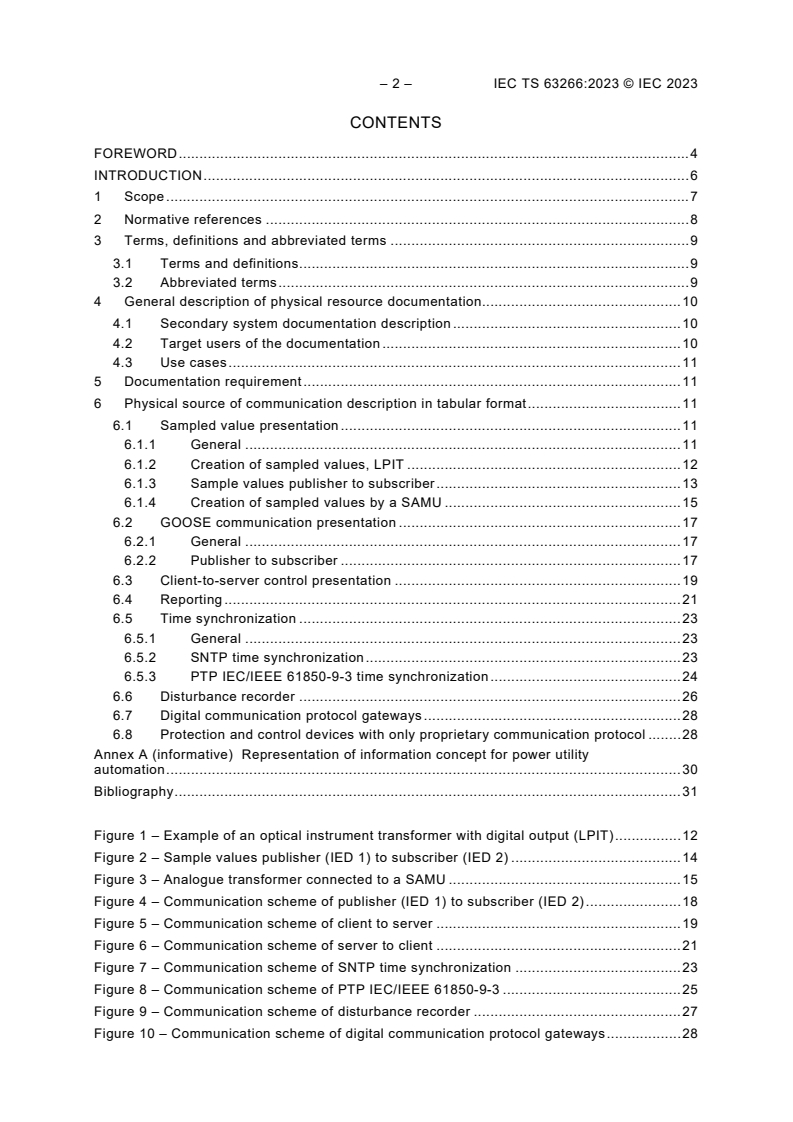
– 2 – IEC TS 63266:2023 © IEC 2023
CONTENTS
FOREWORD . 4
INTRODUCTION . 6
1 Scope . 7
2 Normative references . 8
3 Terms, definitions and abbreviated terms . 9
3.1 Terms and definitions . 9
3.2 Abbreviated terms . 9
4 General description of physical resource documentation. 10
4.1 Secondary system documentation description . 10
4.2 Target users of the documentation . 10
4.3 Use cases . 11
5 Documentation requirement . 11
6 Physical source of communication description in tabular format . 11
6.1 Sampled value presentation . 11
6.1.1 General . 11
6.1.2 Creation of sampled values, LPIT . 12
6.1.3 Sample values publisher to subscriber . 13
6.1.4 Creation of sampled values by a SAMU . 15
6.2 GOOSE communication presentation . 17
6.2.1 General . 17
6.2.2 Publisher to subscriber . 17
6.3 Client-to-server control presentation . 19
6.4 Reporting . 21
6.5 Time synchronization . 23
6.5.1 General . 23
6.5.2 SNTP time synchronization . 23
6.5.3 PTP IEC/IEEE 61850-9-3 time synchronization . 24
6.6 Disturbance recorder . 26
6.7 Digital communication protocol gateways . 28
6.8 Protection and control devices with only proprietary communication protocol . 28
Annex A (informative) Representation of information concept for power utility
automation . 30
Bibliography . 31
Figure 1 – Example of an optical instrument transformer with digital output (LPIT) . 12
Figure 2 – Sample values publisher (IED 1) to subscriber (IED 2) . 14
Figure 3 – Analogue transformer connected to a SAMU . 15
Figure 4 – Communication scheme of publisher (IED 1) to subscriber (IED 2) . 18
Figure 5 – Communication scheme of client to server . 19
Figure 6 – Communication scheme of server to client . 21
Figure 7 – Communication scheme of SNTP time synchronization . 23
Figure 8 – Communication scheme of PTP IEC/IEEE 61850-9-3 . 25
Figure 9 – Communication scheme of disturbance recorder . 27
Figure 10 – Communication scheme of digital communication protocol gateways . 28
Figure 11 – Communication scheme of protection and control devices with only
proprietary communication protocol . 29
Figure A.1 – Positioning of the RCCA within the documentation system for an
IEC 61850 substation . 30
Table 1 – Abbreviations . 9
Table 2 – Data presentation for use in SV communication . 12
Table 3 – Information about all MUs connected to the instrument transformer for data
stream n. 13
Table 4 – Communication between the publishing MU and the subscribing IEDs . 14
Table 5 – Presentation of subscriber n to an SV stream . 15
Table 6 – Data presentation for use in SV communication . 16
Table 7 – Presentation of a SAMU connected to a conventional transformer . 17
Table 8 – Presentation of a publisher of a GOOSE . 18
Table 9 – Presentation of Subscriber to a GOOSE . 19
Table 10 – Presentation of MMS client . 20
Table 11 – Presentation of MMS server . 21
Table 12 – Presentation of an MMS report server . 22
Table 13 – Presentation of an MMS report client . 23
Table 14 – Presentation of a SNTP server . 24
Table 15 – Presentation of a client . 24
Table 16 – Presentation of PTP GMC . 25
Table 17 – Presentation of a PTP slave clock . 26
Table 18 – Presentation of disturbance recorder, server . 27
Table 19 – Presentation of disturbance recorder, client . 27
Table 20 – Presentation of communication conversion . 28
Table 21 – Presentation of protection and control device with proprietary
communication protocol . 29
– 4 – IEC TS 63266:2023 © IEC 2023
INTERNATIONAL ELECTROTECHNICAL COMMISSION
____________
REPRESENTATION OF COMMUNICATION
IN POWER UTILITY AUTOMATION
FOREWORD
1) The International Electrotechnical Commission (IEC) is a worldwide organization for standardization comprising
all national electrotechnical committees (IEC National Committees). The object of IEC is to promote international
co-operation on all questions concerning standardization in the electrical and electronic fields. To this end and
in addition to other activities, IEC publishes International Standards, Technical Specifications, Technical Reports,
Publicly Available Specifications (PAS) and Guides (hereafter referred to as “IEC Publication(s)”). Their
preparation is entrusted to technical committees; any IEC National Committee interested in the subject dealt with
may participate in this preparatory work. International, governmental and non-governmental organizations liaising
with the IEC also participate in this preparation. IEC collaborates closely with the International Organization for
Standardization (ISO) in accordance with conditions determined by agreement between the two organizations.
2) The formal decisions or agreements of IEC on technical matters express, as nearly as possible, an international
consensus of opinion on the relevant subjects since each technical committee has representation from all
interested IEC National Committees.
3) IEC Publications have the form of recommendations for international use and are accepted by IEC National
Committees in that sense. While all reasonable efforts are made to ensure that the technical content of IEC
Publications is accurate, IEC cannot be held responsible for the way in which they are used or for any
misinterpretation by any end user.
4) In order to promote international uniformity, IEC National Committees undertake to apply IEC Publications
transparently to the maximum extent possible in their national and regional publications. Any divergence between
any IEC Publication and the corresponding national or regional publication shall be clearly indicated in the latter.
5) IEC itself does not provide any attestation of conformity. Independent certification bodies provide conformity
assessment services and, in some areas, access to IEC marks of conformity. IEC is not responsible for any
services carried out by independent certification bodies.
6) All users should ensure that they have the latest edition of this publication.
7) No liability shall attach to IEC or its directors, employees, servants or agents including individual experts and
members of its technical committees and IEC National Committees for any personal injury, property damage or
other damage of any nature whatsoever, whether direct or indirect, or for costs (including legal fees) and
expenses arising out of the publication, use of, or reliance upon, this IEC Publication or any other IEC
Publications.
8) Attention is drawn to the Normative references cited in this publication. Use of the referenced publications is
indispensable for the correct application of this publication.
9) Attention is drawn to the possibility that some of the elements of this IEC Publication may be the subject of patent
rights. IEC shall not be held responsible for identifying any or all such patent rights.
IEC TS 63266 has been prepared by IEC technical committee 3: Documentation, graphical
symbols and representations of technical information. It is a Technical Specification.
The text of this Technical Specification is based on the following documents:
Draft Report on voting
3/1611/DTS 3/1623/RVDTS
Full information on the voting for its approval can be found in the report on voting indicated in
the above table.
The language used for the development of this Technical Specification is English.
This document was drafted in accordance with ISO/IEC Directives, Part 2, and developed in
accordance with ISO/IEC Directives, Part 1 and ISO/IEC Directives, IEC Supplement, available
at www.iec.ch/members_experts/refdocs. The main document types developed by IEC are
described in greater detail at www.iec.ch/publications.
The committee has decided that the contents of this document will remain unchanged until the
stability date indicated on the IEC website under webstore.iec.ch in the data related to the
specific document. At this date, the document will be
• reconfirmed,
• withdrawn,
• replaced by a revised edition, or
• amended.
– 6 – IEC TS 63266:2023 © IEC 2023
INTRODUCTION
The data communication system is a critical point in the real time operation of a power utility
automation system. Information from the system is retrieved and used for reliable operation, for
supervision, and for efficient maintenance work in power utility automation systems, such as
hydro power plant, thermal power plant, transmission station, distribution station, industrial site,
etc.; hereby referred to as substations.
Power utility automation systems, including those for substations, have been increasingly
modernized thanks to their benefits to power utilities. Digital data exchange, based on
IEC 61850 (all parts), among the functions in the system, replaces the copper hardwired
conventional communication.
The exchange of digital information, in the form of data objects and data attributes, between
intelligent electronic devices (IEDs), has become very common in utility automation and these
data are essential for control and protection of the power grid, and the amount of such data
exchanges is increasing.
The engineering tools available for configuration of the communication systems are typically
focusing on the data exchange between tools and less on readability for human perception.
Documents prepared by these tools are often comprehensive and well-structured files, for
example, in XML-format, but are difficult to read and to understand and could therefore be
inappropriate in some steps of the product/system life cycle. With the increasing amount of data
exchanges and the increasing level of complexity, the inconsistencies and errors in the complex
documentation cannot be efficiently perceived by human users. Proper visualization of data
exchanges from different entities makes the maintenance and design more reliable.
This document aims to provide a structure for documentation of exchanged information that is
used for testing and maintenance of devices in the substation. This standardized documentation
is called "representation of communication configuration and application", abbreviated as
RCCA. This reference documentation is intended to be part of the delivery documentation for
an IEC 61850 substation.
As a consequence of using IEDs and digital communication in substations, the need arises for
readily available, clearly presented, human-readable representation of data for reliable and
convenient use by persons in the field.
The IEC 61850 series has provided the comprehensive range of International Standards
covering functional, communication and engineering aspects, but not covering the presentation
and visualization of these functions.
REPRESENTATION OF COMMUNICATION
IN POWER UTILITY AUTOMATION
1 Scope
This document specifies a structure for representation of exchanged information that is
essential for testing and maintenance of the devices in power utility automation systems. It is
mainly intended to be applied to communication equipment that communicate information in
accordance with IEC 61850 (all parts) in at least one part of their communication flow.
The following communication equipment is included within the scope:
– optical instrument transformer;
– conventional instrument transformers related to IEC 61850 traffic;
– merging unit;
– stand-alone merging unit;
– protection, control and measuring devices with at least one IEC 61850 interface;
– switchgear control unit (breaker IED);
– switchgear providing IEC 61850 interface;
– IEC 61850 time synchronization device;
– IEC 61850 gateway (RTU) and station HMI;
– digital disturbance recorder / digital fault recorder;
– digital communication protocol gateways with at least one IEC 61850 interface;
– protection, control and measuring devices that utilise a proprietary protocol for
communication with devices that have at least one IEC 61850 interface.
The following communication equipment, scheme and protocols are excluded from the scope:
– IEC 61850 Ethernet switches and network topology;
– PMU phasor measurement unit with at least one IEC 61850 interface;
– the full path of substation-to-substation communication;
EXAMPLE 1: The description of R-GOOSE Publisher in substation A does not include the description of
R-GOOSE Subscriber in substation B.
– functions with only hardwired communication, e.g. direct analogue copper wired connection;
EXAMPLE 2: A current transformer connected to a protection relay with hardwired tripping of a circuit breaker.
– functions using only proprietary communication protocol systems;
EXAMPLE 3: A dedicated system for collecting disturbance recorder files with courier protocol or path from
IEC 60870-5-103 to IEC 60870-5-101 will not be presented in this document.
– protocol mappings to XMPP (IEC 61850-8-2).
This document forms a supplement to other documentation standards in power utility
automation.
It also harmonizes the representation of the logical data flow structures based on IEC 61850
communication among different devices in order to provide a reference document that can be
created for any IEC 61850 substation.
– 8 – IEC TS 63266:2023 © IEC 2023
This document focuses in principle on the visualization of the digital information exchanged
between IEDs and control or measurement devices in a power utility automation system. The
information visualization does not refer to any graphical modelling but to a tabular format of
presentation. The data in tabular format can be used as a basis for other kinds of visual
presentation outside the scope of this document.
For representing all kinds of substation information, a single suitable tabular form is not possible
to find. This document instead presents a limited number of high visual performance
representation formats.
Presentation formats described in this document provide interactive visualization that assists
users in analysing data and identifying some important and essential information in a more
efficient way.
2 Normative references
The following documents are referred to in the text in such a way that some or all of their content
constitutes requirements of this document. For dated references, only the edition cited applies.
For undated references, the latest edition of the referenced document (including any
amendments) applies.
IEC 61082-1, Preparation of documents used in electrotechnology – Part 1: Rules
IEC 61850-5, Communication networks and systems for power utility automation – Part 5:
Communication requirements for functions and device models
IEC 61850-6, Communication networks and systems for power utility automation – Part 6:
Configuration description language for communication in power utility automation systems
related to IEDs
IEC 61850-7-2, Communication networks and systems for power utility automation – Part 7-2:
Basic information and communication structure – Abstract communication service interface
(ACSI)
IEC 61850-8-1, Communication networks and systems for power utility automation – Part 8-1:
Specific communication service mapping (SCSM) – Mappings to MMS (ISO 9506-1 and
ISO 9506-2) and to ISO/IEC 8802-3
IEC 61869-9, Instrument transformers – Part 9: Digital interface for instrument transformers
IEC 62439-3, Industrial communication networks – High availability automation networks –
Part 3: Parallel Redundancy Protocol (PRP) and High-availability Seamless Redundancy (HSR)
IEC 81346-1, Industrial systems, installations and equipment and industrial products –
Structuring principles and reference designations – Part 1: Basic rules
IEC 81346-2, Industrial systems, installations and equipment and industrial products –
Structuring principles and reference designations – Part 2: Classification of objects and codes
for classes
ISO 81346-10, Industrial systems, installations and equipment and industrial products –
Structuring principles and reference designations – Part 10: Power supply systems
IEC 82045-1, Document management – Part 1: Principles and methods
3 Terms, definitions and abbreviated terms
3.1 Terms and definitions
For the purposes of this document, the following terms and definitions apply.
ISO and IEC maintain terminological databases for use in standardization at the following
addresses:
• IEC Electropedia: available at http://www.electropedia.org/
• ISO Online browsing platform: available at http://www.iso.org/obp
3.1.1
substation
part of a power system, concentrated in a given place, including mainly the terminations of
transmission or distribution lines switchgear and housing and which may also include
transformers. It generally includes facilities necessary for system security and control (e.g. the
protective devices)
Note 1 to entry: According to the nature of the system within which the substation is included, a prefix may qualify
it.
EXAMPLE Transmission substation (of a transmission system), distribution substation, 400 kV substation, 20 kV
substation.
[SOURCE: IEC 60050-605:1983, 605-01-01]
3.2 Abbreviated terms
For the purposes of this document, the abbreviations provided in Table 1 are used.
Table 1 – Abbreviations
Abbreviated term Full term
ASDU Application service data unit
FAT Factory acceptance test
FTP File transfer protocol
GNSS Global navigation satellite system
EXAMPLES: GPS/BDS/GLONASS/GALILEO
GMC Grand master clock
GOOSE Generic object oriented substation event
HMI Human machine interface
HSR High-availability seamless redundancy
IED Intelligent electronic device
LPIT Low power instrument transformer
MMS Manufacturing messaging specification
MU Merging unit
PLC Power line carrier
PPS Pulse per second
PRP Parallel redundancy protocol
PTP Precision time protocol
RCB Report control block
RCCA Representation of communication configuration and application
– 10 – IEC TS 63266:2023 © IEC 2023
Abbreviated term Full term
R-GOOSE Routable generic object oriented system event
RTU Remote terminal unit
SAMU Stand-alone merging unit
SAN Single attached node
SAT Site acceptance test
SCD System configuration description
SCL Substation automation system configuration description language
SFTP Secure file transfer protocol
SLD Single line diagram
SNTP Simple network time protocol
SV Sampled value
SvID Sampled value identifier
VLAN Virtual LAN (local area network)
XMPP Extensible messaging presence protocol
4 General description of physical resource documentation
4.1 Secondary system documentation description
Information from other documents used to design and describe power systems like SLD, circuit
diagrams, function diagrams, data sheets, etc. forms the basis for this document. The
presentation format described in this document is a supplementary presentation of the
information found in the documents mentioned.
4.2 Target users of the documentation
This document refers to any kind of information that can be documented either in a conventional
format or by software in such a way that it is usable by humans in utility activities. Annex A
shows a list of document types commonly used in system documentation. The list extends
outside of the scope of IEC 61850.
This document is intended to be used by:
• operators,
• test engineers,
• maintenance technicians,
• protection and control engineers,
• electrical design engineers,
• system design technicians and engineers.
The documentation can be divided into two groups: documents for machine-to-machine
communication and documents for human perception. Regarding the IEC 61850 series, the first
group shall be covered by the file formats in accordance with IEC 61850-6.
The focus of this document is primarily on the presentation of communicated information for
system maintenance, but may also be used in the engineering stage.
The purpose of reference documentation for human perception, is to easily get upfront
information about the communication structures, data flow, applications associated to the
communication flow, etc., without the need to read different documents in different formats in
the search for information.
4.3 Use cases
This document will facilitate the following activities:
• FAT or SAT
In the FAT or SAT, the consistency of other documents with a presentation format in
accordance with this document will be checked and approved. This presentation can be
used for preparing the test cases.
• The process of getting familiar with the described power system, including the presentation
and the purpose of information exchange between functions of that system.
The standardized presentation can assist experts to get familiar with the function and
systems in a reduced amount of time.
• Maintenance
The presentation format set out in this document is essential for identifying dependencies
between equipment.
It can even be helpful for deciding on test cases after some maintenance and revision has
been carried out.
5 Documentation requirement
The presentation formats described in this document are developed on the following basis:
• the latest valid technical documentation shall be available for presentation of the
information.
• the SCD file for the system shall be a part of the as-built delivery documentation of the
power utility automation system and be maintained continuously (updated when changes
are made to the system);
• the RCCA may be generated by the software engineering tools. Manual entry can also be
applied;
• the RCCA should be maintained and kept updated continuously (as built);
EXAMPLE Any IED replacement with a "clone" creates a new MAC address which requires the update of the
RCCA.
• where mandatory information in a project is missing, the entry for that information shall be
marked as "Not available".
Documents shall be formed in accordance with the requirements of IEC 61082-1. Objects shall
be designated according to the IEC 81346 series. Document metadata shall be in accordance
with IEC 82045-1.
6 Physical source of communication description in tabular format
6.1 Sampled value presentation
6.1.1 General
The main source of generation of the SV data stream is the merging unit (MU or SAMU). The
merging unit is connected to one or more (optical) instrument transformers. For each instrument
transformer there shall be one presentation in the reference RCCA (see Figure 1).
– 12 – IEC TS 63266:2023 © IEC 2023
6.1.2 Creation of sampled values, LPIT
This presentation considers the cases where the MU is connected to an instrument transformer
with digital output (LPIT) in accordance with IEC 61869-9, e.g. an optical instrument
transformer. For a MU connected to an analogue instrument transformer, see 6.1.4.
Figure 1 – Example of an optical instrument transformer with digital output (LPIT)
Table 2 contains data presentation for use in SV communication.
Table 2 – Data presentation for use in SV communication
Primary object Comments
Primary object name Name of the primary object as found in the latest SLD. Names should
be in accordance with the International Standard 81346 series.
Type of measurement All the quantities measured by the instrument transformer (current,
voltage, phases involved), for example, currents I , I , I or
L1 L2 L3
voltages U , U , U .
L1 L2 L3
Connected to MU name Name of the device hosting a merging unit function that publishes the
SV stream associated to the measured primary quantities as found in
the SCD file. Names should be in accordance with the International
Standard 81346 series.
Polarity Show with an arrow the positive reference direction for the measured
(positive direction for the current) current.
Rating Nominal primary current or voltage of each measurement (core) of
the instrument transformer.
Nominal range Measurement range for each quantity measured by the instrument
transformer.
Accuracy class Accuracy class for each quantity measured by the instrument
transformer.
Table 3 reports the information about all the MUs connected to the instrument transformer.
There shall be one table for each MU.
Table 3 shows the data to be presented for one data stream. If the MU publisher has more than
one data stream (also called logical MU), there shall be one table for each data stream.
Table 3 – Information about all MUs connected to the instrument
transformer for data stream n
MU Comments
Instrument transformer name Name of the instrument transformer to which the MU is connected,
according to the latest SLD. Names should be in accordance with the
International Standard 81346 series.
Primary equipment connection number Description of all the (proprietary) connections between the MU and
on MU (port) the instrument transformer.
MU name Name of the device hosting a merging unit function, as available in
the SCD file. Names should be in accordance with the International
Standard 81346 series.
MU IP address IP address of the Ethernet port from which the SV data stream is
published, as found in the SCD file.
MU MAC address MAC address of the Ethernet port from which the SV data stream is
published (i.e. source MAC address), as found in the SCD file.
Connection mode (HSR, PRP, SAN) Connection mode / redundancy of the Ethernet port of the MU.
SAN: No redundancy available (single attached node).
PRP, HSR: Seamless redundancy connection.
Ethernet port name Description of the Ethernet port in the MU that is used for the
publication of the SV as found in the documentation of the Ethernet
system within the substation.
SvID A system-wide unique identification of the generated SV data stream,
i.e., attribute MsvID (Multicast sampled value ID) or UsvID (Unicast
sampled value ID) according to IEC 61850-7-2.
SV application Description of all the applications for which the SV data stream is
intended, for example, currents (I .I ) for overcurrent protection and
1 4
voltages (U .U ) not used.
1 4
Polarity of the SV stream Information on the data published in the data stream and if it is in
phase ("in phase") with the analogue data measured by the
instrument transformer or if it is inverted ("inverted") by 180°.
SV MAC address Destination MAC address of the SV stream as found in the SCD file.
SV dataset Name of the dataset associated to the SV data stream, as it is found
in the SCD file.
Value of the VLAN for the published SV stream as found in the SCD
VLAN ID
file.
VLAN Prio Priority of the VLAN for the published SV stream as found in the SCD
file.
Sampling rate Number of acquired samples per second.
Samples per SV message Number of samples per SV message (ASDU).
Accuracy class Accuracy class of the published numerical data. It could be different
from the accuracy class of the instrument transformer.
Data stream n Number of the data stream
6.1.3 Sample values publisher to subscriber
This presentation is related to the description of the communication between the publishing MU
and the subscribing IEDs; see Figure 2 and Table 4. If the MU publisher has more than one
data stream there shall be one table for each data stream.
– 14 – IEC TS 63266:2023 © IEC 2023
Figure 2 – Sample values publisher (IED 1) to subscriber (IED 2)
Table 4 – Communication between the publishing MU and the subscribing IEDs
Publishing MU Comments
MU name Name of the device hosting a merging unit function, as found in the
SCD file. Names should be in accordance with the International
Standard 81346 series.
MU IP address IP address of the Ethernet port from which the SV data stream is
published, as found in the SCD file.
MU MAC address MAC address of the Ethernet port from which the SV data stream is
published (i.e. source MAC address), as found in the SCD file.
Connection mode (PRP, HSR, SAN) Connection mode / redundancy of the Ethernet port of the MU.
SAN: No redundancy available (single attached node).
PRP, HSR: Seamless redundancy connection.
Ethernet port name Description of the Ethernet port in the MU that is used for the
publication of the SV.
SvID SvID of the generated SV data stream, as found in the SCD file.
SV application Description of all the applications for which the SV data stream is
intended.
Polarity of the SV stream Information on the data published in the data stream and if it is in
phase ("in phase") with the analogue data measured by the
instrument transformer or if it is inverted ("inverted") by 180°.
SV MAC address Destination MAC address of the SV stream as found in the SCD file.
SV Dataset Name of the dataset associated to the SV data stream, as it is found
in the SCD file.
VLAN ID Value of the VLAN for the published MU as found in the SCD file.
VLAN Prio Priority of the VLAN for the published MU as found in the SCD file.
Sampling rate Number of acquired samples per second.
Samples per SV message Number of samples per SV message (ASDU).
Subscriber(s) List of all IEDs (IED Names) that are subscribing to this SV stream,
as found in the SCD file.
Table 5 provides the description of devices that subscribe to an SV stream provided by the
publishing MU as described in Table 4.
Note that for each SV stream proved by the publishing MU, the subscriber information in
accordance with Table 5 shall be presented.
Table 5 – Presentation of subscriber n to an SV stream
Subscriber n Comments
Subscribing IED name IED Name of the device subscribing to the SV stream, as available in
the SCD file. Names should be in accordance with the International
Standard 81346 series.
Subscribing IP address IP address of the Ethernet port from which the SV data stream is
subscribed to, as found in the SCD file.
Connection mode (PRP, HSR, SAN) Connection mode / redundancy of the Ethernet port of the
subscribing IED.
SAN: No redundancy available (single attached node).
PRP, HSR: Seamless redundancy connection.
Ethernet port name Description of the Ethernet port of the IED that is used for the
subscription of the SV.
SvID SvID of the subscribed SV stream, as found in the SCD file.
SV Application Description of all the applications for which the SV data stream is
intended to be used in this receiving IED.
SV MAC address Destination MAC address of the subscribed SV stream, as found in
the SCD file.
SV Dataset Name of the dataset associated to the subscribed SV data stream,
as found in the SCD file.
VLAN ID Value of the VLAN for the published SV stream as found in the SCD
file.
VLAN Prio Priority of the VLAN for the published SV Stream as found in the
SCD file.
Publishing MU IED Name IED Name of the publishing physical merging unit, as found in the
SCD file. Names should be in accordance with the International
Standard 81346 series.
6.1.4 Creation of sampled values by a SAMU
This presentation considers the case where the merging unit is connected to an instrument
transformer that provides analogue signals (current transformer, voltage transformer, Rogowski
coil or other analogue sensors).
Figure 3 is a scheme presentation of the considered system.
In this case, the merging unit is called a SAMU.
Figure 3 – Analogue transformer connected to a SAMU
As this kind of application is not widely implemented yet, this document does not provide a
dedicated section for this purpose; however, where applicable, the template provided by Table 6
shall be used as the template to describe that application.
– 16 – IEC TS 63266:2023 © IEC 2023
Table 6 contains data presentation for use in SV communication.
Table 6 – Data presentation for use in SV communication
Primary object Comments
Primary object name Name of the primary object as found in the latest SLD. Names should
be in accordance with the International Standard 81346 series.
Type of measurement All the quantities measured by the instrument transformer (current,
voltage, phases involved), for example, currents I , I , I or
L1 L2 L3
voltages U , U , U .
L1 L2 L3
Connected to SAMU IED name IED name of all the stand-alone merging units that publish the SV
stream associated to the measured primary quantities, as found in
the SCD file. Names should be in accordance with the International
Standard 81346 series.
Polarity Show with an arrow the positive direction for the measured current
(positive direction for the current) (positive reference direction if current flowing into the closest node is
the preferred definition).
Rating Nominal primary current or voltage of each measurement (core) of
the instrument transformer.
Ratio Primary to secondary quantity ratio of the instrument transformer in
A / A or in kV / V, for each quantity (core).
Accuracy class Accuracy class for each quantity measured by the instrument
transformer.
Table 7 reports the information about all the SAMUs connected to the conventional instrument
transformer. There shall be one table for each SAMU.
Table 7 – Presentation of a SAMU connected to a conventional transformer
SAMU Comments
Instrument transformer name Name of the instrument transformer to which the SAMU is connected,
according to the latest SLD. Names should be in accordance with the
International Standard 81346 series.
Primary equipment connection to SAMU Description of all the analogue connections between the SAMU and
the instrument transformer.
SAMU IED name IED name of the stand-alone merging unit, as available in the SCD
file. Names should be in accordance with the International Standard
81346 series.
SAMU IP address IP address of the Ethernet port from which the SV data stream is
published, as found in the SCD file.
Connection mode (HSR, PRP, SAN) Connection mode / redundancy of the Ethernet port of the MU.
SAN: No redundancy available (single attached node).
PRP, HSR: Seamless redundancy connection.
Ethernet port name Description of the Ethernet port of the SAMU that is used for the
publication of the SV.
SvID SvID of the generated SV data stream, as found in the SCD file.
Description of all the applications for which the SV data stream is
SV application
intended.
Polarity of the SV stream Inform if the data published in the data stream is in phase ("in
phase") with the data measured by the instrument transformer or if it
is inverted ("inverted") by 180°.
SV MAC address Destination MAC address of the SV stream as found in the SCD file.
SV dataset Name of the dataset associated to the SV data stream, as it is found
in the SCD file.
VLAN ID Value of the VLAN for the published SV stream as found in the SCD
file.
VLAN Prio Priority of the VLAN for the published SV stream as found in the SCD
file.
Sampling rate Number of acquired samples per second.
Samples per SV message Number of samples per SV message (ASDU).
Accuracy class Accuracy class of the published numerical data. It could be different
from the accuracy class of the instrument transformer.
6.2 GOOSE communication presentation
6.2.1 General
IEC 61850 is used for communication within a substation between IEDs. See Figure 4. In an
electrical substation, some events may be time-critical such as the protection of equipment in
a substation and therefore a message like GOOSE is used for fast and reliable function. GOOSE
is associated with a generic system event, GSE and uses GSE management for communication
which is in accordance with IEC 61850-8-1.
The GSE management is based on the publisher-to-subscriber model and supports the
publishing of the same information to more than one physical device through the multicast
service.
6.2.2 Publisher to subscriber
GOOSE messages provide fast and reliable communication in substations, but the structure of
the message and the content is not directly readable for humans and requires time for
maintenance and design without any visualisation of the data exchange.
– 18 – IEC TS 63266:2023 © IEC 2023
Table 8 contains a data presentation for use in GOOSE
...