

IEC 60730-2-11:2019
(Main)Automatic electrical controls - Part 2-11: Particular requirements for energy regulators
General Information
- Abstract
IEC 60730-2-11:2019 applies to energy regulators for use in, on, or in association with equipment, including energy regulators for heating, air conditioning and similar applications. The equipment may use electricity, gas, oil, solid fuel, solar thermal energy, etc. or a combination thereof.
This standard applies to the inherent safety, to the operating values, operating times and operating sequence where these are associated with equipment safety, and to the testing of automatic electrical energy regulator devices used in, or in association with, equipment.
This standard is also applicable to energy regulators for appliances within the scope of IEC 60335-1.
Throughout this standard the word “equipment” means “appliance and equipment”.
This standard also applies to automatic electrical energy regulators for equipment that may be used by the public, such as equipment intended to be used in shops, offices, hospitals, farms and commercial and industrial applications.
This standard does not apply to automatic electrical energy regulators designed exclusively for industrial process applications unless explicitly mentioned in the equipment standard.
This standard does not apply to equipment that are specifically within the scope of building automation equipment.
This standard is also applicable to individual energy regulators utilized as part of a control system or energy regulators which are mechanically integral with multi-functional controls having non-electrical outputs.
This standard applies to controls powered by primary or secondary batteries, requirements for which are contained within the standard, including Annex V
This third edition cancels and replaces the second edition published in 2006. This edition constitutes a technical revision. This edition includes the following significant technical changes with respect to the previous edition:
a) revision to the title to remove “for household and similar use”;
b) changes to the scope and related modifications;
c) changes to definitions in Annex H.
This Part 2-11 is intended to be used in conjunction with IEC 60730 1. It was established on the basis of the fifth edition of that standard (2013) including Amendment 1 (2015). Consideration may be given to future editions of, or amendments to, IEC 60730-1.
Keywords: Automatic Controls, Energy Regulators, Control Systems
- Status
- Published
- Publication Date
- 16-May-2019
- Technical Committee
- TC 72 - Automatic electrical controls
- Drafting Committee
- WG 6 - TC 72/WG 6
Buy Documents
IEC 60730-2-11:2019 RLV - Automatic electrical controls - Part 2-11: Particular requirements for energy regulators Released:5/17/2019
IEC 60730-2-11:2019 - Automatic electrical controls - Part 2-11: Particular requirements for energy regulators Released:5/17/2019
Overview
IEC 60730-2-11:2019 specifies particular requirements for automatic electrical energy regulators used in, on, or in association with equipment such as heating, air‑conditioning and similar applications. It covers regulators powered from mains or batteries and using electricity, gas, oil, solid fuel, solar thermal energy or combinations thereof. This third edition is a technical revision of the 2006 edition and is intended to be used together with IEC 60730-1 (Part 1).
Key scope points:
- Applies to inherent safety, operating values, operating times and operating sequences where these affect equipment safety.
- Applies to energy regulators for appliances within IEC 60335-1 and to devices used by the public (shops, offices, hospitals, farms, light industry).
- Excludes controls exclusively for industrial process applications and items specifically within building automation scope.
- Includes requirements for electronic controls (Annex H), thermistor use (Annex J) and battery‑powered controls (Annex V).
- Rated limits referenced: regulators with rated voltage up to 690 V and current up to 63 A AC (600 V DC).
Key topics and technical requirements
IEC 60730-2-11 supplements Part 1 by adding or modifying clauses specific to energy regulators. Major technical topics include:
- Safety-related functions: inherent safety, operating sequences and timings where they affect safety.
- Electrical protection: protection against electric shock, earthing provisions, terminals and terminations.
- Construction & mechanical: constructional requirements, mechanical strength, threaded parts and connections.
- Environmental & durability testing: moisture/dust resistance, thermal and environmental stress, endurance and drift.
- Insulation & fire safety: electric strength, insulation resistance, resistance to heat, fire and tracking, creepage distances and clearances.
- EMC: emission and immunity requirements for control systems and components.
- Component and software considerations: requirements for electronic components, low‑complexity functional safety and software classification notes.
Applications and who uses this standard
IEC 60730-2-11 is targeted at professionals involved in the design, manufacture, testing and certification of energy regulators and related control systems:
- Appliance and HVAC manufacturers integrating automatic controls and energy regulators.
- Control system designers and electronics engineers specifying safety and EMC performance.
- Product compliance and certification bodies verifying conformity with IEC 60730 series and IEC 60335-1.
- Test laboratories performing electrical, environmental and functional tests on energy regulators.
- System integrators working with demand‑response or billing‑rate communications to controls (note: interoperability beyond the control system is not covered).
Related standards
- IEC 60730-1 (General requirements) - mandatory companion document.
- IEC 60335-1 - safety for household appliances where relevant.
- IEC 61058-1 - requirements for manual switches (when not part of the automatic regulator).
- Other parts of the IEC 60730 series for specific control types.
Keywords: Automatic Controls, Energy Regulators, Control Systems, IEC 60730-2-11, appliance safety, EMC, functional safety.
Relations
- Effective Date
- 10-May-2024
- Effective Date
- 05-Sep-2023
Buy Documents
IEC 60730-2-11:2019 RLV - Automatic electrical controls - Part 2-11: Particular requirements for energy regulators Released:5/17/2019
IEC 60730-2-11:2019 - Automatic electrical controls - Part 2-11: Particular requirements for energy regulators Released:5/17/2019
Frequently Asked Questions
IEC 60730-2-11:2019 is a standard published by the International Electrotechnical Commission (IEC). Its full title is "Automatic electrical controls - Part 2-11: Particular requirements for energy regulators". This standard covers: IEC 60730-2-11:2019 applies to energy regulators for use in, on, or in association with equipment, including energy regulators for heating, air conditioning and similar applications. The equipment may use electricity, gas, oil, solid fuel, solar thermal energy, etc. or a combination thereof. This standard applies to the inherent safety, to the operating values, operating times and operating sequence where these are associated with equipment safety, and to the testing of automatic electrical energy regulator devices used in, or in association with, equipment. This standard is also applicable to energy regulators for appliances within the scope of IEC 60335-1. Throughout this standard the word “equipment” means “appliance and equipment”. This standard also applies to automatic electrical energy regulators for equipment that may be used by the public, such as equipment intended to be used in shops, offices, hospitals, farms and commercial and industrial applications. This standard does not apply to automatic electrical energy regulators designed exclusively for industrial process applications unless explicitly mentioned in the equipment standard. This standard does not apply to equipment that are specifically within the scope of building automation equipment. This standard is also applicable to individual energy regulators utilized as part of a control system or energy regulators which are mechanically integral with multi-functional controls having non-electrical outputs. This standard applies to controls powered by primary or secondary batteries, requirements for which are contained within the standard, including Annex V This third edition cancels and replaces the second edition published in 2006. This edition constitutes a technical revision. This edition includes the following significant technical changes with respect to the previous edition: a) revision to the title to remove “for household and similar use”; b) changes to the scope and related modifications; c) changes to definitions in Annex H. This Part 2-11 is intended to be used in conjunction with IEC 60730 1. It was established on the basis of the fifth edition of that standard (2013) including Amendment 1 (2015). Consideration may be given to future editions of, or amendments to, IEC 60730-1. Keywords: Automatic Controls, Energy Regulators, Control Systems
IEC 60730-2-11:2019 applies to energy regulators for use in, on, or in association with equipment, including energy regulators for heating, air conditioning and similar applications. The equipment may use electricity, gas, oil, solid fuel, solar thermal energy, etc. or a combination thereof. This standard applies to the inherent safety, to the operating values, operating times and operating sequence where these are associated with equipment safety, and to the testing of automatic electrical energy regulator devices used in, or in association with, equipment. This standard is also applicable to energy regulators for appliances within the scope of IEC 60335-1. Throughout this standard the word “equipment” means “appliance and equipment”. This standard also applies to automatic electrical energy regulators for equipment that may be used by the public, such as equipment intended to be used in shops, offices, hospitals, farms and commercial and industrial applications. This standard does not apply to automatic electrical energy regulators designed exclusively for industrial process applications unless explicitly mentioned in the equipment standard. This standard does not apply to equipment that are specifically within the scope of building automation equipment. This standard is also applicable to individual energy regulators utilized as part of a control system or energy regulators which are mechanically integral with multi-functional controls having non-electrical outputs. This standard applies to controls powered by primary or secondary batteries, requirements for which are contained within the standard, including Annex V This third edition cancels and replaces the second edition published in 2006. This edition constitutes a technical revision. This edition includes the following significant technical changes with respect to the previous edition: a) revision to the title to remove “for household and similar use”; b) changes to the scope and related modifications; c) changes to definitions in Annex H. This Part 2-11 is intended to be used in conjunction with IEC 60730 1. It was established on the basis of the fifth edition of that standard (2013) including Amendment 1 (2015). Consideration may be given to future editions of, or amendments to, IEC 60730-1. Keywords: Automatic Controls, Energy Regulators, Control Systems
IEC 60730-2-11:2019 is classified under the following ICS (International Classification for Standards) categories: 97.120 - Automatic controls for household use. The ICS classification helps identify the subject area and facilitates finding related standards.
IEC 60730-2-11:2019 has the following relationships with other standards: It is inter standard links to IEC 60730-2-11:2025, IEC 60730-2-11:2006. Understanding these relationships helps ensure you are using the most current and applicable version of the standard.
IEC 60730-2-11:2019 is available in PDF format for immediate download after purchase. The document can be added to your cart and obtained through the secure checkout process. Digital delivery ensures instant access to the complete standard document.
Standards Content (Sample)
IEC 60730-2-11 ®
Edition 3.0 2019-05
REDLINE VERSION
INTERNATIONAL
STANDARD
colour
inside
Automatic electrical controls for household and similar use –
Part 2-11: Particular requirements for energy regulators
All rights reserved. Unless otherwise specified, no part of this publication may be reproduced or utilized in any form
or by any means, electronic or mechanical, including photocopying and microfilm, without permission in writing from
either IEC or IEC's member National Committee in the country of the requester. If you have any questions about IEC
copyright or have an enquiry about obtaining additional rights to this publication, please contact the address below or
your local IEC member National Committee for further information.
IEC Central Office Tel.: +41 22 919 02 11
3, rue de Varembé info@iec.ch
CH-1211 Geneva 20 www.iec.ch
Switzerland
About the IEC
The International Electrotechnical Commission (IEC) is the leading global organization that prepares and publishes
International Standards for all electrical, electronic and related technologies.
About IEC publications
The technical content of IEC publications is kept under constant review by the IEC. Please make sure that you have the
latest edition, a corrigendum or an amendment might have been published.
IEC publications search - webstore.iec.ch/advsearchform Electropedia - www.electropedia.org
The advanced search enables to find IEC publications by a The world's leading online dictionary on electrotechnology,
variety of criteria (reference number, text, technical containing more than 22 000 terminological entries in English
committee,…). It also gives information on projects, replaced and French, with equivalent terms in 16 additional languages.
and withdrawn publications. Also known as the International Electrotechnical Vocabulary
(IEV) online.
IEC Just Published - webstore.iec.ch/justpublished
Stay up to date on all new IEC publications. Just Published IEC Glossary - std.iec.ch/glossary
details all new publications released. Available online and 67 000 electrotechnical terminology entries in English and
once a month by email. French extracted from the Terms and Definitions clause of
IEC publications issued since 2002. Some entries have been
IEC Customer Service Centre - webstore.iec.ch/csc collected from earlier publications of IEC TC 37, 77, 86 and
If you wish to give us your feedback on this publication or CISPR.
need further assistance, please contact the Customer Service
Centre: sales@iec.ch.
IEC 60730-2-11 ®
Edition 3.0 2019-05
REDLINE VERSION
INTERNATIONAL
STANDARD
colour
inside
Automatic electrical controls for household and similar use –
Part 2-11: Particular requirements for energy regulators
INTERNATIONAL
ELECTROTECHNICAL
COMMISSION
ICS 97.120 ISBN 978-2-8322-6979-4
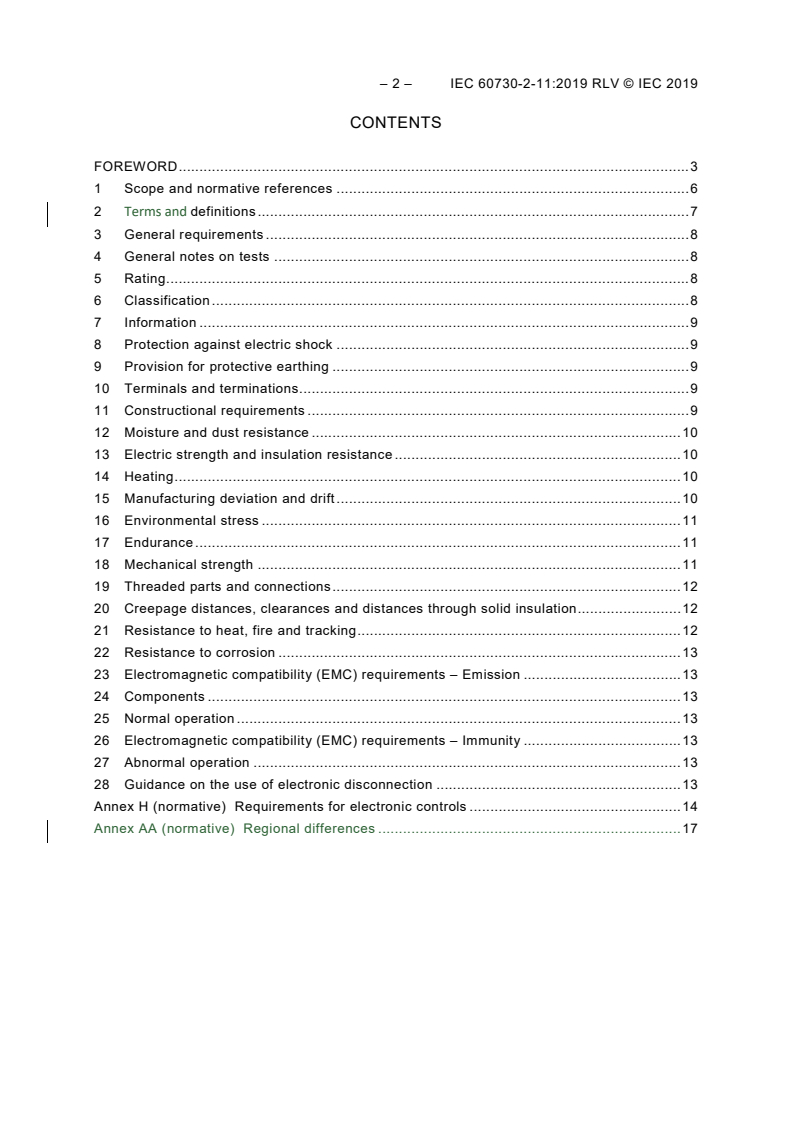
– 2 – IEC 60730-2-11:2019 RLV © IEC 2019
CONTENTS
FOREWORD . 3
1 Scope and normative references . 6
2 Terms and definitions . 7
3 General requirements . 8
4 General notes on tests . 8
5 Rating. 8
6 Classification . 8
7 Information . 9
8 Protection against electric shock . 9
9 Provision for protective earthing . 9
10 Terminals and terminations . 9
11 Constructional requirements . 9
12 Moisture and dust resistance . 10
13 Electric strength and insulation resistance . 10
14 Heating . 10
15 Manufacturing deviation and drift . 10
16 Environmental stress . 11
17 Endurance . 11
18 Mechanical strength . 11
19 Threaded parts and connections . 12
20 Creepage distances, clearances and distances through solid insulation . 12
21 Resistance to heat, fire and tracking . 12
22 Resistance to corrosion . 13
23 Electromagnetic compatibility (EMC) requirements – Emission . 13
24 Components . 13
25 Normal operation . 13
26 Electromagnetic compatibility (EMC) requirements – Immunity . 13
27 Abnormal operation . 13
28 Guidance on the use of electronic disconnection . 13
Annex H (normative) Requirements for electronic controls . 14
Annex AA (normative) Regional differences . 17
INTERNATIONAL ELECTROTECHNICAL COMMISSION
___________
AUTOMATIC ELECTRICAL CONTROLS FOR
HOUSEHOLD AND SIMILAR USE –
Part 2-11: Particular requirements for energy regulators
FOREWORD
1) The International Electrotechnical Commission (IEC) is a worldwide organization for standardization comprising
all national electrotechnical committees (IEC National Committees). The object of IEC is to promote international
co-operation on all questions concerning standardization in the electrical and electronic fields. To this end and
in addition to other activities, IEC publishes International Standards, Technical Specifications, Technical Reports,
Publicly Available Specifications (PAS) and Guides (hereafter referred to as “IEC Publication(s)”). Their
preparation is entrusted to technical committees; any IEC National Committee interested in the subject dealt with
may participate in this preparatory work. International, governmental and non-governmental organizations liaising
with the IEC also participate in this preparation. IEC collaborates closely with the International Organization for
Standardization (ISO) in accordance with conditions determined by agreement between the two organizations.
2) The formal decisions or agreements of IEC on technical matters express, as nearly as possible, an international
consensus of opinion on the relevant subjects since each technical committee has representation from all
interested IEC National Committees.
3) IEC Publications have the form of recommendations for international use and are accepted by IEC National
Committees in that sense. While all reasonable efforts are made to ensure that the technical content of IEC
Publications is accurate, IEC cannot be held responsible for the way in which they are used or for any
misinterpretation by any end user.
4) In order to promote international uniformity, IEC National Committees undertake to apply IEC Publications
transparently to the maximum extent possible in their national and regional publications. Any divergence between
any IEC Publication and the corresponding national or regional publication shall be clearly indicated in the latter.
5) IEC provides no marking procedure to indicate its approval and cannot be rendered responsible for any equipment
declared to be in conformity with an IEC Publication.
6) All users should ensure that they have the latest edition of this publication.
7) No liability shall attach to IEC or its directors, employees, servants or agents including individual experts and
members of its technical committees and IEC National Committees for any personal injury, property damage or
other damage of any nature whatsoever, whether direct or indirect, or for costs (including legal fees) and
expenses arising out of the publication, use of, or reliance upon, this IEC Publication or any other IEC Publications.
8) Attention is drawn to the Normative references cited in this publication. Use of the referenced publications is
indispensable for the correct application of this publication.
9) Attention is drawn to the possibility that some of the elements of this IEC Publication may be the subject of patent
rights. IEC shall not be held responsible for identifying any or all such patent rights.
This redline version of the official IEC Standard allows the user to identify the changes
made to the previous edition. A vertical bar appears in the margin wherever a change has
been made. Additions are in green text, deletions are in strikethrough red text.
– 4 – IEC 60730-2-11:2019 RLV © IEC 2019
International Standard IEC 60730-2-11 has been prepared by IEC technical committee 72:
Automatic electrical controls.
This third edition cancels and replaces the second edition published in 2006. This edition
constitutes a technical revision. This edition includes the following significant technical changes
with respect to the previous edition:
a) revision to the title to remove “for household and similar use”;
b) changes to the scope and related modifications;
c) changes to definitions in Annex H.
The text of this International Standard is based upon the following documents:
CDV Report on voting
72/1137/CDV 72/1167/RVC
Full information on the voting for the approval of this International Standard can be found in the
report on voting indicated in the above table.
This publication has been drafted in accordance with the ISO/IEC Directives, Part 2.
This Part 2-11 is intended to be used in conjunction with IEC 60730-1. It was established on
the basis of the fifth edition of that standard (2013) including Amendment 1 (2015).
Consideration may be given to future editions of, or amendments to, IEC 60730-1.
This Part 2-11 supplements or modifies the corresponding clauses in IEC 60730-1 so as to
convert that publication into the IEC standard: Particular requirements for energy regulators.
Where this Part 2-11 states "addition", "modification" or "replacement", the relevant requirement,
test specification or explanatory matter in Part 1 should be adapted accordingly.
Where no change is necessary, this Part 2-11 indicates that the relevant clause or subclause
applies.
In this publication, the following print types are used:
– requirements proper: in roman type,
– test specifications: in italic type,
– explanatory matter: in smaller roman type,
– defined terms: bold type.
Subclauses, notes, tables and figures which are additional to those in Part 1 are numbered
starting from 101.
A list of all parts of the IEC 60730 series, under the general title Automatic electrical controls,
can be found on the IEC website.
Future standards in this series will carry the new general title as cited above. Titles of existing
standards in this series will be updated at the time of the next edition.
The committee has decided that the contents of this publication will remain unchanged until the
maintenance result date indicated on the IEC web site under "http://webstore.iec.ch" in the data
related to the specific publication. At this date, the publication will be
• reconfirmed;
• withdrawn;
• replaced by a revised edition, or
• amended.
IMPORTANT – The “colour inside” logo on the cover page of this publication indicates
that it contains colours which are considered to be useful for the correct understanding
of its contents. Users should therefore print this publication using a colour printer.
– 6 – IEC 60730-2-11:2019 RLV © IEC 2019
AUTOMATIC ELECTRICAL CONTROLS FOR
HOUSEHOLD AND SIMILAR USE –
Part 2-11: Particular requirements for energy regulators
1 Scope and normative references
This clause of Part 1 is applicable except as follows:
1.1 Scope
Replacement:
In general, this part of IEC 60730 applies to energy regulators for use in, on, or in association
with equipment for household and similar use, including energy regulators for heating, air
conditioning and similar applications. The equipment may use electricity, gas, oil, solid fuel,
solar thermal energy, etc. or a combination thereof.
NOTE These energy regulators may can be thermally, mechanically or electrically operated.
1.1.1 Replacement:
This standard applies to the inherent safety, to the operating values, operating times and
operating sequence where such these are associated with equipment safety, and to the testing
of automatic electrical energy regulator devices used in, or in association with, household or
similar equipment.
This standard is also applicable to energy regulators for appliances within the scope of
IEC 60335-1.
Throughout this standard the word “equipment” means “appliance and equipment”.
This standard also applies to automatic electrical energy regulators for equipment that may be
used by the public, such as equipment intended to be used in shops, offices, hospitals, farms
and commercial and industrial applications.
This standard does not apply to automatic electrical energy regulators designed exclusively for
industrial process applications unless explicitly mentioned in the equipment standard.
This standard does not apply to equipment that are specifically within the scope of building
automation equipment.
This standard is also applicable to individual energy regulators utilized as part of a control
system or energy regulators which are mechanically integral with multi-functional controls
having non-electrical outputs.
Energy regulators for equipment not intended for normal household use, but which nevertheless
may be used by the public, such as equipment intended to be used by laymen in shops, in light
industry and on farms, are within the scope of this standard.
This standard applies to controls powered by primary or secondary batteries, requirements for
which are contained within the standard, including Annex V.
1.1.1 This International Standard applies to the inherent safety, to the operating values,
operating times, and operating sequences where such are associated with equipment safety,
and to the testing of automatic electrical control devices used in, or in association with,
equipment.
This standard applies to controls using thermistors, see also Annex J.
This standard is also applicable to the functional safety of low complexity safety related
systems and controls.
1.1.2 Not applicable.
This standard applies to energy regulators as defined in 2.2.10 of Part 1.
1.1.3 Not applicable.
1.1.4 Replacement:
This standard applies to manual energy regulators when such which are electrically and/or
mechanically integral with automatic controls.
Requirements for manual switches not forming part of an automatic energy regulator are
contained in IEC 61058-1.
1.21.1.5 Replacement:
This standard applies to energy regulators with a rated voltage not exceeding 690 V and with a
rated current not exceeding 63A AC or 600 V DC.
1.31.1.6 Not applicable.
1.41.1.7 Replacement:
This standard applies also to energy regulators incorporating electronic devices, requirements
for which are contained in Annex H.
1.1.8 This standard applies also to energy regulators using NTC or PTC thermistors,
additional requirements for which are contained in Annex J.
1.1.9 This standard applies to the electrical and functional safety of controls capable of
receiving and responding to communications signals, including signals for power billing rate
and demand response.
The signals may be transmitted to or received from external units being part of the control
(wired), or to and from external units which are not part of the control (wireless) under test.
1.1.10 This standard does not address the integrity of the output signal to the network devices,
such as interoperability with other devices unless it has been evaluated as part of the control
system.
2 Terms and definitions
This clause of Part 1 is applicable except as follows:
– 8 – IEC 60730-2-11:2019 RLV © IEC 2019
2.2 Definitions of types of controls according to purpose
2.2.19 Addition:
In general, an energy regulator is an operating control.
2.2.20 protective control
Addition:
Note 1 to entry: In general, energy regulators using software have functions classified as software class A.
2.5 Definitions of type of control according to construction
Addition:
2.5.101
push-and-turn actuation
Push-and-turn actuation denotes a two-step actuation accomplished by first pushing, and then
rotating turning, the actuating member of the control
2.5.102
pull-and-turn actuation
Pull-and-turn actuation denotes a two-step actuation accomplished by first pulling, and then
rotating, the actuating member of the control
3 General requirements
This clause of Part 1 is applicable.
4 General notes on tests
This clause of Part 1 is applicable.
5 Rating
This clause of Part 1 is applicable.
6 Classification
This clause of Part 1 is applicable except as follows:
6.4 According to features of automatic action
6.4.3 Addition:
6.4.3.101 – an action which is initiated only after a push-and-turn or pull-and-turn actuation
and in which only rotation is required to return the actuating member to the off or
rest position (type 1.X and 2.X);
6.4.3.102 – an action which is initiated only after a push-and-turn or pull-and-turn actuation
(type 1.Z or 2.Z).
6.7 According to ambient temperature limits of the switch head
Addition:
6.7.101 Energy regulator for use in or on cooking appliances.
7 Information
This clause of Part 1 is applicable except as follows:
Table 7.2
Table 1 – Required information and methods of providing information
Addition to Note 4 item i):
For energy regulators, limits of the activating quantity are not declared (see 17.7 and 17.8).
8 Protection against electric shock
This clause of Part 1 is applicable.
9 Provision for protective earthing
This clause of Part 1 is applicable.
10 Terminals and terminations
This clause of Part 1 is applicable.
11 Constructional requirements
This clause of Part 1 is applicable except as follows:
11.3.9 Pull-cord actuated control
Addition:
The second explanatory paragraph Note 2 is not applicable to energy regulators classified as type 1.X or 2.X or type
1.Z or 2.Z.
11.4 Actions
Addition:
– 10 – IEC 60730-2-11:2019 RLV © IEC 2019
11.4.101 Type 1.X or 2.X
A type 1.X or 2.X action shall be so designed that a turn action can only be accomplished after
the completion of a push action or a pull action. Only rotation shall be required to return the
actuating member of the energy regulator to the off or rest position.
Compliance is checked by the tests of 18.101.
11.4.102 Type 1.Z or 2.Z
A type 1.Z or 2.Z action shall be so designed that a turn action can only be accomplished after
the completion of a push action or a pull action.
Compliance is checked by the tests of 18.101.
12 Moisture and dust resistance
This clause of Part 1 is applicable.
13 Electric strength and insulation resistance
This clause of Part 1 is applicable.
14 Heating
This clause of Part 1 is applicable except as follows:
Addition:
14.101 Energy regulators for use in or on cooking appliances
14.101.1 The following is applicable to energy regulators classified under 6.7.101.
14.101.2 As a means of complying with note 12) l) of Table 13, if the temperature of insulating
parts exceeds that permitted in Table 14.1 13, then the test of 17.16.101 may be conducted
after the conditioning of 14.102 and 14.102.1.
14.102 A previously untested sample of the energy regulator is conditioned for 1 000 h in an
oven maintained at a temperature between 1,02 T + 20 °C and 1,05 times that temperature,
where T1 is the maximum measured temperature on the insulating part during the test of Clause
14. The energy regulator shall not be energized during the test.
If the elevated temperature is localized, such as at or near a bimetal heater, the
1 000 h conditioning is conducted with the energy regulator between T and T + 5 % for
max max
normal conditions, but with the contacts closed and non-cycling. If necessary, the contacts may
be forced closed to provide the most arduous temperature conditions. A bimetal heater across
the mains is energized at 1,1 times rated voltage. A series bimetal heater shall conduct at 1,1
times rated current.
15 Manufacturing deviation and drift
This clause of Part 1 is applicable.
16 Environmental stress
This clause of Part 1 is applicable.
17 Endurance
This clause of Part 1 is applicable except as follows:
17.16 Tests for particular purpose controls
Replacement:
17.1 to 17.5 Applicable.
17.6 Applicable to actions classified as Type 1.M or 2.M.
Modification:
17.7 and 17.8 are applicable, except that actuating members are placed in the position that
produces the fastest natural cycling rate at the beginning of the test. The rate can be adjusted
to the fastest natural cycling rate during the test. Limits of the activating quantity are not
declared.
17.9 Not applicable.
17.10 to 17.13 inclusive are applicable, except that for actuating members which have been
tested during the automatic action tests of 17.7 and 17.8, the number of cycles of actuation is
reduced in 17.13 by the number of cycles carried out during those tests.
17.14 Applicable.
17.15 Not applicable
17.16 Test for particular purpose controls
Addition:
17.16.101 Evaluation of materials
The following tests are conducted as indicated in 14.101.1.
The energy regulator is subjected to the tests of 17.7 for 50 operations and 17.8 for 1 000
operations. The tests of 17.7 and 17.8 are conducted at an ambient temperature of (20 ± 5) °C.
After these tests, the energy regulator shall comply with 17.5.
18 Mechanical strength
This clause of Part 1 is applicable except as follows:
Addition:
– 12 – IEC 60730-2-11:2019 RLV © IEC 2019
18.101 Push-and-turn or pull-and-turn actuation
Energy regulators with actions classified as type 1.X or 2.X or type 1.Z or 2.Z shall be subjected
to the tests of 18.101.1 and 18.101.2.
One new sample is used for the tests. After these tests, the energy regulator shall comply with
the requirements of 18.1.5.
18.101.1 Energy regulators with actions classified as type 1.X or 2.X or type 1.Z or 2.Z shall
be subjected to the tests.
– The axial force required to push or pull the actuating member shall not be less than 10 N.
– An axial push or pull force of 140 N applied to the actuating member shall not effect
compliance with 18.1.5.
– For an energy regulator intended for use with a knob having a grip diameter or length of 50
mm or less, the means preventing rotation of the shaft prior to the push or pull actuation
shall withstand, without damage or effect on the energy regulator function, a torque of 4 Nm.
– Alternatively, if the means preventing the rotation of the shaft is defeated when a torque of
at least 2 Nm is applied, the effect shall be such that either:
• the means is not damaged but overridden to close the contacts, in which case
subsequent actuation at a torque less than 2 Nm shall require both push-and-turn or
pull-and-turn to operate the contacts, or
• no operation of the contacts occurs nor can be made to occur.
– The torque required to reset the energy regulator to the initial contact condition, if necessary
after the application of the push or pull, shall not be greater than 0,5 Nm.
– A torque of 6 Nm is applied to the setting means. Any breakage or damage to the means
preventing rotation of the shaft shall not result in failure to comply with the requirements of
Clauses 8, 13 and 20.
– For energy regulators intended for use with a knob having a grip diameter or length greater
than 50 mm, the values of torque are increased proportionally.
18.101.2 Energy regulators with actions classified as type 1.X or 2.X, or type 1.Z or 2.Z shall
be actuated for the declared number of manual cycles.
After this test, the energy regulator shall comply with the requirements of 18.101.1. For the
case in which the means preventing rotation is not damaged but is overridden to operate the
contacts, the first one-sixth of the declared manual cycles shall be performed without first
pushing or pulling the actuating member.
19 Threaded parts and connections
This clause of Part 1 is applicable.
20 Creepage distances, clearances and distances through solid insulation
This clause of Part 1 is applicable.
21 Resistance to heat, fire and tracking
This clause of Part 1 is applicable.
22 Resistance to corrosion
This clause of Part 1 is applicable.
23 Electromagnetic compatibility (EMC) requirements – Emission
This clause of Part 1 is applicable.
24 Components
This clause of Part 1 is applicable.
25 Normal operation
See Annex H.
This clause of Part 1 is applicable.
26 Electromagnetic compatibility (EMC) requirements – Immunity
See Annex H.
This clause of Part 1 is applicable.
27 Abnormal operation
This clause of Part 1 is applicable.
See also Annex H.
28 Guidance on the use of electronic disconnection
See Annex H.
This clause of Part 1 is applicable.
Figures
The figures of Part 1 are applicable.
Annexes
The annexes of Part 1 are applicable except as follows:
– 14 – IEC 60730-2-11:2019 RLV © IEC 2019
Annex H
(normative)
Requirements for electronic controls
This annex of Part 1 is applicable except as follows:
H.6 Classification
H.6.18 According to software classes of control functions
H.6.18.1 – Control of class A control functions
Addition:
NOTE In general, energy regulators using software have functions classified as software perform class A control
function.
H.11.12 Controls using software
Modification:
After the second paragraph, add the following note:
NOTE The value(s) given in Table 1, item 71 can be taken from the equipment standard.
H.23.1.2 Radio frequency emission
Addition:
Integrated and incorporated energy regulators are not subjected to the tests of this subclause,
as the results of these tests are influenced by the incorporation of the energy regulator into the
equipment and the use of measures to control emissions used therein. They The tests of this
subclause may, however, be carried out under declared conditions if so requested by the
manufacturer.
H.26 Electromagnetic compatibility (EMC) requirements – Immunity
H.26.2 Addition:
The tests of H.26.4 to H.26.14 are performed with the energy regulator at its highest setting, its
lowest and at the OFF setting, if provided.
H.26.5 Voltage dips, voltage interruptions and voltage variations in the power supply
network
Modification:
H.26.5.3 Test procedure
Delete the paragraph beginning "In the case of three-phase equipment…".
H.26.6 Test of influence of voltage unbalance
Not applicable.
H.26.8 Surge immunity test
H.26.8.3 Test procedure
Addition:
H.26.8.3.101 Two pulses each are performed with the energy regulator at the high and low
settings and one is performed at the OFF setting.
H.26.9 Electrical fast transient/burst immunity test
Addition:
H.26.9.3.101 Test procedure
Two tests each are performed with the energy regulator at the high and low settings, and one
is performed at the OFF setting.
H.26.12 Radio-frequency electromagnetic field immunity
H.26.12.2 Immunity to conducted disturbances
H.26.12.2.2 Test procedure
Addition:
The energy regulator is subjected to three sweeps of the frequency range from minimum to
maximum at the indicated severity level. One sweep each is applied when the energy regulator
is at the high setting, the low setting and the OFF setting.
H.26.12.3 Immunity to radiated disturbances
H.26.12.3.2 Test procedure
Addition:
The energy regulator is subjected to three sweeps of the frequency range from minimum to
maximum at the indicated severity level. One sweep each is applied when the energy regulator
is at the high setting, the low setting and the OFF setting.
H.26.13 Test of influence of supply frequency variations
H.26.13.3 Test procedure
Addition:
The test shall be performed three times each, at the high, low and OFF settings.
H.26.15 Evaluation of compliance
H.26.15.1 Addition:
In the case of multiple testing on a single sample as allowed in H.26.3, the requirements of
Clauses 8 and 20 and of 17.5 shall be applied once at the conclusion of H.26.4 through H.26.14
testing performed on the sample subjected to multiple tests.
– 16 – IEC 60730-2-11:2019 RLV © IEC 2019
H.26.15.4 Replacement:
After the tests, if the energy regulator is operational, it shall continue to operate as intended
with no loss of protective function and the operation of the protective function shall be verified
by the requirements of Clause 15. If the energy regulator is not operational, there shall be no
energy output.
H.27 Abnormal operation
Modification:
H.27.1.1.2 Replace the first line by:
The energy regulator shall be operated under the following conditions. In addition, the energy
regulator shall be tested at the high, low and OFF settings.
H.27.1.2.2.2 First fault
Modification:
Replace the sentence after item d) as follows:
The fault reaction time is declared by the manufacturer referenced to Table 1, item 91.
H.27.1.2.3 Class C control function
H.27.1.2.3.2 First fault
Modification:
Replace the sentence after item d) as follows:
The fault reaction time is declared by the manufacturer referenced to Table 1, item 91.
Annex AA
(normative)
Regional differences
7 Information
This clause of Part 1 is applicable except as follows:
Table 1 – Required information and methods of providing information
Addition to item i):
For energy regulators, limits of the activating quantity are not declared (see 17.7 and 17.8).
In Canada, the following applies:
Item 26: for manual action (M) 6 000 cycles.
Item 27: for automatic action (A) 100 000 cycles.
___________
IEC 60730-2-11 ®
Edition 3.0 2019-05
INTERNATIONAL
STANDARD
NORME
INTERNATIONALE
Automatic electrical controls
Part 2-11: Particular requirements for energy regulators
Dispositifs de commande électrique automatiques
Partie 2-11: Exigences particulières pour les régulateurs d'énergie
– 2 – IEC 60730-2-11:2019 © IEC 2019
CONTENTS
FOREWORD . 3
1 Scope and normative references . 5
2 Terms and definitions . 6
3 General requirements . 7
4 General notes on tests . 7
5 Rating. 7
6 Classification . 7
7 Information . 7
8 Protection against electric shock . 8
9 Provision for protective earthing . 8
10 Terminals and terminations . 8
11 Constructional requirements . 8
12 Moisture and dust resistance . 8
13 Electric strength and insulation resistance . 8
14 Heating . 8
15 Manufacturing deviation and drift . 9
16 Environmental stress . 9
17 Endurance . 9
18 Mechanical strength . 10
19 Threaded parts and connections . 11
20 Creepage distances, clearances and distances through solid insulation . 11
21 Resistance to heat, fire and tracking . 11
22 Resistance to corrosion . 11
23 Electromagnetic compatibility (EMC) requirements – Emission . 11
24 Components . 11
25 Normal operation . 11
26 Electromagnetic compatibility (EMC) requirements – Immunity . 11
27 Abnormal operation . 11
28 Guidance on the use of electronic disconnection . 11
Annex H (normative) Requirements for electronic controls . 12
Annex AA (normative) Regional differences . 15
INTERNATIONAL ELECTROTECHNICAL COMMISSION
___________
AUTOMATIC ELECTRICAL CONTROLS
Part 2-11: Particular requirements for energy regulators
FOREWORD
1) The International Electrotechnical Commission (IEC) is a worldwide organization for standardization comprising
all national electrotechnical committees (IEC National Committees). The object of IEC is to promote international
co-operation on all questions concerning standardization in the electrical and electronic fields. To this end and
in addition to other activities, IEC publishes International Standards, Technical Specifications, Technical Reports,
Publicly Available Specifications (PAS) and Guides (hereafter referred to as “IEC Publication(s)”). Their
preparation is entrusted to technical committees; any IEC National Committee interested in the subject dealt with
may participate in this preparatory work. International, governmental and non-governmental organizations liaising
with the IEC also participate in this preparation. IEC collaborates closely with the International Organization for
Standardization (ISO) in accordance with conditions determined by agreement between the two organizations.
2) The formal decisions or agreements of IEC on technical matters express, as nearly as possible, an international
consensus of opinion on the relevant subjects since each technical committee has representation from all
interested IEC National Committees.
3) IEC Publications have the form of recommendations for international use and are accepted by IEC National
Committees in that sense. While all reasonable efforts are made to ensure that the technical content of IEC
Publications is accurate, IEC cannot be held responsible for the way in which they are used or for any
misinterpretation by any end user.
4) In order to promote international uniformity, IEC National Committees undertake to apply IEC Publications
transparently to the maximum extent possible in their national and regional publications. Any divergence between
any IEC Publication and the corresponding national or regional publication shall be clearly indicated in the latter.
5) IEC provides no marking procedure to indicate its approval and cannot be rendered responsible for any equipment
declared to be in conformity with an IEC Publication.
6) All users should ensure that they have the latest edition of this publication.
7) No liability shall attach to IEC or its directors, employees, servants or agents including individual experts and
members of its technical committees and IEC National Committees for any personal injury, property damage or
other damage of any nature whatsoever, whether direct or indirect, or for costs (including legal fees) and
expenses arising out of the publication, use of, or reliance upon, this IEC Publication or any other IEC Publications.
8) Attention is drawn to the Normative references cited in this publication. Use of the referenced publications is
indispensable for the correct application of this publication.
9) Attention is drawn to the possibility that some of the elements of this IEC Publication may be the subject of patent
rights. IEC shall not be held responsible for identifying any or all such patent rights.
International Standard IEC 60730-2-11 has been prepared by IEC technical committee 72:
Automatic electrical controls.
This third edition cancels and replaces the second edition published in 2006. This edition
constitutes a technical revision. This edition includes the following significant technical changes
with respect to the previous edition:
a) revision to the title to remove “for household and similar use”;
b) changes to the scope and related modifications;
c) changes to definitions in Annex H.
The text of this International Standard is based upon the following documents:
CDV Report on voting
72/1137/CDV 72/1167/RVC
Full information on the voting for the approval of this International Standard can be found in the
report on voting indicated in the above table.
This publication has been drafted in accordance with the ISO/IEC Directives, Part 2.
– 4 – IEC 60730-2-11:2019 © IEC 2019
This Part 2-11 is intended to be used in conjunction with IEC 60730-1. It was established on
the basis of the fifth edition of that standard (2013) including Amendment 1 (2015).
Consideration may be given to future editions of, or amendments to, IEC 60730-1.
This Part 2-11 supplements or modifies the corresponding clauses in IEC 60730-1 so as to
convert that publication into the IEC standard: Particular requirements for energy regulators.
Where this Part 2-11 states "addition", "modification" or "replacement", the relevant requirement,
test specification or explanatory matter in Part 1 should be adapted accordingly.
Where no change is necessary, this Part 2-11 indicates that the relevant clause or subclause
applies.
In this publication, the following print types are used:
– requirements proper: in roman type,
– test specifications: in italic type,
– explanatory matter: in smaller roman type,
– defined terms: bold type.
Subclauses, notes, tables and figures which are additional to those in Part 1 are numbered
starting from 101.
A list of all parts of the IEC 60730 series, under the general title Automatic electrical controls,
can be found on the IEC website.
Future standards in this series will carry the new general title as cited above. Titles of existing
standards in this series will be updated at the time of the next edition.
The committee has decided that the contents of this publication will remain unchanged until the
maintenance result date indicated on the IEC web site under "http://webstore.iec.ch" in the data
related to the specific publication. At this date, the publication will be
• reconfirmed;
• withdrawn;
• replaced by a revised edition, or
• amended.
AUTOMATIC ELECTRICAL CONTROLS
Part 2-11: Particular requirements for energy regulators
1 Scope and normative references
This clause of Part 1 is applicable except as follows:
1.1 Scope
Replacement:
In general, this part of IEC 60730 applies to energy regulators for use in, on, or in association
with equipment, including energy regulators for heating, air conditioning and similar applications.
The equipment may use electricity, gas, oil, solid fuel, solar thermal energy, etc. or a
combination thereof.
NOTE These energy regulators can be thermally, mechanically or electrically operated.
This standard applies to the inherent safety, to the operating values, operating times and
operating sequence where these are associated with equipment safety, and to the testing of
automatic electrical energy regulator devices used in, or in association with, equipment.
This standard is also applicable to energy regulators for appliances within the sco
...
IEC 60730-2-11 ®
Edition 3.0 2019-05
INTERNATIONAL
STANDARD
NORME
INTERNATIONALE
Automatic electrical controls
Part 2-11: Particular requirements for energy regulators
Dispositifs de commande électrique automatiques
Partie 2-11: Exigences particulières pour les régulateurs d'énergie
All rights reserved. Unless otherwise specified, no part of this publication may be reproduced or utilized in any form
or by any means, electronic or mechanical, including photocopying and microfilm, without permission in writing from
either IEC or IEC's member National Committee in the country of the requester. If you have any questions about IEC
copyright or have an enquiry about obtaining additional rights to this publication, please contact the address below or
your local IEC member National Committee for further information.
Droits de reproduction réservés. Sauf indication contraire, aucune partie de cette publication ne peut être reproduite ni
utilisée sous quelque forme que ce soit et par aucun procédé, électronique ou mécanique, y compris la photocopie et
les microfilms, sans l'accord écrit de l'IEC ou du Comité national de l'IEC du pays du demandeur. Si vous avez des
questions sur le copyright de l'IEC ou si vous désirez obtenir des droits supplémentaires sur cette publication, utilisez
les coordonnées ci-après ou contactez le Comité national de l'IEC de votre pays de résidence.
IEC Central Office Tel.: +41 22 919 02 11
3, rue de Varembé info@iec.ch
CH-1211 Geneva 20 www.iec.ch
Switzerland
About the IEC
The International Electrotechnical Commission (IEC) is the leading global organization that prepares and publishes
International Standards for all electrical, electronic and related technologies.
About IEC publications
The technical content of IEC publications is kept under constant review by the IEC. Please make sure that you have the
latest edition, a corrigendum or an amendment might have been published.
IEC publications search - webstore.iec.ch/advsearchform Electropedia - www.electropedia.org
The advanced search enables to find IEC publications by a The world's leading online dictionary on electrotechnology,
variety of criteria (reference number, text, technical containing more than 22 000 terminological entries in English
committee,…). It also gives information on projects, replaced and French, with equivalent terms in 16 additional languages.
and withdrawn publications. Also known as the International Electrotechnical Vocabulary
(IEV) online.
IEC Just Published - webstore.iec.ch/justpublished
Stay up to date on all new IEC publications. Just Published IEC Glossary - std.iec.ch/glossary
details all new publications released. Available online and once 67 000 electrotechnical terminology entries in English and
a month by email. French extracted from the Terms and Definitions clause of IEC
publications issued since 2002. Some entries have been
IEC Customer Service Centre - webstore.iec.ch/csc collected from earlier publications of IEC TC 37, 77, 86 and
If you wish to give us your feedback on this publication or need CISPR.
further assistance, please contact the Customer Service
Centre: sales@iec.ch.
A propos de l'IEC
La Commission Electrotechnique Internationale (IEC) est la première organisation mondiale qui élabore et publie des
Normes internationales pour tout ce qui a trait à l'électricité, à l'électronique et aux technologies apparentées.
A propos des publications IEC
Le contenu technique des publications IEC est constamment revu. Veuillez vous assurer que vous possédez l’édition la
plus récente, un corrigendum ou amendement peut avoir été publié.
Recherche de publications IEC - Le premier dictionnaire d'électrotechnologie en ligne au monde,
webstore.iec.ch/advsearchform avec plus de 22 000 articles terminologiques en anglais et en
La recherche avancée permet de trouver des publications IEC français, ainsi que les termes équivalents dans 16 langues
en utilisant différents critères (numéro de référence, texte, additionnelles. Egalement appelé Vocabulaire
comité d’études,…). Elle donne aussi des informations sur les Electrotechnique International (IEV) en ligne.
projets et les publications remplacées ou retirées.
Glossaire IEC - std.iec.ch/glossary
IEC Just Published - webstore.iec.ch/justpublished 67 000 entrées terminologiques électrotechniques, en anglais
Restez informé sur les nouvelles publications IEC. Just et en français, extraites des articles Termes et Définitions des
Published détaille les nouvelles publications parues. publications IEC parues depuis 2002. Plus certaines entrées
Disponible en ligne et une fois par mois par email. antérieures extraites des publications des CE 37, 77, 86 et
CISPR de l'IEC.
Service Clients - webstore.iec.ch/csc
Si vous désirez nous donner des commentaires sur cette
publication ou si vous avez des questions contactez-nous:
sales@iec.ch.
Electropedia - www.electropedia.org
IEC 60730-2-11 ®
Edition 3.0 2019-05
INTERNATIONAL
STANDARD
NORME
INTERNATIONALE
Automatic electrical controls
Part 2-11: Particular requirements for energy regulators
Dispositifs de commande électrique automatiques
Partie 2-11: Exigences particulières pour les régulateurs d'énergie
INTERNATIONAL
ELECTROTECHNICAL
COMMISSION
COMMISSION
ELECTROTECHNIQUE
INTERNATIONALE
ICS 97.120 ISBN 978-2-8322-6877-3
– 2 – IEC 60730-2-11:2019 © IEC 2019
CONTENTS
FOREWORD . 3
1 Scope and normative references . 5
2 Terms and definitions . 6
3 General requirements . 7
4 General notes on tests . 7
5 Rating. 7
6 Classification . 7
7 Information . 7
8 Protection against electric shock . 8
9 Provision for protective earthing . 8
10 Terminals and terminations . 8
11 Constructional requirements . 8
12 Moisture and dust resistance . 8
13 Electric strength and insulation resistance . 8
14 Heating . 8
15 Manufacturing deviation and drift . 9
16 Environmental stress . 9
17 Endurance . 9
18 Mechanical strength . 10
19 Threaded parts and connections . 11
20 Creepage distances, clearances and distances through solid insulation . 11
21 Resistance to heat, fire and tracking . 11
22 Resistance to corrosion . 11
23 Electromagnetic compatibility (EMC) requirements – Emission . 11
24 Components . 11
25 Normal operation . 11
26 Electromagnetic compatibility (EMC) requirements – Immunity . 11
27 Abnormal operation . 11
28 Guidance on the use of electronic disconnection . 11
Annex H (normative) Requirements for electronic controls . 12
Annex AA (normative) Regional differences . 15
INTERNATIONAL ELECTROTECHNICAL COMMISSION
___________
AUTOMATIC ELECTRICAL CONTROLS
Part 2-11: Particular requirements for energy regulators
FOREWORD
1) The International Electrotechnical Commission (IEC) is a worldwide organization for standardization comprising
all national electrotechnical committees (IEC National Committees). The object of IEC is to promote international
co-operation on all questions concerning standardization in the electrical and electronic fields. To this end and
in addition to other activities, IEC publishes International Standards, Technical Specifications, Technical Reports,
Publicly Available Specifications (PAS) and Guides (hereafter referred to as “IEC Publication(s)”). Their
preparation is entrusted to technical committees; any IEC National Committee interested in the subject dealt with
may participate in this preparatory work. International, governmental and non-governmental organizations liaising
with the IEC also participate in this preparation. IEC collaborates closely with the International Organization for
Standardization (ISO) in accordance with conditions determined by agreement between the two organizations.
2) The formal decisions or agreements of IEC on technical matters express, as nearly as possible, an international
consensus of opinion on the relevant subjects since each technical committee has representation from all
interested IEC National Committees.
3) IEC Publications have the form of recommendations for international use and are accepted by IEC National
Committees in that sense. While all reasonable efforts are made to ensure that the technical content of IEC
Publications is accurate, IEC cannot be held responsible for the way in which they are used or for any
misinterpretation by any end user.
4) In order to promote international uniformity, IEC National Committees undertake to apply IEC Publications
transparently to the maximum extent possible in their national and regional publications. Any divergence between
any IEC Publication and the corresponding national or regional publication shall be clearly indicated in the latter.
5) IEC provides no marking procedure to indicate its approval and cannot be rendered responsible for any equipment
declared to be in conformity with an IEC Publication.
6) All users should ensure that they have the latest edition of this publication.
7) No liability shall attach to IEC or its directors, employees, servants or agents including individual experts and
members of its technical committees and IEC National Committees for any personal injury, property damage or
other damage of any nature whatsoever, whether direct or indirect, or for costs (including legal fees) and
expenses arising out of the publication, use of, or reliance upon, this IEC Publication or any other IEC Publications.
8) Attention is drawn to the Normative references cited in this publication. Use of the referenced publications is
indispensable for the correct application of this publication.
9) Attention is drawn to the possibility that some of the elements of this IEC Publication may be the subject of patent
rights. IEC shall not be held responsible for identifying any or all such patent rights.
International Standard IEC 60730-2-11 has been prepared by IEC technical committee 72:
Automatic electrical controls.
This third edition cancels and replaces the second edition published in 2006. This edition
constitutes a technical revision. This edition includes the following significant technical changes
with respect to the previous edition:
a) revision to the title to remove “for household and similar use”;
b) changes to the scope and related modifications;
c) changes to definitions in Annex H.
The text of this International Standard is based upon the following documents:
CDV Report on voting
72/1137/CDV 72/1167/RVC
Full information on the voting for the approval of this International Standard can be found in the
report on voting indicated in the above table.
This publication has been drafted in accordance with the ISO/IEC Directives, Part 2.
– 4 – IEC 60730-2-11:2019 © IEC 2019
This Part 2-11 is intended to be used in conjunction with IEC 60730-1. It was established on
the basis of the fifth edition of that standard (2013) including Amendment 1 (2015).
Consideration may be given to future editions of, or amendments to, IEC 60730-1.
This Part 2-11 supplements or modifies the corresponding clauses in IEC 60730-1 so as to
convert that publication into the IEC standard: Particular requirements for energy regulators.
Where this Part 2-11 states "addition", "modification" or "replacement", the relevant requirement,
test specification or explanatory matter in Part 1 should be adapted accordingly.
Where no change is necessary, this Part 2-11 indicates that the relevant clause or subclause
applies.
In this publication, the following print types are used:
– requirements proper: in roman type,
– test specifications: in italic type,
– explanatory matter: in smaller roman type,
– defined terms: bold type.
Subclauses, notes, tables and figures which are additional to those in Part 1 are numbered
starting from 101.
A list of all parts of the IEC 60730 series, under the general title Automatic electrical controls,
can be found on the IEC website.
Future standards in this series will carry the new general title as cited above. Titles of existing
standards in this series will be updated at the time of the next edition.
The committee has decided that the contents of this publication will remain unchanged until the
maintenance result date indicated on the IEC web site under "http://webstore.iec.ch" in the data
related to the specific publication. At this date, the publication will be
• reconfirmed;
• withdrawn;
• replaced by a revised edition, or
• amended.
AUTOMATIC ELECTRICAL CONTROLS
Part 2-11: Particular requirements for energy regulators
1 Scope and normative references
This clause of Part 1 is applicable except as follows:
1.1 Scope
Replacement:
In general, this part of IEC 60730 applies to energy regulators for use in, on, or in association
with equipment, including energy regulators for heating, air conditioning and similar applications.
The equipment may use electricity, gas, oil, solid fuel, solar thermal energy, etc. or a
combination thereof.
NOTE These energy regulators can be thermally, mechanically or electrically operated.
This standard applies to the inherent safety, to the operating values, operating times and
operating sequence where these are associated with equipment safety, and to the testing of
automatic electrical energy regulator devices used in, or in association with, equipment.
This standard is also applicable to energy regulators for appliances within the scope of
IEC 60335-1.
Throughout this standard the word “equipment” means “appliance and equipment”.
This standard also applies to automatic electrical energy regulators for equipment that may be
used by the public, such as equipment intended to be used in shops, offices, hospitals, farms
and commercial and industrial applications.
This standard does not apply to automatic electrical energy regulators designed exclusively for
industrial process applications unless explicitly mentioned in the equipment standard.
This standard does not apply to equipment that are specifically within the scope of building
automation equipment.
This standard is also applicable to individual energy regulators utilized as part of a control
system or energy regulators which are mechanically integral with multi-functional controls
having non-electrical outputs.
This standard applies to controls powered by primary or secondary batteries, requirements for
which are contained within the standard, including Annex V.
1.1.1 This International Standard applies to the inherent safety, to the operating values,
operating times, and operating sequences where such are associated with equipment safety,
and to the testing of automatic electrical control devices used in, or in association with,
equipment.
This standard applies to controls using thermistors, see also Annex J.
This standard is also applicable to the functional safety of low complexity safety related
systems and controls.
– 6 – IEC 60730-2-11:2019 © IEC 2019
1.1.2 This standard applies to energy regulators as defined in 2.2.10 of Part 1.
1.1.3 Not applicable.
1.1.4 Replacement:
This standard applies to manual energy regulators which are electrically and/or mechanically
integral with automatic controls.
Requirements for manual switches not forming part of an automatic energy regulator are
contained in IEC 61058-1.
1.1.5 Replacement:
This standard applies to energy regulators with a rated voltage not exceeding 690 V AC or 600
V DC.
1.1.6 Not applicable.
1.1.7 Replacement:
This standard applies also to energy regulators incorporating electronic devices, requirements
for which are contained in Annex H.
1.1.8 This standard applies also to energy regulators using NTC or PTC thermistors,
additional requirements for which are contained in Annex J.
1.1.9 This standard applies to the electrical and functional safety of controls capable of
receiving and responding to communications signals, including signals for power billing rate
and demand response.
The signals may be transmitted to or received from external units being part of the control
(wired), or to and from external units which are not part of the control (wireless) under test.
1.1.10 This standard does not address the integrity of the output signal to the network devices,
such as interoperability with other devices unless it has been evaluated as part of the control
system.
2 Terms and definitions
This clause of Part 1 is applicable except as follows:
2.2 Definitions of types of control according to purpose
2.2.20 protective control
Addition:
Note 1 to entry: In general, energy regulators using software have functions classified as software class A.
2.5 Definitions of type of control according to construction
Addition:
2.5.101
push-and-turn actuation
two-step actuation accomplished by first pushing, and then turning, the actuating member of
the control
2.5.102
pull-and-turn actuation
two-step actuation accomplished by first pulling, and then rotating, the actuating member of the
control
3 General requirements
This clause of Part 1 is applicable.
4 General notes on tests
This clause of Part 1 is applicable.
5 Rating
This clause of Part 1 is applicable.
6 Classification
This clause of Part 1 is applicable except as follows:
6.4 According to features of automatic action
Addition:
6.4.3.101 – an action which is initiated only after a push-and-turn or pull-and-turn actuation
and in which only rotation is required to return the actuating member to the off or
rest position (type 1.X and 2.X);
6.4.3.102 – an action which is initiated only after a push-and-turn or pull-and-turn actuation
(type 1.Z or 2.Z).
6.7 According to ambient temperature limits of the switch head
Addition:
6.7.101 Energy regulator for use in or on cooking appliances.
7 Information
This clause of Part 1 is applicable except as follows:
Table 1 – Required information and methods of providing information
Addition to item i):
For energy regulators, limits of the activating quantity are not declared (see 17.7 and 17.8).
– 8 – IEC 60730-2-11:2019 © IEC 2019
8 Protection against electric shock
This clause of Part 1 is applicable.
9 Provision for protective earthing
This clause of Part 1 is applicable.
10 Terminals and terminations
This clause of Part 1 is applicable.
11 Constructional requirements
This clause of Part 1 is applicable except as follows:
11.3.9 Pull-cord actuated control
Addition:
Note 2 is not applicable to energy regulators classified as type 1.X or 2.X or type 1.Z or 2.Z.
11.4 Actions
Addition:
11.4.101 Type 1.X or 2.X
A type 1.X or 2.X action shall be so designed that a turn action can only be accomplished after
the completion of a push action or a pull action. Only rotation shall be required to return the
actuating member of the energy regulator to the off or rest position.
Compliance is checked by the tests of 18.101.
11.4.102 Type 1.Z or 2.Z
A type 1.Z or 2.Z action shall be so designed that a turn action can only be accomplished after
the completion of a push action or a pull action.
Compliance is checked by the tests of 18.101.
12 Moisture and dust resistance
This clause of Part 1 is applicable.
13 Electric strength and insulation resistance
This clause of Part 1 is applicable.
14 Heating
This clause of Part 1 is applicable except as follows:
Addition:
14.101 Energy regulators for use in or on cooking appliances
14.101.1 The following is applicable to energy regulators classified under 6.7.101.
14.101.2 As a means of complying with note l) of Table 13, if the temperature of insulating parts
exceeds that permitted in Table 13, then the test of 17.16.101 may be conducted after the
conditioning of 14.102.
14.102 A previously untested sample of the energy regulator is conditioned for 1 000 h in an
oven maintained at a temperature between 1,02 T + 20 °C and 1,05 times that temperature,
where T1 is the maximum measured temperature on the insulating part during the test of Clause
14. The energy regulator shall not be energized during the test.
If the elevated temperature is localized, such as at or near a bimetal heater, the
1 000 h conditioning is conducted with the energy regulator between T and T + 5 % for
max max
normal conditions, but with the contacts closed and non-cycling. If necessary, the contacts may
be forced closed to provide the most arduous temperature conditions. A bimetal heater across
the mains is energized at 1,1 times rated voltage. A series bimetal heater shall conduct at 1,1
times rated current.
15 Manufacturing deviation and drift
This clause of Part 1 is applicable.
16 Environmental stress
This clause of Part 1 is applicable.
17 Endurance
This clause of Part 1 is applicable except as follows:
Modification:
17.7 and 17.8 are applicable, except that actuating members are placed in the position that
produces the fastest natural cycling rate at the beginning of the test. The rate can be adjusted
to the fastest natural cycling rate during the test. Limits of the activating quantity are not
declared.
17.9 Not applicable.
17.10 to 17.13 inclusive are applicable, except that for actuating members which have been
tested during the automatic action tests of 17.7 and 17.8, the number of cycles of actuation is
reduced in 17.13 by the number of cycles carried out during those tests.
17.14 Applicable.
17.15 Not applicable
17.16 Test for particular purpose controls
Addition:
– 10 – IEC 60730-2-11:2019 © IEC 2019
17.16.101 Evaluation of materials
The following tests are conducted as indicated in 14.101.1.
The energy regulator is subjected to the tests of 17.7 for 50 operations and 17.8 for 1 000
operations. The tests of 17.7 and 17.8 are conducted at an ambient temperature of (20 ± 5) °C.
After these tests, the energy regulator shall comply with 17.5.
18 Mechanical strength
This clause of Part 1 is applicable except as follows:
Addition:
18.101 Push-and-turn or pull-and-turn actuation
Energy regulators with actions classified as type 1.X or 2.X or type 1.Z or 2.Z shall be subjected
to the tests of 18.101.1 and 18.101.2.
One new sample is used for the tests. After these tests, the energy regulator shall comply with
the requirements of 18.1.5.
18.101.1 Energy regulators with actions classified as type 1.X or 2.X or type 1.Z or 2.Z shall
be subjected to the tests.
– The axial force required to push or pull the actuating member shall not be less than 10 N.
– An axial push or pull force of 140 N applied to the actuating member shall not effect
compliance with 18.1.5.
– For an energy regulator intended for use with a knob having a grip diameter or length of 50
mm or less, the means preventing rotation of the shaft prior to the push or pull actuation
shall withstand, without damage or effect on the energy regulator function, a torque of 4 Nm.
– Alternatively, if the means preventing the rotation of the shaft is defeated when a torque of
at least 2 Nm is applied, the effect shall be such that either:
• the means is not damaged but overridden to close the contacts, in which case
subsequent actuation at a torque less than 2 Nm shall require both push-and-turn or
pull-and-turn to operate the contacts, or
• no operation of the contacts occurs nor can be made to occur.
– The torque required to reset the energy regulator to the initial contact condition, if necessary
after the application of the push or pull, shall not be greater than 0,5 Nm.
– A torque of 6 Nm is applied to the setting means. Any breakage or damage to the means
preventing rotation of the shaft shall not result in failure to comply with the requirements of
Clauses 8, 13 and 20.
– For energy regulators intended for use with a knob having a grip diameter or length greater
than 50 mm, the values of torque are increased proportionally.
18.101.2 Energy regulators with actions classified as type 1.X or 2.X, or type 1.Z or 2.Z shall
be actuated for the declared number of manual cycles.
After this test, the energy regulator shall comply with the requirements of 18.101.1. For the
case in which the means preventing rotation is not damaged but is overridden to operate the
contacts, the first one-sixth of the declared manual cycles shall be performed without first
pushing or pulling the actuating member.
19 Threaded parts and connections
This clause of Part 1 is applicable.
20 Creepage distances, clearances and distances through solid insulation
This clause of Part 1 is applicable.
21 Resistance to heat, fire and tracking
This clause of Part 1 is applicable.
22 Resistance to corrosion
This clause of Part 1 is applicable.
23 Electromagnetic compatibility (EMC) requirements – Emission
This clause of Part 1 is applicable.
24 Components
This clause of Part 1 is applicable.
25 Normal operation
This clause of Part 1 is applicable.
26 Electromagnetic compatibility (EMC) requirements – Immunity
This clause of Part 1 is applicable.
27 Abnormal operation
This clause of Part 1 is applicable.
28 Guidance on the use of electronic disconnection
This clause of Part 1 is applicable.
Figures
The figures of Part 1 are applicable.
Annexes
The annexes of Part 1 are applicable except as follows:
– 12 – IEC 60730-2-11:2019 © IEC 2019
Annex H
(normative)
Requirements for electronic controls
This annex of Part 1 is applicable except as follows:
H.6 Classification
H.6.18 According to classes of control functions
H.6.18.1 – Control of class A control functions
Addition:
NOTE In general, energy regulators perform class A control function.
H.11.12 Controls using software
Modification:
After the second paragraph, add the following note:
NOTE The value(s) given in Table 1, item 71 can be taken from the equipment standard.
H.23.1.2 Radio frequency emission
Addition:
Integrated and incorporated energy regulators are not subjected to the tests of this subclause,
as the results of these tests are influenced by the incorporation of the energy regulator into the
equipment and the use of measures to control emissions used therein. The tests of this
subclause may, however, be carried out under declared conditions if so requested by the
manufacturer.
H.26 Electromagnetic compatibility (EMC) requirements – Immunity
H.26.2 Addition:
The tests of H.26.4 to H.26.14 are performed with the energy regulator at its highest setting, its
lowest and at the OFF setting, if provided.
H.26.5 Voltage dips, voltage interruptions and voltage variations in the power supply
network
Modification:
H.26.6 Test of influence of voltage unbalance
Not applicable.
H.26.8 Surge immunity test
H.26.8.3 Test procedure
Addition:
H.26.8.3.101 Two pulses each are performed with the energy regulator at the high and low
settings and one is performed at the OFF setting.
H.26.9 Electrical fast transient/burst immunity test
Addition:
H.26.9.3.101 Test procedure
Two tests each are performed with the energy regulator at the high and low settings, and one
is performed at the OFF setting.
H.26.12 Radio-frequency electromagnetic field immunity
H.26.12.2 Immunity to conducted disturbances
H.26.12.2.2 Test procedure
Addition:
The energy regulator is subjected to three sweeps of the frequency range from minimum to
maximum at the indicated severity level. One sweep each is applied when the energy regulator
is at the high setting, the low setting and the OFF setting.
H.26.12.3 Immunity to radiated disturbances
H.26.12.3.2 Test procedure
Addition:
The energy regulator is subjected to three sweeps of the frequency range from minimum to
maximum at the indicated severity level. One sweep each is applied when the energy regulator
is at the high setting, the low setting and the OFF setting.
H.26.13 Test of influence of supply frequency variations
H.26.13.3 Test procedure
Addition:
The test shall be performed three times each, at the high, low and OFF settings.
H.26.15 Evaluation of compliance
H.26.15.1 Addition:
In the case of multiple testing on a single sample as allowed in H.26.3, the requirements of
Clauses 8 and 20 and of 17.5 shall be applied once at the conclusion of H.26.4 through H.26.14
testing performed on the sample subjected to multiple tests.
H.26.15.4 Replacement:
After the tests, if the energy regulator is operational, it shall continue to operate as intended
with no loss of protective function and the operation of the protective function shall be verified
by the requirements of Clause 15. If the energy regulator is not operational, there shall be no
energy output.
– 14 – IEC 60730-2-11:2019 © IEC 2019
H.27 Abnormal operation
Modification:
H.27.1.1.2 R
...