

IEC 60079-14:2013
(Main)Explosive atmospheres - Part 14: Electrical installations design, selection and erection
General Information
- Abstract
IEC 60079-14:2013 contains the specific requirements for the design, selection, erection and initial inspection of electrical installations in, or associated with, explosive atmospheres. Where the equipment is required to meet other environmental conditions, for example, protection against ingress of water and resistance to corrosion, additional protection requirements may be necessary. The requirements of this standard apply only to the use of equipment under standard atmospheric conditions as defined in IEC 60079-0. For other conditions, additional precautions may be necessary, and the equipment should be certified for these other conditions. For example, most flammable materials and many materials which are normally regarded as non-flammable might burn vigorously under conditions of oxygen enrichment. These requirements are in addition to the requirements for installations in non-hazardous areas. This standard applies to all electrical equipment including fixed, portable, transportable and personal, and installations, permanent or temporary. No account is taken in this Standard of the toxic risks that are associated with flammable gases, liquids and dusts in concentrations that are usually very much less than the lower explosive limit. In locations where personnel may be exposed to potentially toxic concentrations of flammable material, appropriate precautions should be taken. Such precautions are outside the scope of this Standard. This fifth edition cancels and replaces the fourth edition published in 2007. This edition constitutes a technical revision. Refer to the document's Foreward for a listing of the specific revisions and additional Notes. Key words: requirements for the design, selection, erection and initial inspection of electrical installations in explosive atmospheres.
The contents of the corrigendum of January 2016, the interpretation sheet 1 of February 2017 and March 2020 have been included in this copy.
- Status
- Published
- Publication Date
- 27-Nov-2013
- Technical Committee
- SC 31J - Classification of hazardous areas and installation requirements
- Drafting Committee
- MT 60079-14 - TC 31/SC 31J/MT 60079-14
- Current Stage
- DELPUB - Deleted Publication
- Start Date
- 30-Aug-2024
- Completion Date
- 06-Dec-2019
Overview
IEC 60079-14:2013 is an international standard published by the International Electrotechnical Commission (IEC) that specifies essential requirements for the design, selection, erection, and initial inspection of electrical installations in explosive atmospheres. This standard is crucial for ensuring safety in hazardous environments where flammable gases, vapors, or dusts may be present, posing risks of fire or explosion. The document applies to all types of electrical equipment-including fixed, portable, transportable, and personal equipment-and covers both permanent and temporary installations. It serves as a technical revision of the previous edition from 2007 and includes interpretations and corrigenda to maintain up-to-date guidance.
Key Topics
Scope and Applicability: IEC 60079-14 applies only under standard atmospheric conditions per IEC 60079-0. For environments with additional factors like oxygen enrichment or corrosion, supplementary precautions and certifications are required.
Design and Installation Requirements: The standard details how to design, select, and erect electrical systems to minimize risks in explosive atmospheres. This includes the appropriate choice of equipment protection levels (EPLs) and adherence to installation practices.
Equipment Selection: Guidance on selecting equipment based on hazardous area classification (zones), EPLs, ignition temperatures of gases or dusts, and environmental influences ensures safety and proper operation.
Inspection and Documentation: Initial inspection requirements ensure installations meet the standard before operation. Documentation standards support traceability and compliance verification.
Special Equipment Considerations:
- Motors with converter or reduced-voltage starting must have effective temperature control measures to prevent overheating.
- Recognition of new Types of Protection (e.g., Ex “eb”, Ex “dc”) and their equivalence or additional requirements aid in correct equipment application.
- Selection considerations for radiating, ultrasonic, portable, and personal equipment as well as batteries and RFID systems are incorporated.
Safety Against Incendive Sparking: Measures to prevent sparking dangers, including handling of light metals, live parts, and various earthing systems (TN, TT, IT), are elaborated.
Personnel Qualifications and Training: Proper selection and erection rely on skilled and qualified personnel knowledgeable in hazardous area regulations.
Applications
IEC 60079-14:2013 is critical for industries operating in potentially explosive environments, such as:
- Oil and Gas: Safe electrical installations in refineries, pipelines, and drilling platforms where flammable gases and vapors are present.
- Chemical and Petrochemical Plants: Equipment must be designed to prevent ignition from electrical sources.
- Grain Handling and Processing: Protection against combustible dust explosion hazards.
- Pharmaceutical Manufacturing: Ensuring electrical equipment does not create ignition in volatile organic compound (VOC) environments.
- Mining Operations: Providing safe electrical systems in underground and surface areas prone to explosive atmospheres.
- Renewable Energy: Safe installation in biogas plants and other sites with flammable atmospheres.
By following IEC 60079-14, organizations can significantly reduce the risk of fire and explosions, safeguard personnel, protect assets, and comply with legal and regulatory frameworks governing hazardous locations.
Related Standards
- IEC 60079-0: General requirements relating to the basic concepts and definitions for explosive atmospheres.
- IEC 60079 Series: Covers various equipment types and protection methods, including intrinsic safety (IEC 60079-11), flameproof enclosures (IEC 60079-1), increased safety (IEC 60079-7), and pressurization (IEC 60079-2).
- IEC 60079-10: Classification of hazardous areas, essential for zone determination linked to IEC 60079-14 requirements.
- ISO/IEC Standards: Complementary international standards for electrical installations and risk management in hazardous environments.
- National Standards and Regulations: Many countries incorporate IEC 60079-14 into local laws and standards for hazardous area installation compliance.
Adhering to IEC 60079-14:2013 ensures comprehensive safety measures for electrical installations in explosive atmospheres, optimizing both compliance and operational reliability in hazardous environments worldwide.
Relations
- Effective Date
- 10-Feb-2026
- Effective Date
- 09-Feb-2026
- Effective Date
- 09-Feb-2026
- Effective Date
- 09-Feb-2026
- Effective Date
- 09-Feb-2026
- Effective Date
- 09-Feb-2026
- Effective Date
- 09-Feb-2026
- Effective Date
- 09-Feb-2026
- Effective Date
- 09-Feb-2026
- Effective Date
- 09-Feb-2026
- Effective Date
- 09-Feb-2026
- Effective Date
- 05-Sep-2023
- Effective Date
- 05-Sep-2023
- Effective Date
- 05-Sep-2023
- Effective Date
- 05-Sep-2023
Get Certified
Connect with accredited certification bodies for this standard

IMQ S.p.A. (Certification)
Italian electrical product certification.

SLG Prüf- und Zertifizierungs GmbH
German testing and certification body.

UL Solutions
Global safety science company with testing, inspection and certification.
Sponsored listings
Frequently Asked Questions
IEC 60079-14:2013 is a standard published by the International Electrotechnical Commission (IEC). Its full title is "Explosive atmospheres - Part 14: Electrical installations design, selection and erection". This standard covers: IEC 60079-14:2013 contains the specific requirements for the design, selection, erection and initial inspection of electrical installations in, or associated with, explosive atmospheres. Where the equipment is required to meet other environmental conditions, for example, protection against ingress of water and resistance to corrosion, additional protection requirements may be necessary. The requirements of this standard apply only to the use of equipment under standard atmospheric conditions as defined in IEC 60079-0. For other conditions, additional precautions may be necessary, and the equipment should be certified for these other conditions. For example, most flammable materials and many materials which are normally regarded as non-flammable might burn vigorously under conditions of oxygen enrichment. These requirements are in addition to the requirements for installations in non-hazardous areas. This standard applies to all electrical equipment including fixed, portable, transportable and personal, and installations, permanent or temporary. No account is taken in this Standard of the toxic risks that are associated with flammable gases, liquids and dusts in concentrations that are usually very much less than the lower explosive limit. In locations where personnel may be exposed to potentially toxic concentrations of flammable material, appropriate precautions should be taken. Such precautions are outside the scope of this Standard. This fifth edition cancels and replaces the fourth edition published in 2007. This edition constitutes a technical revision. Refer to the document's Foreward for a listing of the specific revisions and additional Notes. Key words: requirements for the design, selection, erection and initial inspection of electrical installations in explosive atmospheres. The contents of the corrigendum of January 2016, the interpretation sheet 1 of February 2017 and March 2020 have been included in this copy.
IEC 60079-14:2013 contains the specific requirements for the design, selection, erection and initial inspection of electrical installations in, or associated with, explosive atmospheres. Where the equipment is required to meet other environmental conditions, for example, protection against ingress of water and resistance to corrosion, additional protection requirements may be necessary. The requirements of this standard apply only to the use of equipment under standard atmospheric conditions as defined in IEC 60079-0. For other conditions, additional precautions may be necessary, and the equipment should be certified for these other conditions. For example, most flammable materials and many materials which are normally regarded as non-flammable might burn vigorously under conditions of oxygen enrichment. These requirements are in addition to the requirements for installations in non-hazardous areas. This standard applies to all electrical equipment including fixed, portable, transportable and personal, and installations, permanent or temporary. No account is taken in this Standard of the toxic risks that are associated with flammable gases, liquids and dusts in concentrations that are usually very much less than the lower explosive limit. In locations where personnel may be exposed to potentially toxic concentrations of flammable material, appropriate precautions should be taken. Such precautions are outside the scope of this Standard. This fifth edition cancels and replaces the fourth edition published in 2007. This edition constitutes a technical revision. Refer to the document's Foreward for a listing of the specific revisions and additional Notes. Key words: requirements for the design, selection, erection and initial inspection of electrical installations in explosive atmospheres. The contents of the corrigendum of January 2016, the interpretation sheet 1 of February 2017 and March 2020 have been included in this copy.
IEC 60079-14:2013 is classified under the following ICS (International Classification for Standards) categories: 29.260.20 - Electrical apparatus for explosive atmospheres. The ICS classification helps identify the subject area and facilitates finding related standards.
IEC 60079-14:2013 has the following relationships with other standards: It is inter standard links to EN 61800-2:2015, EN ISO 16315:2016, EN ISO 16904:2016, EN ISO 21789:2022, EN ISO 20257-1:2020, EN ISO 16924:2018, EN ISO/IEC 80079-20-1:2019, EN ISO 12643-1:2023, EN 14161:2011+A1:2015, EN ISO 15970:2014, EN ISO 16923:2018, IEC 60079-14:2013/COR1:2016, IEC 60079-14:2024, IEC 60079-14:2013/ISH1:2017, IEC 60079-14:2007. Understanding these relationships helps ensure you are using the most current and applicable version of the standard.
IEC 60079-14:2013 is available in PDF format for immediate download after purchase. The document can be added to your cart and obtained through the secure checkout process. Digital delivery ensures instant access to the complete standard document.
Standards Content (Sample)
IEC 60079-14 ®
Edition 5.0 2013-11
INTERNATIONAL
STANDARD
NORME
INTERNATIONALE
colour
inside
Explosive atmospheres –
Part 14: Electrical installations design, selection and erection
Atmosphères explosives –
Partie 14: Conception, sélection et construction des installations électriques
All rights reserved. Unless otherwise specified, no part of this publication may be reproduced or utilized in any form
or by any means, electronic or mechanical, including photocopying and microfilm, without permission in writing from
either IEC or IEC's member National Committee in the country of the requester.
If you have any questions about IEC copyright or have an enquiry about obtaining additional rights to this publication,
please contact the address below or your local IEC member National Committee for further information.
Droits de reproduction réservés. Sauf indication contraire, aucune partie de cette publication ne peut être reproduite ni
utilisée sous quelque forme que ce soit et par aucun procédé, électronique ou mécanique, y compris la photocopie et les
microfilms, sans l'accord écrit de la CEI ou du Comité national de la CEI du pays du demandeur.
Si vous avez des questions sur le copyright de la CEI ou si vous désirez obtenir des droits supplémentaires sur cette
publication, utilisez les coordonnées ci-après ou contactez le Comité national de la CEI de votre pays de résidence.
IEC Central Office Tel.: +41 22 919 02 11
3, rue de Varembé Fax: +41 22 919 03 00
CH-1211 Geneva 20 info@iec.ch
Switzerland www.iec.ch
About the IEC
The International Electrotechnical Commission (IEC) is the leading global organization that prepares and publishes
International Standards for all electrical, electronic and related technologies.
About IEC publications
The technical content of IEC publications is kept under constant review by the IEC. Please make sure that you have the
latest edition, a corrigenda or an amendment might have been published.
Useful links:
IEC publications search - www.iec.ch/searchpub Electropedia - www.electropedia.org
The advanced search enables you to find IEC publications The world's leading online dictionary of electronic and
by a variety of criteria (reference number, text, technical electrical terms containing more than 30 000 terms and
committee,…). definitions in English and French, with equivalent terms in
It also gives information on projects, replaced and additional languages. Also known as the International
withdrawn publications. Electrotechnical Vocabulary (IEV) on-line.
IEC Just Published - webstore.iec.ch/justpublished Customer Service Centre - webstore.iec.ch/csc
Stay up to date on all new IEC publications. Just Published If you wish to give us your feedback on this publication
details all new publications released. Available on-line and or need further assistance, please contact the
also once a month by email. Customer Service Centre: csc@iec.ch.
A propos de la CEI
La Commission Electrotechnique Internationale (CEI) est la première organisation mondiale qui élabore et publie des
Normes internationales pour tout ce qui a trait à l'électricité, à l'électronique et aux technologies apparentées.
A propos des publications CEI
Le contenu technique des publications de la CEI est constamment revu. Veuillez vous assurer que vous possédez
l’édition la plus récente, un corrigendum ou amendement peut avoir été publié.
Liens utiles:
Recherche de publications CEI - www.iec.ch/searchpub Electropedia - www.electropedia.org
La recherche avancée vous permet de trouver des Le premier dictionnaire en ligne au monde de termes
publications CEI en utilisant différents critères (numéro de électroniques et électriques. Il contient plus de 30 000
référence, texte, comité d’études,…). termes et définitions en anglais et en français, ainsi que
Elle donne aussi des informations sur les projets et les les termes équivalents dans les langues additionnelles.
publications remplacées ou retirées. Egalement appelé Vocabulaire Electrotechnique
International (VEI) en ligne.
Just Published CEI - webstore.iec.ch/justpublished
Service Clients - webstore.iec.ch/csc
Restez informé sur les nouvelles publications de la CEI.
Just Published détaille les nouvelles publications parues. Si vous désirez nous donner des commentaires sur
Disponible en ligne et aussi une fois par mois par email. cette publication ou si vous avez des questions
contactez-nous: csc@iec.ch.
IEC 60079-14 ®
Edition 5.0 2013-11
INTERNATIONAL
STANDARD
NORME
INTERNATIONALE
colour
inside
Explosive atmospheres –
Part 14: Electrical installations design, selection and erection
Atmosphères explosives –
Partie 14: Conception, sélection et construction des installations électriques
INTERNATIONAL
ELECTROTECHNICAL
COMMISSION
COMMISSION
ELECTROTECHNIQUE
PRICE CODE
INTERNATIONALE
CODE PRIX XG
ICS 26.260.20 ISBN 978-2-8322-1276-9
– 2 – IEC 60079-14:2013/ISH1:2017
IEC 2017
INTERNATIONAL ELECTROTECHNICAL COMMISSION
____________
IEC 60079-14
Edition 5.0 2013-11
EXPLOSIVE ATMOSPHERES –
Part 14: Electrical installations design, selection and erection
INTERPRETATION SHEET 1
This interpretation sheet has been prepared by subcommittee 31J: Classification of hazardous
areas and installation requirements, of IEC technical committee 31: Equipment for explosive
atmospheres.
The text of this interpretation sheet is based on the following documents:
ISH Report on voting
31J/268/ISH 31J/270/RVD
Full information on the voting for the approval of this interpretation sheet can be found in the
report on voting indicated in the above table.
___________
INTERPRETATION SHEET
Interpretation sheet for IEC 60079-14:2013, Explosive atmospheres – Part 14: Electrical
installations design, selection and erection
Following decision No 1 of the SC 31J meeting in Frankfurt in 2016, the issuing of an
Interpretation Sheet for IEC 60079-14:2013 was requested, in order to clarify the issues
relating to the installation of the converter supply or reduced voltage starting of electric
motors.
Details of interpretation:
Interpretation of sub clauses 11.2.1 b), 11.2.2 b), 11.3.5 b), 11.4.1 b) 11.4.2 b), 11.5.1 b),
11.5.2 b), 11.6.1 b) and 11.6.2 b) for Motors with converter supply or reduced voltage
starting
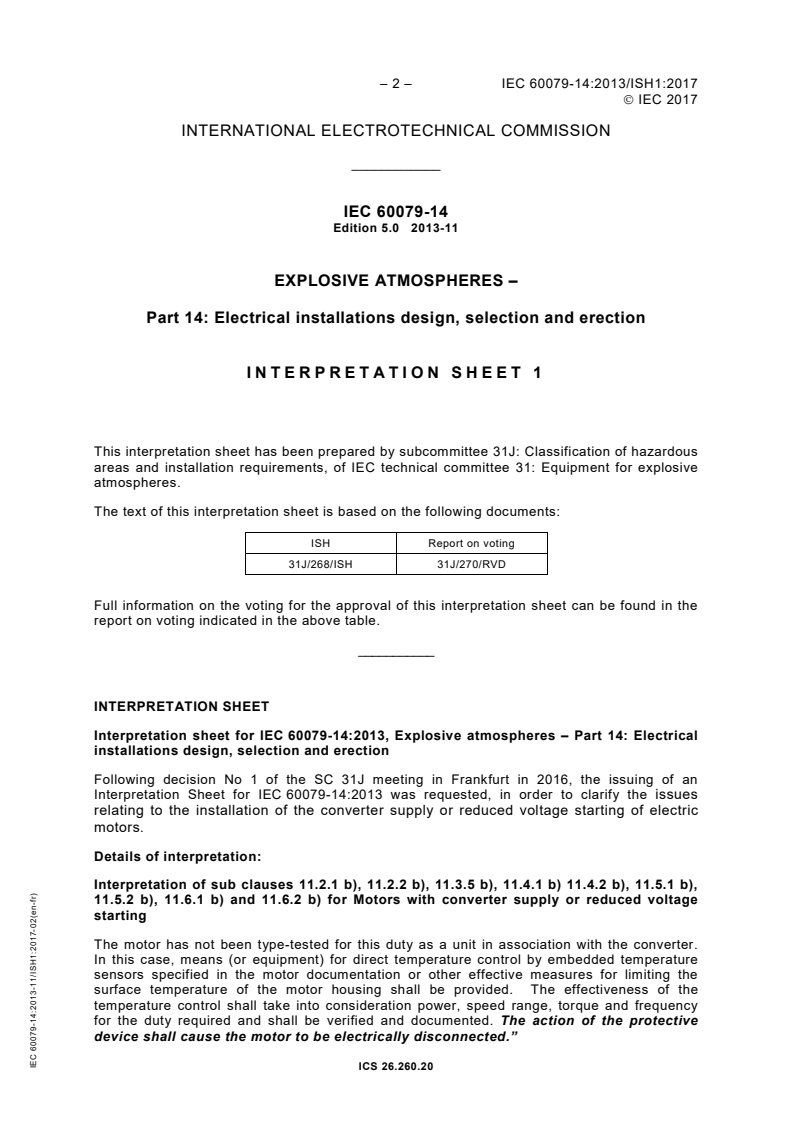
The motor has not been type-tested for this duty as a unit in association with the converter.
In this case, means (or equipment) for direct temperature control by embedded temperature
sensors specified in the motor documentation or other effective measures for limiting the
surface temperature of the motor housing shall be provided. The effectiveness of the
temperature control shall take into consideration power, speed range, torque and frequency
for the duty required and shall be verified and documented. The action of the protective
device shall cause the motor to be electrically disconnected.”
ICS 26.260.20
IEC 2017
Question
Is physical disconnection, such as a switch (circuit breaker) or contactor, required to
accomplish the intent of this requirement ?
Interpretation
The intention of this requirement is to protect the machine from excessive surface
temperatures.
Any action within the control circuit for the motor that accomplishes one of the following
satisfactorily meets the intent of this requirement:
• direct physical disconnection resulting in no output voltage to the motor, or,
• control circuit intervention such as ceasing modulation, resulting in the motor not
operating.
NOTE In this case, voltage to a motor may still exist, but the motor does not operate.
IEC 2020
INTERNATIONAL ELECTROTECHNICAL COMMISSION
____________
IEC 60079-14
Edition 5.0 2013-11
EXPLOSIVE ATMOSPHERES –
Part 14: Electrical installations design, selection and erection
INTERPRETATION SHEET 2
This interpretation sheet has been prepared by subcommittee 31J: Classification of hazardous
areas and installation requirements, of IEC technical committee 31: Equipment for explosive
atmospheres.
The text of this interpretation sheet is based on the following documents:
DISH Report on voting
31J/302/DISH 31J/303/RVDISH
Full information on the voting for the approval of this interpretation sheet can be found in the
report on voting indicated in the above table.
___________
Background
With changes to the Type of Protection designations in the IEC 60079 Series, a number of
these Type of Protection designations are not identified in the current edition of
IEC 60079-14. This may create confusion for end users regarding the correct application of
equipment with these Types of Protection.
Question
How should equipment be marked with new Type of Protection designations be handled in
accordance with IEC 60079-14?
Interpretation
Equipment marked with new Type of Protection designations shall be applied in accordance
with IEC 60079-14 requirements based on the following points and IEC 60079-14:2013,
Table 2.
ICS 26.260.20
– 2 – IEC 60079-14:2013/ISH2:2020
IEC 2020
• Ex "eb" should be treated as equivalent to Ex "e"
• Ex "ec" should be treated as equivalent to Ex "nA"
• Ex "db" should be treated as equivalent to Ex "d"
• Ex "dc" requirements should be based on Ex "d" requirements but is only suitable for
EPL Gc
• Ex "ob" should be treated as equivalent to Ex "o"
• Ex "oc" requirements should be based on Ex "o" requirements but is only suitable for
EPL Gc
– 2 – 60079-14 © IEC:2013
CONTENTS
FOREWORD . 11
INTRODUCTION . 16
1 Scope . 18
2 Normative references . 19
3 Terms and definitions . 20
3.1 General . 20
3.2 Hazardous areas . 21
3.3 Flameproof enclosure . 22
3.4 Increased safety . 22
3.5 Intrinsic safety . 23
3.6 Intrinsic safety parameters . 24
3.7 Pressurization . 24
3.8 Type of protection “n” . 24
3.9 oil-immersion “o” . 25
3.10 powder filling “q” . 25
3.11 encapsulation “m” . 25
3.12 protection by enclosure “t” . 25
3.13 Electrical supply systems . 25
3.14 Equipment . 25
3.15 radio frequency identification RFID . 26
4 General . 26
4.1 General requirements . 26
4.2 Documentation . 27
4.3 Initial inspection . 28
4.4 Assurance of conformity of equipment. 28
4.4.1 Equipment with certificates according to IEC standards . 28
4.4.2 Equipment without certificates according to IEC standards . 28
4.4.3 Selection of repaired, second hand or existing equipment . 29
4.5 Qualifications of personnel . 29
5 Selection of equipment . 29
5.1 Information requirements . 29
5.2 Zones . 30
5.3 Relationship between equipment protection levels (EPLs) and zones . 30
5.4 Selection of equipment according to EPLs . 30
5.4.1 General . 30
5.4.2 Relationship between EPLs and types of protection . 30
5.4.3 Equipment for use in locations requiring EPL “Ga” or “Da” . 32
5.4.4 Equipment for use in locations requiring EPL “Gb” or “Db” . 32
5.4.5 Equipment for use in locations requiring EPL “Gc” or “Dc” . 32
5.5 Selection according to equipment grouping . 32
5.6 Selection according to the ignition temperature of the gas, vapour or dust
and ambient temperature . 33
5.6.1 General . 33
5.6.2 Gas or vapour . 33
5.6.3 Dust . 34
5.7 Selection of radiating equipment . 36
5.7.1 General . 36
60079-14 © IEC:2013 – 3 –
5.7.2 Ignition process . 36
5.8 Selection of ultrasonic equipment . 36
5.8.1 General . 36
5.8.2 Ignition process . 37
5.9 Selection to cover external influences . 37
5.10 Selection of transportable, portable and personal equipment . 38
5.10.1 General . 38
5.10.2 Transportable and portable equipment . 39
5.10.3 Personal equipment . 39
5.11 Rotating electrical machines . 39
5.11.1 General . 39
5.11.2 Environmental Factors for “Ex” machine installation . 40
5.11.3 Power and accessory connections, grounding . 40
5.11.4 Motors fed from a converter supply . 41
5.11.5 Switching motors above 1kV . 41
5.12 Luminaires . 42
5.13 Plugs and socket outlets . 42
5.13.1 General . 42
5.13.2 Specific requirements for explosive dust atmospheres . 42
5.13.3 Location. 42
5.14 Cells and batteries . 42
5.14.1 Charging of secondary cells and batteries . 42
5.14.2 Ventilation . 43
5.15 RFID tags . 43
5.15.1 General . 43
5.15.2 Passive RFID tags . 43
5.15.3 Mounting RFID tags . 43
5.16 Gas detection equipment . 43
6 Protection from dangerous (incendive) sparking . 44
6.1 Light metals as construction materials . 44
6.2 Danger from live parts . 44
6.3 Danger from exposed and extraneous conductive parts . 44
6.3.1 General . 44
6.3.2 TN type of system earthing . 45
6.3.3 TT type of system earthing . 45
6.3.4 IT type of system earthing . 45
6.3.5 SELV and PELV systems . 45
6.3.6 Electrical separation . 45
6.3.7 Non Ex electrical equipment above hazardous areas . 45
6.4 Potential equalization . 46
6.4.1 General . 46
6.4.2 Temporary bonding . 47
6.5 Static electricity . 47
6.5.1 General . 47
6.5.2 Avoidance of a build-up of electrostatic charge on
construction and protecting parts for locations requiring EPL
“Ga”, “Gb” and “Gc” . 47
6.5.3 Avoidance of a build-up of electrostatic charge on
construction and protecting parts for locations requiring EPL
“Da”, “Db” and “Dc” . 49
– 4 – 60079-14 © IEC:2013
6.6 Lightning protection . 49
6.7 Electromagnetic radiation . 49
6.7.1 General . 49
6.7.2 Radio frequency received in hazardous areas . 49
6.8 Cathodically protected metallic parts . 50
6.9 Ignition by optical radiation . 50
7 Electrical protection . 51
8 Switch-off and electrical isolation . 51
8.1 General . 51
8.2 Switch-off . 51
8.3 Electrical isolation . 51
9 Cables and wiring systems . 52
9.1 General . 52
9.2 Aluminium conductors . 52
9.3 Cables . 52
9.3.1 General . 52
9.3.2 Cables for fixed installations . 52
9.3.3 Flexible cables for fixed installations (excluding intrinsically
safe circuits) . 53
9.3.4 Flexible cables supplying transportable and portable
equipment (excluding intrinsically safe circuits) . 53
9.3.5 Single insulated wires (excluding intrinsically safe circuits) . 54
9.3.6 Overhead lines . 54
9.3.7 Avoidance of damage . 54
9.3.8 Cable surface temperature. 54
9.3.9 Resistance to flame propagation . 54
9.4 Conduit systems . 55
9.5 Additional requirements . 56
9.6 Installation requirements . 56
9.6.1 Circuits traversing a hazardous area . 56
9.6.2 Terminations . 56
9.6.3 Unused cores . 56
9.6.4 Openings in walls . 56
9.6.5 Passage and collection of flammables . 56
9.6.6 Accumulation of dust . 57
10 Cable entry systems and blanking elements . 57
10.1 General . 57
10.2 Selection of cable glands . 57
10.3 Connections of cables to equipment . 58
10.4 Additional requirements for entries other than Ex “d”, Ex “t” or Ex “nR” . 59
10.5 Unused openings . 59
10.6 Additional requirements for type of protection “d” – Flameproof
enclosures . 59
10.6.1 General . 59
10.6.2 Selection of cable glands . 60
10.7 Additional requirements for type of protection “t” – Protection by
enclosure . 60
10.8 Additional requirements for type of protection “nR” – Restricted breathing
enclosure . 61
60079-14 © IEC:2013 – 5 –
11 Rotating electrical machines . 61
11.1 General . 61
11.2 Motors with type of protection “d” – Flameproof enclosures . 61
11.2.1 Motors with a converter supply . 61
11.2.2 Reduced-voltage starting (soft starting) . 62
11.3 Motors with type of protection “e” – Increased safety . 62
11.3.1 Mains-operated . 62
11.3.2 Winding temperature sensors . 63
11.3.3 Machines with rated voltage greater than 1 kV . 64
11.3.4 Motors with converter supply . 64
11.3.5 Reduced-voltage starting (soft starting) . 64
11.4 Motors with type of protection “p” and “pD” – Pressurized enclosures . 64
11.4.1 Motors with a converter supply . 64
11.4.2 Reduced-voltage starting (soft starting) . 65
11.5 Motors with type of protection “t” – Protection by enclosures supplied at
varying frequency and voltage . 65
11.5.1 Motors with a converter supply . 65
11.5.2 Reduced-voltage starting (soft starting) . 66
11.6 Motors with type of protection “nA” – Non-sparking . 66
11.6.1 Motors with converter supply . 66
11.6.2 Reduced-voltage starting (soft starting) . 66
11.6.3 Machines with rated voltage greater than 1 kV . 66
12 Luminaires . 67
13 Electric heating systems . 67
13.1 General . 67
13.2 Temperature monitoring . 67
13.3 Limiting temperature . 68
13.4 Safety device . 68
13.5 Electrical trace heating systems . 69
14 Additional requirements for type of protection “d” – Flameproof enclosures . 69
14.1 General . 69
14.2 Solid obstacles . 70
14.3 Protection of flameproof joints . 70
14.4 Conduit systems . 71
15 Additional requirements for type of protection “e” – Increased safety . 71
15.1 General . 71
15.2 Maximum dissipated power of terminal box enclosures . 72
15.3 Conductor terminations . 72
15.4 Maximum number of conductors in relation to the cross-section and the
permissible continuous current . 73
16 Additional requirements for types of protection “i” – Intrinsic safety . 73
16.1 General . 73
16.2 Installations to meet the requirements of EPL “Gb” or “Gc” and “Db” or
“Dc” . 74
16.2.1 Equipment . 74
16.2.2 Cables . 75
16.2.3 Earthing of intrinsically safe circuits . 79
16.2.4 Verification of intrinsically safe circuits . 80
16.3 Installations to meet the requirements of EPL “Ga” or “Da” . 81
– 6 – 60079-14 © IEC:2013
16.4 Simple apparatus . 82
16.5 Terminal boxes . 84
16.5.1 General . 84
16.5.2 Terminal boxes with only one intrinsically safe circuit . 84
16.5.3 Terminal boxes with more than one intrinsically safe circuit . 84
16.5.4 Terminal boxes with non-intrinsically safe and intrinsically
safe circuits . 85
16.5.5 Plugs and sockets used for external connections . 85
16.6 Special applications . 85
17 Additional requirements for pressurized enclosures . 85
17.1 General . 85
17.2 Type of protection “p” . 86
17.2.1 General . 86
17.2.2 Ducting . 86
17.2.3 Action to be taken on failure of pressurization. 87
17.2.4 Multiple pressurized enclosures with a common safety device . 89
17.2.5 Purging . 89
17.2.6 Protective gas . 90
17.3 Type of protection “pD” . 90
17.3.1 Sources of protective gas . 90
17.3.2 Automatic switch-off . 91
17.3.3 Alarm . 91
17.3.4 Common source of protective gas . 91
17.3.5 Switching on electrical supply . 91
17.4 Rooms for explosive gas atmosphere . 91
17.4.1 Pressurized rooms . 91
17.4.2 Analyser houses . 92
18 Additional requirements for type of protection “n” . 92
18.1 General . 92
18.2 “nR” equipment . 92
18.3 Combinations of terminals and conductors for general connection and
junction boxes . 93
18.4 Conductor terminations . 93
19 Additional requirements for type of protection “o”– Oil immersion . 93
19.1 General . 93
19.2 External connections . 94
20 Additional requirements for type of protection “q” – Powder filling . 94
21 Additional requirements for type of protection “m” – Encapsulation . 94
22 Additional requirements for type of protection “op” – Optical radiation . 94
23 Additional requirements for type of protection “t” – Protection by enclosure . 95
Annex A (normative) Knowledge, skills and competencies of responsible persons,
operatives/technicians and designers . 96
A.1 Scope . 96
A.2 Knowledge and skills . 96
A.2.1 Responsible persons . 96
A.2.2 Operatives/technicians (selection and erection) . 96
A.2.3 Designers (design and selection) . 96
A.3 Competencies . 97
60079-14 © IEC:2013 – 7 –
A.3.1 General . 97
A.3.2 Responsible persons . 97
A.3.3 Operatives/technicians . 97
A.3.4 Designers . 97
A.4 Assessment . 98
Annex B (informative) Safe work procedure guidelines for explosive gas atmospheres . 99
Annex C (normative) Initial inspection – Equipment-specific inspection schedules . 100
Annex D (informative) Electrical installations in extremely low ambient temperature . 105
D.1 General . 105
D.2 Cables . 105
D.3 Electrical trace heating systems . 105
D.4 Lighting systems . 105
D.4.1 General . 105
D.4.2 Emergency lights . 105
D.5 Electrical rotating machines . 105
Annex E (informative) Restricted breathing test for cables . 106
E.1 Test procedure . 106
Annex F (informative) Installation of electrical trace heating systems . 107
F.1 General . 107
F.2 Definitions . 107
F.2.1 Electrical trace heating system . 107
F.2.2 System components . 107
F.2.3 Site-fabricated trace heaters . 107
F.2.4 Location of sensors . 108
F.2.5 Thermal insulation . 108
F.2.6 Personnel aspects . 108
F.3 General requirements . 108
F.4 Requirements for EPL “Gb”, “Gc”, “Db” and “Dc” . 109
F.4.1 General . 109
F.4.2 Stabilized design . 109
F.4.3 Controlled design . 109
F.5 Design information . 110
F.5.1 Design information drawings and documents . 110
F.5.2 Isometric or heater configuration line lists and load charts . 110
F.6 Incoming inspections . 111
F.6.1 Receiving materials . 111
F.6.2 Pre-installation testing . 112
F.6.3 Visual examination . 112
F.6.4 Insulation resistance test . 112
F.6.5 Component substitution . 112
F.6.6 Location of power supply . 112
F.7 Installation of trace heaters . 113
F.7.1 General . 113
F.7.2 Connections and terminations . 114
F.7.3 Conductor terminations . 115
F.8 Installation of control and monitoring equipment . 115
F.8.1 Verification of equipment suitability . 115
F.8.2 Sensor considerations . 115
– 8 – 60079-14 © IEC:2013
F.8.3 Controller operation, calibration, and access . 119
F.9 Installation of thermal insulation system . 120
F.9.1 General . 120
F.9.2 Preparatory work . 120
F.10 Installation of distribution wiring and coordination with branch circuits . 120
F.10.1 General . 120
F.10.2 Tagging/identification . 120
F.11 Final installation review . 120
F.11.1 Necessary modifications . 120
F.11.2 Field (site work) circuit insulation resistance test . 121
F.11.3 Visual inspection . 121
F.12 Commissioning . 121
F.12.1 Pre-commissioning check . 121
F.12.2 Functional check and final documentation . 121
Annex G (normative) Potential stator winding discharge risk assessment – Ignition risk
factors . 124
Annex H (normative) Verification of intrinsically safe circuits with more than one
associated apparatus with linear current/voltage characteristics . 125
H.1 General . 125
H.2 Intrinsic safety with level of protection “ib” . 125
H.3 Intrinsic safety with level of protection “ic” . 125
Annex I (informative) Methods of determining the maximum system voltages and
currents in intrinsically safe circuits with more than one associated apparatus with
linear current/voltage characteristics (as required by Annex H) . 126
I.1 Intrinsically safe circuits with linear current/voltage characteristics . 126
I.2 Intrinsically safe circuits with non-linear current/voltage characteristics . 128
Annex J (informative) Determination of cabl
...