

IEC TR 62781:2012
(Main)Ultrasonics - Conditioning of water for ultrasonic measurements
General Information
- Abstract
IEC/TR 62781:2012(E), which is a technical report, is applicable to all measurements of ultrasonic fields where water is the transmission medium. Water provides an inexpensive and readily available medium with characteristic acoustic impedance comparable to biological tissue. However, basic tap water is far from optimum for ultrasonic measurement as it contains many dissolved, absorbed and suspended contaminants. Measurements can be affected in many ways by these impurities. This technical aims to provide a unified source to establish a water treatment process for ultrasonic measurements. The quality and treatment methods for water used within a radiation force balance (RFB) may be different from that required for hydrophone based acoustic measurements. Chemical based methods of water treatment (e.g. algaecides) may be appropriate for these applications. However, in this document, chemical means are noted but appropriately discouraged for acoustic pressure/intensity measurements. This Technical Report describes methods for:
- degassing water to be used in ultrasonic measurements;
- to decrease the ionic content of water to be used in ultrasonic measurements;
- to decrease the biological content of water to be used in ultrasonic measurements; and
- to reduce the suspended particulate content of water to be used in ultrasonic measurements.
- Status
- Published
- Publication Date
- 17-Sep-2012
- Technical Committee
- TC 87 - Ultrasonics
- Drafting Committee
- WG 8 - TC 87/WG 8
- Current Stage
- PPUB - Publication issued
- Start Date
- 18-Sep-2012
- Completion Date
- 15-Dec-2012
Overview
IEC TR 62781:2012 - Ultrasonics: Conditioning of water for ultrasonic measurements is a technical report from the IEC that provides a unified, practical resource for preparing water used as a transmission medium in ultrasonic testing and calibration. It recognizes that common tap water contains dissolved gases, ions, biological contaminants and suspended particulates that can distort ultrasonic fields, induce cavitation, or degrade measurement equipment. The report describes methods to improve water quality for reliable ultrasonic measurements, especially for hydrophone and radiation force balance (RFB) use.
Key topics and technical requirements
IEC TR 62781 addresses water conditioning across four main areas:
- Degassing
- Why degassing matters (bubble formation, cavitation, measurement perturbation) and methods to reduce dissolved gases.
- Physical methods covered include vacuum degassing, reduced-pressure recirculation, degassing contactors, and boiling. Chemical degassing (e.g., oxygen scavengers) is discussed but is discouraged for acoustic pressure/intensity work.
- Verification methods (electrical and optical) and considerations for re-gassing behavior are included.
- Dissolved ionic content
- Techniques to lower ionic conductivity that can affect hydrophone readings and cause deposits on equipment: ion exchange, distillation, and reverse osmosis. Re-ionization control and verification methods are discussed.
- Biological control
- Approaches to reduce algae, bacteria and biofilms. Physical options such as UV filtration and cavitation-based treatments are presented; chemical biocides (chlorine, copper, silver compounds) are noted but generally discouraged for sensitive acoustic measurements.
- Suspended particulates
- Filtration strategies and procedures to limit particulate sources that trap gas or act as reflectors. The report also considers particulate re-contamination and tank hygiene.
- Temperature and tank thermal sources - effects on sound speed and measurement stability.
- Examples of low‑cost water treatment system layouts for hydrophone and RFB measurement tanks are provided.
Practical applications and users
IEC TR 62781 is intended for practitioners who perform or support ultrasonic field measurements where water is the propagation medium:
- Calibration labs and metrology institutes conducting hydrophone characterisation or acoustic intensity/pressure measurements.
- Research and development teams in medical ultrasound and non-destructive testing using water tanks.
- Test engineers operating radiation force balance (RFB) systems.
- Laboratory managers specifying water treatment systems for ultrasound test tanks.
Related standards
- IEC 62127-1 (Ultrasonics - Hydrophones - Measurement and characterization of medical ultrasonic fields up to 40 MHz) is normatively referenced and complements TR 62781 for hydrophone measurement procedures.
IEC TR 62781 is a practical, standards-based guide to reduce measurement uncertainty and equipment risk by proper water conditioning for ultrasonic testing.
Relations
- Effective Date
- 10-Feb-2026
- Effective Date
- 10-Feb-2026
Get Certified
Connect with accredited certification bodies for this standard

BSMI (Bureau of Standards, Metrology and Inspection)
Taiwan's standards and inspection authority.
Sponsored listings
Frequently Asked Questions
IEC TR 62781:2012 is a technical report published by the International Electrotechnical Commission (IEC). Its full title is "Ultrasonics - Conditioning of water for ultrasonic measurements". This standard covers: IEC/TR 62781:2012(E), which is a technical report, is applicable to all measurements of ultrasonic fields where water is the transmission medium. Water provides an inexpensive and readily available medium with characteristic acoustic impedance comparable to biological tissue. However, basic tap water is far from optimum for ultrasonic measurement as it contains many dissolved, absorbed and suspended contaminants. Measurements can be affected in many ways by these impurities. This technical aims to provide a unified source to establish a water treatment process for ultrasonic measurements. The quality and treatment methods for water used within a radiation force balance (RFB) may be different from that required for hydrophone based acoustic measurements. Chemical based methods of water treatment (e.g. algaecides) may be appropriate for these applications. However, in this document, chemical means are noted but appropriately discouraged for acoustic pressure/intensity measurements. This Technical Report describes methods for: - degassing water to be used in ultrasonic measurements; - to decrease the ionic content of water to be used in ultrasonic measurements; - to decrease the biological content of water to be used in ultrasonic measurements; and - to reduce the suspended particulate content of water to be used in ultrasonic measurements.
IEC/TR 62781:2012(E), which is a technical report, is applicable to all measurements of ultrasonic fields where water is the transmission medium. Water provides an inexpensive and readily available medium with characteristic acoustic impedance comparable to biological tissue. However, basic tap water is far from optimum for ultrasonic measurement as it contains many dissolved, absorbed and suspended contaminants. Measurements can be affected in many ways by these impurities. This technical aims to provide a unified source to establish a water treatment process for ultrasonic measurements. The quality and treatment methods for water used within a radiation force balance (RFB) may be different from that required for hydrophone based acoustic measurements. Chemical based methods of water treatment (e.g. algaecides) may be appropriate for these applications. However, in this document, chemical means are noted but appropriately discouraged for acoustic pressure/intensity measurements. This Technical Report describes methods for: - degassing water to be used in ultrasonic measurements; - to decrease the ionic content of water to be used in ultrasonic measurements; - to decrease the biological content of water to be used in ultrasonic measurements; and - to reduce the suspended particulate content of water to be used in ultrasonic measurements.
IEC TR 62781:2012 is classified under the following ICS (International Classification for Standards) categories: 17.140.50 - Electroacoustics. The ICS classification helps identify the subject area and facilitates finding related standards.
IEC TR 62781:2012 has the following relationships with other standards: It is inter standard links to EN IEC 61846:2025, EN 62555:2014. Understanding these relationships helps ensure you are using the most current and applicable version of the standard.
IEC TR 62781:2012 is available in PDF format for immediate download after purchase. The document can be added to your cart and obtained through the secure checkout process. Digital delivery ensures instant access to the complete standard document.
Standards Content (Sample)
IEC/TR 62781 ®
Edition 1.0 2012-09
TECHNICAL
REPORT
colour
inside
Ultrasonics – Conditioning of water for ultrasonic measurements
IEC/TR 62781:2012(E)
All rights reserved. Unless otherwise specified, no part of this publication may be reproduced or utilized in any form
or by any means, electronic or mechanical, including photocopying and microfilm, without permission in writing from
either IEC or IEC's member National Committee in the country of the requester.
If you have any questions about IEC copyright or have an enquiry about obtaining additional rights to this publication,
please contact the address below or your local IEC member National Committee for further information.
IEC Central Office Tel.: +41 22 919 02 11
3, rue de Varembé Fax: +41 22 919 03 00
CH-1211 Geneva 20 info@iec.ch
Switzerland www.iec.ch
About the IEC
The International Electrotechnical Commission (IEC) is the leading global organization that prepares and publishes
International Standards for all electrical, electronic and related technologies.
About IEC publications
The technical content of IEC publications is kept under constant review by the IEC. Please make sure that you have the
latest edition, a corrigenda or an amendment might have been published.
Useful links:
IEC publications search - www.iec.ch/searchpub Electropedia - www.electropedia.org
The advanced search enables you to find IEC publications The world's leading online dictionary of electronic and
by a variety of criteria (reference number, text, technical electrical terms containing more than 30 000 terms and
committee,…). definitions in English and French, with equivalent terms in
It also gives information on projects, replaced and additional languages. Also known as the International
withdrawn publications. Electrotechnical Vocabulary (IEV) on-line.
IEC Just Published - webstore.iec.ch/justpublished Customer Service Centre - webstore.iec.ch/csc
Stay up to date on all new IEC publications. Just Published If you wish to give us your feedback on this publication
details all new publications released. Available on-line and or need further assistance, please contact the
also once a month by email. Customer Service Centre: csc@iec.ch.
IEC/TR 62781 ®
Edition 1.0 2012-09
TECHNICAL
REPORT
colour
inside
Ultrasonics – Conditioning of water for ultrasonic measurements
INTERNATIONAL
ELECTROTECHNICAL
COMMISSION
PRICE CODE
S
ICS 17.140.50 ISBN 978-2-83220-376-7
– 2 – TR 62781 © IEC:2012(E)
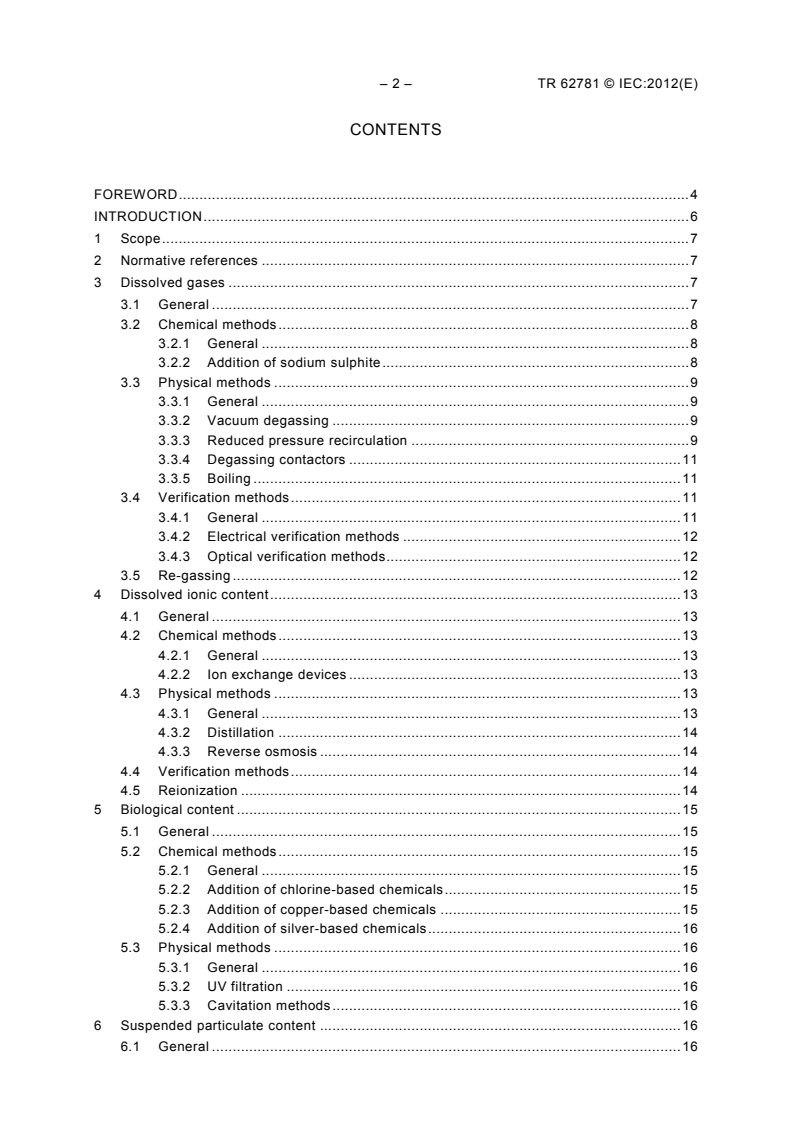
CONTENTS
FOREWORD . 4
INTRODUCTION . 6
1 Scope . 7
2 Normative references . 7
3 Dissolved gases . 7
3.1 General . 7
3.2 Chemical methods . 8
3.2.1 General . 8
3.2.2 Addition of sodium sulphite . 8
3.3 Physical methods . 9
3.3.1 General . 9
3.3.2 Vacuum degassing . 9
3.3.3 Reduced pressure recirculation . 9
3.3.4 Degassing contactors . 11
3.3.5 Boiling . 11
3.4 Verification methods . 11
3.4.1 General . 11
3.4.2 Electrical verification methods . 12
3.4.3 Optical verification methods . 12
3.5 Re-gassing . 12
4 Dissolved ionic content . 13
4.1 General . 13
4.2 Chemical methods . 13
4.2.1 General . 13
4.2.2 Ion exchange devices . 13
4.3 Physical methods . 13
4.3.1 General . 13
4.3.2 Distillation . 14
4.3.3 Reverse osmosis . 14
4.4 Verification methods . 14
4.5 Reionization . 14
5 Biological content . 15
5.1 General . 15
5.2 Chemical methods . 15
5.2.1 General . 15
5.2.2 Addition of chlorine-based chemicals . 15
5.2.3 Addition of copper-based chemicals . 15
5.2.4 Addition of silver-based chemicals . 16
5.3 Physical methods . 16
5.3.1 General . 16
5.3.2 UV filtration . 16
5.3.3 Cavitation methods . 16
6 Suspended particulate content . 16
6.1 General . 16
TR 62781 © IEC:2012(E) – 3 –
6.2 Physical methods . 17
6.3 Particulate re-contamination . 17
7 Water temperature . 17
7.1 General . 17
7.2 Thermal sources in an ultrasonic measurement tank . 18
8 Examples of low-cost water treatment systems . 18
8.1 Hydrophone measurement water tank. 18
8.2 RFB measurement vessel . 19
Bibliography . 21
Figure 1 – Dissolved oxygen concentration as a function of time for 2, 4 and 6 g/l of
sodium sulphite in de-mineralised water and for different surface areas and volumes of
water . 9
Figure 2 – Dissolved oxygen concentration in water as a function of time during
reduced pressure recirculation degassing . 10
Figure 3 – Re-gassing profile for a body of water following reduced pressure
recirculation degassing . 12
Figure 4 – Example water treatment system for hydrophone measurements . 19
Figure 5 – Example water treatment system for RFB measurements . 20
Table 1 – Conditions for degassing by boiling . 11
– 4 – TR 62781 © IEC:2012(E)
INTERNATIONAL ELECTROTECHNICAL COMMISSION
____________
ULTRASONICS – CONDITIONING OF WATER
FOR ULTRASONIC MEASUREMENTS
FOREWORD
1) The International Electrotechnical Commission (IEC) is a worldwide organization for standardization comprising
all national electrotechnical committees (IEC National Committees). The object of IEC is to promote
international co-operation on all questions concerning standardization in the electrical and electronic fields. To
this end and in addition to other activities, IEC publishes International Standards, Technical Specifications,
Technical Reports, Publicly Available Specifications (PAS) and Guides (hereafter referred to as “IEC
Publication(s)”). Their preparation is entrusted to technical committees; any IEC National Committee interested
in the subject dealt with may participate in this preparatory work. International, governmental and non-
governmental organizations liaising with the IEC also participate in this preparation. IEC collaborates closely
with the International Organization for Standardization (ISO) in accordance with conditions determined by
agreement between the two organizations.
2) The formal decisions or agreements of IEC on technical matters express, as nearly as possible, an international
consensus of opinion on the relevant subjects since each technical committee has representation from all
interested IEC National Committees.
3) IEC Publications have the form of recommendations for international use and are accepted by IEC National
Committees in that sense. While all reasonable efforts are made to ensure that the technical content of IEC
Publications is accurate, IEC cannot be held responsible for the way in which they are used or for any
misinterpretation by any end user.
4) In order to promote international uniformity, IEC National Committees undertake to apply IEC Publications
transparently to the maximum extent possible in their national and regional publications. Any divergence
between any IEC Publication and the corresponding national or regional publication shall be clearly indicated in
the latter.
5) IEC itself does not provide any attestation of conformity. Independent certification bodies provide conformity
assessment services and, in some areas, access to IEC marks of conformity. IEC is not responsible for any
services carried out by independent certification bodies.
6) All users should ensure that they have the latest edition of this publication.
7) No liability shall attach to IEC or its directors, employees, servants or agents including individual experts and
members of its technical committees and IEC National Committees for any personal injury, property damage or
other damage of any nature whatsoever, whether direct or indirect, or for costs (including legal fees) and
expenses arising out of the publication, use of, or reliance upon, this IEC Publication or any other IEC
Publications.
8) Attention is drawn to the Normative references cited in this publication. Use of the referenced publications is
indispensable for the correct application of this publication.
9) Attention is drawn to the possibility that some of the elements of this IEC Publication may be the subject of
patent rights. IEC shall not be held responsible for identifying any or all such patent rights.
The main task of IEC technical committees is to prepare International Standards. However, a
technical committee may propose the publication of a technical report when it has collected
data of a different kind from that which is normally published as an International Standard, for
example "state of the art".
IEC 62781, which is a technical report, has been prepared by IEC technical committee 87:
Ultrasonics.
The text of this technical report is based on the following documents:
Enquiry draft Report on voting
87/494A/DTR 87/507/RVC
Full information on the voting for the approval of this technical report can be found in the
report on voting indicated in the above table.
This publication has been drafted in accordance with the ISO/IEC Directives, Part 2.
TR 62781 © IEC:2012(E) – 5 –
The committee has decided that the contents of this publication will remain unchanged until
the stability date indicated on the IEC web site under "http://webstore.iec.ch" in the data
related to the specific publication. At this date, the publication will be
• reconfirmed,
• withdrawn,
• replaced by a revised edition, or
• amended.
A bilingual version of this publication may be issued at a later date.
IMPORTANT – The 'colour inside' logo on the cover page of this publication indicates
that it contains colours which are considered to be useful for the correct
understanding of its contents. Users should therefore print this document using a
colour printer.
– 6 – TR 62781 © IEC:2012(E)
INTRODUCTION
Many ultrasonic measurements are conducted in water, as it provides an inexpensive and
readily available medium with characteristic acoustic impedance comparable to biological
tissue. However, basic tap water is far from optimum for ultrasonic measurement as it
contains many dissolved, absorbed and suspended contaminants. Measurements can be
affected in many ways by these impurities. For example:
• dissolved gases readily dissociate from the water in the presence of high rarefactional
pressures or heat giving rise to bubble formation. These bubbles not only are unwanted
point reflectors but also increase the likelihood of cavitation.
• dissolved ionic components result in a raised conductivity of the water, which in turn can
affect the measured output from some unshielded hydrophones. Furthermore experimental
equipment left in an ionic solution for any period of time will gradually develop a layer of
deposit (e.g. calcium carbonate) on its surface.
• biological activity within an untreated water tank will result in the creation of an unpleasant
film on all available surfaces. If left long enough this biological activity will result in an
undesirable environment for the operator and may also be a health hazard.
To minimize these effects it is necessary to undertake a water treatment process.
These problems are well known and many IEC standards have sought to address these
issues, often by means of an informative annex. This technical report aims to provide a
unified resource for operators wishing to establish a water treatment process for ultrasonic
measurements. This technical report discusses each of the stages within a water treatment
process and provides examples of suitable treatment methods.
TR 62781 © IEC:2012(E) – 7 –
ULTRASONICS – CONDITIONING OF WATER
FOR ULTRASONIC MEASUREMENTS
1 Scope
This Technical Report describes methods:
• for degassing water to be used in ultrasonic measurements,
• to decrease the ionic content of water to be used in ultrasonic measurements,
• to decrease the biological content of water to be used in ultrasonic measurements,
• to reduce the suspended particulate content of water to be used in ultrasonic
measurements.
This technical report is applicable to all measurements of ultrasonic fields where water is the
transmission medium. The quality and treatment methods for water used within a radiation
force balance (RFB) may be different from that required for hydrophone based acoustic
measurements. Chemical based methods of water treatment (e.g. algaecides) may be
appropriate for these applications. However, in this document, chemical means are noted but
appropriately discouraged for acoustic pressure/intensity measurements.
2 Normative references
The following documents, in whole or in part, are normatively referenced in this document and
are indispensable for its application. For dated references, only the edition cited applies. For
undated references, the latest edition of the referenced document (including any
amendments) applies.
IEC 62127-1, Ultrasonics – Hydrophones – Part 1: Measurement and characterization of
medical ultrasonic fields up to 40 MHz
3 Dissolved gases
3.1 General
Tap water is often super-saturated with dissolved gases (although not in the same relative
quantities as in air). Bubbles can be a cause of major experimental problems since they act
as near perfect reflectors of ultrasound. This can perturb the ultrasonic field being measured.
Also, if a bubble forms directly in front of the active element of a hydrophone it will prevent
any propagating ultrasound from being measured by that hydrophone. Finally acoustic
pressures greater than approximately 100 kPa can cause cavitation, i.e. they can bring
bubbles out of solution and it is well established that measurements can be strongly affected
by acoustic cavitation. Trapped gas on particulate is also a significant source of cavitation
and removal of suspended particulates is considered in Clause 6.
Cavitation is the growth, oscillation and collapse of previously existing gas- or vapour-filled
micro-bubbles in a medium. This will result in the production of spurious acoustic signals both
below and above the driving frequency (for stable and inertial cavitation respectively).
Particular care should be taken to avoid inertial cavitation as bubble collapse is a particularly
destructive event. If such a collapse happens on the surface of a hydrophone, damage to the
hydrophone may occur. It is useful to note that macroscopic bubbles are visible to the naked
eye. However, microscopic bubbles may be much harder to visually detect, and can be just as
much of a problem. There is thus a need to define means of obtaining a suitable medium in
which the effects of cavitation are minimized.
– 8 – TR 62781 © IEC:2012(E)
A measurement method to detect the onset of cavitation is described in [1,2] . Specifically,
the onset of inertial cavitation is often characterized by the presence of the sub-harmonic of
the fundamental operating frequency or additional broadband noise. Examples of acoustic
spectra acquired using a needle and membrane hydrophones is presented in [3,4].
3.2 Chemical methods
3.2.1 General
Whilst chemical methods of removing dissolved gases can be very effective both in terms of
initial degassing rate and rate of subsequent re-gassing, they have a number of drawbacks.
Firstly, chemical methods tend to be single gas specific (e.g. removing oxygen only).
Secondly, they involve the addition of ionic content to the water; this is in complete
contradiction to the attempts in Clause 4 to deionise the water. Thirdly, a number of chemical
methods of degassing require the use of strong reducing agents that can be both hazardous
to the user and may cause damage to experimental equipment. Finally, disposal of chemically
treated water needs to be handled with care to avoid potential environmental harm.
3.2.2 Addition of sodium sulphite
SO ) can be added to water to act as an oxygen scavenger. Water
Sodium sulphite (Na
2 3
saturated with oxygen at 20 °C will contain about 9 mg/l oxygen. To bind the oxygen 0,5 g/l
sodium sulphite is needed. The use of Na SO for degassing water results in sodium sulphate
2 3
(Na SO ).
2 4
As an example water has been prepared to which Na SO is added to give a solution of
2 3
0,4 mass % Na SO . The O -content of this water type stays < 4 mg/l during a long period of
2 3 2
time, see Figure 1. The speed of re-gassing strongly depends on the dimensions of the water
tank. Re-gassing periods > 150 h are observed in tanks with greater dimensions.
c , is given by
The speed of sound in a fluid,
L
Κ
c = (1)
L
ρ
,
where Κ is the bulk modulus of the fluid and ρ is its density. The change in density after
adding Na SO in the concentration listed above is < 1 %, and the change in bulk modulus is
2 3
even smaller. Therefore the change in sound speed is negligible. The electrical conductivity
using a mixture of 4 g/l Na SO is 5,1 mS/cm.
2 3
___________
Numbers in square brackets refer to the Bibliography.
TR 62781 © IEC:2012(E) – 9 –
Tank B: volume of water = 200 l
Surface area = 4 000 cm
0 20 40 60 80 100 120 140 160
Time (h)
2 2 2 2 2
2 g/l; 34 cm ; 200 ml 4 g/l; 34 cm ; 200 ml 6 g/l; 34 cm ; 200 ml 6 g/l; 83 cm ; 200 ml 4 g/l; 120 cm ; 870 ml
IEC 1717/12
Measurements started directly after filling the glass. Water temperature (22 ± 1) °C.
Figure 1 – Dissolved oxygen concentration as a function of time
for 2, 4 and 6 g/l of sodium sulphite in de-mineralised water and for
different surface areas and volumes of water
There are some effects on metals like aluminium and nickel (Na SO will act like a base). For
2 3
example, after 2 h in the solution, a transducer with an aluminium front surface will be
corroded somewhat. It is therefore recommended that immersion of these types of metals is
carried out over as short a time period as possible.
3.3 Physical methods
3.3.1 General
Unlike chemical degassing methods, physical degassing methods do not add ionic content to
the water nor are they single gas specific. A good overview of a selection of physical
degassing methods is presented in [5].
3.3.2 Vacuum degassing
When a vacuum (2 kPa to 2,5 kPa) is applied to a standing body of water, the reduced
pressure will prevent dissolved gases from remaining in solution. Under these conditions the
water will appear to boil as the gas bubbles rapidly expand and then break at the water
surface. After a period of 24 h, levels of dissolved oxygen can be as low as 1 mg/l.
3.3.3 Reduced pressure recirculation
Many water conditioning systems employ a pump to circulate water through the treatment
system. Choosing a high volume pump and using a small modification at the inlet allows the
pump to serve a dual purpose. A reduced pressure degassing system [5] can easily be
prepared by attaching a reinforced pipe/rigid tube to the inlet of a high volume pump. A flow
Dissolved oxygen (mg/l)
– 10 – TR 62781 © IEC:2012(E)
restrictor is then attached to the other end of the pipe/tube and placed within a reservoir of
water to be treated. Finally the outlet of the pump is connected via simple tubing back into the
reservoir. The combined effect of the high flow rate pump and the flow restrictor is to form a
partial vacuum in between the two. In this low pressure environment, gas content within the
water is unable to remain dissolved, and bubbles form. Nucleation effects then tend to cause
multiple smaller bubbles to coalesce into fewer larger bubbles. Even when normal pressure is
restored, the surface area-to-volume ratio of these larger bubbles is such that it inhibits their
reabsorption into the water. Therefore the output from the pump is a stream of water
containing larger bubbles.
When returned to the reservoir, these larger bubbles simply float to the water’s surface and
are released to the surrounding environment. The quantity and size of bubbles in the output
stream can also be used as a qualitative measure of the amount of dissolved gas still
remaining within the water reservoir. If required, the water tank can be used as the reservoir,
although a separate vessel can also be used.
It is instructive to note that high filling points should also be avoided since they frequently
become exposed as the water level within the tank reduces due to evaporation. When this
happens, the cascade of water from the inlet traps air and drives bubbles into the body of the
tank. Therefore both inlet and outlet points should be as low as possible in the water tank to
prevent this type of enhanced gas reabsorption mechanism. The effectiveness of this method
depends upon the pressure drop that can be achieved within the inlet hose, but with the
appropriate configuration oxygen levels of 2 mg/l to 3 mg/l can be achieved as can be seen in
Figure 2.
Tank A: volume of water = 850 l
Surface area = 9 000 cm
Tank B: volume of water = 200 l
Surface area = 4 000 cm
0 200 400 600 800 1 000
Time (min)
Tank A: temperature = 23,5 °C Tank A: temperature = 18 °C Tank B: temperature = 17 °C
IEC 1718/12
Figure 2 – Dissolved oxygen concentration in water as a
function of time during reduced pressure recirculation degassing
Within Figure 2, it is instructive to note that the larger volume tank degasses at a much slower
rate than the smaller tank.
Dissolved oxygen (mg/l)
TR 62781 © IEC:2012(E) – 11 –
3.3.4 Degassing contactors
Another method of using the recirculating pumps prevalent in acoustic tanks is to include a
commercially available degassing contactor tube in the fluid path. These degassing tubes are
used in many industries for both gassing and degassing liquids on both a commercial and
laboratory scale.
The tube consists of a bundle of several thousand hollow hydrophobic fibres through which
the fluid passes. The membrane of these fibres is physically permeable to gasses of the order
or smaller, so O and N also pass through these membranes.
of CO
2 2 2
Through partial pressure, the force of the water through the membrane is sometimes enough
to de-gas to an acceptable level. However, with the application of a small or moderate
vacuum to the shell side of the tube, either from a low cost pump or Venturi system, dissolved
oxygen levels in the 1-3 PPM levels can easily be achieved on a single pass through the
device at flow rates of 500 to 3000 ml/min.
Maintenance of these devices is very low, especially with the addition of a particle filter
(0,45 μm or so) to prevent clogging of the orifices on the membrane over time. Some water
vapour also passes through the membrane which can be collected in a fluid trap before the
vacuum pump.
3.3.5 Boiling
Boiling the water for a specified period of time is also a suitable method for degassing.
Table 1 presents results that can be obtained using three different procedures.
The O concentration is given after boiling and cooling down in a water reservoir to below
23 °C. The cooling down period depends on how fast the water in the reservoir is being
refreshed and on stirring.
Table 1 – Conditions for degassing by boiling
Boiling period (minutes) 5 10 20
Start O concentration (mg/l
...