

IEC 61709:2017
(Main)Electric components - Reliability - Reference conditions for failure rates and stress models for conversion
General Information
- Abstract
IEC 61709:2017 gives guidance on the use of failure rate data for reliability prediction of electric components used in equipment. The method presented in this document uses the concept of reference conditions which are the typical values of stresses that are observed by components in the majority of applications. Reference conditions are useful since they provide a known standard basis from which failure rates can be modified to account for differences in environment from the environments taken as reference conditions. Each user can use the reference conditions defined in this document or use their own. When failure rates stated at reference conditions are used it allows realistic reliability predictions to be made in the early design phase. The stress models described herein are generic and can be used as a basis for conversion of failure rate data given at these reference conditions to actual operating conditions when needed and this simplifies the prediction approach. Conversion of failure rate data is only possible within the specified functional limits of the components. This document also gives guidance on how a database of component failure data can be constructed to provide failure rates that can be used with the included stress models. Reference conditions for failure rate data are specified, so that data from different sources can be compared on a uniform basis. If failure rate data are given in accordance with this document then additional information on the specified conditions can be dispensed with. This document does not provide base failure rates for components – rather it provides models that allow failure rates obtained by other means to be converted from one operating condition to another operating condition. The prediction methodology described in this document assumes that the parts are being used within its useful life. The methods in this document have a general application but are specifically applied to a selection of component types as defined in Clauses 6 to 20 and I.2. This third edition cancels and replaces the second edition, published in 2011. This edition constitutes a technical revision. This third edition is a merger of IEC 61709:2011 and IEC TR 62380:2004.
This edition includes the following significant technical changes with respect to the previous edition: addition of 4.5 Components choice, 4.6 Reliability growth during the deployment phase of new equipment, 4.7 How to use this document, and of Clause 19 Printed circuit boards (PCB) and Clause 20 Hybrid circuits with respect to IEC TR 62380; addition of failure modes of components in Annex A; modification of Annex B, Thermal model for semiconductors, adopted and revised from IEC TR 62380; modification of Annex D, Considerations on mission profile; modification of Annex E, Useful life models, adopted and revised from IEC TR 62380; revision of Annex F (former B.2.6.4), Physics of failure; addition of Annex G (former Annex C), Considerations for the design of a data base on failure rates, complemented with parts of IEC 60319; addition of Annex H, Potential sources of failure rate data and methods of selection; addition of Annex J, Presentation of component reliability data, based on IEC 60319.
The contents of the corrigendum of October 2019 have been included in this copy.
Keywords: failure rate data, reliability prediction of electric components
- Status
- Published
- Publication Date
- 16-Feb-2017
- Technical Committee
- TC 56 - Dependability
- Drafting Committee
- MT 18 - TC 56/MT 18
- Current Stage
- PPUB - Publication issued
- Start Date
- 17-Feb-2017
- Completion Date
- 24-Feb-2017
Buy Documents
IEC 61709:2017 RLV - Electric components - Reliability - Reference conditions for failure rates and stress models for conversion Released:2/17/2017
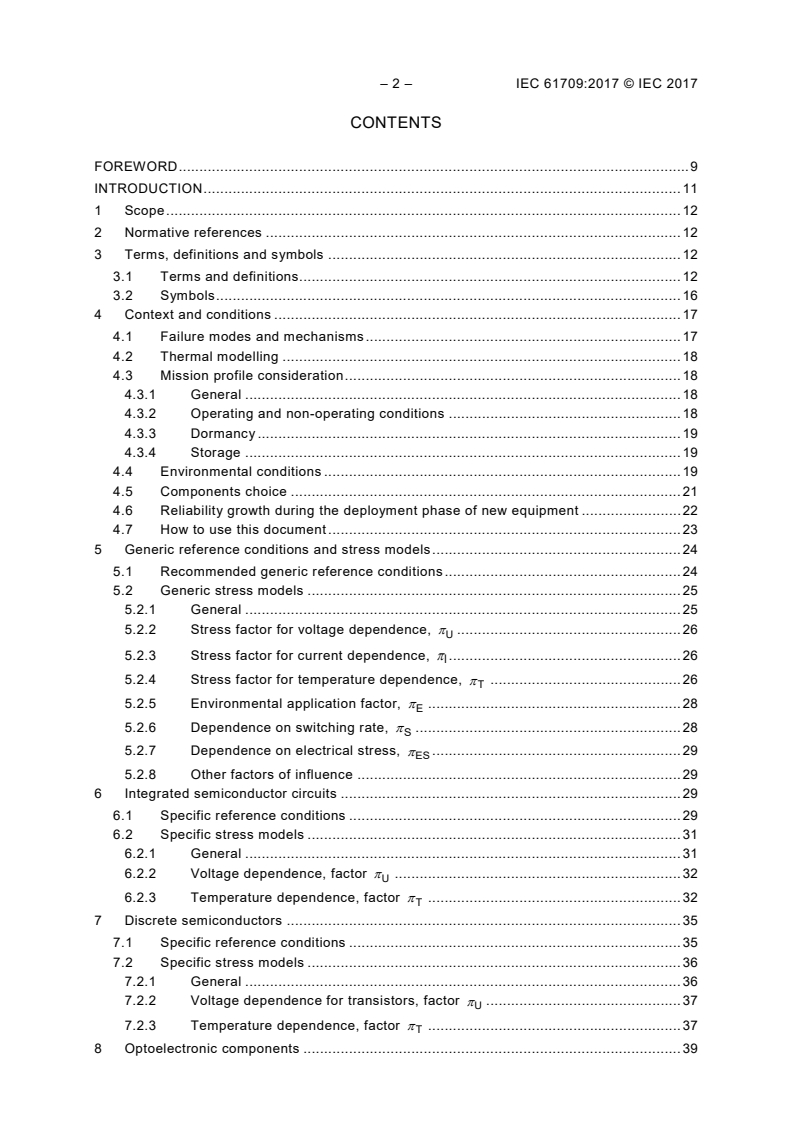
IEC 61709:2017 - Electric components - Reliability - Reference conditions for failure rates and stress models for conversion Released:2/17/2017
Overview
IEC 61709:2017 - Electric components - Reliability - Reference conditions for failure rates and stress models for conversion - provides guidance for using failure rate data in the reliability prediction of electric components. Rather than supplying base failure rates, the standard defines a set of reference conditions (typical stress values seen in most applications) and generic stress models to convert failure rates between reference and actual operating conditions. This allows realistic reliability predictions early in the design cycle and enables consistent comparison of data from different sources. Edition 3 (2017) merges IEC 61709:2011 and IEC TR 62380:2004 and includes corrigenda up to October 2019.
Key Topics and Technical Requirements
- Reference conditions: Defined typical environmental and electrical stresses that form a standardized basis for reporting failure rate data.
- Stress models for conversion: Generic factors for voltage, current, temperature, environment, switching rate and other influences (π factors) to convert failure rates from reference to actual conditions.
- Scope limits: Conversion is valid only within specified functional and useful-life limits of components; predictions assume parts are within their useful life.
- Component-specific guidance: Application of the generic models to component families, including integrated circuits, discrete semiconductors, optoelectronics, capacitors, resistors, connectors, relays, PCBs and hybrid circuits (Clauses 6–20 and I.2).
- Supporting annexes: Informative material on failure modes (Annex A), thermal modelling for semiconductors (Annex B), mission profile and useful-life models (Annex D/E), physics of failure, database design and data presentation (Annexes G–J).
- Data handling: Guidance on constructing and selecting a failure rate database and on presenting component reliability data so that failure rate data from different sources are comparable.
Practical Applications
- Early-stage reliability prediction for electronic equipment using component failure rate conversion to actual operating conditions.
- Design trade-offs: Evaluate how operating temperature, voltage stress or environment affect component reliability.
- Database construction: Create standardized failure rate repositories that enable consistent comparisons and conversions.
- Mission/profile analysis: Incorporate duty cycles, dormancy and storage conditions into reliability estimates.
- Reliability growth and deployment: Guidance on modeling reliability improvement during early deployment phases.
Who Should Use This Standard
- Reliability and systems engineers performing failure rate and MTBF calculations
- Component manufacturers and suppliers preparing failure rate data
- Test laboratories and predictive-analytics teams building failure databases
- Procurement, safety and certification personnel who require consistent reliability data
Related Standards (if applicable)
- IEC TR 62380 (merged into this edition)
- IEC 60319 (used for database and data presentation guidance)
- Other IEC reliability and electronic components guidance documents
Keywords: failure rate data, reliability prediction of electric components, reference conditions, stress models, IEC 61709.
Relations
- Effective Date
- 05-Sep-2023
- Effective Date
- 01-Jul-2026
- Effective Date
- 05-Sep-2023
- Effective Date
- 05-Sep-2023
Buy Documents
IEC 61709:2017 RLV - Electric components - Reliability - Reference conditions for failure rates and stress models for conversion Released:2/17/2017
IEC 61709:2017 - Electric components - Reliability - Reference conditions for failure rates and stress models for conversion Released:2/17/2017
Frequently Asked Questions
IEC 61709:2017 is a standard published by the International Electrotechnical Commission (IEC). Its full title is "Electric components - Reliability - Reference conditions for failure rates and stress models for conversion". This standard covers: IEC 61709:2017 gives guidance on the use of failure rate data for reliability prediction of electric components used in equipment. The method presented in this document uses the concept of reference conditions which are the typical values of stresses that are observed by components in the majority of applications. Reference conditions are useful since they provide a known standard basis from which failure rates can be modified to account for differences in environment from the environments taken as reference conditions. Each user can use the reference conditions defined in this document or use their own. When failure rates stated at reference conditions are used it allows realistic reliability predictions to be made in the early design phase. The stress models described herein are generic and can be used as a basis for conversion of failure rate data given at these reference conditions to actual operating conditions when needed and this simplifies the prediction approach. Conversion of failure rate data is only possible within the specified functional limits of the components. This document also gives guidance on how a database of component failure data can be constructed to provide failure rates that can be used with the included stress models. Reference conditions for failure rate data are specified, so that data from different sources can be compared on a uniform basis. If failure rate data are given in accordance with this document then additional information on the specified conditions can be dispensed with. This document does not provide base failure rates for components – rather it provides models that allow failure rates obtained by other means to be converted from one operating condition to another operating condition. The prediction methodology described in this document assumes that the parts are being used within its useful life. The methods in this document have a general application but are specifically applied to a selection of component types as defined in Clauses 6 to 20 and I.2. This third edition cancels and replaces the second edition, published in 2011. This edition constitutes a technical revision. This third edition is a merger of IEC 61709:2011 and IEC TR 62380:2004. This edition includes the following significant technical changes with respect to the previous edition: addition of 4.5 Components choice, 4.6 Reliability growth during the deployment phase of new equipment, 4.7 How to use this document, and of Clause 19 Printed circuit boards (PCB) and Clause 20 Hybrid circuits with respect to IEC TR 62380; addition of failure modes of components in Annex A; modification of Annex B, Thermal model for semiconductors, adopted and revised from IEC TR 62380; modification of Annex D, Considerations on mission profile; modification of Annex E, Useful life models, adopted and revised from IEC TR 62380; revision of Annex F (former B.2.6.4), Physics of failure; addition of Annex G (former Annex C), Considerations for the design of a data base on failure rates, complemented with parts of IEC 60319; addition of Annex H, Potential sources of failure rate data and methods of selection; addition of Annex J, Presentation of component reliability data, based on IEC 60319. The contents of the corrigendum of October 2019 have been included in this copy. Keywords: failure rate data, reliability prediction of electric components
IEC 61709:2017 gives guidance on the use of failure rate data for reliability prediction of electric components used in equipment. The method presented in this document uses the concept of reference conditions which are the typical values of stresses that are observed by components in the majority of applications. Reference conditions are useful since they provide a known standard basis from which failure rates can be modified to account for differences in environment from the environments taken as reference conditions. Each user can use the reference conditions defined in this document or use their own. When failure rates stated at reference conditions are used it allows realistic reliability predictions to be made in the early design phase. The stress models described herein are generic and can be used as a basis for conversion of failure rate data given at these reference conditions to actual operating conditions when needed and this simplifies the prediction approach. Conversion of failure rate data is only possible within the specified functional limits of the components. This document also gives guidance on how a database of component failure data can be constructed to provide failure rates that can be used with the included stress models. Reference conditions for failure rate data are specified, so that data from different sources can be compared on a uniform basis. If failure rate data are given in accordance with this document then additional information on the specified conditions can be dispensed with. This document does not provide base failure rates for components – rather it provides models that allow failure rates obtained by other means to be converted from one operating condition to another operating condition. The prediction methodology described in this document assumes that the parts are being used within its useful life. The methods in this document have a general application but are specifically applied to a selection of component types as defined in Clauses 6 to 20 and I.2. This third edition cancels and replaces the second edition, published in 2011. This edition constitutes a technical revision. This third edition is a merger of IEC 61709:2011 and IEC TR 62380:2004. This edition includes the following significant technical changes with respect to the previous edition: addition of 4.5 Components choice, 4.6 Reliability growth during the deployment phase of new equipment, 4.7 How to use this document, and of Clause 19 Printed circuit boards (PCB) and Clause 20 Hybrid circuits with respect to IEC TR 62380; addition of failure modes of components in Annex A; modification of Annex B, Thermal model for semiconductors, adopted and revised from IEC TR 62380; modification of Annex D, Considerations on mission profile; modification of Annex E, Useful life models, adopted and revised from IEC TR 62380; revision of Annex F (former B.2.6.4), Physics of failure; addition of Annex G (former Annex C), Considerations for the design of a data base on failure rates, complemented with parts of IEC 60319; addition of Annex H, Potential sources of failure rate data and methods of selection; addition of Annex J, Presentation of component reliability data, based on IEC 60319. The contents of the corrigendum of October 2019 have been included in this copy. Keywords: failure rate data, reliability prediction of electric components
IEC 61709:2017 is classified under the following ICS (International Classification for Standards) categories: 31.020 - Electronic components in general. The ICS classification helps identify the subject area and facilitates finding related standards.
IEC 61709:2017 has the following relationships with other standards: It is inter standard links to IEC TR 62380:2004, EN ISO 8100-2:2026, IEC 61709:2017/COR1:2019, IEC 61709:2011. Understanding these relationships helps ensure you are using the most current and applicable version of the standard.
IEC 61709:2017 is available in PDF format for immediate download after purchase. The document can be added to your cart and obtained through the secure checkout process. Digital delivery ensures instant access to the complete standard document.
Standards Content (Sample)
IEC 61709 ®
Edition 3.0 2017-02
REDLINE VERSION
INTERNATIONAL
STANDARD
colour
inside
Electric components – Reliability – Reference conditions for failure rates and
stress models for conversion
All rights reserved. Unless otherwise specified, no part of this publication may be reproduced or utilized in any form
or by any means, electronic or mechanical, including photocopying and microfilm, without permission in writing from
either IEC or IEC's member National Committee in the country of the requester. If you have any questions about IEC
copyright or have an enquiry about obtaining additional rights to this publication, please contact the address below or
your local IEC member National Committee for further information.
IEC Central Office Tel.: +41 22 919 02 11
3, rue de Varembé Fax: +41 22 919 03 00
CH-1211 Geneva 20 info@iec.ch
Switzerland www.iec.ch
About the IEC
The International Electrotechnical Commission (IEC) is the leading global organization that prepares and publishes
International Standards for all electrical, electronic and related technologies.
About IEC publications
The technical content of IEC publications is kept under constant review by the IEC. Please make sure that you have the
latest edition, a corrigenda or an amendment might have been published.
IEC Catalogue - webstore.iec.ch/catalogue Electropedia - www.electropedia.org
The stand-alone application for consulting the entire The world's leading online dictionary of electronic and
bibliographical information on IEC International Standards, electrical terms containing 20 000 terms and definitions in
Technical Specifications, Technical Reports and other English and French, with equivalent terms in 16 additional
documents. Available for PC, Mac OS, Android Tablets and languages. Also known as the International Electrotechnical
iPad. Vocabulary (IEV) online.
IEC publications search - www.iec.ch/searchpub IEC Glossary - std.iec.ch/glossary
The advanced search enables to find IEC publications by a 65 000 electrotechnical terminology entries in English and
variety of criteria (reference number, text, technical French extracted from the Terms and Definitions clause of
committee,…). It also gives information on projects, replaced IEC publications issued since 2002. Some entries have been
and withdrawn publications. collected from earlier publications of IEC TC 37, 77, 86 and
CISPR.
IEC Just Published - webstore.iec.ch/justpublished
Stay up to date on all new IEC publications. Just Published IEC Customer Service Centre - webstore.iec.ch/csc
details all new publications released. Available online and If you wish to give us your feedback on this publication or
also once a month by email. need further assistance, please contact the Customer Service
Centre: csc@iec.ch.
IEC 61709 ®
Edition 3.0 2017-02
REDLINE VERSION
INTERNATIONAL
STANDARD
colour
inside
Electric components – Reliability – Reference conditions for failure rates and
stress models for conversion
INTERNATIONAL
ELECTROTECHNICAL
COMMISSION
ICS 31.020 ISBN 978-2-8322-3989-6
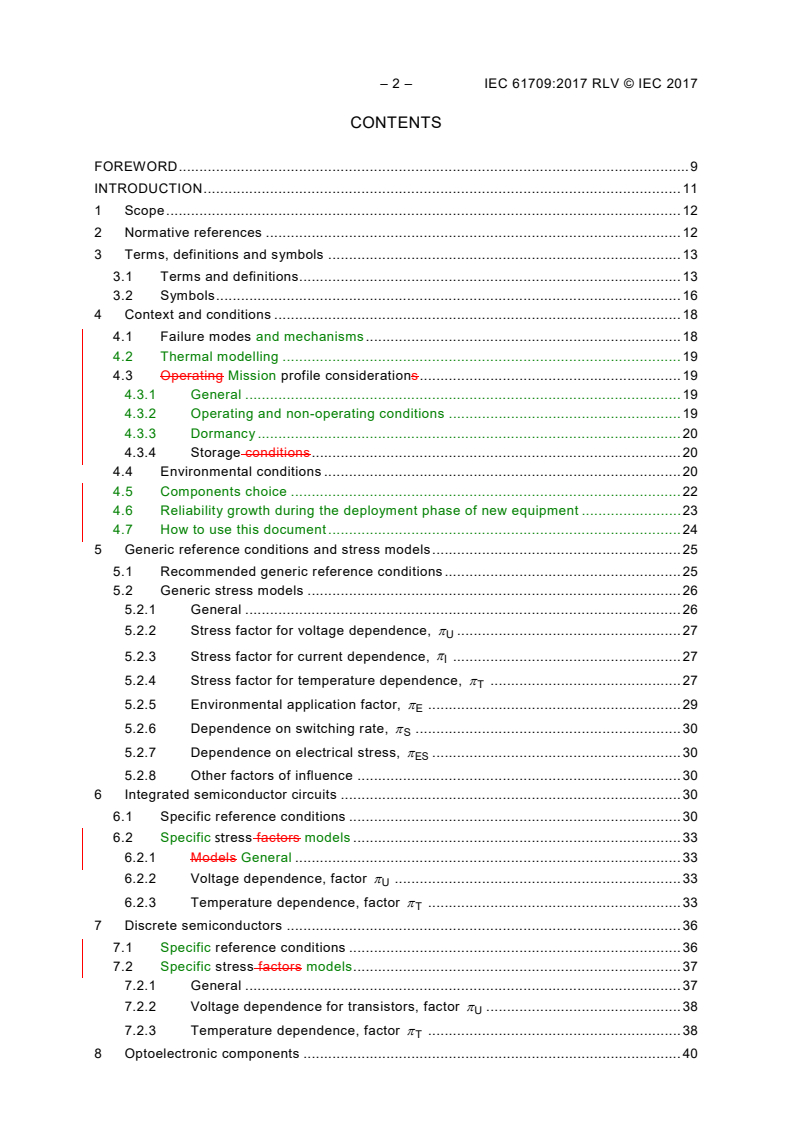
– 2 – IEC 61709:2017 RLV © IEC 2017
CONTENTS
FOREWORD . 9
INTRODUCTION . 11
1 Scope . 12
2 Normative references . 12
3 Terms, definitions and symbols . 13
3.1 Terms and definitions. 13
3.2 Symbols . 16
4 Context and conditions . 18
4.1 Failure modes and mechanisms . 18
4.2 Thermal modelling . 19
4.3 Operating Mission profile considerations . 19
4.3.1 General . 19
4.3.2 Operating and non-operating conditions . 19
4.3.3 Dormancy . 20
4.3.4 Storage conditions . 20
4.4 Environmental conditions . 20
4.5 Components choice . 22
4.6 Reliability growth during the deployment phase of new equipment . 23
4.7 How to use this document . 24
5 Generic reference conditions and stress models . 25
5.1 Recommended generic reference conditions . 25
5.2 Generic stress models . 26
5.2.1 General . 26
5.2.2 Stress factor for voltage dependence, π . 27
U
5.2.3 Stress factor for current dependence, π . 27
I
5.2.4 Stress factor for temperature dependence, π . 27
T
5.2.5 Environmental application factor, π . 29
E
5.2.6 Dependence on switching rate, π . 30
S
5.2.7 Dependence on electrical stress, . 30
π
ES
5.2.8 Other factors of influence . 30
6 Integrated semiconductor circuits . 30
6.1 Specific reference conditions . 30
6.2 Specific stress factors models . 33
6.2.1 Models General . 33
6.2.2 Voltage dependence, factor π . 33
U
6.2.3 Temperature dependence, factor π . 33
T
7 Discrete semiconductors . 36
7.1 Specific reference conditions . 36
7.2 Specific stress factors models . 37
7.2.1 General . 37
7.2.2 Voltage dependence for transistors, factor π . 38
U
7.2.3 Temperature dependence, factor π . 38
T
8 Optoelectronic components . 40
8.1 Specific reference conditions . 40
8.2 Specific stress factors models . 42
8.2.1 General . 42
8.2.2 Voltage dependence, factor π . 42
U
8.2.3 Current dependence, factor π . 42
I
8.2.4 Temperature dependence, factor . 43
π
T
9 Capacitors . 45
9.1 Specific reference conditions . 45
9.2 Specific stress factors models . 45
9.2.1 Models General . 45
9.2.2 Voltage dependence, factor π . 45
U
9.2.3 Temperature dependence, factor π . 47
T
10 Resistors and resistor networks . 48
10.1 Specific reference conditions . 48
10.2 Specific stress factors models . 49
10.2.1 Models General . 49
10.2.2 Temperature dependence, factor π . 49
T
11 Inductors, transformers and coils . 50
11.1 Reference conditions . 50
11.2 Specific stress factors models . 50
11.2.1 Models General . 50
11.2.2 Temperature dependence, factor π . 50
T
12 Microwave devices . 51
12.1 Specific reference conditions . 51
12.2 Specific stress factors models . 52
13 Other passive components . 52
13.1 Specific reference conditions . 52
13.2 Specific stress factors models . 52
14 Electrical connections . 52
14.1 Specific reference conditions . 52
14.2 Specific stress factors models . 53
15 Connectors and sockets . 53
15.1 Reference conditions . 53
15.2 Specific stress factors models . 53
16 Relays . 53
16.1 Reference conditions . 53
16.2 Specific stress factors models . 54
16.2.1 Models General . 54
16.2.2 Dependence on switching rate, factor π . 54
S
16.2.3 Dependence on electrical stress, factor π . 55
ES
16.2.4 Temperature dependence, factor π . 56
T
17 Switches and push-buttons . 56
17.1 Specific reference conditions . 56
17.2 Specific stress factors models . 57
17.2.1 Models General . 57
– 4 – IEC 61709:2017 RLV © IEC 2017
Dependence on electrical stress, factor . 57
17.2.2 π
ES
18 Signal and pilot lamps . 58
18.1 Specific reference conditions . 58
18.2 Specific stress factors models . 58
18.2.1 Models General . 58
π
18.2.2 Voltage dependence, factor . 59
U
19 Printed circuit boards (PCB) . 59
20 Hybrid circuits . 59
Annex A (normative) Failure modes of components . 60
Annex B (informative) Thermal model for semiconductors . 63
B.1 Thermal model . 63
B.2 Junction temperature calculation . 64
B.3 Thermal resistance evaluation . 65
B.4 Power dissipation of an integrated circuit P . 66
Annex C (informative) Failure rate prediction . 69
C.1 General . 69
C.2 Failure rate prediction for assemblies . 69
C.2.1 General . 69
C.2.2 Assumptions and limitations . 70
C.2.3 Process for failure rate prediction . 70
C.2.4 Prediction models . 71
C.2.5 Consideration of operating profiles .
C.2.5 Other methods of reliability prediction . 75
C.2.6 Validity considerations of reliability models and predictions . 76
C.3 Component considerations . 76
C.3.1 Component model . 76
C.3.2 Components classification . 76
C.4 General consideration about failure rate . 77
C.4.1 General . 77
C.4.2 General behaviour of the failure rate of components . 77
C.4.3 Expected values of failure rate. 78
C.4.4 Sources of variation in failure rates . 79
Annex D (informative) Considerations on mission profile . 80
D.1 General . 80
D.2 Dormancy . 80
D.3 Mission profile . 81
D.4 Example of mission profile . 82
Annex E (informative) Useful life models . 83
E.1 General . 83
E.2 Power transistors . 83
E.3 Optocouplers . 83
E.3.1 Useful life L . 83
E.3.2 Factor L . 84
E.3.3 Factor κ . 84
E.3.4 Factor κ . 85
E.3.5 Factor κ . 85
E.3.6 Factor κ . 85
E.4 LED and LED modules . 86
E.4.1 Useful life L . 86
E.4.2 Factor L . 86
E.4.3 Factor κ . 87
E.4.4 Factor κ . 87
E.4.5 Factor κ . 88
E.4.6 Factor κ . 88
E.5 Aluminium, non-solid electrolyte capacitors . 88
E.6 Relays . 89
E.7 Switches and keyboards . 89
E.8 Connectors . 89
Annex F (informative) Physics of failure . 90
F.1 General . 90
F.2 Failure mechanisms of integrated circuits . 91
Annex G (informative) Considerations for the design of a data base on failure rates . 92
G.1 General . 92
G.2 Data collection acquisition – collection process . 92
G.3 Which data to collect and how to collect it . 92
G.4 Calculation and decision making . 93
G.5 Data descriptions . 93
G.6 Identification of components . 94
G.6.1 General . 94
G.6.2 Component identification . 94
G.6.3 Component technology . 94
G.7 Specification of components . 94
G.7.1 General . 94
G.7.2 Electrical specification of components . 94
G.7.3 Environmental specification of components . 95
G.8 Field related issues data . 95
G.8.1 General . 95
G.8.2 Actual field conditions . 95
G.8.3 Data on field failures . 95
G.9 Test related issues data . 96
G.9.1 General . 96
G.9.2 Actual test conditions . 96
G.9.3 Data on test failures . 96
G.10 Failure rate database attributes . 97
Annex H (informative) Potential sources of failure rate data and methods of selection . 99
H.1 General . 99
H.2 Data source selection . 99
H.3 User data . 100
H.4 Manufacturer’s data . 100
H.5 Handbook reliability data . 101
H.5.1 General . 101
H.5.2 Using handbook data with this document . 101
H.5.3 List of available handbooks . 102
Annex I (informative) Overview of component classification . 105
I.1 General . 105
– 6 – IEC 61709:2017 RLV © IEC 2017
I.2 The IEC 61360 system . 105
I.3 Other systems. 113
I.3.1 General . 113
I.3.2 NATO stock numbers . 113
I.3.3 UNSPSC codes . 113
I.3.4 STEP/EXPRESS . 113
I.3.5 IECQ . 113
I.3.6 ECALS . 114
I.3.7 ISO 13584 . 114
I.3.8 MIL specifications . 114
Annex J (informative) Presentation of component reliability data . 115
J.1 General . 115
J.2 Identification of components . 115
J.2.1 General . 115
J.2.2 Component identification . 116
J.2.3 Component technology . 116
J.3 Specification of components . 116
J.3.1 General . 116
J.3.2 Electrical specification of components . 116
J.3.3 Environmental specification of components . 116
J.4 Test related issues data . 116
J.4.1 General . 116
J.4.2 Actual test conditions . 117
J.5 Data on test failures . 117
Annex K (informative) Examples . 119
K.1 Integrated circuit . 119
K.2 Transistor . 119
K.3 Capacitor . 119
K.4 Relay . 120
Bibliography . 121
Figure 1 – Comparison of the temperature dependence of π for CMOS IC. 25
T
Figure 2 – Selection of stress regions in accordance with current and voltage-operating
conditions . 55
Figure 3 – Selection of stress regions in accordance with current and voltage-operating
conditions . 57
Figure B.1 – Stress profile .
Figure B.1 – Temperatures inside equipment . 64
Figure B.2 – Averaging failure rates .
Figure B.2 – Thermal resistance model . 65
Figure D.1 – Mission profile . 82
Table 1 – Basic environments . 21
Table 2 – Values of environmental parameters for basic environments . 22
Table 3 – Recommended reference conditions for environmental and mechanical
stresses . 26
Table 4 – Environmental application factor, π . 29
E
Table 5 – Memory . 31
Table 6 – Microprocessors and peripherals, microcontrollers and signal processors . 31
Table 7 – Digital logic families and bus interfaces, bus driver and receiver circuits . 31
Table 8 – Analog ICs . 32
Table 9 – Application-specific ICs (ASICs) . 32
Table 10 – Constants for voltage dependence . 33
Table 11 – Factor for digital CMOS-family ICs. 33
π
U
Table 12 – Factor π for bipolar analog ICs . 33
U
Table 13 – Constants for temperature dependence . 33
Table 14 – Factor π for ICs (without EPROM; FLASH-EPROM; OTPROM; EEPROM;
T
EAROM) . 35
Table 15 – Factor π for EPROM; FLASH-EPROM; OTPROM; EEPROM; EAROM. 35
T
Table 16 – Transistors common, low frequency. 36
Table 17 – Transistors, microwave, (e.g. RF > 800 MHz) . 36
Table 18 – Diodes . 37
Table 19 – Power semiconductors . 37
Table 20 – Constants for voltage dependence of transistors . 38
Table 21 – Factor π for transistors . 38
U
Table 22 – Constants for temperature dependence of discrete semiconductors . 38
Table 23 – Factor for transistors, reference and microwave diodes . 39
π
T
Table 24 – Factor π for diodes (without reference and microwave diodes) and power
T
semiconductors . 39
Table 25 – Optoelectronic semiconductor signal receivers . 40
Table 26 – LEDs, IREDs, laser diodes and transmitter components . 40
Table 27 – Optocouplers and light barriers. 41
Table 28 – Passive optical components . 41
Table 29 – Transceiver, transponder and optical sub-equipment . 41
Table 30 – Constants for voltage dependence of phototransistors . 42
Table 31 – Factor π for phototransistors . 42
U
Table 32 – Constants for current dependence of LEDs and IREDs . 43
π
Table 33 – Factor for LEDs and IREDs. 43
I
Table 34 – Constants for temperature dependence of optoelectronic components . 43
Table 35 – Factor π for optical components . 44
T
Table 36 – Capacitors . 45
Table 37 – Constants for voltage dependence of capacitors . 46
Table 38 – Factor π for capacitors . 46
U
Table 39 – Constants for temperature dependence of capacitors . 47
Table 40 – Factor π for capacitors . 48
T
Table 41 – Resistors and resistor networks . 49
Table 42 – Constants for temperature dependence of resistors . 49
Table 43 – Factor π for resistors . 50
T
– 8 – IEC 61709:2017 RLV © IEC 2017
Table 44 – Inductors, transformers and coils . 50
Table 45 – Constants for temperature dependence of inductors, transformers and coils . 50
Table 46 – Factor for inductors, transformers and coils . 51
π
T
Table 47 – Microwave devices . 51
Table 48 – Other passive components . 52
Table 49 – Electrical connections. 53
Table 50 – Connectors and sockets . 53
Table 51 – Relays . 54
Table 52 – Factor π for low current relays . 55
ES
Table 53 – Factor π for general purpose relays . 55
ES
Table 54 – Factor π for automotive relays . 56
ES
Table 55 – Constants for temperature dependence of relays . 56
Table 56 – Factor π for relays . 56
T
Table 57 – Switches and push-buttons . 57
Table 58 – Factor π for switches and push-buttons for low electrical stress . 58
ES
Table 59 – Factor π for switches and push-buttons for higher electrical stress . 58
ES
Table 60 – Signal and pilot lamps . 58
π
Table 61 – Factor for signal and pilot lamps . 59
U
Table A.1 – Failure modes: ICs (digital) . 60
Table A.2 – Failure modes: transistors, diodes, optocouplers . 61
Table A.3 – Failure modes: LEDs . 61
Table A.4 – Failure modes: laser diodes and modules . 61
Table A.5 – Failure modes: photodiodes and receiver modules . 61
Table A.6 – Failure modes: capacitors . 62
Table A.7 – Failure modes: Resistors, inductive devices, relays . 62
Table B.1 – Thermal resistance as a function of package type, pin number and airflow
factor . 66
v
Table B.2 – Typical values of are K . 66
Table B.3 – Values of P and P . 67
DC f
Table E.1 – Useful life limitations for switches and keyboards . 89
Table F.1 – Failure mechanism for Integrated circuits . 91
Table G.1 – Reliability prediction database attributes . 98
Table H.1 – Result of calculation for transistors common, low frequency. 102
Table H.2 – Sources of reliability data (in alphabetical order) . 102
Table I.1 – Classification tree (IEC 61360-4) . 106
INTERNATIONAL ELECTROTECHNICAL COMMISSION
_______________
ELECTRIC COMPONENTS –
RELIABILITY –
REFERENCE CONDITIONS FOR FAILURE RATES
AND STRESS MODELS FOR CONVERSION
FOREWORD
1) The International Electrotechnical Commission (IEC) is a worldwide organization for standardization comprising
all national electrotechnical committees (IEC National Committees). The object of IEC is to promote
international co-operation on all questions concerning standardization in the electrical and electronic fields. To
this end and in addition to other activities, IEC publishes International Standards, Technical Specifications,
Technical Reports, Publicly Available Specifications (PAS) and Guides (hereafter referred to as “IEC
Publication(s)”). Their preparation is entrusted to technical committees; any IEC National Committee interested
in the subject dealt with may participate in this preparatory work. International, governmental and non-
governmental organizations liaising with the IEC also participate in this preparation. IEC collaborates closely
with the International Organization for Standardization (ISO) in accordance with conditions determined by
agreement between the two organizations.
2) The formal decisions or agreements of IEC on technical matters express, as nearly as possible, an international
consensus of opinion on the relevant subjects since each technical committee has representation from all
interested IEC National Committees.
3) IEC Publications have the form of recommendations for international use and are accepted by IEC National
Committees in that sense. While all reasonable efforts are made to ensure that the technical content of IEC
Publications is accurate, IEC cannot be held responsible for the way in which they are used or for any
misinterpretation by any end user.
4) In order to promote international uniformity, IEC National Committees undertake to apply IEC Publications
transparently to the maximum extent possible in their national and regional publications. Any divergence
between any IEC Publication and the corresponding national or regional publication shall be clearly indicated in
the latter.
5) IEC itself does not provide any attestation of conformity. Independent certification bodies provide conformity
assessment services and, in some areas, access to IEC marks of conformity. IEC is not responsible for any
services carried out by independent certification bodies.
6) All users should ensure that they have the latest edition of this publication.
7) No liability shall attach to IEC or its directors, employees, servants or agents including individual experts and
members of its technical committees and IEC National Committees for any personal injury, property damage or
other damage of any nature whatsoever, whether direct or indirect, or for costs (including legal fees) and
expenses arising out of the publication, use of, or reliance upon, this IEC Publication or any other IEC
Publications.
8) Attention is drawn to the Normative references cited in this publication. Use of the referenced publications is
indispensable for the correct application of this publication.
9) Attention is drawn to the possibility that some of the elements of this IEC Publication may be the subject of
patent rights. IEC shall not be held responsible for identifying any or all such patent rights.
This redline version of the official IEC Standard allows the user to identify the changes
made to the previous edition. A vertical bar appears in the margin wherever a change
has been made. Additions are in green text, deletions are in strikethrough red text.
– 10 – IEC 61709:2017 RLV © IEC 2017
International Standard IEC 61709 has been prepared by IEC technical committee 56:
Dependability.
This third edition cancels and replaces the second edition, published in 2011. This edition
constitutes a technical revision. This third edition is a merger of IEC 61709:2011 and
IEC TR 62380:2004.
This edition includes the following significant technical changes with respect to the previous
edition:
a) addition of 4.5 Components choice, 4.6 Reliability growth during the deployment phase of
new equipment, 4.7 How to use this document, and of Clause 19 Printed circuit boards
(PCB) and Clause 20 Hybrid circuits with respect to IEC TR 6
...
IEC 61709 ®
Edition 3.0 2017-02
INTERNATIONAL
STANDARD
NORME
INTERNATIONALE
colour
inside
Electric components – Reliability – Reference conditions for failure rates and
stress models for conversion
Composants électriques – Fiabilité – Conditions de référence pour les taux de
défaillance et modèles de contraintes pour la conversion
All rights reserved. Unless otherwise specified, no part of this publication may be reproduced or utilized in any form
or by any means, electronic or mechanical, including photocopying and microfilm, without permission in writing from
either IEC or IEC's member National Committee in the country of the requester. If you have any questions about IEC
copyright or have an enquiry about obtaining additional rights to this publication, please contact the address below or
your local IEC member National Committee for further information.
Droits de reproduction réservés. Sauf indication contraire, aucune partie de cette publication ne peut être reproduite
ni utilisée sous quelque forme que ce soit et par aucun procédé, électronique ou mécanique, y compris la photocopie
et les microfilms, sans l'accord écrit de l'IEC ou du Comité national de l'IEC du pays du demandeur. Si vous avez des
questions sur le copyright de l'IEC ou si vous désirez obtenir des droits supplémentaires sur cette publication, utilisez
les coordonnées ci-après ou contactez le Comité national de l'IEC de votre pays de résidence.
IEC Central Office Tel.: +41 22 919 02 11
3, rue de Varembé Fax: +41 22 919 03 00
CH-1211 Geneva 20 info@iec.ch
Switzerland www.iec.ch
About the IEC
The International Electrotechnical Commission (IEC) is the leading global organization that prepares and publishes
International Standards for all electrical, electronic and related technologies.
About IEC publications
The technical content of IEC publications is kept under constant review by the IEC. Please make sure that you have the
latest edition, a corrigenda or an amendment might have been published.
IEC Catalogue - webstore.iec.ch/catalogue Electropedia - www.electropedia.org
The stand-alone application for consulting the entire The world's leading online dictionary of electronic and
bibliographical information on IEC International Standards, electrical terms containing 20 000 terms and definitions in
Technical Specifications, Technical Reports and other English and French, with equivalent terms in 16 additional
documents. Available for PC, Mac OS, Android Tablets and languages. Also known as the International Electrotechnical
iPad. Vocabulary (IEV) online.
IEC publications search - www.iec.ch/searchpub IEC Glossary - std.iec.ch/glossary
The advanced search enables to find IEC publications by a 65 000 electrotechnical terminology entries in English and
variety of criteria (reference number, text, technical French extracted from the Terms and Definitions clause of
committee,…). It also gives information on projects, replaced IEC publications issued since 2002. Some entries have been
and withdrawn publications. collected from earlier publications of IEC TC 37, 77, 86 and
CISPR.
IEC Just Published - webstore.iec.ch/justpublished
Stay up to date on all new IEC publications. Just Published IEC Customer Service Centre - webstore.iec.ch/csc
details all new publications released. Available online and If you wish to give us your feedback on this publication or
also once a month by email. need further assistance, please contact the Customer Service
Centre: csc@iec.ch.
A propos de l'IEC
La Commission Electrotechnique Internationale (IEC) est la première organisation mondiale qui élabore et publie des
Normes internationales pour tout ce qui a trait à l'électricité, à l'électronique et aux technologies apparentées.
A propos des publications IEC
Le contenu technique des publications IEC est constamment revu. Veuillez vous assurer que vous possédez l’édition la
plus récente, un corrigendum ou amendement peut avoir été publié.
Catalogue IEC - webstore.iec.ch/catalogue Electropedia - www.electropedia.org
Application autonome pour consulter tous les renseignements
Le premier dictionnaire en ligne de termes électroniques et
bibliographiques sur les Normes internationales,
électriques. Il contient 20 000 termes et définitions en anglais
Spécifications techniques, Rapports techniques et autres
et en français, ainsi que les termes équivalents dans 16
documents de l'IEC. Disponible pour PC, Mac OS, tablettes
langues additionnelles. Egalement appelé Vocabulaire
Android et iPad.
Electrotechnique International (IEV) en ligne.
Recherche de publications IEC - www.iec.ch/searchpub
Glossaire IEC - std.iec.ch/glossary
65 000 entrées terminologiques électrotechniques, en anglais
La recherche avancée permet de trouver des publications IEC
en utilisant différents critères (numéro de référence, texte, et en français, extraites des articles Termes et Définitions des
comité d’études,…). Elle donne aussi des informations sur les publications IEC parues depuis 2002. Plus certaines entrées
projets et les publications remplacées ou retirées. antérieures extraites des publications des CE 37, 77, 86 et
CISPR de l'IEC.
IEC Just Published - webstore.iec.ch/justpublished
Service Clients - webstore.iec.ch/csc
Restez informé sur les nouvelles publications IEC. Just
Published détaille les nouvelles publications parues. Si vous désirez nous donner des commentaires sur cette
Disponible en ligne et aussi une fois par mois par email. publication ou si vous avez des questions contactez-nous:
csc@iec.ch.
IEC 61709 ®
Edition 3.0 2017-02
INTERNATIONAL
STANDARD
NORME
INTERNATIONALE
colour
inside
Electric components – Reliability – Reference conditions for failure rates and
stress models for conversion
Composants électriques – Fiabilité – Conditions de référence pour les taux de
défaillance et modèles de contraintes pour la conversion
INTERNATIONAL
ELECTROTECHNICAL
COMMISSION
COMMISSION
ELECTROTECHNIQUE
INTERNATIONALE
ICS 31.020 ISBN 978-2-8322-3902-5
– 2 – IEC 61709:2017 © IEC 2017
CONTENTS
FOREWORD . 9
INTRODUCTION . 11
1 Scope . 12
2 Normative references . 12
3 Terms, definitions and symbols . 12
3.1 Terms and definitions. 12
3.2 Symbols . 16
4 Context and conditions . 17
4.1 Failure modes and mechanisms . 17
4.2 Thermal modelling . 18
4.3 Mission profile consideration . 18
4.3.1 General . 18
4.3.2 Operating and non-operating conditions . 18
4.3.3 Dormancy . 19
4.3.4 Storage . 19
4.4 Environmental conditions . 19
4.5 Components choice . 21
4.6 Reliability growth during the deployment phase of new equipment . 22
4.7 How to use this document . 23
5 Generic reference conditions and stress models . 24
5.1 Recommended generic reference conditions . 24
5.2 Generic stress models . 25
5.2.1 General . 25
5.2.2 Stress factor for voltage dependence, π . 26
U
5.2.3 Stress factor for current dependence, π . 26
I
5.2.4 Stress factor for temperature dependence, π . 26
T
5.2.5 Environmental application factor, π . 28
E
5.2.6 Dependence on switching rate, π . 28
S
5.2.7 Dependence on electrical stress, . 29
π
ES
5.2.8 Other factors of influence . 29
6 Integrated semiconductor circuits . 29
6.1 Specific reference conditions . 29
6.2 Specific stress models . 31
6.2.1 General . 31
6.2.2 Voltage dependence, factor . 32
π
U
6.2.3 Temperature dependence, factor . 32
π
T
7 Discrete semiconductors . 35
7.1 Specific reference conditions . 35
7.2 Specific stress models . 36
7.2.1 General . 36
7.2.2 Voltage dependence for transistors, factor π . 37
U
7.2.3 Temperature dependence, factor π . 37
T
8 Optoelectronic components . 39
8.1 Specific reference conditions . 39
8.2 Specific stress models . 41
8.2.1 General . 41
8.2.2 Voltage dependence, factor π . 41
U
8.2.3 Current dependence, factor π . 41
I
8.2.4 Temperature dependence, factor π . 42
T
9 Capacitors . 44
9.1 Specific reference conditions . 44
9.2 Specific stress model . 44
9.2.1 General . 44
9.2.2 Voltage dependence, factor π . 44
U
9.2.3 Temperature dependence, factor π . 46
T
10 Resistors and resistor networks . 47
10.1 Specific reference conditions . 47
10.2 Specific stress models . 48
10.2.1 General . 48
10.2.2 Temperature dependence, factor π . 48
T
11 Inductors, transformers and coils . 49
11.1 Reference conditions . 49
11.2 Specific stress model . 49
11.2.1 General . 49
11.2.2 Temperature dependence, factor π . 49
T
12 Microwave devices . 50
12.1 Specific reference conditions . 50
12.2 Specific stress models . 51
13 Other passive components . 51
13.1 Specific reference conditions . 51
13.2 Specific stress models . 51
14 Electrical connections . 51
14.1 Specific reference conditions . 51
14.2 Specific stress models . 52
15 Connectors and sockets . 52
15.1 Reference conditions . 52
15.2 Specific stress models . 52
16 Relays . 52
16.1 Reference conditions . 52
16.2 Specific stress models . 53
16.2.1 General . 53
16.2.2 Dependence on switching rate, factor π . 53
S
16.2.3 Dependence on electrical stress, factor π . 54
ES
16.2.4 Temperature dependence, factor π . 55
T
17 Switches and push-buttons . 55
17.1 Specific reference conditions . 55
17.2 Specific stress model . 56
17.2.1 General . 56
– 4 – IEC 61709:2017 © IEC 2017
17.2.2 Dependence on electrical stress, factor π . 56
ES
18 Signal and pilot lamps . 57
18.1 Specific reference conditions . 57
18.2 Specific stress model . 57
18.2.1 General . 57
18.2.2 Voltage dependence, factor π . 58
U
19 Printed circuit boards (PCB) . 58
20 Hybrid circuits . 58
Annex A (normative) Failure modes of components . 59
Annex B (informative) Thermal model for semiconductors . 62
B.1 Thermal model . 62
B.2 Junction temperature calculation . 63
B.3 Thermal resistance evaluation . 64
B.4 Power dissipation of an integrated circuit P . 65
Annex C (informative) Failure rate prediction . 68
C.1 General . 68
C.2 Failure rate prediction for assemblies . 68
C.2.1 General . 68
C.2.2 Assumptions and limitations . 69
C.2.3 Process for failure rate prediction . 69
C.2.4 Prediction models . 70
C.2.5 Other methods of reliability prediction . 71
C.2.6 Validity considerations of reliability models and predictions . 72
C.3 Component considerations . 73
C.3.1 Component model . 73
C.3.2 Components classification . 73
C.4 General consideration about failure rate . 73
C.4.1 General . 73
C.4.2 General behaviour of the failure rate of components . 74
C.4.3 Expected values of failure rate. 75
C.4.4 Sources of variation in failure rates . 75
Annex D (informative) Considerations on mission profile . 77
D.1 General . 77
D.2 Dormancy . 77
D.3 Mission profile . 78
D.4 Example of mission profile . 79
Annex E (informative) Useful life models . 80
E.1 General . 80
E.2 Power transistors . 80
E.3 Optocouplers . 80
E.3.1 Useful life L . 80
E.3.2 Factor L . 81
E.3.3 Factor κ . 81
E.3.4 Factor κ . 82
E.3.5 Factor κ . 82
E.3.6 Factor κ . 82
E.4 LED and LED modules . 83
E.4.1 Useful life L . 83
E.4.2 Factor L . 83
E.4.3 Factor κ . 84
E.4.4 Factor κ . 84
E.4.5 Factor κ . 85
E.4.6 Factor κ . 85
E.5 Aluminium, non-solid electrolyte capacitors . 85
E.6 Relays . 86
E.7 Switches and keyboards . 86
E.8 Connectors . 86
Annex F (informative) Physics of failure . 87
F.1 General . 87
F.2 Failure mechanisms of integrated circuits . 88
Annex G (informative) Considerations for the design of a data base on failure rates . 89
G.1 General . 89
G.2 Data collection acquisition – collection process . 89
G.3 Which data to collect and how to collect it . 89
G.4 Calculation and decision making . 90
G.5 Data descriptions . 90
G.6 Identification of components . 90
G.6.1 General . 90
G.6.2 Component identification . 91
G.6.3 Component technology . 91
G.7 Specification of components . 91
G.7.1 General . 91
G.7.2 Electrical specification of components . 91
G.7.3 Environmental specification of components . 92
G.8 Field related issues data . 92
G.8.1 General . 92
G.8.2 Actual field conditions . 92
G.8.3 Data on field failures . 92
G.9 Test related issues data . 93
G.9.1 General . 93
G.9.2 Actual test conditions . 93
G.9.3 Data on test failures . 93
G.10 Failure rate database attributes . 94
Annex H (informative) Potential sources of failure rate data and methods of selection . 96
H.1 General . 96
H.2 Data source selection . 96
H.3 User data . 97
H.4 Manufacturer’s data . 97
H.5 Handbook reliability data . 98
H.5.1 General . 98
H.5.2 Using handbook data with this document . 98
H.5.3 List of available handbooks . 99
Annex I (informative) Overview of component classification . 102
I.1 General . 102
I.2 The IEC 61360 system . 102
– 6 – IEC 61709:2017 © IEC 2017
I.3 Other systems. 110
I.3.1 General . 110
I.3.2 NATO stock numbers . 110
I.3.3 UNSPSC codes . 110
I.3.4 STEP/EXPRESS . 110
I.3.5 IECQ . 110
I.3.6 ECALS . 111
I.3.7 ISO 13584 . 111
I.3.8 MIL specifications . 111
Annex J (informative) Presentation of component reliability data . 112
J.1 General . 112
J.2 Identification of components . 112
J.2.1 General . 112
J.2.2 Component identification . 113
J.2.3 Component technology . 113
J.3 Specification of components . 113
J.3.1 General . 113
J.3.2 Electrical specification of components . 113
J.3.3 Environmental specification of components . 113
J.4 Test related issues data . 113
J.4.1 General . 113
J.4.2 Actual test conditions . 114
J.5 Data on test failures . 114
Annex K (informative) Examples . 116
K.1 Integrated circuit . 116
K.2 Transistor . 116
K.3 Capacitor . 116
K.4 Relay . 117
Bibliography . 118
Figure 1 – Comparison of the temperature dependence of π for CMOS IC. 24
T
Figure 2 – Selection of stress regions in accordance with current and voltage-operating
conditions . 54
Figure 3 – Selection of stress regions in accordance with current and voltage-operating
conditions . 56
Figure B.1 – Temperatures inside equipment . 63
Figure B.2 – Thermal resistance model . 64
Figure D.1 – Mission profile . 79
Table 1 – Basic environments . 20
Table 2 – Values of environmental parameters for basic environments . 21
Table 3 – Recommended reference conditions for environmental and mechanical
stresses . 25
Table 4 – Environmental application factor, π . 28
E
Table 5 – Memory . 30
Table 6 – Microprocessors and peripherals, microcontrollers and signal processors . 30
Table 7 – Digital logic families and bus interfaces, bus driver and receiver circuits . 30
Table 8 – Analog ICs . 31
Table 9 – Application-specific ICs (ASICs) . 31
Table 10 – Constants for voltage dependence . 32
Table 11 – Factor for digital CMOS-family ICs . 32
π
U
Table 12 – Factor π for bipolar analog ICs . 32
U
Table 13 – Constants for temperature dependence . 32
Table 14 – Factor π for ICs (without EPROM; FLASH-EPROM; OTPROM; EEPROM;
T
EAROM) . 34
Table 15 – Factor π for EPROM; FLASH-EPROM; OTPROM; EEPROM; EAROM. 34
T
Table 16 – Transistors common, low frequency. 35
Table 17 – Transistors, microwave, (e.g. RF > 800 MHz) . 35
Table 18 – Diodes . 36
Table 19 – Power semiconductors . 36
Table 20 – Constants for voltage dependence of transistors . 37
Table 21 – Factor π for transistors . 37
U
Table 22 – Constants for temperature dependence of discrete semiconductors . 37
Table 23 – Factor π for transistors, reference and microwave diodes . 38
T
Table 24 – Factor π for diodes (without reference and microwave diodes) and power
T
semiconductors . 38
Table 25 – Optoelectronic semiconductor signal receivers . 39
Table 26 – LEDs, IREDs, laser diodes and transmitter components . 39
Table 27 – Optocouplers and light barriers. 40
Table 28 – Passive optical components . 40
Table 29 – Transceiver, transponder and optical sub-equipment . 40
Table 30 – Constants for voltage dependence of phototransistors . 41
Table 31 – Factor π for phototransistors . 41
U
Table 32 – Constants for current dependence of LEDs and IREDs . 42
π
Table 33 – Factor for LEDs and IREDs . 42
I
Table 34 – Constants for temperature dependence of optoelectronic components . 42
Table 35 – Factor π for optical components . 43
T
Table 36 – Capacitors . 44
Table 37 – Constants for voltage dependence of capacitors . 45
Table 38 – Factor π for capacitors . 45
U
Table 39 – Constants for temperature dependence of capacitors . 46
Table 40 – Factor π for capacitors . 47
T
Table 41 – Resistors and resistor networks . 48
Table 42 – Constants for temperature dependence of resistors . 48
Table 43 – Factor π for resistors . 49
T
Table 44 – Inductors, transformers and coils . 49
Table 45 – Constants for temperature dependence of inductors, transformers and coils . 49
Table 46 – Factor π for inductors, transformers and coils . 50
T
– 8 – IEC 61709:2017 © IEC 2017
Table 47 – Microwave devices . 50
Table 48 – Other passive components . 51
Table 49 – Electrical connections. 52
Table 50 – Connectors and sockets . 52
Table 51 – Relays . 53
Table 52 – Factor for low current relays . 54
π
ES
Table 53 – Factor π for general purpose relays . 54
ES
Table 54 – Factor π for automotive relays . 55
ES
Table 55 – Constants for temperature dependence of relays . 55
Table 56 – Factor π for relays . 55
T
Table 57 – Switches and push-buttons . 56
Table 58 – Factor for switches and push-buttons for low electrical stress . 57
π
ES
Table 59 – Factor π for switches and push-buttons for higher electrical stress . 57
ES
Table 60 – Signal and pilot lamps . 57
π
Table 61 – Factor for signal and pilot lamps . 58
U
Table A.1 – Failure modes: ICs (digital) . 59
Table A.2 – Failure modes: transistors, diodes, optocouplers . 60
Table A.3 – Failure modes: LEDs . 60
Table A.4 – Failure modes: laser diodes and modules . 60
Table A.5 – Failure modes: photodiodes and receiver modules . 60
Table A.6 – Failure modes: capacitors . 61
Table A.7 – Failure modes: resistors, inductive devices, relays . 61
Table B.1 – Thermal resistance as a function of package type, pin number and airflow
factor . 65
Table B.2 – Typical values of v are K . 65
Table B.3 – Values of P and P . 66
DC f
Table E.1 – Useful life limitations for switches and keyboards . 86
Table F.1 – Failure mechanism for Integrated circuits . 88
Table G.1 – Reliability prediction database attributes . 95
Table H.1 – Result of calculation for transistors common, low frequency. 99
Table H.2 – Sources of reliability data (in alphabetical order) . 99
Table I.1 – Classification tree (IEC 61360-4) . 103
INTERNATIONAL ELECTROTECHNICAL COMMISSION
_______________
ELECTRIC COMPONENTS –
RELIABILITY –
REFERENCE CONDITIONS FOR FAILURE RATES
AND STRESS MODELS FOR CONVERSION
FOREWORD
1) The International Electrotechnical Commission (IEC) is a worldwide organization for standardization comprising
all national electrotechnical committees (IEC National Committees). The object of IEC is to promote
international co-operation on all questions concerning standardization in the electrical and electronic fields. To
this end and in addition to other activities, IEC publishes International Standards, Technical Specifications,
Technical Reports, Publicly Available Specifications (PAS) and Guides (hereafter referred to as “IEC
Publication(s)”). Their preparation is entrusted to technical committees; any IEC National Committee interested
in the subject dealt with may participate in this preparatory work. International, governmental and non-
governmental organizations liaising with the IEC also participate in this preparation. IEC collaborates closely
with the International Organization for Standardization (ISO) in accordance with conditions determined by
agreement between the two organizations.
2) The formal decisions or agreements of IEC on technical matters express, as nearly as possible, an international
consensus of opinion on the relevant subjects since each technical committee has representation from all
interested IEC National Committees.
3) IEC Publications have the form of recommendations for international use and are accepted by
...